Sample Category Title
Australia’s employment grows 55k, yet signs of cooling emerge
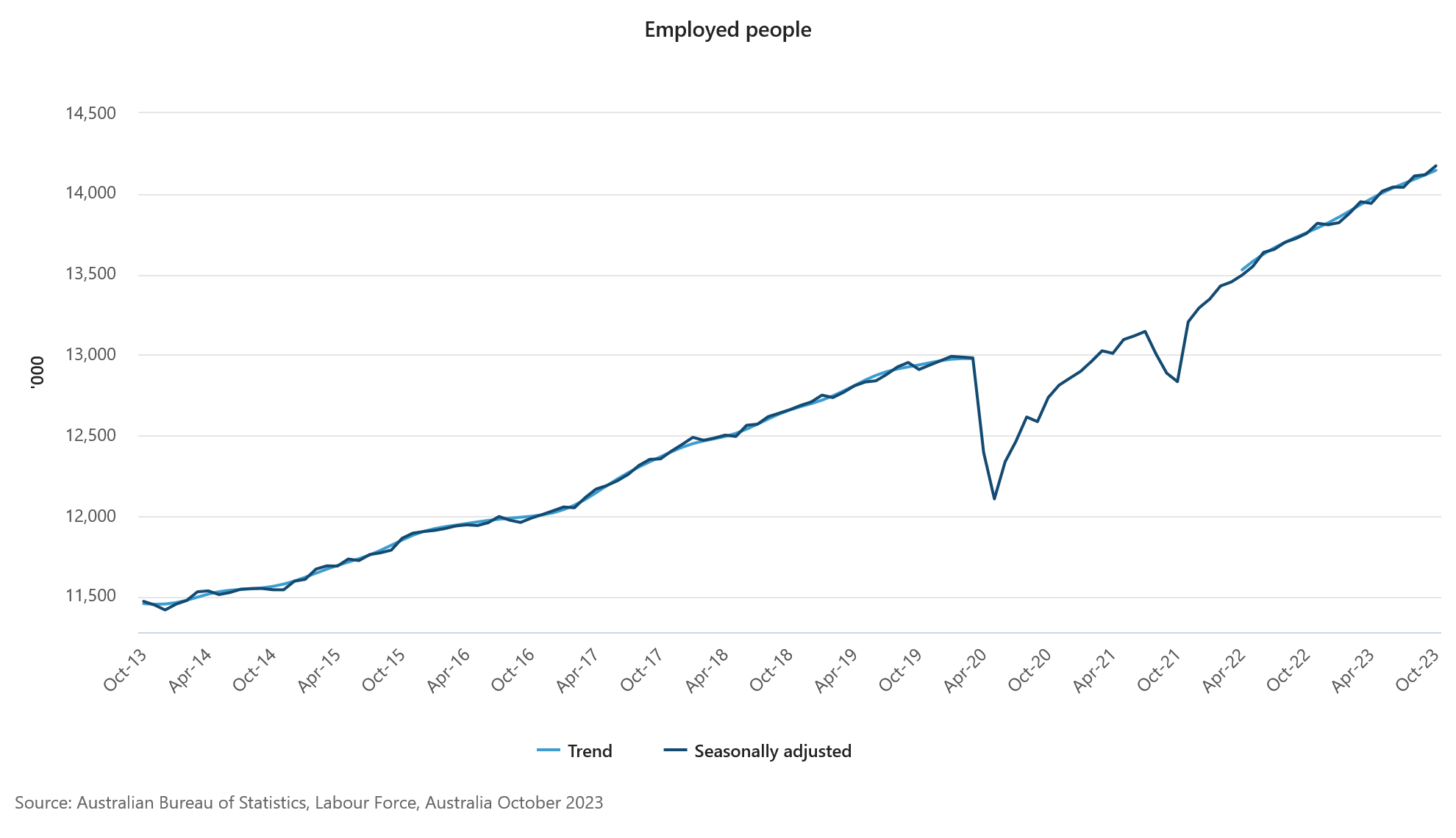
Australia's labor market displayed stronger-than-anticipated performance in October, with employment figures surpassing expectations. The economy added 55k jobs, well above forecasted growth of 22.8k. This increase was driven by both full-time and part-time employment, which rose by 17k and 37.9k respectively.
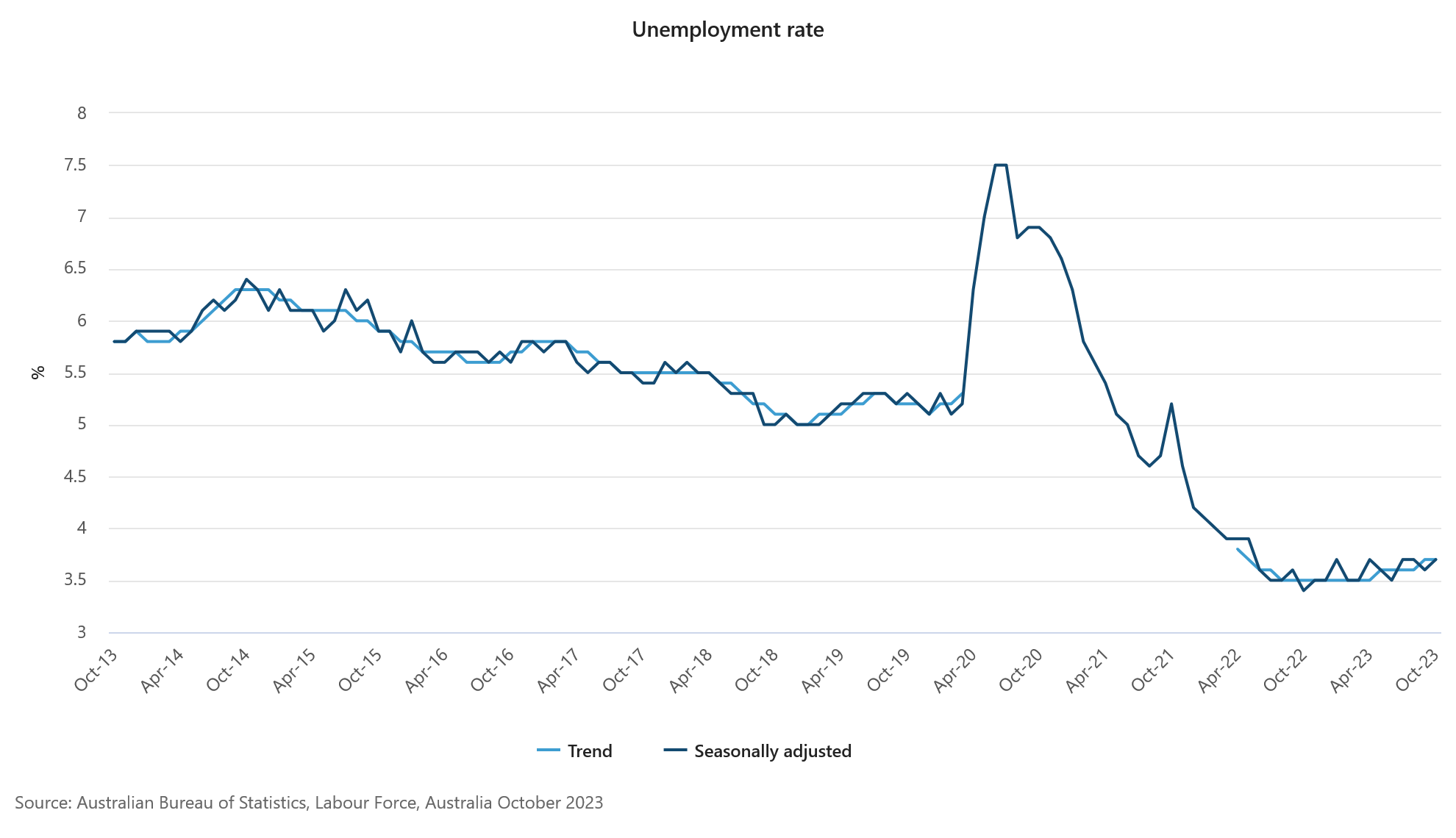
Despite this robust job growth, unemployment rate edged up slightly from 3.6% to 3.7%, aligning with market expectations. Participation rate also saw an uptick, rising by 0.2% to 67.0%. Additionally, month-over-month hours worked in the economy increased by 0.5%.
Bjorn Jarvis, ABS head of labour statistics, noted that over the past two months, this equates to an average monthly employment growth of approximately 31k people, slightly lower than average growth of 35k people a month since October 2022.
He also highlighted that annual growth rate in hours worked has slowed to 1.7%, down from around 5% mid-year, and lower than annual employment growth of 3.0%. This slowdown may suggest that "the labour market is starting to slow, following a particularly strong period of growth."
Yen Jeeps Sinking, Will Tokyo Intervene Again?
- Japanese yen loses over 13% this year as interest rate differentials widen
- Risk of another round of FX intervention is rising, but where exactly?
- Trend reversal is a story for next year - for now, outlook remains negative
Yen sinks despite favorable news
The Japanese yen remains the ‘sick man’ of the FX market. It almost touched a three-decade low against the US dollar this week, falling back to levels that prompted Tokyo to intervene in the FX market last year to defend the currency.
Interest rate differentials have been the driving force behind this relentless selling. The Bank of Japan has refused to raise rates, keeping them in negative territory even as foreign central banks like the Fed have raised their own rates to 5% or beyond. This enormous gap has seen capital leave Japan, searching for higher returns abroad.
High energy prices have also inflicted damage on the yen through the trade channel. Since Japan imports nearly all its oil and gas, the nation has been forced to pay more for its energy in recent years, which has deprived the yen from the trade surplus it has historically enjoyed.
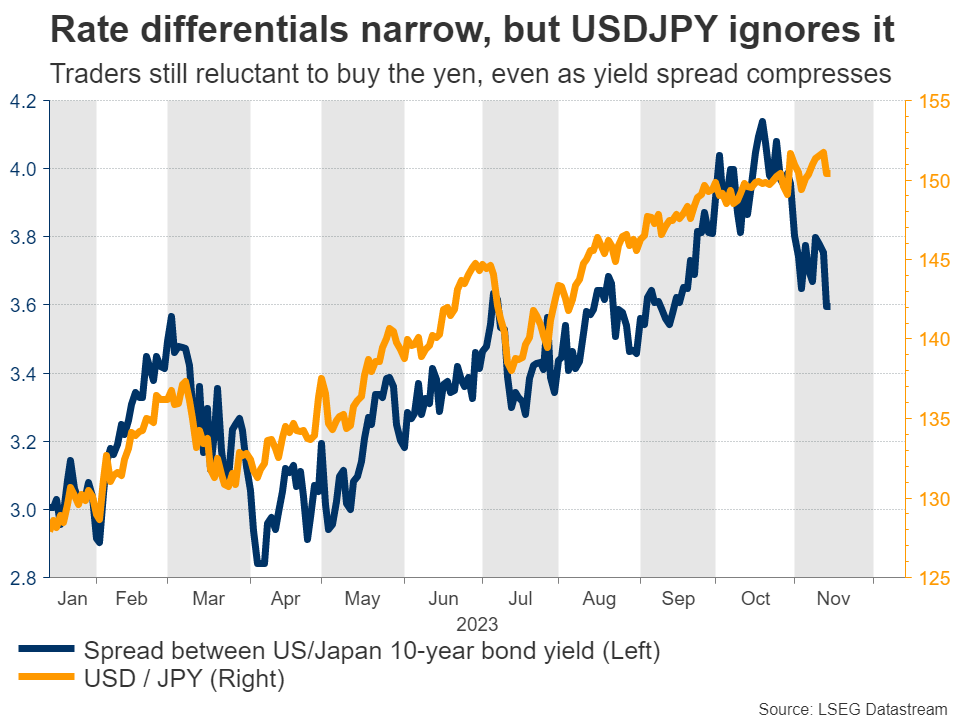
The striking part is that both of these forces lost their punch this month, with US bond yields and oil prices declining sharply, and still the yen was unable to recover. Instead, these favorable developments were only enough to stabilize the wounded currency, which underscores that traders are extremely reluctant to buy the yen.
Will Tokyo intervene again?
Without a question, the risk of another round of FX intervention has risen. The currency is already trading around levels that triggered intervention last year, and Japanese authorities have warned that they won’t hesitate to take further action.
The final authority in intervention matters is the minister of finance - Shunichi Suzuki - who recently said the government will ‘take all possible steps necessary to respond to currency moves’. That said, it’s important to note that Suzuki did not use phrases that would suggest intervention is imminent.
In the past, the buzzwords that would signal Tokyo is about to intervene would be describing FX moves as “one-sided” or “disorderly”. The fact that the finance minister refrained from using such language implies we are still some distance from actual intervention.
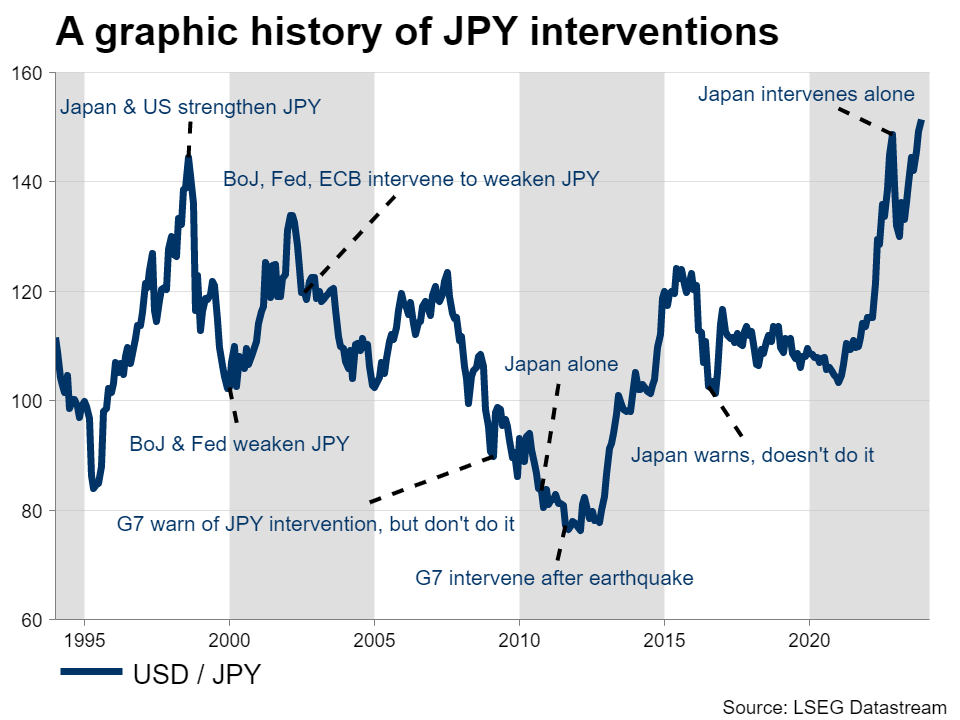
So the question is, where exactly is the line in the sand for Tokyo? That’s tough to answer, because the speed of currency depreciation matters in this calculation. In general, authorities are more concerned about sharp and sudden moves, as those threaten the nation’s economic stability.
Looking at the USD/JPY chart, some strategists believe the catalyst for intervention would be a break above the 152.00 region. However, the lack of urgency in the finance minister’s tone suggests the real threshold might be higher than that.
In this sense, the next spot to watch would be 155.00. How concerned Japanese officials sound as the yen approaches this area would be an indication of whether intervention is coming.
Is a trend reversal a story for 2024?
For now, it’s difficult to be optimistic on the yen. If the sharp drop in US yields and oil prices was not enough to lift the currency, it’s difficult to see what will, especially while the Bank of Japan remains so hesitant to phase out its colossal stimulus program.
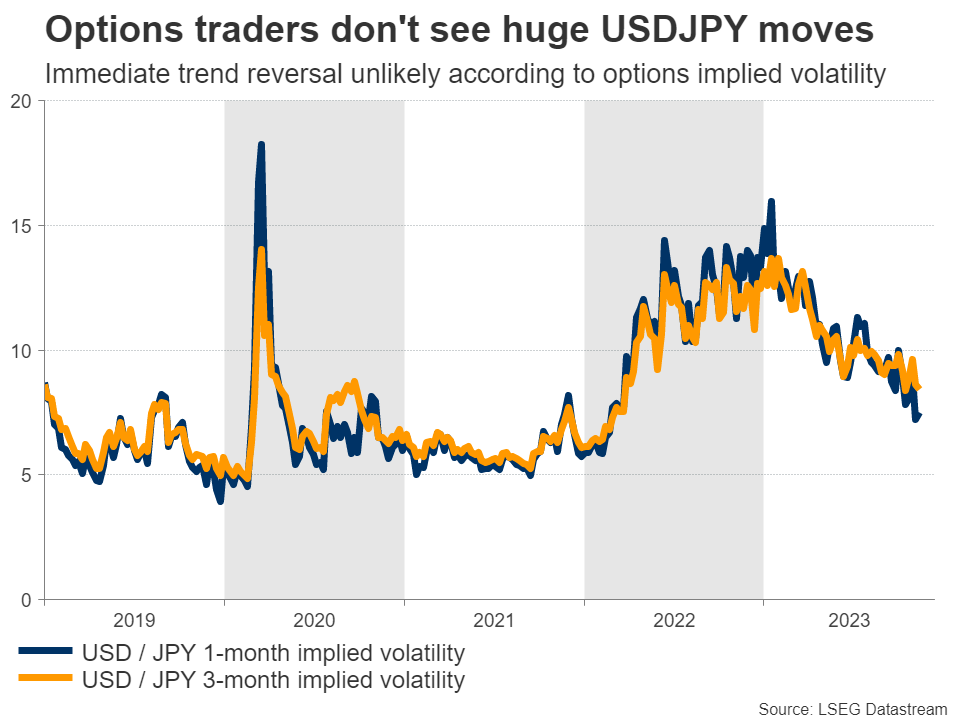
Options traders share this view. Implied volatility in short-dated USD/JPY options has fallen steadily in recent weeks, which means investors are not hedging against any massive yen moves in the next few months, viewing that scenario as unlikely. Hence, according to the options market, there’s no trend reversal on the immediate horizon.
But looking into next year, the outlook appears much brighter. With the global economy losing growth momentum and some regions teetering on the brink of recession, markets anticipate a rate-cutting cycle to begin around the spring. As such, the yen could get some relief from foreign interest rates falling next year.
The yen could also get a lift from the Bank of Japan tightening policy, perhaps by exiting negative interest rates. Markets are pricing in a minor rate increase for April, which coincides with the spring wage negotiations that will be crucial for the BoJ’s decision-making.
Similarly, there’s a chance the BoJ abandons yield curve control. This is the strategy that has crippled the yen, so scrapping it could help revitalize the currency. Whether that happens will depend on the wage negotiations and how the economic landscape evolves, but with the government preparing a heavy spending package to boost growth, the chances seem high.
All told, even though the near-term fortunes for the yen seem bleak, keeping the risk of intervention alive, the bigger picture looks more promising in an environment where interest rate differentials compress next year. The yen’s epic downtrend might be approaching its finale.
Fed’s Daly cautions against premature end to rate hikes, emphasizes need for patience
San Francisco Fed President Mary Daly, in an interview with the Financial Times, acknowledged the "very, very encouraging" signs of falling inflation in this week's data. However, she cautioned against hastily concluding the rate-raising cycle, emphasizing the importance of a cautious and informed approach.
Daly expressed concern about prematurely ending the cycle, noting the potential risks involved. "We have to be bold enough to say 'we don't know' and bold enough to say 'we need to take the time to do it right'," she stated. She warned that a premature halt could lead to a "stop-start" scenario, which could ultimately harm the Fed's credibility.
In her view, rate cuts are not on the immediate horizon. "Rate cuts are 'not happening for a while'," Daly remarked, suggesting a continued commitment to the current restrictive monetary policy direction until there is substantial evidence of a sustainable return to the 2% inflation target.
EUR/GBP – No More Rate Hikes Likely from BoE as Inflation Hits Two-year Low
- UK inflation fell to 4.6% in October (6.7% in September)
- Markets expect the next move to be a rate cut next summer
- EURGBP struggling to break technical resistance, despite data
UK inflation fell sharply in October and faster than the Bank of England anticipated, further reducing the prospect of any more rate hikes in this tightening cycle.
It was already likely that the BoE was done raising rates but as that was based on the view that inflation would fall to 4.8% last month, that could have changed with a higher reading this morning. Instead, it fell even further to 4.6% so there’s unlikely to be a big swing on the MPC in favour of hiking now, not unless the data performs much worse over the coming months.
It’s not just the headline numbers that are encouraging though. Much like the other data we’re seeing, the most recent monthly figures look extremely promising too, suggesting the pace of disinflation has accelerated recently in a manner consistent with inflation now running much lower than the annual comparisons suggest.
If we continue to see this over the coming months, especially if paired with similar trends in monthly wage growth, that first rate cut from the BoE could come earlier than many expect.
There will obviously be areas of stubbornness in the data, most notably services, but if monthly wage data continues to print at levels consistent with the 2% inflation goal and CPI data too, it’s surely only a matter of time until services fall as well. All things considered, this week’s data from the UK looks incredibly promising.
Is EUR/GBP running on fumes?
Today’s data has weighed on the pound, as you’d expect given what it means for interest rate expectations, and yet we haven’t necessarily seen an acceleration in the sell-off against the euro.
EURGBP Daily
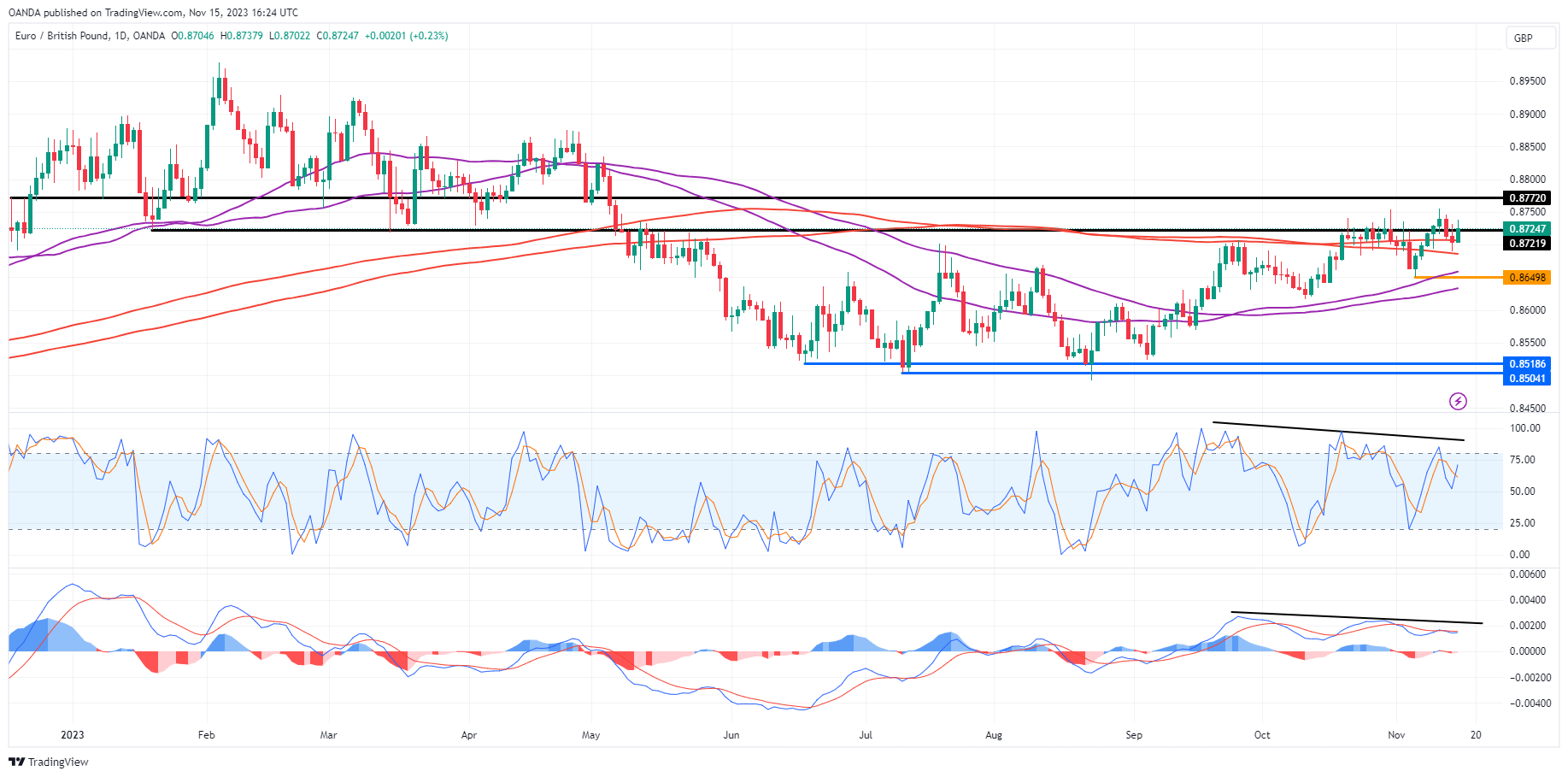
Source – OANDA on Trading View
The euro has rallied against the pound for the last few months, breaking above the 200/233-day simple moving average band in the process, but since doing that, it’s struggled to take off. Rather, it’s become very sluggish and done so is an area that’s proven to be a stubborn point of support and resistance over the last year.
You can see that from the stochastic and MACD on the bottom, both of which have been making lower highs while the price has done the opposite. To see that around a major area of resistance could be viewed as a sign that traders are losing faith in the rally.
That may make 0.8650 a very interesting level as a move below here could complete a double top breakout which would technically be a bearish signal.
Japanese Yen Slips as US Retail Sales Beats Expectations
- Japanese GDP contracts by 2.1%
- US retail sales decline by 0.1% but beats forecast
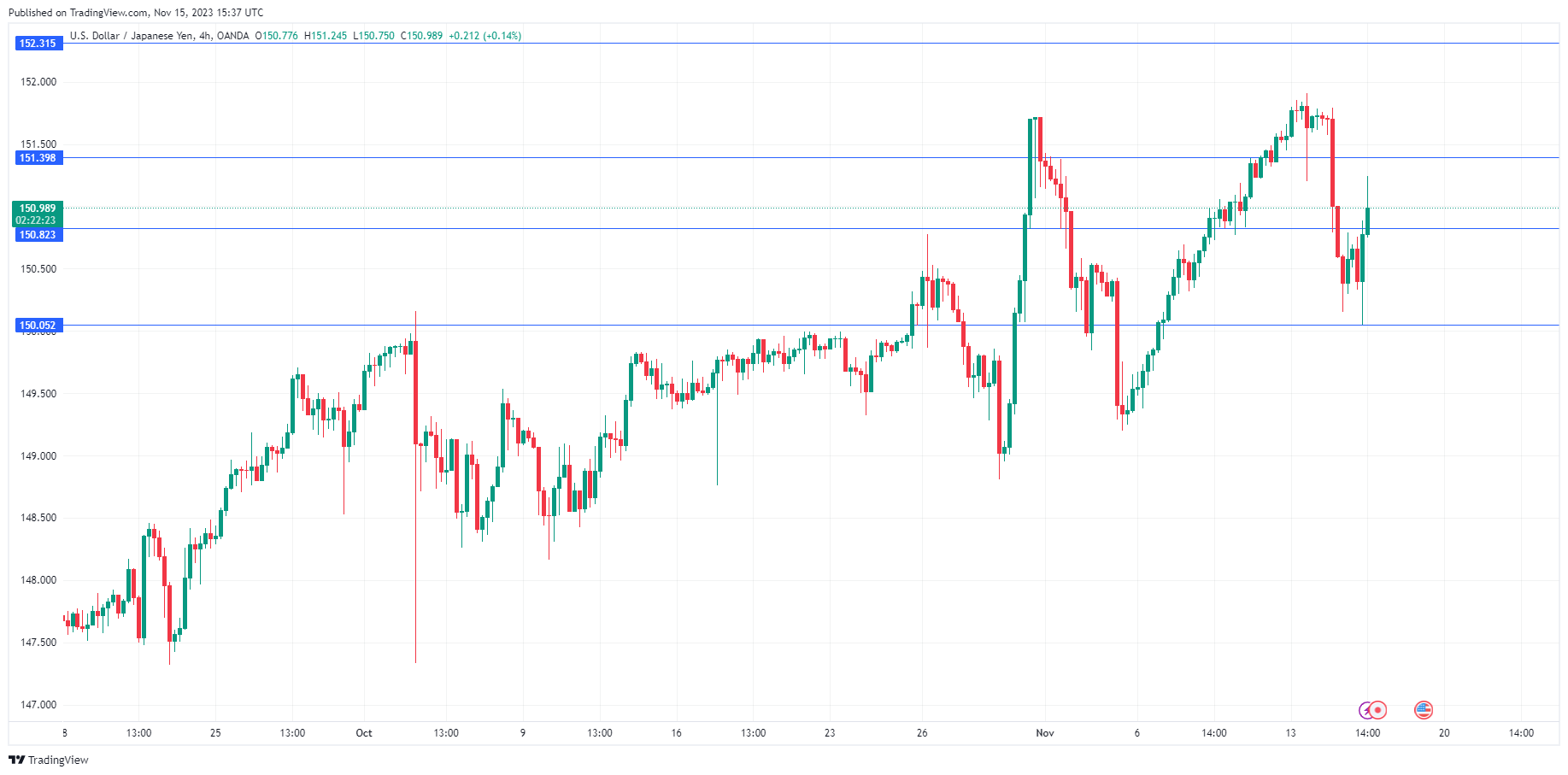
The Japanese yen has lost ground on Wednesday. In the North American session, USD/JPY is trading at 151.09, up 0.48%.
In the US, retail sales declined in October but still managed to beat expectations. Retail sales dropped 0.1% m/m, down from a revised 0.9% in September and snapping a streak of six straight increases. Still, this beat the market consensus of -0.3%.
Japan’s GDP falls 2.1%
Japan’s economy contracted 2.1% y/y in the third quarter, much worse than the market consensus of -0.6%. This follows a strong gain of 4.8% in the second quarter. On a quarterly basis, GDP declined 0.5%, missing the market consensus of -0.1% and the revised second-quarter reading of 1.1%.
The soft GDP release, the weakest in two years, reflected weaker consumer demand and a drop in exports due to decreased global demand. The Japanese economy has been unstable since the Covid pandemic in 2020, alternating between periods of contraction and expansion.
The Bank of Japan has been under pressure to tighten its ultra-loose policy in light of persistently high inflation, but policy makers will have little appetite to tighten while the economy remains fragile. The BOJ is also contending with a rapidly depreciating yen. The currency got a boost on Tuesday as a soft US CPI report sent the US dollar sharply lower, but the yen is back above 151 today and the threat of intervention is hanging in the air.
US inflation weaker than expected
US inflation was softer than expected in October, and the US dollar beat a hasty retreat on Tuesday, with sharp losses against the major currencies, including the yen.
Headline inflation fell from 3.7% to 3.2% and the core rate ticked lower to 4.1%, down from 4.0%. The markets have repriced the rate odds at the December meeting, with the probability of a pause at 99.8%, according to the CME’s FedWatch Tool. It is looking more likely that the Fed’s tightening cycle is over and the markets are now looking at a rate cut as early as May.
USD/JPY Technical
- USD/JPY has support at 150.82 and 150.05
- There is resistance at 151.39 and 152.31
Australian Jobs Report Eyed After Upbeat Wage Data
- Australia to create more jobs, but no serious improvement expected
- Quarterly wage growth the strongest in 14 years
- Another rate hike could remain on the table
RBA resumes data-dependent approach
In contrast to other major central banks, the Reserve Bank of Australia (RBA) hiked interest rates in November under its new chair Michelle Bullock after a four-month pause. But the announcement was well anticipated and a slight dovish tweak in guidance was enough to hammer the Australian dollar.
The central bank judged that another quarter percentage rate increase to 4.35%–the highest in twelve years–was necessary to achieve its 2.0% midpoint inflation target, as progress on inflation had been slower than previously anticipated, despite passing its peak. Nevertheless, the RBA refrained from providing any commitment to additional tightening, linking the future path of rates to a data-dependent approach as the Fed did.
Employment growth to strengthen but nothing cheering expected
Thursday’s employment report for October will be the first piece of data information after the RBA’s latest policy meeting and given the central bank’s dual mandate of price stability and full employment, aussie traders might be sensitive to the headlines.
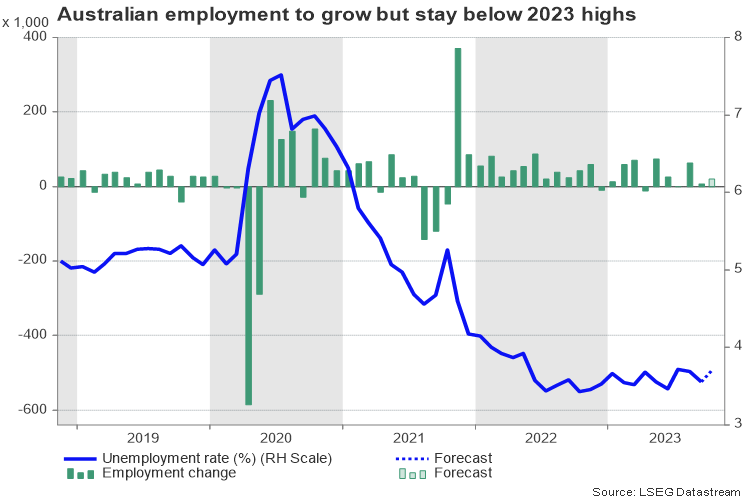
That said, the results may not excite traders. Analysts foresee a mixed report, with jobs growth accelerating by 20k in October from 6k previously and the unemployment rate inching up to 3.7% from 3.6%. That could still be among the weakest surveys so far in 2023.
Recall that job creation was three times larger in Australia during the previous months, while the unemployment rate was ranging between 3.5%-3.7% throughout the year. Hence, the data must surprise significantly to fuel strong volatility in the aussie.
Rate expectations
Perhaps, the monthly CPI indicator due on November 29th could be a bigger market mover following the continuous increase in October to 5.6% y/y. Futures markets are currently pointing to steady interest rates in December, but they reflect a potential for another rate increase to 4.6% at some point during February-September 2024 as the central bank does not expect inflation to return to 2.0% before 2025.
On the other hand, the RBA believes that the unemployment rate could stretch up to 4.2% in 2024–the highest since early 2022. Taking into account the recent record growth in population and the supply restraints in the housing sector, household spending could keep supporting inflation.
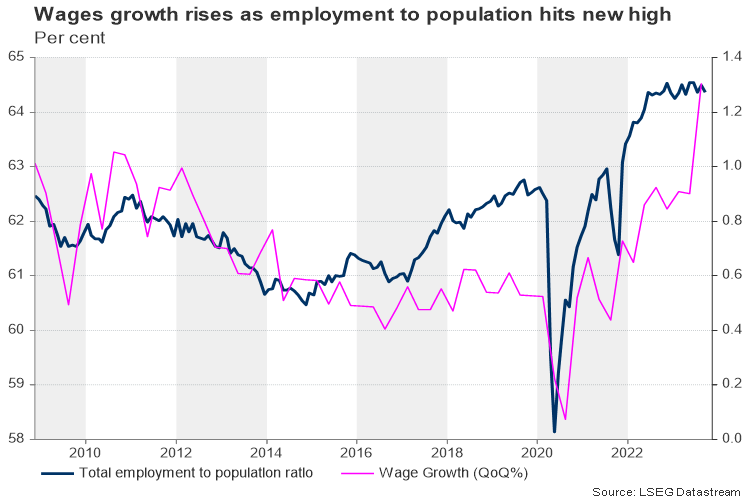
Interestingly, quarterly wage growth hit a fourteen-year high of 1.3% in Q3, suggesting that employees can still bargain for higher payments despite the surge in population. The problem here is that if the positive trend in wages continues, the RBA might have some difficulty in achieving its inflation target.
AUD/USD
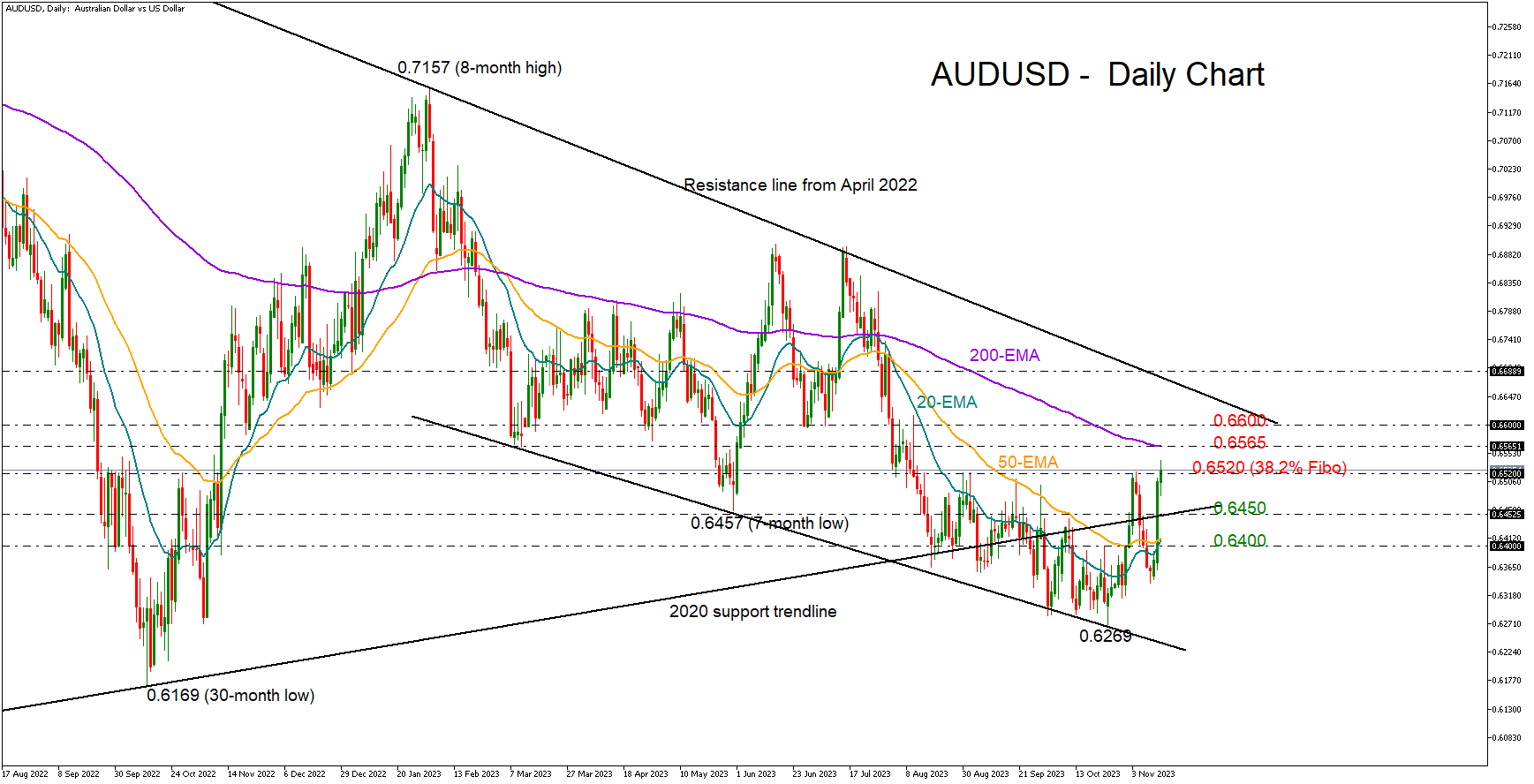
Turning to FX markets, AUDUSD resumed its positive momentum after the upbeat wage data earlier today, stretching Tuesday’s rocket rally above the key nearby resistance of 0.6520 and to a high of 0.6540. A few hours later, a soft positive surprise in US retail sales pressed the pair back below that ceiling.
Investors will look at whether the employment report can help the pair reach its falling 200-day exponential moving average (EMA) higher at 0.6565 on Thursday, and perhaps challenge the 0.6600 psychological mark too.
A disappointing report could alternatively squeeze the pair towards the 0.6450 constraining zone, while a more aggressive decline could take a breather around the 20- and 50-day EMAs at 0.6400.
Strong Consumer Demand Did Not Prevent Inflation from Softening
A new batch of statistics from the US once again reminds us of the Goldilocks story, when one can have fun and not pay the price for it.
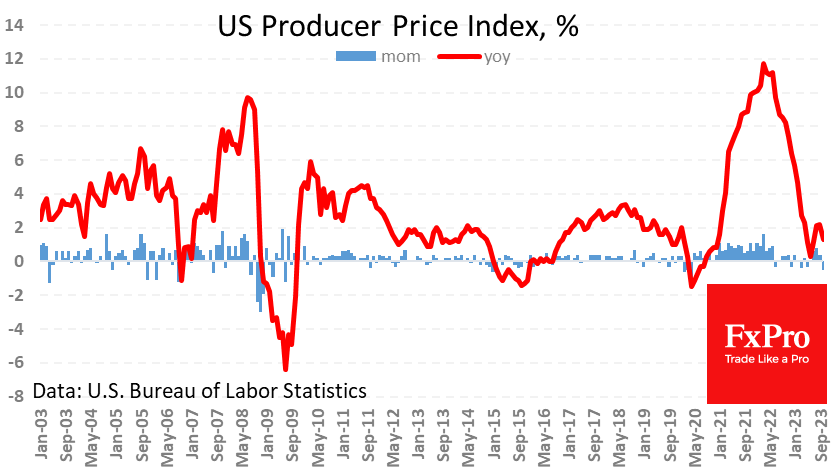
Producer prices fell 0.5%, against expectations for a 0.1% rise. And that’s a weaker report than expected after the release of consumer prices the day before. The annual inflation rate fell from 2.2% to 1.3%, against expectations of 1.9%. The core index, which excludes food and energy, was virtually unchanged for the month, and the annual growth rate fell to 2.4% from 2.7% expected. Had the market not overreacted the day before, such a report could have encouraged fresh dollar sellers and buyers of risk assets.
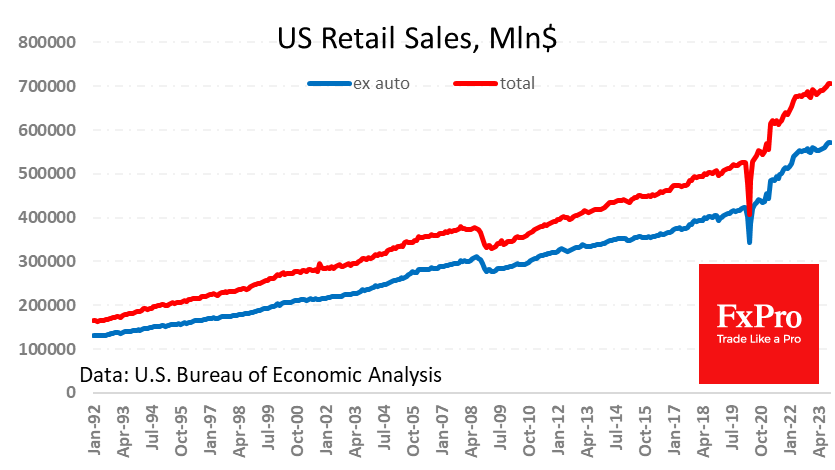
Another report showed that retail sales fell by 0.1%. This is a strong result, as a correction in spending was expected after a 0.9% rise the month before. Sales were virtually flat from September last year to March this year, but there was a strong rebound in sales last summer. Interestingly, this coincided with a pause in policy tightening by the Fed. This acceleration in spending is probably a concern for the regulator, so it is in no hurry to take the option of further policy tightening off the table.
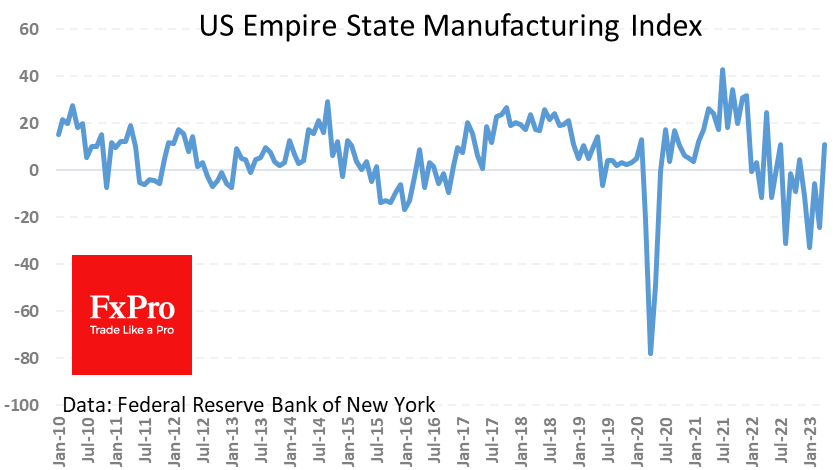
The Empire Manufacturing Index jumped from -4.6 to +9.1 – much better than the expected -3.3 – and the highest since April.
Theoretically, this should allow retailers to join the battle for profit (not market share) by passing costs through to prices. In practice, however, producer prices fell sharply, giving retailers more room to manoeuvre.
ETHUSD Falls Back Below 2,000
- Ethereum pulls back from recent multi-month high
- Impending golden cross could revive the rally
- Momentum indicators ease from overbought conditions
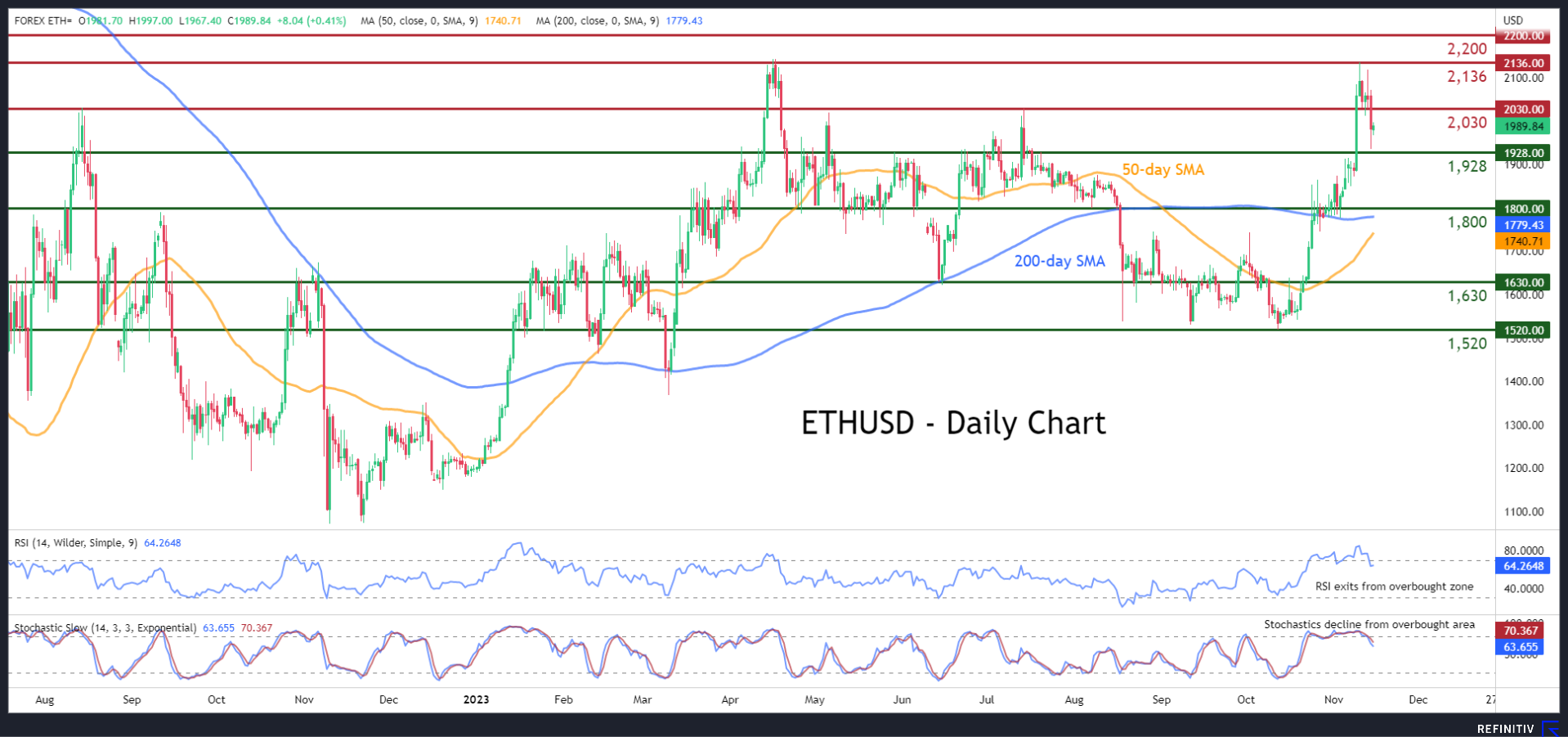
ETHUSD (Ethereum) experienced a strong correction after peaking at 2,136, its highest level since April 2023. However, the 50-day simple moving average (SMA) is closing the gap with the 200-day SMA, where a potential golden cross could induce upside pressures.
Should the positive momentum strengthen, the bulls might attack the July resistance of 2,030, which also held strong in August 2022. A violation of that zone could pave the way for the recent high of 2,136 just shy of the 2023 peak of 2,142. Slicing through the latter, the price may then challenge the 2,200 psychological mark.
On the flipside, if the recent slide resumes, immediate support could be found at the May-June resistance of 1,928. Further declines could then come to a halt at the May support of 1,800. Even lower, the June bottom of 1,630 might provide downside protection.
In brief, ETHUSD experienced a strong pullback as the second largest cryptocurrency had reached extreme overbought conditions. However, the completion of a golden cross could help the bulls propel the price back above the 2,000 mark.
Gold Ends Retreat and Heads Higher
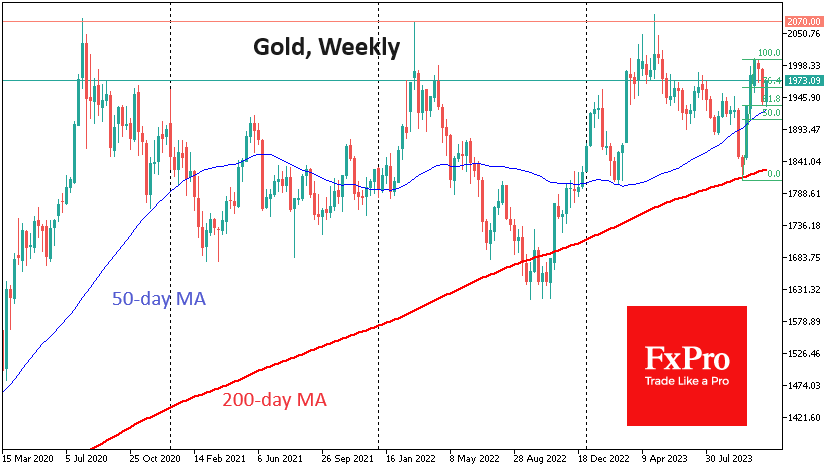
Gold has made a decisive reversal to the upside this week. We are likely to see the start of a new bullish momentum with the potential to renew all-time highs above $2100.
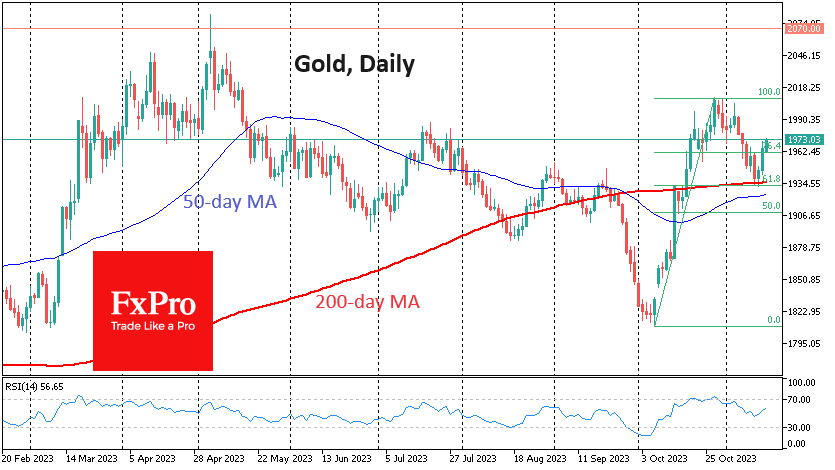
Gold rallied by $200 in October and peaked at $2010, driven by three main factors. Early in the month, gold was an attractive buy on oversold conditions and a touch of the critical 200-week moving average provided a technical reason for a rebound.
But fundamental news continued to drive the buying. The first was the US labour market data, strong employment growth with a moderate slowdown in wage growth. Then, over the weekend, the conflict between Israel and Hamas added fuel to the fire.
By the end of October, gold was overheated and went into a correction, which deepened in November despite the return of risk appetite in US markets after the Fed meeting. As a result, the value of the troy ounce retreated to the 200-day moving average and the 61.8% Fibonacci level of the initial spike.
Gold’s rally from these levels since the start of the week should be seen as a confident return of buyers from technically significant levels and the end of the corrective pullback. According to the Fibonacci pattern, gold’s next upside target is $2130, or 161.8% of last month’s upside amplitude.
However, this pattern will only be fully realised on a confident break of the previous local highs at $2010. A strong break above will confirm that gold is ready to settle above the crucial milestone this time. Over the past three years, gold has rallied strongly on several occasions, but these have always been upside impulses, and we soon see a reversal to the downside. The coming days will tell us if this is the case this time.