

Sample Category Title
GBPUSD Short Term Elliott Wave Structure Suggests Further Upside
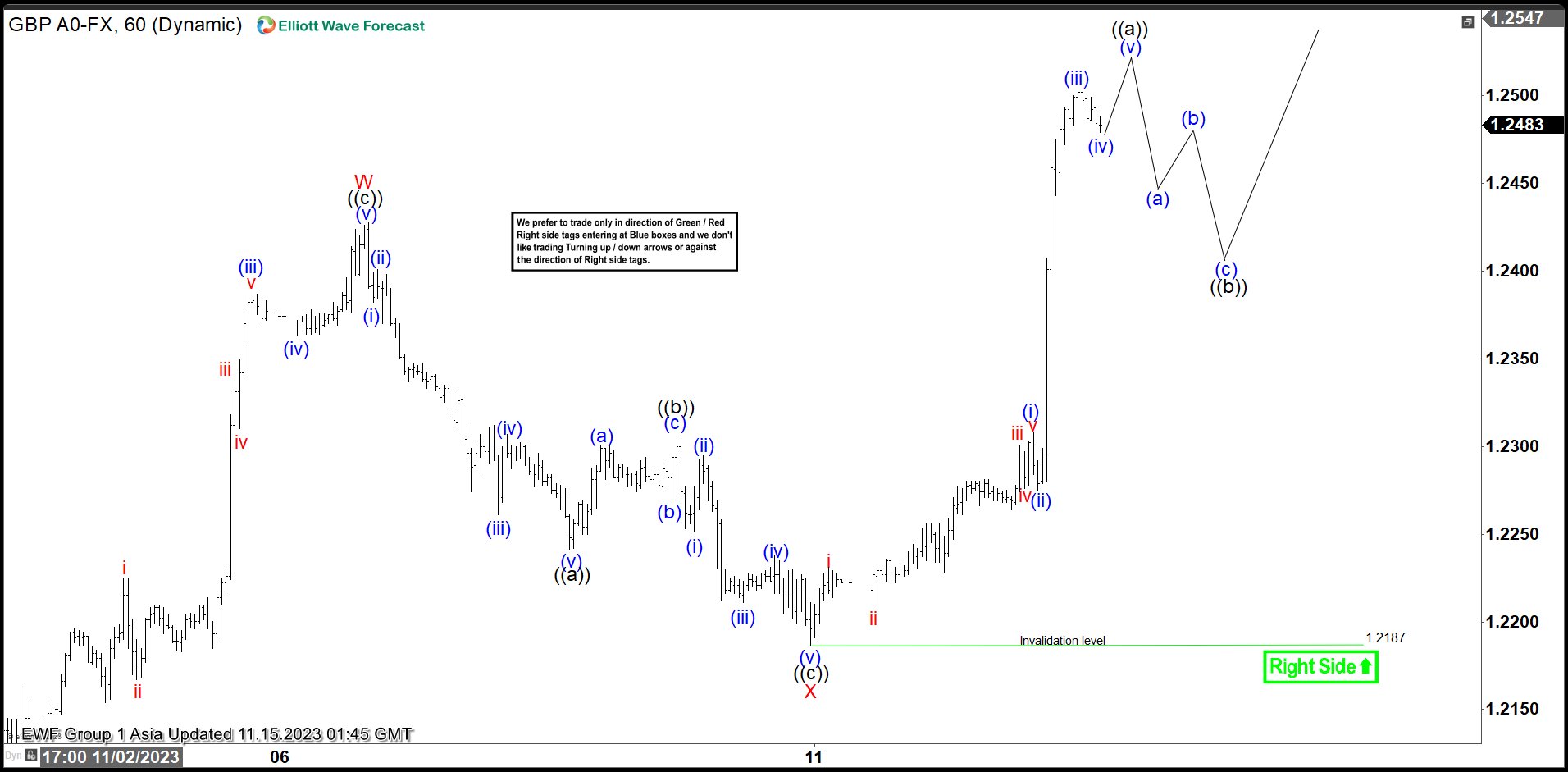
GBPUSD shows a 5 swing sequence from 10.4.2023 low favoring further upside. The rally from 10.4.2023 low takes the form of a double three Elliott Wave structure or a double zigzag. Up from 10.4.2023 low, wave W ended at 1.24.28 and dips in wave X ended at 1.2186. Internal subdivision of wave X unfolded as a zigzag Elliott Wave structure. Down from wave W, wave ((a)) ended at 1.224 and wave ((b)) ended at 1.2309. Wave ((c)) lower ended at 1.2187 which completed wave X.
Pair has since turned higher in wave Y. Internal subdivision of wave Y is unfolding as another zigzag structure. Up from wave X, wave (i) ended at 1.2308 and wave (ii) pullback ended at 1.2275. Wave (iii) higher ended at 1.2506, and wave (iv) ended at 1.2478. Expect pair to extend higher in wave (v) to end wave ((a)). Afterwards, it should pullback in wave ((b)) to correct cycle from 11.10.2023 low before the rally resumes. Near term, as far as pivot at 1.2187 low stays intact, expect dips to find support in 3, 7, 11 swing for further upside. Potential target higher is 100% – 161.8% Fibonacci extension of wave W. This area comes at 1.257 – 1.282.
GBPUSD 60 Minutes Elliott Wave Chart
GBPUSD Elliott Wave Video
https://www.youtube.com/watch?v=0X9vhLc6Wo4
China’s industrial and retail growth surpass expectations, PBOC injects fresh funds
China's industrial output and retail sales for October exceeded market expectations. Industrial production rose 4.6% yoy, surpassing forecasted 4.5% yoy, marking an improvement from September's 4.5% yoy growth. Retail sales recorded a robust 7.6% yoy growth, significantly higher than anticipated 7.0% yoy and showing a considerable improvement from 5.5% yoy increase in September.
However, fixed asset investment experienced slower growth, rising only 2.9% ytd yoy, which was below the expected 3.1%. The real estate sector particularly faced challenges, with investment dropping by -9.3% ytd yoy, a deterioration compared to the previous period through September.
In a separate development, People's Bank of China maintained the interest rate on CNY 1.45T worth of one-year medium-term lending facility loans at 2.50%, consistent with previous operations. As CNY 850B worth of MLF loans were set to expire this month, this move resulted in a net injection of CNY 600B of fresh funds into the banking system.
The central bank stated that this loan operation aimed to keep the banking system's liquidity at a reasonably ample level, countering short-term factors such as tax payments and government bond issuances.
Japan’s GDP down -0.5% qoq, -2.1% annualized in Q3
Japan's GDP contracted -0.5% qoq in Q3, starkly underperformed market expectations of -0.1% qoq decline. On annualized basis, the situation appears even more drastic, with the economy shrinking by -2.1%, far exceeding anticipated -0.6% contraction, and being the worst since Q3 2021.
A critical factor in this downturn was a -0.6% decrease in business investment, marking a continuous decline for two consecutive quarters. This reduction was primarily influenced by reduced spending on semiconductor production equipment, reflecting broader challenges in global tech sector.
Additionally, private consumption, a key driver of economic activity, saw a marginal fall of -0.04%. This marks the second successive quarter of decline, with slump in vehicle sales significantly impacting consumer spending.
Fed’s Goolsbee eyes housing as crucial for continued disinflation progress
Chicago Fed President Austan Goolsbee acknowledged yesterday that "progress continues towards 2% inflation target. He highlighted the decline in goods inflation, but points out the critical role of housing inflation in the coming quarters.
Goolsbee emphasized, "With goods inflation already coming down and nonhousing services inflation typically slow to adjust, the key to further progress over the next few quarters will be what happens to housing inflation."
Separately, Richmond Fed President Thomas Barkin exhibited a more guarded stance. He expresses doubts about a smooth transition to the Fed's inflation target, underscoring the complexity of the current economic scenario.
Barkin noted, "I'm just not convinced that inflation is on some smooth glide path down to 2%." He acknowledges the recent decrease in inflation rates but attributes it primarily to the partial reversal of spikes seen during the Covid era, driven by high demand and supply constraints.
Barkin further points out that certain sectors, such as shelter and services, continue to exhibit inflation rates above historical norms.
Fed’s Barkin not convinced of steady inflation decline despite today’s CPI data
Richmond Fed President Thomas Barkin has voiced skepticism regarding the trajectory of inflation, even in light of today's U.S. CPI data showing decline in headline and core readings. In his comments at a event, Barkin remarked, "I'm just not convinced that inflation is on some smooth glide path down to 2%."
Barkin pointed out that the recent decrease in inflation figures is largely attributable to a partial reversal of the price spikes experienced during Covid-era, which were driven by elevated demand and supply shortages. He highlighted ongoing concerns, stating, "Shelter and shelter inflation remain higher than historic levels, so does services inflation."
Emphasizing the resilience of businesses in the current economic environment, Barkin noted, "Businesses aren't going to back down from prices until they have to," suggesting that a slowdown might be necessary.
"I do see some sort of slowdown," he added.
Sunset Market Commentary
Markets
It all boiled down to October US inflation figures today. Headline inflation was flat compared to September (vs +0.1% M/M forecast) resulting in a slightly bigger than anticipated drop from 3.7% Y/Y to 3.2% Y/Y. Energy prices were down 2.5% M/M with gasoline dropping 5% compared with September. Core inflation rose by 0.2% M/M (vs 0.3% M/M) with the Y/Y-figure a tad softer at 4% (from 4.1%), matching the lowest levels since August and September of 2021. The Bureau of Labour Statistics indicated that the shelter index was the largest factor in the monthly increase in core inflation (0.3% M/M). The market reaction was heavy despite the minor miss with investors taking the possibility of a December rate (14% by yesterday’s close) completely off the table and pulling forward the timing of a first Fed rate cut one meeting (from May to March). Daily changes on the US yield curve range between -15 bps (30-yr) and -22 bps (5-yr) at the moment. From a technical point of view, the 2-yr yield is back below the psychologic 5% mark with the November low at 4.80% serving as first support (4.84% live). The US 5-yr yield loses 4.50% with the November low at 4.43% (4.44% live). The US 10-yr yield is effectively losing the November low at 4.47% (4.45% live) with the 30-yr yield testing that barrier (4.61%). German Bunds rally in sympathy with yields 7 to 9 bps lower on the day and the belly of the curve outperforming the wings. The German 10-yr yield is closing in on the November low as well (2.62% vs 2.61%). Loss of interest rate support hurt the dollar. The trade-weighted greenback currently tests the November low at 104.85 from an open at 105.65. EUR/USD pierces through that technical reference, exchanging hands above 1.08 for the first time since early September (1.0820 from 1.07). Today’s figures and USD weakness even give some reprieve to USD/JPY with the pair declining from 151.80 to 150.80. European stock markets extend their recent bullish, gaining up to 1.5% for the German Dax. The EuroStoxx 50 breaks with the ruling sell-on-upticks pattern after easily taking out the previous high at 4237. US stock markets open with significant gains of up to 2% for the Nasdaq.
News & Views
Hungary and Poland reported a first estimate of Q3 GDP growth. Activity in Hungary rebounded 0.9% compared to the April-June quarter. Growth in the second quarter was also upwardly revised from -0.3% to 0.0%. The Hungarian economy posted negative quarterly growth figures since the third of last year. Even after the Q3 growth economic Hungarian activity was still 0.4% lower compared the same quarter last year. Over the first three quarters of the year, activity was 1.2% lower compared to 2022. The Hungarian Statistical office gave no exact data on the composition of the GDP, but indicated that the decrease in economic performance compared to last year was mostly owing to falls in industry and market services, with the latter mainly in wholesale and retail trade as well as scientific, technical and administrative activities. A good performance of agriculture eased the decline. The decrease in services added value was partly offset by a significant growth in section human health and social work activities. A second estimate of Q3 GDP will be published on December 01. According to flash estimate published by Statistics Poland, Q3 GDP rose 1.5% Q/Q and was 0.4% higher compared to the same quarter last year. The Statistical office also signaled a substantial upward revision of Q2 growth (0.3% from -2.2%). A first revision will be published on November 30.
Sentiment among US small business as measured by the NFIB confidence index remains sluggish. The headline indicator of the National Federation of Independ business declined from 90.8 to 90.7, touching the lowest level in five months. Firms turned more negative on recent sales and a growing number of firms reported an earnings decline over the previous three months. US smaller companies remained negative on the expected development of the economy (-43%) and see negative future earnings (-32%). The number of companies expecting better sales ‘improved’ from -13% to -10%, but still shows a bigger part of the companies seeing a deterioration. The NFIB uncertainty index declined slightly from 79 to 76. With respect to inflation, companies see higher selling prices, extending the uptrend since July (30% from 29% and 25% in July). In this respect NFIB assessed that ‘Labor costs, energy costs, and everything else small business owners pay for to operate their business are not falling, so firms continue to raise selling prices to keep up’.
BoE’s Pill prepared to raise rates if necessary
BoE Chief Economist Huw Pill emphasized today the readiness of the Bank to raise interest rates further if the situation demands, but also indicated that further rate hikes are not a necessity at the current juncture.
Pill highlighted today's wage growth data, noting, "We did have this morning the latest official data on pay growth in the UK with pay growing at 7.7%... But actually over the summer pay growth has remained very strong and we certainly wouldn't see pay growth of that rate as consistent with achieving the 2% inflation target on an ongoing basis."
BoE is closely monitoring the upcoming October CPI data, anticipating a decline to "around 5%." However, Pill acknowledges that even this level is significantly higher than the target, remarking, "But nonetheless, 5% is still much too high."
Pill also expressed concerns about the persistence of inflation, partly attributed to ongoing supply issues. He stressed the importance of maintaining a consistent policy approach, stating, "We need to meet inflation persistence with persistent restrictiveness in policy."
US October CPI: No Spooky Surprises
Summary
October's softer-than-expected CPI print is an encouraging development for the FOMC and reinforces our view that the FOMC has ended its hiking cycle. But, we do not see the latest data as a game-changer for inflation's path ahead. With inflation in October held down by volatile components like gasoline, travel services and autos, we expect inflation's return to 2% will continue to be a slow grind.
Inflation Reprieve
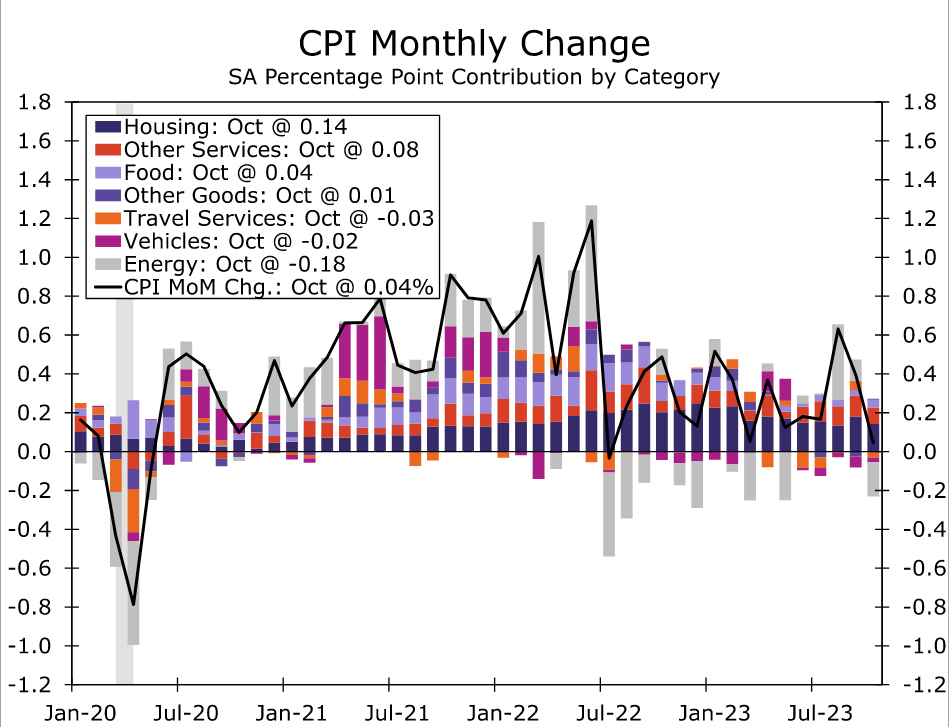
The consumer price index was unchanged in October, the first time monthly inflation was flat since July 2022. The Bloomberg consensus expected a 0.1% increase in the CPI, so this reading was a bit cooler than anticipated. As was the case in July 2022, a large drop in gasoline prices was the main contributor to the soft monthly reading. Gas prices fell 5.0% in October, more than reversing the 2.1% increase that occurred in September. Energy services prices, which includes electricity and utility gas, rose 0.5% in the month. Food prices increased 0.3% in October with food away from home inflation (+0.4%) outpacing the increase in prices at the grocery store (0.3%).
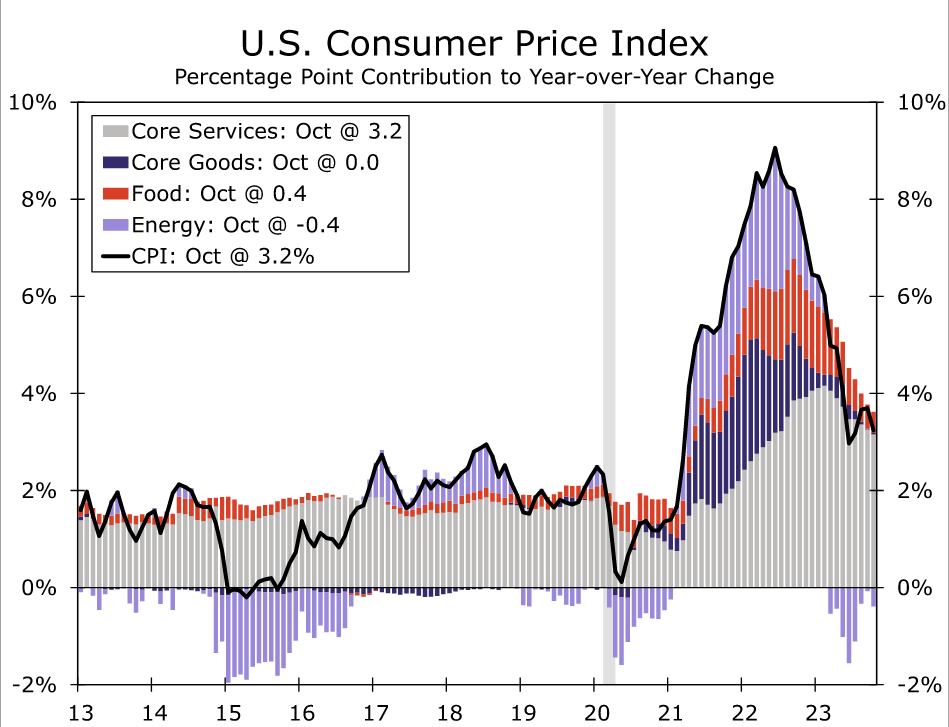
Compared to one year ago, the headline CPI has increased 3.2% (chart). Although this is still about a percentage above the pace that prevailed before the pandemic, it is well below the 9.1% peak that occurred in the summer of 2022. An outright decline in energy prices and much slower increases for food prices have put downward pressure on year-over-year inflation, although core price growth also has slowed to 4.0% from over 6% this time last year.
Excluding food and energy, consumer prices rose 0.2% in October, which was a touch softer than expected. The sharp run-up in goods prices since the pandemic continued to unwind in October. Core goods prices fell 0.1% in October, helped along by another drop in used vehicle prices (-0.8%) and a slight giveback in new vehicle prices (-0.1%). Elsewhere, goods prices were little changed over the month, as declines in education & communication equipment and motor vehicle parts offset small increases in apparel, medical and recreation goods. After peaking at a year-over-year rate of more than 12% last February, core goods price are unchanged from a year ago (chart).
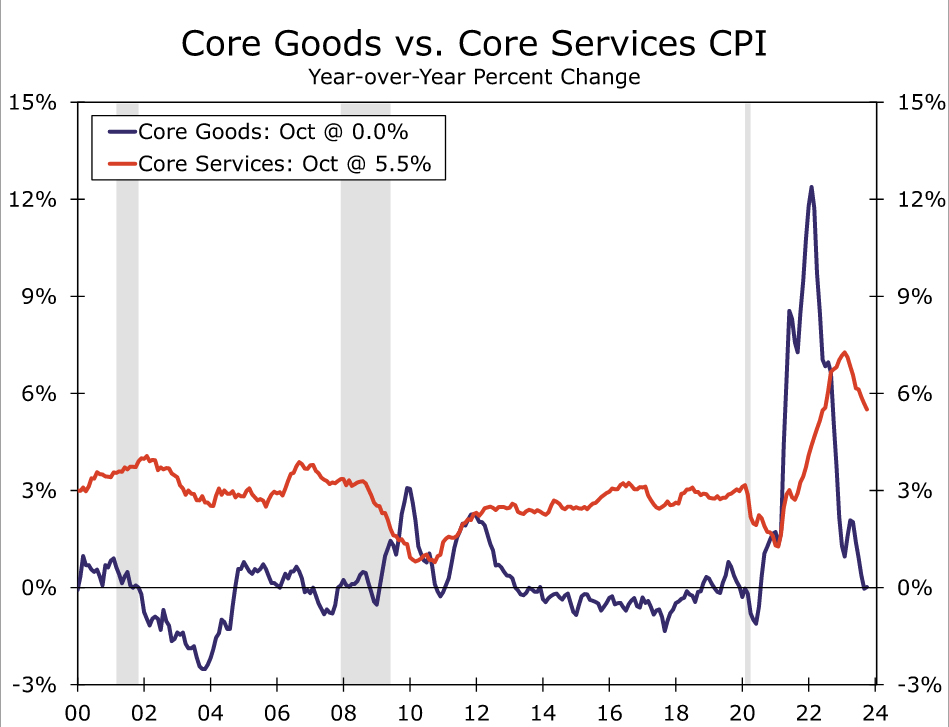
Services inflation continues to ease as well, although progress remains slower than in the goods sector. Core services rose 0.3% in October, bringing the one-year change down to 5.5% from 6.7% this time last year. After a surprise 0.6% leap in September, owners' equivalent rent growth slowed in October (+0.4%), while the monthly change in rent of primary residences was little changed at 0.5%. We expect to see shelter inflation to continue to moderate in the months ahead, although the steady rate of primary rent inflation cautions that the slowdown might not be as sharp as private sector measures have implied.
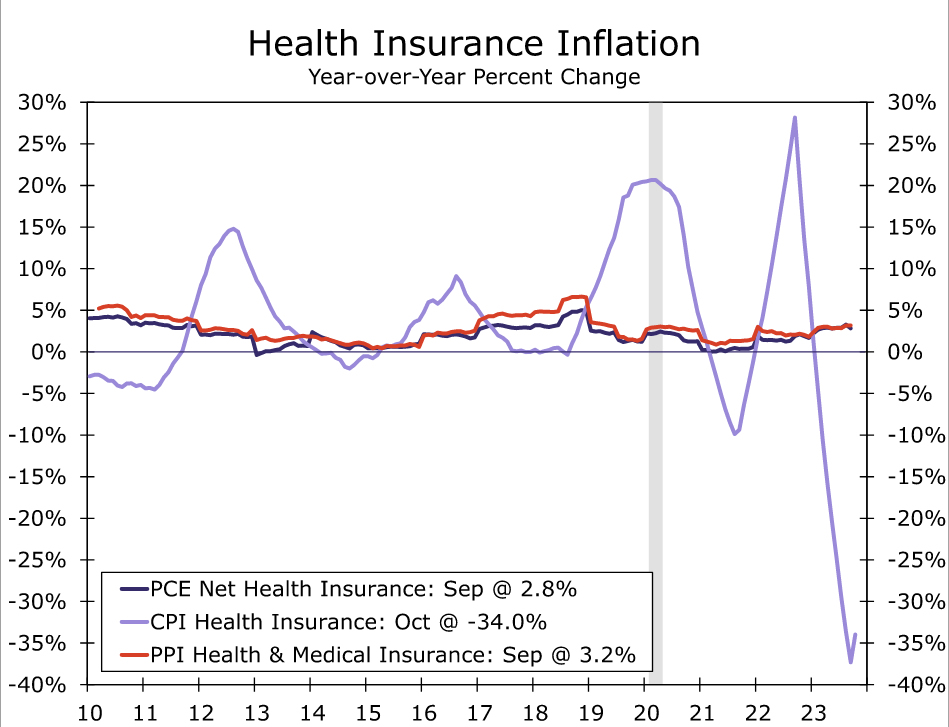
October's softer print in core services came despite a renewed rise in health insurance prices. After falling an average of 3.8% per month over the past year, the health insurance index rose 1.1% in October. "Prices" in this category are measured indirectly by the industry's retained earnings and are rather backward looking, with 2022 data incorporated with this release. Notably, the rise will not feed through to the PCE deflator, the Fed's preferred gauge of inflation, where health insurance inflation is measured differently and is up a rather-unremarkable 2.8% over the past year (chart).
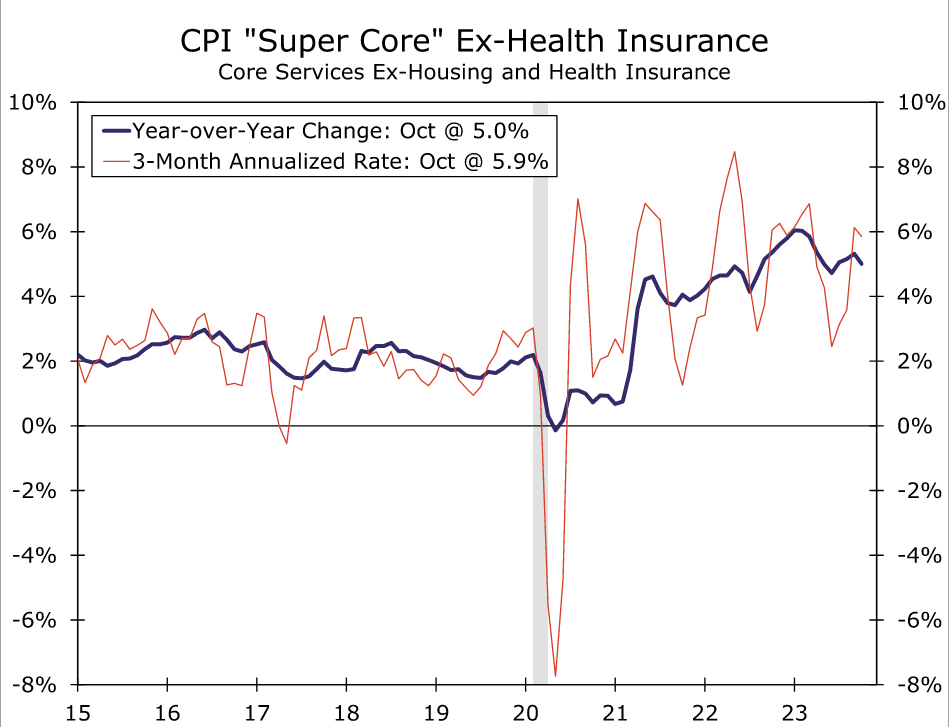
With the con of throwing yet another measure of "core" inflation into the mix, core services less primary shelter and health insurance, i.e., the CPI "super core" with the additional exclusion of health insurance, rose 0.2% in October after a 0.6% rise the prior month. Declines in both airfare (-0.9%) and hotel prices (-2.9%), two of the most volatile components of services, take some of the shine off the services slowdown, as they will be hard to repeat on a consistent basis. Through the large swings in travel-related services, the trend in CPI super core less health insurance is little improved over the past year, underscoring that despite the improvement for goods and housing, the fight against inflation is far from over (chart).
Focus To Turn from Future Rate Hikes to Future Rate Cuts
Today's CPI report further reinforces our view that the last rate hike of this tightening cycle is behind us. We will not receive the October data for the Fed's preferred measure of inflation, the PCE deflator, until November 30. That said, today's CPI data signal that inflation took another step forward on its long road back to 2%. The FOMC's job is not finished. Inflation is not yet back to 2%, and the Committee likely will need to feel confident that 2% inflation can be sustained before it begins to loosen its restrictive stance of monetary policy. Furthermore, the Committee will remain diligently on the lookout for any shocks that could disrupt the disinflationary trends that are currently in place. That said, as 2023 draws to a close and 2024 comes into view, we suspect the debate next year will focus squarely on when rate cuts and the end of quantitative tightening will occur.
US: Lower Prices at the Pump Cool Headline Inflation, and Cooler Core Inflation Provides Reassurance
The Consumer Price Index (CPI) was flat in October, marking a deceleration from September's 0.4% month-on-month (m/m) gain, and below consensus expectations. On a twelve-month basis, headline inflation cooled further to 3.2%.
Energy prices helped hold back headline inflation, dropping 2.5% m/m, driven by a drop in gasoline prices (-5.3% m/m). Food prices added upward pressure to inflation on a monthly basis (+0.3% m/m), but at 3.3% year-on-year, are no longer providing the lift to headline inflation they were last year.
There was good news on core inflation, which rose 0.2% m/m, below market consensus. Core inflation was up 4% on a year-on-year basis in October, down a tick from September.
Core goods prices have been a downward force on inflation for five months now, with prices down 0.1% m/m in October. Even services price gains cooled, up 0.3% m/m after a string of hotter readings over the past few months.
Shelter costs have been a key factor pushing service costs higher, and rose a more modest 0.3% m/m in October. Shelter inflation eased on both a 2.5% m/m drop in lodging away from home, and a cooling in owners' equivalent rent (rising by 0.4% m/m from 0.6% m/m in September).
- Non-housing services (aka the CPI measure of 'supercore') also decelerated in October, rising 0.3% m/m (from 0.6% m/m in September). However, hotter readings in recent months have left the twelve-month pace unchanged at 3.7%.
Key Implications
Well that is more like it. October's CPI inflation report showed encouraging progress towards the Fed's 2% target. Core inflation is still well above a pace consistent with the Fed's target, so it remains way too early for the Fed to declare victory, but policymakers likely just exhaled a bit. On a three-month annualized basis core inflation was 3.4% in October – still too high but pointing to further deceleration ahead.
The challenge for the Fed is much of the low hanging fruit on dis-inflation has been picked. Resolution of supply chain snarls that were keeping prices elevated, and other pandemic re-opening pain points, have already exerted a downward influence on inflation, and now we need to see consistently softer prices pressures due to weaker demand to get back to target. So far, consumer demand has kept up, but we will be watching tomorrow's retail sales figures for October closely for signs of fatigue. If we don't start to see greater cooling, the Fed will likely need to raise rates again.