Sample Category Title
USD/CHF Mid-Day Outlook
Daily Pivots: (S1) 0.8997; (P) 0.9021; (R1) 0.9040; More....
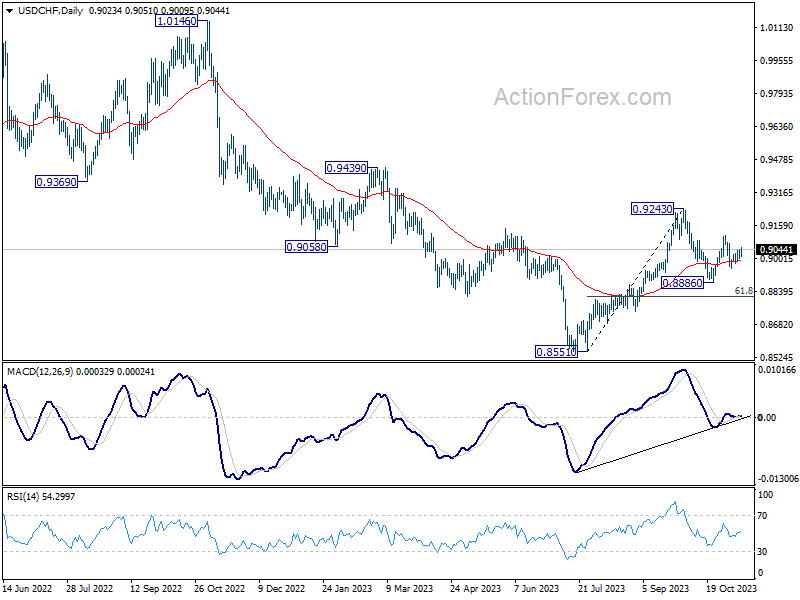
Intraday bias in USD/CHF stays neutral at this point, as range trading continues. On the downside, below 0.8952 will target a test on 0.8886 support first. Break there will resume whole decline from 0.9243 to 0.8815 fibonacci level. However, break of 0.9111 will resume the rebound from 0.8886 instead, and target 0.9243 resistance.
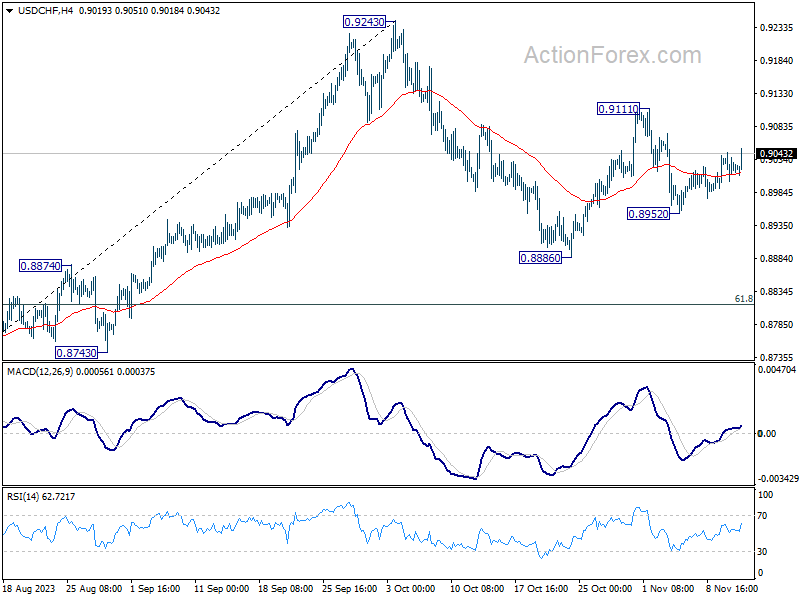
In the bigger picture, outlook is mixed up by the deeper than expected pull back from 0.9243. Yet there was no follow through selling after hitting 0.8886. On the upside, break of 0.9243 resistance will revive the case of medium term bottoming at 0.8851, and turn outlook bullish. However, sustained break of 61.8% retracement of 0.8551 to 0.9243 at 0.8815 will argue that larger decline from 1.0146 is ready to resume through 0.8551 low.
GBP/USD Mid-Day Outlook
Daily Pivots: (S1) 1.2197; (P) 1.2217; (R1) 1.2248; More...
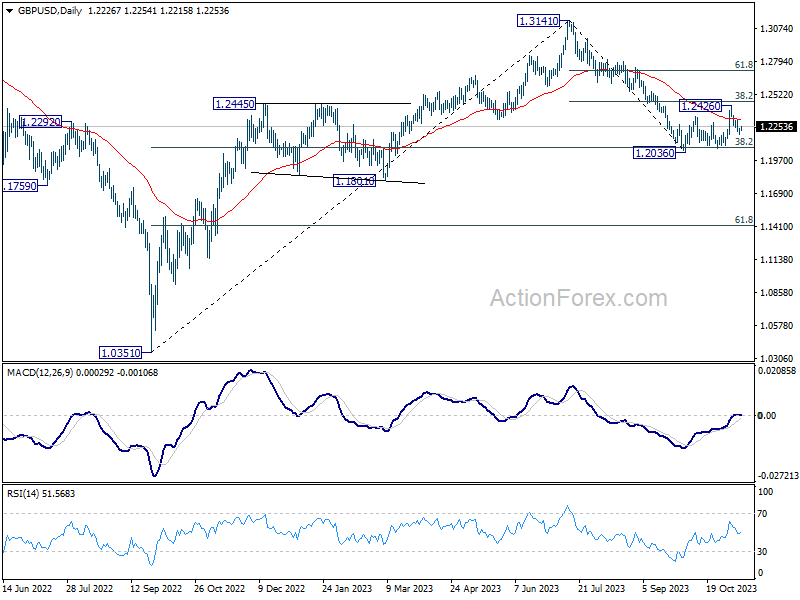
Intraday bias in GBP/USD is turned neutral with current recovery. But outlook is unchanged that corrective rebound from 1.2036 should have completed with three waves up to 1.2426. Below 1.2185 will bring deeper fall to retest 1.2036/68 support zone next. Firm break there will resume larger down trend from 1.3141. However, firm break of 1.2307 will dampen this view and bring stronger rise back to 1.2426 resistance.
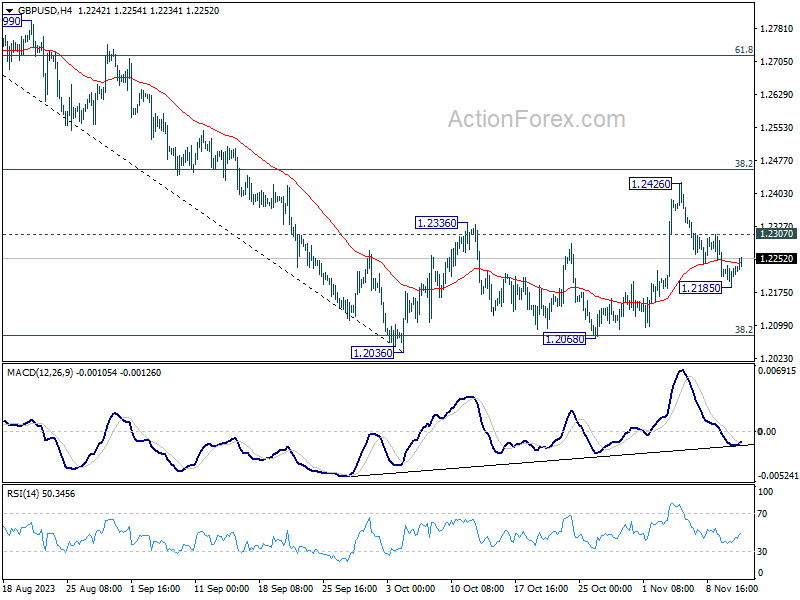
In the bigger picture, rejection by 38.2% retracement of 1.3141 to 1.2036 at 1.2458, suggests fall from 1.3141 is still in progress. Sustained break of 38.2% retracement of 1.0351 (2022 low) to 1.3141 at 1.2075 will bring deeper decline to 61.8% retracement at 1.1417, even just as a corrective move.
EUR/USD Mid-Day Outlook
Daily Pivots: (S1) 1.0663; (P) 1.0678; (R1) 1.0700; More...
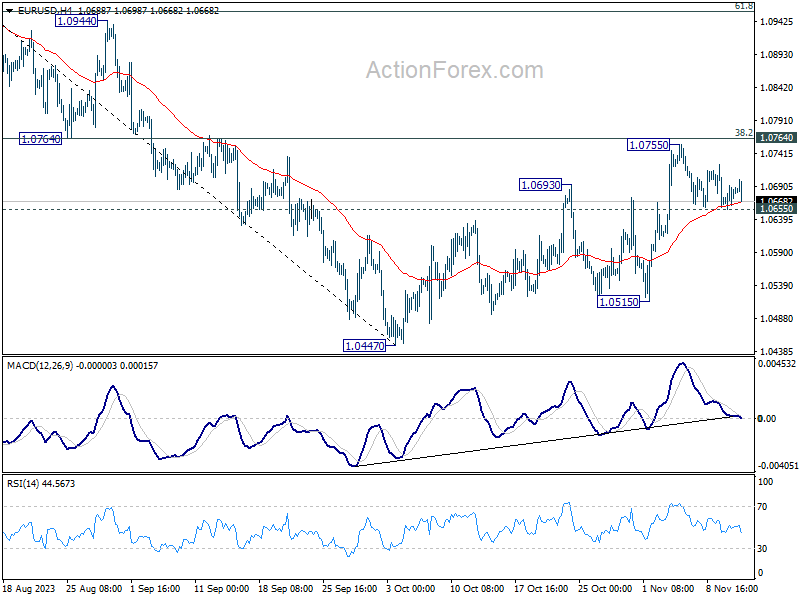
Intraday bias in EUR/USD stays neutral at this point. On the downside, break of 1.0655 minor support, and sustained trading below 55 4H EMA (now at 1.0664), will argue that the rebound from 1.0447 has completed with three waves up to 1.0755. That came after rejection by 1.0764 cluster resistance (38.2% retracement of 1.1274 to 1.0447 at 1.0763). In this case, intraday bias will be turned back to the downside for 1.0447/0515 support zone. Nevertheless, strong bounce from current level, followed by decisive break of 1.0764, will bring stronger rally to 61.8% retracement at 1.0958 next.
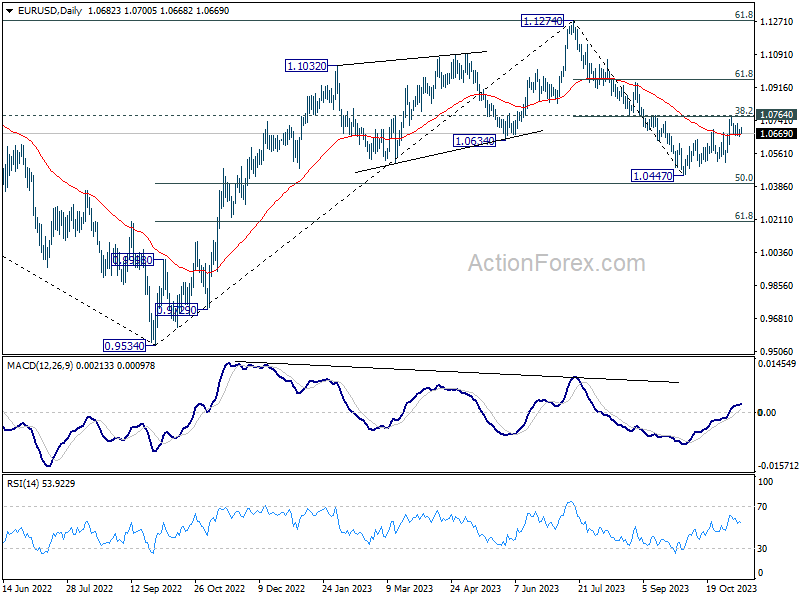
In the bigger picture, price actions from 1.1274 are viewed as a corrective pattern to rise from 0.9534 (2022 low). Rise from 1.0447 is tentatively seen as the second leg. Hence while further rally could be seen, upside should be limited by 1.1274 to bring the third leg of the pattern. However, break of 1.0447 will resume the fall to 61.8% retracement of 0.9543 to 1.1274 at 1.0199.
Sterling and Aussie Bounce Back from Recent Lows, Euro Sees Downside Risk
There's a noticeable lack of a unifying theme in the forex markets today, largely attributed to an empty economic calendar across European and North American regions. Both Australian Dollar and British Pound are seeing a rebound from their recent downturns, particularly noticeable in currency crosses. However, the continuation of this momentum hinges significantly on impending economic data releases. Key reports to watch include Australian consumer and business confidence, along with UK employment data set to be unveiled tomorrow.
Dollar is trailing closely behind as the third strongest currency for the day. Meanwhile, Japanese Yen has seen a slight stabilization from its earlier steep selloff. However, Yen's recovery is relatively modest and is confined to a select few currencies. The Japanese currency still seems poised to challenge its multi-decade low against Dollar, but market participants may reserve their major trading decisions on USD/JPY until release of US CPI data tomorrow.
Swiss Franc finds itself at the bottom of the performance chart today, facing additional downward pressure due to the resumed rally in EUR/CHF. Similarly, New Zealand Dollar and Canadian Dollar are also among the weaker performers, further weighed down by Aussie's rebound against them. Euro, in contrast, presents a mixed picture, showing signs of vulnerability in several pairings except against Swiss Franc.
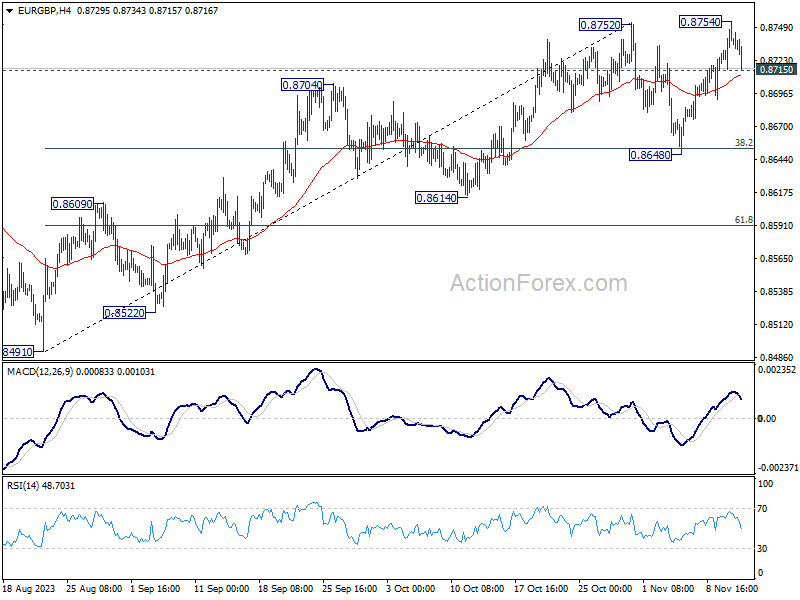
Technically, EUR/GBP is worth some attention in this quiet session. Firm break of 0.8715 minor support will argue that rebound from 0.8648 has completed after rejection by 0.8752 resistance. Fall from 0.8754 would then be seen as the third leg of the corrective pattern from 0.8752, and target 0.8648 support again. Nevertheless, in this case, strong support should emerge around 0.8648 to contain downside to complete the consolidation, and finally bring resumption of whole rise from 0.8491.
In Europe, at the time of writing, FTSE is up 0.63%. DAX is up 0.19%. CAC is up 0.29%. Germany 10-year yield is down -0.0221 at 2.697. Earlier in Asia, Nikkei rose 0.05%. Hong Kong HSI rose 1.30%. China Shanghai SSE rose 0.25%. Singapore Strait Times dropped -0.91%. Japan 10-year JGB yield rose 0.0192 to 0.877.
ECB's de Guindos foresees temporary inflation rebound, December forecasts crucial for policy assessment
In a speech today, ECB Vice President Luis de Guindos said the central bank expects "a temporary rebound" in inflation in the coming months as base-effect drops out of calculations. However, he emphasized that ECB foresees the overall disinflationary process to continue over the medium term.
De Guindos highlighted the unpredictability surrounding energy prices due to geopolitical tensions and fiscal policy impacts, along with the potential upward pressure on food prices resulting from adverse weather events and the broader climate crisis.
Despite a marked decrease in inflation, de Guindos warned that it is expected to remain high for an extended period, with persistent domestic price pressures. "We will therefore ensure that our policy rates will be set at sufficiently restrictive levels for as long as necessary," he affirmed.
Emphasizing the ECB's data-dependent approach, de Guindos stated, "Our future decisions on policy rates will continue to be taken on a meeting-by-meeting basis." He added that the ECB's December meeting, armed with fresh macroeconomic projections and additional data, will be crucial for reassessing the inflation outlook and necessary policy actions.
Japan's wholesale inflation eases to 0.8% yoy, continued downward trend
Japan's corporate goods price index, a key indicator of wholesale inflation, exhibited a significant slowdown in October, underscoring a continued trend of easing price pressures.
The index increased by just 0.8% yoy, falling short of the anticipated 0.9% yoy and marking its first dip below 1% since February 2021. This latest figure also represents the 10th consecutive month of slowing wholesale inflation.
The deceleration in the CGPI can be largely attributed to decreases in the prices of specific commodities. Notably, costs for wood, chemical, and steel products experienced declines, reflecting the broader impact of reduced global commodity prices.
Export price index saw an uptick from 0.5% yoy to 1.0% yoy. Import price index showed a lesser decline, moving from -15.5% yoy to -12.5% yoy.
RBA's Kohler warns of bumpy road ahead in tackling inflation
In a speech, Marion Kohler, Acting Assistant Governor of RBA, remarked that decline in inflation is expected to be a "more gradual process than previously thought."
This outlook stems from the current economic environment characterized by "still-high level of domestic demand" and "strong labour" alongside other cost pressures. These factors contribute to the prediction that inflation will hover just below 3% by the end of 2025.
The Assistant Governor pointed out that the recent trend of declining inflation has primarily been "driven by lower goods price inflation." In stark contrast, "domestically sourced inflation" – especially in the services sector – has shown resilience, being "widespread and slow to decline."
Kohler also underscored the nuanced challenges in the next phase of controlling inflation, which she anticipates to be "more drawn out than the first." This outlook aligns with experiences in other advanced economies that have faced similar inflationary patterns.
Furthermore, she cautioned about the potential for unforeseen challenges, citing the recent increase in fuel prices as an example of supply shocks that could unpredictably influence headline inflation.
Kohler emphasized the uncertain nature of the journey ahead in managing inflation, stating, "the road ahead could be bumpy."
New Zealand BNZ services fell to 48.9, contraction with economic angst
New Zealand's BusinessNZ Performance of Services Index experienced a notable dip in October, falling from 50.6 to 48.9, a level indicative of contraction in the sector. This decline also positions the index well below its long-term average of 53.5.
Activity and sales experienced a significant drop, moving from 50.9 to 47.4. There was also a downturn in employment, which decreased from 50.5 to 49.3. New orders and business fell as well,from 53.9 to 51.9. On a more positive note, stocks and inventories saw an increase, rising from 48.0 to 51.1, and supplier deliveries edged up slightly from 49.7 to 49.8.
Despite these declines, the proportion of negative comments in October decreased to 58.2%, a reduction from 61.8% in September and 63.9% in August, indicating a slight improvement in business sentiment.
BNZ Senior Economist Craig Ebert said that "combined, the PSI (48.9) and PMI (42.5) paint a picture of economic angst. This counsels caution around GDP for Q3, after it posted a surprising gain of 0.9% in Q2".
EUR/USD Mid-Day Outlook
Daily Pivots: (S1) 1.0663; (P) 1.0678; (R1) 1.0700; More...
Intraday bias in EUR/USD stays neutral at this point. On the downside, break of 1.0655 minor support, and sustained trading below 55 4H EMA (now at 1.0664), will argue that the rebound from 1.0447 has completed with three waves up to 1.0755. That came after rejection by 1.0764 cluster resistance (38.2% retracement of 1.1274 to 1.0447 at 1.0763). In this case, intraday bias will be turned back to the downside for 1.0447/0515 support zone. Nevertheless, strong bounce from current level, followed by decisive break of 1.0764, will bring stronger rally to 61.8% retracement at 1.0958 next.
In the bigger picture, price actions from 1.1274 are viewed as a corrective pattern to rise from 0.9534 (2022 low). Rise from 1.0447 is tentatively seen as the second leg. Hence while further rally could be seen, upside should be limited by 1.1274 to bring the third leg of the pattern. However, break of 1.0447 will resume the fall to 61.8% retracement of 0.9543 to 1.1274 at 1.0199.
Economic Indicators Update
| GMT | Ccy | Events | Actual | Forecast | Previous | Revised |
|---|---|---|---|---|---|---|
| 21:30 | NZD | Business NZ PSI Oct | 48.9 | 50.7 | ||
| 23:50 | JPY | PPI Y/Y Oct | 0.80% | 0.90% | 2.00% | 2.20% |
| 06:00 | JPY | Machine Tool Orders Y/Y Oct P | -20.60% | -11.20% |
Aussie Ends Nasty Slide, Confidence Data Next
- Australian dollar breaks five-day losing streak
- Business, consumer confidence will be released on Tuesday
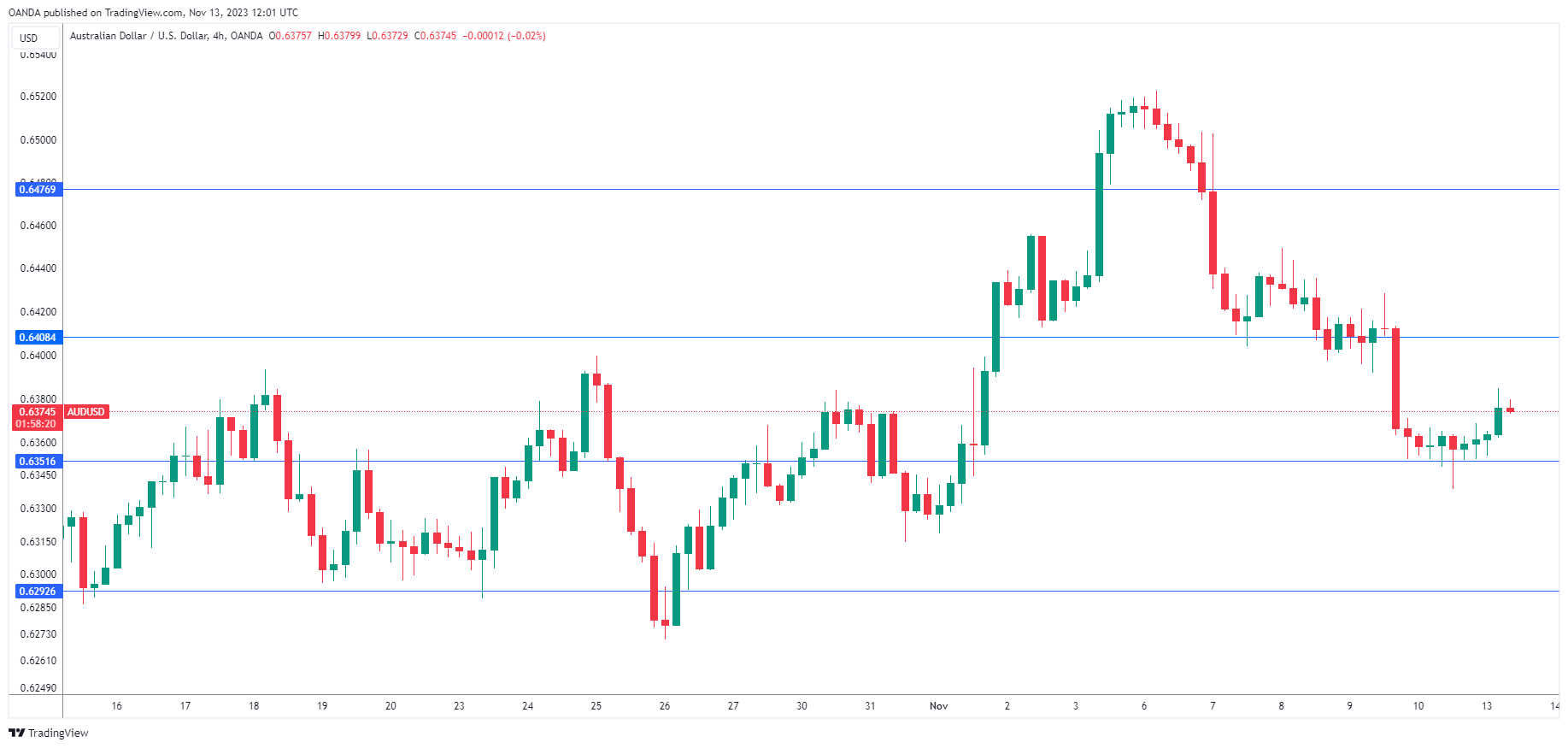
The Australian dollar has edged higher on Monday. In the European session, AUD/USD is trading at 0.6376, up 0.27%. The Aussie has snapped a five-day losing streak in which it declined 2.35%.
Australian dollar eyes business, consumer confidence
Australia will release consumer and business confidence data on Tuesday. Consumers remain deeply pessimistic, although the Westpac Consumer Sentiment index climbed 2.9% in October to 82, its highest level in six months. The 100 level separates pessimism from optimism. Consumers have been squeezed by stubbornly high inflation and elevated interest rates. The market consensus for November is 0.7%, which would raise the index slightly to 82.6.
Business confidence remains well below average and the NAB Business Confidence index is expected to remain unchanged at 1 in October. The zero level separates pessimism from optimism. Business conditions are in better shape but fell from 14 to 11 in September.
Is the Reserve Bank of Australia done with its tightening cycle? The central bank raised rates last week after four consecutive pauses but the Australian dollar fell sharply after the move. The markets were of the view that the RBA had raised the bar to further hikes, even though the RBA statement noted that inflation was still too high.
The RBA quarterly monetary policy statement, released on Friday, warned of risks to the upside for inflation, and the hawkish tone may have helped the Aussie stabilize today after a miserable week. The RBA meets next on December 5th and the October inflation report a week earlier could play a key role as to whether the RBA pauses or raises rates at the final meeting of 2023.
In the US, the Michigan Consumer Sentiment index, released on Friday, eased to 60.4 in November, down from 63.8 in October and shy of the market consensus of 63.7. Confidence fell as consumers’ long-term inflation expectations rose from 3.0% to 3.2% in November, the highest level since 2011. The Fed is in a pickle as inflation expectations are rising while consumer confidence is falling, which is likely to translate into weaker consumer spending.
AUD/USD Technical
- AUD/USD is putting pressure on support at 0.6351. Below, there is support at 0.6292
- 0.6408 and 0.6476 are the next resistance lines
USD/JPY: Bulls Pressure Key 2022 Peak
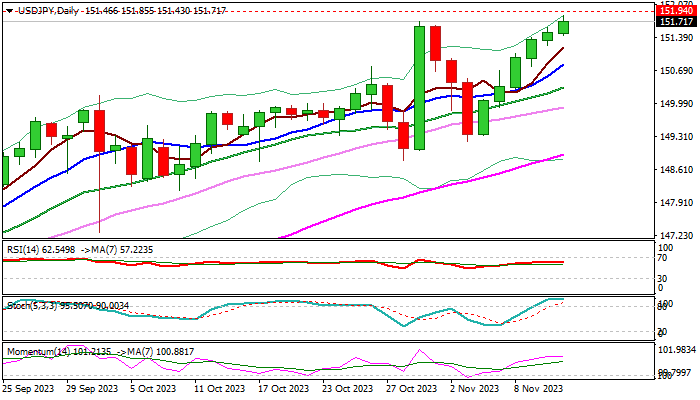
USDJPY keeps firm bullish tone and extends gains, after 1.4% advance last week and hit new 2023 high on Monday.
Rally extends into sixth consecutive day and came just ticks ahead of 2022 peak (151.94, the highest in over three decades) with break of pivotal 152 zone to signal continuation of a larger uptrend from Dec 2011 low (75.55), interrupted by 151.94/127.22 correction.
Fibo projections of the upleg from 149.19 (Nov 3 higher low) mark immediate targets at 152.69 (138.2%), 153.29 (161.8%) and 154.26 (200%).
Full bullish setup of daily studies supports the action, though headwinds cannot be ruled out on overbought conditions and persisting intervention threats.
Friday’s low at 151.22 marks initial support, followed by Thursday’s low at 150.77, with dips to be contained by rising daily Tenkan-sen (150.52), guarding lower pivot at 150.00 (psychological/daily Kijun-sen) loss of which would sideline bulls.
Res: 151.85; 151.94; 152.69; 153.29.
Sup: 151.22; 150.77; 150.52; 150.00.
Bank of England Initiates Stress Test In Aftermath of Liz Truss Budget Disaster
In a groundbreaking move, the Bank of England has called upon more than 50 financial institutions in the City to conduct a comprehensive stress test, simulating the repercussions of a sudden and drastic movement in bond prices. This initiative marks the first financial system-wide stress test of its kind, reflecting the central bank's proactive stance in assessing and fortifying the resilience of the financial sector.
The call for stress testing follows the turmoil experienced in bond markets and the sterling aftermath triggered by Liz Truss's mini-budget in September 2022. During this period, pension funds faced significant pressure, and some teetered on the brink of collapse. The pronounced shift in bond prices and corresponding interest rates underscored the inherent risks associated with specific forms of liability-driven investing (LDI), particularly concerning retirement savings.
This pivotal stress test, involving major players such as big banks, asset managers, hedge funds, pension funds, and major insurers, aims to evaluate how these entities would fare in the face of an unforeseen swing in bond prices. The participants are required to model and analyse the potential impacts on their operations, with results due to be shared with the central bank by January.
The stress test encompasses abrupt and sustained fluctuations in the value of both corporate bonds and sovereign debt, encompassing renowned government bonds like UK gilts. The Bank of England's scenario involves a 10-day-long "shock to rates and risky asset prices," combining multiple elements to simulate a comprehensive market disruption.
The scenario includes a notable shift in UK government borrowing costs akin to the LDI crisis, a corresponding alteration in other governments' debt prices matching the most significant rise witnessed this century, and an increase in corporate borrowing costs mirroring the "dash for cash" observed in March 2020.
While the specific triggers for such a severe shock remain unspecified by the Bank of England, the described scenario is comparable to the outbreak of a major war. The hypothetical situation involves a "sudden crystallisation of geopolitical tensions," disrupting global economic expectations, dominating headlines, and sparking widespread speculation about a potential financial sector meltdown on social media platforms.
Indicative pricing only
The Euro is up on the Pound this morning, after a momentary drop during the latter part of last week.
The central bank has meticulously outlined the cascading effects of this imagined scenario on the financial landscape. Key milestones include a potential sovereign credit rating downgrade for the UK by day 2, a mid-sized hedge fund collapse by day 4, and, by day 10, expectations of a recession surpassing the severity of the 2008 financial crisis.
This stress test underscores the Bank of England's commitment to assessing systemic risks and fortifying the financial sector against unforeseen challenges. In an era where non-bank institutions like asset managers and hedge funds play an increasingly influential role, the central bank's move signifies a broadened focus beyond traditional banks, aligning with the evolving dynamics of the financial landscape.
Importantly, the stress test results will not be used to single out vulnerable firms. Instead, the central bank aims to share systemic findings that apply across institutions, fostering a collaborative approach to enhancing the overall resilience of the financial system.
This article represents the opinion of the Companies operating under the FXOpen brand only. It is not to be construed as an offer, solicitation, or recommendation with respect to products and services provided by the Companies operating under the FXOpen brand, nor is it to be considered financial advice.
ECB’s de Guindos foresees temporary inflation rebound, December forecasts crucial for policy assessment
In a speech today, ECB Vice President Luis de Guindos said the central bank expects "a temporary rebound" in inflation in the coming months as base-effect drops out of calculations. However, he emphasized that ECB foresees the overall disinflationary process to continue over the medium term.
De Guindos highlighted the unpredictability surrounding energy prices due to geopolitical tensions and fiscal policy impacts, along with the potential upward pressure on food prices resulting from adverse weather events and the broader climate crisis.
Despite a marked decrease in inflation, de Guindos warned that it is expected to remain high for an extended period, with persistent domestic price pressures. "We will therefore ensure that our policy rates will be set at sufficiently restrictive levels for as long as necessary," he affirmed.
Emphasizing the ECB's data-dependent approach, de Guindos stated, "Our future decisions on policy rates will continue to be taken on a meeting-by-meeting basis." He added that the ECB's December meeting, armed with fresh macroeconomic projections and additional data, will be crucial for reassessing the inflation outlook and necessary policy actions.
Could Japanese GDP Print Reignite Tightening Expectations?
- GDP report for Q3 will be released on Wednesday 01.50 GMT
- Market feeling disappointed after recent BoJ gathering
- Yen crosses record new highs, ignore intervention threat
Market did not enjoy the last BoJ meeting
The recent Bank of Japan meeting failed to live up to its expectations despite the fact that Governor Ueda made another small step towards the targeted normalization. The famous yield curve control mechanism was updated with the 1% hard cap being transformed into a reference cap where the BoJ aims to conduct nimble operations. In essence, the 10-year Japanese yield is now allowed to trade above this level, with the BoJ looking ready to intervene forcefully when the pace of adjustment looks too aggressive for its liking.
Interestingly, the Policy Board’s median forecasts for core CPI were also upgraded. The projection for the fiscal year of 2024 increased to 2.8% from 1.9% at the July projections, with the core CPI print for the fiscal year of 2025 seen at a modest 1.7%. The 2025 figure is the reason why the BoJ has not moved more aggressively in its normalization process. Governor Ueda and his crew are looking for stronger signs that domestic demand could support the recent elevated inflation rates. And they assume that this could only happen if monetary policy remains extra supportive and wages continue to rise significantly.
In this context, Japan's UA Zensen Union, representing mostly manufacturing sector workers, has lodged a claim for a 6% wage hike for a second consecutive year, and one of Japan's biggest banks has increased its deposit rates for the first time in 12 years. This is probably music to the ears of the BoJ but not yet enough for the central bank to announce its first rate hike since 2007. Governor Ueda is looking for concrete signs that higher wages and rising prices are becoming embedded in the public’s mindset, and not seen as a one-off event driven by external factors.
Importantly, recent economic data has been on the positive side with the PMI surveys surprising on the upside and labor cash earnings showing a yearly increase of 1.2% in September. This might not look like much when compared to other developed nations’ figures, but these data prints are close to what the BoJ has been hoping for.
Key data releases this week
This week the market will be updated on the preliminary GDP print for the third quarter of 2023, following a very strong second quarter. The initial GDP figures from both the US and the UK managed to surprise on the upside, thus raising the possibility for a stronger print than the -0.1% QoQ penciled in now by market analysts. Similarly, lots of focus will be on the GDP price index, which in the previous quarter surpassed the 2015 high of 3.4%.
Equally important will be Thursday’s trade balance data for the month of October. The BoJ would be interested in any signs of a pick-up in imports that have been crashing from the 2022 highs, partly due to the drop in oil and gas prices.
Euro-yen continues higher undaunted
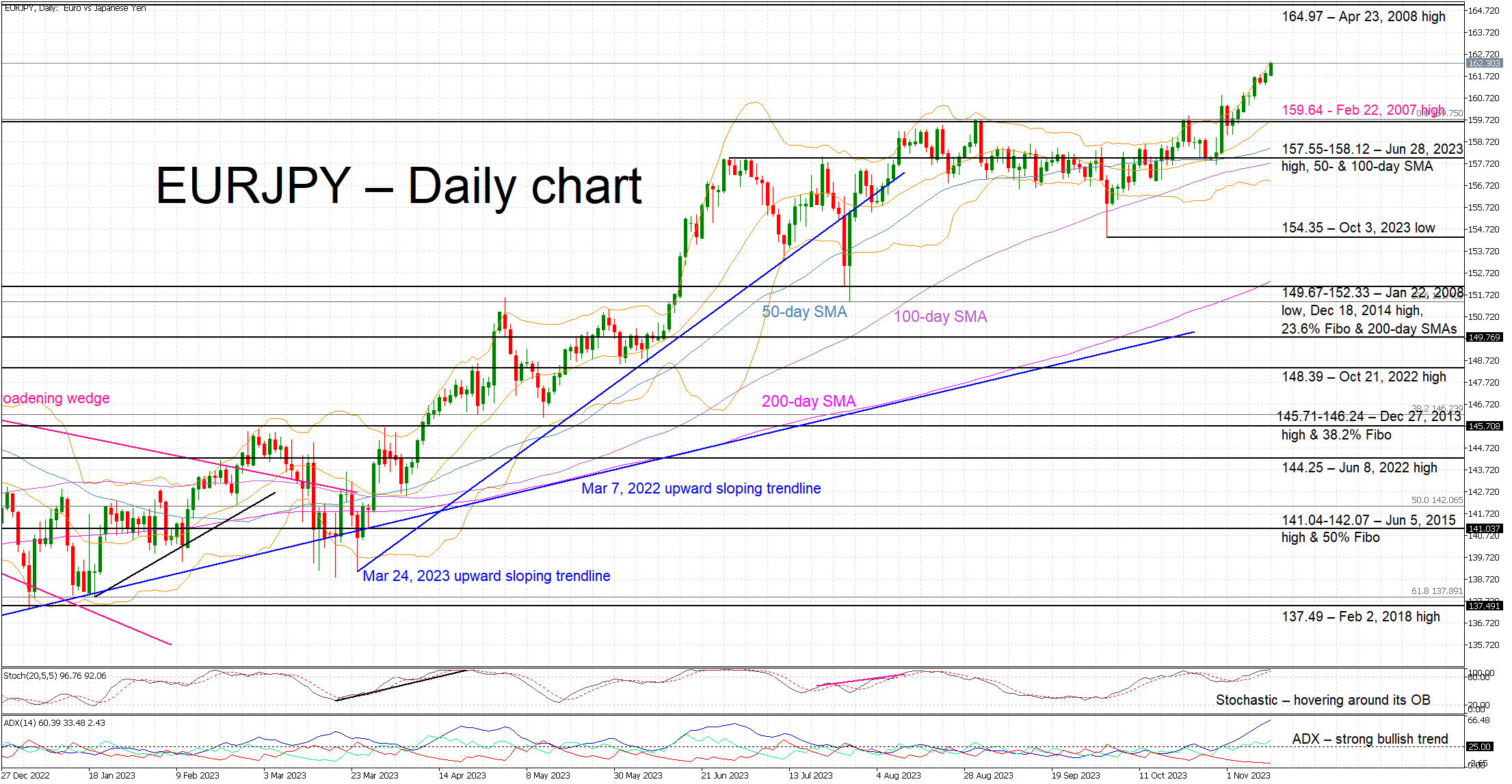
The sky appears to be the limit for yen crosses. The recent disappointing BoJ meeting allowed the euro-yen bulls to stage another rally with the pair recording a new 2023 high and apparently setting course for the April 23, 2008 high at 164.97. The threat of intervention does not seem to trouble the euro bulls since Japanese authorities have up to now limited their reaction to just verbal intervention, possibly at the request of the BoJ.
Having said that, a positive set of figures, especially a stronger GDP print, could result in a bearish reaction with the bears potentially trying to reclaim the 159.64 level. However, this move will most likely prove short-lived. On the flip side, a plethora of weak data releases would satisfy the euro-yen bulls as they potentially continue to test the Japanese authorities’ patience.
Gold Tumbles But 200-day SMA Curbs Decline
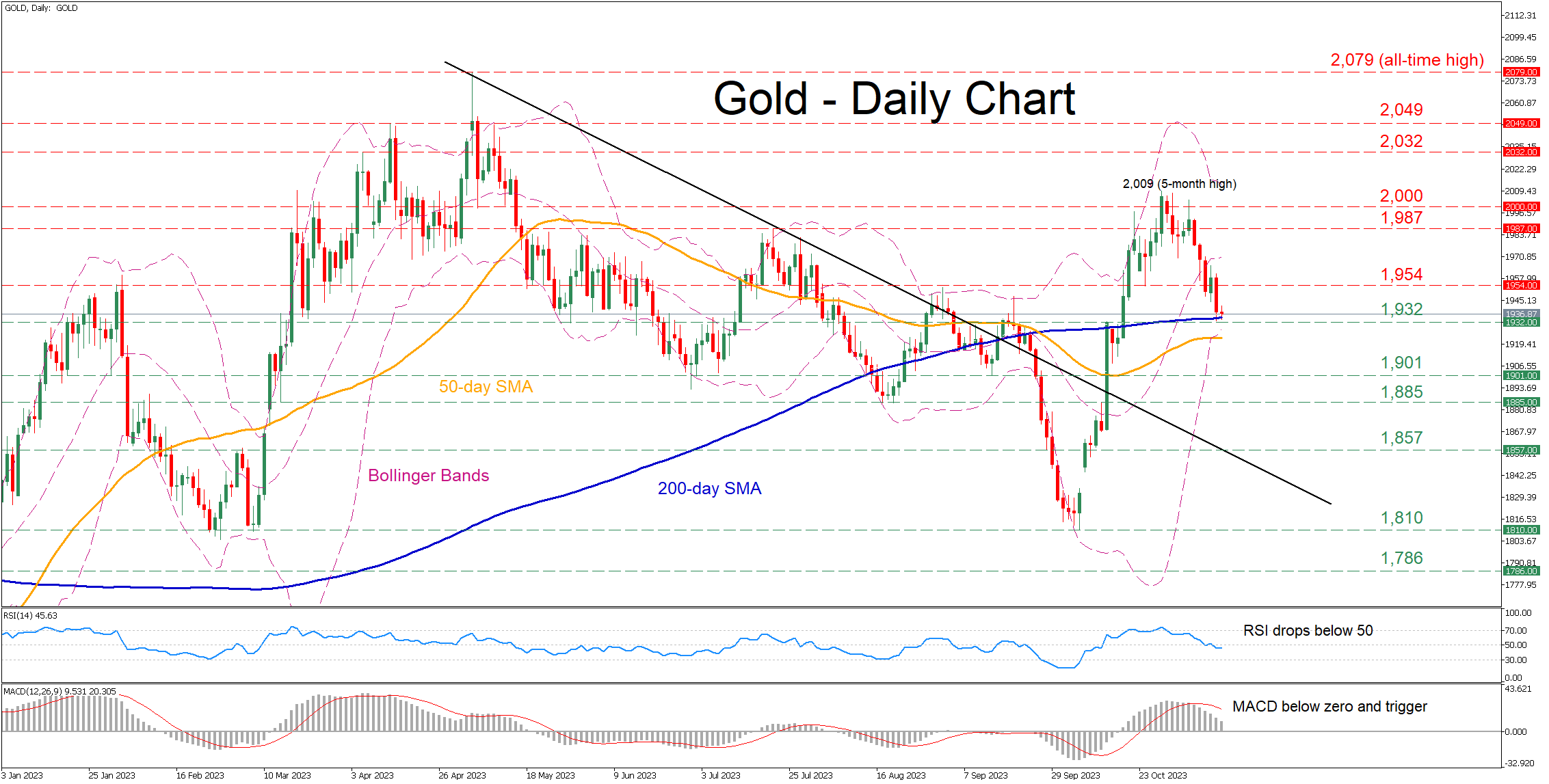
- Gold extends its fall from the 5-month peak of 2,009
- Hits the crucial 200-day SMA, which holds strong for now
- Momentum indicators slowly tilt to the bearish side
Gold had been in a steep uptrend since October 10 mainly on the back of geopolitical tensions, reclaiming crucial technical regions and posting a fresh five-month peak of 2,009. However, bullion has been experiencing a solid downside correction since then, with short-term oscillators pointing at more pain ahead.
Should gold resume its freefall, the bears could initially attack the 1,932 region, which has acted both as support and resistance throughout 2023 and coincides with the 200-day simple moving average (SMA). Failing to halt there, the price may descend towards the September support of 1,901. Even lower, the August bottom of 1,885 might provide downside protection.
On the flipside, if bullion bounces off the 200-day SMA and storms back higher, immediate resistance could be found at the October support of 1,954, which also acted as resistance in early September. Piercing through that region, the price could face the July resistance of 1,987. Further advances could then cease at the crucial 2,000 psychological mark.
In brief gold seems to be under relentless downside pressure, but the 200-day SMA has temporarily paused the steep retreat. Hence, it is clear that a break below the crucial obstacle could easily trigger an acceleration of the decline.