Sample Category Title
USD/CAD Daily Outlook
Daily Pivots: (S1) 1.3774; (P) 1.3814; (R1) 1.3837; More...
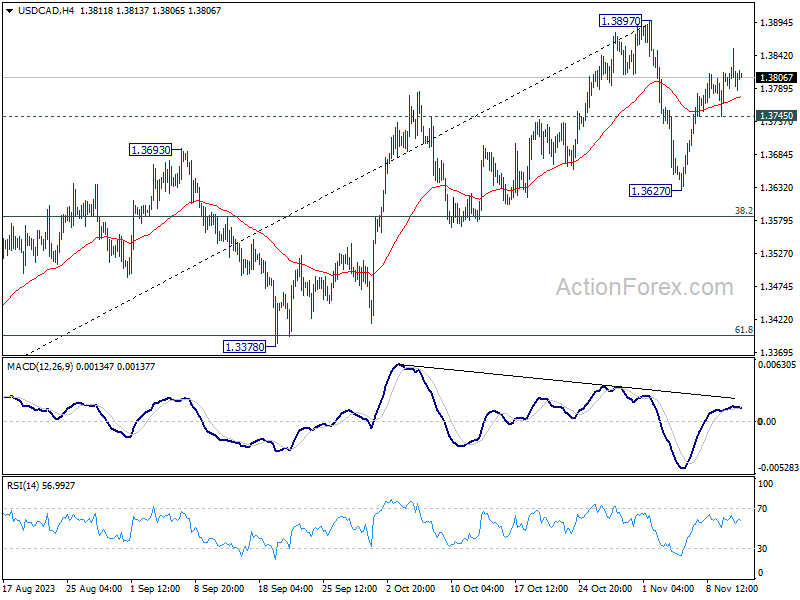
Intraday bias in USD/CAD remains mildly on the upside for retesting 1.3897. Strong resistance could be seen there to limit upside on first attempt. On the downside, break of 1.3745 will turn bias to the downside to extend the corrective pattern from 1.3897 with another falling leg. In this case, strong support should be seen from 38.2% retracement of 1.3091 to 1.3897 at 1.3589 to bring rebound.
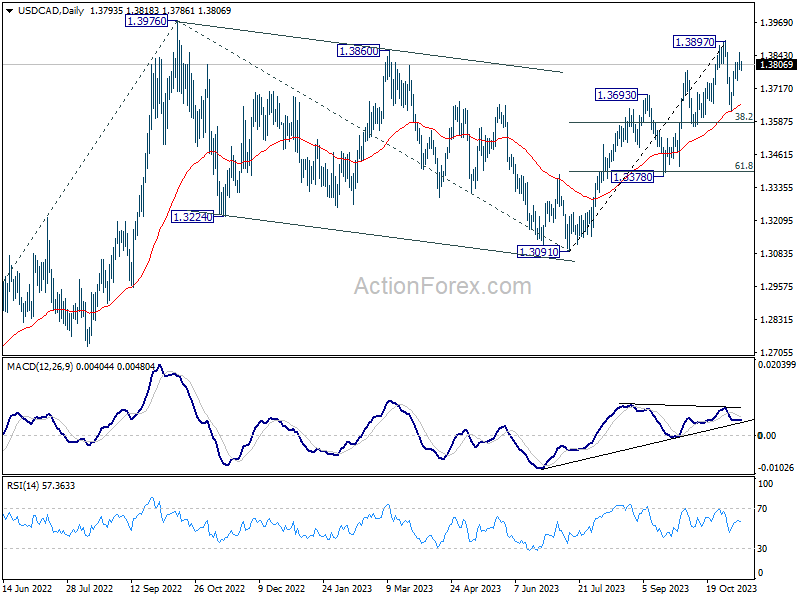
In the bigger picture, corrective pattern from 1.3976 (2022 high) should have completed with three waves down to 1.3091. Decisive break of 1.3976 high will confirm resumption of up trend from 1.2005 (2021 low). Next target is 61.8% projection of 1.2401 to 1.3976 from 1.3091 at 1.4064. This will remain the favored case as long as 1.3378 support holds.
EUR/USD Daily Outlook
Daily Pivots: (S1) 1.0663; (P) 1.0678; (R1) 1.0700; More...
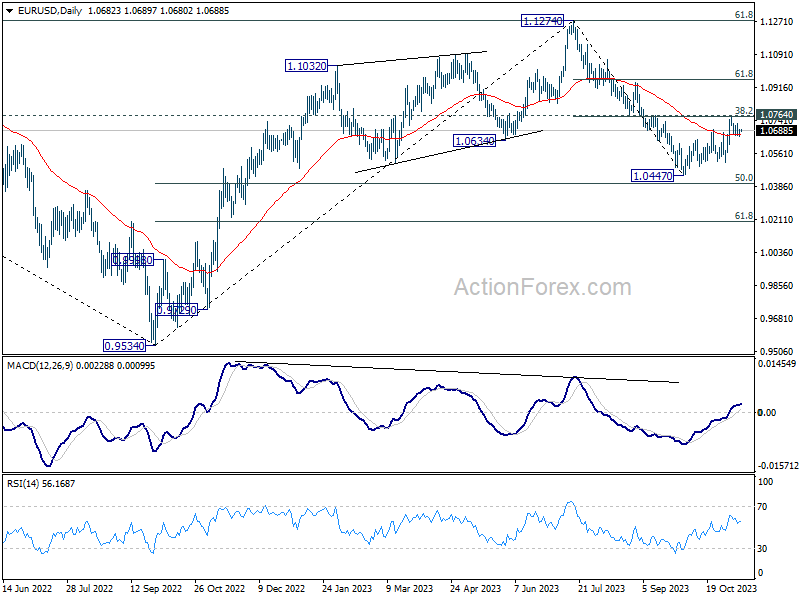
Intraday bias in EUR/USD remains neutral for the moment. On the upside, decisive break of 1.0764 cluster resistance (38.2% retracement of 1.1274 to 1.0447 at 1.0763) will extend the rise from 1.0447 to 61.8% retracement at 1.0958 next. However, sustained break of 55 4H EMA (now at 1.0664) will argue that the rebound has completed, and turn bias back to the downside for 1.0447/0515 support zone instead.
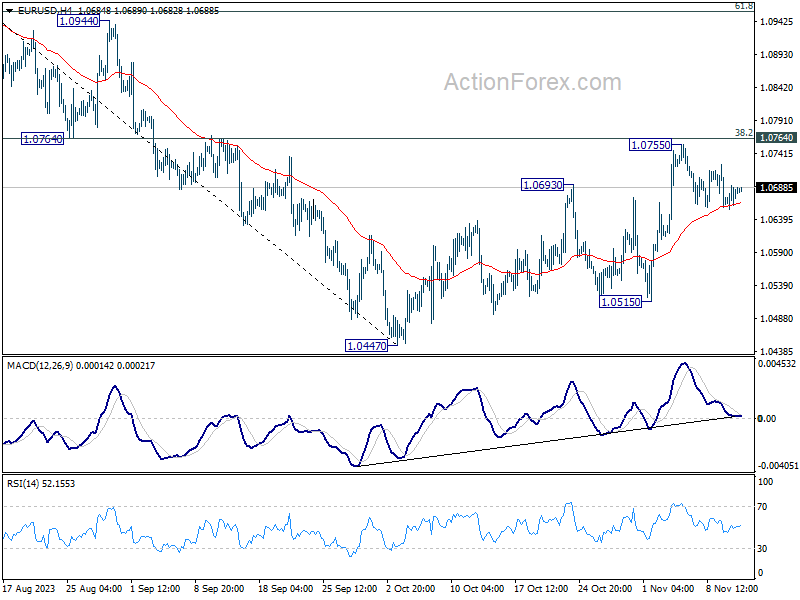
In the bigger picture, price actions from 1.1274 are viewed as a corrective pattern to rise from 0.9534 (2022 low). Rise from 1.0447 is tentatively seen as the second leg. Hence while further rally could be seen, upside should be limited by 1.1274 to bring the third leg of the pattern. However, Break of 1.0447 will resume the fall to 61.8% retracement of 0.9543 to 1.1274 at 1.0199.
GBP/USD Daily Outlook
Daily Pivots: (S1) 1.2197; (P) 1.2217; (R1) 1.2248; More...
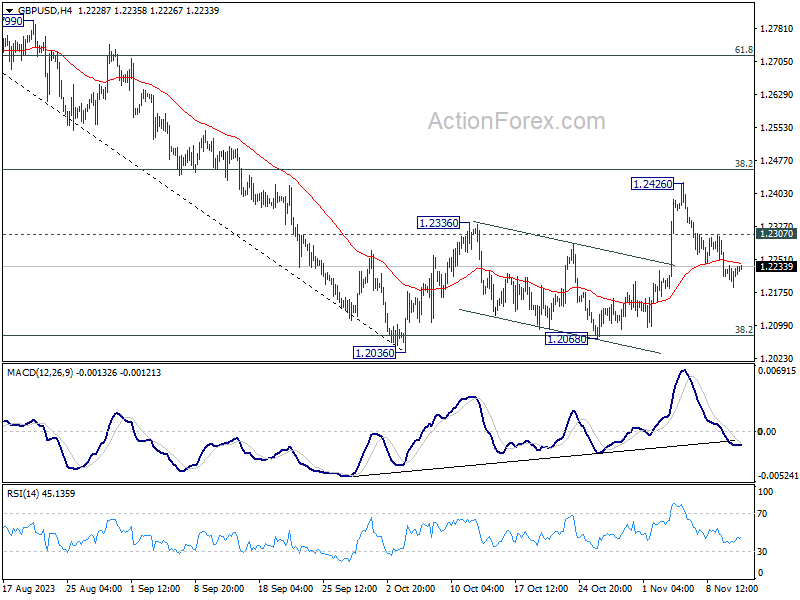
Intraday bias in GBP/USD remains mildly on the downside at this point. Corrective rebound from 1.2036 should have completed with three waves up to 1.2426. Deeper fall should be seen to retest 1.2036/68 support zone next. Firm break there will resume larger down trend from 1.3141. On the upside, above 1.2307 minor resistance will turn intraday bias neutral first.
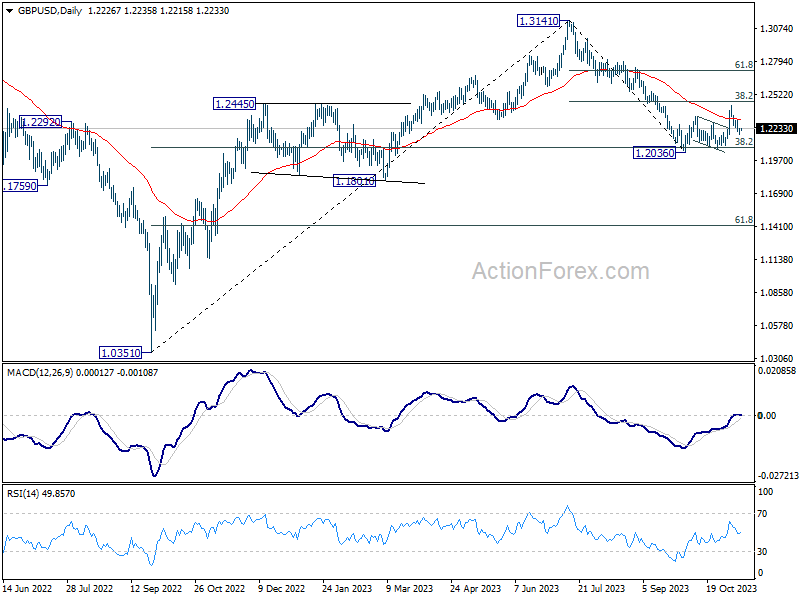
In the bigger picture, rejection by 38.2% retracement of 1.3141 to 1.2036 at 1.2458, suggests fall from 1.3141 is still in progress. Sustained break of 38.2% retracement of 1.0351 (2022 low) to 1.3141 at 1.2075 will bring deeper decline to 61.8% retracement at 1.1417, even just as a corrective move.
USD/CHF Daily Outlook
Daily Pivots: (S1) 0.8997; (P) 0.9021; (R1) 0.9040; More....
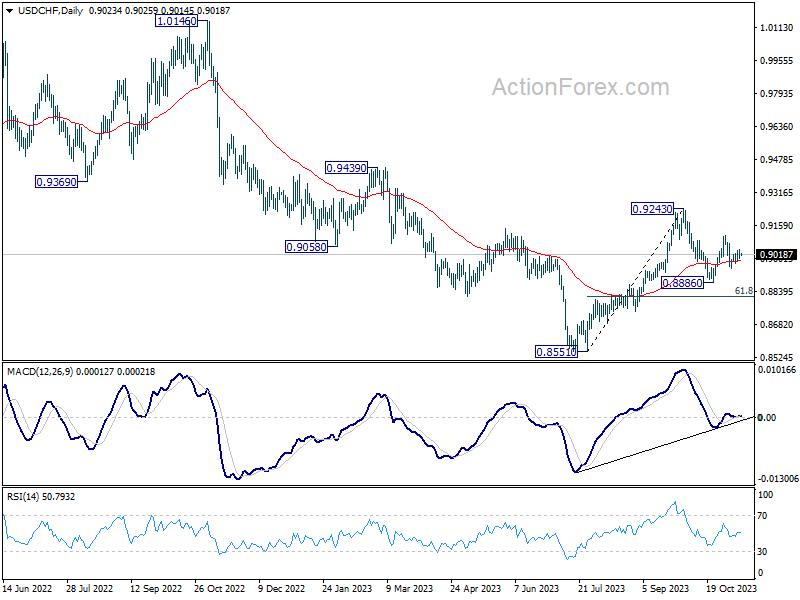
Intraday bias in USD/CHF remains neutral as range trading continues. On the downside, below 0.8952 will target a test on 0.8886 support first. Break there will resume whole decline from 0.9243 to 0.8815 fibonacci level. However, break of 0.9111 will resume the rebound from 0.8886 instead, and target 0.9243 resistance.
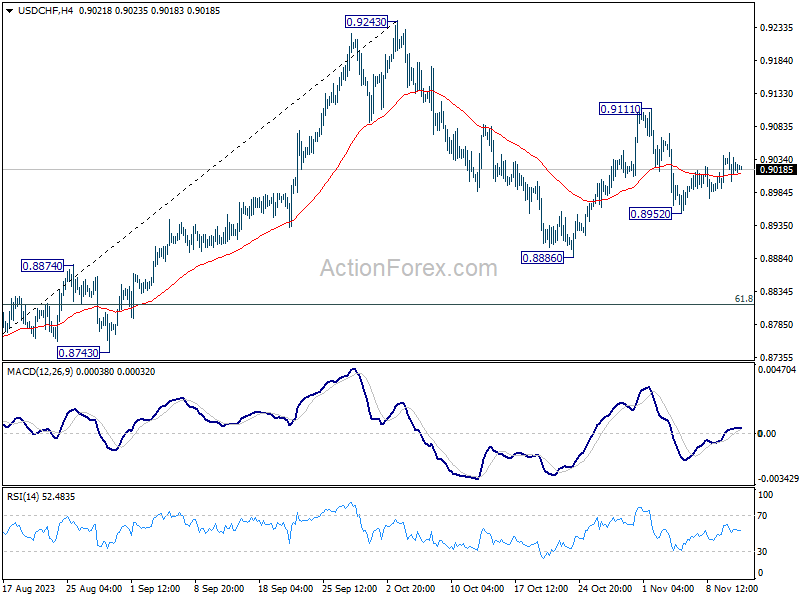
In the bigger picture, outlook is mixed up by the deeper than expected pull back from 0.9243. Yet there was no follow through selling after hitting 0.8886. On the upside, break of 0.9243 resistance will revive the case of medium term bottoming at 0.8851, and turn outlook bullish. However, sustained break of 61.8% retracement of 0.8551 to 0.9243 at 0.8815 will argue that larger decline from 1.0146 is ready to resume through 0.8551 low.
US CPI Week
Market movers today
There are no major data releases planned for today.
The most important release this week will likely be US CPI for October on Tuesday, which is extra uncertain this month due to possible effects from the auto workers' strike as well as technical factors relating to health insurance premiums. Also worth watching is US retail sales on Thursday after the very strong September-print. The week also features a long-expected Xi-Biden meeting on Wednesday along with a string of Chinese data and a possible Chinese rate cut, and UK job and inflation reports.
The 60 second overview
Market focus and overnight: Following a series of weeks this autumn where the market-narrative has shifted considerably amid new economic data releases, last week was rather uneventful when in terms of new global macro information for markets to trade on. The week was initially characterised by a decline in global yields but towards the end of last week we did see a slight reversal of the rally in fixed income with yields moving back higher. First, a few hawkish remarks from prominent Federal Reserve board members including Chair Powell halted the decline. Then Friday's release of University of Michigan inflation expectations showed a surprise rise in the 1Y measure from 4.2% to 4.4% (expected 4.0%) but more importantly the 5-10Y expectations also rose from 3.0% to 3.2% (expected 3.0%). Both drivers sent USD rates higher in a move that flattened the curve. We still think that we have hit the peak in Fed policy rates and do not envision a December rate hike. Also we still see the case for the first Fed rate cut to come as early as March.
It has been fairly quiet overnight with market sentiment turning slightly sour despite little new information and despite a late equity rally during the US session on Friday. On the data front Japanese producer prices were slightly lower than expected. Otherwise market focus is not least on US CPI this week and on US-China relations but also a seeming decline in geopolitical tensions in the Middle East is getting attention.
Oil. The oil market could be worth following in the coming weeks for a bellwether for the global business cycle. Oil prices dropped to the lowest level since July last week despite a severe Middle East crisis, Saudi Arabia hanging on to unilateral output cuts and a weaker USD. If the oil market does not reverse the recent losses global oil demand has likely deteriorated on the back of a drop in global economic growth.
Norway inflation surprise. On Friday, Norwegian core inflation for October surprised significantly to the topside. Core inflation rose to 6.0% y/y (expected: 5.6%) in annual terms while the (seasonally-adjusted) 3-month price growth rose from 2.9% to 4.9% . The details show that, somewhat surprisingly, there was a significant rebound in food prices. The prices of furniture/household equipment, air tickets, and hotel/restaurant services also rose more than expected, so the rise was quite broad-based. The release was a game changer in terms of the signals from previous months which had otherwise indicated a disinflationary trend. While Norwegian inflation releases are notoriously volatile the surprise rise in the October figures does challenge our narrative that underlying inflation clearly was in the process of decreasing. Given Norges Bank's rhetoric at the monetary policy meeting on 3 November this sharply lifts the probability of a 25bp rate hike in December - although we do not see it as a done deal. Indeed if we are right in expecting a sharp downward correction in the November CPI figures and in the growth picture weakening (GDP, regional network, etc.) we would expect markets to question the outlook for a final Norwegian rate hike.
Equities: Global equities were higher on Friday as the US market rallied into the late hour of trading and secured yet another positive week for equities. The rally was led by cyclicals taking 5 days in a row last week and outperforming defensives by almost 3%. It is worth noting that small-caps have been left out of recent rallies as investors see the recession fear as a bigger concern for small-caps compared to large-caps. Energy made a small comeback on Friday but that does not change the fact of an almost 8% underperformance versus tech last week. In the US on Friday: Dow +1.2%, S&P 500 +1.6%, Nasdaq +2.1% and Russell 2000 +1.1%. Asian markets are mostly lower this morning with Taiwan being the bright spot. European futures are flat while US futures are somewhat lower.
FI: European rates were mainly trading sideways on Friday in the 5y+ segment, while the short end sold off by 2-4bp amid ECB president Lagarde saying that a rate cut is not coming 'in the coming quarters' and given spill-overs from the USD curve.
FX: Last week, FX markets were characterised by a setback to commodity currencies in the likes of AUD, NZD and ZAR. While NOK initially had a poor week, Friday's Norwegian inflation surprise gave some support to the NOK returning EUR/NOK back below the 11.90 mark. EUR/USD was range-bound for the most part of last week although the final rise in short-end USD yields did contribute to sending EUR/USD below 1.07 on Friday. EUR/SEK remains close to the 11.65 area while EUR/GBP is back close to the 0.8750-mark.
Credit: Friday was a quiet day in the corporate bond market without significant news. iTraxx Main was 1bp wider at 76bp while iTraxx X-over was 4bp wider at 412bp.
Nordic macro
The only thing happening in Sweden is that vice Governor Aino Bunge will give the last speech of the Riksbank's executive board before the blackout period starts up to their rate decision on 22 November.
USD/JPY Daily Outlook
Daily Pivots: (S1) 151.30 (P) 151.45; (R1) 151.68; More...
As USD/JPY's rise from 149.17 extends, immediate focus is now on 151.93 key resistance. Decisive break there will confirm resumption of long term up trend. Next target will be 157.69 projection level. On the downside, below 151.21 minor support will turn intraday bias neutral first. But near term outlook will stay bullish as long as 149.17 support holds, even in case of deep retreat.
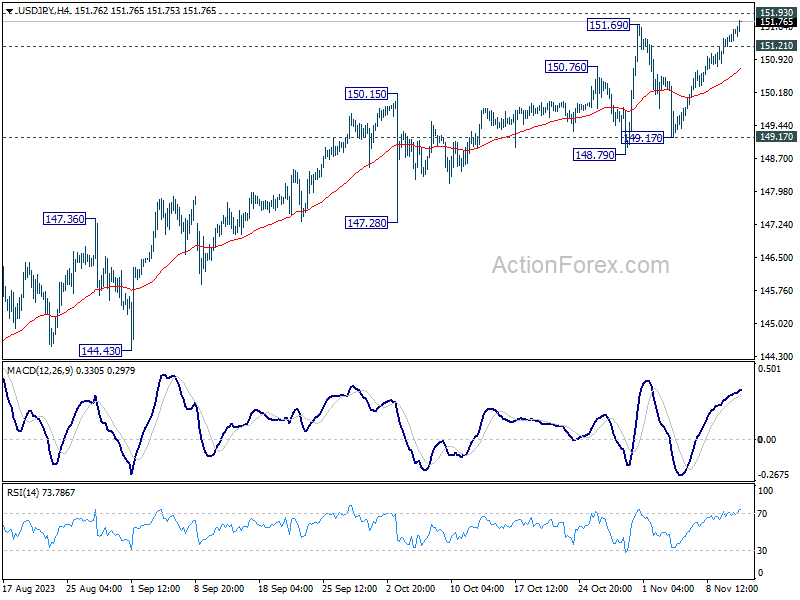
In the bigger picture, immediate focus is now on 151.93 resistance (2022 high). Rejection by 151.93, followed by sustained break of 145.06 resistance turned support will argue that rise from 127.20 has completed, and turn outlook bearish for 137.22 support and below. However, sustained break of 151.93 will confirm resumption of long term up trend. Next target will be 61.8% projection of 102.58 (2021 low) to 151.93 from 127.20 at 157.69.
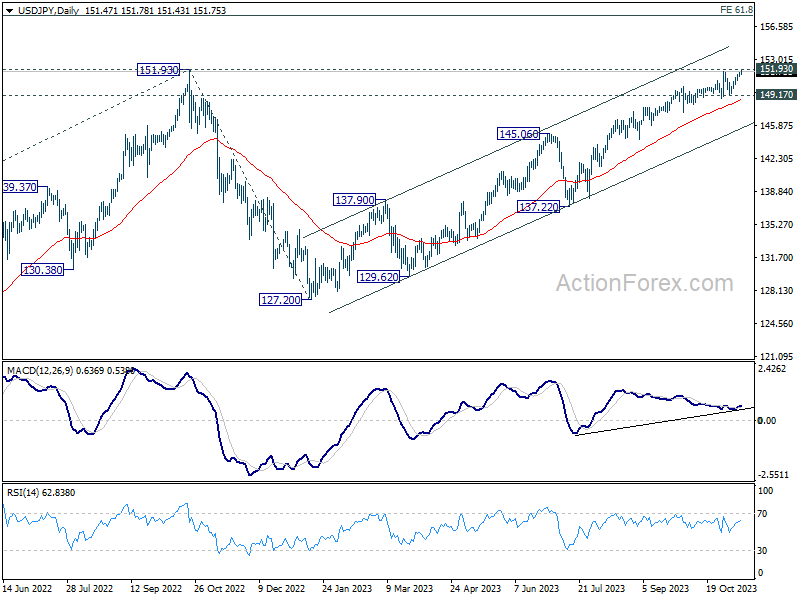
Yen Nears Multi-Decade Low Against Dollar, Eyes on Japan’s Response
Japanese Yen continues to weaken, accelerating its decline in today's Asian session and edging closer to a multi-decade low against Dollar. The market appears to be gaining confidence that Japan will not intervene at this stage, despite the steep and extended depreciation. But the country's approach to currency intervention remains shrouded in typical discretion. So, it's "never say never" regarding the timing of intervention.
Still, it should be noted that top Japanese officials have previously attributed part of Yen's weakness to the divergent monetary policies between Japan and other major economies. BoJ remains cautious, with even the most optimistic officials suggesting a wait until early next year's wage negotiations to gauge the sustainability of the 2% inflation target. That's a clear prerequisite to loose policy exit. Hence, Yen's bearish trend is unlikely to change before that.
In the broader currency market, Canadian Dollar trails Yen as the second weakest, followed by Swiss Franc. On the other hand, New Zealand Dollar leads as the strongest, with Sterling and Australian Dollar also showing robustness. Euro and Dollar are showing mixed performance.
As the week progresses, the focus will shift back to key economic data, particularly CPI figures from US the UK, which are expected to influence market sentiment and central bank policies significantly.
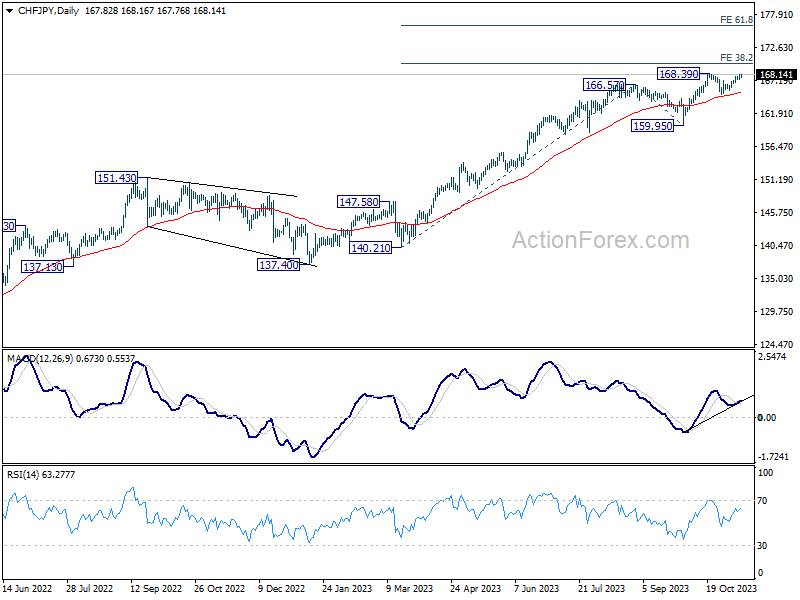
Technically, CHF/JPY's pull back from 168.39 appears to be finished already, ahead of 55 EMA. The shallow fall is likely just a correction to the rise from 159.95 to 168.39 only. Immediate focus is now on 168.39. Decisive break there will resume larger up trend. Next target is 38.2% projection of 140.21 to 166.57 from 159.95 at 170.01. Firm break there could prompt upside acceleration to 61.8% projection at 176.24 next.
In Asia, at the time of writing, Nikkei is down -0.05%. Hong Kong HSI is up 0.01%. China Shanghai SSE is down -0.07%. Singapore Strait Times is down -0.91%. Japan 10-year JGB yield is up 0.026 at 0.884.
Japan's wholesale inflation eases to 0.8% yoy, continued downward trend
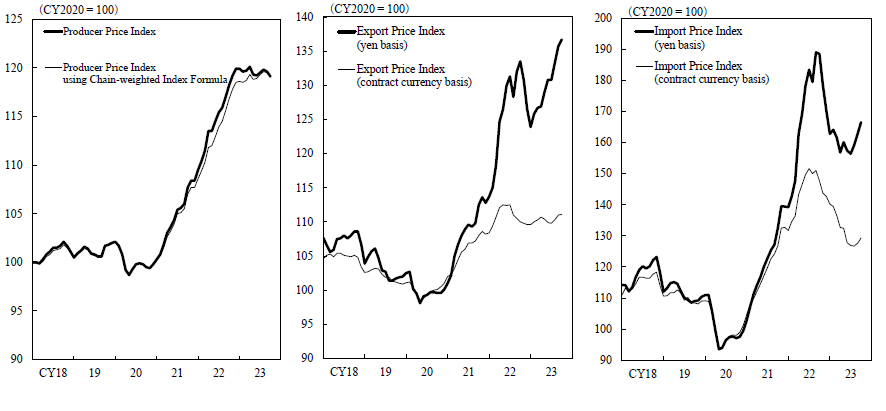
Japan's corporate goods price index, a key indicator of wholesale inflation, exhibited a significant slowdown in October, underscoring a continued trend of easing price pressures.
The index increased by just 0.8% yoy, falling short of the anticipated 0.9% yoy and marking its first dip below 1% since February 2021. This latest figure also represents the 10th consecutive month of slowing wholesale inflation.
The deceleration in the CGPI can be largely attributed to decreases in the prices of specific commodities. Notably, costs for wood, chemical, and steel products experienced declines, reflecting the broader impact of reduced global commodity prices.
Export price index saw an uptick from 0.5% yoy to 1.0% yoy. Import price index showed a lesser decline, moving from -15.5% yoy to -12.5% yoy.
RBA's Kohler warns of bumpy road ahead in tackling inflation
In a speech, Marion Kohler, Acting Assistant Governor of RBA, remarked that decline in inflation is expected to be a "more gradual process than previously thought."
This outlook stems from the current economic environment characterized by "still-high level of domestic demand" and "strong labour" alongside other cost pressures. These factors contribute to the prediction that inflation will hover just below 3% by the end of 2025.
The Assistant Governor pointed out that the recent trend of declining inflation has primarily been "driven by lower goods price inflation." In stark contrast, "domestically sourced inflation" – especially in the services sector – has shown resilience, being "widespread and slow to decline."
Kohler also underscored the nuanced challenges in the next phase of controlling inflation, which she anticipates to be "more drawn out than the first." This outlook aligns with experiences in other advanced economies that have faced similar inflationary patterns.
Furthermore, she cautioned about the potential for unforeseen challenges, citing the recent increase in fuel prices as an example of supply shocks that could unpredictably influence headline inflation.
Kohler emphasized the uncertain nature of the journey ahead in managing inflation, stating, "the road ahead could be bumpy."
New Zealand BNZ services fell to 48.9, contraction with economic angst
New Zealand's BusinessNZ Performance of Services Index experienced a notable dip in October, falling from 50.6 to 48.9, a level indicative of contraction in the sector. This decline also positions the index well below its long-term average of 53.5.
Activity and sales experienced a significant drop, moving from 50.9 to 47.4. There was also a downturn in employment, which decreased from 50.5 to 49.3. New orders and business fell as well,from 53.9 to 51.9. On a more positive note, stocks and inventories saw an increase, rising from 48.0 to 51.1, and supplier deliveries edged up slightly from 49.7 to 49.8.
Despite these declines, the proportion of negative comments in October decreased to 58.2%, a reduction from 61.8% in September and 63.9% in August, indicating a slight improvement in business sentiment.
BNZ Senior Economist Craig Ebert said that "combined, the PSI (48.9) and PMI (42.5) paint a picture of economic angst. This counsels caution around GDP for Q3, after it posted a surprising gain of 0.9% in Q2".
US CPI Data in Focus: A Test of Fed's Insufficient Confidence in Disinflation Progress
A slew of significant economic data releases are scheduled for the week. A major focal point will be US CPI. Market expectations are set for deceleration in headline CPI from 3.7% yoy to 3.3%, while core CPI is anticipated to hold steady at 4.1% yoy.
This data comes under the microscope following remarks from Fed Chair Jerome Powell last week. Powell expressed that Fed is "not confident" about whether the current monetary policy is "sufficiently restrictive" to bring inflation down to the 2% target. His concerns echo the global sentiment that the final leg of the disinflation journey is often the most challenging.
Adding to the intrigue, University of Michigan's report last Friday revealed an uptick in year-ahead inflation expectations to a seven-month high of 4.4%, a significant jump from the previous readings of 4.2% in October and 3.2% in September. Notably, long-term inflation expectations have also escalated to 3.2%, marking the highest point since 2011.
Should the upcoming US CPI report deliver any unexpected upside surprise, it could heavily tilt the scales towards at least one more rate hike by Fed before the end of the tightening cycle.
Alongside CPI, US retail sales data will also be under scrutiny, offering insights into consumer behavior amidst the dual challenges of high inflation and elevated interest rates.
Across the Atlantic, UK CPI is another critical data point, with expectations pointing to a significant slowdown in headline reading from 6.7% yoy to 4.7% yoy, and core CPI anticipated to decrease from 6.1% yoy to 5.7%.
UK's disinflation process is clearly lagging other major economies. BoE Chief Economist Huw Pill recently suggested a strategy of maintaining current interest rates for an extended period to effectively combat inflation. This approach is likely to persist, barring any dramatic spikes in inflation figures. More intensify debate would start when disinflation finally approaches the "last mile".
Additional data releases such as UK job data, retail sales, German ZEW economic sentiment, and Japan's GDP will also be closely monitored. For Australia, employment report is due, but its impact might be overshadowed by crucial data from China, including industrial production and retail sales, which hold significant implications for the Australian economy.
Here are some highlights for the week:
- Monday: New Zealand BNZ services index; Japan PPI, machine tool orders.
- Tuesday: Australia Westpac consumer sentiment, NAB business confidence; UK employment; Swiss PPI; Eurozone GDP revision; Germany ZEW economic sentiment; US CPI.
- Wednesday: Japan GDP; Australia wage price index; China industrial production, retail sales, industrial production; UK CPI; Eurozone industrial production, trade balance; Canada manufacturing sales, wholesale sales; US retail sales PPI, Empire state manufacturing, business inventories.
- Thursday: Japan machine orders, trade balance; Australia employment; Japan tertiary industry index; Italy trade balance; Canada housing starts; US jobless claims, Philly Fed survey, import prices, industrial production, NAHB housing index.
- Friday: New Zealand PPI; UK retail sales; Eurozone current account, CPI final; Canada IPPI, RMPI; US building permits and housing starts.
USD/JPY Daily Outlook
Daily Pivots: (S1) 151.30 (P) 151.45; (R1) 151.68; More...
As USD/JPY's rise from 149.17 extends, immediate focus is now on 151.93 key resistance. Decisive break there will confirm resumption of long term up trend. Next target will be 157.69 projection level. On the downside, below 151.21 minor support will turn intraday bias neutral first. But near term outlook will stay bullish as long as 149.17 support holds, even in case of deep retreat.
In the bigger picture, immediate focus is now on 151.93 resistance (2022 high). Rejection by 151.93, followed by sustained break of 145.06 resistance turned support will argue that rise from 127.20 has completed, and turn outlook bearish for 137.22 support and below. However, sustained break of 151.93 will confirm resumption of long term up trend. Next target will be 61.8% projection of 102.58 (2021 low) to 151.93 from 127.20 at 157.69.
Economic Indicators Update
| GMT | Ccy | Events | Actual | Forecast | Previous | Revised |
|---|---|---|---|---|---|---|
| 21:30 | NZD | Business NZ PSI Oct | 48.9 | 50.7 | ||
| 23:50 | JPY | PPI Y/Y Oct | 0.80% | 0.90% | 2.00% | 2.20% |
| 06:00 | JPY | Machine Tool Orders Y/Y Oct P | -20.60% | -11.20% | ||
| 10:00 | EUR | EU Economic Forecasts |
Struggling Aussie Faces Huge Data Week
The Aussie dollar fell every day last week, losing about 1.5 cents despite the RBA rate hike. A resilient US dollar kept a lid on A$, adding to the focus on US CPI data this week. There will also be key Australian data, including Q3 wages and October employment.
The RBA raised its cash rate 25bp to 4.35%, a decision expected by almost all forecasters (including Westpac) and about 80% priced into money markets. Governor Bullock’s statement summarised the information received since the previous official forecasts in August as showing that “the risk of inflation remaining higher for longer has increased.” Both economic growth and inflation were higher than expected, inflation uncomfortably so.
This reasoning was widely expected but markets reacted to a surprise change in the wording of the closely watched final paragraph, from “some further tightening of monetary policy may be required” (used for the past 6 meetings) to “whether further tightening of monetary policy is required.” This change obviously doesn’t close the door on another hike but it was enough to leave AUD/USD down about half a cent on the day, at 0.6435.
The Aussie’s underperformance on many cross rates is surprising given that money markets continue to price considerable risk of further RBA tightening, in contrast to major central banks. A 5 December hike is widely viewed as a low probability given the limited data before then. But a further 20bp (80% chance of a hike) is priced by May 2024. So on short-end yield spreads, the Aussie’s support is still much improved over the past few weeks.
The Aussie extended its decline on Wednesday and especially Thursday when the US dollar posted sharp gains. The main catalyst was a speech by Fed chair Jerome Powell. He said that “we are not confident that we have achieved” a sufficiently restrictive monetary policy setting to return inflation to the 2% target. Powell’s remarks prompted a bounce in US yields, part of a sizeable gain for the week – the 2-year Treasury note yield rose from 4.84% to 5.06%.
We will hear plenty more from Fed officials this week, but not from Powell. The US focus will be on key October data – the consumer price index and retail sales. CPI is most market-sensitive, with consensus 3.3%yr versus 3.7%yr in September but CPI ex-food and energy unchanged at 4.1%yr.
Australia’s data calendar is very crowded. Westpac-MI November consumer sentiment will show the public response to the RBA’s Melbourne Cup Day rate rise. The Q3 wages survey will capture the July jump in the minimum wage. Westpac looks for 1.3%qtr, 3.9%yr, up from 3.6%yr in Q2. The report will be perused for indicators of wage pressures outside the award wages jump.
In its November statement, the RBA said that “Conditions in the labour market have eased but they remain tight.” In October, Westpac expects a 25k rebound in employment after the soft 7k gain in September. We look for the unemployment rate to remain at 3.6%, while softness in hours worked will also be monitored. As always, there is plenty of room for surprise in this report so AUD will be on edge.
The Aussie’s commodity price support remains mixed. The LME base metals index slipped -1.3% over the week, to be just 1% above year-to-date lows. Crude oil prices hit lows since July, some analysts blaming worries over China’s growth prospects. But iron ore rallied another 3.9% to $127/tonne, reaching highs since March and a long way above Australia’s federal budget assumptions.
The slide in US equities last Thursday coincided with a sharp fall in the Aussie, though equity weakness is often also correlated with a rise in US yields so it can be hard to assess which is impacting the A$ more. It may be in the week ahead that the US equity/rates nexus determines whether AUD/USD tests the bounds of its November range of 0.6318-0.6523.
Event risk
Singapore holiday (Mon), Aust Nov Westpac consumer sentiment, Oct NAB business confidence, Germany Nov ZEW investor sentiment, UK Sep average earnings, US Oct CPI (Tue), Aust Q3 wage price index, Japan Q3 GDP, China Oct retail sales, industrial production, UK Oct CPI, US Oct retail sales (Wed), Aust Oct employment (Thu), UK Oct retail sales (Fri)
EUR/USD Could Resume Increase, USD/JPY Rallies
Key Highlights
- EUR/USD is correcting gains from the 1.0750 resistance zone.
- A key declining channel is forming with resistance near 1.0690 on the 4-hour chart.
- Gold prices started a downside correction from the $2,010 level.
- USD/JPY regained strength and was able to clear the 151.50 resistance.
EUR/USD Technical Analysis
The Euro moved into a bullish zone above the 1.0620 level against the US Dollar. EUR/USD even tested the 1.0750 zone before the bears appeared.
Looking at the 4-hour chart, the pair traded as high as 1.0756 before there was a downside correction. The pair declined below the 23.6% Fib retracement level of the upward move from the 1.0516 swing low to the 1.0756 high.
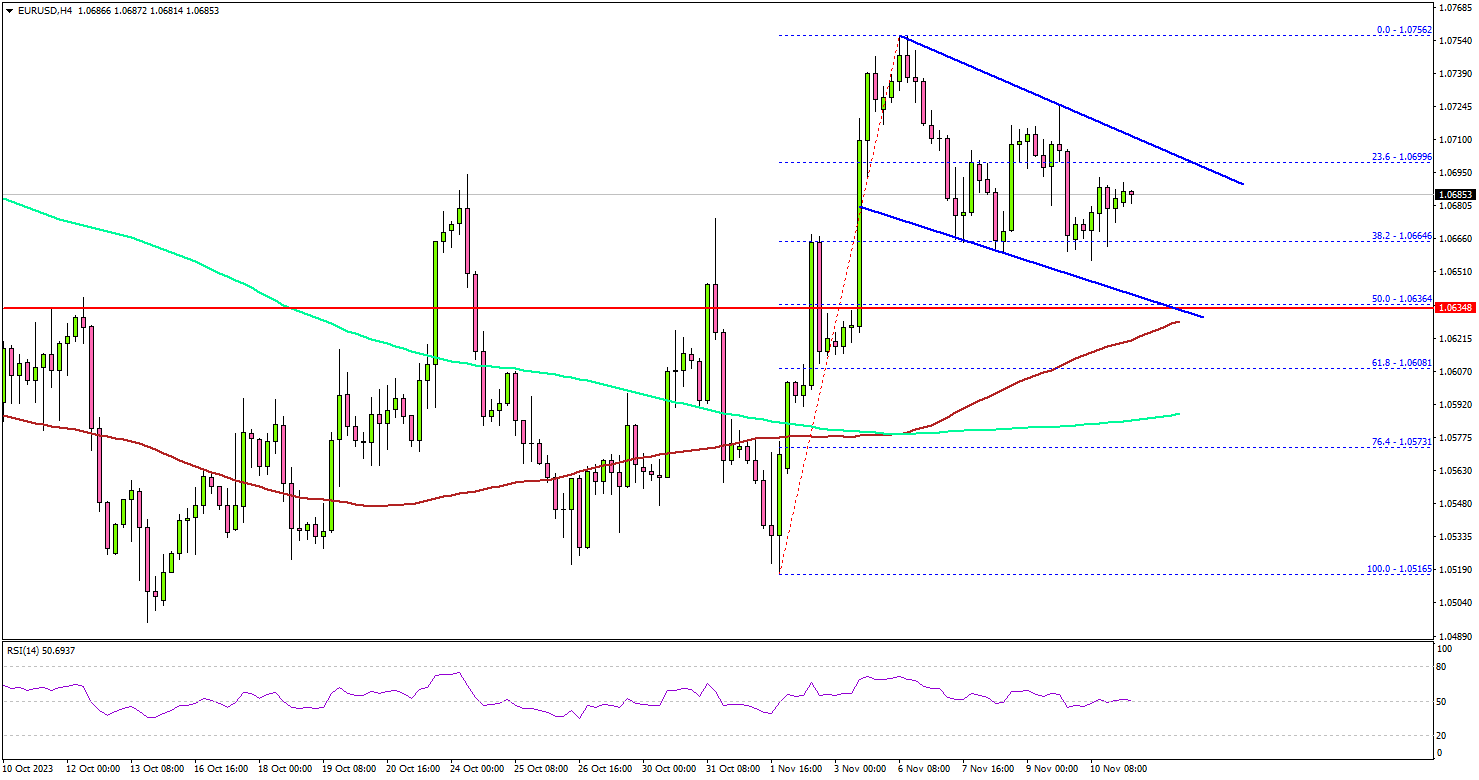
It is still trading well above the 1.0620, the 100 simple moving average (red, 4 hours), and the 200 simple moving average (green, 4 hours).
There is also a key declining channel forming with resistance near 1.0690 on the same chart. If there is a fresh increase, the pair could surpass the channel resistance. The next key resistance is near the 1.0720 level.
The main resistance is still near the 1.0750 level. A close above the 1.070 zone could open the doors for more upsides. The next stop for the bulls might be 1.0880.
If not, the pair might start another drop below the 1.0650 support. The first major support is now forming near the 1.0635 level or the 50% Fib retracement level of the upward move from the 1.0516 swing low to the 1.0756 high, below which the pair could test the 1.0620 pivot level in the near term.
The main support sits near the 1.0520 zone. A downside break below 1.0520 might spark a sharp decline. The next key support sits at 1.0440.
Looking at USD/JPY, the pair is rising and might soon aim for a new high above the 151.75 resistance zone in the coming sessions.
Economic Releases
- European Commission releases Economic Growth Forecasts.
Japan’s wholesale inflation eases to 0.8% yoy, continued downward trend
Japan's corporate goods price index, a key indicator of wholesale inflation, exhibited a significant slowdown in October, underscoring a continued trend of easing price pressures.
The index increased by just 0.8% yoy, falling short of the anticipated 0.9% yoy and marking its first dip below 1% since February 2021. This latest figure also represents the 10th consecutive month of slowing wholesale inflation.
The deceleration in the CGPI can be largely attributed to decreases in the prices of specific commodities. Notably, costs for wood, chemical, and steel products experienced declines, reflecting the broader impact of reduced global commodity prices.
Export price index saw an uptick from 0.5% yoy to 1.0% yoy. Import price index showed a lesser decline, moving from -15.5% yoy to -12.5% yoy.