

Sample Category Title
USD/CHF Weekly Outlook
USD/CHF's pull back from 0.9111 extended to 0.8952 last week but recovered since then. Initial bias remains neutral this week first. On the downside, below 0.8952 will target a test on 0.8886 support first. Break there will resume whole decline from 0.9243 to 0.8815 fibonacci level. However, break of 0.9111 will resume the rebound from 0.8886 instead, and target 0.9243 resistance.
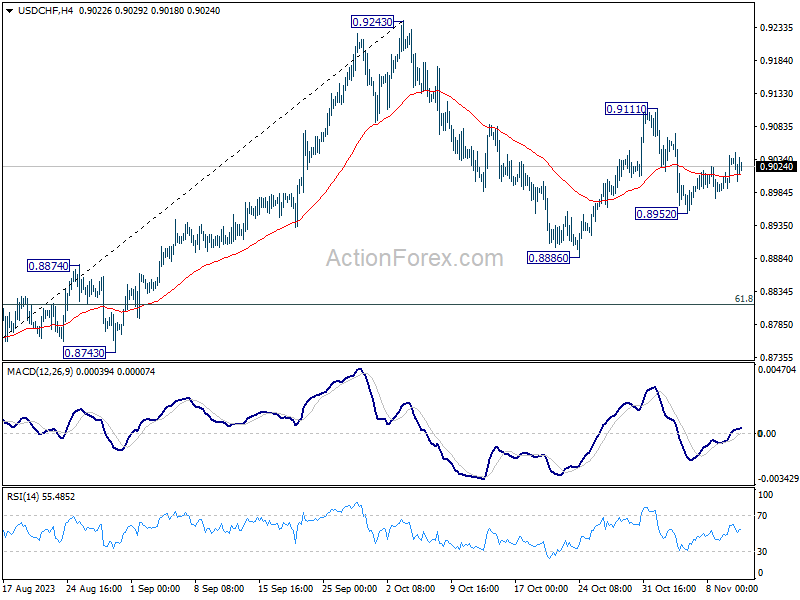
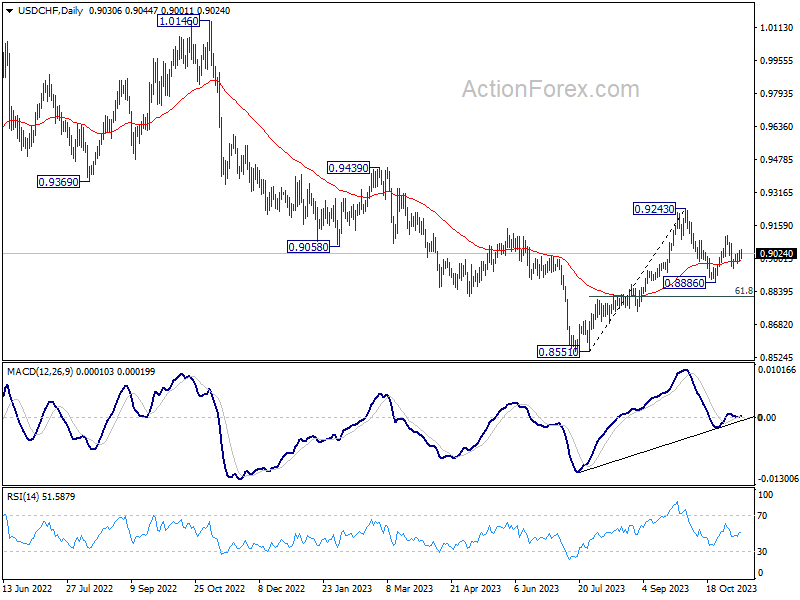
In the bigger picture, outlook is mixed up by the deeper than expected pull back from 0.9243. Yet there was no follow through selling after hitting 0.8886. On the upside, break of 0.9243 resistance will revive the case of medium term bottoming at 0.8851, and turn outlook bullish. However, sustained break of 61.8% retracement of 0.8551 to 0.9243 at 0.8815 will argue that larger decline from 1.0146 is ready to resume through 0.8551 low.
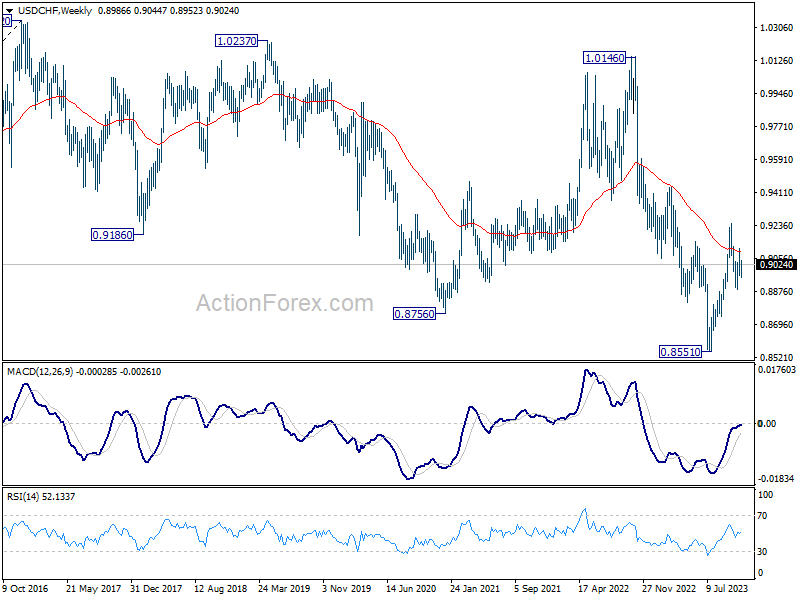
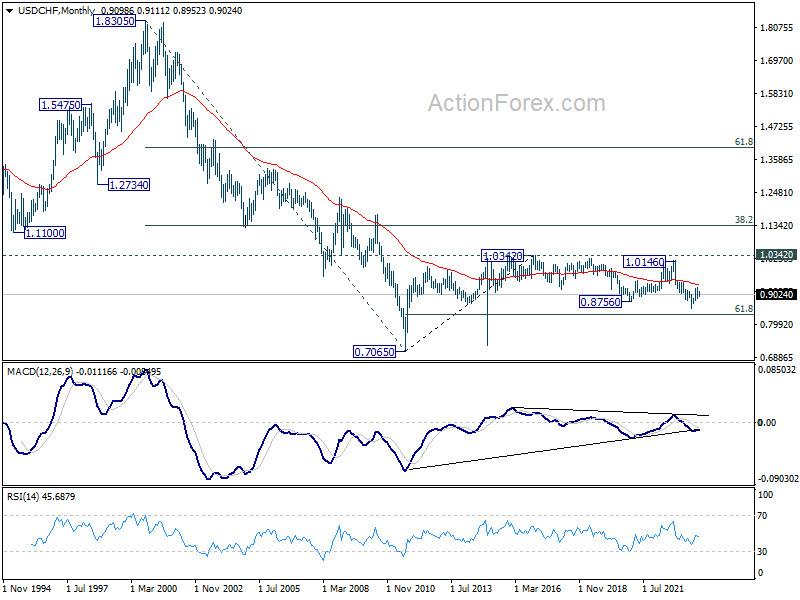
In the long term picture, there is no clear sign that down trend from 1.8305 (2000 high) has completed. With 38.2% retracement of 1.8305 to 0.7065 at 1.1359 intact, outlook is neutral at best.
AUD/USD Weekly Report
AUD/USD's steep decline last week argues that rebound from 0.6269 has completed at 0.6521. Initial bias remains mildly on the downside this week for retesting 0.6269 low. On the upside, above 0.6390 minor resistance will turn intraday bias neutral first, and bring consolidations, before staging another fall.
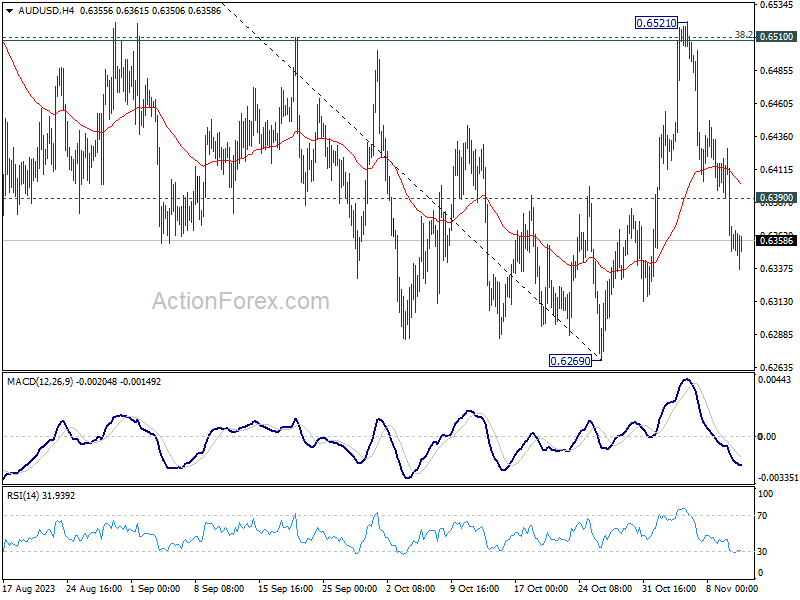
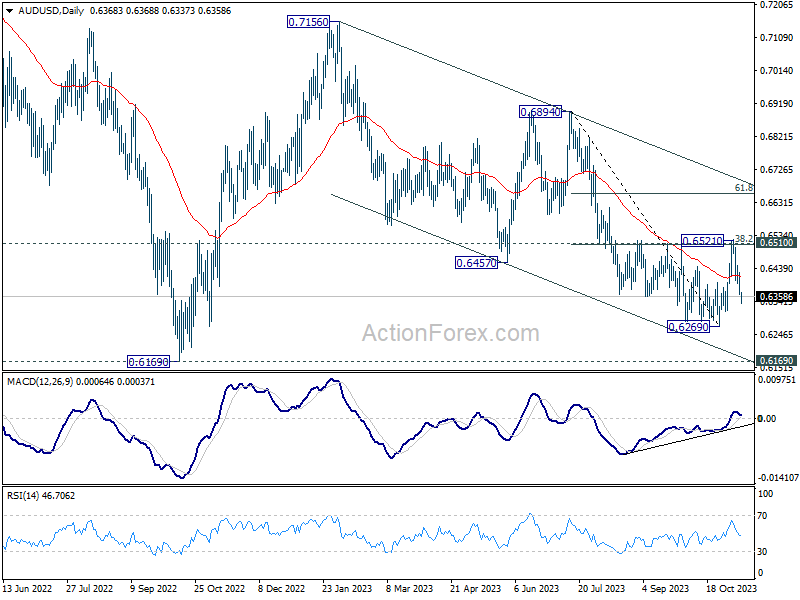
In the bigger picture, rejection by 0.6510 cluster resistance (38.2% retracement of 0.6894 to 0.6269 at 0.6508) keeps medium term outlook bearish. Fall from 0.7156 (2023 high) is still in progress. Break of 0.6269 will resume the down trend and target 0.6169 (2022 low). Nevertheless, firm break of 0.6521 will now indicate medium term bottoming, and bring stronger rebound.
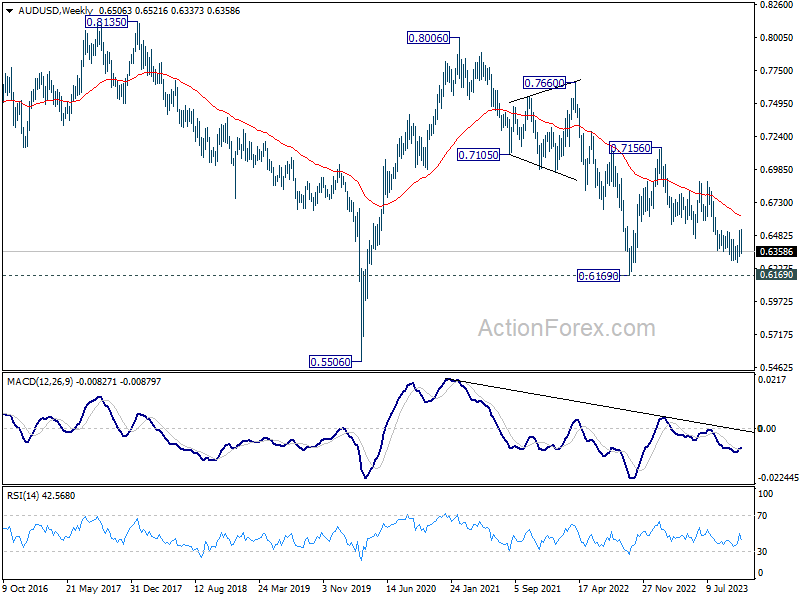
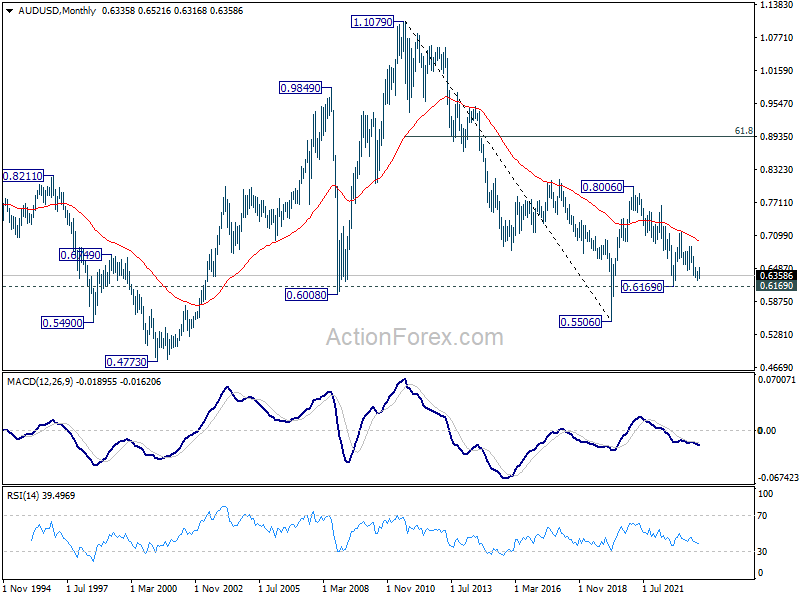
In the long term picture, the down trend from 1.1079 (2011 high) should have completed at 0.5506(2020 low) already. It's unsure yet whether price actions from 0.5506 are developing into a corrective pattern, or trend reversal. But in either case, fall from 0.8006 is seen the second leg of the pattern. Hence, in case of deeper decline, downside strong support should emerge above 0.5506 to bring reversal.
USD/CAD Weekly Outlook
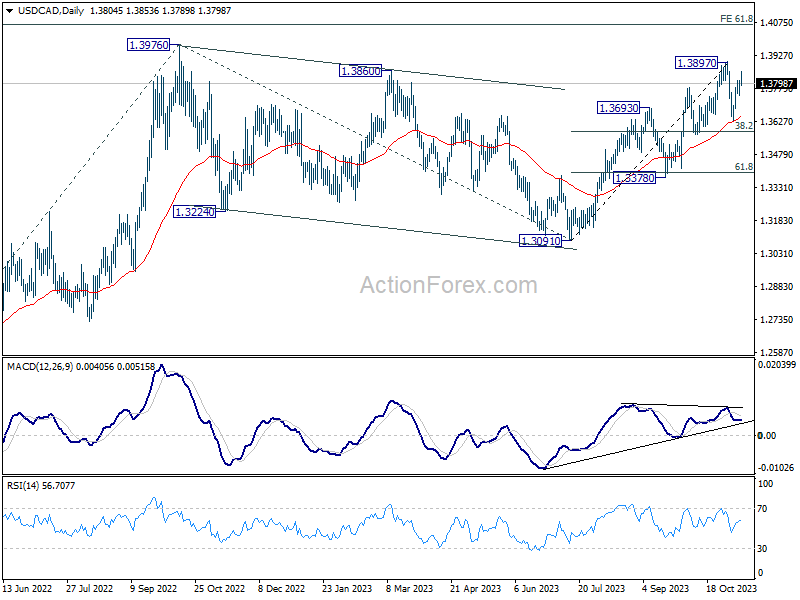
USD/CAD's strong rebound last week indicates that pull back from 1.3897 has completed at 1.3627. Initial bias stays mildly on the upside this week for retesting 1.3897 resistance next. Strong resistance could be seen there to limit upside on first attempt. On the downside, break of 1.3745 will turn bias to the downside to extend the corrective pattern from 1.3897 with another falling leg. In this case, strong support should be seen from 38.2% retracement of 1.3091 to 1.3897 at 1.3589 to bring rebound.
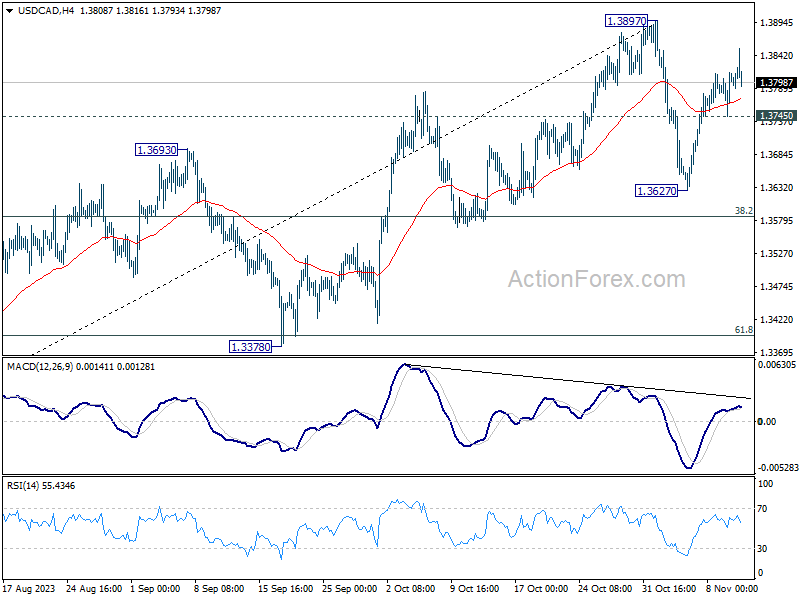
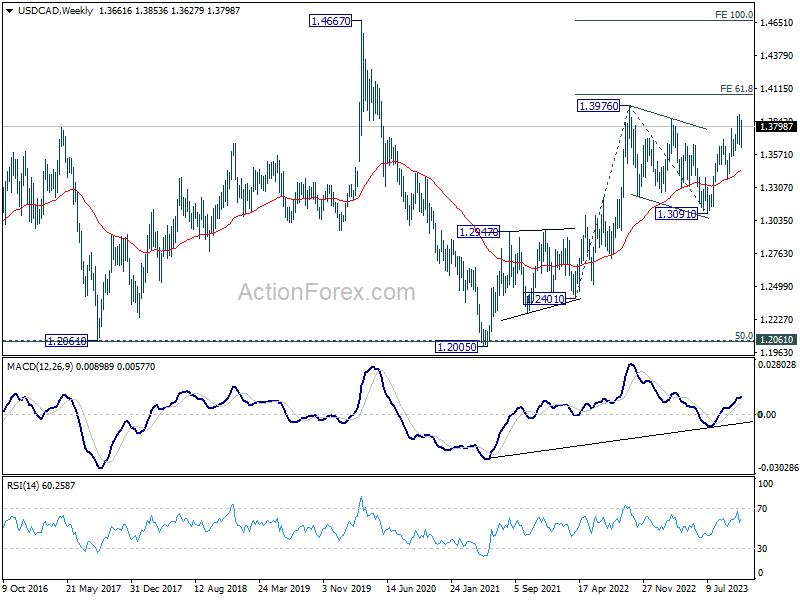
In the bigger picture, corrective pattern from 1.3976 (2022 high) should have completed with three waves down to 1.3091. Decisive break of 1.3976 high will confirm resumption of up trend from 1.2005 (2021 low). Next target is 61.8% projection of 1.2401 to 1.3976 from 1.3091 at 1.4064. This will remain the favored case as long as 1.3378 support holds.
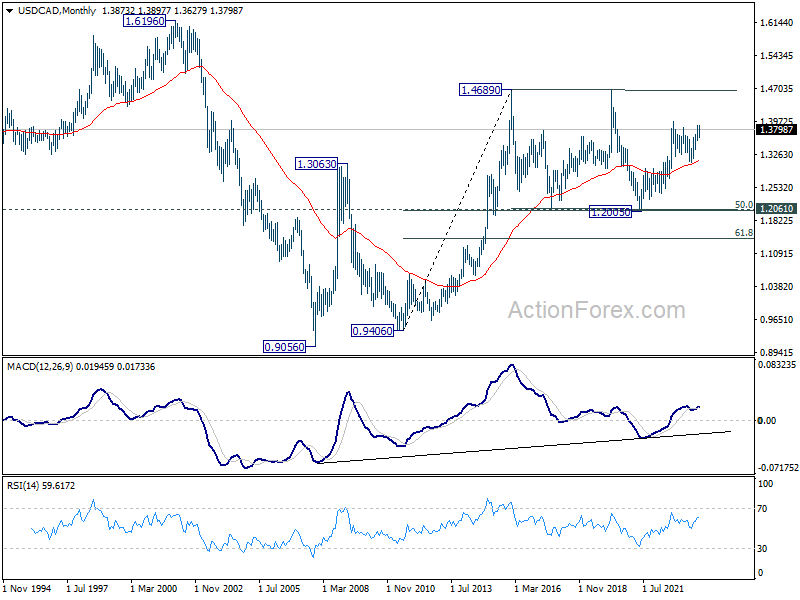
In the longer term picture, price actions from 1.4689 (2016 high) are seen as a consolidation pattern only, which might have completed at 1.2005. That is, up trend from 0.9506 (2007 low) is expected to resume at a later stage. This will remain the favored case as 55 M EMA (now at 1.3132) holds.
GBP/JPY Weekly Outlook
GBP/JPY edged higher to 185.94 last week but turned sideway since then. Initial bias remains neutral this week and more consolidations could be seen. But in case of another dip, downside should be contained above 182.71 support to bring another rally. Break of 185.94 will resume the rebound from 178.02 to retest 186.75 high next.
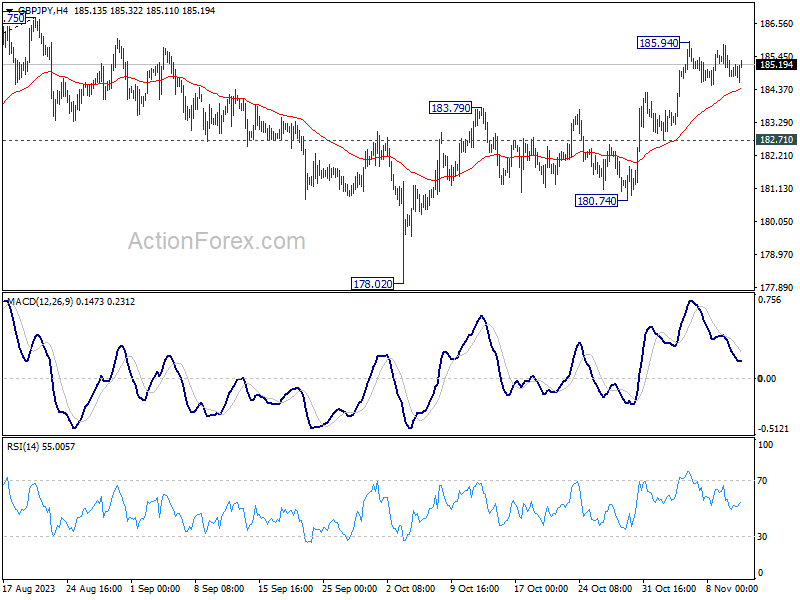
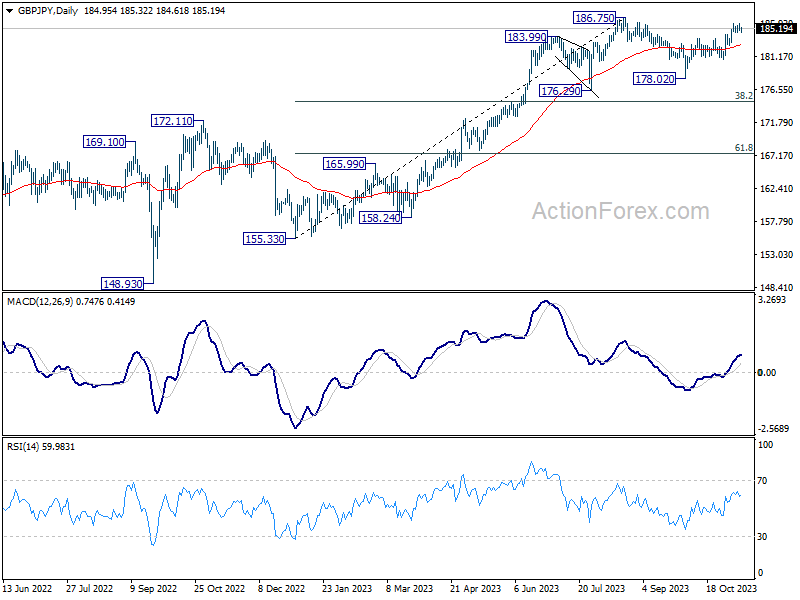
In the bigger picture, as long as 176.29 support holds, larger up trend from 123.94 (202 low) should still be in progress. Break of 186.75 will target 195.86 (2015 high). Nevertheless, firm break of 176.29 will confirm medium term topping, and bring lengthier and deeper consolidations.
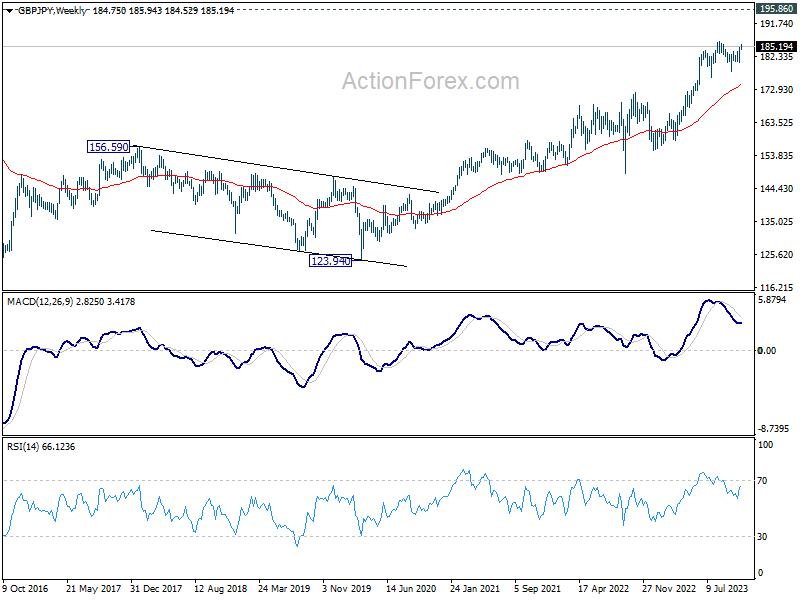
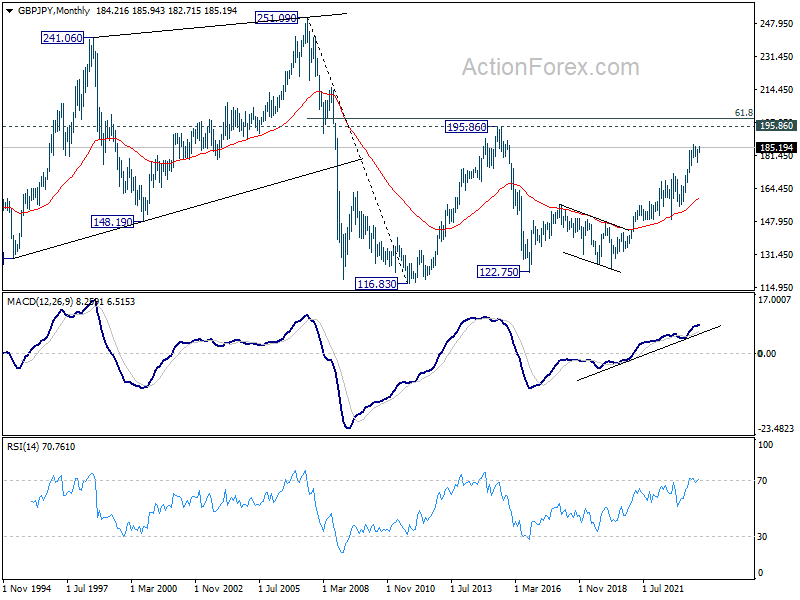
In the longer term picture, rise from 122.75 (2016 low) in still in progress but started losing upside momentum as seen in W MACD. Further rise will remain in favor, though, as long as 176.29 support holds, to retest 195.86 (2015 high).
EUR/JPY Weekly Outlook
EUR/JPY's up trend continued last week and hit as high as 161.93. Initial bias stays on the upside this week. Further rise should be seen to 163.06 projection level next. Strong resistance could be seen there to limit upside on first attempt. On the downside, below 161.01 minor support will turn intraday bias neutral and bring consolidations first, before staging another rise.
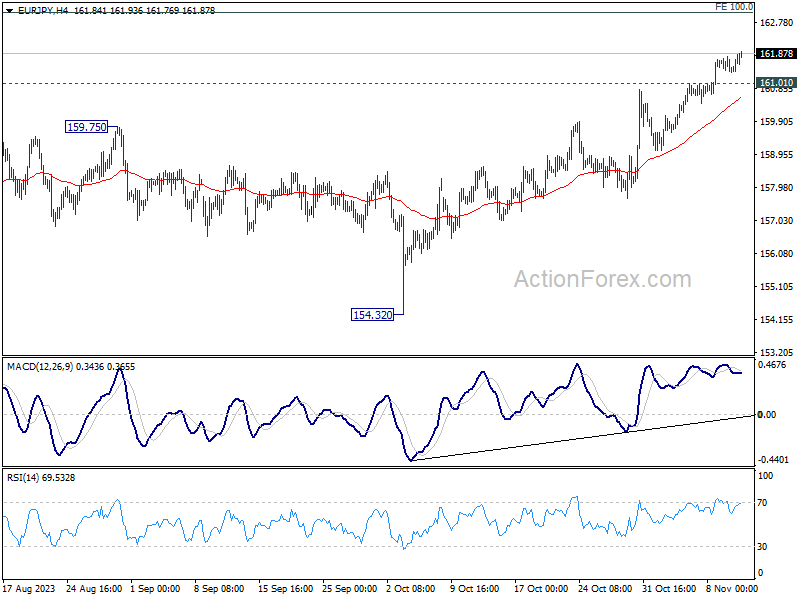
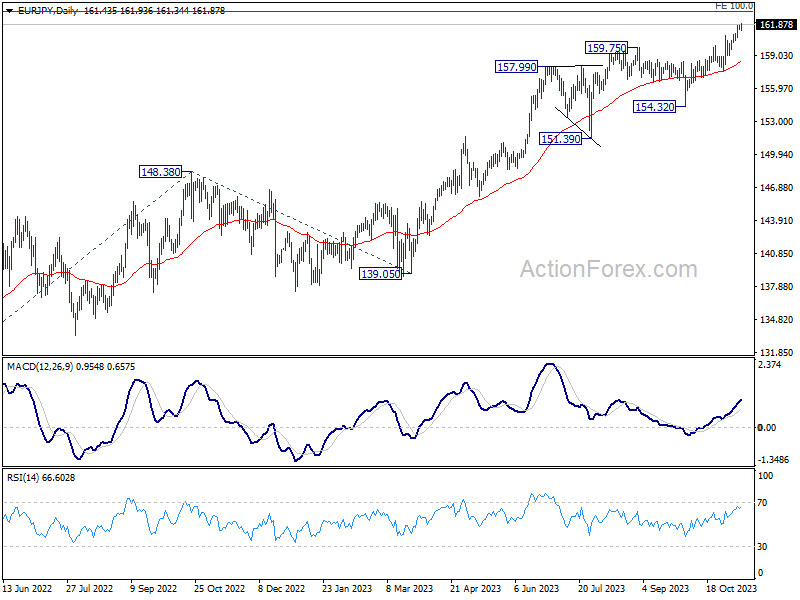
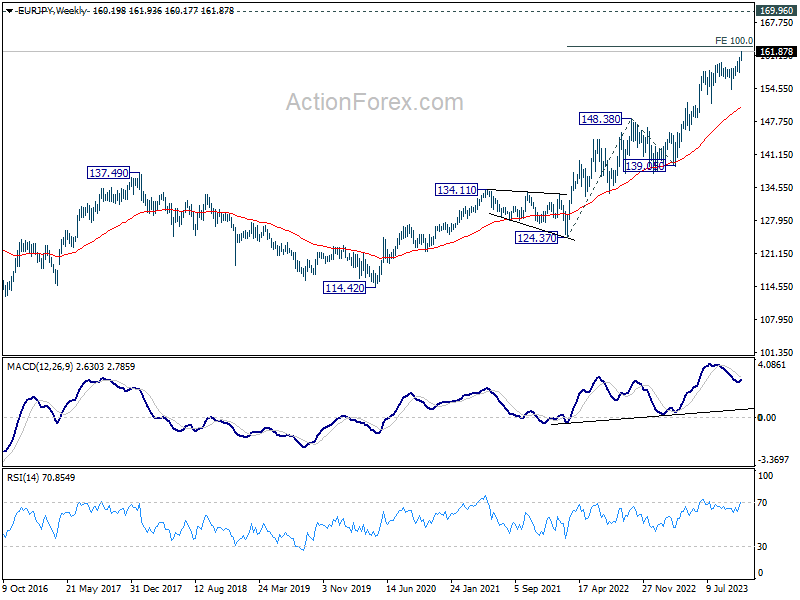
In the bigger picture, rise from 114.42 (2020 low) is in progress. Next target is 100% projection of 124.37 to 148.38 from 139.05 at 163.06. Sustained break there will target 169.96 (2008 high). On the downside, break of 154.32 support is needed to be the first sign of medium term topping. Otherwise, outlook will remain bullish even in case of deep pullback.
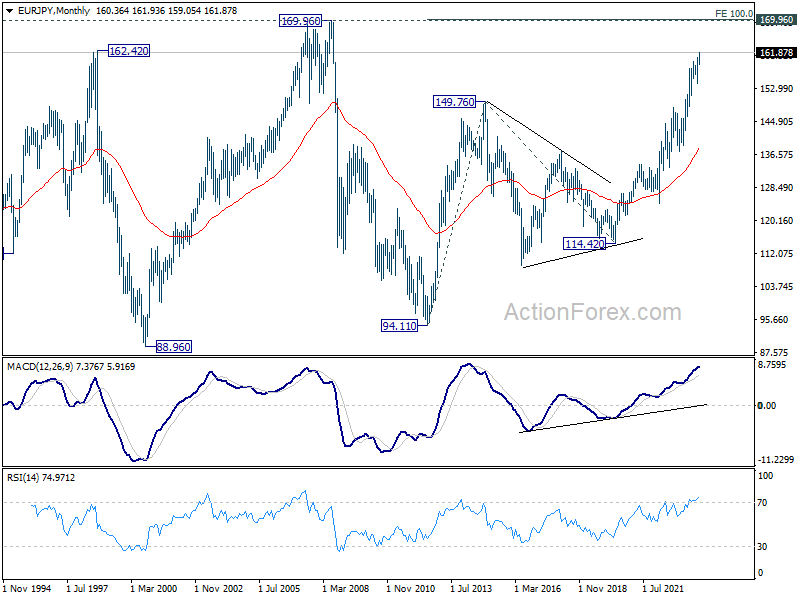
In the long term picture, rise from 109.03 (2016 low) is seen as the third leg of the whole up trend from 94.11 (2012 low). Next target is 100% projection of 94.11 to 149.76 from 114.42 at 170.07 which is close to 169.96 (2008 high).
EUR/GBP Weekly Outlook
EUR/GBP's strong rebound last week suggests that correction from 0.8752 has completed at 0.8648, after hitting 38.2% retracement of 0.8491 to 0.8752 at 0.8652. Initial focus is on 0.8752 resistance this week. Decisive break there will resume larger up trend and target 0.8874 resistance next. On the downside, below 0.8715 minor support will extend the corrective pattern with another falling leg before completion.
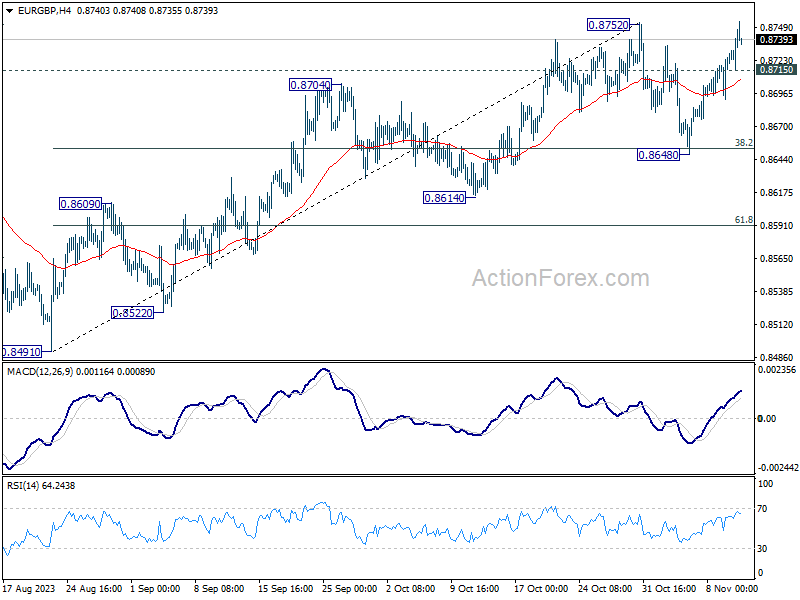
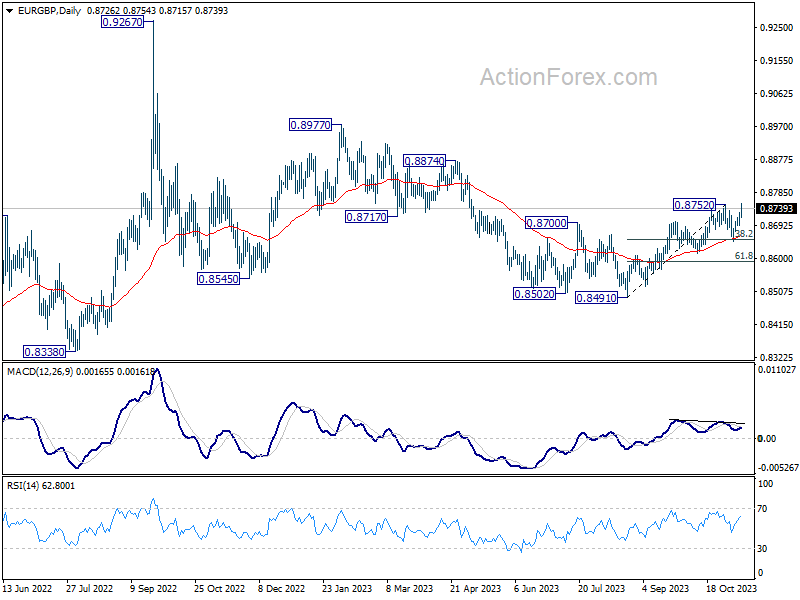
In the bigger picture, current development suggests that whole down trend from 0.9267 (2022 high) has completed with three down to to 0.8491. Rise from 0.8491 is seen as another leg inside that pattern from 0.9499 (2020 high). Further rally should be seen to 0.8977 resistance and above. This will remain the favored case as long as 0.8614 support holds.
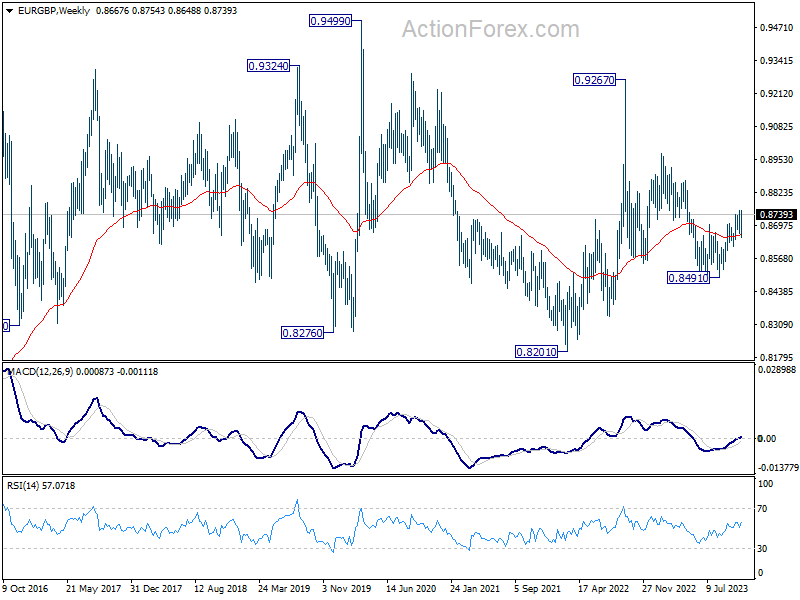
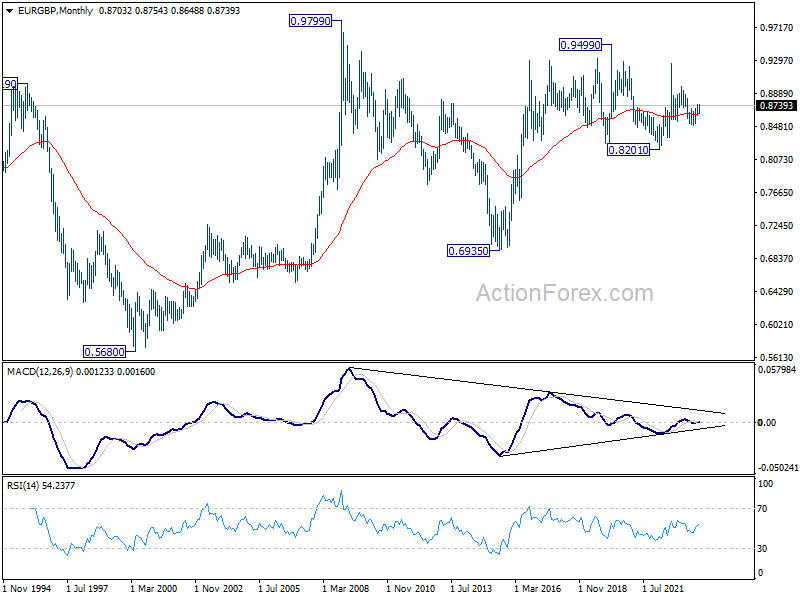
In the long term picture, long term range pattern is extending. But rise from 0.6935 (2015 low) is expected to resume at a later stage, to 0.9799 (2009 high).
EUR/AUD Weekly Outlook
EUR/AUD's strong rebound last week revived near term bullishness. Immediate focus is on 1.6843 resistance this week. Firm break there will resume the rebound from 1.6319 for retesting 1.7062 high next. On the downside, however, below 1.6666 minor support will turn bias back to the downside for 1.6449 support instead.
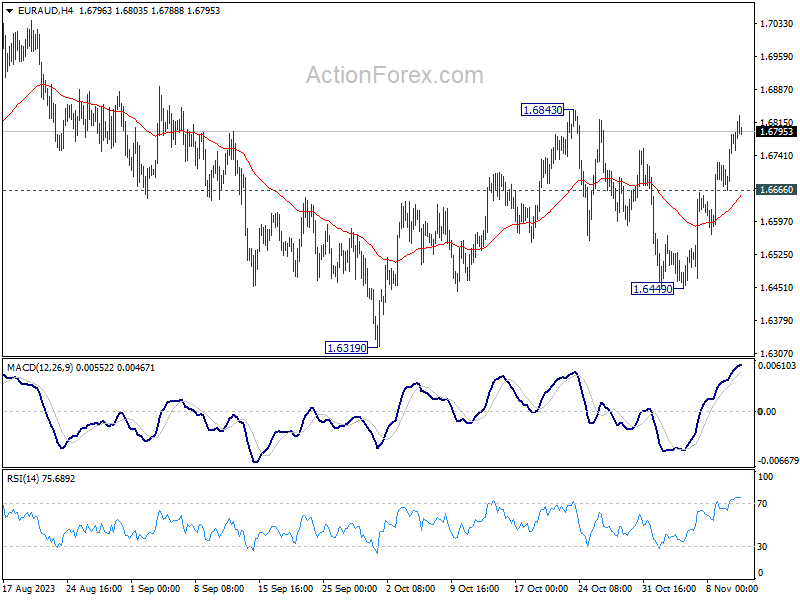
In the bigger picture, while 1.7062 is a medium term top, there is no clear sign of trend reversal as EUR/AUD continues to draw strong support from the medium term trend line. Break of 1.7062 will resume the larger up trend from 1.4281 (2022 low) to 1.7691 fibonacci level. Nevertheless, break of 1.6449 support will argue that deeper correction is underway to 38.2% retracement of 1.4281 to 1.7062 at 1.6000.
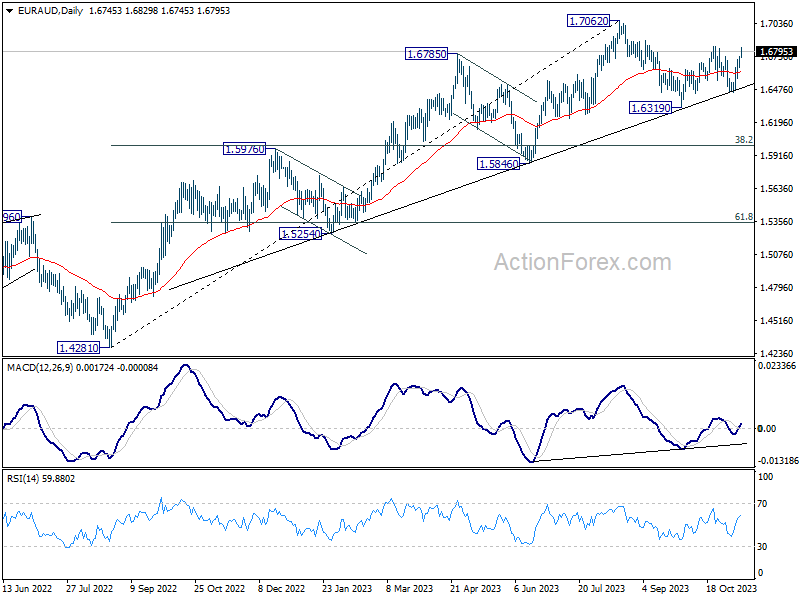
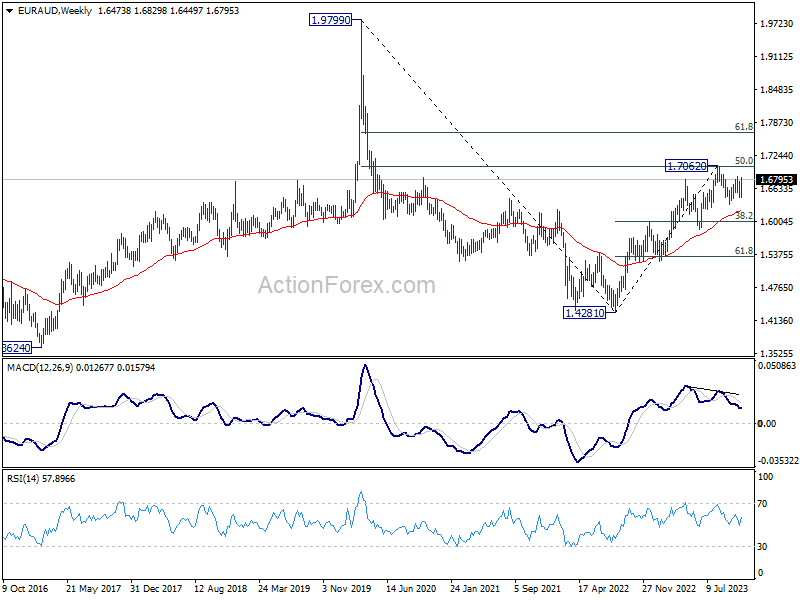
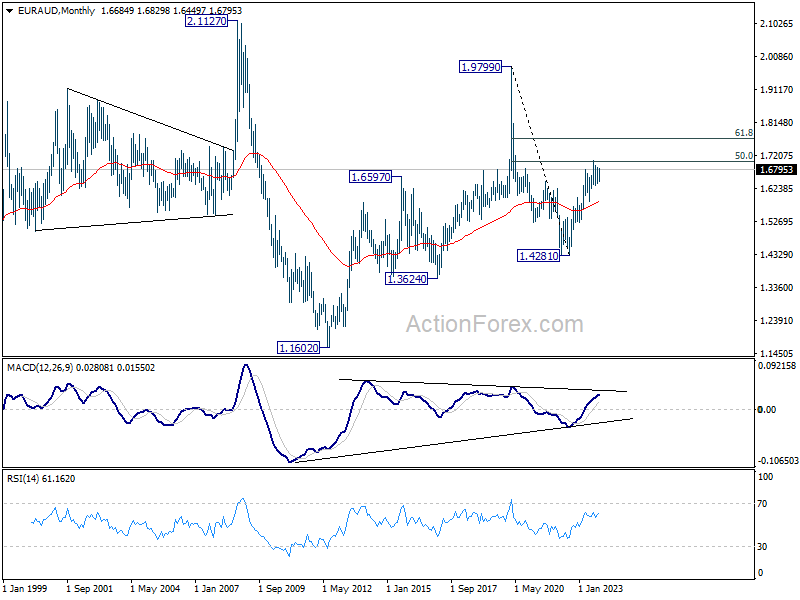
In the longer term picture, loss of upside momentum as seen in 55 W MACD at this stage argues that rise from 1.4281 (2022 low) is more likely a corrective move. Further rise could still be seen as long as 1.5846 support holds. But upside will likely be limited by 61.8% retracement of 1.9799 to 1.4281 at 1.7691. Firm break of 1.5846 support will argue that the rise has completed, and another medium term down leg has started.
EUR/CHF Weekly Outlook
EUR/CHF edged higher to 0.9651 last week but turned into sideway consolidation then. Initial bias stays neutral this week first. Another dip cannot be ruled out. But downside should be contained by 0.9564 support to bring another rally. On the upside, break of 0.9651 will resume the rise from 0.9416 to 0.9691 resistance first. Firm break there will argue that whole decline from 1.0095 has completed at 0.9416, just ahead of 0.9407 support (2022 low).
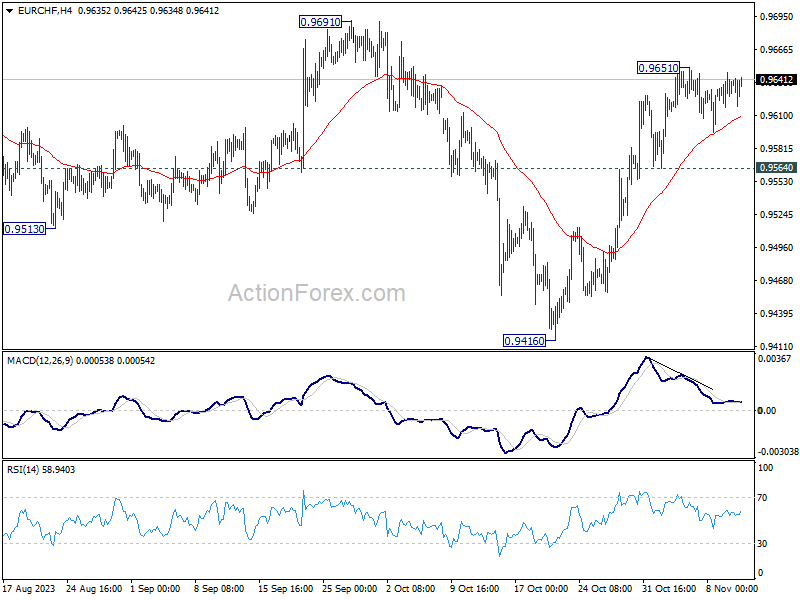
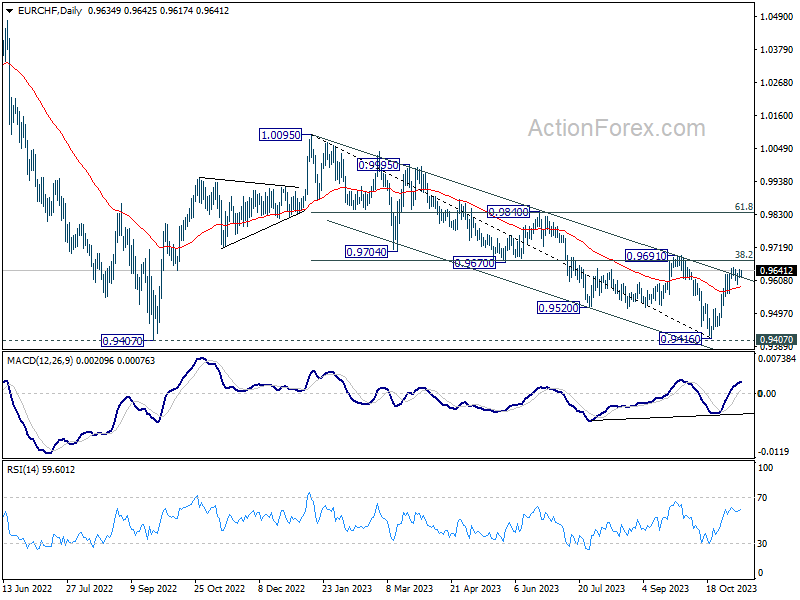
In the bigger picture, fall from 1.0095 (2023 high) might have completed at 0.9416, just ahead of 0.9407 support (2022 low). Sustained break of 0.9691 cluster resistance (38.2% retracement of 1.0095 to 0.9416 at 0.9675) will pave the way to 61.8% retracement at 0.9836 and above. However, rejection by 0.9691 will maintain medium term bearishness for another test on 0.9407 at least.
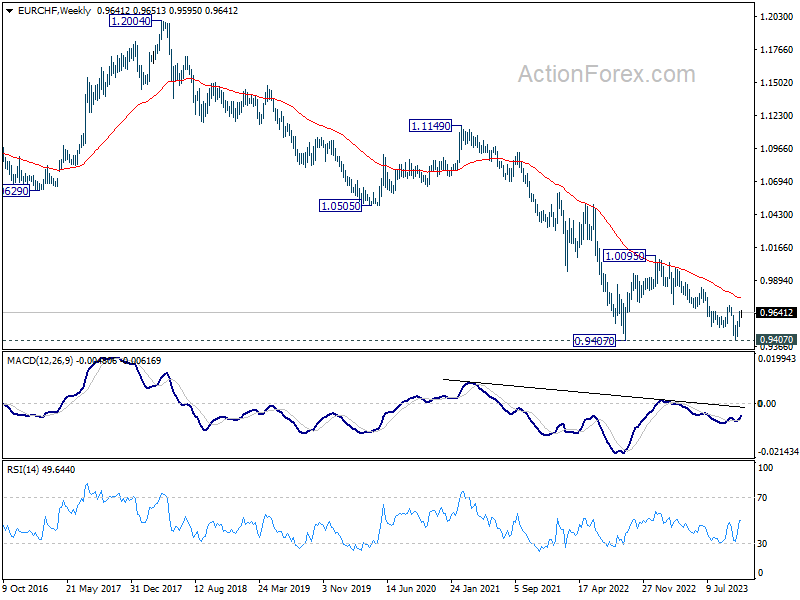
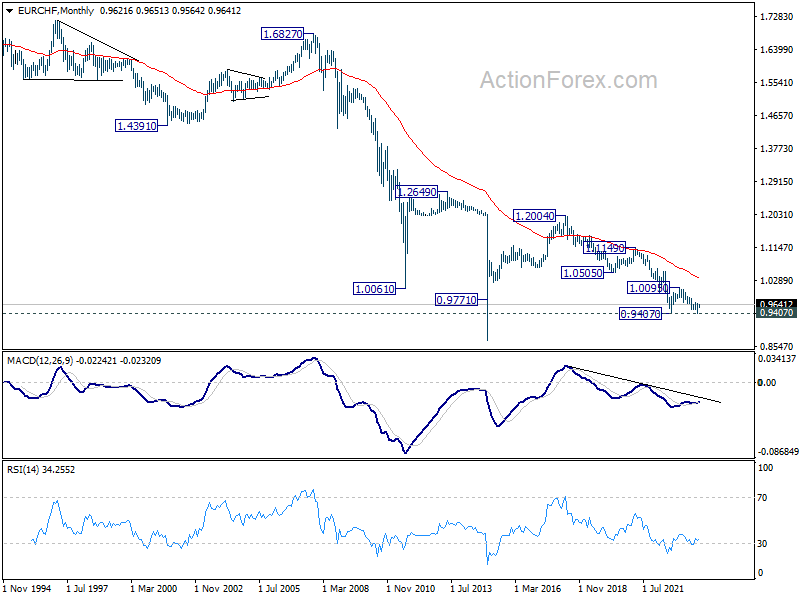
In the long term picture, outlook remains bearish as it's staying well below 55 M EMA (now at 1.0341). Price actions from 0.9407 are viewed as a three-wave consolidation pattern first. Larger down trend from 1.2004 (2018 high) might still resume through 0.9407 at a later stage. Break of 1.0095 resistance is needed to be the first sign of bottoming, or the multi-decade down trend is expected to continue.
Weekly Economic & Financial Commentary: Long and Variable Lags Evident in Credit Availability
Summary
United States: Long and Variable Lags Evident in Credit Availability
- Ben Franklin famously said, “If you would know the value of money, try to borrow some.” Amid a light calendar for economic data, we focus this week on how lenders tightened standards for most loan types in Q3 even as demand for loans weakened, according to the Federal Reserve's Senior Loan Officer Opinion Survey (SLOOS).
- Next week: CPI (Tue.), Retail Sales (Wed.), Housing Starts (Fri.)
International: British Economy Stalls During the Third Quarter
- The U.K. economy stalled during the third quarter, as Q3 GDP registered a flat quarter-over-quarter outcome. While that was better than the consensus forecast for a small decline, the details of the report were less encouraging. Consumer spending, government spending and business investment all fell during the quarter, indicative of very weak domestic demand. We still expect the U.K. to fall into a mild recession through late 2023 and into early 2024.
- Next week: Japan GDP (Wed.), China Industrial Production & Retail Sales (Wed.), U.K. CPI (Wed.)
Interest Rate Watch: Reserve Bank of Australia Resumes Rate Hikes
- While the Federal Reserve and many of the world's other major central banks are currently on hold, a few central banks are continuing to nudge interest rates higher. One such institution is the Reserve Bank of Australia (RBA), which, after remaining on pause since July, resumed its monetary tightening cycle this week with a 25 bps policy rate increase to 4.35%.
Topic of the Week: Census Projects Population Dip in 2080
- This week, the U.S. Census Bureau released its first population projections incorporating the results of the 2020 Census. The projections, stretching into 2100, show population growth plateauing over the next few decades. The population is expected to peak at 370 million in 2080 before contracting in the following years.
The Weekly Bottom Line: ‘Higher for Longer’ is the BoC’s Winning Strategy
U.S. Highlights
- The risk of a government shutdown has returned as Congress has one week left before the continuing resolution passed on September 30th expires.
- The Federal Reserve’s Senior Loan Officer Opinion Survey showed that banks continued to tighten credit standards in the third quarter, as credit demand weakened further.
- Consumer credit growth eased in the third quarter as an acceleration in revolving credit growth (i.e. credit cards) was offset by a contraction in nonrevolving credit (i.e. student loans).
Canadian Highlights
- Merchandise trade data out this week showed a further widening in Canada’s trade surplus in September, suggesting net trade will make a positive contribution to Q3 growth.
- The minutes from the Bank of Canada’s policy discussions showed that “lack of downward momentum” on the inflation front remained the top concern for policymakers and was behind the difference in opinion on whether more hikes are needed.
- The Senior Deputy Governor Carolyn Rogers delivered an update on the Financial Systems Review where she warned households and businesses to prepare for a “new normal”, where the cost of borrowing is likely to remain elevated over the medium-term.
U.S. – Government Shutdown Risk Redux
After last week’s busy slate markets took a breather to digest last week’s Federal Reserve policy decision and prepare for the risk of another potential government shutdown next Friday. On the data front, the Federal Reserve Senior Loan Officer Opinion Survey (SLOOS) and consumer credit report both showed credit conditions remained tight and demand continues to wane.
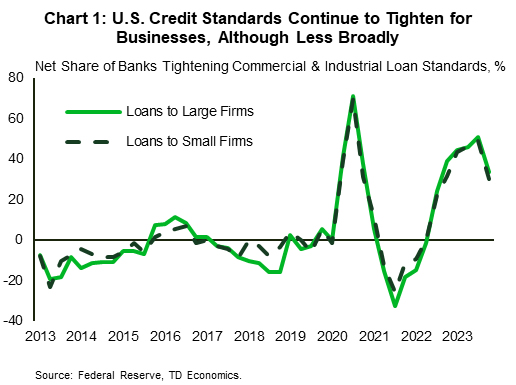
Monday’s release of the SLOOS showed that banks continued to tighten credit standards across loan categories in the third quarter and report weaker business and consumer demand for loans (see here). Although this came as little surprise considering Treasury yields rose by roughly 100 basis-points in Q3, the share of banks reporting tighter standards for commercial and industrial loans actually declined relative to the second quarter (Chart 1). This also held true for consumer credit cards and auto loans, although personal and mortgage loans each saw broader tightening relative to the second quarter. Despite the modest narrowing of credit tightening in the third quarter, the Federal Reserve’s continued signaling of rates staying higher for longer means a material loosening of credit standards likely remains a way off.
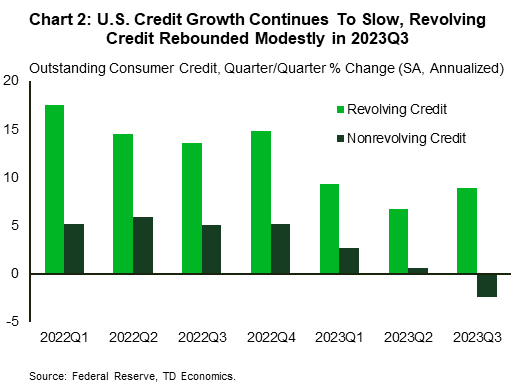
Easing consumer demand for loans was also evident in the Federal Reserve’s consumer credit data release on Tuesday which showed outstanding credit growth slowed notably relative to the second quarter. Outstanding revolving credit loans, which includes credit cards, saw accelerating growth in the third quarter of 8.6% while non-revolving credit growth, which includes student loans, declined by 2.4% (Chart 2). Under the weight of higher prices many consumers are increasingly relying on revolving credit to support spending, particularly as the moratorium on student loan repayment ends. Next week’s retail sales data will show whether the past six months of real sales growth, aided by consumer credit, continued into October despite the growing headwinds facing consumers.
In addition, updated CPI data out next week is expected to show continued easing in aggregate price pressures, supported by cooling energy prices. While this would undoubtedly be positive news, core inflation, which excludes food and energy prices, is expected to persist well above the Federal Reserve’s 2% target. A majority of FOMC members have noted that their current pause is conditional on sustained disinflation progress, with Chair Powell stating on Thursday that “if it becomes appropriate to tighten policy further, we will not hesitate to do so”.
Rounding out the coming week is the return of the risk of a potential government shutdown (see here) as the continuing resolution passed on September 30th expires on Friday, November 17th. Of the twelve appropriation bills that need to be passed to fund the federal government, the House has passed seven and the Senate has passed three with no consolidated bill managing to pass both chambers of Congress. This means that another continuing resolution may be used as a stopgap once again, but markets are likely to become increasingly apprehensive as Friday’s deadline approaches.
Canada – 'Higher for Longer' is the BoC's Winning Strategy
This week was sparse on economic data but rich on remarks from the Central Bank. Neither had a significant impact on the markets, with the TSX largely building on the dynamics across global equity markets, and finishing the week slightly lower. Volatility in the bond market returned by Thursday, reflecting the anxiety south of the border where weak demand in the 30-year auction helped to push the term premium higher. The only sigh of relief came from oil prices, although the decline in crude was driven largely by expectations for slowing global demand rather than peace in the Middle East.
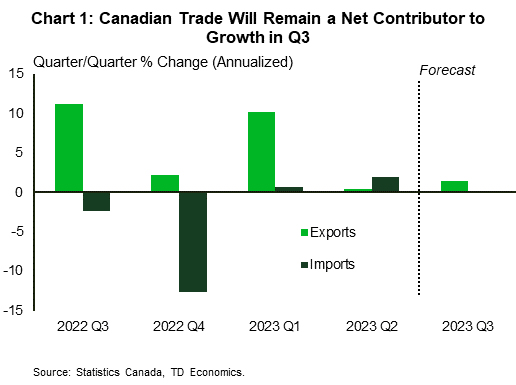
On the macro front, Statistics Canada reported September's data on merchandise trade, which recorded a second consecutive month of trade surplus, with exports gaining slightly more than imports. This offset the negative impact from the B.C. port strike and Nova Scotia floods, observed earlier in the quarter. Exports also outperformed imports in volume terms, which means trade will be a net contributor to Q3 growth.
Looking ahead, the minutes from the Bank of Canada's policy discussions indicated an anticipated slowdown in exports, attributed to a decrease in global demand. But it was concerns of the disinflationary process stalling that remained the top concern for the Governing Council. Higher global oil prices, rising cost of rent and other housing-related costs, driven by demand-supply imbalances, have been the primary factors leading to the recent stalling in disinflationary dynamics. Moreover, despite the ongoing easing in the labour market, wage growth remains in a range that's higher than is needed to help push inflation down towards the BoC's target. This 'lack of downward momentum' was behind the difference in opinion on whether more hikes are needed.
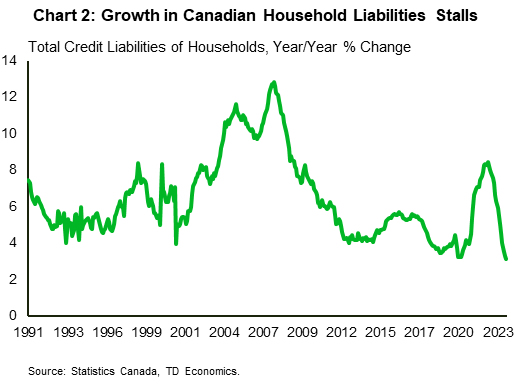
Despite these concerns, members observed that the 475 basis points in rate hikes have helped to rebalance the economy. Consumer spending and household credit growth are both showing signs of slowing, as households continue to adjust to higher borrowing costs (Chart 2). This message was echoed by the Senior Deputy Governor Carolyn Rogers who delivered an update on the Financial Systems Review. She reiterated that servicing debt is getting harder for some households, which can be observed through higher consumer delinquency rates and a rising share of accounts with utilization rates above 90%.
Rogers also pushed back on the expectations for lower rates and advised households and businesses to prepare for a 'new normal', where the cost of borrowing is likely to remain elevated. 'Higher for longer' rhetoric remains the winning strategy for the Bank as it keeps financial conditions tight without adjusting the policy rate. With little hard data to mull over, markets are likely to remain in 'wait and see' mode until the CPI report on November 21st. Next week, we'll get the most recent reading on existing home sales, which will provide an update on whether recent weakness gained more traction in October alongside the sharp uptick in yields. Stay tuned!