Sample Category Title
EUR/CHF Daily Outlook
Daily Pivots: (S1) 0.9626; (P) 0.9639; (R1) 0.9653; More...
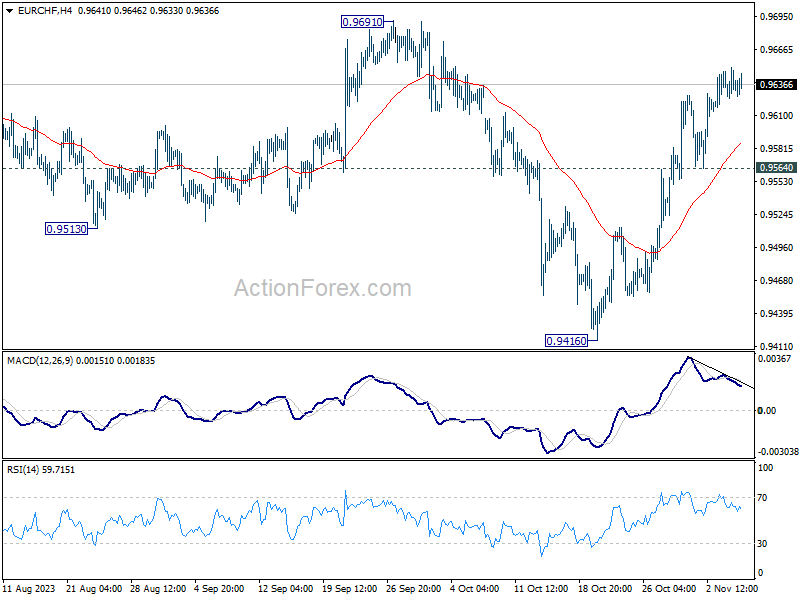
While EUR/CHF is losing upside momentum as seen in 4H MACD, further rise is still expected with 0.9564 support holds. Current rebound from 0.9416 should target 0.9691 resistance first. Firm break there will argue that whole decline from 1.0095 has completed at 0.9416, just ahead of 0.9407 support (2022 low). Further rally would be seen to 0.9840 resistance.
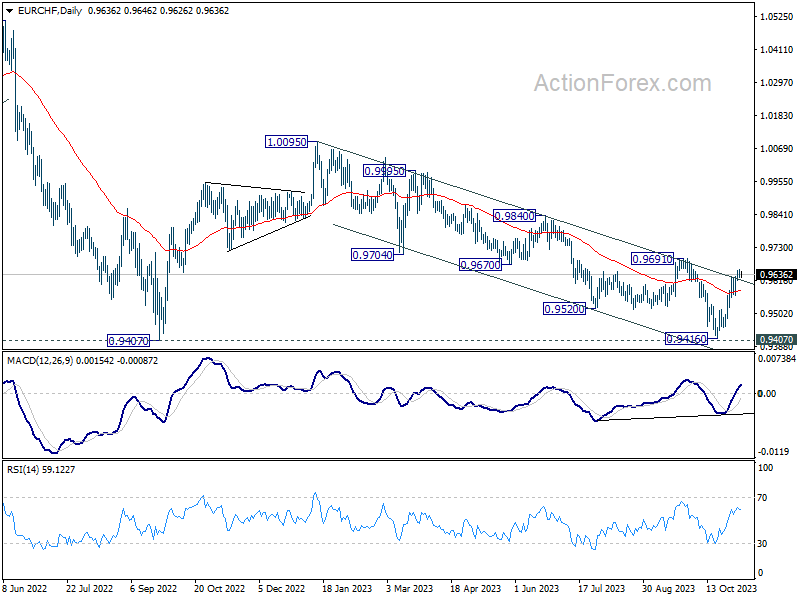
In the bigger picture, as long as 1.0095 resistance holds, price actions from 0.9407 are viewed as a three-wave consolidation pattern first. Current rise from 0.9416 might be the third leg. That is, larger down trend from 1.2004 (2018 high) might still resume through 0.9407 at a later stage. However, decisive break of 1.0095 will argue that the long term down trend is reversing.
AUD/USD Technical: RBA Hike Already Priced In, Minor Corrective Decline in Progress
- RBA hiked the official cash rate by 25 bps to 4.35% as expected.
- Revised up slightly projected year-end 2024 Australia CPI inflation to be around 3.5% from 3.25% previously forecasted in August.
- AUD/USD has declined by -64 pips intraday from yesterday, 6 November high of 0.6523.
- Short-term momentum has turned bearish as depicted by the hourly RSI.
- Watch the key short-term pivotal resistance at 0.6520 on the AUD/USD with intermediate support coming in at 0.6395/6370.
On the contrary, the AUD/USD did not shape the residual push down and staged a bullish breakout from the medium-term “Descending Wedge” bullish reversal configuration as highlighted in our previous report.
The recent bullish outburst of the AUD/USD in the past week has been reinforced by an increased odd that the Australian central bank, RBA may choose to restart its interest rate hike cycle today after four consecutive pauses on its policy cash rate to maintain it at 4.1%.
Based on the pricing from the ASX 30-day interbank cash rate futures as of yesterday, 6 November, the data has implied that there is a 50% chance of a 25 basis points (bps) hike in today’s RBA’s monetary policy meeting to bring the cash rate to 4.35% due to the recent hawkish vibes from the new RBA Governor Bullock and the recent uptick in the monthly CPI number for October.
At the risk of undergoing minor pull-back after a swift up move
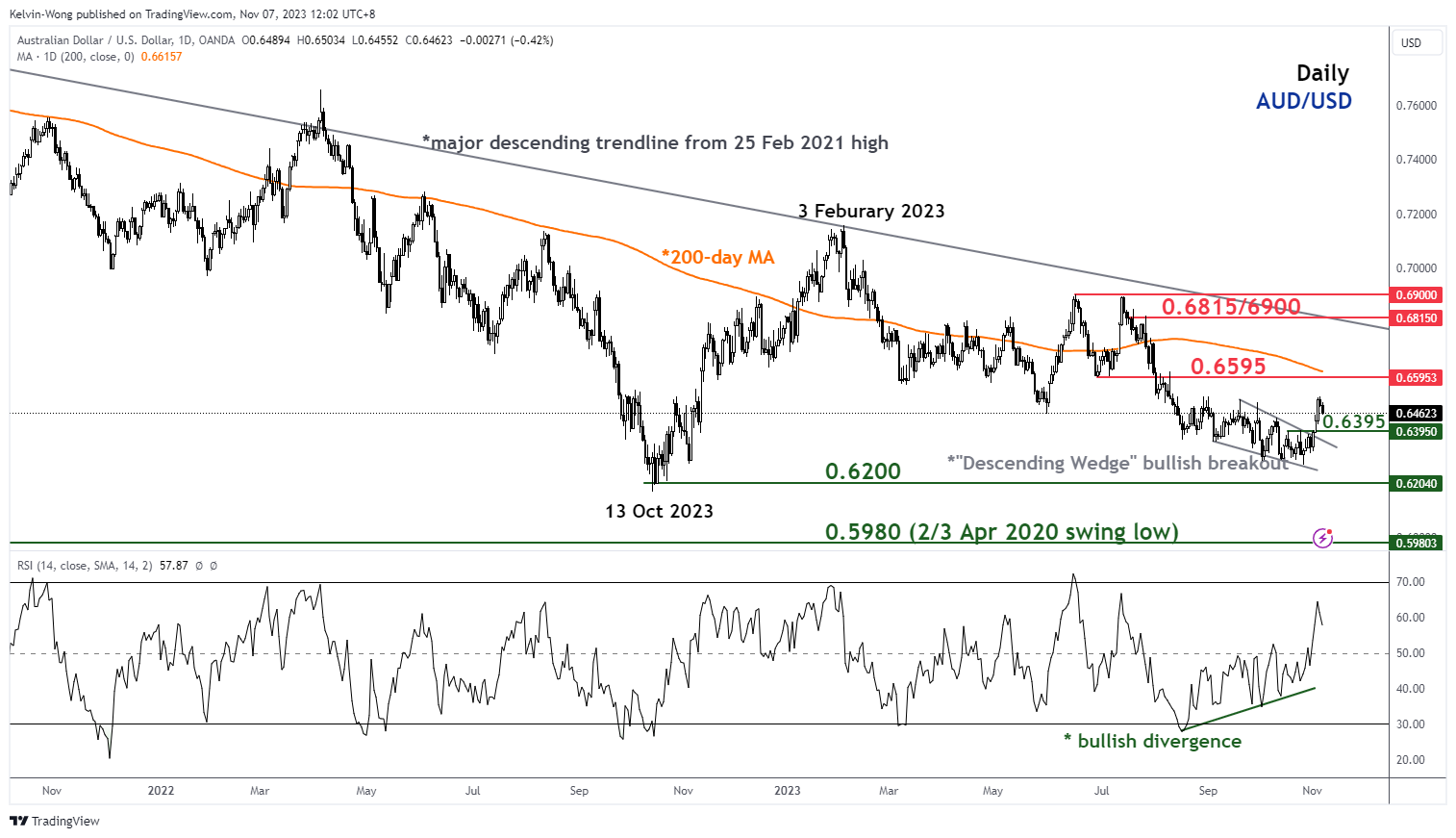
Fig 1: AUD/USD medium-term trend as of 7 Nov 2023 (Source: TradingView, click to enlarge chart)
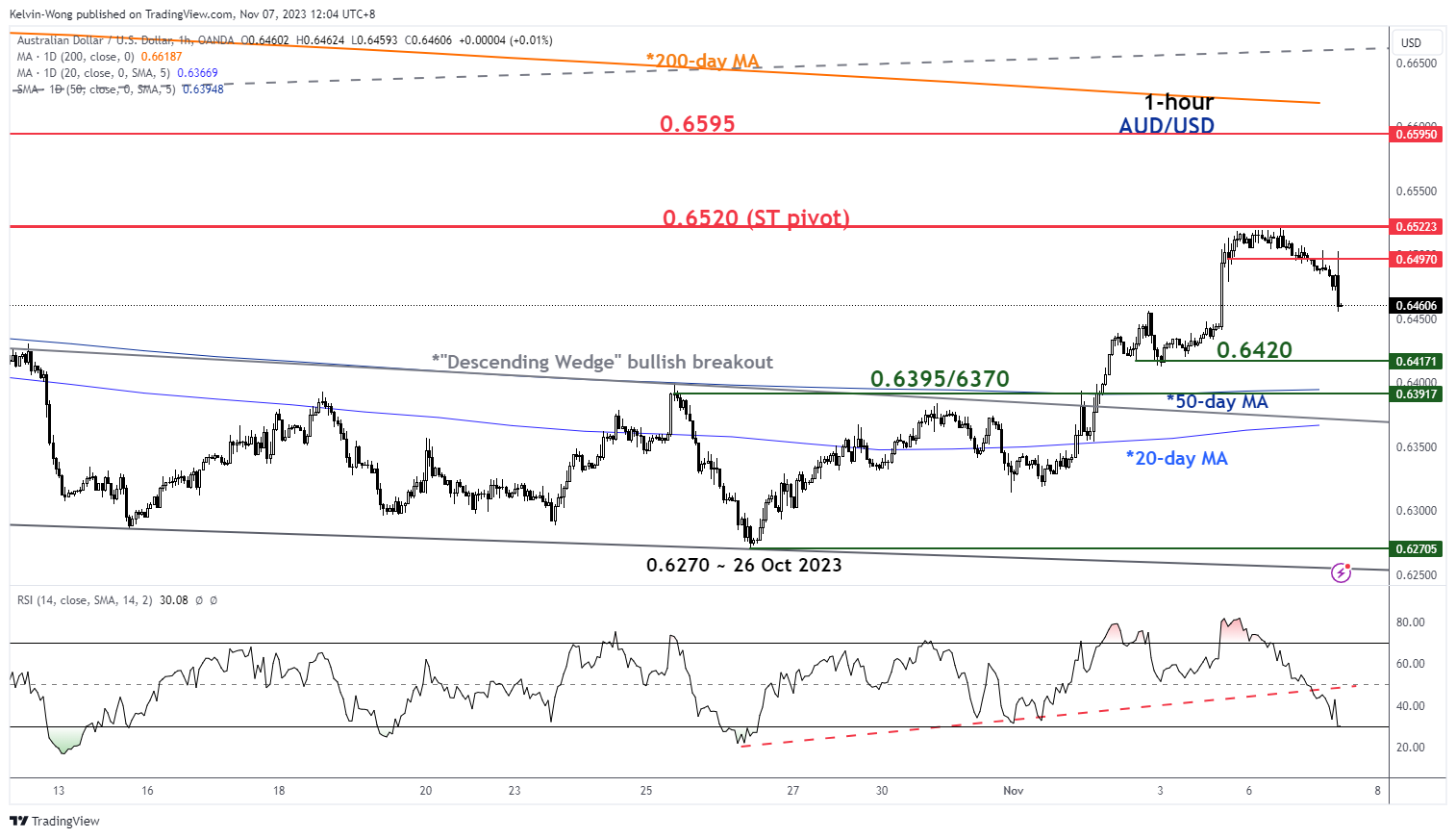
Fig 2: AUD/USD minor short-term trend as of 7 Nov 2023 (Source: TradingView, click to enlarge chart)
As seen on the short-term 1-hour chart, momentum has turned bearish on the AUD/USD as depicted by the breakdown seen in the hourly RSI momentum indicator.
If the 0.6520 short-term pivotal resistance (also the minor swing high areas of 30 August/1 September 2023) is not surpassed to the upside, the AUD/USD may see a further potential minor corrective decline towards the intermediate supports of 0.6420 and 0.6395/6370 (also the 20 and 50-day moving averages & the pull-back of the former “Descending Wedge” resistance) before a new potential bullish impulsive up move sequence unfolds.
However, a clearance above 0.6520 invalidates the corrective pull-back scenario for a squeeze-up to see the next intermediate resistance coming in at 0.6595 (also the 200-day moving average) in the first step.
RBA Board Has Responded to Material Increase in Inflation Outlook
As we expected, the RBA Board raised the cash rate target by ¼ percentage point to 4.35%. Their inflation outlook is stronger, and so is their outlook for the labour market. But follow-up increases in rates are far from assured.
At its November meeting, the RBA Board raised the cash rate target by ¼ percentage point to 4.35%. This is a break from the run of meetings where it was comfortable to hold steady and monitor the evolving situation. Given its low tolerance for upside surprises, a stronger inflation outlook and some unexpected resilience in the real economy has induced the Board to act.
As we noted last month, the CPI release for the September quarter tipped the balance in favour of raising the cash rate further. The Governor’s statement noted that inflation “is proving more persistent than expected a few months ago” and that “progress looks to be slower than earlier expected”. The considerably rewritten statement was noteworthy for the detailed explanation of what the Board had previously believed, and how things have changed since the RBA’s last forecast round in August.
Services inflation has remained sticky and there are some concerning signs in housing-related inflation and the prices of some retail goods. The Governor’s statement highlighted that many services prices “are continuing to rise briskly”. The language of the statement shows that the Board is increasingly concerned that inflation will not decline on the trajectory it is aiming for, and so it has decided to take out more insurance to achieve the desired result. That is despite the reduced risk of a price–wage spiral that the Board called out in the October minutes.
The RBA’s forecast for inflation over 2024 have been revised up, from 3.3% to 3½% now. More detail will be made available on Friday with the release of the November Statement on Monetary Policy. Our own forecasts have also been revised up over the past month. Also noteworthy is that the RBA’s unemployment forecast for end-2025 has been revised down from 4.5% to 4¼%. We will know more on Friday, but this seems like a nod to the signs of unexpected resilience in parts of the real economy.
We do not expect that the RBA will follow up with another rate increase in December. The last paragraph of the statement contained a shift in language from “Some further tightening of monetary policy may be required” used in the October media release to “Whether further tightening of monetary policy is required”. This reads as the Board hoping not to have to raise rates again, but being very willing to do so if things change. There is not enough new information between now and the December meeting to drive a change in view. Given the upgraded inflation forecasts and lower unemployment forecast, though, they are likely to have even less tolerance for upside surprises than they indicated in recent communication. So while a December move is unlikely, it is more likely that February meeting would become ‘live’ if the inflation outlook continues to lift.
Next year the RBA Board moves to a timetable of eight meetings per year, rather than the traditional eleven. This means that all meetings will follow significant data releases, including either the quarterly CPI or the national accounts. Enough new information will be able to be accumulated between each meeting that the RBA’s view of the outlook could shift. From the new year, all Board meetings should therefore be considered potentially ‘live’ in a way that was not the case in the past.
The RBA’s decision stands in contrast to the recent decisions of the FOMC, ECB and Bank of England to hold rates at their recent meetings. At a deeper level, though, all of these central banks are facing similar decisions. They have already raised policy rates a lot, and monetary policy is now restrictive in all these economies. Each central bank is watching the data unfold for signs that they need to do more. Countries such as the United States are further along the disinflation journey, just as they were earlier to experience the surge in inflation. They also would have more confidence in that the disinflation will unfold as expected. The RBA Board has not yet achieved that level of comfort.
AUD Weakens after RBA Hike, Oil Downbeat
The US bond yields rebounded, and the equity rally slowed on Monday. The US 10-year rebound from last Friday low, and the S&P500 consolidate gains near three-week highs. There are divergent opinions regarding whether last week’s risk rally is on sufficiently solid ground to extend into a Santa rally, or it would simply fade away. And it all depends on what matters the most for investors. The softening Federal Reserve (Fed) and other central bank expectations and falling sovereign yields are positive for stock valuations, but the chatter of potentially higher-for-longer rates, growing signs of slowing global economy and the rising recession odds don’t offer a bright outlook for equities into the year end. Seasonally speaking, November and December are known to be good months for the S&P500 stocks. In the past, the S&P500 stocks gained, on average, 1.8% in November and 0.9% in December. But this year, the picture is overshadowed by a lot of weak guidance and revenue warnings.
The chatter of weak demand and profit warnings are not great for equities but the worst news would be sticky inflation despite slowing growth and a persistently long period of high interest rates. For now, the Fed is perceived as being ‘done’ with interest rate hikes. But Powell is due to speak this week and he will probably leave the door open for a rate hike… otherwise he knows that all the past 1.5-year’s efforts will be instantaneously thrown out of the window with everyone rushing to US treasuries – which would pull the yields lower and loosen the financial conditions and eventually boost growth and inflation. This is something the Fed doesn’t want.
And despite a series of no rate hike news that we received over the past few weeks from major central banks including the Fed, the ECB and the BoE, the Reserve Bank of Australia (RBA) raised its rates by 25bp, as broadly expected, today. The RBA hike came as a sour reminder that there is no rule that says that a bank can’t hike rates after pausing for four meetings. Interestingly, the AUDUSD fell after the decision, along with the Australian stock markets. Today’s rate hike revived fears of economic slowdown more than appetite for higher Aussie yields – while a broad-based recovery in the US dollar and weak Chinese trade data certainly didn’t help.
Speaking of weakness
The Chinese exports which are a good gauge of global economic health, are down for the 6th consecutive month and Iranian oil exports fell for the 2nd straight month to 1.43mbpd as demand in Asia weakened. That’s certainly why we haven’t seen oil prices react to the news of escalation tensions in the Middle East and the news that Saudi and Russia will keep their oil production curbs in place during the weekend. The barrel of crude is trading a touch above the $80pb psychological mark this morning. We revise our medium-term outlook for crude oil from neutral to negative. Last week’s persistent selloff despite a broad-based risk rally, oil bulls’ unresponsiveness to normally price-positive geopolitical developments and the fact that the market focus is shifting from supply to demand side hint that a fall below the $80pb is increasingly possible, and a verbal intervention from Saudi or OPEC won’t prevent a deeper decline in the short run. Iran’s implication in the Gaza war could be a game changer but the American crude is now in the medium-term bearish consolidation zone, and will remain downbeat below $81.50, the major 38.2% Fibonacci retracement on this summer’s rally.
RBA Hikes, China Trade Data Disappoints
Market movers today
Today we have a light calendar with no tier-1 data releases.
In the euro area, we receive September PPI figures. Producer prices have dropped like a stick this year after the sharp increases last year. In August, the index fell 11.5% and consensus looks for a further decline to 12.5% y/y in September.
In Germany, industrial production figures for September are due. The figures are interesting since GDP declined less than expected in Q3. If industrial production comes in weaker than expected Q3 GDP growth might be revised slightly down.
The 60 second overview
Fed SLOOS: The Fed's Q3 Senior Loan Officer Opinion Survey (SLOOS) showed that a somewhat lower share of US banks' reported tightening lending standards for commercial and industrial (C&I) loans compared to Q1 and Q2. Similarly, fewer banks reported weaker demand, although the share of banks reporting a recovery in loan demand also remained low. Lending standards for commercial real estate sector (CRE) continued tightening, as was the case for most consumer lending as well. Overall credit conditions still remain clearly restrictive, even if the pace of tightening is moderating towards the end of the policy rate hiking cycle. As financial conditions continued to tighten over the survey period, an increasing number of FOMC participants have now signalled that policy rate hikes are likely over. Last night, the Fed's Lisa Cook echoed her colleagues' recent commentary saying that she 'hopes that current policy settings are restrictive enough'.
RBA: The Reserve Bank of Australia (RBA) hiked the Cash Rate by 25bp to 4.35% this morning after four consecutive holds in previous meetings. The decision followed an upside surprise in Q3 CPI, and RBA saw especially the sticky services inflation increasing the risk of price pressures becoming more persistent than anticipated. That said, its forward guidance was somewhat more dovish than earlier, as the statement no longer indicated that 'further tightening may be required'. The door for hiking the policy rate is still open, but given the recent tightening in global financial conditions, we think the RBA is likely to remain on hold from here. The hike was widely anticipated by the consensus and mostly priced in by the markets ahead of the meeting, and the initial uptick in AUD/USD faded quickly. We still maintain a downward-sloping forecast profile for the cross in 12m horizon (0.62).
China: The October international trade data overnight was a mixed bag. Imports recovered more than expected (+3.0% y/y, consensus -4.8%), which could suggest that the recent policy easing is supporting domestic demand. But in contrast, exports fell more sharply than anticipated (-6.4% y/y, consensus -3.3%), as tightening financial conditions are restricting demand elsewhere. Overall trade balance weakened, with surplus declining to USD56.5 billion (from USD77.7).
Equities: Global equities were higher yesterday as the optimism from last week continued. However, the move in yields yesterday was not the driver of optimism but rather the expectation that peak yields are behind us. It is interesting to see in surveys how investors fear inflation less and less every month (Sentix yesterday). The turnaround in yields yesterday gave headwinds to REITs and small caps while the massive underperformance of defensives we saw last week paused. In US Dow +0.1%, S&P 500 +0.2%, Nasdaq +0.3% and Russell 2000 (1.29%). Sentiment in Asia much sourer this morning as volatile Chinese export data underwhelms. Futures in Europe and US are lower as well.
FI: European yield curves steepened from the long end with 30y Bunds up by 9bp on the day. This follows from the setback in yields seen last week and in particular following the FOMC meeting on Wednesday. The move was mostly observed in the cash bond space with EUR swap rates only partially following the move. 10y Bund ASW spread tightened 2.7bp to 52.9bp, which is a level not observed since early 2022. ECB's Holzmann tried to push back on the dovish pricing in markets as he said that ECB should be ready to hike if needed. He also said that QT is not coming this year via end of PEPP reinvestments. Amid this, real rates were slightly lower on the day.
FX: The G10 FX market digested last week's data and big central bank meetings on Monday. CHF, USD and EUR posted small gains vis-à-vis JPY, AUD, NZD and CAD. EUR/USD traded above 1.07 and USD/JPY below 150.
Credit: Secondary credit markets had a relatively uneventful day with muted activity. iTraxx Main was 1bp wider at 78bp while iTraxx Xover widened 5bp to 418vp. On a positive note the primary market activity was relatively high with a number of new issues - among others from Danone, Suez SACA and EPH Financing International. Furthermore, we saw financial issuance from the likes of Danske Bank, BNP Paribas SA, Deutsche Bank and Swedbank. Overall issuers took advantage of slightly improved market conditions and a clearer calendar to come to the market.
Nordic macro
Sweden: The SNDO publishes October figures for the Swedish budget balance (CET 8:00). Their own forecast from two weeks ago indicates a deficit of SEK4bn for the month. The 2023 full-year forecast was revised higher to a surplus of SEK31bn, up from a deficit of SEK15bn. For the coming two years the SNDO expect a deficit of SEK 49bn and SEK 60bn, respectively. Deputy Governor Martin Flodén will discuss the Riksbank's view of the economy and work on monetary policy in a troubled world tomorrow at CET 15:10.
EUR/USD Daily Outlook
Daily Pivots: (S1) 1.0703; (P) 1.0730; (R1) 1.0743; More...
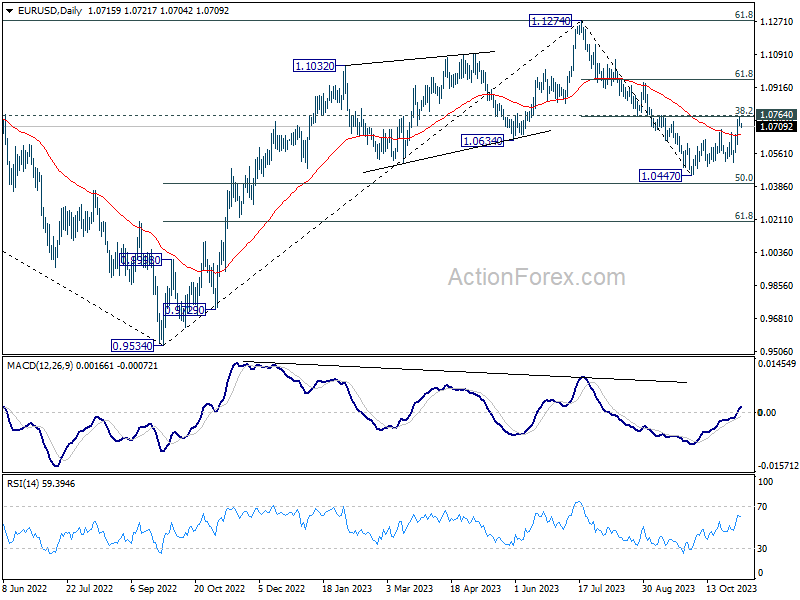
Intraday bias in EUR/USD is turned neutral with current retreat, and some consolidations could be seen. But further rally is in favor as long as 55 4H EMA (now at 1.0637) holds. Decisive break of 1.0764 cluster resistance (38.2% retracement of 1.1274 to 1.0447 at 1.0763) will extend the rise from 1.0447 to 61.8% retracement at 1.0958 next. However, sustained break of 55 4H EMA will argue that the rebound has completed, and target 1.0515 support, and then 1.0447 low.
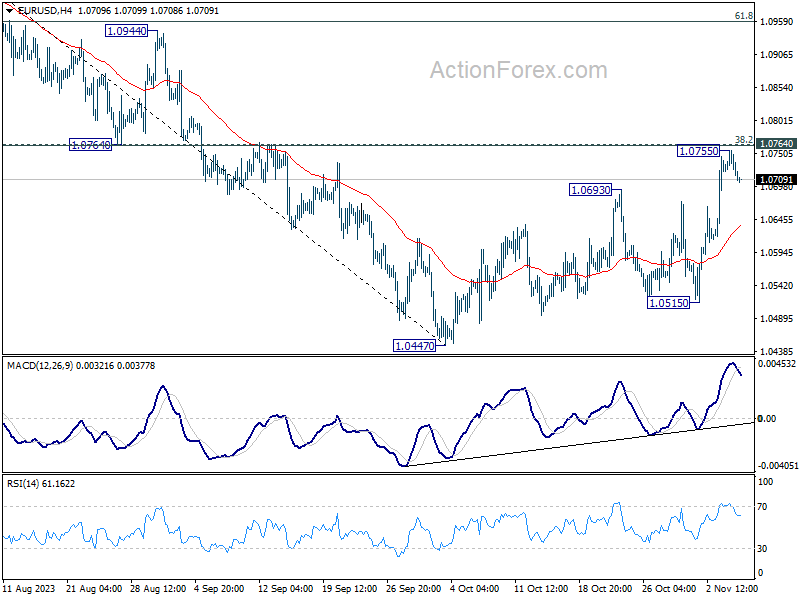
In the bigger picture, price actions from 1.1274 are viewed as a corrective pattern to rise from 0.9534 (2022 low). Rise from 1.0447 is tentatively seen as the second leg. Hence while further rally could be seen, upside should be limited by 1.1274 to bring the third leg of the pattern.
GBP/USD Daily Outlook
Daily Pivots: (S1) 1.2312; (P) 1.2370; (R1) 1.2402; More
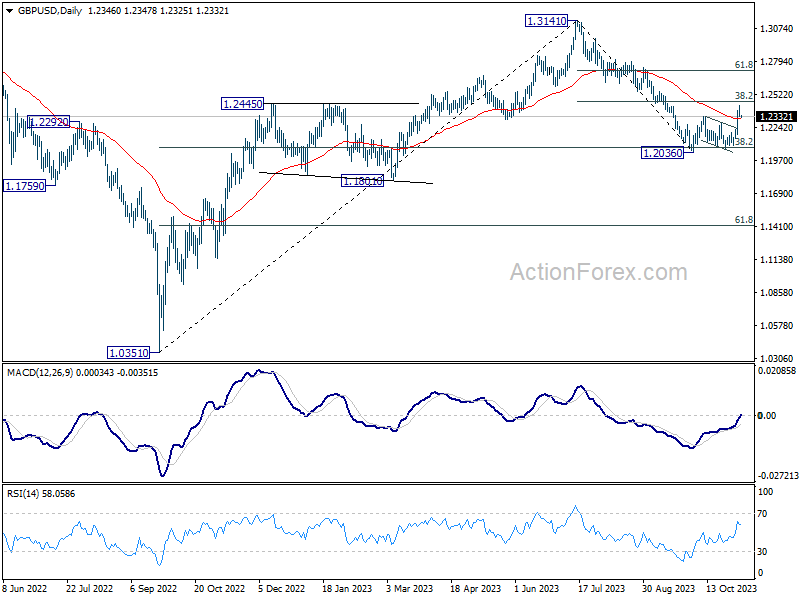
Intraday bias in GBP/USD is turned neutral with current retreat and some consolidations could be seen first. Further rise is in favor as as long as 4H 55 EMA (now at 1.2223) holds. Decisive break of 38.2% retracement of 1.3141 to 1.2036 at 1.2458 will pave the way to 61.8% retracement at 1.2783. However, sustained break of 4H 55 EMA will revive near term bearishness and bring retest of 1.2036 low.
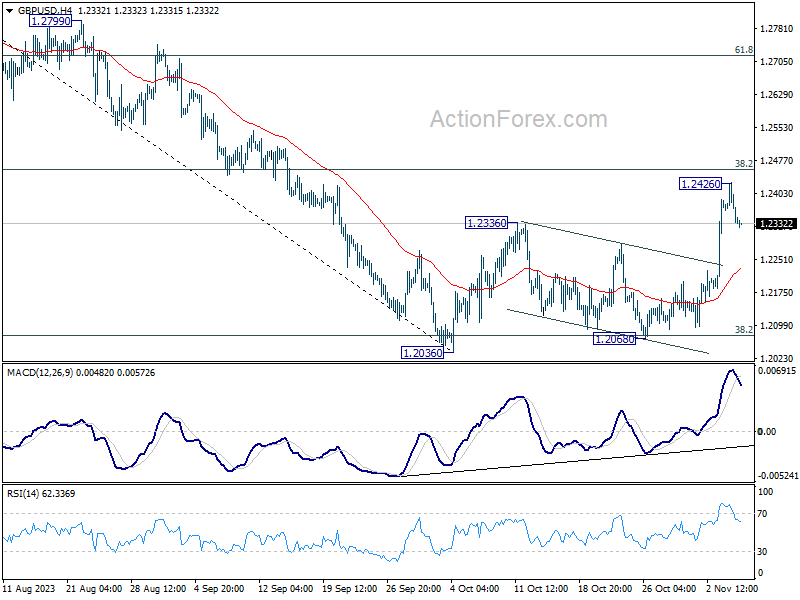
In the bigger picture, the strong rebound from 38.2% retracement of 1.0351 to 1.3141 at 1.2075 argues that price action from 1.3141 are merely a correction to rise from 1.0351 (2022 low). Current rally from 1.2036 is tentatively seen as the second leg of the pattern. Hence, while further rally is in favor, upside should be limited by 1.3141 to start the third leg.
USD/CHF Daily Outlook
Daily Pivots: (S1) 0.8967; (P) 0.8982; (R1) 0.9010; More....
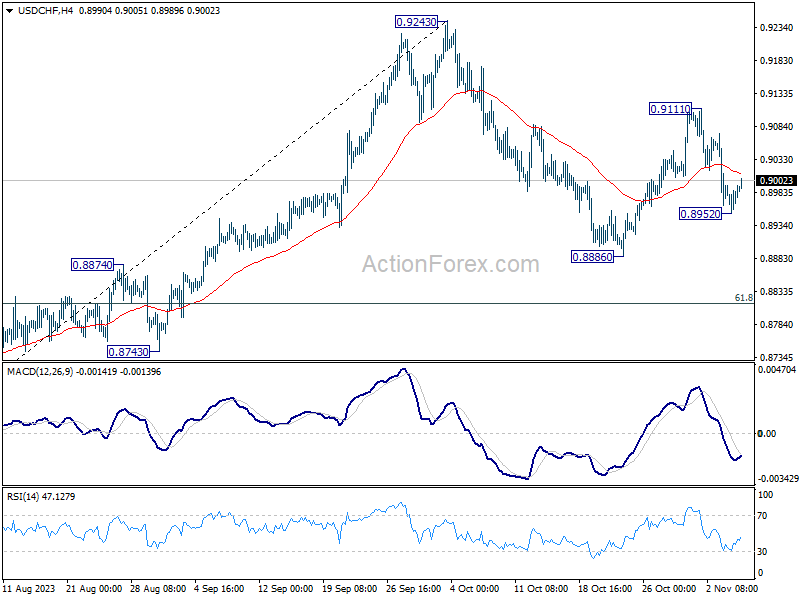
Intraday bias in USD/CHF is turned neutral with current recovery. On the downside, below 0.8952 will target a test on 0.8886 support first. Break there will resume whole decline from 0.9243 to 0.8815 fibonacci level. However, break of 0.9111 will resume the rebound from 0.8886 instead, and target 0.9243 resistance.
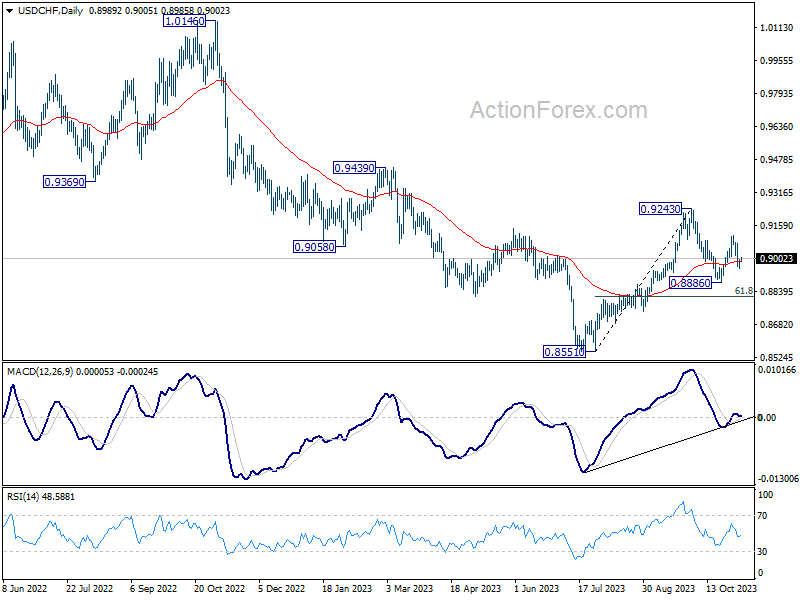
In the bigger picture, outlook is mixed up by the deeper than expected pull back from 0.9243. Yet there was no follow through selling after hitting 0.8886. On the upside, break of 0.9243 resistance will revive the case of medium term bottoming at 0.8851, and turn outlook bullish. However, sustained break of 61.8% retracement of 0.8551 to 0.9243 at 0.8815 will argue that larger decline from 1.0146 is ready to resume through 0.8551 low.
USD/JPY Daily Outlook
Daily Pivots: (S1) 149.59; (P) 149.83; (R1) 150.33; More...
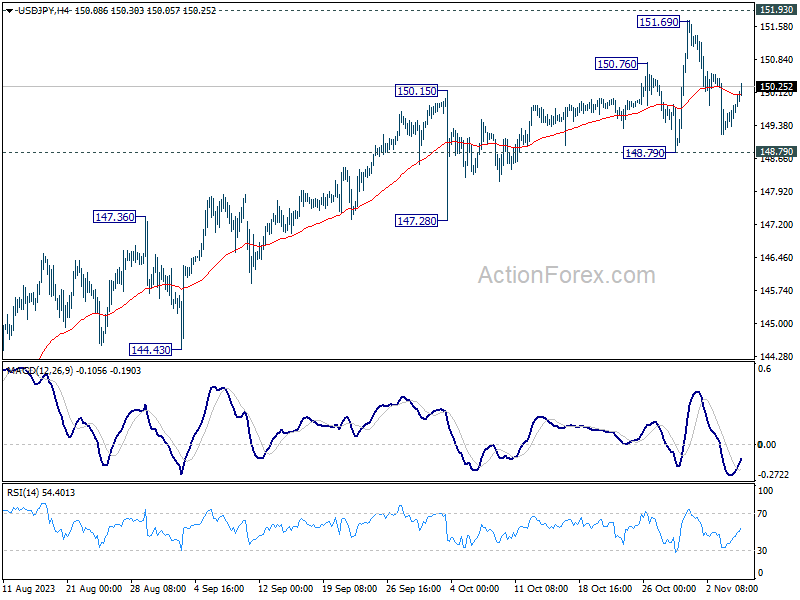
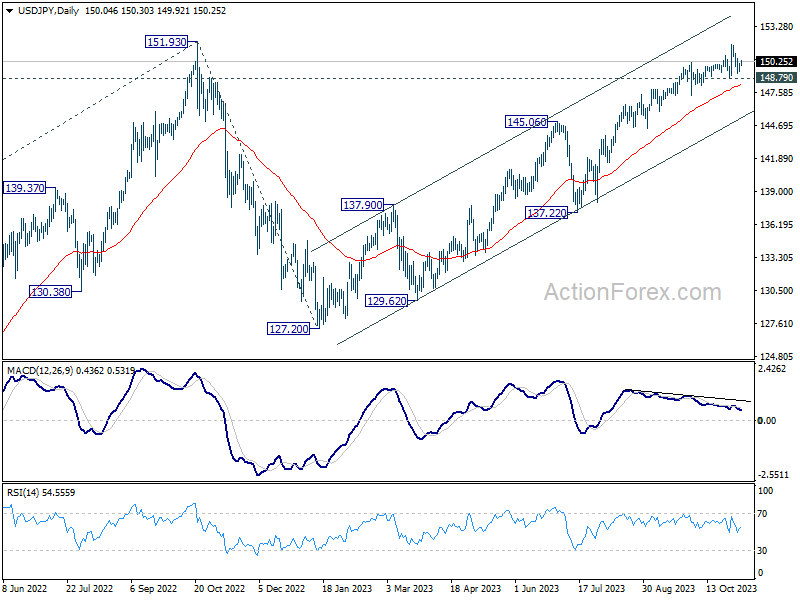
Intraday bias in USD/JPY stays neutral as consolidation from 151.69 is extending. Further rally is expected as long as 148.79 support holds. Firm break of 151.69 high will resume larger up trend. However, decisive break of 148.79 will indicate rejection by 151.93 key resistance, and bring deeper fall through 147.28 support.
In the bigger picture, immediate focus is on 151.93 resistance (2022 high). Rejection by 151.93, followed by sustained break of 145.06 resistance turned support will argue that rise from 127.20 has completed, and turn outlook bearish for 137.22 support and below. However, sustained break of 151.93 will confirm resumption of long term up trend. Next target will be 61.8% projection of 102.58 to 151.93 from 127.20 at 157.69.
USD/CAD Daily Outlook
Daily Pivots: (S1) 1.3652; (P) 1.3678; (R1) 1.3725; More...
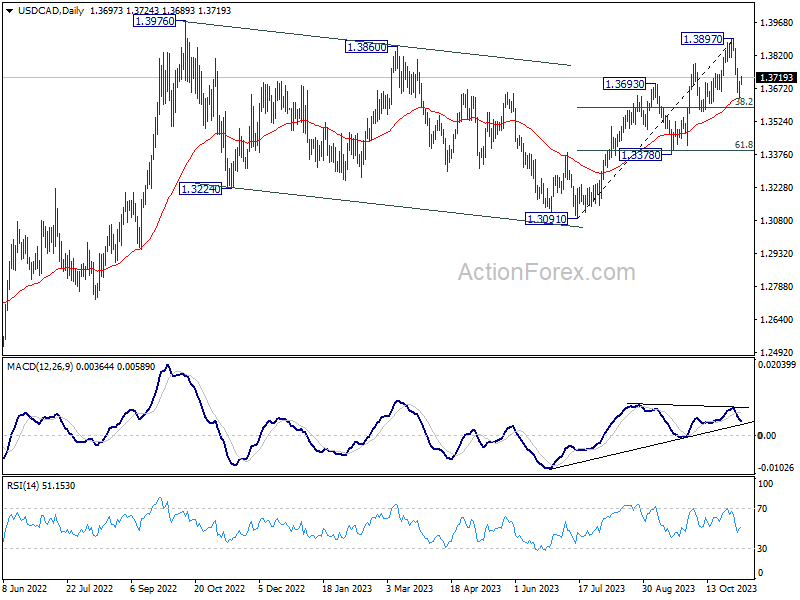
Intraday bias in USD/CAD is turned neutral first with current recovery. While fall from 1.3897 might still extend further, strong support should be seen from 38.2% retracement of 1.3091 to 1.3897 at 1.3589 to bring rebound. On the upside, above 1.3759 minor resistance will bring retest of 1.3897. However, sustained break of 1.3589 will bring deeper fall to 61.8% retracement at 1.3399 instead.
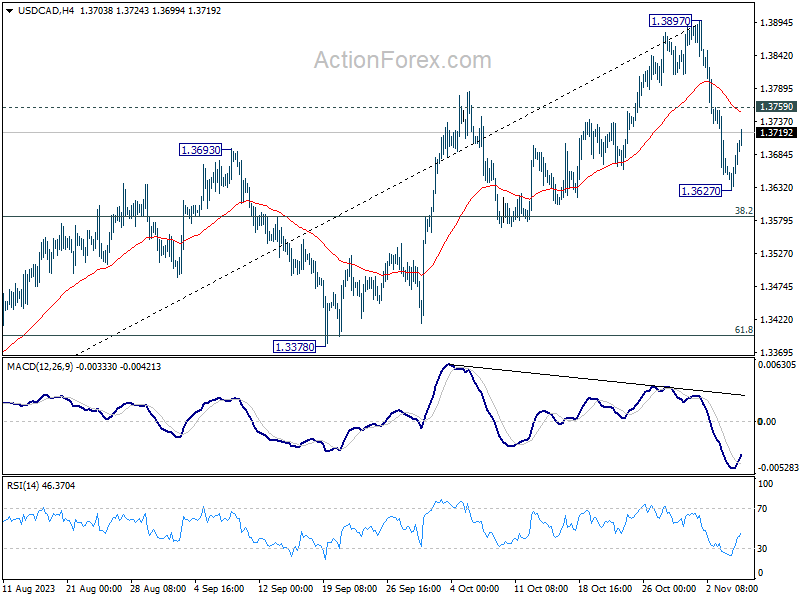
In the bigger picture, corrective pattern from 1.3976 (2022 high) should have completed with three waves down to 1.3091. Decisive break of 1.3976 high will confirm resumption of up trend from 1.2005 (2021 low). This will now remain the favored case as long as 1.3378 support holds. However, firm break of 1.3378 will argue that the pattern from 1.3976 is indeed still extending.