Sample Category Title
Fed’s Bowman expects to raise interest rates further
In a speech overnight, Fed Governor Michelle Bowman asserted, "I continue to expect that we will need to increase the federal funds rate further to bring inflation down to our 2% target in a timely way."
She acknowledged that interest rates "appears to be restrictive" while financial conditions "have tightened since September". However, "We don't yet know the effects of tightened financial conditions on economic activity and inflation, she cautioned.
"There is an unusually high level of uncertainty regarding the economy and my own economic outlook, especially considering recent surprises in the data, data revisions, and ongoing geopolitical risks," she noted.
Fed’s Logan: Tight financial conditions crucial to steer inflation back to target
At a Fed conference overnight, Dallas Fed President Lorie Logan said that inflation appears to be "trending toward 3%", a figure still above the 2% target.
Despite a cooling labor market, Logan highlighted that it remains "too tight," implying that the job market's strength could continue to put upward pressure on wages and, consequently, inflation.
Logan emphasized the need "see tight financial conditions in order to bring inflation to 2% in a timely and sustainable way". She will be looking at "data" and "financial conditions" as the next meeting in December approaches.
With a particular focus on recent retracement in 10-year Treasury yield and broader financial conditions, Logan suggests these elements will play a pivotal role in shaping Fed's forthcoming monetary policy decisions.
Eurozone Recession: Increasingly Possible, But Not Yet Inevitable
Summary
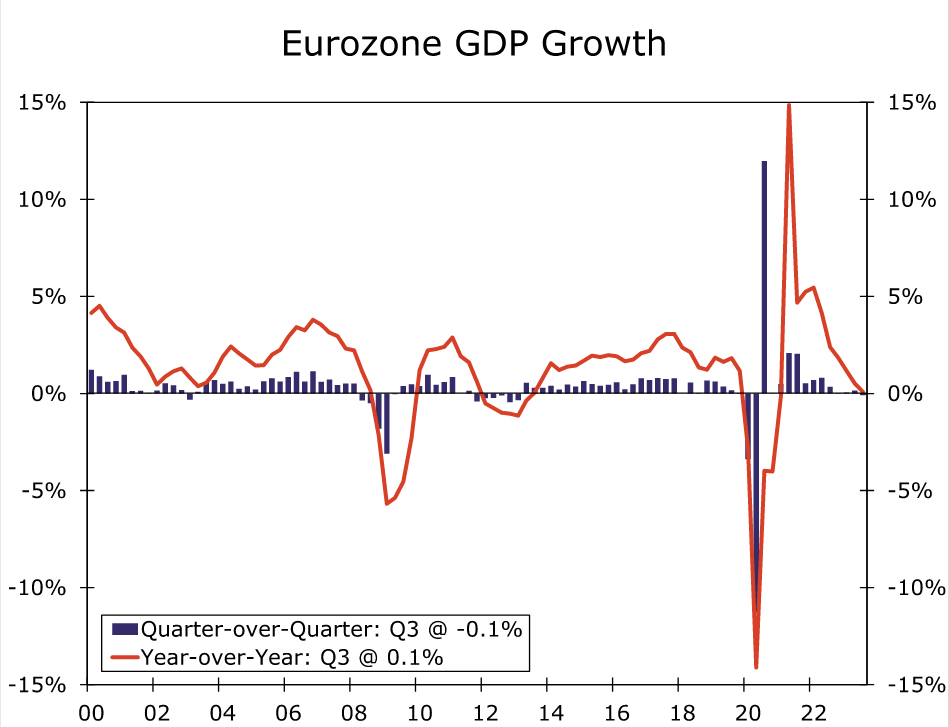
- The Eurozone has continued to deliver disappointing economic data as Q3 GDP shrank 0.1% quarter-over-quarter, the first decline (outside of the pandemic) since early 2013. With recent activity and survey data remaining soft, the natural question to ask is whether the Eurozone is on the cusp of, or perhaps already in, recession.
- One notable area of weakness has been consumer spending. That said, we believe the worst of the consumer slowdown may now have largely passed, as real household income trends have turned more positive and household interest costs have risen only moderately. We do, however, expect a further slowdown in investment spending given slowing corporate profit growth and declining capacity utilization rates.
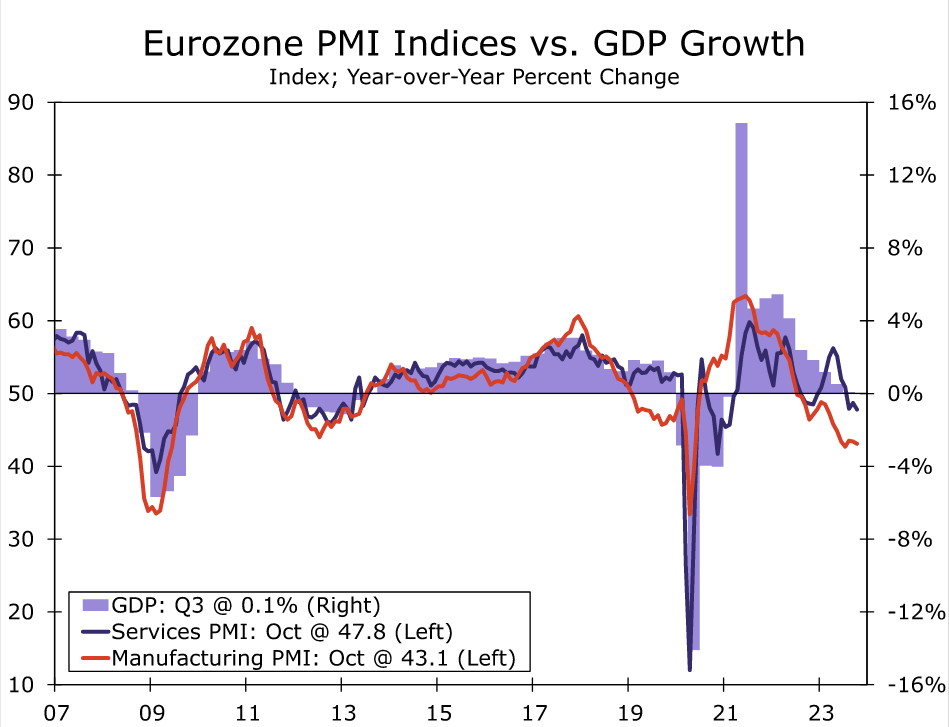
- The mixed outlook for consumer and investment spending leaves the Eurozone very close to recession. While we are not calling for recession just yet, should the PMI surveys stay at their current contractionary levels in the months ahead or soften further, an economic downturn may eventually become unavoidable.
- The underwhelming growth outlook means European Central Bank (ECB) rate hikes are very likely done, with the most recent progress on the inflation front reinforcing the view that the peak in policy rates has already been reached. However, we believe the ECB will still want to see underlying inflation trends move closer to, and remain near, its 2% inflation target before it becomes comfortable embarking on a monetary easing cycle.
- Against that backdrop, we do not forecast an initial ECB rate cut until the June 2024 meeting, although a steady series of rate cuts after that should see the ECB lower its Deposit Rate by a cumulative 150 bps to 2.50% between mid 2024 and early 2025. Overall, we view the risks as skewed toward the ECB lowering interest rates earlier, or more aggressively, than generally expected.
Eurozone Economy Delivers Disappointing Data
Eurozone economic data have been broadly downbeat in recent months, a trend capped by the region's third quarter GDP report. Q3 GDP surprised to the downside, dipping 0.1% quarter-over-quarter, although an upward revision to Q2 GDP provided a partial offset. Growth in the region's largest economies was subdued, as German GDP fell 0.1%, Italian GDP was flat and French GDP edged up just 0.1%. With recent activity and survey data remaining soft, the natural question to ask is whether the Eurozone is on the cusp of—or perhaps already in—recession. In this report we take a look at updated consumer and business fundamentals to offer some perspectives on those questions.
Consumer Slowdown May Be Passing The Worst
One notable area of weakness has been consumer spending, which has declined by a cumulative 0.6% in the three quarters through Q2-2024, the latest quarter for which full data are available. Moreover, the indications for third quarter spending are not encouraging. Retail sales fell in both June and July, and the average level of sales for the July-August period is down 0.6% compared to Q2. That said, we believe the worst of the consumer slowdown may be coming to an end. As headline inflation has receded, real household disposable income has returned to positive territory during this first half of this year. For Q2, real household disposable income rose 1.4% year-over-year, outpacing the 0.4% year-over-year increase in real consumer spending.
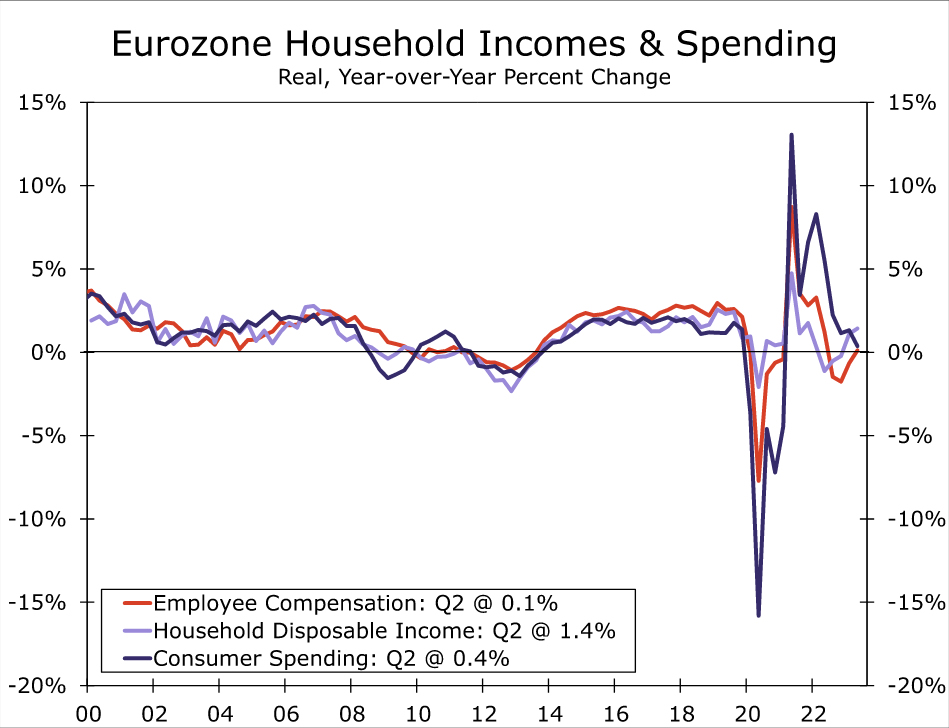
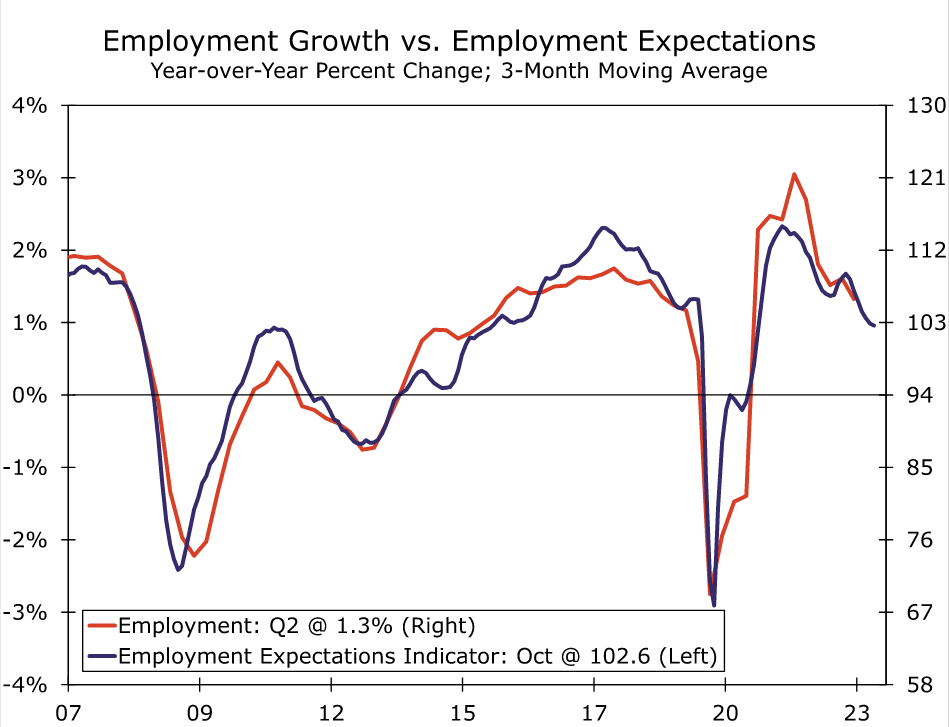
Our outlook is for growth in real household incomes to continue, and perhaps strengthen slightly further, through the rest of 2023 and into 2024. We see continued employment growth, though perhaps at a somewhat more gradual pace than recently. We note that while the European Commission's Employment Expectations Indicator (EEI) has softened, it has held up better than the broader Economic Sentiment Indicator. Indeed, the EEI remains above its long-term average from 2000 to 2022, and its October reading of 102.8 is historically consistent with employment growth of around 1% per year. With labor costs still growing by around 4.5%-5.5% and with inflation likely to decelerate somewhat further, we anticipate some further firming in real income growth going forward. We also note the household saving rate rose to 14.9% of disposable income in Q2, and remains moderately above pre-pandemic levels, providing Eurozone consumers some capacity to spend. Finally, we observe that household interest costs have risen only moderately over the past several quarters, to 2.1% of household disposable income by Q2-2023. Overall, while we don't necessarily envisage a sharp rebound, these moderately favorable household finance fundamentals should, in our opinion, prevent a significant further decline in consumer spending.
Business Outlook Gradually Softening
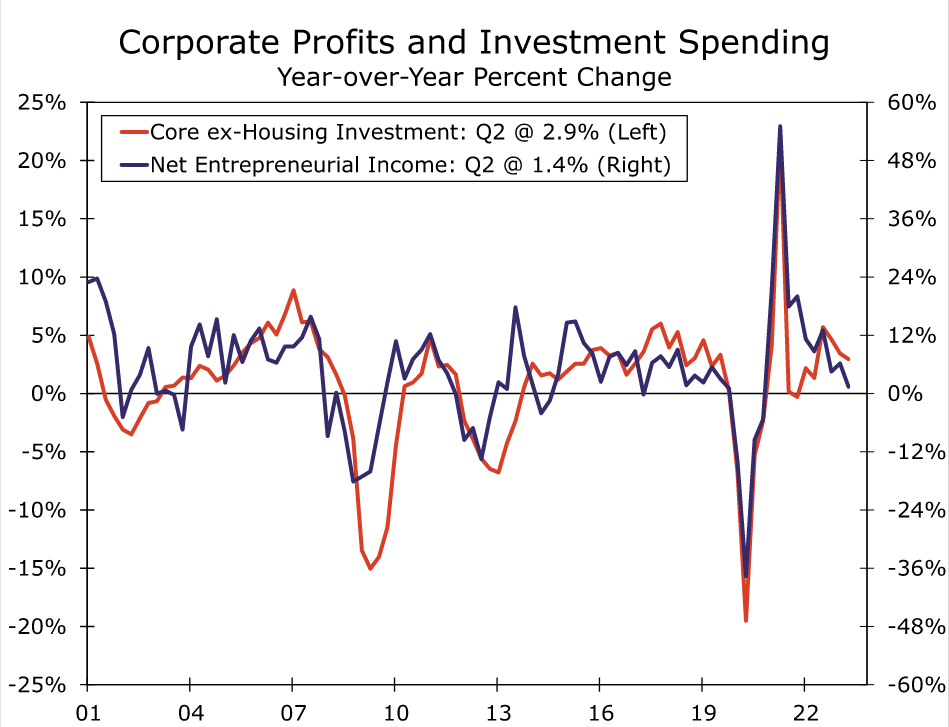
While we believe the consumer outlook may be passing the worst, we see potential for a moderate further weakening in the business outlook across the Eurozone and, as a result, possible weakness in investment spending in the quarters ahead. Eurozone corporate profits have held up reasonably well so far, but are showing signs of softening. Net Entrepreneurial Income (which, according to Eurostat, broadly approximates pre-tax corporate profits) grew 1.4% year-over-year in Q2-2023, the latest available data. On the positive side, corporate profits have not shown an outright decline so far, though on the more negative side, profit growth has slowed noticeably over the past year.
How might these gradually worsening trends for Eurozone businesses affect employment growth and investment spending? As we highlighted above, the gradually softening in business environment has led to only a moderate slowdown in employment growth. We expect job gains can continue in the quarters ahead, albeit at a slower pace than recently.
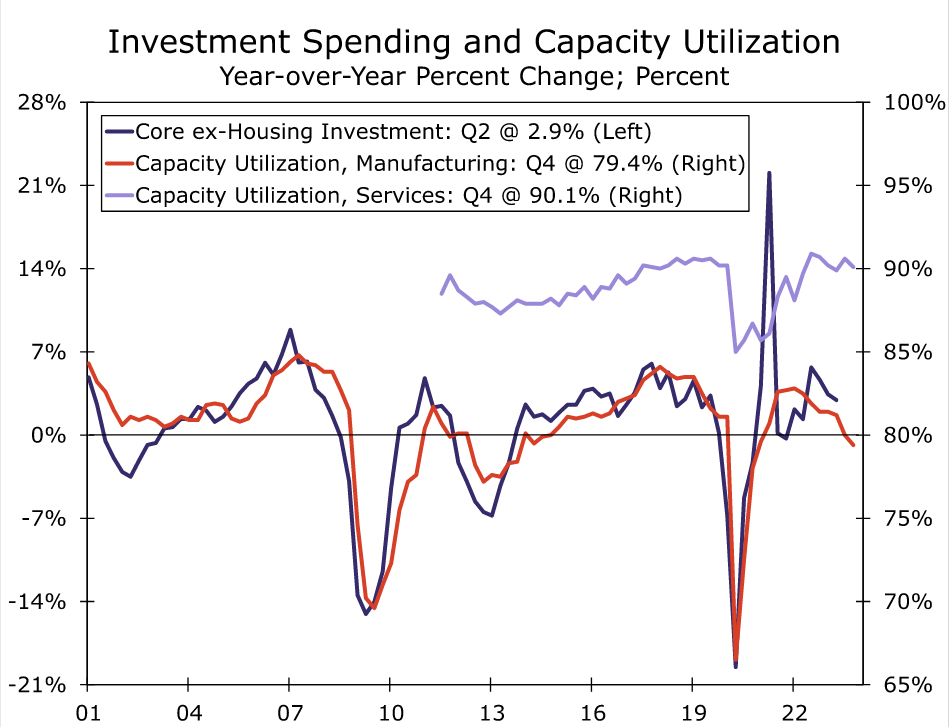
With respect to investment spending, we believe a range of recent indicators point to some decline in investment spending in the quarters ahead. For the Eurozone, a precise measure of business fixed investment is not readily available. We can, however, estimate a measure that broadly approximates that metric, and for which we believe investment cycles are broadly similar. Specifically, we calculate Eurozone investment spending excluding dwellings (or housing) investment and excluding intellectual property products. We exclude dwellings on the basis that it is clearly related to households and not businesses. While spending on intellectual property products is clearly relevant for business investment, it is also a particularly volatile series, and its removal allows for a clearer sense of underlying investment trends. Fortunately our estimated metric, which we define as “Core ex-Housing Investment”, shows a similar but less volatile cycle than overall Eurozone investment spending. While growth in core ex-housing investment has slowed, it was still up 2.9% year-over-year in Q2-2023. That said, trends in Eurozone net entrepreneurial income (or corporate profits) point to a further slowdown in core ex-housing investment ahead. Historically, Eurozone profit growth and investment growth cycles have followed reasonably similar patterns, and thus the slower growth in corporate profits also portends a downturn in investment spending. That would especially be the case if Eurozone profit growth turns negative, which is clearly a distinct possibility.
We also see some other indicators than reinforce the outlook for an investment spending slowdown. In particular, Eurozone capacity utilization measures have fallen in recent quarters, a trend that would suggest a slowdown in investment spending. That decline in capacity utilization has been most evident in the manufacturing sector, from 82.8% in Q1-2022 to 79.4% by Q4-2023. Historically, a capacity utilization rate of below 80% for manufacturing has been consistent with declining core ex-housing investment for the Eurozone. Capacity utilization in the service sector has also softened, though only slightly, from 90.9% in Q3-2022 to 90.1% by Q4-2023. Finally, Eurozone bank lending to non-financial corporates slowed to just 0.2% year-over-year in September, also an indirect indicator of slower investment spending ahead.
Overall the mixed outlook for consumer and investment spending leaves the Eurozone very close to recession, and largely dependent on whether the improvement in consumer spending transpires more quickly than any investment spending slowdown. Among the indicators we will be monitoring most closely are monthly retail sales and quarterly corporate profits and capacity utilization. Moreover, while we are not calling for Eurozone recession just yet, should the Eurozone PMI surveys stay at their current contractionary levels in the months ahead or soften further, an economic downturn may eventually become unavoidable.
Eurozone Rate Hikes Are Done, Monetary Easing Still Some Way Off
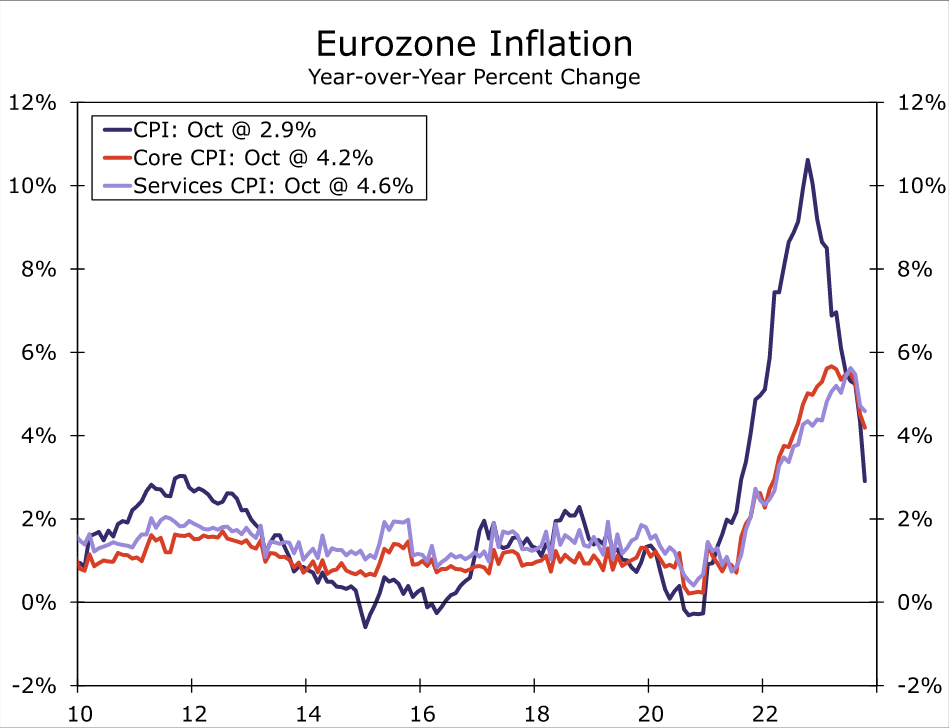
Regardless of whether the Eurozone falls into recession, we see enough growth headwinds to suggest that the European Central Bank's (ECB) monetary tightening is done. At its October announcement, the ECB held Deposit Rate at 4.00% and repeated that interest rates are at levels that if “maintained for a sufficiently long duration, will make a substantial contribution” to returning inflation to its 2% target in a timely manner. The most recent progress on the inflation front reinforces the outlook that a peak in policy interest rates has already been reached. The Eurozone October CPI slowed sharply 2.9% year-over-year, while there was also a moderate deceleration in core inflation and services inflation to 4.2% and 4.6%, respectively. The improvement in inflation trends when measured on a three-month annualized basis is even more noteworthy. Service sector inflation slowed to a 3.5% annualized pace in the three months to October, while the CPI excluding food and energy rose at a 2.3% annualized pace—the slowest rate of increase for this metric since June 2021.
Despite these encouraging trends, we believe it is too early for the ECB to sound the "all clear" on the inflation front and, accordingly, too early for the central bank to consider rate cuts just yet. Even on the three-month annualized measures, inflation remain a bit above the ECB's 2% inflation target. Moreover, it's not yet clear whether the October outcome reflects a temporary inflation reprieve, or the start of a more sustained downtrend. We expect three-month annualized inflation would need to slow closer to 2%, and remain in that region for several months, before the European Central Bank becomes comfortable enough to embark upon a rate cut cycle. For that reason, and even with an underwhelming growth outlook, we currently do not forecast an initial ECB rate cut until the June 2024 meeting. That is slightly earlier than the consensus forecast of economists, which envisages an initial rate cut at the September 2024 meeting, and broadly in line with the timing implied by market pricing.
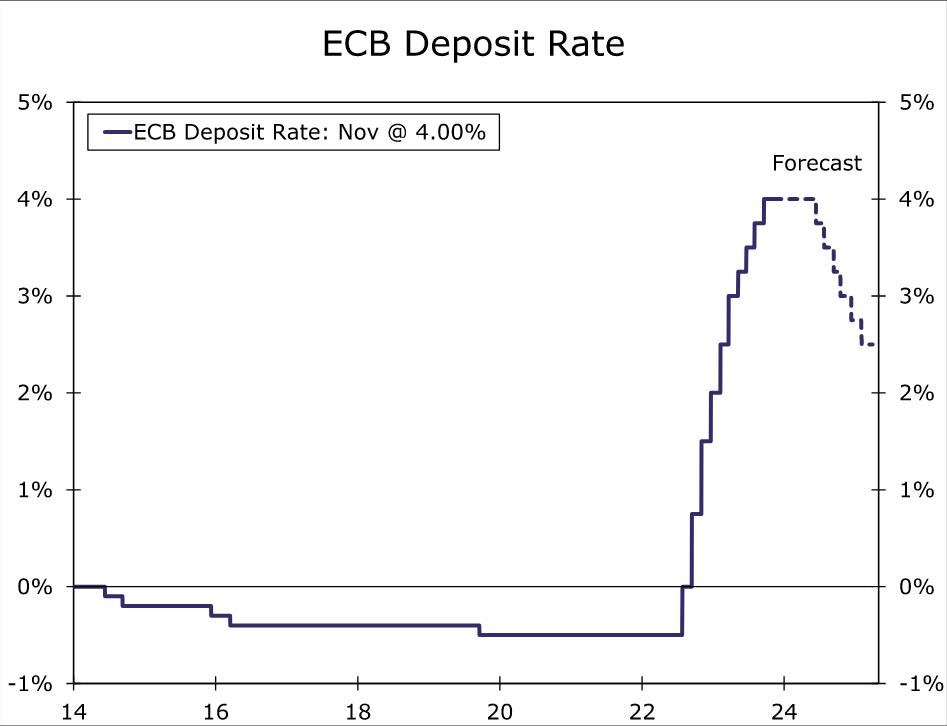
While the view the risks around our base case as relatively balanced, we certainly wouldn't rule out an initial rate cut coming even earlier than June next year. Given the progress on inflation so far and if the Eurozone does indeed fall into recession, we could envisage an initial rate cut as early as the April 2024 meeting. In addition, considering the underwhelming Eurozone economic outlook, we believe the ECB will be inclined to deliver a steady series of rate cuts once it is comfortable that inflation is under control. Accordingly, our base case is for the ECB to lower its Deposit rate by a cumulative 150 bps to 2.50% between Q2-2024 and Q1-2025. Overall our main takeaway is that, relative to the consensus economist forecast or market implied pricing, we believe the risks are tilted toward the ECB lowering interest rates earlier, or more aggressively, than generally expected.
Could Surprise Indices Explain Market Movements?
- Surprise indices are an easy way of mapping the current state of an economy
- Our index confirms that the US economy has been losing steam the past few weeks
- Could EURUSD moves be explained by our surprise indices?
Theory states that the price of financial assets should reflect the underlying economic conditions in the respective region. While this tends to occur from a long-term perspective, a good chunk of the movements occurring in the short-term are dictated by sentiment and the impact of surprises by economic data releases.
Without aiming to steal the thunder from more established surprises indices, we created economic surprise indices for the US, the UK and Germany; the latter one is used as a proxy for the euro area. Our intention is to (a) identify the current state of economic surprises in each region, (b) compare the different regions, and (c) examine whether these indices confirm or even lead the performance of key financial assets.
We have used economic releases since 2013 and have assigned different weights to the more market-moving data. For example, the preliminary release of PMIs surveys has a greater weight in the index compared to other smaller and less market-moving business surveys. Similarly, data releases with no market forecast have the lowest possible impact on the surprise indices. It is worth noting that by surprise we refer to any economic data release significantly diverging from the economists’ forecast; thus a surprise could be positive and negative.
US, UK and German surprise indices – interesting findings
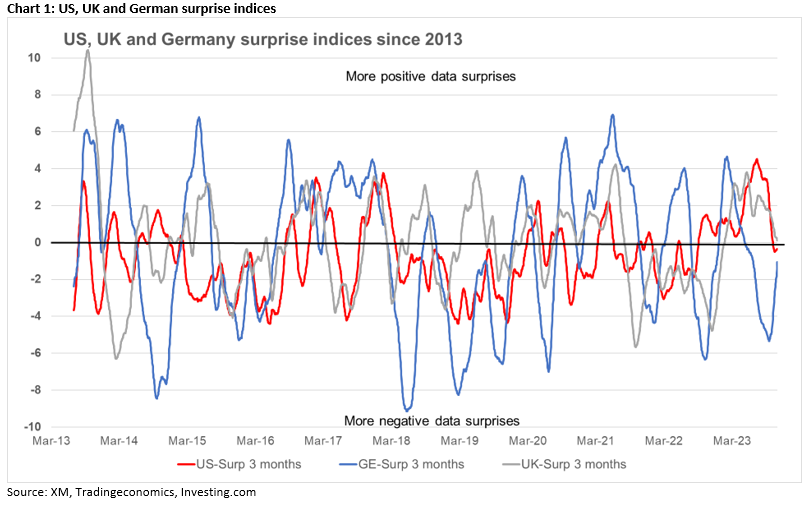
Our brand-new surprise indices, using a 3-month rolling period of economic data releases, are presented in Chart 1 below. According to our findings, only the UK index is in positive territory. This means that over the past 3 months data releases in the UK have mostly been stronger than their previous prints, and that data surprises have been more positive than negative. However, this trend appears to have changed lately, as the UK index is on a downward path with the negative surprises multiplying.
The same kind of worsening is more evident in the US surprise index. As seen in Chart 1, the US economy was at its strongest position during the summer. However, it peaked on July 17, and it has been aggressively moving lower since then. It is currently a tad below the zero line, as the recent data releases have been worsening and producing marginally more negative surprises compared to expectations.
Similarly, the German surprise index is currently hovering at a low level. However, since mid-September this index has been on an aggressive upward trend, pointing to an improvement in data releases despite the bleak short-term economic forecasts from various German think tanks.
We have to highlight the fact that economists tend to become more optimistic especially when the economy is assumed to be progressing well. This potentially gives rise to more negative surprises. This attitude is also shared by central banks when examining their forecasting record. For example, the ECB tends to produce inflation projections that show that the Bank is close to its target at the end of the forecasting window examined, despite its recent dismal record.
Euro/dollar and the surprise indices
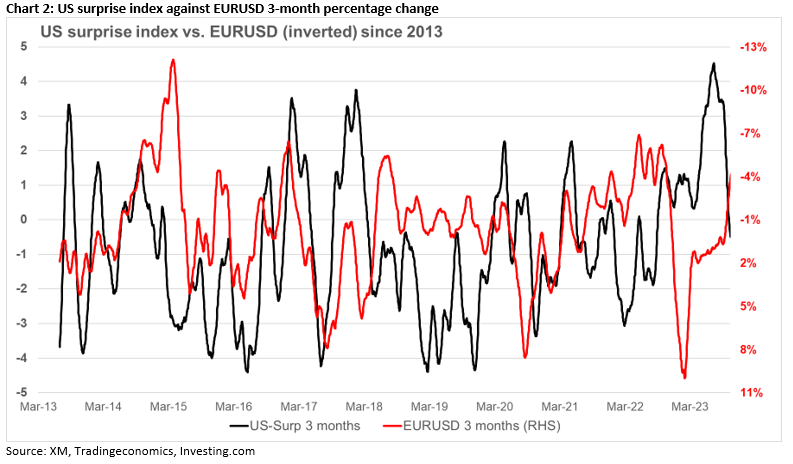
The key motivation for the creation of surprise indices is to unmask any possible correlation with key market assets. Therefore, we tried to tie up the recent trend of the surprise indices with the performance of instruments like the EURUSD. Interestingly, the progressive and significant divergence of the US and the German surprise indices over the summer, seen quite clearly in Chart 1 above, can explain to a certain degree the strong bearish move recorded in EURUSD during the July-September period. More recently, the converging US and the German surprise indices are bound to have played a role in the EURUSD upleg registered since early October.
The long-term relationship between the US surprise index and EURUSD is presented in Chart 2 below and, at times, the negative correlation tends to be rather strong. Interestingly, since the start of 2023 this correlation has been strengthening as strong US data releases fueled the sell-off in EURUSD. A growing US economy, especially when other developed economies are going through a rough patch, tends to attract global investor interest. This situation increases demand for the US dollar, as investors want to take advantage of investment opportunities. However, since early September, this relationship turned positive, potentially pointing to other factors being behind the recent EURUSD move.
S&P 500 cash index driven by the surprise indices?
Like EURUSD, there appears to be a strong relationship between the S&P 500 cash index and the US surprise index. Since early-2023 this relationship has been getting stronger with the current correlation being very close to 1, the strongest possible positive correlation. This situation is expected as the stock market, at normal times, reflects the current economic conditions and the market participants’ expectations about the future. Therefore, we can assume that the S&P 500 rally during 2023 was fueled by consistent upside surprises in US data.
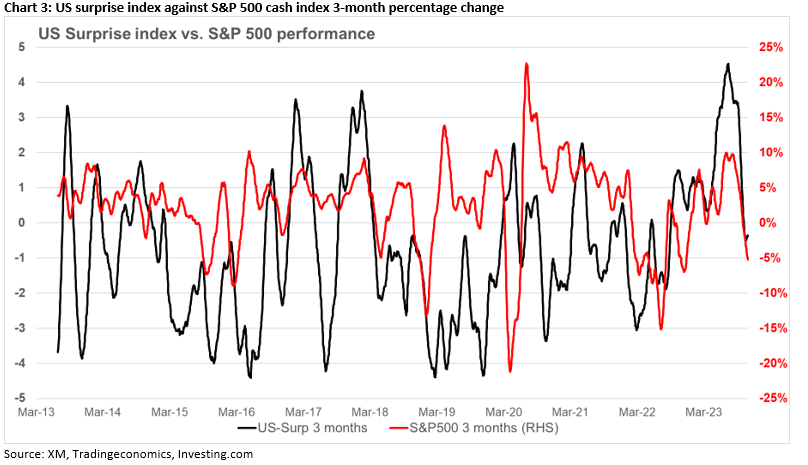
To sum up, our first attempt to create surprise indices for the three key developed economies has produced some interesting findings. The UK appears to record the best economic surprise score at this stage with Germany still hovering at negative territory and the US recently experiencing an aggressive weakening in its economic data prints. This difference between the US and the German surprise indices can explain at a great length the EURUSD performance during the until late September. Finally, in terms of equities, the US surprise index is currently very strongly positively correlated with the S&P 500 cash index.
GBPUSD Wave Analysis
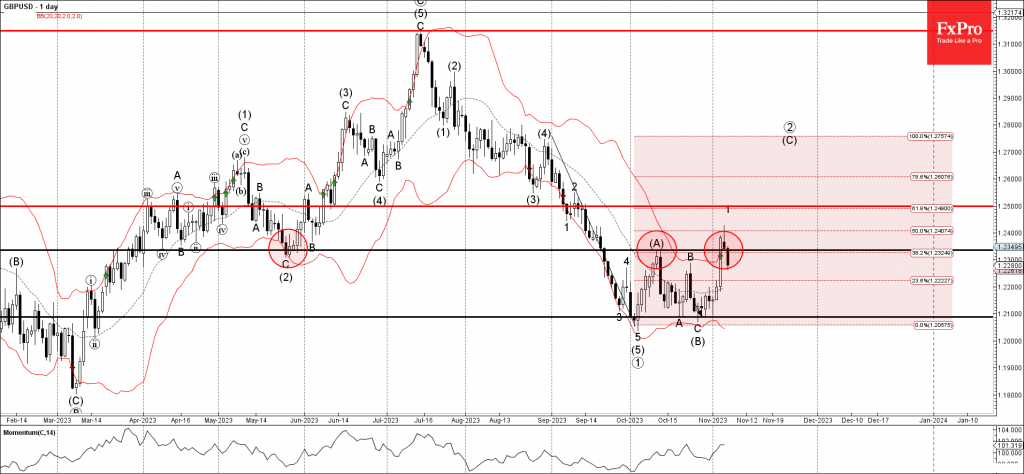
- GBPUSD reversed from key resistance level 1.2335
- Likely to fall to support level 1.2200
GBPUSD currency pair recently reversed down with the daily Shooting Star from the key resistance level 1.2335 (former strong support from May).
The resistance level 1.2335 was strengthened by the upper daily Bollinger Band and by the 50% Fibonacci correction of the downward impulse from august.
Given the strength of the resistance level 1.2335, GBPUSD can be expected to fall further toward the next support level 1.2200.
AUDJPY Wave Analysis
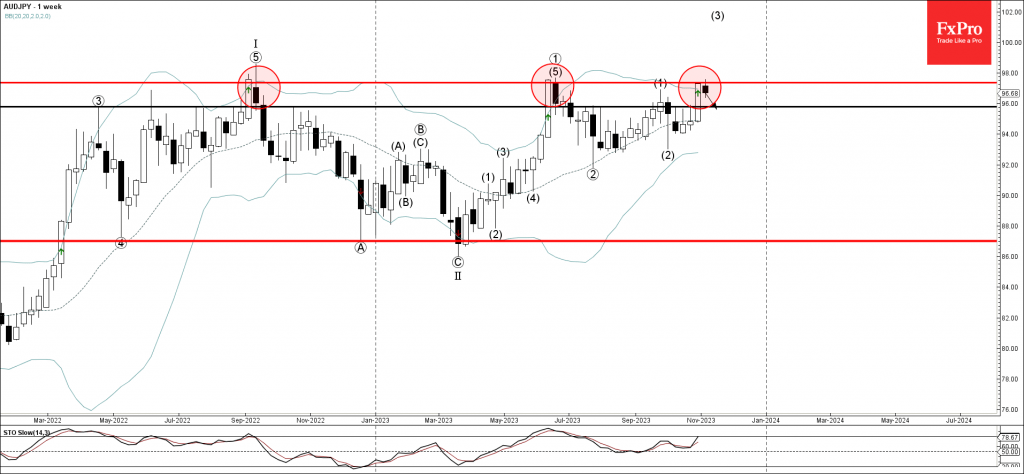
- AUDJPY reversed from resistance level 97.35
- Likely to fall to support level 96.00
AUDJPY currency pair recently reversed down from the major resistance level 97.35 (which has been reversing the pair from September of 2022).
The resistance level 97.35 was strengthened by the upper daily and weekly Bollinger Bands.
Given the strength of the resistance level 97.35 and the overbought daily Stochastic, AUDJPY can be expected to fall further toward the next support level 96.00.
Fed’s Goolsbee: Job market getting into better balance
Chicago Fed President Austan Goolsbee, in recent comments to CNBC, noted that the job market is "getting into better balance," a sign that the central bank's policies may be having the desired effect without tipping the economy into a sharp downturn.
The Chicago Fed head also mentioned the need for a shift in focus from the height of rate hikes to the duration for which these elevated rates might need to be maintained.
"As long as we're making progress," he remarked, "the moment of arguing how high should the rate go is going to fade to how long should we keep rates at this level as inflation is coming down."
Fed’s Kashkari sees inflation battle far from over
In a recent interview with Bloomberg TV, Minneapolis Fed President Neel Kashkari underscored Fed's commitment to reining in inflation, stressing the importance of reducing the inflation rate to Fed's target of 2% over a "reasonable period of time."
However, he also candidly expressed that the exact measures required to achieve this goal are still uncertain, as the economic response will guide future actions.
"We have to get inflation back down to 2% over a reasonable period of time," Kashkari stated, adding, "Ultimately, the economy will tell us how much is needed to get there. And I just don't know."
Kashkari's remarks come at a time when the economy is displaying resilience in the face of aggressive monetary tightening, with economic indicators not showing signs of significant weakening. "I'm not seeing a lot of evidence that the economy is weakening,"
Despite Fed's aggressive rate hikes aimed at cooling inflation, Kashkari emphasized that policymakers have not declared victory yet. The fight against inflation is ongoing, and Fed is prepared to implement additional tightening measures if they are deemed necessary.
EURUSD Sustains Strength Near Six-Week Highs
The EUR/USD currency pair remains steadfast near 1.0710 on Tuesday, maintaining proximity to the six-week highs set the previous day.
The U.S. dollar has seen a tempered performance, influenced by recent U.S. labor market statistics for October and the resultant stock market adjustments. The data pointed to pockets of weakness in the employment sector, leading investors to infer that the cooling may be an effect of tighter credit and monetary policies. Consequently, there has been a recalibration of expectations regarding the trajectory of future Federal Reserve rate hikes.
In detail, the U.S. unemployment rate edged up to 3.9%, slightly higher than the previous 3.8%. Nonfarm payrolls showed an increase of 150 thousand, which was shy of the forecasted 178 thousand. Additionally, the average wage increment was a modest 0.2% month-over-month, missing the anticipated mark.
Market sentiment now appears to lean towards the belief that the current interest rates may represent the zenith of the present monetary tightening cycle.
EUR/USD technical analysis
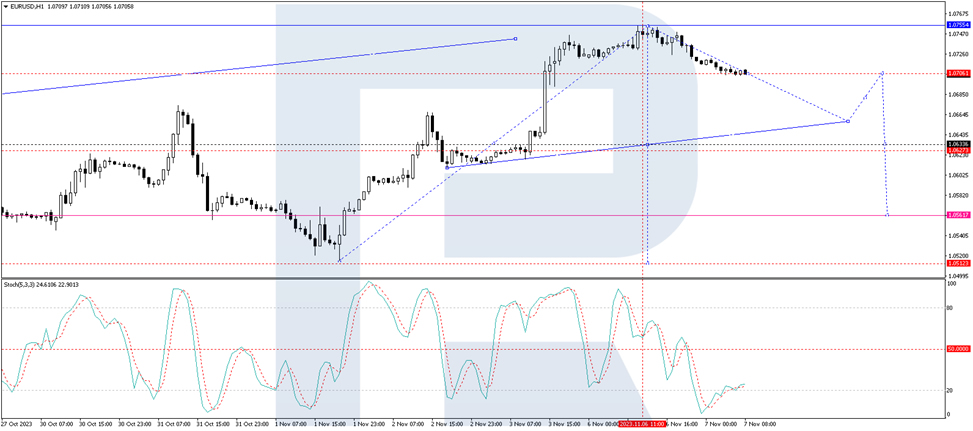
On the H4 chart for EUR/USD, the currency pair has attained the correctional target at 1.0755. The trend now seems to be tilting downwards, with a trajectory set towards the 1.0655 level. A consolidation phase around this mark is probable. A break below this consolidation could signal a further decline to 1.0633, and potentially, should this support give way, a fall to 1.0515 could be on the horizon. The MACD indicator suggests a peak formation, with its signal line at the highs and anticipating a downturn.
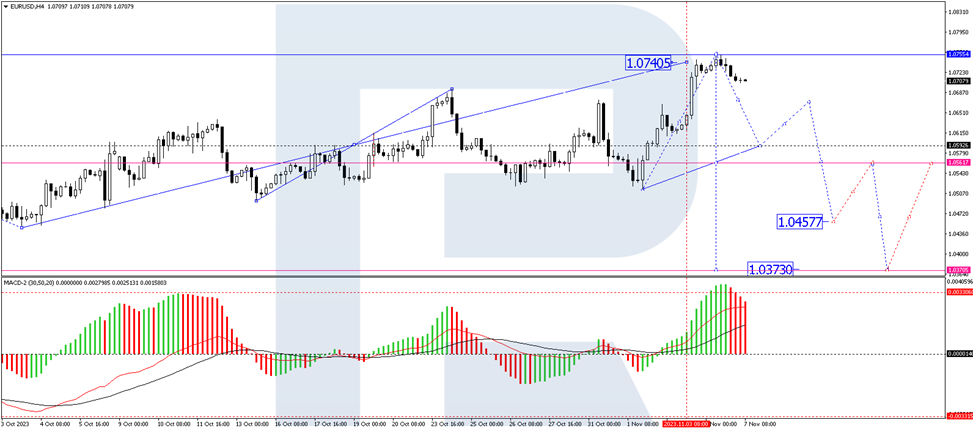
The H1 chart reveals a continuation of the downward wave targeting 1.0655. Should the pair touch this level, a corrective move upwards to around 1.0700 might ensue. Subsequent to this correction, the market may witness a renewed descent towards 1.0633. The Stochastic oscillator provides technical affirmation for this bearish outlook, with its signal line dropping below 50 and aiming for the 20 level.