Sample Category Title
DXY Looking Towards March Highs, to Complete the Higher Degree Recovery
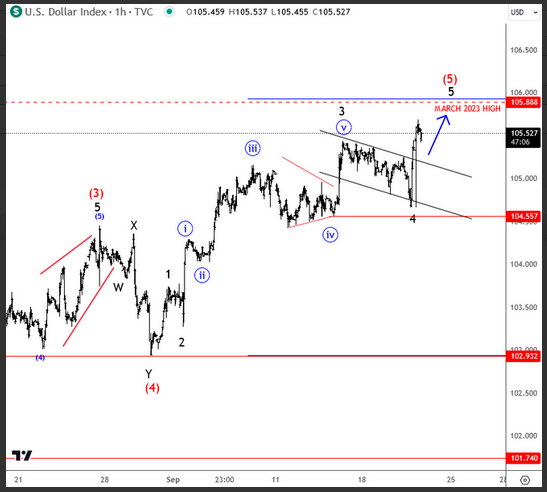
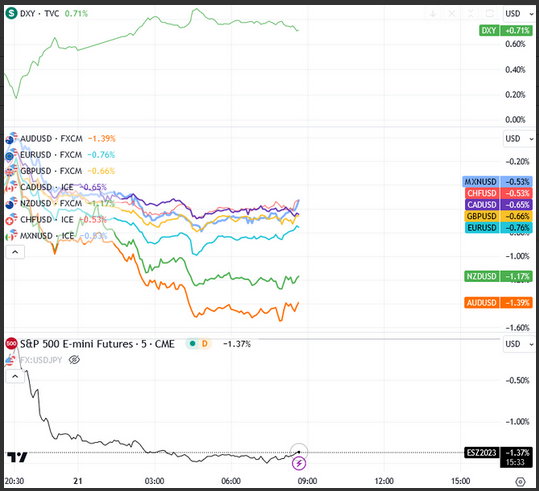
Markets are in risk-off mode after the Fed left its policy rate unchange. The USD extended the gains across the board with DXY catching the March highs. Interesting, Aussie and kiwi are again one of the weakest while MXN is not down much, so for dollar shorts I still faovur to look at USDMXN pairs, while dollar longs can be the best vs NZD and AUD.
Dollar Index Lifted by Fed’s Hawkish Pause
The dollar index rose to new multi-month high in early Thursday, boosted by Fed’s decision to keep rates on hold at September’s meeting but signaling another hike by the end of the year, which markets saw as hawkish rate pause.
The US central bank left its policy rate unchanged at 5.25%-5.50%, in line with expectations, but left the door open for one more hike, expecting interest rate to peak at 5.50%-5.75% range this year.
The policymakers see the overall economic conditions as satisfactory for now that will allow them to keep restrictive policy for extended period, without high risk of significantly harming the economy.
In addition, the Fed signaled it will continue fight with inflation even if prices decline further in coming months, with first rate cuts expected the earliest in mid-2024, if conditions continue to improve, though they downgraded initial projection for 100 basis points cut next year to 50 basis points.
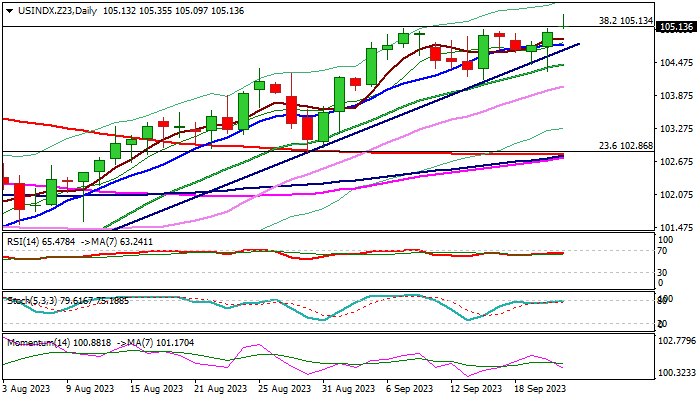
Fresh rise of dollar index price generated initial signal of bullish continuation, after larger bulls paused under pivotal Fibo resistance in past almost three weeks.
Bulls cracked 105.13 barrier (Fibo 38.2% of 114.72/99.20 descend) with close above here seen as a minimum requirement to keep fresh bulls intact for attack at another strong obstacle provided by weekly Ichimoku cloud (spanned between 105.47/106.22).
Firm break above the cloud (which will continue to thicken in coming weeks) is needed to confirm bullish signal.
Daily studies remain bullish overall but fading positive momentum and stochastic about to enter overbought territory, add to headwinds and require caution.
Near-term action should stay above 104.80 zone (10DMA / bull-trendline off 99.20, July 18 low) to keep bullish bias, while increased downside risk to be expected on break below 104.44/17 (20DMA / Sep 14 trough).
Res: 105.47; 105.60; 106.22; 106.96.
Sup: 105.00; 104.80; 104.44; 104.17.
Markets Heed Hawkish Fed
Risk sentiment was forced to turn lower as the Fed delivered its higher-for-longer messaging to markets, projecting fewer-than-anticipated rate cuts for 2024. With potentially one more rate hike to come this year, the US dollar moved back closer to its year-to-date high while global equities tumbled, though spot gold was able to mitigate its losses.
Following the Fed’s latest commentary, markets have now pared bets for US rate cuts in 2024, with next year’s median rate in the dot plot revised up by 50 basis points higher than June’s projections. Chair Powell admitted that a rate cut “will come” but refrained from saying when.
US rates that are kept higher for longer are set to erode an expected tailwind for US stocks and spot gold over the coming year; even a soft landing may not be in the best interests of the bulls. Furthermore, the threat of $100 oil could revive the need for additional rate hikes, further delaying central bankers’ victory lap against still-stubborn inflation.
However, an erosion of US economic resilience, perhaps via the UAW strikes, government shutdown, or a steep drop in consumer spending, may hasten the Fed’s eventual rate cut while potentially providing some year-end cheer for risk-taking activities across global financial markets.
BOE decision on knife’s edge
Markets have slashed bets for another 25-basis point hike by the Bank of England today, with such odds now standing at 48%, in stark contrast to the 80% chance priced in this time last week.
Yesterday’s lower-than-expected August inflation prints are expected to bind the hands of MPC hawks. A rate hike today may even confirm that UK rates have peaked for this cycle.
Dovish signals out of the BOE today, even if it were accompanied by a rate hike, could see GBPUSD bears potentially gunning for the 1.20 psychological level.
SNB bucks expectations and keeps interest rate steady
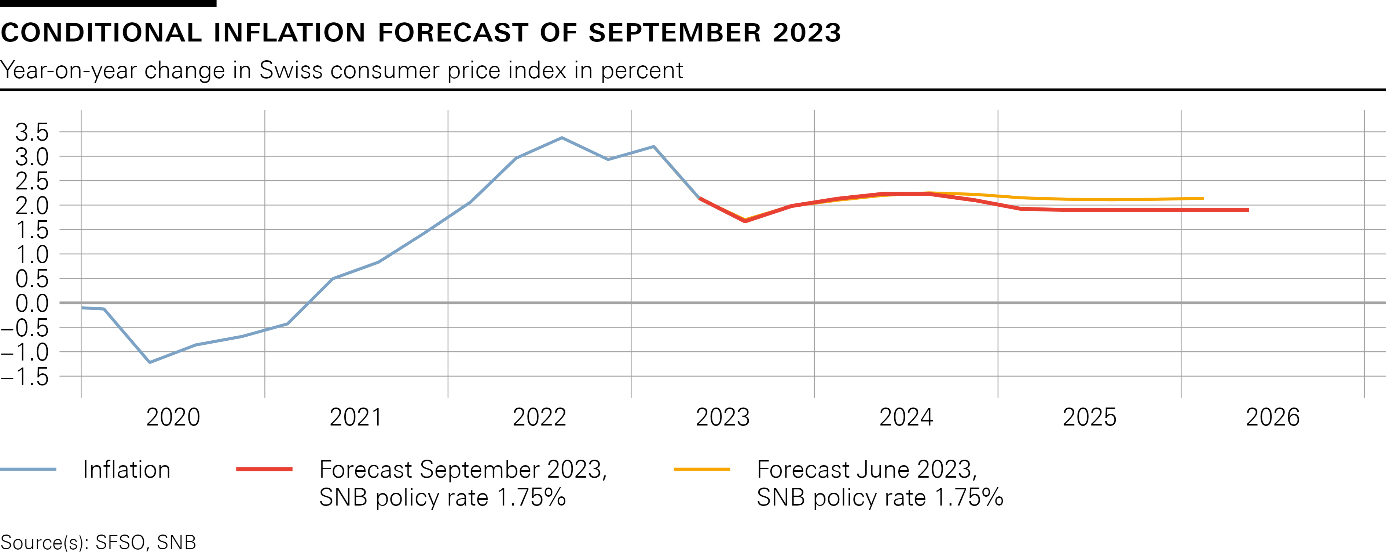
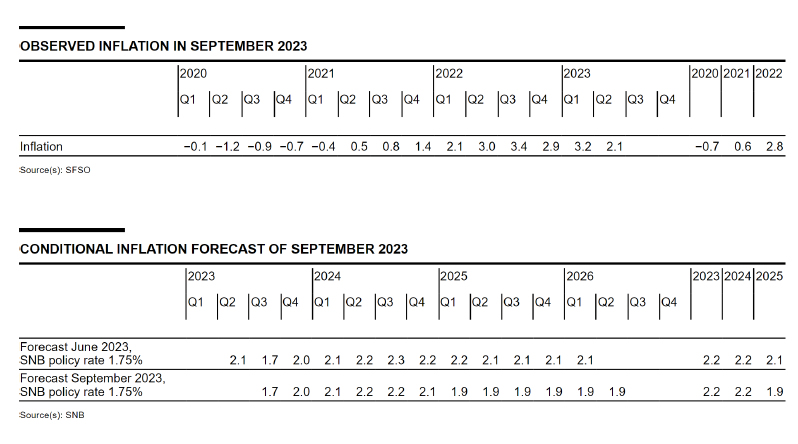
In an unexpected move that diverged from the market's anticipations, SNB held its policy rate steady at 1.75%, side-stepping the anticipated hike to 2.00%. The conditional inflation projections have undergone downward revision. While inflation could surge above 2% target in upcoming quarters, it's projected to retract back to 1.9% in 2025 based on current interest rate, without further tightening.
Despite this, SNB did not completely distance itself from a hawkish tone, and maintained the further tightening "may become necessary". It also reiterated the willingness to intervene in the market with focus on "selling foreign currency
Delving into the specifics of the conditional inflation projections, based on steady 1.75% policy rate, inflation is forecasted to ascend to 2.0% by the end of this year. It will scale up to its apex at 2.2% in the second quarter of 2024, before experiencing a slight dip to 1.9% at the onset of 2025, maintaining that level thereafter.
On the economic growth front, SNB's projections lean towards the cautious side, forecasting tepid growth for the remainder of the year. The annual growth is projected to hover around a modest 1%.
(SNB) Swiss National Bank leaves SNB policy rate unchanged at 1.75%
The Swiss National Bank is leaving the SNB policy rate unchanged at 1.75%. The significant tightening of monetary policy over recent quarters is countering remaining inflationary pressure. From today's perspective, it cannot be ruled out that a further tightening of monetary policy may become necessary to ensure price stability over the medium term. The SNB will therefore monitor the development of inflation closely in the coming months. To provide appropriate monetary conditions, the SNB is also willing to be active in the foreign exchange market as necessary. In the current environment, the focus is on selling foreign currency.
Banks' sight deposits held at the SNB will continue to be remunerated at the SNB policy rate of 1.75% up to a certain threshold. Sight deposits above this threshold will be remunerated at an interest rate of 1.25%, and thus still at a discount of 0.5 percentage points relative to the SNB policy rate.
Inflation has declined further in recent months, and stood at 1.6% in August. This decrease was above all attributable to lower inflation on imported goods and services.
The new conditional inflation forecast is based on the assumption that the SNB policy rate is 1.75% over the entire forecast horizon (cf. chart 1). In the medium term, the new forecast is somewhat below that of June, mainly due to the economic slowdown and slightly lower inflationary pressure from abroad. The inflation forecast puts average annual inflation at 2.2% for 2023 and 2024, and at 1.9% for 2025 (cf. table 1). It is thus just within the range of price stability at the end of the forecast horizon.
Global economic growth was moderate in the second quarter of this year. Although inflation continued to decline in many countries, it remains clearly above the respective targets. Against this background, numerous central banks tightened their monetary policy further during the last quarter, albeit at a slower pace than in the previous quarters.
The growth outlook for the global economy in the coming quarters remains subdued. At the same time, inflation is likely to remain elevated worldwide for the time being. Over the medium term, however, it should return to more moderate levels, not least due to more restrictive monetary policy.
This scenario for the global economy remains subject to large risks. In particular, the high inflation in some countries could be more persistent than expected, necessitating a further tightening of monetary policy there. Equally, the energy situation in Europe could deteriorate again in Q4 2023 and Q1 2024. A pronounced slowdown in the global economy therefore cannot be ruled out.
Swiss GDP stagnated in the second quarter of 2023. The services sector once again grew solidly, while value added in manufacturing contracted significantly. The labour market remained robust, and utilisation of overall production capacity continued to be above average, albeit only slightly.
Growth is expected to remain weak for the rest of the year. Subdued demand from abroad, the loss of purchasing power due to inflation, and more restrictive financing conditions are having a dampening effect. Overall, Switzerland's GDP is likely to grow by around 1% this year. In this environment, unemployment will probably continue to rise slightly, and the utilisation of production capacity is likely to decline somewhat.
The forecast for Switzerland, as for the global economy, is subject to high uncertainty. The main risk is a more pronounced economic slowdown abroad.
Momentum on the mortgage and real estate markets has weakened noticeably in recent quarters. However, the vulnerabilities in these markets remain.
What Will the BoE Do?
The Federal Reserve (Fed) maintained interest rates unchanged, as expected. It revised its growth forecast higher, as expected. The peak unemployment rate was revised to 4.1%, down from 4.5% as a result of a resilient jobs market. The Fed President Jerome Powell said that they are getting close to where they want to be and that the bank must ‘proceed carefully’ on the last mile. He also said that the positive pressure on yields was due to strong growth prospects and an abundance of Treasury issuance rather than higher inflation. And the dot plot showed one more rate hike before the end of this year, and less cuts next year.
So yes, the Fed announcement was hawkish, without much surprise. The market reaction was smooth and unsurprising, as well. The US 2-year yield spiked to 5.20%, the 10-year yield reached 4.45%. Both the S&P500 and Nasdaq slipped below their ascending base building since October, while the US dollar index extended gains and pulled out the all-important Fibonacci resistance. The index now trades above the major 38.2% Fibonacci retracement on past year’s rally, potentially marking the end of the last year’s bearish trend. The next bullish targets stand at 107 than 109 levels.
The only thing that could slow down the US dollar’s appreciation is a hawkish shift in other major central bank’s policies. But with the European Central Bank (ECB) preparing to pause rate hikes as soon as next meeting, and the Bank of England (BoE) expected to announce its last rate hike today, we can only rely on the Bank of Japan (BoJ) to make a change. And well… I wouldn't place my bets on a hawkish BoJ even if the universe handed me a lucky horseshoe. The USDJPY is now above the 148 mark, and if the BoJ does or says nothing tomorrow, the pair could be propelled to 155. The only risk in a long USDJPY trade is a direct FX intervention from Japan. And that’s just turning the mill with carried water…
Fifty-fifty
Up until yesterday, the expectation was an almost certain 25bp hike from the BoE at today’s meeting, but yesterday’s shocker inflation data has shaken these expectations. In fact, no one, and even less the BoE Chief Bailey himself, was expecting to see softer inflation in Britain last month, when oil prices spiked and sterling fell. Therefore, the surprising nature of yesterday’s data release should prevent the BoE from announcing a surprise rate pause today. Because:
- Rising energy prices, and falling sterling hint at potentially higher inflation in the foreseeable future,
- At 6.2%, core inflation is still more than three times the BoE’s 2% inflation target.
In summary, the BoE is not there yet. And if sterling continues to fall – which is the most plausible outcome if the BoE softens its policy stance more than necessary today, inflation in Britain will become harder to contain. As a result, a - maybe - last 25bp rate hike is on today’s menu to limit losses in sterling so that energy costs wouldn’t spike as a result of a happy CPI report, that’s happiness would remain short-lived.
Speaking of energy, the barrel of US crude fell below the $90pb on Wednesday even though the US crude inventories fell more than 2-mio barrel last week, more than a 1.3-mio-barrel fall expected by analysts. This week’s retreat from above the $93pb is due to profit taking. The downside correction that could reasonably extend toward $86/87 range.
Central Bank Bonanza
Market movers today
A packed central bank day kicks off with Riksbank which we expect to hike rates by 25bp to 4% in line with consensus view. We expect this to be the final hike in the cycle but risks remain skewed on the upside, and we believe Riksbank will leave door open for November. See more below.
The SNB will announce their rate decision at the same time as the Riksbank, and despite inflation being in their target range of 0-2%, we and the consensus expect them to hike the policy rate by 25bp to 2%, marking the peak.
We expect Norges Bank to hike rates by 25bp to 4.25 % and signal that rates most likely have peaked. However, Norges Bank will keep the door open for further hikes if needed, which will also be illustrated by the rate path in the MPR. The same rate path will probably postpone the timing of the first cut to well into H2.
For Bank of England, markets are split after yesterday's inflation data, and are now only pricing in less than 50% probability of a hike today (was 80% before CPI). Yesterday's August inflation print was a big surprise, as headline inflation declined from 6.8% to 6.7%. Analysts had expected an increase to 7.0%. Core inflation fell even more sharply from 6.9% to 6.2% (exp. 6.8%). While we do not believe a single weak data release is enough to defer the BoE from hiking by 25bp, we think yesterday's release definitely favours a dovish commentary, signalling a peak.
Also, in the afternoon, Central Bank of Turkey is expected to hike rates by 500bp to 30%.
Overnight, Bank of Japan will announce their monetary policy decision. We do not expect any changes this time, but do think another tweak in their YCC is likely later this year.
On data front, we get the euro area September consumer confidence figures. Consumer confidence has increased greatly since last fall where the energy crisis and inflation shock depressed consumers. In August, consumer confidence took a small dive and it will be interesting to see if this was a one-off or if consumers' moods are fading again due to the weakened growth and employment outlook.
The 60 second overview
Market sentiment: Markets are risk off, digesting the Fed's hawkish hold yesterday, and preparing for today's central bank bonanza. The US 2-year yield has reached its highest level since 2006, EUR/USD is approaching 1.06 level and Brent oil price has retraced back below USD 93 level.
Fed: Last night, the Fed maintained rates unchanged as widely anticipated, but the clearly stronger-than-expected economic forecasts marked a hawkish surprise for the markets. The Fed revised up 2023 GDP forecast to 2.1% (from 1.0%), 2024 to 1.5% (from 1.1%) and left 2025-2026 forecasts at 1.8%. Despite the stronger than expected growth, inflation is still seen cooling largely in line with earlier forecasts. Powell made it clear that the more upbeat outlook warrants maintaining rates higher for longer, which was also visible in the updated rate projections. 12 out of 19 participants called for one more hike in 2023, while 2024 and 2025 median 'dots' were revised up by 50bp to 5.1% and 3.9% respectively. While we share the Fed's view of cooling inflation, we expect a clearly more pronounced slowdown for growth on the back of already restrictive stance of monetary policy and continuing tightening in financial conditions. As such, we make no changes to our Fed call, and still think that the Fed's next move will be a cut in Q1 2024. Read our full Fed review: Upbeat on growth, 20 September.
China: In a further sign of stimulus by Chinese officials the fifth largest city in China, Guangzhou, has eased home-buying rules for non-citizens who will now be eligible to purchase a home if they have paid personal income taxes there for at least two years (was previously five years).
FI: The Federal Reserve kept rates unchanged as expected, but signalled that there could be one more hike later in the year. Furthermore, the FOMC committee also raised their "dot plots" such that they are not expecting as many cuts as previously. Hence, the FOMC committee sees the fed funds rate at 5.1% by the end of 2024 to previously 4.6%.
FX: Central banks and relative rates keep setting the tone in FX markets. Last week the dovish hike from the ECB sent EUR/USD one figure lower and after the Fed's hawkish hold the cross dropped another full figure to currently around 1.063. Meanwhile, USD/JPY soared and is back well above 148, GBP/USD weakened and USD/Scandies both rallied more than ten figures on the back of Fed. Scandies which in general had a strong day ahead of Fed, erased some of the gains afterwards. Now, SEK, NOK, CHF and GBP wait to take direction from today's European Central Bank's decisions.
Credit: The credit markets traded with a positive tone yesterday with good 2-way flow in cash and tightening of the indices. While headline indices were distorted by the roll to series 40 yesterday, we see like for like spreads tightening of 1bp in iTraxx main and 4bp in Xover.
Nordic macro
For the Riksbank meeting, we expect a 25bp hike up to 4.00% which is in line with consensus and market pricing. As for the forward guidance, we would expect that the rate path is revised slightly higher, signalling some 10-15bp for another hike in November. We do not expect the Riksbank to make adjustment to the QT programme, where they currently sell government bonds at a monthly pace of SEK5bn. The most interesting part of today's announcement will be if the Riksbank provides any details on the potential hedging of 25% of the FX exposure in the currency reserve. While the Riksbank stressed in June that such a decision should not be seen as a currency intervention, we assess that it could nevertheless lend support to the SEK in the coming months. See more in our preview in Reading the Markets Sweden - 15 September.
We expect Norges Bank to hike rates by 25bp to 4.25% and signal that rates have most likely peaked. However, Norges Bank will keep the door open for further hikes if needed, which will also be illustrated by the rate path in the MPR. The same rate path will probably postpone the timing of the first cut to well into H2.
USD/JPY Daily Outlook
Daily Pivots: (S1) 147.76; (P) 148.06; (R1) 148.65; More...
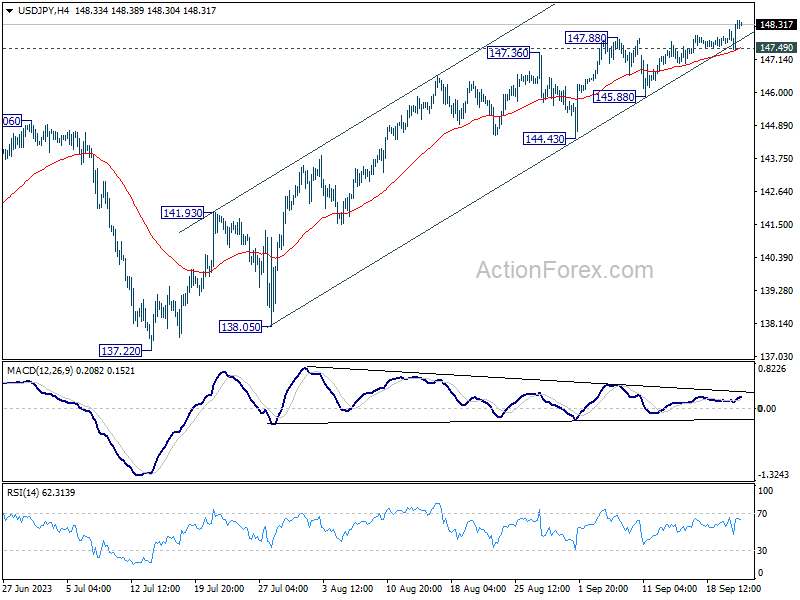
USD/JPY's rally is in progress and intraday bias stays on the upside. Current rise from 127.20 should target a retest on 151.93 high. On the downside, below 147.49 minor support will turn intraday bias neutral first. But outlook will stay bullish as long as 145.88 support holds, in case of retreat.
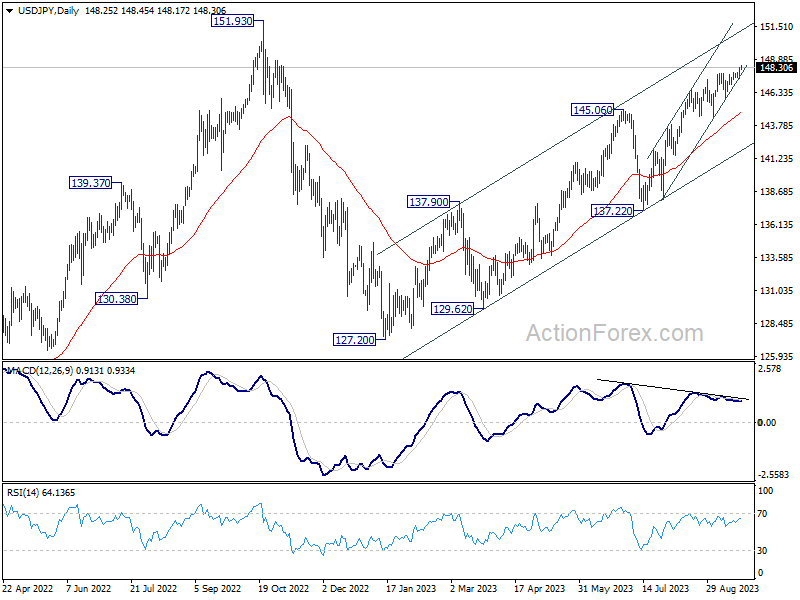
In the bigger picture, while rise from 127.20 is strong, it could still be seen as the second leg of the corrective pattern from 151.93 (2022 high). Rejection by 151.93, followed by break of 137.22 support will indicate that the third leg of the pattern has started. However, sustained break of 151.93 will confirm resumption of long term up trend.
USD/CHF Daily Outlook
Daily Pivots: (S1) 0.8947; (P) 0.8972; (R1) 0.9011; More....
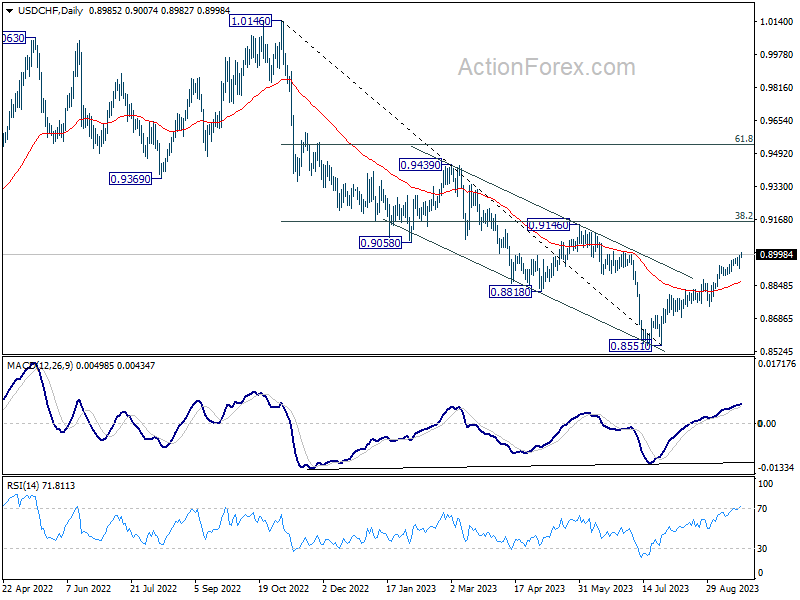
USD/CHF's rally resumed after brief consolidations and intraday bias is back on the upside. Current rally from 0.8551 should target 0.9146 cluster resistance. On the downside, break of 0.8930 support will argue that a short term top is possibly formed, and turn bias back to the downside for 55 D EMA (now at 0.8868).
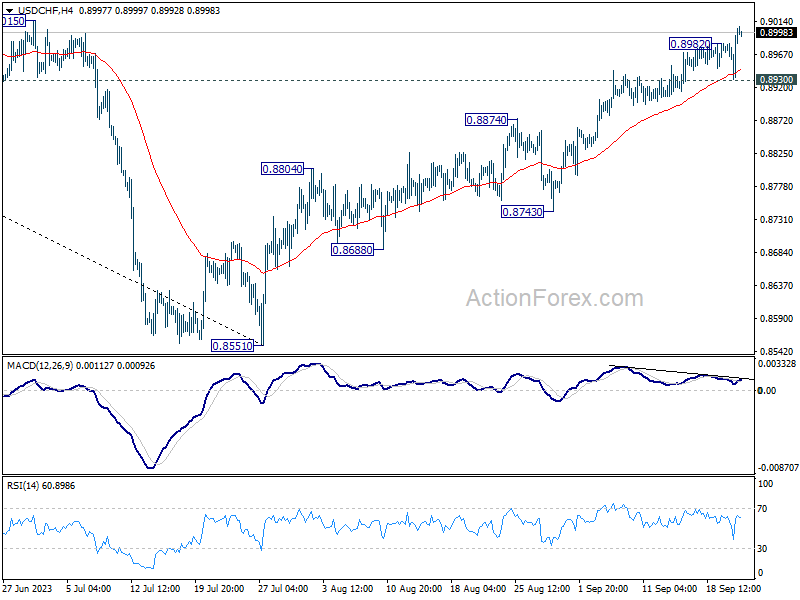
In the bigger picture, rebound from 0.8551 medium term bottom is currently seen as a correction to the downtrend from 1.0146 (2022 high). Further rally would be seen to 0.9146 cluster resistance (38.2% retracement of 1.0146 to 0.8551 at 0.9160). Strong resistance could be seen there to limit upside, at least on first attempt.
GBP/USD Daily Outlook
Daily Pivots: (S1) 1.2310; (P) 1.2366; (R1) 1.2399; More...
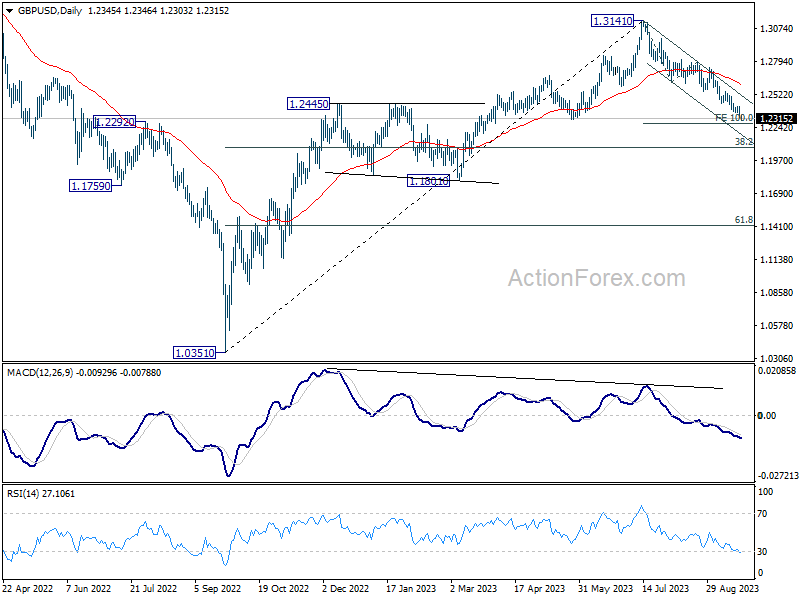
GBP/USD's decline from 1.3141 is extending today and intraday bias stays on the downside. Decisive break of 100% projection of 1.3141 to 1.2618 from 1.2799 at 1.2276. will target 1.2075 fibonacci level next. On the upside, above above 1.2423 minor resistance will turn intraday bias neutral again. But near term outlook will stay bearish as long as 1.2618 support turned resistance holds, in case of strong recovery.
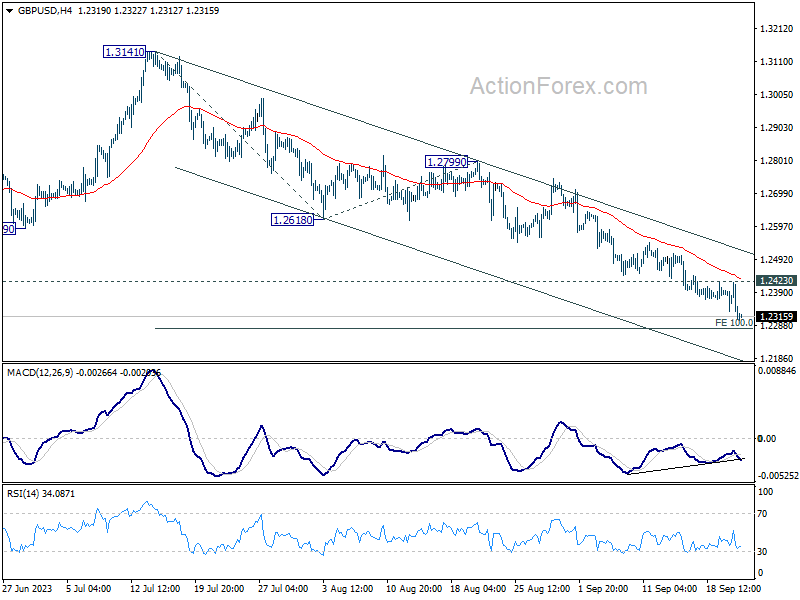
In the bigger picture, fall from 1.3141 medium term top is seen as a correction to up trend from 1.0351 (2022 low). Deeper decline would be seen to 38.2% retracement of 1.0351 to 1.3141 at 1.2075. Strong support would be seen there to bring rebound on first attempt. However, sustained break of 1.2075 will raise the chance of bearish trend reversal.