Sample Category Title
Bank of England Pauses Monetary Tightening
Summary
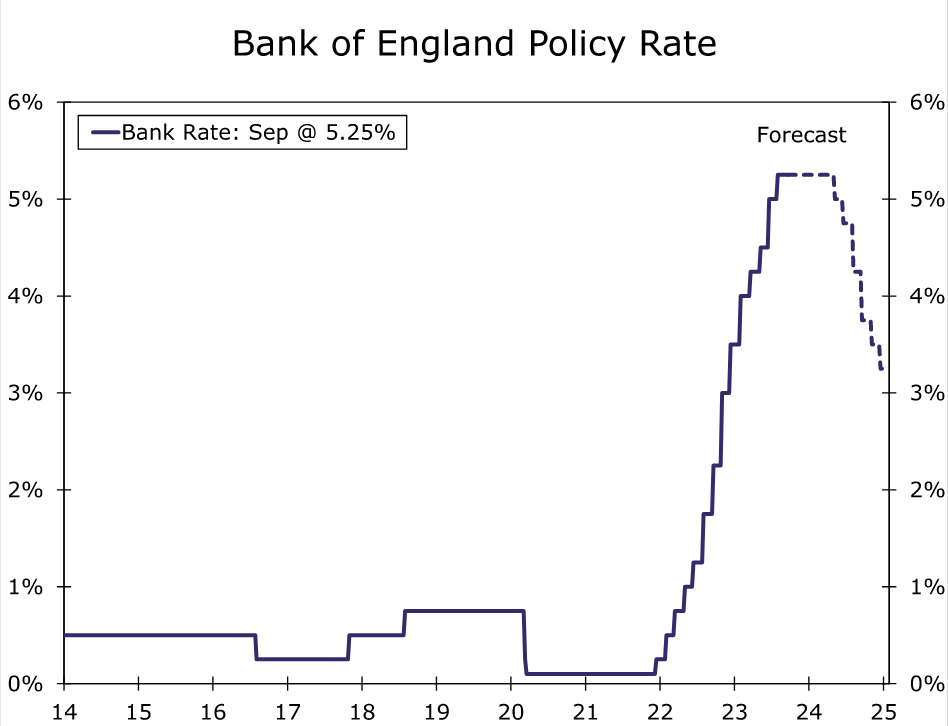
- In what was a finely balanced decision, Bank of England (BoE) policymakers held their policy rate steady at 5.25% at today's monetary policy announcement. In a significant change, the BoE said there were mixed developments on indicators of inflation's persistence, noting slower varied signals on wage growth and slower services inflation.
- We believe today's interest rate pause could also represent an interest rate peak. The BoE said it views the current level of interest rates as restrictive, and that monetary policy would need to be sufficiently restrictive for sufficiently long to return inflation towards target.
- We do not anticipate an initial 25 bps rate cut until the May 2024 meeting, and see the BoE's policy rate ending next year at 3.25%. Today's decision also represents a loss of interest rate support for the pound. In that context, we view the risks as tilted towards further U.K. currency weakness through early 2024, and cannot rule out a move towards $1.2000 or below.
Bank of England Holds Rates Steady
In what was a finely balanced decision, Bank of England (BoE) policymakers held their policy rate steady at 5.25% at today's monetary policy announcement. BoE policymakers voted 5-4 to keep interest rates unchanged, with four policy committee members favoring a 25 bps increase. Separately, the BoE continued with its quantitative tightening, saying it would reduce the size of its balance sheet by £100 billion over the next 12 months.
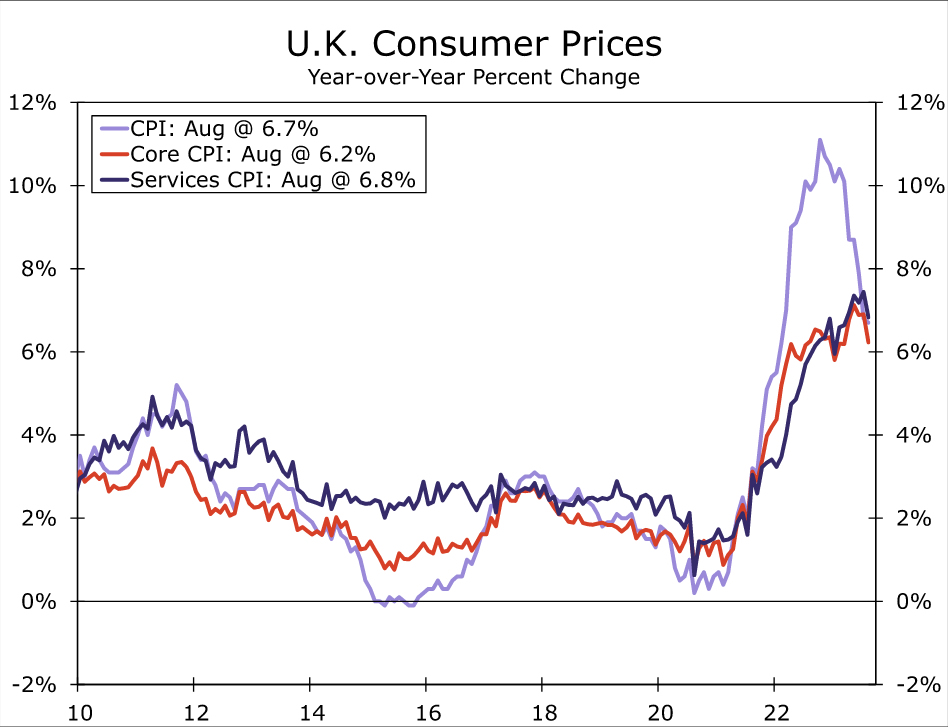
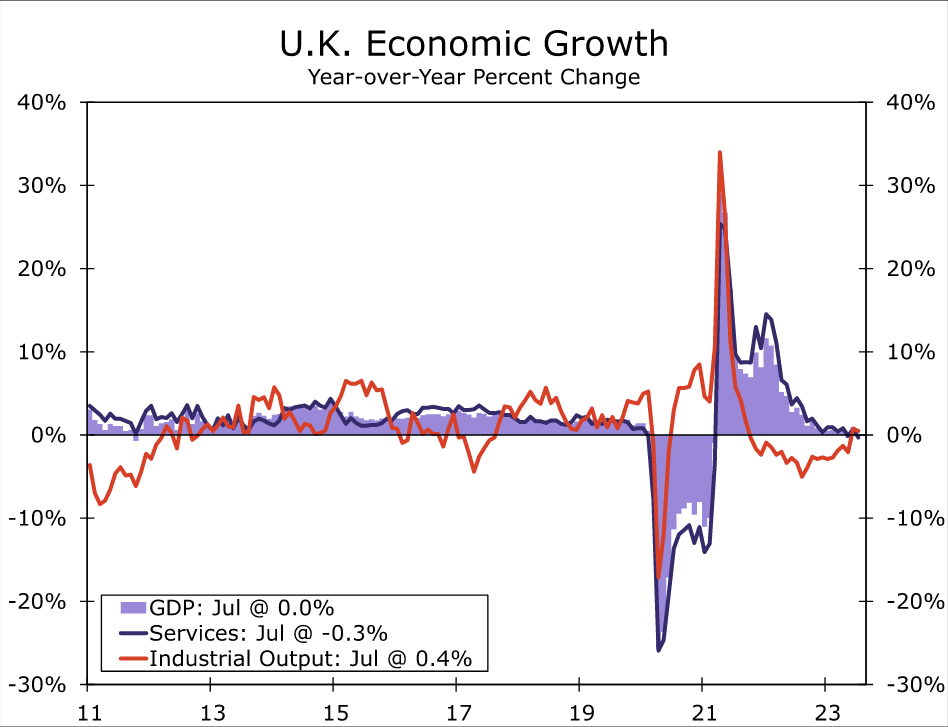
In holding interest rates steady, the Bank of England in a key change noted mixed developments on indicators of inflation's persistence. The central bank said the recent acceleration of average weekly earnings is not consistent or apparent in other wage measures, while also noting downside news on services inflation, which slowed to 6.8% year-over-year in August. Separately, the Bank of England also said core goods inflation is much weaker than had been expected. Finally, the Bank of England also said there are increasing signs of some impact of tighter monetary policy on the labor market and on momentum in the real economy more generally. On that front, we note that July GDP fell 0.5% month-over-month, while the unemployment rate rose to 4.3% in the three months to July.
Policy Rate Pause Could Also Be A Policy Rate Peak
In our opinion, there are also indications that today's policy rate pause could be a policy rate peak. The BoE said "given the significant increase in Bank Rate since the start of this tightening cycle, the current monetary policy stance is restrictive”, while adding that “monetary policy will need to be sufficiently restrictive for sufficiently long to return inflation to the 2% target sustainably in the medium term.” We view that language as consistent with the Bank of England keeping rates at the current level for an extended period. The central bank did leave the door open to further rate hikes, saying a further tightening in monetary policy would be required if there were to be evidence of more persistent inflation pressures. However, given the weakening in the economy to date and the mild U.K. recession we forecast, along with the more significant deceleration of inflation that now appears to be underway, we believe such rates hikes are unlikely to eventuate.
As a result, we now forecast that the current policy rate of 5.25% will be the peak for this cycle. We do expect rates to remain at that level for some time and, following a mild recession beginning from late this year and as CPI inflation moves closer the 2% target, forecast an initial modest 25 bps rate reduction only by the time of the May 2024 policy meeting. We expect the pace of rate cuts to gather momentum through the rest of next year, and see the Bank of England policy rate to end next year at 3.25%. From a currency perspective, today's decision to pause and the probable end to policy tightening represents a loss of interest rate support. As a result and even though the GBP/USD exchange rate has already moved below our medium-term target of $1.2300, we think the risks remain tilted toward further sterling weakness through early 2024. In that context, a move to $1.2000 or below cannot be ruled out.
Sunset Market Commentary
Markets
A slew of central bank meetings kept markets busy all day. From the Turkish central bank (+500 bps to 30%) over the Riksbank & the Norges Bank (+25 bps to 4% and 4.25%) to the Swiss national bank and the Bank of England (status quo). A summary for most of them can be found below while we discuss the BoE here. The central bank’s decision to leave rates unchanged at 5.25% was a close 5-4 call. Inflation, though still too high, dropped more than expected with the central bank specifically pointing to services inflation finally easing. The labour market, meanwhile is showing early signs of easing (eg. lower employment rates and higher unemployment rates) and economic growth is expected to be lower following disappointing PMI’s and several other business indicators. Market pricing going into the meeting (about 50-50) suggests there was an equally solid case to be made for another hike. But the ECB’s and Fed’s pause probably (though not officially) helped to tilt the balance in favour of a hold. The BoE retains the possibility of further hikes should inflation prove more persistence but we think the bar is high. Governor Bailey’s appearance before parliament two weeks ago once again made that clear. The pound slips. EUR/GBP is testing 0.8678 resistance. Cable (GBP/USD) loses 1.2308 support (May low) to trade at 1.2262, the lowest since mid-March. UK yields in a kneejerk reaction dropped before quickly paring losses again. Current changes vary between 7.5-12.4 bps with the belly underperforming.
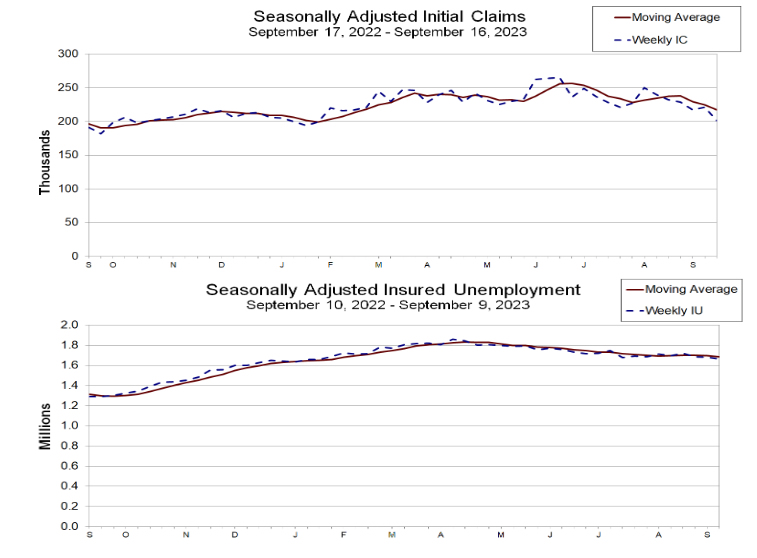
Core bonds are spared no respite after yesterday’s hawkish Fed meeting. And if it weren’t enough, once again bumper US jobless claims (201k vs 225k) just came in today. US yields extend gains with changes varying from -1.7 bps (2-y, after briefly hitting new cycle high) to +8 bps (30-y). German yields rally 4-5.9 bps. The 10-y yield is testing the previous cycle high at 2.77% in a move largely driven by real yields. The one in the US meanwhile moves further north of the 2% barrier to the highest since 2008. The dollar gets another push in the back, including from a dire risk environment (stocks down 1.4% in Europe, 1% on WS). EUR/USD temporarily lost 1.0635 support and went for 1.0611 before paring losses. DXY gapped above 105.38 resistance at the open trade at 105.57 currently. USD/JPY is the exception to the rule (147.9) with the yen banking on its safe haven status going into tomorrow’s BoJ meeting.
News & Views
The Swiss National Bank (SNB) unexpectedly left its policy rate at 1.75%. A wide majority of analysts expected an increase to 2%. Governor Jordan said that the battle on inflation isn’t over yet, but the SNB is able to wait for the December review to see whether previous tightening was sufficient to keep inflation within 0-2% on a sustainable basis. Further tightening remains possible. Inflation in Switzerland in August eased to 1.6% Y/Y. The SNB expects 2.0% at the end of this year and an average of 2.2% next year before returning to 1.9% in 2025. The lower inflation trajectory compared to June is due to lower economic growth and slightly lower inflationary pressure from abroad. For the second half of this year, SNB expects annual growth of about 1.0% for 2023. The SNB remains prepared to sell foreign currency if needed. However, given recent CHF-strength, that’s probably not the case right now. EUR/CHF initially rallied from 0.957 to 0.9675, but the franc gradually recouped part of the loss (currently 0.963).
The Norges Bank and the Swedish Riksbank raised policy rates by 25 bps to respectively 4.25% and 4.0%. Swedish inflation is falling, for an important part due to lower energy prices. Still CPIF inflation at 4.7% is still too high and well above the 2% target. Core inflation excluding energy even stands at 7.2%. The RB sees CPIF and core inflation in 2024 respectively at 2.5% and 2.9% and at 1.8% and 2.1% in 2025. Growth for this year was downward revised to -0.8% (from -0.5%) and to -0.1% in 2024. The (“unjustifiable”) weak krone adds to inflationary risks. The policy rate can therefore still be raised further. The krone briefly gained after the decision, but with the Fed reinforcing its higher for longer mantra, the krone (EUR/SEK 11.96) again nears its all-time low against the euro. The Norwegian central bank acknowledges that inflation stays markedly above the 2.0% target. Headline inflation in August eased more than expected to 4.8% Y/Y but underlying inflation still was 6.3%. In its new projections the NB expects underlying inflation well above target through 2026. Growth is seen slowing to 0.4% next year. Despite this, the NB sees the policy rate being raised further to about 4.5% to stay there throughout 2024. The krone since June strengthened modestly from about EUR/NOK 12+ to currently trade near 11.52. A rebound attempt after the NB rate hike failed.
USD/CHF Mid-Day Outlook
Daily Pivots: (S1) 0.8947; (P) 0.8972; (R1) 0.9011; More....
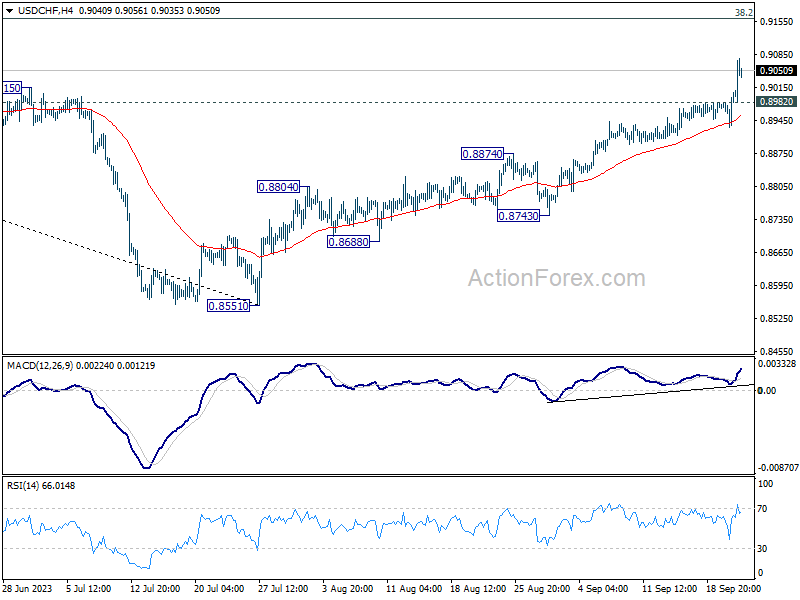
USD/CHF's accelerates to as high as 0.9077 so far today. Intraday bias stays on the upside and current rise from 0.8551 should target 0.9146 cluster resistance. On the downside, break of 0.8982 minor support will turn intraday bias neutral first. But further rally will remain in favor as long as 0.8874 resistance turned support holds, in case of retreat.
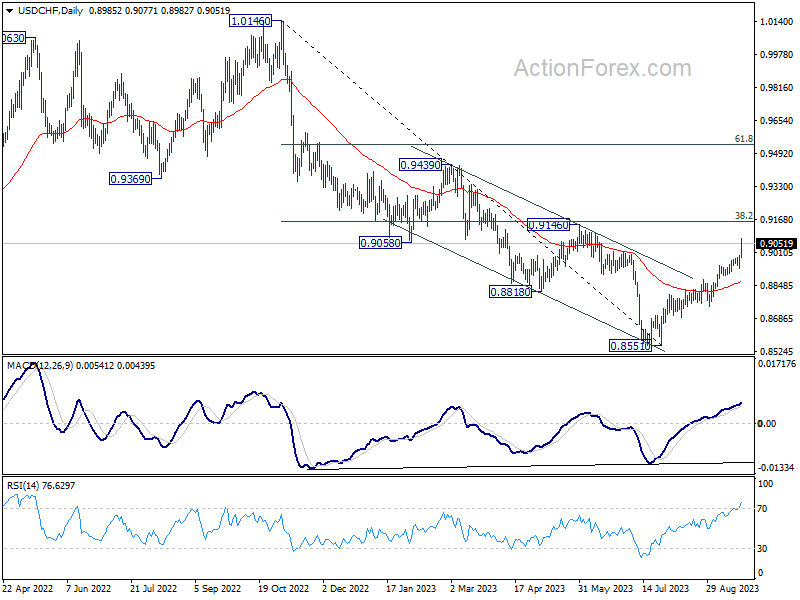
In the bigger picture, rebound from 0.8551 medium term bottom is currently seen as a correction to the downtrend from 1.0146 (2022 high). Further rally would be seen to 0.9146 cluster resistance (38.2% retracement of 1.0146 to 0.8551 at 0.9160). Strong resistance could be seen there to limit upside, at least on first attempt.
USD/JPY Mid-Day Outlook
Daily Pivots: (S1) 147.76; (P) 148.06; (R1) 148.65; More...
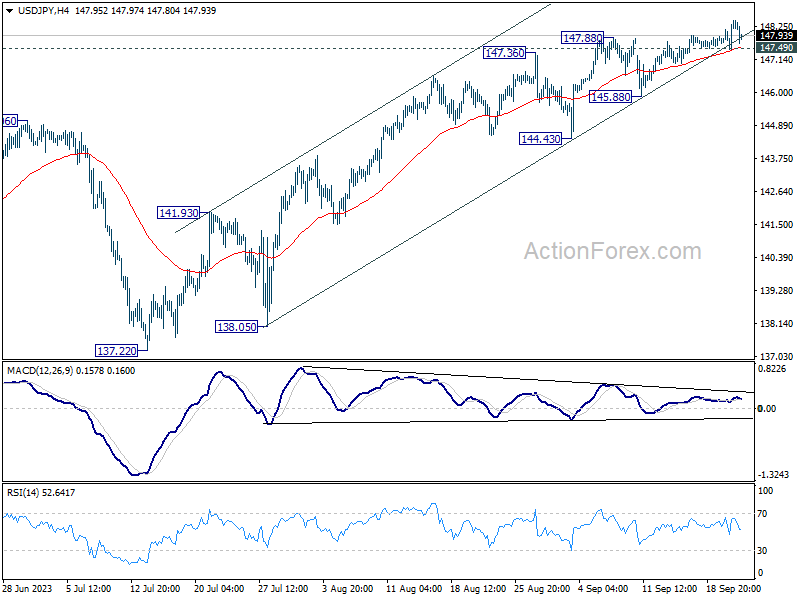
Further rise is mildly in favor in USD/JPY as long as 147.49 minor support intact. Current rally would target 151.93 high. However, break of 147.49 will argue that a short term top is already formed. intraday bias will be turned to the downside for 145.88 support instead.
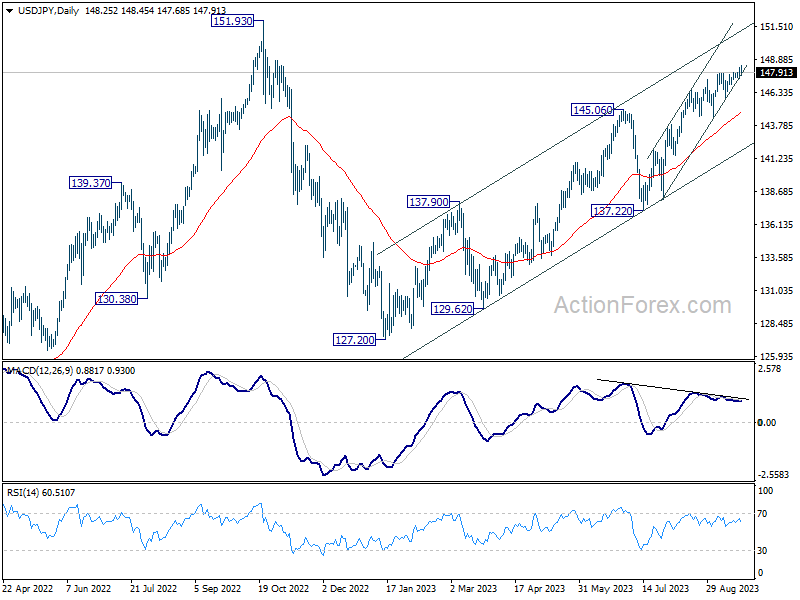
In the bigger picture, while rise from 127.20 is strong, it could still be seen as the second leg of the corrective pattern from 151.93 (2022 high). Rejection by 151.93, followed by break of 137.22 support will indicate that the third leg of the pattern has started. However, sustained break of 151.93 will confirm resumption of long term up trend.
EUR/USD Mid-Day Outlook
Daily Pivots: (S1) 1.0628; (P) 1.0683; (R1) 1.0715; More...
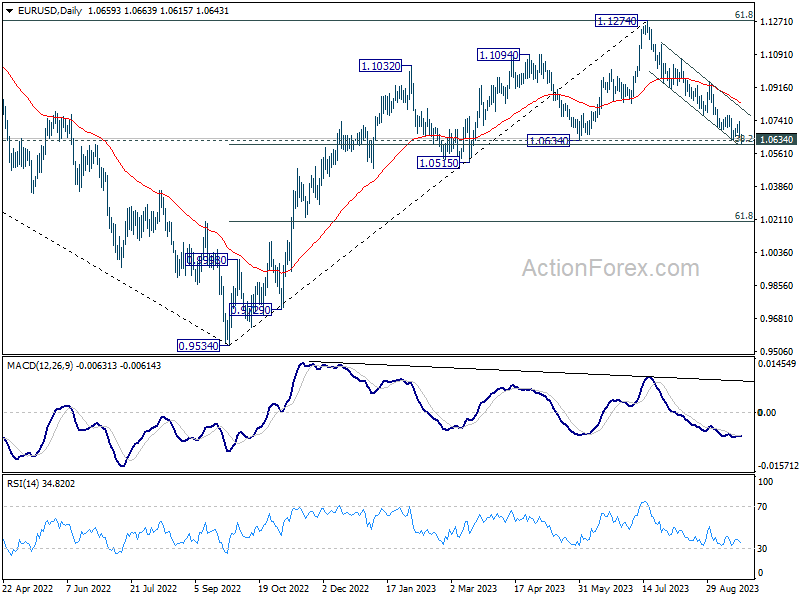
Intraday bias in EUR/USD remains on the downside for the moment. Sustained break of 1.0609/34 support zone will carry larger bearish implication. Fall from 1.1274 should then target target 1.0515 support next. Nevertheless, strong strong rebound from current level, followed by break of 1.0767 resistance, should confirm short term bottoming. Intraday bias will be back on the upside for 1.0944 resistance.
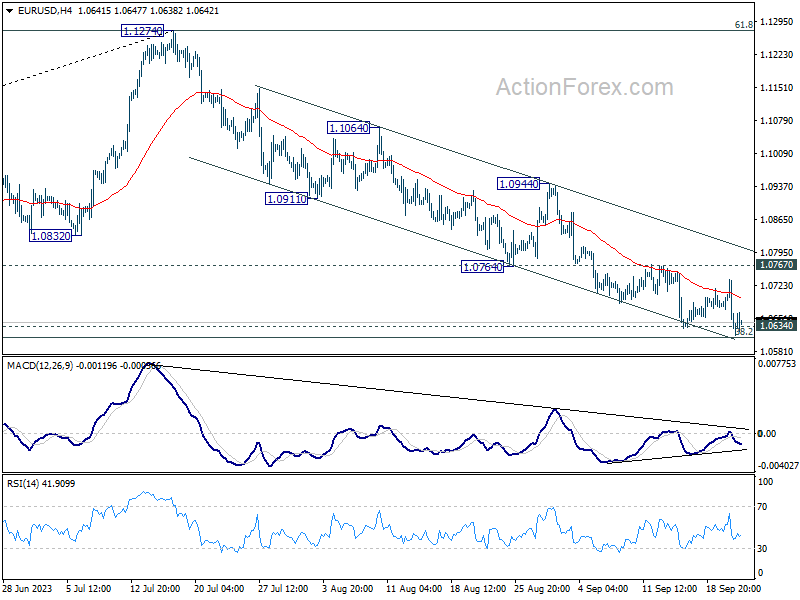
In the bigger picture, fall from 1.1274 medium term top is seen as a correction to up trend from 0.9534 (2022 low). Strong support could be seen from 1.0634 cluster support (38.2% retracement of 0.9534 to 1.1274 at 1.0609) to bring rebound, at least on first attempt. However, sustained break of 1.0609/0634 will raise the chance of bearish trend reversal, and target 61.8% retracement at 1.0199.
Swiss Sinks on SNB Surprise, Fed Pauses
- SNB surprises and holds interest rates
- Fed delivers a ‘hawkish hold’
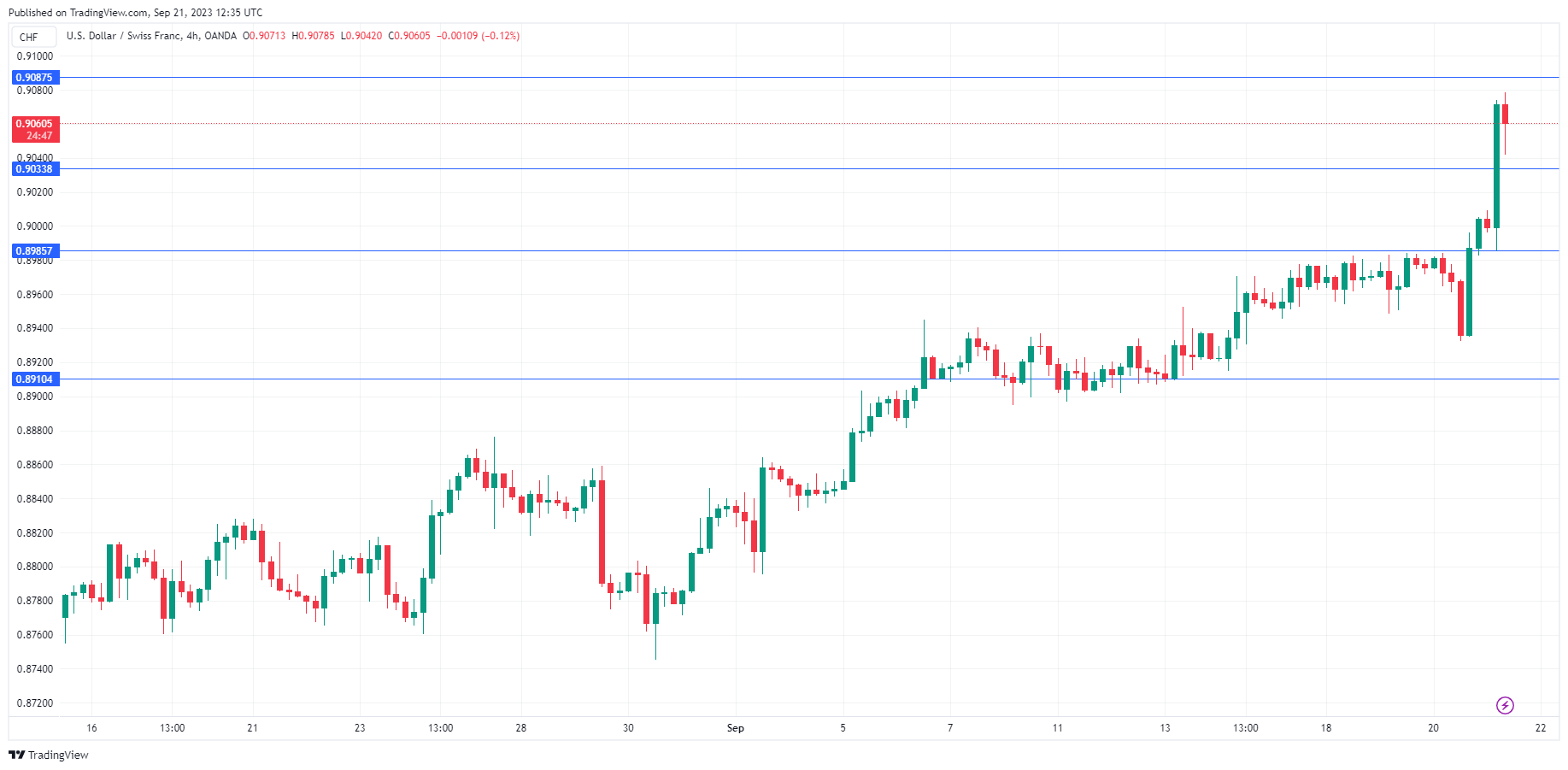
The Swiss franc has fallen sharply on Thursday. In the European session, USD/CHF is trading at 0.9060, up 0.80%. Earlier, USD/CHF hit a high of 0.9078, its highest level since June 13th.
The driver behind the Swiss franc’s downturn was the Swiss National Bank’s decision to hold rates at 1.75%, after five consecutive rate hikes. This surprised the markets which had expected a quarter-point increase. The SNB policy assessment noted that significant tightening had curbed inflation, but that further tightening could not be ruled out.
Have interest rates peaked in Switzerland? The answer appears to be yes, unless inflation rises unexpectedly. Inflation was unchanged in August at 1.6%, within the SNB’s target of 0%-2%. The assessment noted that Swiss growth has been weak and there is a risk that the global economic slowdown will worsen.
The assessment also noted the SNB is “willing to be active in the foreign exchange market as necessary”. The SNB hasn’t been shy about intervention in order to stabilize the exchange rate, which has helped to control external inflationary pressures. At the same time, the central bank doesn’t want the Swiss franc to appreciate to such an extent that it weighs on the crucial export sector.
Fed holds rates as expected
The Federal Reserve paused rates for the second time in three months, maintaining the benchmark rate at 5.5%. The decision was a ‘hawkish pause’, as the Fed signaled that it would hold rates higher for longer.
The dot plot indicated that the Fed expects to raise rates once more before the end of the year and is projecting trimming rates by 50 basis points in 2024. In June, the dot plot indicated one more hike before the year’s end and rate cuts of 100 basis points. The Fed also revised its growth forecast for 2023 to 2.1%, up from 1% in June, indicating that the Fed is confident it can guide the economy to a soft landing and avoid a recession.
USD/CHF Technical
- USD/CHF pushed above resistance at 0.9033 and is putting pressure on resistance at 0.9087
- 0.8985 and 0.8910 are providing support
Franc Weakens as SNB’s Logical Move Surprises Markets
The Swiss National Bank left its key interest rate unchanged at 1.75%. On average, markets had been predicting a 25-basis point hike, contrary to our expectations.
Most likely, market participants’ forecasts were influenced by the ECB rate hike a week earlier. In addition, policy tightening expected in Sweden and Norway indeed took place. But there are a couple of things that set Switzerland apart from other European countries.
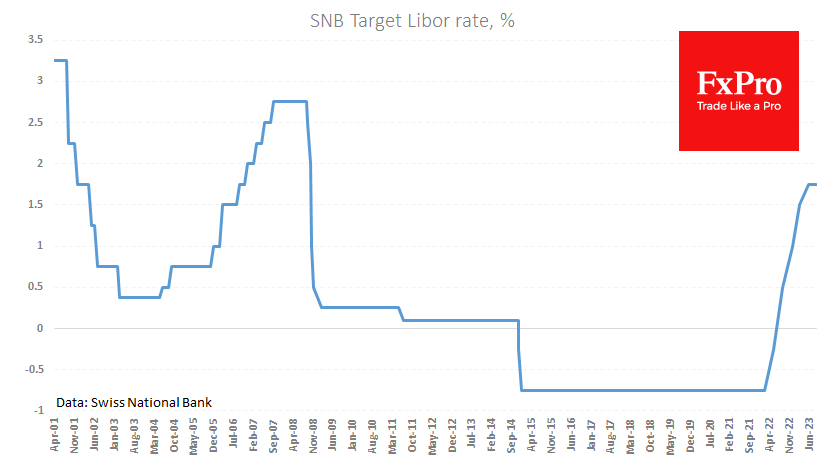
First is inflation. The annual rate of price increases has been below 2% for the past three months, and this is not a high-base effect. Monthly price increases have averaged 0.09% over the past six months and half that over the past three months, bringing annual inflation to 1.1% and 0.55%, respectively.
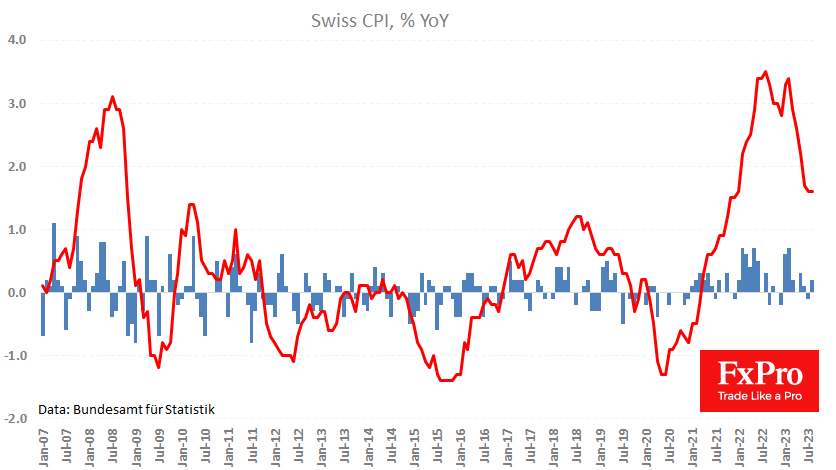
Second is the Swiss franc exchange rate. In July, the USDCHF fell to 0.8550. It was briefly lower in 2015 and from May to September 2011. By comparison, the yen – another example of a safe haven – is testing multi-month lows. Neither the euro nor the pound can boast high levels relative to historical prospects.
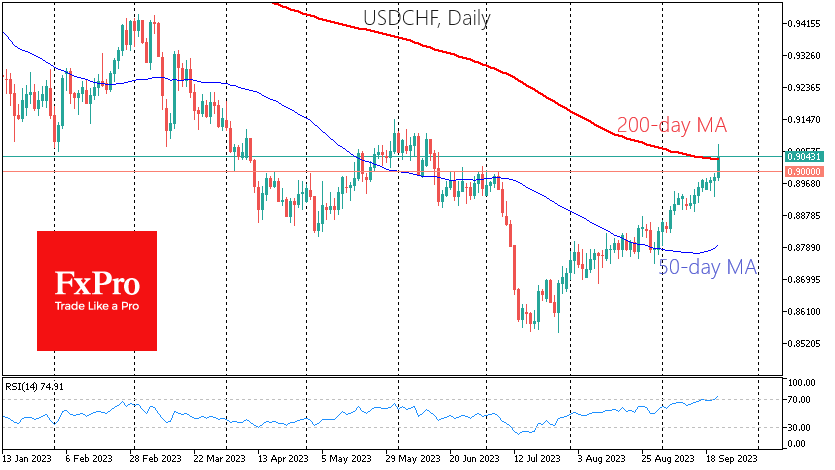
The Swiss franc lost 1.5% against the dollar in response to the Fed’s hawkish pause and a “surprise” from the SNB. The USDCHF pair has risen above 0.9050, its highest level in over three months, after moving slowly but smoothly upwards for the past two months.
If the pair holds these levels for the rest of the day, or even better, for the rest of the week, we will have signalled a change in the long-term trend, as the USDCHF has crossed the 200-day moving average.
However, we should expect a severe fight at current levels as the pair looks overbought. The pair’s upward momentum on Thursday could be the last mile before broad profit-taking begins on the previous gains.
The Franc has likely run out of fuel for further declines. A corrective pullback to 0.9850-0.9000 may be needed to make selling the Franc attractive again in the medium term. On the bearish side, risk aversion in global markets could return in the coming days if it leads to deleveraging.
GBP/USD Mid-Day Outlook
Daily Pivots: (S1) 1.2310; (P) 1.2366; (R1) 1.2399; More...
GBP/USD falls to as low as 1.2232 so far today and intraday bias stays on the downside. 100% projection of 1.3141 to 1.2618 from 1.2799 at 1.2276 is already met but there is no sign of bottoming. next target would be 1.2075 fibonacci level. On the upside, above 1.2423 minor resistance will turn intraday bias neutral again. But near term outlook will stay bearish as long as 1.2618 support turned resistance holds, in case of strong recovery.
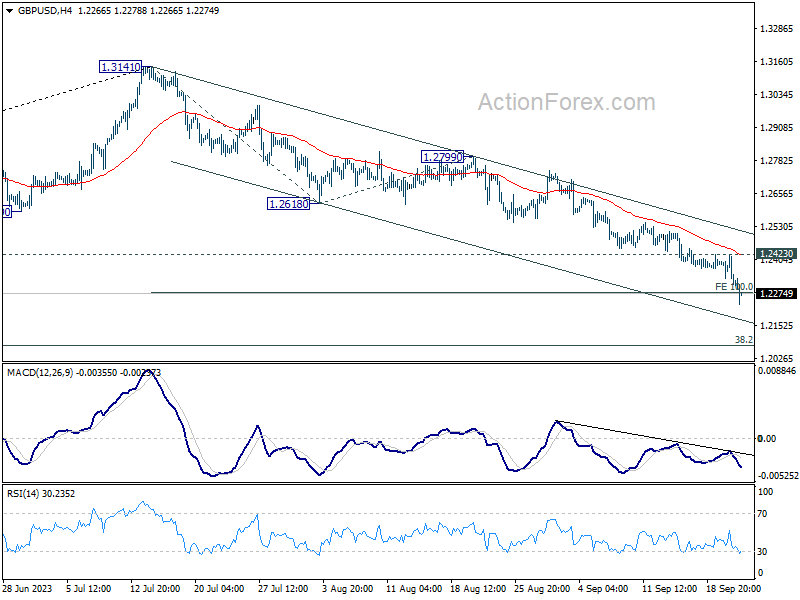
In the bigger picture, fall from 1.3141 medium term top is seen as a correction to up trend from 1.0351 (2022 low). Deeper decline would be seen to 38.2% retracement of 1.0351 to 1.3141 at 1.2075. Strong support would be seen there to bring rebound on first attempt. However, sustained break of 1.2075 will raise the chance of bearish trend reversal.
Sterling and Franc Stumble on BoE and SNB; Yen Rises ahead BoJ
The currency markets faced significant shifts today, notably with Sterling and Swiss Franc, which are enduring considerable selloffs. Both BoE and SNB opted to maintain their current interest rates, prompting speculation that these institutions might have peaked in their tightening cycles. However, Australian Dollar bore the brunt of today's market sentiment, emerging as the day's biggest loser, possibly due to escalating risk aversion. This sentiment has been echoed in major global indexes, most likely influenced by Fed hawkish hold yesterday coupled which also triggered soaring treasury yields.
On the flip side, Japanese Yen is shining as the day's top performer. This strength is, in part, attributed to 10-year JGB yield surpassing 0.75% mark. Market participants are also possibly adjusting their positions in anticipation of a potentially hawkish surprise from BoJ in the upcoming Asian trading session. Following closely,Dollar maintains its robust position, though USD/JPY pair continues to show signs of strain ahead of 150 mark. Euro is also gaining a bit traction, but only benefiting from trades against the beleaguered Swiss Franc and Sterling. Meanwhile, Canadian Dollar's performance is mixed, retracting much of the gains driven by this week's CPI data.
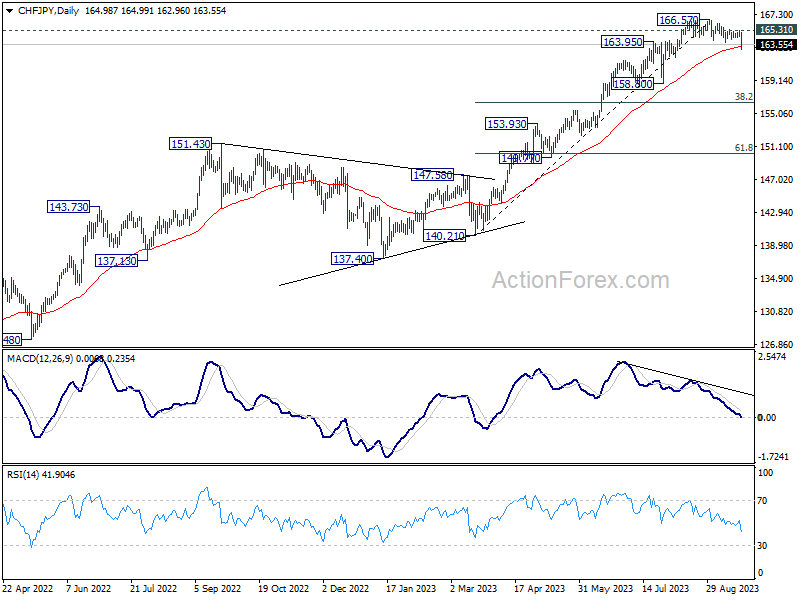
Technically, CHF/JPY's fall from 166.57 resumes today on broad-based Swiss Franc weakness. Considering bearish divergence condition in D MACD, this decline is probably corrective whole rise from 140.21. Sustained trading below 55 D EMA (now at 163.27) will add more credence to this case. Deeper fall should then be seen to 158.80 support, or possibly further to 38.2% retracement of 150.21 to 166.57 at 156.50.
 In Europe, at the time of writing, FTSE is down -0.43%. DAX is down -1.39%. CAC is down -1.72%. Germany 10-year yield is up 0.0658 at 2.771. Earlier in Asia, Nikkei fell -1.37%. Hong Kong HSI fell -1.29%. China Shanghai SSE fell -0.77%. Singapore Strait Times fell -1.21%. Japan 10-year JGB yield rose 0.0285 to 0.754.
US initial jobless claims drop to 201k, vs exp 222k
US initial jobless claims fell -20k to 201k in the week ending September 16, well below expectation of 222k. Four-week moving average of initial claims dropped -8k to 217k. Continuing claims fell -21k to 1662 in the week ending September 9. Four-week moving average of continuing claims fell-9k to 1687k.
BoE on hold at 5.25%, heavyweights win tight vote
BoE opts to keep its Bank Rate unchanged at 5.25%. The decision, however, came after a razor-thin 5-4 vote that showed divisions within the central bank's ranks. Notably, the influential figures - Governor Andrew Bailey, Deputies Ben Broadbent and Dave Ramsden, along with Chief Economist Huw Pill, sided with Swait Dhingra in favour of retaining the rate at its current level.
In its accompanying statement, BoE underscored the need for a vigilant approach, stating, "Monetary policy will need to be sufficiently restrictive for sufficiently long". Furthermore, the central bank emphasized its readiness to consider more rate hikes, signaling that "Further tightening in monetary policy would be required if there were evidence of more persistent inflationary pressures."
Amid these cautions, Bank's staff adjusted their growth outlook, expecting only a slight uptick in GDP for the third quarter of 2023. They also anticipate that the underlying growth for the second half of the year will likely underperform previous expectations.
On the inflation front, the bank projected a notable decline in CPI in the near future. Despite recent spikes in oil prices, the central bank expects this drop due to "lower annual energy inflation" and anticipated further reductions in food and core goods prices.
Yet, the BoE warned that the services sector could buck this trend, foreseeing that "Services price inflation, however, is projected to remain elevated in the near term, with some potential month-to-month volatility."
Also, in a unanimous decision, the MPC agreed to reduce the stockpile of UK government bond purchases, cutting it down by GBP 100B over the coming year, bringing the total to GBP 658B.
SNB bucks expectations and keeps interest rate steady
In an unexpected move that diverged from the market's anticipations, SNB held its policy rate steady at 1.75%, side-stepping the anticipated hike to 2.00%. The conditional inflation projections have undergone downward revision. While inflation could surge above 2% target in upcoming quarters, it's projected to retract back to 1.9% in 2025 based on current interest rate, without further tightening.
Despite this, SNB did not completely distance itself from a hawkish tone, and maintained the further tightening "may become necessary". It also reiterated the willingness to intervene in the market with focus on "selling foreign currency
Delving into the specifics of the conditional inflation projections, based on steady 1.75% policy rate, inflation is forecasted to ascend to 2.0% by the end of this year. It will scale up to its apex at 2.2% in the second quarter of 2024, before experiencing a slight dip to 1.9% at the onset of 2025, maintaining that level thereafter.
On the economic growth front, SNB's projections lean towards the cautious side, forecasting tepid growth for the remainder of the year. The annual growth is projected to hover around a modest 1%.
ECB's Nagel uncertain if rate plateau is reached
ECB Governing Council, Joachim Nagel, Bundesbank head, posed a crucial question in his speech in Frankfurt, "Have we reached the plateau" on interest rates? He answered by stating that it "cannot yet be clearly predicted". He continued, elaborating that "the forecasts still only show a slow decline toward the target level of 2%."
Nagel's comments hinted at the continuous monitoring of economic indicators, suggesting that while borrowing costs are expected to "remain at a sufficiently high level for a sufficiently long time," the exact interpretation hinges on the incoming data.
Addressing concerns about Germany's economic health, he remarked that characterizing Germany as the 'sick man' "seems exaggerated." He attributed the present sluggish growth to specific influences such as the global economic deceleration, Russia's conflict with Ukraine, and reduced public expenditure. Offering a silver lining, Nagel projected, "Once we get past the worst of these special factors, the weak growth should also ease. We expect the economy to grow again in 2024."
On the other hand, Latvia's central bank chief, Martins Kazaks, highlighted the structural nature of recent oil price hikes. He pointed out, "The recent oil price increase in my view is not a temporary or transitory, it's very much a structural issue." Such dynamics, according to Kazaks, present heightened inflation risks. Regarding the anticipated rate cuts, he expressed skepticism about their timing, asserting, "I think expecting rate cuts mid next year is somewhat too early."
New Zealand's Q2 GDP outperforms expectations with 0.9% qoq growth
New Zealand's GDP surged by 0.90% qoq in Q2, doubling the expected growth rate of 0.4%. This notable growth is significantly attributed to substantial boost in the business services sector, specifically within the realm of computer system design.
Despite a setback in the primary industries, which contracted by 1.9%, goods-producing industries and service sectors pulled their weight, recording a growth of 0.7% and 1.0% respectively. The service sector emerged as a strong pillar of economic advancement.
The quarter also saw manufacturing sector shake off its lethargy, reversing a trend of decline sustained over five consecutive quarters to contribute positively to the economic pie.
GBP/USD Mid-Day Outlook
Daily Pivots: (S1) 1.2310; (P) 1.2366; (R1) 1.2399; More...
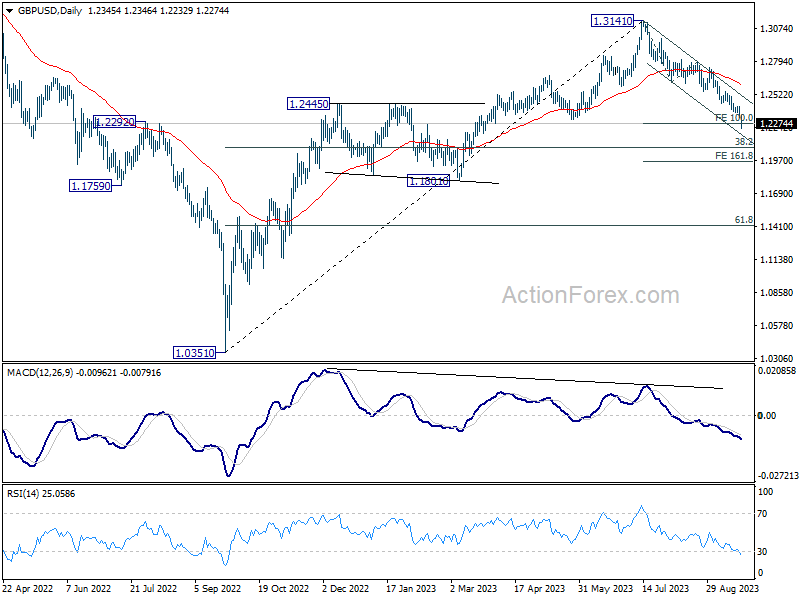
GBP/USD falls to as low as 1.2232 so far today and intraday bias stays on the downside. 100% projection of 1.3141 to 1.2618 from 1.2799 at 1.2276 is already met but there is no sign of bottoming. next target would be 1.2075 fibonacci level. On the upside, above 1.2423 minor resistance will turn intraday bias neutral again. But near term outlook will stay bearish as long as 1.2618 support turned resistance holds, in case of strong recovery.
In the bigger picture, fall from 1.3141 medium term top is seen as a correction to up trend from 1.0351 (2022 low). Deeper decline would be seen to 38.2% retracement of 1.0351 to 1.3141 at 1.2075. Strong support would be seen there to bring rebound on first attempt. However, sustained break of 1.2075 will raise the chance of bearish trend reversal.
Economic Indicators Update
| GMT | Ccy | Events | Actual | Forecast | Previous | Revised |
|---|---|---|---|---|---|---|
| 22:45 | NZD | GDP Q/Q Q2 | 0.90% | 0.40% | -0.10% | 0.00% |
| 06:00 | GBP | Public Sector Net Borrowing (GBP) Aug | 10.8B | 9.8B | 3.5B | |
| 07:30 | CHF | SNB Interest Rate Decision | 1.75% | 2.00% | 1.75% | |
| 11:00 | GBP | BoE Interest Rate Decision | 5.25% | 5.50% | 5.25% | |
| 11:00 | GBP | MPC Official Bank Rate Votes | 4--0--5 | 8--0--1 | 8--0--1 | |
| 12:30 | CAD | New Housing Price Index M/M Aug | 0.10% | 0.00% | -0.10% | |
| 12:30 | USD | Initial Jobless Claims (Sep 15) | 201K | 222K | 220K | 221k |
| 12:30 | USD | Philadelphia Fed Survey Sep | -13.5 | -0.7 | 12 | |
| 12:30 | USD | Current Account (USD) Q2 | -212B | -220B | -219B | |
| 14:00 | USD | Existing Home Sales Aug | 4.10M | 4.07M | ||
| 14:00 | EUR | Eurozone Consumer Confidence Sep P | -16.5 | -16 | ||
| 14:30 | USD | Natural Gas Storage | 65B | 57B |
US initial jobless claims drop to 201k, vs exp 222k
US initial jobless claims fell -20k to 201k in the week ending September 16, well below expectation of 222k. Four-week moving average of initial claims dropped -8k to 217k.
Continuing claims fell -21k to 1662 in the week ending September 9. Four-week moving average of continuing claims fell-9k to 1687k.