

Sample Category Title
Australia PMI composite back to expansion, risk of “no land” for the economy
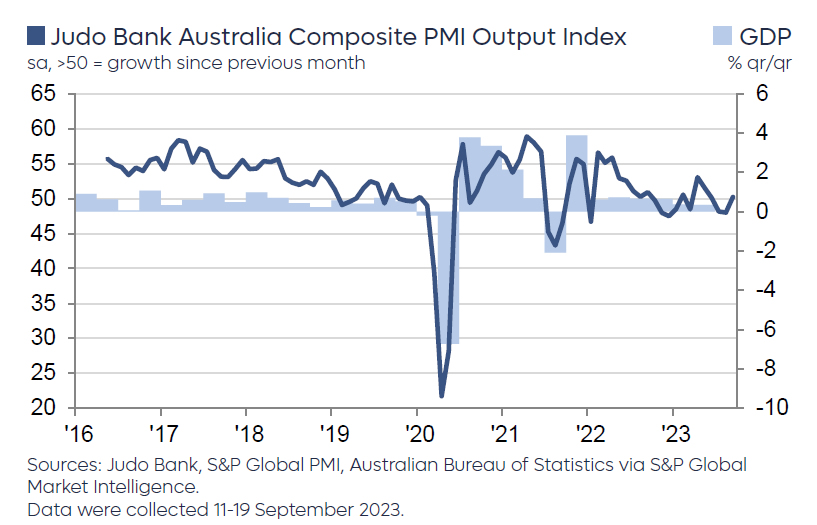
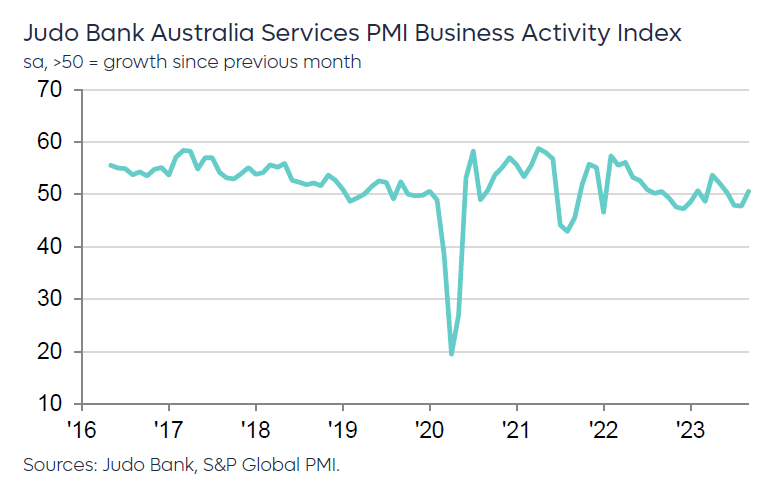
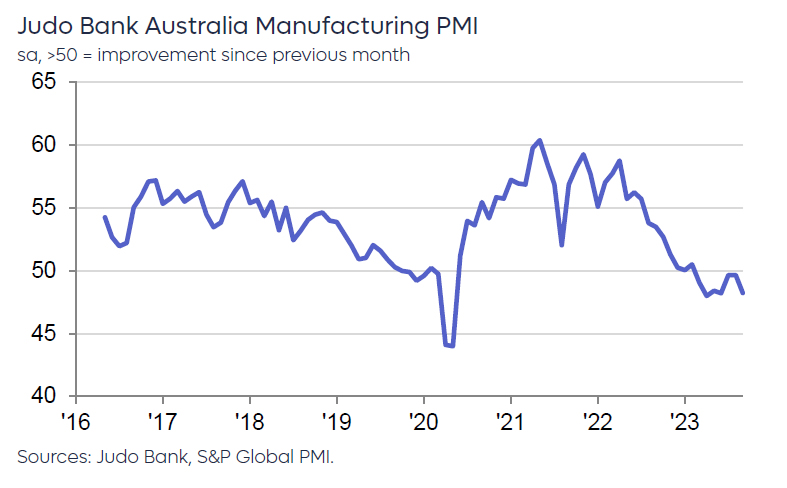
In September, Australia's Manufacturing PMI slipped to a 3-month low, declining from 49.6 to 48.2. In contrast, PMI Services showcased resilience, rising from 47.8 to a 4-month high of 50.5. PMI Composite also surged from 48.0 to 50.2, a 4-month peak, signaling a return to expansion in the broader economy.
Warren Hogan, Chief Economic Advisor at Judo Bank,said that "demand in the economy is holding up, and business activity remains on a sound footing." He further remarked that, contrary to some expectations, the present economic scenario isn't about choosing between a "hard or soft landing." Instead, he proposed that the real risk is of "no landing" for the economy.
Hogan further touched upon the inflation concerns that have been a pivotal discussion in financial circles. "The inflation indicators remain elevated at levels pointing to above-target CPI over the next 6-9 months," he stated. He pointed out that input prices remained unchanged in September, hinting at continued cost pressures. However, the final prices index experienced a slight dip in the September flash report. Despite this marginal decline, Hogan suggested that "inflation over the second half of 2023 could be higher than desired."
This latest PMI data follows a trend of stronger-than-predicted figures emerging from Australia in recent weeks. While this demonstrates economic stamina and persisting inflation, all eyes are on RBA's next steps. Hogan postulates that the RBA Board, under leadership of the new Governor Michele Bullock, will likely adopt a patient stance. However, he doesn't rule out further monetary tightening, possibly "in early November on Melbourne Cup day," should the economic indicators not align with RBA's projections of a slowdown.
USD/JPY Dips But Holds Key Uptrend Support
Key Highlights
- USD/JPY traded to a new multi-week high at 148.45.
- A few key supports are forming near 147.15 and 146.60 on the 4-hour chart.
- Bitcoin price failed to surpass $27,500 and corrected lower.
- The US Manufacturing PMI could rise from 47.9 to 48.0 in Sep 2023 (Preliminary).
USD/JPY Technical Analysis
The US Dollar followed a bullish path above the 147.00 pivot level against the Japanese Yen. USD/JPY even traded above 148.00 and traded to a new multi-week high at 148.45.
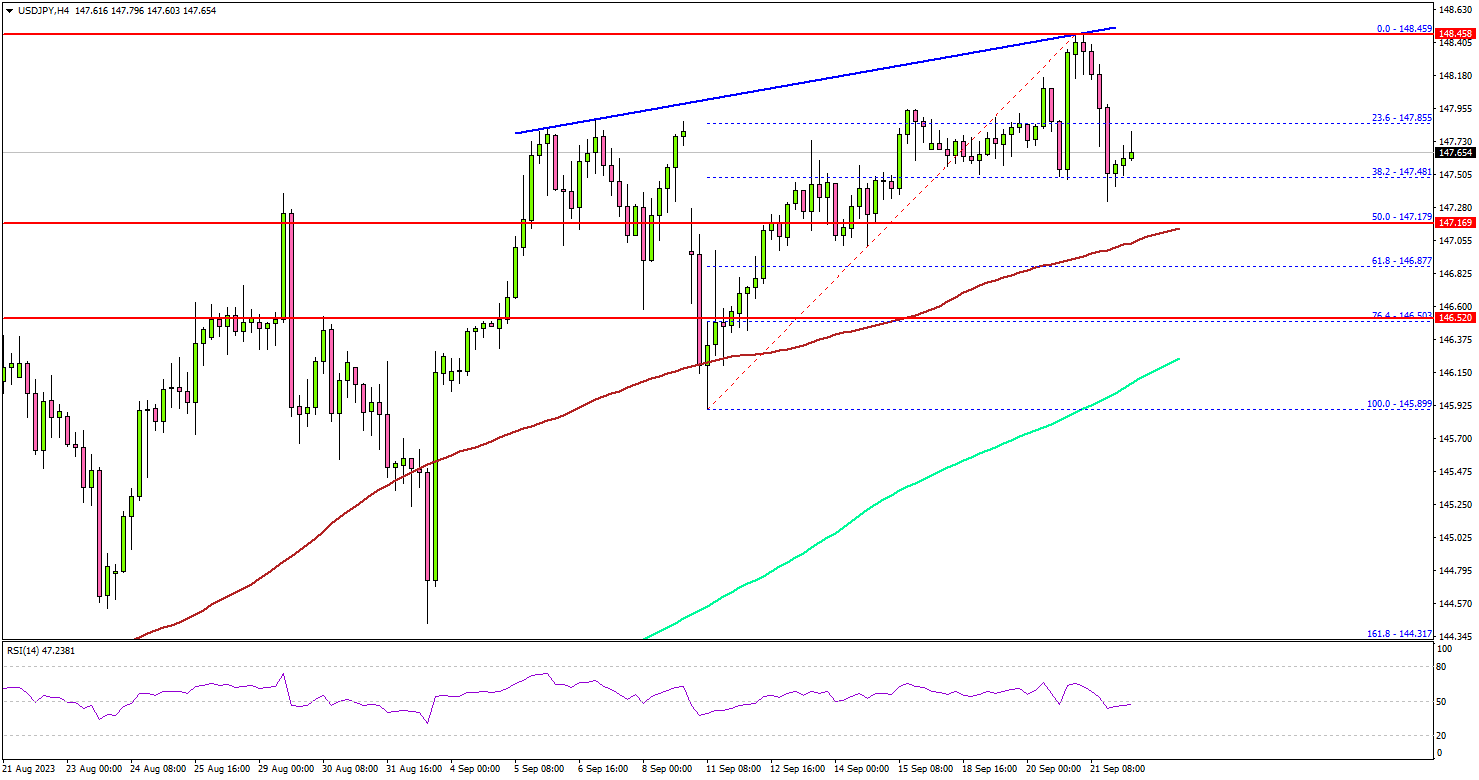
Looking at the 4-hour chart, the pair started a downside correction from 148.45. It is trading well above the 100 simple moving average (red, 4 hours) and the 200 simple moving average (green, 4 hours).
The first major support could be 147.15 or the 50% Fib retracement level of the upward move from the 145.89 swing low to the 148.45 high. It is close to the 100 simple moving average (red, 4 hours).
The next key support is seen near the 146.50 level, below which it could test the 200 simple moving average (green, 4 hours) at 146.15. If there is a move below 146.15, the pair could dive toward 145.20. Any more losses might send the pair toward the 144.50 level.
On the upside, the pair might face resistance near 148.20. The next major resistance is near the 148.50 zone. A close above 148.50 could start a steady increase toward 149.20. Any more gains might send USD/JPY toward the 150.00 handle.
Looking at Bitcoin, the price saw a strong rejection near the $27,500 zone and recently started a downside correction.
Economic Releases
- Germany’s Manufacturing PMI for Sep 2023 (Preliminary) - Forecast 39.5, versus 39.1 previous.
- Germany’s Services PMI for Sep 2023 (Preliminary) - Forecast 47.2, versus 47.3 previous.
- Euro Zone Manufacturing PMI for Sep 2023 (Preliminary) – Forecast 44.0, versus 43.5 previous.
- Euro Zone Services PMI for Sep 2023 (Preliminary) – Forecast 47.7, versus 47.9 previous.
- UK Manufacturing PMI for Sep 2023 (Preliminary) – Forecast 43.0, versus 43.0 previous.
- UK Services PMI for Sep 2023 (Preliminary) – Forecast 49.2, versus 49.5 previous.
- US Manufacturing PMI for Sep 2023 (Preliminary) – Forecast 48.0, versus 47.9 previous.
- US Services PMI for Sep 2023 (Preliminary) – Forecast 50.6, versus 50.5 previous.
New Zealand’s trade data sees China dominates decline in exports and imports
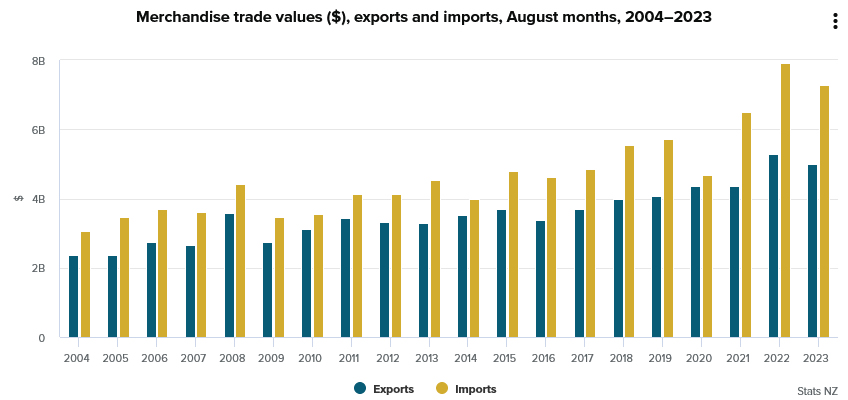
In August, New Zealand observed a dip in both its goods exports and imports compared to the previous year, leading to a monthly trade deficit of NZD -2.3B.
Compared to figures from August 2022, goods exports saw a reduction of NZD -296m, marking a -5.6% yoy drop, settling at NZD 5.0B. On the other hand, goods imports displayed an even steeper decline, shrinking by NZD -639m or -8.1% yoy, amounting to NZD 7.3B.
A deeper dive into the export figures revealed China as the major contributor to the monthly dip. Exports to China fell sharply by NZD -262m, representing an -18% yoy decline. Other notable declines were witnessed in exports to Australia, which dipped by NZD -71m (-9.0% yoy), and Japan, with a decrease of NZD -34m (-11% yoy). However, there was some silver lining with US and EU. Exports to the USA grew by NZD 62m, marking a 9.6% yoy increase, and those to the EU surged by NZD 28m, a 7.7% yoy rise.
China also took the lead in the contraction in imports. Imports from China plummeted by NZD -363m, a stark -19% yoy decline. Other significant reductions in imports were observed from Australia, down by NZD -92m (-9.7% yoy), South Korea with a drop of NZD -74m (-13% yoy), and US decreasing by NZD -36m (-5.4% yoy). In contrast, imports from EU displayed a robust growth, climbing by NZD 120m or 12% yoy.
ECB’s Lane: 4% deposit rate can bring inflation back to target within projection horizon
ECB's Chief Economist, Philip Lane, offered insights into last week's rate hike during a speech overnight. He noted that "the choice between holding at 375 and moving to 400 was finely balanced," referring to the deposit rate. Lane went on to express that opting for an additional hike was a safer decision "at a margin".
He believed that 4% deposit rate should be "consistent with a return of inflation to target within the projection horizon." The condition is that it's to be " maintained for a sufficiently long duration".
Looking to the future, Lane cautioned about the extended phase of uncertainty that looms regarding the disinflation process. Highlighting the intricacies of the present economic climate, Lane pointed to the "initial inflation shock, the lagged nature of wage adjustment in the euro area, [and] the considerable sectoral rebalancing" as contributors to the prolonged period of inflation uncertainty.
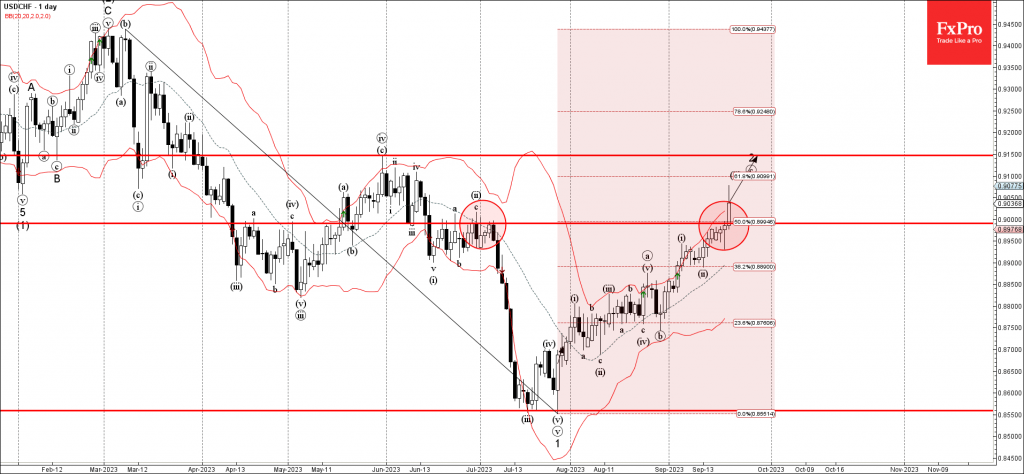
USDCHF Wave Analysis
- USDCHF broke resistance level 0.9000
- Likely to rise to resistance level 0.9150
USDCHF recently broke above the round resistance level 0.9000 (which has been reversing the price from June) intersecting with the 50% Fibonacci correction of the downtrend from March.
The breakout of the resistance level 0.9000 should accelerate the active impulse wave c, which belongs to the ABC correction 2 from July.
USDCHF can be expected to rise further toward the next resistance level 0.9150 (target for the completion of the active impulse wave c).
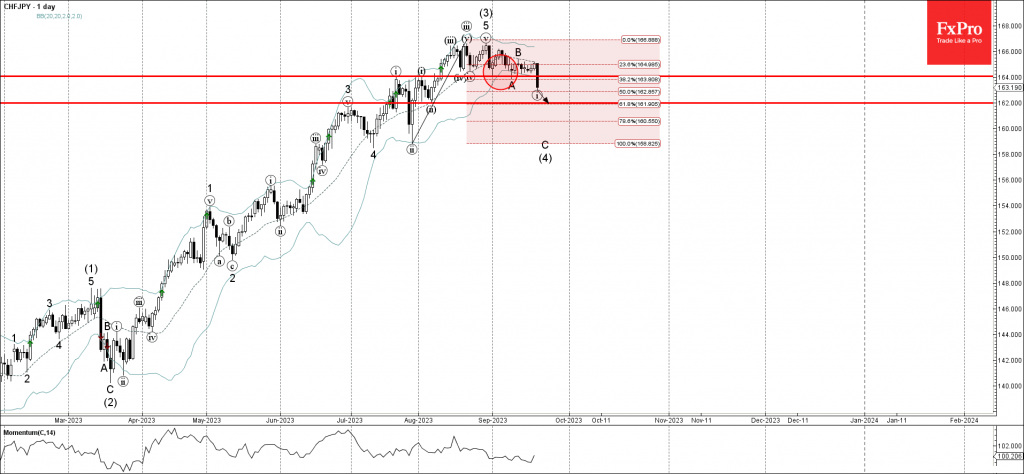
CHFJPY Wave Analysis
- CHFJPY broke support level 164.00
- Likely to fall to support level 162.00
CHFJPY continues to fall inside the minor impulse wave i, which previously broke the support level 164.00 (low of the previous wave A) intersecting with the 38.2% Fibonacci correction of the upward impulse from July.
The breakout of the support level 164.00 should accelerate the active impulse wave i, which belongs to the C-wave of the intermediate ABC wave (4) from the end of August.
CHFJPY can be expected to fall further toward the next support level 162.00 (low of the previous correction ii from August).
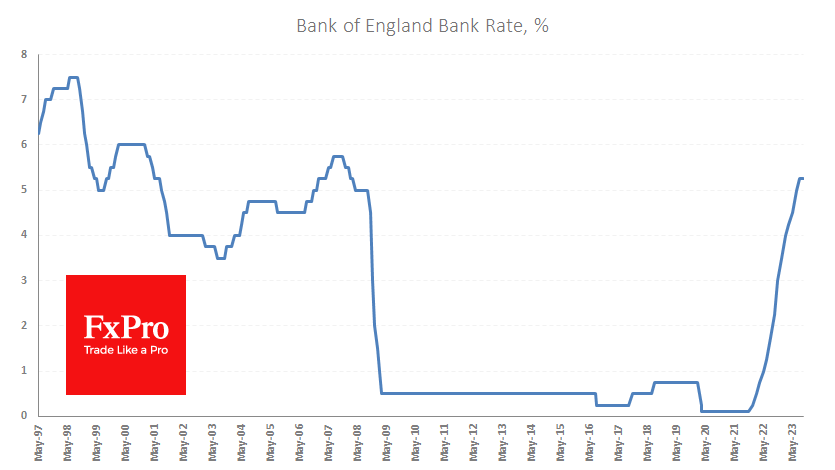
BoE Joins the ‘Done With Hikes’ Team
The Bank of England has left its key interest rate unchanged at 5.25%. The likelihood of such an outcome was actively priced into Pound quotes following yesterday’s UK inflation report.
The accompanying commentary noted the Bank of England’s worsening outlook for GDP growth and signs of deterioration in the labour market. In addition, the central bank expects inflation to slow significantly in the near term.
This is a much softer stance than we had expected, given the return of higher energy prices, the turnaround in producer prices and the still very high level of consumer inflation.
Today’s decision has raised expectations that the Bank of England has reached an interest rate ceiling. A similar scenario is now the main one for the Fed, the ECB and the SNB.
The Bank of England’s focus on the economy rather than inflation briefly sent GBPUSD to 1.2250, its lowest level since March, bringing the pair’s overall decline from its July peak to 6.8%.
The British Pound fell below its 200-day moving average this week, returning to a bearish trend. On the other hand, the pair has accumulated a short-term oversold condition over the past two months, which increases the chances of a corrective bounce in the coming days, paving the way for further declines.
Except for the US, September seems to be a turning point for the G7’s central banks. The Fed yesterday signalled the greatest willingness to raise rates soon and to keep them on hold for an extended period. In contrast, many opted to signal that they are comfortable with the current level of interest rates. This divergence is fuelling the strengthening of the US currency, albeit at a high cost to the US government, whose nominal debt servicing costs have risen to unprecedented levels.
WTI Oil Futures Turn Positive Again After Pullback from 10-month High
- Slide in oil doesn’t last long as bulls remain in control
- But further gains will depend on whether 50% Fibonacci can be overcome
WTI oil futures (cash) are heading higher on Thursday, reversing an earlier decline to a one-week low of 88.96. The price brushed a 45-week peak of 93.08 on Tuesday, extending the year-to-date gains to more than 15%.
The pullback was to be expected as both the RSI and stochastics had crossed into their respective overbought zones. The stochastics remain tilted downwards, heading towards the neutral level, but the RSI is attempting to re-enter the overbought region. This could be a sign that some further upside action is possible before a more sizeable correction is triggered.
That trigger could be the 50% Fibonacci retracement of the June 2022-May 2023 downtrend at 93.91. The significance of the 50% Fibonacci is underscored by the upper Bollinger band, which is flatlining just above it. A break above this crucial resistance area would green-light a sustained recovery in oil, clearing the path for the 61.8% Fibonacci of 101.04.
But should it succeed in capping gains, the price could retreat towards the 38.2% Fibonacci of 86.77, which corresponds with the 20-day simple moving average (SMA). The 50-day SMA lies not that much lower at 82.75, while further down, the 23.6% Fibonacci of 77.95 could next provide support as it did in August. However, a sharper selloff that pushes the price below the 200-day SMA in the 77.00 region would risk turning the bullish medium-term outlook to neutral.
Overall, this latest fall appears to have been only a minor setback for WTI oil futures and there’s not enough indication at this stage suggesting the uptrend is in danger. However, the 50% Fibonacci will be an important test, while a drop below the 20-day SMA would further weaken the short-term positive bias.
Bank of England Review: End to the Hiking Cycle, But Not GBP Headwinds
- The BoE today decided to keep the policy rate unchanged at 5.25% with forward guidance remaining broadly unchanged.
- We think that this marks the peak in the Bank Rate of 5.25%, although wage growth and service inflation remain a joker.
- We stay negative on GBP and continue to see relative rates as a moderate positive for EUR/GBP from here.
The Bank of England (BoE) decided to keep the the Bank Rate (key policy rate) unchanged at 5.25%. Five members voted for an unchanged decision while four members voted for an increase of 25bp. On gilt stock reduction, the BoE set a target of a reduction of GBP 100bn for the next 12 months (up from 80bn the past 12 months).
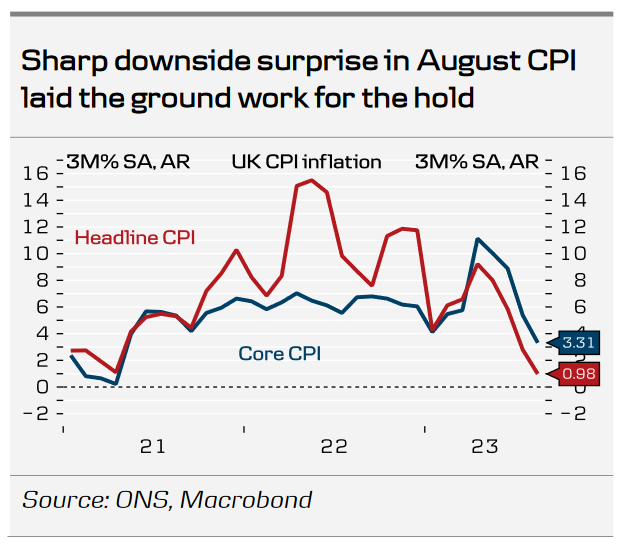
The majority of the Monetary Policy Committee (MPC) voted to keep the Bank Rate unchanged, citing the recent downside surprise to august inflation and further signs that the labour market was loosening. The BoE now expects GDP to rise only slightly in 2023 Q3 and underlying growth in the second half of 2023 also likely to be weaker than expected. Likewise, the BoE expects CPI inflation to "fall significantly further" while noting that service inflation is projected to remain elevated in the near-term. The BoE reiterated that "the current monetary policy stance is restrictive" and that "Monetary policy will need to be sufficiently restrictive for sufficiently long to return inflation to the 2% target sustainably in the medium term, in line with its remit". The BoE retained its forward guidance repeating that "further tightening in monetary policy would be required if there were evidence of more persistent inflationary pressures". While there is potential for a hike further out, only further amplified by the tight vote split, we do not believe that data will prove sufficiently strong for this to be the case. We expect the UK economy to show further signs of weakness, inflation to level off and a peak in private sector wage growth. Likewise, data releases are rather limited before the next meeting on 2 November, where we only get one job market report and inflation data for September.
Rates. Overall, the reaction in rates markets was relatively muted. Initially, rates markets rallied on the decision and statement and sent 2Y Gilt yields lower, but largely retraced the move during the afternoon. Markets are pricing in 10bp for the November meeting and a peak in the Bank Rate of 5.45%.
FX. EUR/GBP initially moved higher but partly retraced the move later on. On balance, we continue to see relative rates as a moderate positive for EUR/GBP, although GBP has been largely decoupled from moves in relative rates the past month. We expect the relative performance of the euro area and UK economy to be a driver, targeting a moderate rise in EUR/GBP to 0.88 the next year.
Our call. We expect the peak in the Bank Rate to have been reached. In order for BoE to opt for a 25bp instead of an unchanged decision at the next meeting we believe that we would have to see data releases, most notably wage growth and core inflation, prove considerably better than what we currently pencil in. Our call is less than current market pricing (20bp until March 2024). We still believe that the first rate cuts will not be delivered before Q2 2024.