Sample Category Title
Will BoC Come to Loonie’s Rescue?
The Bank of Canada (BoC) might move to the sidelines on Wednesday at 14:00 GMT after two rate increases during the summer. Investors are not seeing any additional hikes in the year ahead, but they have not excluded the case entirely. Hence, any clues the central bank could return to the tightening path in the foreseeable future could provide some footing to the loonie. Yet, with the economy fizzling out, the central bank may refrain from boosting rate expectations, likely providing poor support to the Canadian currency.
Will the BoC pause rate hikes?
The Canadian dollar has been a victim of the greenback, depreciating by more than 4.0% since July’s BoC policy meeting helped it bounce to a nine-month high. The loonie has completely reversed its May-July upleg, and despite the recent resurgence in crude oil prices, it could barely find its feet, with traders currently wondering whether September’s policy meeting on Wednesday could stop the melting.
The short answer is no. Investors are certain that the central bank will leave interest rates unchanged at 5.0% and perhaps it may not have a good reason to justify additional rate increases this time.
During its previous gathering, the central bank saw inflation returning sustainably to its 2.0% midpoint target by the middle of 2025. Therefore, since policymakers are not scheduled to update their economic projections before October, it would be unwise to suddenly shut the door to additional tightening. Unlike its US peer, the BoC has a flexible inflation target set within a control band of 1-3%, and the CPI measures are currently slightly above that range. This could lead to less commitment to future rate increases, especially since the Q2 GDP data arrived surprisingly lower than expected.
Canadian economy shrinks
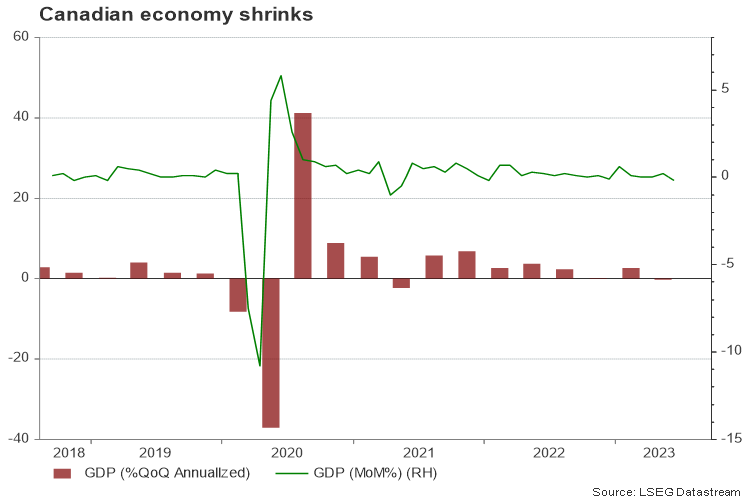
The Canadian economy contracted by 0.2% on an annualized basis in Q2, while a preliminary GDP estimate for July and the latest gloomy Ivey business PMI survey sent negative warnings for the third quarter too. Recall that the central bank hoped for a stronger annualized growth of 1.5% y/y back in July.
Probably the wildfires in the country caused limited access to resources and disturbed business activities. But the decline in housing investment and the slowdown in consumption could also be a broader sign that the economy is starting to feel the pain from higher borrowing costs.
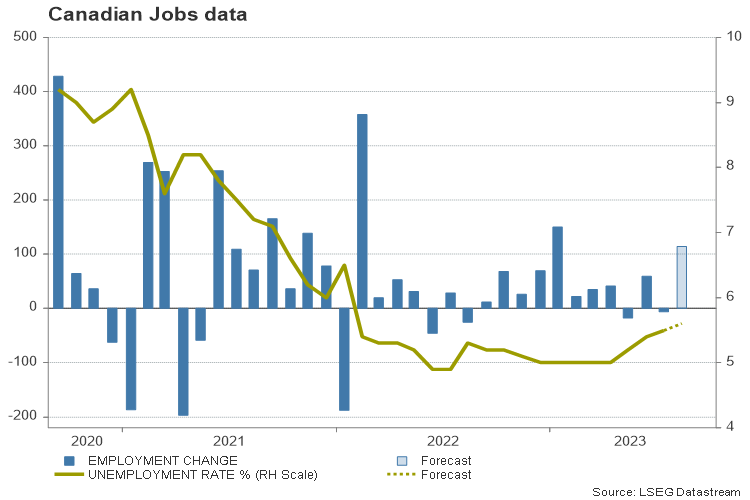
The soft rebound in the unemployment rate might further motivate a pause this month and allow some time for monitoring. August’s jobs report will be published two days after the rate announcement on Friday at 12:30 GMT, with forecasts pointing to a higher employment growth of 15k compared to the 6.4k decline registered in July. Interestingly, the unemployment rate is expected to rise for the third consecutive month to 5.6%.
Market reaction
For now, the central bank could switch to a neutral stance, avoiding any hawkish signals, and, more importantly, any language that could bolster rate cut speculation. If this scenario plays out, the loonie may find it hard to change course to the upside, unless the Canadian Jobs numbers show a significant improvement and US headlines add pressure to the greenback.
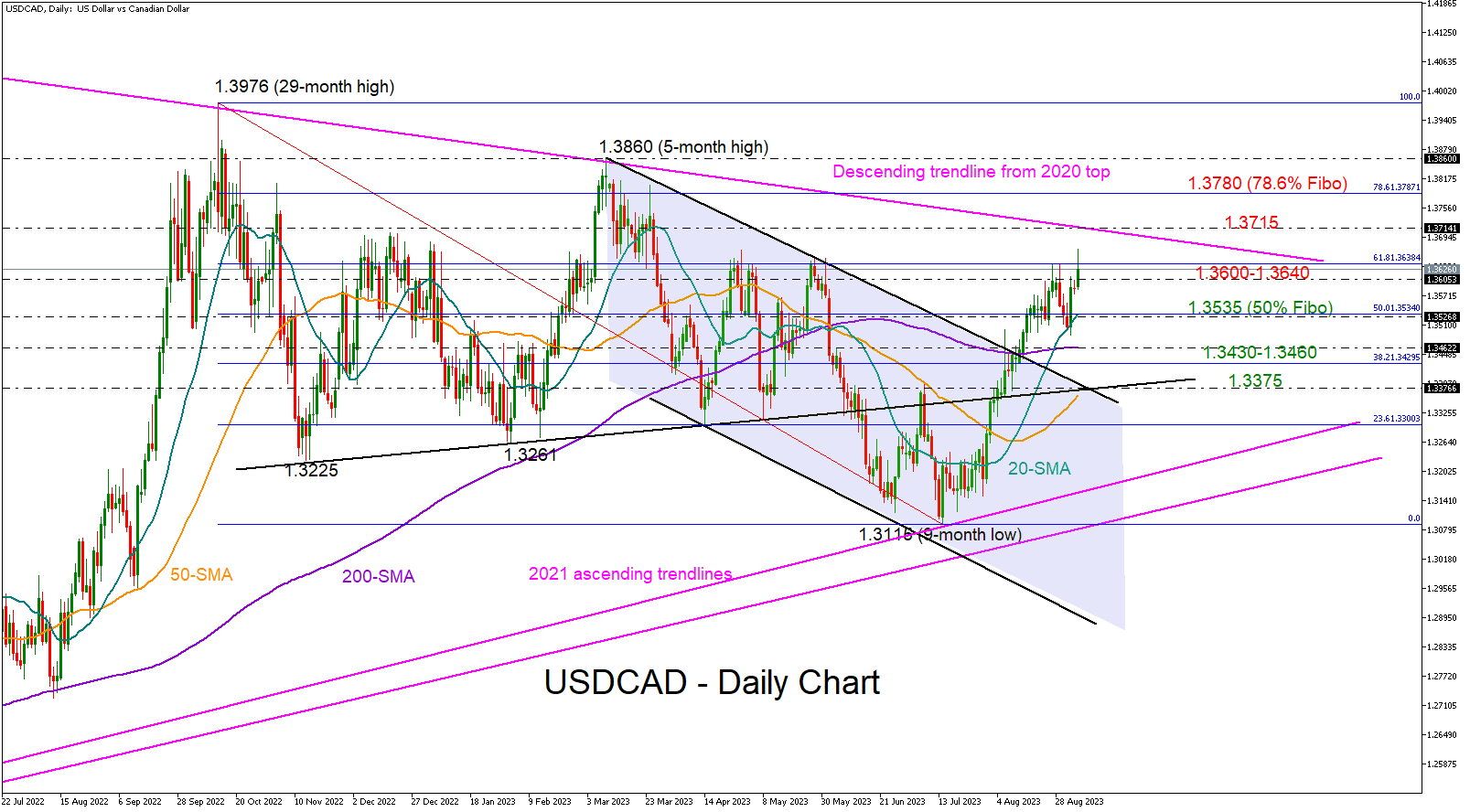
From a technical perspective, a rebound in the loonie cannot be ruled out. Dollar/loonie is currently struggling to overcome the familiar resistance of 1.3640, while the descending trendline from the 2020 top could be another headache at 1.3730.
On the downside, the 20-day simple moving average (SMA) could ease downside forces around 1.3535 ahead of the 200-day SMA at 1.3460 and the 1.3430 support region.
The Two-Month Pound Correction Not Over Yet
Business activity in the UK is losing ground, as is the case in Europe and China, although the final reading for August saw the services PMI rise to 49.5 from the first estimate of 48.7. According to today’s PMI, the services sector moved from growth to contraction in August, falling to 49.5.
At the end of last week, the PMI for the manufacturing sector fell to 43.0. Apart from April and May 2020, the index was only lower between October 2008 and February 2009.

This dynamic clearly shows the harshness of the current monetary policy for the manufacturing sector. The services sector has only begun correcting, enjoying a long tailwind from the post-pandemic recovery.
However, the markets seem to be paying more attention to signs of a contracting economy than ‘better than expected data’. GBPUSD fell as low as 1.2530 during the day before recovering to 1.2570 by the start of active trading in New York. The pair has lost around 4.5% since mid-July, with successive lows and highs.
The pair may find tangible support in the 1.2410-1.2470 area, with the lower boundary being the 200-day average and the upper boundary being the 76.4% Fibonacci level of the entire rally from September last year to July this year.
One should also be prepared for a deeper dive to 1.2060 for an established (61.8%) retracement of this advance.

Sunset Market Commentary
Markets
The dollar returned from a long weekend and immediately left a stamp on trading. EUR/USD lost support from the lower bound of the 2023 upward sloping trading range at around 1.0785 before moving further south towards next support at 1.0735 (December 2022 interim high). That technical level is currently under heavy test as well. DXY (trade-weighted dollar, 104.58) temporarily rose above 104.7 resistance (May correction high). USD/JPY hits a new 2023 high at 147.40 with few to no obstacles in the way for a return towards the October 2022 multi-decade top. A risk-off environment that spilled over from Asian dealings into Europe couldn’t completely explain the strong move. The likes of the EuroStoxx50 indeed opened with losses of about 1% but pared losses as the session evolved. Most indices currently even trade flat. US Treasuries do underperform German Bunds today. Yields rise 2.5-4.9 bps across the curve with real yields accounting for about half of the move higher again. The 10-y real yield variant is nearing the 2% level again, the highest since 2009. Aside from monetary policy expectations (high for longer) we’d argue that it reflects at least as much the resilience of the US economy. Fed’s Waller in an interview today said that data is looking “pretty good” in terms of avoiding a recession. He did add that the recent batch doesn’t say the Fed needs to do anything imminent and that it can proceed carefully. His comments further downplay chances for a September hike but lift those for a final increase in November marginally. German Bund yields tried to join the US higher but lack momentum. They currently trade 0.8-3.1 bps higher. European data came in mixed and offered little guidance. In its consumer inflation survey, the ECB said 1-year ahead expectations stopped declining and stabilized at 3.4%. The 3-year ahead series even ticked higher from 2.3% to 2.4%. Final PMIs were revised downwardly, with services now standing at 47.9 instead of the preliminary 48.3. The composite gauge as a result fell to 46.7, the lowest since November 2020, instead of the initial 47. Unlike in the US, worsening growth prospects prevent European real yields to rise as much as they should to act forcefully against high inflation. A Bloomberg article today, which was given little market attention, mentioned that speculation is mounting for the ECB to shrink its bond portfolio faster than currently as a countermeasure. APP is being wound down as fast as bonds are maturing (about €30/m on average for the next 12 months). PEPP reinvestments run through 2024 but calls are growing for a faster ending.
News & Views
South African GDP grew by 0.6% Q/Q in Q2 (1.6% Y/Y), beating the 0.3% Q/Q consensus estimate and slightly outpacing Q1 growth (0.4%). The supply side picture shows that six of ten industries recorded growth with manufacturing and finance outperforming. The main drag came from utility and from transport. The demand side picture showed an increase in investments (3.9% Q/Q) and government consumption (1.7%) with net exports (-2.4%) and household consumption (-0.3%) decreasing. Customers cut back expenses on nearly every category apart from health, education, transport and restaurants & hotels. Apart from GDP numbers, the August South African PMI rose significantly in August (51 from 48.2). It’s only this year’s second 50+ reading (February). S&P Global, responsible for the survey, talks about an encouraging turnaround in the private economy midway through the third quarter with companies reporting an increase in output for the first time in a year and order books starting to improve even as inflation saps spending power. Input purchases rose the strongest since June 2022. The August improvement is welcome, but doesn’t balance relatively weak growth in H1 2023. The South African rand can’t profit from today’s better-then-expected figures. USD/ZAR closes in on the August high at 19.30. Higher core bond yields are to blame.
The Swedish services PMI crashed from 53.4 to 49 in August, erasing the July uptick. The composite measure followed, declining from 51.9 to 48.1 and returning back to contraction territory where it had been all year. Details showed a huge setback in new orders which had triggered the July spike (46.3 to 58) with actual and planned business volumes both dropping. Companies significantly reduced their order backlog, but employment remains surprisingly strong. Supplier input prices accelerated to their highest level since December of last year (69.6 from 62.2) suggesting no signs of easing price pressure. The Swedish krone is again at the backfoot, closing in on the all-time lows just below EUR/SEK 12.
GBP/USD Breaks Down Amid Global Risk-Aversion
- EU and China Service PMIs drive global growth concerns
- UK Final Services PMI revised higher but downward trend remains
- Fed’s Waller (hawk) says “There is nothing that is saying we need to do anything imminent anytime soon.”
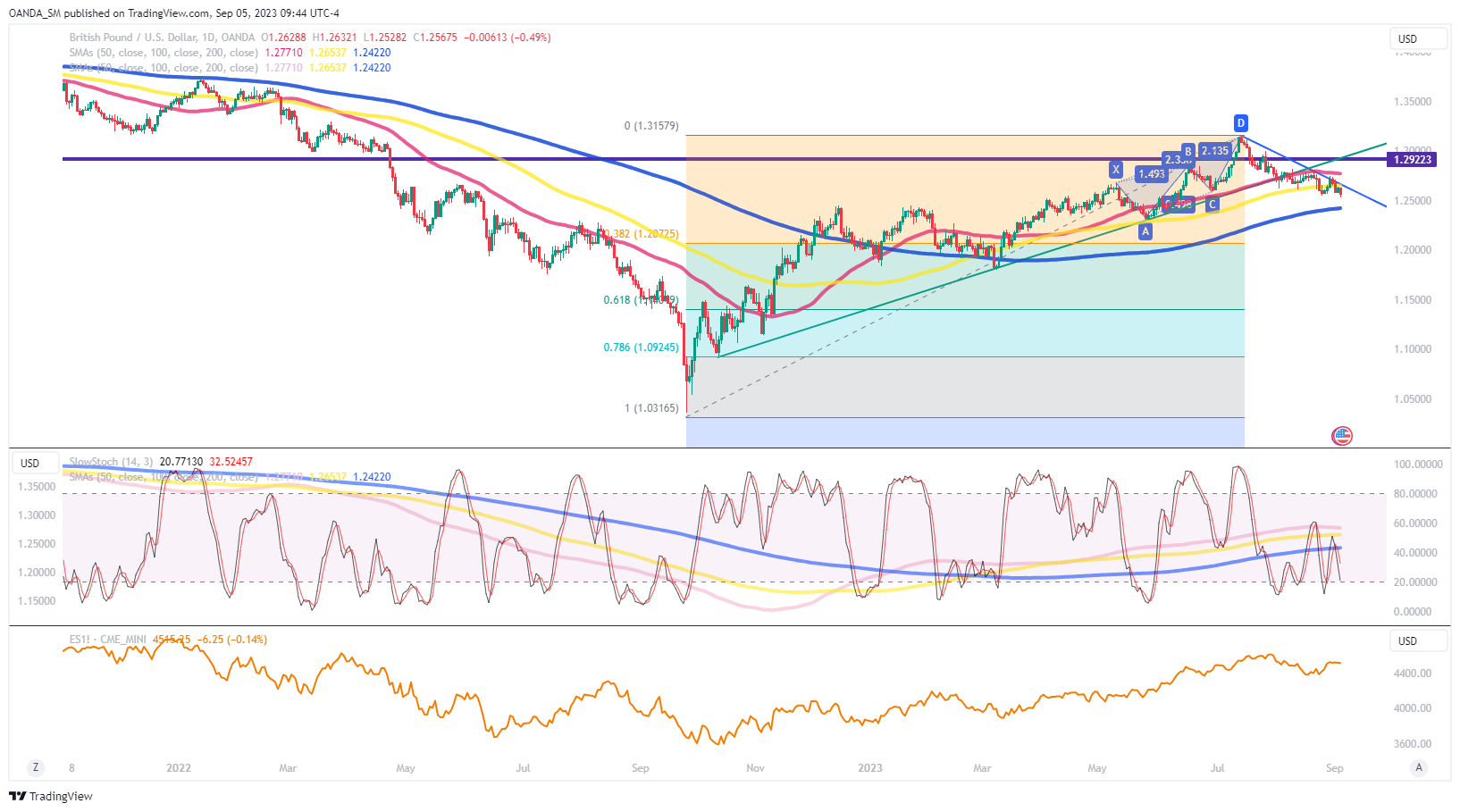
GBP/USD (daily chart) as of Tuesday (9/5/2023) has made a quick and strong breakdown below multiple support levels, indicating a potential bearish breakdown could target the 38.2% Fibonacci level, which resides at 1.2072. A bearish near-term outlook has been in place over the past month on the decline of both the longstanding bullish support trendline that was in place since last October and below the 50-day SMA. Price action is currently trading below the 100-day SMA and if downside continues, could target the 200-day SMA at 1.2421.
Upward UK PMI revisions
The British pound pared losses this morning after UK services data came in better-than expected, outperforming what came from the Eurozone and following the downbeat readings from China. The UK service sector is still in contraction territory, standing at 49.5, but it did buck the trend we saw with the rest of Europe. While the service reading was revised higher from a preliminary reading of 48.7, the downward trend that started in April remains firmly in place.
Central bank expectations
Slowing global growth concerns are sending rate hike expectations lower across the board. Fed fund futures now are only pricing in a 6.8% chance of a rate hike at the September 20th meeting and the November 1st odds are currently at 37.2%. The ECB rate hike odds for the September 14th meeting are now at 25.5% and the October 26th meeting has a 25.8% expectation for a rate increase.
Both the BOE and Riksbank are the only central banks (advanced economies) that are close to fully pricing in rate increases at their respective September policy decisions. The BOE appears poised to deliver two quarter-point rate increases as financial markets price a 97.6% chance of an increase at the September 21st meeting.
Short-term drivers
The GBP/USD pair reacted positively to Fed’s Waller’s comment that the data doesn’t say we need to do anything imminent. Waller is considered one of the more hawkish Fed members, so this comment could help convince markets that the Fed is likely done raising rates. It appears that global sentiment will likely be the primary driver here for the British pound, but dollar weakness could emerge if more Fed officials signal the end of tightening has arrived. If the UK labor market starts to loosen and household spending softens, BOE rate hike odds could come down and that could also fuel further downward pressure on sterling.
Fed Waller cautiously optimistic on inflation trend, eyes further data for rate decisions
Fed Governor Christopher Waller offered a cautious but upbeat assessment of recent US economic indicators in a CNBC interview today. Describing the previous week's data as "a hell of a good week," Waller emphasized that positive trends, particularly in inflation, would allow Fed to "proceed carefully" on interest rates.
Waller stated that inflation remains Fed's primary concern at this time. "The biggest thing is just inflation," he said, adding that consecutive favorable reports have been encouraging. However, he refrained from being overly optimistic, noting that Fed needs to "see whether this low inflation is a trend or if it was just an outlier or a fluke."
His cautious tone comes from recent history. "We've been burned twice before," Waller observed. In both 2021 and the end of 2022, initial indications suggested inflation was stabilizing, only to shoot up or be revised away later. As a result, Waller emphasized the need for a more sustained pattern of data before making any conclusive statements. "I want to be very careful about saying we've kind of done the job on inflation until we see a couple of months continuing along this trajectory," he elaborated.
When asked about the possibility of further tightening, Waller insisted that decisions would be data-dependent. He did, however, reassure that one more rate hike wouldn't necessarily throw the economy into recession. "It's not obvious that we're in real danger of doing a lot of damage to the job market, even if we raise rates one more time," he stated.
USD/JPY Mid-Day Outlook
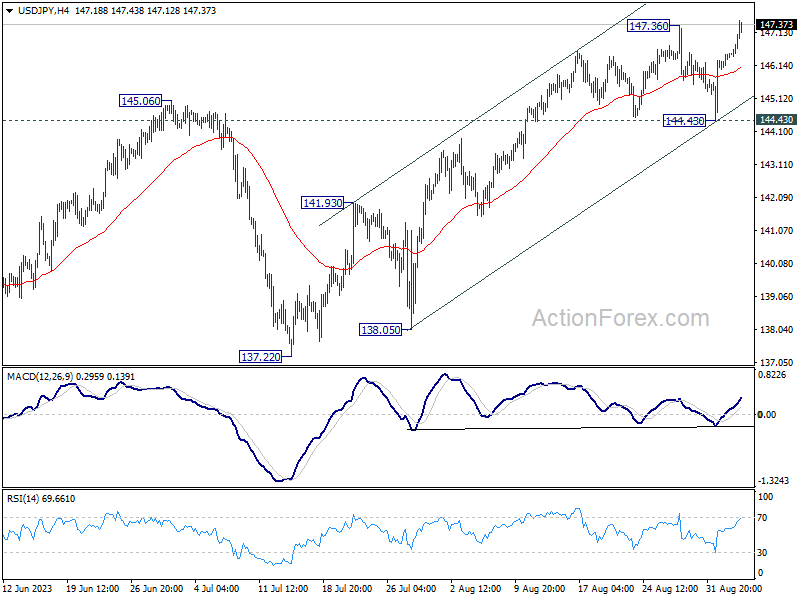
Daily Pivots: (S1) 146.18; (P) 146.34; (R1) 146.65; More...
Break of 147.36 resistance indicates resumption of recent rally in USD/JPY. Intraday bias is back on the upside. Current rise from 127.20 should target a test on 151.93 high. For now, near term outlook will stay bullish as long as 144.43 support holds, in case of retreat.
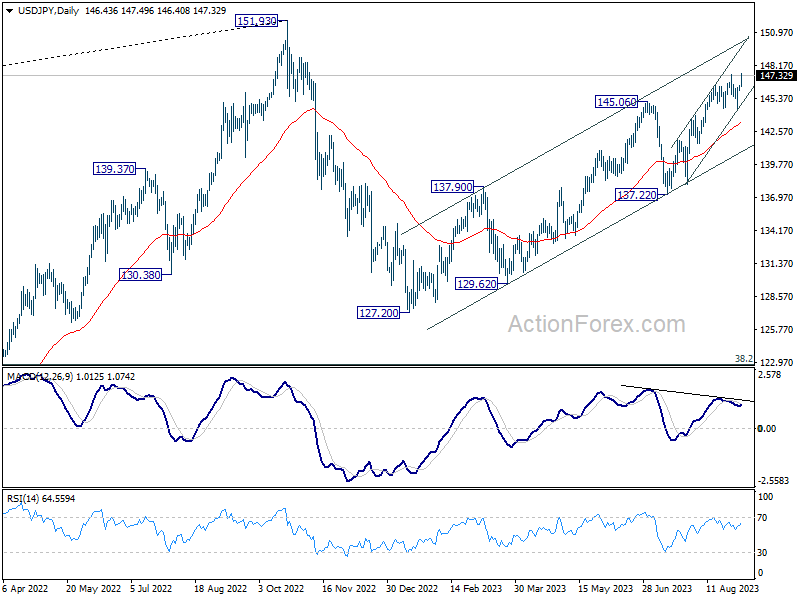
In the bigger picture, overall price actions from 151.93 (2022 high) are views as a corrective pattern. Rise from 127.20 is seen as the second leg of the pattern and could still be in progress. But even in case of extended rise, strong resistance should be seen from 151.93 to limit upside. Meanwhile, break of 137.22 support should confirm the start of the third leg to 127.20 (2023 low) and below.
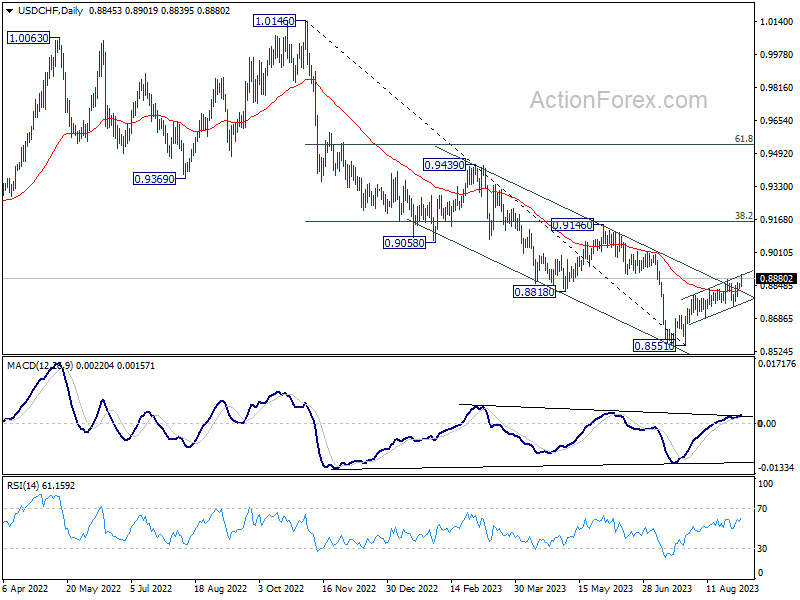
USD/CHF Mid-Day Outlook
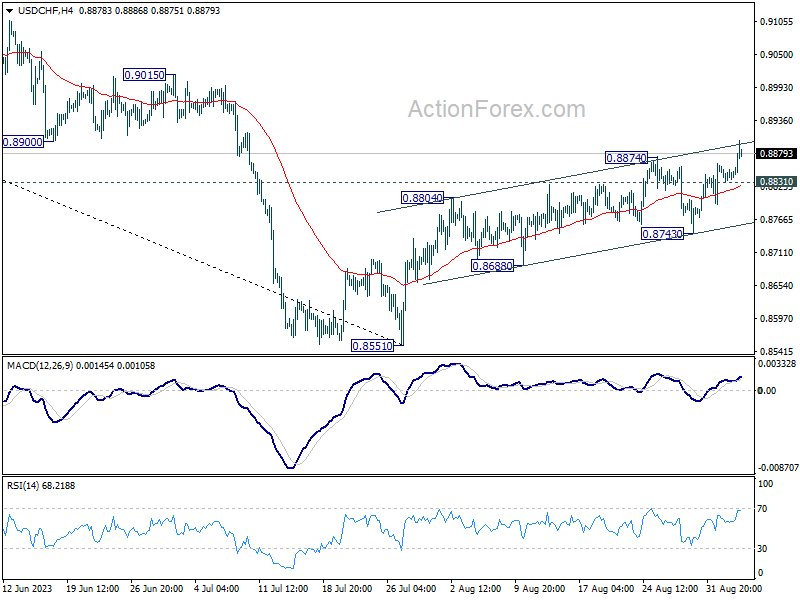
Daily Pivots: (S1) 0.8831; (P) 0.8847; (R1) 0.8860; More....
USD/CHF's break of 0.8874 resistance confirms resumption of rebound from 0.8551. Intraday bias is back on the upside. Further rally should be seen to 0.9146 cluster resistance. On the upside, below 0.8831 minor support will turn intraday bias neutral first. But risk will stay on the upside as long as 0.8743 support holds.
In the bigger picture, rebound from 0.8551 medium term bottom is currently seen as a correction to the downtrend from 1.0146 (2022 high). Further rally would be seen to 0.9146 cluster resistance (38.2% retracement of 1.0146 to 0.8551 at 0.9160). Strong resistance could be seen there to limit upside, at least on first attempt.
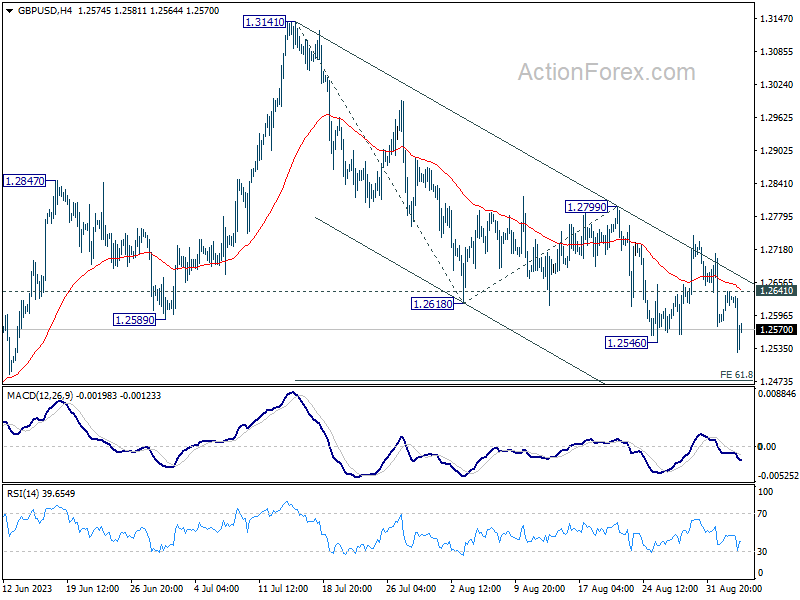
GBP/USD Mid-Day Outlook
Daily Pivots: (S1) 1.2596; (P) 1.2620; (R1) 1.2652; More...
Breach of 1.2546 support indicates resumption of whole fall from 1.3141. Intraday bias ins GBP/USD is back on the downside for 61.8% projection of 1.3141 to 1.2618 from 1.2799 at 1.2476. Firm break there could prompt downside acceleration to 100% projection at 1.2276. On the upside, above 1.2641 minor resistance will turn intraday bias neutral first.
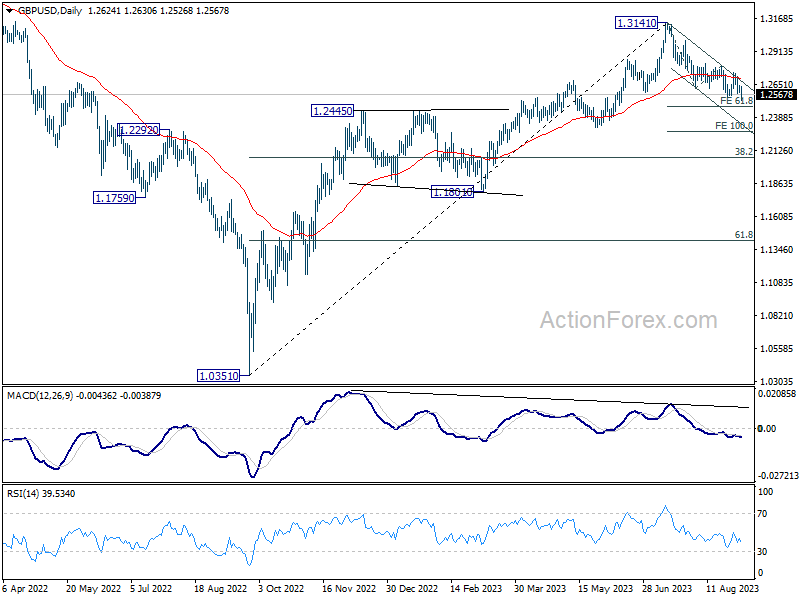
In the bigger picture, fall from 1.3141 medium term top is seen as a correction to up trend from 1.0351 (2022 low). Deeper decline would be seen to 38.2% retracement of 1.0351 to 1.3141 at 1.2075. Strong support would be seen there to bring rebound on first attempt. But outlook will be neutral at best as long as 1.3141 resistance holds, and consolidation from there is set to extend, until further development.
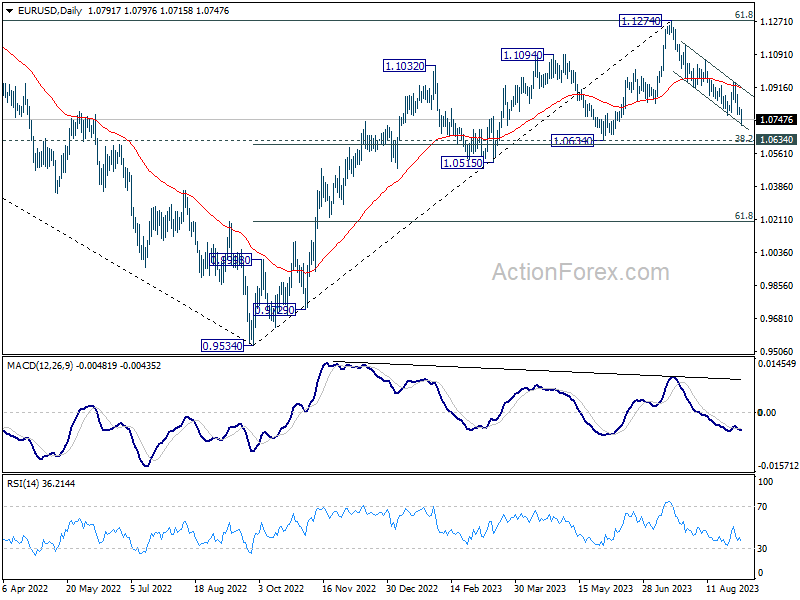
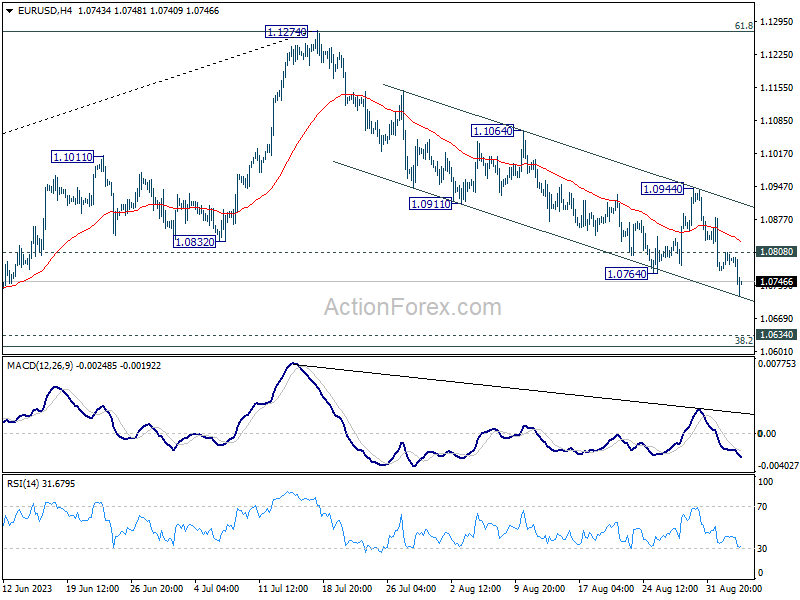
EUR/USD Mid-Day Outlook
Daily Pivots: (S1) 1.0776; (P) 1.0793; (R1) 1.0813; More...
EUR/USD's break of 1.0764 support confirms resumption of whole decline from 1.1274. Intraday bias is back on the downside for 1.0609/34 cluster support next. On the upside, above 1.0808 minor resistance will turn intraday bias neutral first. But risk will stay on the downside as long as 1.0944 resistance holds, in case of recovery.
In the bigger picture, fall from 1.1274 medium term top is seen as a correction to up trend from 0.9534 (2022 low). Deeper decline would be seen to 1.0634 cluster support (38.2% retracement of 0.9534 to 1.1274 at 1.0609). Strong support could be seen there, at least on first attempt, to bring rebound. Yet, medium term outlook will be neutral for now, as long as 1.1274 resistance holds. However, sustained break of 1.0609/34 will raise the chance of bearish trend reversal, and target 61.8% retracement at 1.0199.