Sample Category Title
Dollar Rally Looks at ISM Services for Fresh Catalyst, Canadian Awaits BoC Hold
Forex markets have found a moment of stability in today's Asian trading session, with Dollar taking a breather as it looks for fresh catalysts to continue this week's rally. All eyes are now on the upcoming ISM Services data, which could prove pivotal for Dollar's trajectory.
Services sector has emerged as the main engine of growth for US economy this year, overshadowing the manufacturing sector that has slipped into contraction. Whether we're discussing jobs growth, inflation, or consumer spending, the services sector remains the cornerstone of economic resilience. A strong showing in ISM Services data could extend Dollar's rally, underpinning the narrative of a resilient US economy amid global uncertainties.
Conversely, a surprising downturn in services could put the brakes on the Dollar, aligning it more closely with slowing economic trends observed in Eurozone and UK.
As of now, Dollar reigns as this week's strongest performer, followed by the Sterling and Swiss Franc. On the flip side, Australian Dollar has emerged as the weakest, with New Zealand Dollar not far behind. Yen's decline has decelerated after Japan's verbal intervention but still ranks as the third weakest performer this week. Meanwhile, Euro and Canadian Dollar are trading mixed, with traders keenly watching today's BoC rate decision where a hold on interest rates is widely expected.
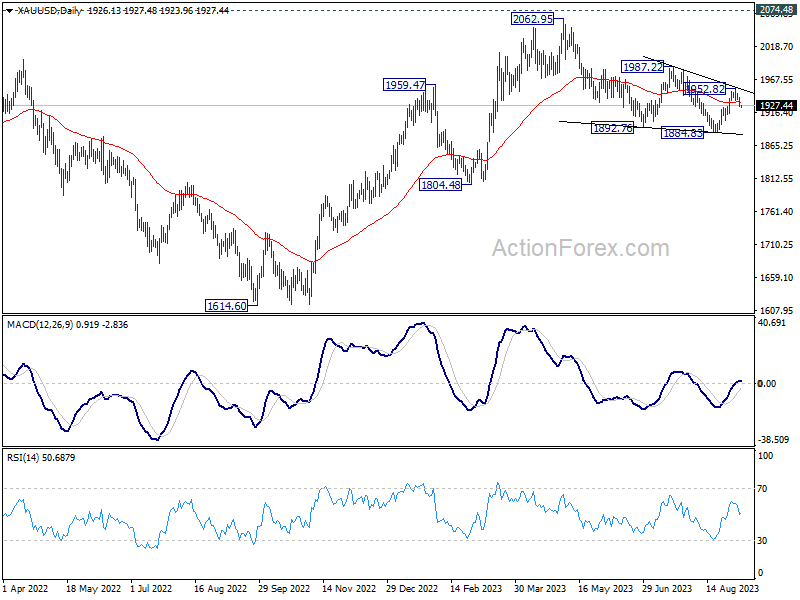
Technically speaking, both Gold and Silver have experienced significant declines this week, largely due to Dollar's strength. Gold appears to have completed its rebound at 1952.82 from 1844.83. Corrective pattern from 2062.95 is likely extending with another falling leg towards 1884.83 support again in the near term.
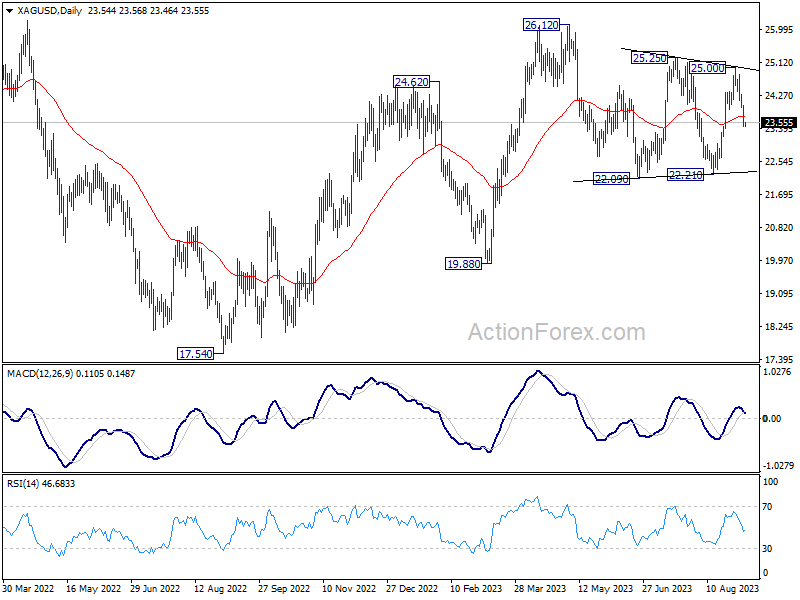
Silver's scenario echoes Gold's, having completed its rebound at 25.00 from 22.21. Further fall towards 22.21 seems imminent. Both Gold and Silver are likely to remain under pressure as long as their respective resistance levels at 1952.82 and 25.00 hold.
Overnight, DOW dropped -0.56%. S&P 500 dropped -0.42%. NASDAQ dropped -0.08%. 10-year yield rose 0.091 to 4.376. In Asia, at the time of writing, Nikkei is up 0.41%. Hong Kong HSI is down -0.78%. China Shanghai SSE is down -0.32%. Singapore Strait Times is down -0.21%. Japan 10-year JGB yield is up 0.0012 at 0.659.
Japan's Kanda flags "high urgency" as Dollar bears 148 Yen
Japan's Vice Minister of Finance for International Affairs, Masato Kanda, issued a strong warning as Dollar approaches 148 yen, marking a high for this year.
Kanda stated, "We are closely monitoring the situation, with a high sense of urgency. If such moves continue, the government will take appropriate measures, and all options are on the table."
These remarks are the first significant warning since the Ten dropped below the 145-per-dollar mark in mid-August. Since then, Japanese authorities had been relatively silent.
With the declared "high sense of urgency", Japan has effectively put currency traders on alert for potential intervention or other policy moves. The "all options are on the table" comment raises the possibility of multiple policy actions, ranging from more verbal warnings to more market interventions to curb yen's fall.
BoJ's Takata signals new dawn in wage-price cycle
BoJ board member Hajime Takata highlighted in a speech today the significant shifts in firms' behavior on price-setting and wages, leading to a budding "virtuous cycle between wages and prices" in Japan.
The existence of the virtuous wage-price cycle, if it sustains, could give BoJ more room to navigate its monetary policy and prompt an exit from the ultra-loose monetary policy, particularly if it's accompanied by "proactive and forward-looking efforts by firms" and appropriate "policy responses by the government."
"My understanding is that, on the whole, firms' price-setting behavior has changed from that observed during the deflation period," Takata said. This shift in behavior indicates that Japanese firms, traditionally cautious in raising prices, are beginning to pass on increased costs to consumers.
The significant point here is not merely the change but also the why of the change. According to Takata, firms' new willingness to adjust selling prices upwards is "likely because consumption has been solid even when prices have been rising, underpinned by standby funds that accumulated during the pandemic and by pent-up demand."
Another key takeaway is the substantial change in firms' wage-setting behavior. "As reflected in the results of the annual spring labor-management wage negotiations this year, firms' wage-setting behavior has changed, leading to wage increases and moves to pass on higher wage costs to selling prices," Takata highlighted. This wage growth has, in turn, boosted consumer sentiment, potentially setting the stage for a self-sustaining cycle of growth and inflation.
What financial markets should keep an eye on are the upcoming annual spring labor-management wage negotiations. Takata expects a "relatively high wage growth rate," given that labor shortages and high inflation rates are likely to continue.
Australia GDP grew 0.4% qoq on capital investment and services exports
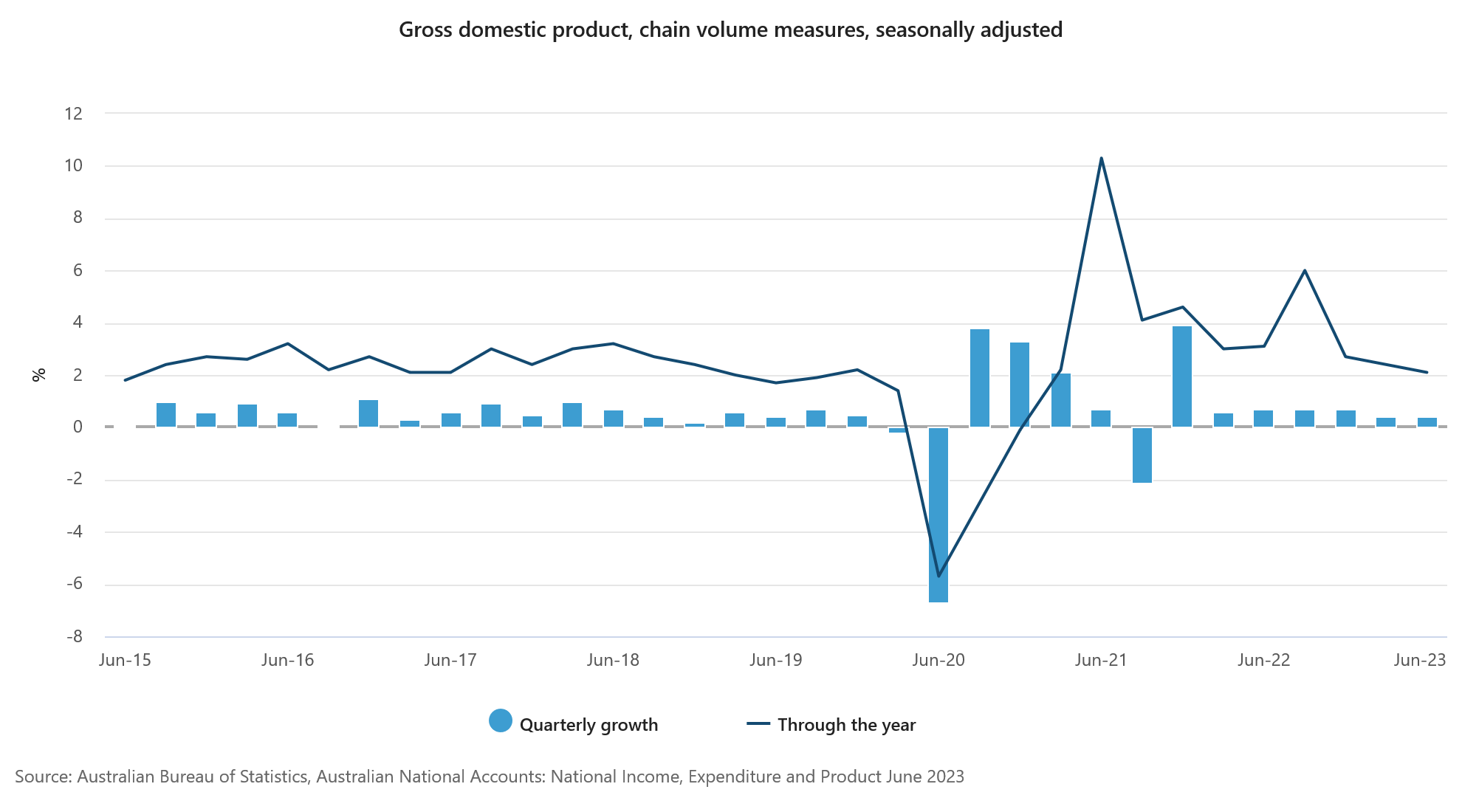
Australia's GDP saw 0.4% qoq growth in Q2, aligning perfectly with market expectations. This marks the seventh consecutive quarter of economic growth for the nation. The economy exhibited resilience with a 3.4% annual growth rate for 2022-23 financial year, comfortably surpassing 10-year pre-pandemic average of 2.6%.
However, it wasn't all good news: nominal GDP dropped by -1.2% qoq in the June quarter. GDP implicit price deflator also fell -1.5%, primarily due to -7.9% decline in terms of trade. Export prices fell by -8.2%, exceeding -0.3% fall in import prices. Despite this, domestic price growth remained stable at 1.2%, buoyed by increases in household rents, food prices, and the cost of capital goods, which escalated due to Australian Dollar's depreciation.
The positive quarterly GDP numbers were largely driven by two key factors: capital investment and the exports of services. Total gross fixed capital formation surged by 2.4%, reflecting growth in both public and private investment sectors.
Services exports soared 12.1%, with a significant push coming from 18.5% uptick in travel services.
Net trade in goods added 0.5% to GDP, with 2.5% rise in goods exports led mainly by mining commodities.
Household spending, on the other hand, remained rather muted, contributing just 0.1T to the GDP growth with modest 0.1% increase.
BoC to pause today after surprised Q2 GDP contraction
BoC is widely anticipated to maintain its current interest rate of 5.00% today. This expected pause in rate adjustments comes on the heels of surprising economic contraction in Canada, with the GDP shrinking at an annualized rate of -0.2% in Q2. The contraction signals the onset of economic slowdown, a stark contrast to the relatively robust performance seen in previous quarters.
Although July's inflation rate of 3.3% remains well above BoC's target, weakening economic backdrop is likely to bolster policymakers' confidence that inflation will gradually fall back to target over time. The slower economy could apply downward pressure on prices, providing the central bank with some breathing room to keep rates unchanged for now.
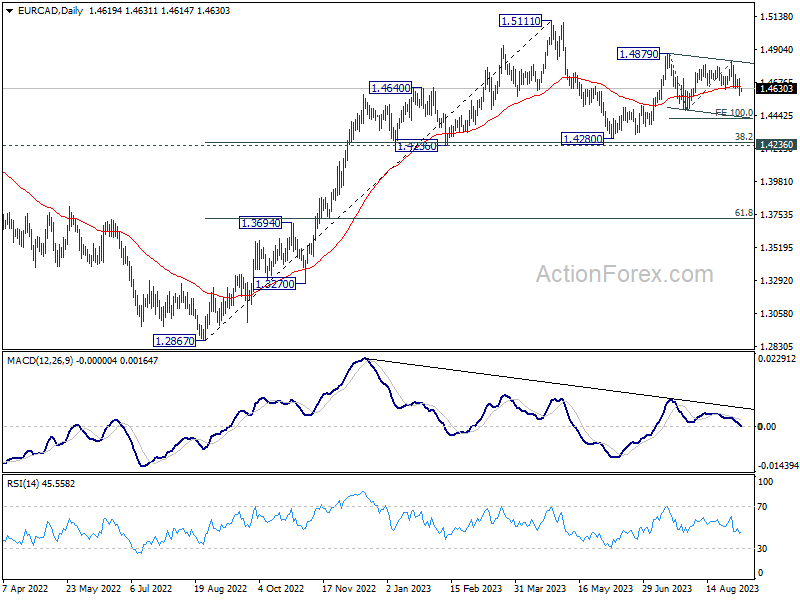
EUR/CAD's decline since last week suggests that recovery from 1.4482 has completed at 1.4822 already, ahead of 1.4879 resistance. For now, price actions from 1.4879 are seen as a consolidation pattern only, and thus, rise from 1.4280 should resume after this pattern completes. Hence, while deeper fall is in favor in the near term as long as 1.4700 resistance holds, downside should be contained by 100% projection of 1.4879 to 1.4482 from 1.4822 at 1.4425.
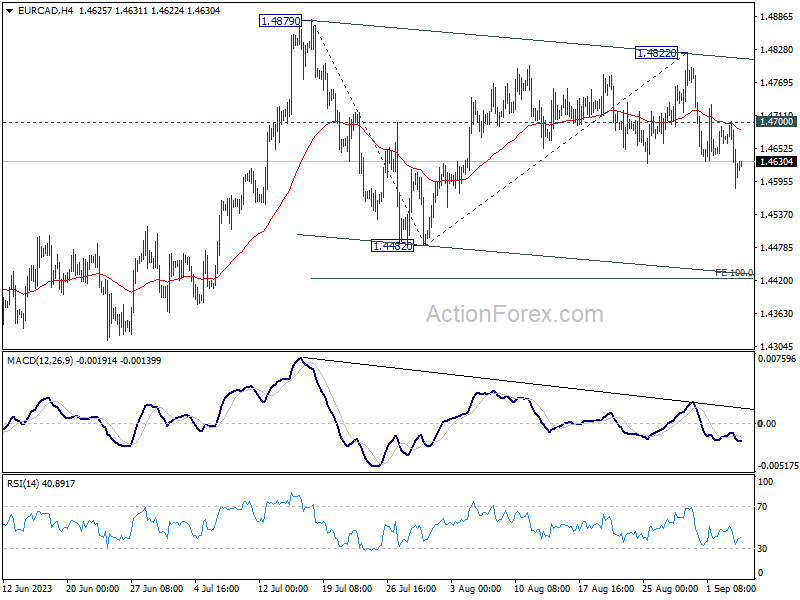
On a broader scale, price actions from 1.5111 are seen as a corrective pattern only and the up trend from 1.2867 is not over. The lingering question is whether the rise from 1.4280 constitutes the second leg of a medium-term pattern or signifies a resumption of the upward trend. More clarity on this could emerge once the current consolidation phase from 1.4879 completes.
Looking ahead
Germany factory orders, UK PMI construction and Eurozone retail sales will be released in European session. US ISM services will be the main event later in the day, together with BoC rate decisions. Both US and Canada will also publish trade balance. Fed will also release Beige Book economic report.
USD/JPY Daily Outlook
Daily Pivots: (S1) 146.82; (P) 147.31; (R1) 148.22; More...
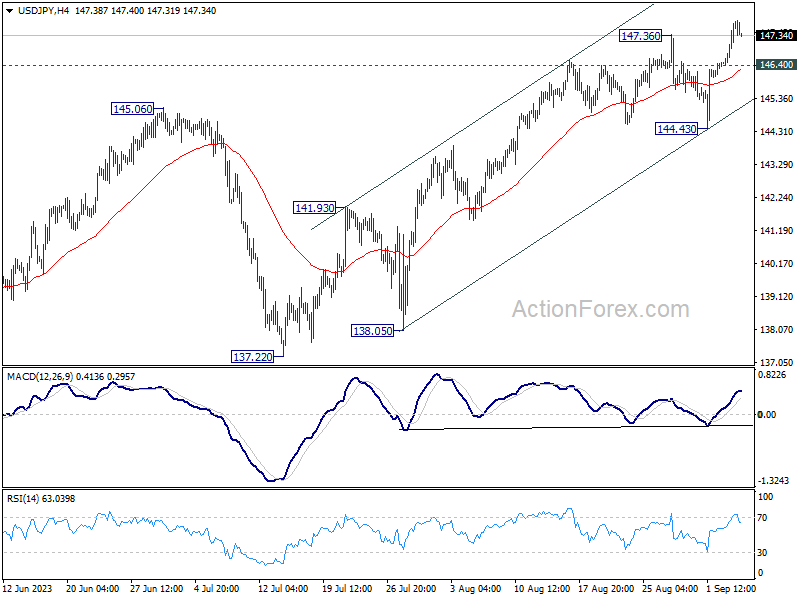
Intraday bias in USD/JPY remains on the upside at this point. Current rally is part of the whole rise from 127.20, and should target a test on 151.93 high. On the downside, below 146.40 minor support will turn intraday bias neutral first. But near term outlook will stay bullish as long as 144.43 support holds, in case of retreat.
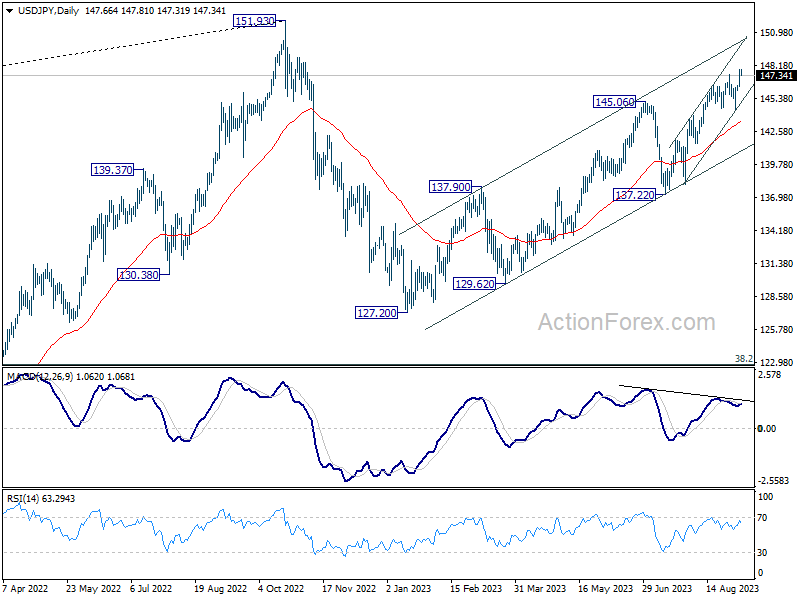
In the bigger picture, overall price actions from 151.93 (2022 high) are views as a corrective pattern. Rise from 127.20 is seen as the second leg of the pattern and could still be in progress. But even in case of extended rise, strong resistance should be seen from 151.93 to limit upside. Meanwhile, break of 137.22 support should confirm the start of the third leg to 127.20 (2023 low) and below.
Economic Indicators Update
| GMT | Ccy | Events | Actual | Forecast | Previous | Revised |
|---|---|---|---|---|---|---|
| 01:30 | AUD | GDP Q/Q Q2 | 0.40% | 0.40% | 0.20% | |
| 06:00 | EUR | Germany Factory Orders M/M Jul | -4.30% | 7.00% | ||
| 08:30 | GBP | Construction PMI Aug | 49.8 | 51.7 | ||
| 09:00 | EUR | Eurozone Retail Sales M/M Jul | -0.20% | -0.30% | ||
| 12:30 | CAD | Labor Productivity Q/Q Q2 | -0.10% | -0.60% | ||
| 12:30 | CAD | Trade Balance (CAD) Jul | -3.5B | -3.7B | ||
| 12:30 | USD | Trade Balance (USD) Jul | -67.9B | -65.5B | ||
| 12:30 | USD | Goods Trade Balance Jul | $-91.2B | |||
| 13:45 | USD | Services PMI Aug F | 51 | 51 | ||
| 14:00 | USD | ISM Services PMI Aug | 52.6 | 52.7 | ||
| 14:00 | CAD | BoC Interest Rate Decision | 5.00% | 5.00% | ||
| 18:00 | USD | Fed's Beige Book |
Research China – Downside Risks Return
Research China - Downside risks return
- Financial stress has increased again and put focus again on whether China is heading for a deeper financial and economic crisis.
- While we do see a rising risk of this happening (25% probability), our baseline scenario remains that China has the tools to avert such an outcome and will use them to the extend needed. Yet, due to the recent weak data and rise in financial stress we recently revised down our forecast to 4.8% growth this year and 4.2% in 2024.
- China has already turned up the volume on policy measures such as easing of mortgage policies, tax cuts and infrastructure spending and we expect the government to do more if needed to keep growth close to the target of 5% this year.
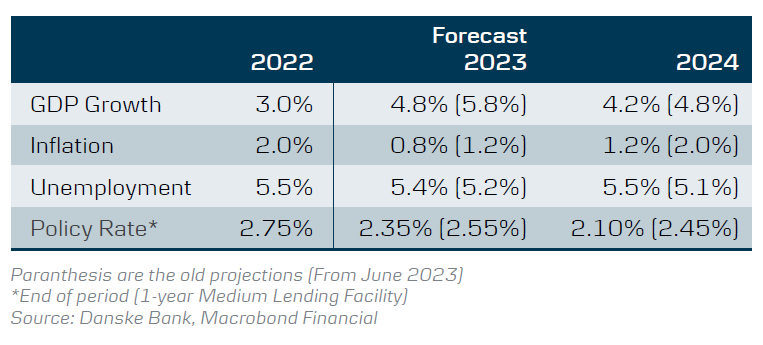
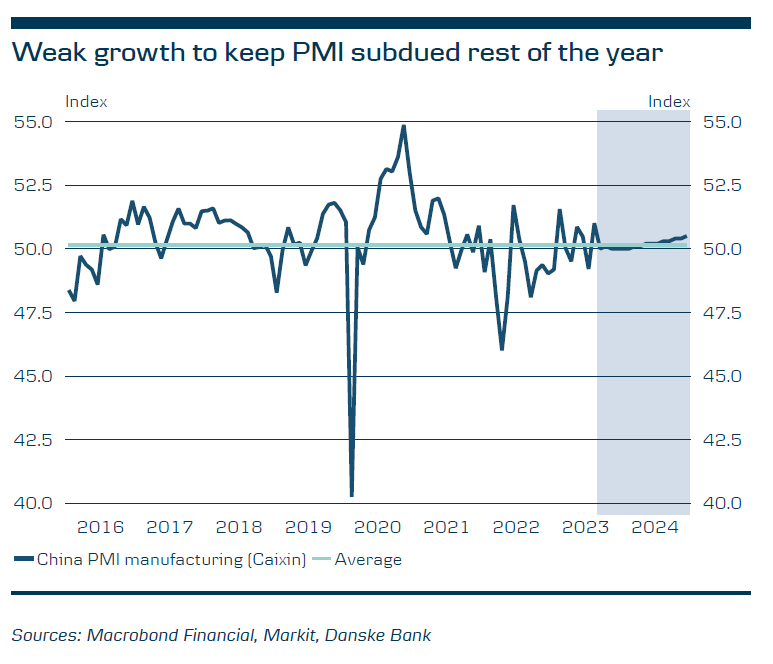
Financial stress has increased again with another major developer, Country Garden, at brink of default. Contagion to the shadow banking system has also come to the surface with a big trust company, Zhongrung International Trust Co missing payments. On top of this economic data has disappointed across the board with both consumer spending, home sales and exports undershooting expectations in recent months. Taking these developments into account we have revised down growth to 4.8% this and 4.2% next year. In our baseline scenario we expect policy makers to step up stimulus as broadly signalled following the Politburo meeting in late July and to take more measures to improve financing channels for developers and lift home sales. We also expect them to provide the necessary lifelines to local governments and facilitate a restructuring of major shadow banking entities in distress. We believe they will still strive to reach their 5% target and do what is necessary to at least put a floor under growth so it does not fall below 4-4½%.
Half of the economy already in recession
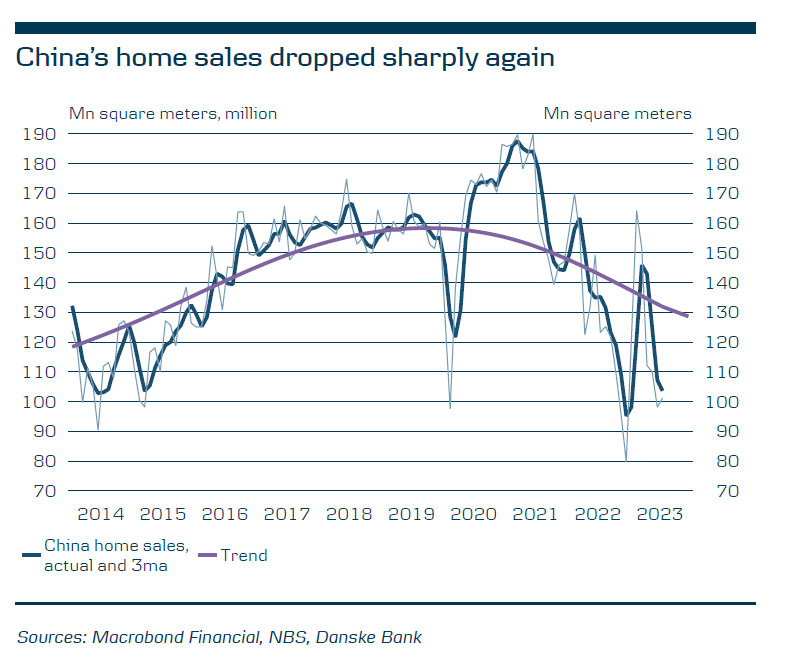
Of China's different growth engines, housing and exports are the weak spots both being in recession. Together they constitute close to 50% of the economy. Private consumption and infrastructure investments have underpinned growth so far but there is a risk that the weakness in housing spreads to household spending, which would add further downward pressure on demand. It is crucial that Chinese policy makers step up further in stimulating housing to avoid this negative spiral. There is little China can do about the weak exports as a devaluation would risk creating more uncertainty and instability and China is unlikely to go down that path. China consumer prices fell into deflation in July as they declined 0.3% y/y. However, it was driven by energy and food and the core inflation that excludes these components were up 0.8% y/y. Hence, we are not yet seeing broad based deflation in China. We look for overall inflation to turn positive again over the next 6-9 months but that inflation generally stays low as demand is set to undershoot supply for some time.
China's tool box is not exhausted yet
In early September China took new steps to support the economy by lowering mortgage rates and reducing the required down payments for house purchases. Early indications are that it has already spurred some home buyer interest but if needed China can ease more via these tools. Funding channels for developers can also be improved and on Friday18 August, PBOC and financial regulators met with bank executives telling them to direct more lending to support an economic recovery. China is also likely to cut Reserve Requirement Ratios (RRR) for banks to free up more liquidity to buy credit bonds and increase lending. The RRR for small and medium sized banks is 7.75% while it is 10.75% for large banks and thus has plenty of room to be lowered. Finally, if needed, China could opt for quantitative easing (QE) with PBOC buying bonds directly in the market. This would serve as a strong signal that they step in as lender of last resort.
China in a painful rebalancing of the economy
China is currently in a painful rebalancing where it needs to continue to wean itself off the reliance on housing as a structural demand driver and instead transition into an economy, where private consumption and high-tech manufacturing are the main drivers. Chinese leaders seem increasingly willing to pay a price to growth in the coming years from the lower levels of activity in the housing sector in order to achieve this rebalancing and get more capital allocated to more productive parts of the economy, not least high-tech manufacturing. The challenge is, though, to avoid that the decline in housing is so steep that it pulls down the consumer and investments with it. This is the risk China is currently facing and why we expect somewhat stronger measures to lift housing from the current depressed levels but not being so strong that they risk creating a new bubble.
Elliott Wave View: DAX Looking to Extend Lower in Double Three
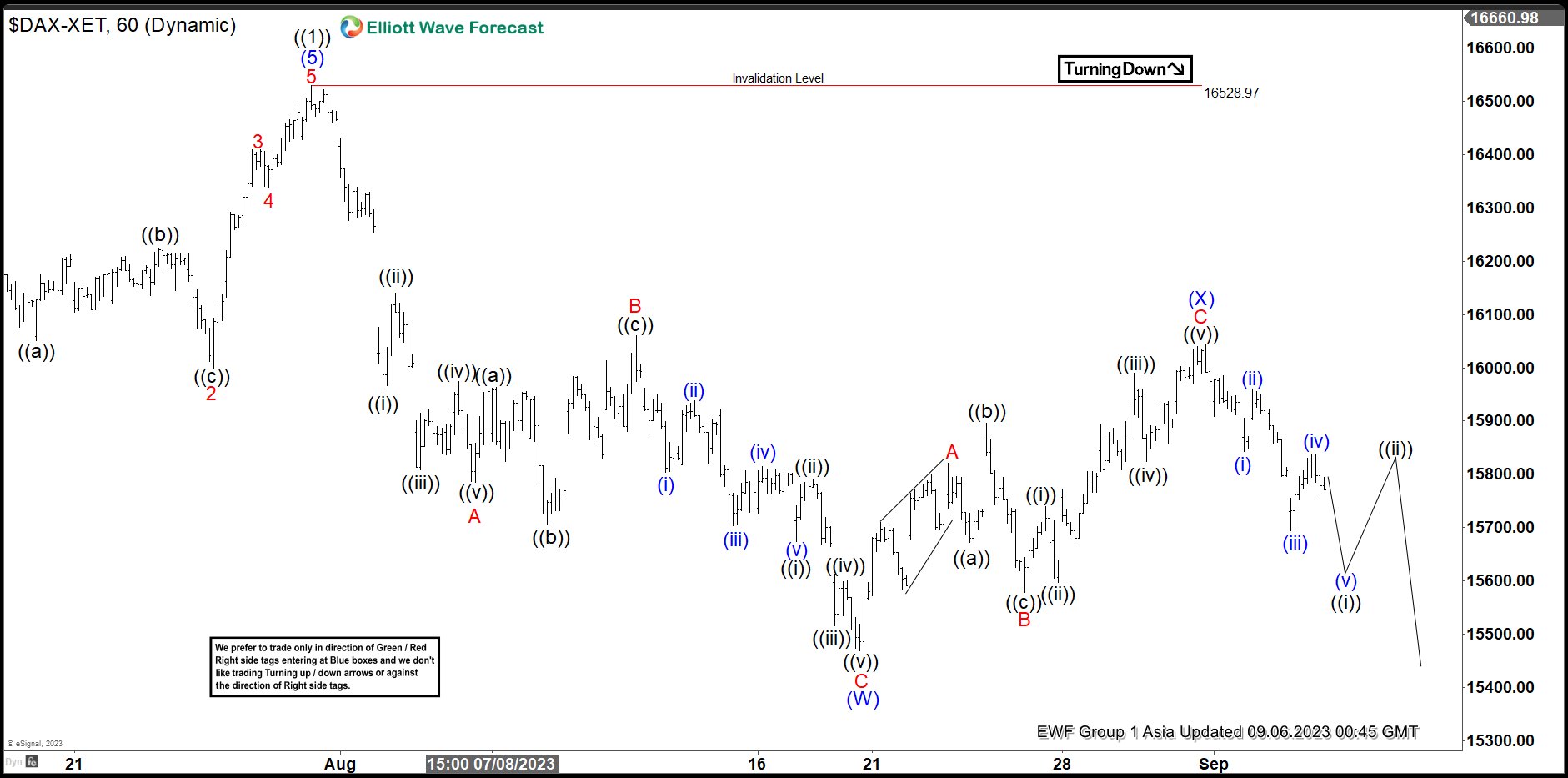
DAX ended cycle from September 28, 2022 low with wave ((1)) at 16528.97 as the 1 hour chart below shows. Index is currently in wave ((2)) pullback to correct the larger degree from September 2022 low. Internal subdivision of wave ((2)) is unfolding as a double three Elliott Wave structure. Down from wave ((1)), wave A ended at 15784.52. Wave B rally ended at 16060.27 as an expanded Flat. Index resumed lower again in wave C towards 15468.65 which completed wave (W).
Index then turned higher in wave (X) with internal subdivision as a zigzag Elliott Wave structure. Up from wave (W), wave A ended at 15820.95 and pullback in wave B ended at 15578.97. Index then extended higher in wave C towards 16042.66 which completed wave (X). DAX has turned lower in wave (Y) but still needs to break below wave (W) at 15468.65 to rule out any double correction. Down from wave (X), another leg lower is expected to end wave ((i)). Afterwards, it should rally in wave ((ii)) before turning lower again. Near term, as far as pivot at 16528.97 high stays intact, expect the Index to extend lower.
DAX 60 Minutes Elliott Wave Chart
DAX Elliott Wave Video
https://www.youtube.com/watch?v=4_bMF25IaTo
Japan’s Kanda flags “high urgency” as Dollar bears 148 Yen
Japan's Vice Minister of Finance for International Affairs, Masato Kanda, issued a strong warning as Dollar approaches 148 yen, marking a high for this year.
Kanda stated, "We are closely monitoring the situation, with a high sense of urgency. If such moves continue, the government will take appropriate measures, and all options are on the table."
These remarks are the first significant warning since the Ten dropped below the 145-per-dollar mark in mid-August. Since then, Japanese authorities had been relatively silent.
With the declared "high sense of urgency", Japan has effectively put currency traders on alert for potential intervention or other policy moves. The "all options are on the table" comment raises the possibility of multiple policy actions, ranging from more verbal warnings to more market interventions to curb yen's fall.
BoJ’s Takata signals new dawn in wage-price cycle
BoJ board member Hajime Takata highlighted in a speech today the significant shifts in firms' behavior on price-setting and wages, leading to a budding "virtuous cycle between wages and prices" in Japan.
The existence of the virtuous wage-price cycle, if it sustains, could give BoJ more room to navigate its monetary policy and prompt an exit from the ultra-loose monetary policy, particularly if it's accompanied by "proactive and forward-looking efforts by firms" and appropriate "policy responses by the government."
"My understanding is that, on the whole, firms' price-setting behavior has changed from that observed during the deflation period," Takata said. This shift in behavior indicates that Japanese firms, traditionally cautious in raising prices, are beginning to pass on increased costs to consumers.
The significant point here is not merely the change but also the why of the change. According to Takata, firms' new willingness to adjust selling prices upwards is "likely because consumption has been solid even when prices have been rising, underpinned by standby funds that accumulated during the pandemic and by pent-up demand."
Another key takeaway is the substantial change in firms' wage-setting behavior. "As reflected in the results of the annual spring labor-management wage negotiations this year, firms' wage-setting behavior has changed, leading to wage increases and moves to pass on higher wage costs to selling prices," Takata highlighted. This wage growth has, in turn, boosted consumer sentiment, potentially setting the stage for a self-sustaining cycle of growth and inflation.
What financial markets should keep an eye on are the upcoming annual spring labor-management wage negotiations. Takata expects a "relatively high wage growth rate," given that labor shortages and high inflation rates are likely to continue.
Gold Price Starts Downside Correction, $1,915 Is The Key
Key Highlights
- Gold price struggled near $1,950 and corrected lower.
- It traded below a declining channel with support near $1,932 on the 4-hour chart.
- Crude oil prices surged further higher above the $87.00 level.
- The US ISM Services Index could decline marginally from 52.7 to 52.6 in August 2023.
Gold Price Technical Analysis
Gold price faced resistance near the $1,950 zone against the US Dollar. The price peaked near $1,952 and recently started a downside correction.
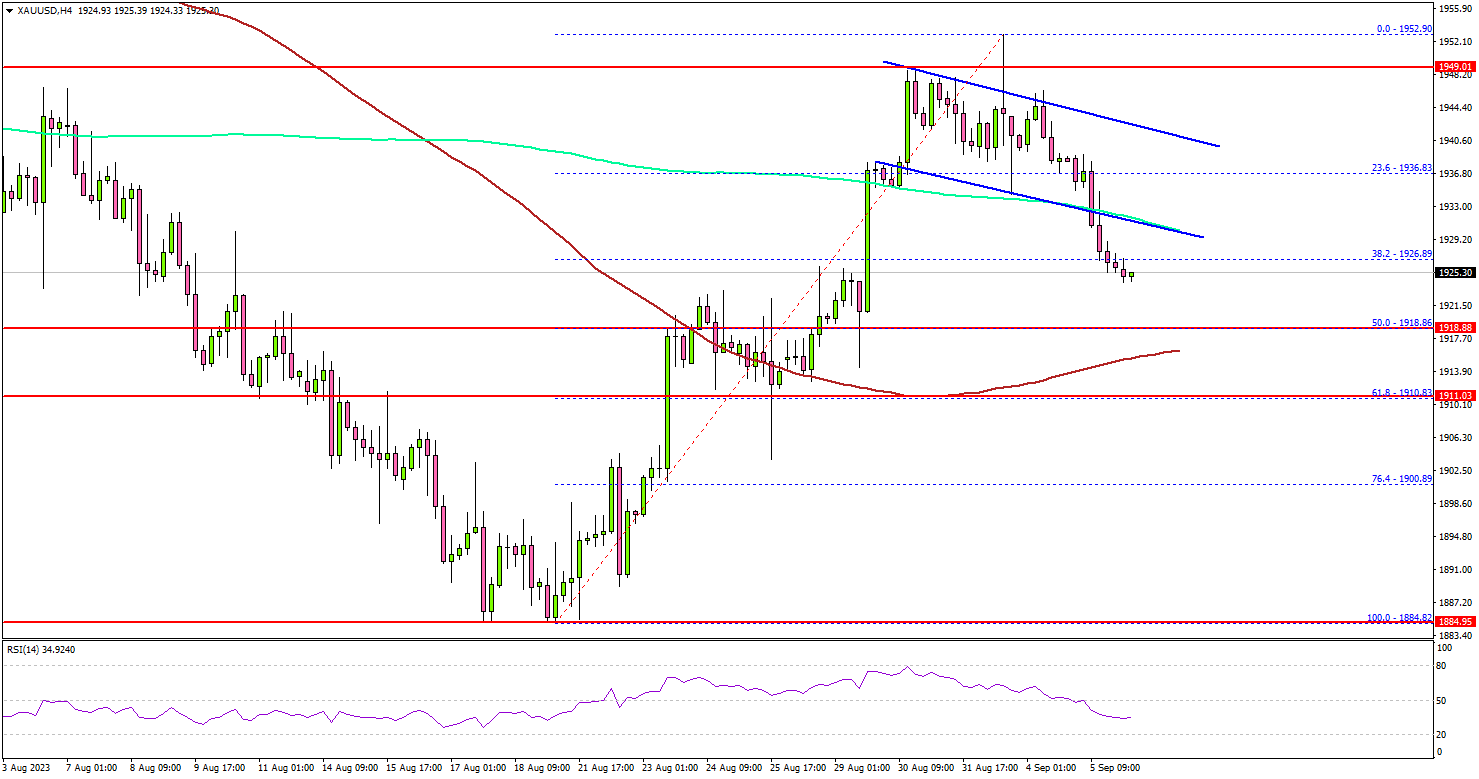
The 4-hour chart of XAU/USD indicates that the price declined below the 38.2% Fib retracement level of the upward move from the $1,884 swing low to the $1,952 high. Besides, the price traded below a declining channel with support near $1,932.
There was also a close below the 200 Simple Moving Average (green, 4 hours). If the price continues to move down, it could test the $1,920 support.
The 50% Fib retracement level of the upward move from the $1,884 swing low to the $1,952 high is also near $1,920. The main support could be $1,915 and the 100 Simple Moving Average (red, 4 hours).
If the bulls fail to protect the $1,915 support, there is a risk of a major decline. In the stated case, the price could decline toward the $1,885 level.
Immediate resistance is near the $1,935 zone. The next major resistance is near the $1,940 level, above which Gold could revisit the key $1,950 resistance zone.
Looking at crude oil prices, there was a sustained upward move and the price even broke the $87.00 resistance zone.
Economic Releases to Watch Today
- US ISM Services Index for August 2023 – Forecast 52.6, versus 52.7 previous.
- BoC Interest Rate Decision – Forecast 5.0%, versus 5.0% previous.
BoC to pause today, EUR/CAD down in consolidation pattern
BoC is widely anticipated to maintain its current interest rate of 5.00% today. This expected pause in rate adjustments comes on the heels of surprising economic contraction in Canada, with the GDP shrinking at an annualized rate of -0.2% in Q2. The contraction signals the onset of economic slowdown, a stark contrast to the relatively robust performance seen in previous quarters.
Although July's inflation rate of 3.3% remains well above BoC's target, weakening economic backdrop is likely to bolster policymakers' confidence that inflation will gradually fall back to target over time. The slower economy could apply downward pressure on prices, providing the central bank with some breathing room to keep rates unchanged for now.
EUR/CAD's decline since last week suggests that recovery from 1.4482 has completed at 1.4822 already, ahead of 1.4879 resistance. For now, price actions from 1.4879 are seen as a consolidation pattern only, and thus, rise from 1.4280 should resume after this pattern completes. Hence, while deeper fall is in favor in the near term as long as 1.4700 resistance holds, downside should be contained by 100% projection of 1.4879 to 1.4482 from 1.4822 at 1.4425.
On a broader scale, price actions from 1.5111 are seen as a corrective pattern only and the up trend from 1.2867 is not over. The lingering question is whether the rise from 1.4280 constitutes the second leg of a medium-term pattern or signifies a resumption of the upward trend. More clarity on this could emerge once the current consolidation phase from 1.4879 completes.
Australia GDP grew 0.4% qoq on capital investment and services exports
Australia's GDP saw 0.4% qoq growth in Q2, aligning perfectly with market expectations. This marks the seventh consecutive quarter of economic growth for the nation. The economy exhibited resilience with a 3.4% annual growth rate for 2022-23 financial year, comfortably surpassing 10-year pre-pandemic average of 2.6%.
However, it wasn't all good news: nominal GDP dropped by -1.2% qoq in the June quarter. GDP implicit price deflator also fell -1.5%, primarily due to -7.9% decline in terms of trade. Export prices fell by -8.2%, exceeding -0.3% fall in import prices. Despite this, domestic price growth remained stable at 1.2%, buoyed by increases in household rents, food prices, and the cost of capital goods, which escalated due to Australian Dollar's depreciation.
The positive quarterly GDP numbers were largely driven by two key factors: capital investment and the exports of services. Total gross fixed capital formation surged by 2.4%, reflecting growth in both public and private investment sectors.
Services exports soared 12.1%, with a significant push coming from 18.5% uptick in travel services.
Net trade in goods added 0.5% to GDP, with 2.5% rise in goods exports led mainly by mining commodities.
Household spending, on the other hand, remained rather muted, contributing just 0.1T to the GDP growth with modest 0.1% increase.
EURJPY Wave Analysis
- EURJPY reversed from support level 156.95
- Likely to rise to resistance level 159.50
EURJPY currency pair recently reversed up from the pivotal support level 156.95 (low of the previous correction 2), intersecting with the support trendline from March.
The support level 156.95 was further strengthened by the lower daily Bollinger Band and the 61.8% Fibonacci correction of the upward impulse from the start of August.
Given the strong daily uptrend, EURJPY can be expected to rise further toward the next resistance level 159.50 (which reversed the price 3 times last month).

CHFJPY Wave Analysis
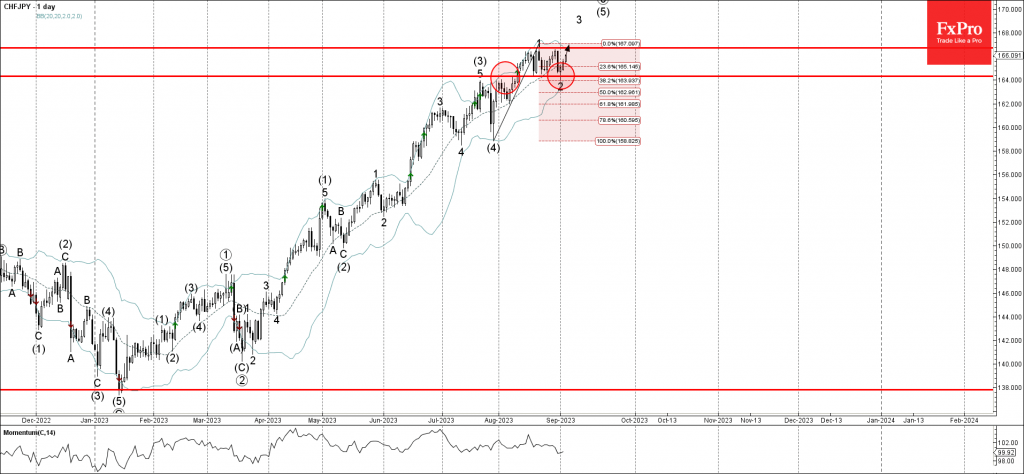
- CHFJPY reversed from support level 164.30
- Likely to rise to resistance level 166.70
CHFJPY currency pair recently reversed up from the pivotal support level 164.30 (which has been reversing the price from the middle of August), coinciding with the 38.2% Fibonacci correction of the upward impulse from July.
The upward reversal from the support level 164.30 started the active short-term impulse wave 3, which belongs to the higher order impulse wave (5) from July.
Given the clear daily uptrend, CHFJPY can be expected to rise further toward the next resistance level 166.70 (top of the previous impulse wave 1).