

Sample Category Title
EUR/USD Consolidates Around 1.0810 as Powell’s Speech Influences Market Sentiment
The EUR/USD currency pair is entering the final week of August in a phase of consolidation around the 1.0810 level. This follows a speech by Jerome Powell, the Chair of the Federal Reserve, during the recent Jackson Hole Symposium in the US. Powell highlighted the Fed's commitment to raising interest rates continuously to maintain elevated levels of inflation, while also considering the effectiveness of measures already in place.
As a result, the Federal Reserve plans to make necessary interest rate adjustments and maintain a stringent monetary policy until it successfully manages price control.
With a relatively quiet macroeconomic calendar at the beginning of the week, the market is relying on existing factors to determine direction.
Technical Analysis of the EUR/USD Currency Pair
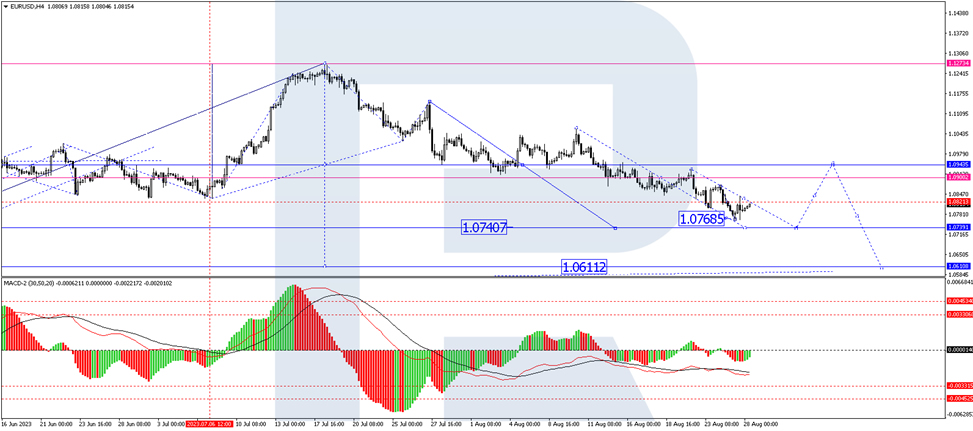
On the H4 chart, EUR/USD has completed a decline to 1.0765, followed by a corrective structure forming up to 1.0816. Once this correction is complete, there is potential for the decline to continue to 1.0740, a local target. The scenario is supported by the MACD indicator, as its signal line is below zero and pointed downwards.
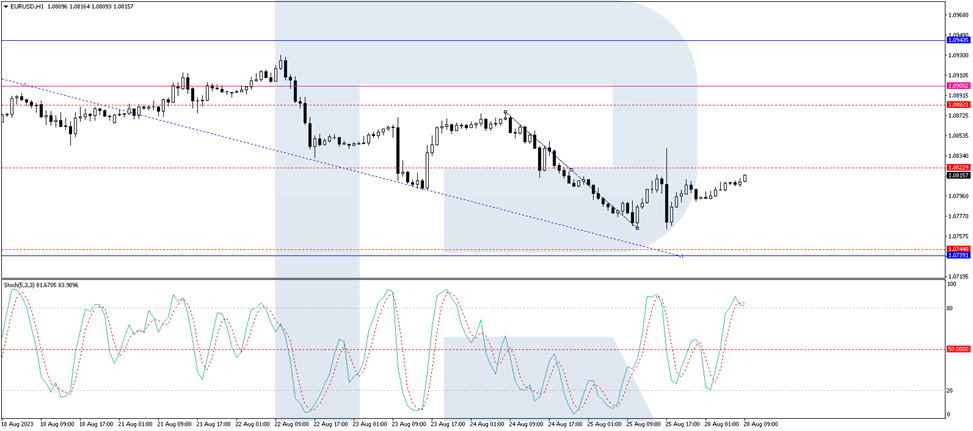
On the H1 chart, EUR/USD has undergone a correction to 1.0816, possibly leading to the formation of a consolidation range below that level. If the price breaks out of this range in a downward direction, a new wave of decline to 1.0740 could be formed. This scenario is backed by the Stochastic oscillator, as its signal line is currently above 80, indicating a potential drop to 50. A break of this level could open the door to a decline towards 20.
Sunset Market Commentary
Markets
Neither Fed’s Powell nor ECB’s Lagarde at the Jackson Hole gathering offered groundbreaking views on the economy or monetary policy going forward. Add to that today’s empty (but backloaded!) calendar and lower trading volumes – the UK enjoys the Summer Bank Holiday – and you get the perfect background for a technical trading session. The ECB’s monthly credit survey is worth mentioning though. Annual M1 money growth in July was -9.2% compared to -8% in June. Growth in the broader monetary aggregate M3 also turned negative for the first time in more than 13 years. At -0.4% it matches the previous series low of February 2010. The annual growth rate in loans to households eased from 1.7% to 1.3% while the measure for non-financial companies fell from 3% to 2.2%. The numbers underscore the (lending) slowdown in the European economy after the bigger-than-expected drop in the (services) PMI already did so last week. Stocks in the region eke out a 0.90% gain (EuroStoxx 50) nevertheless. The Chinese measures announced on Sunday to “invigorate capital markets and boost investor confidence” to some extent help. US Treasuries trade with a strengthening bias. Yields ease between 1.0 bps (2-y) to -2.7 bps (10-y). German Bunds underperform with rates rising 1.9 bps at the front end of the curve while losing 1.0 bp further out. Austrian ECB Governing Council member Holzmann was the latest to weigh in on policy after the JH symposium. The monetary hawk said that, barring a big surprise, rates should be raised further. He argues against a pause in the cycle: “It’s better to achieve a peak rate faster, which also means we can eventually start going lower earlier”, adding that “It’s more difficult for markets to digest a stop-and-go rate path.” Holzmann also said that the ECB should consider speeding up the unwinding of its balance sheet by opening the debate on PEPP reinvestments sooner. They currently run at least through the end of 2024. FX markets trade quietly. The dollar loses a little ground but is off the intraday lows. EUR/USD trades just north of 1.08. The trade-weighted index changes hands around 104.10. USD/JPY (146.46) stays near the recent highs with the Japanese yen the only currency in the G10 landscape worse off than the USD. The Swedish krone (see below) and the Aussie dollar marginally strengthen against peers with the latter currency hoping for further concrete Chinese measures to stimulate its ailing economy. AUD/USD moves a tad higher towards 0.642.
News & Views
Excerpts of a speech of Riksbank Deputy governor Flodén show that the MPC member sees the weak krona as a problem. “It risks contributing to continued high inflationary pressures. The weakness seems to be linked, for instance, to trend-following behaviour, concern regarding the Swedish property sector, the geopolitical situation and the image of Sweden, as well as the expectation that the Riksbank will raise the interest rate less than other countries. But in my opinion, none of this can justify the size of the krona depreciation. There are also many strengths in the Swedish economy, and the krona will reasonably strengthen in the future”, the Riksbank website reads. Quotes on Reuters after the speech was given in Stockholm add that Flodén sees the krone as 20% undervalued and that currency intervention is not a very effective method to affect the level of a currency. The krona today gains marginally, but at 11.91, the Swedish currency continues to trade within reach of its all-time low level against the euro.
Sentiment in the German export industry deteriorated slightly further according the export expectations published by the German Ifo institute today. Export expectations declined to -6.3 in August from -6.0 in July. According to the head of surveys at Ifo, Klaus Wohlrable, German exports continue to struggle with weak global demand. However more German companies are also said to complain about being less able to compete at a global level. On the positive side, the chemical industry is reported to have turned around and now expects a rise in exports. Food and beverage exports also expect improved international sales. Positive and negative responses were reported more or less balanced for automobile manufacturers. On the negative side, the export outlook for manufacturers of machinery and equipment and in the metal industry deteriorated further.
EUR/USD Mid-Day Outlook
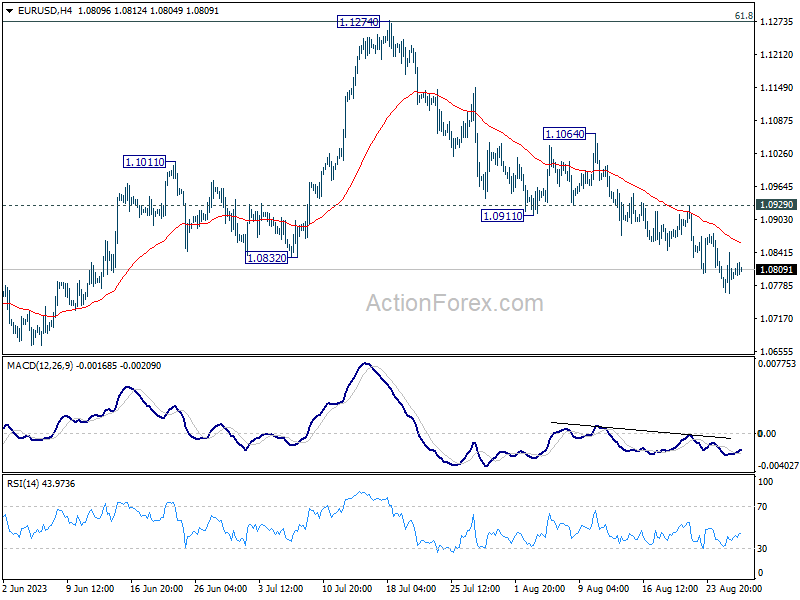
Daily Pivots: (S1) 1.0761; (P) 1.0801; (R1) 1.0837; More...
No change in EUR/USD's outlook and intraday bias stays on the downside. Current fall from 1.1274 should target 1.0609/34 cluster support next. On the upside, break of 1.0929 resistance is needed to indicate short term bottoming. Otherwise, outlook will remain bearish in case of recovery.
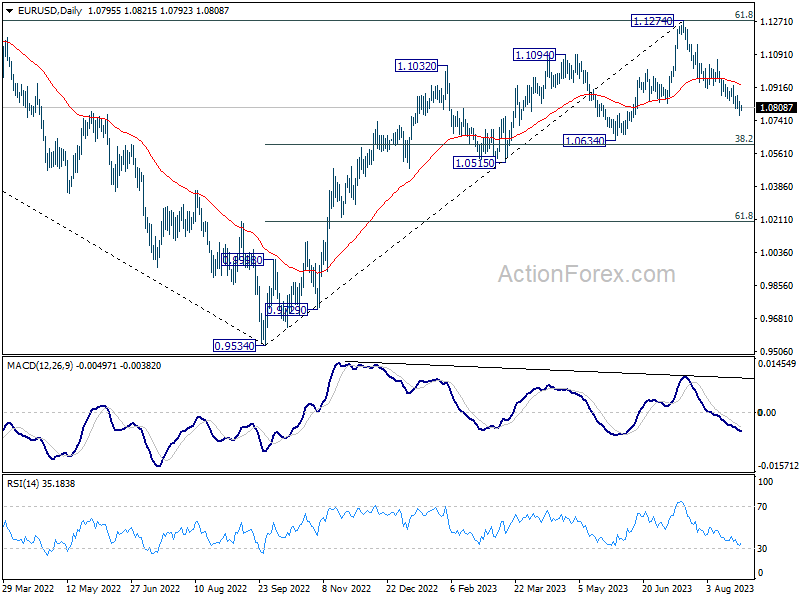
In the bigger picture, fall from 1.1274 medium term top is seen as a correction to up trend from 0.9534 (2022 low). Deeper decline would be seen to 1.0634 cluster support (38.2% retracement of 0.9534 to 1.1274 at 1.0609). Strong support could be seen there, at least on first attempt, to bring rebound. Yet, medium term outlook will be neutral for now, as long as 1.1274 resistance holds.
GBP/USD Mid-Day Outlook
Daily Pivots: (S1) 1.2535; (P) 1.2594; (R1) 1.2641; More...
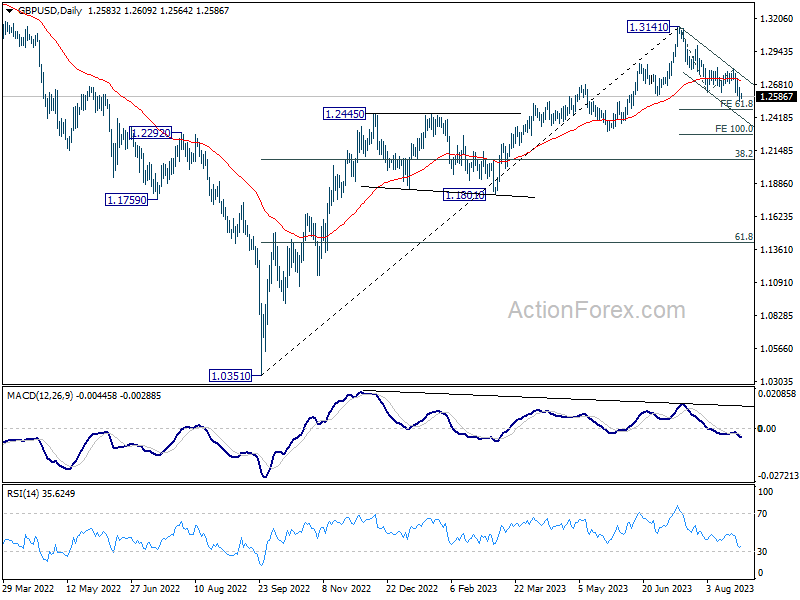
Intraday bias in GBP/USD stays neutral for consolidation above 1.2546 temporary low. Near term outlook remains mildly bearish as long as 1.2799 resistance holds. On the downside, break of 1.2546 will resume whole fall from 1.3141 to 61.8% projection of 1.3141 to 1.2618 from 1.2799 at 1.2476. Firm break there could prompt downside acceleration to 100% projection at 1.2276.
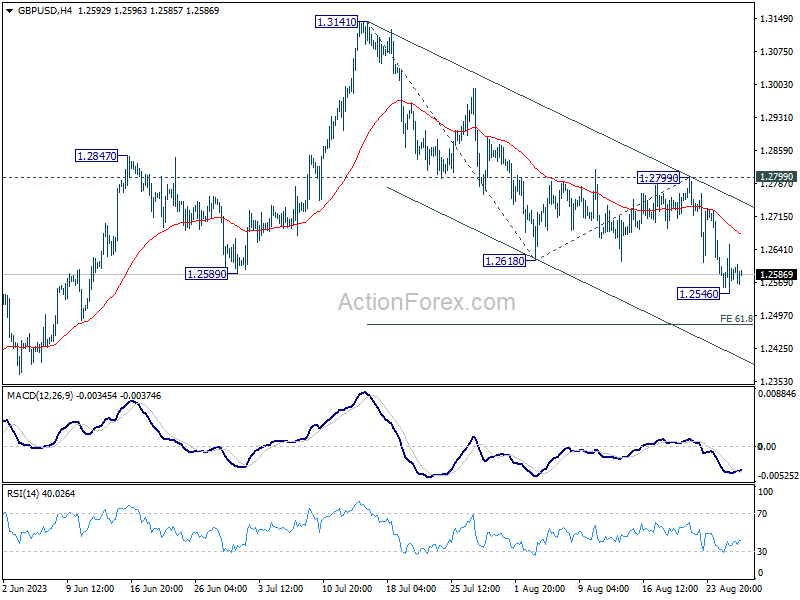
In the bigger picture, for now, fall from 1.3141 medium term top is seen as a correction to up trend from 1.0351 (2022 low). Deeper decline would be seen to 38.2% retracement of 1.0351 to 1.3141 at 1.2075. Strong support would be seen there to bring rebound on first attempt. But outlook will be neutral at best as long as 1.3141 resistance holds, and consolidation from there is set to extend, until further development.
USD/CHF Mid-Day Outlook
Daily Pivots: (S1) 0.8820; (P) 0.8848; (R1) 0.8874; More....
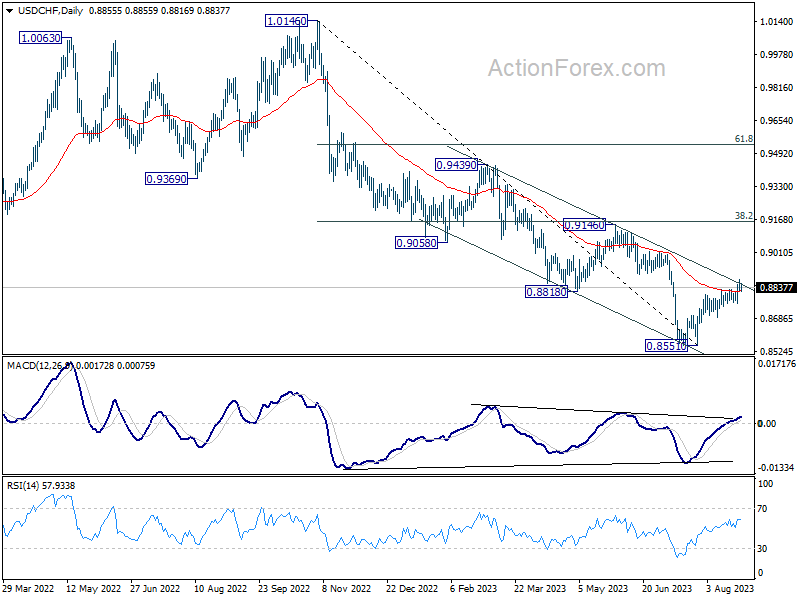
Intraday bias in USD/CHF remains neutral for consolidation below 0.8874 temporary top. But further rally is expected as long as 0.8758 support holds. On the upside, break of 0.8874 will resume the rise from 0.8551 to 0.9146 cluster resistance next.
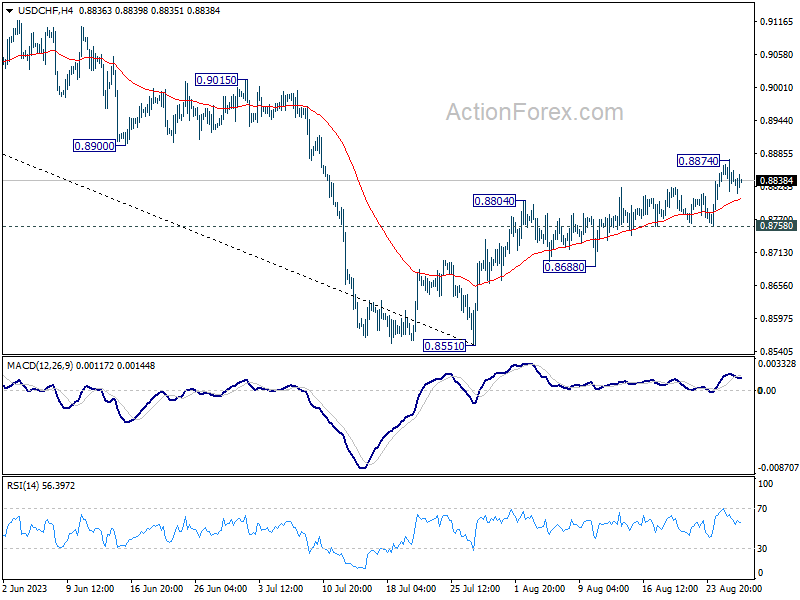
In the bigger picture, rebound from 0.8551 medium term bottom is currently seen as a correction to the downtrend from 1.0146 (2022 high). Further rally would be seen to 0.9146 cluster resistance (38.2% retracement of 1.0146 to 0.8551 at 0.9160). Strong resistance could be seen there to limit upside, at least on first attempt. Nevertheless, medium term outlook is neutral at best as long as 0.8551 holds, until further developments.
USD/JPY Mid-Day Outlook
Daily Pivots: (S1) 145.89; (P) 146.26; (R1) 146.79; More...
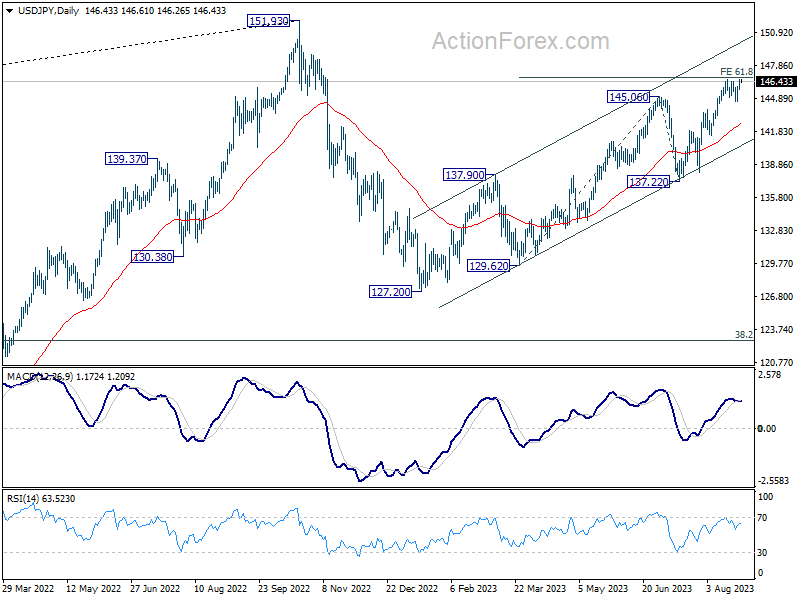
Outlook in USD/JPY remains unchanged and intraday bias stays on the upside. Sustained break of 61.8% projection of 129.62 to 145.06 from 137.22 at 146.76 will pave the way to retest 151.93 high. For now, outlook will stays cautiously bullish as long as 144.52 support holds, in case of retreat.
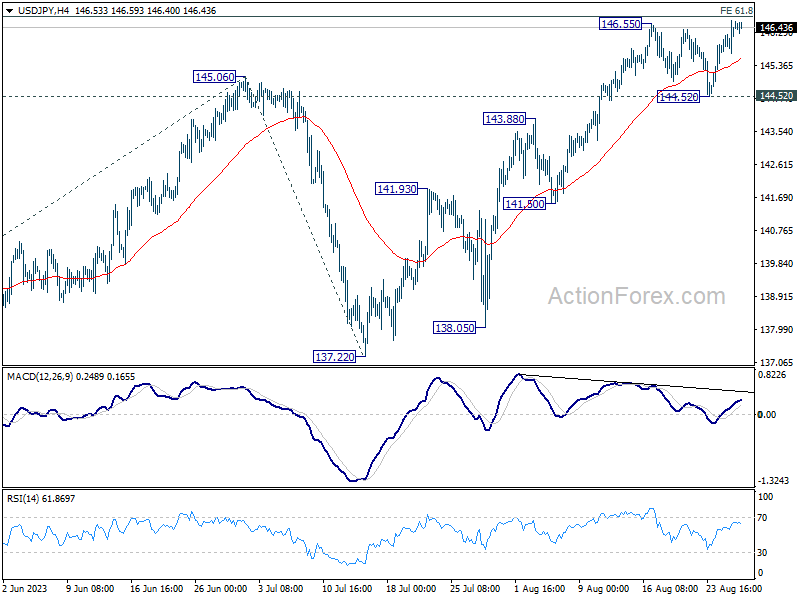
In the bigger picture, overall price actions from 151.93 (2022 high) are views as a corrective pattern. Rise from 127.20 is seen as the second leg of the pattern and could still be in progress. But even in case of extended rise, strong resistance should be seen from 151.93 to limit upside. Meanwhile, break of 137.22 support should confirm the start of the third leg to 127.20 (2023 low) and below.
Yen Staying Weak in Muted Trading, Chinese Yuan Softens
Trading in the forex market today saw a tempered tone, with most major currencies trading in a tight range due to a sparse economic calendar. An early uplift in market sentiment was observed, largely attributed to China's strategic moves aimed at boosting investor confidence. This positive wave continued into the early US trading hours, though its broader effects remained contained. Australian and New Zealand Dollars are emerging as today's outperformers, closely shadowed by Euro and Sterling. In contrast, Japanese Yen recorded the most significant dip, with Swiss Franc and Dollar also trailing behind.
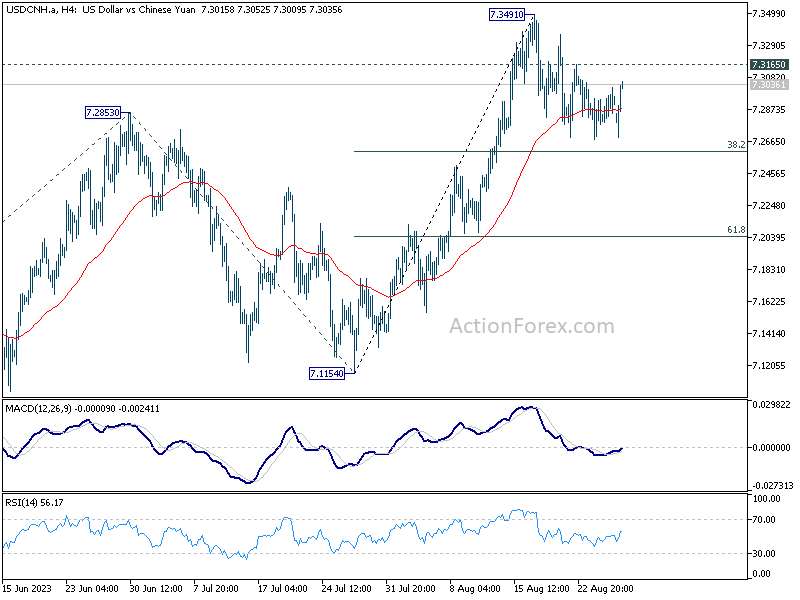
Technically, while offshore Chinese Yuan's recovery in the past week appears to be losing momentum. 38.2% retracement of 7.1154 to 7.3491 at 7.2598 could provide a floor to USD/CNH's pull back. Break of 7.3165 would bring stronger rebound to retest 7.3491 high at least. Decisive break will resume larger rally to 7.3745 key resistance. Risk aversion in China and Asia could come back if the stronger bounce in USD/CNH is accompanied by poor PMI data from China later in the week.
In Europe, at the time of writing, FTSE is up 0.07%. DAX is up 0.76%. CAC is up 1.00%. Germany 10-year yield is down -0.010 at 2.551. Earlier in Asia, Nikkei rose 1.73%. Hong Kong HSI rose 0.97%. China Shanghai SSE rose 1.13%. Singapore Strait times rose 0.75%. Japan 10-year JGB yield rose 0.0076 to 0.668.
ECB's Holzmann advocates further rate hike, views economy as stagnating
ECB Governing Council member Robert Holzmann expressed concerns over the inflationary environment, stating, "We're not yet in the clear when it comes to inflation." He accentuated the need for continued rate increases, suggesting that barring unforeseen circumstances, there could be a compelling case to "push on with rate increases without taking a pause" come September.
Holzmann emphasized the advantages of achieving the peak rate swiftly, noting, "It's better to achieve a peak rate faster, which also means we can eventually start going lower earlier." He highlighted the challenges for markets in navigating a sporadic "stop-and-go rate path."
Furthermore, Holzmann acknowledged that the ECB has been "somewhat behind the curve" in its endeavors to combat inflation. When quizzed on the possibility of continued rate hikes beyond September, he remarked that once rates reach the 4% threshold, the matter would be up for discussion again.
On the topic of Eurozone's economic health, Holzmann offered a measured perspective. While conceding that the economy isn't performing at the anticipated level, he was quick to dismiss fears of an impending recession. He characterized the current economic landscape as one of stagnation, stating, "We're looking at a stagnating economy."
Japan's Cabinet Office upgrades export assessment amid stable economic outlook
In its latest monthly economic report, Japan Cabinet Office has lifted its assessment on exports for the first time since May. Exports, which previously displayed a "steady undertone," are now characterized as showing "movements of picking up recently."
Other key areas of the economy showed stable and positive trend. Private consumption and business investment are both on an "picking up". Corporate profits have seen moderate improvement. Employment situation shows movements of improvement. Consumer prices are rising.
Looking ahead, the report expects the Japanese economy to sustain its moderate recovery, driven by enhancements in employment and income situations. However, it does underscore potential threats. The slowing pace of foreign economies, especially due to global monetary tightening and uncertainties about China's economic direction, are identified as primary external risks to Japan's growth trajectory.
Australia retail sales rose 0.5% mom in Jul, but underlying growth subdued
Australia's retail sales turnover for July showed a 0.5% mom increase, reaching AUD 35.38B, surpassing anticipated 0.3% mom rise. When compared to figures from July 2022, turnover has risen by 2.1% yoy.
Commenting on the rebound, Ben Dorber, ABS head of retail statistics, noted, "The rise in July is a partial reversal of last month's sharp decline in turnover." He attributed the June dip to "weaker-than-usual end of financial year sales."
However, Dorber cautioned against interpreting July numbers as a sign of robust retail health. Elaborating on the sector's underlying momentum, he stated, "While there was a rise in July, underlying growth in retail turnover remained
Supporting this perspective, Dorber pointed out the lack of substantial movement in the trend terms: "In trend terms, retail turnover was unchanged in July and up only 1.9 per cent compared to July 2022, despite considerable price growth over the year."
USD/JPY Mid-Day Outlook
Daily Pivots: (S1) 145.89; (P) 146.26; (R1) 146.79; More...
Outlook in USD/JPY remains unchanged and intraday bias stays on the upside. Sustained break of 61.8% projection of 129.62 to 145.06 from 137.22 at 146.76 will pave the way to retest 151.93 high. For now, outlook will stays cautiously bullish as long as 144.52 support holds, in case of retreat.
In the bigger picture, overall price actions from 151.93 (2022 high) are views as a corrective pattern. Rise from 127.20 is seen as the second leg of the pattern and could still be in progress. But even in case of extended rise, strong resistance should be seen from 151.93 to limit upside. Meanwhile, break of 137.22 support should confirm the start of the third leg to 127.20 (2023 low) and below.
Economic Indicators Update
| GMT | Ccy | Events | Actual | Forecast | Previous | Revised |
|---|---|---|---|---|---|---|
| 01:30 | AUD | Retail Sales M/M Jul | 0.50% | 0.30% | -0.80% | |
| 08:00 | EUR | Eurozone M3 Money Supply Y/Y Jul | 0.40% | 0.00% | 0.60% |
Retail Sales Gives Aussie Brief Boost
- Australia retail sales rebounds with 0.5% gain
- Fed’s Powell keeps door open to further hikes
The Australian dollar started the week with gains but then retreated. In the European session, AUD/USD is trading at 0.6408, up 0.09%. Last week, the Australian dollar showed significant swings of around 1%.
Australia’s retail sales surprise on the upside
Australian retail sales rebounded in July with a respectable gain of 0.5% m/m. This followed a dismal -0.8% reading in June and beat the consensus estimate of 0.3%. The welcome uptick was driven by the Women’s World Cup which was held in Australia and was a massive boost for Australia’s travel and retail sectors. Much of the tournament took place in August, which means that the August retail sales report should also receive a shot to the arm.
The August report showed that consumers still have an appetite for spending, but there are unmistakable signs that the economy is cooling. Inflation has been falling, wage growth in the second quarter was weaker than expected and unemployment rose to 3.7%. This all points to the Reserve Bank of Australia holding rates at the September 5th meeting, and the future markets have priced a hold at around 90%.
The slowdown in China, which is Australia’s largest trading partner, could throw a monkey wrench into the central bank’s efforts to guide the economy to a soft landing. There is a always the concern that aggressive tightening, with the aim of curbing inflation, will choke economic growth and tip the economy into a recession. The Australian dollar is sensitive to Chinese releases and the recent batch of soft Chinese data has weighed on the struggling Australian dollar.
Powell sends cautious message
Fed Chair Powell didn’t provide much in the way of headline material in his speech at Jackson Hole on Friday. Powell reiterated that the battle to lower inflation to the 2% target “still has a long way to go”. As for rates, Powell was somewhat hawkish, saying that the Fed would “proceed carefully” with regard to raising rates or hold and wait for additional data. This was a deliberate omission of any mention of rate cuts, a signal that the Fed isn’t even thinking about lowering rates. The future markets responded by raising the odds of a rate hike in September to 21%, up from 14% a week ago.
AUD/USD Technical
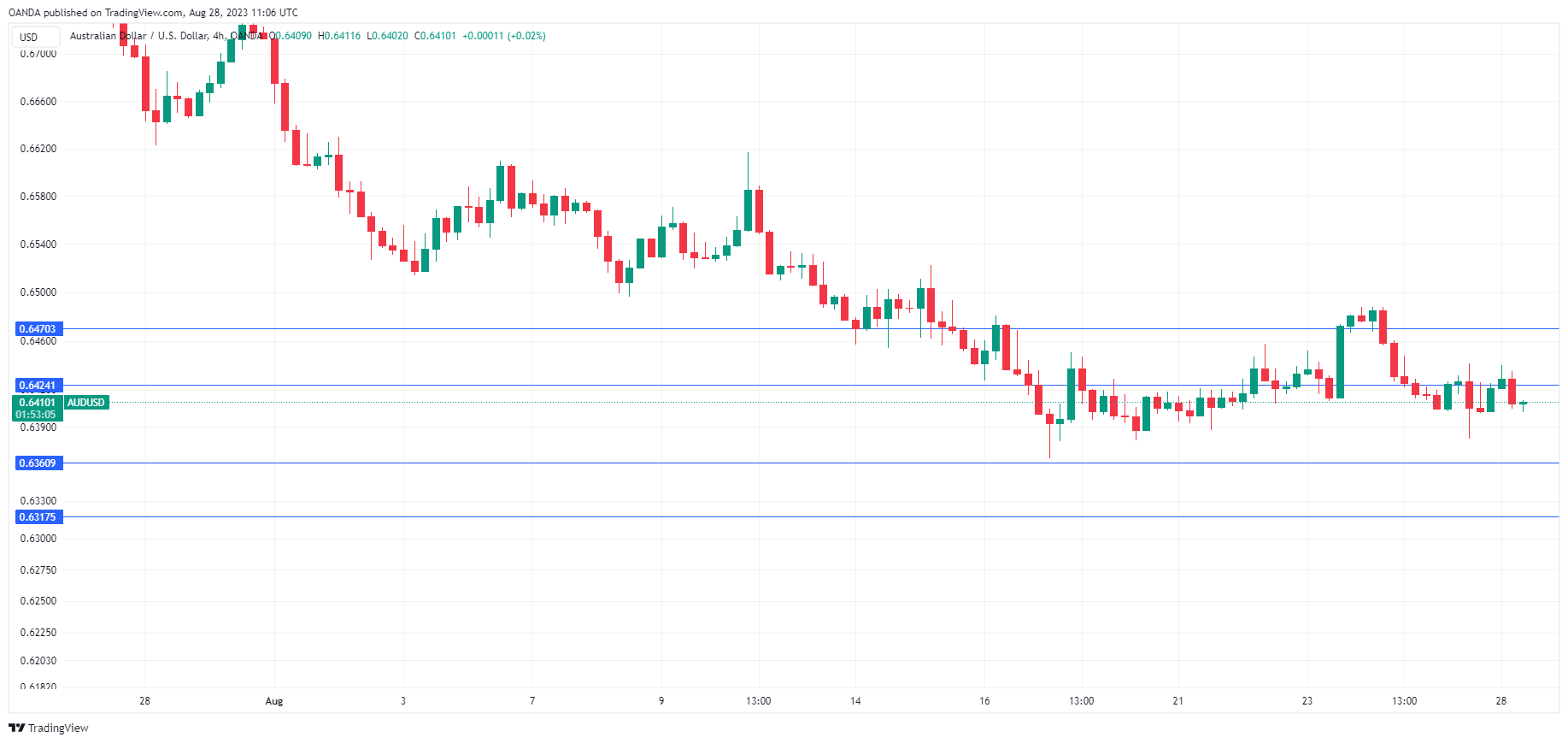
- AUD/USD is testing resistance at 0.6424. Above, there is resistance at 0.6470
- There is support at 0.6360 and 0.6317
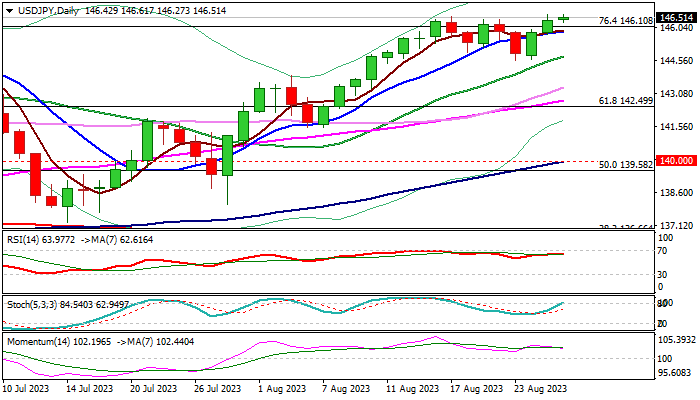
USD/JPY: Weekly Close Above Pivotal Fibo Barrier Reinforces Bullish Stance
USDJPY keeps firm tone at the beginning of the week, as hawkish tones from Fed Chair Powell on Friday, offered additional support to dollar.
Faded threats of Japan’s intervention to support yen, expected on breach of 145 trigger, contributed to larger bulls, with fresh positive signal being generated on weekly close above 146.10 Fibo resistance (76.4% of 151.94/127.22 descend).
Sustained break higher would reinforce bullish structure and open way for extension towards psychological 150 barrier, which could be, according to the latest speculations, the new trigger for intervention.
Broken Fibo barrier and 10DMA (146.10/145.88) reverted to supports which should ideally keep the downside protected and guard lower pivots at 144.72/54 (20DMA / Aug 23 trough).
Res: 147.00; 148.00; 148.82; 150.00.
Sup: 146.27; 146.10; 145.88; 144.54.
Japan’s Cabinet Office upgrades export assessment amid stable economic outlook
In its latest monthly economic report, Japan Cabinet Office has lifted its assessment on exports for the first time since May. Exports, which previously displayed a "steady undertone," are now characterized as showing "movements of picking up recently."
Other key areas of the economy showed stable and positive trend. Private consumption and business investment are both on an "picking up". Corporate profits have seen moderate improvement. Employment situation shows movements of improvement. Consumer prices are rising.
Looking ahead, the report expects the Japanese economy to sustain its moderate recovery, driven by enhancements in employment and income situations. However, it does underscore potential threats. The slowing pace of foreign economies, especially due to global monetary tightening and uncertainties about China's economic direction, are identified as primary external risks to Japan's growth trajectory.