

Sample Category Title
EURJPY Wave Analysis
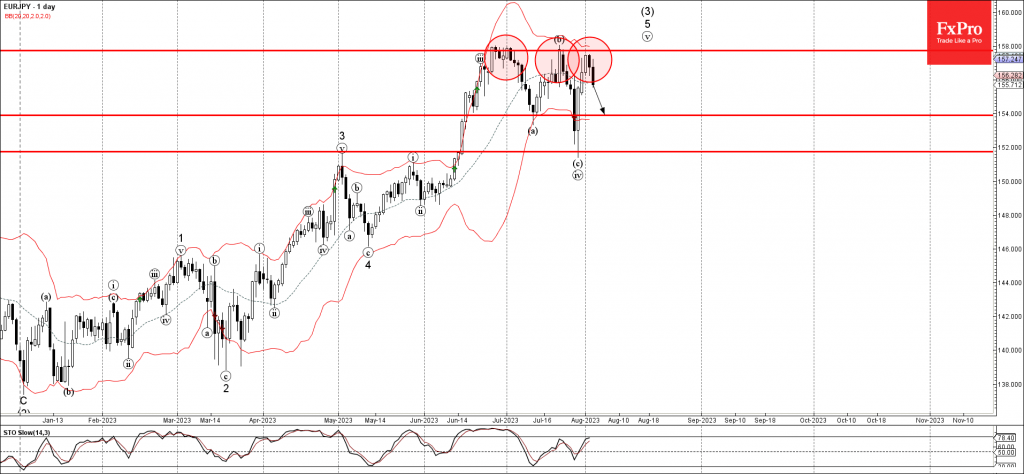
- EURJPY reversed from key resistance level 157.75
- Likely to fall to support at 154.00
EURJPY currency pair recently reversed down with the Dark Cloud Cover from the key resistance level 157.75, which has been reversing the price from June.
The resistance level 157.75 was strengthened by the upper daily Bollinger Band.
Given the strength of the resistance level 157.75 and the strong yen gains across the FX markets, EURJPY can be expected to fall further toward the next support at 154.00.
GBPJPY Holds Near Highs Amid Weakening Bullish Bias
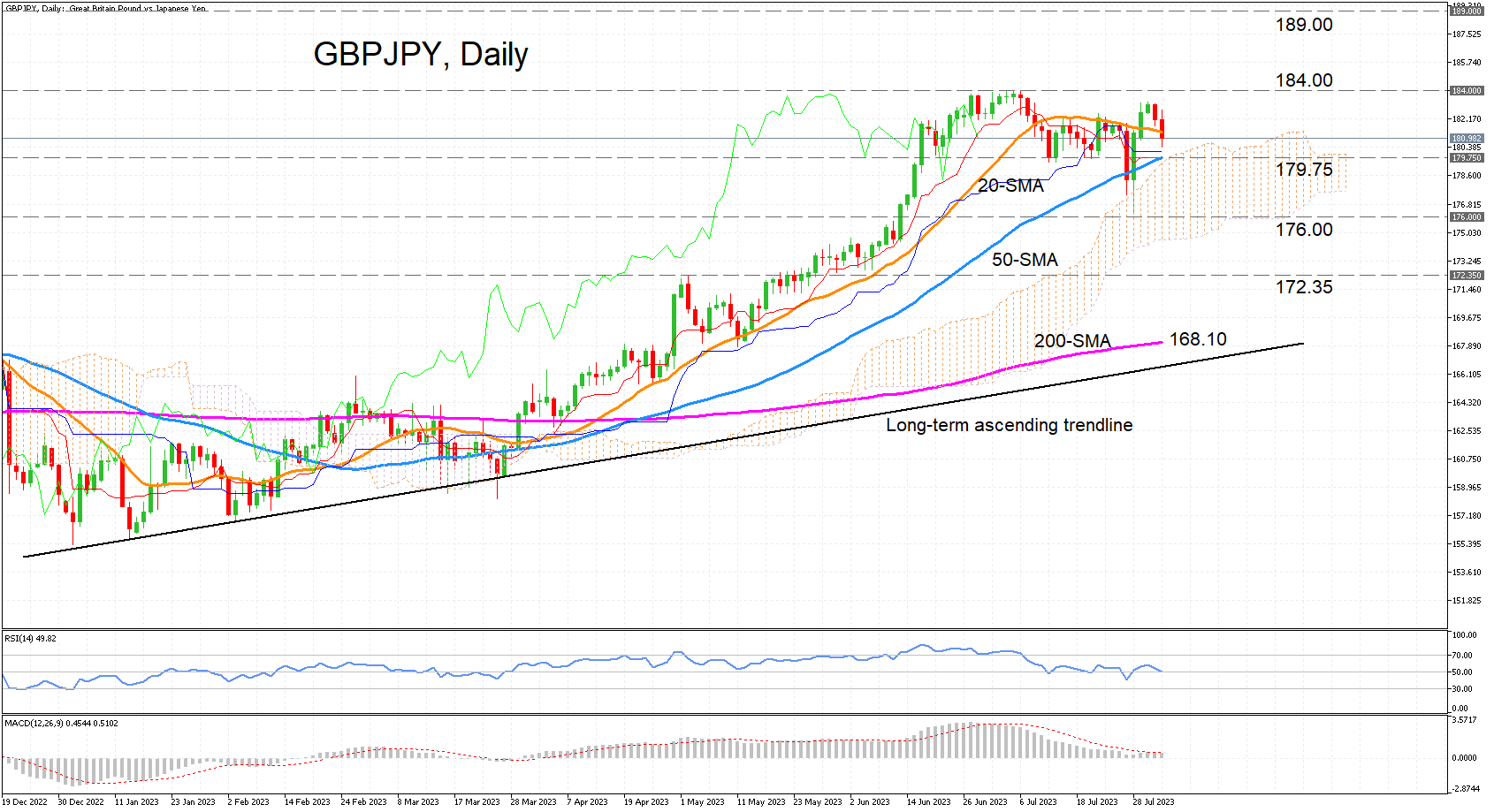
GBPJPY has been consolidating over the past month after reaching a 7½-month high of 183.99 on July 5, but the negative risks appear to be accumulating. The worsening short-term bias is supported by the momentum oscillators.
The RSI is sloping downwards, dipping slightly below the 50 neutral level, while the MACD remains below its red signal line, though above zero, having declined considerably from its June highs.
Moreover, the price has just breached the 20-day simple moving average (SMA) and is headed back towards the 50-day SMA, which only last week successfully defended the long-term uptrend when the pair briefly spiked below it. The area around the 50-day SMA is forming into a crucial support zone as the Tenkan-sen line is about to intersect it and both look set to enter the Ichimoku cloud in the 179.75 region.
If the price is able to hold above this support area, the bulls will have another chance to regain control and revisit the July top of 183.99. Higher up, the focus might turn to the 189.00 level, which acted as resistance back in 2014 and 2015.
However, if the price breaks below the 50-day SMA and plunges into the cloud, the next support might not come until the 176.00 level near the July trough. Even lower, the slide may extend until the congested region of 172.35 before sellers aim for the 200-day SMA at 168.10.
In brief, the downside risks are rising for GBPJPY and it may be up to the 50-day SMA again to decide whether the price bounces off it or breaches it. However, the longer-term uptrend should stay intact as long as the pair holds above the ascending trendline.
ISM Index Shows Services Sector Expansion Continued in July
The ISM Services PMI index pulled back to 52.7 in July from 53.9 in June. This falls short of the 53.1 percent reading consensus was expecting. This is the seventh consecutive month of expansion for the services sector.
Unlike the headline measure, the business activity sub-index cooled to 57.1, down from 59.2 in June.
The new orders index fell 0.5 percentage points (pp) to 55.0, roughly in line with June's reading but still noticeably lower since February's high.
The prices paid component rose to 56.8 in July. Despite the uptick in price growth the index is still lower than at any point between June 2020 and April 2023.
Supplier delivery times registered 48.1, up from 47.6 in June, while the backlog of orders index jumped 8.2 points to 52.1. Order backlogs registered their first expansion since February 2023.
The employment sub-component slipped 2.4 pp to 50.7.
Fourteen out of 18 industries expanded in July, down from fifteen in June.
Key Implications
The services sector continues to do the bulk of the heavy lifting in helping the economy defy the 525 basis points of rate hikes the Fed has thrown at it since last year. Despite the pace of new business growth slowing, consumer demand for services remains robust – helping order backlogs grow for the first time in months.
For the Fed, eyes are on inflation signals and signs from the labor market. Employment growth remains relatively tepid and while cost pressures rose slightly for the month, they are far below what the economy has had to deal with in the past two years. Policymakers will be keenly attentive to any signs that inflation is again gaining steam, but for now it remains likely that the Fed has done enough to help bring inflation back to target.
Bank of England Review – We Stay Negative on GBP with BoE Nearing Peak
- In line with our expectation, the BoE today hiked the policy rate by 25bp, bringing the Bank Rate to 5.25%.
- We stick to our call of a final 25bp hike in September marking a peak in the Bank Rate of 5.50%. Wage growth and service inflation remain the key releases to follow.
- We stay negative on GBP and continue to see relative rates as a positive for EUR/GBP from here.
The Bank of England (BoE) hiked the Bank Rate (key policy rate) by 25bp to 5.25% with 6 members voting for a 25bp hike, two members for 50bp and one member voting for keeping the Bank Rate unchanged.
The majority of the Monetary Policy Committee (MPC) voted for an increase of 25bp to "address the risk from greater inflation persistence" although they noted that previous increases in monetary policy are weighing on economic activity. The BoE retained its forward guidance repeating that "if there were to be evidence of more persistent pressures, then further tightening in monetary policy would be required" and struck a cautious note by stating that while recent data it was too early to conclude that the economy was "at or close to a turning point". Although the BoE both in the statement and later at the press conference repeatedly referred to the upside risks to inflation and in particular developments in wage growth, the BoE added that "the current monetary policy stance is restrictive" and that the MPC "will ensure that Bank Rate is sufficiently restrictive for sufficiently long to return inflation to the 2% target sustainably in the medium term, in line with its remit." This could possibly indicate that the BoE is priming markets for an impending pause.
While the labour market has started to show signs of loosening and June inflation surprised to the downside, we do not believe that data will have weakened enough for the BoE to pause at the September meeting. Before the next meeting on 21 September, we get both two job market reports and inflation data for July and August. As the key concern for the BoE remains developments in wage data as well as service inflation these are the key data releases to follow.
Rates. Overall, the reaction in rates markets was relatively muted. Initially, rates markets rallied on the decision and statement and sent 2Y Gilt yields lower, but largely retraced the move during the afternoon. Markets are pricing in 22bp for the September meeting and a peak in the Bank Rate of 5.80%.
FX. As expected, EUR/GBP initially moved higher but partly retraced the move the following hours. On balance, we continue to see relative rates as a positive for EUR/GBP from here, which is one of several reasons behind our fundamental predisposition of buying EUR/GBP dips. We still like our short GBP/CHF trade recommendation.
Our call. We continue to expect a 25bp at the September meeting and this to mark the final hike in this is hiking cycle and a peak in the Bank Rate of 5.50%. In order for BoE to opt for an unchanged decision instead of 25bp we believe that we would have to see data releases, most notably wage growth, prove considerably worse than what we currently pencil in. Our call is less than current market pricing (55bp until February 2024). We still believe that the first rate cuts will not be delivered before Q2 24.
Dollar’s Ascent Could be the Start of a Long-Term Trend
The US dollar is continuing the rally that began in the middle of last month, benefiting from the caution in financial markets in recent days. Although the current rally has not yet brought the Dollar Index back to the levels seen before the massive sell-off in early July, the recent Dollar rally could become a long-term trend.
The Dollar has recently been supported by robust macro data, including yesterday’s ADP report of a 324k increase in private-sector employment. The largest weekly drop in commercial oil inventories also indicates domestic solid demand. The markets are now getting the message from the Fed that we don’t have to wait for a policy reversal soon and that rate hikes are not over yet.
The Fitch downgrade has breathed new life into the dollar rally. As a first step, investors are getting rid of the weakest assets in their portfolios by buying more liquid Treasuries and the dollar. If the US’s image is damaged, it may take months for the overhang of selling to reach the most protective instruments.
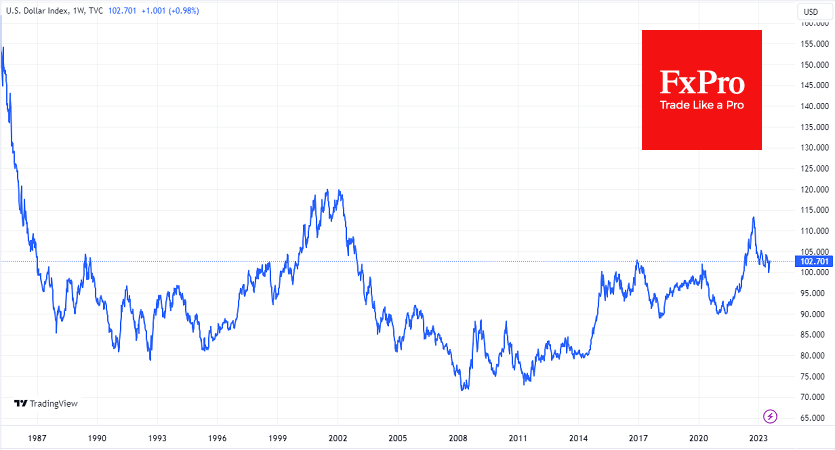
In 2011, the S&P downgrade of the U.S. triggered a multi-year rally in the dollar as other countries fared even worse, not to mention riskier corporate bonds.
Something similar could happen this time around. In that case, the 100 level on the dollar index could be a new stepping stone to start another multi-year rise. The levels of 80 from 1990 to 1995 and in 2014 and 90 from 2017 to 2021 played roughly the same role.
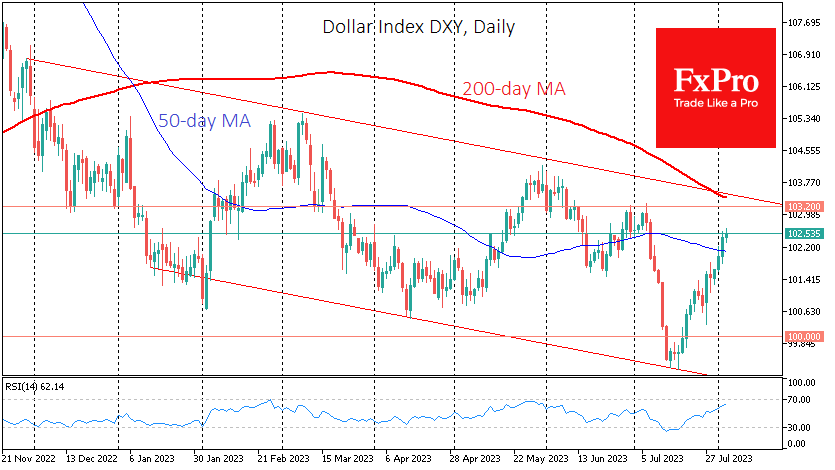
However, the long road must begin with the first step. The dollar index has been in a downward channel since last November, with its upper boundary now near 103.2, but to confirm a reversal, the dollar would need to climb above the previous local peak at 104.2.
The 200-day moving average is near 103.40, and a move up to it from the current 102.5 may be a much easier task than consolidating above it. But if it happens, the importance of this signal for FX and global markets must be emphasised.
Crude Oil Slows Down for a New Correction
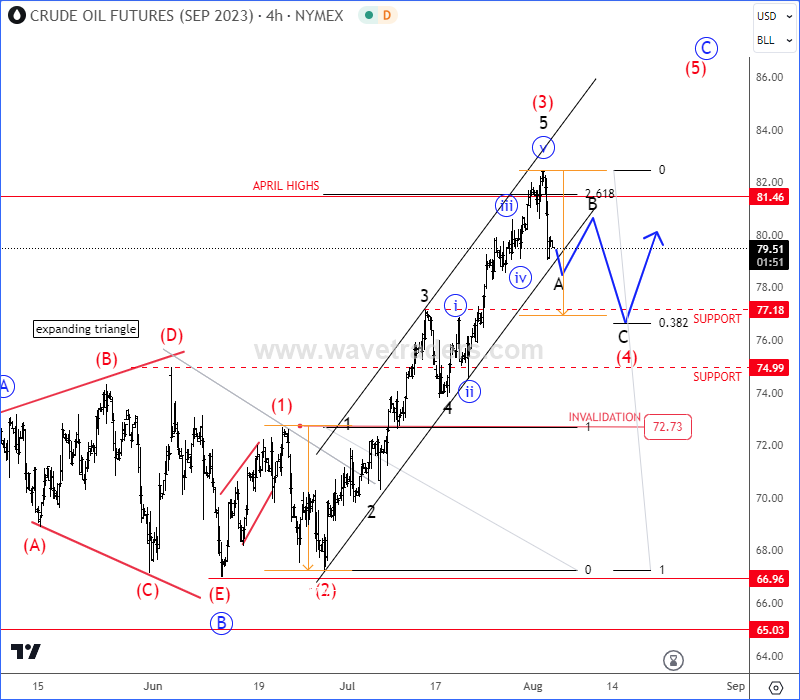
Crude oil faced strong drop and spike back in May, which can be also considered as the final leg of wave (5) of A, so we are aware of a higher degree A-B-C recovery after strong reversal up from the lows. After a completed wave A and expanding triangle in wave B, which is tricky, but still a bullish pattern that already sent prices higher, ideally within a five-wave bullish impulse into wave C. Now that came back to projected April highs for wave 5 of (3), we can see a new, higher degree A-B-C correction within wave (4) that can retest 77-75 support area before the uptrend for wave (5) resumes.
BTCUSD Retreats Below Ascending 50-day SMA
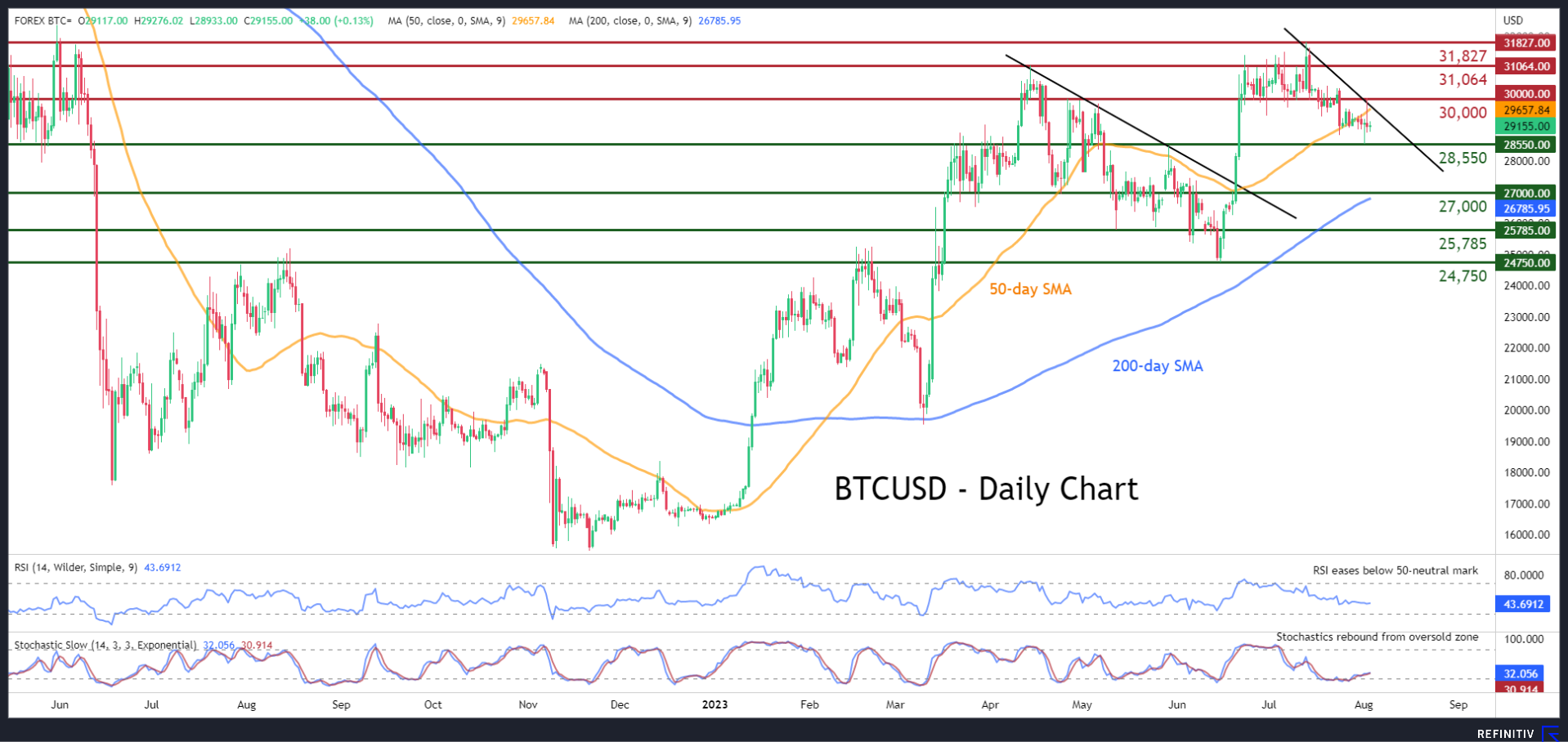
BTCUSD (Bitcoin) has been rangebound in the last few daily sessions following a mild pullback from its recent highs. Moreover, the king of cryptos has been gradually forming a structure of lower highs similar to the one observed during the April-June period, with the decline beneath the 50-day simple moving average (SMA) further darkening the outlook.
The momentum indicators currently suggest that the near-term risks are tilted to the downside. Specifically, the RSI is descending below the 50-neutral threshold, while the stochastics remain flat after a rebound from the oversold territory.
Should the bears try to push the price lower, the recent support of 28,550 could act as the first line of defence. If that barricade fails, the spotlight could turn to the April bottom of 27,000 before the May low of 25,785 gets tested. Further declines might then cease at the June low of 24,750.
On the flipside, if the price regains tractions and edges back higher, the $30,000 psychological mark could prove to be the first barricade for buyers to claim. A violation of that zone may open the door for the April peak of 31,064. Surpassing that region, the price could then challenge the 14-month high of 31,827.
Overall, BTCUSD has been rangebound in the last few sessions amid a broader short-term bearish pattern. For the bulls to regain confidence, the price needs to jump back above the 50-day SMA.
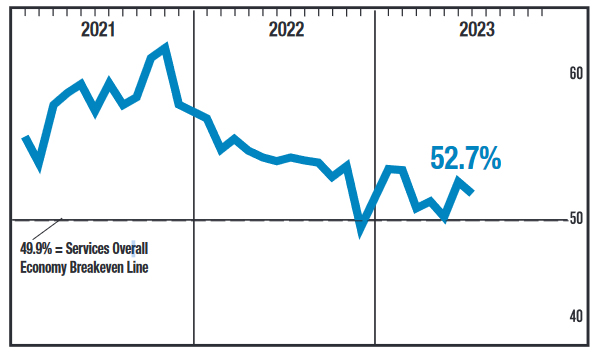
US ISM services fell to 52.7 in Jul, corresponds to 1% annualized GDP growth
US ISM Services PMI dropped from 53.9 to 52.7 in July, slightly below expectation of 53.0. Looking at some details, business activity/production dropped from 59.2 to 57.1. New orders dropped from 55.5 to 55.0. Employment dropped from 53.1 to 55.9. Prices rose from 54.1 to 56.8.
ISM said: "The past relationship between the Services PMI® and the overall economy indicates that the Services PMI® for July (52.7 percent) corresponds to a 1-percent increase in real gross domestic product (GDP) on an annualized basis."
Sunset Market Commentary
Markets
The Bank of England board raised interest rates by 25 bps to 5.25% in a 6-3 split decision. Two members favoured a continuation at the 50 bps clip while one wanted to keep the policy rate unchanged. The BoE acknowledged but downplayed the bigger than expected June CPI decline (to 7.9%). New forecasts based on a policy rate hitting 6% showed inflation still being at 5% by the end of this year and not hitting the 2% target before 2025Q2! The upward inflation revision compared to the May forecast, when a peak policy rate of “only” 4.75% was used, comes as the BoE decided to bring some of the inflation risks effectively into the projection. One of them includes increasing pay gains. Private sector pay growth increased to 7.7% y/y in the three months to May, materially above the May expectations. This follows a still tight labour market, even if some signs of easing begin to emerge. Quarterly GDP growth has been around 0.2% during 2023H1 and a similar growth rate may occur in the near term. Here too, signs of weakness arise, with the BoE specifically mentioning the July PMIs. In terms of further tightening, the BoE retains guidance that more hikes follow in case of more evidence of persistent inflationary pressures. It added a phrase stating that “The MPC will ensure that Bank Rate is sufficiently restrictive for sufficiently long to return inflation to the 2% target sustainably in the medium term, in line with its remit.” Hello, higher for longer.
UK money markets still fully discount two more rate hikes over the course of this year/beginning of the next. UK short term rates collapsed 10 bps after the decision as some braced for another 50 bps move before cutting losses in half. The pound loses ground, though the bulk of that move happened in the run-up to the meeting. EUR/GBP tested the 0.865 zone, up from the low 0.86 area. Ahead of the BoE, there was some talk of the central bank stepping up the balance sheet reduction as indicated by the likes of Ramsden. Instead, it only said it would decide over the year ahead amount (Oct 23 – Sep 24) at the September meeting. In other markets, the core bond/UST and equity sell-off continued. US yields extend yesterday’s ascent by adding 3.6 (2-y)-11 (30-y) bps. Fed’s Barkin saw in the June CPI signs of a soft landing, supporting the yield rally at the long end of the curve. Germany adds up to 6 bps. EUR/USD whipsawed around opening levels of 1.094. The Japanese yen outperforms. Economic data today included marginally weaker than expected weekly jobless claims (227k vs 221k), a sharper than anticipated uptick in Q2 nonfarm productivity (3.7% vs 2.2%), causing unit labor costs to rise less than estimated (1.6% vs 2.5%). The US services ISM is scheduled for release after wrapping up this report.
News & Views
Swiss inflation fell in July. The monthly pace turned to a negative -0.1%, making the yearly figure ease from 1.7% to 1.6%. Core inflation dropped 0.2% m/m, falling to 1.7% vs. an unchanged 1.8% analyst estimate. The Swiss Federal Statistics Office said reduced prices for clothing and footwear were among the reasons for the decline. Prices for air transport and international package holidays fell too while prices for supplementary accommodation and the hire of private means of transport increased. Services inflation as a whole eased further, from 1.7% to 1.5%. The headline gauge has been within the central bank’s 0-2% target range for a second month straight now. However, the Swiss National Bank expects price pressures to rebound by the end of the year amid a wave of rent increases. SNB president Jordan said a September rate hike is therefore “most likely” to bring inflation permanently below 2%. EUR/CHF weakens to 0.957 today though that has mainly to do with the general risk aversion.
Turkish disinflation came to a halt in July. Price pressures reaccelerated from 38.21% to 47.83% on a searing 9.49% m/m pace. Core inflation picked up too, from 47.33% to 56.09%. All measures topped expectations. Transportation costs jumped the most as a result from last month’s introduced tax hikes on fuel. The government also raised taxes on several other essential goods as it sought to finance Erdogan’s expensive pre-election pledges including one month of free natural gas. This complemented ongoing weakness in the Turkish lira, fueling inflation further. The Turkish central bank expects the current bout of rising price pressures to end only by mid-2024, project at around 60%. It is currently in the process of gradually lifting the policy rate, having brought it from 8.5% to 17.5% currently. Its next meeting is August 24. The Turkish lira today holds steady at record low levels around EUR/TRY 29.56 and USD/TRY 26.98.