

Sample Category Title
BoJ Uchida: Monetary easing to continue to nurture firms’ changing pricing strategies
BoJ Deputy Governor Shinichi Uchida highlighted in a speech today an emerging trend in firms' pricing strategies, noting that "firms are developing more forward-looking strategies for setting prices." According to Uchida, these changes "might be the chance to finally change Japan's economy." Hence, he emphasized BoJ will "patiently continue with monetary easing to carefully nurture these signs."
Uchida was explicit in outlining the Bank's monetary policy stances. Firstly, he ruled out near-term adjustments to short-term interest rate, currently at -0.10%, stating "there is still a long way to go before such decisions are made."
Secondly, BoJ will "maintain the current framework" until sustainable and stable achievement of 2% inflation target "come in sight".
Thirdly, Uchida affirmed the ongoing yield curve control under the present policy framework, aiming to balance its benefits and drawbacks, especially in relation to financial intermediation and the market.
Despite the high economic and price outlook uncertainty, Uchida stated the recent yield curve control modification, allowing the 10-year JGB yield to rise to up to 1%, is aimed at sustaining the ultra-loose policy. "Needless to say, we do not have an exit from monetary easing in mind," he emphasized.
New Zealand employment up 1% in Q2, wage inflation unchanged at 4.3% yoy
New Zealand reported a better-than-expected employment growth of 1.0% in the second quarter of 2023, surpassing market expectations of a 0.6% rise. On the other hand, unemployment rate slightly increased from 3.4% to 3.6%, marginally above the anticipated 3.5%.
The data released showed that employment rate rose from 69.6% to 69.8%, and the participation rate increased from 72.0% to 72.4%. These are the highest rates recorded since the series began in 1986.
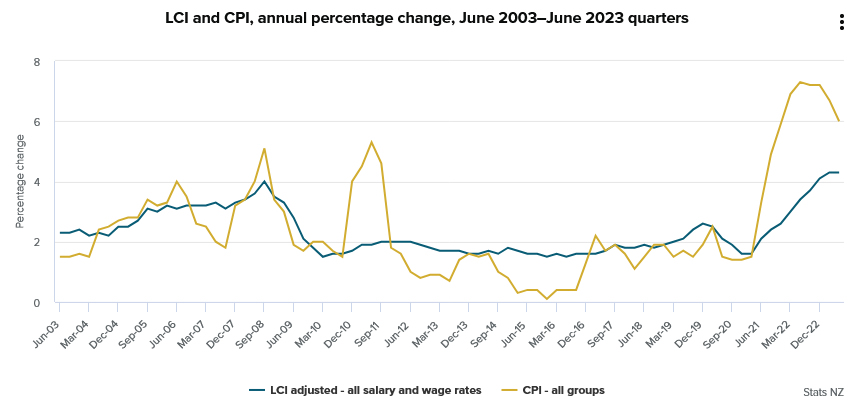
In terms of wage growth, all sector wage inflation climbed by 1.1% on a quarterly basis, resulting in an annual increase of 4.3%. "Annual wage costs continued to increase at historically high rates this quarter, equal to the 4.3 percent annual increase last quarter," said Bryan Downes, business prices delivery manager.
Downes noted that the most significant contribution to the Labour Cost Index for the June 2023 quarter came from retail trade and accommodation industry. This sector witnessed 1.5% increase in wages on a quarterly basis, following 0.7% rise in the previous quarter. The wage growth in this industry was primarily driven by rise in minimum wage, thereby pushing up overall wage growth during the quarter.
Fed Bostic warns of overtightening risks, advocates for cautious approach
Yesterday, Atlanta Fed President Raphael Bostic expressed guarded optimism and highlighted the "significant progress" in controlling inflation. He observed, "Inflation is well off its highs that we saw in the last year. And recent numbers have come in promising in ways that suggest that we might be seeing continued declines."
Bostic pointed to the ongoing economic evolution as in line with an "orderly slowdown," which he views as "quite promising". As such, he advocated to be cautious, patient and resolute" in policy-making.
He also voiced concerns about the risk of overtightening monetary policy. "I think we are in a phase now where there is some risk of us overtightening. And so we've just got to have that in mind," he said. By exercising appropriate caution, Bostic believes that the damage to employment can be minimized.
Looking forward, Bostic said, "My baseline outlook doesn't contemplate any cuts until the second half of next year at the earliest." He insists on being "resolute to make sure that we don't move our policy posture in a different direction until we're absolutely, absolutely certain that inflation is going to get to our target."
Fed Goolsbee: Every meeting is live around transition point
Chicago Fed President Austan Goolsbee has refrained from pre-committing to Fed's actions in September, insisting that every meeting is crucial when navigating the transition point. "When you're around the transition point, every meeting is a live meeting and you're trying to figure out trends, not just reflect one month's data," Goolsbee said yesterday.
Goolsbee is "guardedly optimistic" about Fed's ability to stick to what he terms the "golden path," bringing down prices without inducing a recession. He emphasized the importance of watching how core goods and housing inflation evolve in the coming months to remain on this path.
"Those are the two components that over the next three to six months, let's call it, if we are to succeed to stay on the golden path, we've got to see progress on those two parts of inflation," he said. He added that progress on services inflation isn't currently necessary.
He also shared his perspective on the link between wages and inflation, suggesting that wages are more of a lagging indicator rather than a predictor of inflation. According to Goolsbee, if Fed officials focus too much on wages when shaping their policy, they could risk overshooting interest rates.
NZ First Impressions: Labour Market Update, June Quarter 2023
Employment growth was strong, but with a large number of new entrants to the labour force, unemployment still rose to 3.6%. Wage growth has remained strong, but fell short of market forecasts.
- Unemployment rate: 3.6% (prev: 3.4%, Westpac f/c: 3.5%)
- Employment change: +1.0% (prev: +1.1%, f/c: +0.8%)
- Labour costs (private, ordinary time): +1.1% (prev; 0.9%, f/c: 1.3%)
- Average hourly earnings (private, ordinary time): +1.9% (prey: 2.1%)
The June quarter labour market surveys pointed to very strong employment growth, but growth that was nonetheless insufficient to absorb new entrants into the labour force. Wage growth remained elevated, reflecting past tightness in the labour market, but now appears to have peaked.
In the details:
- Employment rose by a very strong 1.0% in the June quarter, following an upward revision to the March quarter. Today’s result was stronger than our above-market forecast.
- However, labour force growth was even stronger, with migrant inflows boosting the pool of available labour. That saw the labour force participation rate rising 0.4ppts to a new record high of 72.4% (also above forecast).
- As a result, the unemployment rate edged up 0.2ppts to 3.6% in the June quarter. That outcome was 0.1ppt above our forecast, and that of both the market and RBNZ.
While the unemployment rate has been creeping higher since last year, wage growth remains elevated.
- The Labour Cost Index (LCI) rose 1.1% for the quarter, leaving the annual rate of increase steady at its previous cyclical high of 4.3%.
- The LCI for the private sector (ordinary time) also increased 1.1%, lowering annual growth by 0.2ppts to 4.3%. That result was slightly softer than we had forecast and also a notch below the RBNZ's forecast.
- The unadjusted LCI - which better represents developments in take-home pay - increased 5.9% over the year, thus tracking broadly in line with CPI inflation.
- Average hourly earnings, as measured by the more volatile Quarterly Employment Survey, increased 6.9% over the year, while the annual rate of increase for private sector wages dropped back to 7.7% from 8.2% previously.
Take outs for the RBNZ
While employment growth was stronger than the RBNZ had expected, developments in both the unemployment rate and wages will likely leave the Bank comfortable with the broad story underpinning the projections in the May Monetary Policy Statement.
Looking ahead, the RBNZ is forecasting the unemployment rate to rise to 4.6% by the end of this year. While online job vacancies have eased in recent months, suggesting slower jobs growth ahead, the unemployment rate may yet rise slower than forecast by the RBNZ. Developments in the labour market will remain crucial to the outlook for interest rates.
EURJPY Wave Analysis
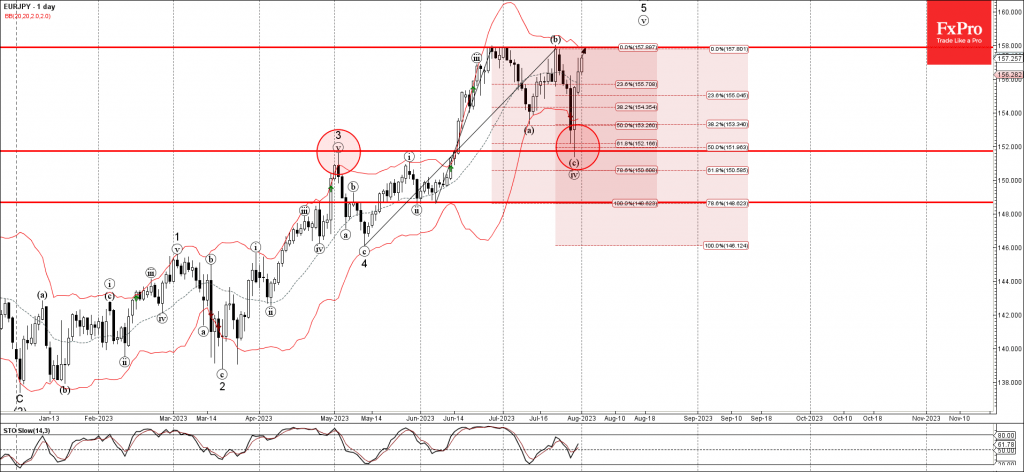
- EURJPY reversed from support level 152.00
- Likely to rise to resistance level 158.00
EURJPY currency pair recently reversed up from the key support level 152.00 (former multi-month high from May, acting as support after it was broken in June).
The support level 152.00 was strengthened by the lower daily Bollinger Band and by the two intersecting Fibonacci corrections – 61.8% and 50% of the previous upward impulses from May and June.
Given the clear daily uptrend and the continued yen sales, EURJPY currency pair can be expected to rise further toward the next resistance level 158.00 (top of the previous correction b).
USDJPY Wave Analysis
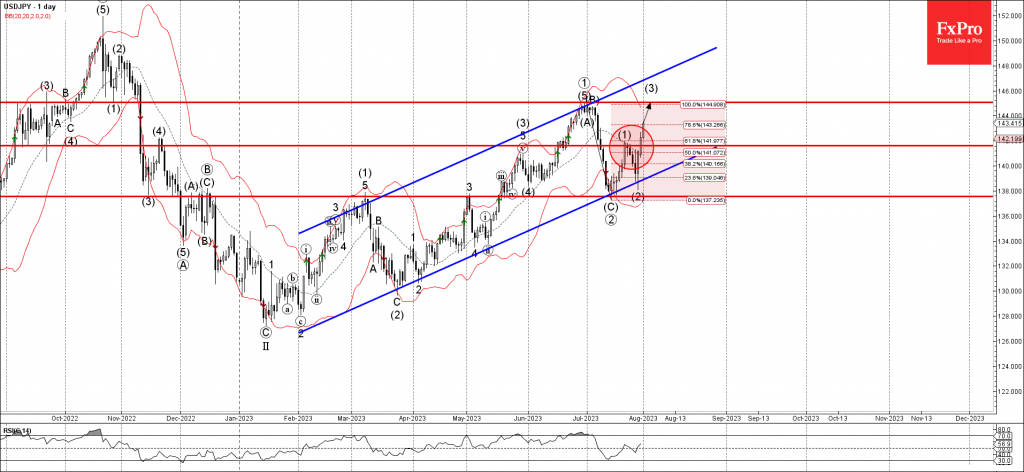
- USDJPY broke resistance level 141.60
- Likely to rise to resistance level 145.00
USDJPY currency pair recently broke the key resistance level 141.60 (top of the previous sharp upward impulse wave (1) from last month).
The breakout of the resistance level 141.60 coincided with the breakout of the 61.8% Fibonacci correction of the previous downward correction from June.
Given the clear daily uptrend, USDJPY currency pair can be expected to rise further toward the next resistance level 145.00 (previous monthly high from June).
CHFJPY Extends Rally to Record Highs
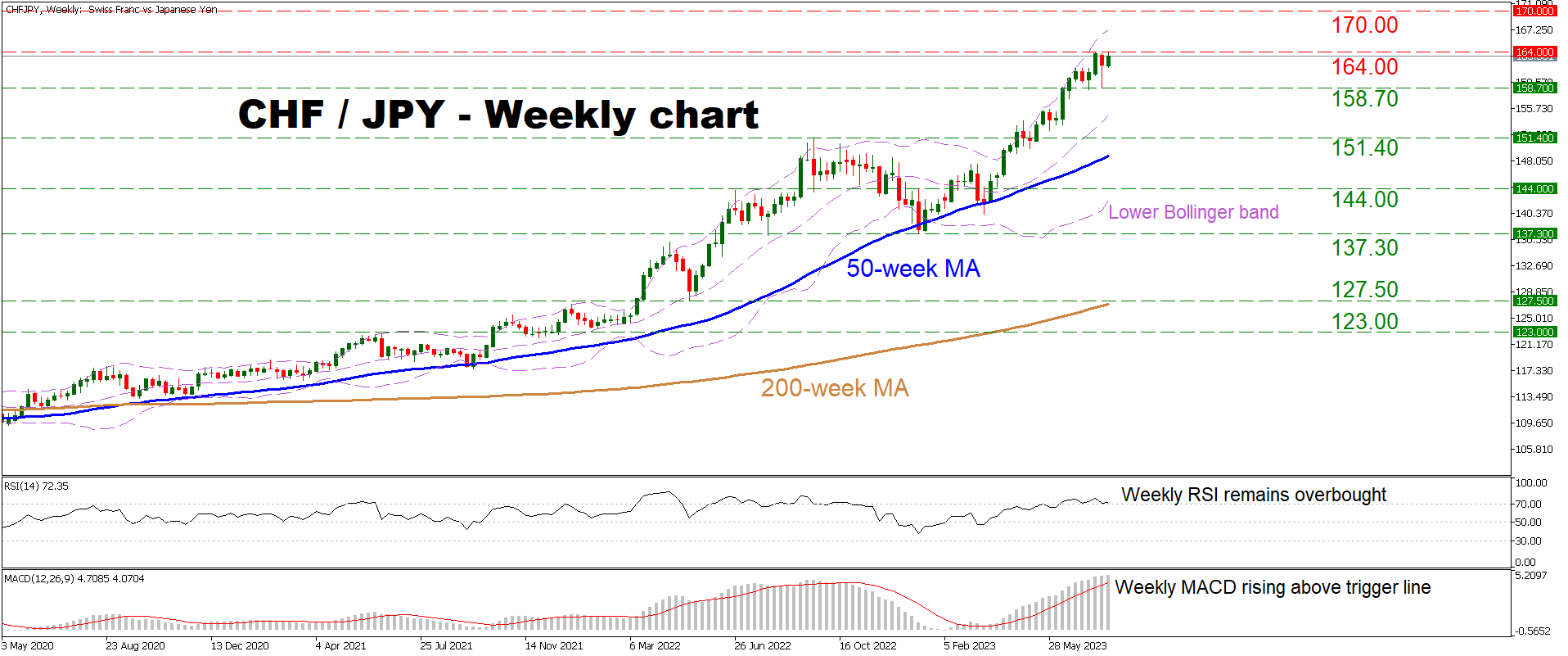
CHFJPY has been steadily marching higher this year, reaching its highest levels in at least four decades, since official records began. The pair is currently challenging those record highs near the 164.00 area, a violation of which would propel the market into uncharted waters.
On the weekly chart, momentum oscillators signal overbought conditions. The weekly RSI has flatlined but remains above the 70 level, while the weekly MACD is at its highest point in at least three decades. These readings are so extreme that they would normally be a warning for the bulls, although it is worth noting that markets can remain overbought for long periods of time.
If buyers remain in control and pierce above the record high of 164.00, the next major resistance barrier could be near 170.00, as traders might prefer to set their stops close to round psychological numbers. Even higher, the next area of interest would be around 174.00, which is the 261.8% Fibonacci extension of the correction in late 2022.
Now in case sellers come back into play and push the market lower, the first major cluster of support might be found near 158.70. That’s where the pair rebounded twice in July, and it’s also where the 50-day moving average has converged. Slicing below that region, the focus would shift towards 151.40, which was the high back in September.
In short, the technical outlook remains overwhelmingly positive, even if the momentum indicators are at extreme levels. A break above the record high of 164.00 would likely act as fuel for buyers.
US: Manufacturing Sector Activity Continued to Soften in July
The July ISM Manufacturing Index registered 46.4, a slight improvement over June's 46.0 reading but short of the firming to 46.9 markets had expected.
The new orders sub-index rose 1.7 percentage points (pp) to 47.3, while new export orders fell another 1.1 pp to 46.2.
The backlog of orders sub-index registered 42.8, up from June's 38.7 print. The sub-index shows backlogs have been falling since October 2022.
The production and employment indexes both signaled contraction, registering 48.3 and 44.4, respectively.
The supplier deliveries sub-index rose to 46.1 from 45.7 in June – still reflecting improving supplier delivery times. The prices paid sub-index rose to 42.6 but continues to reflect softening raw materials prices.
Two of 18 manufacturing industries reported growth in July. The industries reporting growth are Petroleum & Coal Products and Furniture & Related Products.
Key Implications
The manufacturing sector is showing signs of contraction for the ninth consecutive month with little change in the headline index, and all subcomponents showing declining activity. Moreover, only two of 18 industries reported growth in July, down from four in June. The weakness in the sector is growing more pervasive – as would be expected given that new orders have now declined for 11 consecutive months.
For the Fed, weakness in the manufacturing sectors output should signal the freeing up of capacity and easing price pressures. From this lens, despite last week's personal consumption expenditure report showing that consumer demand for goods ticked up again in June – led higher by healthy growth in durables expenditures – inflation continues to soften. Looking forward, we are of the view that the Fed has likely reached the end of its tightening cycle and will wait for the full force of policy to work its way through the economy.