

Sample Category Title
Eurozone unemployment rate unchanged at 6.4%, EU at 5.9%
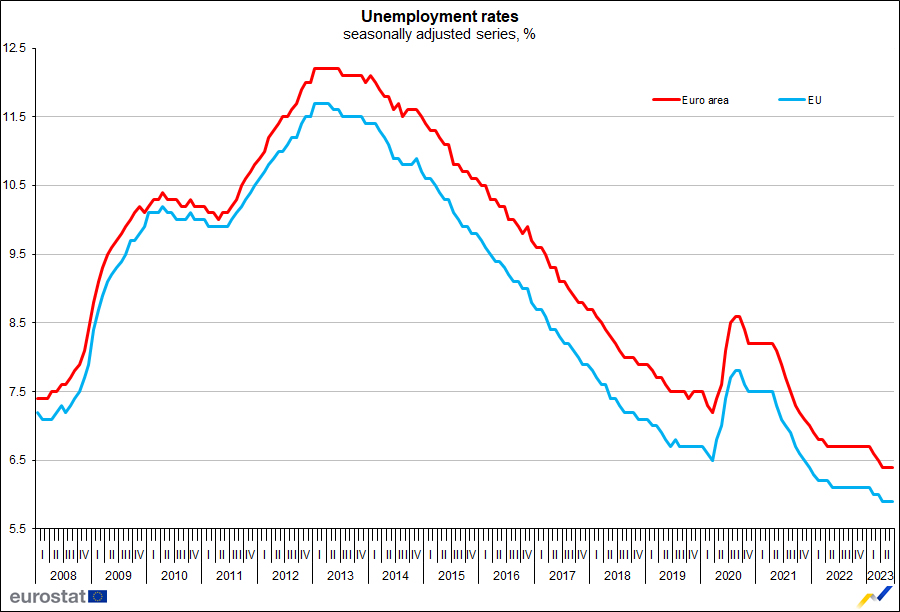
In June, unemployment rates in both Eurozone the EU remained stable at 6.4% and 5.9% respectively, according to Eurostat data.
Eurostat estimated that as of June 2023, around 12.802m individuals in the EU were unemployed, 10.814m of whom are from Eurozone.
Despite the unchanged monthly figures, the unemployment rate has seen a year-on-year decrease. Compared with June 2022, unemployment decreased by -387k in the EU and by -441k in Eurozone.
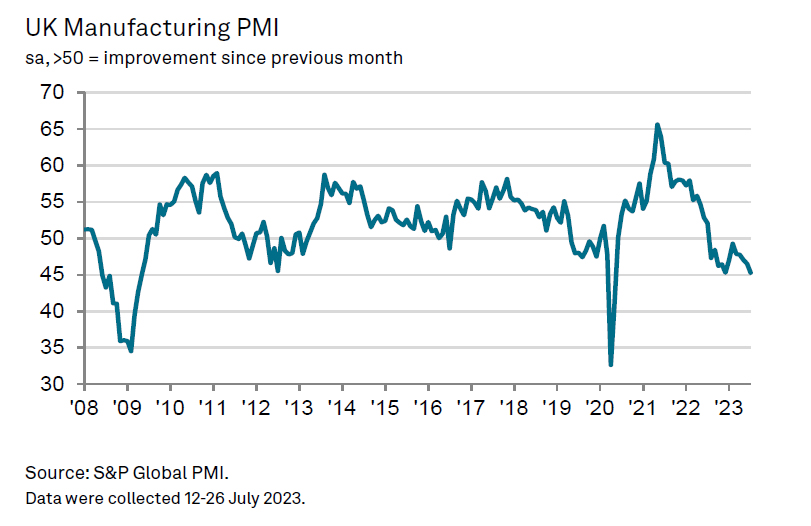
UK PMI manufacturing finalized at 45.3, deepening downturn
UK PMI Manufacturing was finalized at 45.3 in July. This level, matching the joint-weakest performance since May 2020, signals an ongoing deterioration in operating conditions, with PMI remaining below the pivotal 50.0 threshold for the twelfth consecutive month.
"July saw a deepening of the UK's manufacturing downturn," noted Rob Dobson, Director at S&P Global Market Intelligence. He attributed the slump to a combination of factors including overstocked clients, escalating export losses, rising interest rates, and the ongoing cost-of-living crisis.
Dobson also highlighted falling domestic and export demand and rapidly declining backlogs of work as precursors to potential cutbacks in production, employment, and purchasing in the near future. While falling prices offer some relief from inflation, he warned that they could signify more trouble ahead for manufacturers' profits and subsequent investment.
Australian Dollar Plummeting After RBA Decision
The Reserve Bank of Australia (RBA) this morning decided to leave the interest rate at 4.10%, although market participants expected an increase to 4.35%.
According to the forecast of the central bank, inflation in Australia will return to its target range of 2-3% by the end of 2025 from the current 6%. At the same time, a warning was made that additional tightening (rate increase) may be required to curb inflation.
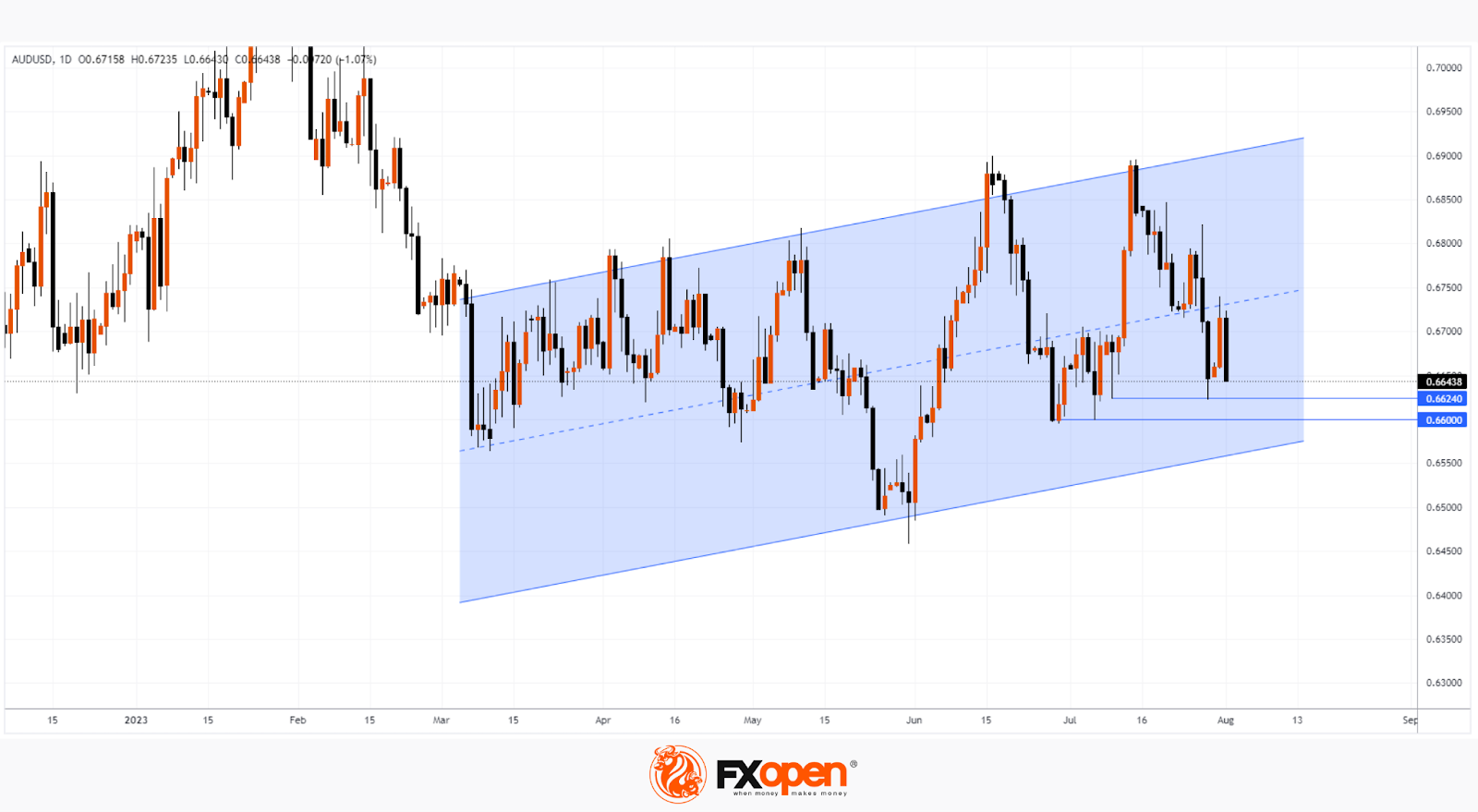
Amid the RBA's decision, the Australian dollar weakened against other currencies. So, on the AUD/USD chart, the price fell below the level of 0.665. At the same time, a reversal was formed from the median line of the channel, shown in blue; at yesterday's maximum, it was tested as a resistance line.
If the downward movement on the AUD/USD pair caused by the RBA decision continues, then the market may find support:
- at the level of 0.6624 – where important July lows were formed;
- at the level of 0.66 – there are important June lows;
- near the lower border of the blue channel.
Gold Has a Good Support Zone But Patience Needed
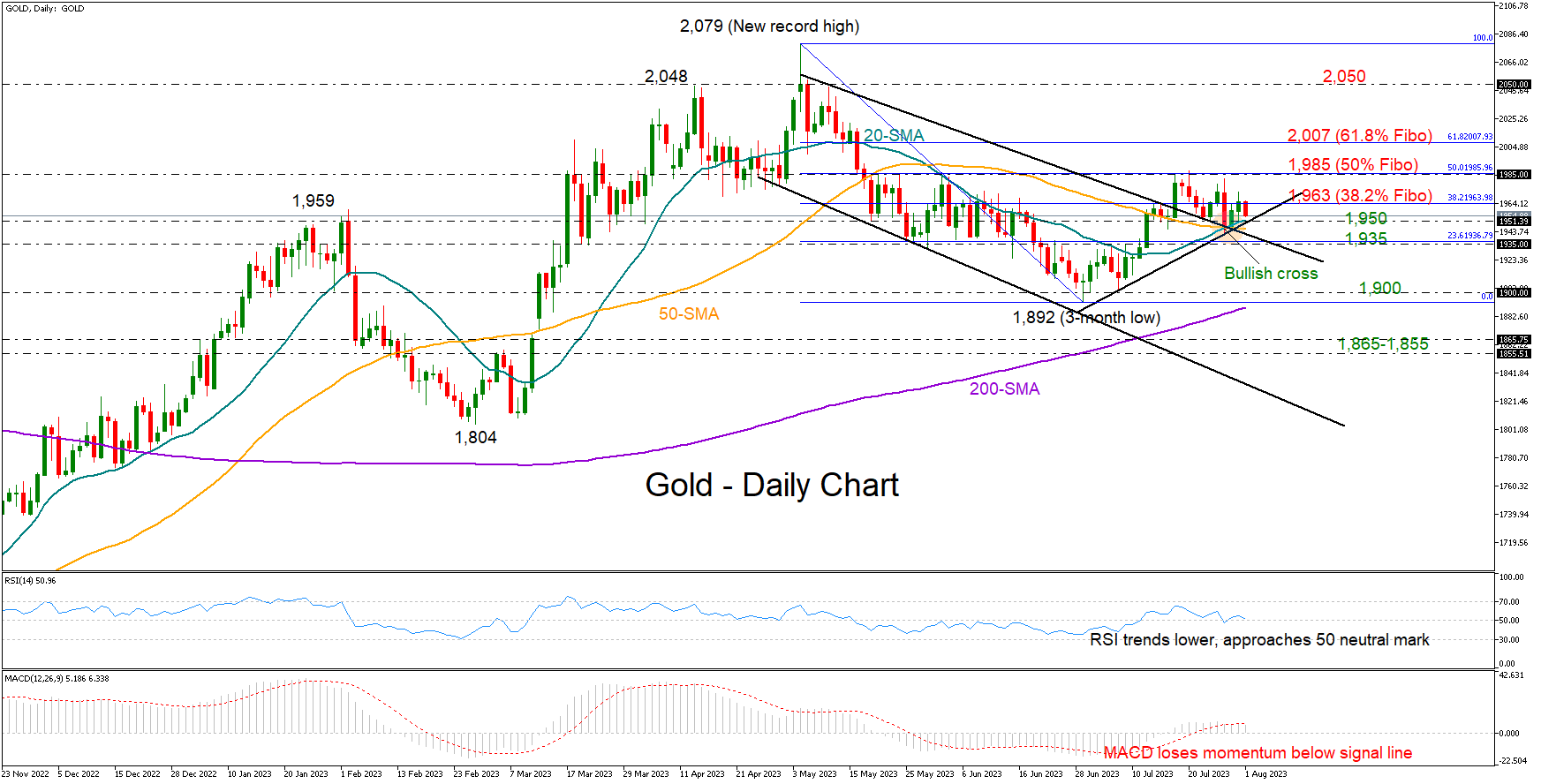
Gold has been forming lower lows and lower highs over the past two weeks, with the 50-day simple moving average (SMA) preventing major declines once again along with the 20-day SMA near 1,945 last Friday.
The price maintained its position above the broken bearish channel, which is a good sign for July's upleg continuation. The progressing bullish cross between the 20- and 50-day SMAs is endorsing that case as well. Yet, the negative trajectory in the RSI and the MACD is reflecting some persisting weakness in demand.
Traders are waiting for the price to go above 1,985 and beyond the 50% Fibonacci retracement of the previous downleg before focusing on 2,000. If the bulls claim the latter, the price could accelerate towards the 2,050 bar and perhaps attempt to touch the record high of 2,079.
On the downside, the area of 1,935-1,950, which encapsulates the shorter-term SMAs, the tentative ascending trendline from June’s lows and the channel’s upper band, will be closely watched. The 38.2% Fibonacci mark is placed there too. Therefore, a downfall below that region could motivate an aggressive sell-off towards the 1,892-1,900 zone, where the 200-day SMA is converging. A deeper fall could take a halt somewhere between 1,865 and 1,855.
All in all, gold is currently showing mixed signals, with investors expected to stay patient until the price crosses above 1,985 or slides below 1,935-1,950.
EURCHF Current Upleg Could Have Legs
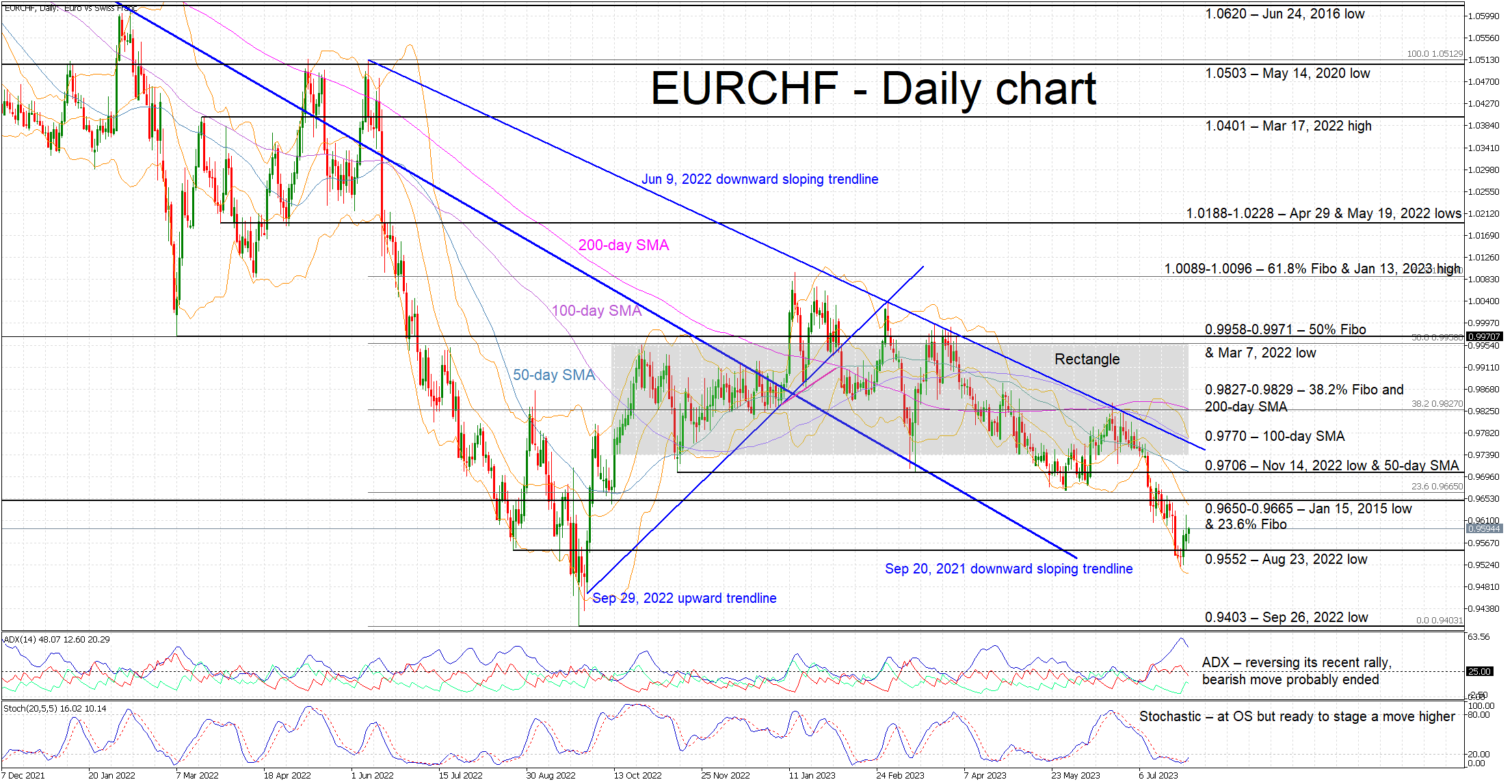
EURCHF is trading sideways today, a tad above the new 2023 low of 0.9521 recorded on July 27. This was the lowest print of the pair since September 29, 2022 as the bears finally staged their much-anticipated breakout from the 10-month-old rectangle.
However, the good news for the bears appears to stop here as the momentum indicators are gradually turning in favour of the bulls. More specifically, the Average Directional Movement Index (ADX) traded to the highest level since December 2021, but it is now moving aggressively lower. This could be seen as a sign that the recent bearish trend has run its course. Similarly, the stochastic oscillator is preparing to rise above its oversold territory. If this move actually takes place, it could be a strong signal for the start of a bullish move.
Should the bulls feel inspired by the momentum indicators, they would like to reclaim the key 0.9650-0.9665 range that is defined by the January 15, 2015 low and the 23.6% Fibonacci retracement of the June 9, 2022 – September 26, 2022 downtrend respectively. Even higher, the 0.9706 area, populated by the November 14, 2022 low and the 50-day simple moving average (SMA), should prove stronger to overcome. If successful, the bulls could start thinking about pushing EURCHF back inside the recent rectangle.
On the flip side, the bears look determined to push EURCHF even lower. The first obstacle appears to be the August 23, 2022 low at 0.9552 and the recent 2023 low at 0.9521. Breaking these levels would mean that the door would be wide open for a more sizeable move towards the 0.9403 area, and the chance to record a new all-time low.
To sum up, the bears remain in control of the market but there is increasing bullish pressure which could quickly gain traction if the bulls stage a rally above the 0.9665 area.
RBA Board Pauses in August – Rates Now Likely on Hold for Extended Period
The Board now believes that the recent data is consistent with achieving the inflation target. It also expresses uncertainty around the link between tight labour markets and inflation. It will be another close call in September but thereafter we expect the weak economy to dominate policy. The first rate cut is not likely until the September quarter 2024.
The Reserve Bank Board left the cash rate unchanged at 4.1% at the August Board meeting.
The key explanation was a desire to take more time to assess the impact of the increase in rates to date and the economic outlook.
The Board also noted that “some further tightening of monetary policy may be required to ensure that inflation returns to target in a reasonable time frame.“
There was a somewhat confusing signal from its assessment of the recent better-than-expected inflation print for the June quarter.
The central forecast for inflation in 2024 held at 3¼ % – unchanged from the May Statement on Monetary Policy, indicating that the June quarter report was not interpreted as signalling a flatter inflation trajectory.
On the other hand, we did see a more confident approach to the outlook for inflation. The Governor’s statement noted that: “The recent data are consistent with inflation returning to the 2–3% target range over the forecast horizon.”
We will see exactly where the staff sees the inflation rate by end 2025 when the Statement on Monetary Policy (SoMP) prints on August 4. The comment in the Governor’s Statement is that inflation will be “back within the 2–3% target range in late 2025.”
With the current forecasts having inflation slowing from 3.2% to 3.0% in the first half of 2025 and the decision statement noting the central case economic growth forecast to be lifting from 1¾ % to 2% (unchanged from the May SoMP) it seems unlikely that the fall into the range will be any more than a further 0.2ppts to 2¾%, indicating that the Board is still comfortable to continue to see inflation holding above the middle of the target range after more than four years above the target range.
While the Statement continued to emphasise the significant uncertainties around the persistence of services inflation it introduced a potentially profound new insight, likely drawn from the experience in the US and other countries, that: “There are also uncertainties regarding the lags in the operation of monetary policy and how firms’ pricing decisions and wages respond to the slowing in the economy at a time when the labour market remains tight.”
This observation may be disclosing that the Board is prepared to entertain the possibility that, due to weak demand, firms are unable to pass on higher costs, including wages, holding down inflation and squeezing margins. This clearly raises questions about the nexus between tight labour markets and rising inflation, possibly explaining why the Board has not responded to the signs of further tightening in labour markets over the last two meetings.
The issues of weak productivity growth; strongly rising unit labour costs, and a margin squeeze continue to get the attention of the Board: “At the aggregate level, wages growth is still consistent with the inflation target, provided that productivity growth picks up.”
They can raise the issue but provide no reason why productivity growth is likely to pick up. The national accounts for the June quarter will print the day after the September Board meeting with likely evidence that unit labour costs continue to rise at a cracking pace – the most recent update having already shown a 7.9% rise over the year to March.
It is unlikely that this issue would have an immediate impact on policy. But, as we argued in last week’s note, it could restrict the progress in bringing down inflation in 2024 – delaying the timing of rate relief.
Westpac expected that the case for another rate increase – based on high services inflation; the 50 year low in the unemployment rate; the clear tightening bias; the unlikely prospect that the staff would lower its inflation or growth forecasts; and only very modest increases in the unemployment rate – was respectable.
In not acting in those circumstances and indicating that “recent data are consistent with inflation returning to the 2–3% target range over the forecast horizon” the balance of risks now favours the prospect that the RBA is now on hold.
It is true that the Board maintains its tightening bias and the volatile monthly inflation indicator could lift sharply in July, just as it did in April. The Wage Price Index could surprise to the high side for the June quarter so we certainly cannot rule another rate hike in September completely out of the picture.
Going into this meeting we assessed that the best approach would be to hike and maintain the tightening bias. As the evidence of the weakening spending continues to build, the case for raising rates becomes progressively more difficult. We were never of the view that rate hikes would extend deep into the second half of 2023 and stand by that approach.
The Board’s assessment of the risks associated with the competing forces of a very weak economy and a very tight labour market appears to be now favouring concerns about the weak economic outlook.
That points to rates remaining on hold
We acknowledge that just as the decision at today’s Board meeting would have been finely-balanced the decision in September will also be close. In October the Board will choose to await the quarterly inflation report and the staff’s updated forecasts. The evidence around the economy by November and the ongoing slowdown in inflation will make a November increase unlikely.
The next challenge for the outlook should now be the timing for the beginning of the easing cycle. When Westpac was forecasting rate hikes in both August and September we were comfortable with the cycle beginning in the June quarter of 2024.
That timing now looks more likely to be in the September quarter 2024 when we expect the unemployment rate to be nearing 5% and inflation in the 3–3.5% range.
Conclusion
The Board is now more confident about achieving its inflation objective of moving into the 2–3% band by end 2025. Not achieving the middle of the target band even by end 2025 seems problematic but the Board seems unfazed about that prospect.
The decision not to raise rates for a second month despite clear evidence of a very tight labour market indicates that the Board will need to see the impact of tight labour markets on inflation. The concept of being pre-emptive seems to have been replaced by a “data dependent” approach to this issue as well.
We do not expect a data flow over the next month that would trigger that hike in September, although the monthly inflation indicator always represents a risk.
Thereafter the weak outlook for activity and the slowing in inflation is likely to preclude any further need for higher rates.
The next move is now likely to be the first cut in the cycle which is forecast for the September quarter of 2024.
Eurozone PMI manufacturing finalized at 42.7, manufacturing recession is here to stay
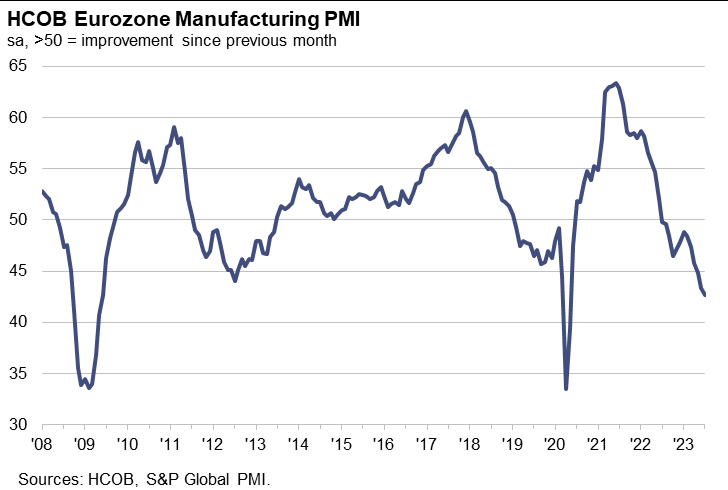
Eurozone PMI Manufacturing was finalized at 42.7 in July, down from June's 43.4, marking a 38-month low. PMI Manufacturing Output correspondingly dipped to 42.7 from 44.2, signaling another 38-month low.
Among member states, Greece's PMI Manufacturing showed a promising uptick to 53.5, a 14-month high, whereas Germany and Austria both posted a dismal 38-month low at 38.8. France also hit 38-month low at 45.1. Other states exhibited mixed results, with Spain hitting a 7-month low at 47.8, and Italy experiencing a modest 2-month high at 44.5.
Commenting on these figures, Cyrus de la Rubia, Chief Economist at Hamburg Commercial Bank, stated: "It looks like the manufacturing recession is here to stay in the eurozone. Stronger declines in output, new orders and purchase volumes at the start of the third quarter back up our view that the economy as a whole is in for a bumpy ride in the second half of the year."
de la Rubia also noted ECB's reaction to deflation of output prices, which have quickened their decline, falling at the fastest pace in nearly 14 years. However, he cautioned that "the worries about services inflation remain high on the agenda."
GBPUSD Consolidates as Pullback Fades
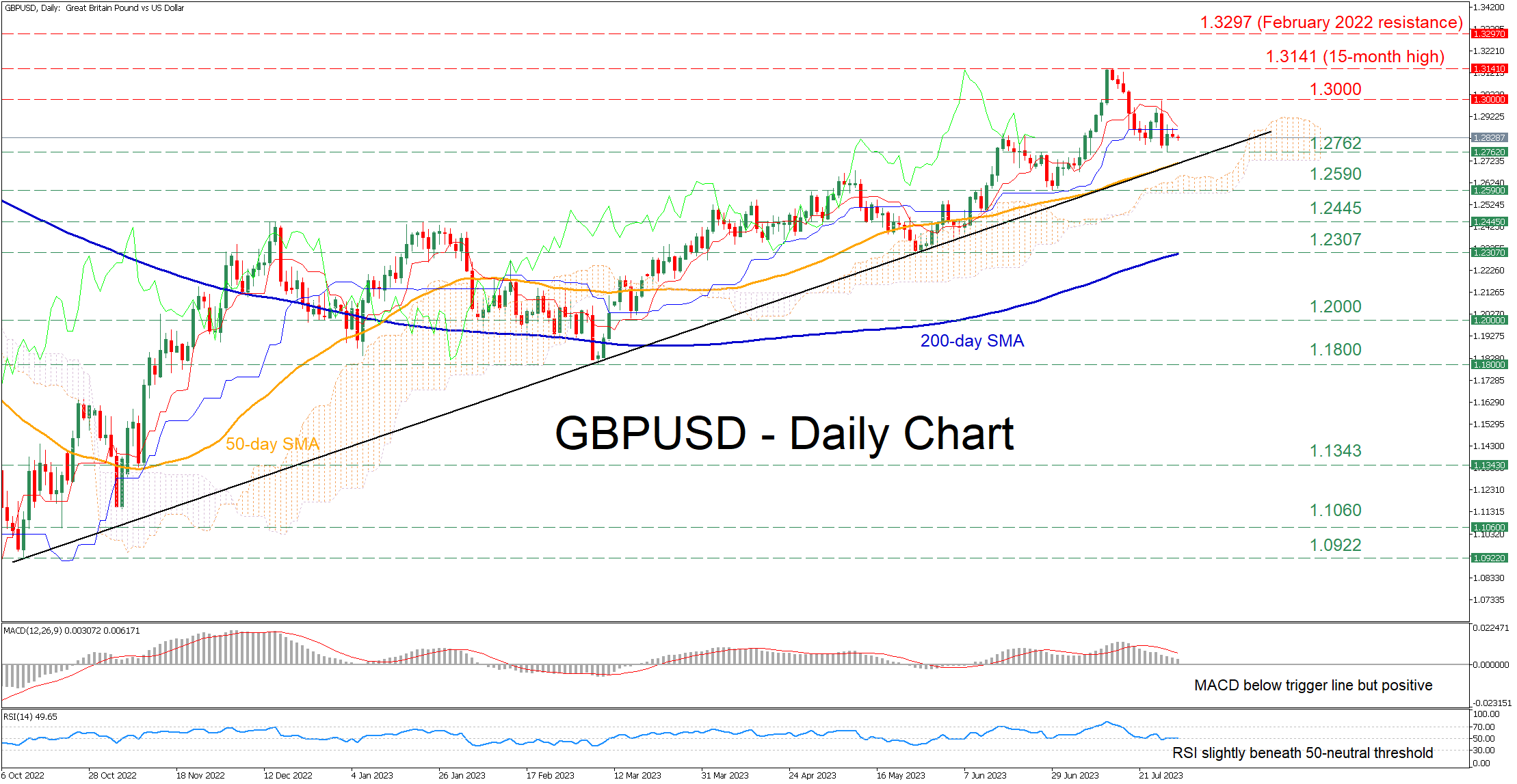
GBPUSD has been in a prolonged uptrend since October 2022, storming to a fresh 15-month high of 1.3141 on July 14. Since then, the pair has been experiencing a mild downside correction, which seems to be faltering as the price has been directionless in the past few daily sessions.
However, the momentum indicators suggest that bearish forces continue to hold the upper hand. Specifically, the MACD remains below its red signal line in the positive zone, while the RSI is hovering slightly below the 50-neutral mark after a series of failed attempts to claim it.
Should bearish pressures persist, the price could face the recent support of 1.2762 ahead of the upward sloping trendline that connects higher lows since October 2022. Sliding beneath the latter, the pair might descend towards the June support of 1.2590 before 1.2445 gets tested. Further declines could then cease at the May bottom of 1.2307, which overlaps with the 200-day simple moving average (SMA).
On the flipside, should the latest correction prove to be short-lived, the bulls could propel the price back higher towards the 1.3000 psychological mark. A violation of that zone could pave the way for the 15-month peak of 1.3141. If that barricade fails, the pair could edge higher to post fresh multi-month highs, where the February 2022 resistance of 1.3297 may curb any upside attempts.
In brief, it appears that GBPUSD’s recent correction is coming to an end, with the pair entering a consolidation phase. Hence, it is likely that the price extends its bullish long-term structure as long as it holds above the ascending trendline.
A “Data-Dependent” RBA Does Not Bode Well for Aussie Bulls
- Australia’s central bank, RBA has kept its policy cash rate unchanged at 4.1% for the second consecutive month.
- The tonality of the latest monetary policy implies that RBA is now data-dependent, and indirectly acknowledged the negative adverse lagged effects of higher interest rates towards economic growth.
- Overall, RBA may continue to remain on hold on its policy cash rate at 4.1% for the rest of 2023 which in turn negates any potential major bullish movement of the AUD/USD.
Expectations of interest rates traders were right in line with the Australian central bank, RBA’s latest monetary policy decision (no interest rate hike today) that was in contrast to the 25-basis points hike consensus from the majority of the economists surveyed.
RBA has decided to hold on to its official policy cash rate at 4.1% for the second consecutive month; data from the ASX 30-day interbank cash rate futures as of 31 July 2023 has indicated a patty pricing of only a 14% chance of a 25-bps hike, down significantly from a 41% chance being priced a week ago.
These are the key takeaways from today’s RBA monetary policy statement;
The Board has decided to hold the interest rate steady this month to access the impact of the prior rate increases and monitor the economic outlook.
Risk of below-trend growth for the Australian economy due to weak household consumption growth and dwelling investment.
The labour market has remained tight, with job vacancies and postings at high levels, though labour shortages have lessened. But the unemployment rate is expected to rise gradually from 3.5% to around 4.5% in late 2024.
Even though wage growth has picked up due to the tight labour market and high inflation but wage growth, together with productivity growth remains consistent with the inflation target.
The current growth rate of 6% inflation in Australia is still considered too high. The central forecast expects CPI inflation will decline to around 3.5% by the end of 2024 and revert to the target range of 2% to 3% by late 2025.
The Board may consider further tightening of monetary policy to ensure inflation returns to the target range of 2% to 3% depending on data and evolving risk assessments.
Switched to being “data-dependent” suggests RBA may stand pat on interest rates till end of 2023
The last point as mentioned above stood up starkly, in the previous July’s monetary policy statement, it was noted as “some further tightening of monetary policy may be required to ensure that inflation returns to target in a reasonable timeframe, but that will depend upon how the economy and inflation evolve”.
In today’s monetary policy, it has been stated as “that will depend upon the data and the evolving assessment of risks”. Hence, this latest framing of being data-dependent, and acknowledging the implied negative adverse lagged effects of a higher interest rate environment towards economic growth (risk assessment) seems to portray that if the recent trend of key economic indicators continues their respective trajectories, it is likely the RBA may continue to remain on hold on its policy cash rate at 4.1% for the rest of 2023 while monitoring the global inflationary environment.
Lacklustre sentiment for AUD/USD
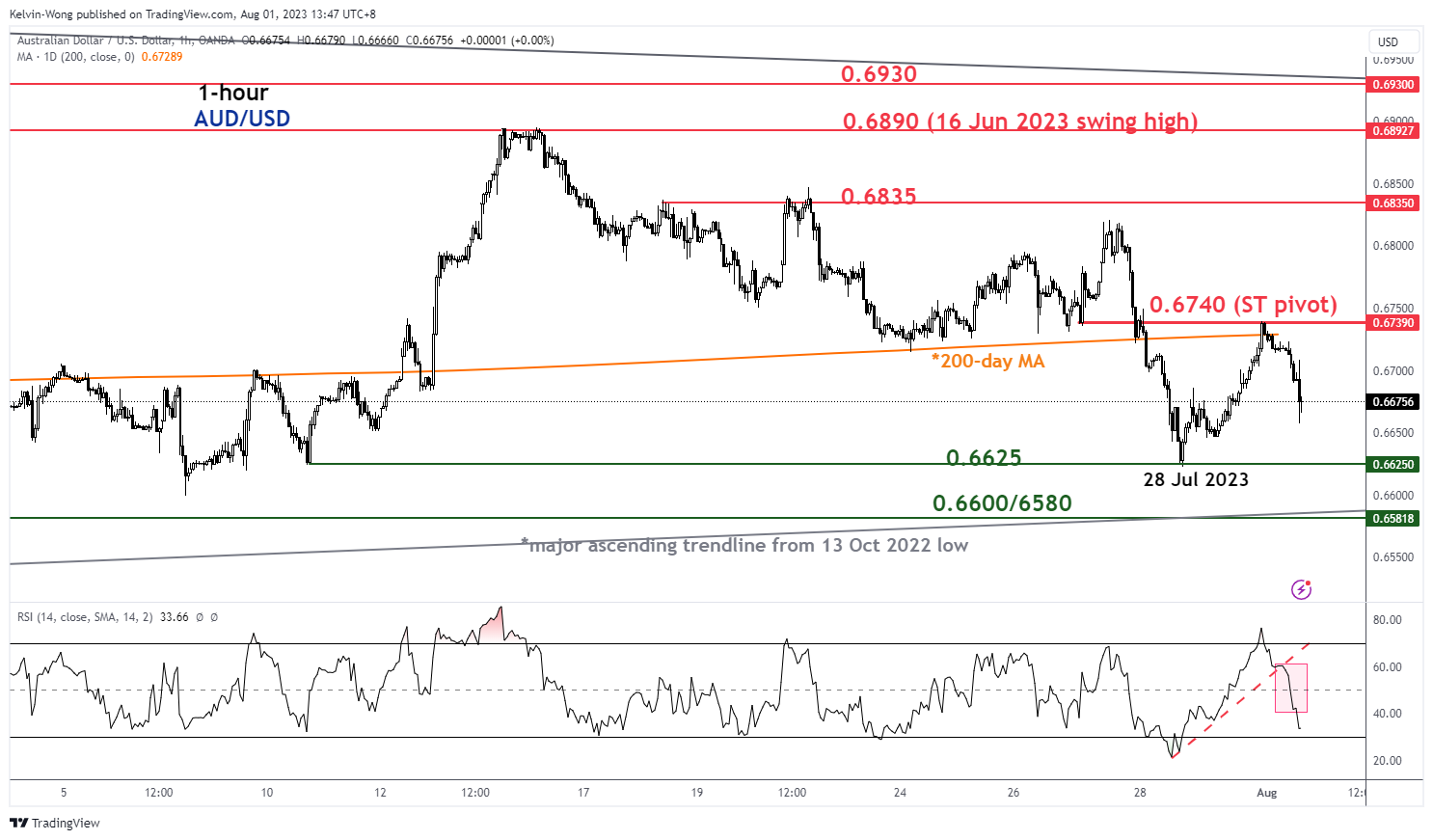
AUD/USD minor short-term trend as of 1 Aug 2023 (Source: TradingView, click to enlarge chart)
A “data-dependent” RBA has knocked out the bullish tone of AUD/USD after a reprieve rebound seen yesterday, 31 July where the pair staged a minor rebound of 117 pips from its last Friday, 28 July intraday low of 0.6622 to an intraday high of 0.6739 during yesterday’s US session.
Right now, it has shed -81 pips to print a current intraday low of 0.6657 at this time of the writing, and the Aussie is the worst performer intraday today, 1 Aug (-0.65%) among the major currencies against the US dollar; EUR (-0.03%), CHF (-0.03%), GBP (-0.07%), CAD (-0.22%), and JPY, (-0.34%).
The Aussie has resumed its underperformance against the US dollar seen in the last two trading days of last week where the AUD/USD recorded an accumulated loss of -1.68% from 27 July to 28 July versus EUR/USD (-0.63%), GBP/USD (-0.71%), and JPY/USD (-0.65%) over the same period ex-post FOMC, ECB, and BoJ.
From a technical analysis standpoint, short-term bearish momentum remains intact as yesterday’s rebound has failed to surpass the 200-day moving average after a re-test on it, now acting as a key short-term pivotal resistance at around 0.6740 with the next major support coming in at 0.6600/6580.
Aussie Trades on Backfoot Following RBA’s Decision
Markets
European (core) inflation and Q2 GDP growth topped expectations and keeps the September ECB meeting a very live one but it caught more attention from market watchers than markets themselves. The Fed’s Senior Loan Officer Opinion Survey showed that past rate increases are still working through the economy, curbing both credit demand and supply. Chair Powell had the SLOOS already at his disposal during the policy meeting last week. Core bonds started on weaker footing in Asian and early European dealings but soon found their composure. Eventual changes amounted to no more than -1.3 (2-)y to +0.1 (30-y) bps in Germany and moves of less than 1 bp across the US curve. European stocks inched marginally higher as did Wall Street, thanks to an end-of-session jump. The dollar showed no clear directional trend on FX markets. EUR/USD in the end closed a tad lower in the 1.10 area. EUR/GBP went nowhere in the upper 0.85/86 half. The Japanese yen was a notable underperformer following the BoJ’s unscheduled bond-buying operation. USD/JPY finished comfortably above 142, EUR/JPY north of 156. Cyclicals and commodity driven currencies including the Norwegian krone, Aussie and kiwi dollar topped the G10 leader bord. Brent oil extended its recent advance yesterday to close above $85/b for the first time since mid-April.
Stocks in the Asian-Pacific region kick off the new month in a mildly constructive risk setting. China marks an exception. The private Caixin manufacturing PMI unexpectedly fell into contraction territory (49.2 from 50.5). The dollar ekes out a small gain while the Aussie trades on the backfoot following the RBA’s decision to hold steady. Japan’s yen is still in the defensive though losses remain contained. Yet another stronger-than-expected PBOC fixing of China’s yuan doesn’t result in follow-up gains after a strong July month for the currency. USD/CNY fills bids in the 7.166 region. Core bond markets trade with a minor upward bias as we go into early European dealings. There’s not much to be seen there in terms of economic data though. We have to wait until the US opens with the JOLT job openings and July manufacturing ISM scheduled for release. The former is expected to ease to a still-elevated 9600k. Consensus for the latter is for a potential bottoming out of the indicator, from 46 to 46.9 but analysts were hoping something similar last month too. This time around, several regional indicators as well as the July PMI’s suggest it may finally happen. That could put a bottom below core/US bond yields and the dollar, although we do not expect a sharp market reaction as other key data points are still due later this week.
News and views
The Reserve Bank of Australia this morning kept its policy rate unchanged at 4.1%. The decision surprised the average analyst (expectations for a 25 bps) but not so much markets, who only saw a 20% chance of another tightening move. The RBA’s hold comes amid uncertainty of the passthrough of its previous 400 bps rate hikes on household consumption, the labour market and the economy in general. Inflation is declining but is still too high at 6% with especially persistent services inflation a point of worry. CPI should decline further but may only reach the 2- 3% target range in late 2025. The economy meanwhile is growing below trend as household consumption weakened as did dwelling investment. A tight labour market is showing further signs of some easing. Wages continue to grow however. The pace is considered to be consistent with the inflation target provided that productivity growth picks up. The RBA keeps the possibility of more tightening on the table but it depends on how the data evolves. Today’s halt provides the opportunity of a more thorough assessment by the next meeting September 5. Australian money markets currently only attach a 50% probability of one more hike later this year to 4.35%. Swap yields drop up to 6 bps at the front end of the curve while the Aussie dollar loses moderate ground. AUD/USD declines from 0.672 to 0.667.
UK shop prices for the first time in two years actually fell in July, dropping 0.1% m/m compared to June. That brought the annual rate from 8.4% to 7.6%, the second drop straight after hitting a series high of 9% in May this year. It is another potential sign of inflation easing further in the country, even though the rate is still much too high. June CPI numbers two weeks ago also came in lower than expected after four consecutive (strong) beats. The data is undoubtedly welcomed by the Bank of England. The central bank meets on Thursday. A hike is all but certain though the jury is still out on the size (25 vs 50 bps).