Sample Category Title
EUR/USD Daily Outlook
Daily Pivots: (S1) 1.0979; (P) 1.1012; (R1) 1.1031; More...
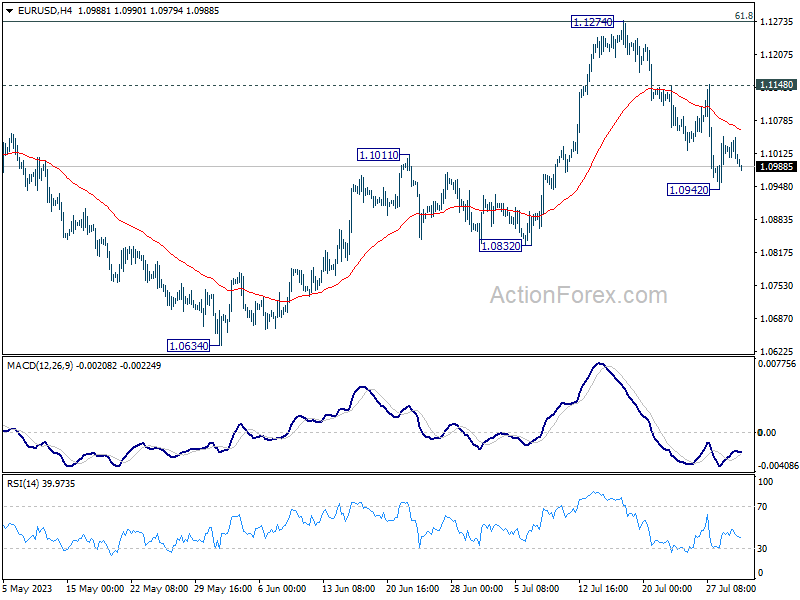
EUR/USD is extending the consolidations above 1.0942 and intraday bias remains neutral. Further fall is expected as long as 1.1148 resistance holds. Below 1.0942 will target 1.0832 support next. Nevertheless, break of 1.1148 will argue that the decline has completed and bring retest of 1.1274 high.
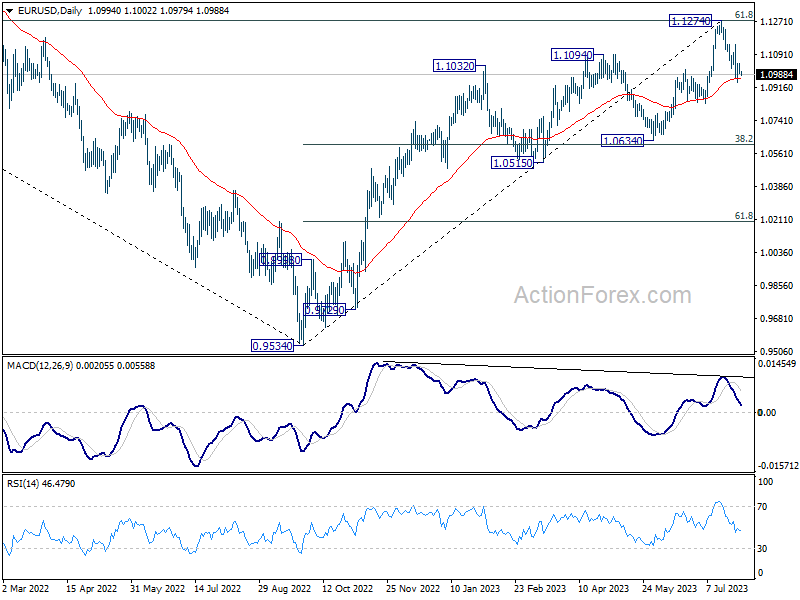
In the bigger picture, a medium term top could be formed at 1.1274, after failing to break through 61.8% retracement of 1.2348 (2021 high) to 0.9534 at 1.1273 decisively, on bearish divergence condition in D MACD. Sustained trading below 55 D EMA (now at 1.0963) will bring deeper correction to 1.0634 cluster support (38.2% retracement of 0.9534 to 1.1274 at 1.0609). Strong support could be seen there, at least on first attempt, to set the range for consolidation.
EUR/AUD Daily Outlook
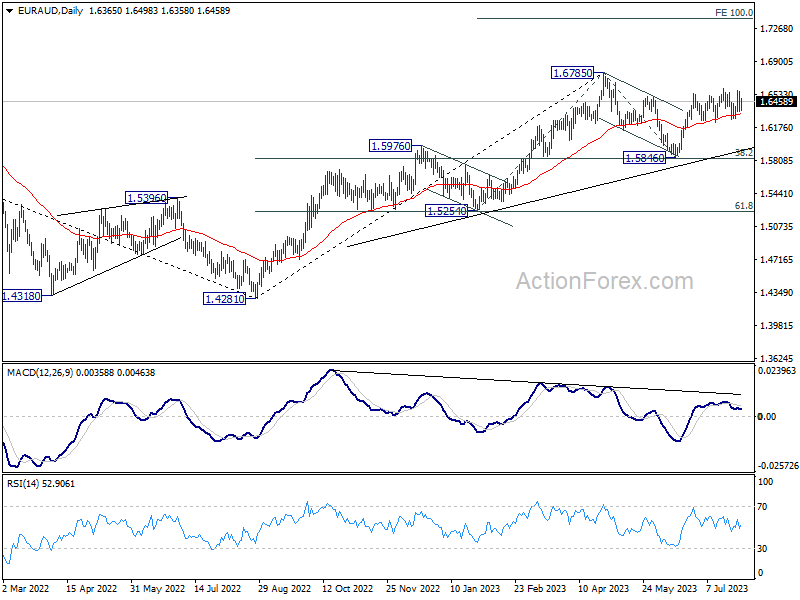
Daily Pivots: (S1) 1.6292; (P) 1.6433; (R1) 1.6513; More...
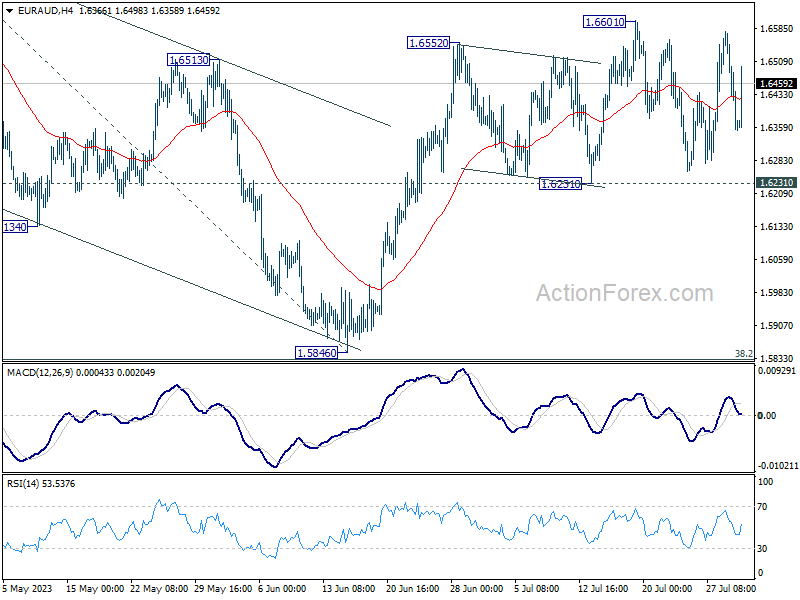
EUR/AUD is still bounded in range trading below 1.6601 and intraday bias stays neutral. Further is expected with 1.6231 support intact. Firm break of 1.6601 will solidify the case that corrective fall from 1.6785 has completed, and target a retest on this high next.
In the bigger picture, with 38.2% retracement of 1.4281 to 1.6785 at 1.5828 intact, rally from 1.4281 is still in progress. Firm break of 1.6785 will confirm rise resumption. Next target is 100% projection of 1.5254 to 1.6785 from 1.5846 at 1.7377. On the other hand, rejection by 1.6785 will extend the corrective pattern with another fall leg. But outlook will stay bullish as long as 1.5828 holds.
RBA on hold, keeps tightening bias
RBA kept its cash rate target at 4.10%, retaining a hawkish bias. The bank noted, "Some further tightening of monetary policy may be required to ensure that inflation returns to target in a reasonable timeframe." However, RBA underscored that any future decision will be data-dependent and based on an "evolving assessment of risks."
Explaining the decision to hold rates, RBA stated that "higher interest rates are working to establish a more sustainable balance between supply and demand in the economy and will continue to do so." Amidst "uncertainty" surrounding the economic outlook, maintaining the current rate provides "further time" to assess the impact of previous hikes.
While the central bank anticipates recent data to be "consistent" with an inflation return to its 2-3% target over the forecast horizon, it warned of "significant uncertainties".
RBA expressed concerns about the surprising persistence of services price inflation overseas, which could potentially reflect in Australia. Additionally, it mentioned uncertainties about "how firms' pricing decisions and wages will respond to the slowing in the economy at a time when the labour market remains tight." Also, it stated that "the outlook for household consumption is also an ongoing source of uncertainty."
(RBA) Statement by Philip Lowe, Governor: Monetary Policy Decision
At its meeting today, the Board decided to leave the cash rate target unchanged at 4.10 per cent and the interest rate paid on Exchange Settlement balances unchanged at 4.00 per cent.
Interest rates have been increased by 4 percentage points since May last year. The higher interest rates are working to establish a more sustainable balance between supply and demand in the economy and will continue to do so. In light of this and the uncertainty surrounding the economic outlook, the Board again decided to hold interest rates steady this month. This will provide further time to assess the impact of the increase in interest rates to date and the economic outlook.
Inflation in Australia is declining but is still too high at 6 per cent. Goods price inflation has eased, but the prices of many services are rising briskly. Rent inflation is also elevated. The central forecast is for CPI inflation to continue to decline, to be around 3¼ per cent by the end of 2024 and to be back within the 2–3 per cent target range in late 2025.
The Australian economy is experiencing a period of below-trend growth and this is expected to continue for a while. Household consumption growth is weak, as is dwelling investment. The central forecast is for GDP growth of around 1¾ per cent over 2024 and a little above 2 per cent over the following year.
Conditions in the labour market remain very tight, although they have eased a little. Job vacancies and advertisements are still at very high levels, although firms report that labour shortages have lessened. With the economy and employment forecast to grow below trend, the unemployment rate is expected to rise gradually from its current rate of 3½ per cent to around 4½ per cent late next year. Wages growth has picked up in response to the tight labour market and high inflation. At the aggregate level, wages growth is still consistent with the inflation target, provided that productivity growth picks up.
Returning inflation to target within a reasonable timeframe remains the Board's priority. High inflation makes life difficult for everyone and damages the functioning of the economy. It erodes the value of savings, hurts household budgets, makes it harder for businesses to plan and invest, and worsens income inequality. And if high inflation were to become entrenched in people's expectations, it would be very costly to reduce later, involving even higher interest rates and a larger rise in unemployment. To date, medium-term inflation expectations have been consistent with the inflation target and it is important that this remains the case.
The recent data are consistent with inflation returning to the 2–3 per cent target range over the forecast horizon and with output and employment continuing to grow. There are though significant uncertainties. Services price inflation has been surprisingly persistent overseas and the same could occur in Australia. There are also uncertainties regarding the lags in the operation of monetary policy and how firms' pricing decisions and wages will respond to the slowing in the economy at a time when the labour market remains tight. The outlook for household consumption is also an ongoing source of uncertainty. Many households are experiencing a painful squeeze on their finances, while some are benefiting from rising housing prices, substantial savings buffers and higher interest income. In aggregate, consumption growth has slowed substantially due to the combination of cost-of-living pressures and higher interest rates.
Some further tightening of monetary policy may be required to ensure that inflation returns to target in a reasonable timeframe, but that will depend upon the data and the evolving assessment of risks. In making its decisions, the Board will continue to pay close attention to developments in the global economy, trends in household spending, and the outlook for inflation and the labour market. The Board remains resolute in its determination to return inflation to target and will do what is necessary to achieve that.
GBP/JPY Daily Outlook
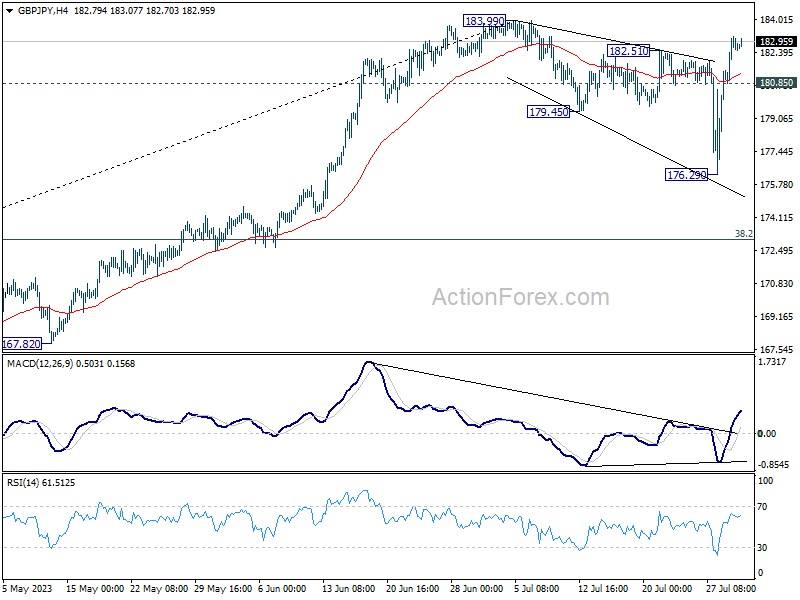
Daily Pivots: (S1) 181.26; (P) 182.22; (R1) 183.57; More...
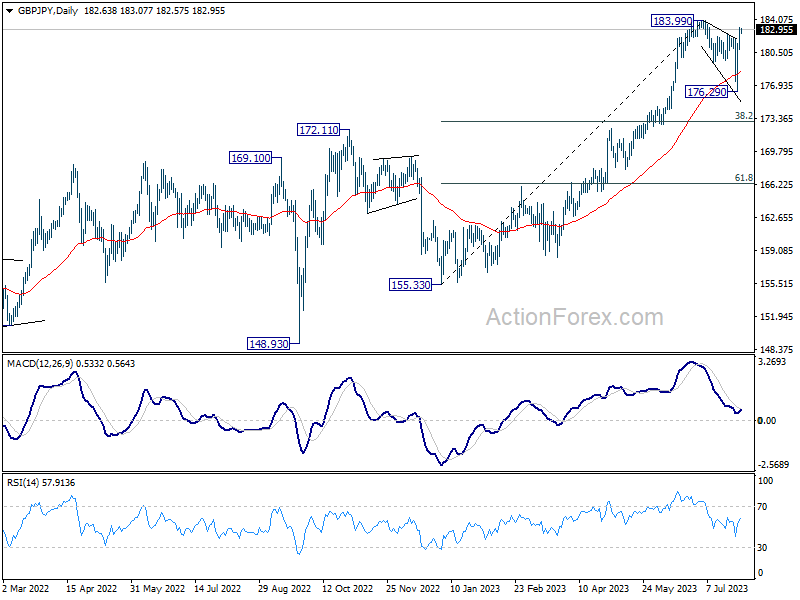
The break of 182.51 resistance affirmed the case that corrective pattern from 183.99 has completed with three waves down to 176.29. Intraday bias stays on the upside for retesting 183.99. Decisive break there will resume larger up trend. On the downside, below 180.85 minor support will turn intraday bias neutral first. Also, outlook will stay bullish as long as 38.2% retracement of 155.33 to 183.99 at 173.04 holds, in case of another dip.
In the bigger picture, as long as 172.11 resistance turned support holds, up trend from 123.94 (2020 low) is expected to continue through 183.99 at a later stage, towards 195.86 (2015 high). Nevertheless, firm break of 172.11 will argue that larger correction is already underway.
EUR/JPY Daily Outlook
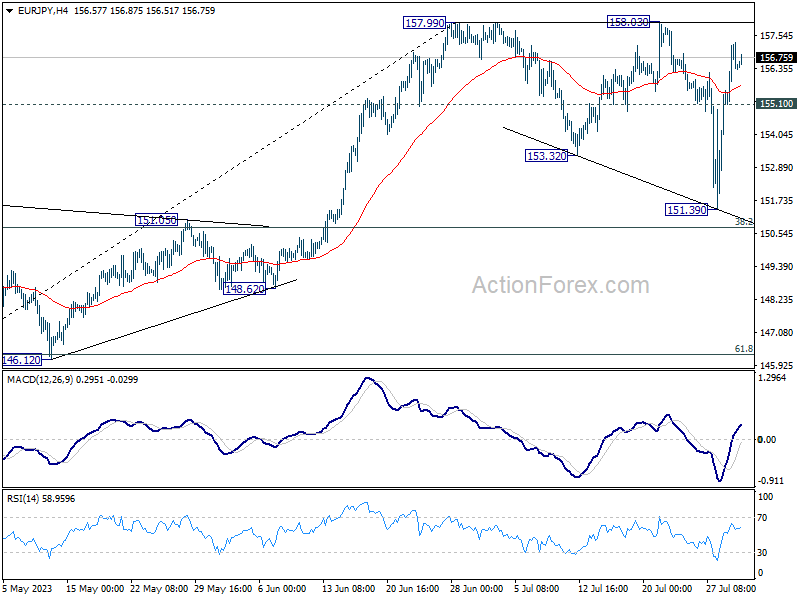
Daily Pivots: (S1) 155.28; (P) 156.28; (R1) 157.45; More....
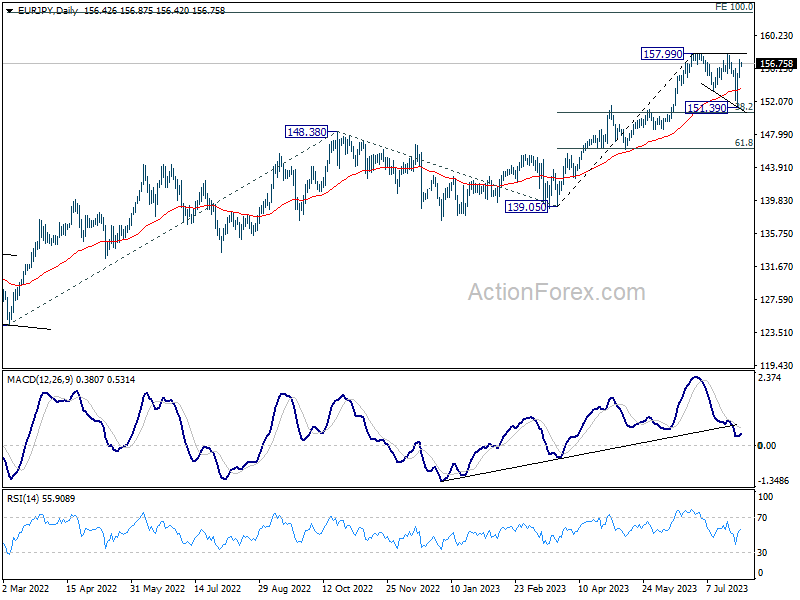
Intraday bias in EUR/JPY stays mildly on the upside for retesting 157.99/158.03 resistance. Decisive break there will resume larger up trend to 162.82 projection level next. On the downside, below 155.10 minor support will turn intraday bias neutral again. But outlook will remain bullish as long as 38.2% retracement of 139.05 to 157.99 at 150.77 holds, in case of another dip.
In the bigger picture, as long as 151.60 resistance turned support holds, rise from 114.42 (2020 low) is in progress. On resumption, next target is 100% projection of 124.37 to 148.38 from 138.81 at 162.82. Nevertheless, sustained break of 151.60 will argue that larger correction is already underway. Deeper decline would be seen to 55 W EMA (now at 145.56).
EUR/GBP Daily Outlook
Daily Pivots: (S1) 0.8553; (P) 0.8572; (R1) 0.8587; More...
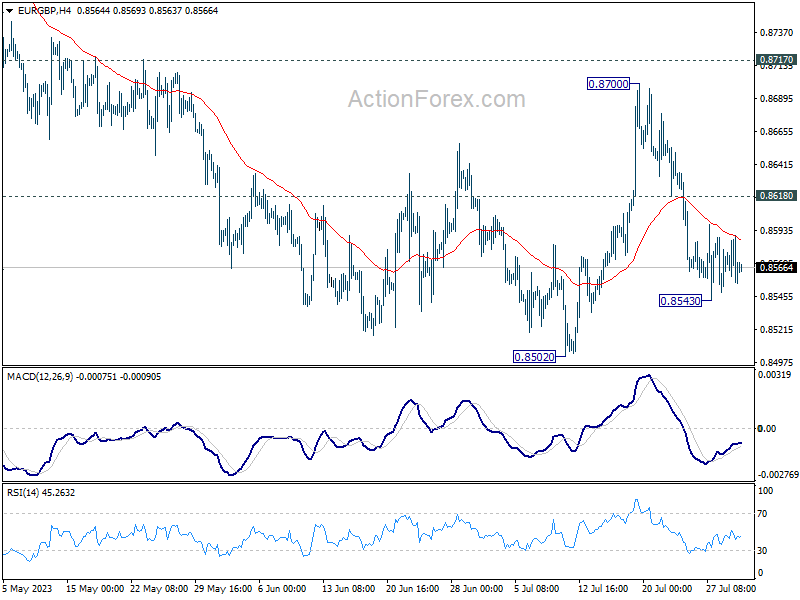
Intraday bias in EUR/GBP remains neutral at this point, and outlook is unchanged. On the downside, below 0.8543 will target a test on 0.8502 low. Decisive break there will resume larger decline from 0.8977. On the upside, above 0.8618 minor resistance will turn bias back to the upside for 0.8700, and possibly further to 0.8717 key support turned resistance.
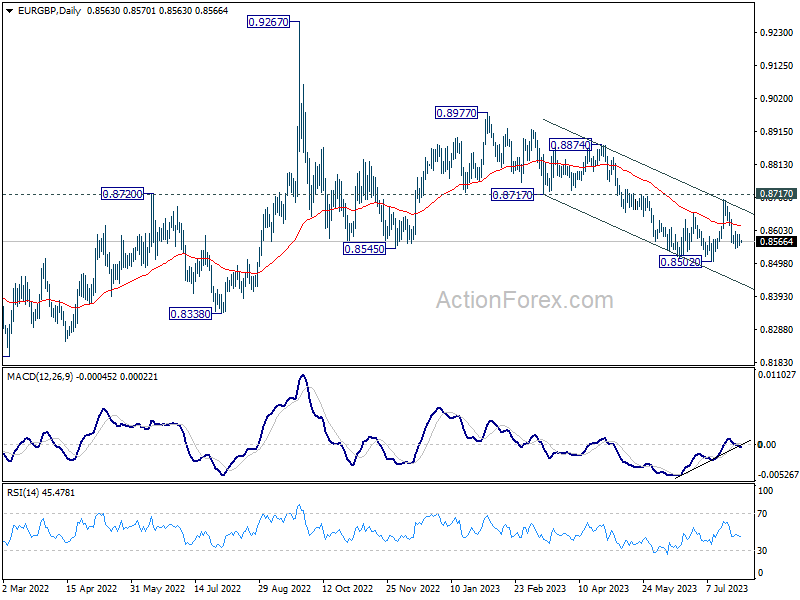
In the bigger picture, the down trend from 0.9267 (2022 high) is seen as part of the long term range pattern from 0.9499 (2020 high). Firm break of 0.8717 support turned resistance will argue that it has completed with three waves down to 0.8502. Further break of 0.8977 will bring retest of 0.9267 high. Nevertheless, rejection by 0.8717, followed by break of 0.8502 will resume the decline towards 0.8201 (2022 low).
EUR/CHF Daily Outlook
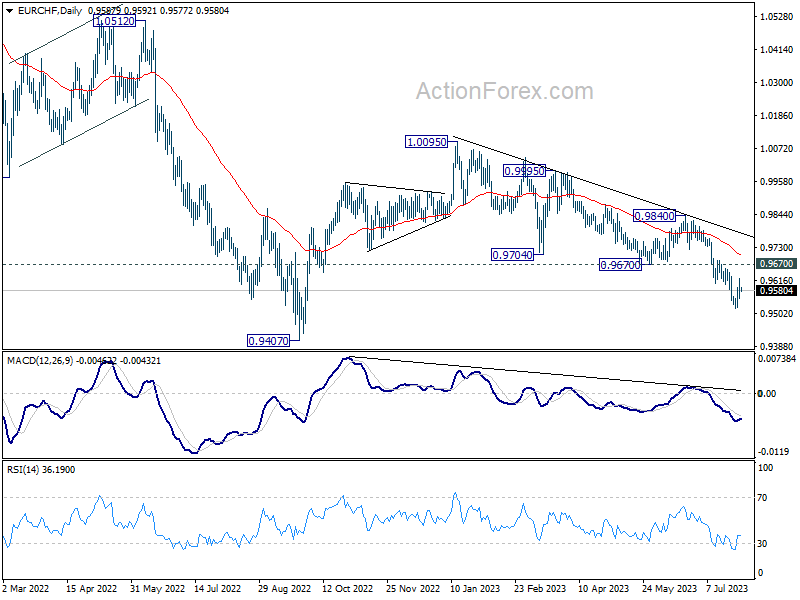
Daily Pivots: (S1) 0.9554; (P) 0.9588; (R1) 0.9622; More...
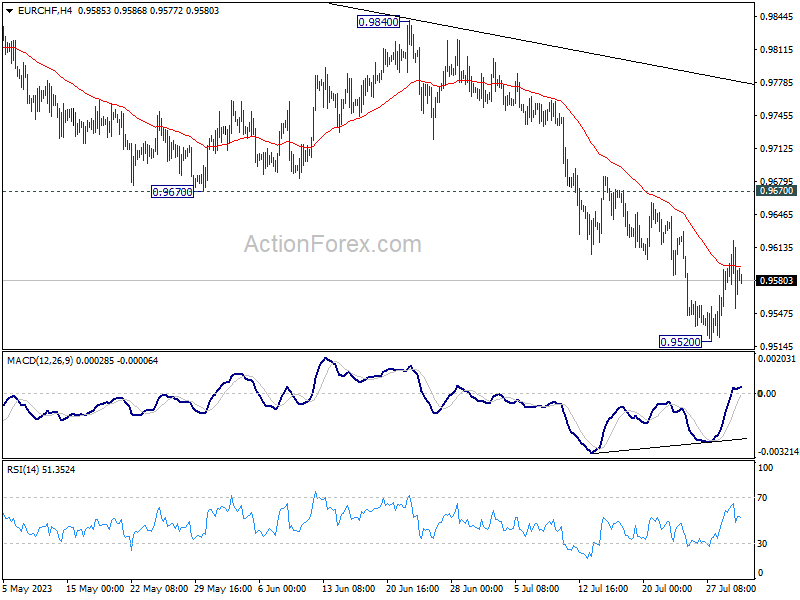
EUR/CHF is extending the consolidations above 0.9520 and intraday bias remains neutral at this point. While stronger recovery could be seen, outlook will remain bearish as long as 0.9670 support turned resistance holds. Break of 0.9520 will resume the fall from 1.0095 towards 0.9407 low.
In the bigger picture, medium term outlook is staying bearish as the pair is capped well below falling 55 W EMA (now at 0.9876). Down trend from 1.2004 (2018 high) is in favor to continue. Sustained break of 0.9407 will target 61.8% projection of 1.1149 to 0.9407 from 1.0095 at 0.9018. For now, this will remain the favored case as long as 0.9840 resistance holds, in case of strong rebound.
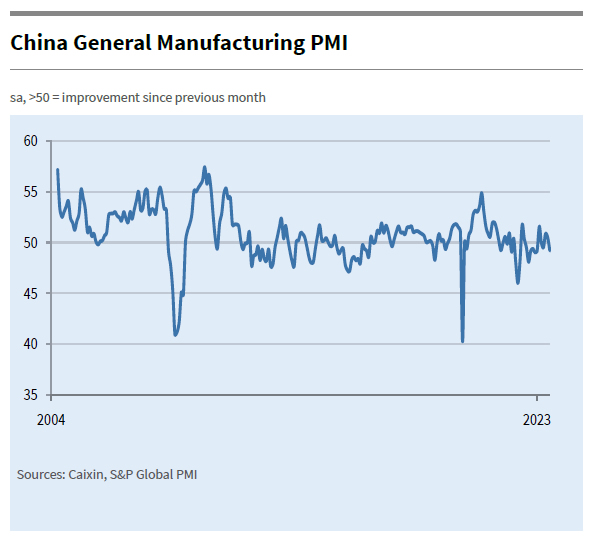
China Caixin PMI manufacturing down to 49.2, first contraction in three months
China's Caixin PMI Manufacturing index slipped from 50.5 to 49.2 in July, marking the first contraction in three months and falling below the expected 50.3. According to Caixin, there was a marginal contraction in output, and total sales plummeted due to a more pronounced decline in new export orders. Additionally, both input costs and output charges saw a decrease.
Senior Economist at Caixin Insight Group, Wang Zhe, highlighted the deteriorating situation, stating, "Overall, manufacturing conditions contracted in July, with supply, demand, exports, and employment all deteriorating. Prices continued to decline, inventories rose without companies adjusting them, and logistics times increased." He noted that manufacturers' optimism remained, but it had weakened.
Wang further explained, "China's economic recovery in the first quarter exceeded expectations, but the momentum weakened in the second. Although the data for industrial production and investment in June showed some signs of recovery, macroeconomic growth remained sluggish, and considerable downward pressure on the economy persisted."
Japan PMI manufacturing finalized at 49.6, but business optimism elevated
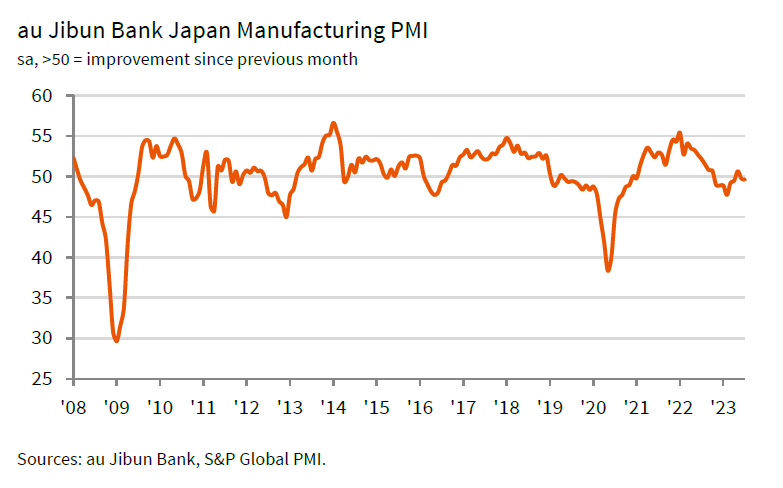
Japan PMI Manufacturing was finalized at 49.6 in July, down from June's 49.8. That also marked the second month of concurrent decline in output and new orders. Usamah Bhatti at S&P Global Market Intelligence highlighted the significant role of "quicker deterioration in new order inflows" and also "sustained" decline in production.
Despite these struggles, inflationary pressures showed signs of abating as the rate of input cost inflation was the slowest since February 2021. However, selling price inflation was "unchanged" and "sharp overall" as Japanese manufacturers passed on a portion of higher cost burdens to clients.
The industry displayed robust optimism about the future, with the second-highest positive sentiment recorded in the last 18 months, driven by expectations of a boost in domestic and international demand owing to new product launches and the ongoing mitigation of COVID-19 and inflation-related influences.