

Sample Category Title
Will BoE Go Back to 25bps Interest Rate Increments?
With inflation in the UK slowing by more than expected in June and the July PMIs revealing that UK business activity continues to weaken, investors have become increasingly convinced that the Bank of England may need to slow down the pace of its future hikes and return to 25bps increments. The Bank meets on Thursday at 11:00 GMT and it will be interesting to see whether this will be the case and how the overall outcome could affect the British pound.
BoE accelerates tightening pace in June
At its June meeting, the Bank of England decided to proceed with a 50bps rate increment amid stubbornly high inflation and mounting political pressure, reiterating the guidance that if there were evidence of more price pressures, further tightening in monetary policy would be required.
The decision and remarks by Governor Bailey in the following days that they must act to bring inflation to heel, allowed market participants back then to maintain bets of another 50bps hike at the August meeting and more than 100bps worth of additional rate increases thereafter. This put the BoE at the top spot in terms of hike expectations among other major central banks and allowed the pound to stay in the front seat in terms of year-to-date performance of the major currencies.
But data since then has come on the soft side
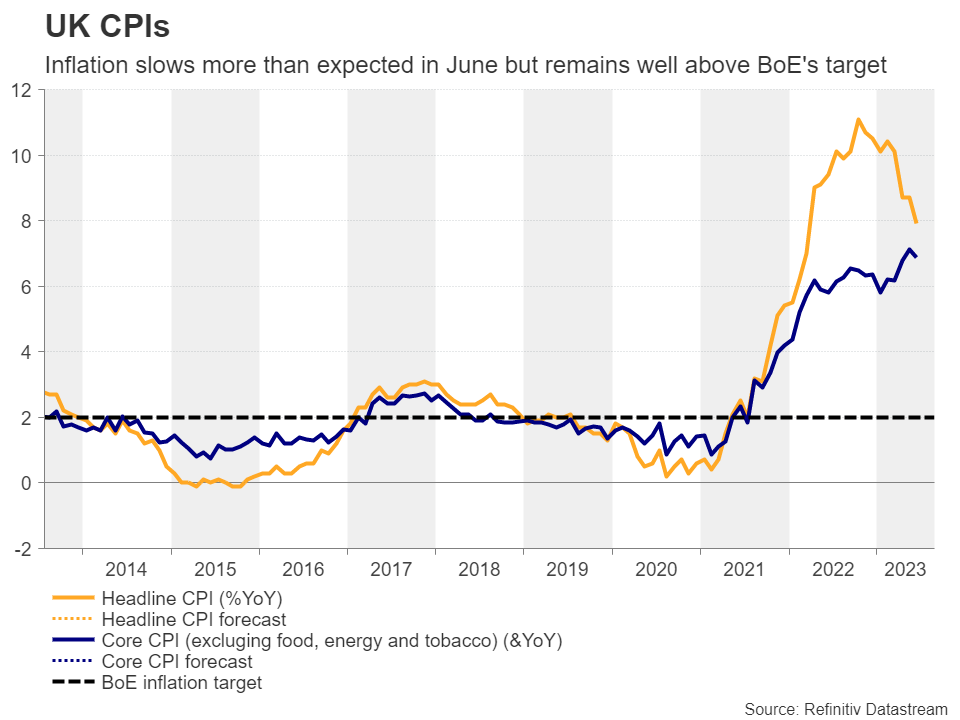
Nonetheless, investors changed their minds as soon as the inflation data for June was out. The headline CPI rate fell to 7.9% year-on-year from 8.7%, while the core one slid to 6.9% y/y from 7.1% instead of holding steady as the forecast suggested.
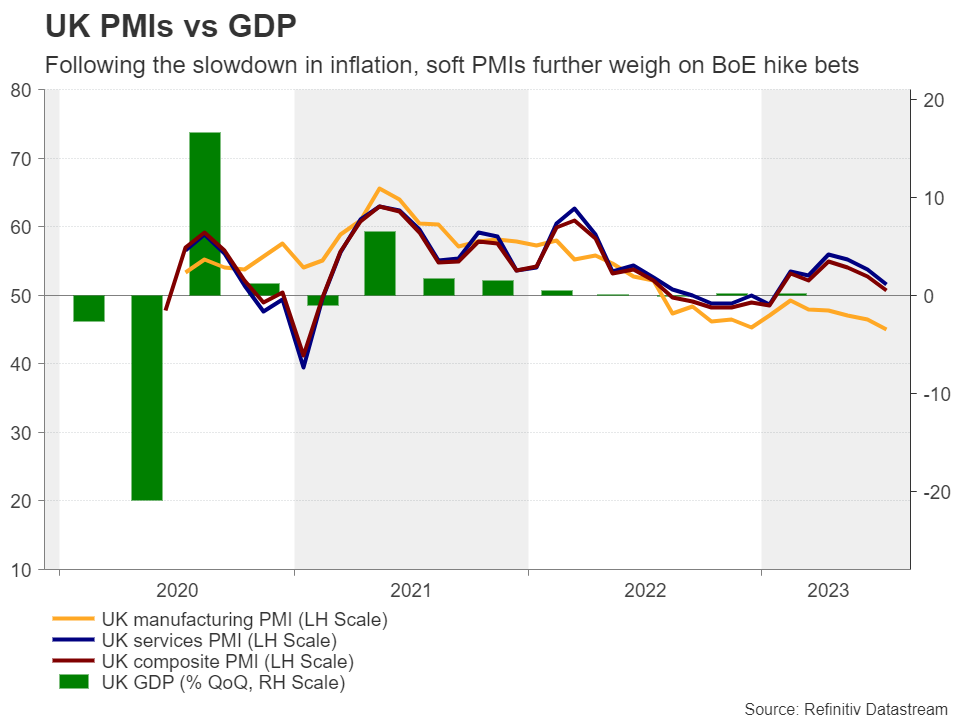
The preliminary PMIs for July revealed that business activity continued to suffer, with the manufacturing index falling further into the contractionary territory, and the composite one, although still pointing to expansion, getting closer to the boom-or-bust zone of 50. On top of that, in the composite report, it was noted that the latest round of prices charged inflation was the slowest for nearly two-and-a-half years, suggesting that inflation may continue its cooling trajectory in the months to come.
Investors expect a return back to 25bps
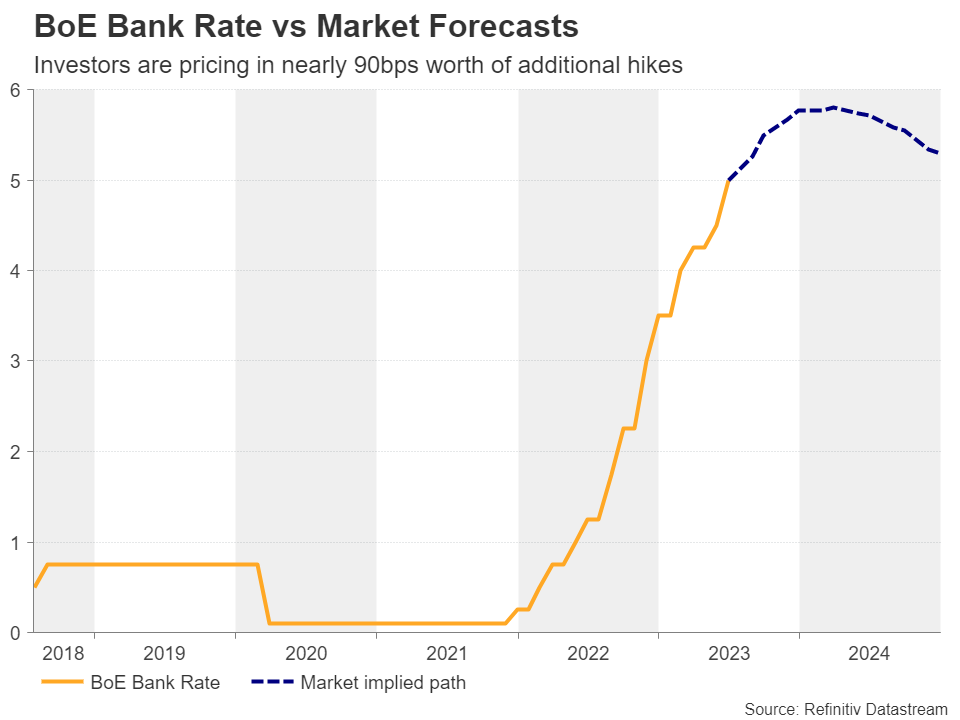
Putting all these new variables into their calculations, investors are now seeing more chances for a 25bps hike on Thursday, and they have scaled back their bets with regards to the number of basis points worth of additional increments in the next gatherings. According to the UK overnight index swaps (OIS), there is a 70% probability for a quarter-point increase on Thursday, with the remaining 30% still pointing to a double hike. As for the future, conditional upon a 25bps hike now, investors expect around 65bps worth of additional rate increases thereafter.
But market pricing could still prove supportive for the pound
Having said all that though, underlying inflation in the UK rests higher than in other major economies and more than triple the BoE’s objective. With that in mind, investors’ implied BoE path, despite being lowered lately, remains steeper than those of other major central banks.
Combined with expectations that the Fed may have concluded its own tightening crusade last week and seen cutting rates massively next year, this divergence could still work in favor of pound/dollar if the BoE remains committed to deliver more in the coming months, even if it hikes by only 25bps at this gathering. Yes, a quarter-point hike could disappoint the 30% expecting more and thereby result in a small retreat, but a hawkish message could help the pair rebound quickly and extend its prevailing uptrend.
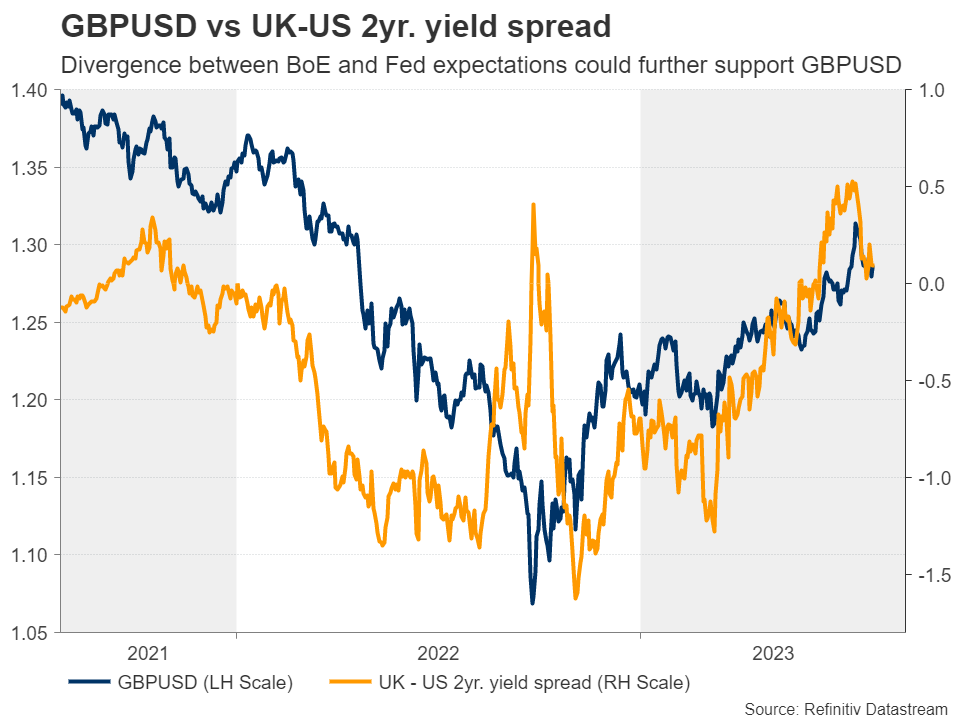
For the pound to suffer against its US counterpart post meeting, the BoE may need to signal that they are also getting closer to the end of their own tightening campaign. Now, in the case of another double hike, the pound is likely to shoot higher instantly.
Cable remains in uptrend mode, despite pullback
From a technical standpoint, Cable has been trading in an uptrend mode since the end of September, and above an upward sloping trend line since October 12. Despite pulling back lately, the pair remains above that trendline and above both the 50- and 200-day exponential moving averages (EMAs). All these technical indications keep the picture positive.
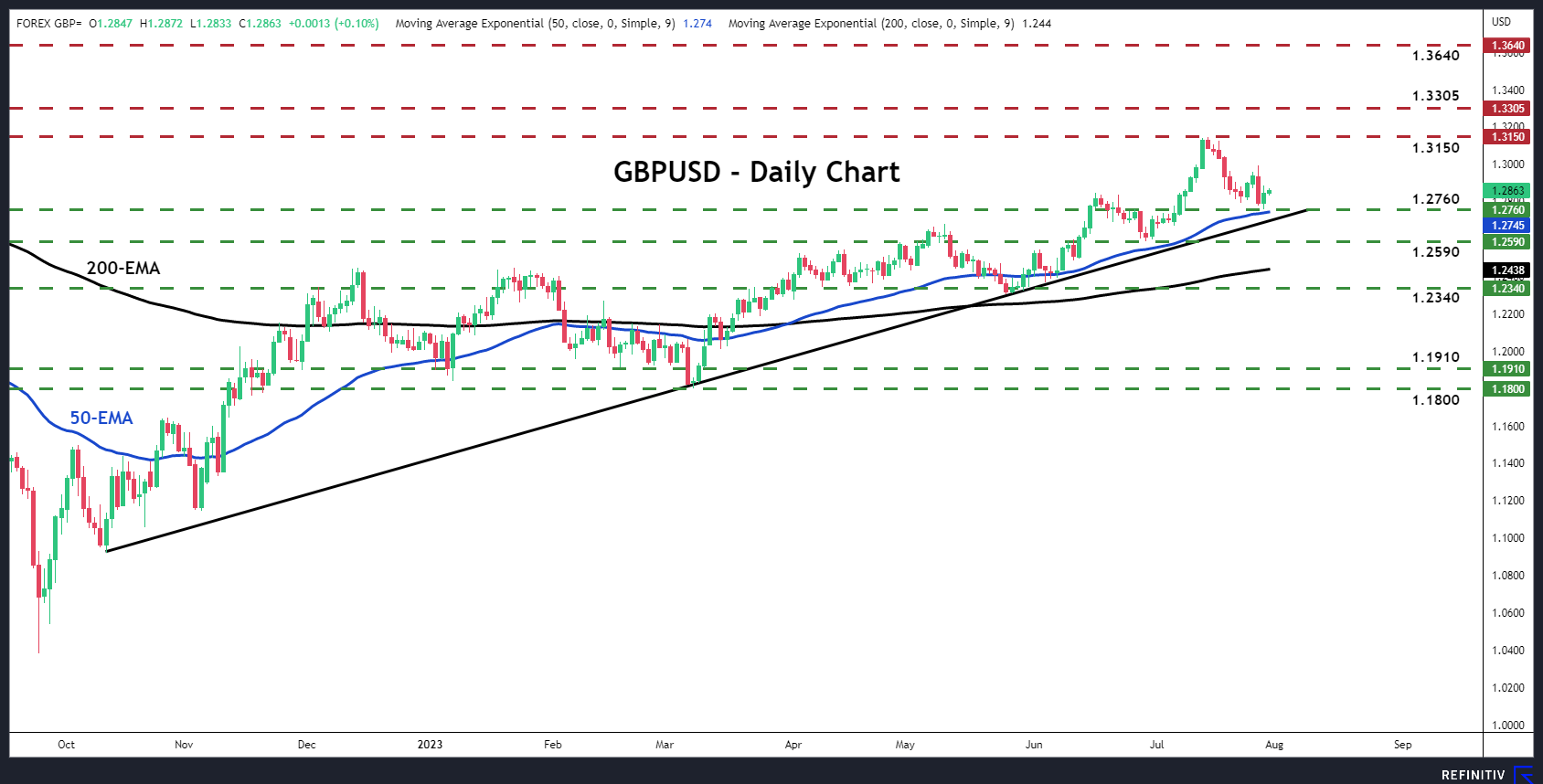
If the bulls are strong enough to recharge from near the aforementioned trendline, they could aim for another test near the high of July 14 at 1.3150. If they manage to overcome that obstacle, a higher high would be confirmed, and the 1.3305 barrier may come into play. A break higher could see scope for extensions towards the 1.3640 zone, which offered resistance in February 2022.
A dovish decision could result in a break below the uptrend line, but for a bearish reversal to be fully completed, the pair may need to fall below the 1.2340 key zone, which acted as both support and resistance in the past.
Sunset Market Commentary
Markets
European CPI numbers and Q2 GDP growth were the main (and only) dish for today. The economy expanded more-than-expected 0.3% in the previous quarter after stagnating in Q1. Compared to the same period last year, GDP is 0.6% larger. It’s only the flash reading, so changes may still take place. That said, the figure suggests the economy for the time being is weathering all sorts of headwinds rather well, including coming from the ECB’s aggressive tightening cycle and slowing growth abroad (US, China …). The upside surprise, amongst others, came after a whopping 3.3% q/q advance in Ireland and 0.5% q/q in France. Italy’s economy, on the other hand, unexpectedly contracted by 0.3%. Headline inflation, then, fell 0.1% m/m – as expected – to be up 5.3% y/y in July. It’s only a minor deceleration from the 5.5% in June. In addition, underlying price pressures remain stubborn as ever. Core inflation (ex. food and energy) came in at an unchanged 5.5%, defying expectations/hopes for even the smallest cooldown possible (5.4%). HICP m/m increased for goods, food and energy. Service price pressures hit a new record high of 5.6%. The uptick is probably to a large extend the result of German base effects as the country introduced cheap transport tickets from June to August last year. Core/services inflation is thus unlikely to drop sharply in the summer months.
As the ECB at the gathering last week adopted a data-dependent meeting-by-meeting approach, today’s releases (including GDP) keep a September rate hike firmly on the table for now. Euro area money markets need a bit more convincing though, with a final hike to 4% given a 70% chance give or take. European yields are up 1-2 bps across the curve. US yields painted a similar picture with current changes amounting to less than 1 bp. Markets’ guarded approach today isn’t surprising given the slew of (particularly US) eco data still scheduled for release this week (US ISMs, JOLTS, ADP, payrolls). The Japanese yen on currency markets is strongly underperforming global peers. EUR/JPY rises towards 156.83, nearing the previous 15-year highs of 158+. USD/JPY surpassed 142. The currency is under pressure after the BoJ announced an unscheduled bond buying operation following Friday’s yield surge (which was extended today, 30-y + 11.7 bps). At the other side of the spectrum we find the Aussie and kiwi dollar. Both profit from hopes that China will unveil additional measures to stimulate local consumption to boost the economy. EUR/USD is a tight balance currently turning slightly in favour of the common currency. The pair is filling bids in the 1.103 area. Sterling isn’t going anywhere either as it awaits the Bank of England policy meeting this Thursday.
News & Views
Czech GDP after three quarters in a row grew again in Q2 this year. The economy expanded at a nevertheless slow 0.1% q/q clip. According to the Czech statistical office (CZSO) said domestic “The quarter-on-quarter growth was contributed to by domestic demand while final consumption expenditure of households was stagnating.” Compared to the same quarter in 2022, GDP is 0.6% lower amid a negative influence from lower final household consumption and lower gross capital formation. External demand had a positive influence again, CZSO said. The Czech koruna appreciates today, extending a recent turnaround after having lost more than 4% against the euro since mid-April. EUR/CZK is currently changing hands at 23.89.
Polish CPI dropped 0.2% m/m to be up 10.8% y/y in July, down from 11.5% the month before. Expectations were for the monthly figure to flatline a third month straight while the yearly figure was estimated at 11%. Fueling the decline were food & nonalcoholic drinks (-1.2% m/m). Polish price pressures have eased since February this year, lifting market bets for a cutting cycle to start fairly soon. National Bank of Poland governor Glapinski earlier in July said a 25 bps cut was possible in September in the not so unlikely scenario inflation by then has fallen into the single digits. That’s what is currently priced in by Polish money markets today. The Polish zloty lost marginal territory in a kneejerk move lower before paring losses again. EUR/PLN (4.406) is currently still trading at the weakest (PLN strongest) level since September 2020.
EUR/USD Mid-Day Outlook
Daily Pivots: (S1) 1.0958; (P) 1.1003; (R1) 1.1061; More...
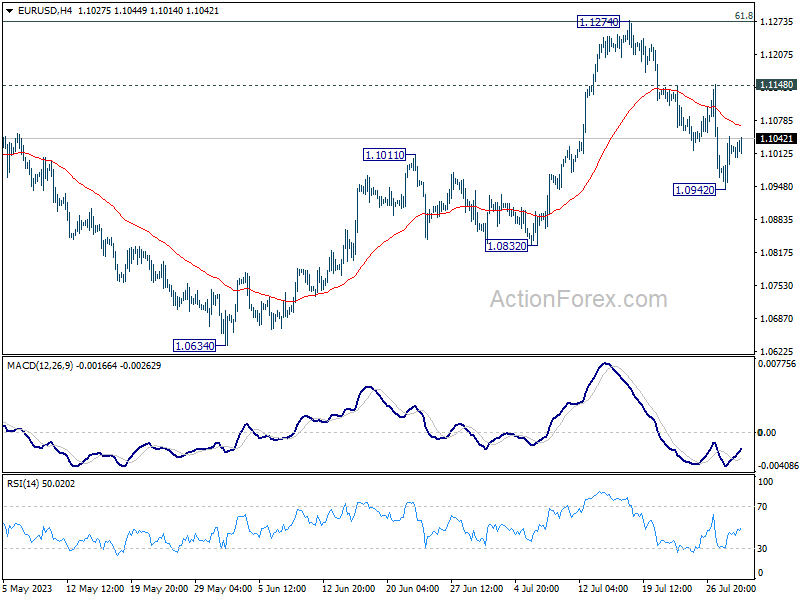
Range trading continues in EUR/USD and intraday bias stays neutral. Further fall is expected as long as 1.1148 resistance holds. Below 1.0942 will target 1.0832 support next. Nevertheless, break of 1.1148 will argue that the decline has completed and bring retest of 1.1274 high.
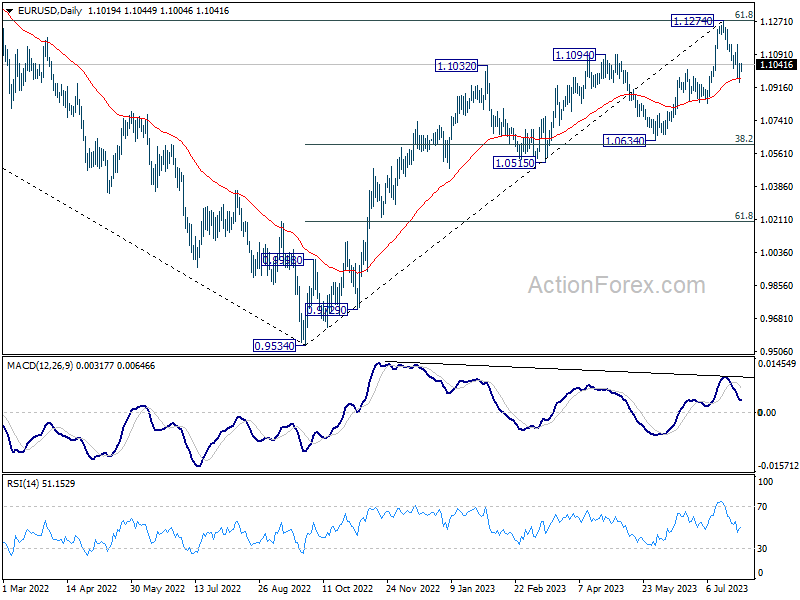
In the bigger picture, a medium term top could be formed at 1.1274, after failing to break through 61.8% retracement of 1.2348 (2021 high) to 0.9534 at 1.1273 decisively, on bearish divergence condition in D MACD. Sustained trading below 55 D EMA (now at 1.0963) will bring deeper correction to 1.0634 cluster support (38.2% retracement of 0.9534 to 1.1274 at 1.0609). Strong support could be seen there, at least on first attempt, to set the range for consolidation.
GBP/USD Mid-Day Outlook
Daily Pivots: (S1) 1.2780; (P) 1.2834; (R1) 1.2904; More...
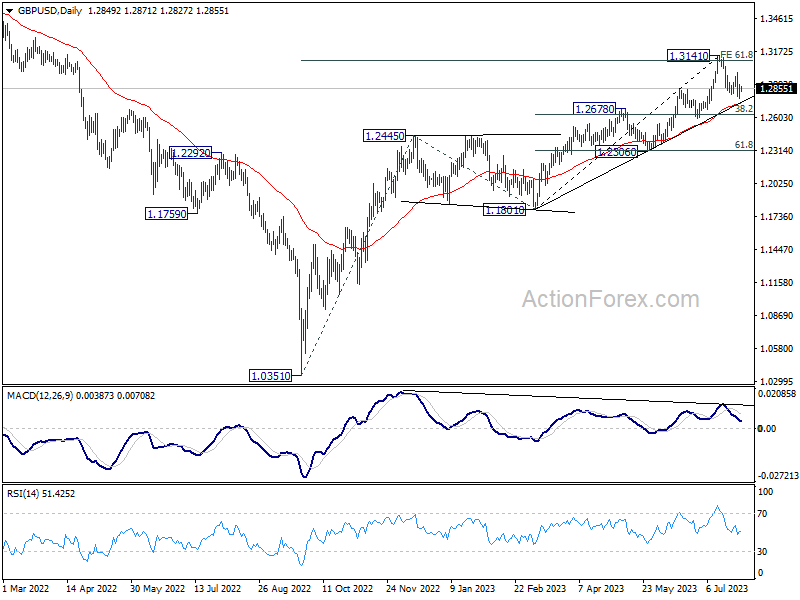
Range trading continues in GBP/USD and intraday bias stays neutral. Further decline is in favor as long as 1.2994 resistance holds. Break of 1.2761 will target 55 D EMA (now at 1.2720) and below. Nevertheless, on the upside, break of 1.2994 resistance will argue that the pull back has completed, and bring retest of 1.3141 high.
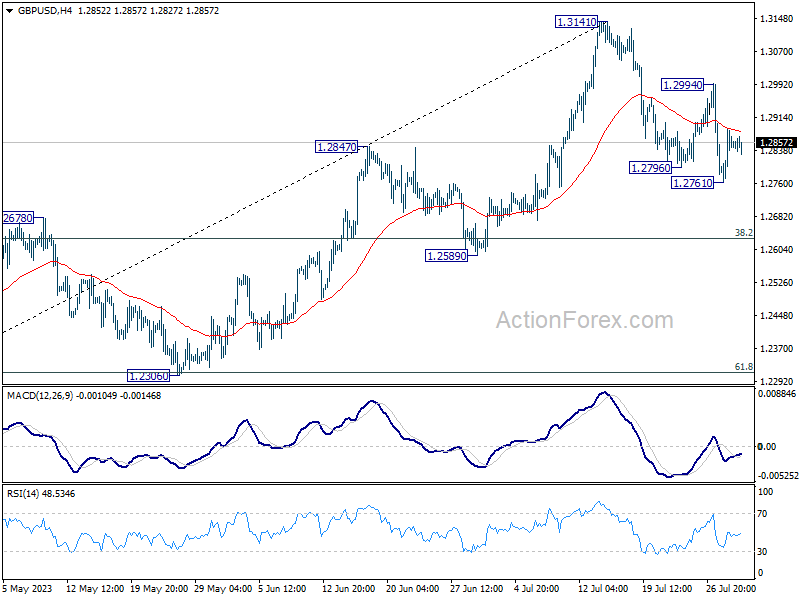
In the bigger picture, as long as 1.2678 resistance turned support holds, rise from 1.0351 (2022 low) is expected to continue. Next target is 100% projection of 1.0351 to 1.2445 from 1.1801 at 1.3895. However, sustained break of 1.2678 will argue that it's at least correcting this rally, with risk of bearish reversal.
USD/CHF Mid-Day Outlook
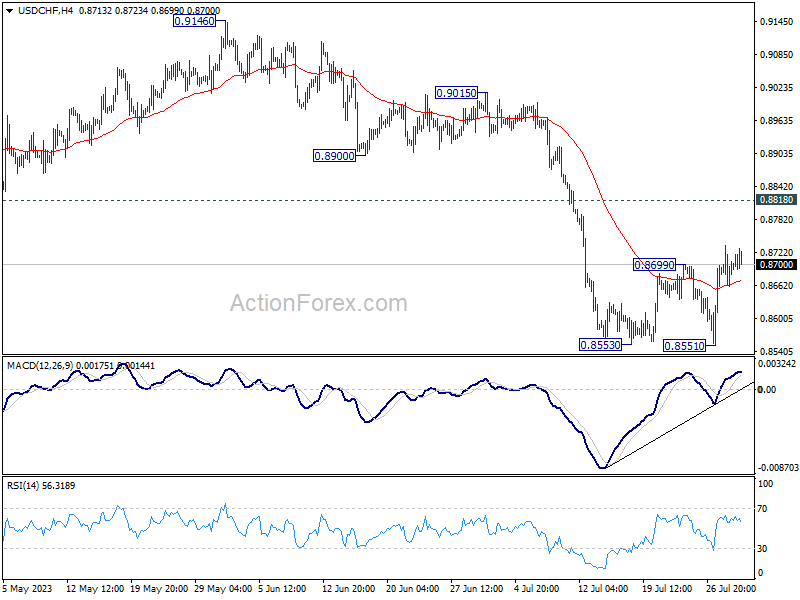
Daily Pivots: (S1) 0.8665; (P) 0.8701; (R1) 0.8740; More....
USD/CHF's rebound from 0.8551 is in progress, and intraday bias stays on the upside for further rise. But strong resistance could be seen from 0.8818 support turned resistance to complete the recovery and bring down trend resumption. On the downside, firm break of 0.8551 will resume larger down trend from 1.0146, targeting 0.8317 fibonacci level.
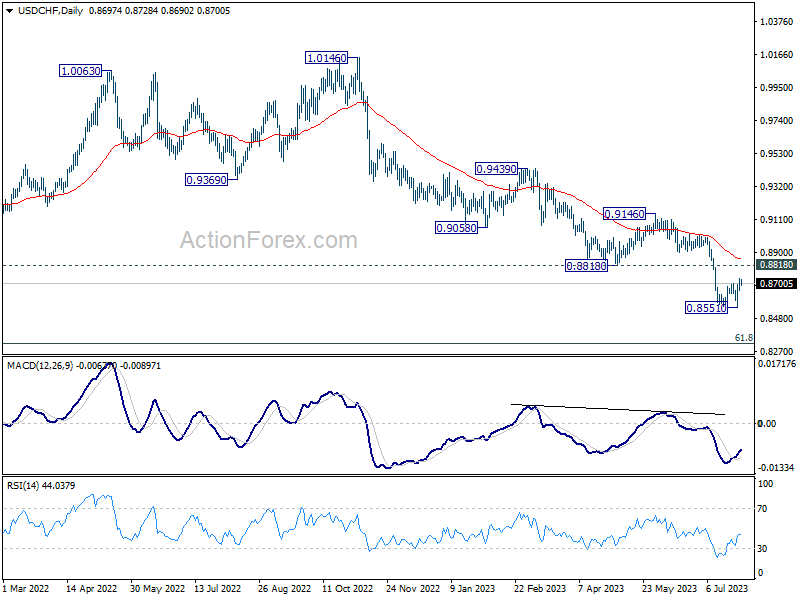
In the bigger picture, down trend from 1.0146 is seen as in progress as long as 0.8188 support turned resistance holds. Next target is 61.8% retracement of 0.7065 (2011 low) to 1.0342 (2016 high) at 0.8317. However, sustained break of 0.8818 will be the first sign of medium term bottoming, and turn focus back to 0.9146 resistance for confirmation.
USD/JPY Mid-Day Outlook
Daily Pivots: (S1) 139.10; (P) 140.14; (R1) 142.21; More...
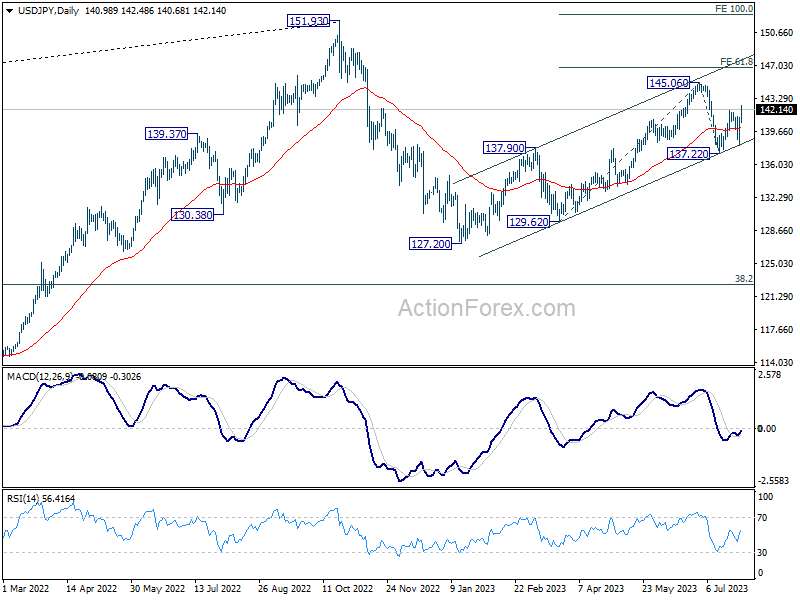
Intraday bias in USD/JPY remains on the upside for retesting 145.60. Firm break there will resume whole rally from 172.20. Next target is 61.8% projection of 129.62 to 145.06 from 137.22 at 146.76. On the downside, below 140.68 minor support will mix up the outlook and turn intraday bias neutral first.
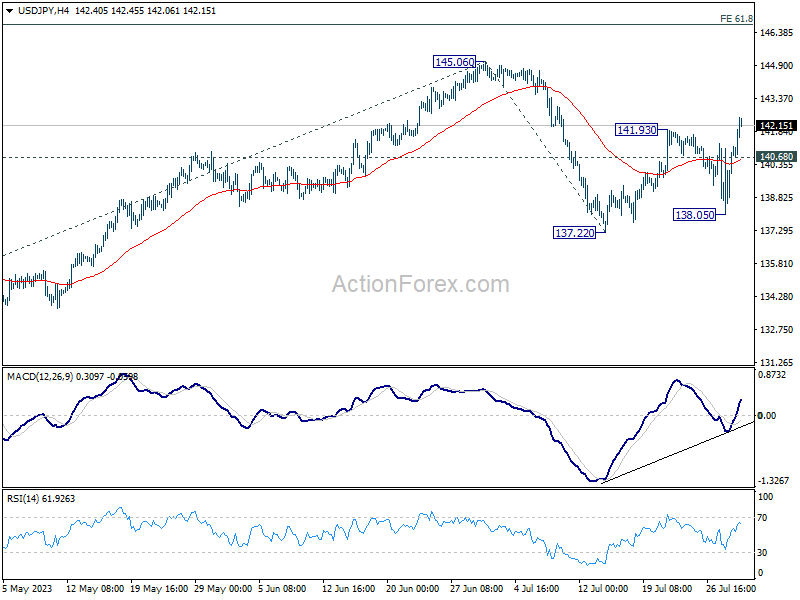
In the bigger picture, overall price actions from 151.93 (2022 high) are views as a corrective pattern. Rise from 127.20 is seen as the second leg of the pattern and could still be in progress. But even in case of extended rise, strong resistance should be seen from 151.93 to limit upside. Meanwhile, break of 137.22 support should confirm the start of the third leg to 127.20 (2023 low) and below.
Copper Takes Aussie Higher ahead of RBA
Commodity currencies are trading generally higher today on mildly positive market sentiment. Australian Dollar is the stronger one among them, ahead of RBA's rate decision tomorrow. Opinions on whether RBA would hike by 25bps next month (i.e. August 1 tomorrow) are divided . Major local banks exhibit this split sentiment, with Commonwealth Bank and Westpac predicting a 25bps hike, while ANZ and NAB foresee a pause. Still, it's actually more of a question of timing on whether the final hike will be delivered tomorrow or later in September. The rally in Copper prices is more likely the primary driver behind Aussie's rebound.
Elsewhere in the currency markets, European majors are mixed for now. But Euro does ride on slightly stronger than expected core inflation reading to rally against Swiss Franc. Yen is the worst performer, followed by Franc and then Dollar. The selloff in Yen is so far steady, and thus, it's likely to continue for a while. Dollar will need some strong ISM and NFP readings to revive its near term rebound, except versus the weak Yen.
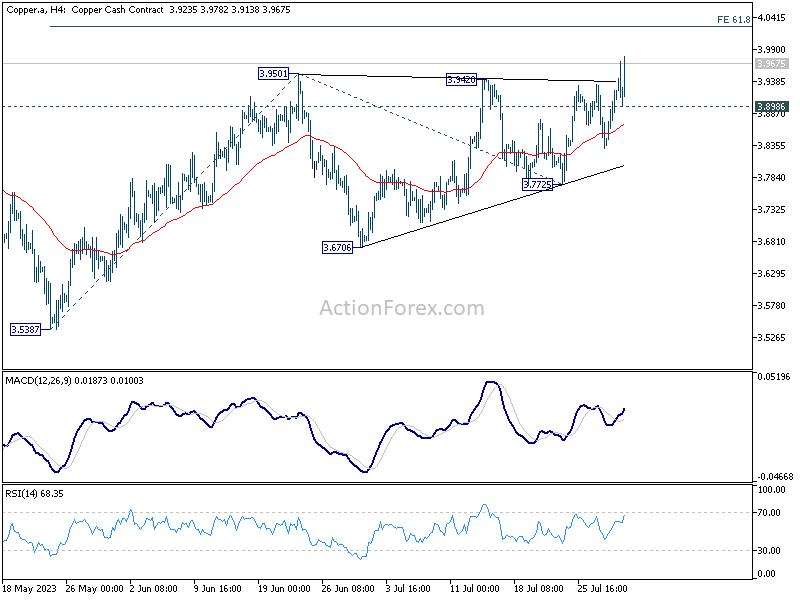
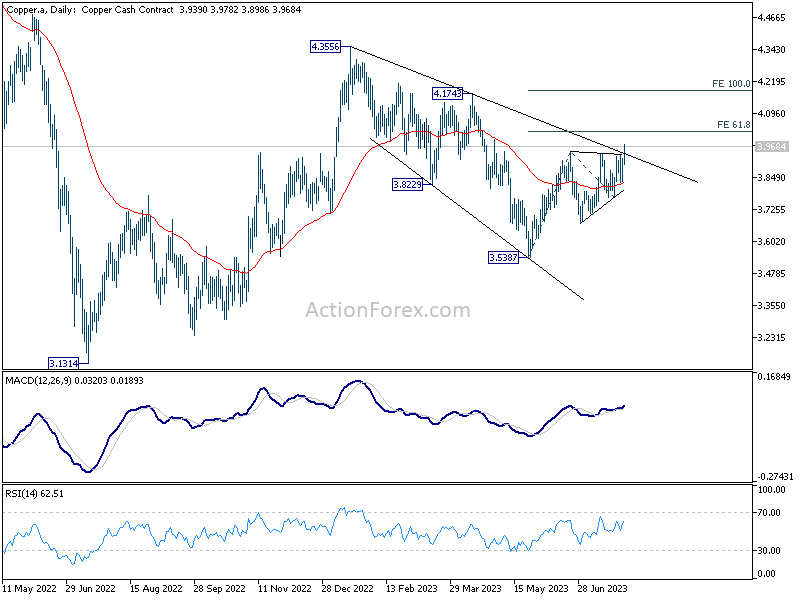
Technically, Copper's solid rally today should confirm resumption of rise from 3.5387. It also affirms the case that corrective decline from 4.3556 has completed at 3.5387. Further rise is now expected, as long as 3.8986 minor support holds, to 61.8% projection of 3.5387 to 3.9501 from 3.7725 at 4.0267. Firm break there will solidify this bullish case and target 100% projection at 4.1839. Also, strong break of 4.0267 in Copper will give Aussie a solid boost this week, regardless of tomorrow's RBA decision.
In Europe, at the time of writing, FTSE is up 0.07%. DAX is up 0.19%. CAC is up 0.47%. Germany 10-year yield is up 0.0146 at 2.505. Earlier in Asia, Nikkei rose 1.26%. Hong Kong HSI rose 0.82%. China Shanghai SSE rose 0.46%. Singapore Strait Times rose 0.08%. Japan 10-year JGB yield rose 0.0531 to 0.603.
Eurozone GDP grew 0.3% qoq in Q2, EU flat
Eurozone GDP grew 0.3% qoq in Q2, above expectation of 0.2% qoq. EU GDP was flat at 0.0% qoq.
Among the Member States for which data are available, Ireland (+3.3%) recorded the highest increase compared to the previous quarter, followed by Lithuania (+2.8%). Declines were recorded in Sweden (-1.5%), in Latvia (-0.6%), in Austria (-0.4%) and in Italy (-0.3%).
The growth rates compared to the same quarter of the previous year were positive for seven countries, with the highest values observed for Ireland (+2.8%), Portugal (+2.3%) and Spain (+1.8%). The highest declines were recorded for Sweden (-2.4%), Czechia (-0.6%) and Latvia (-0.5%).
Eurozone CPI slowed to 5.3.% in Jul, core unchanged at 5.5%
Eurozone CPI slowed from 5.5% yoy to 5.3% yoy in July, matched expectations. CPI core (excluding energy, food, alcohol & tobacco) was unchanged at 5.5% yoy, above expectation of 5.4% yoy.
Looking at the main components, food, alcohol & tobacco is expected to have the highest annual rate in July (10.8%, compared with 11.6% in June), followed by services (5.6%, compared with 5.4% in June), non-energy industrial goods (5.0%, compared with 5.5% in June) and energy (-6.1%, compared with -5.6% in June).
Japan's industrial production rose 2.0% mom in Jun, moderately picking up
Japan's Ministry of Economy, Trade and Industry reported 2.0% mom increase in industrial production in June, below expected 2.4%. This places the seasonally adjusted index of production at factories and mines at 105.3, with 2020 as the base of 100.
Motor vehicles led industrial production growth, surging 6.1% thanks to robust demand in both domestic and overseas markets. Out of 15 industrial sectors covered , 10 sectors saw increased output, while production in five dropped.
Despite the production growth coming in lower than expected, the Ministry maintained its basic assessment, noting that industrial production was "showing signs of moderately picking up."
Looking ahead, the Ministry's forecast based on a poll of manufacturers anticipates slight output decline of -0.2% in July, followed by climb of 1.1% in August.
Also released, retail sales rose 5.9% yoy in June, above expectation of 5.4% yoy, picked up from prior month's 5.7% yoy.
China's PMI manufacturing ticked up to 49.3, but marked 4th month of contraction
China's official Manufacturing PMI rose from 49.0 in June to 49.3 in July, slightly above anticipated 49.2. However, it marked the fourth consecutive month that this indicator remained below the 50-point mark separating expansion from contraction on a monthly basis.
Zhao Qinghe, a senior NBS official, indicated that while there was a slight rebound, many enterprises reported experiencing a "complicated and severe" external environment. In his statement, Zhao stated, "overseas orders have decreased, and insufficient demand is still the main difficulty faced by enterprises."
Meanwhile, Non-Manufacturing PMI, which measures activity in both services and construction sectors, dropped from 53.32 to 51.5, missing the expected 53.1, marking its fourth straight monthly decline. The services subindex fell from 52.8 to 51.5, while the construction subindex saw a significant drop from 55.7 to 51.2.
Composite PMI, which provides a broader picture of the economy, also declined from 52.3 in June to 51.1 in July, reflecting the challenges faced by both the manufacturing and non-manufacturing sectors.
NZ ANZ business confidence rose to -13.1, highest since Sep 2021
New Zealand's business confidence has reached its highest point since September 2021, with ANZ Business Confidence Index improved from -18.0 to -13.1. Although this remains in the negative territory, it shows a relative boost in optimism.
Looking at the details, Own Activity Outlook, a measure of businesses' expectations of their own activity, experienced a slight drop from 2.7 to 0.8. However, various components of the index witnessed improvements. Export intentions increased from -1.8 to 1.5, indicating a renewed confidence in overseas markets. Both investment and employment intentions showed minor improvements.
Inflation indicators were mixed, with cost expectations climbing from 76.0 to 80.6, while inflation expectations saw a slight ease from 5.29% to 5.14%. At the same time, profit expectations and pricing intentions edged slightly lower.
Despite expecting a recession and rising unemployment, ANZ's view on the current economic environment is that it's "patchy rather than capitulating," suggesting that although there are definite challenges ahead, New Zealand's economy might show more resilience than expected.
USD/JPY Mid-Day Outlook
Daily Pivots: (S1) 139.10; (P) 140.14; (R1) 142.21; More...
Intraday bias in USD/JPY remains on the upside for retesting 145.60. Firm break there will resume whole rally from 172.20. Next target is 61.8% projection of 129.62 to 145.06 from 137.22 at 146.76. On the downside, below 140.68 minor support will mix up the outlook and turn intraday bias neutral first.
In the bigger picture, overall price actions from 151.93 (2022 high) are views as a corrective pattern. Rise from 127.20 is seen as the second leg of the pattern and could still be in progress. But even in case of extended rise, strong resistance should be seen from 151.93 to limit upside. Meanwhile, break of 137.22 support should confirm the start of the third leg to 127.20 (2023 low) and below.
Economic Indicators Update
| GMT | Ccy | Events | Actual | Forecast | Previous | Revised |
|---|---|---|---|---|---|---|
| 23:50 | JPY | Industrial Production M/M Jun P | 2.00% | 2.40% | -2.20% | |
| 23:50 | JPY | Retail Trade Y/Y Jun | 5.90% | 5.40% | 5.70% | |
| 01:00 | CNY | NBS Manufacturing PMI Jul | 49.3 | 49.2 | 49 | |
| 01:00 | CNY | Non-Manufacturing PMI Jul | 51.5 | 53.1 | 53.2 | |
| 01:00 | NZD | ANZ Business Confidence Jul | -13.1 | -18 | ||
| 01:00 | AUD | TD Securities Inflation M/M Jul | 0.80% | 0.10% | ||
| 01:30 | AUD | Private Sector Credit M/M Jun | 0.20% | 0.40% | 0.40% | |
| 05:00 | JPY | Housing Starts Y/Y Jun | -4.80% | -0.20% | 3.50% | |
| 05:00 | JPY | Consumer Confidence Index Jul | 37.1 | 37 | 36.2 | |
| 06:00 | EUR | Germany Import Price Index M/M Jun | -1.60% | -0.80% | -1.40% | |
| 06:00 | EUR | Germany Retail Sales M/M Jun | -0.80% | -0.20% | 0.40% | 1.90% |
| 08:00 | EUR | Italy GDP Q/Q Q2 P | -0.30% | 0.00% | 0.60% | |
| 08:30 | GBP | Mortgage Approvals Jun | 55K | 49K | 51K | |
| 08:30 | GBP | M4 Money Supply M/M Jun | -0.10% | 0.50% | 0.20% | |
| 09:00 | EUR | Eurozone GDP Q/Q Q2 P | 0.30% | 0.20% | -0.10% | |
| 09:00 | EUR | Eurozone CPI Y/Y Jul P | 5.30% | 5.30% | 5.50% | |
| 09:00 | EUR | Eurozone CPI Core Y/Y Jul P | 5.50% | 5.40% | 5.50% | |
| 13:45 | USD | Chicago PMI Jul | 43.5 | 41.5 |
AUD/USD Technical Analysis
On the hourly chart of AUD/USD at FXOpen, the pair gained bearish momentum below the 0.6720 zone. The Aussie Dollar entered a bearish zone after breaking below the 0.6680 support level.
The pair even settled below the 50-hour simple moving average and tested 0.6620. AUD/USD is now consolidating losses and facing resistance near the 0.6680 level. The first breakout zone could be near the 50-hour simple moving average or 0.6720.
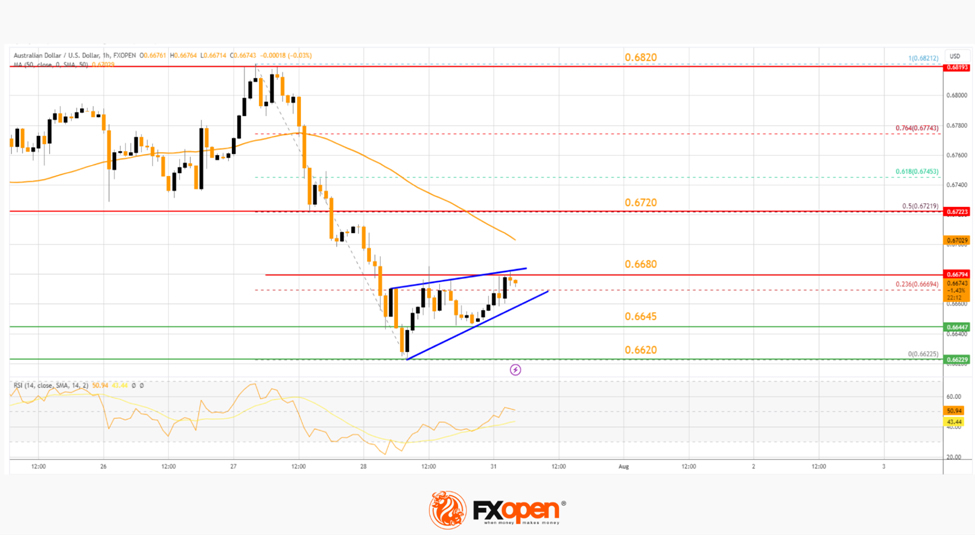
If there is an upside break above the 0.6720 zone, the pair could rise steadily toward the 0.6820 level. Any more gains might send AUD/USD toward 0.6840.
Conversely, the pair could start a fresh decline below 0.6645. The first major support is near the 0.6620 level, below which the pair could drop toward 0.6600. Any more losses might send AUD/USD toward the 0.6565 support.
This article represents the opinion of the Companies operating under the FXOpen brand only. It is not to be construed as an offer, solicitation, or recommendation with respect to products and services provided by the Companies operating under the FXOpen brand, nor is it to be considered financial advice.
EURUSD Correction Halts as Overall Technical Picture Unclear
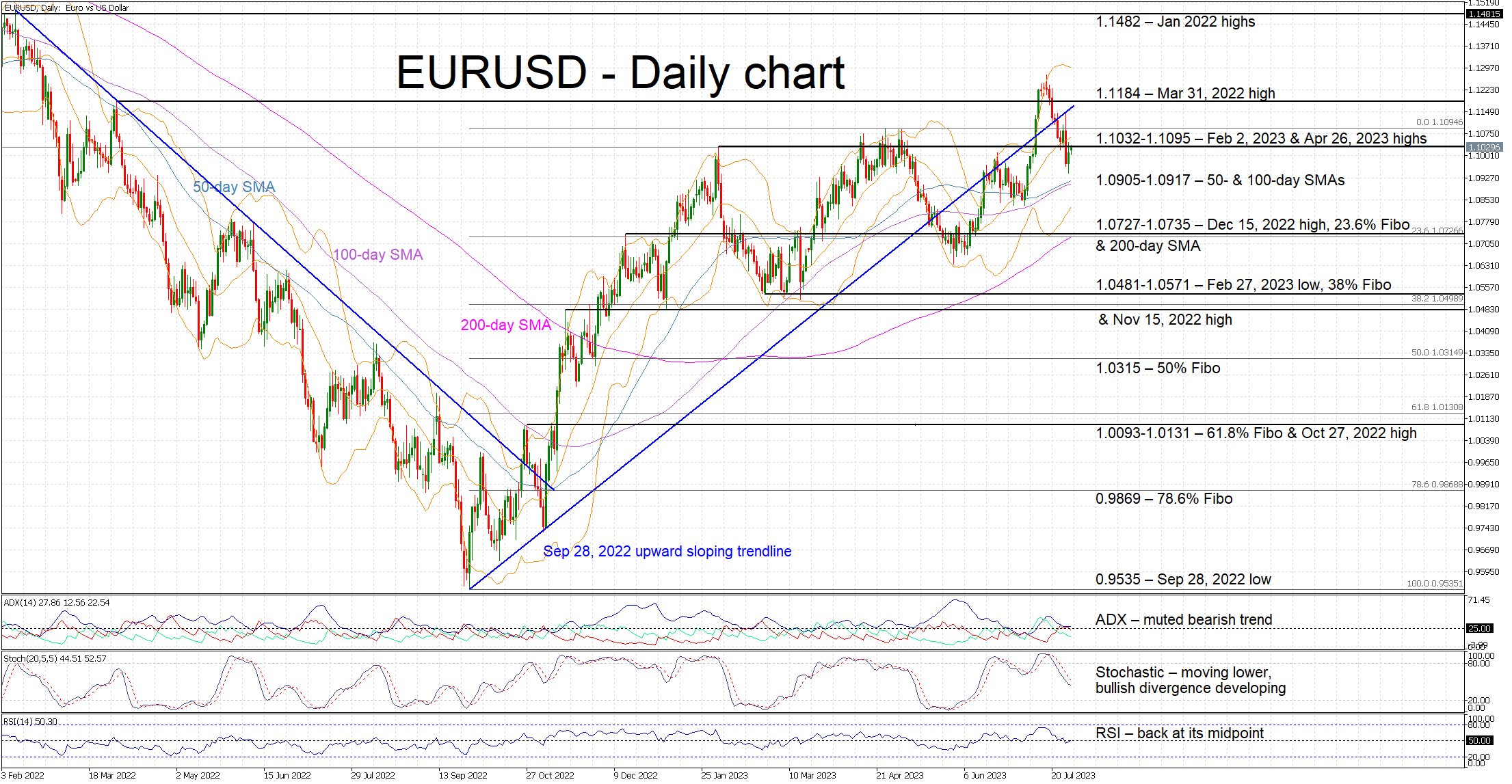
EURUSD is edging higher today as it is trying to find its footing following an eventful week. The pair is hovering a tad below the busy 1.1032-1.1095 area and remains comfortably below the September 28, 2022 upward sloping trendline. The convergence of the 50- and 100-day simple moving averages (SMAs) persists and thus keeps the door open to a sizeable move soon.
In the meantime, most momentum indicators appear to have reset following their recent decent moves. The Average Directional Movement Index (ADX) is slightly above its 25-threshold and thus pointing to a muted bearish trend in the market, and the RSI is again hovering around its midpoint. More interestingly, the stochastic oscillator is moving lower and has built a good gap from its moving average. However, the current lower low in the stochastic has been met by a higher low in EURUSD, giving rise to the formation of a bullish divergence.
Should the bulls try to take advantage of the stochastic’s developing divergence, they would aim for a move above the busy 1.1032-1.1095 range that is populated by the February 2, 2023 and April 26, 2023 highs respectively. They would then have the chance of testing the resistance set by the September 28, 2022 upward sloping trendline, a tad below the March 31, 2022 high at 1.1184.
On the flip side, the bears are looking for a continuation of the current downleg. If they manage to successfully defend the 1.1032-1.1095 range, they could then have a go at the 1.0905-1.0917 area. This appears to be a strong support region as it is defined by the 50- and 100-day SMAs. Even lower, the path remains tricky with the next key area coming at the 1.0727-1.0735 range.
To conclude, EURUSD bears appear to be still in control, but the developing bullish divergence could quickly reverse market sentiment.
EUR/GBP Technical: Recent Downside Momentum Subsided
- The 4-hour RSI oscillator has traced out a bullish divergence condition at its oversold region.
- A break above the 50-day moving average now acts as a 0.8600 intermediate resistance may rekindle another leg of short-term rebound for EUR/GBP.
- The next resistance stands at 0.8720 which is also the 200-day moving average.
The recent 157 pips slide seen on the EUR/GBP cross pair from its 0.8701 high printed on 19 July 2023 to 27 July 2023 intraday low of 0.8544 has managed to find support at the former medium-term descending channel resistance from 26 April 2023 high now turns pull-back support at the 0.8550 level.
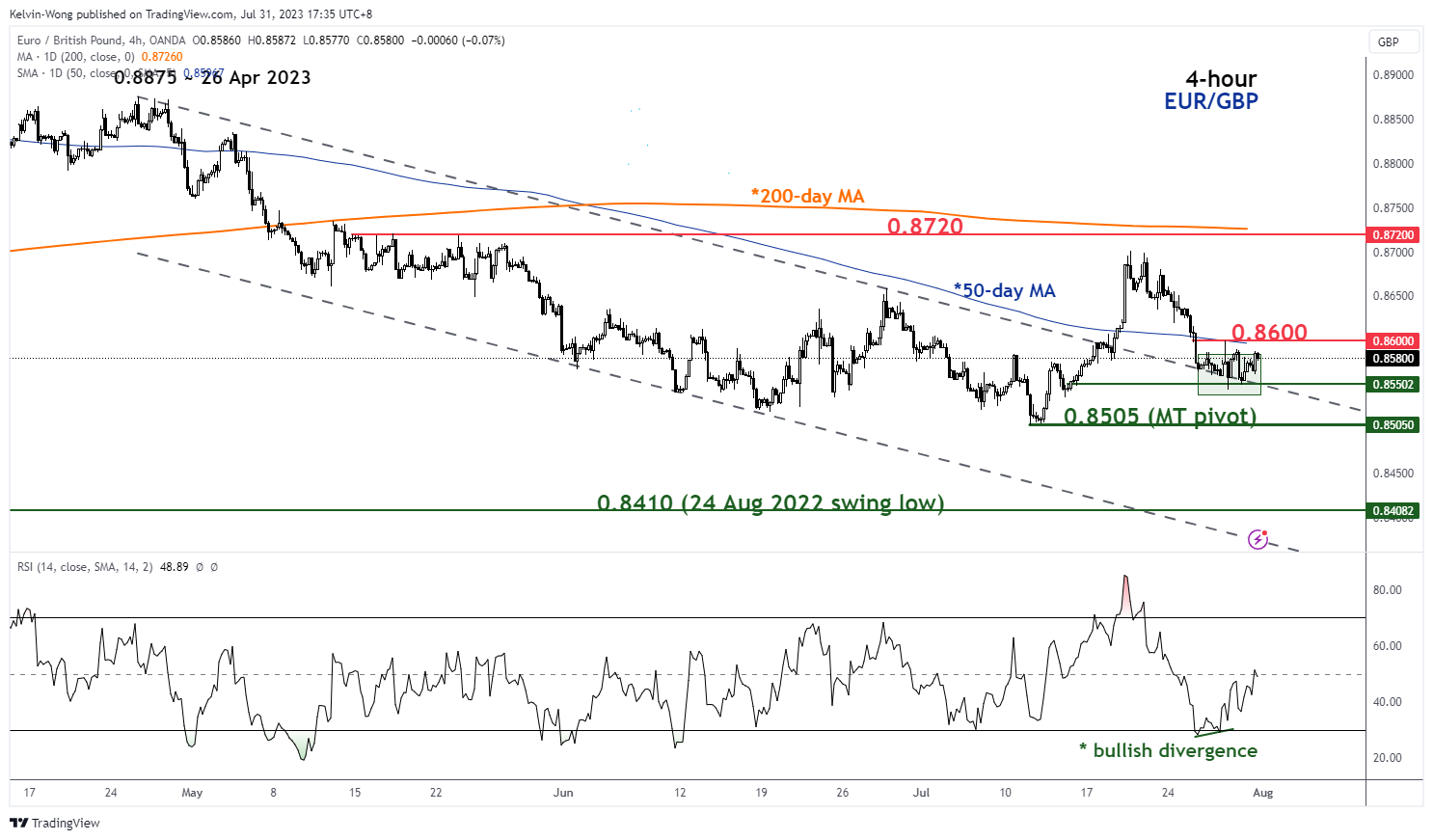
EUR/GBP short-term trend as of 31 Jul 2023 (Source: TradingView, click to enlarge chart)
In addition, the 4-hour RSI oscillator has shaped a bullish divergence condition at its oversold region and inched backed up above the 50 level today, 31 Jul which suggests that short-term downside momentum has eased.
A clearance above the intermediate resistance of 0.8600 (also the 50-day moving average) sees the next resistance coming at 0.8720 (congestion area of 13 May to 23 May 2023 & 200-day moving average).
On the flip side, a break below 0.8505 key medium-term pivotal support invalidates the short-term rebound scenario to expose the next support at 0.8410.