Sample Category Title
Weekly Economic & Financial Commentary:
Summary
United States: Economic Resilience Suggests the Fed Has More Work to Do
- Chair Powell noted this week in Congressional testimony that economic activity has been resilient in the face of higher interest rates, suggesting there is more work to be done by policymakers in order to achieve their 2% inflation target. Housing was the dominant theme this week and intimated the housing market is holding up reasonably well in the face of higher interest rates and the potential for recession early next year.
- Next week: Durable Goods (Tue.), New Home Sales (Tue.), Personal Income & Spending (Fri)
International: Bank of England Revs Up Rate Hikes
- In the wake of disappointing inflation news in recent months, the Bank of England (BoE) this week decided to deliver a large 50 bps policy rate hike to 5.00%. The BoE's hand was essentially forced by especially rapid inflation in recent months, including a May CPI that quickened to 7.1% year-over-year. We doubt wage or price inflation will cool substantially by the time of the Bank of England's August announcement, and expect the U.K. central bank to deliver another 50 bps rate increase, to 5.50%, at that meeting. Beyond that, we also see a 25 bps hike to 5.75% in September, which we expect to be the peak for the current cycle.
- Next week: Riksbank Policy Rate (Thu.), China PMIs (Fri.), Eurozone CPI (Fri.)
Credit Market Insights: H8 to See You Go, Commercial Bank Loans Are Declining
- Credit conditions have tightened in the weeks since the advent of turmoil in the U.S. financial sector and giving the Fed more to consider in its deliberations over the future path of interest rates. Recently released H8 data depict a downward trend in the loans and leases of commercial banks in the U.S. during the weeks since these events, driven primarily by a deceleration in C&I loans.
Topic of the Week: Chairman Powell Reveals a Touch of Grey
- As mandated by the Federal Reserve Reform Act of 1977, Chair Jerome Powell presented the Federal Reserve's semiannual monetary policy report to the House of Representatives and Senate this week.
Week Ahead – Euro and Bleeding Yen Brace for Inflation Tests
With all the major central bank decisions behind us, the spotlight next week will turn to a new round of inflation releases. The euro has been riding high this month, but whether it still has some miles left in the tank will depend on what the inflation data spells for ECB policy. Meanwhile, the yen has been demolished and since FX intervention seems unlikely, it might take a serious acceleration in Japanese inflation to stop the bleeding.
Can the euro keep going?
It’s been a solid month for the euro, which has capitalized on bets that the European Central Bank will raise interest rates further than previously expected. Despite mounting signs that inflation is cooling off and economic activity is stagnating, the ECB still decided to telegraph its intentions for higher rates.
Ultimately this precommitment might prove to be a mistake since it ties the ECB’s hands, but for now, the rally in European yields has turned the euro into a more attractive investment destination. Another blessing for the euro has been the weakness in the US dollar, and even more so in the Japanese yen lately. After all, FX is a relative game.
Looking ahead, the question is whether there is still some juice left in the euro’s rally. That might be decided by the inflation report on Friday and what it implies for the ECB’s path. Inflation has been steadily declining this year and the latest business surveys suggest this trend continued in June, with selling prices rising at the slowest pace in over two years.
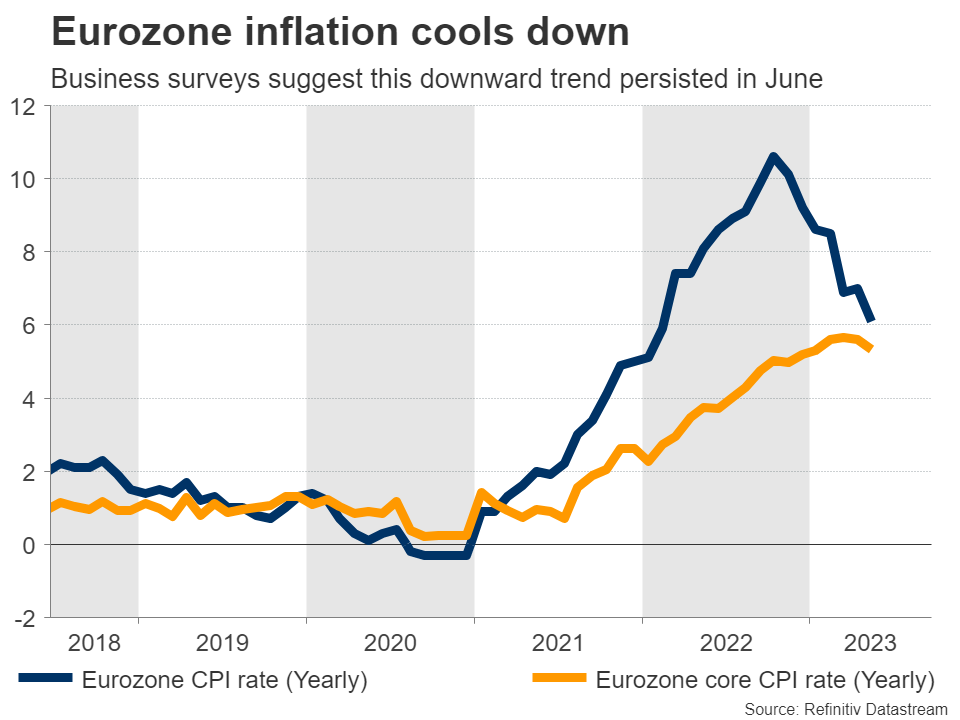
Markets are already pricing in another two rate increases over the coming months, and admittedly, it will be extremely difficult for the ECB to exceed those expectations amid slowing inflation and with the economy already in a mild technical recession.
Therefore, the euro might not be able to count on any further support from monetary policy. It could still advance if other major currencies keep depreciating, but the rally is unlikely to receive any more ‘fuel’ from the euro side of the equation.
Ahead of the Eurozone-wide flash CPI print on Friday, investors will get a taste of what to expect from the German numbers on Thursday.
Sinking yen turns to inflation data for help
Over in Japan, the yen has been devastated by the Bank of Japan’s refusal to tighten monetary policy. Naturally, the yen’s losses have been heavier against currencies that are backed up by hawkish central banks, hence the parabolic moves in euro/yen and pound/yen.
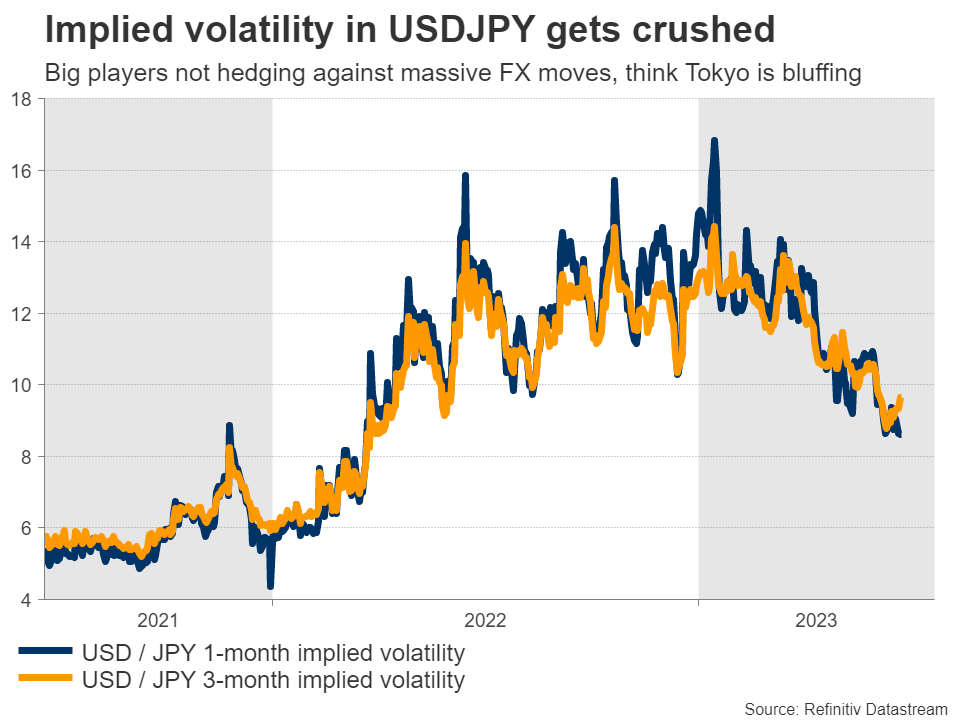
With the currency in freefall, Japanese authorities have stepped up their warnings about FX intervention, but market participants don’t seem to believe them. Implied volatility in dollar/yen has been falling for months now, so bank dealers and investment managers are not panic-hedging against any massive movements in the yen.
Indeed, the intervention rhetoric from Japanese officials has not reached ‘peak levels’ either. So far, the finance minister has refrained from using phrases that would suggest intervention is imminent. Instead, he has been more measured with his comments, which makes the risk of FX intervention appear relatively low for now.
As such, for the yen to stand any chance of a comeback, it would need to rely on speculation that the Bank of Japan might adjust its policy settings next month. This puts extra emphasis on the CPI inflation numbers for Tokyo, which will hit the markets on Friday.
The Tokyo core CPI rate is projected to have risen in June, although just barely. Such an increase probably wouldn’t be enough to get the markets excited about a BoJ policy shift in July, which suggests the yen might continue to suffer for a while longer.
Dollar eyes PCE inflation
In the United States, the show will get started on Tuesday with the release of durable goods orders and new home sales for May, ahead of the core PCE price index on Friday, which will be released alongside personal consumption and income numbers for the same month.
There is a game of chicken being played between Fed officials and market participants in recent weeks, with policymakers telegraphing another two rate increases for this year but investors only pricing in one. As such, the persistence of inflationary pressures will decide who is right, driving the dollar accordingly.
Overall, the greenback has been under some pressure this month, partly because of the market’s skepticism about the Fed’s hawkish signals and partly because of the euphoric tone in stock markets that has diminished safe-haven flows.
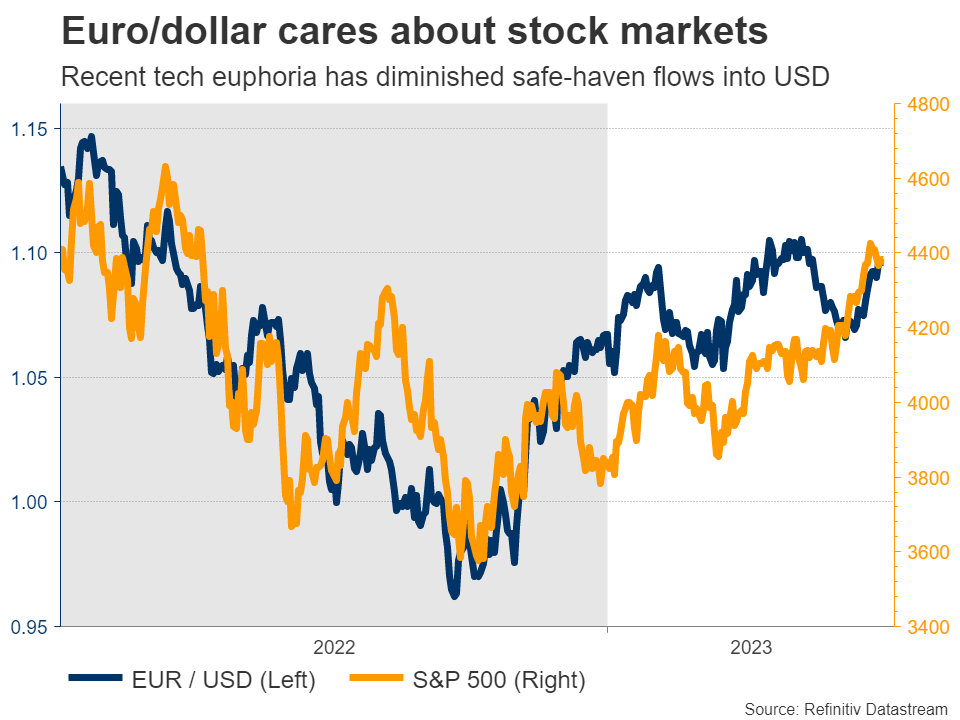
Yet, there is some scope for a dollar recovery moving forward, since the US economy seems much more resilient than its competitors and the summer months could be marked by tighter liquidity conditions as the Treasury continues to raise its cash levels.
Finally in neighboring Canada, inflation stats for May are out on Tuesday. The loonie has advanced lately despite the decline in oil prices, mostly on the back of hawkish signals from the Bank of Canada, so the inflation report will be crucial in deciding the longevity of this rally.
Weekly Focus – Hawkish Surprise
Rates markets prepare for recession as yields curves inverted further this week. With a hawkish tilt to central bank decisions this week, Bank of Japan (BoJ) continues to stand in stark contrast supported by several dovish messages from BoJ, leaving yen as one of the big losers in FX markets. Scandi currencies have also seen some headwinds with EUR/SEK hitting the highest level ever. European yields moved lower as PMI data ticked in significantly weaker than expected, with service sector growth easing and further weakness in manufacturing. Oil and energy in general took a leg lower following the weak PMIs and as the US inventory report showed continued selling of strategic oil reserves.
Another key market events this week was Fed chair Powell's semi-annual testimony in the House Financial Services Committee. Powell said, it might make sense to hike further at a more moderate pace; nothing new compared to last week's FOMC meeting. Fed pricing was little changed and markets price in one additional hike this year. We still think this hiking cycle is done.
Thursday brought a flurry of rate hikes, with hawkish surprises from Norges Bank and Bank of England, both hiking by 50 bps. While expectations were split between a 25 and 50 bps hike for the former, the latter was a big surprise with 31 bps priced in ahead of the meeting. Both decisions come on the back of further surge in inflation in May. FX markets strengthened Sterling on announcement but quickly reversed the move and rates curves inverted further. As expected, the Turkish central bank U-turned as the new governor Erkan hiked the key interest rate by 650 basis points to 15%. Analyst expectations were dispersed to say the least. That said, the hike was significantly smaller than priced in by markets, and the lira tumbled to new lows despite a promise to tighten further.
We have published a new Nordic Outlook this week. The news have mostly been good in recent months when it comes to inflation, employment and the near-term growth outlook in most major economies. However, we have yet to see the full effect of the monetary and fiscal tightening that has already happened, and inflation is still not sufficiently under control. We expect prolonged slowdown and moderately higher unemployment, with the risk of a deeper recession still present. This is also true in the Nordic countries, even though the outcome so far has surprised positively in Denmark and Sweden.
Next week, focus turns back to inflation data, as euro area figures are released Friday. We expect headline inflation continued to slide rapidly to 5.3% from 6.0% in May. Core inflation on the other hand is stickier and we forecast a small decline from 5.3 to 5.1%. We will also keep an eye on ECB president Lagarde's speech at Sintra. In the US, May PCE data will be in focus along with Powell, who is scheduled to speak again Wednesday.
In China, focus will be on whether we get any concrete announcements on new stimulus. We also get the official PMI release for June, look for a small lift to the manufacturing PMI and further moderation in the service PMI from still high levels.
Economic Activity Has Cooled Euro
The Euro suffered a setback after the June PMIs revealed a slowdown in economic activity. Analysts were caught off guard by the contraction in French services, which dropped from 52.5 to 48.0 – far below the forecast of 52.2. Manufacturing also disappointed, staying below 50 for the tenth time in twelve months.
Germany followed with a grim report, showing a sharp decline in both manufacturing and services. The manufacturing PMI plunged from 43.2 to 41.0 (43.6 expected), and the services PMI slipped from 57.2 to 54.1 (56.3 expected).
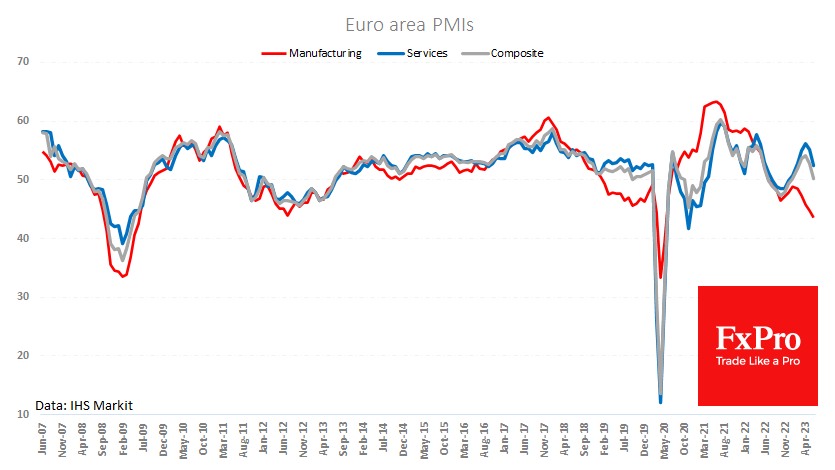
These poor results weighed on the euro zone’s overall performance, where the composite business activity index fell to 50.3, its lowest level since January. The manufacturing PMI came in at 43.6, signalling a severe contraction in the region’s economy soon. Apart from the Covid dip, it has only been lower between October 2008 and May 2009, when the economy shrank by more than 5%. Although the current situation is not as dire, fears are mounting.
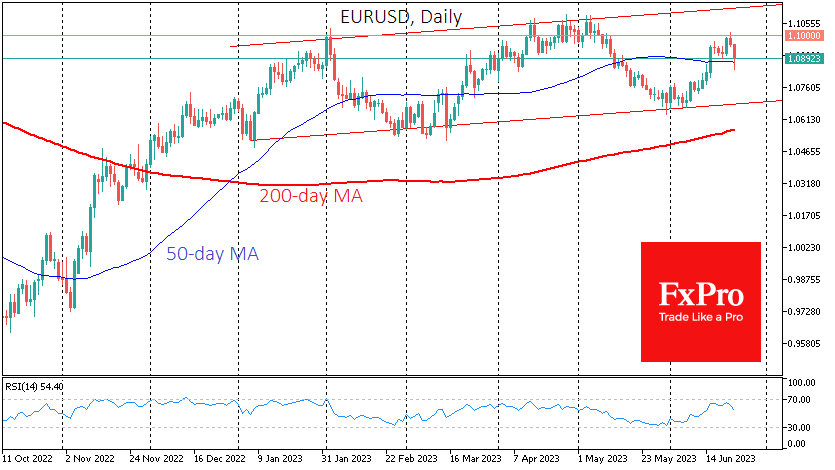
The EURUSD lost around 1.5% in less than a day after touching 1.10 in the middle of the European session on Thursday. It accelerated as it broke below 1.0920 on Friday morning following the release of the Eurozone PMI estimates.
Intraday, the EURUSD is hovering around its 50-day moving average. If it can hold above this level in the coming days, it could attract active buyers and further push the pair to test previous highs above 1.1070. However, weak macroeconomic data and dwindling risk appetite in global markets increase the odds of a downward move, at least to the lower border of the rising channel at 1.0700 or further to the previous local lows at 1.0550.
Sunset Market Commentary
Markets
European June PMIs disappointed on all accounts. The manufacturing rout continued, unexpectedly easing from 44.8 to 43.6. Services have long compensated but are now also showing a loss of momentum, retreating more than expected from 55.1 to 52.4. The composite series fell to 50.3 (-2.5 points) as a result. Diving into some details, new business inflows declined for the first time since January. This was driven by an increasingly sharp downturn in manufacturing. Services registered only a modest increase. Backlogs fell at the steepest rate for seven months. S&P Global considers this as a bad precursor for payroll numbers. Indeed, employment growth slowed again in June with the manufacturing sector cutting jobs for the first time since January 2021. Headcount in the services sector waned to the lowest since March though remains strong by historical standards. Factory input prices dropped for a fourth consecutive month. Those in the services sector continued to rise at a rate well above the long-term average, in particular due to wage pressures, though the pace moderated. Prices charged for goods fell the most in three years but rose sharply for services even as the rate cooled substantially. Concerns over demand growth and the broader impact of higher interest rates depressed optimism for the year ahead to the lowest level so far this year and below the long-run average. S&P Global concludes: " […] the probability has increased somewhat that the GDP change will again carry a negative sign in the current quarter, due in part to weak services activity in France. […] the downward trend in the Composite PMI points to a difficult second half of the year as companies across all sectors face deteriorating order books." The market reaction was textbook with German yields tumbling 11-17 bps across the curve, stocks under recessionary pressure and the euro down for the day. EUR/USD is testing minor support at 1.0893. Commodities and commodity-related currencies including the AUD, NOK and NZD face the recessionary fall-out. AUD/USD tumbles to 0.667 from 0.675, NZD/USD hits a weekly low around 0.613 and Norwegian krone erases the little that what was left from yesterday’s bigger-than-expected rate hike to trade 1.75% lower against the euro (EUR/NOK 11.82). US PMIs came in close to expectations for services. The sector held strong at 54.1. The pain for the manufacturing sector intensified (46.3) vs consensus hoping for a stabilization around 48.5. US yields hold on to (most) of their daily losses of about 6.4-8.2 bps.
British PMIs also missed the bar though showed a bit more resilience than in the EMU (composite PMI 52.8 from 54). The services gauge eased from 55.2 to 53.7. The manufacturing gauge dropped 0.9 points to 46.2. Service providers still reported solid new inflows, contrasting the steep and accelerated fall in manufacturing. Jobs were created for a third month straight, thanks to the services sector, and the pace of hiring was the fastest since September 2022. Input prices showed similar dynamics to the EU. Prices charged rose sharply in services, pushed by strong wage pressures while there was only a fractional decline in manufacturing. Private sector firms remain optimistic about their growth prospects 12 months ahead. The PMIs followed stronger-than-expected UK retail sales and give the pound a push in the back against an generally weak euro. EUR/GBP intraday lost almost a full big figure to trade in the 0.8545 area currently. UK yields rise 4.8 bps at the front but lose almost >10 bps at longer maturities as markets further boost BoE tightening bets and ponder its economic impact (6.25% at some point).
News & Views
Belgian Business confidence in June fell for the third consecutive month, the National bank of Belgium reported. The overall synthetic curve declined from -9.1 to -12.1. Business climate worsened sharply in business related services (-2.5 from 10.5). All components of the indicator declined. In addition to a more negative assessment of current activity, respondents expressed much more pessimistic expectations of future activity and market demand in general. All components in the trade sub-indicator (from -13.2 from -9.2) also fell as both demand and employment expectations and intentions of placing order with suppliers in the next three months deteriorated. The third consecutive drop in manufacturing (-15.6 from -14.3) reflects a more unfavourable assessment of total order books and stock levels which was partially offset by more positive demand expectations. The near stabilisation in the building industry (-6.6 from -6.0) was due to an improvement in the recent orders and increased equipment use. Other components deteriorated slightly.
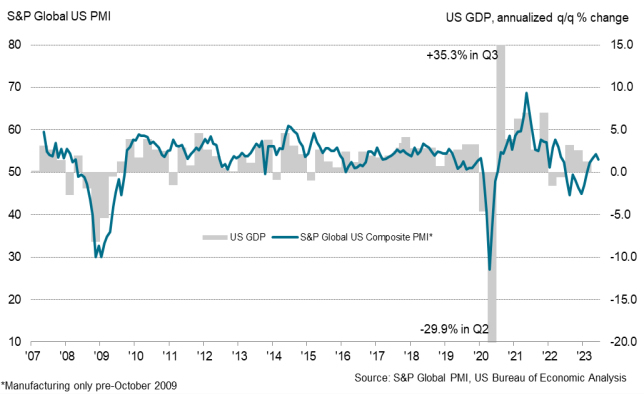
US PMI composite fell to 53.0, Q2 GDP growth in region of 2%
US PMI Manufacturing fell from 48.4 to 46.3 in June, a 6-month low. PMI Services fell from 54.9 to 54.1, a 2-month low. PMI Composite fell from 54.3 to 53.0, a 3-month low.
Chris Williamson, Chief Business Economist at S&P Global Market Intelligence said:
"The overall rate of expansion of business activity in the US remained robust in June, consistent with GDP rising at a rate of 1.7% to put second quarter growth in the region of 2%.
"Growth remains dependent on service sector spending, however, with manufacturing slipping back into decline after three months of growth. While improving supply conditions had helped boost manufacturing production in prior months, an increasingly severe downturn in new orders mean factories are running out of work.
"The situation is brighter in the service sector, where demand is proving resilient and the recent pause in rate hikes appears to have helped boost business optimism for the year ahead.
"The question remains as to how resilient service sector growth can be in the face of the manufacturing decline and the lagged effect of prior rate hikes. Any further rate hikes will of course have a further dampening effect on this sector which is especially susceptible to changes in borrowing costs.
"The tightness of the labor market remains a concern, and upward wage pressure remains a key driver of higher costs in the service sector. However, it is encouraging to see the overall rate of selling price inflation for goods and services drop to the lowest since late 2020 in a sign that the Fed is winning its fight against inflation."
Euro Skids After Soft PMI Data, Markets Eye ISM Mfg. PMI
- Eurozone and German PMIs weakened in June
- EUR/USD fell as much as 110 pips on Friday
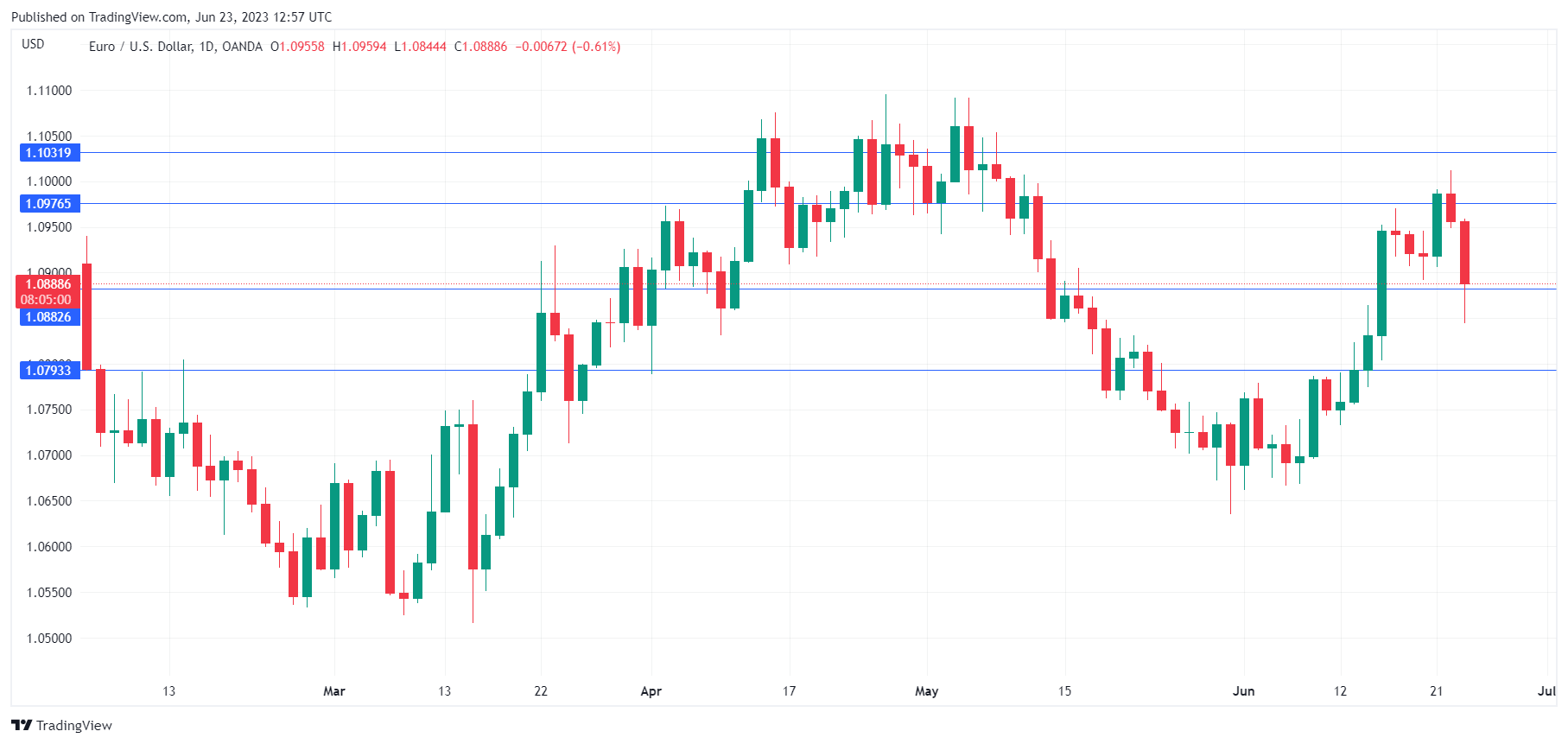
EUR/USD has taken a tumble on Friday. In the European session, the euro is trading at 1.0885, down 0.64%. The euro fell as low as 1.0844 earlier in the day. Later today, the US releases ISM Services PMI. The consensus stands at 54.0 for June, following 54.9 in May. The services sector is in solid shape and the ISM Services PMI has posted four straight readings over the 50 level, which separates expansion from contraction.
Eurozone, German PMIs fall in June
Eurozone PMIs for June pointed to weaker activity in the services and manufacturing sectors. The Services PMI eased to 52.4, down from 55.1 in May and below the consensus of 54.5 points. The Manufacturing PMI fell to 43.6, down from the May reading of 44.8 which was also the consensus. Germany, the largest economy in the eurozone, showed a similar trend, with Services PMI falling from 54.7 to 54.1 and Manufacturing PMI dropping from 43.5 to 41.0 points. The 50 line separates contraction from expansion.
The takeaway from these numbers is that the eurozone economy is cooling down. Business activity is still growing but at a weaker pace, while the manufacturing recession has deepened. The eurozone economy is yet to recover after negative growth in the past two quarters, as the ECB’s aggressive tightening makes its way through the economy.
At first glance, the weak PMI readings should be good news for the ECB, which is trying to dampen economic growth in order to wrestle inflation back down to the 2% target. However, inflation remains very high at 6% and further tightening could tip the weak eurozone economy into a recession.
The ECB’s efforts to push inflation lower have been made more difficult, as unemployment is at historic lows and wage growth is high. Germany, the bloc’s largest economy, isn’t the power locomotive that it once was and is still in recovery mode. The ECB has signalled that it will hike rates in July and another increase could be coming in September unless inflation decelerates more quickly.
EUR/USD Technical
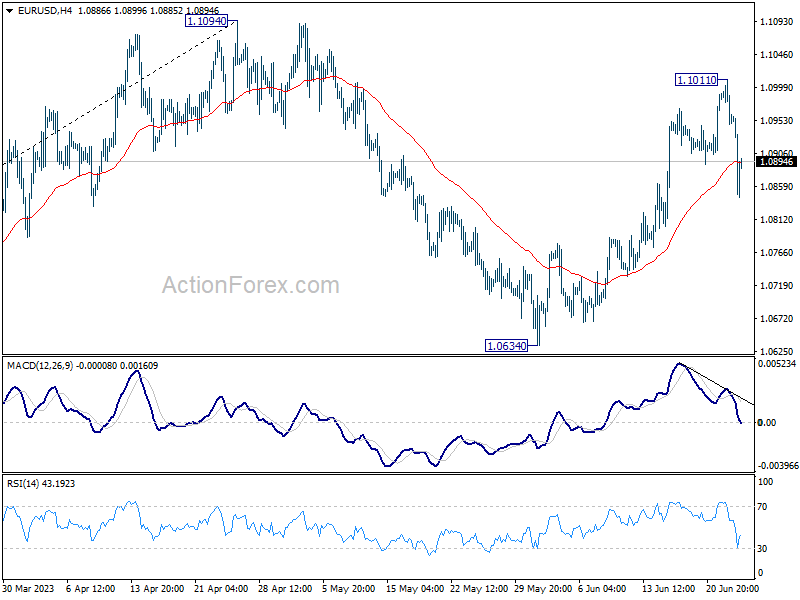
- EUR/USD is testing support at 1.0882. The next support level is 1.0793
- 1.0976 and 1.1031 are the next resistance lines
EUR/USD Mid-Day Outlook
Daily Pivots: (S1) 1.0933; (P) 1.0972; (R1) 1.0995; More...
Intraday bias in EUR/USD remains mildly on the downside at this point. Fall from 1.1011 is seen as the third leg of the corrective pattern from 1.1094. Sustained break of 55 D EMA (now at 1.0838) will target 1.0634 support and below. Nevertheless, rebound from current level, followed by break of 1.1011 will target a test on 1.1094 high instead.
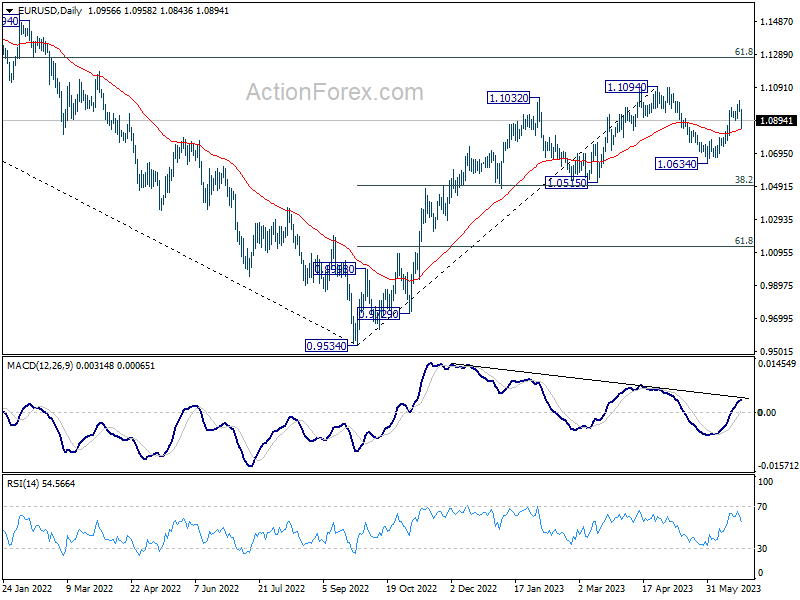
In the bigger picture, as long as 1.0515 support holds, rise from 0.9534 (2022 low) would still extend higher. Sustained break of 61.8% retracement of 1.2348 (2021 high) to 0.9534 at 1.1273 will solidify the case of bullish trend reversal and target 1.2348 resistance next (2021 high).
GBP/USD Mid-Day Outlook
Daily Pivots: (S1) 1.2707; (P) 1.2767; (R1) 1.2809; More...
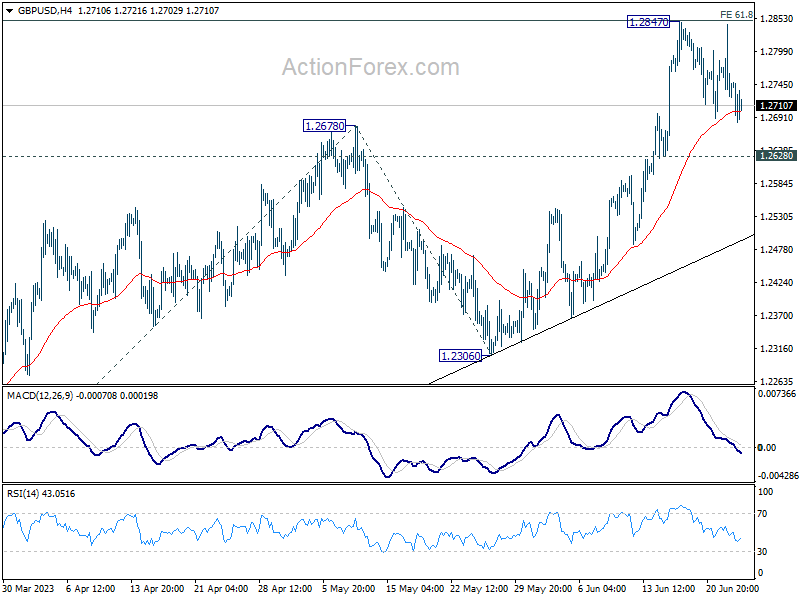
GBP/USD is still bounded in consolidation from 1.2847 and intraday bias stays neutral. On the upside, firm break of 1.2847 will resume larger up trend and target 100% projection of 1.1801 to 1.2678 from 1.2306 at 1.3183 next. However, firm break of 1.2628 will turn bias to the downside, for deeper fall to 1.2306 support instead.
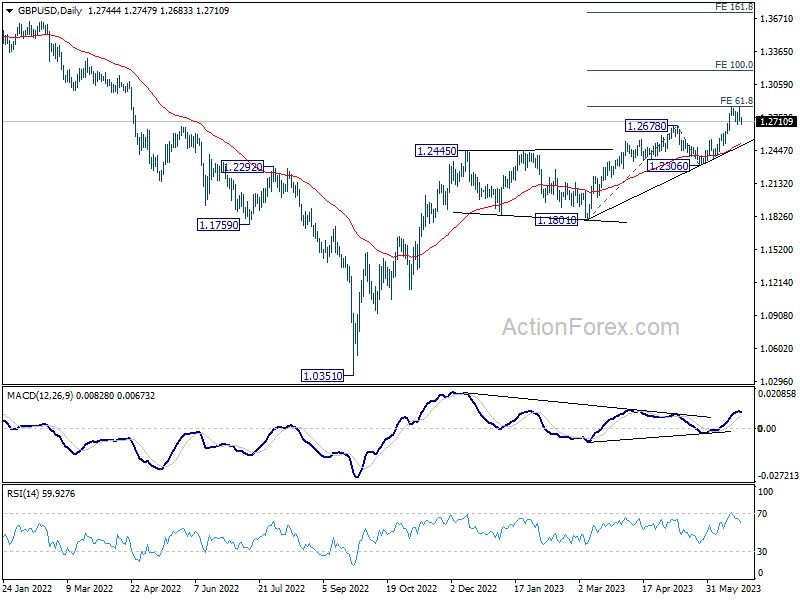
In the bigger picture, the strong support from 55 W EMA (now at 1.2345) is a medium term bullish sign. Outlook will stay bullish as long as 1.2306 support holds. Rise from 1.0351 medium term bottom (2022 low) is expected to extend further to retest 1.4248 key resistance (2021 high).
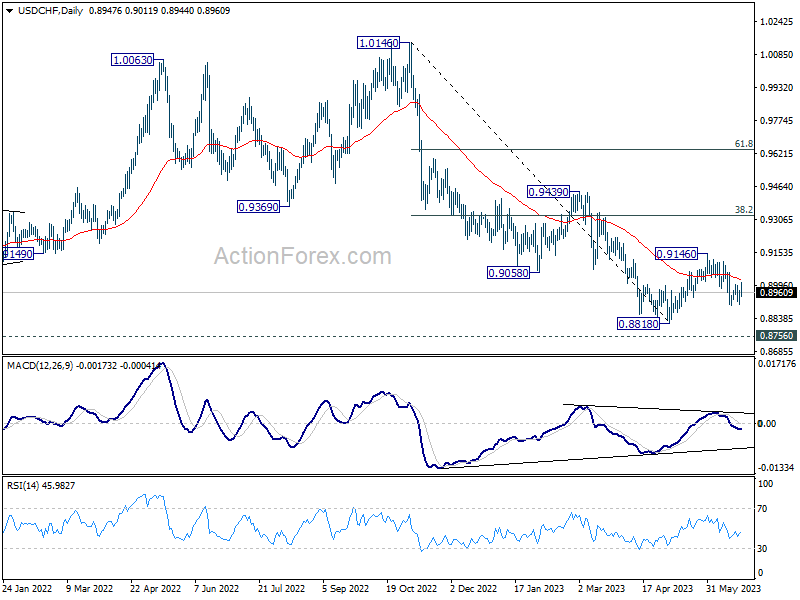
USD/CHF Mid-Day Outlook
Daily Pivots: (S1) 0.8914; (P) 0.8943; (R1) 0.8979; More...
Intraday bias in USD/CHF is turned neutral again with current retreat. On the upside, above 0.9011 will bring stronger rise towards 0.9146 resistance. On the downside, through, break of 0.8900 will target 0.8818 and possibly below.
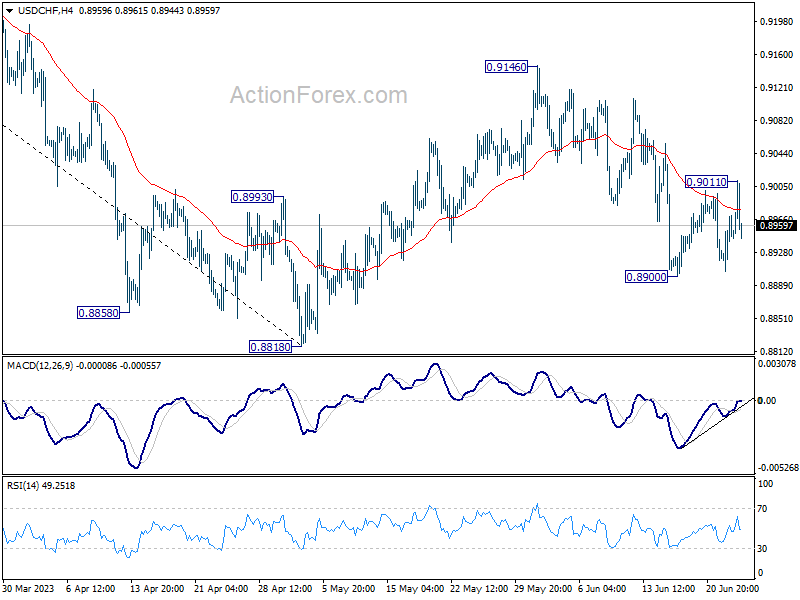
In the bigger picture, fall from 1.1046 (2022 high) is seen as a leg in the long term range pattern from 1.0342 (2016 high), which might have completed at 0.8818 already, just ahead of 0.8756 long term support. Sustained trading above 0.9058 support turned resistance should confirm medium term bottoming.