Sample Category Title
USD/JPY Mid-Day Outlook
Daily Pivots: (S1) 142.07; (P) 142.65; (R1) 143.69; More...
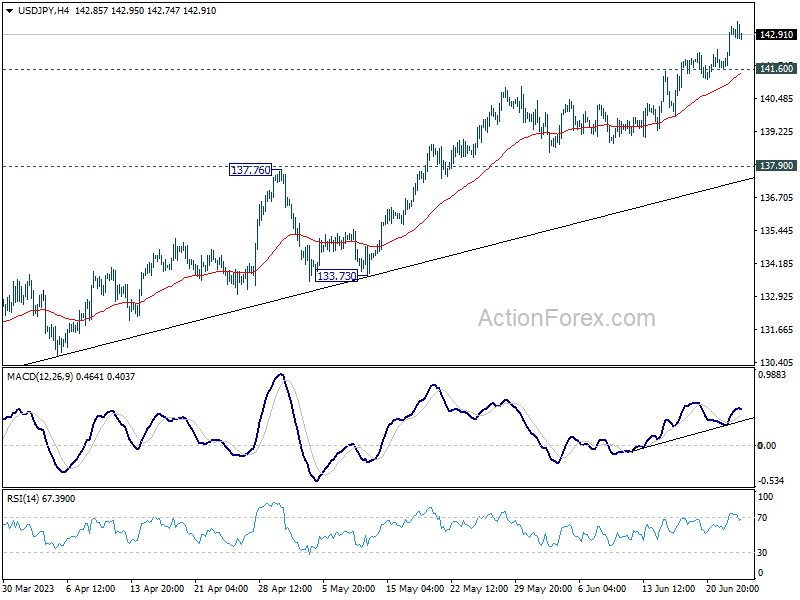
Intraday bias in USD/JPY remains on the upside for the moment. Current rise from 127.20 would target a retest on 151.93 high. On the downside, below 141.20 minor support will turn intraday bias neutral first. But further rally will now remain in favor as long as 137.90 resistance turned support holds.
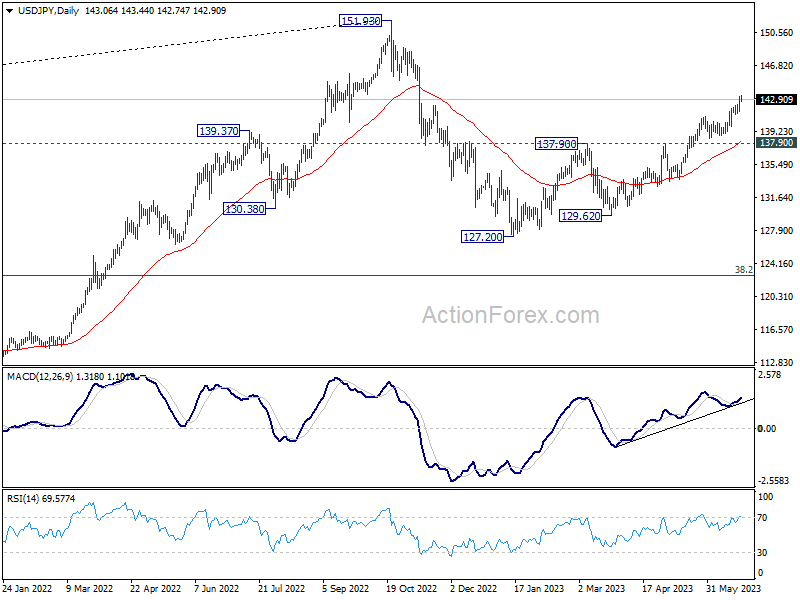
In the bigger picture, rise from 151.93 are seen as a corrective pattern to up trend from 102.58. The first leg has completed at 127.20. Rebound from there is seen as the second leg, and should be limited below 151.93. Sustained trading below 55 D EMA (now at 137.93) will argue that the third leg has started back to 127.20 and possibly below.
EUR/CHF Mid-Day Outlook
Daily Pivots: (S1) 0.9783; (P) 0.9812; (R1) 0.9834; More...
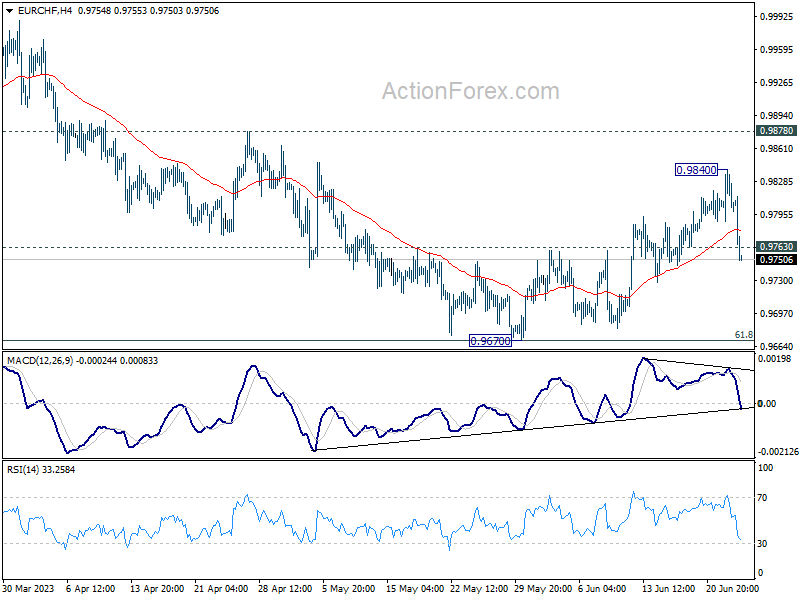
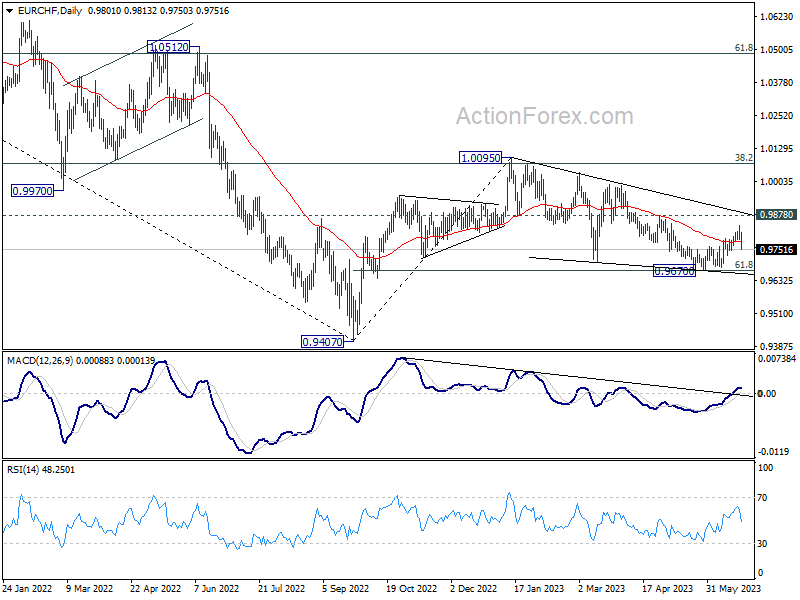
EUR/CHF's break of 0.9763 minor support argues that recovery from 0.9670 has completed as a correction to 0.9840 Intraday bias is back on the downside for retesting 0.9670 low. Sustained break there will resume the whole fall from 1.0095. Nevertheless, break of 0.9840 will resume the rebound to 0.9878 resistance.
In the bigger picture, prior rejection by 38.2% retracement of 1.1149 to 0.9407 at 1.0072 suggests that medium term outlook is staying bearish. The pair is also capped below 55 W EMA (now at 0.9924). Down trend from 1.2004 (2018 high) is not complete yet and is in favor to resume through 0.9407 at a later stage. However, decisive break of 1.0095 resistance will raise the chance of bullish trend reversal. Rise from 0.9407 should then target 1.0505 cluster resistance (2020 low at 1.0505, 61.8% retracement of 1.1149 to 0.9407 at 1.1484).
Euro Dips on Poor PMI Data, Dollar Losing Some Momentum
Dollar has launched a broad-based rebound in today's market. However, momentum appears to be faltering against its European counterparts in early U.S. trading session. Although it continues to perform strongly against Yen and Australian dollar, the greenback has been struggling to break last week's high against other key currencies. Consequently, this rebound seems to be more of a corrective move than a robust up trend. Nevertheless, today's surge could potentially signal a period of consolidation that might extend through the remainder of the month.
Meanwhile, Euro has suffered broad losses today, driven by disappointing PMI data. While a July rate hike by ECB seems almost certain, the outlook beyond that point is clouded in uncertainty. Australian and New Zealand Dollars, have taken a severe hit following sell-off in Hong Kong stocks and continuous decline in Chinese Yuan. Despite being among the week's worst performers, Yen is experiencing a slight recovery against other currencies, with the notable exception of Dollar.
In Europe, at the time of writing, FTSE is down -0.57%. DAX is down -1.20%. CAC is down -0.60%. Germany 10-year yield is down -0.165 at 2.335. Earlier in Asia, Nikkei fell -1.45%. 10-year JGB yield dropped -0.0072 to 0.372. Hong Kong HSI fell -1.71%. Singapore Strait Times fell -0.96%.
ECB de Cos: Not appropriate to forecast rates after July hike
ECB Governing Council member Pablo Hernandez de Cos conveyed his anticipation of another interest rate hike. He underscored that ECB's decisions would continue to rely on key data and inflation outlook.
He stated today, "If the central scenario of our forecasts published by the ECB last week materialises, we will also have to raise 25 basis points again in July." However, "beyond that it is not appropriate to make any forecasts."
De Cos highlighted the essential role of key data and inflation dynamics in shaping ECB's decisions. He added, "we will continue to take our decisions depending on the data and, in particular, on the aggregate assessment of the inflation outlook, the dynamics of underlying inflation."
Eurozone PMI manufacturing down to 43.6, services down to 52.4
Eurozone PMI Manufacturing fell from 44.8 to 43.6 in June, a 37-month low. PMI Services dropped from 52.4 to 55.1, a 5-month low. PMI Composite tumbled from 52.8 to 50.3, a 5-month low.
HCBO Bank noted in the release that there are diverging trends in the manufacturing and service sectors. Despite falling prices in manufacturing that would typically herald rate cuts, persistent price hikes in the larger service sector continue to slow down core inflation's decline.
Adding to the complexity are regional differences: France's service sector contracted in June while Germany's continues to expand. With Eurozone GDP potentially falling for a third consecutive quarter, the Composite PMI predicts a challenging second half of the year for businesses.
In France, PMI Manufacturing ticked down from 45.7 to 45.5 in June, a 37-month low. PMI Services dropped sharply from 52.5 to 48.0, a 28-month low. PMI Composite fell from 51.2 to 47.3, a 28-month low.
In Germany, PMI Manufacturing fell from 43.2 to 41.0, a 27-month low. PMI Services dropped from 57.2 to 54.1, a 3-month low. PMI Composite declined from 53.9 to 50.8, a 4-month low.
UK PMI manufacturing down to 46.2, Services down to 53.7
UK PMI Manufacturing fell from 47.1 to 46.2 in June, a 6-month low. PMI Services dropped from 55.2 to 53.7, a 3-month low. PMI Composite lowered from 54.0 to 52.8, a 3-month low.
Chris Williamson, Chief Business Economist at S&P Global Market Intelligence said:
"June's flash PMI survey indicates that the UK economy has lost momentum again after a brief growth spurt in the spring, and looks set to weaken further in the months ahead.
"Most notably, consumer spending on services, which was a core growth driver in the spring, is now showing signs of faltering… The manufacturing sector meanwhile continues to report recessionary conditions.
"One notable area of resilience in the economy is the labour market…While falling backlogs of work suggest this hiring trend could also fade in the coming months as the economy weakens.
"The survey's price gauges point to consumer price inflation remaining well above the Bank of England's target into 2024, which will add to the case for further interest rate hikes…
"Stubbornly elevated price growth in the service sector suggests the Bank of England will consider its fight against inflation as still a work in progress.
Japanese Finance Minister speaks out amid rapid Yen depreciation
As Yen continues to face intense selling pressure, Japanese Finance Minister Shunichi Suzuki reiterated the importance of market-determined exchange rates and the undesirability of abrupt currency movements.
Suzuki stated, "Currency rates should be set by the market, reflecting fundamentals." He also emphasized the need for stability, saying, "Sharp moves are undesirable, currencies should move stably reflecting fundamentals. With that in mind, we will continue to keep firm watch on market moves."
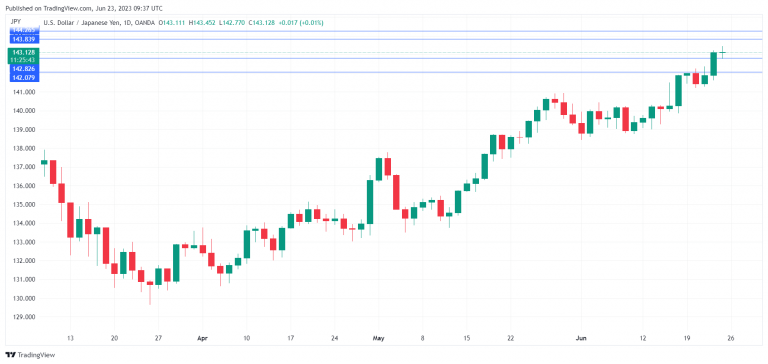
His comments come as the USD/JPY surged past the 143 handle, marking a significant acceleration in Yen's recent depreciation. The slide began last week following BoJ's decision to maintain its ultra-loose monetary policy stance. Today's strong inflation data, rather than tempering Yen's decline, seemed to have had little impact in averting its downtrend.
The verbal intervention from Suzuki underscores the growing concern over the pace and extent of Yen's depreciation. It also signals the government's readiness to monitor market trends closely, and possibly intervene should the currency's movements threaten to undermine the economic fundamentals.
Japan PMI manufacturing fell to 49.8, services down to 54.2
Japan PMI Manufacturing declined from 50.6 to 49.8 in June, below expectation of 50.2. PMI Manufacturing Output fell from 50.9 to 48.3. PMI Services dropped from 55.9 to 5.4.2. PMI Composite decreased from 54.3 to 52.3.
Annabel Fiddes, Economics Associate Director at S&P Global Market Intelligence, said:
"A fresh fall in manufacturing output coincided with a softer rise in services activity, leading to the weakest expansion of overall output for four months....
"The softening of growth momentum fed through to reduced optimism around the outlook, with business confidence slipping to a five-month low...
"However, there was some better news in terms of inflationary pressures, which showed further signs of easing. Notably, input price inflation softened to a 22-month low in June, while output charges increased at the softest pace since January."
Australia PMI composite fell to 50.5, RBA has time on their side
Australia PMI Manufacturing ticked up from 48.4 to 48.6 in June. PMI Services fell from 52.1 to 50.7. PMI Composite declined from 51.6 to 50.5.
Warren Hogan, Chief Economic Advisor at Judo Bank said:
"The loss of momentum in recent months will probably give the RBA some comfort that economic activity is slowing down across the economy in 2023, following their consecutive rate hikes in May and June...
"The survey suggests that the RBA has time on their side and does not necessarily need to hike rates again in July. The slowdown taking place across the economy provides further evidence that the point at which the RBA can undertake a genuine pause in their tightening cycle is getting closer.
"We cannot rule out a further hike in the next few months, but we are close to a level of interest rates whereby the RBA can sit back for 4-6 months and observe the effects of past interest rate increases."
EUR/CHF Mid-Day Outlook
Daily Pivots: (S1) 0.9783; (P) 0.9812; (R1) 0.9834; More...
EUR/CHF's break of 0.9763 minor support argues that recovery from 0.9670 has completed as a correction to 0.9840 Intraday bias is back on the downside for retesting 0.9670 low. Sustained break there will resume the whole fall from 1.0095. Nevertheless, break of 0.9840 will resume the rebound to 0.9878 resistance.
In the bigger picture, prior rejection by 38.2% retracement of 1.1149 to 0.9407 at 1.0072 suggests that medium term outlook is staying bearish. The pair is also capped below 55 W EMA (now at 0.9924). Down trend from 1.2004 (2018 high) is not complete yet and is in favor to resume through 0.9407 at a later stage. However, decisive break of 1.0095 resistance will raise the chance of bullish trend reversal. Rise from 0.9407 should then target 1.0505 cluster resistance (2020 low at 1.0505, 61.8% retracement of 1.1149 to 0.9407 at 1.1484).
Economic Indicators Update
| GMT | Ccy | Events | Actual | Forecast | Previous | Revised |
|---|---|---|---|---|---|---|
| 23:00 | AUD | Manufacturing PMI Jun P | 48.6 | 48.4 | ||
| 23:00 | AUD | Services PMI Jun P | 50.7 | 52.1 | ||
| 23:01 | GBP | GfK Consumer Confidence Jun | -24 | -26 | -27 | |
| 23:30 | JPY | National CPI Y/Y May | 3.20% | 3.50% | ||
| 23:30 | JPY | National CPI Core Y/Y May | 3.20% | 3.10% | 3.40% | |
| 23:30 | JPY | National CPI Core-Core Y/Y May | 4.30% | 4.10% | ||
| 00:30 | JPY | Manufacturing PMI Jun P | 49.8 | 50.2 | 50.6 | |
| 06:00 | GBP | Retail Sales M/M May | 0.30% | -0.20% | 0.50% | |
| 07:15 | EUR | France Manufacturing PMI Jun P | 45.5 | 45.2 | 45.7 | |
| 07:15 | EUR | France Services PMI Jun P | 48 | 52.1 | 52.5 | |
| 07:30 | EUR | Germany Manufacturing PMI Jun P | 41 | 43.6 | 43.2 | |
| 07:30 | EUR | Germany Services PMI Jun P | 54.1 | 56.3 | 57.2 | |
| 08:00 | EUR | Eurozone Manufacturing PMI Jun P | 43.6 | 44.9 | 44.8 | |
| 08:00 | EUR | Eurozone Services PMI Jun P | 52.4 | 54.5 | 55.1 | |
| 08:30 | GBP | Manufacturing PMI Jun P | 46.2 | 46.8 | 47.1 | |
| 08:30 | GBP | Services PMI Jun P | 53.7 | 54.9 | 55.2 | |
| 13:45 | USD | Manufacturing PMI Jun P | 48.5 | 48.4 | ||
| 13:45 | USD | Services PMI Jun P | 54 | 54.9 |
ECB de Cos: Not appropriate to forecast rates after July hike
ECB Governing Council member Pablo Hernandez de Cos conveyed his anticipation of another interest rate hike. He underscored that ECB's decisions would continue to rely on key data and inflation outlook.
He stated today, "If the central scenario of our forecasts published by the ECB last week materialises, we will also have to raise 25 basis points again in July." However, "beyond that it is not appropriate to make any forecasts."
De Cos highlighted the essential role of key data and inflation dynamics in shaping ECB's decisions. He added, "we will continue to take our decisions depending on the data and, in particular, on the aggregate assessment of the inflation outlook, the dynamics of underlying inflation."
Japanese Finance Minister speaks out amid rapid Yen depreciation
As Yen continues to face intense selling pressure, Japanese Finance Minister Shunichi Suzuki reiterated the importance of market-determined exchange rates and the undesirability of abrupt currency movements.
Suzuki stated, "Currency rates should be set by the market, reflecting fundamentals." He also emphasized the need for stability, saying, "Sharp moves are undesirable, currencies should move stably reflecting fundamentals. With that in mind, we will continue to keep firm watch on market moves."
His comments come as the USD/JPY surged past the 143 handle, marking a significant acceleration in Yen's recent depreciation. The slide began last week following BoJ's decision to maintain its ultra-loose monetary policy stance. Today's strong inflation data, rather than tempering Yen's decline, seemed to have had little impact in averting its downtrend.
The verbal intervention from Suzuki underscores the growing concern over the pace and extent of Yen's depreciation. It also signals the government's readiness to monitor market trends closely, and possibly intervene should the currency's movements threaten to undermine the economic fundamentals.
Accumulation in Bitcoin, Ethereum
Market picture
Crypto market capitalisation has adjusted 0.65% in the past 24 hours to 1.17 trillion, remaining near the highs since early May. The correction is primarily due to a 0.55% dollar strengthening over the same period. The current dynamic is still a halt after a 16% rally but not a correction.
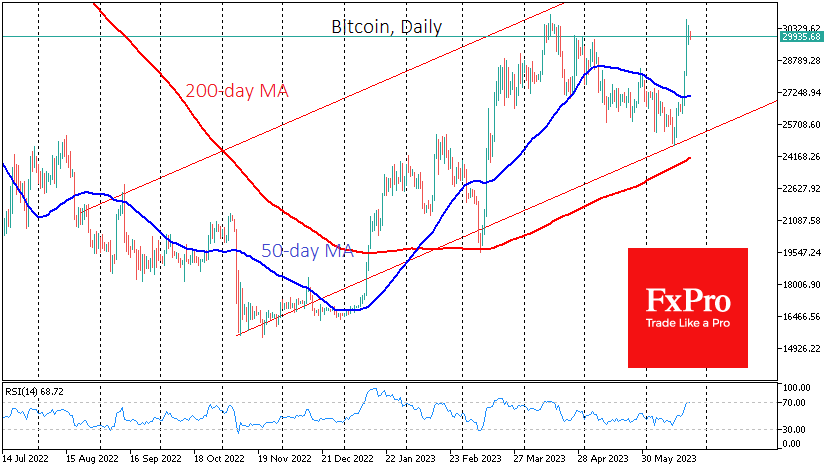
Bitcoin is frozen at $30K, a significant technical level. These levels were pivotal for the first cryptocurrency in April, and last May it took more than a month for the bears to sell the rate lower. Also, a furious part of the crypto rally started from this level in early 2021. It’s worth being prepared for quite a long consolidation, but this week’s bullish breakout suggests that long-term investors have already moved to accumulate Bitcoin on drawdowns.
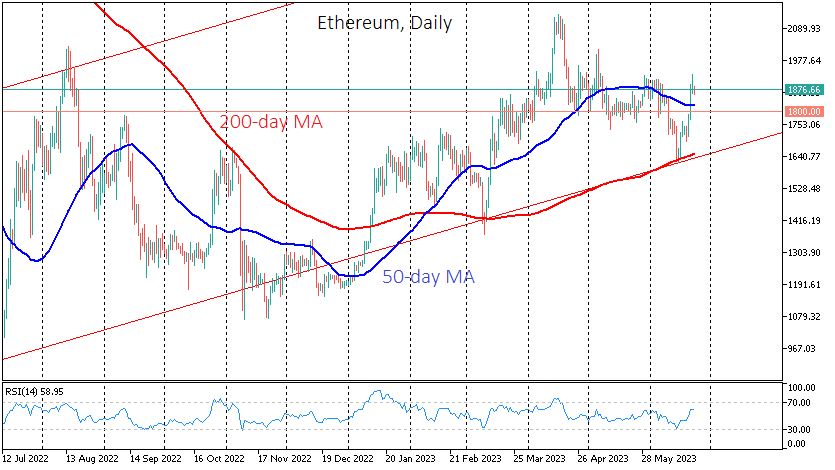
Ethereum’s dynamics are settling into a general uptrend channel with buying on downturns, roughly repeating the dynamics we’ve seen for 2019 and 2020. It could take months before a FOMO rally.
News background
Gemini cryptocurrency exchange co-founder Cameron Winklevoss announced a new phase of bitcoin hoarding. He says, “Anyone watching the flow of ETF bids understands that now is a good time to buy BTC before the ETFs hit the market.
Eight founder Michael van de Poppe sees $28.5K as an excellent level to buy before Bitcoin moves towards $40K. He noted that the BTC dominance index is approaching meaningful resistance, which should lead to Bitcoin consolidation and a shift in market attention to altcoins.
Valkyrie Investments has applied to the SEC to launch an exchange-traded fund (ETF) based on the Bitcoin spot price. BlackRock, WisdomTree, Invesco and Bitwise had also previously applied to establish a spot bitcoin ETF.
Singapore has approved a digital token licence for Ripple, allowing the company to expand its platform for cross-border payments in XRP.
EUR/USD: Euro Falls Sharply on Stronger Dollar, Downbeat EU PMI Data
The Euro accelerated lower on Friday morning, losing around 0.9% in early European trading, pressured by stronger dollar and weak EU economic data.
Fed Chair Powell said that the central bank will move interest rates at a careful pace after pausing sharp rate hiking cycle in June, but markets widely expect rate hikes to resume in July, seeing overall picture as hawkish.
Another negative factor for the single currency was stall of EU business growth in June, as data released on Friday showed further downturn in manufacturing sector, while the activity in dominant services sector barely expanded.
Weak Eurozone PMI data in June add to growing worries that bloc’s economic growth would remain negative in the second quarter and keep in play risk of recession.
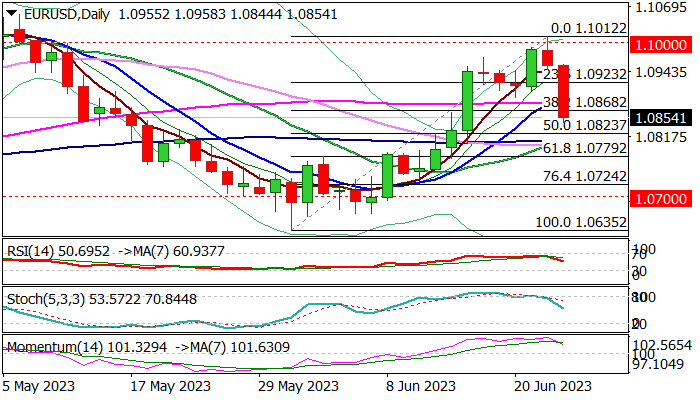
Pullback from Thursday’s top at 1.1012 extended into second straight day, following a bull-trap above Fibo 76.4% barrier at 1.0983 and psychological 1.10 level, with formation of reversal pattern on daily chart, weakening near-term structure.
Fresh weakness has so far retraced over 38.2% of 1.0635/1.1012 bull-leg and penetrated deeply into thick daily Ichimoku cloud.
Friday’s close below broken Fibo 38.2% support (1.0868) is needed to confirm bearish signal and keep bears fully in play for test of targets at 1.0823 (50% retracement / daily Kijun-sen), 1.0805 (daily cloud base) and 1.0779 (Fibo 61.8% of 1.0635/1.1012).
Broken Fibo 38.2% marks initial resistance, followed by converged 10/55 DMA’s (1.0890) and daily cloud top (1.0905) which should cap extended upticks.
Res: 1.0868; 1.0890; 1.0905; 1.0923.
Sup: 1.0823; 1.0805; 1.0779; 1.0733.
USD/JPY Rallies, Japanese Inflation Remains Above Target
- USD/JPY climbs above 143
- Japan’s core CPI remains above 3%
The Japanese yen has stabilized on Friday after falling close to 1% a day earlier. In the European session, USD/JPY is trading at 143.05, down 0.04%. Earlier, USD/JPY touched a high of 143.45, the highest level since early November 2022.
On the data calendar, the US releases ISM Services PMI later today. The consensus stands at 54.0 for June, following 54.9 in May. The services sector has posted four straight readings over the 50 level, which separates expansion from contraction.
Japan’s core inflation higher than expected
Japan continues to grapple with high inflation and core CPI for May was higher than expected. With inflation around 3%, other central banks would love to trade places with the Bank of Japan, but Japan’s inflation remains above the 2% target and has become an issue for the central bank after decades of deflation.
Nationwide core CPI, which excludes fresh food but includes energy items, climbed 3.2% in May y/y, down from 3.4% in April but above the consensus of 3.1%. What was more worrying was the “core-core index”, which excludes fresh food and energy, jumped 4.3% in May, up from 4.1% in April. This was above expectations and marked the highest level since June 1981.
Core CPI has now remained above the BoJ’s inflation target of 2% for 14 consecutive months. This puts into question the BoJ’s stance that cost-driven inflation is temporary and therefore there is no need to tighten monetary policy. Inflation risks are tilted to the upside and the BoJ will find it more difficult to defend its ultra-loose policy if inflation pressures don’t ease.
The BoJ maintained its policy settings at last week’s meeting and has no plans to tighten interest rates anytime soon. This puts the BoJ at odds with other major central banks, which have been aggressively tightening rates in order to curb inflation. The US/Japan rate differential has been widening as the Fed raises rates while the BoJ stands pat. This has sent the yen sharply lower, raising concerns that the government could intervene in the currency markets in order to prop up the yen.
The Ministry of Finance stunned the global financial markets in September and October when it intervened, at a time when the yen had fallen below the 150 line. The yen hasn’t fallen quite that low, but I would expect to hear louder verbal intervention out of Tokyo if the yen falls below 145.
USD/JPY Technical
- USD/JPY tested support at 142.82 earlier. The next support level is 142.07
- There is resistance at 143.83 and 144.27
EUR/GBP Daily Outlook
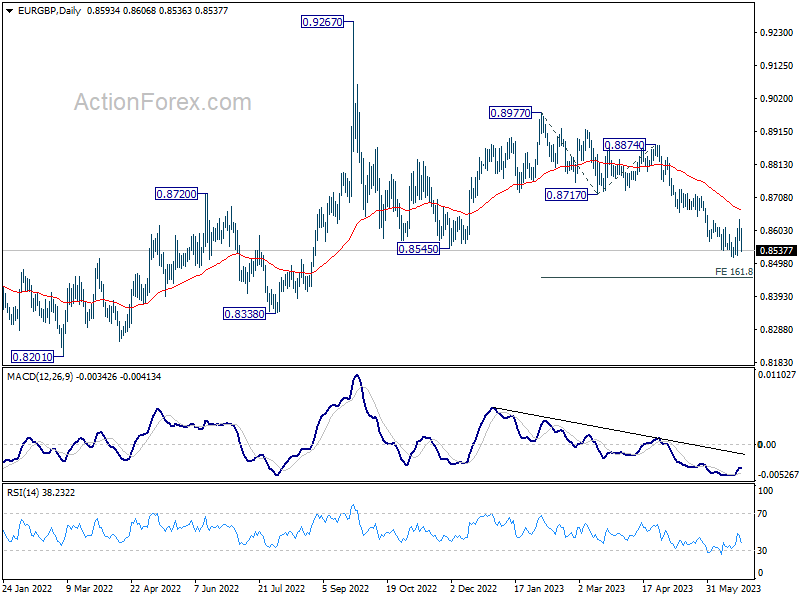
Daily Pivots: (S1) 0.8570; (P) 0.8603; (R1) 0.8627; More...
Intraday bias in EUR/GBP remains neutral as it reversed after brief recovery to 0.8635. On the downside, break of 0.8517 will resume the fall from 0.8977 to 161.8% projection of 0.8977 to 0.8717 from 0.8874 at 0.8453. Nevertheless, decisive break of 0.8635 will confirm short term bottoming, and bring stronger rebound to 55 D EMA (now at 0.8670) and above.
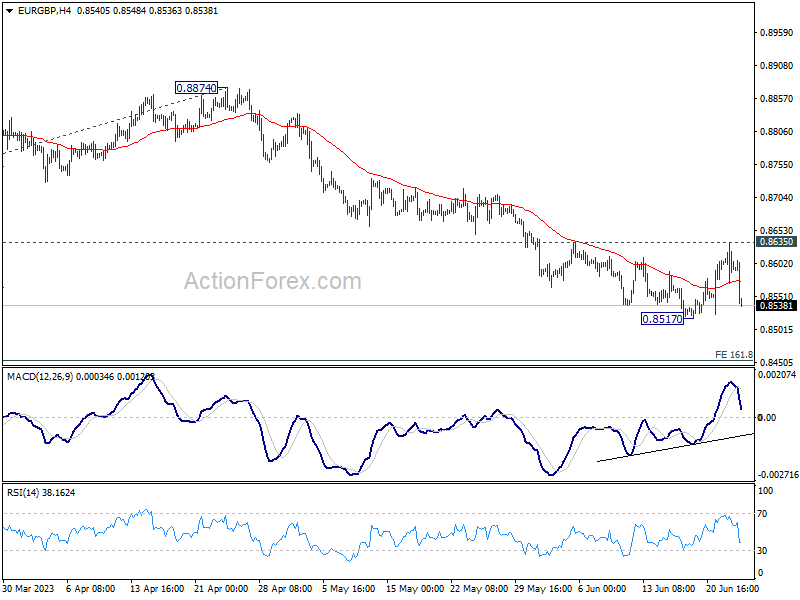
In the bigger picture, the down trend from 0.9267 (2022 high) is still in progress. It's seen as part of the long term range pattern from 0.9499 (2020 high). Deeper fall would be seen towards 0.8201 (2022 low). But strong support should be seen from there to bring reversal. This will now remain the favored case as long as 0.8717 support turned resistance holds.
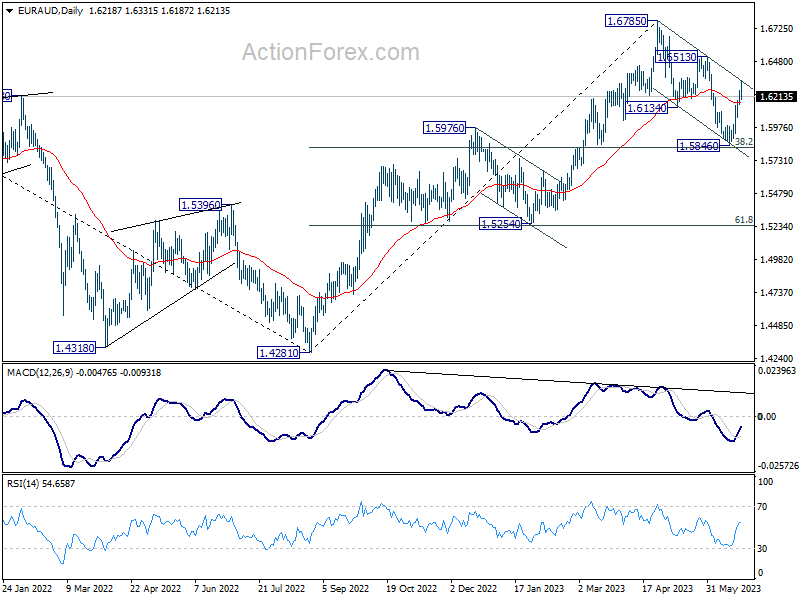
EUR/AUD Daily Outlook
Daily Pivots: (S1) 1.6159; (P) 1.6209; (R1) 1.6266; More...
Intraday bias in EUR/AUD stays on the upside for the moment. Corrective fall from 1.6785 should have completed with three waves down to 1.5846. Further rise should be seen to 1.6513 resistance next. On the downside, though, break of 1.6142 minor support will mix up the outlook and turn intraday bias neutral first.
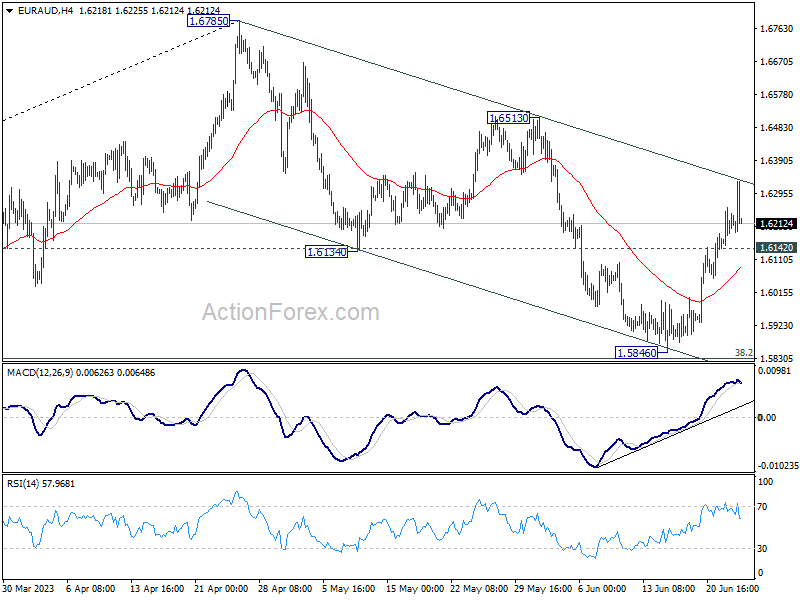
In the bigger picture, price actions from 1.6785 are seen as a correction to up trend from 1.4281 (2022 low) only. Strong support should be seen around 38.2% retracement of 1.4281 to 1.6785 at 1.5828 to complete the first leg and bring rebound. However, sustained trading below 1.5828 will raise the chance of trend reversal and target 61.8% retracement at 1.5238.