Sample Category Title
EUR/USD Mid-Day Outlook
Daily Pivots: (S1) 1.0808; (P) 1.0841; (R1) 1.0872; More...
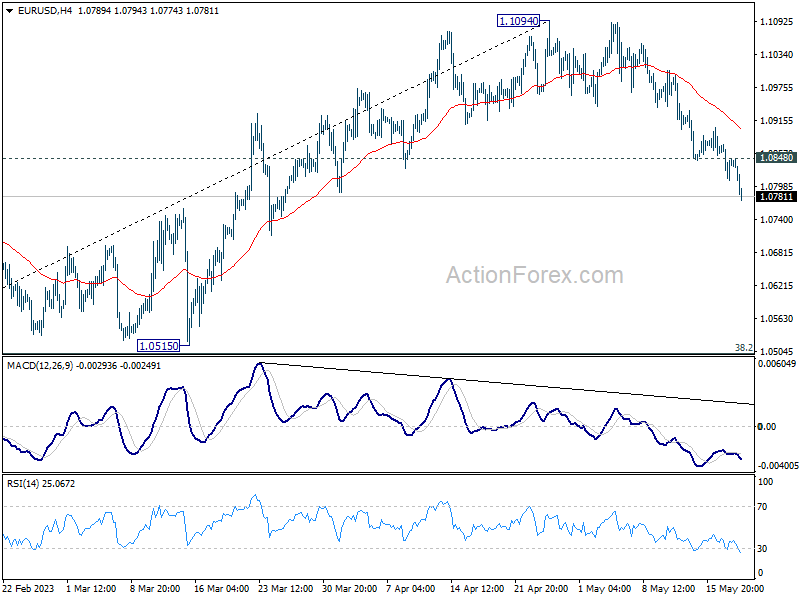
EUR/USD's decline from 1.1094 is still in progress and intraday bias stays on the downside. As a correction to whole up trend from 0.9534, current fall should target 1.0515 cluster support, 38.2% retracement of 0.9534 to 1.1094 at 1.0498. On the upside, above 1.0848 minor resistance will turn intraday bias neutral first.
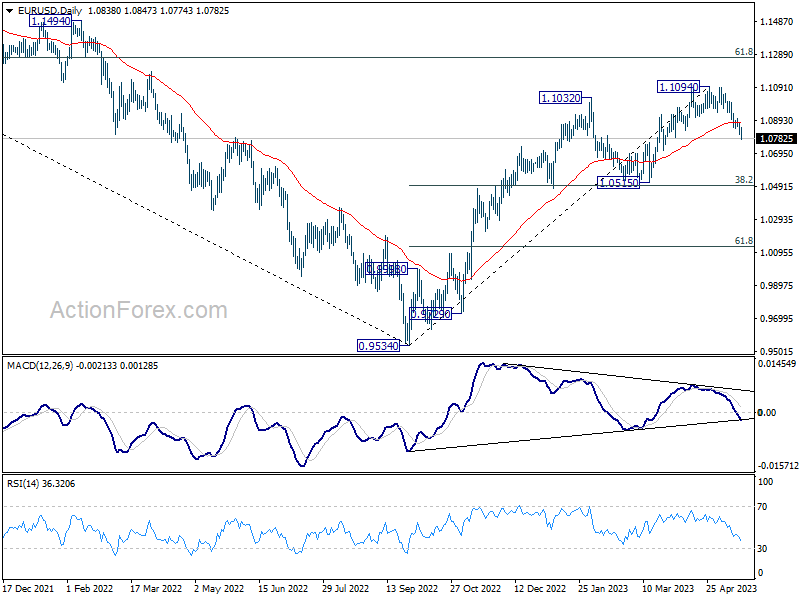
In the bigger picture, as long as 1.0515 support holds, rise from 0.9534 (2022 low) would still extend higher. Sustained break of 61.8% retracement of 1.2348 (2021 high) to 0.9534 at 1.1273 will solidify the case of bullish trend reversal and target 1.2348 resistance next (2021 high).
GBP/USD Mid-Day Outlook
Daily Pivots: (S1) 1.2436; (P) 1.2473; (R1) 1.2524; More...
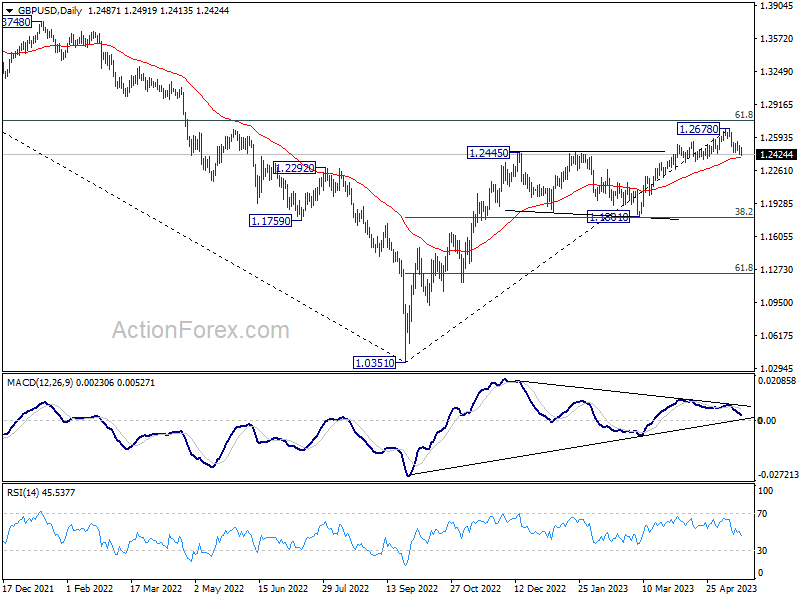
GBP/USD's break of 1.2434 support confirms short term topping at 1.2678. Considering bearish divergence condition in D MACD, it's probably corrective whole up trend from 1.0351. Intraday bias is now on the downside. Sustained trading below 55 D EMA (now at 1.2392) will affirm this case, and pave the way to 1.1801 cluster support (38.2% retracement of 1.0351 to 1.2678 at 1.1789). On the upside, above 1.2545 minor resistance will turn intraday bias neutral first.
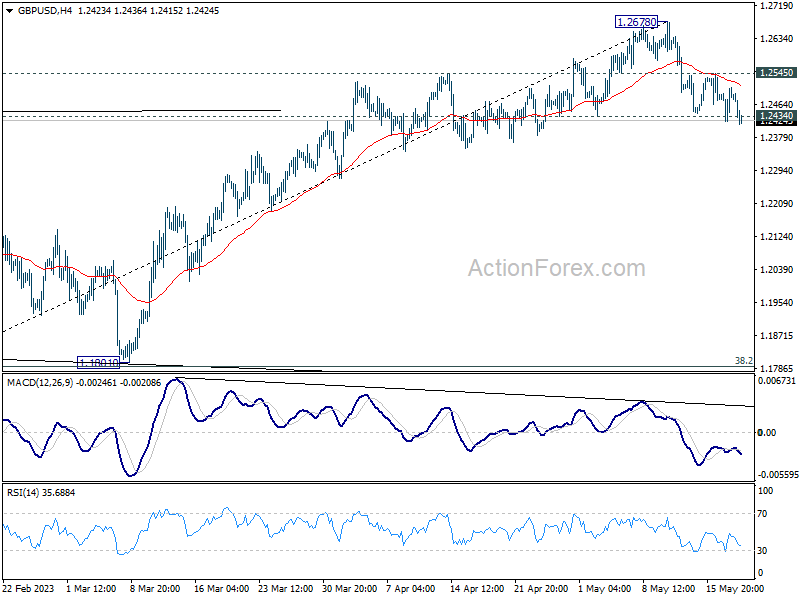
In the bigger picture, as long as 1.1801 support holds, rise from 1.0351 medium term bottom (2022 low) is expected to extend further. Sustained break of 61.8% retracement of 1.4248 (2021 high) to 1.0351 at 1.2759 will add to the case of long term bullish trend reversal. However, firm break of 1.1801 will indicate rejection by 1.2759, and bring deeper decline, even as a correction.
USD/CHF Mid-Day Outlook
Daily Pivots: (S1) 0.8947; (P) 0.8987; (R1) 0.9024; More...
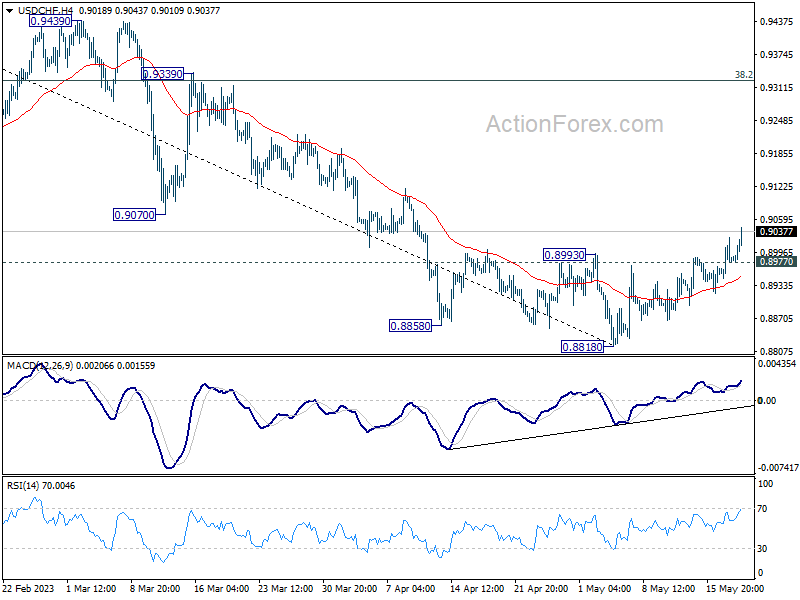
Intraday bias in USD/CHF remains on the upside as rise from 0.8818 short term bottom is extending. Sustained trading above 55 D EMA (now at 0.9042) should confirm that current rally is at least correcting whole down trend from 1.0146. Further rise should then be seen to 38.2% retracement of 1.0146 to 0.8818 at 0.9325. On the downside, below 0.8977 minor support will turn intraday bias neutral first.
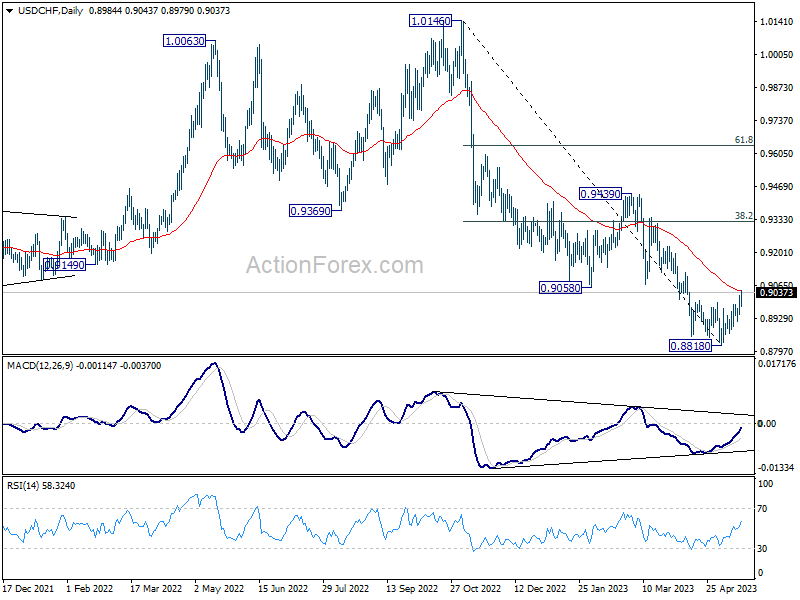
In the bigger picture, fall from 1.1046 (2022 high) is seen as a leg in the long term range pattern from 1.0342 (2016 high). So, downside should be contained by 0.8756 to bring reversal. Sustained break of 0.9058 support turned resistance will be the first sign of medium term bottoming. However, decisive break of 0.8756 will carry larger bearish implications.
USD/JPY Mid-Day Outlook
Daily Pivots: (S1) 136.78; (P) 137.24; (R1) 138.18; More...
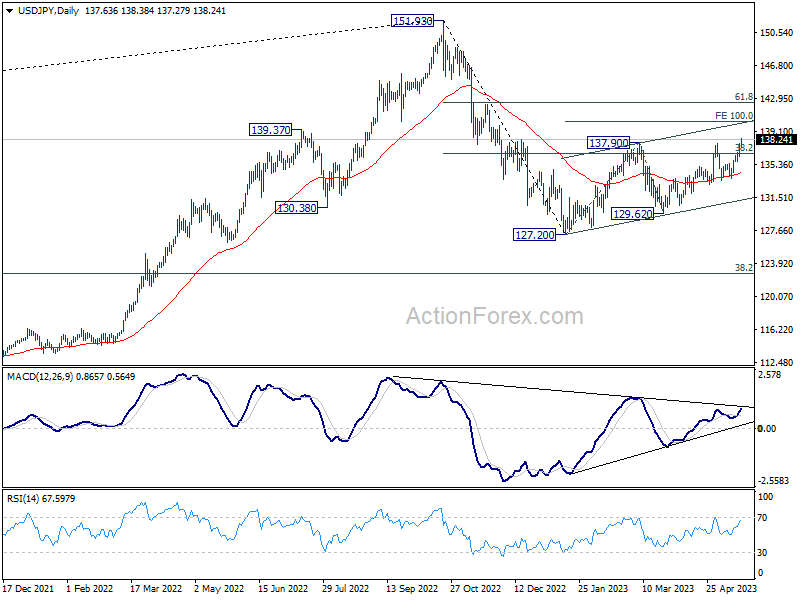
USD/JPY's rally continues today and break of 137.90 resumes indicate resumption of whole rebound from 127.20. Intraday bias stays on the upside. Next target is 100% projection of 127.20 to 137.90 from 129.62 at 140.32. Break there will target 142.48 fibonacci level. On the downside, below 137.27 minor support will turn intraday bias neutral first.
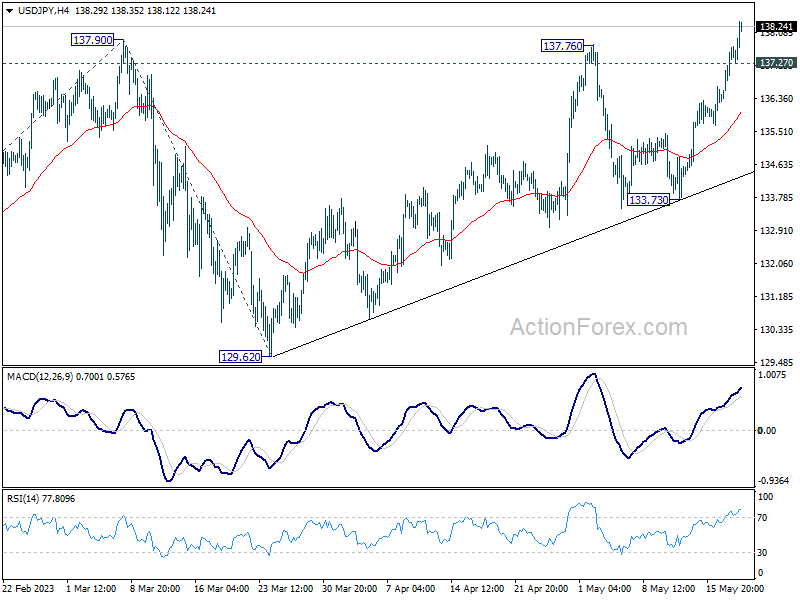
In the bigger picture, price actions from 151.93 high are currently seen as a corrective pattern to the long term up trend. The first leg should have completed at 127.20. Rebound from there is seen as the second leg. Sustained break of 38.2% retracement of 151.93 to 127.20 at 136.34 will bring stronger rise to 61.8% retracement at 142.48. Meanwhile, break of 129.62 will argue that the third leg is starting through 127.20 low.
Dollar Extends Rally, Gold Breaks Key Support
Dollar continues to power up today, as traders are rethinking Fed's policy path ahead. The odds of a hold at June 14 FOMC meeting has dropped to around 60%, as the economy continued to show resilience. The strong stock market rally this week is also helping. Canadian Dollar is currently following as second best, and then Swiss Franc. Aussie is the worst performer for the day so far, followed by Euro and Kiwi. While Yen is still the biggest loser for the week, selling has somewhat slowed a bit.
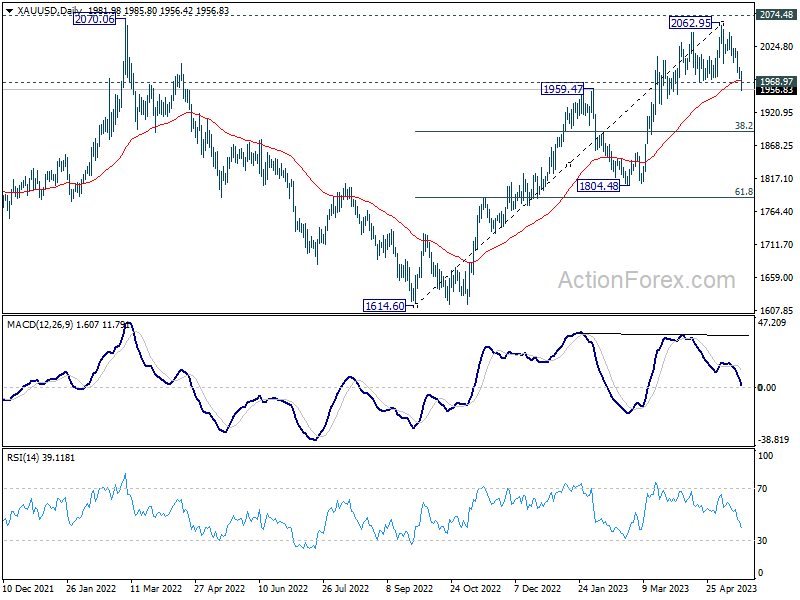
Technically, Gold has finally taken out 1968.97 key near term support, as well as 55 D EMA today, as selloff from 2062.95 extends. The development should confirm rejection by 2074.48 record high. Fall from 2062.95 is at least a correction to rise from 1614.60, with potential as the fifth leg of the long term sideway pattern from 2074.48. In either case, deeper decline is now expected to 38.2% retracement of 1614.60 to 2062.95 at 1891.69.
In Europe, at the time of writing, FTSE is up 0.38%. DAX is up 1.17%. CAC is up 0.62%. Germany 10-year yield is up 0.0971 at 2.438. Earlier in Asia, Nikkei rose 1.60%. Hong Kong HSI rose 0.85%. China Shanghai SSE rose 0.40%. Singapore Strait Times rose 0.27%. Japan 10-year JGB yield rose 0.0156 to 0.385.
Fed Logan: We haven't yet made the progress we need to make
Dallas Fed Lorie Logan said in speech, "after raising the target range for the federal funds rate at each of the last 10 FOMC meetings, we have made some progress."
Logan noted, "The data in coming weeks could yet show that it is appropriate to skip a meeting. As of today, though, we aren't there yet."
Addressing the inflation target, Logan emphasized the challenges that remain. "We haven't yet made the progress we need to make. And it's a long way from here to 2% inflation," she remarked.
US initial jobless claims dropped back to 242k, below expectation
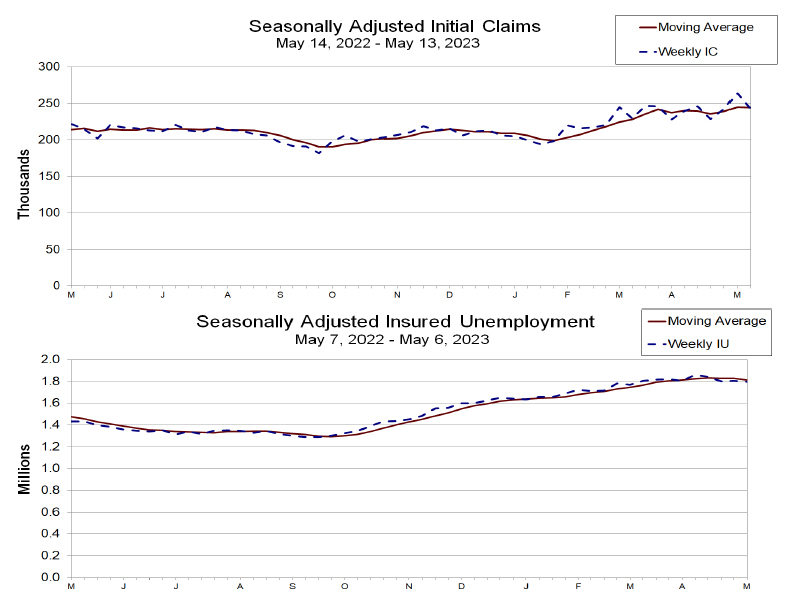
US initial jobless claims dropped -22k to 242k in the week ending May 13, below expectation of 260k. Four-week moving average of initial claims dropped -1k to 244k.
Continuing claims dropped -8k to 1799k in the week ending May 6. Four-week moving average of continuing claims dropped -15.5k to 1812.5k.
BoE Bailey not seeing balance sheet returning to pre-financial crisis levels
In his remarks to the Treasury Committee, BoE Governor Bailey commented that he does not foresee the BoE's balance sheet returning to pre-financial crisis levels. Instead, he envisages a more proactive adjustment strategy, stating, "The Bank wants to adjust its balance sheet so that it has headroom to do whatever it might need to do in the future. It does not want its balance sheet to simply get larger after every economic shock."
In a rebuttal to critics linking the UK's inflation surge to QE policies, Bailey downplayed the connection, suggesting that the impact of COVID-19 supply chain disruptions was likely time-limited. "If the only shock that the world had experienced was that one [the Covid-19 supply chain disruption] then I think the evidence now suggests it had a limited time period. Unfortunately, of course, Ukraine came along, and there was no gap between these shocks," he explained.
Deputy governor Ben Broadbent supported Bailey's perspective, noting that the UK, along with other regions such as the US and the Eurozone, had engaged in a decade of QE without witnessing an inflation problem or robust money growth.
Addressing concerns about housing prices, Bailey refuted suggestions that the BoE's policies had contributed to a surge. "Actually, the period in which the house price to income ratio rose most was the period of 10 years before 2007. That was the period when it rose most substantially. It hasn't done the same thing since then," he noted.
Australia employment down -4.3k in Apr, unemployment rate up to 3.7%
Australia employment contracted -4.3k in April, much worse than expectation of 25k growth. Full time job decreased -27.1k while part-time jobs rose 22.8k. Unemployment rate rose from 3.5% to 3.7%, above expectation of being unchanged at 3.5%. Participation rate dropped -0.1% to 66.7%. Employment-to-population ratio fell -0.2% to 64.2%. Monthly hours worked rose 2.6% mom or 49m hours.
Bjorn Jarvis, ABS head of labour statistics, said: "The small fall in employment followed an average monthly increase of around 39,000 people during the first quarter of this year." Meanwhile, both employment-to-population ratio and participation rate "were still well above pre-COVID-19 pandemic levels and close to their historical highs in 2022".
Japan's exports grow at slowest pace since Feb 2021 despite setting record high for Apr
Japan's exports grew by a modest 2.6% yoy to JPY 8288B in April. Although this represented the lowest growth in exports since February 2021, it still marked the largest export figure for April on record.
A closer examination of the data reveals a shift in trading dynamics. Exports to China fell by -2.9% yoy, marking the fifth consecutive month of decline. The decrease was driven by downturns in shipments of cars, car parts, and steel. Similarly, exports to Asia overall declined by -6.6% yoy, continuing a contraction trend for the fourth month in a row.
However, things looked rosier elsewhere. Exports to the US and EU showed robust growth, rising by 10.5% yoy and 11.7% yoy respectively. This uptick was led by a rebound in exports of cars and car parts, which have seen easing supply constraints.
Contrasting with export trends, imports fell by -2.3% yoy to JPY 8721B, the first annual decline witnessed in 27 months. This decrease was largely attributed to a slump in imports of crude oil and liquefied natural gas. Consequently, Japan recorded a trade deficit of JPY -432B for the 21st month running.
In seasonally adjusted term, the situation presents a slightly different picture. Exports rose by 2.5% mom to JPY 8259B, while imports inched up by 0.1% mom to JPY 9276B. In light of this, trade deficit narrowed to JPY -1017B.
USD/JPY Mid-Day Outlook
Daily Pivots: (S1) 136.78; (P) 137.24; (R1) 138.18; More...
USD/JPY's rally continues today and break of 137.90 resumes indicate resumption of whole rebound from 127.20. Intraday bias stays on the upside. Next target is 100% projection of 127.20 to 137.90 from 129.62 at 140.32. Break there will target 142.48 fibonacci level. On the downside, below 137.27 minor support will turn intraday bias neutral first.
In the bigger picture, price actions from 151.93 high are currently seen as a corrective pattern to the long term up trend. The first leg should have completed at 127.20. Rebound from there is seen as the second leg. Sustained break of 38.2% retracement of 151.93 to 127.20 at 136.34 will bring stronger rise to 61.8% retracement at 142.48. Meanwhile, break of 129.62 will argue that the third leg is starting through 127.20 low.
Economic Indicators Update
| GMT | Ccy | Events | Actual | Forecast | Previous | Revised |
|---|---|---|---|---|---|---|
| 22:45 | NZD | PPI Input Q/Q Q1 | 0.20% | 0.50% | 0.50% | |
| 22:45 | NZD | PPI Output Q/Q Q1 | 0.30% | 0.80% | 0.90% | |
| 23:50 | JPY | Trade Balance (JPY) Apr | -1.02T | -1.08T | -1.21T | |
| 01:30 | AUD | Employment Change Apr | -4.3K | 25K | 53K | 61.1K |
| 01:30 | AUD | Unemployment Rate Apr | 3.70% | 3.50% | 3.50% | |
| 12:30 | CAD | New Housing Price Index M/M Apr | -0.10% | -0.10% | 0.00% | |
| 12:30 | USD | Initial Jobless Claims (May 12) | 242K | 260K | 264K | |
| 12:30 | USD | Philadelphia Fed Survey May | -10.4 | -20 | -31.3 | |
| 14:00 | USD | Existing Home Sales Apr | 4.35M | 4.44M | ||
| 14:30 | USD | Natural Gas Storage | 109B | 78B |
Fed Logan: We haven’t yet made the progress we need to make
Dallas Fed Lorie Logan said in speech, "after raising the target range for the federal funds rate at each of the last 10 FOMC meetings, we have made some progress."
Logan noted, "The data in coming weeks could yet show that it is appropriate to skip a meeting. As of today, though, we aren't there yet."
Addressing the inflation target, Logan emphasized the challenges that remain. "We haven't yet made the progress we need to make. And it's a long way from here to 2% inflation," she remarked.
US initial jobless claims dropped back to 242k, below expectation
US initial jobless claims dropped -22k to 242k in the week ending May 13, below expectation of 260k. Four-week moving average of initial claims dropped -1k to 244k.
Continuing claims dropped -8k to 1799k in the week ending May 6. Four-week moving average of continuing claims dropped -15.5k to 1812.5k.
BoE Bailey not seeing balance sheet returning to pre-financial crisis levels
In his remarks to the Treasury Committee, BoE Governor Bailey commented that he does not foresee the BoE's balance sheet returning to pre-financial crisis levels. Instead, he envisages a more proactive adjustment strategy, stating, "The Bank wants to adjust its balance sheet so that it has headroom to do whatever it might need to do in the future. It does not want its balance sheet to simply get larger after every economic shock."
In a rebuttal to critics linking the UK's inflation surge to QE policies, Bailey downplayed the connection, suggesting that the impact of COVID-19 supply chain disruptions was likely time-limited. "If the only shock that the world had experienced was that one [the Covid-19 supply chain disruption] then I think the evidence now suggests it had a limited time period. Unfortunately, of course, Ukraine came along, and there was no gap between these shocks," he explained.
Deputy governor Ben Broadbent supported Bailey's perspective, noting that the UK, along with other regions such as the US and the Eurozone, had engaged in a decade of QE without witnessing an inflation problem or robust money growth.
Addressing concerns about housing prices, Bailey refuted suggestions that the BoE's policies had contributed to a surge. "Actually, the period in which the house price to income ratio rose most was the period of 10 years before 2007. That was the period when it rose most substantially. It hasn't done the same thing since then," he noted.
AUD/USD Under Pressure After Soft Aussie Employment
- Australia’s employment change declines
- Markets lower expectations of a Fed pause in June
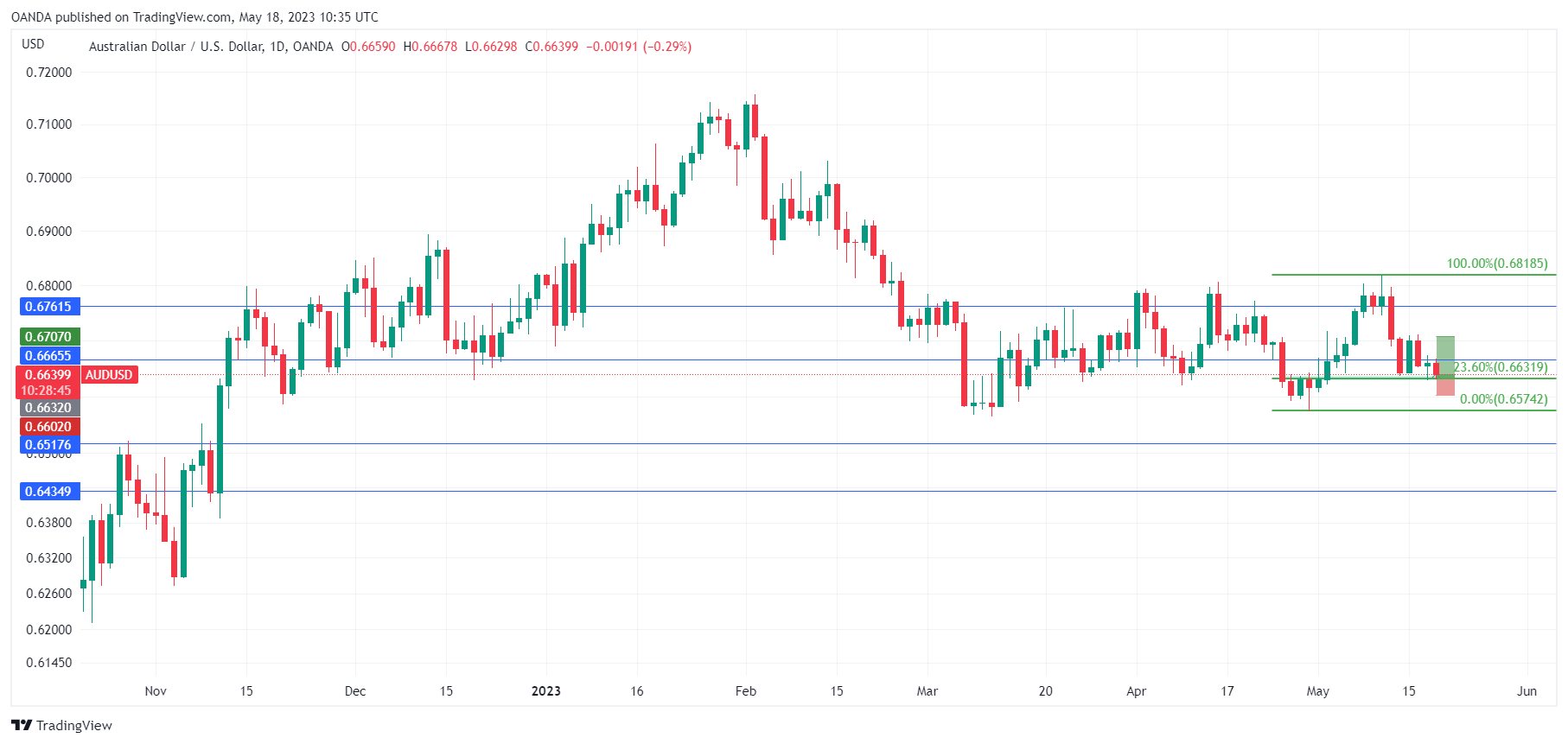
The Australian dollar has resumed its downswing on Thursday after taking a pause a day earlier. AUD/USD is trading at 0.6641 in Europe, down 0.26% on the day.
Australian employment slips
Australia’s April employment report surprised to the downside today, sending the Australian dollar lower. Net employment fell by 4,300 in April, after a gain of 61,100 in March. The market estimate stood at 25,000. What was more disconcerting was the full-time employment decline of 27,100, after a gain of 72,000 in March. As well, unemployment jumped to 3.7% in April, up from 3.5% a month earlier.
The soft job numbers provide support for the Reserve Bank of Australia to pause its rate hikes at the June 6th meeting, after shocking the markets with a 25-basis point hike earlier this month. The markets are confident of a pause, which stands at 100% probability according to the ASX RBA Rate Tracker. The central bank would like to ease up on its rate hikes and guide the economy to a soft landing, and a cooler labour market will certainly help. Still, inflation will have to cooperate and continue to head lower for the RBA to take another pause.
The US dollar is showing gains against the major currencies, as progress was reported in debt ceiling talks between Republicans and Democrats. The US has never defaulted on its debt and there’s every reason to believe that lawmakers will resolve the crisis before the June 1st deadline.
Investors continue to scale back expectations that the Fed will ease up on its rate policy. Only a week ago, the odds of a pause were 89% and a 25-bp rate hike at 11%, according to CME’s FedWatch. This has been revised to a 74% chance of a pause and a 26% chance of a 25-bp increase. The markets have mostly priced in a rate cut in December (71%), despite Jerome Powell and other members stating that no rate cuts are planned. JP Morgan came out in support of the market’s stance earlier in the week, saying that the economy was likely heading into a recession and the Fed would have to respond with rate cuts.
AUD/USD Technical
- AUD/USD is putting pressure on resistance at 0.6665. This is followed by 0.6761
- 0.6517 and 0.6434 are providing support
EUR/GBP Daily Outlook
Daily Pivots: (S1) 0.8660; (P) 0.8690; (R1) 0.8711; More...
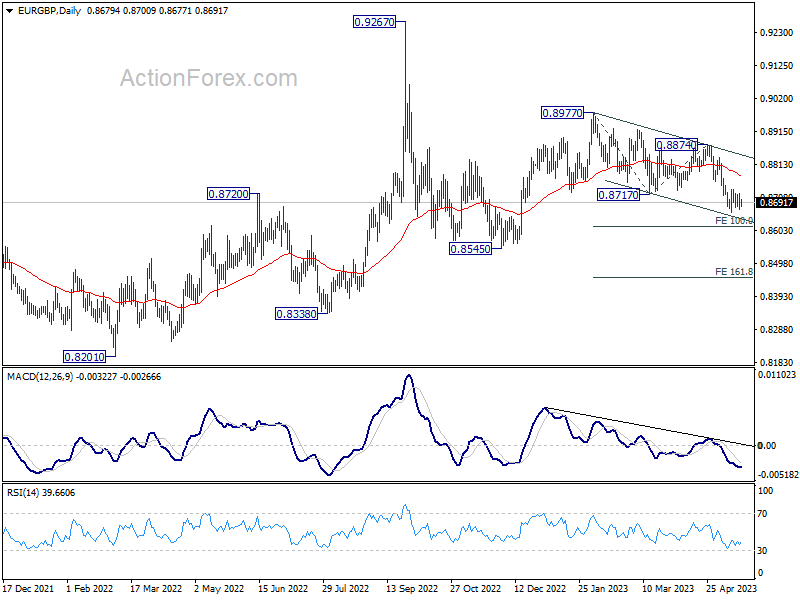
EUR/GBP is staying in consolidation from 0.8660 and intraday bias remains neutral. Further decline is expected as long as 0.8758 resistance holds. On the downside, break of 0.8660 will resume recent decline to 100% projection of 0.8977 to 0.8717 from 0.8874 at 0.8614. Nevertheless, break of 0.8758 minor resistance will turn bias back to the upside for stronger rebound.
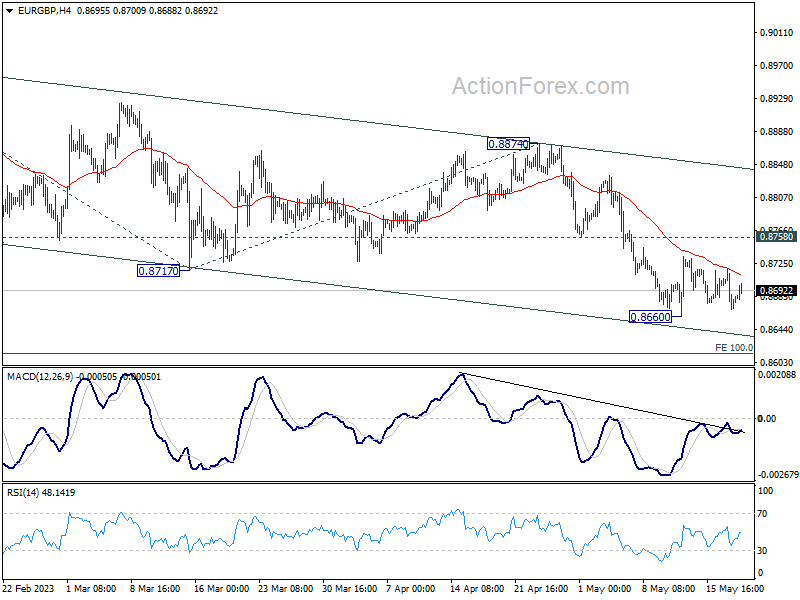
In the bigger picture, current development argues that whole decline from 0.9267 (2022 high) is still in progress. This is part of the long term range pattern from 0.9499 (2020 high). Deeper fall would be seen through 0.8545 support. his will now remain the favored case as long as 0.8874 resistance holds.