Sample Category Title
Sunset Market Commentary
Markets
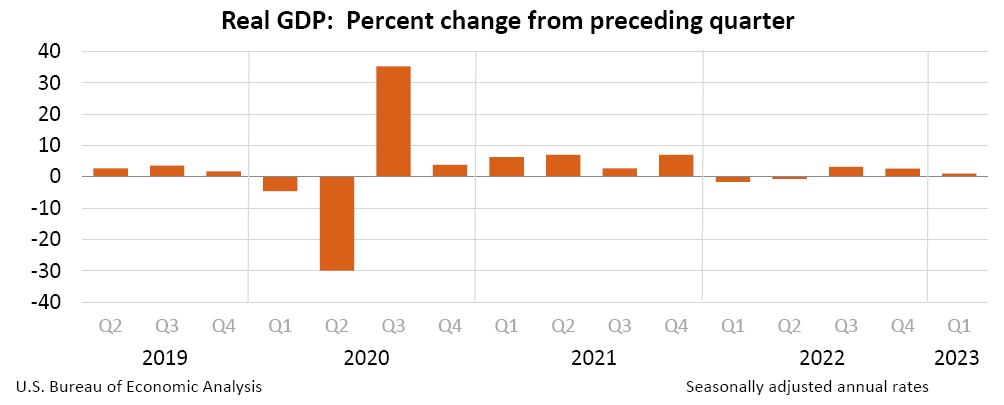
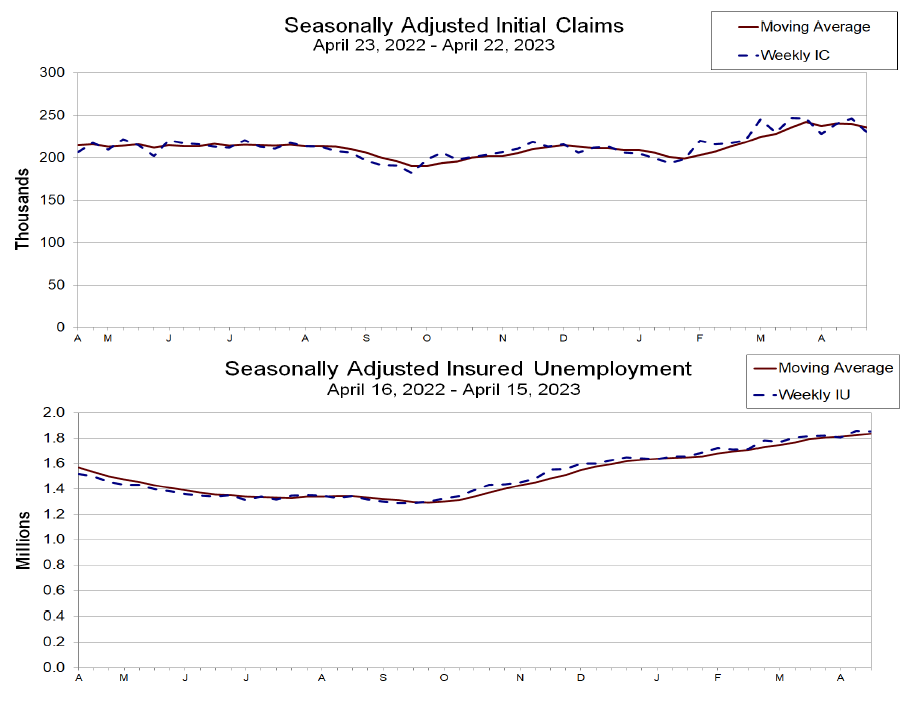
Since the early March collapse of Silicon Valley Bank, investors reacted in an asymmetric manner to eco figures. They cherrypicked the slightest disappointments to strengthen their case of a nearby Fed policy rate peak and policy rate cuts starting in H2 2023 to accommodate the economy. Today, in a change of heart, they forfeited on the opportunity to boost their dovish cases after US GDP grew less than expected in Q1 (1.1% Q/Qa from 2.6% in Q4 2022 and vs 1.9% forecast). A look under the hood showed personal consumption accelerating from 1% Q/Qa to 3.7% Q/Qa (vs 4% expected, but nevertheless the fastest pace since Q2 2021) with joe sixpack spending on both goods and services. The consumer does hold up well despite inflation, the Fed’s tightening trajectory and uncertainty around financial stability. A very tight labour market, wage growth and a pandemic build-up in savings provide sufficient counterweight for the moment. Underlying US Q1 GDP was also much stronger when taking into account that inventories took off 2.26 percentage points from the growth rate. Government spending (especially defense) and trade contributed a bit to growth with business investment the only real disappointment. Q1 price deflators printed on the topside as well with especially core PCE rising by the fastest pace since Q1 2022 (4.9% Q/Q from 4.4% in Q4 2022 and vs 4.7% expected). They suggest upside risks to tomorrow’s March monthly deflators. Simultaneously with GDP figures, US weekly jobless claims increased less than expected (230k vs 248k forecast from 246k). Solid underlying growth and stubborn price pressure pulled US Treasuries lower, underperforming German Bunds. US yields currently add 2.6 bps (30-yr) to 8.3 bps (2-yr). The US 2-yr yield turns back above 4% with the 10-yr yield back above 3.5%. German yields add 3 to 3.5 bps across the curve. US eco data and yield dynamics pulled EUR/USD from levels around 1.1050 down to 1.10. We only expect a longer stay below 1.10 should tomorrow’s national EMU CPI data print on the soft side thereby reducing the market implied probability of a 50 bps ECB rate hike next week (currently around 25%). US equity futures already pointed to a positive stock market opening following stronger Q1 Meta earning and got an additional boost on US economic strength. They open up to 1% higher for Nasdaq.
News & Views
Belgian inflation decelerated further from 6.67% to 5.60% in April. Energy decreased sharply again, declining 17.08% y/y and subtracting 2.36% of total inflation. Food prices still add 3.19 ppts (16.64% y/y but slightly lower than the 17.02% last month) and are by far the biggest contributor to headline inflation. Core inflation for the first time since September 2021 eased, from 8.57% to 8.28% y/y. Price pressures in services were slightly less intense than in March, rising 6.80% vs 7.06%. If April indeed marks the start of the disinflationary process (of core inflation), question now is how quickly (or not) it runs. In other Belgian news, GDP expanded at 0.4% q/q in 2023 Q1 with the pace picking up from the previous quarter’s 0.1%, the NBB’s preliminary estimate revealed. Belgium’s economy is now 1.3% bigger than the same period last year. The services sector outperformed, with value added rising 0.7%, followed by construction (0.4%). Value added in the industrial sector shrunk 0.6%.
Swedish GDP grew 0.2% q/q in Q1 of this year following a -0.6% contraction in 2022Q4. That’s more than the stagnation expected by analysts but slightly below the country’s central bank own estimate (+0.3% q/q). The economy grew 0.3% y/y in Q1. The numbers are a preliminary estimate, compiled with more limited statistics than the regular quarterly national accounts (due May 30). They do reveal economic momentum is slowing down. The monthly GDP reading in January still printed at a strong 1.6% m/m but was then followed by -1.1% in February and -0.2% in March. This suggests the Riksbank’s tightening efforts are gradually filtering through. It has, however, still some way to go with inflation at levels well above the 2% target. Just yesterday, the central bank lifted policy rates by 50 bps to 3.5% and, much to the SEK’s disappointment, only projected an additional 25 bps hike in July or September. The Swedish crown shrugged at today’s numbers with EUR/SEK hovering near multiyear lows at around 10.38.
U.S. Growth Slips to 1.1% in Q1, Though Details Show a Strong Gain in Consumer Spending
Real GDP expanded by 1.1% quarter-on-quarter (q/q, annualized) in the first quarter of 2023 – a marked deceleration from last quarter's 2.6% – and well below the consensus forecast of 1.9%.
Consumer spending grew by a robust 3.7% – a meaningful acceleration from Q4's gain of 1.0%. Spending on goods rose 6.5%, largely the result of a sharp rebound in durables (+16.9%), while non-durables edged higher by just 0.9%. Service spending was up by 2.3%.
Non-residential business investment expanded by a modest 0.7%, as a pullback in equipment spending (-7.3%) was more than offset by a robust gain in structures (+11.2%) and more modest growth in intellectual property products (+3.8%).
Residential investment declined for an eighth consecutive quarter - falling by 4.2%. That said, declines moderated in Q1 as home construction appeared to stabilize while home sales turned modestly higher.
Both exports (+4.8%) and imports (+2.9%) were higher last quarter, though a larger gain in the former meant that net trade made a small (+0.1 percentage point) contribution to headline growth.
Government spending rose 4.7%, thanks to gains at both the federal (+7.8%) and state & local (+2.9%) levels.
After making an outsized contribution to growth last quarter, inventory investment subtracted 2.3 percentage points from Q1 growth.
Core PCE – the Fed's preferred inflation metric – rose to 4.9% q/q (annualized) in Q1, slightly stronger than the consensus forecast of 4.7%.
Key Implications
First quarter GDP came in well below the consensus forecast, largely owing to an outsized decline in inventory accumulation. Putting that aside, final domestic demand rose by a robust 3.2% – a meaningful acceleration from last quarter's 0.7% gain.
Much of the strength on the domestic front was the result of a very strong reading on consumer spending. While warmer weather may have had some influence – particularly for January where there was an outsized gain in spending activity – a sturdy labor market alongside some easing in inflationary pressures are helping to support real household incomes and sustain a robust pace of consumer spending.
We have already started to see some evidence of cooling in the labor market, while other higher frequency data points indicate a further softening in economic activity heading into the second quarter. We expect these pressures to intensify over the coming months as the cumulative impact of higher interest rates and some tightening in bank lending standards exert a more meaningful drag on domestic demand, pushing growth to a near stall speed as early as Q2.
EUR/CHF Mid-Day Outlook
Daily Pivots: (S1) 0.9798; (P) 0.9821; (R1) 0.9864; More...
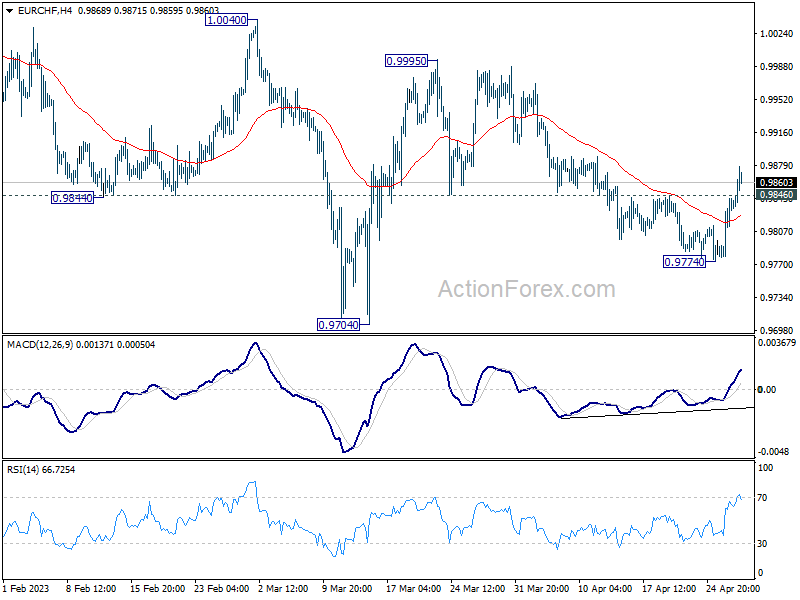
EUR/CHF's break of 0.9846 resistance suggests that fall form 0.9995 has completed at 0.9774, well ahead of 0.9704 low. The development also argue revive the case that whole correction from 1.0095 has completed at 0.9704. Intraday bias is back on the upside. Sustained trading above 55 D EMA (now at 0.9876) will affirm this bullish case, and target 0.9995 resistance next.
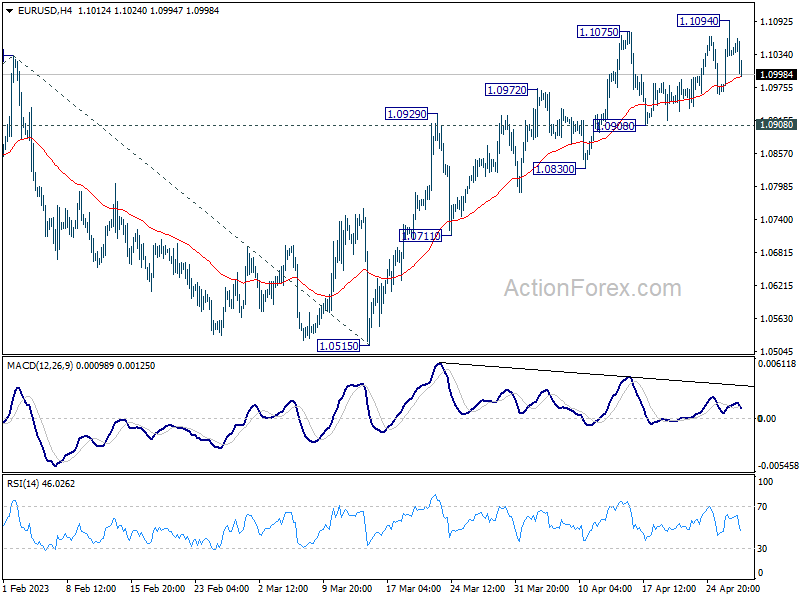
In the bigger picture, prior rejection by 55 W EMA (now at 0.9989) and 38.2% retracement of 1.1149 to 0.9407 at 1.0072 suggests that medium term outlook is staying bearish. That is, down trend from 1.2004 is not completed yet and is in favor to resume through 0.9407 at a later stage. However, decisive break of 1.0095 resistance will raise the chance of bullish trend reversal. Rise from 0.9407 should then target 1.0505 cluster resistance (2020 low at 1.0505, 61.8% retracement of 1.1149 to 0.9407 at 1.1484).
EUR/USD Mid-Day Outlook
Daily Pivots: (S1) 1.0972; (P) 1.1034; (R1) 1.1100; More...
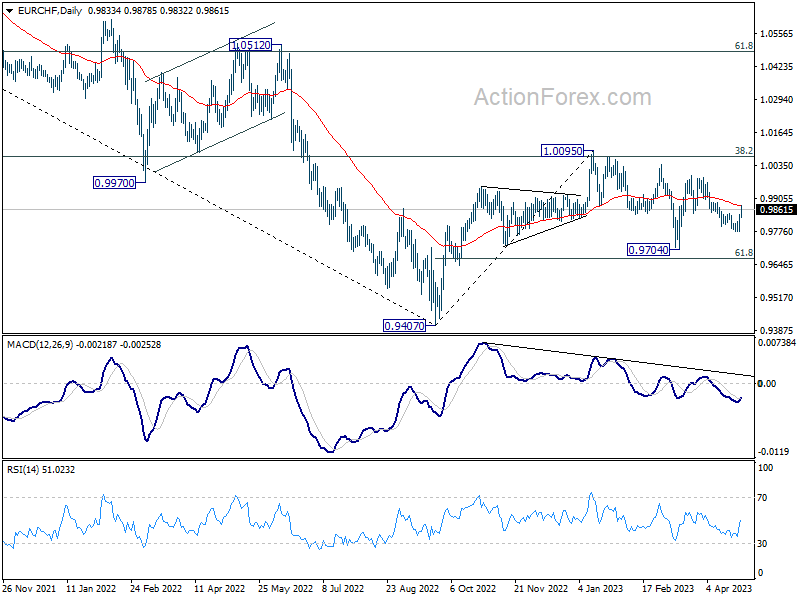
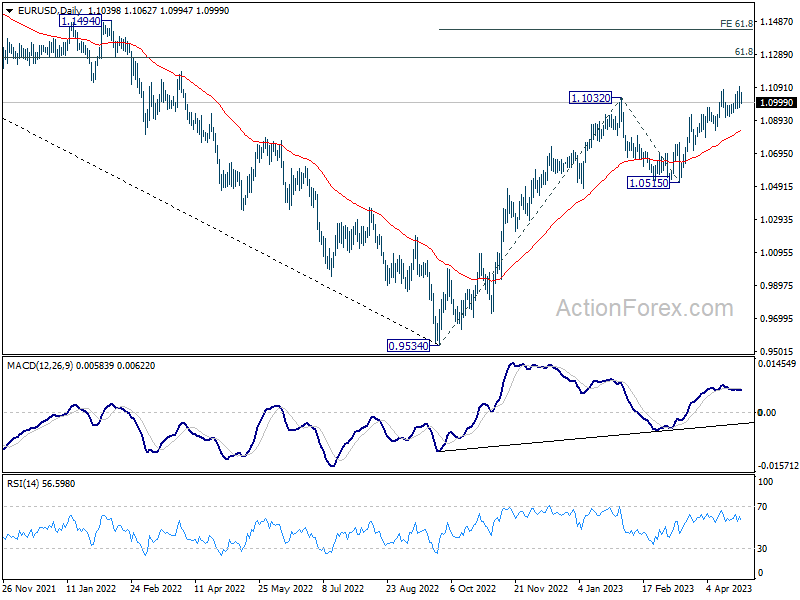
Intraday bias in EUR/USD is turned neutral with current retreat. Some consolidations could be seen first. But further rally is expected as long as 1.0908 support holds. Break of 1.1094 will resume larger up trend to 1.1273 fibonacci level. Break there will target 61.8% projection of 0.9534 to 1.1032 from 1.0515 at 1.1441.
In the bigger picture, rise from 0.9534 (2022 low) is in progress for 61.8% retracement of 1.2348 (2021 high) to 0.9534 at 1.1273. Sustained break there will solidify the case of bullish trend reversal and target 1.2348 resistance next (2021 high). This will now remain the favored case as long as 1.0515 support holds, even in case of deeper pull back.
GBP/USD Mid-Day Outlook
Daily Pivots: (S1) 1.2409; (P) 1.2462; (R1) 1.2521; More...
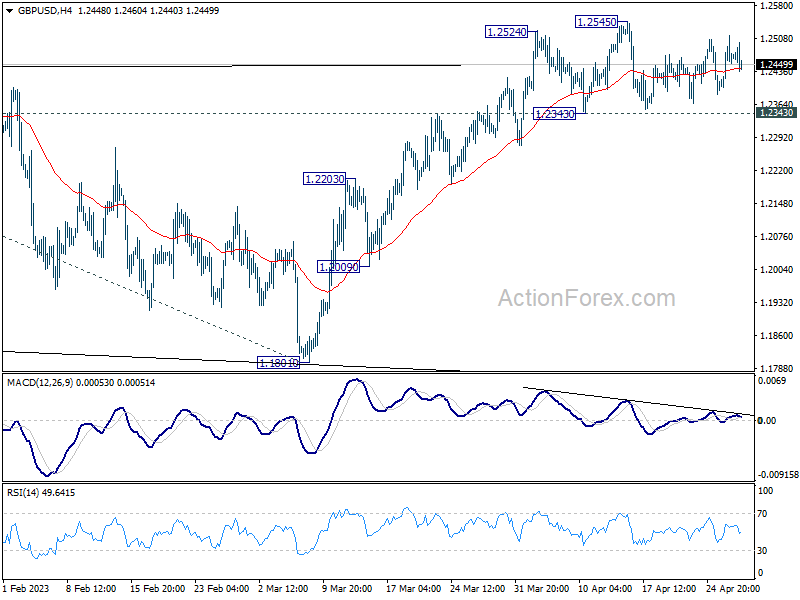
GBP/USD is staying in sideway consolidation and intraday bias stays neutral. Also, outlook remains bullish with 1.2343 support intact. On the upside, above 1.2545 will target 1.2759 fibonacci level first. Firm break there will target 61.8% projection of 1.0351 to 1.2445 from 1.1801 at 1.3095. However, considering bearish divergence condition in 4H MACD, firm break of 1.2343 will confirm short term topping, and turn bias back to the downside for deeper pullback.
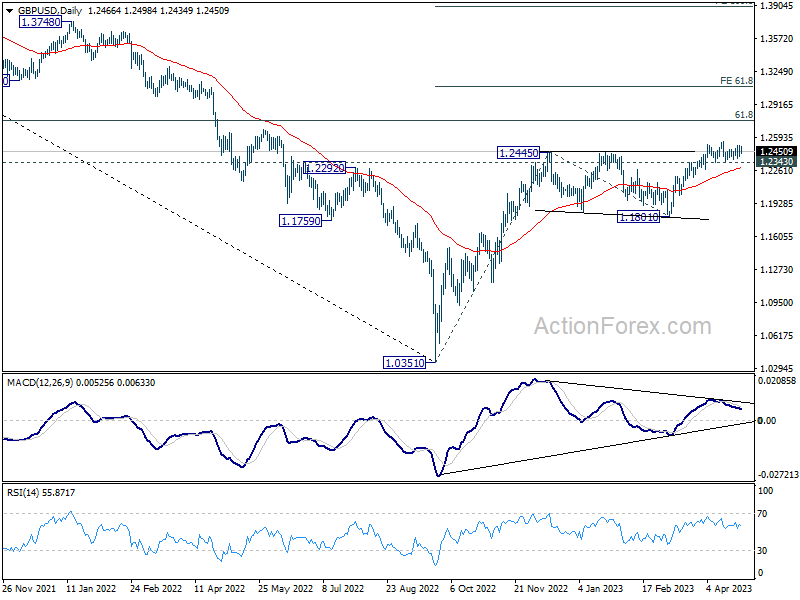
In the bigger picture, the rise from 1.0351 medium term term bottom (2022 low) is in progress for 61.8% retracement of 1.4248 (2021 high) to 1.0351 at 1.2759. Sustained break there will add to the case of long term bullish trend reversal. Further break of 61.8% projection of 1.0351 to 1.2445 from 1.1801 at 1.3095 could prompt upside acceleration to 100% projection at 1.3895. For now, this will remain the favored case as long as 1.1801 support holds, even in case of deep pull back.
USD/JPY Mid-Day Outlook
Daily Pivots: (S1) 133.13; (P) 133.55; (R1) 134.07; More...
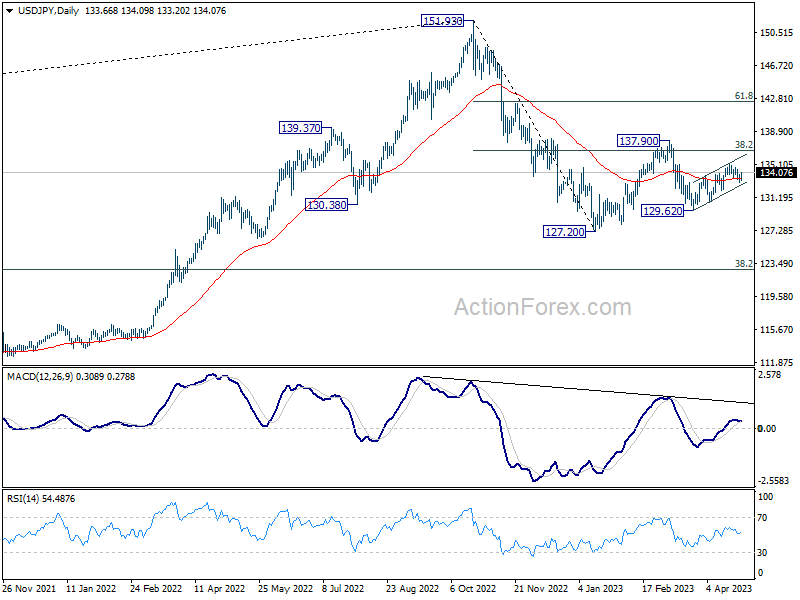
USD/JPY is still bounded in consolidation from 135.13 and intraday bias remains neutral for the moment. Further rally is expected as long as 132.03 support holds. On the upside, break of 135.13 will resume the choppy rebound from 129.62 towards 137.90 resistance next. However, break of 132.03 will argue that the rebound has completed already and turn bias back to the downside for 129.62 and below.
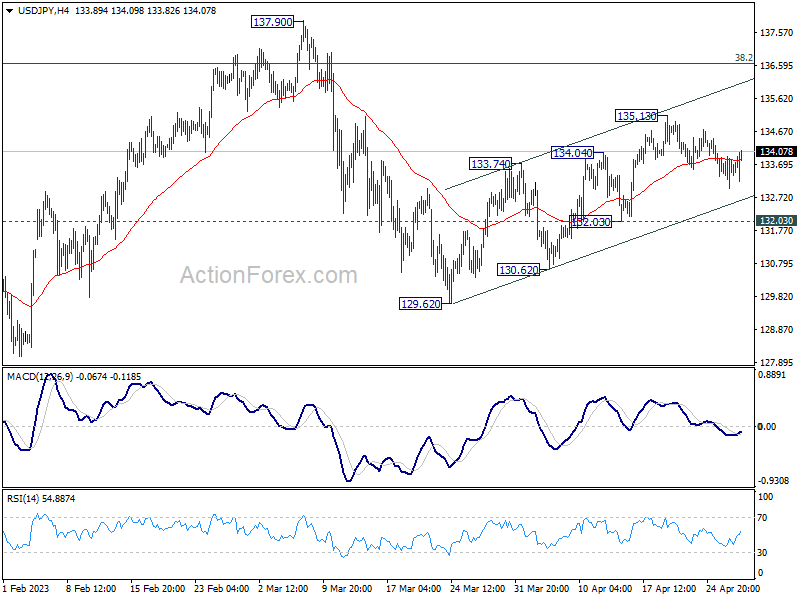
In the bigger picture, corrective pattern from 127.20 might be extending. But after all, down trend from 151.93 is expected to resume at a later stage. Break of 127.20 will resume this down trend and target 61.8% projection of 151.93 to 127.20 from 137.90 at 122.61. This will now be the favored case as long as 137.90 resistance holds.
USD/CHF Mid-Day Outlook
Daily Pivots: (S1) 0.8869; (P) 0.8897; (R1) 0.8943; More...
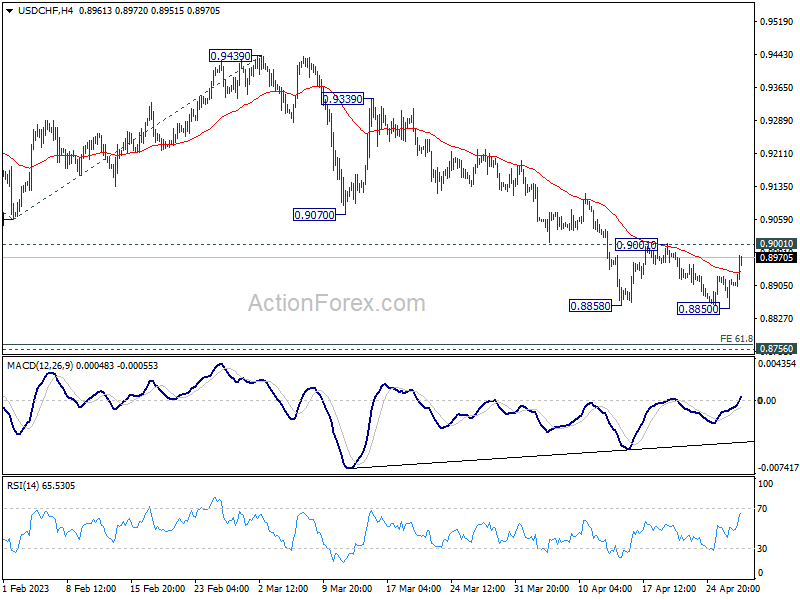
Intraday bias in USD/CHF remains neutral for the moment. On the upside, decisive break of 0.9001 resistance should confirm short term bottoming at 0.8850. Intraday bias will be back on the upside 55 D EMA (now at 0.9120). Sustained break there will be a strong sign of bullish reversal. On the downside, break of 0.8850 will resume larger fall from 1.0146, to 61.8% projection of 1.0146 to 0.9058 from 0.9439 at 0.8767, which is close to 0.8756 long term support. Strong support is expected there to bring rebound, at least on first attempt.
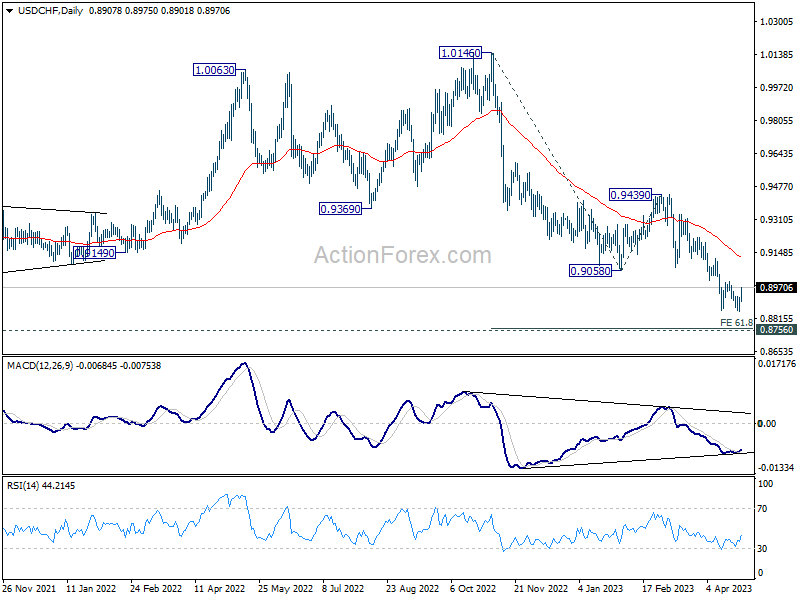
In the bigger picture, fall from 1.1046 (2022 high) is in progress for 0.8756 support (2021 low). But overall, this fall is still seen as a leg in the long term range pattern from 1.0342 (2016 high). So, downside should be contained by 0.8756 to bring reversal. Sustained break of 0.9058 support turned resistance will be the first sign of medium term bottoming. However, decisive break of 0.8756 will carry larger bearish implications.
Dollar Recovers Shrugging GDP Miss, Swiss Franc Reversing
Dollar shrugs off worse than expected Q1 GDP data and recovers against European majors in early US session. But momentum is so far weak except versus Swiss Franc, which happens to be the worst performer for the day. Australian Dollar and other commodity currencies turned into consolidation, digesting this week's losses. Meanwhile, Euro and Sterling are losing much momentum for now, and turned mixed. Yen is also engaging in range trading, awaiting tomorrow's first BoJ announcement by new governor Kazuo Ueda.
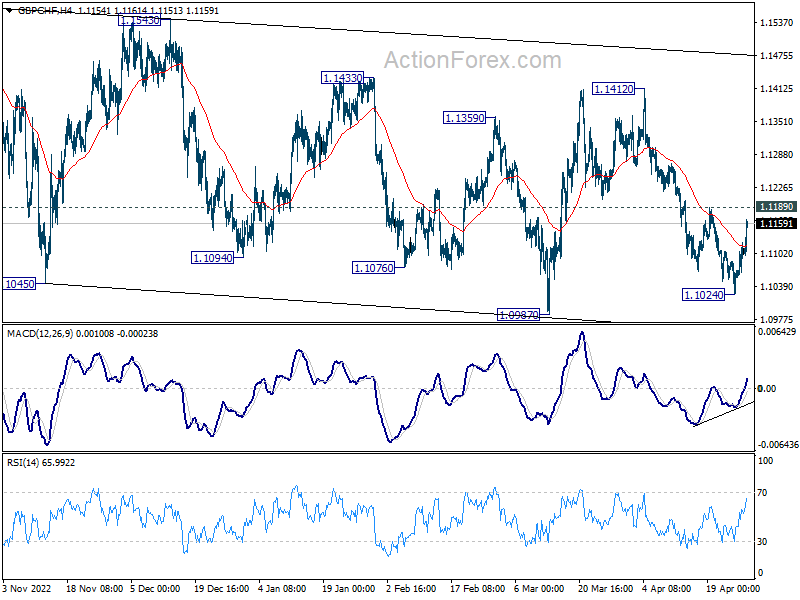
Technically, EUR/CHF's break of 0.9846 resistance argues that near term pull back form 0.9995 has completed at 0.9774 already. Stronger rally is now in favor back towards 0.9995. One focus is now on USD/CHF, as firm break of 0.9001 should confirm short term bottoming, and bring stronger rebound. Another focus is 1.1189 resistance in GBP/CHF. Firm break there will indicate that fall from 1.1412 has completed at 1.1412. The sideway pattern from 1.1574 (Oct high) should have then started another rising leg.
In Europe, at the time of writing, FTSE is up 0.04%. DAX is up 0.28%. CAC is up 0.45%. Germany 10-year yield is up 0.0288 at 2.430. Earlier in Asia, Nikkei rose 0.15%. Hong Kong HSI rose 0.42%. China Shanghai SSE rose 0.67%. Singapore Strait Times dropped -0.36%. Japan 10-year JGB yield dropped -0.0027 to 0.460.
US GDP grew only 1.1% annualized in Q1, well below expectations
US GDP growth for Q1 2023 came in at a mere 1.1% annualized, significantly below the expected 2.0%.
The increase in real GDP can be attributed to rises in consumer spending, exports, federal government spending, state and local government spending, and nonresidential fixed investment.
However, these increases were partially offset by declines in private inventory investment and residential fixed investment. Meanwhile, imports, which are subtracted when calculating GDP, also increased.
Price index for gross domestic purchases rose by 3.8% in Q1, compared to the 3.6% increase recorded in Q4. Personal Consumption Expenditures price index saw a 4.2% increase, up from the previous quarter's 3.7% increase. Excluding food and energy prices, PCE price index climbed by 4.9%, compared to 4.4% increase in the previous quarter.
US initial jobless claims down -16k to 230k
US initial jobless claims dropped -16k to 230k in the week ending April 22, better than expectation of 245k. Four-week moving average of initial claims dropped -4k to 236k.
Continuing claims dropped -3k to 1858k in the wee ending April 15. Four-week moving average of continuing claims rose 10k to 1837k, highest since December 18, 2021.
Eurozone economic sentiment up slightly to 99.3, third month of sideways movement
Eurozone Economic Sentiment Indicator ticked up from 99.2 to 99.3 in April, below expectation of 99.9. This is the third month of a general sideways movement of the indicator. Industry confidence dropped from -0.5 to -2.6. Services confidence rose from 9.6 to 10.5. Consumer confidence rose from -19.1 to -17.5. Retail trade confidence rose from -1.5 to -1.0. Construction confidence was unchanged at 1.0. Employment Expectation Indicator dropped from 108.9 to 107.4. Economic Uncertainty Indicator dropped from 22.4 to 22.2.
EU ESI was unchanged at 97.3. Employment Expectation Indicator dropped from 107.5 to 106.1. Economic Uncertainty Indicator dropped from 22.1 to 21.8. Amongst the largest EU economies, the ESI improved in Spain (+3.7) and, to a lesser extent, in Poland (+1.1) and Germany (+0.8). While sentiment edged up also in Italy (+0.3), it deteriorated in the Netherlands (-1.6) and, particularly, in France (-4.2).
NZ ANZ business confidence dropped slightly, inflation expectation lowest since Mar 2022
New Zealand ANZ Business Confidence index decrease slightly in April, dipping from -43.4 to -43.8. On the other hand, Own Activity Outlook improved from -8.5 to -7.6. A closer look at the details reveals that export intentions jumped from -8.9 to -1.5, while investment intentions remained unchanged at -6.8. Employment intentions rose from -4.6 to -2.4, and pricing intentions fell from 56.8 to 53.7. Cost expectations dropped from 86.4 to 84.2, and profit expectations declined from -33.9 to -37.7.
Inflation expectations decreased from 5.82 to 5.70, reaching the lowest level since March 2022. ANZ observed that the overall decline in inflation signals is consistent with RBNZ gradually gaining traction. However, the situation is far from resolved, as the proportion of firms experiencing high costs and intending to raise prices remains "problematically high".
ANZ added: "The RBNZ will be encouraged to see the ongoing fall in the inflation indicators in the survey. While there's still a way to go, inflation is set to continue easing over the year ahead, as they and we are forecasting.
"It's important to note that the data does not represent a 'surprise' for the RBNZ; rather, it's what they will be expecting to see if their forecasts are to come to fruition, with the OCR able to top out shortly.
"There are risks on both sides: inflation could get "stuck" north of the target band, or global markets could deliver a side-swipe, for example. But the overall message from this month's survey is "on track."
USD/CHF Mid-Day Outlook
Daily Pivots: (S1) 0.8869; (P) 0.8897; (R1) 0.8943; More...
Intraday bias in USD/CHF remains neutral for the moment. On the upside, decisive break of 0.9001 resistance should confirm short term bottoming at 0.8850. Intraday bias will be back on the upside 55 D EMA (now at 0.9120). Sustained break there will be a strong sign of bullish reversal. On the downside, break of 0.8850 will resume larger fall from 1.0146, to 61.8% projection of 1.0146 to 0.9058 from 0.9439 at 0.8767, which is close to 0.8756 long term support. Strong support is expected there to bring rebound, at least on first attempt.
In the bigger picture, fall from 1.1046 (2022 high) is in progress for 0.8756 support (2021 low). But overall, this fall is still seen as a leg in the long term range pattern from 1.0342 (2016 high). So, downside should be contained by 0.8756 to bring reversal. Sustained break of 0.9058 support turned resistance will be the first sign of medium term bottoming. However, decisive break of 0.8756 will carry larger bearish implications.
Economic Indicators Update
| GMT | Ccy | Events | Actual | Forecast | Previous | Revised |
|---|---|---|---|---|---|---|
| 01:00 | NZD | ANZ Business Confidence Apr | -43.8 | -43.4 | ||
| 01:30 | AUD | Import Price Index Q/Q Q1 | -4.20% | 0.60% | 1.80% | |
| 09:00 | EUR | Eurozone Economic Sentiment Indicator Apr | 99.3 | 99.9 | 99.3 | 99.2 |
| 09:00 | EUR | Eurozone Services Sentiment Apr | 10.5 | 9.5 | 9.4 | 9.6 |
| 09:00 | EUR | Eurozone Industrial Confidence Apr | -2.6 | 0.2 | -0.2 | -0.5 |
| 09:00 | EUR | Eurozone Consumer Confidence Apr F | -17.5 | -17.5 | -19.1 | |
| 12:30 | USD | Initial Jobless Claims (Apr 21) | 230K | 245K | 245K | 246K |
| 12:30 | USD | GDP Annualized Q1 P | 1.10% | 2.00% | 2.60% | |
| 12:30 | USD | GDP Price Index Q1 P | 4.00% | 3.70% | 3.90% | |
| 14:00 | USD | Pending Home Sales M/M Mar | 1.00% | 0.80% | ||
| 14:30 | USD | Natural Gas Storage | 76B | 75B |
US initial jobless claims down -16k to 230k
US initial jobless claims dropped -16k to 230k in the week ending April 22, better than expectation of 245k. Four-week moving average of initial claims dropped -4k to 236k.
Continuing claims dropped -3k to 1858k in the wee ending April 15. Four-week moving average of continuing claims rose 10k to 1837k, highest since December 18, 2021.
US GDP grew only 1.1% annualized in Q1, well below expectations
US GDP growth for Q1 2023 came in at a mere 1.1% annualized, significantly below the expected 2.0%.
The increase in real GDP can be attributed to rises in consumer spending, exports, federal government spending, state and local government spending, and nonresidential fixed investment.
However, these increases were partially offset by declines in private inventory investment and residential fixed investment. Meanwhile, imports, which are subtracted when calculating GDP, also increased.
Price index for gross domestic purchases rose by 3.8% in Q1, compared to the 3.6% increase recorded in Q4. Personal Consumption Expenditures price index saw a 4.2% increase, up from the previous quarter's 3.7% increase. Excluding food and energy prices, PCE price index climbed by 4.9%, compared to 4.4% increase in the previous quarter.