

Sample Category Title
S&P 500 stays near term bullish after biggest rally since Jan
US stocks rallied strongly overnight, the DOW and S&P 500 recording their largest rallies since January, and NASDAQ since March. The turnaround in sentiment was driven by Meta's impressive quarterly performance, which saw shares close up 14%. Additionally, weaker-than-expected Q1 GDP data fueled expectations that Fed is getting closer to ending its tightening cycle, providing ammunition for pessimists to call for a potential rate cut before year-end should the economy continue to deteriorate.
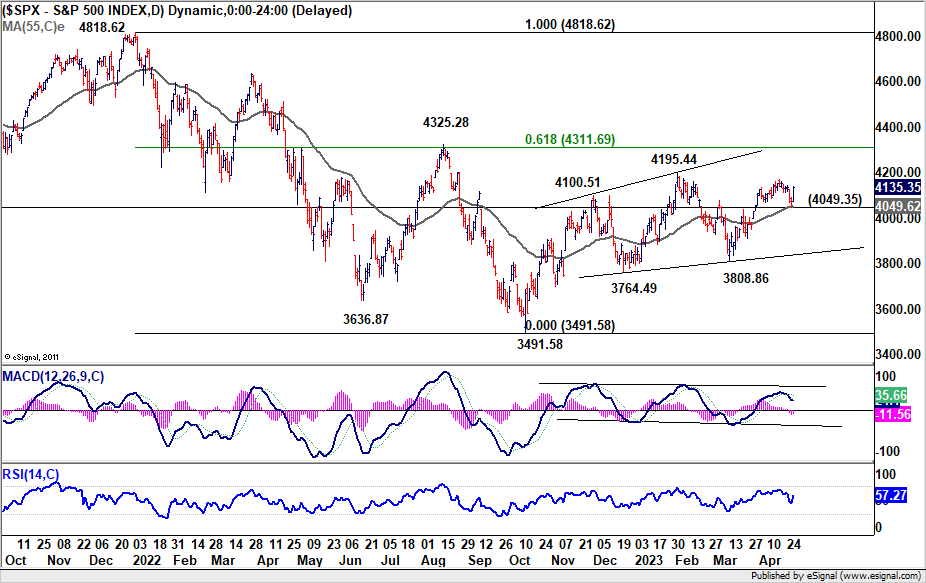
Technically, DOW, S&P 500, and NASDAQ all found robust support from their respective 55 D EMA this week. In the case of SPX, the development keeps the rally from 3808.83 alive. Near-term outlook remains bullish as long as 4049.35 support level holds. Break of 4195.44 resistance will confirm resumption of the overall rebound from 3491.58.
Meanwhile, a critical obstacle lies in the 4325.28 cluster resistance (61.8% retracement of 4818.62 to 3491.58 at 4311.69) for SPX. Sustained break of this cluster resistance will pave the way for further rally towards historical high of 4818.62. The market's reaction to the 4300 handle will largely depend on next week's FOMC rate decision and Chair Jerome Powell's press conference.
Japan industrial production rose 0.8% mom, with signs of moderate pick up
Japan's industrial production expanded for the second consecutive month, recording a 0.8% mom growth in March, surpassing the expected 0.4% mom increase. The growth was driven by output in eight sectors, led by motor vehicles, while declines were observed in seven sectors, including electronic components and devices.
The Ministry of Economy, Trade and Industry upgraded its basic assessment for the month, stating that industrial production was "showing signs of moderately picking up" as parts supply shortages continued to ease. This is a marked improvement from the previous month's assessment of "weakening." The ministry also projects a further 4.1% growth in industrial production for April and a -2.0% decline in May.
Other economic indicators released include 7.2% yoy increase in retail sales for March, surpassing expectations of 6.5% yoy. However, unemployment rate rose for the second month in a row, reaching 2.8%, above expectation of 2.5%.
April, Tokyo core CPI, which excludes fresh food, accelerated from 3.2% to 3.5% yoy, exceeding expectations of 3.2% yoy. Core-core CPI, which excludes fresh food and fuel costs, accelerated from 3.4% to 3.8% year-on-year, marking the highest rate since April 1982.
RBA Board to Pause Again at its May Meeting: 3.6% Now the Likely Cash Rate Peak
The Reserve Bank Board meets next week on May 2.
Following the release of the March quarter inflation report Westpac now expects the Board to extend the pause it instigated at its April meeting to the May meeting.
This decision will be despite the likelihood that the FOMC will announce the decision to lift the federal funds rate by 0.25% to 5.125% two days after the RBA meeting (see below). However, as with the RBA, we do believe that this decision will mark the peak of the cycle.
We have always argued that May would likely be the peak of the tightening cycle so we are now lowering our forecast cash rate peak from 3.85% to 3.6%.
Given the uncertainty around the current outlook and a need to contain inflation expectations, the Board is almost certain to maintain its clear tightening bias. However, as we move through the remainder of 2023 the credibility of that bias is likely to fade.
In his recent speech on April 4 the Governor justified the pause in April by saying that it would: "give the Board more time to assess the economic outlook and the impact of the increases in interest rates so far." He expanded that: "This approach is consistent with our practice in earlier interest rate cycles … to move interest rates multiple times then wait for a while to assess the pulse of the economy and move again if the situation warranted doing so … it is a return to that world."
The key information available between the two meetings has been around the labour market and inflation.
The March employment report was relatively strong, indicating that, for now, the unemployment remained near 50-year lows. Given that the Board is aiming to return inflation to its target while retaining, as far as possible, the employment gains in recent years, this would not necessarily be viewed as 'bad news' if there was satisfactory progress on achieving the inflation objective.
The Governor describes the inflation objective in terms of reaching the top of the of the 2–3% target range by mid-2025.
That path has been laid out in the Bank's forecasts in the February Statement on Monetary Policy (SOMP). These have trimmed mean inflation slowing from 6.9%yr in December 2022 to 6.2%yr by June 2023, while headline inflation slows from 7.8%yr in December 2022 to 6.7%yr in June 2023.
These forecasts imply an expectation that the March inflation report would print at around 6.5–6.6%yr for trimmed mean and 7.2–7.3%yr for headline inflation.
It seems very unlikely that the staff's refreshed forecasts, which will be supplied to the Board at the May meeting, will indicate that the timing of the achievement of the inflation target needs to be pushed out further – a change that would require an immediate policy response from the Board.
Instead, it seems likely that the staff's forecasts for household spending and GDP growth in 2023 will be lowered somewhat, supporting the view that there is scope to pause (see below).
The March quarter inflation report printed 6.6%yr for the trimmed mean and 7.0%yr for headline inflation. The trimmed mean path is in line with expectations while the headline print looks to be slightly lower than expectations.
That result for the trimmed mean contrasts with the December quarter which printed 6.9%yr compared to the Bank's expectations of 6.5%yr – an upside surprise that prompted the hawkish shift in rhetoric following the February Board meeting.
With the inflation result in line with the Bank's forecast path for eventually achieving its inflation target, the Board can take time to allow a further assessment of the cumulative impact of 350bps of tightening. That includes assessing the lagged impact on the roughly 35% of mortgages that are progressing from fixed rate to much higher floating rate terms over the course of the next year or so. In this unusual cycle, rate increases do not end just because the RBA goes on hold.
The RBA Governor's comment in the speech about "a return to that world" points to linking further decisions to quarterly inflation reports. While useful, the monthly inflation indicators do not provide measures of underlying inflation, and a reliable link between the monthly headline measures and the quarterly headline measures has not yet been established.
If we look forward to the Bank's June quarter forecasts of 6.2%yr trimmed mean and 6.7%yr headline inflation, we expect these 'milestones' to be easily achieved. Indeed, our own forecasts have headline Inflation back to 4% by December 2023, compared to the Bank's current path which sees it back at 4.8%yr.
Indeed, our weaker growth and inflation path means that the need for further tightening will fade decisively in the second half of 2023.
We have argued for the last six months that the peak in the current cycle will be the May Board meeting. Our preference was for that peak to be 3.85%, with a final 25bp hike in May based on the 'here and now' – record low unemployment and very high inflation – rather than relying on forecasts. We still believe this would be the better policy approach given the risks, but it appears to be out of line with the Board's intentions.
If, as we now expect, the peak will be 3.6% there are now some upside risks to our growth and inflation profiles through the second half of 2023, although there also look to be downside risks to the first half forecasts.
These upside risks are also associated with our recently revised view that the housing market has stabilised and that immigration has lifted markedly.
On the downside, our already very weak profile for household spending may see a further downgrade given the prospect of a contraction in real retail sales in the March quarter. We are currently forecasting annual household spending growth to slow to 1.8% in the year to the June quarter and 0.7% in calendar 2023.
We currently forecast growth at 1% for 2023 with headline inflation at 4%.
These dynamics – materially below-trend growth and inflation closing in on the top of the inflation target – would be consistent with a rate cut cycle beginning in the March quarter. The upside risks to the growth and inflation outlook in the second half of 2023 raise the possibility that the rate cut cycle may begin somewhat later, although this is balanced somewhat by downside risks to our near-term profile.
With the uncertainty around next week's meeting, we will review these issues in light of the Board's decision next week.
Revised forecasts in the Statement on Monetary Policy
In his April 4 speech the Governor gave considerable attention to household spending. He revealed the Bank's forecast for spending growth in the March quarter of 0.2%qtr. That implies a likely downward revision to the February SOMP forecast for household consumption over the year to June 2023, from 2.5% to 2% or less. Household consumption growth for calendar 2023 could be lowered from 1.7% to 1% or less, in turn implying a possible downward revision to GDP growth in 2023 from 1.6% to 1.3-1.4%. At the margin these numbers will also have to incorporate a higher profile for population growth.
Conclusion
The inflation report is in line with the Board's path to achieving its stated objective of having inflation back at the top of the 2–3% target by mid-2025. This provides the Board with further scope to extend the pause we saw in April.
The Board will still retain its tightening bias but given that the next 'live' meeting is likely to be in August (following the release of the June quarter inflation report) and that the need for further tightening will have eased further by then, the cash rate appears to have peaked at 3.6%.
Change to FOMC Forecast for 2023
The FOMC also meet for their May meeting next week. Recent data has continued to point to the US economy losing momentum and growing downside risks related to activity and the labour market. Concerns around credit availability following the disruptions to the regional banks are also prevalent.
Regardless, comments made by FOMC members ahead of the pre-meeting blackout point to a desire to take out a little more insurance against inflation risks. Recognising this, we now forecast one final 25bp hike by the FOMC in May to 5.125%.
A lengthy pause thereafter is still expected, but the deterioration evident in consumer and business investment partials, the ongoing softening in the labour market and risks surrounding the banking system most likely mean that the first cut will now be seen in December, leaving the federal funds rate at 4.875% at end-2023, unchanged from our prior forecast.
By December 2023, we expect inflation to be back near the 2.0% target on an annualised basis, making way for an additional 200bps of cuts during 2024, leaving the fed funds rate at 2.875% end-2024.
The easing cycle we envisage for the FOMC will begin earlier and be more rapid than the RBA in recognition of the highly contractionary starting point and the likely more severe downturn than we are forecasting for Australia.
USD/JPY Aims Fresh Increase To 135.00, Oil Price Dips
Key Highlights
- USD/JPY could rise further if it clears the 134.20 resistance.
- It is facing a major bearish trend line with resistance near 134.25 on the 4-hour chart.
- EUR/USD is struggling to gain momentum above the 1.1075 resistance.
- The US Personal Income could increase by 0.2% in March 2023 (MoM).
USD/JPY Technical Analysis
The US Dollar started a downside correction from the 135.15 zone against the Japanese Yen. USD/JPY declined below 134.00 but remained supported near 133.00.
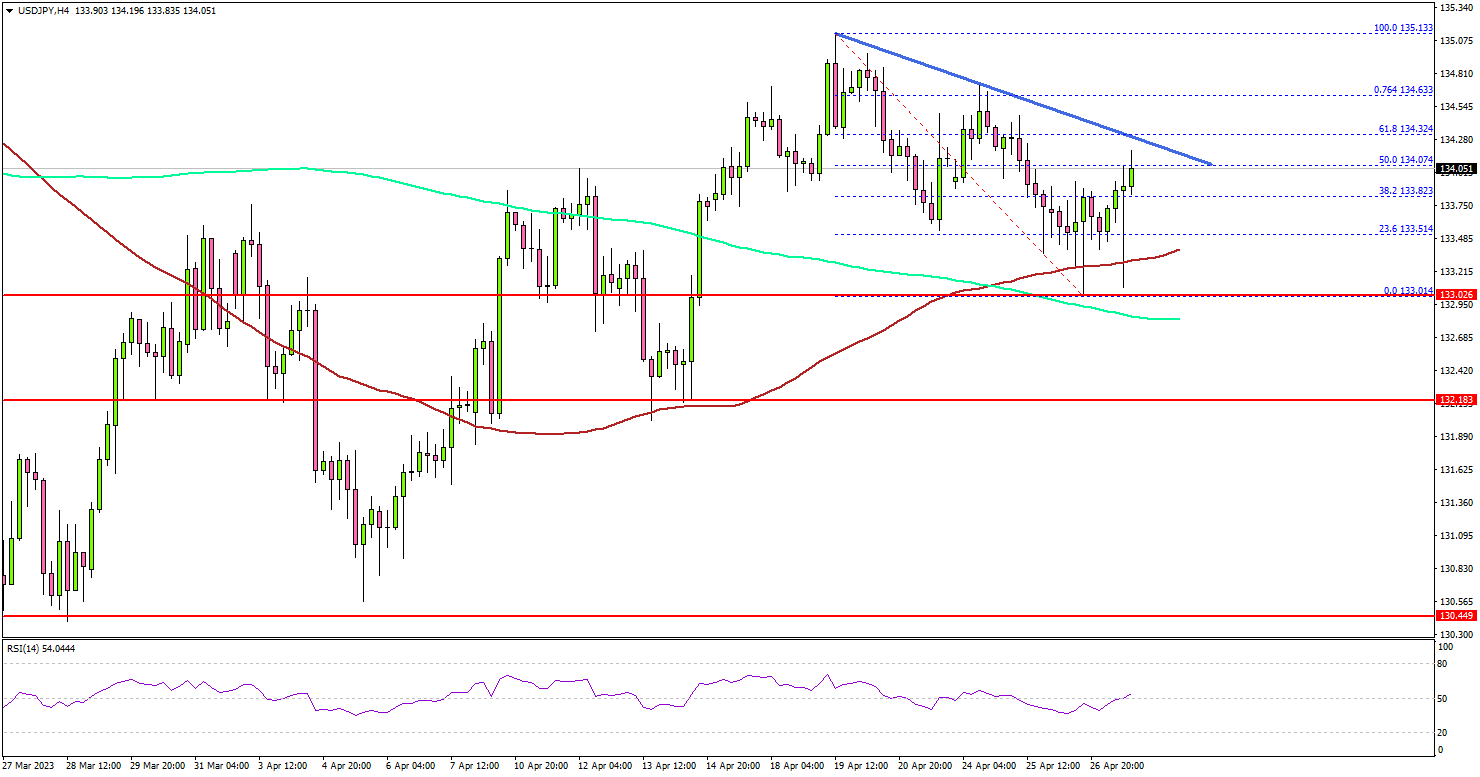
Looking at the 4-hour chart, the pair remained stable above the 133.00 zone, the 100 simple moving average (red, 4 hours), and the 200 simple moving average (green, 4 hours).
The pair is now attempting a fresh increase above the 133.50 resistance. Immediate resistance on the upside is near the 134.20 level. There is also a major bearish trend line forming with resistance near 134.25 on the same chart.
The next major resistance is near the 134.60 level. A clear upside break and close above the 134.60 resistance might send the pair toward 135.00.
The next key resistance is near the 135.15 zone. Any more gains might send the pair toward 136.20. On the downside, there is major support near 133.40 and the 100 simple moving average (red, 4 hours).
The next major support sits near the 133.00 level, below which the pair might accelerate lower. In the stated case, USD/JPY could visit the 132.20 support zone.
Looking at EUR/USD, the pair attempted a fresh increase above the 1.1075 resistance but failed to gain bullish momentum.
Economic Releases
- Euro Zone Gross Domestic Product for Q1 2023 (Prelim) (QoQ) - Forecast 0.2%, versus 0% previous.
- US Personal Income for March 2023 (MoM) - Forecast +0.2%, versus +0.3% previous.
USDCHF Wave Analysis
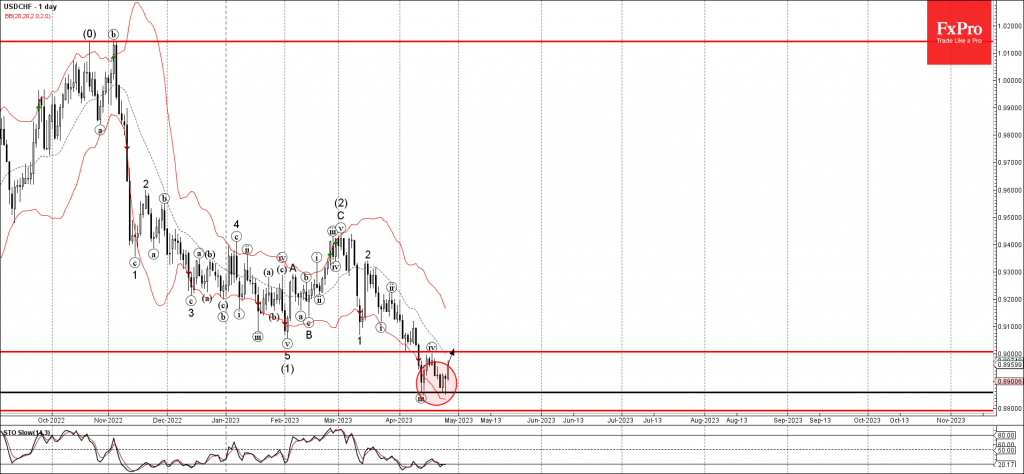
- USDCHF reversed from support level 0.8860
- Likely to rise to resistance level 0.9000
USDCHF currency pair recently reversed up from the key support level 0.8860 (which stopped the previous impulse wave (iii) at the start of this month).
The support zone near the support level 0.8860 was further strengthened by the lower daily Bollinger Band.
Given the strength of the support level 0.8860 and the bullish divergence on the daily Stochastic, USDCHF currency pair can be expected to rise further toward the next round resistance level 0.9000 (top of the previous correction (iv)).
GBPCHF Wave Analysis
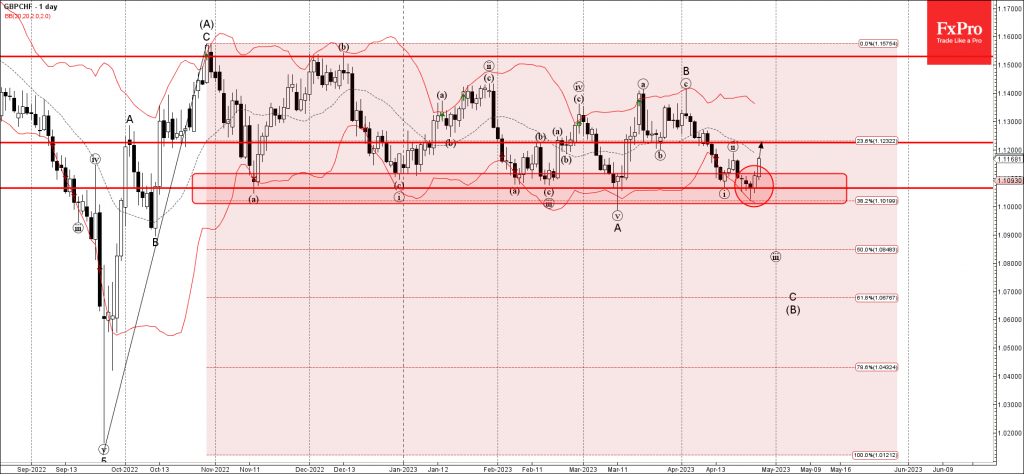
- GBPCHF reversed from long-term support level 1.1065
- Likely to rise to resistance level 1.1225
GBPCHF currency pair recently reversed up from the long-term support level 1.1065 (which has been reversing the pair from November), standing near the lower daily Bollinger Band.
The upward reversal from the support level 1.1065 stopped the C-wave of the medium-term ABC correction (B) from October.
Given the strong Swiss franc sales, GBPCHF currency pair can be expected to rise further toward the next resistance level 1.1225.
A Gold Bull cycle is not over yet
Gold has flirted with $2000 three times in the last three years. This time, however, it is more likely that the bulls will soon be able to hold higher for longer, as gold’s rally now has a slightly different character.
In 2020, interest in gold was an investor response to unprecedented monetary and fiscal easing. When the price reached the psychologically important $2000 level, the gold rally was more than 70% of the cycle low. The rally’s most furious phase began when gold broke through significant resistance at $1800, but the new buying potential was largely exhausted. As a result, the liquidation of short positions that saw gold rewrite its all-time high at $2075 was followed by a prolonged period of profit-taking, despite the continued rally in other risky assets.
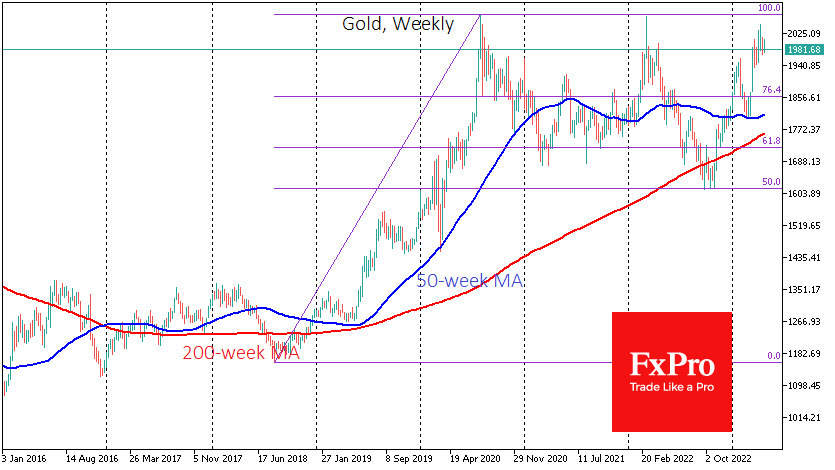
In early 2022, gold was in demand, first on fears of capital depreciation and soon after on geopolitics, and we saw a rise of over 15% in less than five weeks. It then failed to make new all-time highs and peaked at $2072. A decisive monetary policy reversal by the Fed and other central banks dragged the price down. Gold bottomed in September-October on signals that the Fed was slowing the rate hikes and that interest rates might soon peak.
We then saw a very rapid return to historical highs – much faster than the other asset classes, which fell in 2022 and bottomed around the same time.
Early last month, we saw a more reliable reason to buy gold – the market’s reaction to the banks’ problems. Gold gained traction as the end of the tightening cycle approached. Moreover, bank problems leading to economic growth issues are a significant reason for the Fed to turn its policy towards easing.
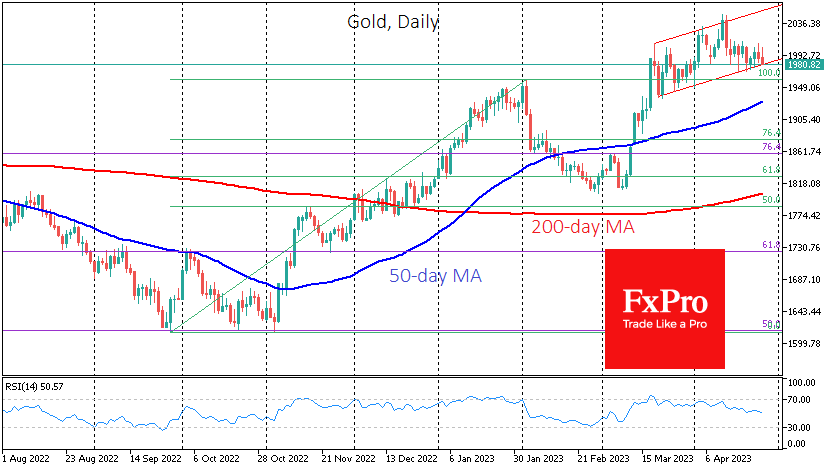
Gold rallied sharply in March, and the market possibly unwound this overheating in the recent 3% correction from the $2048 highs. The sequence of lower highs in 2020, 2022 and 2023 is worrying. But the series of higher local lows over the past five weeks is worth noting. Moreover, all this consolidation is taking place at higher levels than in previous similar episodes, reflecting more interest in buying gold.
The historical tendency for the dollar to weaken at a similar stage in the monetary cycle is also worth considering.
In addition to technical analysis, gold buying is also justified by geopolitics, which remains tense and keeps the idea of a move towards supranational stores of value.
Fed Preview: One More Hike – Cuts Still Far Away
Fed Preview: One More Hike - Cuts Still Far Away
- We expect the Fed to deliver a final 25bp hike next week and then maintain the Fed Funds rate at 5.00-5.25% for the remainder of the year.
- Powell is unlikely to close the door for further hikes, but even with nominal rates on hold, we expect the monetary policy stance to continue tightening towards H2.
- We see modest upside risks to short-term yields, i.e. out to 6M, but with no updated projections, markets' focus will remain on macro data.
We expect the Fed to deliver a final hike of the tightening cycle bringing the Fed Funds Rate to 5.00-5.25%. With no updated projections and markets already pricing in around 20bp ahead of the meeting, the main emphasis will be on Powell's verbal guidance.
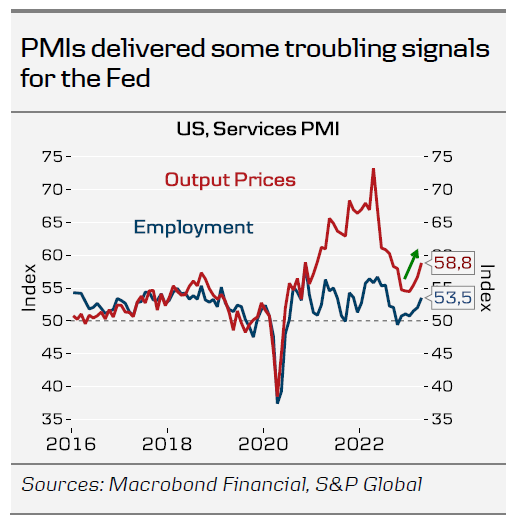
We doubt Powell will fully close the door for further hikes in the summer, and see some room for the markets to speculate with higher rates. The Flash PMIs suggested that banking sector turmoil's immediate negative consequences for the broader economy have been limited, yet December Fed Funds pricing remains 110bp below early March peak.
We still think maintaining rates at modestly restrictive levels for longer strikes the best balance between avoiding a hard landing and ensuring inflation comes down for good. As service sector inflation remains too fast, we see little room for easier policy anytime soon. Minutes from the February meeting showed that FOMC participants are well aware of the risk of allowing financial conditions to ease prematurely. In the March SEPs, 7 out of 18 preferred hiking rates above 5.00-5.25% even amid the high uncertainty at the time.
Even if the Fed ends the hiking cycle next week, we expect it to tighten monetary policy further rest of the year. The market discounts around 60-65bp of rate cuts before the end of the year. Hence, the inverted curve allows the Fed to tighten monetary policy passively by keeping the Fed Funds rate unchanged. In addition, short-term consumer inflation expectations have been on a downwards trend. A further drop in inflation expectations will push real interest rates higher and deliver further passive monetary tightening. Finally, we look for the Fed to continue quantitative tightening even if the hiking cycle ends.
In the press conference, Powell will likely be asked about the debt ceiling, but we think he will simply reiterate that it is the congress' duty to ensure US avoids a default. A failure to do so could lead to a sharp tightening in financial conditions, which would naturally warrant a reaction from the Fed, but hinting about potential support would create moral hazard.
For markets, we do not expect the meeting to be a game changer, as the pricing for the summer meetings is well in line with our view, and as the renewed uncertainty around First Republic Bank this week reminded that visibility much beyond remains low.
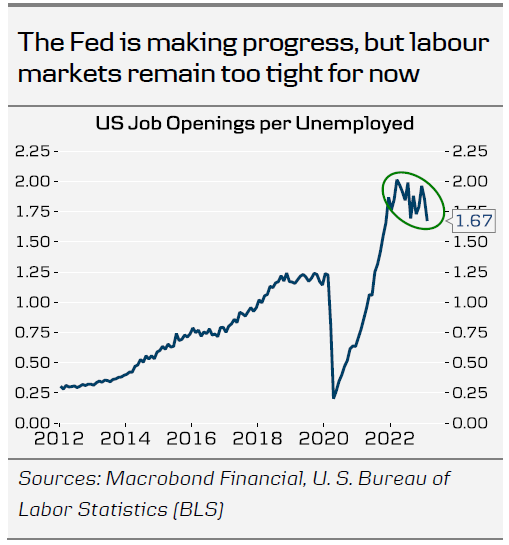
Rather, we will pay close attention to ISM, JOLTs and the Jobs Report, where we expect NFP to settle at a moderating, yet still upbeat +200k on the back of recovering labour supply and rising PMI employment indices. We generally see some upside risks to short USD rates, and forecast lower EUR/USD towards the latter half of the year, but next week the ECB meeting will likely be relatively more important for the latter.
ECB Preview: The Art of Compromise
Next week, the ECB will meet to deliver another rate hike in its hiking cycle that started in July last year. This time, the question is whether it will slow the hiking pace to 25bp or continue to hike once more by 50bp. We believe it will be a 50bp compromise deal with no specific forward guidance (nor guidance on balance sheet normalisation in H2 yet), but repeating a data-dependent approach to future policy decisions.
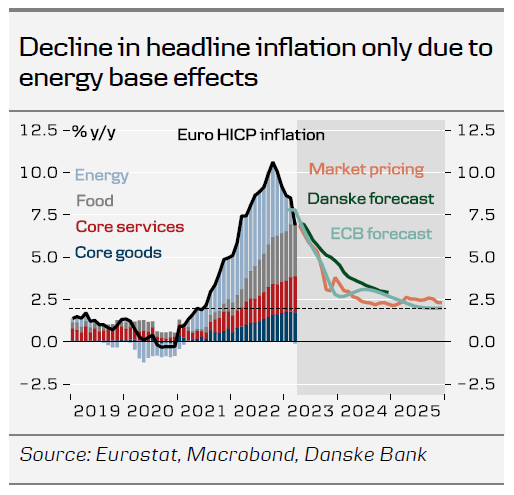
Economic developments since the ECB meeting, coinciding with the banking turmoil, have shown resilient economic activity and another record-high core inflation print. Headline inflation has declined on the back of base effects, but the stickiness of core inflation and wages should pave the way for another 50bp rate hike, in our view.
On Tuesday 2 May, the ECB and Eurostat will publish the last and important data releases ahead of the meeting. The Bank Lending Survey (BLS) and loan growth data will likely deteriorate compared with previous releases, while inflation is set to bring another high print (core around 5.7%). A significant surprise in any of the releases could change the market pricing and hence probabilities of a 25bp or 50bp rate hike outcome.
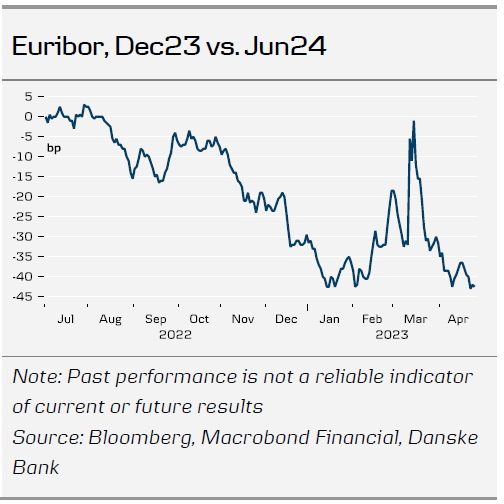
Refraining from delivering a 50bp rate hike at this meeting is set to result in a dovish market reaction, with easing financial conditions to follow. We recommend to receiving the Dec-23 euribors and pay the Jun-24 euribors at -42bp with a target of -20.
Strong services economy keeps ECB's inflation concerns alive
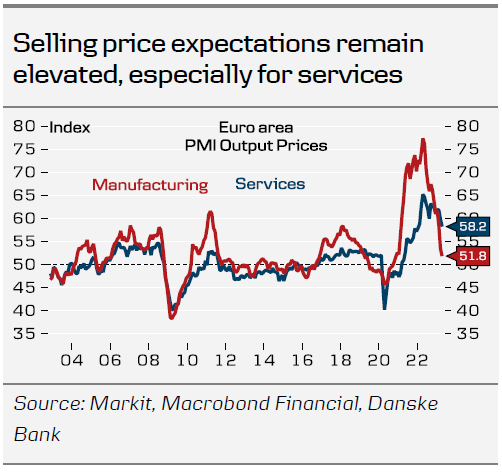
Despite banking sector jitters and the ECB's ongoing tightening efforts, the euro area economy has continued to show remarkable resilience since the March meeting. Business surveys suggest the economy picked up momentum at the start of Q2, with the services sector in particular (accounting for 73% of GDP) driving the ongoing improvement. The labour market remains tight and firms' hiring activity continues to increase, especially amid services providers, where jobs growth picked up to the fastest rate since July 2007. This is pressuring wages, as demonstrated by the latest collective wage agreement for German public sector employees, which expects wage growth of 11.5% over the next two years. The decline in headline inflation in recent months remains almost entirely due to energy base effects, while core and food prices have continued their uptrend. With this dynamic, the ECB can hardly declare 'mission accomplished' on inflation in our view. With easing input cost inflation, consumer goods inflation showed signs of peaking in March. But the same cannot be said for services inflation, where rising wage costs play a greater role, taking over as the prime core inflation driver. Selling price expectations and most underlying inflation measures point to a peak in core inflation in the next 1-2 months, but they also suggest 'sticky' core inflation will remain a concern for the ECB for some time, setting the scene for further rate hikes. We still expect the ECB's monetary tightening to take its toll on the economic outlook (see Nordic Outlook – Unchartered territory, 4 April), but in contrast to markets, our forecasts show core inflation still above the ECB's target by the end of 2024, with the green transition and higher than expected wage growth still presenting upside risks.
2 May releases and banking turmoil
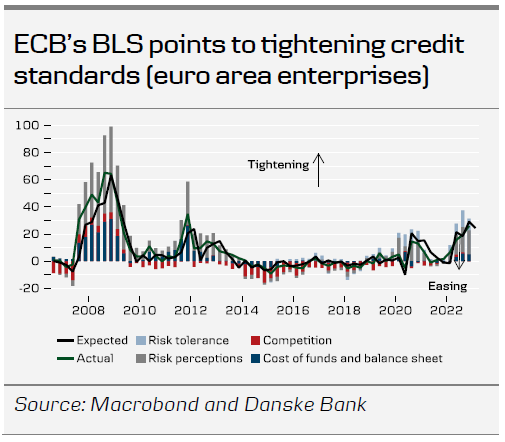
The March monetary policy meeting took place at the height of the banking turmoil last month. A key discussion point at the May meeting will therefore be how much tightening of financial conditions the banking turmoil in itself has triggered. On Tuesday 2 May, the ECB and Eurostat will publish the last and important release ahead of the meeting. The upcoming Bank Lending Survey has received significant attention by the GC members in recent communication, as they want to see the results before making up their mind on the size of the rate hike. We take it as given that the BLS will point to tightening credit standards, as the ECB is already in a tightening cycle, which means that we see the focus of this BLS to be on what additional tightening the recent turmoil has added. On 2 May we also get the loan growth data for March, which we also view as important for the decision, as the ECB mulls the transmission of monetary policy to the real economy. A significant surprise in any of the releases could change the market pricing and hence probabilities of a 25bp or 50bp rate hike outcome. If the BLS and the risk perception aspect as well as the loan growth developments to March deteriorate substantially, we see markets pricing out the probability of a 50bp rate hike, while a rise in underlying inflation would lead to an upward revision of the rate hike size, beyond 40bp.
A 'dovish' 50bp or 'dovish' 25bp hike
There should be little doubt that any ECB decision at the coming meetings will be a compromise. At the March meeting a 'very large majority' supported the 50bp rate hike and comments since then from GC members such as Stournaras, Panetta, and Visco call for a more cautious approach to monetary policy tightening. While only the most hawkish GC member Holzmann has voiced clear support for 50bp, the members of the 'hawkish camp' have said that a 50bp rate hike should be considered. In light of the incoming data, we see that option to gain the most support. However, that also means that any decision taken at the upcoming meetings will not be unanimous, which we also discussed in COTW: Unanimity is utopia, 21 April. This divergence of views will likely keep realised volatility in markets high in the short-term.
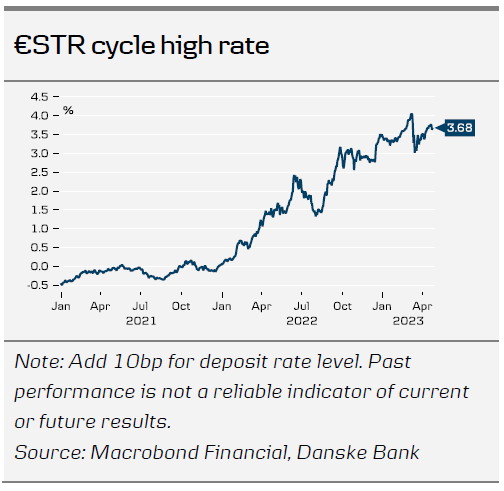
If President Lagarde wants to send a hawkish signal, we believe a 50bp rate hike is a prerequisite, but that alone is not sufficient as markets are forward looking by nature. That means that she also needs to back it up with hawkish arguments on the labour market, wage growth, and the stickiness of underlying inflation. But even in that case, we see a risk of markets reacting with lower yields, as this will likely be the final 50bp rate hike from the ECB. A 50bp rate hike would implicitly also be a signal for a July hike in our reading. Hence, the risk for lower medium-to long-term rates, irrespective of the hiking, is prominent, in a bearish flattening move of the curves. If the ECB chooses to go for a 25bp rate hike, we also see the risk for a dovish market interpretation with a bullish steepening, given that the ECB has refrained from giving guidance for the coming meetings, and thereby letting the prevailing market narrative of lower rates / central bank pivot continue. With a 25bp rate hike, we find it difficult for Lagarde to communicate a rate hike beyond June, which could take around 15bp out of the peak policy rate pricing, and in this case we see further lowering on the real rates and as such easing of the monetary policy stance.
70% probability of 25bp and 30% probability for 50bp
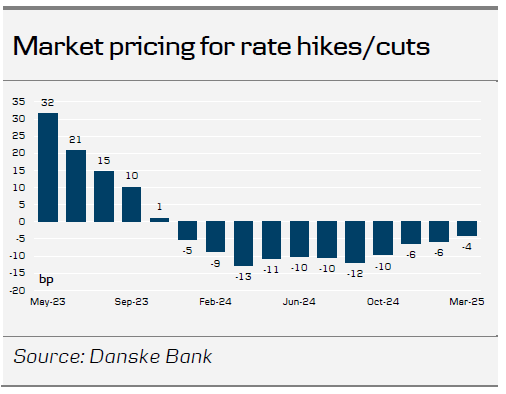
Markets are currently pricing 32bp for next week's meeting, well below our baseline expectation of a 50bp rate hike. Looking beyond the most imminent meetings with 21bp for June and 15bp for July, the peak policy rate is priced to be 3.78% after summer, which we find to be on the low side. At the same time, markets are pricing a sharp rate cut process to commence next year, where markets are pricing 82bp altogether, and more than half of that already in H1 24. We like to pay that segment (for less rate cuts), and therefore recommend to receiving the Dec-23 euribors and pay the Jun-24 euribors at -42bp with a target of -20 and a stop loss of -52bp. We remain open for further rate cuts to come in September.
No discussion of future decisions
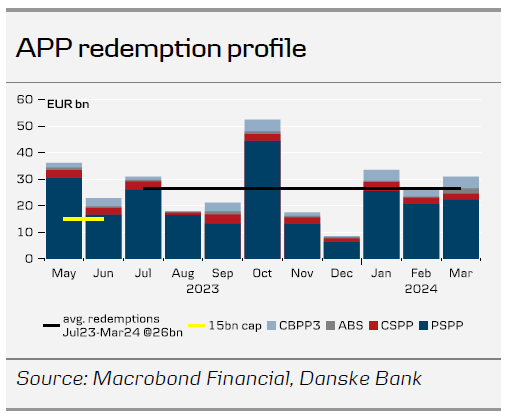
At the March meeting, the ECB refrained from giving explicit guidance for the May policy meeting, but outlined the reaction function that consists of 1) its assessment of the inflation outlook in light of the incoming economic and financial data; 2) the dynamics of underlying inflation; and 3) the strength of monetary policy transmission. We do not expect firm guidance for June to be delivered next week. That also means no guidance for the APP bond holding normalisation at this meeting, but a discussion and a decision to be announced at the June meeting. At that meeting, we expect a full end to APP reinvestments starting 1 July until the first rate cut from the ECB (which we pencil in for summer 2024). This amounts to an increase from on average EUR15bn to EUR26bn/month. Earlier this month, sources reported that a growing consensus in the GC was for a full end to APP reinvestments. Note that the PEPP reinvestments in full are still expected at least until December 2024– in line with current guidance.
FX reaction will likely be EUR positive in case of a 50bp rate hike
A 50bp rate hike will likely contribute to a broad EUR appreciation on impact, although it depends on the sequential growth outlook priced by markets.
The EUR/USD has been on an upward trajectory over the past two months supported by general growth optimism in the euro area, likely fuelled by the reopening in China, implying significant outperformance in euro area risk assets. Furthermore, lower energy prices and narrowing of rates spread between the US and the euro area have likely also been a tailwind for the cross, especially the latter.
Overall, we still have a bearish stance on the EUR/USD in the medium- to long-term, as rate hiking cycles generally are approaching an end, we think focus will increasingly turn from relative rates differentials to relative growth differentials. We are particularly sceptical about the longevity of the euro area optimism, although we acknowledge that there is a possibility of it continuing in the short-term, adding to tactical topside risk in EUR/USD in conjunction with further narrowing of relative rates spread on the back of the ECB meeting. That said, we still expect the EUR/USD to head lower based on relative terms of trade, real rates, and relative unit labour costs. The Fed meeting on 3 May – the day before the ECB meeting – is also worth having in mind, where our expectation of a 25bp rate hike is almost fully priced by markets. We forecast the cross to remain range bound in the next 1-3M, but expect it to decline to 1.06 and 1.03 on a 6-12M horizon.