

Sample Category Title
USD/CAD Weekly Outlook
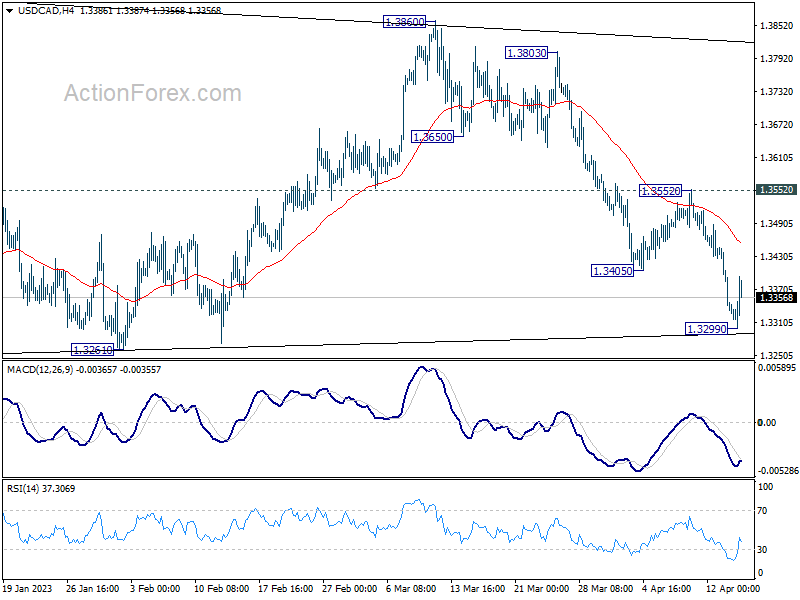
USD/CAD's decline from 1.3860 resumed last week and hit as long as 1.3299. But a temporary low should be formed there. Initial bias is neutral this week first. Overall, this fall is seen as the third leg of the corrective pattern from 1.3976. In case of another decline, down side should be contained by 1.3224/61 support zone to bring rebound. Break of 1.3552 should turn bias back to the upside for stronger rally.
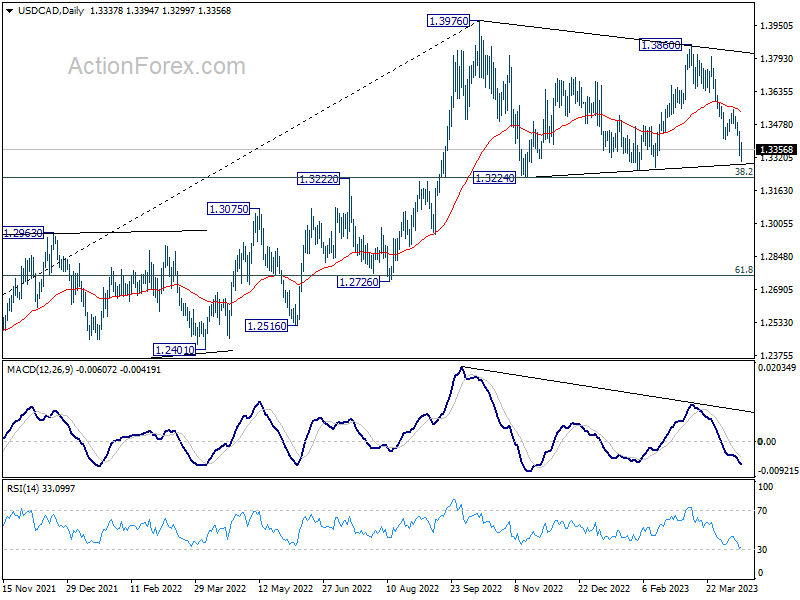
In the bigger picture, the up trend from 1.2005 (2021 low) is still in progress. Break of 1.3976 will confirm resumption and target 61.8% projection of 1.2401 to 1.3976 from 1.3261 at 1.4234. Firm break there will pave the way to long term resistance zone at 1.4667/89 (2016, 2020 highs). On the downside, sustained break of 55 W EMA (now at 1.3282) is needed to confirm medium term topping. Otherwise, outlook will remain bullish even in case of deep pull back.
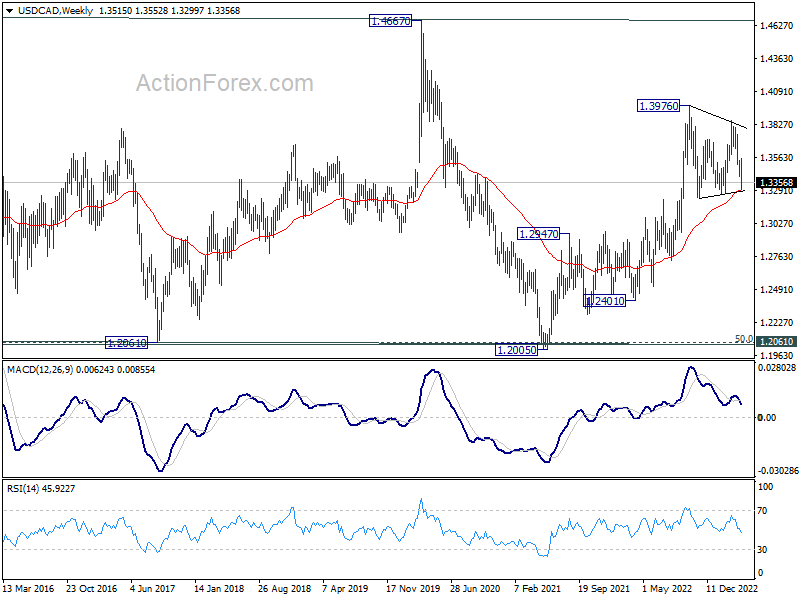
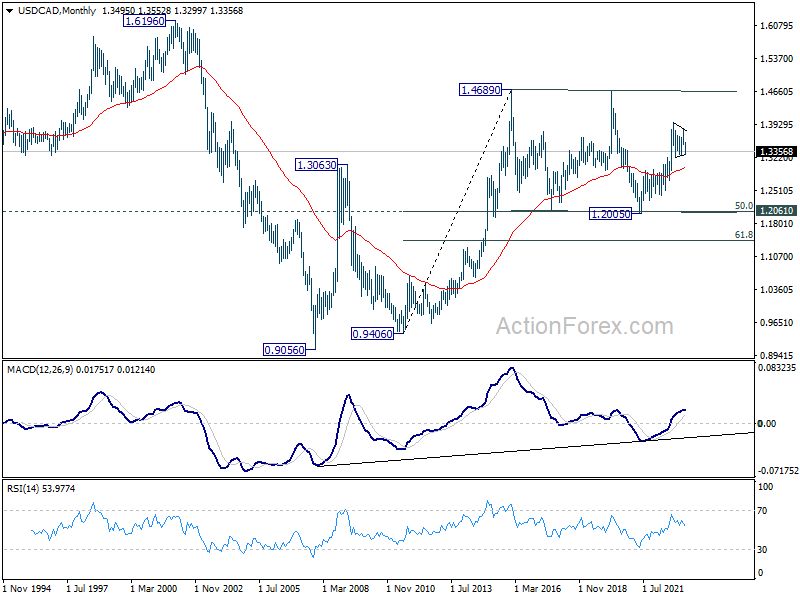
In the longer term picture, price actions from 1.4689 (2016 high) are seen as a consolidation pattern only, which might have completed at 1.2005. That is, up trend from 0.9506 (2007 low) is expected to resume at a later stage. This will remain the favored case as 55 M EMA (now at 1.3005) holds.
GBP/JPY Weekly Outlook
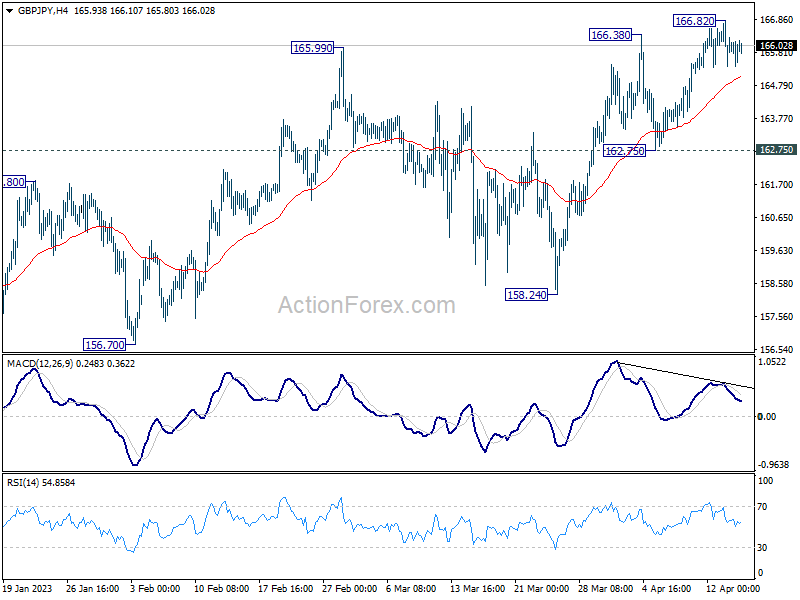
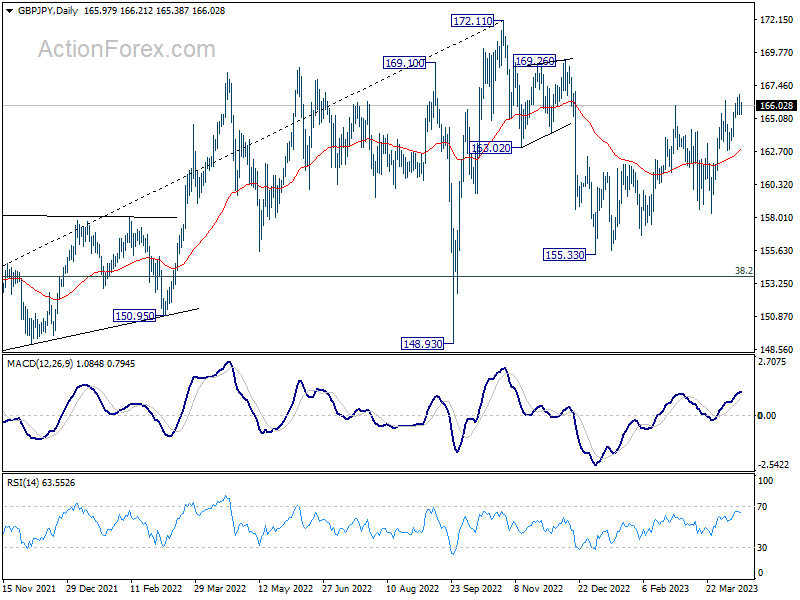
GBP/JPY's rally from 155.33 resumed last week but retreated again after hitting 166.82. Initial bias is neutral this week for consolidations first. Outlook will stay cautiously bullish as long as 162.75 support holds. Above 166.82 will resume the larger rebound from 155.33 to 169.26 resistance next.
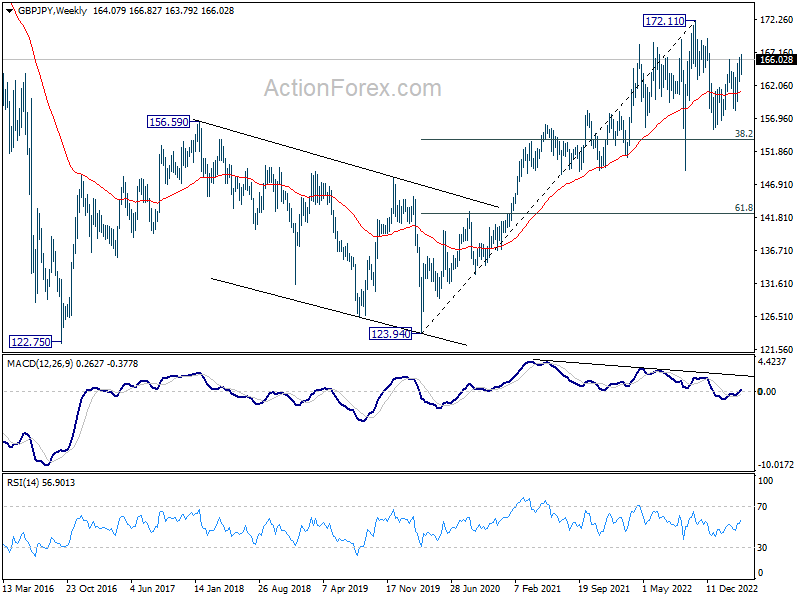
In the bigger picture, as long as 38.2% retracement of 123.94 (2020 low) to 172.11 (2022 high) at 153.70 holds, medium term bullishness is retained. That is, larger up trend from 123.94 (2020 low) is still in progress. Break of 172.11 high to resume such up trend is expected at a later stage.
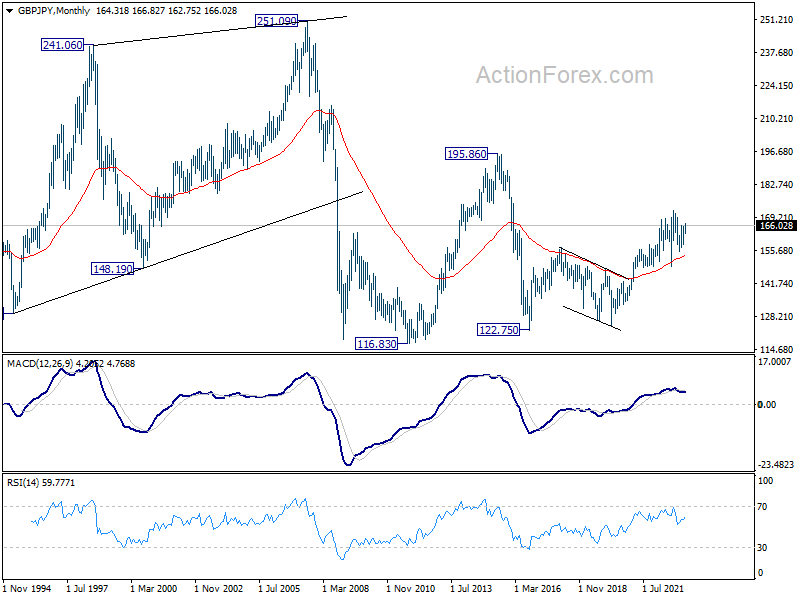
In the longer term picture, as long as 55 M EMA (now at 153.64) holds, rise from 122.75 (2016 low) could still extend higher at a later stage to 195.86 (2015 high).
EUR/JPY Weekly Outlook
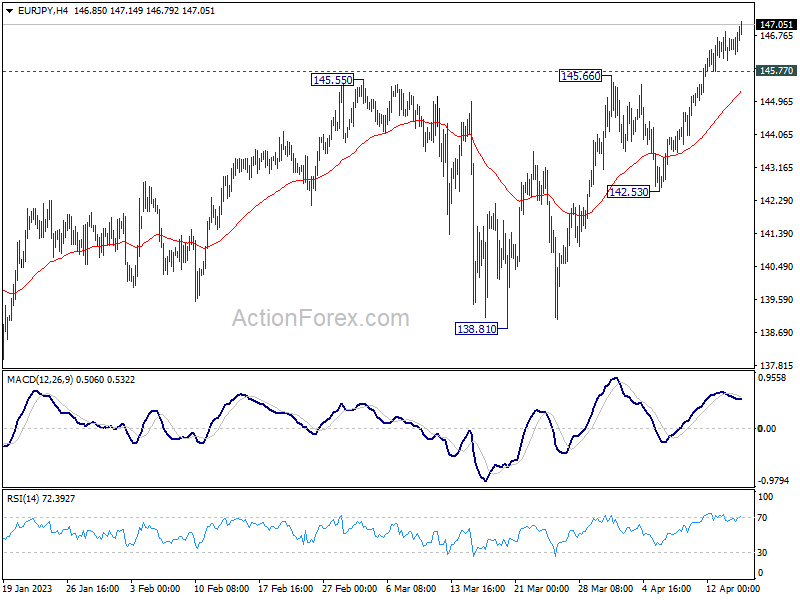
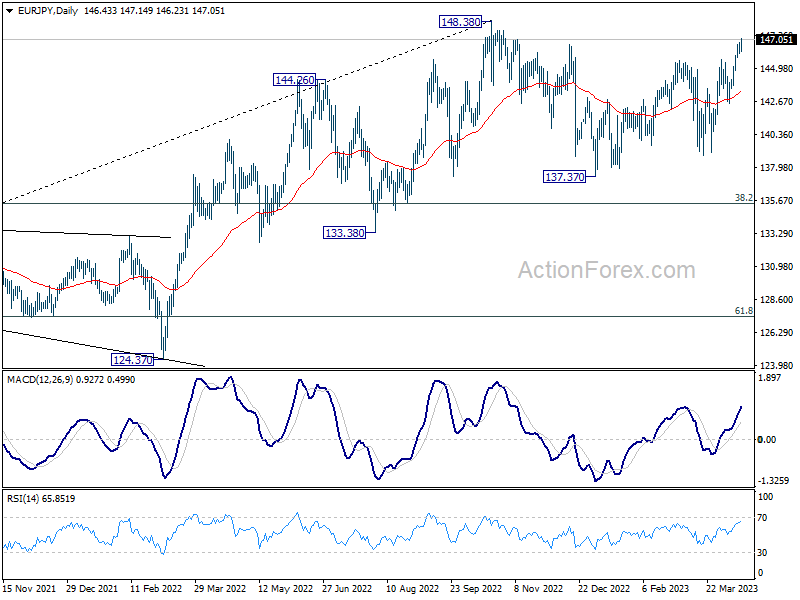
EUR/JPY's rise from 137.37 resumed last week and hit as high as 147.14. Initial bias remains on the upside for retesting 148.38 high. Firm break there will resume larger up trend. On the downside, below 145.77 minor support will turn intraday bias neutral and bring consolidations. But outlook will stay cautiously bullish as long as 142.53 support holds, in case of retreat.
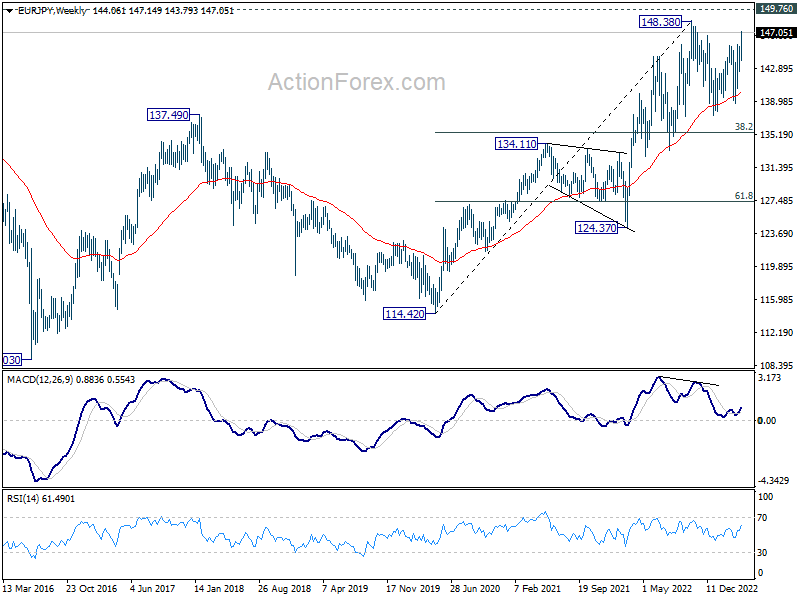
In the bigger picture, as long as 55 W EMA (now at 140.18) holds, larger up trend from 114.42 (2020 low) is still in progress for 149.76 long term resistance. Decisive break there will resume long term up trend. However, sustained break of 55 W EMA will bring deeper fall to 38.2% retracement of 114.42 to 148.38 at 135.40.
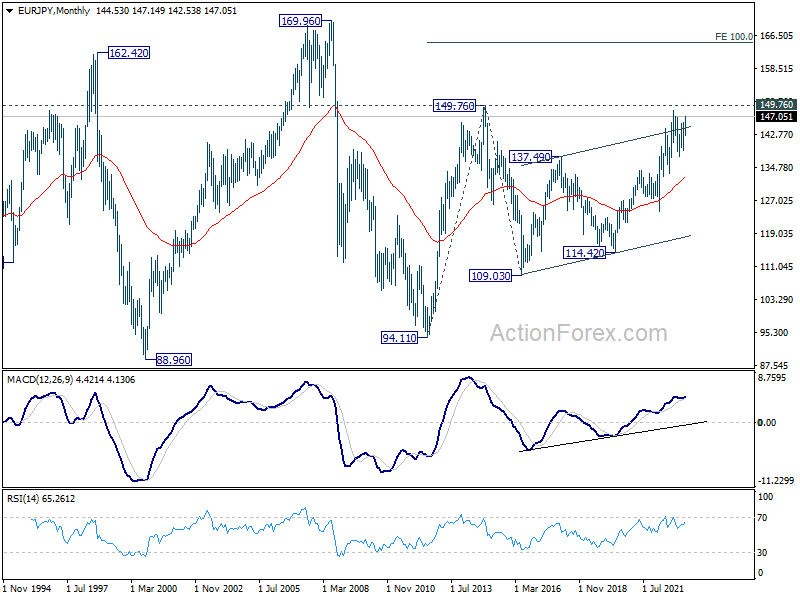
In the long term picture, outlook will stay bullish as long as 134.11 resistance turned support holds (2021 high). Sustained break of 149.76 (2014 high) will open up further rally, as resumption of the rise from 94.11 (2012 low), towards 169.96 (2008 high).
EUR/GBP Weekly Outlook
EUR/GBP was still bounded in range of 0.8717/8864 last week. Near term outlook remains mixed for now. On the upside, break of 0.8864 will target 0.8924 resistance first. Firm break there should resume larger rise from 0.8545 through 0.8977 high. However, decisive break of 0.8717 support will resume the decline from 0.8977 instead.
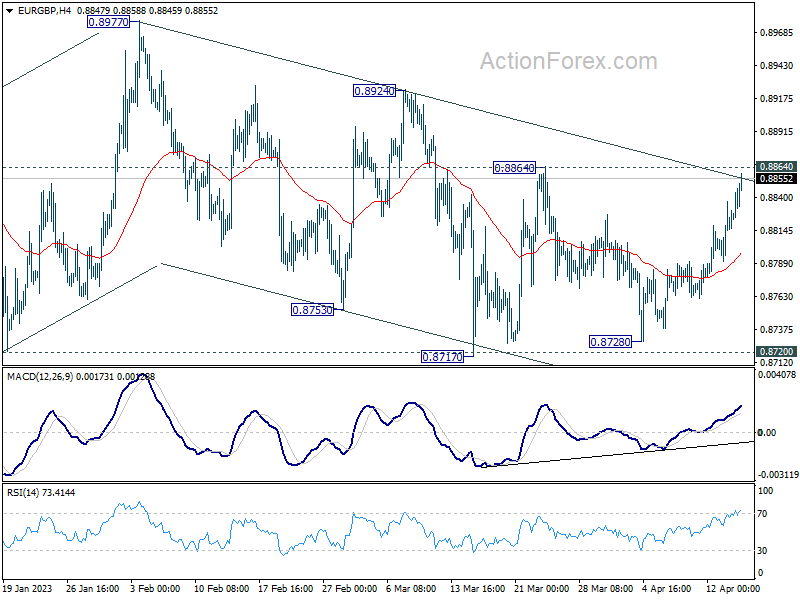
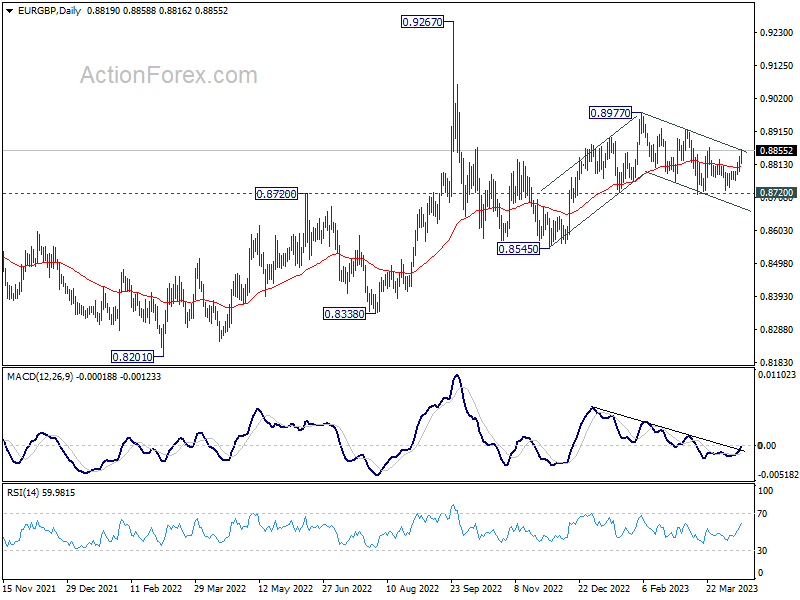
In the bigger picture, outlook remains rather mixed for now, except that price actions from 0.9267 (2022 high) are part of the long term range pattern from 0.9499 (2020 high). With 0.8720 support intact, rise from 0.8545 is in favor to continue through 0.8977. However, firm break of 0.8720 will argue that such rebound has completed, and open up deeper fall through this support level.
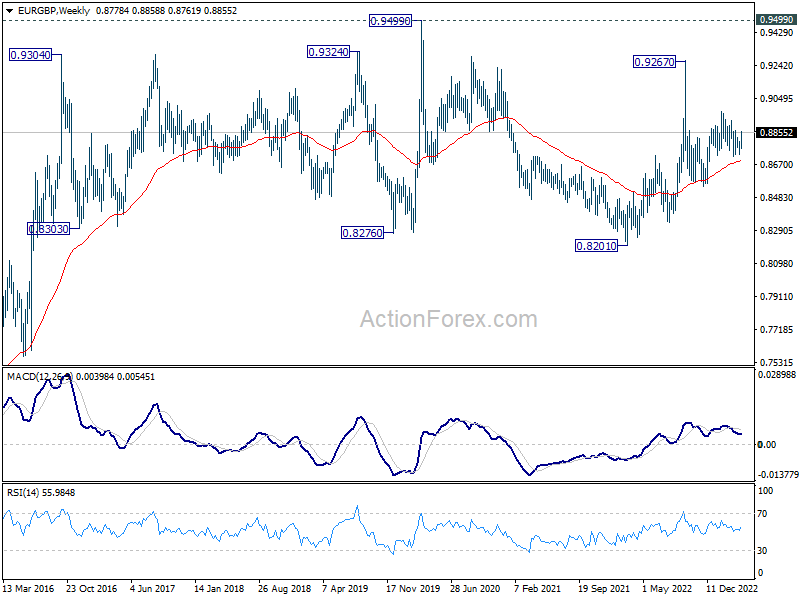
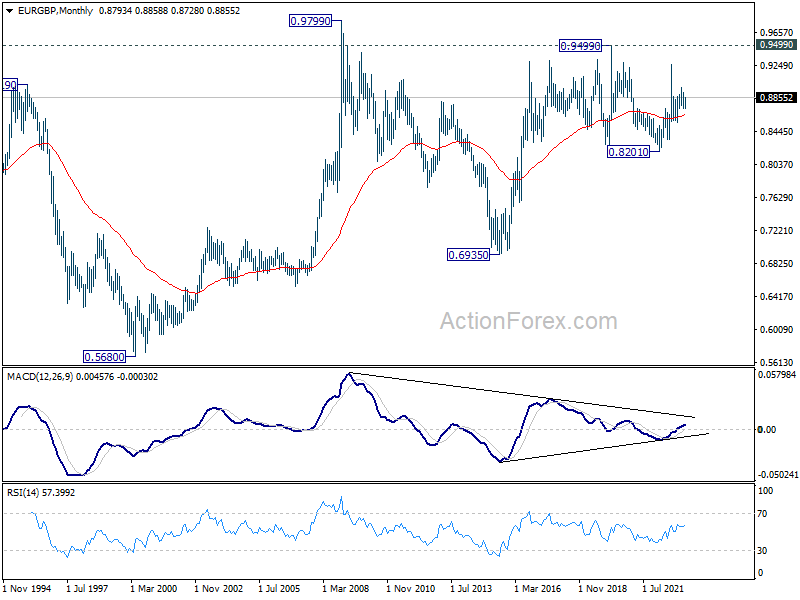
In the long term picture, long term range pattern is extending. But rise from 0.6935 (2015 low) is expected to extend at a later stage, to 0.9799 (2009 high).
EUR/AUD Weekly Outlook
EUR/AUD rose further to 1.6444 last week and breached 1.6434 resistance, but couldn't close above. Initial bias remains neutral this week first. On the upside, decisive break of 1.6434 resistance will carry larger bullish implications. However, considering bearish divergence condition in 4H MACD, firm break of 1.6216 should confirm short term topping, after rejection by 1.6389/6434 cluster resistance zone. Intraday bias will be back on the downside in this case, to 1.6033 support and possibly below.
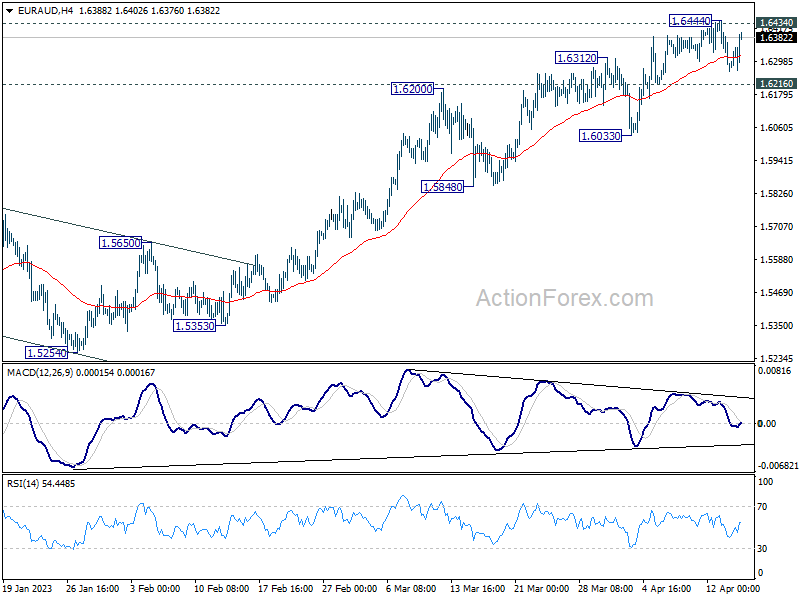
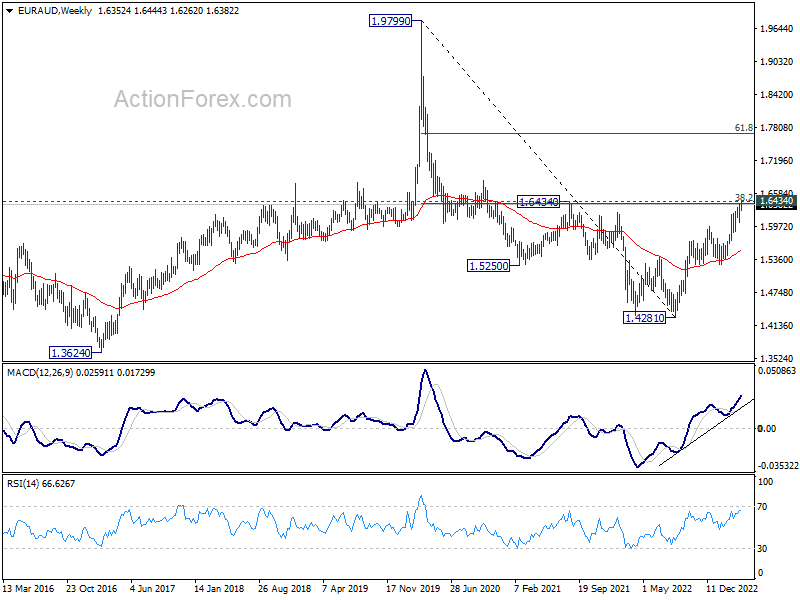
In the bigger picture, focus stays on 1.6389/6434 cluster resistance (38.2% retracement of 1.9799 to 1.4281 at 1.6389). Sustained break there should confirm that whole down trend from 1.9799 (2020 high) has completed. Further rally should then be seen to 61.8% retracement at 1.7691. However, rejection by this cluster resistance will make medium term outlook neutral at best.
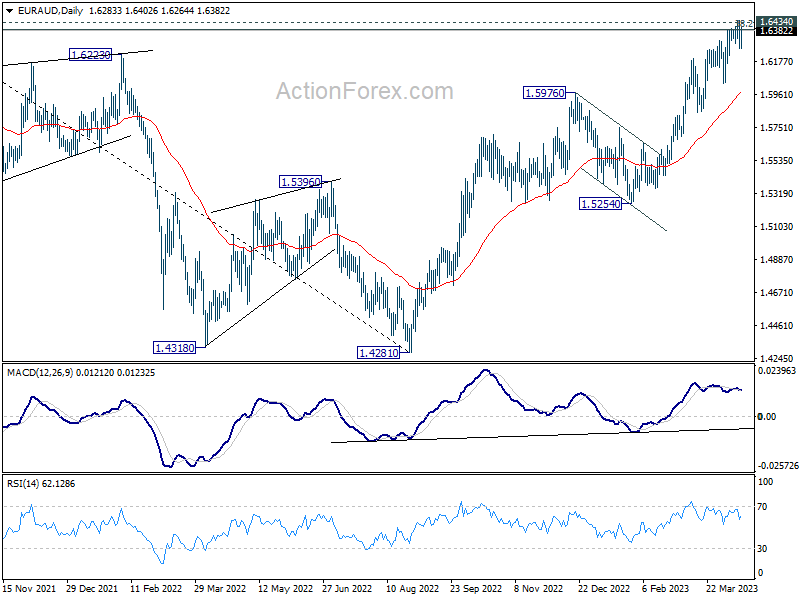
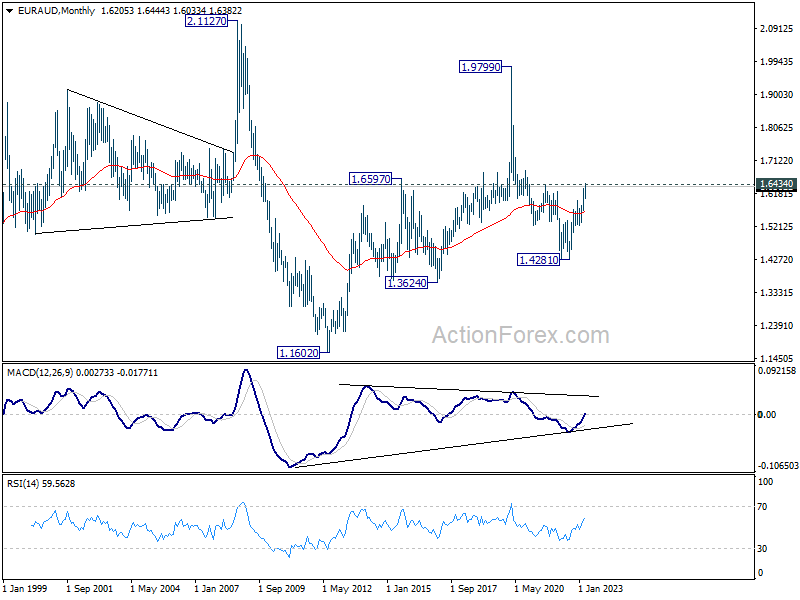
In the longer term picture, the strong break above 55 M EMA (now at 1.5646) raised the chance of bullish trend reversal. Firm break of 1.6434 resistance should confirm that the down trend from 1.9799 has completed. It's still early to decide if the up trend from 1.1602 (2012 low) is resuming. An assessment will be made after rise from 1.4281 reveals more of its structure.
EUR/CHF Weekly Outlook
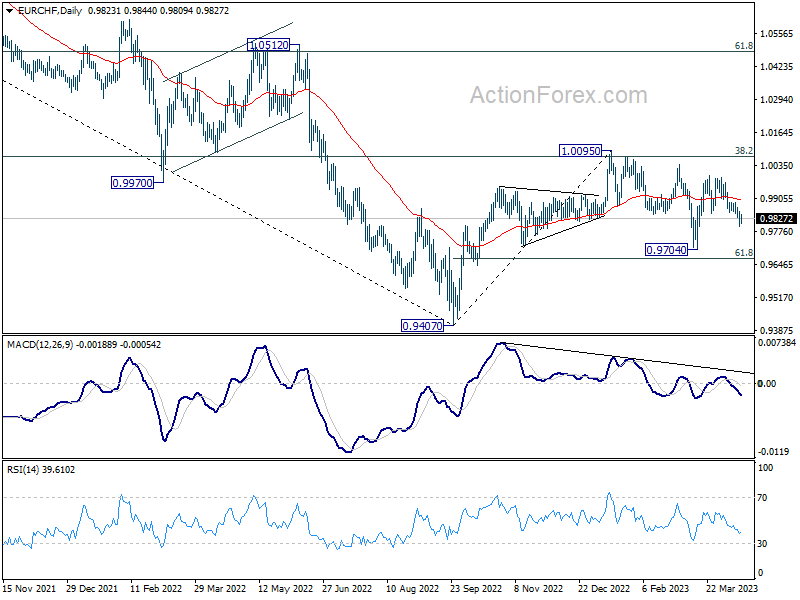
EUR/CHF's extended decline last week argues that rebound from 0.9704 might have completed at 0.9995 already. More importantly, the corrective pattern from 1.0095 might be extending with another falling leg. Deeper decline is expected this week as long as 0.9889 resistance holds, towards 0.9704 support. On the upside, though, break of 0.9889 minor resistance will turn intraday bias back to the upside for stronger rebound.
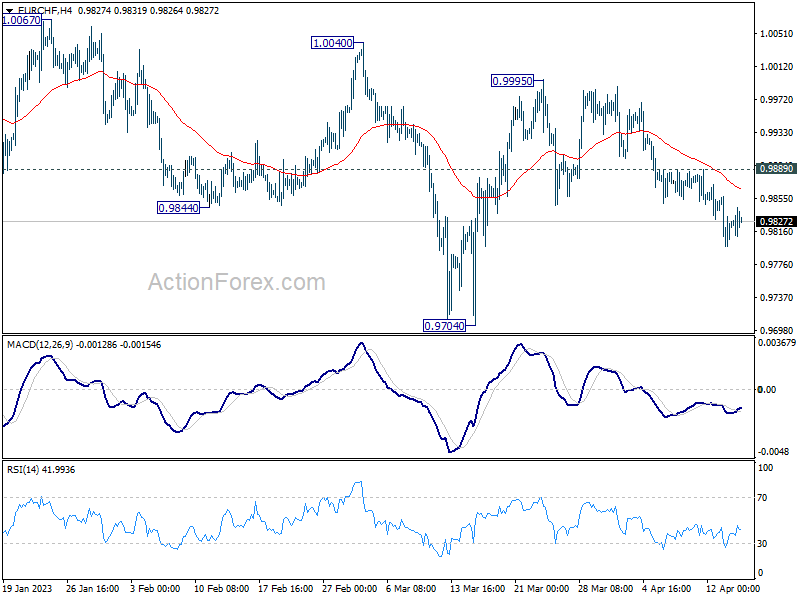
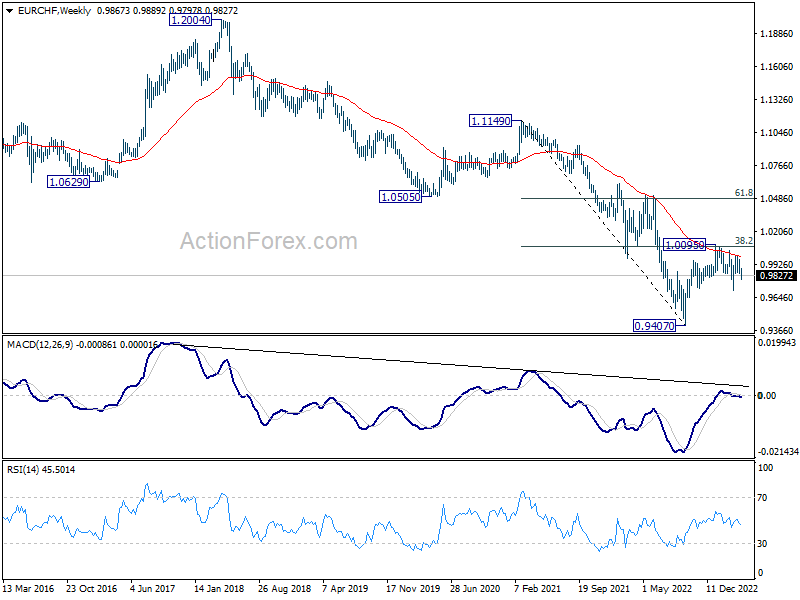
In the bigger picture, prior rejection by 55 W EMA (now at 0.9989) and 38.2% retracement of 1.1149 to 0.9407 at 1.0072 suggests that medium term outlook is staying bearish. That is, down trend from 1.2004 is not completed yet and is in favor to resume through 0.9407 at a later stage. However, decisive break of 1.0095 resistance will raise the chance of bullish trend reversal. Rise from 0.9407 should then target 1.0505 cluster resistance (2020 low at 1.0505, 61.8% retracement of 1.1149 to 0.9407 at 1.1484).
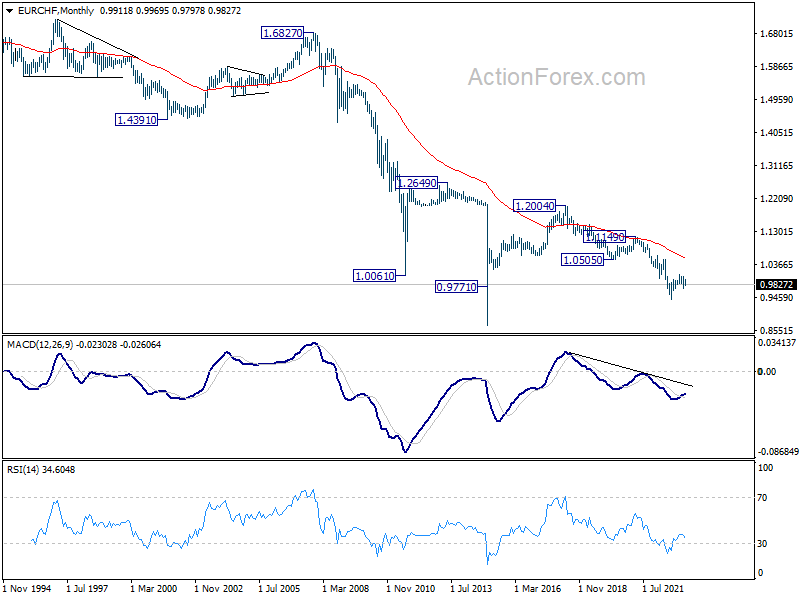
In the long term picture, it's still way too early too call for bullish trend reversal with upside capped well below 55 M EMA and 1.0505 support turned resistance (2020 low). The multi-decade down trend could still continue.
Dollar’s Fate Uncertain Amid Mixed Week: Risk Sentiment, Stocks, and Bonds in Focus
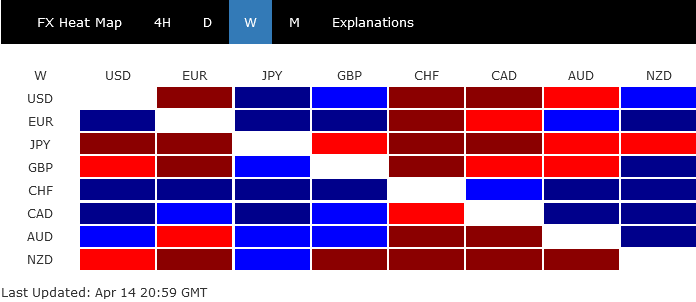
Dollar fell to its lowest level of the year and breached a critical support, after being under pressure for most of the week. Yet, it staged a recovery towards the end, closing mixed only. Decelerating US inflation data was welcomed by risk market investors, but a lower terminal rate may not necessarily lead to an earlier rate cut. While risk-on sentiment received a boost, the markets seem somewhat uncertain. Whether the greenback can find a bottom at current levels may depend on overall developments in other markets like stocks and bonds.
Staying in the currency markets, Yen emerged as the week's worst performer, following new BoJ Governor Kazuo Ueda's persistent commitment to ultra-loose monetary policy. New Zealand Dollar came in as the second worst, largely due to a reversal in its cross against Australian Dollar. Swiss Franc ended as the strongest currency, followed by Canadian Dollar and Euro.
US Disinflation Continues, Fed Opinions Diverge on Rate Hikes
One of the major themes last week was that disinflation continued in the US as reflected by latest CPI and PPI data. Meanwhile, retail sales contracted for another month in March, indicating that inflation and higher interest rates were starting to bite into people's pockets. Jobless claims had also returned to a more "normal" level above 200k, suggesting that the economy has already be cooling.
However, opinions among Fed officials remain divided. Hawks, such as Fed Governor Christopher Waller, bemoaned the lack of "much progress" on core inflation. In contrast, doves like Chicago Fed President Austan Goolsbee urged caution, calling for restraint in tightening. Additionally, a dampener was put on inflation optimism as the University of Michigan's consumer inflation expectation for the year ahead spiked from 3.6% to 4.6%.
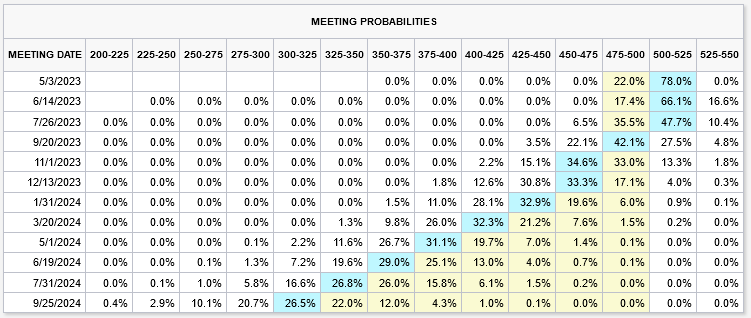
Regardless, Fed is undoubtedly nearing a pause in rate hikes, even if it remains uncertain whether it will be a "one and done" in May. Diverging opinions from Fed officials are expected during this stage of the cycle. What is more critical is when Fed will start reversing the rate hikes. Fed funds futures are pricing in a near 58% chance of rates staying at 5.00-5.25% in July (after one more hike in May) and a 68% chance of a cut in September. Excluding a resurgence and intensification of the banking crisis, these pricings are overly aggressive, considering that Fed officials and projections have essentially ruled out a cut this year. However, the situation is evolving week by week.
Dollar Index Testing Key Support Support, Yet Uncertainty Remains
Last week, Dollar Index dipped to a new 2023 low at 100.78 but found substantial support at 100.82, ultimately recovering to close at 101.55. From a technical perspective, the base case suggests that price movements from 100.82 are unfolding into a three-wave corrective pattern. As such, sustained break below 100.82 is not anticipated for now, and a rebound is due.
On the upside, a break through 102.51 resistance level would confirm short-term bottoming and trigger stronger rally towards 105.88 resistance, passing through 55 D EMA (now at 103.16).
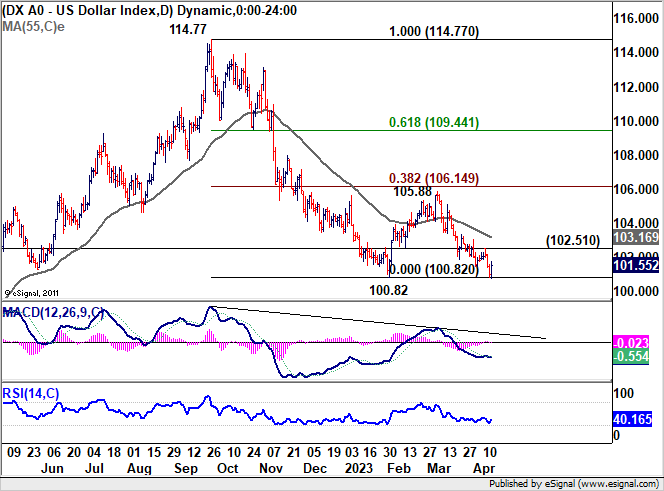
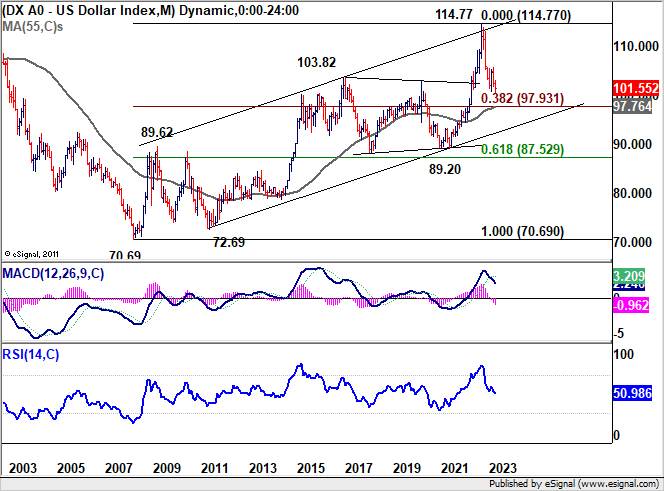
Conversely, a decisive break below 100.82 would nullify this outlook and lead to a resumption of the overall downtrend from 114.77. In this scenario, Dollar Index may only find enough support for a bounce at 55 W EMA (now at 97.76), which is near to 38.2% retracement of 70.69 to 114.77 at 97.93.
Dollar's Fate Hangs in the Balance: Risk Appetite and Yields
Whether Dollar could rebound from the current level would very much also depend on the interaction with other markets. The extended rally in stocks and improvement in risk appetite is negative for the greenback. But at the same time, rebound in treasury yields should be supportive. It remains to be seen which factor would persist further and exert a larger influence on Dollar.
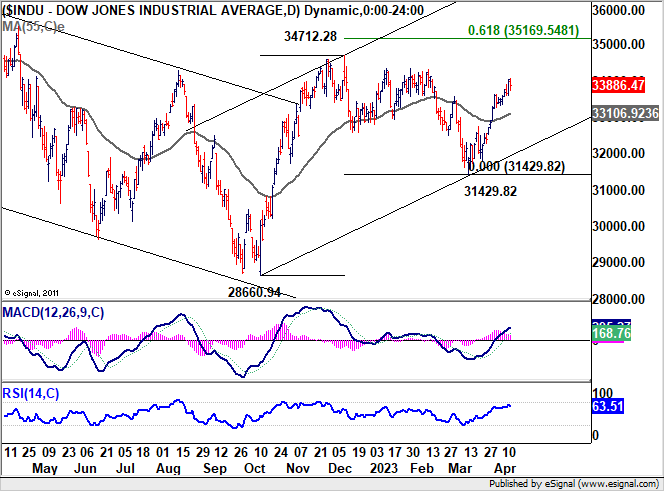
Recent development suggests that DOW's corrective pattern from 34712.28 has completed with three waves down to 31429.82 already. Further rise is expected as long as 55 D EMA (now at 33106.92) holds. Break of 34712.28 resistance is likely as the rally extends. The main level to watch is 61.8% projection of 28660.94 to 34712.28 from 31429.82 at 35169.54. If realized, the development would at least cap any rebound momentum of Dollar, with prospect of trigger deeper selloff.
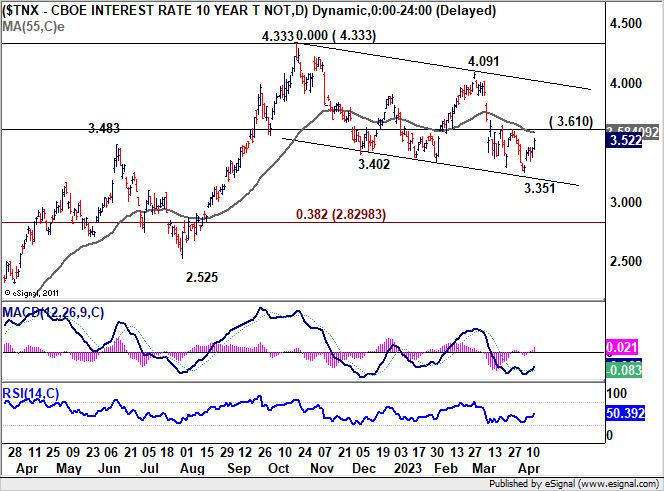
10-year yield's strong close last week raises the chance of short term bottoming at 3.351. More importantly, the whole corrective pattern from 4.333 might have completed with three waves down to there too. Near term focus is shifted to 3.610 resistance. Firm break there will add to this bullish case and bring stronger rise back to 4% handle, or to 4.091 resistance. This development, if realized will help limit downside momentum in Dollar. However, rejection by 3.610 and 55 D EMA (now at 3.583) should extend the decline from 4.333 through 3.351 later.
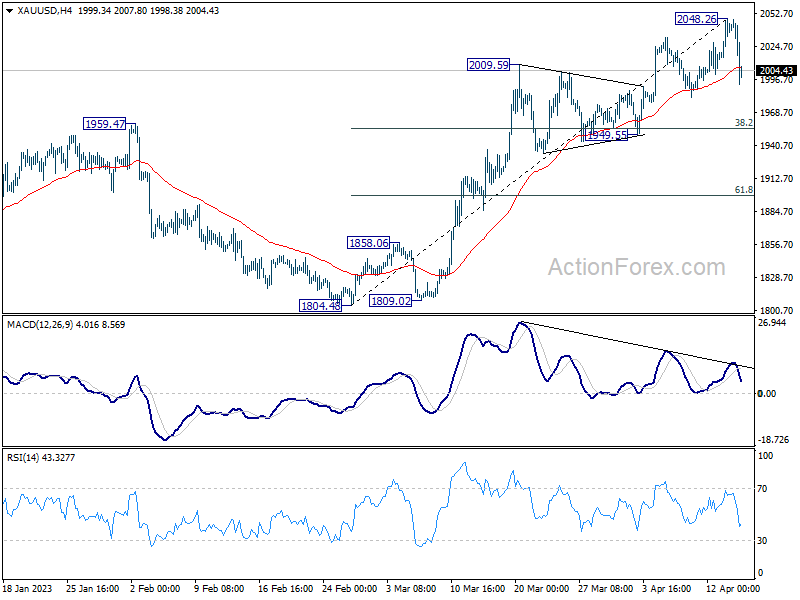
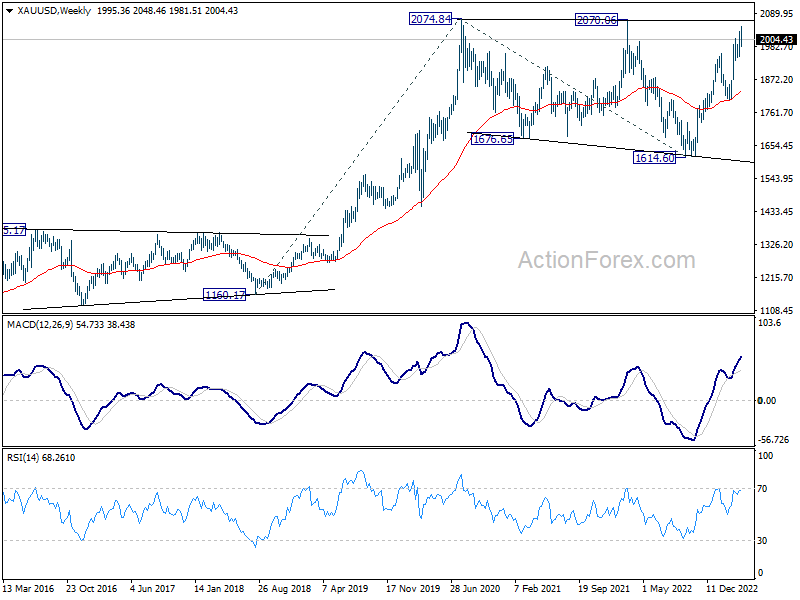
Gold, though more influenced by the Dollar than vice versa, is still worth monitoring to confirm the greenback's underlying direction. While Gold rose further to 2048.26, it's starting to feel heavy ahead of 2070.06/2074.84 long term resistance zone. Bearish divergence in 4H MACD suggests that a short term top is possibly in place already. Deeper pull back is likely for 38.2% retracement of 1804.48 to 2048.26 at 1955.13, which is close to 1949.55. Strong support could be seen there to contain downside to bring rebound. But sustained break of this fibonacci level will bring deeper pull back to 61.8% retracement at 1897.60.
EUR/USD Weekly Outlook
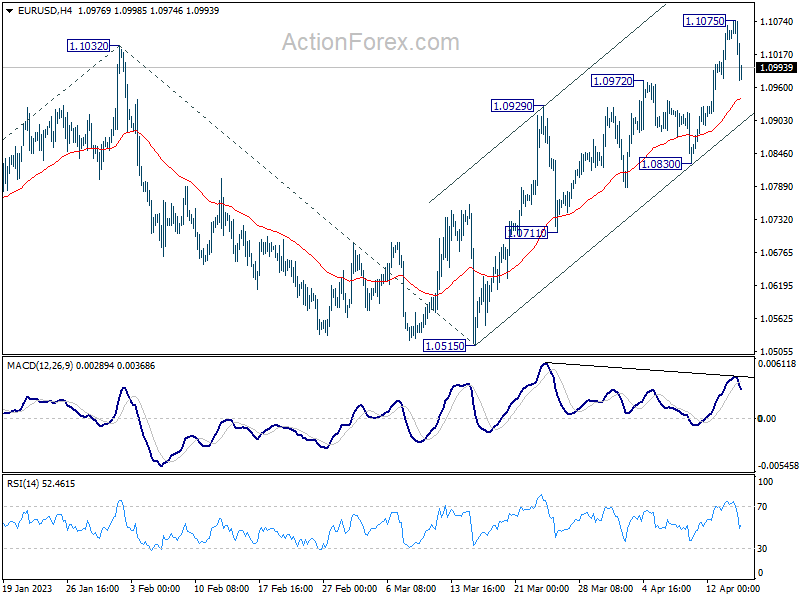
EUR/USD's up trend resumed last week by breaking through 1.1032 resistance. However, a temporary top was formed after hitting 1.1075. Initial bias is neutral this week for consolidations first. Outlook will stay bullish as long as 1.0830 support holds. Above 1.1075 will resume larger up trend to 1.1273 fibonacci level. Break there will target 61.8% projection of 0.9534 to 1.1032 from 1.0515 at 1.1441.
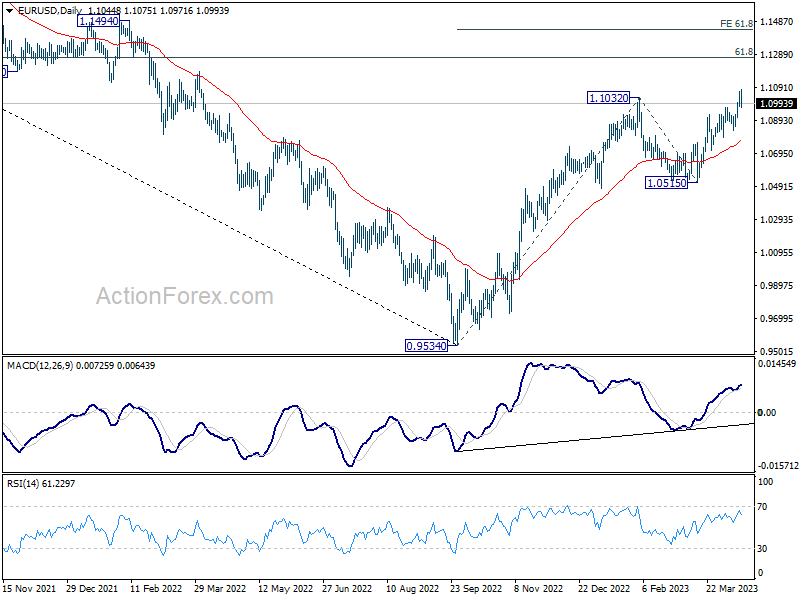
In the bigger picture, rise from 0.9534 (2022 low) is in progress for 61.8% retracement of 1.2348 (2021 high) to 0.9534 at 1.1273. Sustained break there will solidify the case of bullish trend reversal and target 1.2348 resistance next (2021 high). This will now remain the favored case as long as 1.0515 support holds, even in case of deeper pull back.
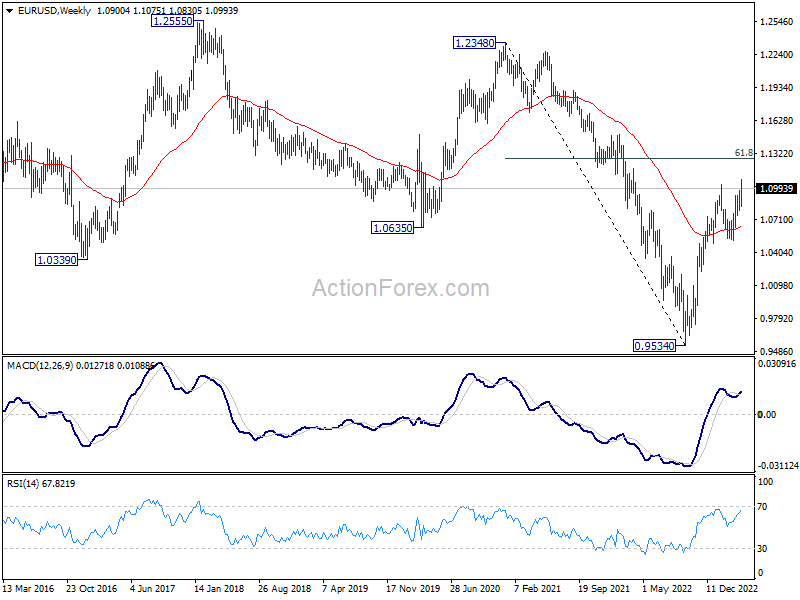
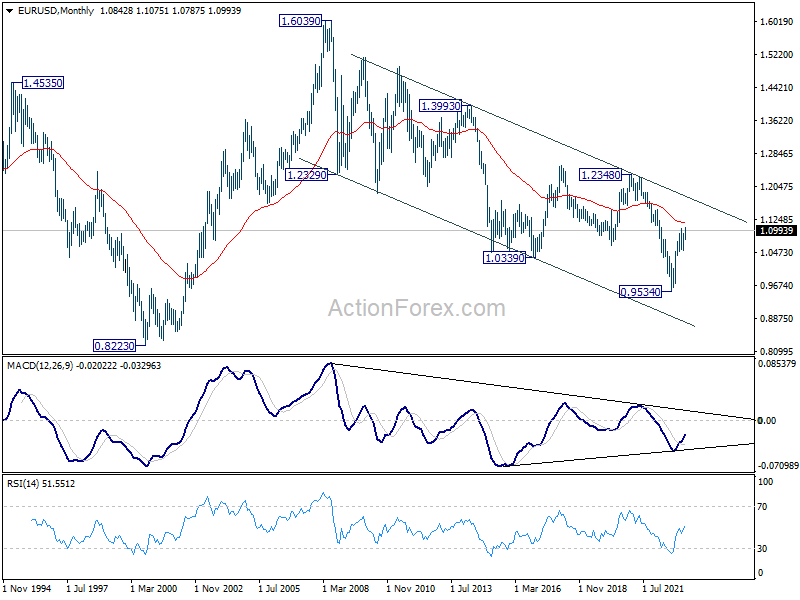
In the long term picture, while it's still early to call for long term trend reversal at this point, the strong break of 1.0635 support turned resistance (2020 low) should at least turn outlook neutral. Focus will turn to 55 M EMA (now at 1.1166). Rejection by this EMA will revive long term bearishness.
Summary 4/17 – 4/21
Monday, Apr 17, 2023
| GMT | Ccy | Events | Consensus | Previous |
|---|---|---|---|---|
| 22:30 | NZD | Business NZ PSI Mar | 55.8 | |
| 12:30 | CAD | Wholesale Sales M/M Feb | -1.60% | 2.40% |
| 12:30 | CAD | Foreign Securities Purchases (CAD) Feb | 6.28B | 4.21B |
| 12:30 | USD | Empire State Manufacturing Index Apr | -18.2 | -24.6 |
| 14:00 | USD | NAHB Housing Market Index Apr | 44 | 44 |
| GMT | Ccy | Events | |
|---|---|---|---|
| 22:30 | NZD | Business NZ PSI Mar | |
| Forecast: | Previous: 55.8 | ||
| 12:30 | CAD | Wholesale Sales M/M Feb | |
| Forecast: -1.60% | Previous: 2.40% | ||
| 12:30 | CAD | Foreign Securities Purchases (CAD) Feb | |
| Forecast: 6.28B | Previous: 4.21B | ||
| 12:30 | USD | Empire State Manufacturing Index Apr | |
| Forecast: -18.2 | Previous: -24.6 | ||
| 14:00 | USD | NAHB Housing Market Index Apr | |
| Forecast: 44 | Previous: 44 | ||
Tuesday, Apr 18, 2023
| GMT | Ccy | Events | Consensus | Previous |
|---|---|---|---|---|
| 01:30 | AUD | RBA Meeting Minutes | ||
| 02:00 | CNY | GDP Y/Y Q1 | 4.00% | 2.90% |
| 02:00 | CNY | Fixed Asset Investment YTD Y/Y Mar | 5.80% | 5.50% |
| 02:00 | CNY | Industrial Production Y/Y Mar | 4.70% | 2.40% |
| 02:00 | CNY | Retail Sales Y/Y Mar | 8.00% | 3.50% |
| 06:00 | GBP | Claimant Count Change Mar | 10.2K | -11.2K |
| 06:00 | GBP | ILO Unemployment Rate (3M) Feb | 3.70% | 3.70% |
| 06:00 | GBP | Average Earnings Excluding Bonus 3M/Y Feb | 6.20% | 6.50% |
| 06:00 | GBP | Average Earnings Including Bonus 3M/Y Feb | 4.90% | 5.70% |
| 08:00 | EUR | Italy Trade Balance (EUR) Feb | -3.23B | -4.19B |
| 09:00 | EUR | Germany ZEW Economic Sentiment Apr | 15.1 | 13 |
| 09:00 | EUR | Germany ZEW Current Situation Apr | -40 | -46.5 |
| 09:00 | EUR | Eurozone ZEW Economic Sentiment Apr | 11.2 | 10 |
| 12:30 | USD | Building Permits Mar | 1.46M | 1.52M |
| 12:30 | USD | Housing Starts Mar | 1.41M | 1.45M |
| 12:30 | CAD | CPI M/M Mar | 0.40% | |
| 12:30 | CAD | CPI Y/Y Mar | 5.20% | |
| 12:30 | CAD | CPI Median Y/Y Mar | 4.90% | |
| 12:30 | CAD | CPI Trimmed Y/Y Mar | 4.80% | |
| 12:30 | CAD | CPI Common Y/Y Mar | 6.40% |
| GMT | Ccy | Events | |
|---|---|---|---|
| 01:30 | AUD | RBA Meeting Minutes | |
| Forecast: | Previous: | ||
| 02:00 | CNY | GDP Y/Y Q1 | |
| Forecast: 4.00% | Previous: 2.90% | ||
| 02:00 | CNY | Fixed Asset Investment YTD Y/Y Mar | |
| Forecast: 5.80% | Previous: 5.50% | ||
| 02:00 | CNY | Industrial Production Y/Y Mar | |
| Forecast: 4.70% | Previous: 2.40% | ||
| 02:00 | CNY | Retail Sales Y/Y Mar | |
| Forecast: 8.00% | Previous: 3.50% | ||
| 06:00 | GBP | Claimant Count Change Mar | |
| Forecast: 10.2K | Previous: -11.2K | ||
| 06:00 | GBP | ILO Unemployment Rate (3M) Feb | |
| Forecast: 3.70% | Previous: 3.70% | ||
| 06:00 | GBP | Average Earnings Excluding Bonus 3M/Y Feb | |
| Forecast: 6.20% | Previous: 6.50% | ||
| 06:00 | GBP | Average Earnings Including Bonus 3M/Y Feb | |
| Forecast: 4.90% | Previous: 5.70% | ||
| 08:00 | EUR | Italy Trade Balance (EUR) Feb | |
| Forecast: -3.23B | Previous: -4.19B | ||
| 09:00 | EUR | Germany ZEW Economic Sentiment Apr | |
| Forecast: 15.1 | Previous: 13 | ||
| 09:00 | EUR | Germany ZEW Current Situation Apr | |
| Forecast: -40 | Previous: -46.5 | ||
| 09:00 | EUR | Eurozone ZEW Economic Sentiment Apr | |
| Forecast: 11.2 | Previous: 10 | ||
| 12:30 | USD | Building Permits Mar | |
| Forecast: 1.46M | Previous: 1.52M | ||
| 12:30 | USD | Housing Starts Mar | |
| Forecast: 1.41M | Previous: 1.45M | ||
| 12:30 | CAD | CPI M/M Mar | |
| Forecast: | Previous: 0.40% | ||
| 12:30 | CAD | CPI Y/Y Mar | |
| Forecast: | Previous: 5.20% | ||
| 12:30 | CAD | CPI Median Y/Y Mar | |
| Forecast: | Previous: 4.90% | ||
| 12:30 | CAD | CPI Trimmed Y/Y Mar | |
| Forecast: | Previous: 4.80% | ||
| 12:30 | CAD | CPI Common Y/Y Mar | |
| Forecast: | Previous: 6.40% | ||
Wednesday, Apr 19, 2023
| GMT | Ccy | Events | Consensus | Previous |
|---|---|---|---|---|
| 00:30 | AUD | Westpac Leading Index M/M Mar | -0.06% | |
| 04:30 | JPY | Industrial Production M/M Feb F | 4.50% | 4.50% |
| 06:00 | GBP | CPI M/M Mar | 0.50% | 1.10% |
| 06:00 | GBP | CPI Y/Y Mar | 9.80% | 10.40% |
| 06:00 | GBP | Core CPI Y/Y Mar | 6.00% | 6.20% |
| 06:00 | GBP | RPI M/M Mar | 0.60% | 1.20% |
| 06:00 | GBP | RPI Y/Y Mar | 13.30% | 13.80% |
| 06:00 | GBP | PPI Input M/M Mar | -0.40% | -0.10% |
| 06:00 | GBP | PPI Input Y/Y Mar | 9.80% | 12.70% |
| 06:00 | GBP | PPI Output M/M Mar | -0.10% | -0.30% |
| 06:00 | GBP | PPI Output Y/Y Mar | 8.70% | 12.10% |
| 06:00 | GBP | PPI Core Output M/M Mar | 0.20% | -0.20% |
| 06:00 | GBP | PPI Core Output Y/Y Mar | 9.80% | 10.40% |
| 08:00 | EUR | Eurozone Current Account (EUR) Feb | 10.3B | 17.1B |
| 09:00 | EUR | Eurozone CPI Core Y/Y Mar | 6.90% | 6.90% |
| 09:00 | EUR | Eurozone CPI Y/Y Mar | 5.70% | 5.70% |
| 12:15 | CAD | Housing Starts Mar | 260K | 244K |
| 12:30 | CAD | Industrial Product Price M/M Mar | -0.80% | |
| 12:30 | CAD | Raw Material Price Index Mar | -0.40% | |
| 14:30 | USD | Crude Oil Inventories | 0.6M | |
| 18:00 | USD | Fed's Beige Book | ||
| 22:45 | NZD | CPI Q/Q Q1 | 1.50% | 1.40% |
| 22:45 | NZD | CPI Y/Y Q1 | 7.20% | |
| 23:50 | JPY | Trade Balance (JPY) Mar | -1.78T | -1.19T |
| GMT | Ccy | Events | |
|---|---|---|---|
| 00:30 | AUD | Westpac Leading Index M/M Mar | |
| Forecast: | Previous: -0.06% | ||
| 04:30 | JPY | Industrial Production M/M Feb F | |
| Forecast: 4.50% | Previous: 4.50% | ||
| 06:00 | GBP | CPI M/M Mar | |
| Forecast: 0.50% | Previous: 1.10% | ||
| 06:00 | GBP | CPI Y/Y Mar | |
| Forecast: 9.80% | Previous: 10.40% | ||
| 06:00 | GBP | Core CPI Y/Y Mar | |
| Forecast: 6.00% | Previous: 6.20% | ||
| 06:00 | GBP | RPI M/M Mar | |
| Forecast: 0.60% | Previous: 1.20% | ||
| 06:00 | GBP | RPI Y/Y Mar | |
| Forecast: 13.30% | Previous: 13.80% | ||
| 06:00 | GBP | PPI Input M/M Mar | |
| Forecast: -0.40% | Previous: -0.10% | ||
| 06:00 | GBP | PPI Input Y/Y Mar | |
| Forecast: 9.80% | Previous: 12.70% | ||
| 06:00 | GBP | PPI Output M/M Mar | |
| Forecast: -0.10% | Previous: -0.30% | ||
| 06:00 | GBP | PPI Output Y/Y Mar | |
| Forecast: 8.70% | Previous: 12.10% | ||
| 06:00 | GBP | PPI Core Output M/M Mar | |
| Forecast: 0.20% | Previous: -0.20% | ||
| 06:00 | GBP | PPI Core Output Y/Y Mar | |
| Forecast: 9.80% | Previous: 10.40% | ||
| 08:00 | EUR | Eurozone Current Account (EUR) Feb | |
| Forecast: 10.3B | Previous: 17.1B | ||
| 09:00 | EUR | Eurozone CPI Core Y/Y Mar | |
| Forecast: 6.90% | Previous: 6.90% | ||
| 09:00 | EUR | Eurozone CPI Y/Y Mar | |
| Forecast: 5.70% | Previous: 5.70% | ||
| 12:15 | CAD | Housing Starts Mar | |
| Forecast: 260K | Previous: 244K | ||
| 12:30 | CAD | Industrial Product Price M/M Mar | |
| Forecast: | Previous: -0.80% | ||
| 12:30 | CAD | Raw Material Price Index Mar | |
| Forecast: | Previous: -0.40% | ||
| 14:30 | USD | Crude Oil Inventories | |
| Forecast: | Previous: 0.6M | ||
| 18:00 | USD | Fed's Beige Book | |
| Forecast: | Previous: | ||
| 22:45 | NZD | CPI Q/Q Q1 | |
| Forecast: 1.50% | Previous: 1.40% | ||
| 22:45 | NZD | CPI Y/Y Q1 | |
| Forecast: | Previous: 7.20% | ||
| 23:50 | JPY | Trade Balance (JPY) Mar | |
| Forecast: -1.78T | Previous: -1.19T | ||
Thursday, Apr 20, 2023
| GMT | Ccy | Events | Consensus | Previous |
|---|---|---|---|---|
| 01:30 | AUD | NAB Business Confidence Q1 | -1 | |
| 04:30 | JPY | Tertiary Industry Index M/M Feb | 0.40% | 0.90% |
| 06:00 | EUR | Germany PPI M/M Mar | -0.30% | |
| 06:00 | EUR | Germany PPI Y/Y Mar | 15.80% | |
| 11:30 | EUR | ECB Monetary Policy Meeting Accounts | ||
| 12:30 | USD | Initial Jobless Claims (Apr 14) | 238K | 239K |
| 12:30 | USD | Philadelphia Fed Manufacturing Survey Apr | -19.1 | -23.2 |
| 14:00 | USD | Existing Home Sales Mar | 4.50M | 4.58M |
| 14:00 | EUR | Eurozone Consumer Confidence Apr P | -18 | -19 |
| 14:30 | USD | Natural Gas Storage | 25B | |
| 23:00 | AUD | Manufacturing PMI Apr P | 49.1 | |
| 23:00 | AUD | Services PMI Apr P | 50.7 | |
| 23:01 | GBP | GfK Consumer Confidence Apr | -35 | -36 |
| 23:30 | JPY | National CPI Y/Y Mar | 3.30% | |
| 23:30 | JPY | National CPI Core Y/Y Mar | 3.10% | |
| 23:30 | JPY | National CPI Core-Core Y/Y Mar | 3.50% |
| GMT | Ccy | Events | |
|---|---|---|---|
| 01:30 | AUD | NAB Business Confidence Q1 | |
| Forecast: | Previous: -1 | ||
| 04:30 | JPY | Tertiary Industry Index M/M Feb | |
| Forecast: 0.40% | Previous: 0.90% | ||
| 06:00 | EUR | Germany PPI M/M Mar | |
| Forecast: | Previous: -0.30% | ||
| 06:00 | EUR | Germany PPI Y/Y Mar | |
| Forecast: | Previous: 15.80% | ||
| 11:30 | EUR | ECB Monetary Policy Meeting Accounts | |
| Forecast: | Previous: | ||
| 12:30 | USD | Initial Jobless Claims (Apr 14) | |
| Forecast: 238K | Previous: 239K | ||
| 12:30 | USD | Philadelphia Fed Manufacturing Survey Apr | |
| Forecast: -19.1 | Previous: -23.2 | ||
| 14:00 | USD | Existing Home Sales Mar | |
| Forecast: 4.50M | Previous: 4.58M | ||
| 14:00 | EUR | Eurozone Consumer Confidence Apr P | |
| Forecast: -18 | Previous: -19 | ||
| 14:30 | USD | Natural Gas Storage | |
| Forecast: | Previous: 25B | ||
| 23:00 | AUD | Manufacturing PMI Apr P | |
| Forecast: | Previous: 49.1 | ||
| 23:00 | AUD | Services PMI Apr P | |
| Forecast: | Previous: 50.7 | ||
| 23:01 | GBP | GfK Consumer Confidence Apr | |
| Forecast: -35 | Previous: -36 | ||
| 23:30 | JPY | National CPI Y/Y Mar | |
| Forecast: | Previous: 3.30% | ||
| 23:30 | JPY | National CPI Core Y/Y Mar | |
| Forecast: | Previous: 3.10% | ||
| 23:30 | JPY | National CPI Core-Core Y/Y Mar | |
| Forecast: | Previous: 3.50% | ||
Friday, Apr 21, 2023
| GMT | Ccy | Events | Consensus | Previous |
|---|---|---|---|---|
| 00:30 | JPY | Manufacturing PMI Apr P | 49.9 | 49.2 |
| 00:30 | JPY | Services PMI Apr P | 55 | |
| 06:00 | GBP | Retail Sales M/M Mar | -0.10% | 1.20% |
| 06:00 | GBP | Retail Sales Y/Y Mar | -4.50% | -3.50% |
| 06:00 | GBP | Retail Sales ex-Fuel M/M Mar | -0.20% | 1.50% |
| 06:00 | GBP | Retail Sales ex-Fuel Y/Y Mar | -4.80% | -3.30% |
| 07:15 | EUR | France Manufacturing PMI Apr P | 47.5 | 47.3 |
| 07:15 | EUR | France Services PMI Apr P | 53.6 | 53.9 |
| 07:30 | EUR | Germany Manufacturing PMI Apr P | 45.6 | 44.7 |
| 07:30 | EUR | Germany Services PMI Apr P | 53.5 | 53.7 |
| 08:00 | EUR | Eurozone Manufacturing PMI Apr P | 48.2 | 47.3 |
| 08:00 | EUR | Eurozone Services PMI Apr P | 54.6 | 55.0 |
| 08:30 | GBP | Manufacturing PMI Apr P | 48.8 | 47.9 |
| 08:30 | GBP | Services PMI Apr P | 52.9 | 52.9 |
| 12:30 | CAD | Retail Sales M/M Feb | 1.40% | |
| 12:30 | CAD | Retail Sales ex Autos M/M Feb | 0.90% | |
| 13:45 | USD | Manufacturing PMI Apr P | 49.2 | 49.2 |
| 13:45 | USD | Services PMI Apr P | 51.8 | 52.6 |
| GMT | Ccy | Events | |
|---|---|---|---|
| 00:30 | JPY | Manufacturing PMI Apr P | |
| Forecast: 49.9 | Previous: 49.2 | ||
| 00:30 | JPY | Services PMI Apr P | |
| Forecast: | Previous: 55 | ||
| 06:00 | GBP | Retail Sales M/M Mar | |
| Forecast: -0.10% | Previous: 1.20% | ||
| 06:00 | GBP | Retail Sales Y/Y Mar | |
| Forecast: -4.50% | Previous: -3.50% | ||
| 06:00 | GBP | Retail Sales ex-Fuel M/M Mar | |
| Forecast: -0.20% | Previous: 1.50% | ||
| 06:00 | GBP | Retail Sales ex-Fuel Y/Y Mar | |
| Forecast: -4.80% | Previous: -3.30% | ||
| 07:15 | EUR | France Manufacturing PMI Apr P | |
| Forecast: 47.5 | Previous: 47.3 | ||
| 07:15 | EUR | France Services PMI Apr P | |
| Forecast: 53.6 | Previous: 53.9 | ||
| 07:30 | EUR | Germany Manufacturing PMI Apr P | |
| Forecast: 45.6 | Previous: 44.7 | ||
| 07:30 | EUR | Germany Services PMI Apr P | |
| Forecast: 53.5 | Previous: 53.7 | ||
| 08:00 | EUR | Eurozone Manufacturing PMI Apr P | |
| Forecast: 48.2 | Previous: 47.3 | ||
| 08:00 | EUR | Eurozone Services PMI Apr P | |
| Forecast: 54.6 | Previous: 55.0 | ||
| 08:30 | GBP | Manufacturing PMI Apr P | |
| Forecast: 48.8 | Previous: 47.9 | ||
| 08:30 | GBP | Services PMI Apr P | |
| Forecast: 52.9 | Previous: 52.9 | ||
| 12:30 | CAD | Retail Sales M/M Feb | |
| Forecast: | Previous: 1.40% | ||
| 12:30 | CAD | Retail Sales ex Autos M/M Feb | |
| Forecast: | Previous: 0.90% | ||
| 13:45 | USD | Manufacturing PMI Apr P | |
| Forecast: 49.2 | Previous: 49.2 | ||
| 13:45 | USD | Services PMI Apr P | |
| Forecast: 51.8 | Previous: 52.6 | ||
U.S. Dollar’s Reserve Currency Status Still Secure
Summary
Over the last few weeks, headlines around the U.S. dollar losing its global reserve currency status have become widespread and captured attention. In our view, the U.S. dollar is not on the brink of losing global reserve currency status at any point in the foreseeable future. The dollar meets all the characteristics of a reserve currency, and is still the dominant currency in the global payments' marketplace as well as the currency of choice for FX reserve managers. While the FX reserve allocation to the dollar has declined over time, we believe this trend is a product of one-off developments and not necessarily a movement to shun the greenback. Going forward, we believe the dollar will maintain its status as the global reserve currency as EU fragmentation risks will prevent the euro from gathering momentum, a distorted Japanese Government Bond market counters the yen, and convertibility challenges limits the rise of the renminbi for the time being.
U.S. Dollar's Reserve Status Is Under False Scrutiny
In recent weeks, the U.S. dollar's status as the world's global reserve currency has come under intense scrutiny, with some analysts predicting the demise of the greenback's reign. Such speculation has occurred in the context of recently announced initiatives such as China and Brazil announcing clearing arrangements in each other's local currencies, Middle Eastern energy exporting countries agreeing to settle transactions in renminbi, and the BRICS nations announcing plans to develop a single currency to reduce dependence on the U.S. dollar. Still, while such initiatives could at the margin see less use of the U.S. dollar for trade or investment purposes, we see many characteristics which suggest the U.S. dollar will remain the preeminent global currency for the foreseeable future.
To be considered a “reserve currency” a currency must demonstrate certain characteristics. These desirable attributes include being:
- Freely convertible (i.e. not pegged and/or subject to capital controls)
- Widely accepted and used in trade and global transactions
- Backed by large and liquid debt markets easily accessible to foreign investors
- Not subject to undue political influence (i.e. associated with an independent central bank)
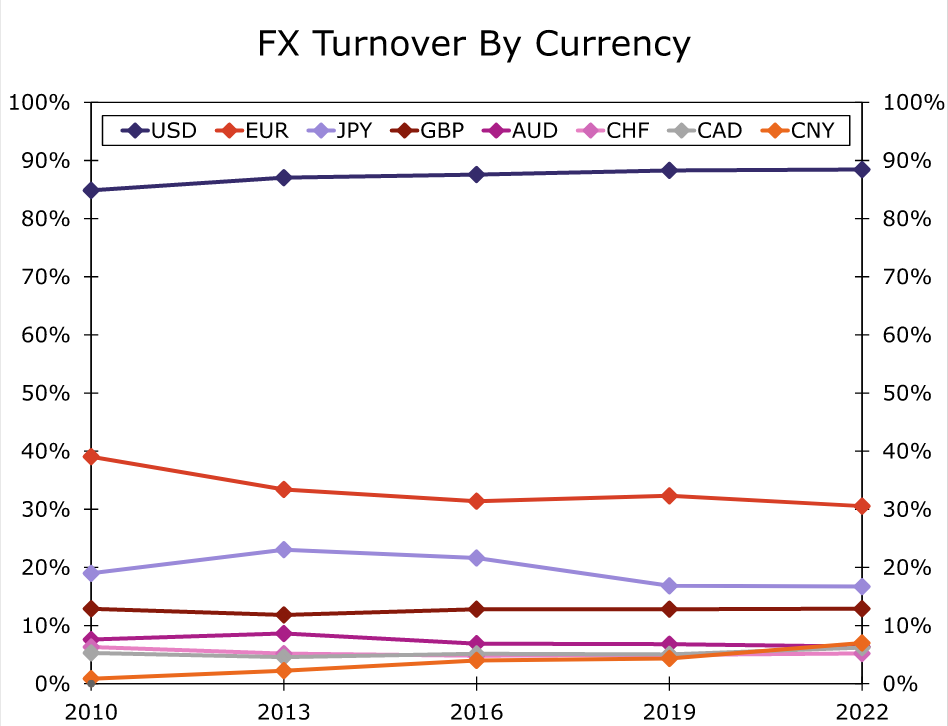
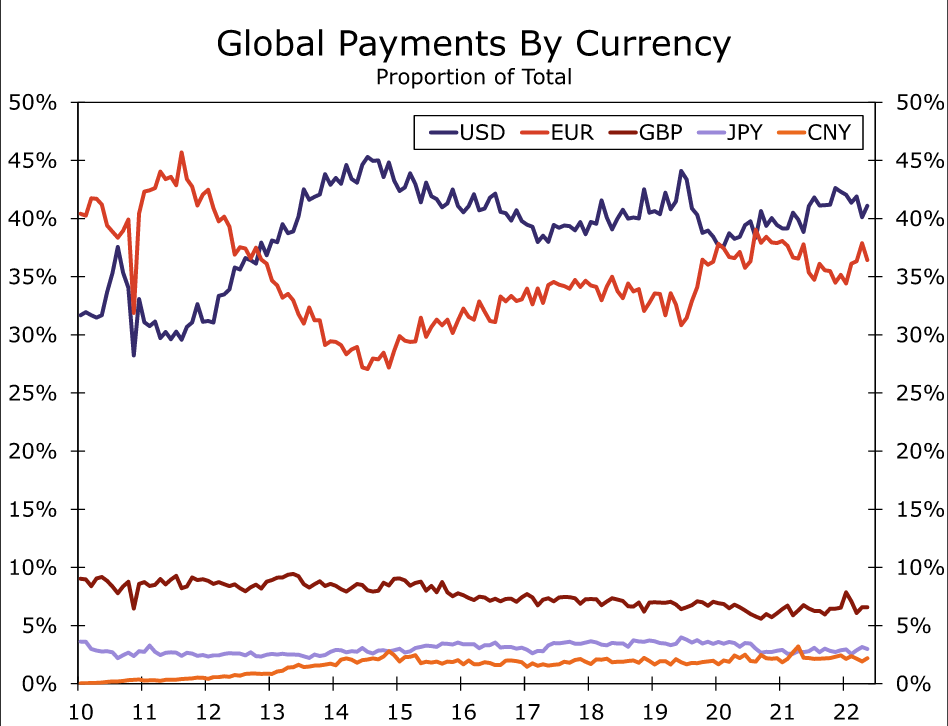
The U.S. dollar measures up well, and certainly better than any other currency, against these metrics, underpinning our view that the dollar's global reserve currency status will remain intact going forward. To that point, the greenback is the most used currency for trade and other cross-border transactions by a fairly wide margin. According to relevant and available data, no clear evidence exists that U.S. dollar usage is diminishing. According to the Bank for International Settlements (BIS) three-year survey of foreign exchange turnover—which indicate the prevalence of individual currencies across a range of transactions (spot, forward, swaps, options and other products)—the U.S. dollar's percentage share of FX turnover in April 2022 was 88.4%, which is higher than the 84.9% in April 2010 (Figure 1). Keep in mind given that foreign exchange transactions are two-sided, these percentages add to 200%. This relatively high usage reflects the ease of transacting in U.S. dollars, no convertibility issues, and the dollar's widespread acceptance around the world. Some distance behind the dollar is the euro at 30.5%; however, euro usage is down notably from 39.0% in April 2010. In fact, aside from the Chinese renminbi, all other key major currencies have seen their usage decline from 2010-2022. In the case of the Chinese renminbi, the yuan only appears in ~5% of total FX turnover. Data from the Society for Worldwide Interbank Financial Telecommunication (SWIFT) confirms the U.S. dollar's prominence in the global marketplace. SWIFT publishes monthly figures of the proportion of global payments made in each currency. Once again, the U.S. dollar comes out on top, rising to 41.1% of total payments in February 2023 (Figure 2). To be fair, the U.S. dollar is not as dominant on this metric, with 36.4% of payments made in euros in February. However, other currencies such as the British pound, Japanese yen and Chinese renminbi are far behind. We also note that proportion of global payments in U.S. dollar has ranged between 35% and 45% since 2013, and there is no clear evidence of a trend decline of the use of the U.S. dollar in the SWIFT data.
FX Reserve Managers Continue to Choose the Dollar
In addition to usage in the global marketplace, the composition of foreign exchange reserves held by central banks around the world continue to be dominated by the U.S. dollar. At the end of 2022, foreign exchange reserve assets totaled US$11.963 trillion, of which the U.S. dollar represented the majority of these global FX reserve assets. According to these IMF data, the U.S. dollar is still the most popular choice of FX reserve managers in managing currency reserves. That said, we acknowledge there has been a gradual shift away from the proportion of FX reserves held in U.S. dollars over the past decades. In Q1-2000 FX reserve managers held 71.5% of global FX reserves in dollars. This number has since fallen to 58.4% by at the end of 2022 (Figure 3).
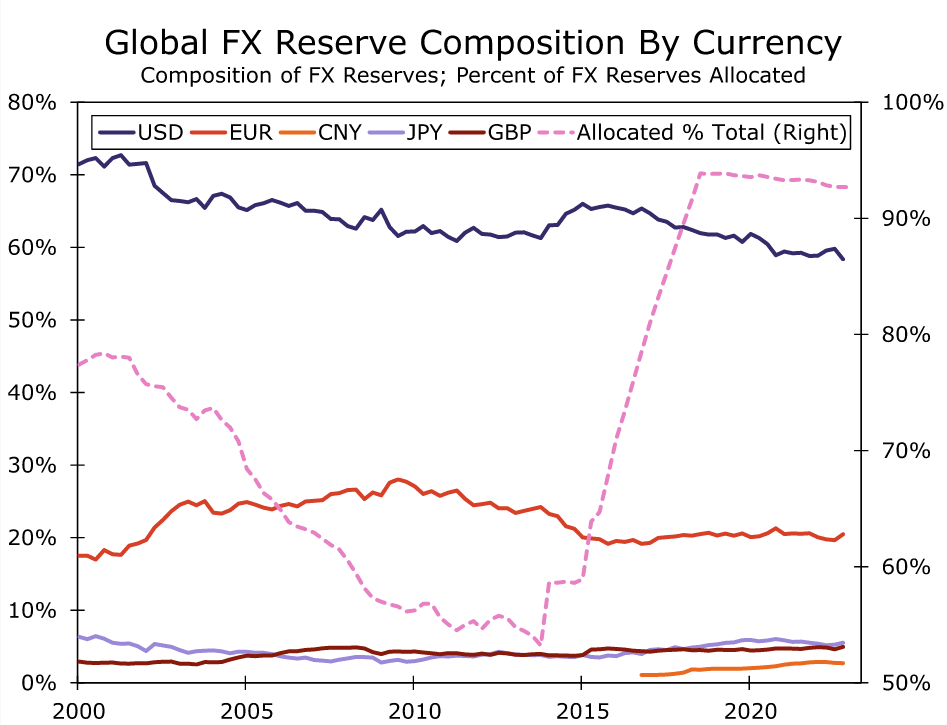
We see multiple relevant factors that have likely contributed to the gradual decline in the U.S. dollar's use as a reserve currency during this timeframe. First, the introduction and adoption of the euro in 1999 and early 2000s likely contributed to the dollar's initial downward trend. To that point, in the immediate years following the introduction of the euro, the decline in U.S. dollar-denominated FX reserves coincides with increasing usage of the euro as a reserve currency. However, holdings FX reserves in euros was a one-off occurrence (albeit a long one) and ran its course around 2010. The second phase of the decline occurred started around 2015 and lasted through 2020; however, we question, or at least cannot say with any certainty, whether the dollar was being shunned or if these dynamics were more statistical in nature. We say statistical in the sense that this was a period when a more robust sample of countries, most notably China, began reporting the composition of their FX reserves to the International Monetary Fund. Starting in 2015 and persisting for a few years, additional central banks became more transparent and a larger allocation of all global foreign exchange reserves became know. In 2018, the IMF was able to report that the currency allocation of 93% of global FX reserves were known, up from just 53% in late 2013 (Figure 3). With China's massive FX reserve position being included the composition calculation, disentangling whether the dollar's allocation declined as a result of FX reserve managers moving away from the greenback or whether China's FX reserves were allocated toward multiple currencies and not just the dollar is a bit of an unknown. Regardless of whether the decline was a product of FX reserve management or a statistical byproduct of changing areas of coverage, most importantly we note that proportion of FX reserves held in U.S. dollars has been stable since late 2020, and still far above the next most used currency by hard currency reserve managers.
Alternatives Are Limited. Dollar's Status is Secure
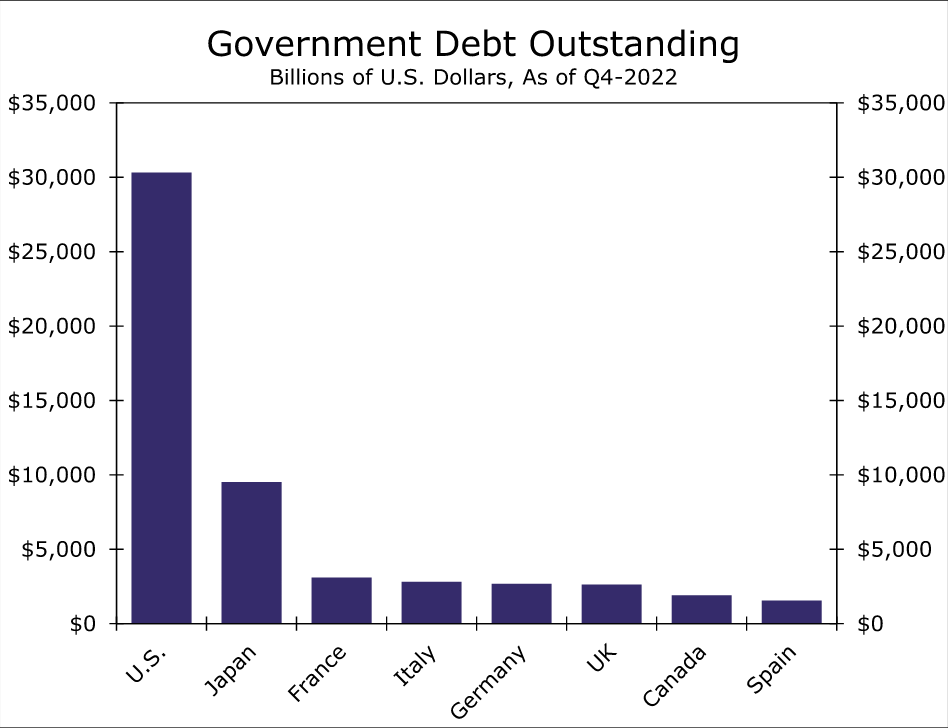
Moreover, we believe there are limits to how much lower, for now, the use of the U.S. dollar by FX reserve mangers can go. As we stated earlier, a desirable characteristic of a global reserve currency is one that is easily and freely tradable, as well as backed by large and liquid debt markets. Using data from the Institute of International Finance (IIF), government debt outstanding for the United States (US$30.3 trillion) and Japan (US$9.5 trillion) comfortably exceed the size of other major government bond markets (Figure 4). This should make those bond markets and their respective currencies popular choices for FX reserve managers, more so the case for the United States. For Japan, the government bond market has been, and continues to be, significantly distorted by the central bank's Yield Curve Control policy. In addition, the Bank of Japan holds a significant majority of all outstanding Japanese Government Bonds, and yields of Japanese debt remain quite low. While the independence of the Bank of Japan is not in question, the accessibility of the JGB market to foreign investors is something of a challenge and will likely limit the yen's ability to make significant headway toward becoming the dominant global reserve currency. In Europe, sovereign debt markets are sizable, although still not nearly as sizable as the U.S. or Japan, and in that sense are somewhat segmented. Fragmentation is also a relevant regional risk and one that has gathered momentum since the euro was adopted. Brexit—the risk of Frexit, Grexit, Italexit, Spexit and other percolating EU-fragmentation movements as well as further U.K.-EU tensions—in our view, are enough for FX reserve managers to at least pause when considering allocating an outsized amount to European government bonds. And finally, with respect to Chinese government bonds, capital controls as well as the managed nature of the renminbi and convertibility concerns should offer disincentive for reserve managers to allocate currency holdings toward Chinese assets at this point. Taking these factors into account, we see limited alternatives at the current juncture for FX reserve managers to U.S. government bonds and, accordingly, see limits as to how much lower holdings of U.S. dollar assets by reserve managers will go. With the use of the U.S. dollar for trade and other cross border transactions still widespread, and the use of U.S. dollar assets still a clearly favored choice of reserve managers, we view the U.S. dollar's status as the global reserve currency as secure for the foreseeable future.
Weekly Economic & Financial Commentary: FOMC on Path for 25 bps Rate Hike on May 3
Summary
United States: Spring Break Is Over
- On balance, this week's data show the U.S. economy is losing momentum, as the lagged effects of the FOMC's rapid pace of monetary policy tightening appear to be slowing growth as intended. In March, retail sales fell 1.0%, manufacturing production slipped 0.5% and the consumer price index rose a modest 0.1%.
- Next week: Housing Starts (Tue), Existing Home Sales (Thu), Leading Economic Index (Thu)
International: Bank of Canada's Waiting Game Continues
- The Bank of Canada (BoC) again held its policy rate steady at 4.50% at its monetary policy meeting this week. The central bank said growth in early 2023 will be stronger than previously forecast and that it remains prepared to tighten further if needed. At the same time, it expects past rate hikes will see growth slow as the year progresses and also expects inflation to slow quickly to around 3% by the middle of this year. Overall, we think the BoC remains comfortably on hold for now, with the main risk being that resilient economic trends see monetary easing beginning later than we currently expect.
- Next week: China GDP (Tue), U.K. CPI (Wed), Eurozone PMIs (Fri)
Interest Rate Watch: FOMC on Path for 25 bps Rate Hike on May 3
- With volatility in financial markets subsiding recently and with inflationary pressures remaining elevated, we look for the FOMC to hike rates by another 25 bps at its May 3 meeting. But we also think May 3 will mark the end of the tightening cycle that has been in place since last March.
Topic of the Week: Nothing Is Certain in Life Except Death and Taxes
- As millions of Americans have poured over their W-2s and 1099s in recent weeks, the culmination of the filing season will have important implications for the fiscal outlook, including the debt ceiling.