Sample Category Title
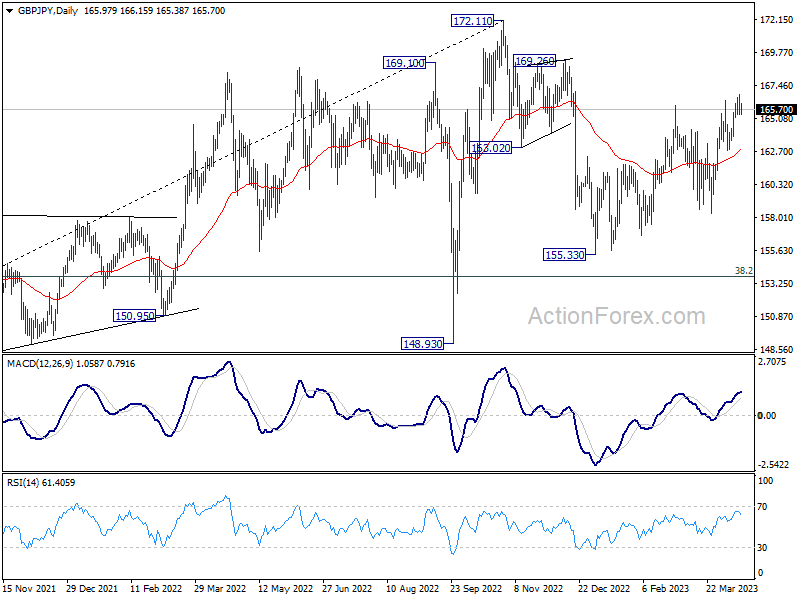
ETHUSD Rose by 10% in a Day on the Background of Shanghai Upgrade
Shanghai, an important upgrade to the Ethereum blockchain, has been a success. Against the backdrop of the news, the ETHUSD rate rose by 10% per day, breaking the psychological level of $2,000. As of Friday morning, ETH is trading above $2,100, something that has not happened since May 2022. Since the beginning of the year, ETHUSD has risen in price by about 77% (for comparison, Bitcoin, by about 86%).
In the long run, the Shanghai (also known as Shapella) upgrade has the advantage of providing more freedom to invest. But in the short term, a collapse in the value of ETH could occur, as investors got the opportunity to withdraw funds from staking. According to on-chain metrics, after the update, more than 1 million ETH tokens were requested for withdrawal. “[This] is much lower than what was previously expected,” Matt Maximo, an analyst with Grayscale, told CNBC.
The growth of the ETHUSD rate was also facilitated by the lower US dollar index — it fell to the lows of the current year after the release of March producer price index on Thursday, which showed signs of weakening inflation.
On the daily chart of ETHUSD, there was a bullish breakout (1) of the upper boundary of the rising channel that was active in 2023 – which suggests that the market is overbought, and a technical pullback with a breakout test of the $2k psychological level will be a likely scenario.
EUR/USD: Bulls Hold Grip But Caution on Growing Signals of Pullback
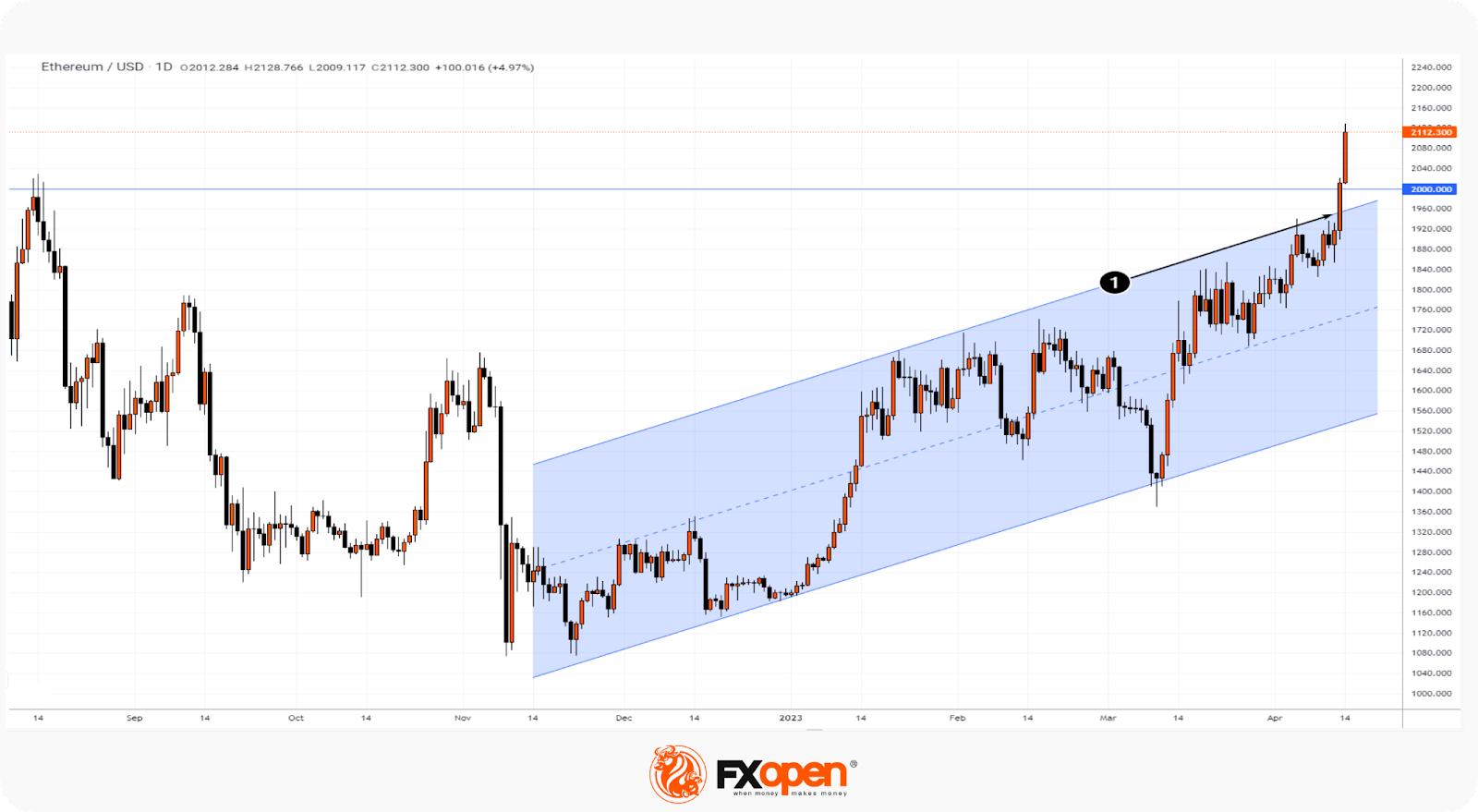
The Euro has established above psychological 1.10 level and holding gains above former top at 1.1032, with Friday’s upside extension to new one-year high, adding to positive signals.
On the other hand, strongly overbought daily studies and 14-d momentum turning south, point to growing risk of rally’s stall and pullback that would prompt traders to collect some profits on larger long positions.
This is so far seen as an indication, with more evidence needed to generate negative signal, however the idea of bulls taking a breather after strong acceleration will remain on the table.
Weekly close will be in focus, as the pair is on track for the biggest weekly gain since the second week of Nov 2022 and also for the fourth consecutive bullish week.
Potential dips should be shallow in current euro-positive environment and offer better prices to re-enter larger uptrend, with 1.10 level offering initial support, followed by broken 100WMA/10DMA (1.0945) and 20DMA (1.0880) expected to contain extended dips and mark a healthy correction ahead of fresh push higher.
Res: 1.1075; 1.1100; 1.1154; 1.1229.
Sup: 1.1032; 1.1000; 1.0945; 1.0880.
USD/JPY Steady, BOJ’s Ueda Pledges to Maintain Policy, Markets Eye US Retail Sales
BoJ’s Ueda says he’ll maintain policy
It has been a light data calendar in Japan this week, leaving Bank of Japan Governor Ueda’s remarks at a G20 meeting in Washington as the highlight of the week. Ueda took over as head of the central bank on Sunday and will chair his first BoJ policy meeting at the end of the month.
Ueda didn’t veer from the script which he has been using since his confirmation hearings earlier this year. He reiterated to maintain the BoJ’s ultra-loose monetary policy, as the central bank expects inflation, which is around 3%, to return back to the 2% target later in the year. There has been speculation that Ueda might tweak policy, such as widening the target band on 10-year government bonds. The BoJ surprised the markets with such a move in December and the yen shot higher as a result.
The G-20 meeting provided Ueda with another opportunity to outline his policy plans and pour cold water on any expectations of a shift in policy. The previous governor, Haruhiko Kuroda, injected massive monetary stimulus in order to boost the weak economy, which has kept the yen at low levels and distorted bond markets. Speculators, who play a cat-and-mouse game with the BoJ, will be on the alert for policy change by Ueda, if not at the April meeting, then perhaps in the coming months.
Markets brace for weak US retail sales
The US releases March retail sales later today, with the markets projecting a weak report. Headline retail sales is expected to decline by 0.4% for a second straight month, while the core rate is forecast to fall by 0.3%, after a -0.1% read in February.
Currently, the odds of a 25-bp hike are 69%, with a 31% chance of a pause, according to the CME Group. The retail sales release could affect the direction of the US dollar. A strong release would make a rate hike more likely, which is bullish for the greenback, while a soft release would raise expectations of a Fed pause and weigh on the dollar.
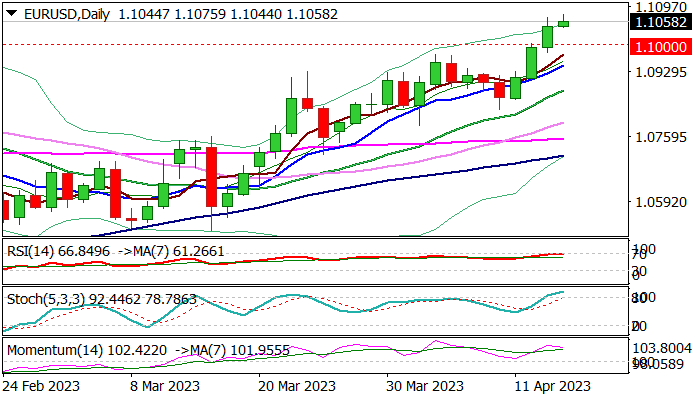
USD/JPY Technical
- There is resistance at 133.45 and 135.31
- 132.18 and 130.61 are providing support
Fed Bostic: Recent data consistent with one more rate hike
In a recent interview with Reuters, Atlanta Fed President Raphael Bostic discussed the implications of this week's slowing consumer price increases and falling producer price inflation. According to Bostic, these developments are in line with the possibility of one more rate hike, as momentum suggests a trajectory towards 2% inflation.
Bostic expressed that the aggressive rate increases over the past year are just beginning to "bite" the economy, justifying a pause after one more rate increase. This pause would allow for an assessment of the economy and inflation's progression while aiming to minimize the impact on growth and employment.
Despite the current economic landscape, Bostic remains optimistic, believing that unemployment won't need to surpass 4% and that the economy can continue to grow, albeit at a slower pace. He attributes the persistent consumer demand and robust hiring to the economic distortions caused by the trillions of dollars in government support provided during the COVID-19 pandemic.
Fed Shrinks Balance Sheet Slower than ECB
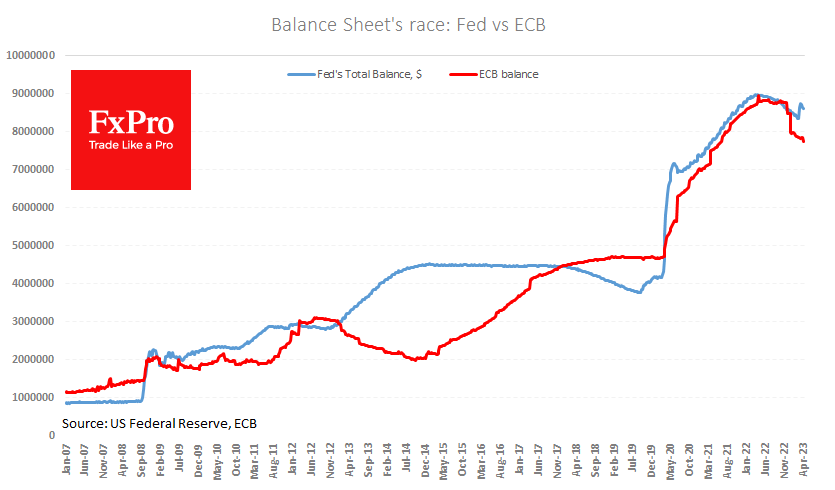
The Fed’s balance sheet shrank by 17.6 bn last week to 8,615 bn. Down 119bn over three weeks, the balance sheet is still 275bn higher than at the start of March.
Pumping liquidity into the financial system helps to support demand for risky assets, as it reduces stress in the financial system and creates more optimistic expectations for the banking sector and the market.
A shrinking balance sheet is only good news for the dollar in theory. In practice, the ECB is more disciplined in reducing its balance sheet. Moreover, comments from European officials are shaping expectations that the next ECB rate hike will also be a 50bp hike. Markets are currently pricing in a 69% probability of the Fed’s 25bp hike and a 31% probability of no hike.
The situation with US banks in March highlighted the Fed’s flexibility and willingness to change course as circumstances dictate. This is good news for the economy, commodities, and equity markets but also a negative agenda for the dollar. The US is clearly in the lead regarding policy tightening, while the ECB is raising interest rates and selling assets from its balance sheet more actively.
We expect this to continue, putting moderate pressure on the USD against its major rivals. On the macro monetary policy, 2022 is similar to 2002, when the EURUSD began a strong recovery, and the pair rose by more than 50% in less than three years.
New Zealand Dollar Drifting after Soft Manufacturing PMI, Markets Brace for Soft US Retail Sales
New Zealand manufacturing declines
New Zealand wrapped up the week on a sour note, as Manufacturing PMI for March slipped to 48.1, after a downwardly revised 51.7 in February and below the estimate of 51.0. A reading above 50.0 indicates expansion; below 50.0 indicates contraction. The manufacturing sector has been struggling across the globe due to weak economic conditions and supply chain issues, and the market reaction to the weak release was muted.
Inflation remains the Reserve Bank of New Zealand’s number one priority. The central bank has taken off the gloves and has been very aggressive, including a 50-basis point hike last week which completely blindsided the markets. The benchmark cash rate is currently at 5.25%, but inflation remains stubbornly high at 7.2%. The markets are bracing for inflation to rise to 7.5% for the first quarter, and RBNZ Governor Orr will have a lot of explaining to do if inflation accelerates despite the relentless rise in interest rates.
The US releases March retail sales later today, with the markets projecting soft numbers. Headline retail sales is expected to decline by 0.4% for a second straight month, while the core rate is forecast to fall by 0.3%, after a -0.1% read in February.
Currently, the odds of a 25-bp hike are 69%, with a 31% chance of a pause, according to the CME Group. The retail sales release could impact on the movement of the US dollar. A strong release would make a rate hike more likely, which is bullish for the greenback, while a soft release would raise expectations of a Fed pause and weigh on the dollar.
NZD/USD Technical
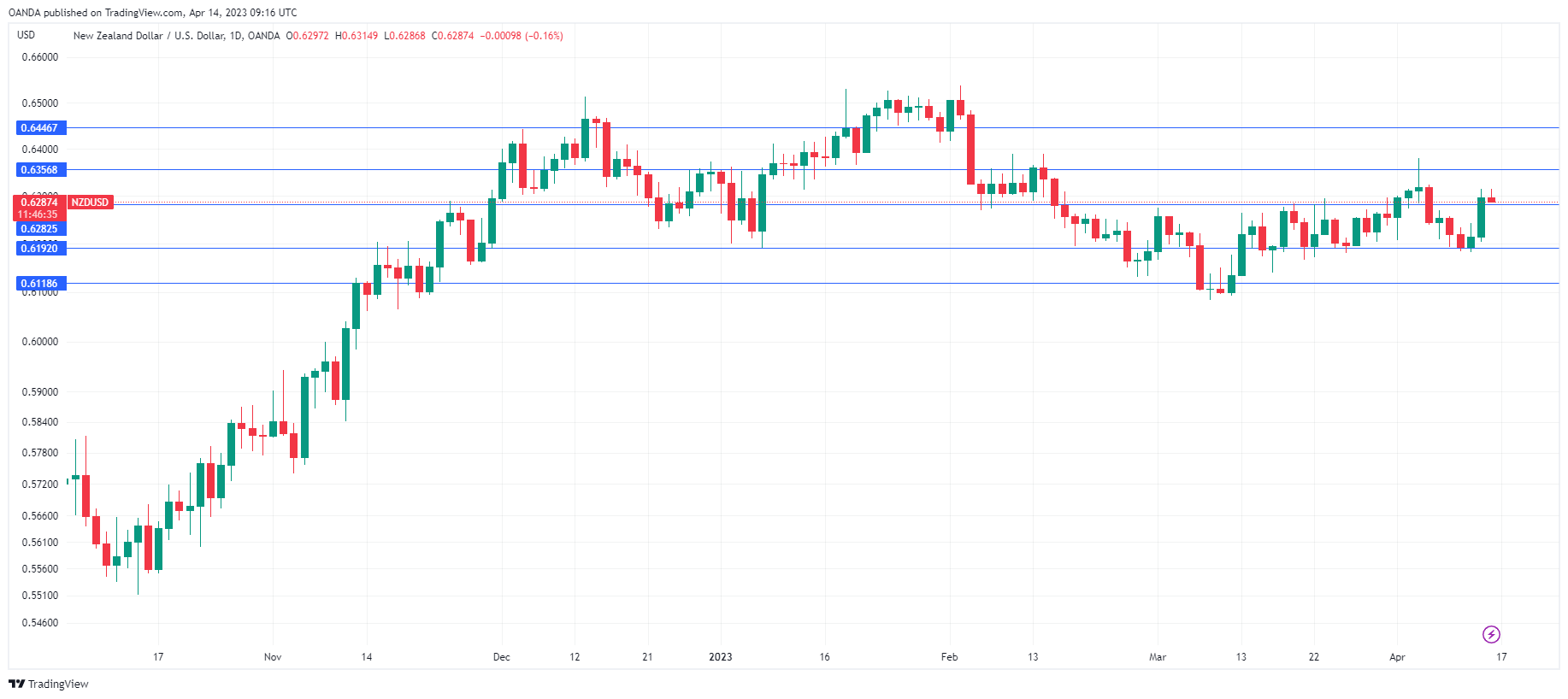
- NZD/USD is putting pressure on support at 0.6282. Below, there is support at 0.6192
- 0.6356 and 0.6446 are the next resistance lines
EUR/GBP Daily Outlook
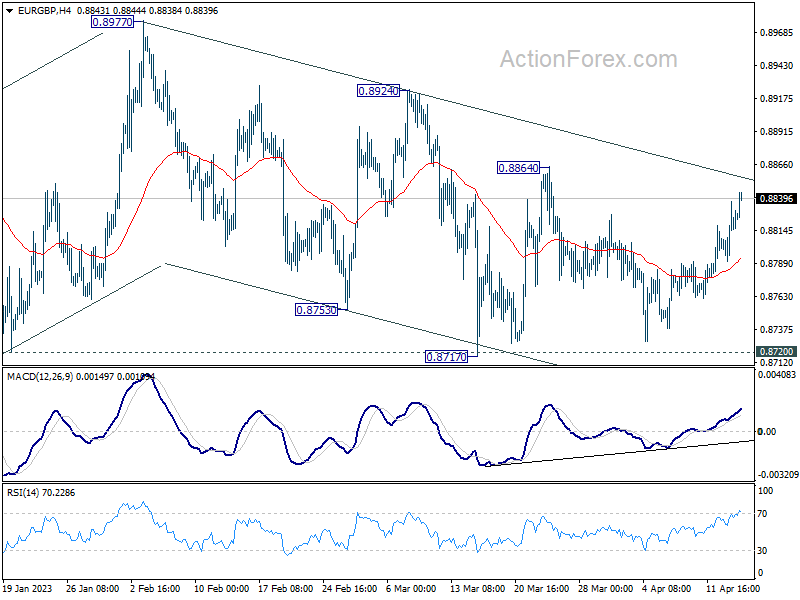
Daily Pivots: (S1) 0.8796; (P) 0.8817; (R1) 0.8843; More...
Intraday bias in EUR/GBP stays neutral first as it's staying below 0.8864 resistance despite current recovery. On the upside, break of 0.8864 will target 0.8924 resistance first. Firm break there should resume larger rise from 0.8545 through 0.8977 high. However, decisive break of 0.8717 support will resume the decline from 0.8977 instead.
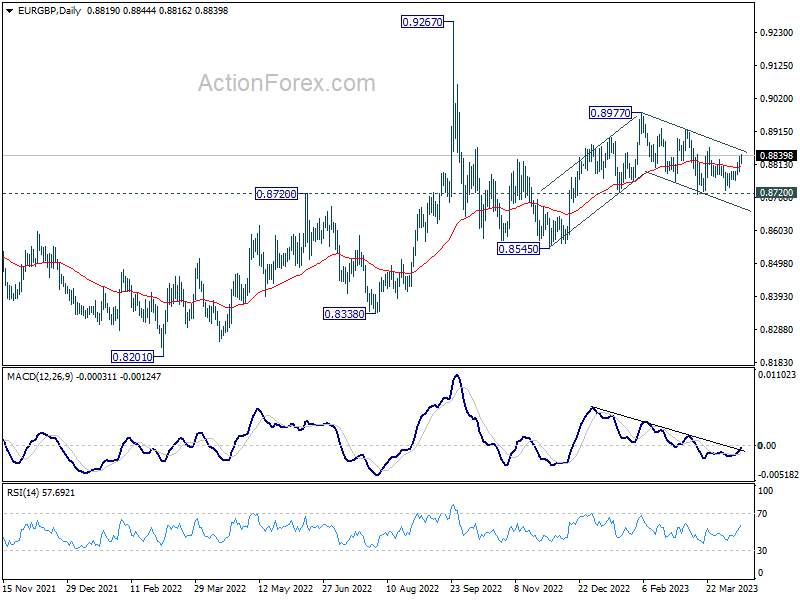
In the bigger picture, outlook remains rather mixed for now, except that price actions from 0.9267 (2022 high) are part of the long term range pattern from 0.9499 (2020 high). With 0.8720 support intact, rise from 0.8545 is in favor to continue through 0.8977. However, firm break of 0.8720 will argue that such rebound has completed, and open up deeper fall through this support level.
EUR/AUD Daily Outlook
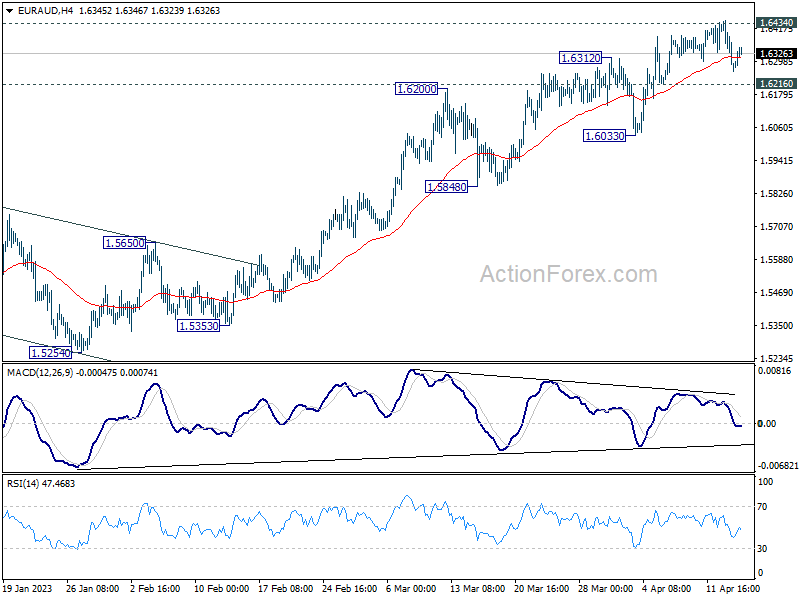
Daily Pivots: (S1) 1.6218; (P) 1.6332; (R1) 1.6399; More...
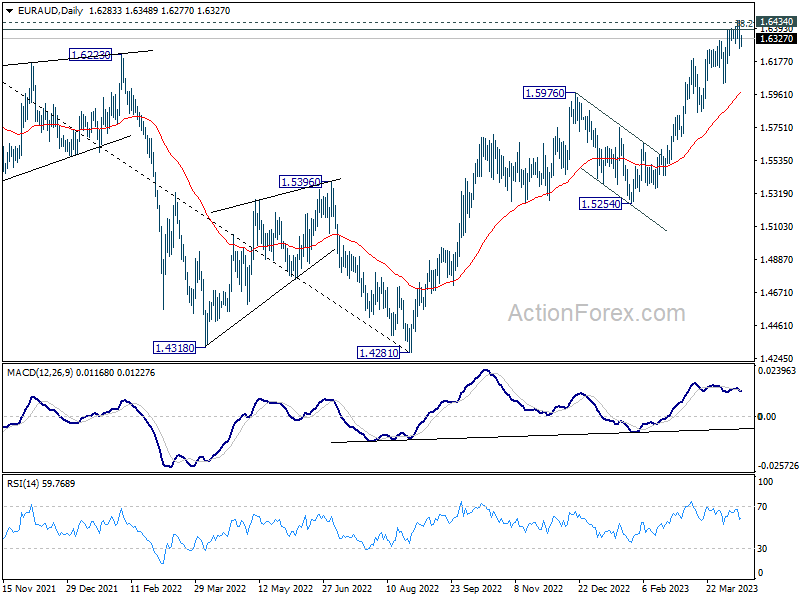
Intraday bias in EUR/AUD remains neutral and outlook is unchanged. Decisive break of 1.6434 resistance will carry larger bullish implications. Nevertheless, considering bearish divergence condition in 4H MACD, firm break of 1.6216 should confirm short term topping, after rejection by 1.6389/6434 cluster resistance zone. Intraday bias will be back on the downside in this case, to 1.6033 support and possibly below.
In the bigger picture, focus stays on 1.6389/6434 cluster resistance (38.2% retracement of 1.9799 to 1.4281 at 1.6389). Sustained break there should confirm that whole down trend from 1.9799 (2020 high) has completed. Further rally should then be seen to 61.8% retracement at 1.7691. However, rejection by this cluster resistance will make medium term outlook neutral at best.
EUR/JPY Daily Outlook
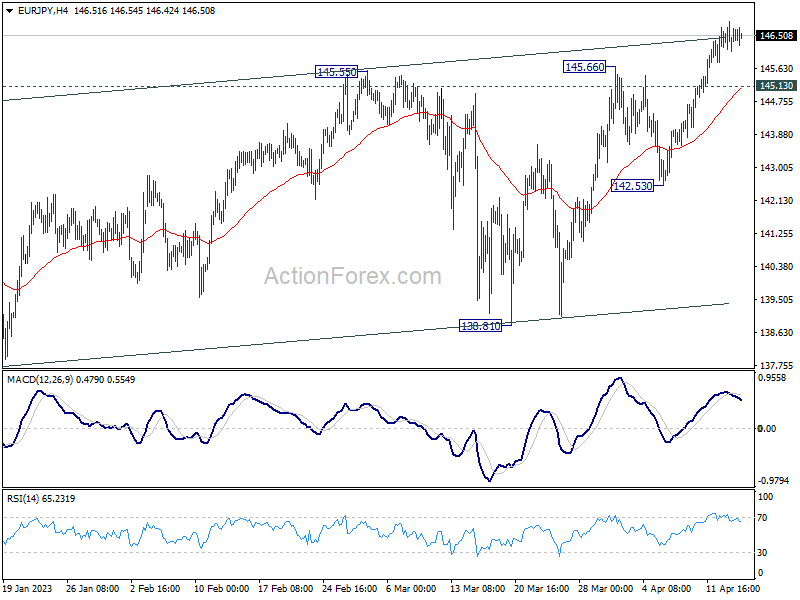
Daily Pivots: (S1) 146.07; (P) 146.48; (R1) 146.87; More....
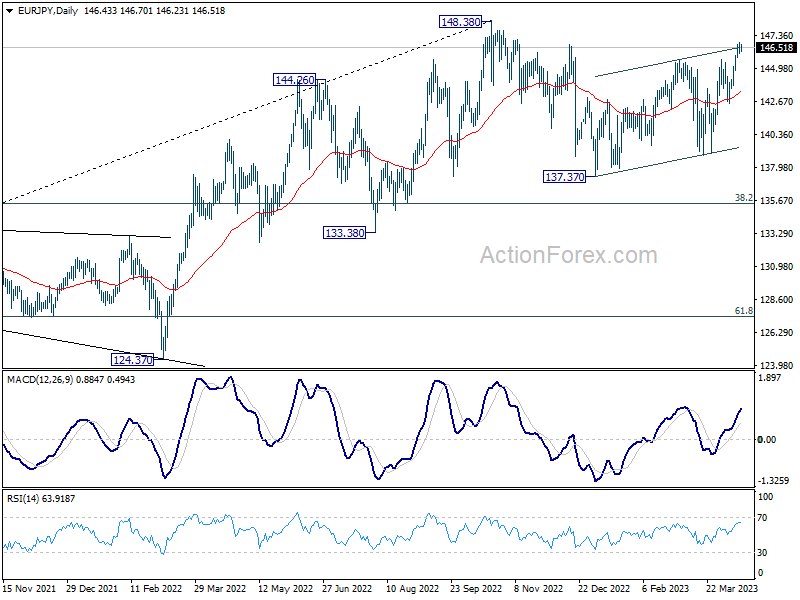
No change in EUR/JPY's outlook and intraday bias stays on the upside. Current rise from 137.37 is in progress and further further rally should be seen back to retest 148.38 high. On the downside, below 145.13 minor support will turn intraday bias neutral. But outlook will stay cautiously bullish as long as 142.53 support holds, in case of retreat.
In the bigger picture, as long as 55 week EMA (now at 139.78) holds, larger up trend from 114.42 (2020 low) is still in progress for 149.76 long term resistance. However, sustained break of 55 week EMA will bring deeper fall to 38.2% retracement of 114.42 to 148.38 at 135.40. Decisive break there will raise the chance of trend reversal, and target 61.8% retracement at 127.39.
GBP/JPY Daily Outlook
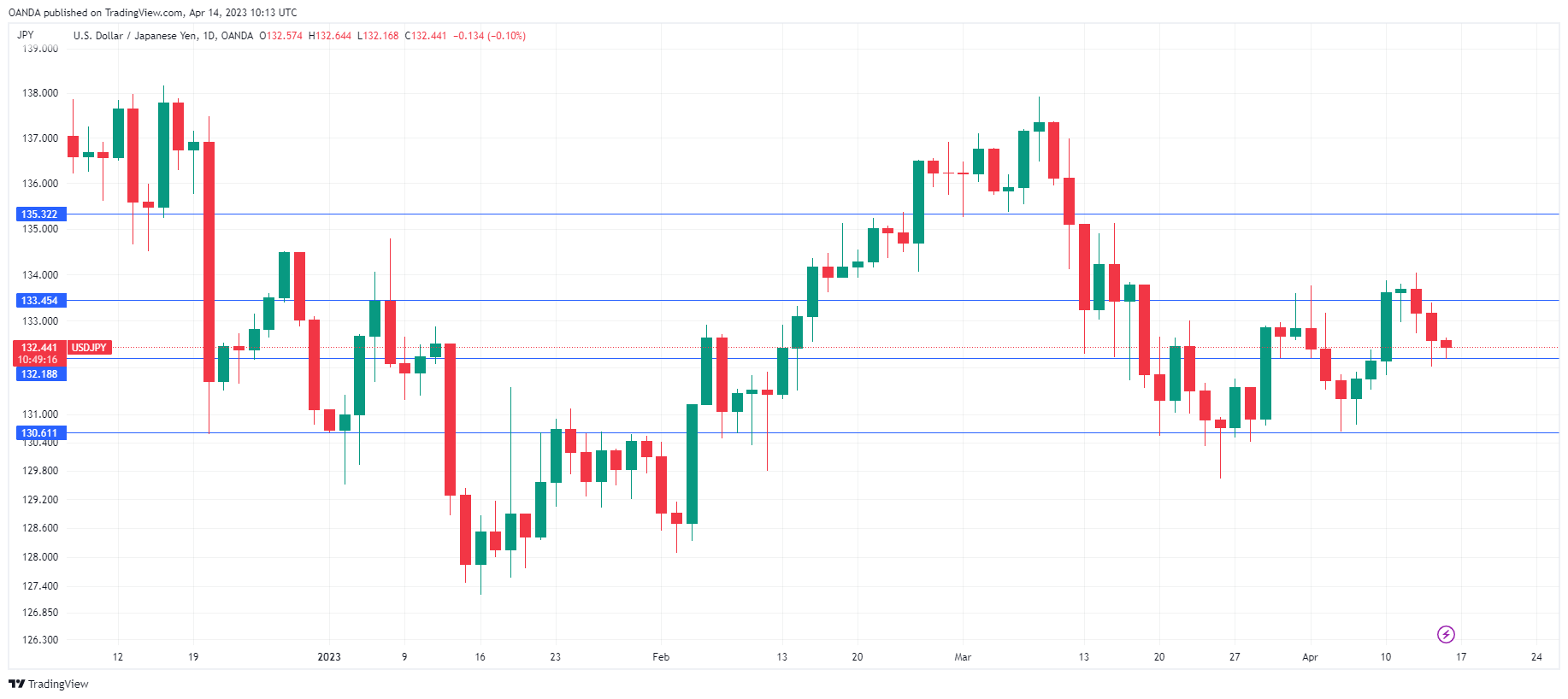
Daily Pivots: (S1) 165.35; (P) 166.09; (R1) 166.77; More...
Intraday bias in GBP/JPY is turned neutral with current retreat and some consolidations could be seen. But outlook will stay cautiously bullish as long as 162.75 support holds. Above 166.82 will resume the larger rebound form 155.33 to 169.26 resistance next.
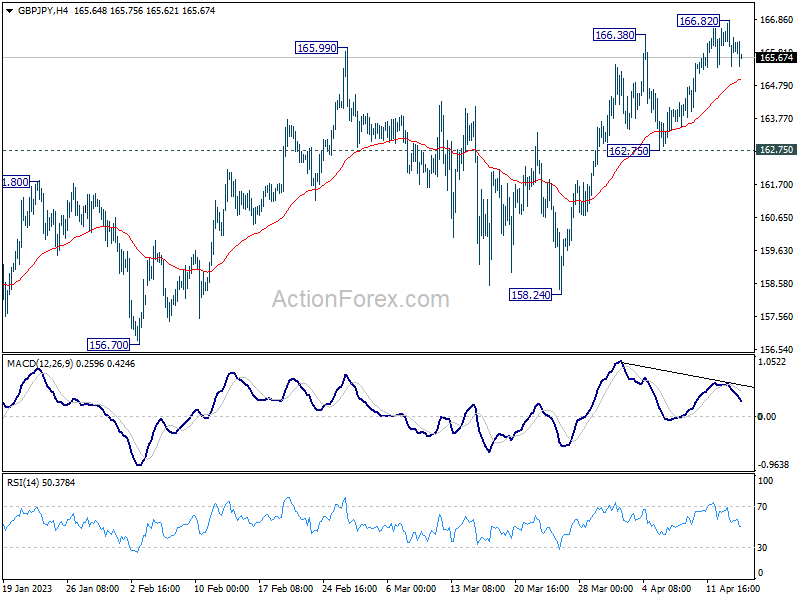
In the bigger picture, as long as 38.2% retracement of 123.94 (2020 low) to 172.11 (2022 high) at 153.70 holds, medium term bullishness is retained. That is, larger up trend from 123.94 (2020 low) is still in progress. Break of 172.11 high to resume such up trend is expected at a later stage.