

Sample Category Title
USD/CHF Mid-Day Outlook
Daily Pivots: (S1) 0.8845; (P) 0.8910; (R1) 0.8960; More...
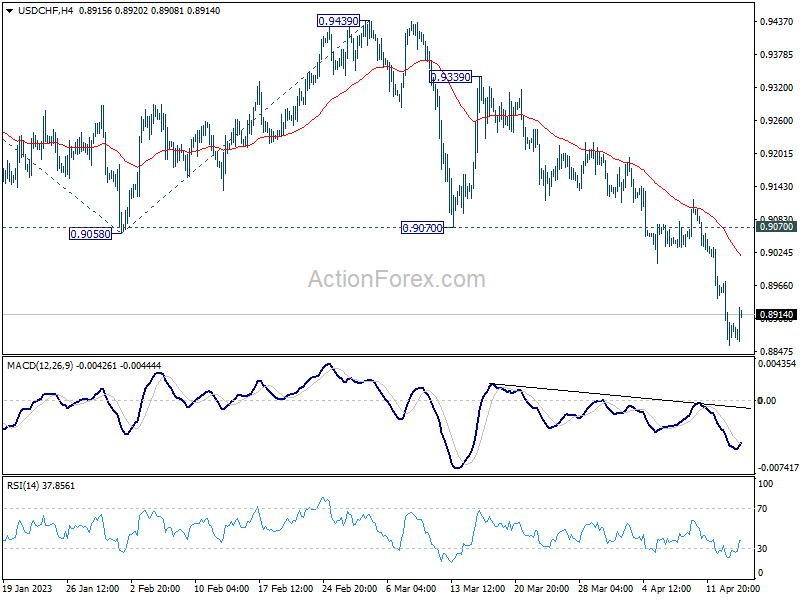
Intraday bias in USD/CHF is turned neutral with 4 hour MACD crossed above signal line. Deeper decline could still be seen to 61.8% projection of 1.0146 to 0.9058 from 0.9439 at 0.8767, which is close to 0.8756 long term support. Strong support is expected there to bring rebound, at least on first attempt. Break of 0.9070 support turned resistance will confirm short term bottoming and turn bias back to the upside.
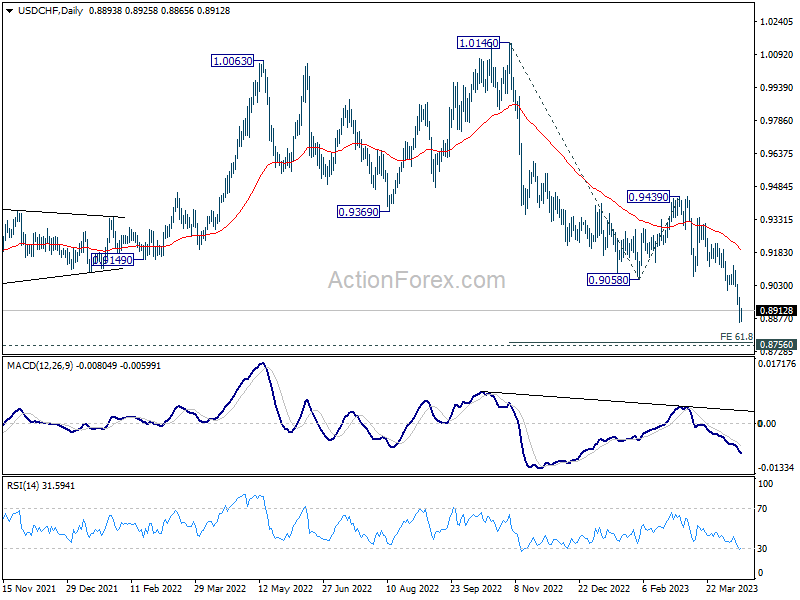
In the bigger picture, fall from 1.1046 (2022 high) is in progress for 0.8756 support (2021 low). But overall, this fall is still as a leg in the long term range pattern from 1.0342 (2016 high). So, downside should be contained by 0.8756 to bring reversal. Sustained break of 0.9058 support turned resistance will be the first sign of medium term bottoming. However, decisive break of 0.8756 will carry larger bearish implications.
USD/JPY Mid-Day Outlook
Daily Pivots: (S1) 131.94; (P) 132.66; (R1) 133.31; More...
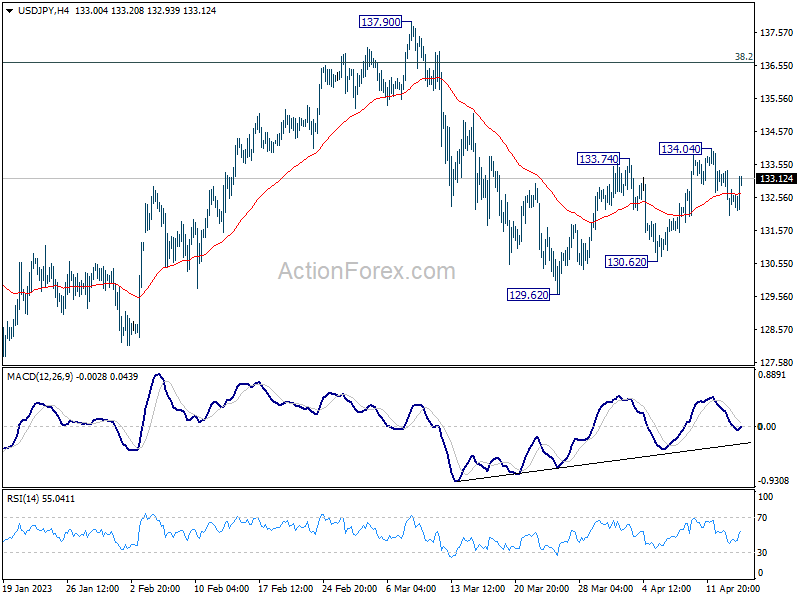
Intraday bias in USD/JPY remains neutral for the moment as sideway trading continues. On the upside, break of 134.04 will resume the rebound from 129.62 towards 137.90 resistance again. On the downside, break of 130.62 should resume the fall from 137.90 through 129.62 to retest 127.20 low.
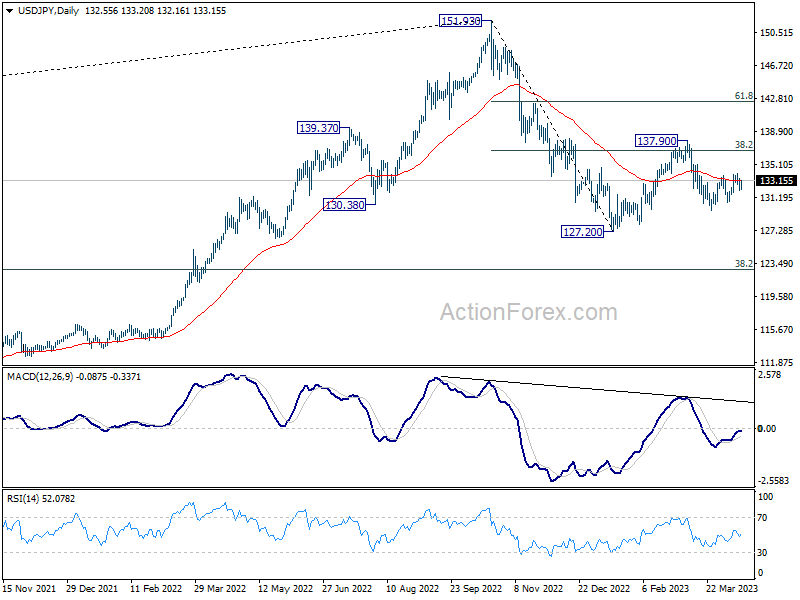
In the bigger picture, corrective pattern from 127.20 might be extending. But after all, down trend from 151.93 is expected to resume at a later stage. Break of 127.20 will resume this down trend and target 61.8% projection of 151.93 to 127.20 from 137.90 at 122.61. This will now be the favored case as long as 137.90 resistance holds.
EUR/USD Mid-Day Outlook
Daily Pivots: (S1) 1.0993; (P) 1.1031; (R1) 1.1084; More...
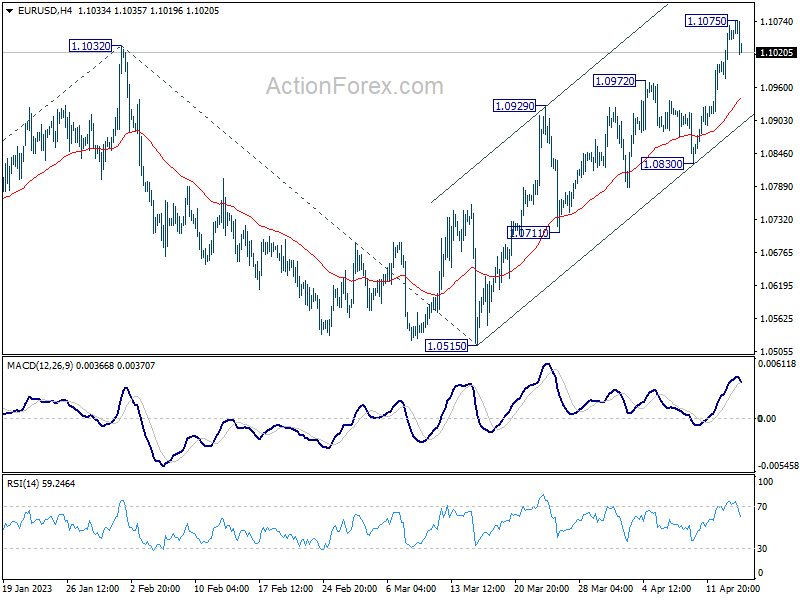
A temporary top is formed at 1.1075 in EUR/USD with current retreat and intraday bias is turned neutral first. Some consolidations could be seen but outlook will stay bullish as long as 1.0830 support holds. Above 1.1075 will resume larger up trend to 1.1273 fibonacci level. Break there will target 61.8% projection of 0.9534 to 1.1032 from 1.0515 at 1.1441.
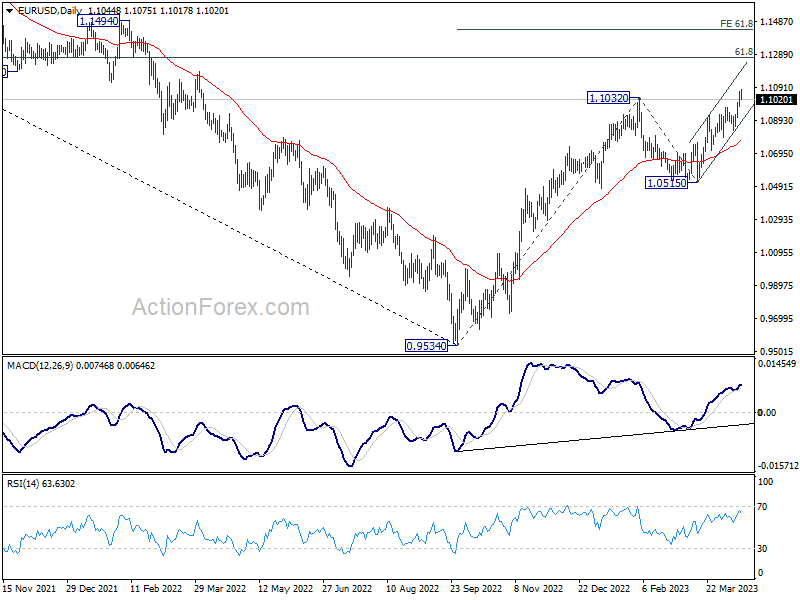
In the bigger picture, rise from 0.9534 (2022 low) is in progress for 61.8% retracement of 1.2348 (2021 high) to 0.9534 at 1.1273. Sustained break there will solidify the case of bullish trend reversal and target 1.2348 resistance next (2021 high). This will now remain the favored case as long as 1.0515 support holds, even in case of deeper pull back.
US: Retail Sales Fall Sharply in March, Recording a Second Consecutive Month of Declines
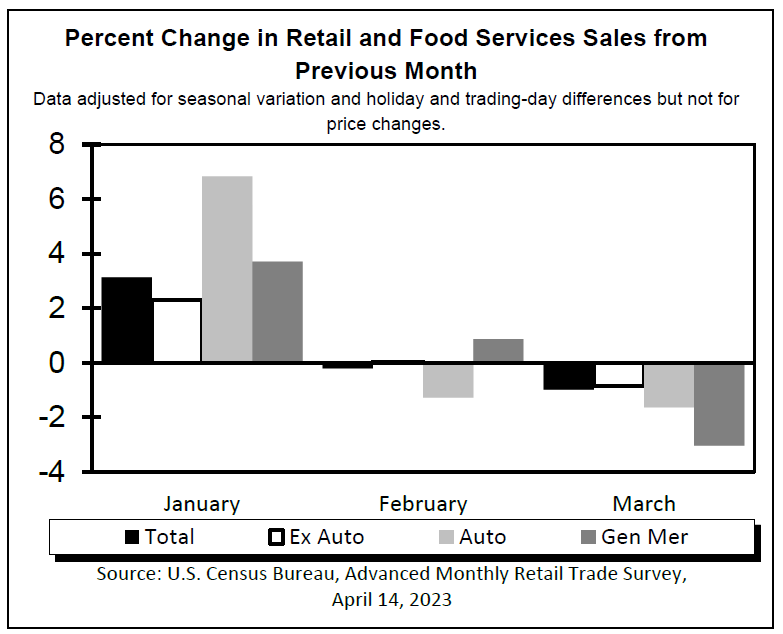
Retail sales fell 1.0% month-on-month (m/m) in March, much weaker than the consensus forecast calling for a more moderate pullback of 0.4% m/m. February's reading was revised up marginally to -0.2% (from -0.4%), making today's print just a tad less unfavorable.
Sales in the auto sector declined for the second consecutive month, largely driven by weak sales at motor vehicle sales (-1.5%) whose February's reading was revised up to -1.6% (from the previously reported -2.0% m/m). Sales at automotive parts & tire stores declined by 2.7% m/m. Excluding autos, retail sales were down by 0.8%.
Sales in other more volatile categories were also softer in March. The building materials and equipment category fell 2.1% m/m while sales at gasoline stations declined 5.5% m/m – in line with weaker gas prices.
Retail sales in the "control group", which excludes the above categories and is used to estimate personal consumption expenditures (PCE), fell by 0.3% m/m from an unrevised 0.5% m/m in February.
Most categories were in the red in March with the biggest declines coming from general merchandise stores (-3.0% m/m), clothing & accessory stores (-1.7% m/m) and furniture, electronics & appliance stores (-1.6% m/m).
Gains were reported at non-store retailers (+1.9% m/m), health & personal care stores (+0.3% m/m), sporting goods, hobby, book & music stores (+0.2% m/m), and miscellaneous store retailers (+0.2% m/m).
Food services & drinking places – the only services category in today's report – was up by 0.1% m/m in nominal terms, but after adjusting for inflation fell by 0.6% m/m.
Key Implications
As expected, spending continued to give back some of the gains from earlier in the quarter, after a solid start to the year. Accounting for revisions, nominal retail trade grew by 7% (annualized) in Q1 2023 and 3.1% when removing the effect of rising prices. Most of the gains came from sales at restaurants with the second biggest contribution coming from the auto sector where improvement in production helped fuel stronger sales. While auto sales will likely continue to tick higher given the build-up of pent-up demand, discretionary service spending is likely to soften over the coming months as the effect of higher interest rates starts to bare down on the economy. We expect consumer spending to slow from 4.2% in Q1 to a stall speed by Q2.
One factor that remains a wild card in our consumer spending outlook is credit tightening. Americans have already run down more than half of their cash reserves built up during the pandemic and started to finance more of their purchases with consumer credit, access to which tightened before the banking turmoil in March. Consumer lending at the most-exposed small- and medium-sized banks, which accounts for one quarter of consumer credit in the banking sector, stalled in March. The additional tightening of credit conditions may still weigh on consumer confidence, further affecting their spending behavior that's becoming increasingly more cautious.
GBP/USD Mid-Day Outlook
Daily Pivots: (S1) 1.2489; (P) 1.2513; (R1) 1.2547; More...
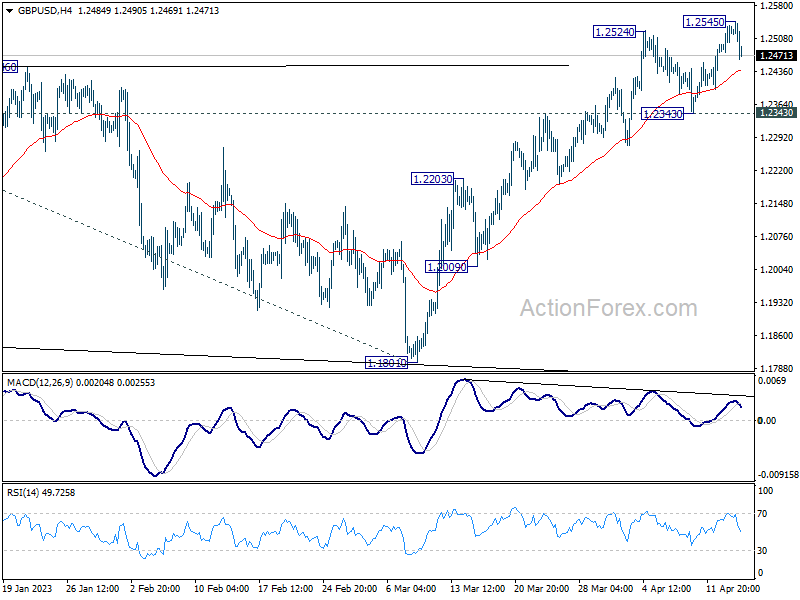
A temporary top is formed at 1.2545 with current retreat and intraday bias in GBP/USD is turned neutral first. Still, outlook will remain bullish as long as 1.2343 support holds. Above 1.2545 will target 1.2759 fibonacci level first. Firm break there will target 61.8% projection of 1.0351 to 1.2445 from 1.1801 at 1.3095.
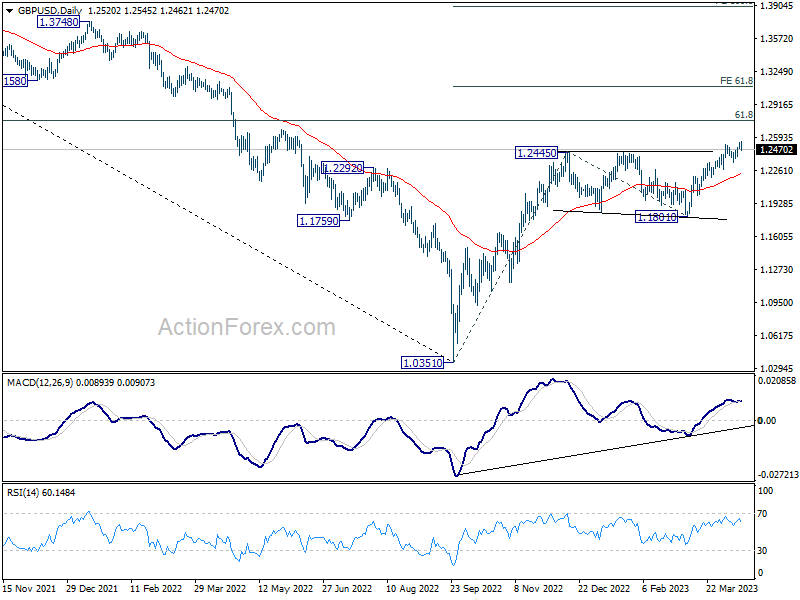
In the bigger picture, the rise from 1.0351 medium term term bottom (2022 low) is in progress for 61.8% retracement of 1.4248 (2021 high) to 1.0351 at 1.2759. Sustained break there will add to the case of long term bullish trend reversal. Further break of 61.8% projection of 1.0351 to 1.2445 from 1.1801 at 1.3095 could prompt upside acceleration to 100% projection at 1.3895. For now, this will remain the favored case as long as 1.1801 support holds, even in case of deep pull back.
Dollar Attempts Recovery After Poor Retail Sales, But No Bottoming Confirmed
Dollar is attempting to rebound in early trading sessions, as market sentiment is shaken by disappointing US retail sales data. Furthermore, a top Fed official has cautioned that interest rates could remain high for a more extended period than previously anticipated by the market. Nevertheless, the greenback continues to be one of the week's worst performers, alongside the Japanese yen. On the other end of the spectrum, Swiss Franc remains the top performer, now followed by Canadian Dollar and the Australian Dollar.
From a technical standpoint, it is too early to declare that the dollar has reached its bottom despite today's recovery. At a minimum, EUR/USD would have to breach the 1.0972 resistance-turned-support level. In addition, USD/CHF would need to break through the 0.8973 resistance level to signal that a more robust recovery is underway. Otherwise, risk will remain on the downside, and selling pressure could resurface at any moment.
In Europe, at the time of writing, FTSE is up 0.61%. DAX is up 0.48%. CAC is up 0.44%. Germany 10-year yield is up 0.026 at 2.401. Earlier in Asia, Nikkei rose 1.20%. Hong Kong HSI rose 0.46%. China Shanghai SSE rose 0.60%. Singapore Strait Times rose 0.25%. Japan 10-year JGB yield dropped -0.0041 to 0.461.
US retail sales down -1% mom in Mar, ex-auto sales down -0.8% mom
US retail sales contracted -1.0% mom to USD 691.7B in March, worse than expectation of -0.5% mom. Total sales for January through March period were up 5.4% from the same period a year ago.
For the month, ex-auto sales dropped -0.8% mom to USD 562.9B, below expectation of -0.4% mom. Ex-gasoline sales decreased -0.6% mom to USD 636.5B. Ex-auto and gasoline sales declined -0.3% mom to USD 507.6B.
Fed's Waller: Not much progress on inflation, my job is not done
In a speech, Fed Governor Christopher Waller expressed concern over the persistently high inflation rates and emphasized the need for the continuation of tighter monetary policies.
Waller stated, "Whether you measure inflation using the CPI or the Fed's preferred measure of personal consumption expenditures, it is still much too high and so my job is not done."
"I interpret these data as indicating that we haven't made much progress on our inflation goal, which leaves me at about the same place on the economic outlook that I was at the last FOMC meeting, and on the same path for monetary policy," he added.
His outlook remains consistent with the stance from the last FOMC meeting, indicating a steadfast commitment to tightening monetary policy. He emphasized that "the labor market continues to be strong and quite tight, and inflation is far above target, so monetary policy needs to be tightened further."
The Fed Governor also emphasized that, given the current circumstances, "monetary policy will need to remain tight for a substantial period of time, and longer than markets anticipate."
Fed Bostic: Recent data consistent with one more rate hike
In a recent interview with Reuters, Atlanta Fed President Raphael Bostic discussed the implications of this week's slowing consumer price increases and falling producer price inflation. According to Bostic, these developments are in line with the possibility of one more rate hike, as momentum suggests a trajectory towards 2% inflation.
Bostic expressed that the aggressive rate increases over the past year are just beginning to "bite" the economy, justifying a pause after one more rate increase. This pause would allow for an assessment of the economy and inflation's progression while aiming to minimize the impact on growth and employment.
Despite the current economic landscape, Bostic remains optimistic, believing that unemployment won't need to surpass 4% and that the economy can continue to grow, albeit at a slower pace. He attributes the persistent consumer demand and robust hiring to the economic distortions caused by the trillions of dollars in government support provided during the COVID-19 pandemic.
ECB's Lagarde expects inflation to continue falling with receding price pressures
In a speech, ECB President Christine Lagarde anticipates Eurozone inflation to continue falling as lagged price pressures recede and tighter monetary policy increasingly affects demand. However, she notes that historically high wage growth, driven by tight labor markets and compensation for high inflation, will support core inflation over the projection horizon, as it gradually returns to rates around the ECB's target.
Lagarde admits that this outlook is shrouded in uncertainty, with both upside and downside risks. She states, "Stronger than expected pipeline pressures or higher than anticipated increases in wages or profits could drive up inflation, while financial market tensions and falling energy prices could lead to faster disinflation."
ECB staff projections predict that Eurozone economy will recover in the coming quarters, driven by a strong labor market, resolved supply bottlenecks, and moderating inflation. Nevertheless, Lagarde acknowledges that risks to the growth outlook lean towards the downside, with persistently elevated financial market tensions potentially dampening confidence and tightening broader credit conditions more than anticipated. Russia's ongoing war against Ukraine remains a significant downside risk to the economy, potentially raising energy and food costs once more.
BoJ Ueda foresees core inflation slowing, reiterates commitment to ultra-loose monetary policy
BoJ Governor Kazuo Ueda, who recently attended the G20 finance leaders' meeting in Washington, expects core consumer inflation in Japan, currently around 3%, to slow below 2% by the latter half of this fiscal year. Ueda emphasized the central bank's commitment to maintaining ultra-loose monetary policy in order to achieve its 2% inflation target in a stable and sustainable manner.
Ueda believes that "as our base scenario is for global growth to pick up after a period of slowdown, Japan's wages will likely keep rising." He added that the BoJ's forecasts already factor in the possibility of a global economic slowdown, but a severe global recession is not considered in the baseline projection.
As for the upcoming April policy meeting, Ueda said, "It's been just a week since I took office and now I am on a business trip. I'll think about it closely once I'm back." Market participants are closely watching the BoJ's first policy meeting under Ueda's leadership on April 27-28, where the board will release fresh quarterly growth and inflation forecasts extending through fiscal 2025.
NZ BNZ manufacturing dropped to 48.1, sector faces headwinds
New Zealand's BusinessNZ Performance of Manufacturing Index fell from 51.7 in February to 48.1 in March, slipping back into negative territory after briefly reaching positive levels in January and February. The decline in the index signals challenges for the manufacturing sector.
A closer look at the data reveals that production dropped from 48.7 to 43.3, its lowest level since August 2021. Employment shrank from 55.2 to 47.1, while new orders dipped from 51.5 to 46.7, matching November 2022 levels. Finished stocks decreased from 55.1 to 48.4, and deliveries rose slightly from 52.2 to 53.8.
Catherine Beard, BusinessNZ's Director of Advocacy, pointed out that the numbers behind the main March result indicate the manufacturing sector is facing significant headwinds. BNZ Senior Economist Craig Ebert added that although New Zealand's March PMI was disappointing, it was "not especially negative in the longer-term context" and was in line with global manufacturing readings.
GBP/USD Mid-Day Outlook
Daily Pivots: (S1) 1.2489; (P) 1.2513; (R1) 1.2547; More...
A temporary top is formed at 1.2545 with current retreat and intraday bias in GBP/USD is turned neutral first. Still, outlook will remain bullish as long as 1.2343 support holds. Above 1.2545 will target 1.2759 fibonacci level first. Firm break there will target 61.8% projection of 1.0351 to 1.2445 from 1.1801 at 1.3095.
In the bigger picture, the rise from 1.0351 medium term term bottom (2022 low) is in progress for 61.8% retracement of 1.4248 (2021 high) to 1.0351 at 1.2759. Sustained break there will add to the case of long term bullish trend reversal. Further break of 61.8% projection of 1.0351 to 1.2445 from 1.1801 at 1.3095 could prompt upside acceleration to 100% projection at 1.3895. For now, this will remain the favored case as long as 1.1801 support holds, even in case of deep pull back.
Economic Indicators Update
| GMT | Ccy | Events | Actual | Forecast | Previous | Revised |
|---|---|---|---|---|---|---|
| 22:30 | NZD | Business NZ PMI Mar | 48.1 | 51 | 52 | |
| 06:30 | CHF | Producer and Import Prices M/M Mar | 0.20% | -0.20% | -0.20% | |
| 06:30 | CHF | Producer and Import Prices Y/Y Mar | 2.10% | 2.70% | 2.70% | |
| 12:30 | CAD | Manufacturing Sales M/M Feb | -3.60% | -2.50% | 4.10% | |
| 12:30 | USD | Retail Sales M/M Mar | -1.00% | -0.50% | -0.40% | |
| 12:30 | USD | Retail Sales ex Autos M/M Mar | -0.80% | -0.40% | -0.10% | |
| 12:30 | USD | Import Price Index M/M Mar | -0.60% | -0.20% | -0.10% | |
| 13:15 | USD | Industrial Production M/M Mar | 0.4% | 0.20% | 0.00% | 0.2% |
| 14:00 | USD | Michigan Consumer Sentiment Index Apr P | 62.7 | 62 | ||
| 14:00 | USD | Business Inventories Feb | 0.20% | -0.10% |
Fed’s Waller: Not much progress on inflation, my job is not done
In a speech, Fed Governor Christopher Waller expressed concern over the persistently high inflation rates and emphasized the need for the continuation of tighter monetary policies.
Waller stated, "Whether you measure inflation using the CPI or the Fed's preferred measure of personal consumption expenditures, it is still much too high and so my job is not done."
"I interpret these data as indicating that we haven't made much progress on our inflation goal, which leaves me at about the same place on the economic outlook that I was at the last FOMC meeting, and on the same path for monetary policy," he added.
His outlook remains consistent with the stance from the last FOMC meeting, indicating a steadfast commitment to tightening monetary policy. He emphasized that "the labor market continues to be strong and quite tight, and inflation is far above target, so monetary policy needs to be tightened further."
The Fed Governor also emphasized that, given the current circumstances, "monetary policy will need to remain tight for a substantial period of time, and longer than markets anticipate."
US retail sales down -1% mom in Mar, ex-auto sales down -0.8% mom
US retail sales contracted -1.0% mom to USD 691.7B in March, worse than expectation of -0.5% mom. Total sales for January through March period were up 5.4% from the same period a year ago.
For the month, ex-auto sales dropped -0.8% mom to USD 562.9B, below expectation of -0.4% mom. Ex-gasoline sales decreased -0.6% mom to USD 636.5B. Ex-auto and gasoline sales declined -0.3% mom to USD 507.6B.
ECB’s Lagarde expects inflation to continue falling with receding price pressures
In a speech, ECB President Christine Lagarde anticipates Eurozone inflation to continue falling as lagged price pressures recede and tighter monetary policy increasingly affects demand. However, she notes that historically high wage growth, driven by tight labor markets and compensation for high inflation, will support core inflation over the projection horizon, as it gradually returns to rates around the ECB's target.
Lagarde admits that this outlook is shrouded in uncertainty, with both upside and downside risks. She states, "Stronger than expected pipeline pressures or higher than anticipated increases in wages or profits could drive up inflation, while financial market tensions and falling energy prices could lead to faster disinflation."
ECB staff projections predict that Eurozone economy will recover in the coming quarters, driven by a strong labor market, resolved supply bottlenecks, and moderating inflation. Nevertheless, Lagarde acknowledges that risks to the growth outlook lean towards the downside, with persistently elevated financial market tensions potentially dampening confidence and tightening broader credit conditions more than anticipated. Russia's ongoing war against Ukraine remains a significant downside risk to the economy, potentially raising energy and food costs once more.
Bitcoin At 30k; Can It Go Any Higher?
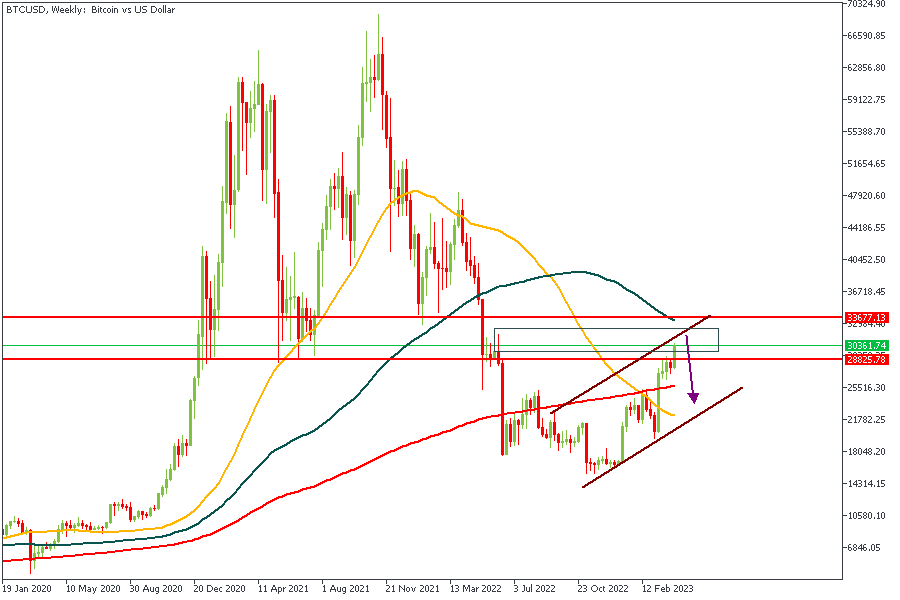
Hold on to your seats, folks! Bitcoin (BTC) is back with a vengeance, soaring past the $30 000 mark on April 11th, reaching its highest point since June 2022. And it's not just BTC - Ethereum (ETH) is also making gains, trading at $1917 and bagging 3.1% gains over the past day. But watch out for the Shanghai upgrade on April 12th, as it's expected to create some selling pressure on ETH and negatively impact its price. Still, with BTC and ETH up over 81% and 60% year-to-date, respectively, the crypto market is hotter than ever! In my article last week, I mentioned that the bulls might be back for Bitcoin, yet the lingering question is: how long can this move last?
BTCUSD - Weekly Timeframe
The bullish spring of Bitcoin prices has reached a key pivot zone that may serve as a resistance to push prices back down slightly. It is also worthy of note that the current price action is a consolidation move within a rising channel, with the trendline resistance overlapping with the pivot zone. Another important confluence is the presence of a drop-base-drop supply zone right inside the pivot zone. Suppose the consolidation holds without a significant break above the trendline resistance. In that case, we should see a retracement move on Bitcoin pretty soon - even though the overall trend is largely bullish.
Analysts’ Expectations:
- Direction: Bearish
- Target: $23,100
- Invalidation: $32,783
ETHUSD - Weekly Timeframe
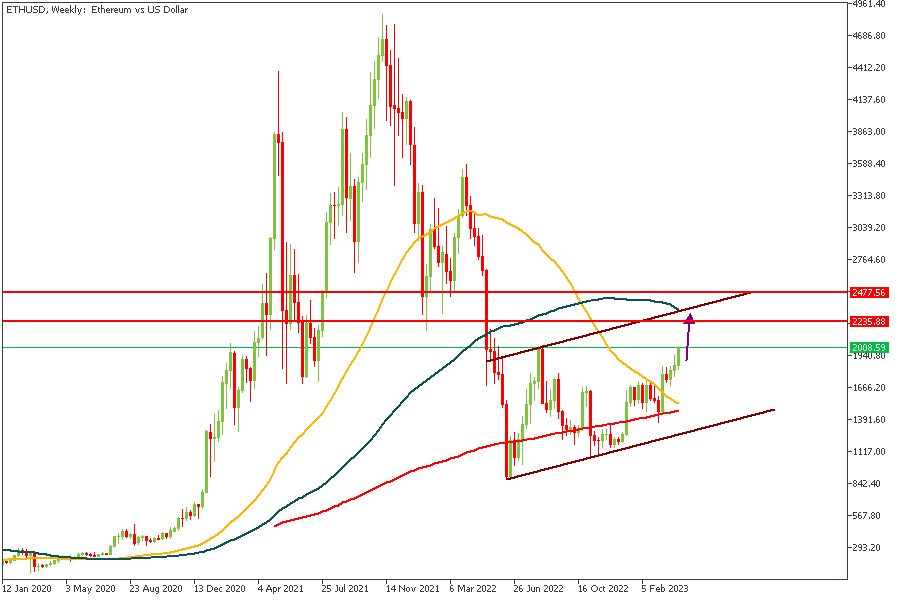
Similar to what we saw on the Bitcoin chart, Ethereum is also inching toward its pivot zone. However, with the resistance trendline of the rising channel price currently trading inside, the 100-Period Moving Average is another indicator of a bearish movement. Even though I expect the overall direction to be bullish, there's nothing wrong with having a few bearish correction movements along the way.
Analysts’ Expectations:
- Direction: Bearish
- Target: $1,613
- Invalidation: $2,505
CONCLUSION
The trading of CFDs comes at a risk. Thus, to succeed, you have to manage risks properly. To avoid costly mistakes while you look to trade these opportunities, be sure to do your due diligence and manage your risk appropriately.