Sample Category Title
USD/CHF Mid-Day Outlook
Daily Pivots: (S1) 0.9148; (P) 0.9185; (R1) 0.9234; More...
Outlook in USD/CHF is unchanged and intraday bias stays neutral as range trading continues. Corrective pattern from 0.9058 low is extending. Another rise cannot be ruled out, but upside should be limited by 0.9474 fibonacci level. On the downside, firm break of 0.9058 will resume larger down trend from 1.1046.
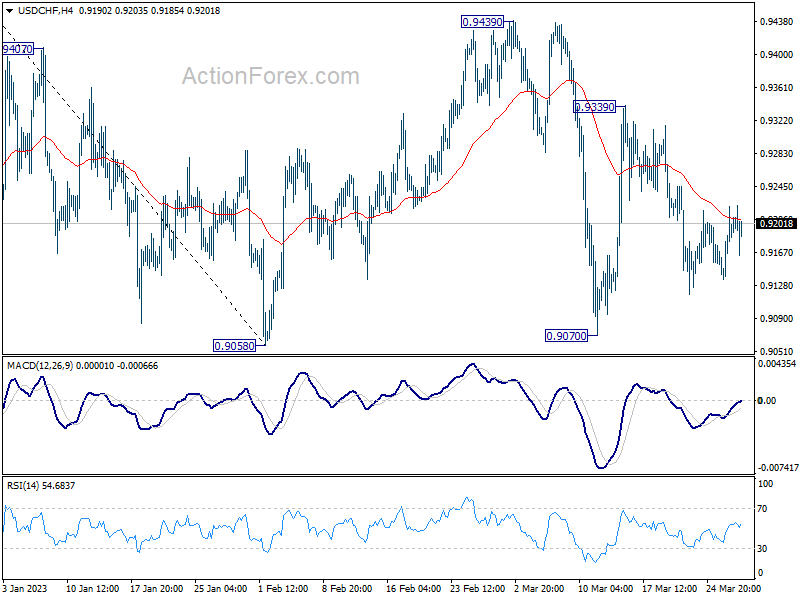
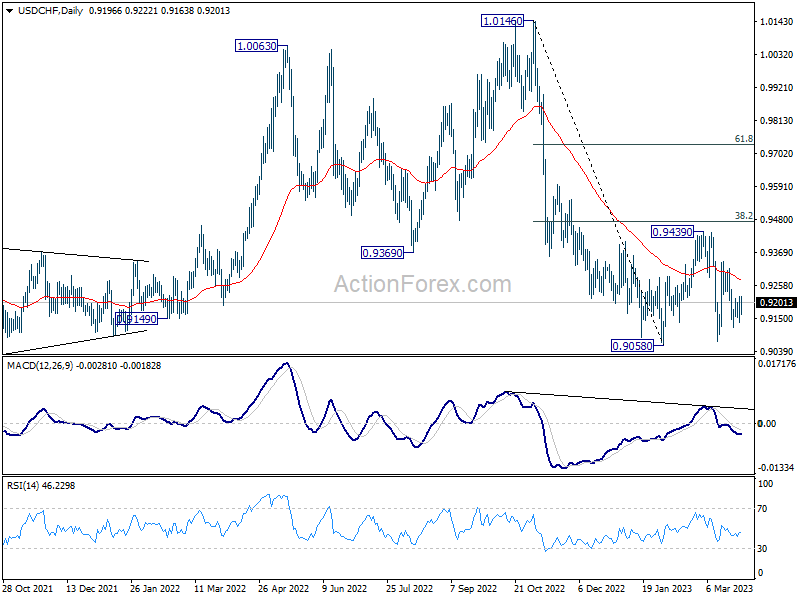
In the bigger picture, fall from 1.1046 (2022 high) should still be in progress with 38.2% retracement of 1.0146 to 0.9058 at 0.9474 intact. Prior rejection by 55 week EMA was a medium term bearish sign. Break of 0.9058 will resume such decline towards 0.8756 support (2021 low). But overall, this fall is still as a leg in the long term range pattern from 1.0342 (2016 high). So, downside should be contained by 0.8756 to bring reversal.
USD/JPY Mid-Day Outlook
Daily Pivots: (S1) 130.34; (P) 130.97; (R1) 131.54; More...
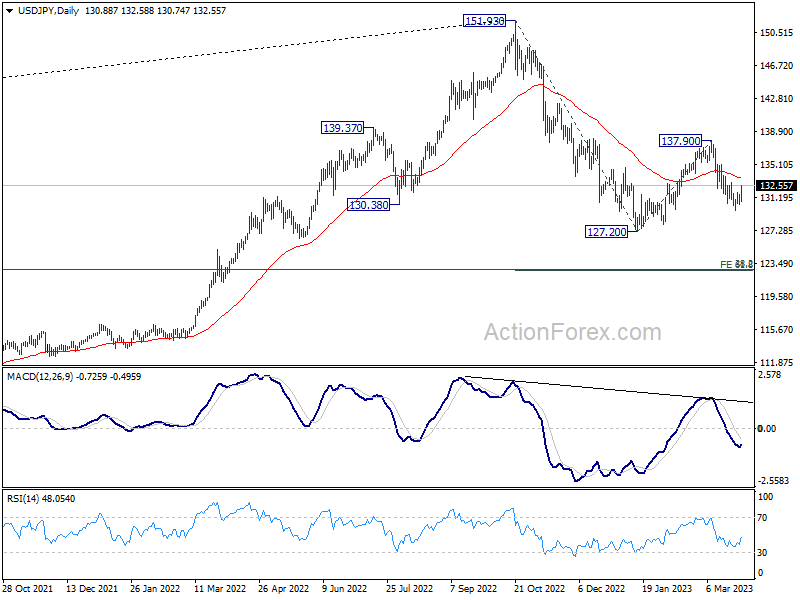
Intraday bias in USD/JPY stays neutral at this point. With 132.99 resistance intact, outlook remains bearish. On the downside, break of 129.62 will target a test on 127.20 low. Decisive break there will resume larger decline from 151.93 to 61.8% projection of 151.93 to 127.20 from 137.90 at 122.61. However, firm break of 132.99 will argue that fall from 137.90 has completed, and turn bias back to the upside for 137.90.
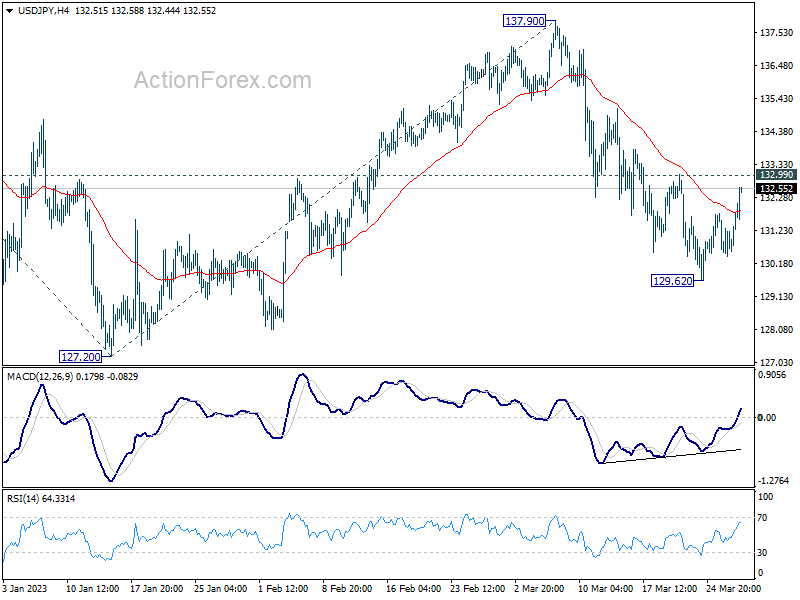
In the bigger picture, rebound from 127.20 should have completed at 137.90 as a corrective move. The down trend from 151.93 (2022 high) is still in progress. Break of 127.20 will resume this down trend and target 61.8% projection of 151.93 to 127.20 from 137.90 at 122.61. This will now be the favored case as long as 137.90 resistance holds.
GBP/JPY Mid-Day Outlook
Daily Pivots: (S1) 160.93; (P) 161.35; (R1) 161.97; More...
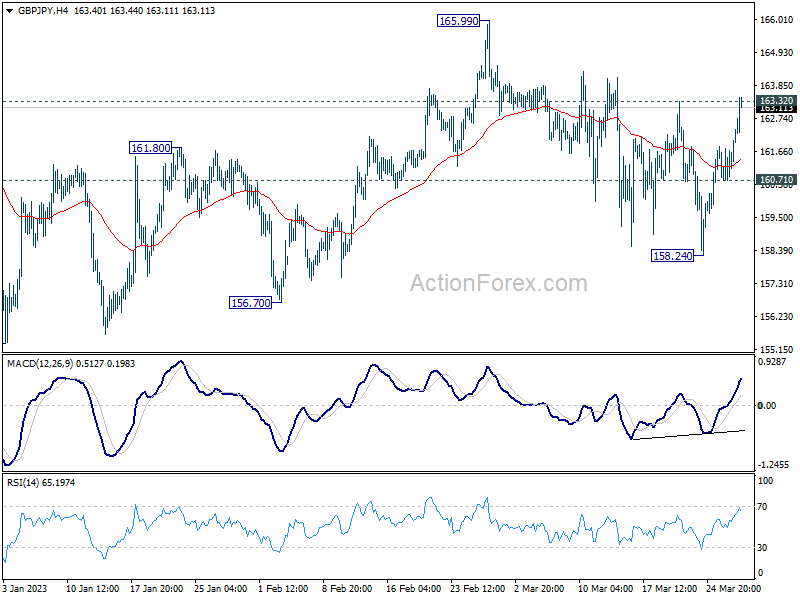
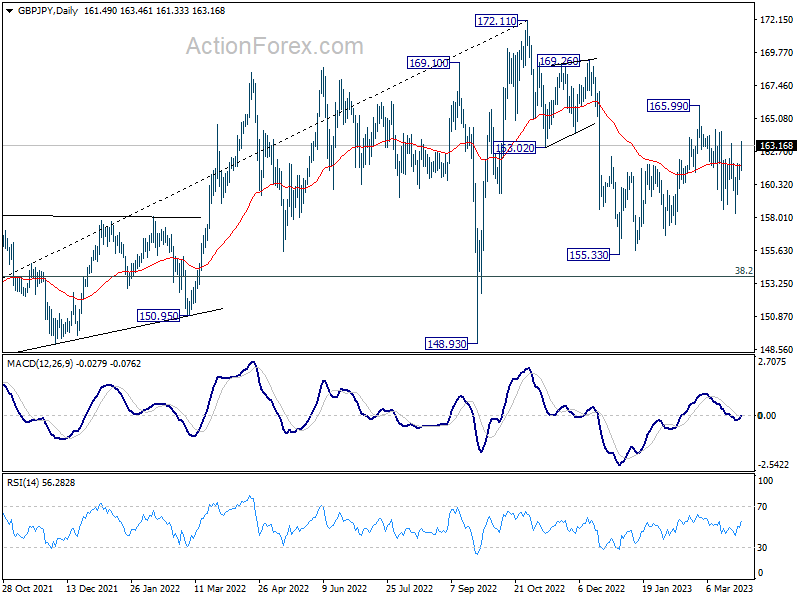
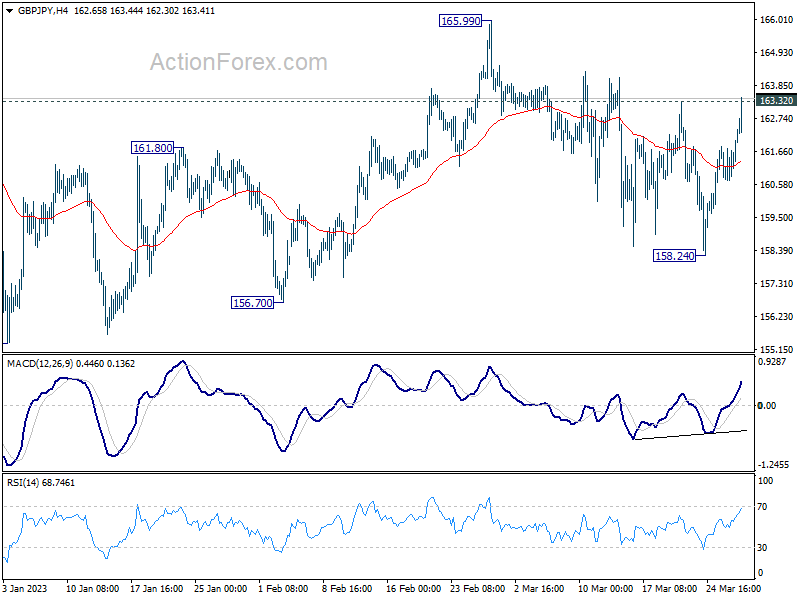
GBP/JPY's breach of 163.32 resistance argues that pull back from 165.99 has completed at 158.24. Intraday bias is back on the upside for 165.99. Break there will resume the whole rebound from 155.33 to 169.26 resistance. On the downside, however, break of 160.71 will mix up the outlook and turn intraday bias neutral.
In the bigger picture, as long as 38.2% retracement of 123.94 (2020 low) to 172.11 (2022 high) at 153.70 holds, medium term bullishness is retained. That is, larger up trend from 123.94 (2020 low) is still in progress. Break of 172.11 high to resume such up trend is expected at a later stage.
EUR/JPY Mid-Day Outlook
Daily Pivots: (S1) 141.30; (P) 141.73; (R1) 142.40; More....
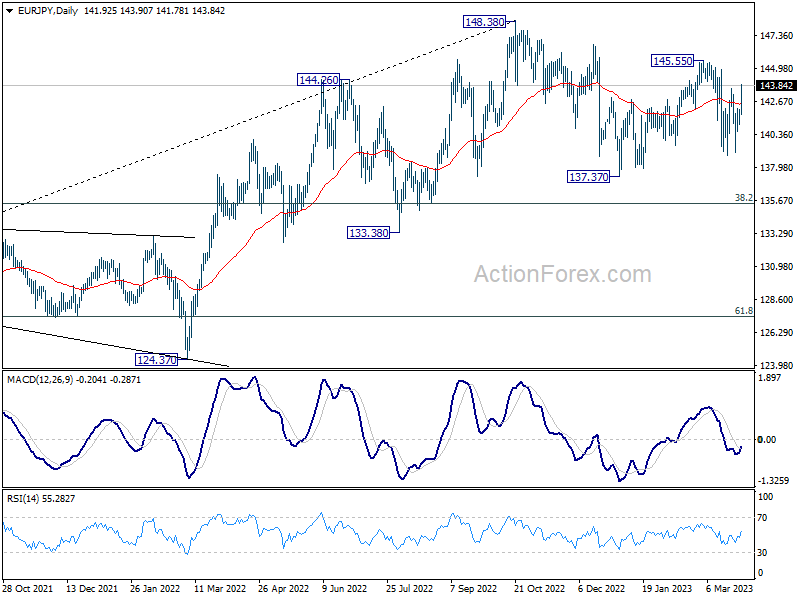
EUR/JPY's break of 143.61 resistance now argues that pull back form 15.55 has completed at 138.81 already. Intraday bias is back on the upside for 145.55 resistance first. Break there will resume the whole rebound from 137.37 and target a test on 148.38 high. On the downside, though, below 142.21 minor support will mix up the outlook again and turn intraday bias neutral.
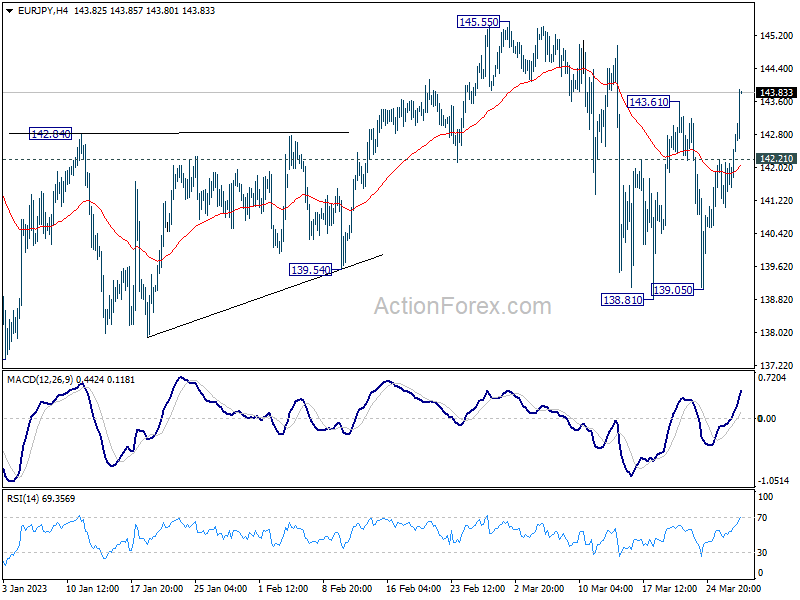
In the bigger picture, as long as 55 week EMA (now at 139.58) holds, larger up trend from 114.42 (2020 low) is still in progress for 149.76 long term resistance. However, sustained break of 55 week EMA will bring deeper fall to 38.2% retracement of 114.42 to 148.38 at 135.40. Decisive break there will raise the chance of trend reversal, and target 61.8% retracement at 127.39.
Euro Gains as ECB Official Signals More Rate Hikes Ahead, Yen Broadly Pressured
Euro is trading mildly higher today following indications from a key ECB official that more interest rate hikes are in the pipeline for the central bank. Concurrently, the improving market sentiment across Europe is lending support to both Sterling and the Swiss Franc. However, Canadian Dollar emerges as the strongest for the day, fueled by robust oil prices.
Conversely, Yen is facing widespread pressure as European benchmark treasury yields continue their rebound. Australian and New Zealand Dollars trail closely behind as the next weakest. Dollar's performance is mixed at the moment, but its recovery against Yen could potentially decelerate the greenback's decline elsewhere.
From a technical standpoint, EUR/JPY's break of the 143.61 resistance level suggests that the pullback from 145.55 has already concluded. Further gains are expected to retest 145.55, with a break there extending the rebound from 137.37. Attention is also focused on GBP/JPY, which is currently pressing 163.32. A break at that level would align the outlook with EUR/JPY and trigger a more substantial rise to 165.99. A firm break there would resume the overall rebound from 155.33.
In Europe, at the time of writing, FTSE is up 0.93%. DAX is up 0.90%. CAC is up 1.26%. Germany 10-year yield is up 0.035 at 2.321. Earlier in Asia, Nikkei rose 1.33%. Hong Kong HSI rose 2.06%. China Shanghai SSE dropped -0.16%. Singapore Strait Times rose 0.22%. Japan 10-year JGB yield dropped -0.077 to 0.307.
ECB Lane indicates more hikes needed to tame inflation
ECB Chief Economist Philip Lane, in an interview with German newspaper Die Zeit, emphasized the necessity for further interest rate hikes to ensure that inflation returns to the 2% target. Lane stated, "Under our baseline scenario, in order to make sure inflation comes down to 2%, more hikes will be needed."
He also suggested that even in cases of limited financial stress, interest rates would still need to rise. "If the financial stress we see is non-zero, but turns out to be still fairly limited, interest rates will still need to go up," he said.
Meanwhile, Lane expressed optimism about moderating price pressures at earlier stages of production, which are expected to eventually impact consumer prices. "If you look at the earlier stages of production, at the farm gate prices, at the prices of the food ingredients, you will recognize: all of these have turned around," he said.
The chief economist also dismissed the notion that a recession is required to bring inflation down, asserting that a soft landing for the economy is possible. Lane believes that the pandemic recovery can continue alongside decreasing inflation, as he noted, "We've lost so much growth momentum in the pandemic that it's possible for the pandemic recovery to continue and for inflation to come down simultaneously."
Germany Gfk consumer sentiment ticked up to -29.5, hindered by purchasing power concerns
Germany's GfK consumer sentiment index for April posted a modest improvement for the sixth consecutive month, rising from -30.6 to -29.5, although it fell short of the expected -29.0. In March, economic expectations for dipped from 6.0 to 3.7, while income expectations increased from -27.3 to -24.3. Propensity to buy also saw a slight uptick from -17.3 to -17.0.
GfK consumer expert Rolf Bürkl attributes the improved income expectations to the recent decline in energy prices, particularly for gas and heating oil. However, Bürkl cautions that inflation will remain elevated this year, albeit lower than the 6.9% recorded in 2022.
He explains, "The expected loss of purchasing power is preventing a sustained recovery in domestic demand. Accordingly, private consumption is unlikely to make a positive contribution to economic growth in Germany this year." This outlook is reinforced by the persistently low level of consumer sentiment.
Australia CPI slowed to 6.8% yoy, supports RBA pause next week
Australia's monthly CPI in February eased from 7.4% yoy to 6.8% yoy, below expectation of 7.2% yoy. CPI excluding volatile items such as fruit, vegetables, and automotive fuel also slowed from 7.5% yoy to 6.9% yoy.
Michelle Marquardt, Head of Prices Statistics at the Australian Bureau of Statistics (ABS), noted that "this marks the second consecutive month of lower annual inflation, also known as 'disinflation', from the peak of 8.4% in December 2022."
Although inflation remains well above RBA's target band of 2-3%, the start of disinflation process could increase the likelihood of a pause in the RBA's tightening cycle during their next meeting. The continued easing of inflationary pressures may prompt the central bank to take a more cautious approach in the near term.
Incoming BoJ Deputy Governor Uchida Stresses Importance of Trend Inflation in Monetary Policy
Incoming BoJ Deputy Governor Shinichi Uchida emphasized the significance of trend inflation in a parliamentary session today, stating that the central bank will conduct a comprehensive assessment of various data, including trend inflation developments, to guide monetary policy.
Uchida said that "trend inflation is an extremely important factor for us in judging on achievement of 2% inflation target in a stable manner." He also mentioned that the BoJ will "make comprehensive judgment by looking at various price indicators."
In addition, Uchida highlighted the importance of communication between the central bank and the markets, saying, "We will strive to communicate firmly with markets to gain understanding" regarding the BoJ's policy approach. This statement underscores the commitment of the BoJ to transparency and open dialogue in shaping its monetary policy.
EUR/JPY Mid-Day Outlook
Daily Pivots: (S1) 141.30; (P) 141.73; (R1) 142.40; More....
EUR/JPY's break of 143.61 resistance now argues that pull back form 15.55 has completed at 138.81 already. Intraday bias is back on the upside for 145.55 resistance first. Break there will resume the whole rebound from 137.37 and target a test on 148.38 high. On the downside, though, below 142.21 minor support will mix up the outlook again and turn intraday bias neutral.
In the bigger picture, as long as 55 week EMA (now at 139.58) holds, larger up trend from 114.42 (2020 low) is still in progress for 149.76 long term resistance. However, sustained break of 55 week EMA will bring deeper fall to 38.2% retracement of 114.42 to 148.38 at 135.40. Decisive break there will raise the chance of trend reversal, and target 61.8% retracement at 127.39.
Economic Indicators Update
| GMT | Ccy | Events | Actual | Forecast | Previous | Revised |
|---|---|---|---|---|---|---|
| 00:30 | AUD | Monthly CPI Y/Y Feb | 6.80% | 7.20% | 7.40% | |
| 06:00 | EUR | Germany Gfk Consumer Confidence Apr | -29.5 | -29 | -30.5 | -30.6 |
| 08:00 | CHF | Credit Suisse Economic Expectations Mar | -41.3 | -12.3 | ||
| 08:30 | GBP | Mortgage Approvals Feb | 44K | 42K | 40K | |
| 08:30 | GBP | M4 Money Supply M/M Feb | -0.40% | 0.90% | 1.30% | 1.20% |
| 13:00 | CHF | SNB Quarterly Bulletin | ||||
| 14:00 | USD | Pending Home Sales M/M Feb | -2.20% | 8.10% | ||
| 14:30 | USD | Crude Oil Inventories | 1.8M | 1.1M |
EUR/USD: Euro Extends Advance as Tensions in Banking Sector Continue to Ease
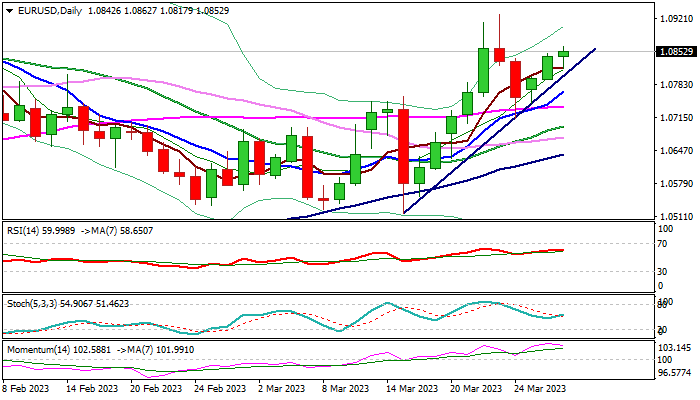
The Euro extends steep recovery into third straight day, lifted by renewed risk appetite on easing fears of deeper crisis in banking sector.
Strong bullish acceleration has so far retraced over 61.8% of last week’s sharp two-day pullback (1.0930/1.0713), contributing to signs of a healthy correction (contained by rising 10DMA) preceding fresh advance.
The daily chart structure remains firmly bullish (north-heading moving averages track the rise of price and form a multiple bull-crosses; positive momentum is strong) that keeps near-term focus shifted to the upside.
Also, no significant impact was seen from today’s daily cloud twist, which is usually magnetic, keeping fresh bulls so far unharmed.
Broken 50% retracement level (1.0821) is reinforced by 5DMA and marks solid support which should ideally keep the downside protected and maintain bullish bias for further gains.
Fibo level at 1.0878 (76.4% retracement of 1.0930/1.0713) marks immediate target, ahead of key near-term barriers at 1.0930 (Mar 23 peak) and 1.1000 (psychological).
Res: 1.0862; 1.0878; 1.0912; 1.0930.
Sup: 1.0821; 1.0796; 1.0757; 1.0737.
Best Trade Ideas for April
Hey guys! So, April is fast approaching, and there's already an array of over 30 high-impact news releases; that is, almost every single trading day! As a result, in order to be better positioned to 'milk' all of these volatile events in the market, here are a few trade ideas to consider.
Disclaimer: Now, I know we've had quite an amazing run these past few month, with over 78% accuracy in our trade ideas and sentiments, and thousands of pips in profits monthly, you must know I am not a 100% accurate AI. So, do not bet all your money on these ideas without proper risk management!
XAUUSD
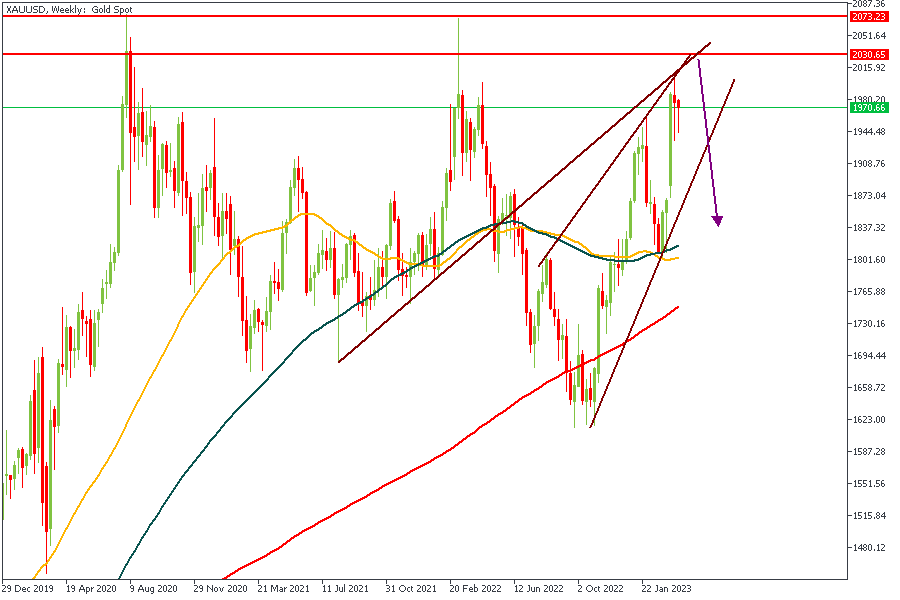
Here is our dear friend Gold, from the weekly timeframe. We can clearly see price confined within a rising wedge, and approaching a major area of resistance (a pivot zone). There is also a supply zone at the peak of the inducement candle (that previous rejection candle with the long wick). Based on the confluence of the two resistance trendlines, the supply zone, the pivot zone, and the 88% Fibonacci retracement level, I am quite confident of this playing out.
Analysts’ Expectations:
- Direction: Bearish
- Target: $1842
- Invalidation: $2074
NZDCAD
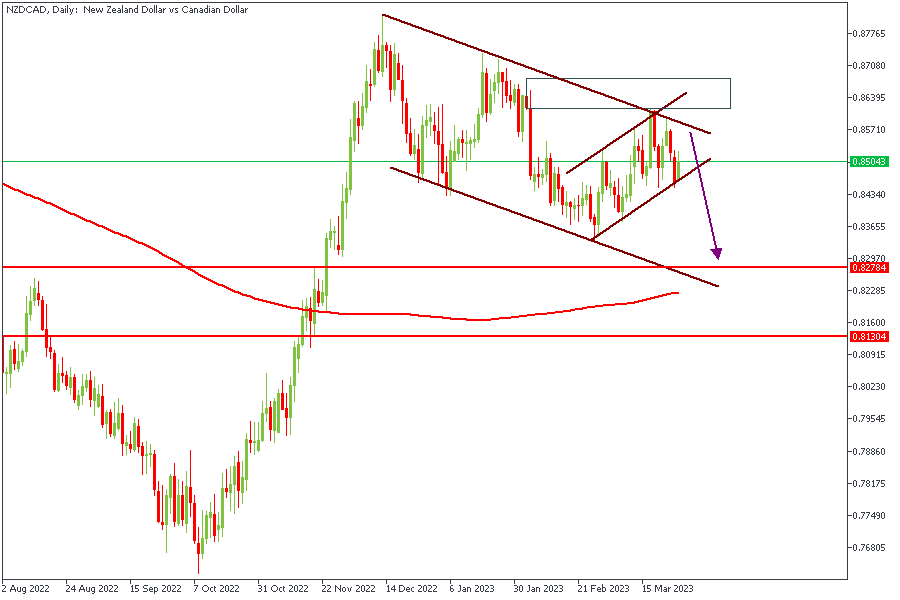
NZDCAD is currently trading within a rising channel that is inside a bigger descending channel, and has recently been rejected from the resistance trendline of the channel. I expect price to head into the supply zone once more for a confirmed bearish push. Once price breaks through the support trendline, it would sail very quickly towards the 200-Day MA.
Analysts’ Expectations:
- Direction: Bearish
- Target: 0.83000
- Invalidation: 0.85800
EURNZD
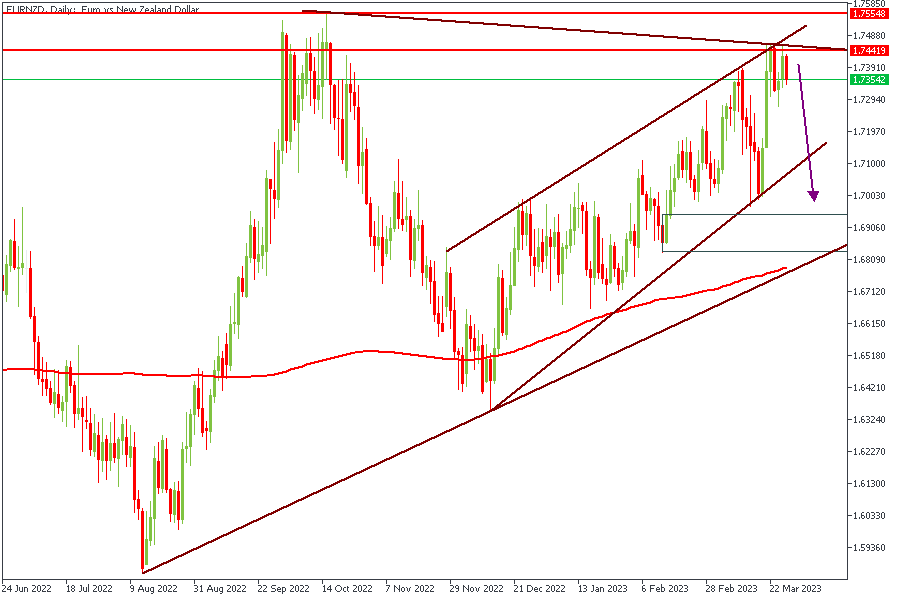
EURNZD is at a cruciall point on the Daily timeframe. First of all, we have the resistance trendline from the previous high, then followed by the resistance trendline from the rising wedge. Don't forget, we also have the resistance zone and a rally-base-drop supply zone at the site of the price action. All these combined to give me a clear bearish sentiment.
Analysts’ Expectations:
- Direction: Bearish
- Target: 1.75700
- Invalidation: 1.69450
GBPCHF
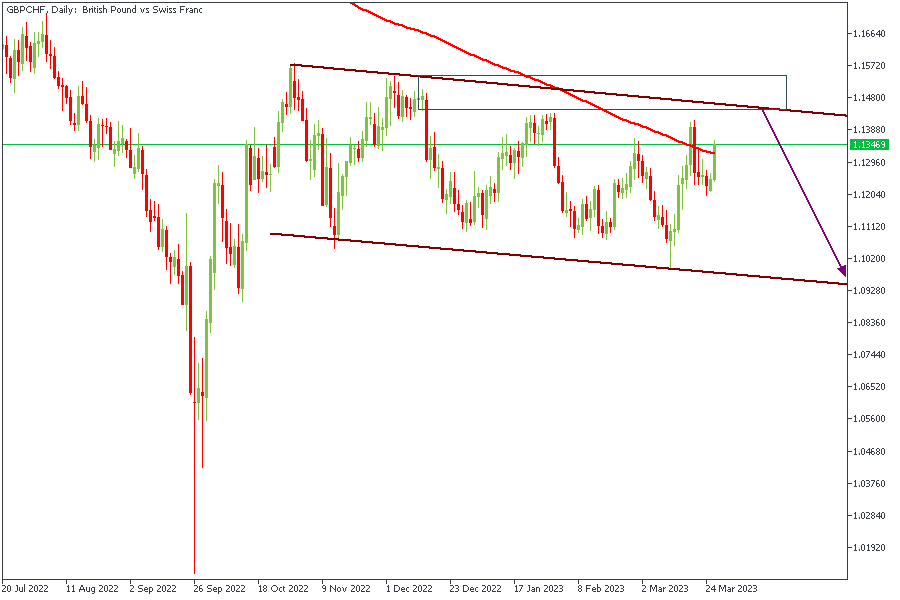
There'a hardly any need for a lengthy explanation of this GPBCHF chart. The major factors to consider here are; the resistance trendline, the rally-base-drop supply zone, the 200-Day MA, and the general overview of the market structure.
Analysts’ Expectations:
- Direction: Bearish
- Target: 1.11100
- Invalidation: 1.15700
AUDUSD
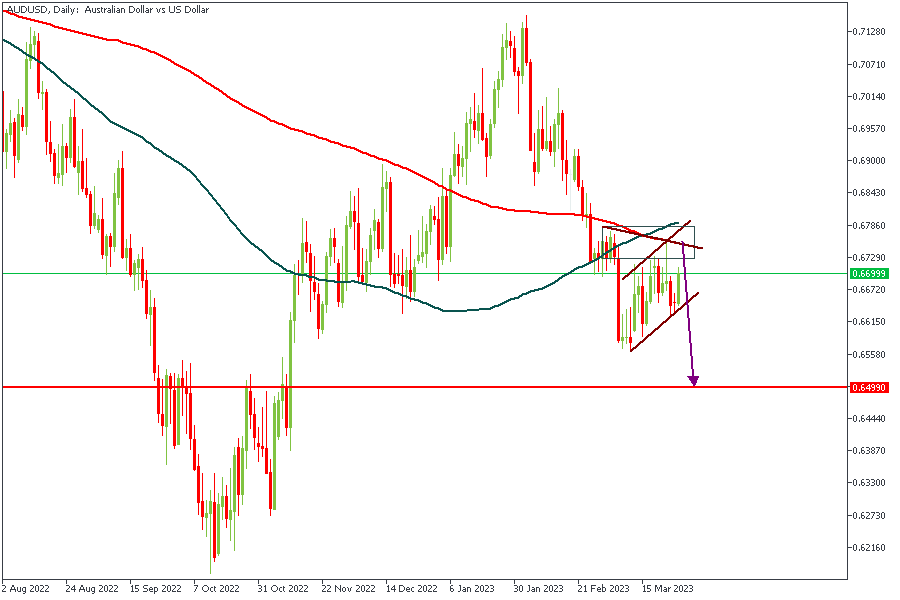
AUDUSD is another interesting idea I found. You see how the resistance trendline aligns with the rally-base-drop supply zone and the 200-Day MA? I see it too! And based on the general overview of the price action market structure, bearish seems the rational way to go.
Analysts’ Expectations:
- Direction: Bearish
- Target: 0.64330
- Invalidation: 0.67860
CONCLUSION
The trading of CFDs comes at a risk. Thus, to succeed, you have to manage risks properly. To avoid costly mistakes while you look to trade these opportunities, be sure to do your due diligence and manage your risk appropriately.
An Upside Inflation Surprise Could Not Come at a Better Time for Yen Bulls
With the rest of the world almost reliving the 2007-08 events, the Japanese developments were mostly under the market radar. This is not atypical, but as we get closer to the Bank of Japan governorship handout the market will start to pay attention to Japanese news. Yen bulls have been enjoying the recent moves, but for the next leg they need concrete economic evidence. Hence, all eyes may be on Friday’s busy calendar with the Tokyo inflation figures being the highlight release.
What has been happening in Japan lately?
As the market got fixated on the banking sector shenanigans that eventually led to the demise of the once-too-big-to-fail Credit Suisse, the Japanese news were treated as non-events. To be fair, the data releases have been on the mixed side and the last BoJ meeting on March 10 proved to be dull. Outgoing governor Kuroda decided to pass the baton to the incoming BoJ chief Ueda without any amendments to the current monetary policy framework or the forward guidance. However, there was very positive news from the Shunto wage negotiations. A number of key firms including Mitsubishi Heavy Industries and Toyota not only fully agreed with the demands of their respective labour unions, but also did so in record time. Honda, for example, completed the negotiations at the fastest time since the 1990s. The end-product up to now has been significant, above inflation, increases in workers’ pay that should be music to the ears of the BoJ members.
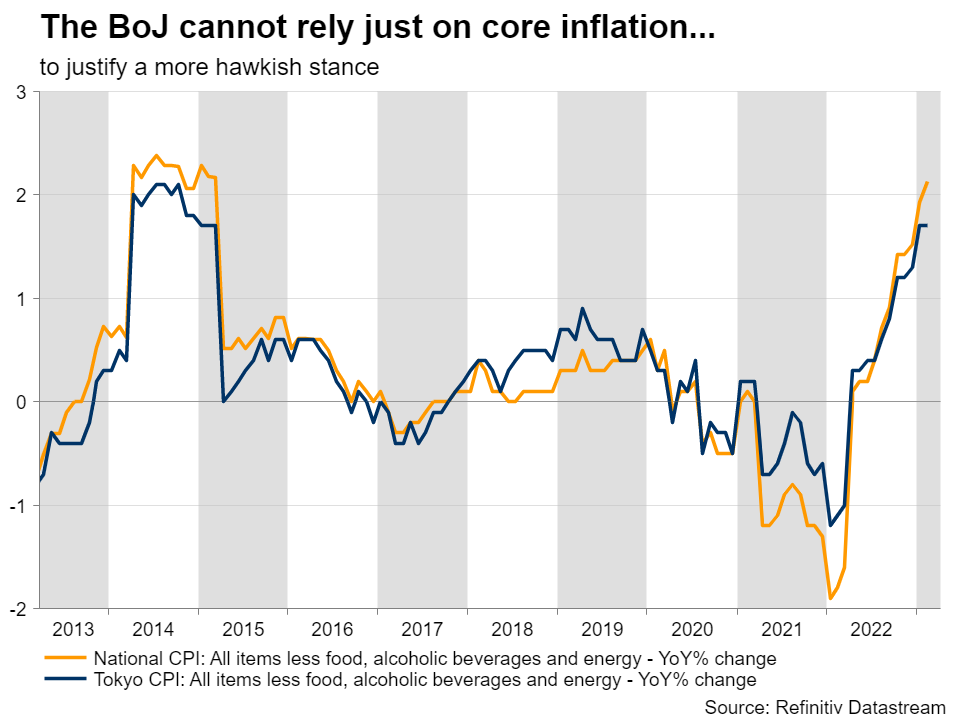
The key point going forward is whether this higher-wages momentum will translate into stronger consumer sentiment. As repeatedly highlighted, Japan has not been plagued by double digit inflation rates seen in other developed countries. However, the headline CPI moved to the highest year-on-year rate since the early 1990s and the core component recorded its strongest yearly increase since early 1980. But apart from the January adjustment at the yield curve control (YCC), the BoJ has not really amended its monetary policy stance, essentially abandoning the yen to foreign market forces.
Tokyo CPI frontrunning the nationwide print
The national CPI print for February showed a full percentage drop in the yearly rate of increase, from 4.3% to 3.3%. While globally we have seen some signs of inflation cooling off, particularly in the US and the euro area, the magnitude of the drop in Japan was clearly not anticipated. Similarly, the core component dropped to a yearly level not seen since September 2022, even though the rest of the world is facing stickier-than-expected-core inflation, and hence complicating the reaction function of the key central banks. On Friday, we get the March Tokyo headline and core CPI figures, an early preview of the current national inflation pressures. The market is looking for further easing in both indicators, which means that inflation is abating. If these forecasts are indeed confirmed, then it would be difficult for the new BoJ leadership to change dramatically the current mixture on monetary policy. The national aggregate inflation print is scheduled for release on April 20, a week before the first BoJ meeting under Ueda.
Decent retail sales growth despite low consumer confidence
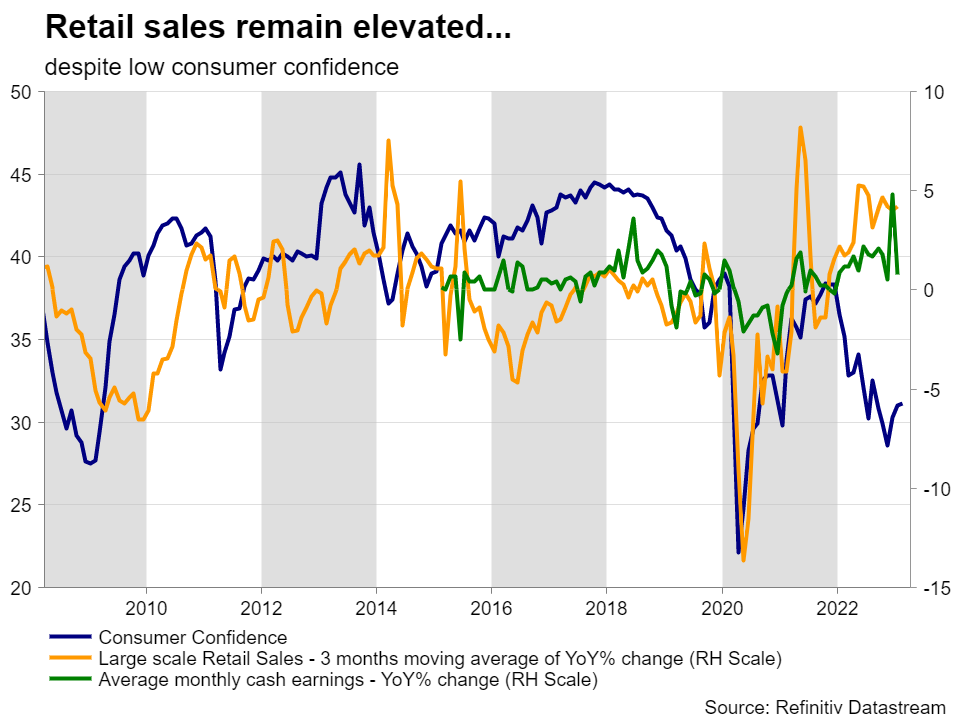
While the rest of the central banks have been almost exclusively focusing on CPI, the BoJ has been all over the consumer spending data. The ongoing disparity between the retail sales figures and consumer confidence remains significant. While the latter has dropped aggressively and hovers around low levels, retail sales growth remains elevated. This gap is even more evident when analyzing the large-scale retail shops data. Putting aside the volatile nature of the sales dataset, history points to a possible correction in retail sales ahead. However, the recent wage increases agreed should support retail sales going forward, and lead to some degree of correction in the consumer appetite. But this tendency is expected to be seen in next month’s figures, thus raising the possibility for a downside surprise on Friday.
Industrial production raises question about GDP growth
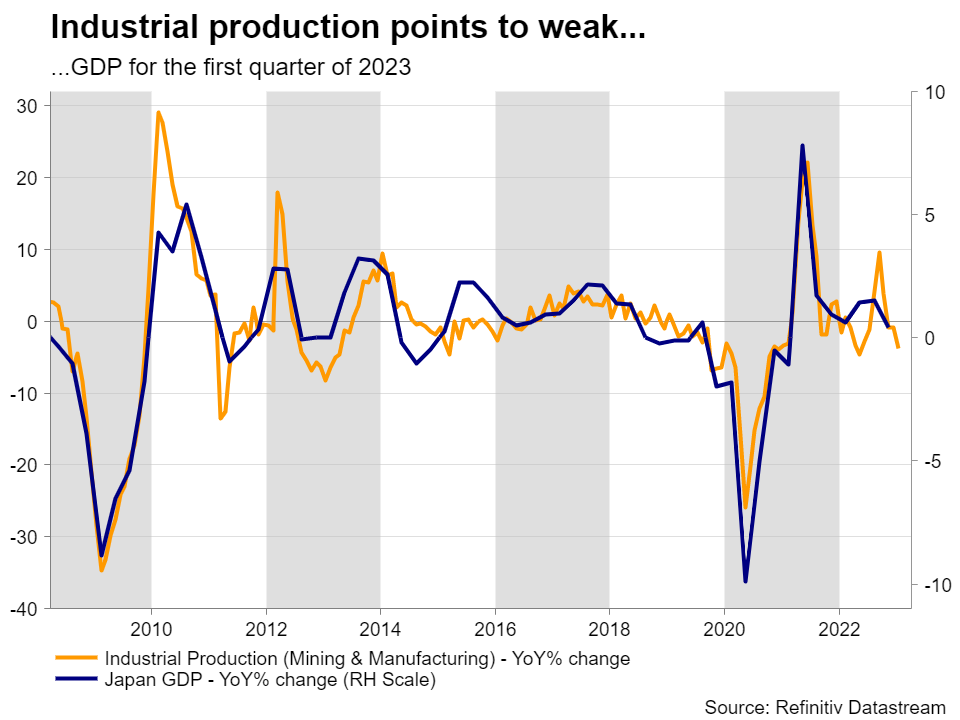
With the final fourth-quarter GDP report disappointing on March 9 and revealing an almost stagnant economy, the market would be looking closely at the preliminary March industrial production data on Friday morning. Up to now, the Q1 figures have been quite disheartening and another negative print means that the market could almost completely write off any hawkish expectations for the next BoJ meetings. In addition, questions will multiply regarding the true extent of the Chinese reopening, and its much-anticipated impact on goods demand and supply lines globally.
Yen’s fate determined by foreign forces
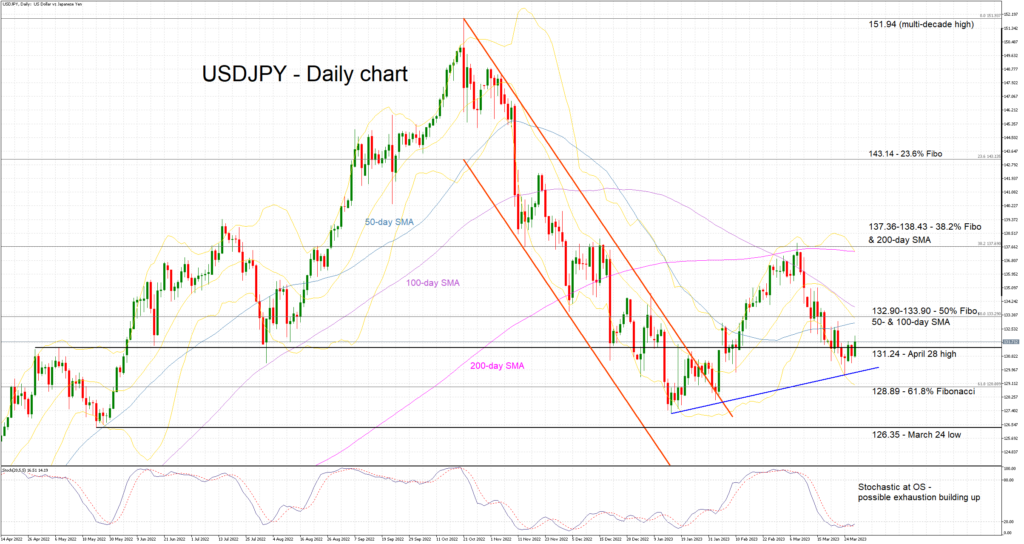
Yen has been one of the beneficiaries of the banking sector woes. Following a negative 3-month spell, the yen managed to record gains against both the euro and US dollar, a typical reaction in the risk-off sentiment seen earlier in March. As we return to more normal conditions and the market refocuses on the economic outlook, the yen underperformance is likely to resume. However, we are currently in a much different world to the early March situation, and hence yen bears should be satisfied with moderate gains in the dollar/yen pair. The overall technical set-up looks favourable for them as the stochastic is preparing for an upward move, signaling the possible start of another rally. The 132.90-133.90 range is a key area for momentum, and if successfully tackled by the yen bears, an aggressive push towards the early March highs could be possible.
EURGBP Pulls Back But Stays Above Uptrend Line
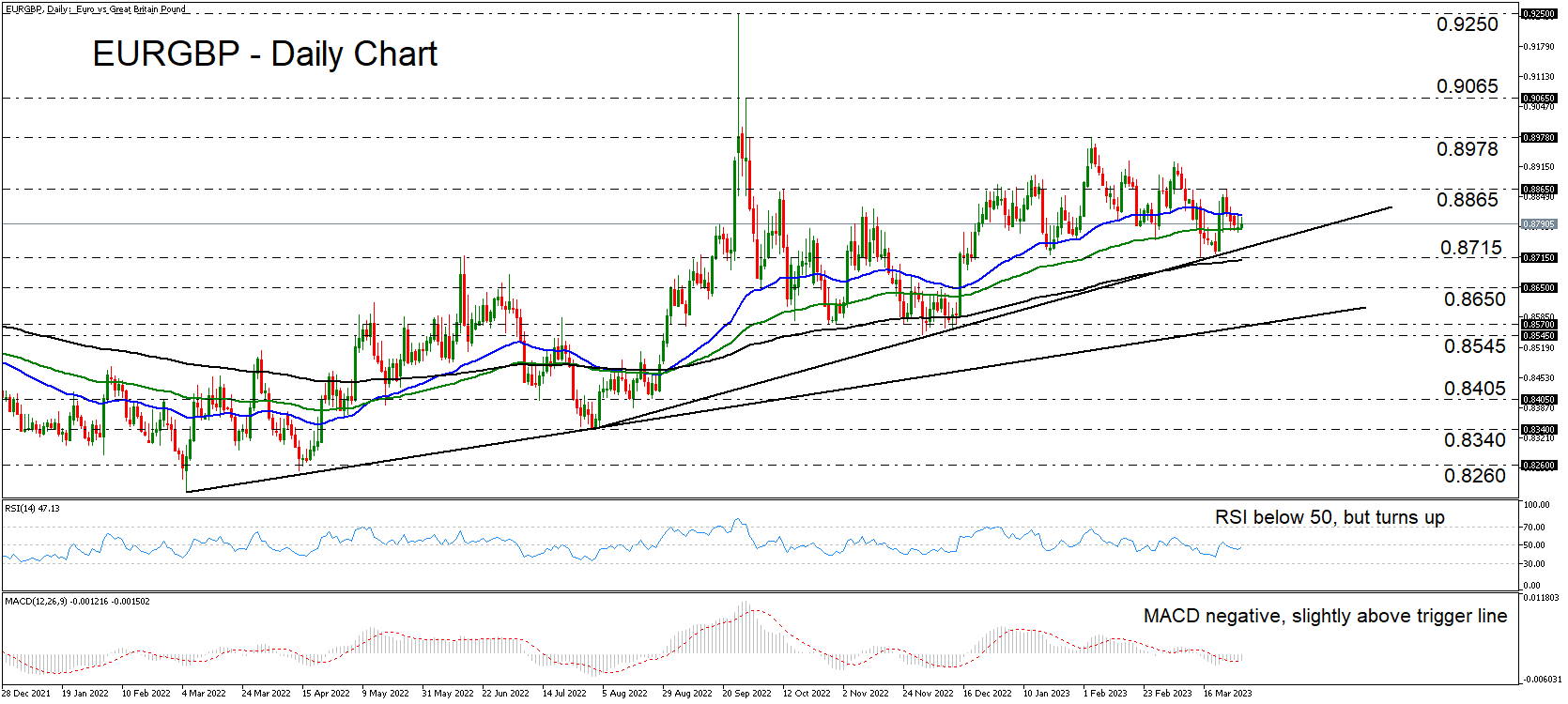
EURGBP entered a sliding mode last week, but the retreat stopped near the 100-day exponential moving average (EMA) just yesterday. The pair continues to trade above the uptrend line drawn from the low of August 3, which means that the chances for the bulls to take charge again soon are decent.
Both the short-term momentum indicators corroborate that view. The RSI, although marginally negative, has turned up, while the MACD is lying below zero, but above its trigger line, pointing slightly up as well.
A decisive break above the high of March 23 at 0.8865 might confirm that the bulls are back in the driver’s seat and could thereby pave the way towards the peak of February 3 at 0.8978. If they are not willing to stop there, they could then extend their march towards the 0.9065 territory, defined as resistance by the high of September 28.
On the downside, even if the bears manage to push the action below the aforementioned uptrend line, they will still have to face another, longer-term, upward-sloping line drawn from the low of March 7, 2022. Thus, a dip below that line and the 0.8545 area may be needed for the near-term picture to turn overly negative. Should that happen, the sellers may feel confident to aim for the 0.8405 area, marked by the low of August 24.
To wrap up, EURGBP pulled back last week, but the slide was stopped near the 100-day EMA, above the uptrend line drawn from the low of August 3. This likely keeps the bulls in the game, with a break above 0.8865 potentially confirming their ascendancy.
German Consumer Climate Continues to Recover
The GfK consumer climate index for Germany rose by 1.1 points to -29.5 in April, a very low level by historical standards and still below the lows of the pandemic in the year 2020. Sentiment has been improving since October, allowing talk of a recovery from the inflation and energy shock in Europe’s largest economy, although the pace of recovery has slowed.
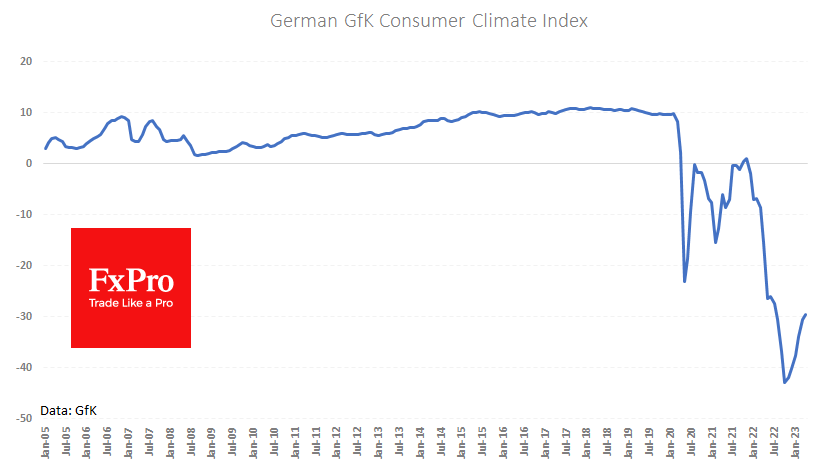
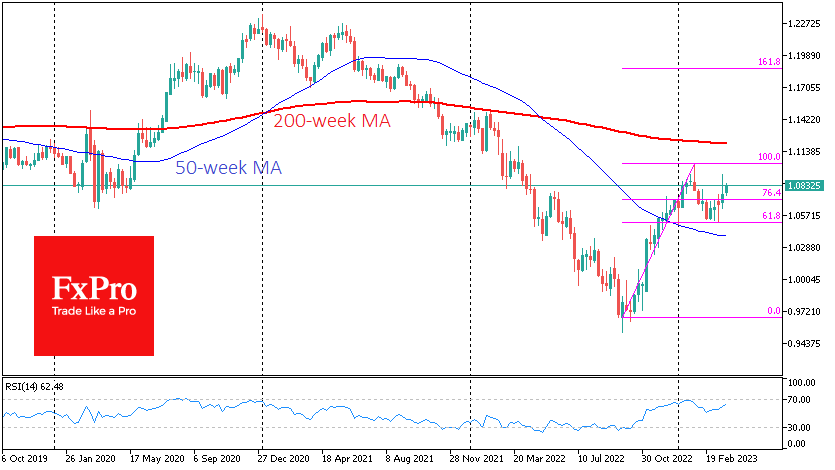
Interestingly, the turnaround in consumer sentiment coincided with a “bottom” in EURUSD. The single currency rallied strongly in the final quarter of last year, briefly topping 1.10 in early February before a technical correction. In the second half of March, the single currency recovered against the dollar, despite selling pressure from Credit Suisse and Deutsche Bank.
We believe this interest in the single currency correlates with rising business and consumer sentiment indices. The economic recovery will allow the ECB to maintain a tighter monetary policy.
Assuming a positive correlation between consumer sentiment and the EURUSD exchange rate, we expect the #1 currency pair to continue its upward trend but with a much more subdued amplitude than at the end of last year. As early as April, the euro could fully emerge from its correction and rise above 1.10, but it is unlikely to exceed 1.12 in the year’s first half.