Sample Category Title
SNB Meets But Developments Elsewhere Could Carry More Weight for Swissie
The Swiss National Bank (SNB) holds its final meeting for 2022 on Thursday, December 15. The current market pricing points to a 50bps rate hike. Will this hike be enough to turn the tide around for the swissie against the euro or developments elsewhere could be more impactful?
The September meeting did not appease the market
The SNB holds its fourth and final rate-setting meeting for 2022, joining the chorus of rate meetings from other major central banks this week. It has been some time since the last meeting on September 22 when the SNB announced the return to a positive policy rate. The 75-bps rate hike was in line with expectations and failed to inspire the markets. In addition, the post-meeting press conference’s message was slightly dovish as Chairman Jordan did not appear overly enthusiastic about further rate hikes.
Recent data somewhat stronger than in other regions
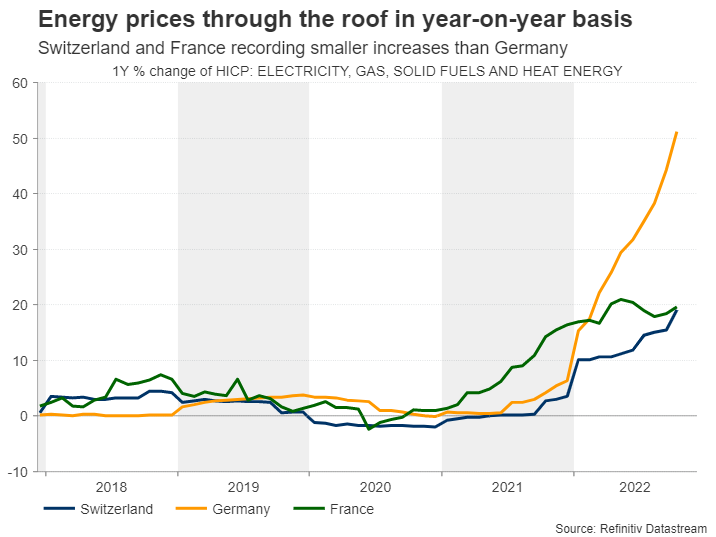
The Swiss economy appears to be in better shape than its main trading partners. While at 3.0%, the year-on-year CPI remains above the SNB's comfort zone, it is clearly lower than the double-digit increases seen not far from the Swiss borders. Similarly, the manufacturing PMI stands comfortably above the 50-expansion level. But the domestic economy cannot come out completely unscathed by the economic hardship seen elsewhere, as consumer sentiment in the fourth-quarter dropped to record low levels, and annual growth in retail sales continues to hover around zero. Hence, consumer spending appears to be affected even though the electricity market in Switzerland remains highly regulated for small consumers and households.
Swissie under pressure against the euro lately
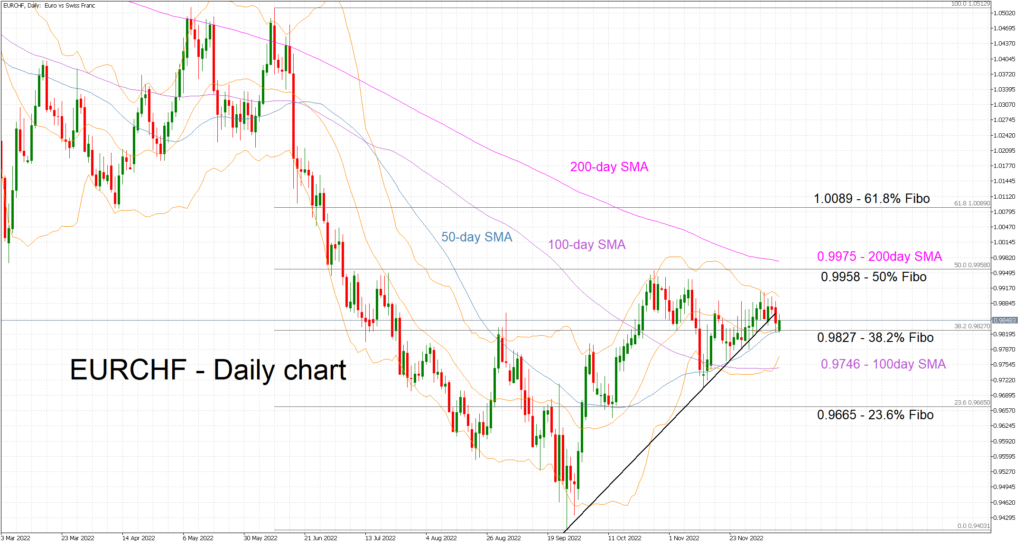
The escape from negative rates did not prove beneficial for swissie as the market had already turned its focus elsewhere. The swissie has enjoyed a steady bid against the euro over the past few years reaching a multi-decade high of 0.94 per euro on September 26, on the back of the elevated inflation rates across Europe and the increased chances of recession in both the euro area and US matter in 2023. SNB’s preference for a stronger currency at this juncture is not concealed, as it is one of the reasons for the lower inflation rates recorded in Switzerland. Hence, the fourth-quarter rally in the euro/swissie pair should have raised some eyebrows at the SNB head offices.
Could the SNB be more aggressive at this meeting?
The SNB has been a laggard among the major central banks in the current rate hiking cycle. Contrary to the ECB’s 200bps rate increase, the SNB has raised rates by just 125bps in 2022. With both the Fed and ECB expected to hike again this week by 50bps respectively, the onus is on the SNB to make its next move. The market currently assigns a 77% probability for a 50bps rate hike, with the remaining 23% looking for a quarter-point rate move. There will be the usual interest on the ensuing press conference and the conditional inflation bank forecasts. However, two days before the meeting we will get the SECO forecasts. These forecasts, which tend to be in line with, albeit a bit more conservative than the SNB’s forecasts, thus limiting the surprise element on the meeting day.
If the SNB wishes to appear determined about keeping the swissie strong, and thus offsetting the potentially higher imported inflation, the door is open for a stronger move of 75bps and a hawkish showing at the press conference. Otherwise, a 50bps rate hike would mostly appease the market and allow the SNB to use its FX reserves to manage unwanted moves in the euro/swissie pair. Additionally, if the bleak forecasts for a 2023 recession in the euro area get confirmed or there is another energy-related episode, the SNB could just wait on the sidelines. The swissie would most likely enjoy another safe-haven inflow without the need for aggressive hikes from the SNB.
Likely market reaction
Should the SNB meeting hold no surprises, euro/swissie should look for guidance at the ECB meeting later on Thursday. Should the swissie bulls attempt to control the market, their primary aim would be the 100-day simple moving average at 0.9746 followed by the 0.9665 area. On the other hand, another attempt from swissie bears to recover part of the ground lost during 2022, means that the busy 0.9958-75 area should be tested first.
EUR/USD: Firm Break of Key Fibo Barrier to Neutralize Warnings from Weekly Chart
The Euro regained traction in early Monday’s trading after Friday’s close in red, and attacks again key Fibo barrier at 1.0578 (38.2% of 1.2266/0.9535) where the action was already rejected twice last week.
Daily studies maintain strong bullish momentum and the action was underpinned by a double golden-cross (10/200 & 20/200DMA’s) which supports bodes well for final push through cracked 1.0578 (Fibo) and 1.0590 (falling 55WM pivots, to signal bullish continuation and expose targets at 1.0786 (May 29 lower top) and 1.0901 (50% retracement of 1.2266/0.9535).
On the other hand, warning of possible rally stall comes from weekly chart, as stochastic is strongly overbought and bullish momentum is fading, along with last week’s Doji.
Rising 10 DMA offers initial support at 1.0491 which should hold to keep immediate bulls intact and guard 20DMA (1.0421) and 200DMA (1.0350) with loss of the latter to sideline bulls.
Res: 1.0590; 1.0615; 1.0700; 1.0782.
Sup: 1.0522; 1.0491; 1.0421; 1.0350.
EUR/JPY Mid-Day Outlook
Daily Pivots: (S1) 143.20; (P) 143.84; (R1) 144.50; More....
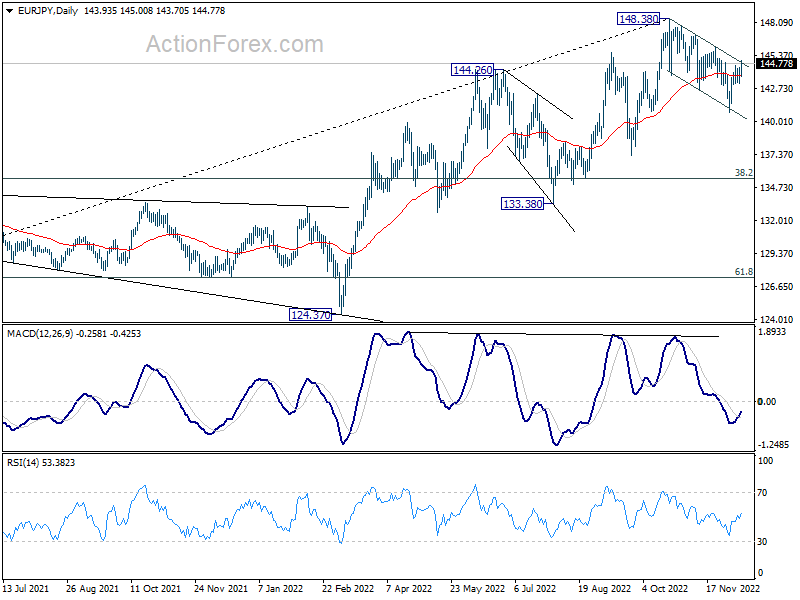
EUR/JPY's break of the near term channel resistance suggests that correction from 148.38 has completed at 140.75. Intraday bias is back on the upside for 146.12 resistance first. Firm break there will bring retest of 148.38 high. On the downside, however, break of 143.16 minor resistance will dampen this bullish case and turn intraday bias neutral again.
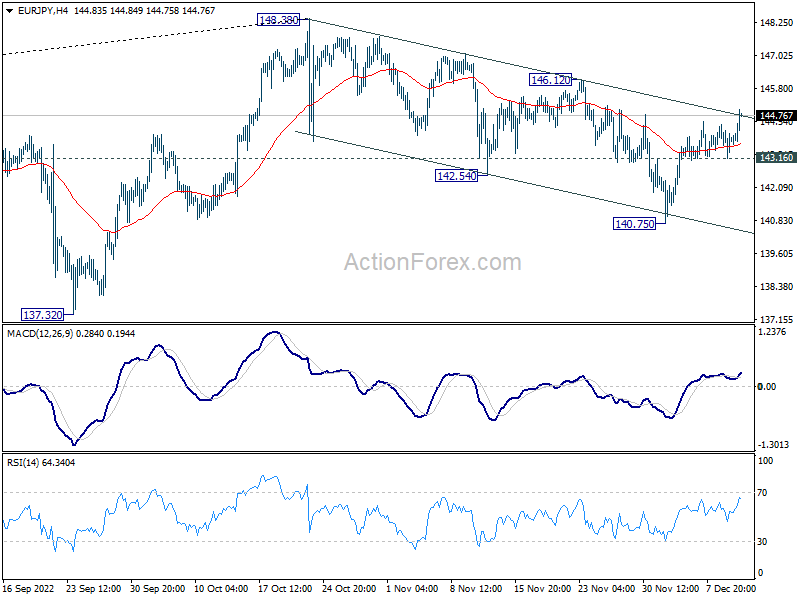
In the bigger picture, considering bearish divergence condition in weekly MACD, 148.38 could be a medium term top already. Fall from there is probably correcting whole up trend from 114.42 (2020 low). Deeper decline would be seen to 55 week EMA (now at 138.08), or further to 38.2% retracement of 114.42 to 148.38 at 135.40 before completion.
USD/JPY Mid-Day Outlook
Daily Pivots: (S1) 135.83; (P) 136.37; (R1) 137.13; More...
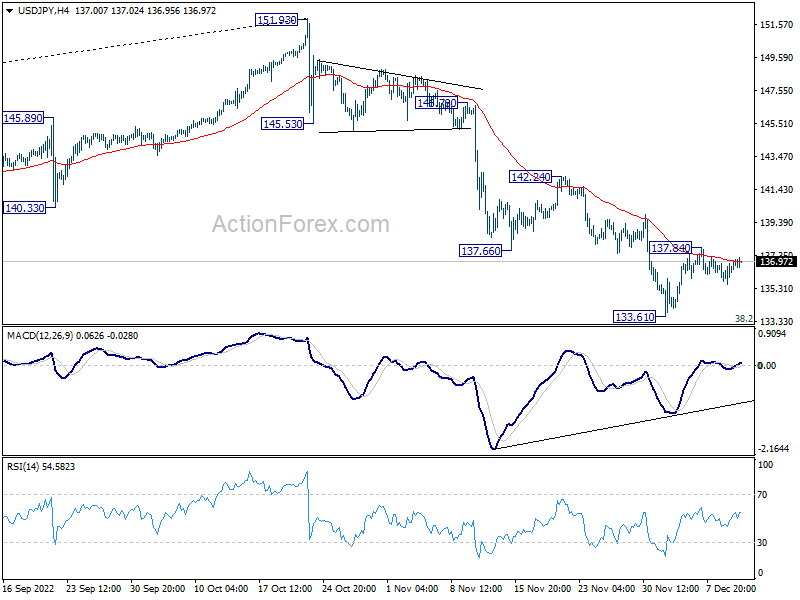
Intraday bias in USD/JPY remains neutral and outlook is unchanged. On the upside, break of 137.84 resistance will revive the case of short term bottoming at 133.61, and turn bias back to the upside for 55 day EMA (now at 140.89). However, break of 133.61 will resume the decline form 151.93 through 133.07 fibonacci level.
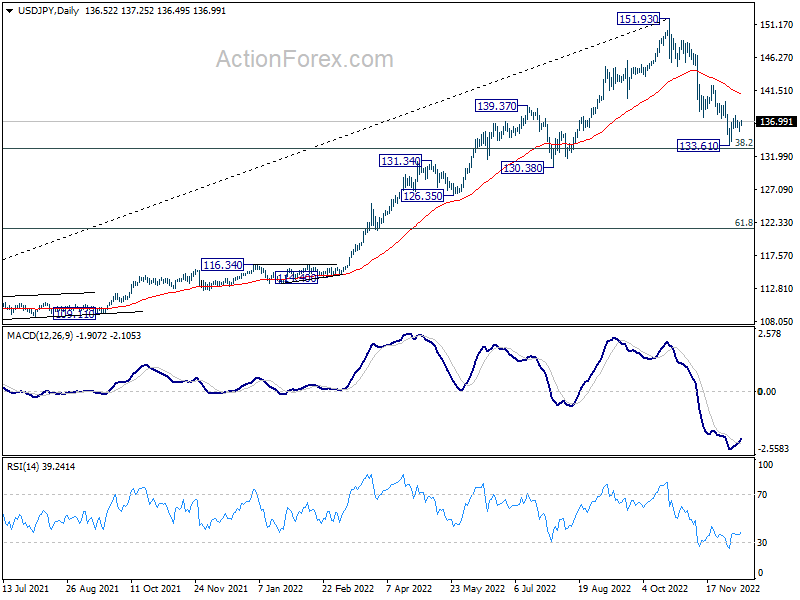
In the bigger picture, price actions from 151.93 medium term could be just a corrective pattern to up trend from 102.58 (2021 low). Strong support from 38.2% retracement of 102.58 to 151.93 at 133.07 and 55 week EMA (now at 131.71) will set the range for such corrective pattern. However, sustained break of 55 week EMA will pave the way to 61.8% retracement at 121.43.
USD/CHF Mid-Day Outlook
Daily Pivots: (S1) 0.9313; (P) 0.9347; (R1) 0.9382; More...
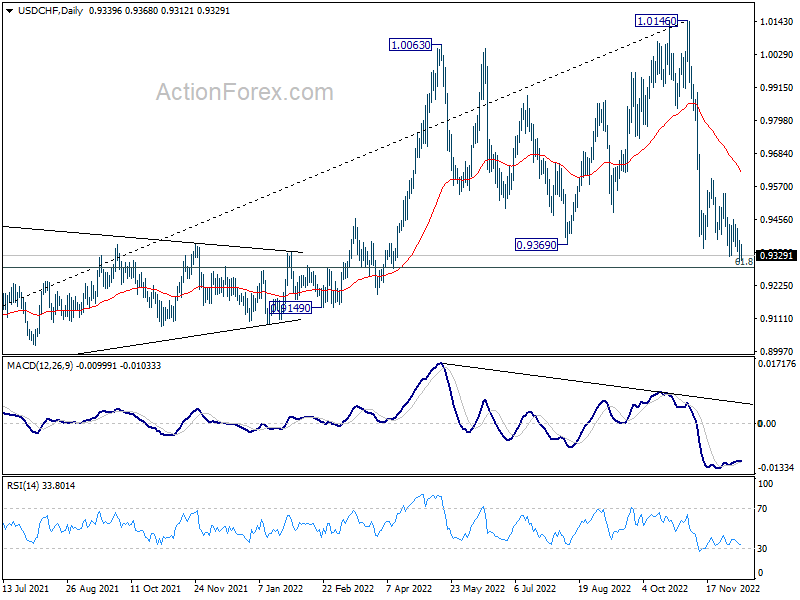
No change in USD/CHF's outlook. Intraday bias stays mildly on the downside with focus on 0.9287 fibonacci level. Decisive break there will target 0.9149 structural support next. On the upside, though, break of 0.9454 resistance will now indicate short term bottoming. Intraday bias will be turned back to the upside for 0.9545 resistance and above.
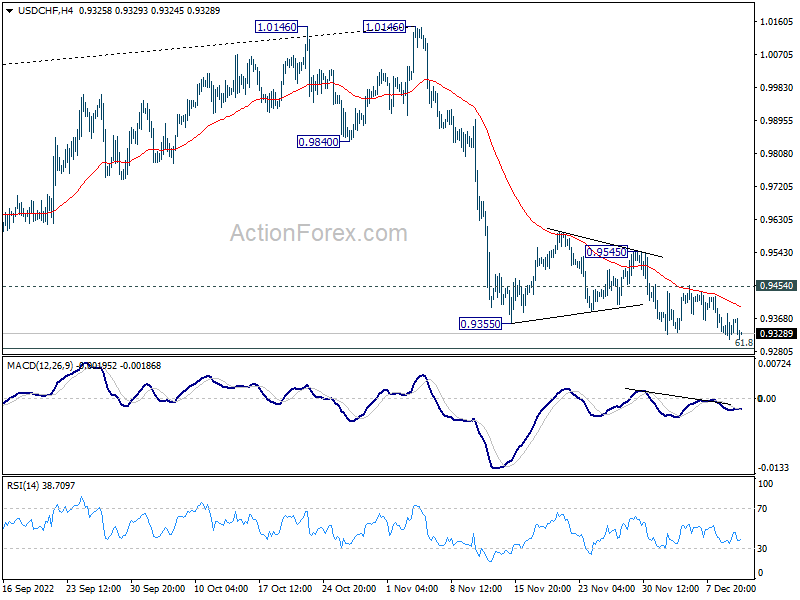
In the bigger picture, rise from 0.8756 (2021 low) has completed at 1.0146, well ahead of 1.0342 long term resistance (2016 high). Based on current downside momentum, fall from 1.0146 might be a medium term down trend itself. Sustained break of 61.8% retracement of 0.8756 to 1.0146 at 0.9287 will pave the way to 0.8756. In any case, risk will stay on the downside as long as 55 day EMA (now at 0.9621) holds.
GBP/USD Mid-Day Outlook
Daily Pivots: (S1) 1.2211; (P) 1.2267; (R1) 1.2325; More...
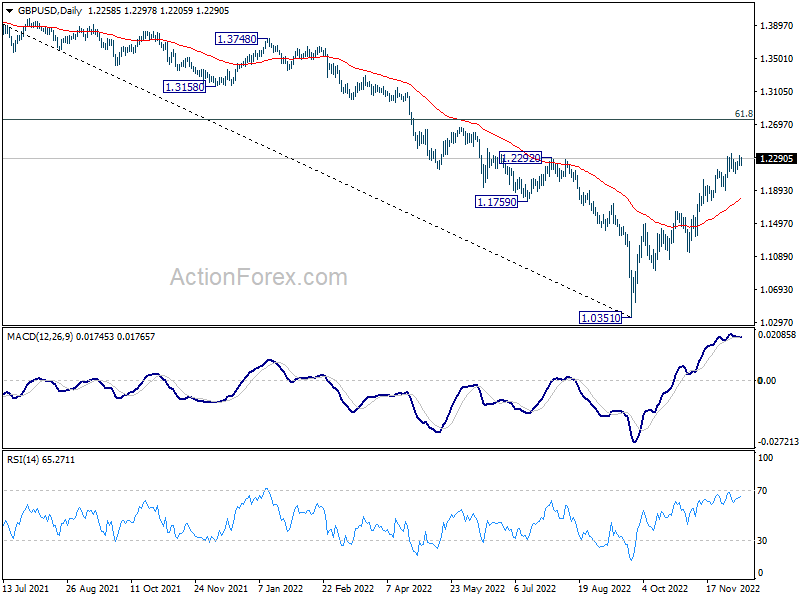
Range trading continues in GBP/USD and intraday bias stays neutral. Further rally is expected as long as 1.1898 support holds. Break of 1.2343 will resume larger rally from 1.0351 and target 1.2759 medium term fibonacci level next. However, firm break of 1.1898 support will confirm short term topping and turn bias back to the downside.
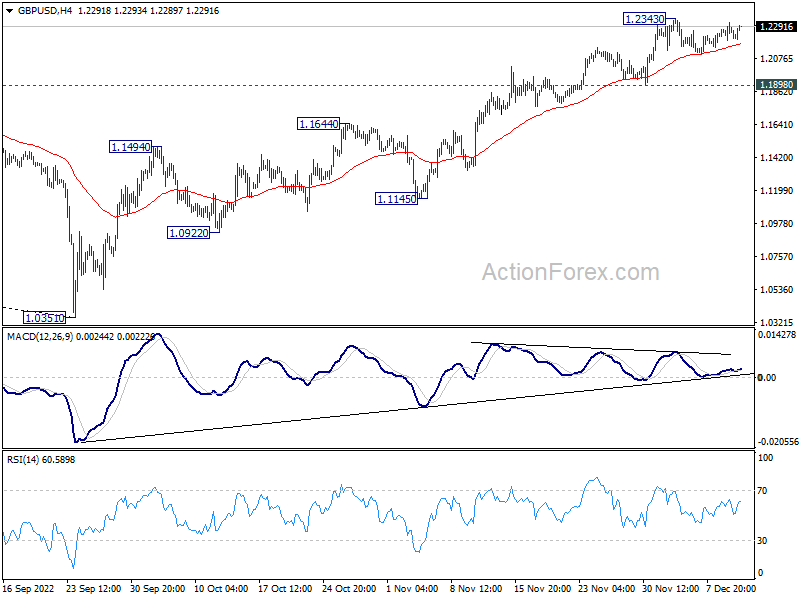
In the bigger picture, rise from 1.0351 medium term bottom is at least correcting whole down trend from 1.4248 (2021 high). Further rise is expected as long as 1.1644 resistance turned support holds. Next target is 61.8% retracement of 1.4248 to 1.0351 at 1.2759. Sustained break there will pave the way back to 1.4248.
AUD/USD Drops, Confidence Data Next
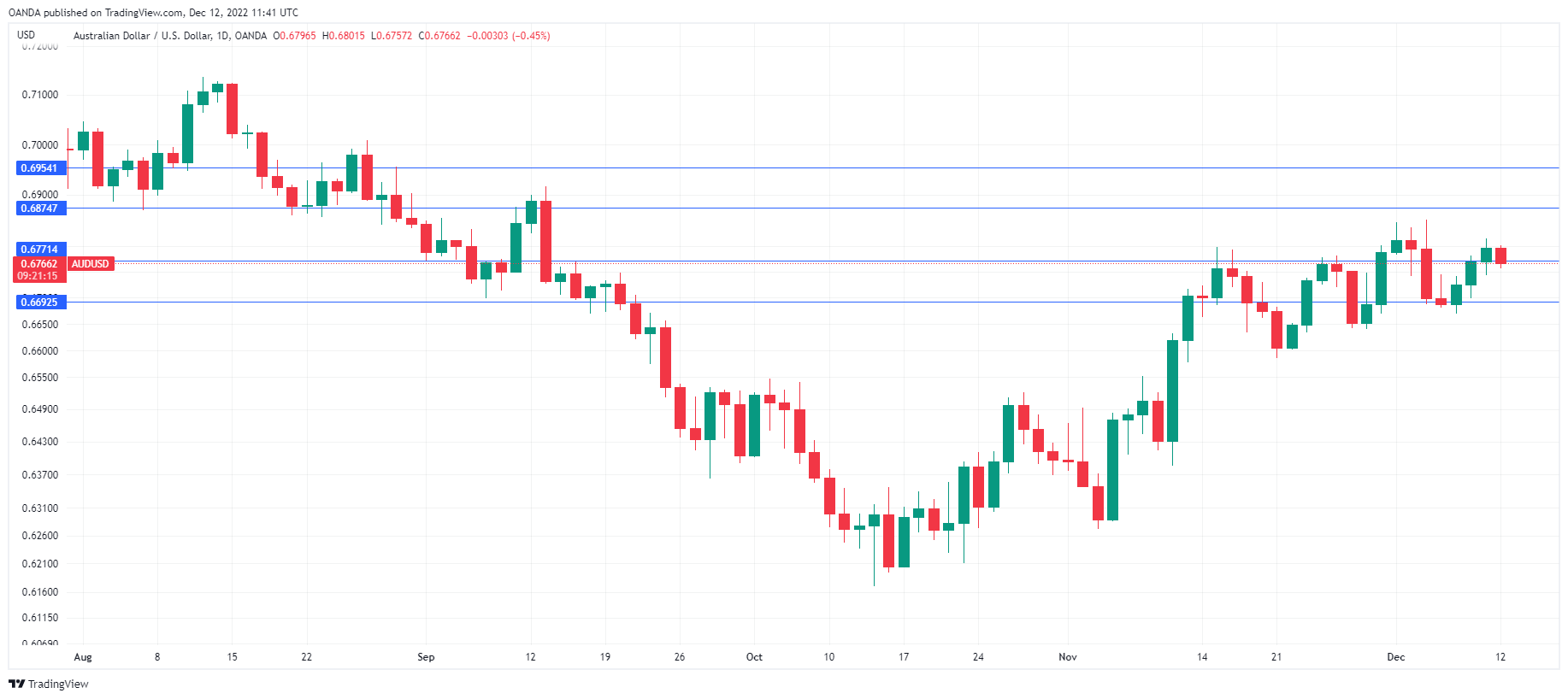
The Australian dollar has started the week in negative territory. In European trade, AUD/USD is trading at 0.6766, down 0.44%.
Australian dollar eyes confidence releases
Australian confidence indicators headed south in the most recent releases – will we see an improvement on Tuesday? NAB Business Confidence slipped to zero in October, down from 5 a month earlier. The consensus for November stands at 5 points. Westpac Consumer Sentiment declined by 6.9% in November, down from -0.9% in October. The index has only managed one gain in the past 12 months, pointing to prolonged weakness in consumer confidence.
With inflation still not under control, the RBA continues to raise rates, although it has now delivered three straight hikes of 25 basis points. Last week’s meeting was the final one for 2023, with the next meeting not until February. There is a great deal of economic uncertainty, including which direction inflation is headed. This has resulted in differing views on the terminal rate, with forecasts ranging from 3.3% all the way to 3.8%. With the cash rate currently at 3.10%, there is little doubt that the RBA will renew its tightening in February, likely with a 25-bp increase.
The Federal Reserve will also be in the spotlight this week, with the final rate meeting on Wednesday expected to produce a 50-bp hike. Even with a record pace of rate hikes in 2022 and the Fed saying that the terminal rate could hit 5% or higher, the markets haven’t bought into the Fed’s hawkish message. We have seen how softer-than-expected inflation reports have renewed risk appetite and hopes of a dovish Fed pivot. The US will release the November inflation report on Tuesday, a day prior to the Fed meeting. If CPI is weaker than the 7.3% forecast, we could see investors again speculate about the Fed turning dovish. Fed policy makers don’t want to see financial conditions loosening just yet, since that would complicate the Fed’s battle against inflation.
AUD/USD Technical
- AUD/USD tested support at 0.6676 earlier. Next, there is support at 0.6558
- There is resistance at 0.6760 and 0.6878
EUR/USD Mid-Day Outlook
Daily Pivots: (S1) 1.0497; (P) 1.0543; (R1) 1.0579; More...
Intraday bias in EUR/USD stays neutral for the moment as range trading continues. On the downside, break of 1.0442 support will indicate rejection by 1.0609 fibonacci level. Bias will be back on the downside for 1.0222 support and below. However, firm break of 1.0594/0609 resistance zone will carry larger bullish implication. Next near term target is 61.8% projection of 0.9729 to 1.0481 from 1.0222 at 1.0687, and then 100% projection at 1.0974.
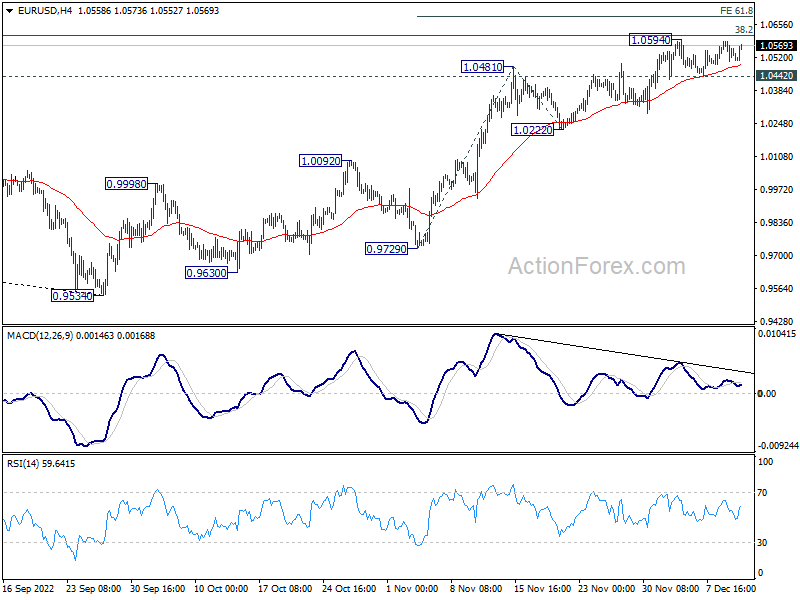
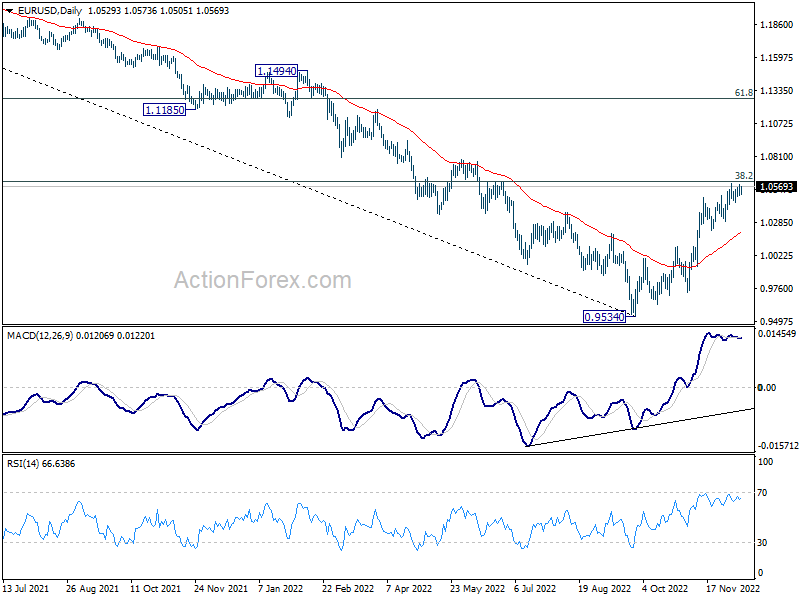
In the bigger picture, focus is now on 38.2% retracement of 1.2348 (2021 high) to 0.9534 at 1.0609. Rejection by 1.0609 will suggest that price actions from 0.9534 medium term bottom are developing into a corrective pattern. Thus, medium bearishness is retained for another fall through 0.9534 at a later stage. However, sustained break of 1.0609 will raise the chance of trend reversal and target 61.8% retracement at 1.1273.
Euro Rises Against Yen and Commodity Currencies
Euro is trading as the strongest one today so far, followed by Sterling, Swiss Franc and Dollar. All four currencies are going to have respective central bank meetings this week, and all are expected to hike by 50bps. Australian Dollar is leading commodity currencies and Yen lower. News flow is slow while the economic calendar is very light today. UK GDP report was largely ignored by investors. So, today's moves are probably due to traders preparing ahead of the main events.
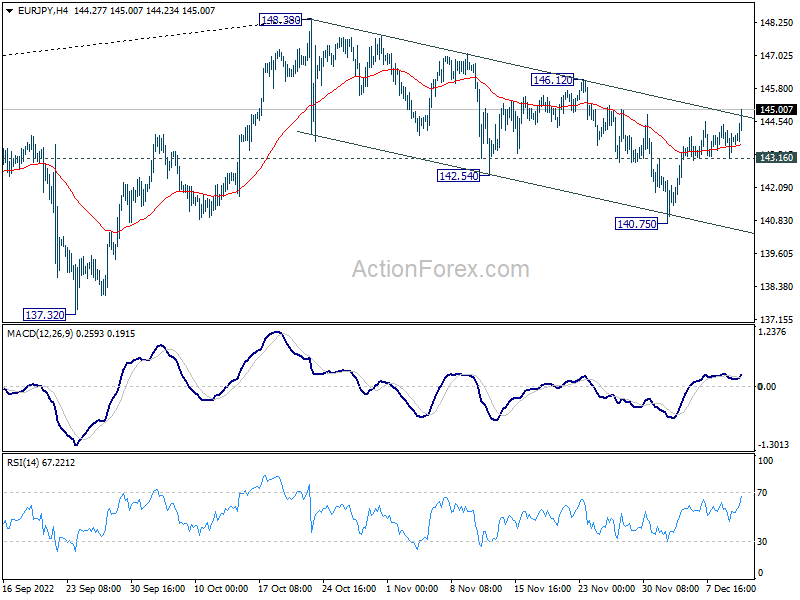
Technically, EUR/JPY's break of near term channel resistance suggests that corrective fall from 148.48 has completed at 140.75 already. Further rise is in favor to 146.12 resistance first. Break there will bring retest of 148.38 high. The question now is on whether EUR/JPY's rally would be accompanied by break of 137.84 minor resistance in USD/JPY, or 1.0594 high in EUR/USD.
In Europe, at the time of writing, FTSE is down -0.25%. DAX is down -0.29%. CAC is down -0.28%. Germany 10-year yield is down -0.025 at 1.907. Earlier in Asia, Nikkei dropped -0.21%. Hong Kong HSI dropped -2.20%. China Shanghai SSE dropped -0.87%. Singapore Strait Times dropped -0.19%. Japan 10-year JGB yield rose 0.0007 to 0.257.
NIESR: UK GDP to remain flat in Q4
NIESR said the 0.5% mom growth in UK GDP in October "largely reflects the weakness in September" resulting from additional Bank Holiday for the State Funeral of HM Queen Elizabeth II. The risks of GDP contraction in Q4 "remains elevated". It expects GDP to remain flat in Q4.
Paula Bejarano Carbo Associate Economist, NIESR said:
"Monthly GDP grew by 0.5 per cent in October, in line with our forecast last month, driven by a strong pick-up in wholesale and retail trade, and repair of motor vehicles and motorcycles, which seem to have been strongly affected by the additional September bank holiday.
"Despite this positive outlook from the monthly growth figure, there are still strong downside risks to GDP in the fourth quarter of this year due to high inflation and interest rates –which continue to suppress demand –and supply chain disruptions, as well as work backlogs due to industrial action and a tight labour market –which continue to weigh on business growth. We still expect GDP to remain flat in the fourth quarter of this year."
UK GDP grew 0.5% mom in Oct, driven by services
UK GDP grew 0.5% mom in October, better than expectation of 0.4% mom. Services grew 0.6% mom and was the main driver of growth in GDP. Production was broadly flat for the month. Construction grew 0.8% mom. GDP is estimated to be 0.4% above is pre-coronavirus levels in February 2020.
In the three months to October, compared with the three months to July, GDP contracted -0.3%. Services was down -0.1%. Production dropped -1.7%. Construction rose 1.1%.
Also released, industrial production came in at 0.0% mom, -2.4% yoy, versus expectation of -0.3% mom, -4.2% yoy. Manufacturing was at 0.7% mom, -4.6% yoy, versus expectation of -0.1% mom, -6.3% yoy. Goods trade deficit narrowed to GBP -14.5B, versus expectation of GBP -15.0B.
Japan PPI slowed to 9.3% yoy in Nov, global commodity prices easing
Japan corporate goods price index slowed from 9.4% yoy to 9.3% yoy in November, above expectation of 8.9% yoy. The index, at 118.5, was a record high. Yen-based import price index slowed notably from 42.3% yoy to 28.2% yoy.
"Companies were passing on rising raw material costs for a broad range of goods. But some goods saw the impact of recent easing of global commodity prices," a BOJ official told a briefing.
Also from Japan, MoF's Business Survey Index for all large industries rose from 0.4 to 0.7 in Q4. BSI large manufacturing, however, dropped from 1.7 to -3.6. BSI large non-manufacturing improved form -0.2 to 2.7. BSI medium all industries rose from -2.2 to 4.7. BSI small all industries rose from -15.9 to -6.0.
EUR/USD Mid-Day Outlook
Daily Pivots: (S1) 1.0497; (P) 1.0543; (R1) 1.0579; More...
Intraday bias in EUR/USD stays neutral for the moment as range trading continues. On the downside, break of 1.0442 support will indicate rejection by 1.0609 fibonacci level. Bias will be back on the downside for 1.0222 support and below. However, firm break of 1.0594/0609 resistance zone will carry larger bullish implication. Next near term target is 61.8% projection of 0.9729 to 1.0481 from 1.0222 at 1.0687, and then 100% projection at 1.0974.
In the bigger picture, focus is now on 38.2% retracement of 1.2348 (2021 high) to 0.9534 at 1.0609. Rejection by 1.0609 will suggest that price actions from 0.9534 medium term bottom are developing into a corrective pattern. Thus, medium bearishness is retained for another fall through 0.9534 at a later stage. However, sustained break of 1.0609 will raise the chance of trend reversal and target 61.8% retracement at 1.1273.
Economic Indicators Update
| GMT | Ccy | Events | Actual | Forecast | Previous | Revised |
|---|---|---|---|---|---|---|
| 23:50 | JPY | PPI Y/Y Nov | 9.30% | 8.90% | 9.10% | 9.40% |
| 23:50 | JPY | BSI Manufacturing Index Q4 | -3.6 | 2.3 | 1.7 | |
| 06:00 | JPY | Machine Tool Orders Y/Y Nov P | -7.80% | -5.40% | -5.50% | |
| 07:00 | GBP | GDP M/M Oct | 0.50% | 0.40% | -0.60% | |
| 07:00 | GBP | Index of Services 3M/3M Oct | -0.10% | -0.10% | 0.00% | |
| 07:00 | GBP | Industrial Production M/M Oct | 0.00% | -0.30% | 0.20% | |
| 07:00 | GBP | Industrial Production Y/Y Oct | -2.40% | -4.20% | -3.10% | |
| 07:00 | GBP | Manufacturing Production M/M Oct | 0.70% | -0.10% | 0.00% | |
| 07:00 | GBP | Manufacturing Production Y/Y Oct | -4.60% | -6.30% | -5.80% | |
| 07:00 | GBP | Goods Trade Balance (GBP) Oct | -14.5B | -15.0B | -15.7B | |
| 12:13 | GBP | NIESR GDP Estimate (3M) Nov | -0.30% | -0.30% |
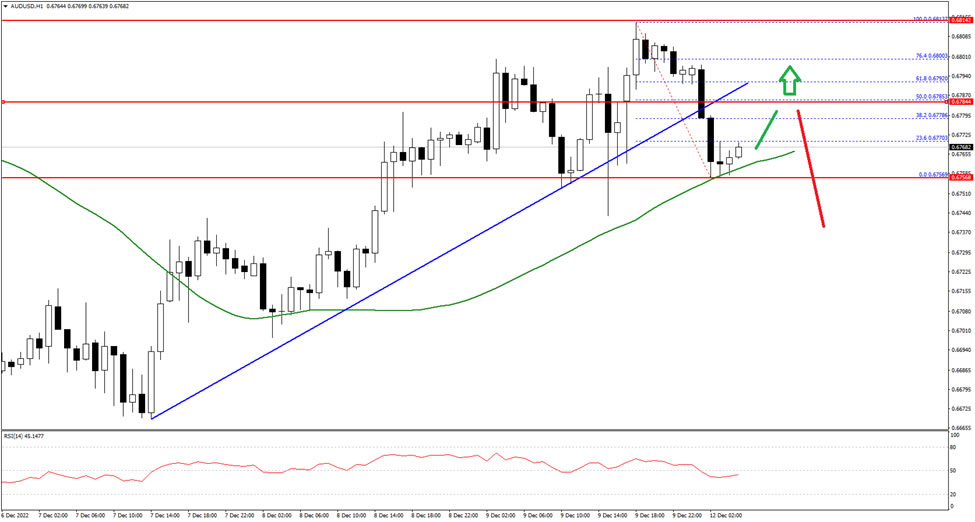
AUD/USD Pair Started a Downside Correction Below 0.6800
The Aussie Dollar failed to clear the 0.6820 resistance against the US Dollar. The AUD/USD pair started a downside correction below the 0.6800 and 0.6780 support levels.
There was a move below a key bullish trend line with support at 0.6780 on the hourly chart. The pair is now consolidating above the 0.6755 support and the 50 hourly simple moving average. An immediate resistance on the upside is near the 0.6785 level.
If there is an upside break above the 0.6785 zone, the pair could rise steadily towards the 0.6820 level in the near term. The main resistance now sits near 0.6850 on FXOpen.
An immediate support is near the 0.6760 level. The next key support is near the 0.6750 level. A downside break below the 0.6750 support could lead the pair towards the 0.6710 support.