

Sample Category Title
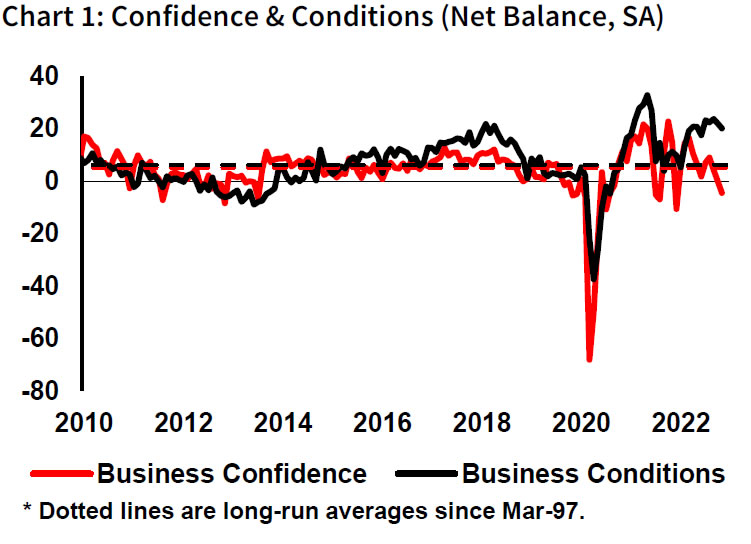
Australia NAB business conditions hold up, but confidence turned negative
Australia NAB Business Confidence dropped from 0 to -4 in November, below zero for the first time since December 2021. Business Conditions dropped from 22 to 20, but remained elevated. Looking at some details, trading conditions dropped from 30 to 28. Profitability conditions dropped from 21 to 20. Employment conditions dropped from 14 to 13.
NAB Chief Economist Alan Oster. "There was a slight softening across a number of industries but the level of business conditions really still remains elevated across the board including in key consumer-facing sectors such as retail and recreation & personal services, and across the states."
"Confidence is now negative, for the first time this year, despite the strength in conditions," said Oster. "The gap between current business conditions and business confidence is now at a record level in the history of the survey – with the exception of March 2020 – pointing to heightened concerns about the resilience of the economy in the period ahead as inflation and higher rates begin to weigh on consumers."
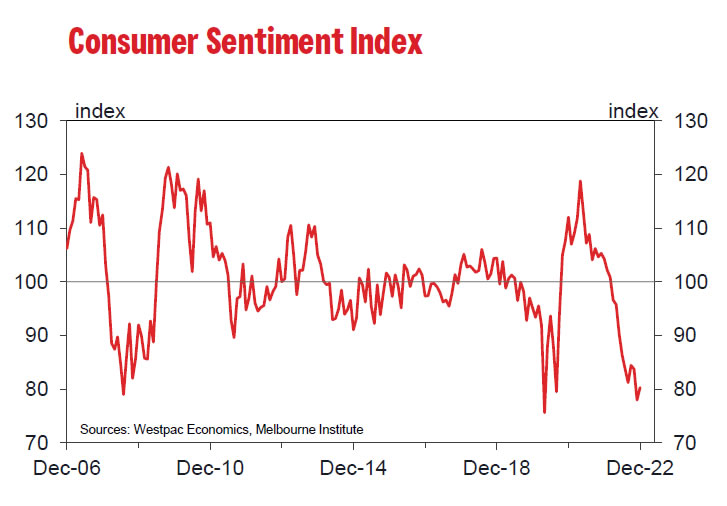
Australia Westpac consumer sentiment bounced from near record low
Australia Westpac Consumer Sentiment Index bounced from near record low and rose 3% from 78.0 to 80.3 in December. But the level remains comparable to the lows see during the pandemic and the Global Financial Crisis.
Concerns over inflation remained dominant among respondents, followed by budget and taxation, economic conditions and interest rates.
Westpac expects RBA to continue to deliver on its "strong tightening bias" in February and hike by 25bps, and signal that there is still more work to be done.
BoC Macklem: Higher interest rates are working to rebalance the economy
BoC Governor Tiff Macklem said in a speech yesterday, "Higher interest rates are working to rebalance the economy. Domestic demand is slowing, and we expect growth in gross domestic product will be close to zero through to the middle of next year as the economy adjusts to higher interest rates. This will relieve domestic price pressures, and inflation will come down."
He reiterated the position that the central bank will be considering "whether there is a need to increase the policy rate further". He explained, "This means that decisions to raise the rate or to pause and assess the impact of past rate increases will depend on incoming data and our judgments about the outlook for inflation."
Macklem also said BoC is "watching very closely to see how the economy is responding to higher interest rates". It is looking at an job market data, how supply chains are resolving, how business are passing on costs, measures of core inflation, and inflation expectations.
GBP/USD Eyes Upside Break, US CPI Next
Key Highlights
- GBP/USD could rally further above the 1.2350 and 1.2400 levels.
- A major bullish trend line is forming with support near 1.2225 on the 4-hours chart.
- The UK Claimant count could change -13.3K in Nov 2022.
- The US CPI could increase 7.3% in Nov 2022 (YoY), down from +7.7%.
GBP/USD Technical Analysis
The British started a fresh increase above 1.2000 against the US Dollar. GBP/USD settled above the 1.2120 level to move into a positive zone.
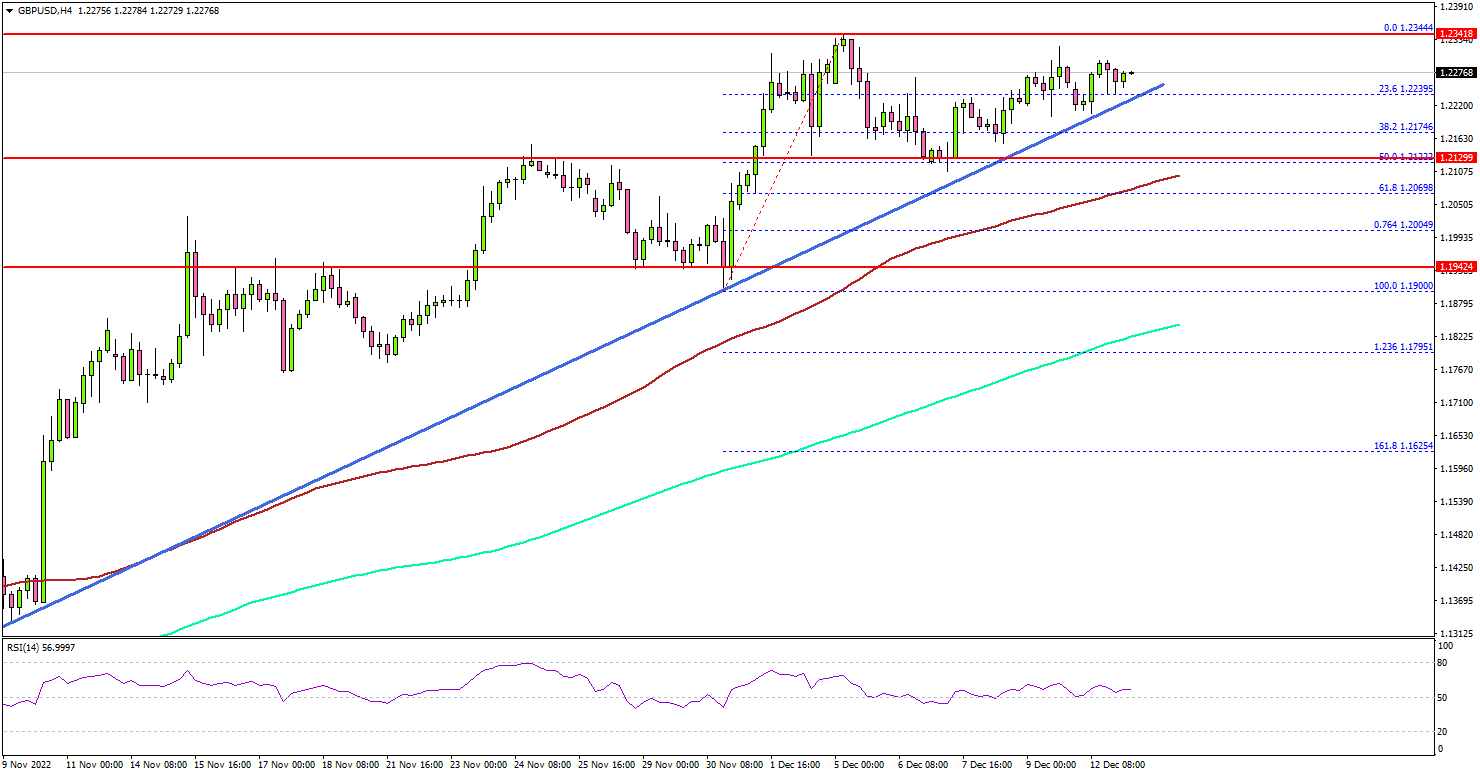
Looking at the 4-hours chart, the pair gained pace above the 1.2150 level. The pair even settled above the 1.2200 level, the 100 simple moving average (red, 4-hours), and the 200 simple moving average (green, 4-hours).
This past week, the pair attempted an upside break above 1.2350 but failed. As a result, there was a downside correction to 1.2100. It remained well supported and started a fresh increase above 1.2200.
There is also a major bullish trend line forming with support near 1.2225 on the same chart. The next major support is near the 1.2120 zone.
Any more losses might send the pair towards the 1.2080 support zone and the 100 simple moving average (red, 4-hours). If the bears push the pair further lower, there might be a test of the 1.1840 support zone.
On the upside, the pair is facing resistance near the 1.2320. The next major resistance may perhaps be near 1.2350. A clear move above the 1.2350 resistance might start another decent increase.
In the stated case, GBP/USD may perhaps test 1.2420. Any more gains could set the pace for a move towards the 1.2500 resistance zone.
Looking at EUR/USD, the pair is also showing bullish signs and there are chances of a move above the 1.0620 resistance zone.
Economic Releases
- UK Claimant Count Change for Nov 2022 – Forecast -13.3K, versus -3.3K previous.
- UK ILO Unemployment Rate Oct 2022 (3M) – Forecast 3.7%, versus 3.6% previous.
- US Consumer Price Index for Nov 2022 (MoM) – Forecast +0.3%, versus +0.4% previous.
- US Consumer Price Index for Nov 2022 (YoY) – Forecast +7.3%, versus +7.7% previous.
- US Consumer Price Index Ex Food & Energy for Nov 2022 (YoY) – Forecast +6.1%, versus +6.3% previous.
Will the ECB Signal the Need for More Rate Hikes?
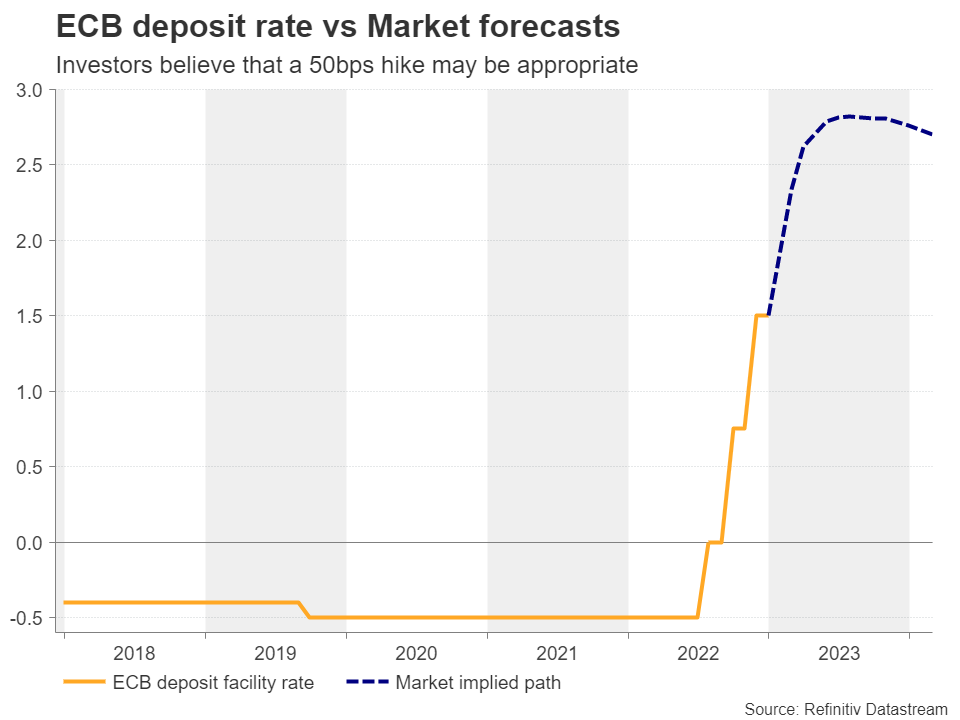
Following the slowdown in the euro area inflation during the month of November, investors changed their minds with regards to whether another triple hike is needed by the ECB, with hopes of a peak in sky-high prices allowing them to conclude that a 50bps increment may be more appropriate. The ECB meets on Thursday at 13:15 GMT, and it remains to be seen whether investors are right or wrong. A bigger question though may be what kind of signals officials will offer with regards to their future plans, and how the euro may react.
Investors believe that a 50bps hike may be appropriate
Since deciding to begin its tightening crusade in July, the ECB has been raising interest rates at its fastest pace on record, already adding 200 basis points to its key deposit rate. At its latest gathering, the Bank delivered its second 75bps hike, with the minutes of that meeting revealing that policymakers were anxious about inflation becoming entrenched.
However, according to preliminary data, inflation slowed by more than expected in November, with the headline rate of the harmonized index of consumer prices sliding to 10.0% y/y from 10.6%. This offered a degree of relief to investors, who scaled back bets of a third triple hike and became more convinced that a 50bps increment may be appropriate. That said, according to money markets, there is a decent 30% chance of another triple hike, which means that not all participants believe that a slowdown is appropriate. According to a Reuters poll, 7 out of 60 economists surveyed also believe that a more aggressive action is warranted.
Spotlight to fall on accompanying language
Ergo, a 50bps hike may come as a disappointment to those expecting a bolder move and the euro may slide on such a decision. That said, any hike-related retreat may remain limited and short-lived, as a half-point hike is the base case scenario. Traders are likely to quickly turn their attention to the accompanying statement for clues and hints with regards to the Bank’s future course of action. Although the updated macroeconomic projections are a downside risk for the euro, as they could point to a recession in 2023, a hawkish message and even a split Council with some members favoring a larger hike could eventually prove supportive for the euro.
Ahead of the November inflation data, ECB President Christine Lagarde said that inflation has not peaked, while chief economist Philip Lane more recently said that they will have to raise rates several more times, even if inflation is now close to its peak, remarks which add some credence to the hawkish case.
Economic releases permit a hawkish tone
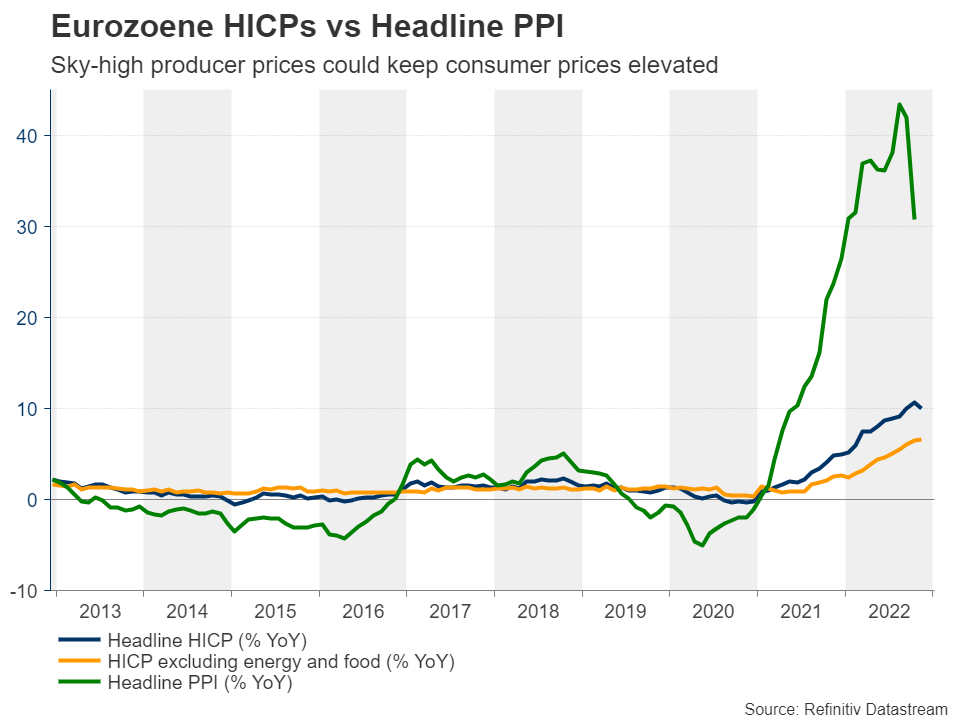
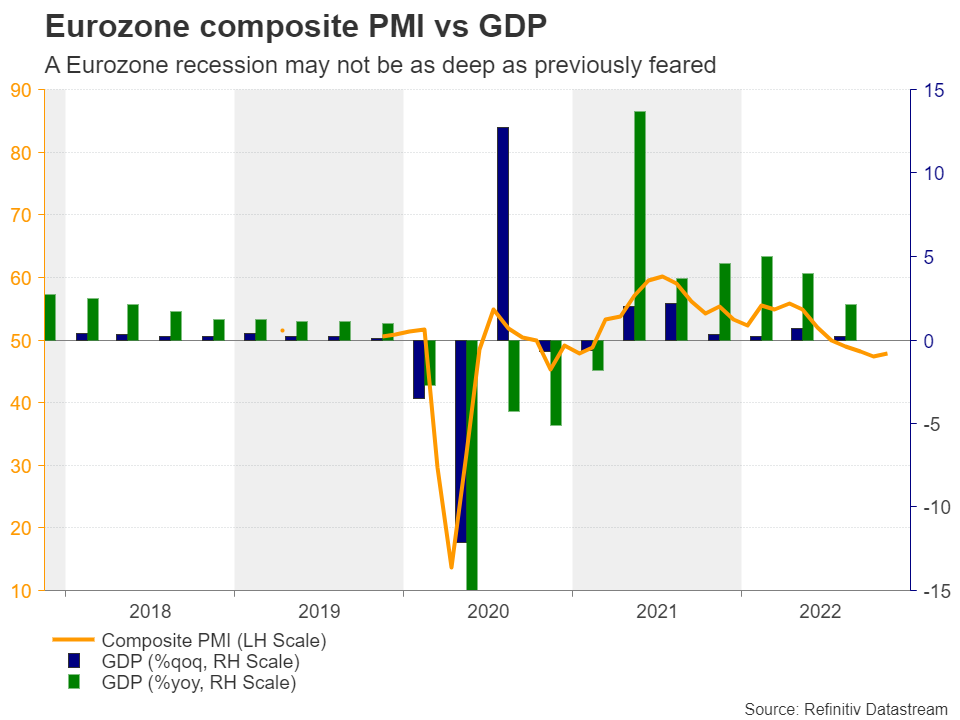
After all, headline inflation remains in double digits, core inflation has yet to show signs of topping, while the headline PPI rate, despite a deep slowdown during last month, remains at unparalleled levels (around 30%). Surging producer prices could well be channeled into consumer prices in coming months, which doesn’t allow room for complacency. On top of that, the S&P Global composite PMI pointed to another month of contraction in November, but it rose instead of sliding like it was initially forecast. Yes, a recession in the euro area seems inevitable, and the ECB’s forecasts may well confirm that, but the PMIs may have added to hopes that the wounds may not be as deep as feared a couple of months ago, thereby giving another reason to policymakers for signaling that this fight against inflation is not over yet.
This tilts the risks surrounding the reaction of the euro to the upside, even in the case of a 50bps hike. For the euro to stay wounded in the aftermath, the statement and President Lagarde may have to signal and highlight that inflation has already peaked, which according to the aforementioned data doesn’t seem a likely scenario.
Euro/dollar awaits not only the ECB, but the Fed as well
However, how the euro will perform against its US counterpart may also depend on the outcome of the FOMC decision just the day before. So, for the common currency to perform well against the greenback in case ECB officials appear in their hawkish suits, the Fed decision may need to have a dovish flavor. A median dot for 2023 below the terminal rate projected by the market could perhaps do the trick. Of course, if the ECB pushes the triple-hike button for a third consecutive time, the euro is likely to shoot higher without caring what the Fed has done.
From a technical standpoint, euro/dollar has been struggling to break above the 1.0600 zone, which offered strong resistance back in June and also coincides with the 38.2% Fibonacci retracement level of the May 2021 – September 2022 downtrend. A dovish Fed and/or a hawkish ECB could result in the break above that obstacle, a move that could see scope for upside extensions towards the 1.0800 territory, marked by the high of May 30.
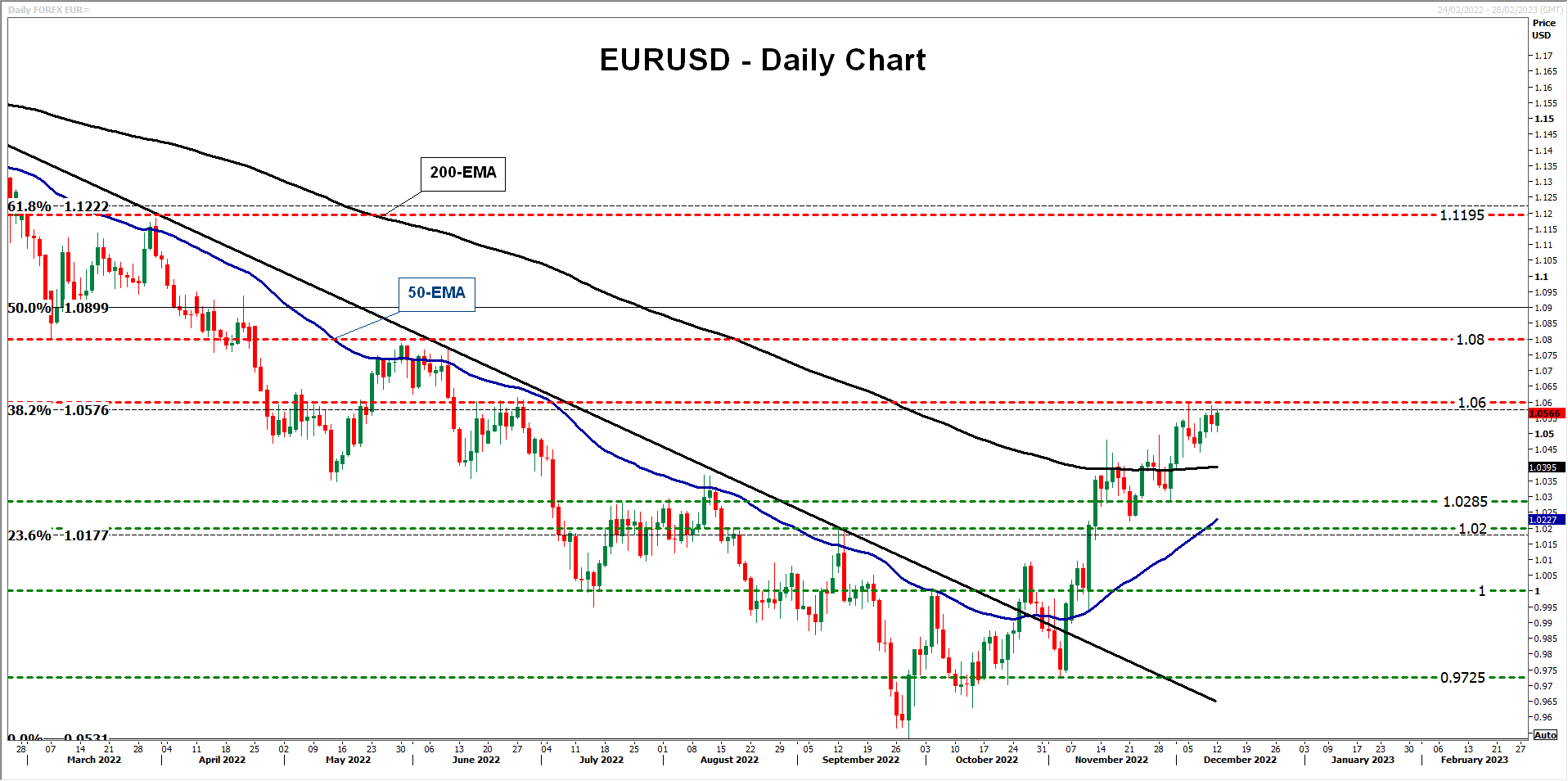
Now, in the less likely case of ECB policymakers signaling that euro area inflation has already peaked, the pair may pull back and perhaps test the support zone of 1.0285, marked by the low of November 30, or the 1.0200 area, defined as support by the inside swing high of September 12.
GBPNZD Wave Analysis
- GBPNZD reversed from key support level 1.9135
- Likely to rise to resistance level 1.9400
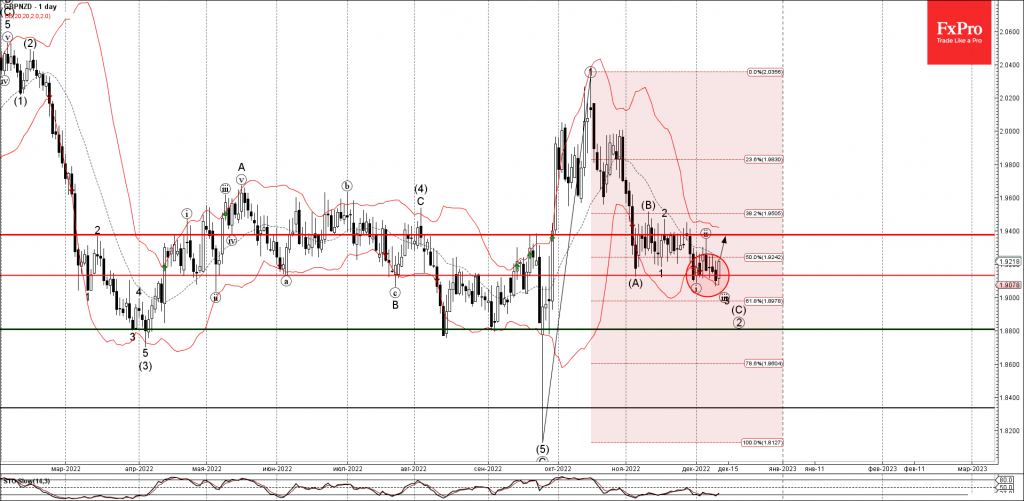
GBPNZD today reversed up from the key support level 1.9135 (which has been repeatedly reversing the pair from the start of November) – intersecting with the lower daily Bollinger Band.
The upward reversal from the support level 1.9135 will form the daily Japanese candlesticks reversal pattern Bullish Engulfing – if the pair closes today near the current levels.
GBPNZD gas can be expected to rise further toward the next resistance level 1.9400 (top of the earlier minor correction (ii) from the start of this month).
Gold Wave Analysis
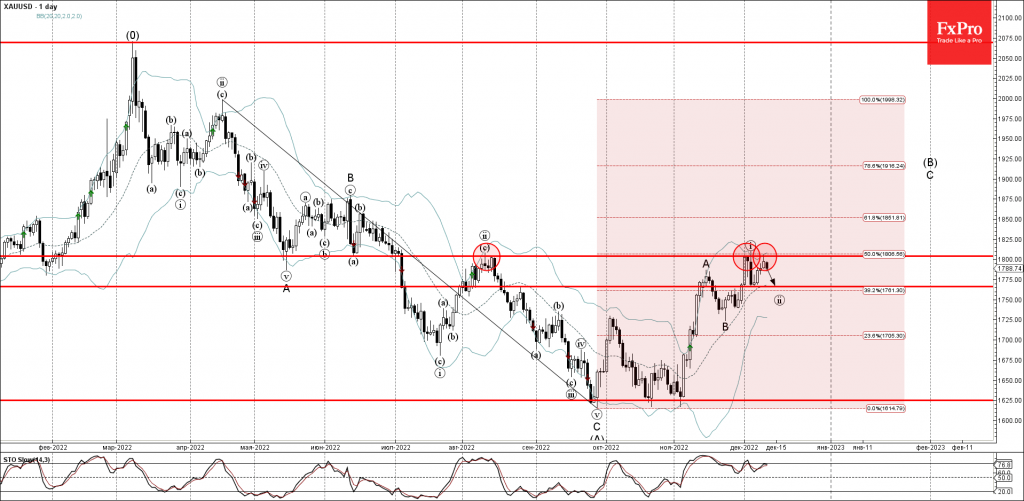
- Gold reversed from key resistance level 1800.00
- Likely to fall to support level 1765.00
Gold previously reversed down from the major resistance level 1800.00 (which has been steadily reversing the price from May, when it served as the strong support).
The resistance level 1800.00 was further strengthened by the intersecting upper daily Bollinger Band and by the 50% Fibonacci correction of the downward impulse from April.
Gold gas can be expected to fall further toward the next support level 1765.00 (low of the earlier Morning Star from the start of December).
Brent Lost 11% Over Week
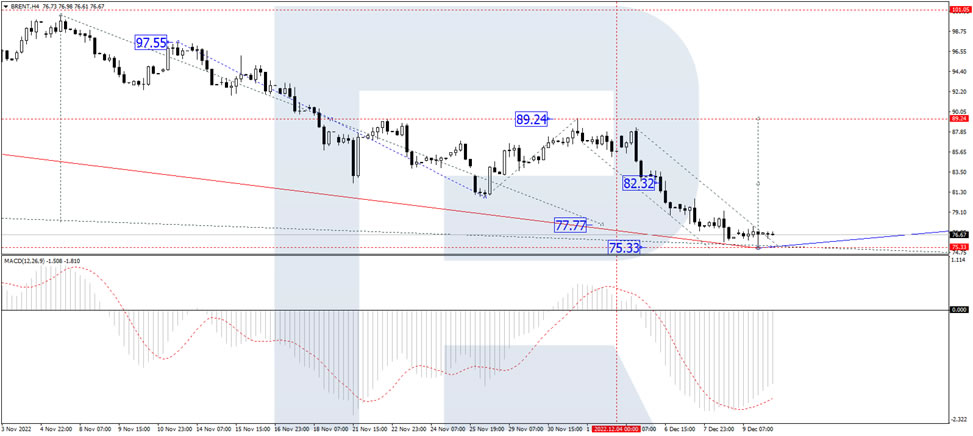
The crude oil market keeps trying to stabilise but fails. Brent barrel started this week by an attempt to reach 76.55 USD.
On the whole, the probability of an equally fast decline looks limited. Nonetheless, investors may react negatively to the oil demand forecasts presented by OPEC and the IEA. However, market participants can use the fact that the Keystone Pipeline that delivers crude oil from Canada to the US is still laying idle.
According to Baker Hughes, the number of active drills in the US has dropped by 2 over a week, reaching 625 units.
On H4, Brent has reached the local goal of the wave of decline at 75.33. Today the market is forming a structure of a wave of growth to 89.40. A link of correction to 82.30 is expected, followed by growth to 101.00. Technically, this scenario is confirmed by the MACD: its signal line is headed strictly upwards to zero. A breakaway and further growth to new highs should follow.
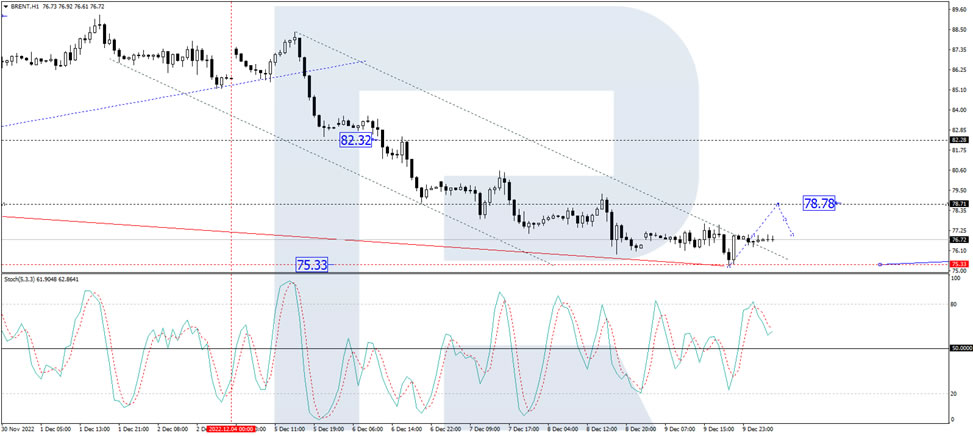
On H1, Brent has formed the first impulse of growth to 77.00. A link of correction to 76.06 is not excluded. Then a new structure of growth is expected to develop to 78.78. Technically, this scenario is confirmed by the Stochastic oscillator. Its signal line is under 80, headed strictly down to 50. A bounce off it and growth back to 80 are expected.
‘Quite before the (potential) storm’ on markets today
Markets
‘Quite before the (potential) storm’ on markets today as investors are counting down to a large plethora of data and policy decisions later this week. European and Asian investors started the week with a tentative risk-off mood as a cold snap in most of Europe and rising Covid infections in China highlight short-term roadblocks to economic activity in both regions. European equities are ceding about 0.5%. US indices open marginally positive after Friday’s setback. Contrary to end last week when higher yields weighed on (especially) US equities, a fragile risk sentiment again caused a bull flattening/further inversion of EMU and US yields curves. German yields are ceding between 2 bps (2-y) and 7 bps (30-y). US yields in a similar fashion are declining between 2 bps (2-y) and 6.5 bps (30-y). Still, with the German and US 10-y yield holding at 1.85% and 3.53% respectively, key technical levels at 1.77% and 3.50/3.42% for now aren’t challenged any further. Intra-EMU spreads continue a cautious narrowing (10-y Italy minus 3 bps) even as the ECB on Thursday is expected to announce a framework to start a (gradual) roll-off of its APP bond holdings. Later today, the US Treasury will sell $40 bln of 3-year and $32 bln of 10-y Notes. It’s interesting to see investors appetite for the bond after recent substantial repricing/curve inversion, especially for bond with longer-dated maturities.
On FX markets, the dollar again fails to maintain Friday’s rebound even as declines in US and European yields are quite similar. The DXY TW USD (104.75) index again dropped below the 105 barrier with the correction low (104.11) still within reach. At 1.056, the EUR/USD cross rate also keeps the key 1.0611 target on the radar. The yen underperforms with USD/JPY trying to regain the 137 big figure. Higher-than-expected Japanese PPI inflation (9.3%) published this morning obviously isn’t enough to change markets’ assessment on the BOJ’s approach in the near future. After a surprising outperformance of sterling on Friday, EUR/GBP today returned to well-known territory in the 0.86 area. UK October production/monthly GDP data were slightly better than expected, but should be considered a bit outdated and probably won’t change the BoE’s assessment. Among the smaller currencies the Swiss franc continues to trade rather weak (EUR/CHF 0.986) as markets ponder whether the SNB will raise its policy rate by 75 or 50 bps at its policy meeting on Thursday, with the second option seen as most likely.
News Headlines
Czech inflation accelerated more than expected in November, by 1.2% M/M lifting the Y/Y outcome from 15.1% in October to 16.2%. Inflation would have been 3.6 percentage points higher if it weren’t for the inclusion of government measures. “Housing, water, electricity, gas and other fuels” and “food and non-alcoholic beverages” recorded the biggest monthly increases. Last year’s lower comparative base, when VAT was waived for electricity and natural gas prices, partially contributed to the increase. Prices of goods in total went up by 1.8% M/M (18.5% Y/Y) and prices of services by 0.3% (12.7% Y/Y). The overall November inflation figure was more than two percentage points lower than expected in the Czech National Bank’s autumn forecast. The negative deviation was due mainly to administered prices, which reflected a fall in electricity prices in October due to the statistical inclusion of the energy savings tariff. Core inflation declined, but remains high at 13.8% Y/Y. The CNB expects Y/Y price growth to remain volatile in the near future. It will only be around mid-2023 that inflation is expected to fall to single digit levels with a return closer to the 2% inflation target in H1 2024. EUR/CZK didn’t respond to the release, trading extremely steady at 24.30. The Czech swap yield curve turns slightly more inverse with yields up to 5 bps higher at the front end following an initial spike of almost 15 bps.
Slovak debt agency Ardal announced its 2023 borrowing requirements. They aim to raise €8bn in long term funding, split evenly between regular auctions (9) and new syndications (2). It compares with €5.2bn YTD this year. The country’s maturity profile suggests a new long 10-12y bond and one with a medium-term maturity. Typically, Ardal aims for early Spring and Autumn syndications. T-bill issuance doesn’t make part of next year’s plans. Slovakia has around €55bn of government bonds outstanding with the debt to GDP ratio expected to revert <60% by the end of this year and stabilize thereafter.