

Sample Category Title
CAD Falls Broadly after GDP, Markets Lag Direction Elsewhere
Canadian Dollar falls broadly after weaker than expected GDP data. Dollar and Swiss Franc are also weak on steady market sentiment. Australia and New Zealand Dollar are currently the strongest ones, followed by Sterling. But all three are just staying in range against the greenback. Euro is also relatively directionless with mixed trading with Yen together.
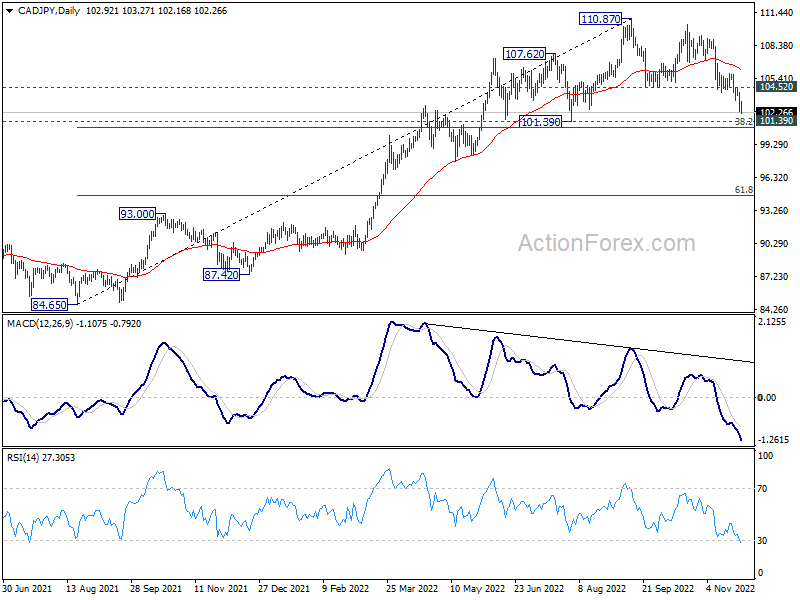
Technically, CAD/JPY is extending the fall from 110.87. Such decline is seen as a correction to the up move from 84.65. Downside could be contained by 101.39 support zone (38.2% retracement of 84.65 to 110.87 at 100.85) to bring rebound, at least on first attempt. But overall, further fall will remain in favor as long as 104.52 minor resistance holds.
In Europe, at the time of writing, FTSE is up 0.67%. DAX is up 0.05%. CAC is up 0.18%. Germany 10-year yield is down -0.053 at 1.943. Earlier in Asia, Nikkei dropped -0.48%. Hong Kong HSI rose 5.24%. China Shanghai SSE rose 2.31%. Singapore Strait Times rose 1.12%. Japan 10-year JGB yield dropped -0.038 to 0.254.
Canada GDP grew 0.1% mom in Sep, to be unchanged in Oct
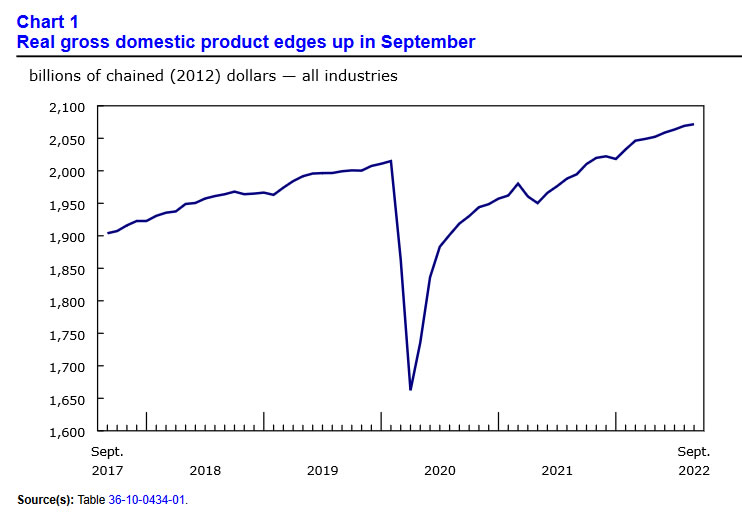
Canada GDP rose 0.1% mom in September, below expectation of 0.2% mom. Goods-producing industries grew 0.3% while services-producing industries were essentially unchanged.
Advance information indicates that real GDP was unchanged in October. Increases in the public, transportation and warehousing, construction and wholesale trade sectors were offset by decreases in the manufacturing and mining, quarrying and oil and gas extraction sectors.
BoE Mann: Medium-term inflation expectation important for next rate vote
BoE MPC member Catherine Mann said at an online event, "looking at medium-term expectations is a very important ingredient to my assessment of what the appropriate Bank Rate at the next vote might be."
"Once inflation expectations have been managed, the bank rate can come off a future peak," she added. At the same time, foreign exchange rate is also an "important ingredient" for inflation in the UK.
Eurozone economic sentiment rose to 93.7 in Nov, first increase since Feb
Eurozone Economic Sentiment Indicator rose from 92.7 to 93.7 in November, the first increase since February. Industrial confidence dropped from -1.2 to -2.0. Services confidence rose from 2.1 to 2.3. Consumer confidence rose from -27.5 to -23.9. Retail trade confidence was unchanged at -6.7. Construction confidence dropped from 2.6 to 2.3. Employment Expectation Indicator rose from 105.4 to 107.4. Economic Uncertainty Indicator dropped from 30.7 to 28.4.
EU ESI rose from 91.2 to 92.2. Amongst the largest EU economies, the ESI increased strongly in Italy (+4.1) and, to a lesser extent, the Netherlands (+1.2) and Germany (+1.1), while it eased in Spain (-1.7) and France (-1.6). Sentiment in Poland stayed broadly flat (+0.3). EEI rose from 104.9 to 106.3. EUI dropped from 29.8 to 27.8.
Swiss GDP grew 0.2% qoq in Q3
Swiss GDP grew 0.2% qoq in Q3, matched expectations. Looking at some details, manufacturing contracted -0.2%. Construction dropped -2.2%. Finance and insurance dropped -2.1%. But trade expanded 2.3% while accommodation and food rose 2.8%.
By expenditure approach, private consumption grew 0.7%. Equipment and software investment rose 2.1%. Exports excluding valuables rose 7.89%. But construction investment dropped -2.0%.
NZIER: RBNZ rate to peak at 5% next year
In the November Monetary Policy Statement, RBNZ projected that interest rate would peak at 5.5% while the economy would start contracting in Q2 2023 until Q1 2024.
NZIER said it expected the negative impact of higher interest rates on demand will "become more apparent around mid-2023". With that, RBNZ "will not need to increase interest rates by as much as it currently expects to".
"Nonetheless, we expect further increases in the OCR and for it to peak at 5 percent over the coming year," NZIER added.
USD/CAD Mid-Day Outlook
Daily Pivots: (S1) 1.3420; (P) 1.3462; (R1) 1.3539; More....
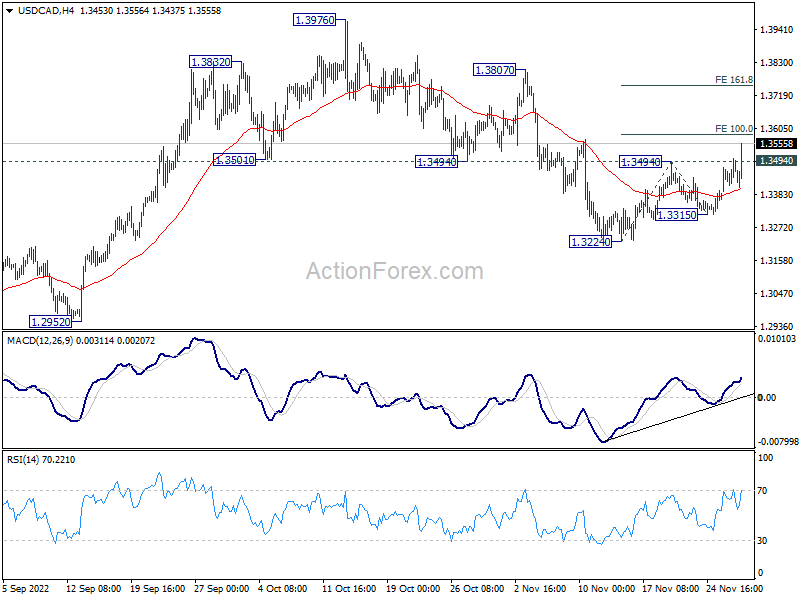
USD/CAD's rise from 1.3224 resumed by breaking through 1.3494 resistance finally. The development adds to the case that correction from 1.3976 has completed at 1.3224. Intraday bias is now back on the upside. Further break of 100% projection of 1.3224 to 1.3494 from 1.3315 at 1.3585 should prompt upside acceleration to 161.8% projection at 1.3752. This will now remain the favored case as long as 1.3315 support holds, in case of retreat.
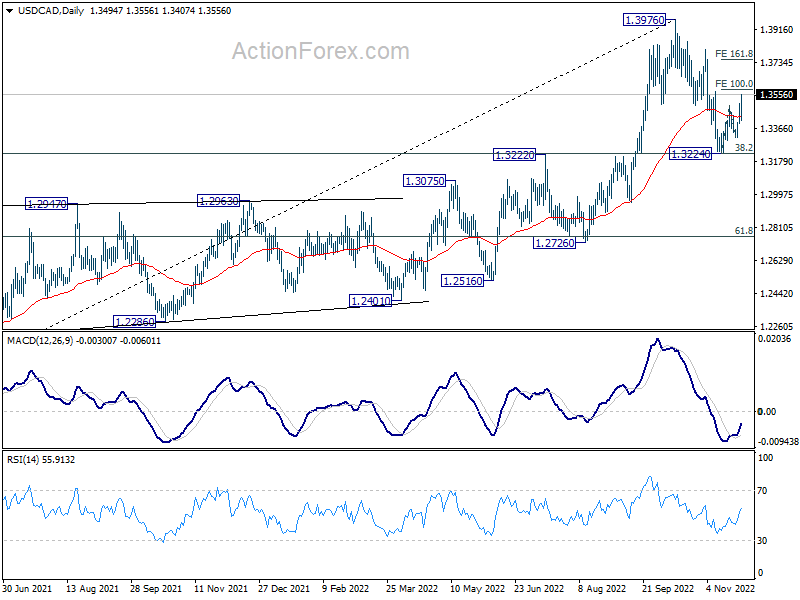
In the bigger picture, as long as 1.3222 cluster support (38.2% retracement of 1.2005 to 1.3976 at 1.3223) holds, larger up trend from 1.2005 (2021 low) is still expected to resume through 1.3976 high at a later stage. However, firm break of 1.3222/3 will indicate that the trend might have reversed. Deeper fall would be seen to next cluster support at 1.2726 (61.8% retracement at 1.2758).
Economic Indicators Update
| GMT | Ccy | Events | Actual | Forecast | Previous | Revised |
|---|---|---|---|---|---|---|
| 23:30 | JPY | Unemployment Rate Oct | 2.60% | 2.60% | 2.60% | |
| 23:50 | JPY | Retail Trade Y/Y Oct | 4.30% | 5.00% | 4.50% | 4.80% |
| 08:00 | CHF | GDP Q/Q Q3 | 0.20% | 0.20% | 0.30% | 0.10% |
| 09:30 | GBP | M4 Money Supply M/M Oct | 0.00% | 0.80% | 2.10% | |
| 09:30 | GBP | Mortgage Approvals Oct | 59K | 60K | 67K | |
| 10:00 | EUR | Eurozone Economic Sentiment Nov | 93.7 | 93 | 92.5 | 92.7 |
| 10:00 | EUR | Eurozone Industrial Confidence Nov | -2 | -0.8 | -1.2 | |
| 10:00 | EUR | Eurozone Services Sentiment Nov | 2.3 | 3.4 | 1.8 | |
| 10:00 | EUR | Eurozone Consumer Confidence Nov F | -23.9 | -23.9 | -23.9 | |
| 13:00 | EUR | Germany CPI M/M Nov P | -0.50% | 2.00% | 0.90% | |
| 13:00 | EUR | Germany CPI Y/Y Nov P | 10.00% | 10.90% | 10.40% | |
| 13:30 | CAD | GDP M/M Sep | 0.10% | 0.20% | 0.10% | |
| 14:00 | USD | S&P/Case-Shiller Home Price Indices Y/Y Sep | 10.70% | 13.10% | ||
| 14:00 | USD | Housing Price Index M/M Sep | -1.20% | -0.70% | ||
| 15:00 | USD | Consumer Confidence Nov | 100 | 102.5 |
BoE Mann: Medium-term inflation expectation important for next rate vote
BoE MPC member Catherine Mann said at an online event, "looking at medium-term expectations is a very important ingredient to my assessment of what the appropriate Bank Rate at the next vote might be."
"Once inflation expectations have been managed, the bank rate can come off a future peak," she added. At the same time, foreign exchange rate is also an "important ingredient" for inflation in the UK.
Canada GDP grew 0.1% mom in Sep, to be unchanged in Oct
Canada GDP rose 0.1% mom in September, below expectation of 0.2% mom. Goods-producing industries grew 0.3% while services-producing industries were essentially unchanged.
Advance information indicates that real GDP was unchanged in October. Increases in the public, transportation and warehousing, construction and wholesale trade sectors were offset by decreases in the manufacturing and mining, quarrying and oil and gas extraction sectors.
Aussie Storms Higher
The Australian dollar has rebounded on Tuesday after a poor start to the week. In the European session, AUD/USD is trading at 0.6737, up 1.28%.
What goes down … can go right back up. This has been the story early this week for the Australian dollar, which tumbled 1.5% on Monday but has recovered most of those losses today. The Australian dollar was hit hard after a weak retail sales report and widespread unrest in China over the country’s zero-covid policy. The unrest in China has put a damper on risk appetite, as the result is likely to exacerbate supply chain disruptions and dampen domestic spending. Investors may have sensed an opportunity for profit-taking after the massive slide on Monday, which would help explain the rebound today.
Fed members keep up the blitz
The Fed doesn’t hold a policy meeting for another two weeks, but the Fedspeak blitz, which started after the soft US inflation report sent the markets in a tizzy, continued in earnest on Monday. Fed member Bullard said on Monday the markets could be underestimating the likelihood of higher rates and that the Fed funds rate will have to reach the bottom end of the 5%-7% range in order to curb inflation, which has been more persistent than anticipated. Fed member Williams added that the Fed needed to do more work to tame inflation, which is “far too high”. Fed member Brainard, a dove, expressed concern about inflation expectations rising above the Fed’s 2% target. The Fed has been aggressive in telegraphing the markets that its rate cycle is far from over, a message we’re likely to continue to hear in the coming weeks.
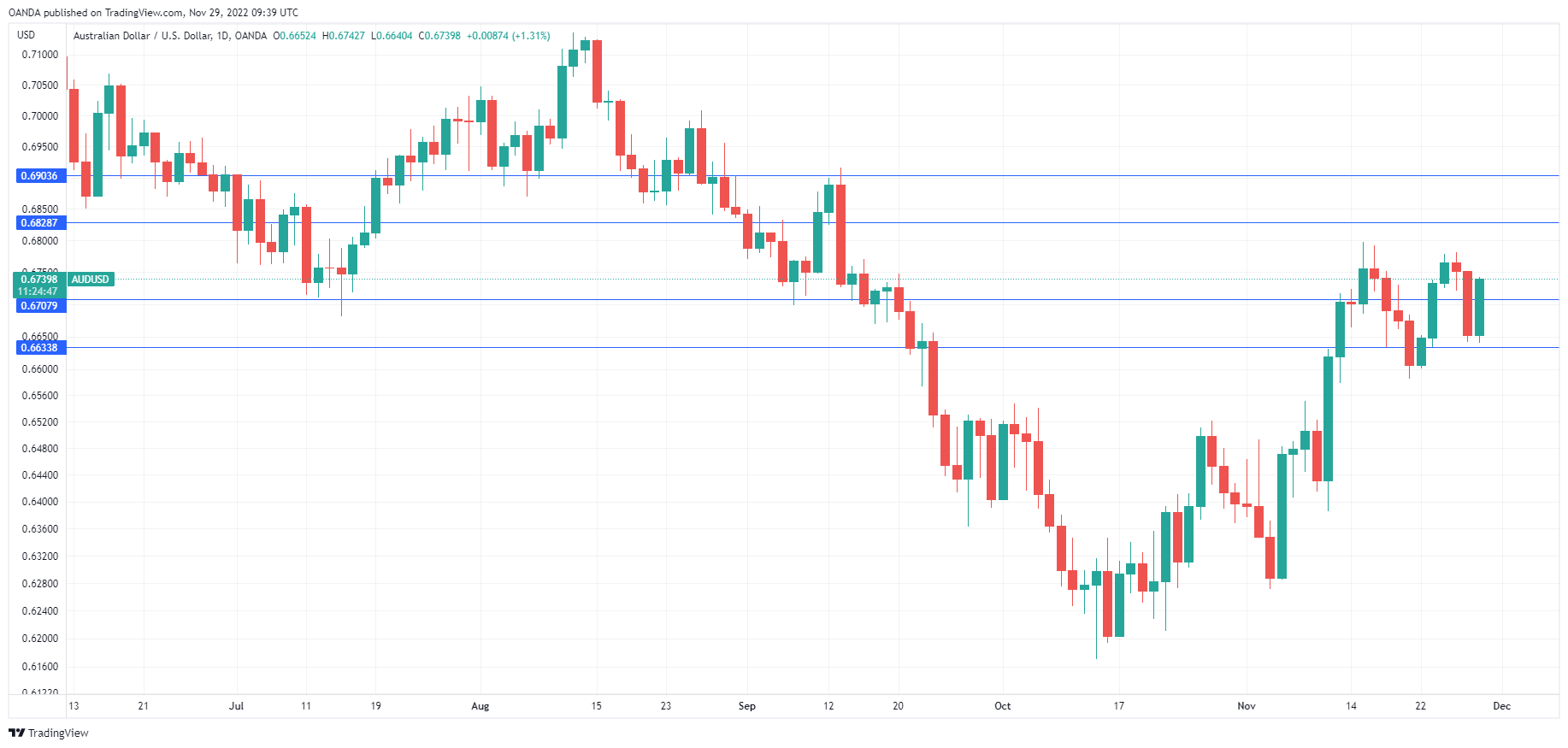
AUD/USD Technical
- AUD/USD is testing resistance at 0.6707. The next resistance line is 0.6829
- There is support at 0.6633 and 0.6511
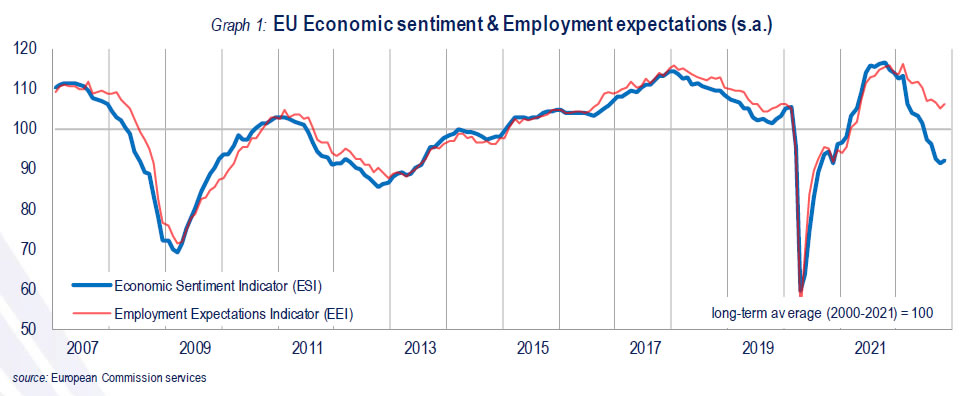
Eurozone economic sentiment rose to 93.7 in Nov, first increase since Feb
Eurozone Economic Sentiment Indicator rose from 92.7 to 93.7 in November, the first increase since February. Industrial confidence dropped from -1.2 to -2.0. Services confidence rose from 2.1 to 2.3. Consumer confidence rose from -27.5 to -23.9. Retail trade confidence was unchanged at -6.7. Construction confidence dropped from 2.6 to 2.3. Employment Expectation Indicator rose from 105.4 to 107.4. Economic Uncertainty Indicator dropped from 30.7 to 28.4.
EU ESI rose from 91.2 to 92.2. Amongst the largest EU economies, the ESI increased strongly in Italy (+4.1) and, to a lesser extent, the Netherlands (+1.2) and Germany (+1.1), while it eased in Spain (-1.7) and France (-1.6). Sentiment in Poland stayed broadly flat (+0.3). EEI rose from 104.9 to 106.3. EUI dropped from 29.8 to 27.8.
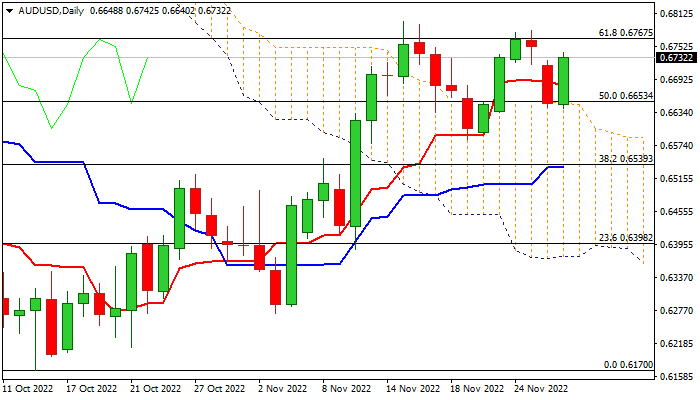
AUD/USD: Aussie Rallies on Improved Sentiment as Top of Thick Daily Cloud Provides Strong Support
The Australian dollar bounces strongly in Asian / early European trading on Tuesday (up 1.3%), lifted by improved risk sentiment on speculations that China could ease Covid restrictions after recent protests.
Fresh bullish acceleration comes after repeated rejection at the top of thick daily cloud (0.6649) which continues to underpin near-term action.
Daily studies maintain strong bullish momentum and improved on the latest rally which pushed the price above converged 10/100DMA’s, bringing moving averages in full bullish setup.
Bulls look for retest of key resistance zone (0.6767/97) provided by Fibo 61.8% of 0.7136/0.6170 / recent tops of Nov 15/24, with firm break here to generate signal bullish continuation.
Extension of larger uptrend from 0.6170 (Oct 13) would focus targets at 0.6906/16 (Fibo 76.4% / Sep 13 high).
Daily cloud top marks strong support, guarding lower pivots at 0.6584/52 (Nov 21 trough / Fibo 38.2% of 0.6170/0.6797) loss of which would weaken near-term structure.
Res: 0.6780; 0.6797; 0.6894; 0.6906
Sup: 0.6698; 0.6649; 0.6614; 0.6584
GBPUSD Needs Break Above 200-SMA
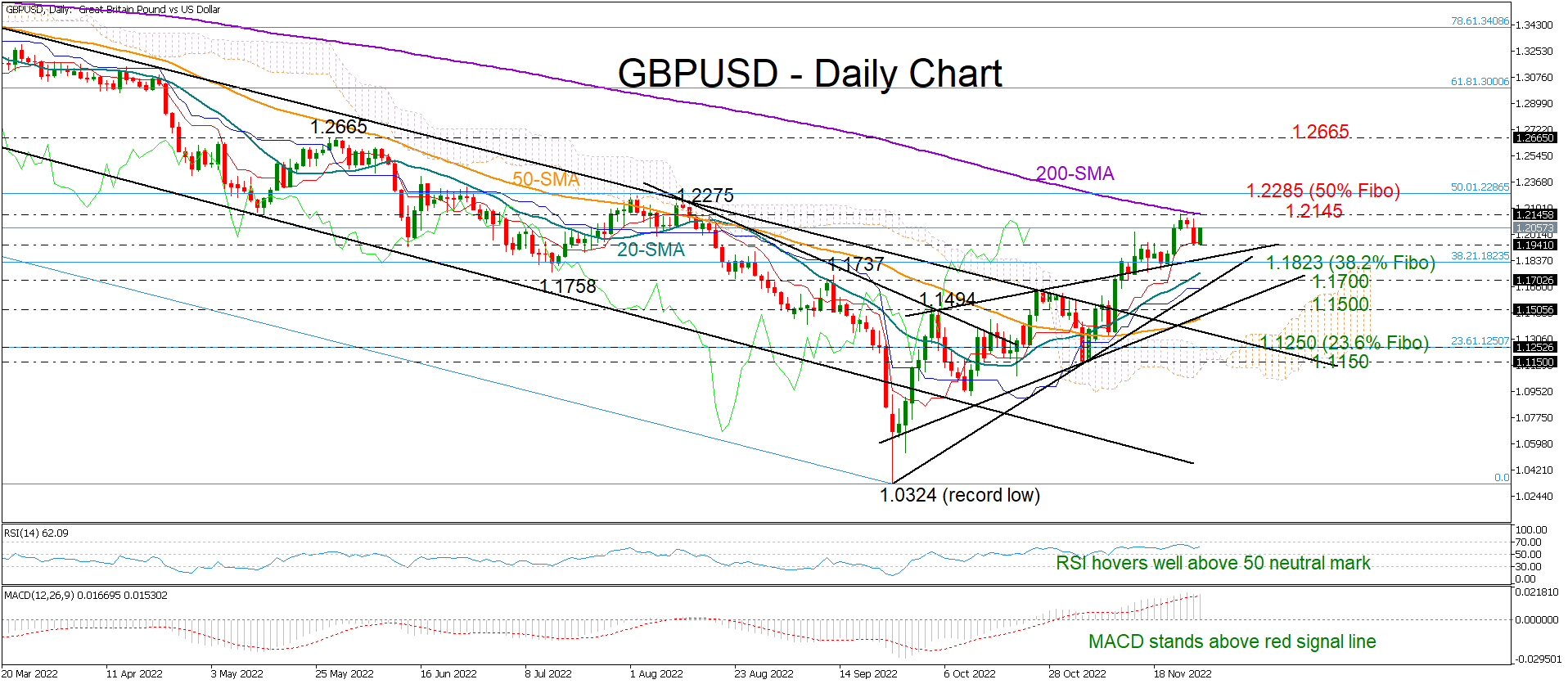
GBPUSD finished Monday’s session on the negative side, unable to climb above the 200-day simple moving average (SMA) at 1.2145 once again; the line has been acting as a crucial ceiling to upside movements since September 2021.
The positive structure of higher highs and higher lows in the short-term picture remains valid, backed by the bullish cross between the 20- and 50-day SMAs.
Encouragingly, the momentum indicators are still in favor of the bulls despite the latest retreat in the price. The RSI is maintaining a positive trajectory above its 50 neutral mark and the MACD is standing above its red signal and zero lines. Adding to the optimism is the flattening red Tenkan-sen line, which is fluctuating some distance above the blue Kijun-sen line.
Support is currently provided by the red Tenkan-sen line at 1.1940, where the 50-period SMA is positioned in the four-hour chart. If that base stands firm, the pair may again challenge the 200-day SMA with scope to reach the 50% Fibonacci retracement of the 1.4248–1.0324 downleg at 1.2285. The area has been a key resistance zone during the second half of 2022. Therefore, a sustainable move above that wall could renew bullish pressures, sparking a rally towards the next barrier of 1.2665.
On the downside, the 1.1823–1.1700 zone, which encapsulates two constraining lines, the 20-day SMA, and the 38.2% Fibonacci, may limit selling pressures. If not, the lower ascending trendline currently at 1.1500 may prevent an outlook deterioration and an aggressive decline towards the 1.1250–1.1150 support area.
In brief, GBPUSD keeps trading within a bullish region, though only an advance above the 200-day SMA would bring new buyers into the market.
Swiss GDP grew 0.2% qoq in Q3
Swiss GDP grew 0.2% qoq in Q3, matched expectations. Looking at some details, manufacturing contracted -0.2%. Construction dropped -2.2%. Finance and insurance dropped -2.1%. But trade expanded 2.3% while accommodation and food rose 2.8%.
By expenditure approach, private consumption grew 0.7%. Equipment and software investment rose 2.1%. Exports excluding valuables rose 7.89%. But construction investment dropped -2.0%.
EURJPY Retreats Below 50-day SMA
EURJPY has been in a prolonged uptrend since early March, generating consecutive multi-year peaks. However, the pair has been losing ground in the short term after its rally paused at the eight-year high of 148.39.
The momentum indicators currently suggest that bearish forces are strengthening. Specifically, the RSI has crossed below its 50-neutral mark, while the MACD histogram is retreating further below both zero and its red signal line.
If sellers push the price lower, initial support could be met at the recent low of 142.54. Diving beneath that region, the bears could aim for 141.00 before the spotlight turns to the September low of 137.30. Even lower, the 135.50 hurdle could provide downside protection.
On the flipside, bullish actions could boost the price towards the 50-day simple average (SMA), currently at 144.28. Piercing through that zone, the pair could ascend towards 146.12 or higher to test the 147.75 barrier. A break above the latter might then set the stage for the eight-year high of 148.39.
In brief, EURJPY appears ready to extend its pullback as negative momentum is intensifying. Therefore, a break below the recent low of 142.54 might open the door for further downside.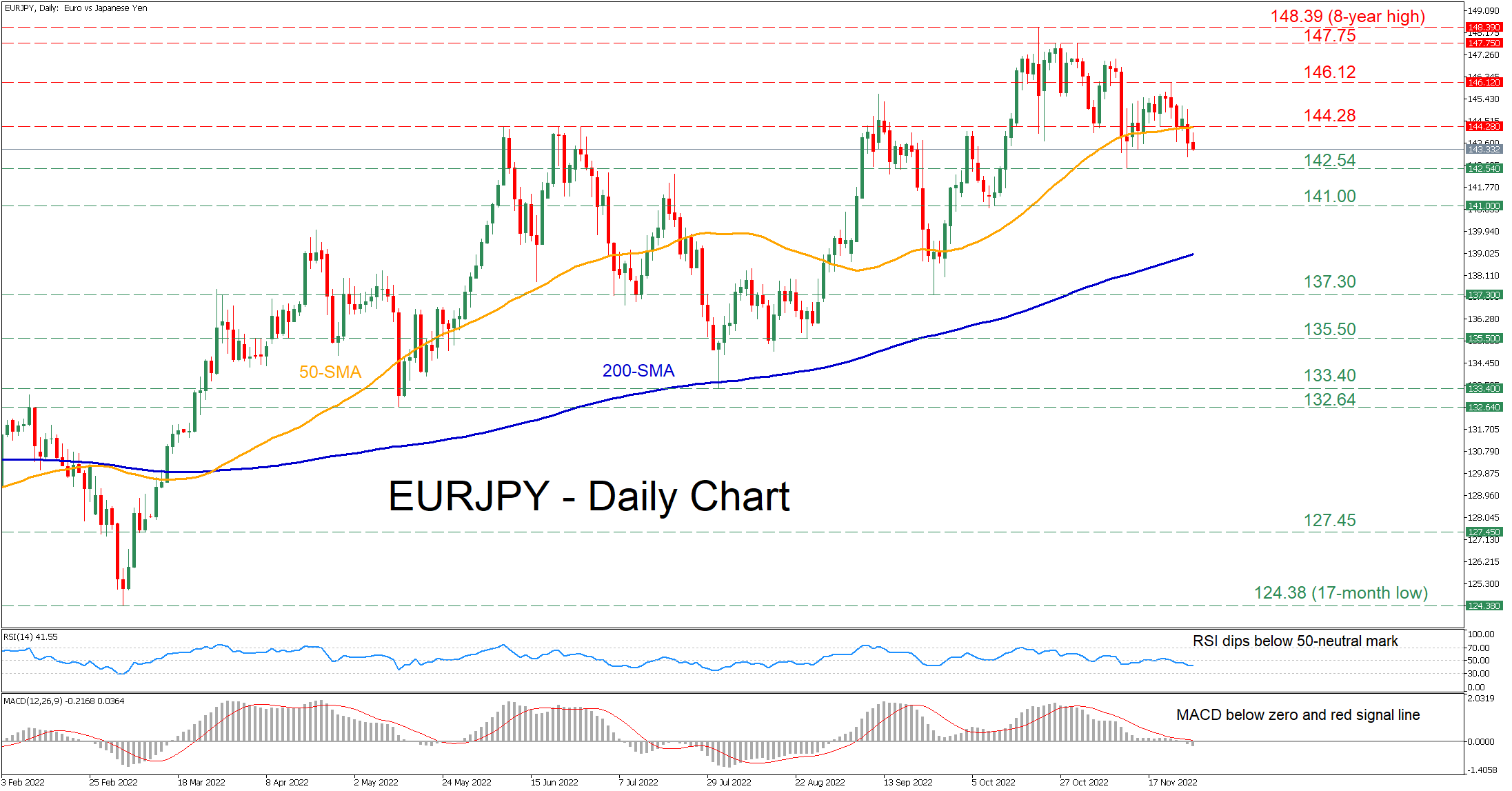
Risk Sentiment Improves as China Rebounds
Volatility could be the name of the game over the next few days due to the protests in China, speeches from Fed officials including Jerome Powell, and top-tier economic data.
Investors received a taster early this morning with Asian stocks rallying as Chinese shares rebounded from the heavy selloff triggered by unrest over Covid restrictions. Shares in the region were also supported by a rally in the property sector after China removed restrictions on developers selling stock to raise funds. European futures are pointing to a positive open amid the improving market mood in Asia. This renewed appetite for risk could find its way back to Wall Street as market jitters over the developments in China ease. In the currency space, the dollar fell along with Treasury yields while the euro hovered around the 200-day SMA at 1.0380. Gold prices rebounded during early trading helped by a weaker dollar, while oil prices jumped as speculation around more supply cuts by OPEC+ intensifies.
In Europe, the pending economic sentiment and consumer confidence figures for November could provide insight into the health of the European economy. The euro may find itself under renewed pressure if these reports fail to meet expectations. However, the key focus falls on the German inflation figures scheduled to be released today and then for the wider region on Wednesday. Inflation in Europe is expected to remain at elevated levels, with the CPI projected to ease slightly from a record high of 10.6% in October.
All eyes on Fed Chair Powell
Dollar bulls were injected with renewed inspiration on Monday thanks to hawkish comments from Federal Reserve officials. Perennial hawk Bullard said he believed “markets are underpricing a little bit the risk that the FOMC will have to be more aggressive rather than less”. New York Fed President Williams struck a softer tone but also said he saw the rate path higher.
Regardless of recent gains, the greenback could find itself under fresh selling pressure not only due to the improving market mood, but if Powell reinforces expectations over the central bank slowing its pace of interest rate increases in a speech scheduled for Wednesday. Much attention will also be directed toward the PCE Core Deflator on Thursday which is the Fed’s preferred measure of inflation. Any signs of cooling inflation will most likely fortify expectations around the Fed adopting a less aggressive approach toward rates.
Friday could be the main market shaker as all eyes turn to the monthly US non-farm payrolls report. The US economy is expected to have created 200,000 jobs in October with the unemployment rate unchanged at 3.7%. A report that meets or prints below expectations may justify a change in the pace of the Fed’s policy tightening, ultimately weakening the dollar further.
Talking technicals, the DXY remains under pressure on the daily charts. A move back below 106.00 could encourage a decline toward the 200-day SMA around 105.30. Below this point, the next level of interest can be found at 104.50.
Currency spotlight – EUR/USD
This is bound to be a volatile trading week for the EURUSD thanks to the numerous key risk events in Europe and the United States.
With the Eurozone inflation figures and Powell’s speech on Wednesday, the US PCE deflator and US ISM on Thursday, topped off with the US jobs report on Friday, this could be a rollercoaster week for the EURUSD. Looking at the technical picture, the currency pair is bullish on the daily charts but remains capped around the 200-day SMA. A solid daily close above 1.0450, followed by a move towards 1.0500 could signal that bulls remain in control. Alternatively, a selloff towards 1.0300 could result in a move to 1.0190 and 1.0100.
Commodity spotlight - Gold
Gold is waiting for a fresh fundamental spark to get its gears moving and this could come in the form of speeches from Fed officials, geopolitical risks, or key US economic data such as the NFP.
The precious metal remains in a wide range on the daily charts with support at $1735 and resistance at $1785. However, with the fundamentals slowly tilting in favour of gold bulls, a solid breakout could be around the corner. In the meantime, prices are trading above the 50-day and 100-day SMA but below the 200-day SMA. A solid breakout above $1785 could open the doors toward $1800 and $1840. Should prices slip back below $1735, this may result in a selloff towards $1700.