Sample Category Title
Will Australian Jobs Report Justify the RBA’s Need for Caution?
Employment numbers out of Australia will be watched on Thursday (00:30 GMT) as the country’s central bank ponders how much further to tighten policy. Higher interest rates have been attributed to the downturn in Australia’s housing market, but up until recently, policymakers were hopeful that the strong labour market would cushion the economy against a broader slowdown. Is the soft patch in the jobs market just temporary, or will there be a rebound in October?
RBA worried about housing market
The Reserve Bank of Australia was a bit late in the game when it came to joining its global peers in hiking interest rates. Nevertheless, the cash rate has risen by a whopping 275 basis points in a short period of time so it’s understandable that policymakers want to tread more carefully going forward. But striking the right balance in terms of doing enough to contain inflation while managing the downside risks to growth will probably be more difficult than they envisioned.
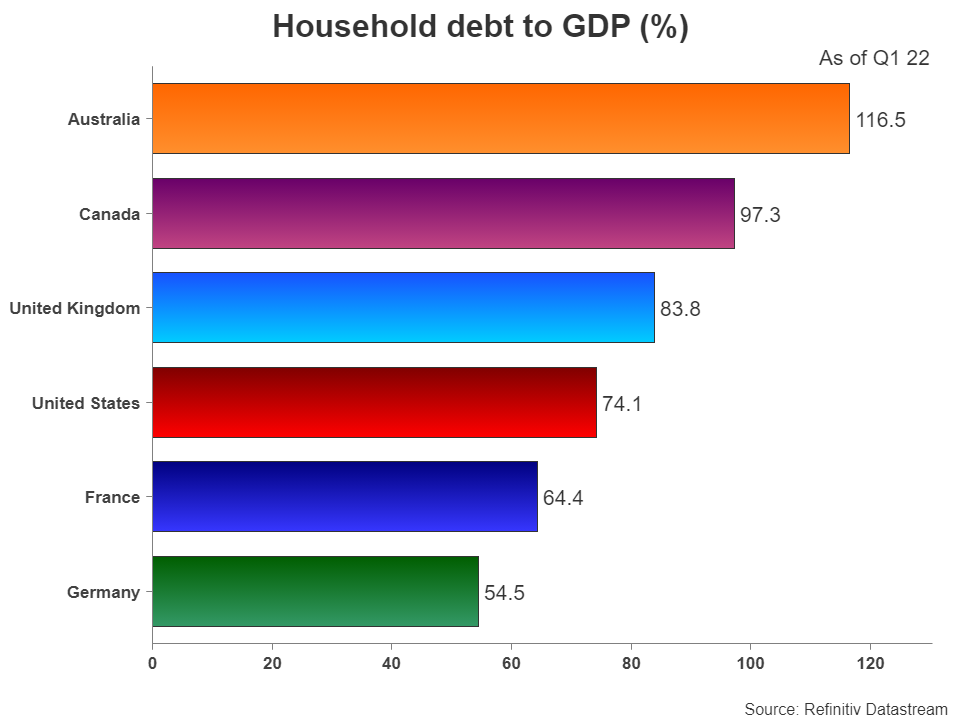
Households have been hit hard by the rapid and steep increase in borrowing costs. Not only does Australia have very high household debt levels, but it also has a large portion of households on variable mortgages, making consumers very sensitive to any changes in interest rates. House prices are now falling in every major Australian city, with places like Sydney and Melbourne recording the largest declines.
Jobs market has lost some steam
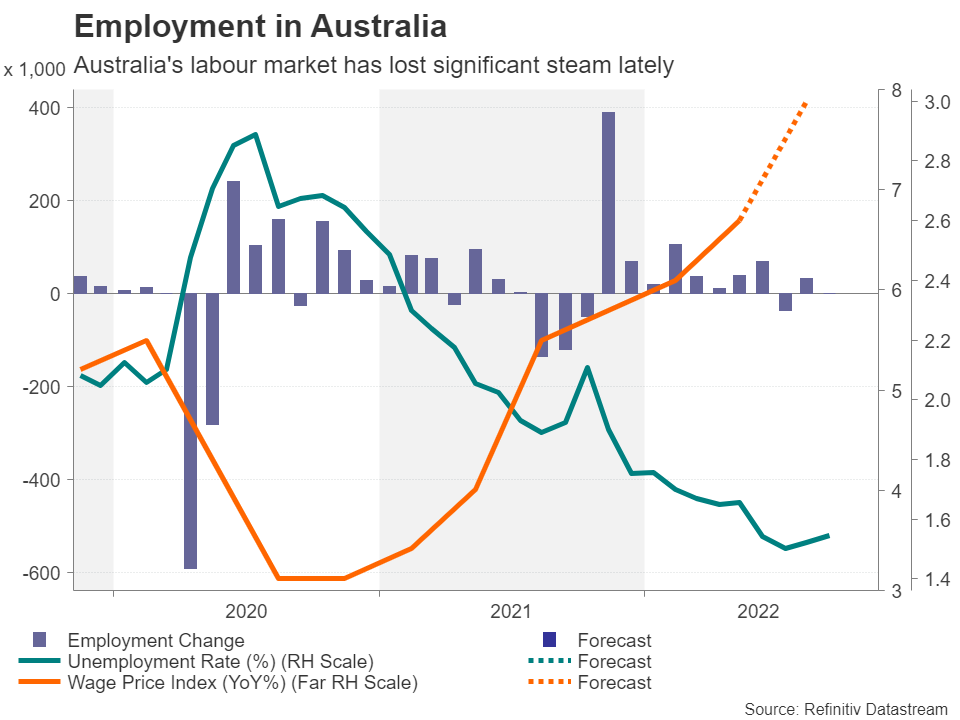
But it’s not just the property sector that’s struggling. The entire services economy has been stagnant since late summer according to the S&P Global PMI gauge, and even the labour market is slowing. Jobs growth has been flat since July and the unemployment rate has ticked up slightly. The forecast for October is a little better. Economists expect a gain of 15k jobs versus a paltry increase of 900 jobs in September. Though, the jobless rate is expected to edge up again from 3.5% to 3.6%.
Ahead of the employment figures, the wage price index will also catch investors’ attention on Wednesday (00:30 GMT). Despite the tightest labour market in decades, wage growth has so far been disappointing. It hit 2.6% y/y in the second quarter and is forecast to have accelerated to 3.0% in the third quarter – less than half the rate of inflation, which hit 7.3% in the same period.
Overly cautious?
Taking all this into consideration, the RBA might be right to be pre-emptively cautious, even if inflation possibly hasn’t peaked yet. China’s growing economic woes have been another source of worry, although exports remain strong for now.
But just how much of a dovish pivot is this for the RBA? After all, it’s one of the few central banks in the world that meets 11 times a year – something that gives it extra flexibility to adjust the pace of rate hikes s as it sees fit. This confusion or potential miscommunication may end up wrongfooting investors who could be underestimating the RBA’s resolve to get inflation down. Money markets have priced in an almost 25% probability that the RBA will keep rates on hold at its next meeting in December seem overdone based on the information available.
Aussie rebounds as dollar rally falters
Yet, when it comes to the Australian dollar, the dovish expectations may not necessarily be particularly detrimental at a time when the US dollar is finding itself increasingly on the backfoot. The aussie has retraced more than 60% of the August-October downfall as investors have upped their bets that the Fed is nearing the end of its tightening cycle, pressuring the greenback.
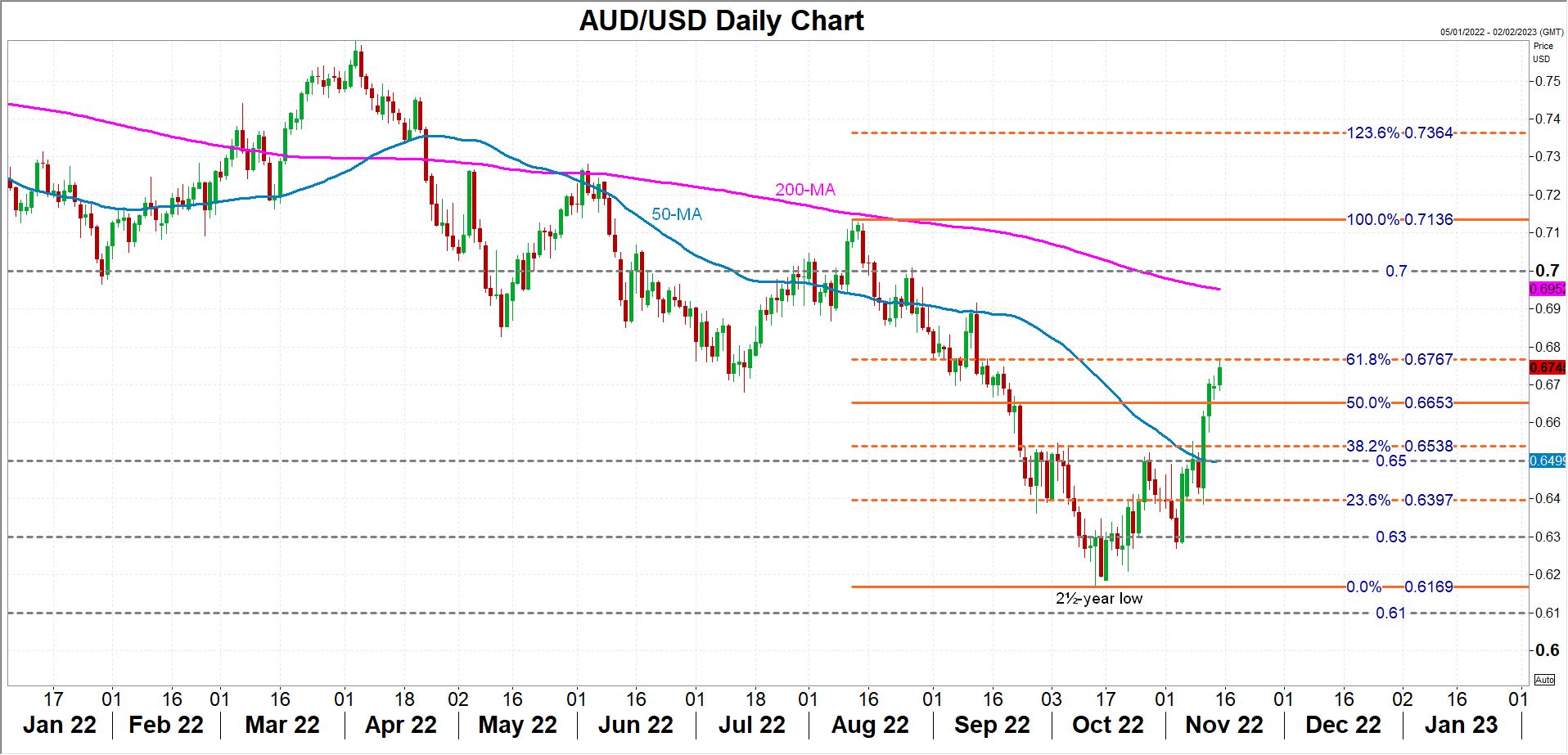
If the aussie manages to break above the 61.8% Fibonacci retracement at $0.6767, its gains could stretch until the 200-day moving average (MA) around $0.6950. However, the battle around the $0.70 barrier is likely to be a lot tougher.
In the event that the employment data adds to concerns about the Australian economy, the aussie could fall back towards its 50-day MA in the $0.65 region. If broken, the next psychological levels of $0.64 and $0.63 are likely to be tested too.
The RBA next meets on December 6, but prior to that, the recently launched monthly reading of CPI on November 30 may provide a further clue on the final policy decision of the year.
Wounded US Dollar Turns to Retail Sales for Direction
Hopes that inflation is finally cooling down led traders to unwind bets that the Fed will raise rates beyond 5%, dealing a heavy blow to the US dollar last week. The next event is the retail sales report this week. It will reveal how demand is holding up, helping investors decide whether the selloff in the dollar was an overreaction or the beginning of a trend reversal.
Fed bets
The latest US inflation data came as a bombshell for markets, causing a drastic rethinking around how quickly and how high the Fed will lift interest rates. With mounting signs that inflation has started to cool, the conclusion was that the Fed will ‘only’ raise rates by half a percentage point next month and the peak will be below 5%.
This shift inflicted severe damage on the dollar, which lost more than 4% against the euro in a single week as US yields came crashing down, eroding its interest rate advantage. Admittedly though, this sharp reaction was probably driven by one-sided positioning. Since ‘long dollar’ was a very crowded trade, huge reversals can happen merely as traders lock in profits.
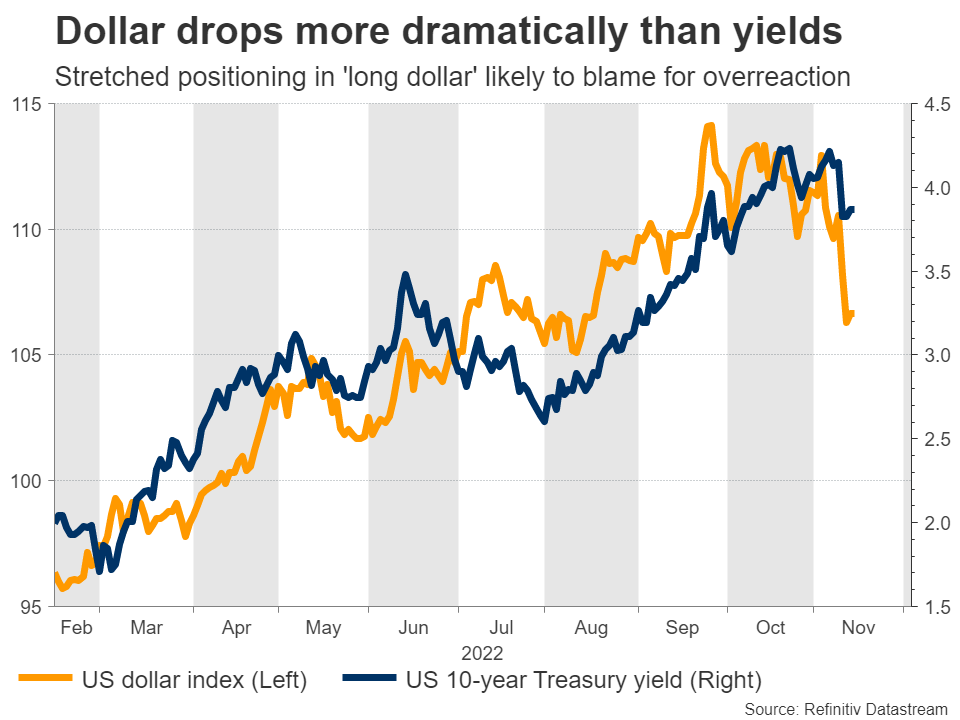
Most importantly, the story around the Fed hasn’t changed enough to warrant such dramatic moves. While inflation might have peaked, it is still running at almost four times the Fed’s target and there is no telling how quickly it will come down. With China slowly relaxing its zero-covid strategy too, commodity prices could come back to life, boosting inflationary pressures again.
Drawing conclusions from one data point is never a good idea, so it is difficult to say at this stage whether the latest market moves were an overreaction or the beginning of the end for the dollar’s rally. The picture will become clearer on Wednesday, with the latest batch of US retail sales.
Slowing down
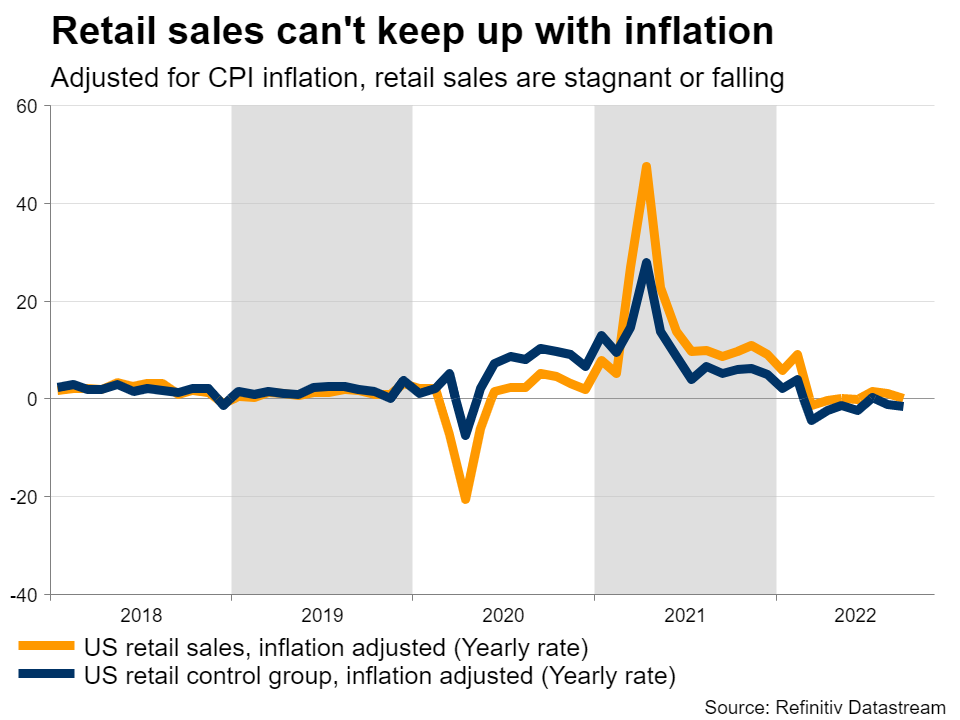
In October, retail sales are expected to have risen by 1% after stagnating the previous month, while the retail control group that is used in GDP estimates is projected to clock in at 0.3%, a slight deceleration from September. In yearly terms, both are set to slow dramatically, as much stronger numbers drop out of the 12-month calculation.
Bear in mind that retail sales numbers are not adjusted for inflation. Once we account for inflation running at 7.7%, retail sales are basically stagnant from last year. That’s a worrisome sign, but the counter is that consumption has shifted towards services and away from goods since last year, so focusing on retail sales as a proxy of demand is not wise.
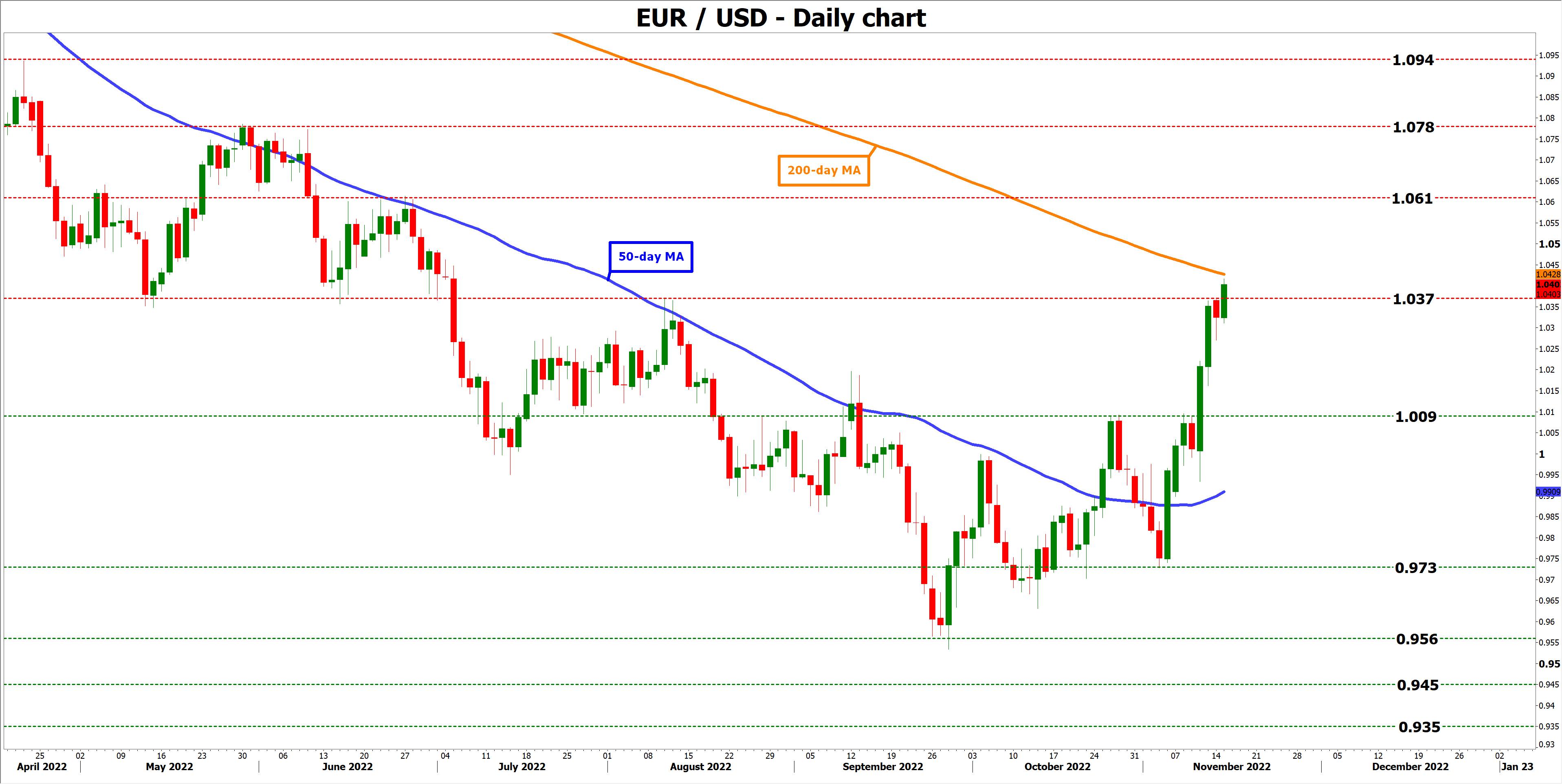
In any case, the dollar will most likely react to any surprises. Prints that surpass expectations would be the best outcome for the currency, as that could revive speculation for Fed rates to exceed 5% in this cycle. In this case, euro/dollar could edge back below 1.0370, and perhaps aim for another test of the 1.0090 region.
On the flipside, a disappointing dataset could reinforce the narrative that the Fed will be more cautious. That could propel euro/dollar even higher, with a move above the 200-day moving average at 1.0428 opening the door towards the 1.0610 zone.
Big picture
All told, the dollar is currently at a crossroads. Most of the elements that fueled this stunning rally seem to be losing their kick, for instance with inflation cooling down but potentially yet to peak in other economies, and big government spending packages off the table now that Congress will likely be divided.
Meanwhile, the outlook for other major currencies has started to improve. A sharp decline in European energy prices paints a brighter picture for the Eurozone economy, nerves around UK politics have calmed for now, and the Bank of Japan seems to be gearing up for policy changes.
Markets don’t move in straight lines and the dollar might still have one ‘last hurrah’ left, especially if the global economy falls into recession. Still, this ferocious rally seems to be on its last legs.
ETH and BTC Under Pressure from the Pros
Market picture
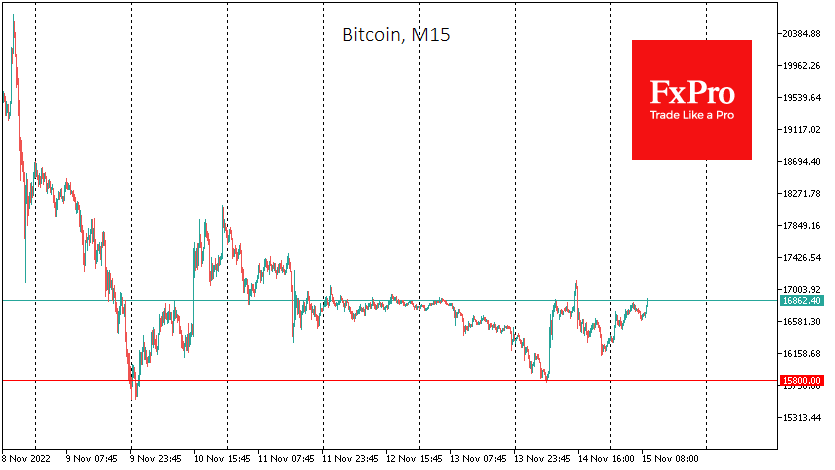
Bitcoin is trading in the $16.7K area (+1.6% in 24 hours), a significant consolidation area of the past five days. It was helped back to these levels by the news of Binance launching a fund to help cryptocurrency companies experiencing temporary liquidity difficulties. The news has stopped a wave of selloffs but has yet to be able to turn the market up.
On the intraday charts of BTCUSD, there is a notable resistance area near the current price. In Ethereum, the situation is very similar, and the price fails to develop a growth above $1250 (+2.2% in 24 hours). The two most popular cryptocurrencies have the widest share of institutional investors, whose confidence in the sector has been eroded recently. It is their professional unloading into the market that we are now seeing on the charts.
The entire crypto market is more enthusiastic, adding 4.3% in capitalisation overnight to $841B, according to CoinMarketCap estimates.
According to CoinShares, investments in cryptocurrencies rose last week to their highest in three months. Inflows of $42M compared to outflows of $16M a week earlier. Bitcoin investments rose by $19M, and Ethereum by $3M. Investments in funds that allow shorts on bitcoin increased by $13M. Altcoin basket products attracted the highest since June by $8M. Investors saw the FTX collapse as an investment opportunity, CoinShares noted.
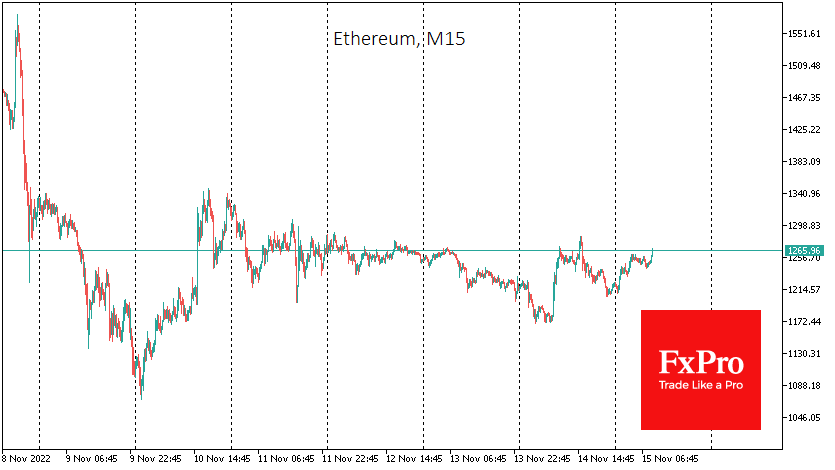
According to Glassnode, BTC withdrawals from cryptocurrency exchanges reached an all-time high of 106,000 BTC for the month. Previously, the market has only experienced similar BTC outflows three times in history.
News background
Binance CEO Changpeng Zhao and MicroStrategy founder Michael Saylor urged users to store assets in cold wallets, especially during “market turbulence”. According to Bloomberg, FTX customers are unlikely to get their funds back.
Elon Musk said the crypto winter could be long, but bitcoin would eventually survive.
The collapse of FTX showed that the cryptocurrency industry needs “prudent regulation”, US Treasury Secretary Janet Yellen said. The consequences of the incident could have been much worse if the crypto market had been more connected to the traditional financial system, she said.
Aussie Remains Bullish after RBA Minutes – Elliott Wave Shows Room for Further Strength
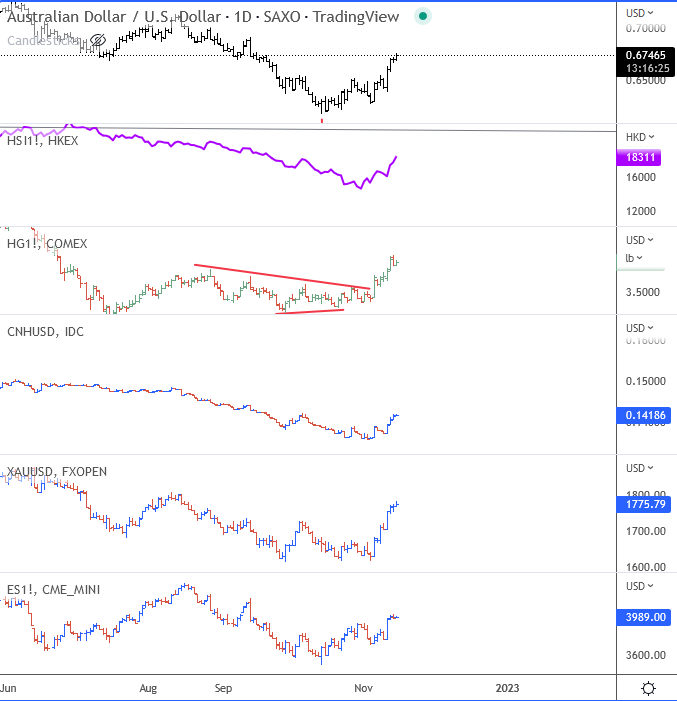
RBA is looking for higher rates in an upcoming meeting, but its unclear if there will be 25 or 50bp increase which will be determined by incoming data and the outlook for inflation and employment. We see AUDUSD trading at the highs of the week after the minutes were released and it appears there is room for further gains as we see price in wave three, headed towards 161.8% Fib. We also see stocks still in bullish mode, including HSI, and copper while USDCNH is coming down, so these are all positive signs for the Aussie. As such, I may look for long entries after a pullback.
https://www.youtube.com/watch?v=iEDz-z8HGQE
EURJPY’s Bullish Trend Cracks
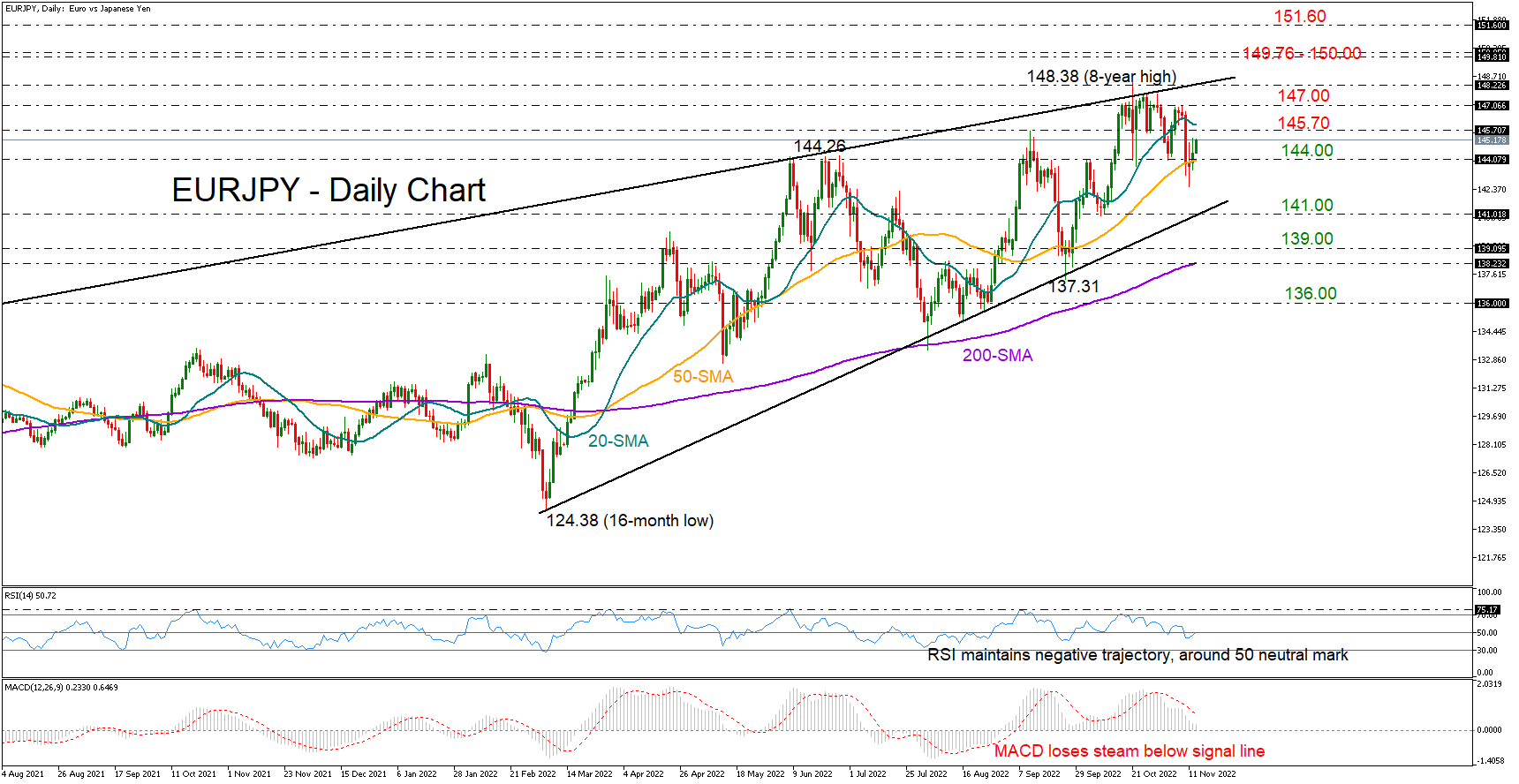
EURJPY halted its latest steep decline near the 50-day simple moving average (SMA), returning to the green zone on Monday.
The bulls are currently hunting the 145.00 psychological mark, though the short-term technical picture is barely backing the positive action in the price. Particularly, the bullish trend is showing signs of exhaustion in the short-term timeframe after the peak at an eight-year high of 148.38, with the price making lower lows and lower highs.
In momentum indicators, the RSI and the MACD have been in a negative move too, with the former struggling to rise back above its 50 neutral mark and the latter remaining negatively charged below its red signal line.
On the upside, the 20-day SMA could block the way towards the key resistance of 147.00. If that proves to be the case, the price may reverse lower to retest the 50-day SMA at 144.00. Failure to bounce here could fortify selling pressures towards the support trendline at 141.00. Falling lower, the pair may next seek shelter somewhere between the 139.00 number and the 200-day SMA at 138.30.
Otherwise, a forceful move above 147.00 may immediately falter near the strong resistance trendline, which joins all the highs since August 2020. The line is currently lying around 148.25. If it gives way this time, the spotlight will fall on the 2014 high of 149.76 and the 150.00 handle. Running higher, the next obstacle could emerge around the 151.60 level last active during 2007-2008.
In brief, the current bullish action in EURJPY seems fragile as technical signals show a lack of buying power. An extension above the 147.00-148.25 constraining zone is probably needed to restore confidence in the long-term positive trajectory.
GBPUSD Remains Slightly Below the 2½-Month Peak
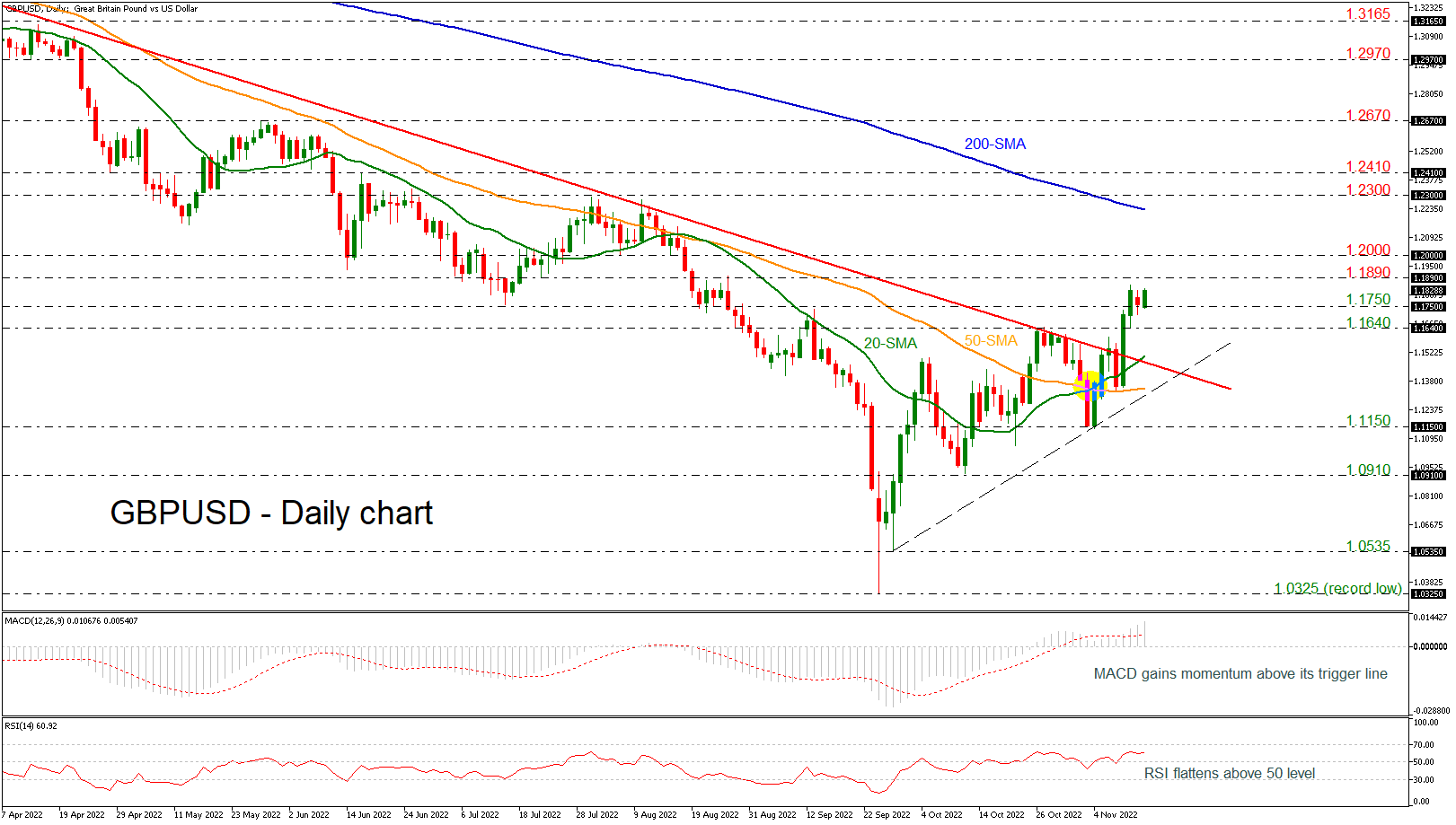
GBPUSD is looking bullish in the short term after surging above its daily moving averages (MAs) and the long-term descending trend line. Prices hit a two-and-half-month high of 1.1853 on Friday, and the technical indicators are all pointing to further positive momentum in the near term.
The MACD oscillator is heading upwards, strengthening its positive momentum above its trigger and zero lines, suggesting plenty of scope for additional upside moves. The RSI is moving slightly sideways into bullish territory but has yet to approach the 70 overbought level.
Immediate resistance to further gains would likely come from the 1.1890, which capped prices in the preceding sessions. This is also near the August 16 inside swing low of 1.2000 so this could prove to be a potentially difficult hurdle for the pair to overcome. If there is a successful break above this area, further resistance could be met around the 200-day SMA at 1.2230.
If, however, the strong upside momentum was to lose steam and the pair moves lower, support would initially come from the 1.1640 barrier and the 20-day SMA at 1.1500. A slip below this level could take prices towards the 50-day SMA and the short-term uptrend line near 1.1340. Failure to hold above this line would switch the focus back to the downside and attention would increasingly turn to the 1.1150 hurdle.
In the more medium-term picture, the broader bearish outlook recently shifted to a positive one in the short term and if the market surpasses the 200-day SMA, that may endorse this view.
BoE Facing Tough Decisions
Equity markets are looking slightly positive in early trade on Tuesday, adding to modest gains at the start of the week.
While the rally is perhaps slowing a little after the strong gains of recent weeks, there doesn't appear to be much appetite at this stage to bail on it. Perhaps the experience of the last year and the huge declines in equity markets have left investors seeing substantial value and they've become excited at even the prospect of a bull run. Perhaps there's some FOMO at play after a long time of such opportunities being few and far between.
Not a great UK labour market report
I'm not entirely sure who will look at the UK labour market and be able to take many positives from it. The unemployment rate ticking up when job vacancies have fallen for the fourth month may suggest to the BoE that slack is appearing. But at the same time, the rate remains very low and wages excluding bonuses rose by 0.2% to 5.7%, exceeding expectations, which will be a concern when inflation is already above 10% and rising.
Inactivity is another negative takeaway as this makes the job of increasing slack in the labour market all the more difficult. Whichever way you look at it, this isn't a great report and it will likely keep the pressure on the BoE to keep hiking aggressively, creating further headwinds for the economy.
Sensible RBA minutes move away from the era of forward guidance
The key takeaway from the RBA minutes overnight was that forward guidance will no longer be a tool the central bank leans on unless there is value in doing so. The RBA wants to maintain a flexible approach based on the incoming data rather than be tied to its guidance, which makes a lot of sense in these highly uncertain times. It highlighted the benefits of explicit and specific guidance in certain situations but the current one simply doesn't tick any of those boxes. As such, while a 25 basis point hike was appropriate at the last meeting - and I assume will be at the next - the central bank could move back to 50bps should the data warrant it. That all sounds very sensible.
Oil treading water
Oil prices are basically flat on Tuesday, sitting a little below the middle of their recent trading ranges as traders continue to weigh up the global economic outlook, OPEC+ production risks, and China's Covid approach.
Prices remain choppy and that's likely to remain the case given the ongoing uncertainty around these key areas. Everyone became much more optimistic around the US after last week's inflation report but that appears to have quickly faded. Enormous downside risks remain around the global economy next year even if the Fed does pause its tightening a little sooner and perhaps that reality is kicking in again.
Gold rally stalls at key resistance level The great gold recovery has stalled, with the yellow metal only slightly higher on the day after dipping a little earlier in the session. That follows a similar pattern to Monday and could be viewed as a positive sign given the reluctance to allow the recent rally to retrace in any considerable way.
It has been a very impressive recovery though, up around 10% from the lows earlier this month, so a corrective move wouldn't come as a surprise. It's seeing resistance around $1,780 at the moment, a level that was a major area of support earlier in the year and again in May before finally crumbling in early July. A move above here would be a significant technical breakout.
Traders may be tempted to sidestep cryptos for a while
Bitcoin is fighting back this morning but it remains very much on the ropes. Gains of more than 2% barely offset the losses since Friday, let alone what came earlier that week. Cryptos remain very vulnerable, not just to the fallout from FTX - the full extent of which remains a cloud of uncertainty over the industry - but also to what else may be uncovered as the environment becomes ever more challenging.
What we've seen recently will be discouraging to some who may have become tempted in recent years but with rates no longer at zero and more traditional assets arguably becoming attractive once more, traders may be tempted to sidestep cryptos and wait for the storm to pass.
Weakening of Yen for Now Apparently Isn’t a Support for Japanese Economy
Markets
Yesterday was the first day of what we fear will be a November lull. The sharp repositioning after last Thursday’s US CPI release, the arrival of technical support/resistance levels, the absence of key eco data and central bank gatherings and reduced trading volumes in next week’s shortened Thanksgiving week set the stage for short term consolidation/corrections to continue. US yields added 2.1 bps (30-yr) to 5.8 bps (2-yr) yesterday compared to Thursday’s close (bond exchanges closed for Veteran’s Day). German yields lost 1 to 2 bps across the curve. EUR/USD closed almost unchanged at 1.0325 after failing to take out the key resistance zone of 1.0341/50/68. European stock markets gained up to 1% with main US gauges given gains away in the final trading hour to close up to 1% weaker following an incredible two-day rebound. The eco calendar was empty apart from outdated EMU production numbers for September (0.9% M/M vs 0.5% expected). We retain comments from Fed vice chair Brainard who said it would be appropriate to slow down the pace of rate hikes soon. In line with recent Fed chorus, she stresses that the US central bank’s inflation fight isn’t done yet and that the Fed needs to remain vigilant. Focus should shift from the pace of hikes to the peak of the cycle, which several governors suggested could be well above 5%, and to the horizon on which restrictive monetary policy will be applied.
Asian risk sentiment is vibrant this morning with China (+1.5%) and Hong Kong (+4%) outperforming. The Biden-Xi Summit in the sidelines of the G20 meeting in Bali is welcomed as a new starting point to stop the tumbling of bilateral ties and stabilize the relationship. Recent actions to weaken the zero-Covid policy guidelines and support the real estate sector are still at play as well. Slightly weaker-than-expected monthly Chinese eco data are this morning interpreted according to the “bad news is good news” paradigm, raising the stakes of more fiscal stimulus. Retail sales fell 0.5% Y/Y to be up only 0.6% YTD YoY. Industrial production weakened to 5% Y/Y to be up 4% YTD YoY. Investments stabilize at 5.8% YTD YoY. Property investment contracted 8.8% in the period.
Today’s eco calendar contains November German ZEW investor sentiment, 2nd reading of EMU Q3 GDP data, October US PPI figures, November Empire Manufacturing Survey and speeches by several ECB and Fed members. We don’t expect them to change current market dynamics. The latest UK labour market report is just out and broadly in line with forecasts. Wages continued to grow at a 6% Y/Y pace with the unemployment rate ticking up marginally to 3.6% in Q3. Employment fell by 52k in Q3 compared to Q2, but monthly data for October showed a stronger then expected 74k increase. Sterling gained a few pips with EUR/GBP trading at 0.8760.
News Headlines
According to reporting of the Belgian Financial newspaper ‘De Tijd’, the final documents submitted to the Belgian Parliament show a bigger Belgian budget deficit compared to the drafts that were proposed to the European Commission a month ago. The structural deficit of the federal government is now estimated at 3.4% of GDP, compared to 2.9%. The global Belgian deficit has been raised to 6.1% of GDP (€35bn) compared to 5.8% of the GDP presented earlier. The review is said to be due to uncertainty on the timing of the reform of some excise duties which have to be put in place to counterbalance for a lowering the VAT on energy products. Due the higher budget deficit, the Belgian debt to GDP ratio now is estimated at 109.4% of GDP compared to 108% expected earlier.
The weakening of the yen for now apparently isn’t a support for the Japanese economy. Japanese GDP growth in the third quarter unexpectedly contracted by 0.3% Q/Q. This compared to expectations for a 0.3% quarterly growth and a rise of 1.1% Q/Q in the second quarter. Private consumption slowed to 0.3% Q/Q from 1.2% Q/Q as did fixed capital investment (1.2% Q/Q from 4.8%). Net exports subtracted 0.7% from growth as exports rose only 1.9% while imports gained 5.2%. Via different channels, the weak yen is weighing on domestic purchasing power and hampering growth. The yen weakened again slightly this morning to trade near USD/JPY 140.40. However, this move is at least partially supported by a (modest) USD comeback overall.
GBP/JPY Daily Outlook
Daily Pivots: (S1) 163.52; (P) 164.62; (R1) 165.54; More...
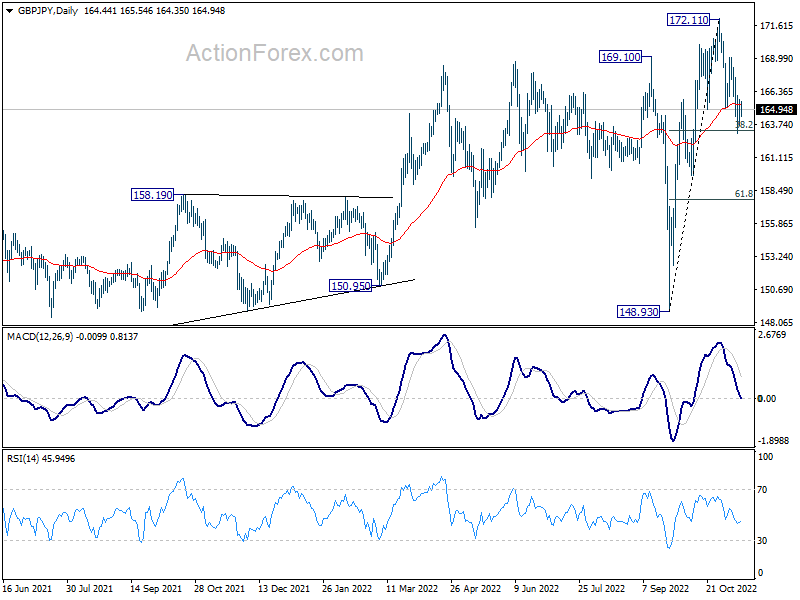
Intraday bias in GBP/JPY stays neutrla for the moment. Strong rebound from current level, followed by break of 166.06 minor support will turn bias back to the upside for retesting 172.11 high. However, sustained trading below 38.2% retracement of 148.93 to 172.11 at 163.25 will bring deeper decline to 61.8% retracement at 157.78 and possibly below.
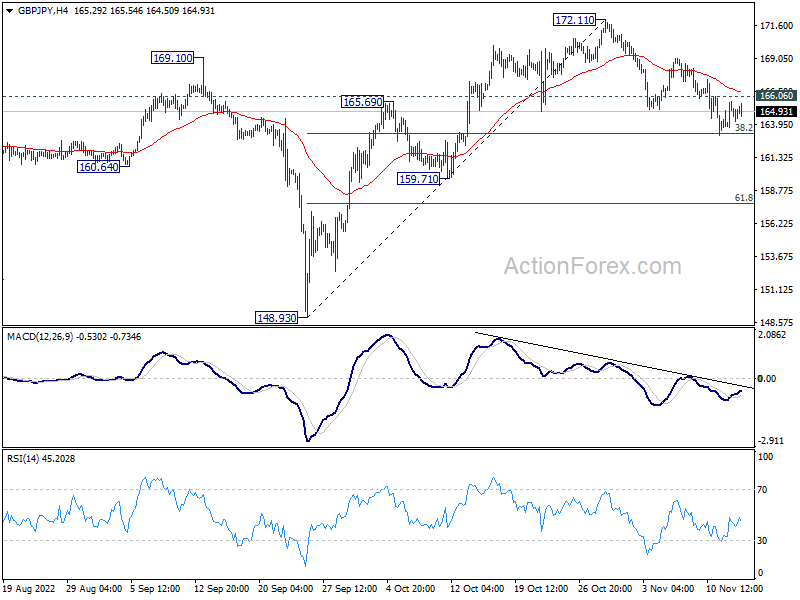
In the bigger picture, there is no clear sign of medium term topping yet. Up trend from 123.94 (2020 low) could still resume through 172.11 high at a later stage. However, firm break of 159.71 support will argue that it's already in correction to the up trend from 123.94, and deeper decline would be seen back towards 148.93 support.
EUR/JPY Daily Outlook
Daily Pivots: (S1) 143.59; (P) 144.41; (R1) 145.35; More....
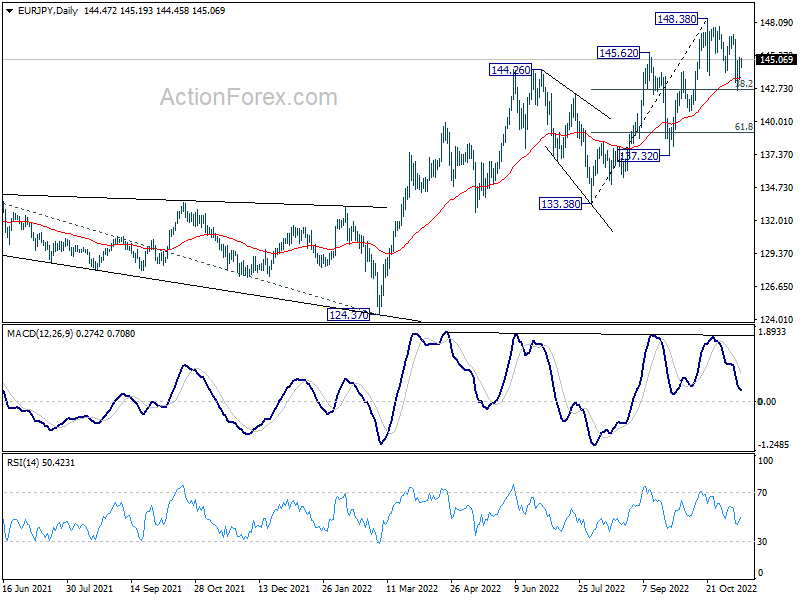
Breach of 145.02 minor resistance argues that EUR/JPY's correction from 148.38 might be completed at 142.54. Intraday bias is back on the upside for retesting 148.38 high first. However, on the downside, sustained break of 38.2% retracement of 133.38 to 148.38 at 142.65 will bring deeper fall to 61.8% retracement at 139.11 and possibly below.
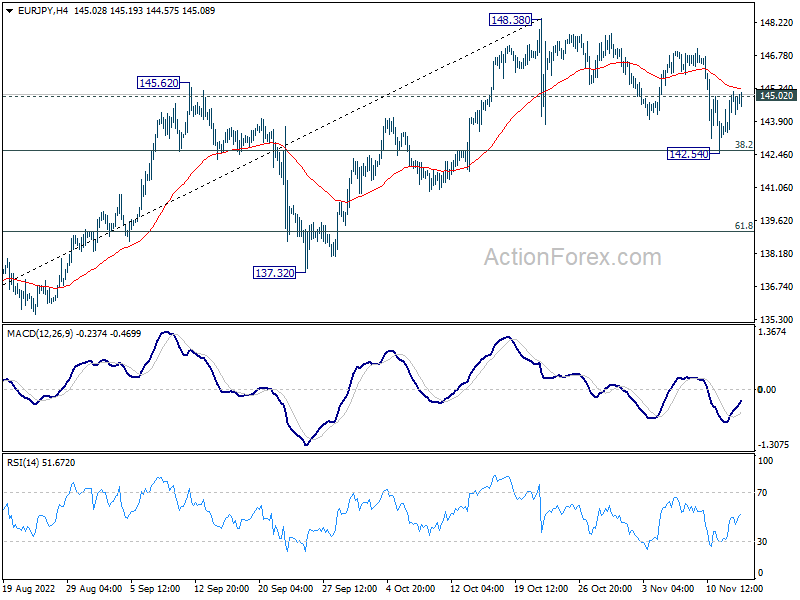
In the bigger picture, there is no clear sign of medium term topping yet. Up trend from 114.42 (2020 low) could still resume through1 48.38 to 149.76 (2014 high). However, break of 137.32 support argue that a medium term correction has already started to correct the whole up trend from 144.42.