Sample Category Title
Fed Brainard: Appropriate soon to move to a slower pace
Fed Vice Chair Lael Brainard said yesterday, "I think it will probably be appropriate soon to move to a slower pace of increases, but I think what's really important to emphasize is... we have additional work to do."
"It's really going to be an exercise on watching the data carefully and trying to assess how much restraint there is and how much additional restraint is going to be necessary, and sustained for how long, and those are the kinds of judgments that lie ahead for us," she said.
"It makes sense to move to a more deliberate and a more data dependent pace as we continue to make sure that there's restraint that will bring inflation down over time," she said.
"As we go forward...risks are going to be two sided if we get into more restrictive or further into restrictive territory," she said, "so we'll be balancing those considerations."
GBP/USD: Resistance Turned Support At 1.1600
Key Highlights
- GBP/USD was able to clear the 1.1600 and 1.1700 resistance levels.
- A key bullish trend line is forming with support near 1.1600 on the 4-hours chart.
- EUR/USD started a consolidation phase below the 1.0350 resistance.
- Gold price is showing signs of more gains above $1,770.
GBP/USD Technical Analysis
The British Pound formed a base above the 1.1150 level against the US Dollar. GBP/USD started a steady increase and was able to settle above the 1.1500 resistance.
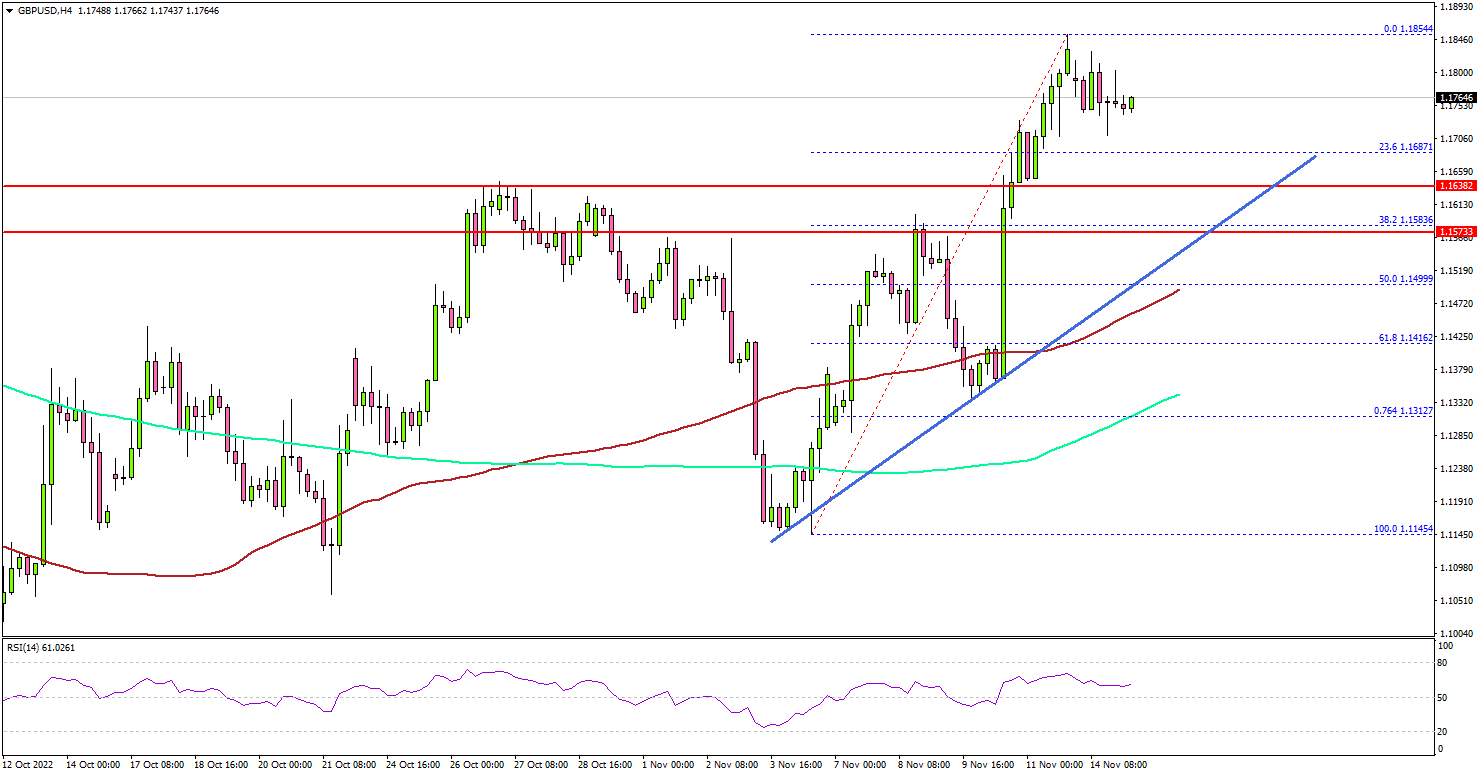
Looking at the 4-hours chart, the pair gained bullish momentum above the 1.1600 resistance, the 100 simple moving average (red, 4-hours) plus the 200 simple moving average (green, 4-hours).
The upward move was such that the pair even climbed above the 1.1700 and 1.1750 levels. It traded as high as 1.1854 before there was a minor downside correction. An initial support is near the 1.1650 level.
The next major support is near the 1.1620 zone. The main support sits at 1.1600. There is also a key bullish trend line forming with support near 1.1600 on the same chart. A close below the 1.1600 level might start another strong decline. In the stated case, GBP/USD could decline towards the 1.1250 support.
On the upside, an immediate resistance is near 1.1850 level. The next major resistance may perhaps be near 1.1920. Any more gains could set the pace for a move towards the 1.2000 level, above which it could even test 1.2150.
Looking at gold price, the bulls seem to be in control and they might aim more gains above the $1,770 level in the coming sessions.
Economic Releases
- UK Claimant Count Change for Oct 2022 – Forecast -12.6K, versus +25.5K previous.
- UK ILO Unemployment Rate for Sep 2022 (3M) – Forecast 3.5%, versus 3.5% previous.
- Euro Zone Gross Domestic Product Q3 2022 (Preliminary) (QoQ) - Forecast 0.2%, versus 0.2% previous.
Sunset Market Commentary
Markets
Global markets experience some kind of ‘the day (week) after’-feeling as investors tried the assess last week’s sharp repositioning post softer than expected US inflation data released on Thursday. Fed governor Waller during the weekend at least tried to put the report into perspective. The Fed maybe can consider slowing the pace of rate hikes (from 75 bps steps to 50 bps). However, it’s much too early to already start the debate on the end point of the rate cycle. Several Fed members scheduled to give their view later this week, will probably talk in a similar way. Technical factors are also in play. The US 2-year (currently 4.41%) end last week came within reach of the key 4.26% support area. A break below this level would coincide with markets dismissing Fed Powell’s guidance that interest rates will have to be raised beyond the 4.50/4.75% peak level indicated in the September dots. It’s too early already to expect such a U-turn in the Fed strategy/communication just on one ‘positive’ CPI reading with inflation still far above target. The US 10-y yield (4.88%) also hesitates whether there is already room for follow-through price action after breaking below a first support near 3.90% (ST neckline). US yields today rebound between 7 bps (2-y) and 4 bps (30-y) from Thursday’s closing levels (US bond markets were closed Friday). The repositioning on EMU bond markets last week was more limited compared to the US and German/EMU yields already reversed part of Thursday’s correction on Friday. German yields are easing between 6 bps (2-y) and 3.5 bps (30-y). Especially short-term European yields stay close to recent cycle peak levels as the ECB still has more work to do to arrest an ongoing rise in inflation. European equities show modest gains (+0.5%/1.0%). For now, the EuroStoxx 50 is holding above the 3819 neckline, which, if confirmed would suggest that a this year’s sell-on upticks pattern might roll over into more sideways trading. Brent oil eases slightly ($95 p/b area), extending its consolidation pattern.
The dollar already showed signs of a topping out pattern before the US CPI and last week dropped below several intermediate support levels. The short-term picture for the US currency remains fragile. DXY traded in the 113 area only 10 days ago, but now struggles to regain the 107 big figure. EUR/USD also hardly returns any of last week’s gains. At 1.0320, the pair is holding within reach of the key 1.0350/70 resistance area. The yen underperforms with USD/JPY regaining the 140 handle (140.4 from open of 138.75). EUR/GBP (0.8775) gains a few ticks as markets await an in extenso eco update later this week (labour data tomorrow, CPI on Wednesday and retail sales on Friday) as well as Fin Min Hunt’s autumn fiscal statement expected on Thursday. CE currencies last week only profited very mostly from the global risk rebound as domestic interest rates also nosedived sharply. Today, regional currencies are facing modest selling pressure, with the forint underperforming (EUR/HUF 408) even as the MNB indicated that market speculation on reducing high (18%) overnight interest rates are premature. The zloty also eases as the NBP in its November inflation report only expects inflation to return to the 2.5% (+/- 1.0%) target range end 2025.
News Headlines
The cartel of oil producing and exporting countries (OPEC) released its monthly oil market monitor today. The world economic growth forecast for 2022 and 2023 remains unchanged at 2.7% and 2.5%, respectively. The world oil demand growth forecast for 2022 is revised down by 0.1 mb/d to now stand at 2.5 mb/d. China’s strict anti-Covid measures and global economic uncertainty are the main reasons. Demand for OPEC crude in 2022 is revised down by 0.1 mb/d from the previous month’s assessment to stand at 28.6 mb/d, which is around 0.5 mb/d higher than in 2021. Demand for OPEC crude in 2023 is also revised down by 0.2 mb/d from the previous month’s assessment to stand at 29.3 mb/d, which is 0.7 mb/d higher than in 2022. OPEC expects that it will need to pump an average of 28.92 million barrels a day of crude to satisfy demand during the fourth quarter, keeping the market in surplus.
The National Bank of Poland published September balance of payments data today. The current account deficit shrank to €1.56bn from €3.33bn. The trade deficit fell from €2.64bn to €2.05bn with exports (€28.5bn from €25.75bn) rising faster than imports (€30.55bn from €28.39bn). The issue is mainly located in the goods industry with services posting a small surplus. High nominal dynamics of trade in goods were primarily the result of strong increases in transaction prices on both exports and imports. In contrast, real changes remained relatively small.
BoC Macklem: We need to rebalance demand and supply in labor market
BoC Governor Tiff Macklem said in a speech, "to restore price stability, we need to rebalance demand and supply in the labour market to relieve price pressures.
"Monetary policy affects demand. By raising interest rates, we are moderating spending, and that will reduce the demand for workers," he said.
"The other way to rebalance supply and demand is to increase the supply of workers. That takes time, and with inflation already far too high and with elevated risks that high inflation becomes entrenched, increasing labour supply is not an alternative to slowing demand."
The UK October Data Barrage
This week, Cable traders will have a lot to look at. Of course the big event later in the week is the long anticipated Autumn Budget that is expected to be released on Thursday. It's not expected to be such a controversial affair this time around, but there are still some pending issues that could shake up the markets. And pending nervousness after what happened last time a new Chancellor announced a spending plan.
The main issue is how will Chancellor Hunt balance the books over an expected shortfall of £60B due to slower economic outlook and increasing costs. What has been leaked so far suggests that it will be a combination of higher taxes and spending cuts. While these measures are generally understood to weigh on economic growth, they are also expected to help with the inflation situation.
It's stagflation now
What happens with the budget is particularly relevant for the BOE, since it is facing something of a crossroads. After UK GDP came in negative for the third quarter, it's expected to show the beginning of the prolonged recession the BOE anticipated. The BOE is also forecasting that inflation will remain in the double digits for a couple of months, and won't start trending lower definitively until the middle of next year. In other words, stagflation.
The question is how will the BOE choose to deal with this situation. One way is to raise rates aggressively to kill off inflation, provoking a hard landing for the economy. Another is to try to rescue the economy and let inflation run hot until productivity can increase and stabilize the currency. Both are politically difficult solutions. Since the BOE and the new Chancellor are on the same wavelength, that could work with the Autumn Budget. An "austerity" budget would work with crushing inflation sooner, and shoring up the government's finances for an expected growth strategy later. Though, all of that is in theory; practice might be an entirely different matter. But it's useful to have some insight into how officials are thinking.
The data that could shake things up
The first bit of important information comes out tomorrow, which are labor figures. Here the market's focus is likely to be on the claimant count numbers, since the employment change and unemployment rates are from previous months. October claimant count is expected to continue its rise and reach 27K, up from 25.5K previously. That would be the largest number of people going on unemployment since March of last year.
Wednesday has what could be the market mover in cable this week, which is the release of October inflation, which is expected to move up to 10.6%, and another multi-decade high. That's above the previous 10.1%. The BOE doesn't expect inflation to peak until next year.
To tighten or not to tighten
Where the BOE could see some relief is in the core inflation rate, which is expected to tick lower to 6.4% from 6.5% prior, the first drop in months. This is likely to have more of an impact on monetary policy, since the BOE appears to be worried about tightening too much, which could impact liquidity in the financial sector. With the government looking to cut spending, liquidity could be even tighter.
So, if core inflation starts to move lower (or moves down faster than the market anticipates, like it did in the US), then that opens the very real possibility the BOE could let up on the tightening. That would weaken the pound, and push cable lower.
Australian Dollar Takes a Pause
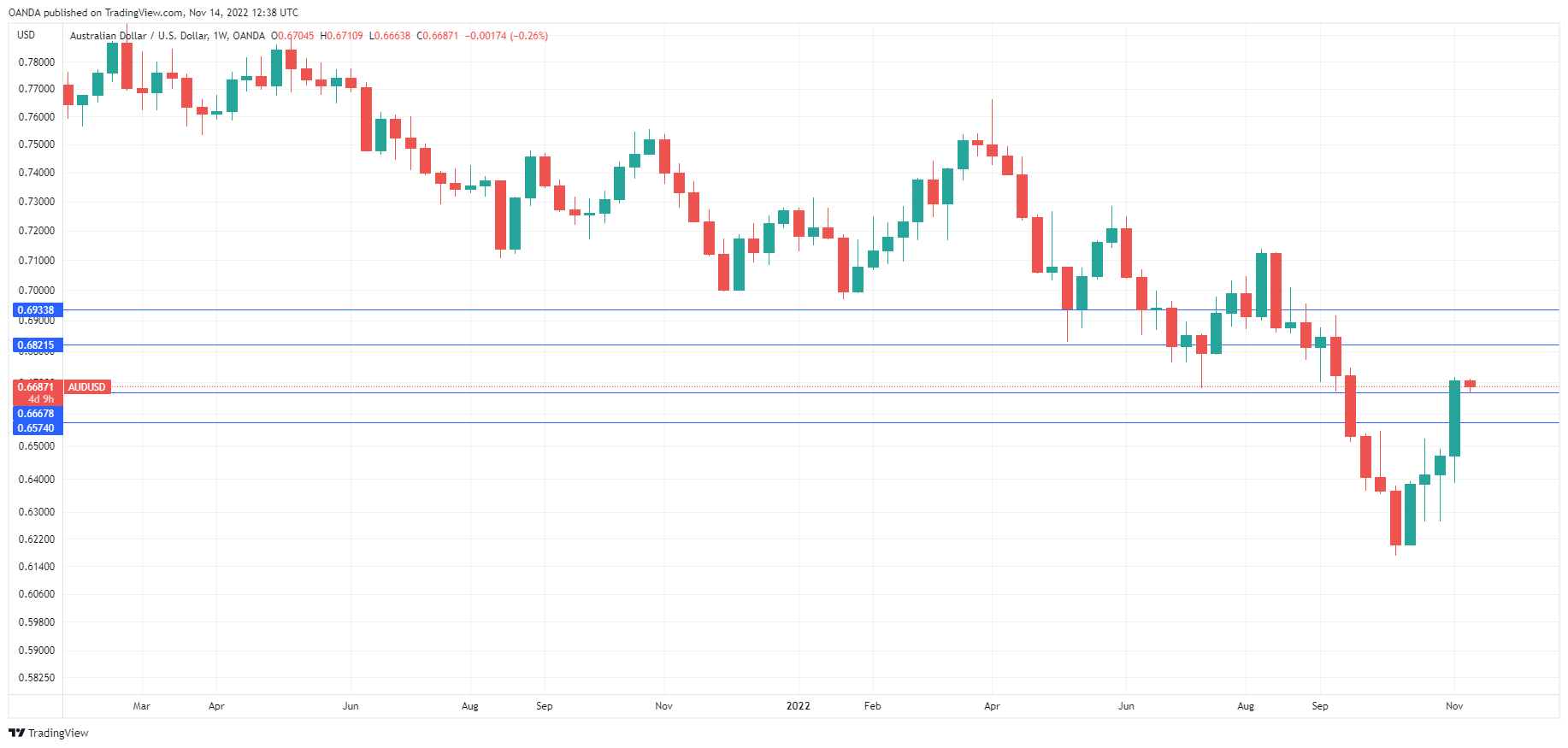
The Australian dollar is in negative territory today, after posting huge gains last week. In the European session, AUD/USD is trading at 0.6690, down 0.22%.
The US dollar took a nasty spill last week, and the Australian dollar made the most of it, gaining 3.6%. The US dollar was slammed after a soft inflation report, with headline and core inflation slowing in October and beating the forecasts. This lit up risk appetite and sent the Australian dollar to its highest level since September 22nd.
The soft inflation report had such a strong effect on the greenback because it has raised expectations that the Fed will ease up on its rate tightening. After four consecutive hikes of 0.75%, the markets have now priced in a 0.50% increase at the December meeting. That would still represent an oversize hike, but investors have been looking for a reason to rush into stocks and the drop in inflation provided that excuse. It’s still too early to tell if inflation has peaked, but the Fed has tweaked its terminology, with Fed members now describing rate policy with words like “gradual” and “measured”. The Fed hasn’t sent out any signals that it is planning a dovish pivot. Quite the contrary; the Fed has stated clearly that the terminal rate could be higher than it had expected, but the markets appear to be ignoring this message and expectations are rising that the Fed will lower rates in the second half of 2023.
RBA raises inflation forecast
In Australia, inflation is also the number one priority. The Reserve Bank of Australia has raised its inflation forecast, with a peak expected at 8 per cent in December and has said inflation will not decline to the 2 per cent target until 2025. The RBA is likely to raise rates by 0.25% for a third straight time at the December meeting. RBA Deputy Governor Michele Bullock said last week that the RBA could have raised rates more sharply to bring inflation down faster, but that a “scorched earth” policy would have meant the loss of strong job gains.
AUD/USD Technical
- There is resistance at 0.6821 and 0.6934
- AUD/USD tested support at 0.6667 earlier today. Below, there is support at 0.6574
EUR/USD Mid-Day Outlook
Daily Pivots: (S1) 1.0224; (P) 1.0294; (R1) 1.0425; More...
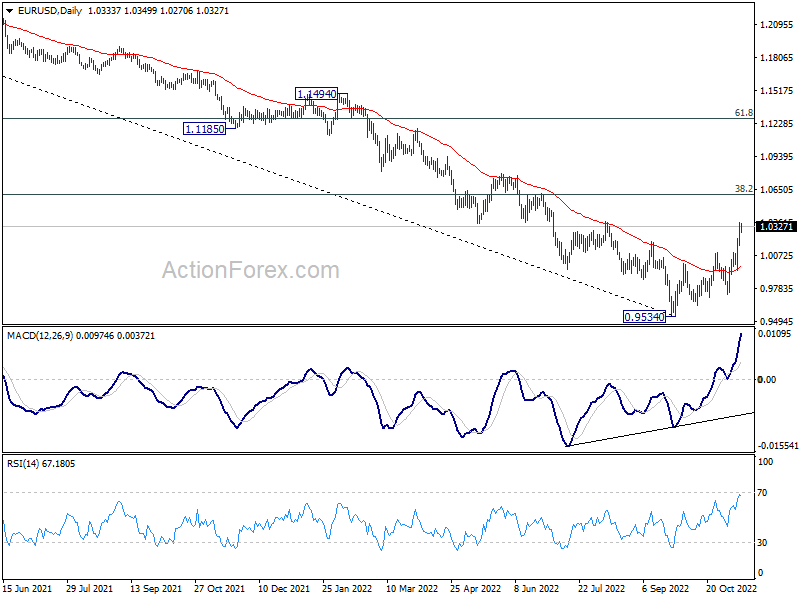
EUR/USD's rally is still in progress and intraday bias remains on the upside. Current rise should target 1.0609 fibonacci level next. On the downside, below 1.0221 minor support will turn intraday bias neutral and bring consolidations first, before staging another rally.
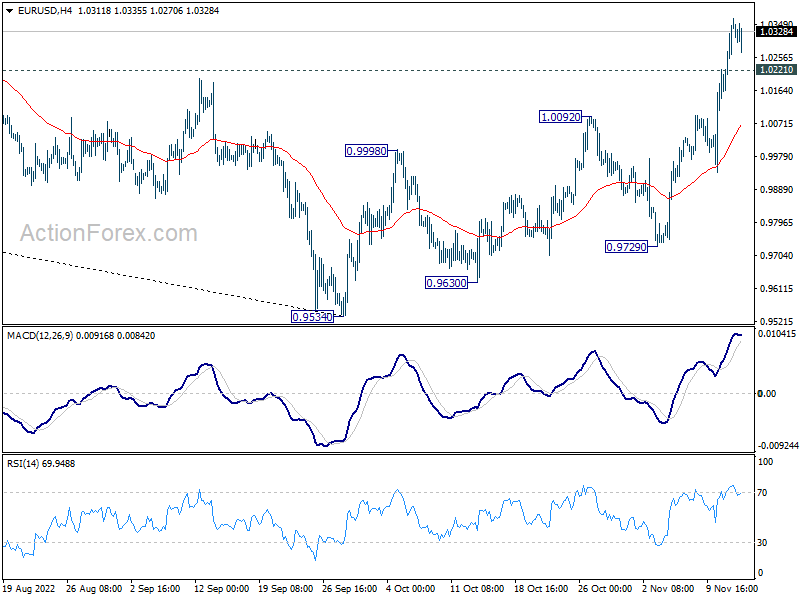
In the bigger picture, a medium term bottom was in place at 0.9534, on bullish convergence condition in daily MACD. Even as a corrective rise, rally from 0.9534 should target 38.2% retracement of 1.2348 (2021 high) to 0.9534 at 1.0609. Sustained trading above 55 week EMA (now at 1.0566) will raise the chance of trend reversal and target 61.8% retracement at 1.1273. This will now remain the favored case as long as 1.0092 resistance turned support holds.
GBP/USD Mid-Day Outlook
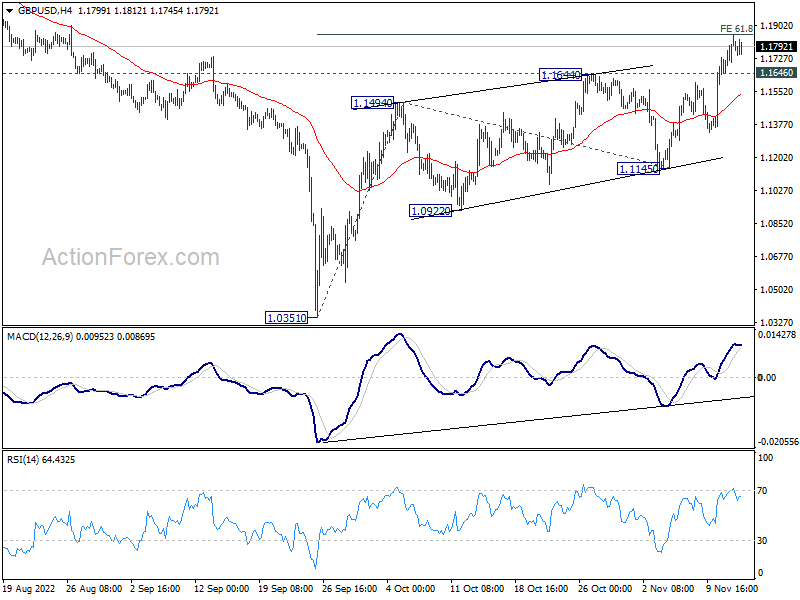
Daily Pivots: (S1) 1.1703; (P) 1.1779; (R1) 1.1911; More...
GBP/USD's rally is still in progress and intraday bias stays on the upside. Firm break of 61.8% projection of 1.0351 to 1.1494 from 1.1145 at 1.1851 will pave the way to 100% projection at 1.2288. On the downside, below 1.1646 minor support will turn intraday bias neutral and bring consolidation first.
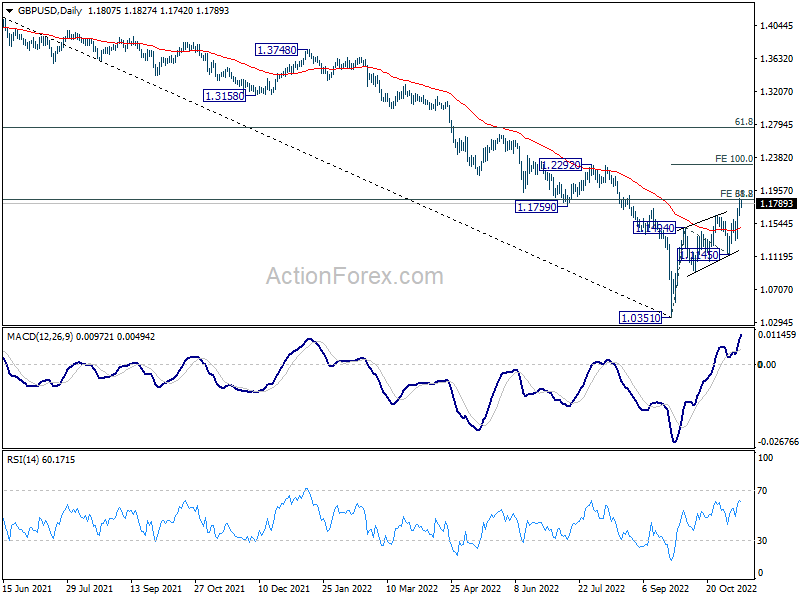
In the bigger picture, current development suggests that rise from 1.0351 is a medium term bottom. Rise from there is at least correcting whole down trend from 1.4248 (2021 high). Further rise is expected as long as 1.1145 support holds. Sustained break of 38.2% retracement of 1.4248 to 1.0351 at 1.1840 will pave the way to 61.8% retracement at 1.2759 and possibly above.
USD/CHF Mid-Day Outlook
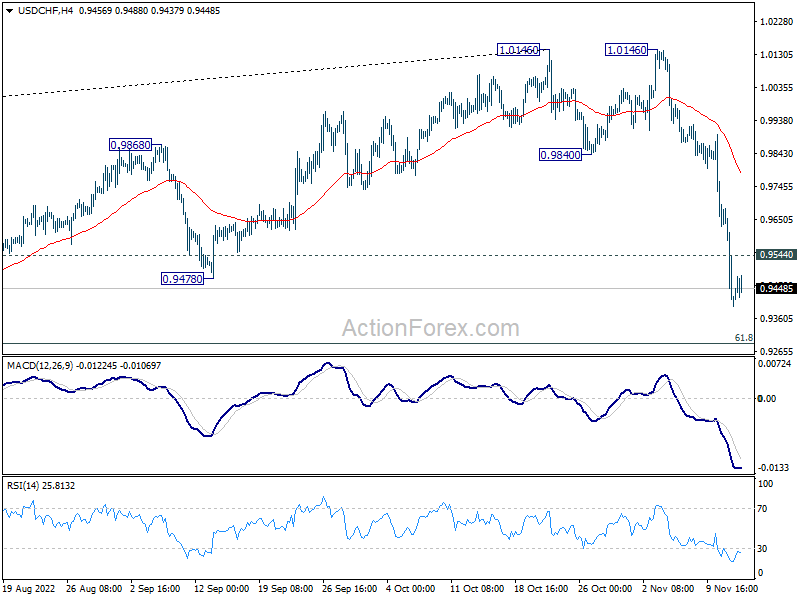
Daily Pivots: (S1) 0.9313; (P) 0.9497; (R1) 0.9597; More...
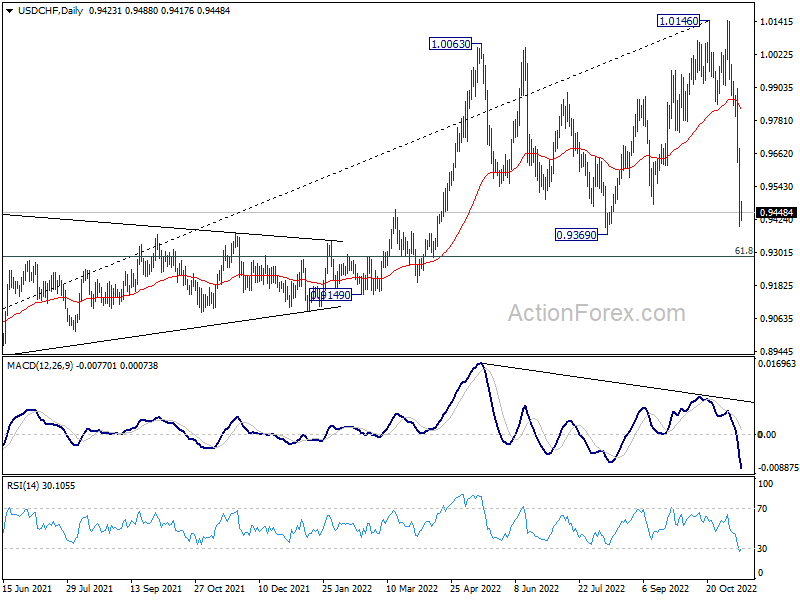
USD/CHF's decline from 1.0146 is still in progress and intraday bias stays on the downside. Further fall should be seen to 0.9369 support, and then 0.9287 fibonacci level. On the upside, break of 0.9544 minor resistance will turn intraday bias neutral first and bring consolidation, before staging another decline.
In the bigger picture, rise from 0.8756 (2021 low) has completed at 1.0146, well ahead of 1.0342 long term resistance (2016 high). Based on current downside momentum, fall from 1.0146 might be a medium term down trend itself. Break of 61.8% retracement of 0.8756 to 1.0146 at 0.9287 will pave the way to 0.8756. In any case, risk will stay on the downside as long as 55 day EMA (now at 0.9821) holds.