Sample Category Title
ECB Panetta: Aggressive tightening is not advisable now
ECB Executive Board member Fabio Panetta said in a speech, "after the progress we have already done in adjusting our policy stance, an aggressive tightening is not advisable, for two main reasons."
First, "current macroeconomic policies should be designed to avoid unnecessarily heightening the risk that the increasingly likely contraction in coming months becomes a severe and protracted one, which would scar the economy... it also requires that monetary policy does not ignore the risks of overtightening," he said".
Second, "even in the face of lasting consequences of supply shocks on potential output, the implications for the output gap, inflation dynamics and optimal policy calibration can only be derived over time. And this reinforces the case that, for as long as inflation expectations remain anchored, monetary policy should adjust but not overreact".
Eurozone industrial production rose 0.9% mom, EU up 0.9% mom
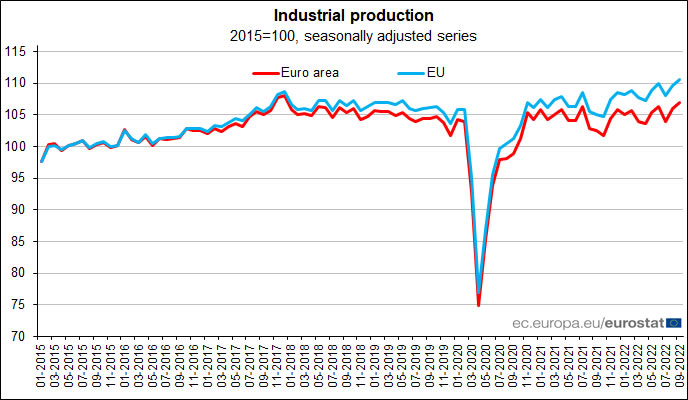
Eurozone industrial production rose 0.9% mom in September, well above expectation of 0.1% mom. Production of non-durable consumer goods rose by 3.6% and capital goods by 1.5%, while production of intermediate goods as well as durable consumer goods fell by -0.9% and energy by -1.1%.
EU industrial production also rose 0.9% mom. Among Member States for which data are available, the highest monthly increases were registered in Ireland (+11.9%), Belgium (+7.1%) as well as in Hungary and the Netherlands (both +1.6%). The largest decreases were observed in Lithuania (-8.2%), Greece (-4.5%) and Estonia (-3.6%).
USD/CNH falling towards 7.000, but shouldn’t break there for long
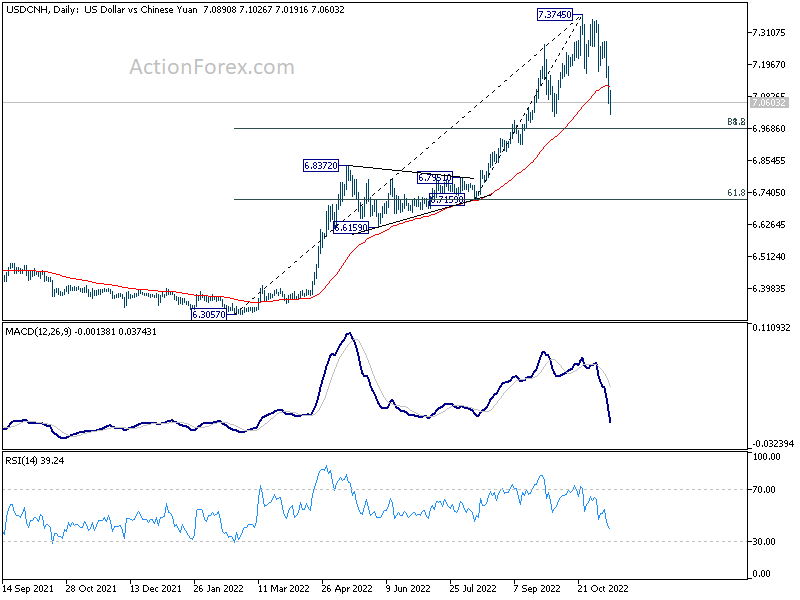
Chinese Yuan surges today and hits the highest level against Dollar since early October. The rally was fueled by growing optimism that China is going to relax is strict zero-COVID policy, even as outbreaks worsen with highest infections in six months. At the same time, of course, decline in USD/CNH happened with global selloff in Dollar, after last week's lower than expected CPI data solidified the case for Fed to start to slow its tightening pace in December.
Technically speaking, there is room for more pull back in USD/CNH, towards 7.000 psychological level. However, there's an important cluster support, with 61.8% retracement of 6.7159 to 7.3475 at 6.9675 and 38.2% retracement of 6.3057 to 7.3745 at 6.9662 just nearby. Downside should be contained by this 6.9662/75 support zone to bring rebound, unless there are some fundamental changes, in China, or the US, or their diplomatic relations, or any combinations of these factors.
GBPUSD: Consolidation Likely to Precede Push Towards 1.20 Target
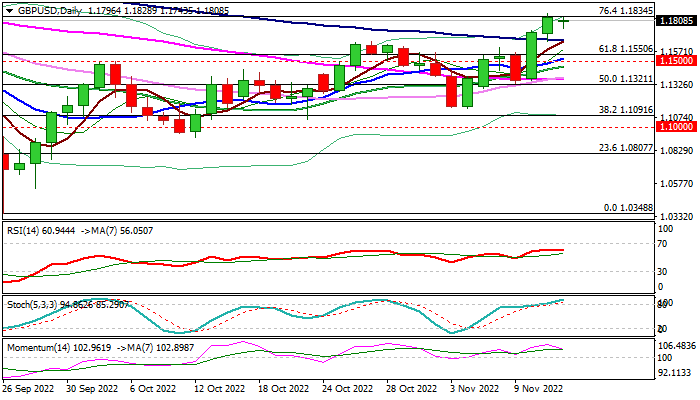
Cable is consolidating under new multi-week high (1.1854) reinforced by cracked Fibo 76.4% of 1.2293/1.0348 (1.1834), where last week’s strong rally faced headwinds.
Bulls remain firmly in play despite overextended daily studies, boosted by weekly bullish engulfing pattern, pressuring 1.1834 Fibo pivot, break of which would open way for attack at psychological 1.20 barrier.
Converged 5/100DMA’s are about to form bull-cross (1.1655) and offer good support which should protect the downside and keep focus at the upside.
Only loss of pivotal 1.1550/1500 support zone (broken Fibo 61.8% / 10DMA / psychological) would harm bulls and signal deeper pullback.
Res: 1.1854; 1.1900; 1.2000; 1.2048.
Sup: 1.1743; 1.1655; 1.1645; 1.1550.
AUD/USD Pair Moved into a Bullish Zone above 0.6550
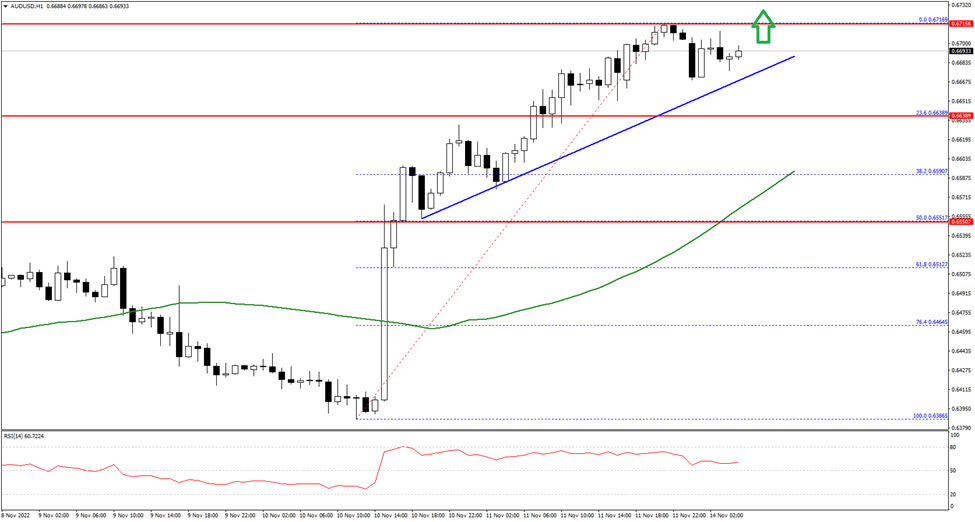
The Aussie Dollar started a decent increase from the 0.6400 zone against the US Dollar. The AUD/USD pair climbed above the 0.6550 level to move into a bullish zone.
There was a clear move above the 0.6660 level and the 50 hourly simple moving average. The pair even spiked above the 0.6700 level and is currently consolidating gains. An immediate resistance on the upside is near the 0.6715 level and the recent high.
If there is an upside break above the 0.6715 zone, the pair could rise steadily towards the 0.6750 level in the near term. The main resistance now sits near the 0.6800 level.
An immediate support is near the 0.6680 level a connecting bullish trend line on the hourly chart. The next key support is near 0.6640 on FXOpen. A downside break below the 0.6640 support could lead the pair towards the 0.6590 support.
EURUSD: Bulls Taking a Breather after Biggest Weekly Rally Since March 2020
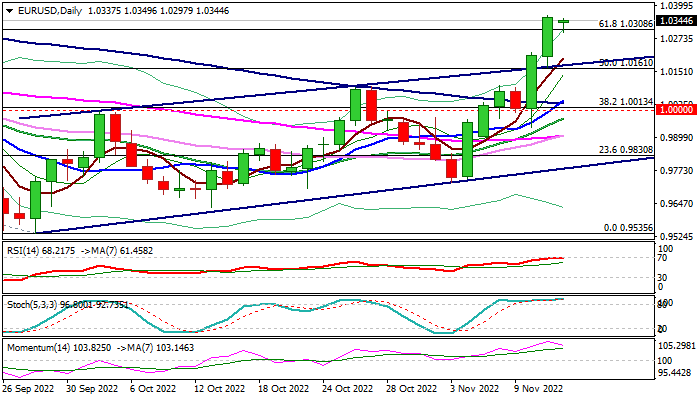
Bulls are taking a breather in early Monday’s trading following strong rally last week (up 4.5% for the week, the biggest weekly gains since mid-March 2020).
Last week’s acceleration of the recovery from new 20-year low (0.9535) was mainly driven by weaker dollar on growing signs that the Fed may ease its aggressive approach to policy tightening after US inflation further dropped in October.
Bulls registered weekly close above 1.0308 (Fibo 61.8% of 1.0786/0.9535) but faced strong headwinds on approach to Aug high (1.0368).
Partial profit-taking on overbought daily studies may keep bulls on hold for consolidation, with additional pressure seen from 100/200DMA’s bear-cross.
Broken trendline which marks the upper boundary of bull-channel reverted to solid support (1.0177) which should ideally contain dips and offer better buying opportunities for fresh push higher.
Bulls need clear break through Aug peak (1.0368) to generate fresh signal for extension towards falling 200DMA (1.0433) and Fibo 76.4% of 1.0786/0.9535 (1.0491).
Caution on break below trendline support which would risk deeper pullback and put bulls on hold, with loss of parity zone to weaken near-term structure and signal top.
However, early downside rejection would signal that bulls remain firmly in play for further advance after a brief pause.
Res: 1.0368; 1.0400; 1.0433; 1.0491.
Sup: 1.0300; 1.0197; 1.0177; 1.0138.
A Choppy Start
It's been quite a choppy start to the trading week, with much of the focus on China where Covid relaxation measures and property market support have brought some relief.
Unfortunately, both come at a time of record Covid infections in major cities including Beijing and Guangzhou. And those relaxation measures that were announced are not ambitious enough to make any difference in those cities seeing rising cases which means activity is going to weaken.
There is hope that China could further relax its zero-Covid policy next spring but for now, mass testing, heavy restrictions, and lockdowns are here to stay, despite growing opposition and fatigue. Those hoping that this initial relaxation phase would be more substantial were always setting themselves up for disappointment.
Property stocks in China and Hong Kong were given a big lift at the start of the week as Beijing unveiled its 16-point plan to support the industry. Having almost brought the industry to its knees as part of its reform efforts, Beijing is attempting to build it back up but as it's already finding, the former is much easier to do than the latter.
Confidence is shattered and it will take time, effort, and patience to restore it. Now it's a question of how much these measures will undermine Beijing's initial reform measures and whether they'll even succeed in reinvigorating the industry. Efforts until now have been like pushing on a piece of string.
Oil is steady but upside risks remain
The prospect of looser restrictions has boosted the price of oil recently and yet Brent still finds itself trading around the middle of its $90-$100 range. The US inflation data last week gave crude another boost as traders were left to dream again about a possible soft landing if the data continues that way and the Fed raises rates less.
There's still a long way to go though and much of the world won't be so lucky, assuming it isn't already too late for the US. But further signs of inflation peaking will no doubt be welcome, you just wonder whether it will also be the catalyst for oil to break $100 again, further complicating the growth outlook once more.
Gold's spectacular rebound
It's been a fantastic 10 days for gold, with the yellow metal going from at risk of breaking below $1,620 support to rallying almost 10% to its highest level in almost three months. It's been quite the ride, fueled by signals from the central bank that the next hike could be less aggressive and then that inflation report.
Can gold hold onto this momentum and break $1,800, taking it into territory that it hasn't traded within since late-Spring, early-summer? It's a big ask but if the data is generous and the dollar continues to give back some of its enormous gains from the past year, there's every chance gold could build momentum from here.
Bad timing
Bitcoin waited patiently for this moment, forming a base around $20,000 in anticipation of inflation falling and the Fed narrative becoming much less hawkish. Unfortunately, that moment coincided with the spectacular collapse of FTX which has sent shockwaves through the industry and hammered crypto prices. Rather than taking off, bitcoin has plummeted to levels not seen in two years and further pain may lie ahead. There's now enormous uncertainty in the space which could hold it back in the near term and weigh on prices.
S&P 500 Tests Resistance
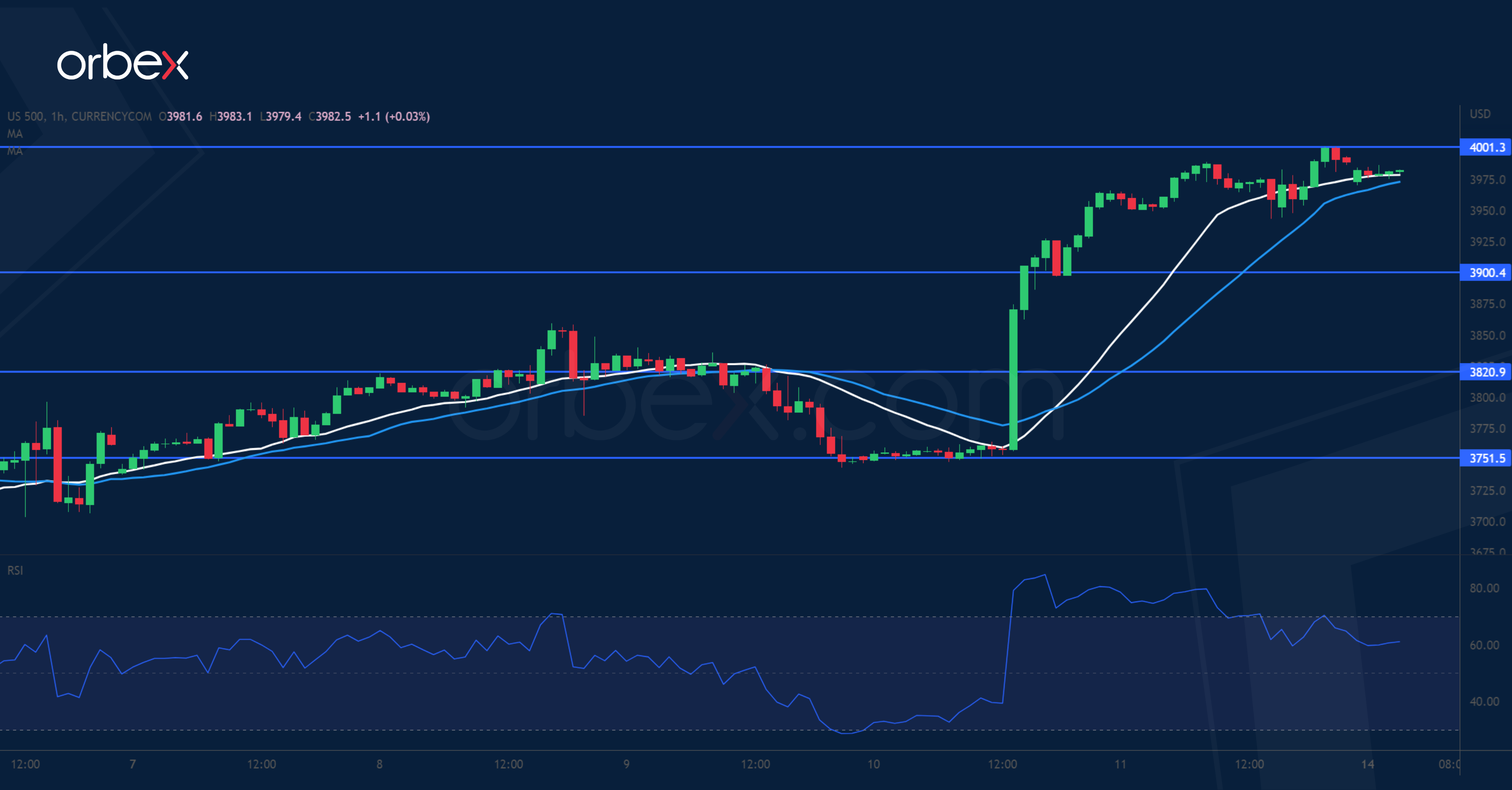
The S&P 500 flies high fuelled by the Fed pivot optimism. The vertical rise above 3900 confirms the bullish MA cross on the daily chart, suggesting an acceleration to the upside. The index is testing the psychological level of 4000, which is also a former support from a mid-September sell-off. A breakout would put the September peak of 4150 within reach. The RSI shows an overextension and may prompt intraday buyers to take profit in the supply zone. The resistance-turn-support at 3900 would be the first level to monitor.
EURGBP Meets Support
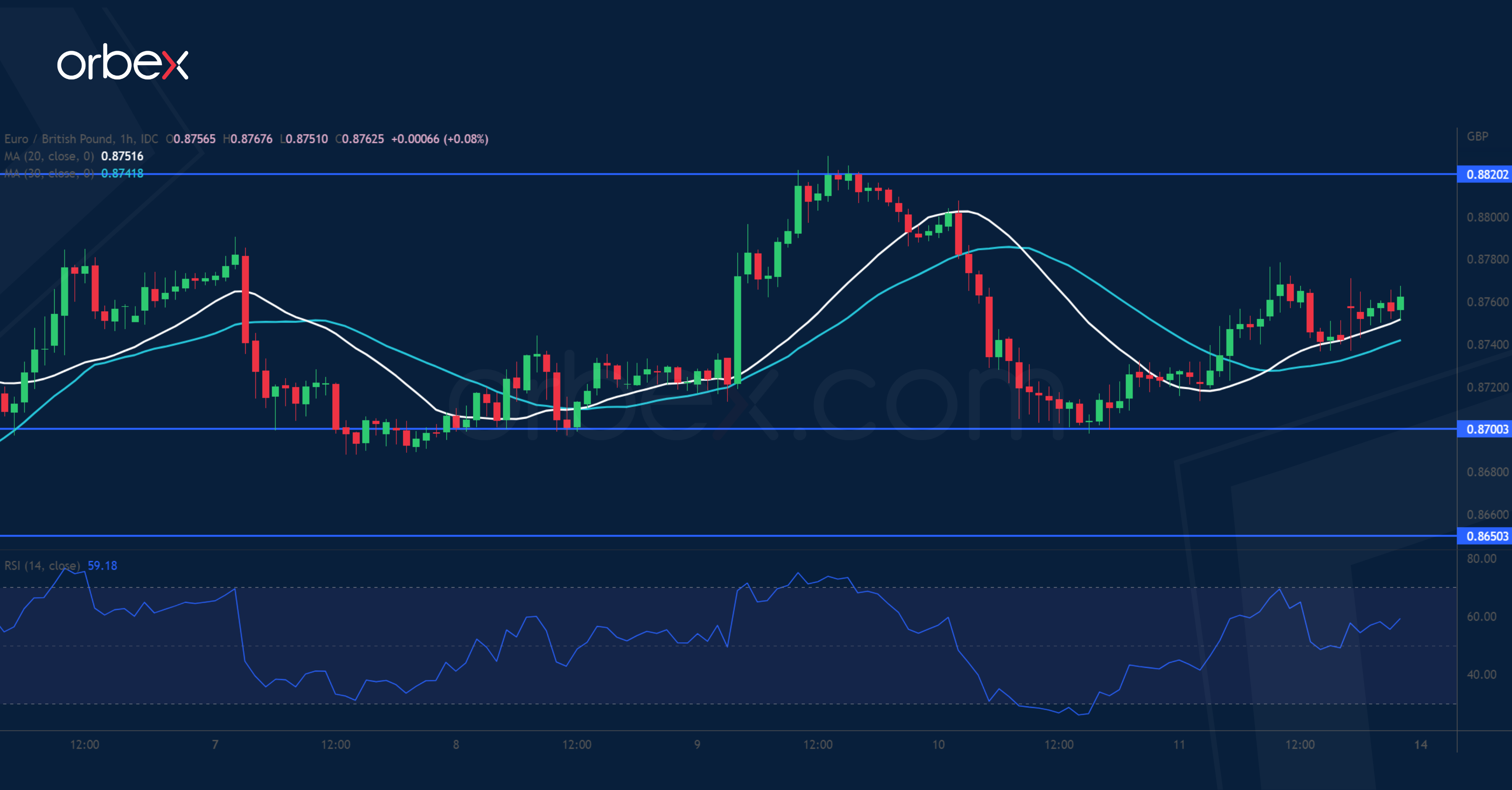
The pound found support from upbeat GDP in Q3. The pair has been looking to hold onto its recent gains above 0.8780, which is a prerequisite before a sustained recovery could materialise. The latest retracement came to a rest over the previous low at 0.8700, a sign of robust interest in keeping the single currency’s edge. A close above 0.8820 could attract momentum and trigger a runaway rally above 0.8900, confirming a bullish reversal in the process. On the downside, 0.8650 is a second line of defence in case of hesitation.
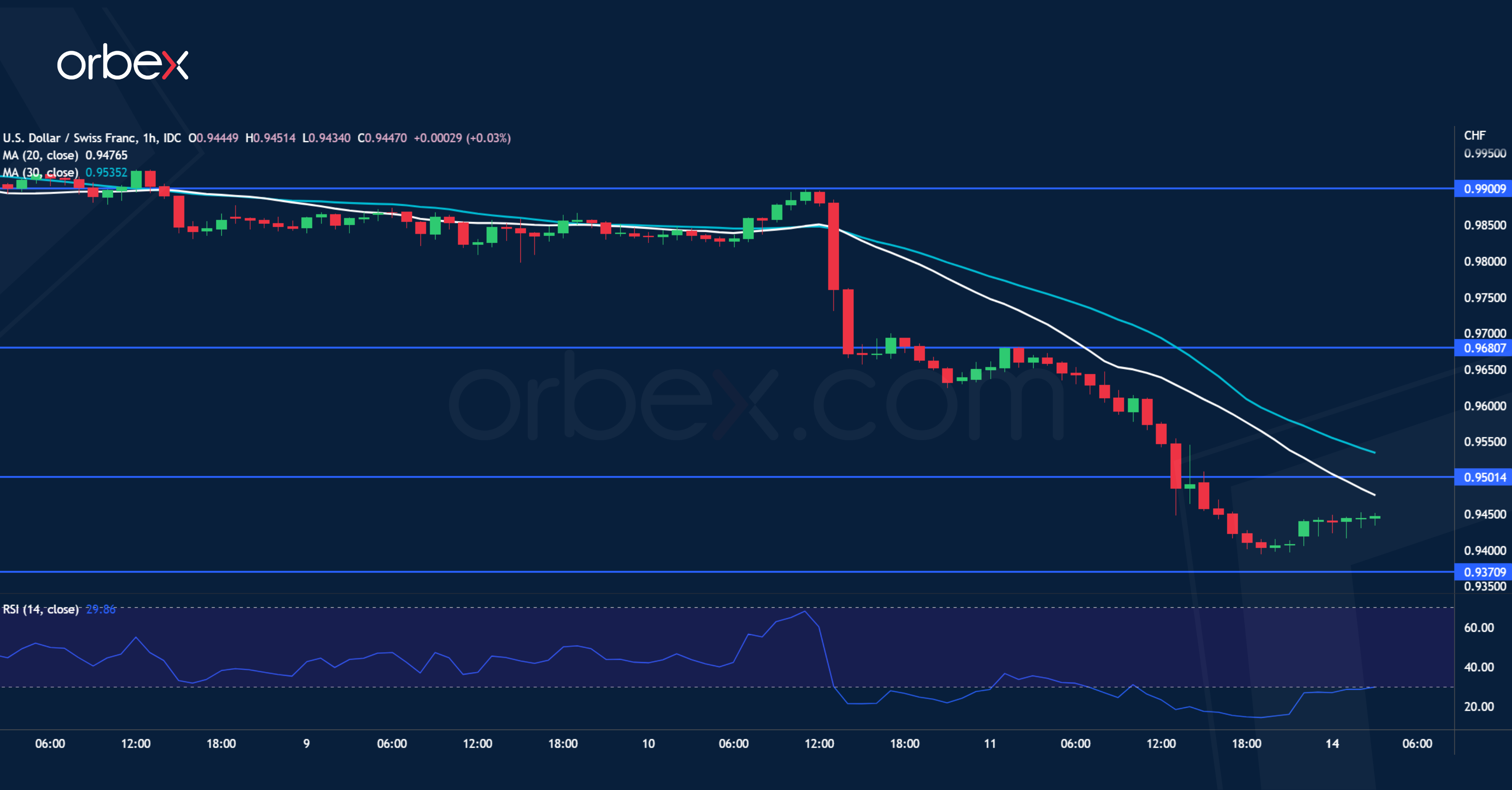
USDCHF Probes August’s Low
The US dollar sank as traders reassessed the Fed’s stance in light of cooling inflation. A sharp fall below the daily support at 0.9740 prompted more buyers to bail out. Then strong momentum below 0.9500 was a sign that the reversal has caught the bulls off-guard, causing a mass liquidation. August’s low of 0.9370 is the next support but buyers could be wary of catching a falling knife. A bearish breakout would pave the way for a slide towards 0.9300. The support-turned-resistance 0.9500 is the first hurdle when the dust settles.