

Sample Category Title
EUR/USD Punches above Parity, ECB Next
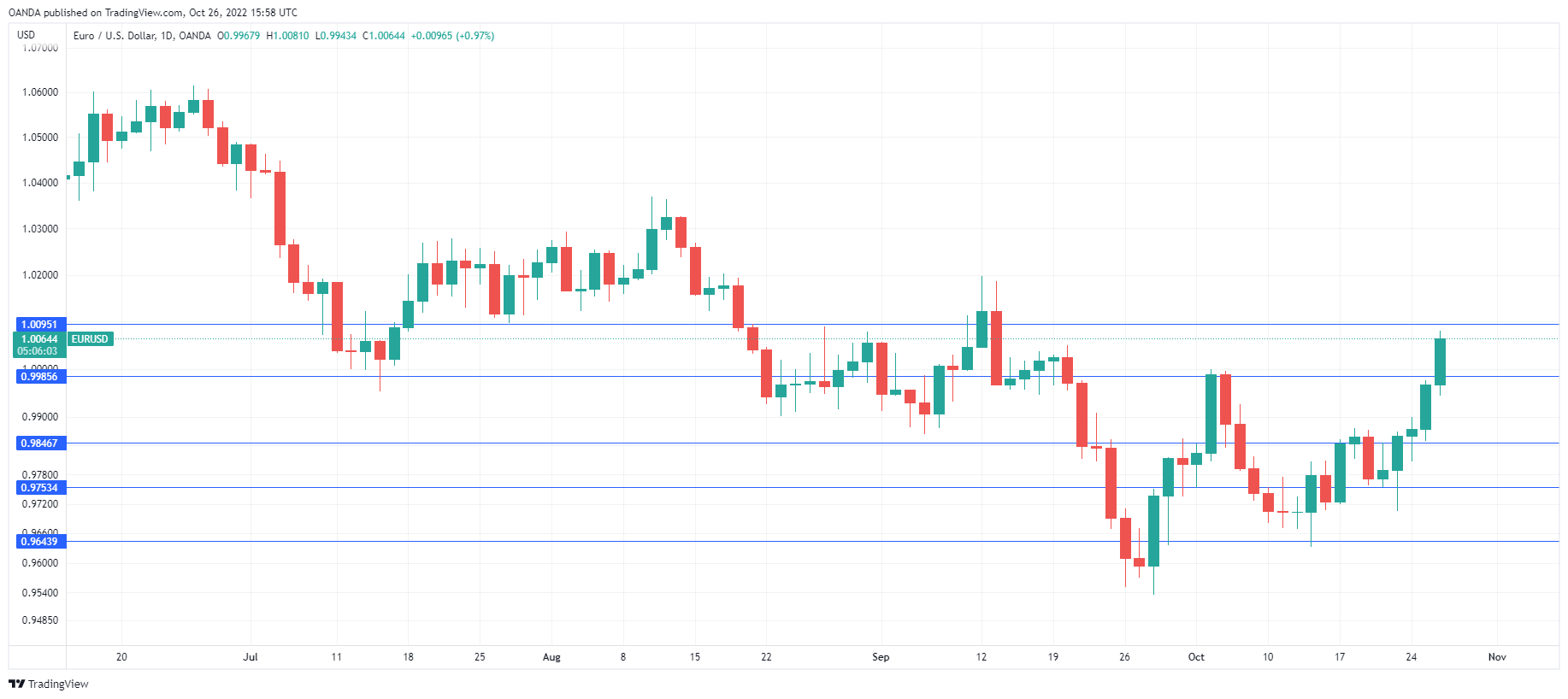
EUR/USD continues to power forward and has breached the parity line for the first time since September 20th. The euro is red hot, having gained 2.1% this week, as the US dollar has hit a bump in the road and is lower against all the major currencies. In the North American session, EUR/USD is trading at 1.0069, up 1.02%.
The German economy, the largest in the eurozone, continues to show signs of weakness. September PMIs pointed to contraction in manufacturing and business activity, and these are unlikely to rebound as the Ukraine war continues and an energy crisis looms, with winter close by. The Ifo Business Confidence index fell for a fourth straight month in October and GfK Consumer Sentiment, which will be released tomorrow, is expected to remain deep in negative territory.
ECB expected to hike by 0.75%
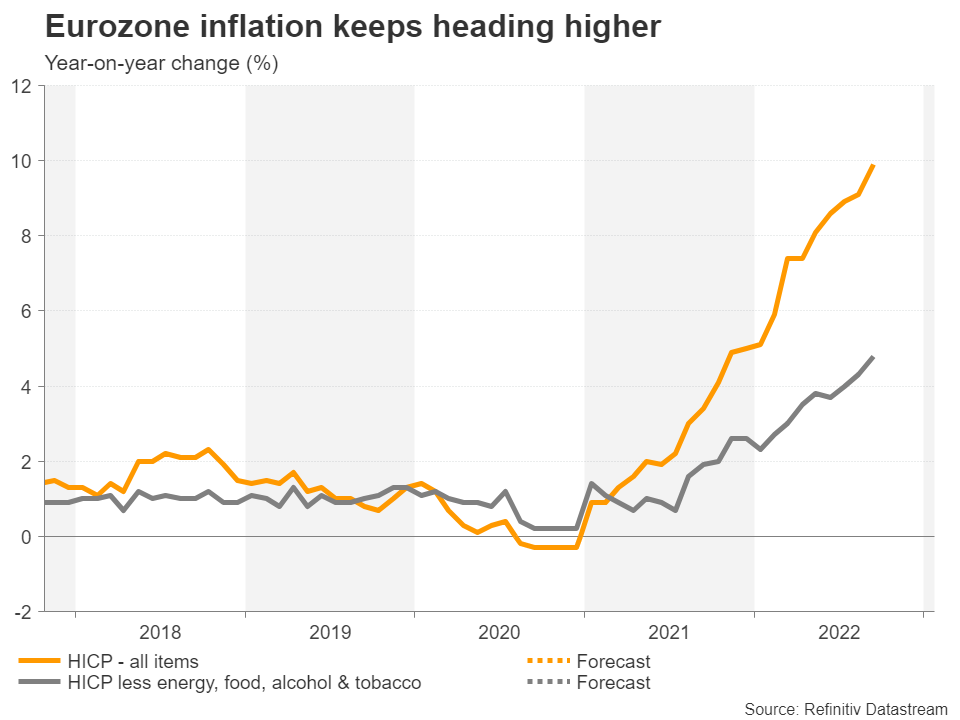
The ECB meets on Thursday, with policy makers having to contend not only with a gloomy economic outlook in the eurozone, but also with spiralling inflation, with no sign of a peak. Eurozone CPI jumped to 9.9% in September, up sharply from the 9.1% rise in August. The markets have priced in a supersize 0.75% hike, which would bring the cash rate to 2.0% and investors will be looking for the Bank to declare its commitment to bring inflation back to the 2% target.
A jumbo full-point increase remains a slight possibility, given that inflation is close to double-digits. Investors will be monitoring the follow-up press conference, and the euro’s direction tomorrow could depend on ECB President Lagarde’s message to the markets. If Lagarde signals that further rate hikes are coming, the euro will likely gain ground. Conversely, a dovish stance from Lagarde could cut short the euro’s rally.
EUR/USD Technical
- EUR/USD has broken above 0.9846 and is testing resistance at 0.9985. The next resistance line is 1.0095
- There is support at 0.9753 and 0.9643
BoC’s Smaller-than-Expected Rate Hike Not Crushing CAD
There was an important signal today that monetary authorities in North America are ready to ease the pace of policy tightening faster than the market expects.
The Bank of Canada raised the rate by 50 points to 3.75%, although analysts, on average, predicted a repeat of September’s move with a 75-point hike. While the Bank of Canada’s commentary on the decision pointed to the need for further rate hikes, there is no getting around the fact that the central bank is now more concerned with fine-tuning its policy rather than chasing fleeing prices.
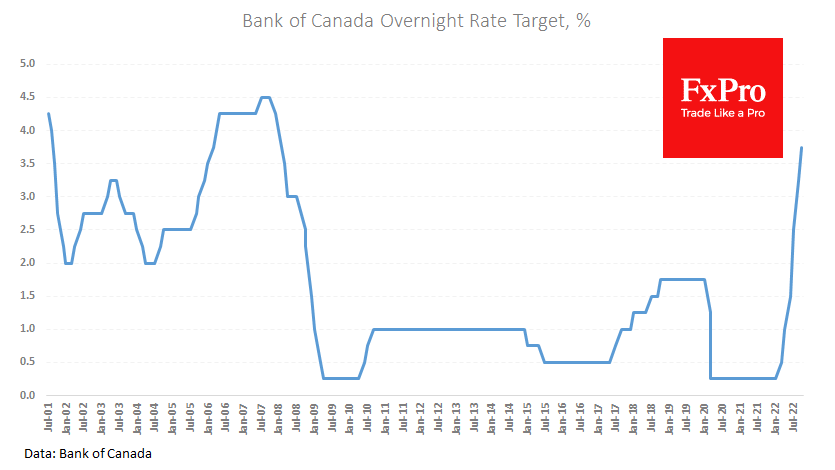
The Bank has noted a slowdown in consumer price growth from 8.1% to 6.9% over the last three months. The situation in the USA is not much different, with inflationary pressures also declining. However, the fundamental difference is that the expensive dollar raises inflation elsewhere and reduces it in the USA. Hence, a more fine-tuning phase becomes more relevant for the Fed, too.
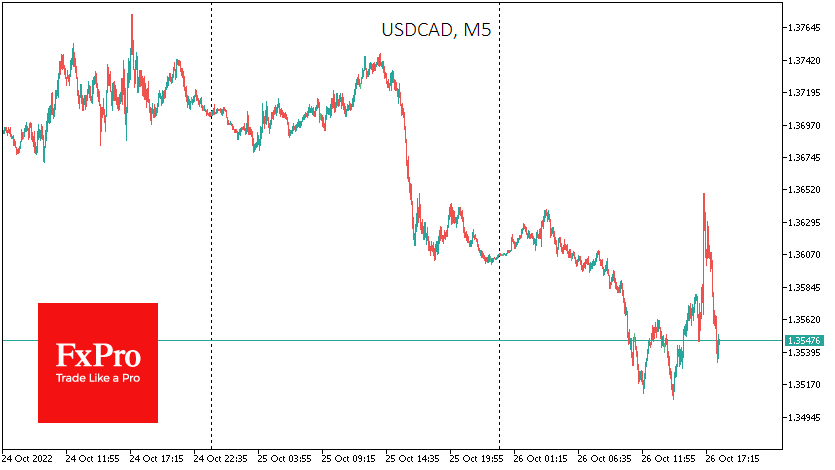
The USDCAD reaction is also very indicative. From the highs near 1.3650, where the robots pushed the pair in the first moments after the release, it has rolled back 0.8% to 1.3540 in just over an hour. As a reminder, just three months ago, raising the rate less than the Fed was practically dooming the currency to fall. However, today the USDCAD is retesting October lows.
BoC’s Half Point Hike Suggests Peak is Near
- BoC dials back tightening pace with below-consensus 50 bp hike to 3.75%
- Statements says rates expected to rise further but getting closer to end of tightening phase
- BoC sees economy stalling in coming quarters
The BoC dialed back the pace of its tightening cycle today with a 50 bp increase that fell short of market expectations and consensus for another 75 bp hike. We were in the minority anticipating a half point increase, with a deteriorating global backdrop, slowing domestic growth, early signs of a softening labour market, and faster-than-expected decline in headline inflation all supporting a slower pace of rate hikes. These factors apparently outweighed concerns about a weakening Canadian dollar (ahead of a likely 75 bp hike by the Fed next week), sticky core inflation and only modest improvement in inflation expectations. For all the concerns about the currency, this morning’s dovish surprise hasn’t had a sustained impact on the Canadian dollar, though government bond yields are down sharply.
With today’s smaller-than-expected rate increase, the BoC has entered the late stages of what has been a historically rapid tightening cycle. While we are “not there yet,” Governor Macklem made clear that we are getting closer to the end of the BoC’s tightening phase. He also said the BoC is “trying to balance the risks of under- and over-tightening,” suggesting a more even-handed approach than in recent months. Today’s dovish pivot supports our view that the BoC will continue to taper its tightening cycle into year end with a 25 bp increase in December leaving the terminal rate at 4%. Risks around that forecast are still skewed to the upside—indeed, Macklem seemed to frame next meeting’s debate as 25 vs. 50 bps—and we think the BoC will want to see further easing in monthly core inflation measures and inflation expectations to pause at 4%.
Justifying what is still an outsized rate increase, the BoC continued to emphasize high and broadly-based inflation and domestic price pressures stemming from excess demand and tight labour market conditions. But at the same time (and consistent with our assessment above) the policy statement noted a challenging global growth backdrop and evidence that policy tightening is slowing domestic activity beyond its early impact on housing. GDP growth is now projected to “essentially stall” in the coming quarters. While the BoC isn’t using the r-word, it acknowledged “a couple of quarters with growth slightly below zero is just as likely as a couple of quarters with small positive growth.” That might be as close as the central bank will come to calling a recession until we’re actually in one. While the BoC cut its 2023 growth forecast in half to 0.9%, that’s still well above our 0.2% projection.
Bank of Canada Delivers a 50 Basis-Point Hike
The Bank of Canada raised the overnight rate by 50 basis points to 3.75%, while stating that it will continue with Quantitative Tightening (QT).
On rising prices, it stated that "measures of core inflation are not yet showing meaningful evidence that underlying price pressures are easing. Near-term inflation expectations remain high, increasing the risk that elevated inflation becomes entrenched."
On economic growth, the Bank stated that it "is expected to stall through the end of this year and the first half of next year as the effects of higher interest rates spread through the economy. The Bank projects GDP growth will slow from 3¼% this year to just under 1% next year and 2% in 2024."
On the future path of policy, the Bank noted that "given elevated inflation and inflation expectations, as well as ongoing demand pressures in the economy, the Governing Council expects that the policy interest rate will need to rise further."
Key Implications
The Bank of Canada has slowed the pace of rate hikes, as it pivots to a more forward-looking policy framework. Given the BoC's expectation for stagnant growth from now through the end of 2024, the focus is on how past interest rate hikes will weigh on the economy going forward. Though the BoC is not done hiking this year, we are clearly nearing a peak in the policy rate.
With the BoC undershooting market expectations of a 75 basis-point hike today, yields are falling. The Canada 2-year yield is down nearly 20 basis points at writing, as market participants price in a lower terminal rate. Governor Macklem is on deck with his press conference and we will all be closely watching how he navigates this policy shift.
ECB Policy Meeting: Is More than a Rate Hike on the Table?
With inflation five times its target, the ECB has certainly more work to do to achieve its price stability goal. On Thursday, the central bank is largely expected to repeat September’s triple rate hike even though a recession looms ahead. Any comments on the terminal rate level and plans for quantitative tightening could make the meeting relatively special, although such discussions might be premature at the moment.
A cloudy economic outlook
Financial conditions are not bright in the euro area. The European Systemic Risk board, which is responsible for tracking threats to the financial system, has warned over increased macro vulnerabilities in the region even before the UK’s political failure spooked financial markets. Particularly, the body advised financial institutions to enhance their provision practices and capital planning as recent geopolitical developments and tightening financial conditions threaten renewed balance sheet stress for non-financial corporations and households.
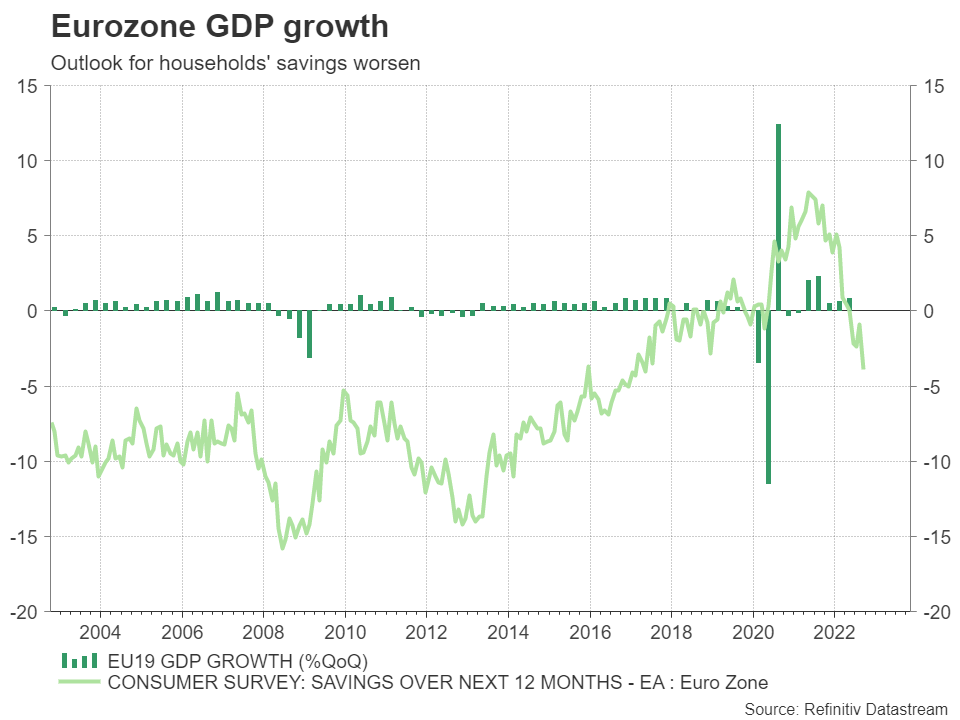
Two more severe systemic risks were mentioned regarding large margin calls for investors in the event of sharp falls in asset prices, and a drop in asset quality and profitability outlook, while elevated risks in the real estate sector is also something that cannot be ignored.
Another triple rate hike due this week
The ECB chief Christine Lagarde acknowledged the above headwinds but refrained from easing her hawkish tone as inflation is expected to remain the number one problem for longer. The sum of recent public speeches delivered by ECB board members further convinced traders that rate announcements will be more pronounced by the end of the year, with futures markets fully pricing in a second 75 bps rate increase this week.
Key points to watch
On the other hand, there was a group of dovish policymakers who recently highlighted the cost of maintaining such an aggressive policy tightening. That immediately raised questions about whether the central bank will take smaller rate steps once it reaches the level that neither stimulates nor restrains the economy. Currently, investors anticipate two 50 bps rate hikes in the next two meetings before the pace of increases slows to 25 bps in March and May 2023 to reach the terminal rate at 2.75%-3.0%.
Yet, the communication might not be clear on where the neutral rate level could be and whether the central bank will terminate its rate hike cycle at that point, as unlike inflation in the US, eurozone inflation has barely shown any signs of abating so far. Note that new updates on economic projections are scheduled for the next meeting in December. Therefore, that might be a story for another day.
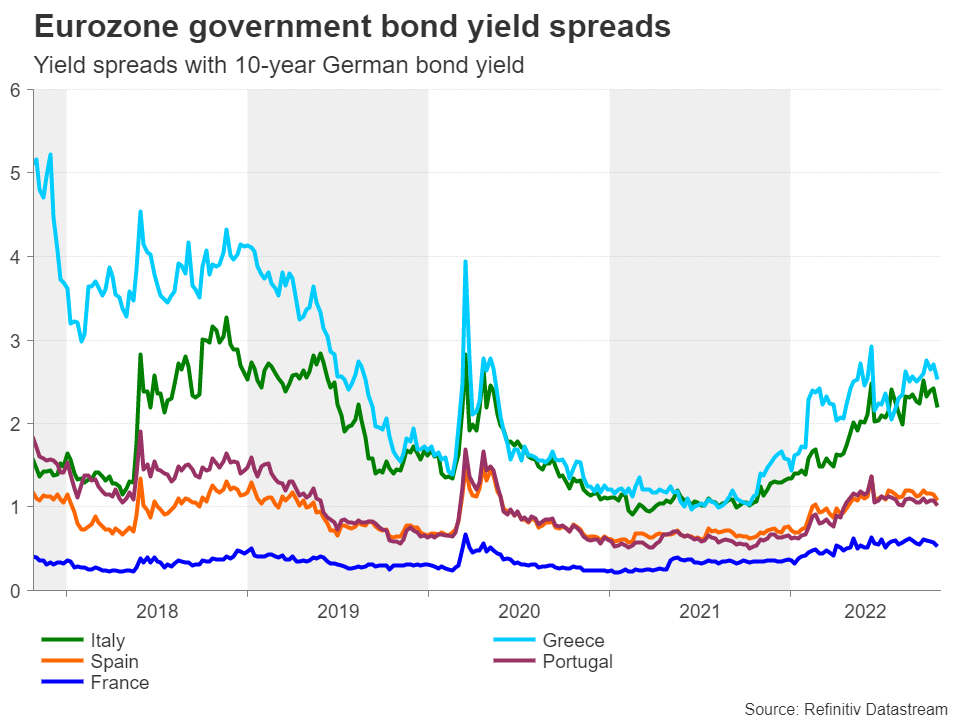
The ECB may also avoid providing any guidance on quantitative tightening, although internal discussions seem to have started already. Lagarde said that a balance sheet reduction may not happen until interest rates reach the neutral level. Of course, making plans in advance is helpful, though leaking important information when bond markets are melting and the spread between Italian and German yields remains wide could further scare investors and pressure markets in high-debt member states such as Italy. Note that many policymakers expect the central bank to carefully phase out reinvestments from matured bonds bought under the regular APP asset purchase program in spring 2023.
Investors will also look for any changes in the terms of cheap targeted longer-term refinancing operations (TLTRO) loans. That could be a convenient way to restrain liquidity by speeding up repayments from banks.
Euro/dollar
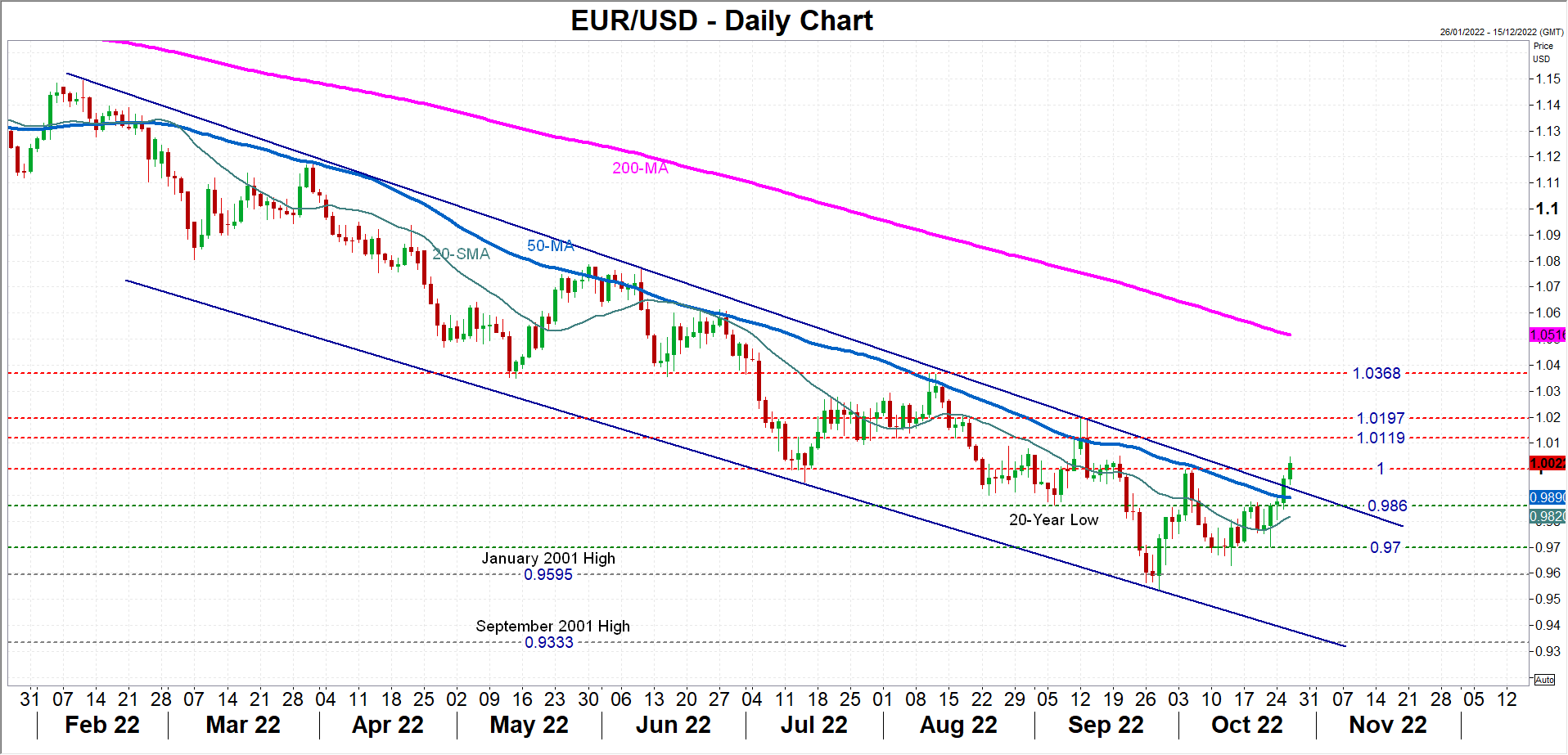
Turning to FX markets, the rate announcement itself may not create any exciting bullish reaction in the euro, as it’s already fully priced in and backed by policymakers. Hence, the focus will fall elsewhere and particularly on the extra details that the central bank might provide regarding liquidity reduction through other channels, such as quantitative tightening. If the central bank judges economic conditions might be better-than-expected to allow similar bold rate increases in the coming months and a balance sheet reduction at the start of next year, euro/dollar could stretch up to test the 1.0119-1.0197 resistance region. A break above the August high of 1.0368 could add more credence to the bullish wave.
Otherwise, heightened concerns over the coming quarters and increased speculation that the neutral rate level could be reached earlier next year, but QT may come with some delay and could squeeze euro/dollar back into the bearish channel. A break below the 50-day simple moving average (SMA) and the 0.9860 key level could open the door for the 0.9700 support region.
EUR/CAD rises after BoC, heading to 1.4?
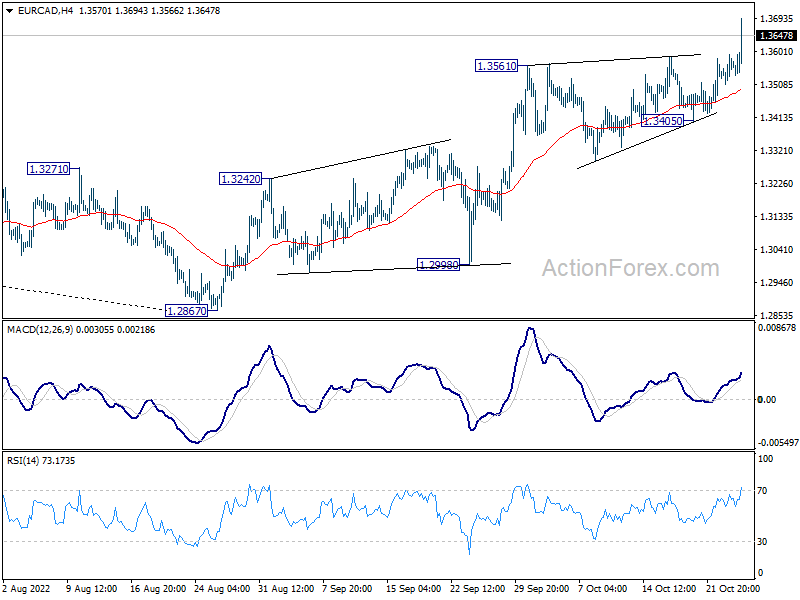
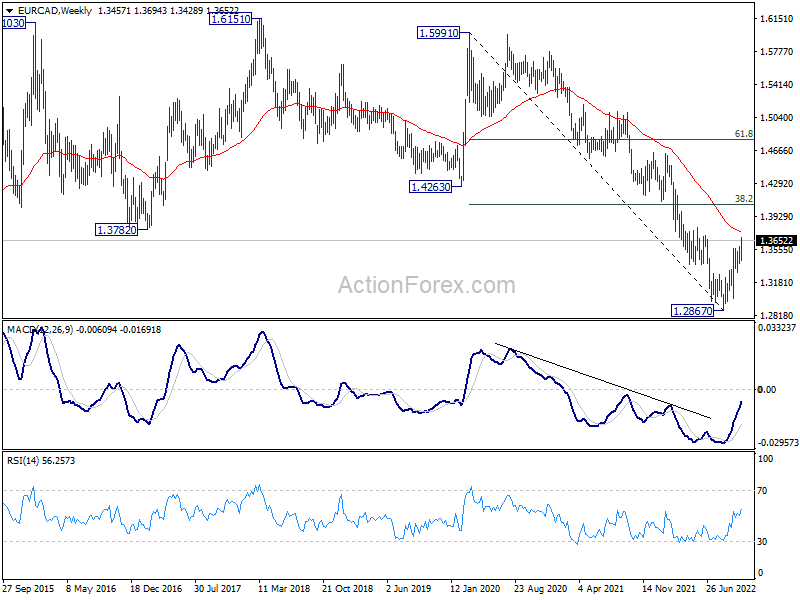
EUR/CAD's rise from 1.2867 accelerates upwards after smaller than expected rate hike by BoC. For now, further rally is expected as long as 1.3405 support holds even in case of retreat. Next target is 55 week EMA (now at 1.3753). Sustained break there will argue that stronger rise is underway, even as a corrective move. EUR/CAD would then target 38.2% retracement of 1.5991 to 1.2867 at 1.4060.
USD/CAD Daily Outlook
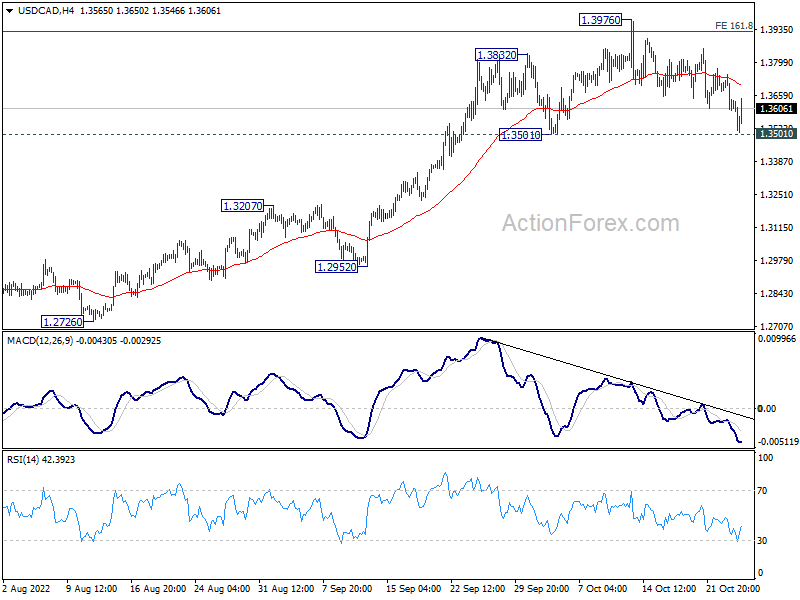
Daily Pivots: (S1) 1.3556; (P) 1.3652; (R1) 1.3703; More....
USD/CAD recovers just ahead of 1.3501 support and intraday bias remains neutral for the moment. As long as 1.3501 holds, further rise is still in favor. On the upside, firm break of 1.3976 will target 200% projection of 1.2005 to 1.2947 from 1.2401 at 1.4285. However, firm break of 1.3501 will bring deeper correction to 55 day EMA (now at 1.3429) and possibly below.
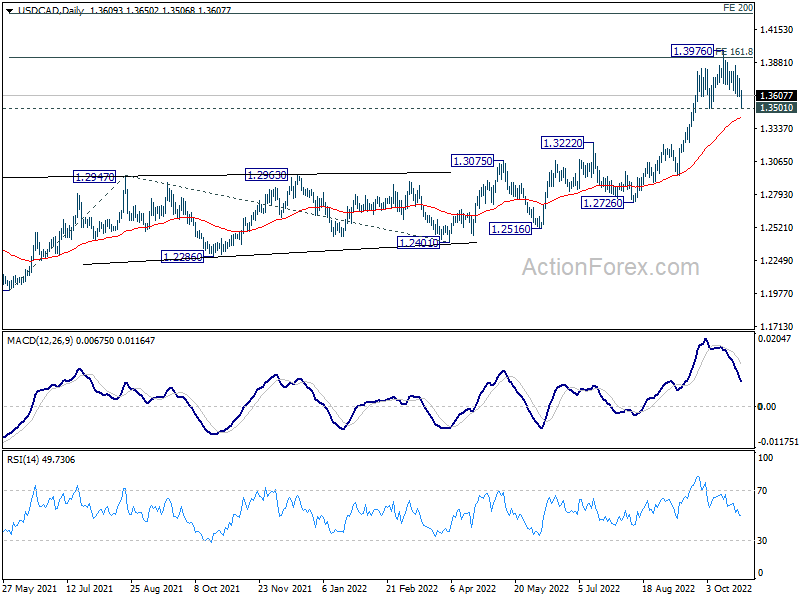
In the bigger picture, up trend from 1.2005 (2021 low) is still in progress. Based on current impulsive momentum, it could be resuming long term up trend from 0.9056 (2007 low). Whether it is or it isn't, retest of 1.4689 (2016 high) should be seen next. This will now remain the favored case as long as 1.3222 resistance turned support holds.
BoC hikes only 50bps, downgrades growth and inflation forecasts
BoC hikes overnight by only 50bps to 3.75%, disappointing those expecting a 75bps hike. Bank Rate and deposit rate are at 4.00% and 3.75% respectively. The central bank maintains tightening bias, and noted that "the Governing Council expects that the policy interest rate will need to rise further".
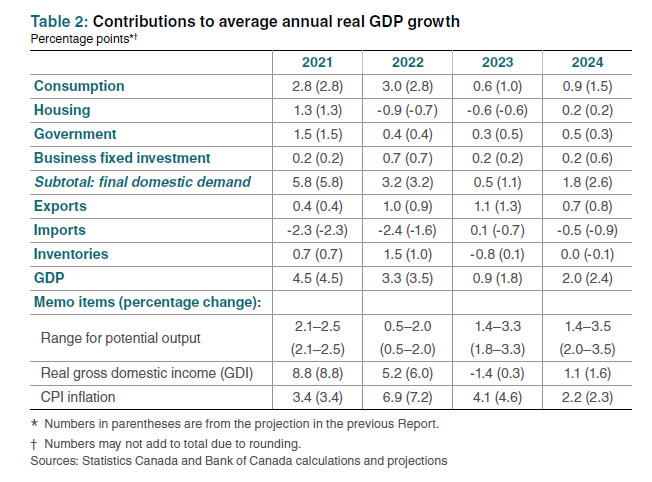
In the new economic projections, GDP growth was downgraded from 3.5% to 3.3% in 2022, from 1.8% to 0.9% in 2023, and from 2.4% to 2.0% in 2024. CPI inflation forecasts was also downgraded from 7.2% to 6.9% in 2022, from 4.6% to 4.1% in 2023, and from 2.3% to 2.2% in 2024.
(BOC) Bank of Canada increases policy interest rate by 50 basis points, continues quantitative tightening
The Bank of Canada today increased its target for the overnight rate to 3¾%, with the Bank Rate at 4% and the deposit rate at 3¾%. The Bank is also continuing its policy of quantitative tightening.
Inflation around the world remains high and broadly based. This reflects the strength of the global recovery from the pandemic, a series of global supply disruptions, and elevated commodity prices, particularly for energy, which have been pushed up by Russia's attack on Ukraine. The strength of the US dollar is adding to inflationary pressures in many countries. Tighter monetary policies aimed at controlling inflation are weighing on economic activity around the world. As economies slow and supply disruptions ease, global inflation is expected to come down.
In the United States, labour markets remain very tight even as restrictive financial conditions are slowing economic activity. The Bank projects no growth in the US economy through most of next year. In the euro area, the economy is forecast to contract in the quarters ahead, largely due to acute energy shortages. China's economy appears to have picked up after the recent round of pandemic lockdowns, although ongoing challenges related to its property market will continue to weigh on growth. Overall, the Bank projects that global growth will slow from 3% in 2022 to about 1½% in 2023, and then pick back up to roughly 2½% in 2024. This is a slower pace of growth than was projected in the Bank's July Monetary Policy Report (MPR).
In Canada, the economy continues to operate in excess demand and labour markets remain tight. The demand for goods and services is still running ahead of the economy's ability to supply them, putting upward pressure on domestic inflation. Businesses continue to report widespread labour shortages and, with the full reopening of the economy, strong demand has led to a sharp rise in the price of services.
The effects of recent policy rate increases by the Bank are becoming evident in interest-sensitive areas of the economy: housing activity has retreated sharply, and spending by households and businesses is softening. Also, the slowdown in international demand is beginning to weigh on exports. Economic growth is expected to stall through the end of this year and the first half of next year as the effects of higher interest rates spread through the economy. The Bank projects GDP growth will slow from 3¼% this year to just under 1% next year and 2% in 2024.
In the last three months, CPI inflation has declined from 8.1% to 6.9%, primarily due to a fall in gasoline prices. However, price pressures remain broadly based, with two-thirds of CPI components increasing more than 5% over the past year. The Bank's preferred measures of core inflation are not yet showing meaningful evidence that underlying price pressures are easing. Near-term inflation expectations remain high, increasing the risk that elevated inflation becomes entrenched.
The Bank expects CPI inflation to ease as higher interest rates help rebalance demand and supply, price pressures from global supply disruptions fade, and the past effects of higher commodity prices dissipate. CPI inflation is projected to move down to about 3% by the end of 2023, and then return to the 2% target by the end of 2024.
Given elevated inflation and inflation expectations, as well as ongoing demand pressures in the economy, the Governing Council expects that the policy interest rate will need to rise further. Future rate increases will be influenced by our assessments of how tighter monetary policy is working to slow demand, how supply challenges are resolving, and how inflation and inflation expectations are responding. Quantitative tightening is complementing increases in the policy rate. We are resolute in our commitment to restore price stability for Canadians and will continue to take action as required to achieve the 2% inflation target.
Information note
The next scheduled date for announcing the overnight rate target is December 7, 2022. The Bank will publish its next full outlook for the economy and inflation, including risks to the projection, in the MPR on January 25, 2023.
USD/JPY Mid-Day Outlook
Daily Pivots: (S1) 147.28; (P) 148.19; (R1) 148.86; More...
USD/JPY is extending the consolidation from 151.93 and intraday bias stays neutral. In case of another fall, downside should be contained by 38.2% retracement of 130.38 to 151.93 at 143.69 to bring rebound. Upside of rally attempt should be limited by 151.39 resistance.

In the bigger picture, up trend from 101.18 is still in progress, as part of the whole up trend from 75.56 (2011 low). 147.68 (1998 high) was already met and there is no clearly sign of topping yet. In any case, break of 140.33 support is needed to be the first sign of medium term topping. Otherwise, further rise is in favor to next target at 160.16 (1990 high).
