Sample Category Title
NZDUSD Rangebound after Bouncing Off 30-Month Low
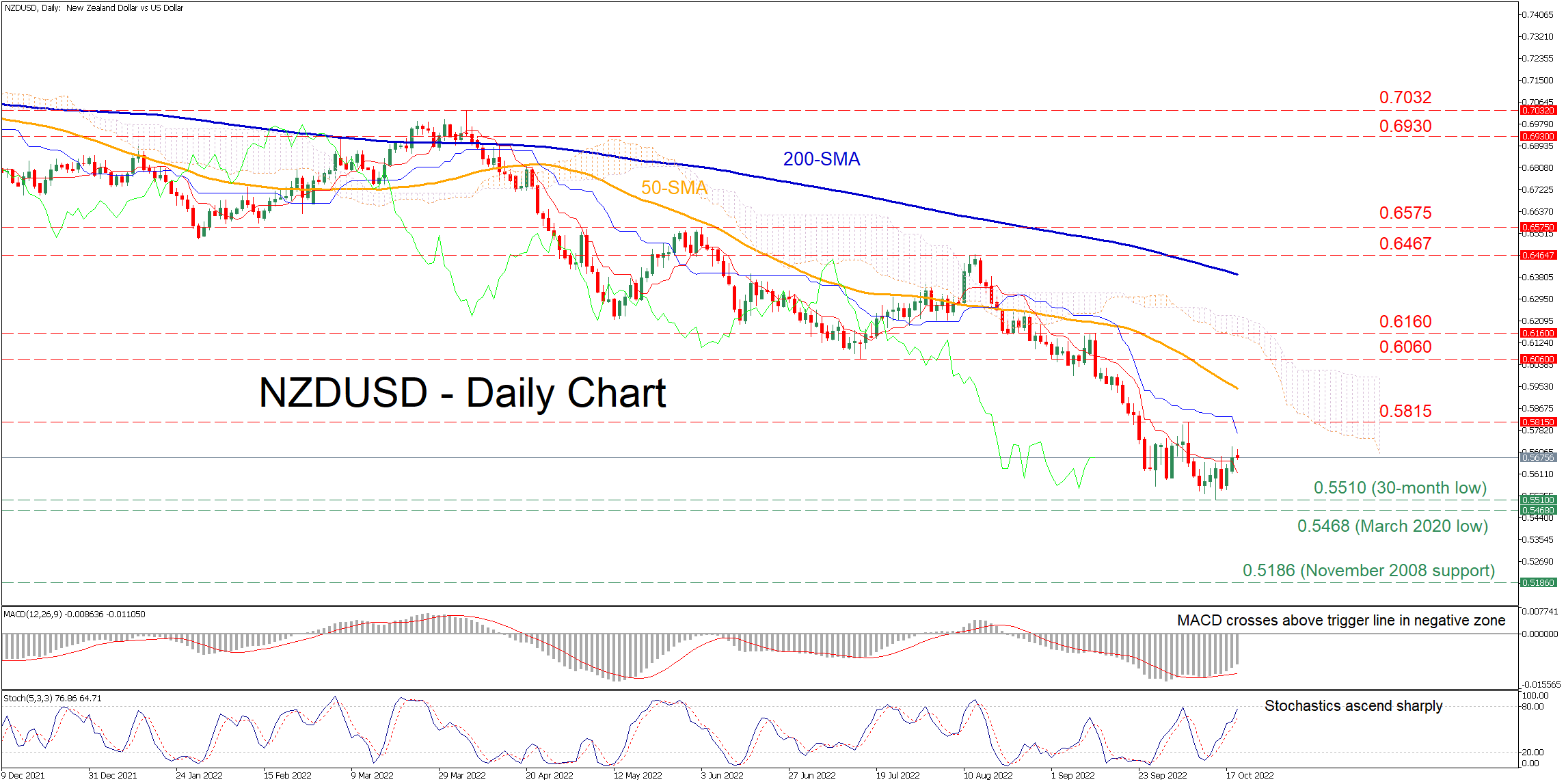
NZDUSD has been trending lower since March, generating a profound structure of lower highs and lower lows. Nevertheless, the pair has been trading sideways in the last few daily sessions, attempting a minor recovery after hitting a 30-month low of 0.5510.
The momentum indicators are endorsing a cautiously positive near-term tone. Specifically, the MACD histogram has jumped above its red signal line but remains in the negative territory, while the stochastic oscillator is ascending sharply towards its 80-overbought region.
To the upside, bullish actions could send the price to test the recent resistance region of 0.5815. Piercing through this barrier, the pair might ascend towards the July low of 0.6060, which could now act as resistance. A break above the latter may turn the spotlight to 0.6160 before the August high of 0.6467 comes under examination.
Alternatively, should selling pressures intensify, the price could encounter initial support at the 30-month low of 0.5510. Sliding beneath that floor, the bears could target the March 2020 bottom of 0.5468. If that floor collapses, the pair will dive towards levels not seen in the past 13 years, where the November 2008 support of 0.5186 might provide downside protection.
Overall, even though the market is pushing for some recovery, it seems that NZDUSD lacks the necessary momentum to alter its short-term picture back to positive. For the latter to be accomplished, a close above the 0.5815 ceiling is initially required.
GBP/USD Pair is Consolidating Near 1.1340
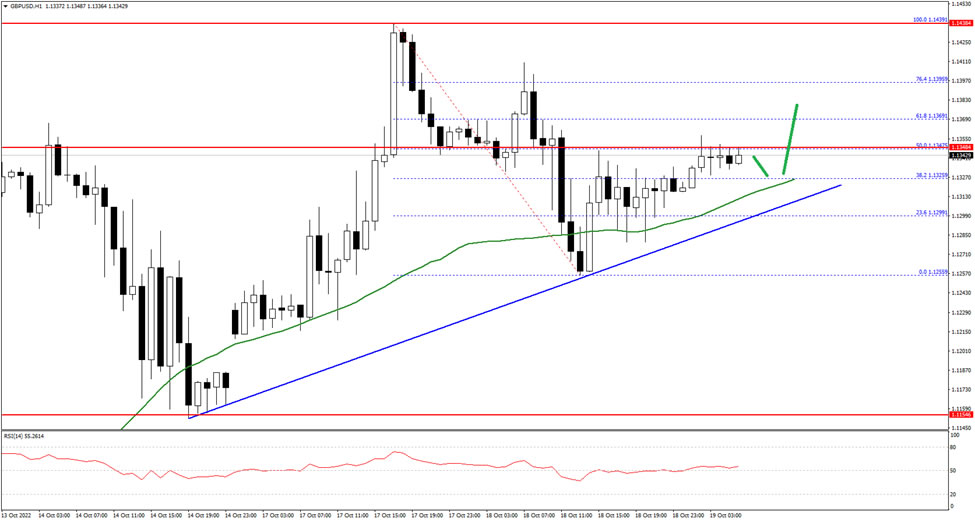
The British Pound started a fresh decline from the 1.1440 resistance zone against the US Dollar. The GBP/USD pair declined below the 1.1300 support.
It traded as low as 1.1255 and is currently rising. There was a move above the 1.1300 level and the pair settled above the 50 hourly simple moving average. It is now consolidating near the 1.1340 level, with an immediate resistance at 1.1350 on FXOpen.
If there is a clear upside break above the 1.1350 resistance, the pair could rise steadily towards the 1.1400 level in the near term. The next major resistance sits near the 1.1450 level.
On the downside, the first major support is near the 1.1310 level. The main support is forming near the 1.1300 level and a connecting bullish trend line on the hourly chart. A break below the 1.1300 support could even push the pair below the 1.1250 support.
FTSE 100 Tests Resistance
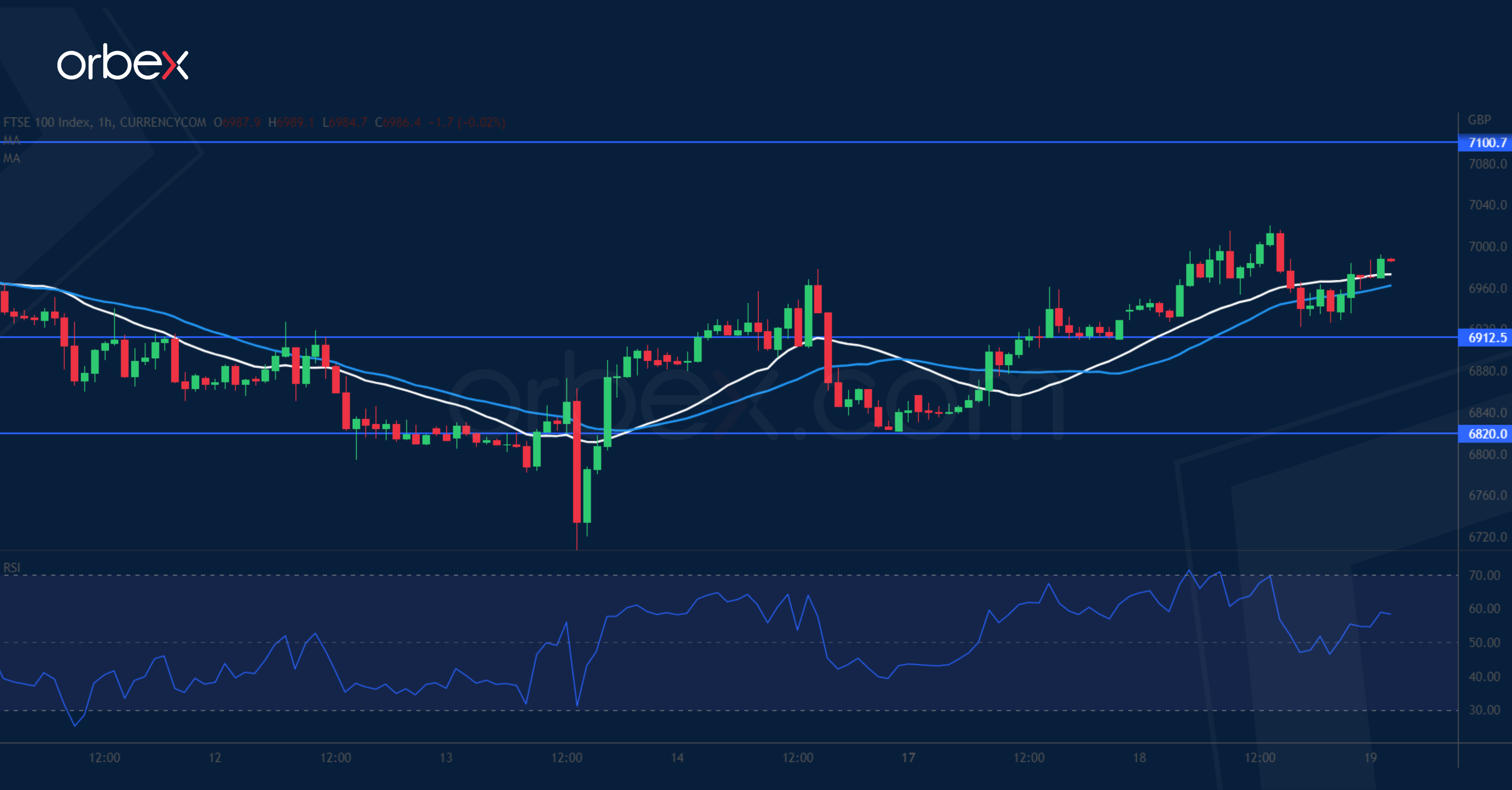
The FTSE 100 inches higher on improved risk sentiment. A break above 6900 prompted some short interests to cover, easing the downward pressure. A series of higher lows would further boost buyers’ confidence and send the index to the daily resistance at 7100 where a breakout could extend the recovery towards 7300. In the meantime, an overbought RSI may cause a limited pullback with 6912 as the closest support. Further down, 6820 is the bulls’ second line of defence to keep the price action afloat.
XAU/USD Seeks Support
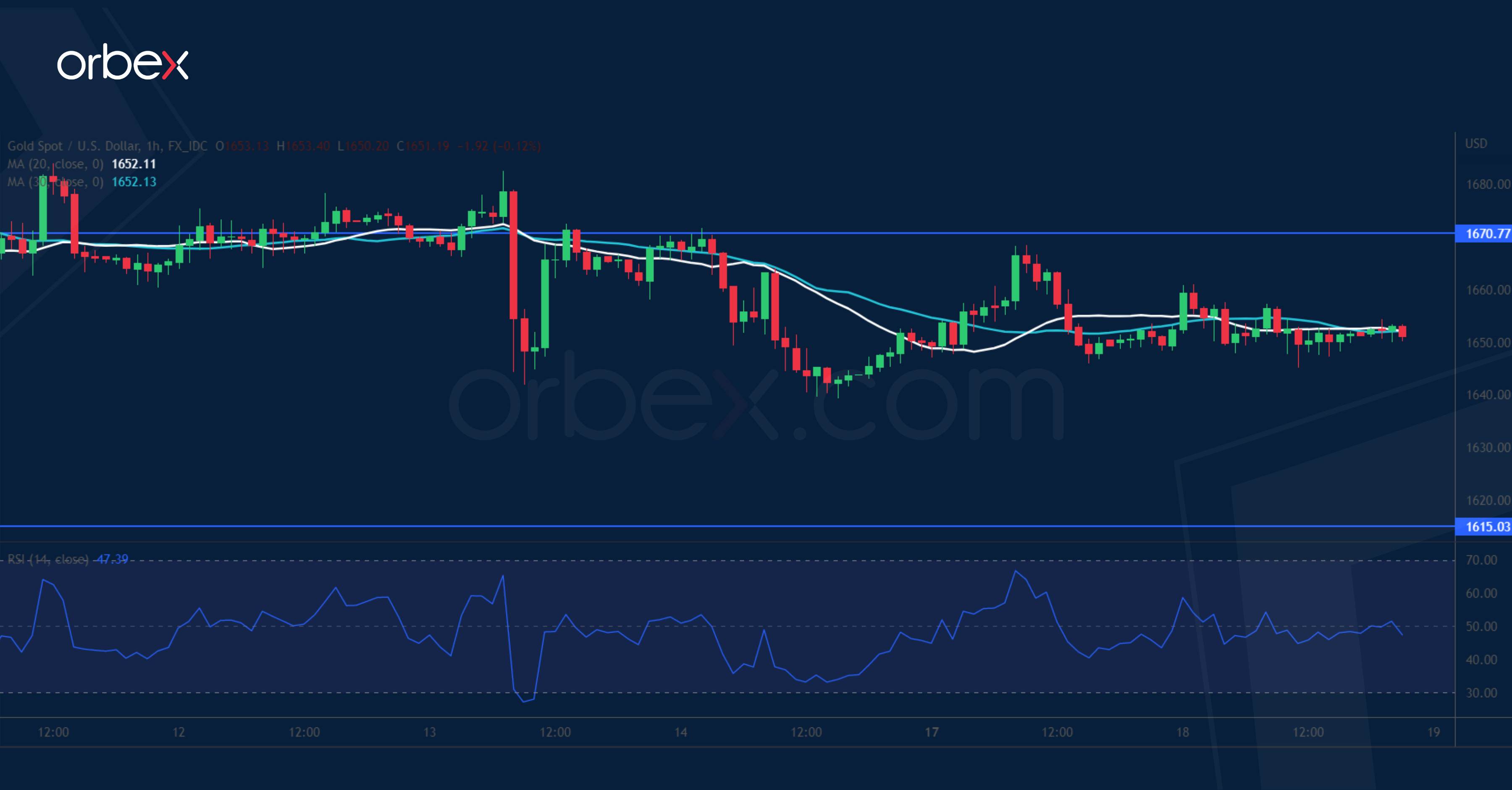
Bullions steadies as the US dollar softens across the board. After meeting stiff selling pressure in the supply zone (1730), the precious metal has been struggling to hold onto its recent gains. The trend remains bearish and may bring in more followers to depress the price action. 1615 is a critical level to keep the rebound relevant and its breach would trigger a new round of sell-off to April 2020’s low at 1570. The support-turned-resistance 1670 is the first level to crack then the real challenge would be to lift 1730.
USD/CHF Takes Breather
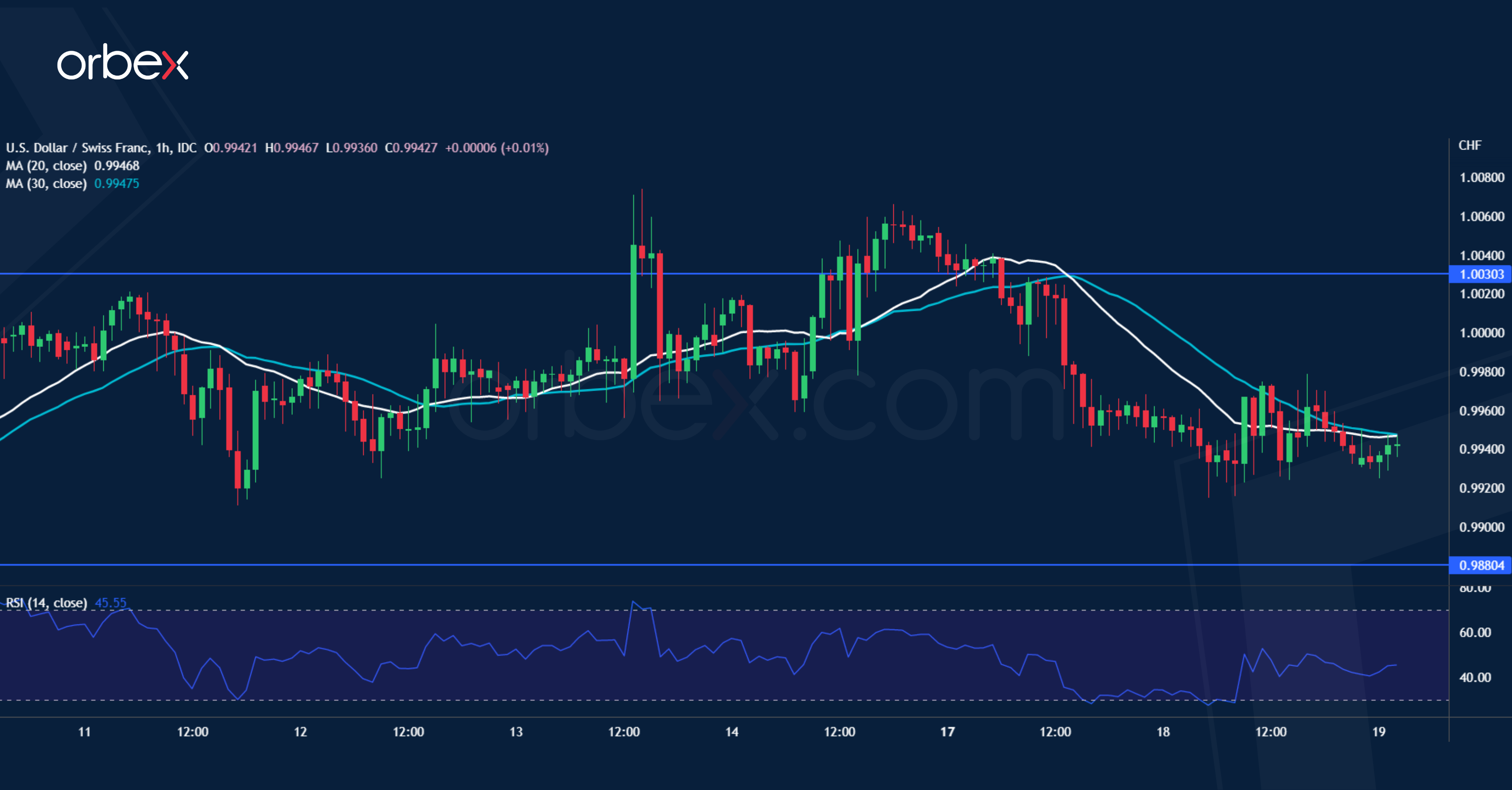
A regain in risk appetite keeps the US dollar in check. A drop below 0.9960 led intraday buyers to take profit. The price is taking a breather after it broke above the double top at 1.0040, a key resistance on the daily chart. The bullish breakout may have paved the way for an extended rally in the medium-term. The current pullback might be an opportunity for the bulls to stake in. 0.9880 over the 20-day moving average is the first support and the RSI’s oversold condition may attract bids. A close above 1.0030 would resume the uptrend.
Elliott Wave View: EURUSD Should Be Near To Pullback
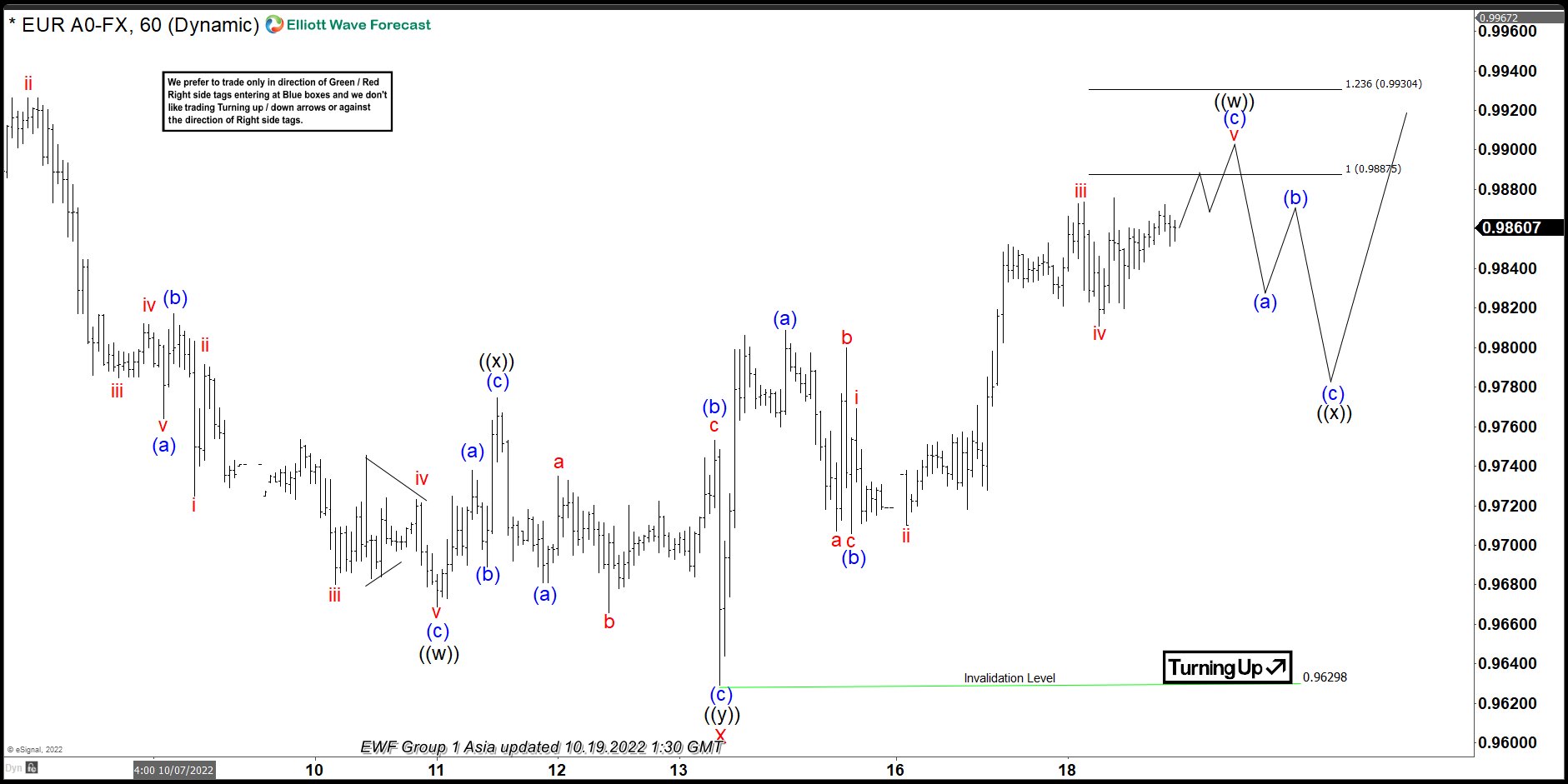
Short term Elliott Wave view on EURUSD suggests the cycle from 10.04.2022 high is over at 0.9630 low as a double correction structure. The market bounced and a new double correction is in progress to end the cycle from 9.28.2022. Up from 10.13.2022 low, wave (a) ended at 0.9808 and dips in wave (b) ended at 0.9706 as a flat correction.
Pair then resumes higher in wave (c). In lesser degree wave i of (c) ended at 0.9768. Pullback in wave ii ended at 0.9710 with internal subdivision as a zigzag structure. Then rally resume and wave iii finish at 0.9873 and corrective wave iv ended at 0.9811. Near term, we are developing last push higher. This should complete wave v of (c) and the first leg of the double correction as wave ((w)). We are expecting that wave ((w)) should fail in 0.9888 – 0.9930 area and the pair should enter in a correction. As far as pivot at 0.9630 low stays intact, expect dips to find support in 3, 7, or 11 swing for further upside.
EURUSD 60 Minutes Elliott Wave Chart
Fed Kashkari’s After-market Comments Help US Yields a Tad Higher
Markets
Markets whipsawed yesterday, lacking guidance from mixed economic data in Germany (ZEW) and the US (industrial production strong but tumbling NAHB housing market confidence). Stocks finished in the green (about +1%) but were well below intraday highs. Energy prices extended their recent decline. Brent oil closed just above $90/b and Dutch gas futures (€113/MWh) fell to the lowest level since June as high inventory levels ease concerns for a winter shortfall. Core bonds traded choppy in the neighborhood of recent cycle highs. US yields edged no more than 1.4 bps lower. The 10y yield held above 4% for a third day straight. Minneapolis Fed Kashkari in an after-market speech said he sees no reason why the Fed should stop at 4.5 or 4.75% in early 2023 if core inflation by then showed no material progress. German rates added between 1 to 2.8 bps across the curve with the belly outperforming the wings. European swap yields, in contrast, fell 3.4-4.8 bps in the 2y-10y segment. Gilt yields fell a few bps too with the very long end (30y, -7 bps) outperforming. The Bank of England dismissed an FT article reporting a further delay (beyond October) in the start of UK gilt sales. However, for Q4, the central bank will refrain from selling bonds with a maturity longer than 20 years. Any shortfall in the £80bn sales target as a result of the earlier postponement will be incorporated into sales in subsequent quarters. The US dollar’s performance improved from soft to mixed during US dealings. EUR/USD capped gains to 0.986 and the trade-weighted index (close above 112) avoided an actual test of the lower bound of the upward sloping channel. USD/JPY defied all verbal warnings and grinded higher towards 150. Sterling fell. EUR/GBP finished north of 0.87.
Kashkari’s after-market comments yesterday help US yields a tad higher this morning. The 10y (+2.1 bps) inches further north of 4%. Germany’s Bund future drifts south. Oil prices rise marginally even as the US said it is prepared for significant releases from its strategic reserves this winter if needed (see below). Sentiment is mixed. Chinese stocks underperform regional peers in quiet trading. The Federal Reserve kicks off its monetary cycle with the publication of the Beige Book later today. We doubt it’ll have any impact on financial markets though. The waiting game is in full play this week and that probably won’t change. Core bonds and (EUR/)USD are stuck in a sideways trading range for the time being with daily swings defined by general sentiment/earnings season. Economic data today included a higher-than-expected UK September CPI print. Prices rose 10.1% y/y, up from 9.9%. Core inflation accelerated from 6.3% to 6.5% (6.4% expected). The pound sterling in a first reaction loses marginal ground.
News Headlines
Later today, US president Biden is expected to announce to release of a last tranche of 15 mln barrels of oil from the US strategic reserves from a total of $ 180 mln that was announced in March as the US government tries to ease higher oil prices for US consumers going into the mid-term elections. At the same time, according to sources, the US president may indicate that he is prepared to do more during the winter if this would be necessary. The White House also said it intends to restore the reserves, buying oil when the price of WTI is at or below the $67 to $72 p/b range. Both WTI and Brent oil this morning are trading up from yesterday’s intraday low with Brent oil hovering near $90.5 p/b.
Czech lawmakers yesterday approved that this year’s budget deficit will be allowed to rise to CZK 375 bln, about a third higher compared to the initially planned deficit of CZK 280 bln. The rise in the deficit comes as the government took measures to shield consumers and firms higher energy prices due to the war in Ukraine. The rise in the budget deficit marks a U-turn in the government’s policy which initially prioritized on cutting the fiscal deficit. For 2023, the government aims to reduce the deficit to CZK 290 bln. The reaction of the krone to the budget announcement was close to non-existent. EUR/CZK is holding a tight range near 24.55.
Earnings Season Kicks Off on a Positive Note, Netflix Up 14% after the Bell
British efforts to reverse the Liz Truss-induced calamity, and better-than-expected earnings in the US give a boost to the global financial markets. But the recession fears, the hawkish Fed expectations and headache around a too-strong US dollar are looming risks to the actual investor optimism.
UK hasn’t convinced investors yet, but is on the right path
Britain’s newest Chancellor of Exchequer Jeremy Hunt scrapping almost all that was promised in the mini budget, pulled British gilt yields lower, and pushed sterling higher.
Cable traded above the 1.14 on Monday, but remains under pressure, as Britain’s political turmoil is not over just yet.
The next natural step for Liz Truss government is to replace Liz Truss by someone with a better financial discipline and market sense.
Unfortunately for Liz Truss, the market’s aggressive negative reaction to her spending plan leaves her with little support today. Those who didn’t like her, like her even less due to the calamity that she caused in just about more than a month. And those who liked her, probably don’t like her anymore as she won’t be delivering what she promised she would in terms of tax cuts and energy spending.
A survey from Bank of America showed that investors cut their exposure to the UK stocks by 9 percentage points since Liz Truss took office in September.
We shall see both the pound, the British sovereigns and the equities on a rocky road until investors are convinced that UK has a solid leadership team, which is not the case right now.
Earnings season kicks off on a positive note
Bank earnings were mixed, but most banks topped market estimates.
JP Morgan reported its highest ever quarterly net interest income due to the rising interest rates in the US. Wells Fargo and Bank of America also topped analyst estimates despite concerns of slowing economy.
US retail sales stalled last month due to worsening inflation, but Bank of America said, their clients’ spending, at least, remains resilient to the unideal macroeconomic environment. BoFa’s net interest income revenue also jumped by 24%!
Goldman Sachs also topped estimates with a trading revenue of above $6 billion in Q3, although the bank is looking for another restructuring to scrap businesses that don’t make money.
But Morgan Stanley’s earnings fell for the 3rd consecutive quarter and Blackrock saw its profits fall 16%.
Overall, the US financials rallied more than 10% since October 13 dip, BUT all major US banks, even those that did well in the Q3, boosted reserves to deal with a potential economic downturn. They all put hundreds of millions of dollars to absorb potential losses on loans. Among them, JP set aside more than $800 million, Wells Fargo $375 million and Citigroup around $370 million, because the rising interest rates are good for the interest revenues, but they are also expected to dampen the consumer demand as they make the mortgage and credit rates more expensive.
Beyond banks, Johnson & Johnson topped estimates, although the shares closed the day slightly down as the company narrowed its outlook due to the strong US dollar, while Netflix jumped up to 15% in the afterhours trading as the company finally came with good news on the subscriber front. Netflix added 2.4 million new subscribers in the latest quarter, versus 1 million they had forecasted. The latter marked the end of slowing growth since the beginning of this year, and the end of an era for Netflix, as the company will be launching the ad supported version by early November, which will cost just $6.99 per month to the subscribers. Those who chose the ad-support version will have to watch 5 minutes of ads every hour, which is clearly not ideal, but they will not find the same price in competitors, like Disney+ or HBO max.
According to forecasts, Netflix’s ad-supported strategy could bring an additional $3 billion in extra revenue to Netflix by 2025.
Netflix shares have a lot to recover, as the share price lost up to 75% of its value since last November and is trading with 65% discount compared to last year peak levels. The next natural bullish target stands at $290, the 23.6% Fibonacci retracement on the past year selloff. But the share price should win over the $368 resistance, the major 38.2% level, for a medium term bullish reversal. And that might be difficult in the actual, difficult market environment.
Bloomberg now says the US will be in recession for sure next year, and we think that the latest rally could again be a flash in the pan before a deeper selloff in equities.
Tesla is the next to announce earnings today, after the bell. The Q3 results will likely be good, but will they leave up to high market expectations, is the million-dollar question.
GBP/JPY Daily Outlook
Daily Pivots: (S1) 167.96; (P) 168.89; (R1) 169.87; More...
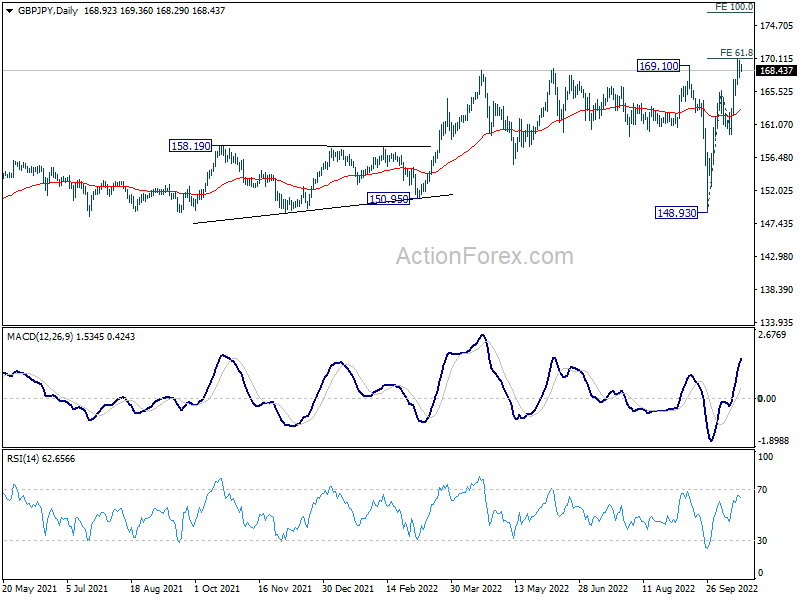
Intraday bias in GBP/JPY stays on the upside despite some loss of upside momentum. Firm break of 61.8% projection of 148.93 to 165.69 from 159.71 at 170.06 will target 100% projection at 176.47. On the downside, below 165.00 minor support will turn Intraday bias neutral and bring consolidations first, before staging another rally.
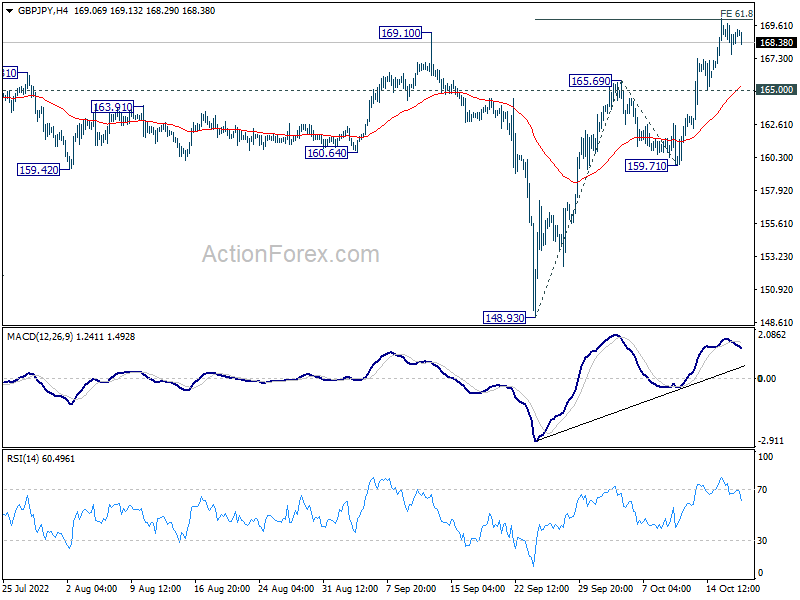
In the bigger picture, current development suggests that up trend from 123.94 (2020 low) is still in progress. Sustained break of 61.8% retracement of 195.86 (2015 high) to 122.75 (2016 low) at 167.93 will pave the way to retest 195.86 high. This will now remain the favored case as long as 148.93 support holds.
EUR/JPY Daily Outlook
Daily Pivots: (S1) 146.51; (P) 146.85; (R1) 147.48; More....
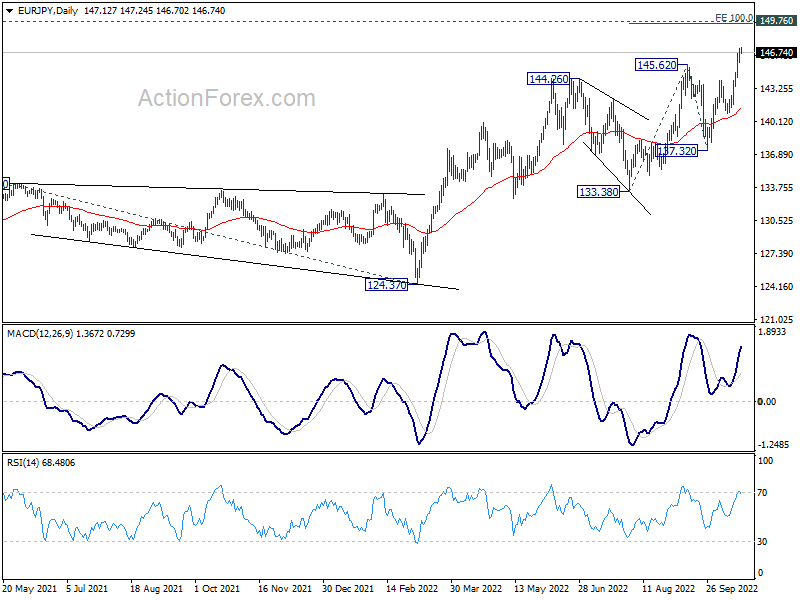
Intraday bias in EUR/JPY remains on the upside despite some loss of upside momentum. Current rally should target 100% projection of 133.38 to 145.62 from 137.32 at 149.56, which is close to 149.76 long term resistance. On the downside, below 145.80 minor support will turn intraday bias neutral and bring consolidations first, before staging another rally.
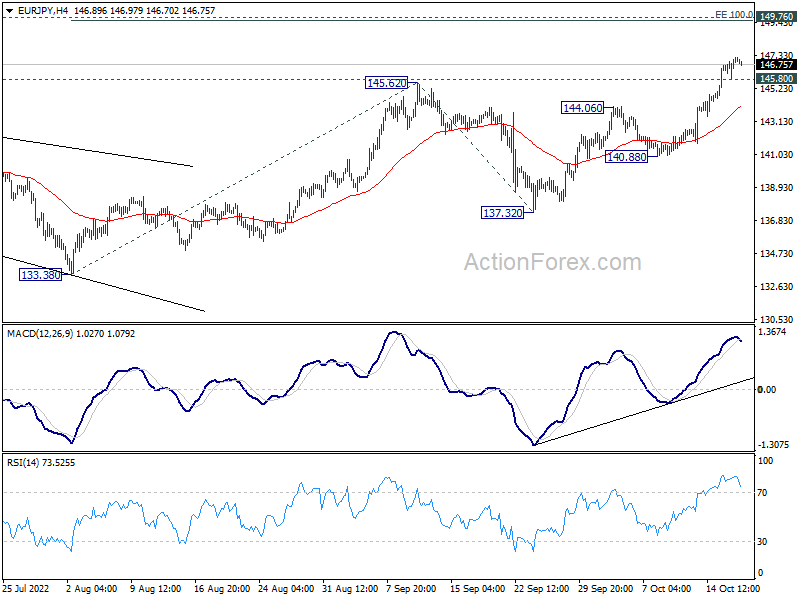
In the bigger picture, the up trend from 114.42 (2020 low) is still in progress for 149.75 (2014 high). Decisive break there will pave the way to 161.8% projection of 114.42 to 134.11 from 124.37 at 156.22. This will now remain the favored case as long as 137.32 support holds.