Sample Category Title
EURJPY Wave Analysis
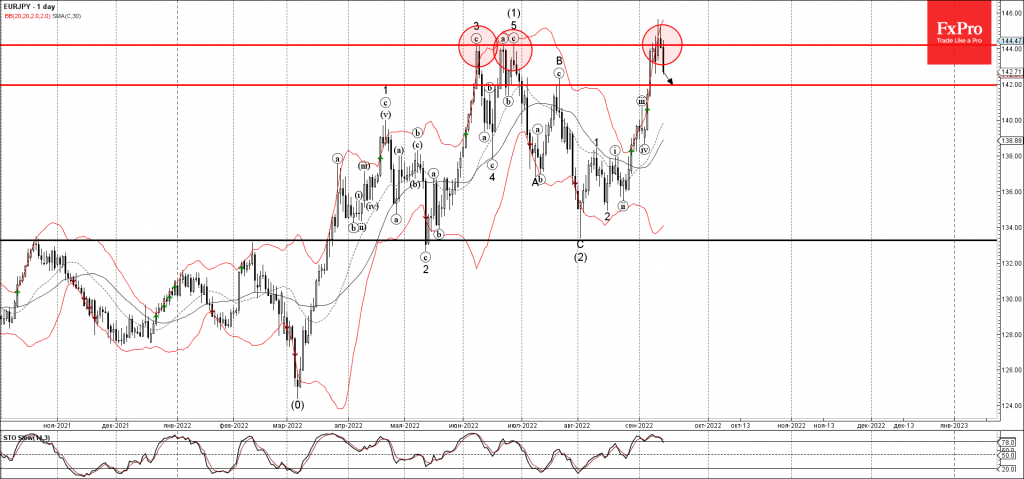
- EURJPY reversed from resistance level 144.00
- Likely to fall to support level 142.00
EURJPY recently reversed down from the key resistance level 144.00 (which has been reversing the price from the start of June), standing near the upper daily Bollinger Band.
The downward reversal from the resistance level 144.00 created the daily Japanese candlesticks reversal pattern Shooting Star.
EURJPY can be expected to fall further toward the next support level 142.00 (former resistance, which stopped wave B in July).
New Zealand Q2 GDP Eyed as Recession Fears Ramp Up
New Zealand will report second-quarter GDP data on Wednesday at 22:45 GMT. After a negative start to the year, the commodity-dependent economy has likely enjoyed some post-Covid expansion, avoiding a technical recession despite the dim economic releases during the period. A negative surprise cannot be ruled out, though in any case, the data could do little to alter the RBNZ’s hawkish stance and hence affect the battered kiwi.
Disappointing retail sales flag technical recession
The June quarter was not very pleasant for the New Zealand economy according to recent stats. Retail sales slumped more than projected by 2.3% q/q led by declines in furniture, electrical goods, and vehicles. Although retail sales are representing a minor share of GDP, investors consider the measure a solid proxy for economic performance. Therefore, another negative print could be possible, keeping the case for a technical recession open.
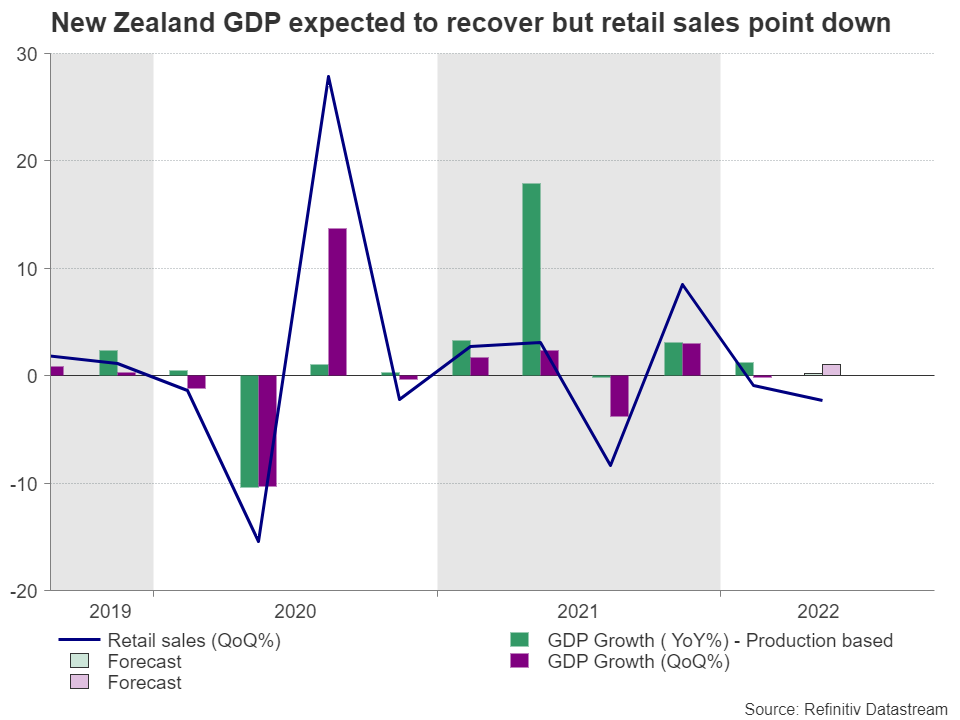
Despite that, analysts are on average optimistic the economy bounced back to the positive area, marking a growth of 1.0% q/q, while on a yearly basis, estimates point to a slowdown to 0.2% from 1.2% previously. Recall that the trade balance was a surplus most of the second quarter despite the depressed business confidence before switching again to deficit in June, while Q2 labor costs almost doubled from the previous quarter as the unemployment rate remained at record lows.
The Reserve Bank of New Zealand is also optimistic that the economy enjoyed some recovery in the June quarter, while eyeing a recession in 2023 in the absence of net exports recovery.
RBNZ may shrug off GDP data
Perhaps the lifting of travel curbs in May brought some economic relief, which may be more evident in the Q3 GDP release. Nevertheless, no matter what the outcome will be, Q2 GDP figures might be outdated when the Reserve Bank of New Zealand meets on October 5 to set its policy.
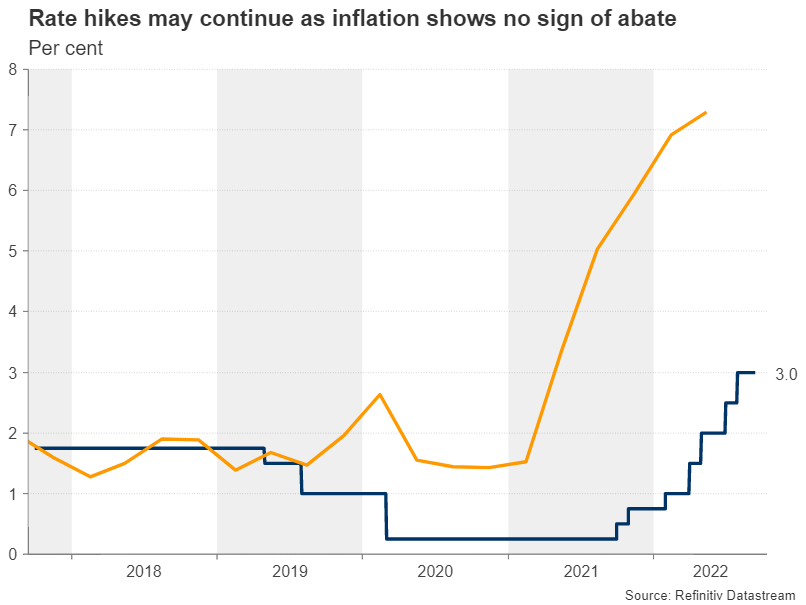
Besides, with the labor market so tight and high margins in the key dairy industry offsetting farm rising costs so far, policymakers can still afford to prioritize cooling inflation towards their 1-3% target over growth, which is exposed to a slowing housing market and China’s softening outlook. Recall that consumer prices hit the steepest-than-forecast 7.3% y/y increase in June -the highest since 1980.
NZD/USD outlook
Therefore, unless there is a big deviation from forecasts, the data may have a negligible impact on the RBNZ rate expectations, which are currently pointing to a 50bps rate hike with a probability of 86%. The next inflation and employment reports may have a larger influence on the RBNZ guidance, which showed interest rates rising faster to 4.1% in the second quarter of 2023 versus 3.59% projected in May. It’s also worthy to note that a gradual decline in 2024 is still on the cards.
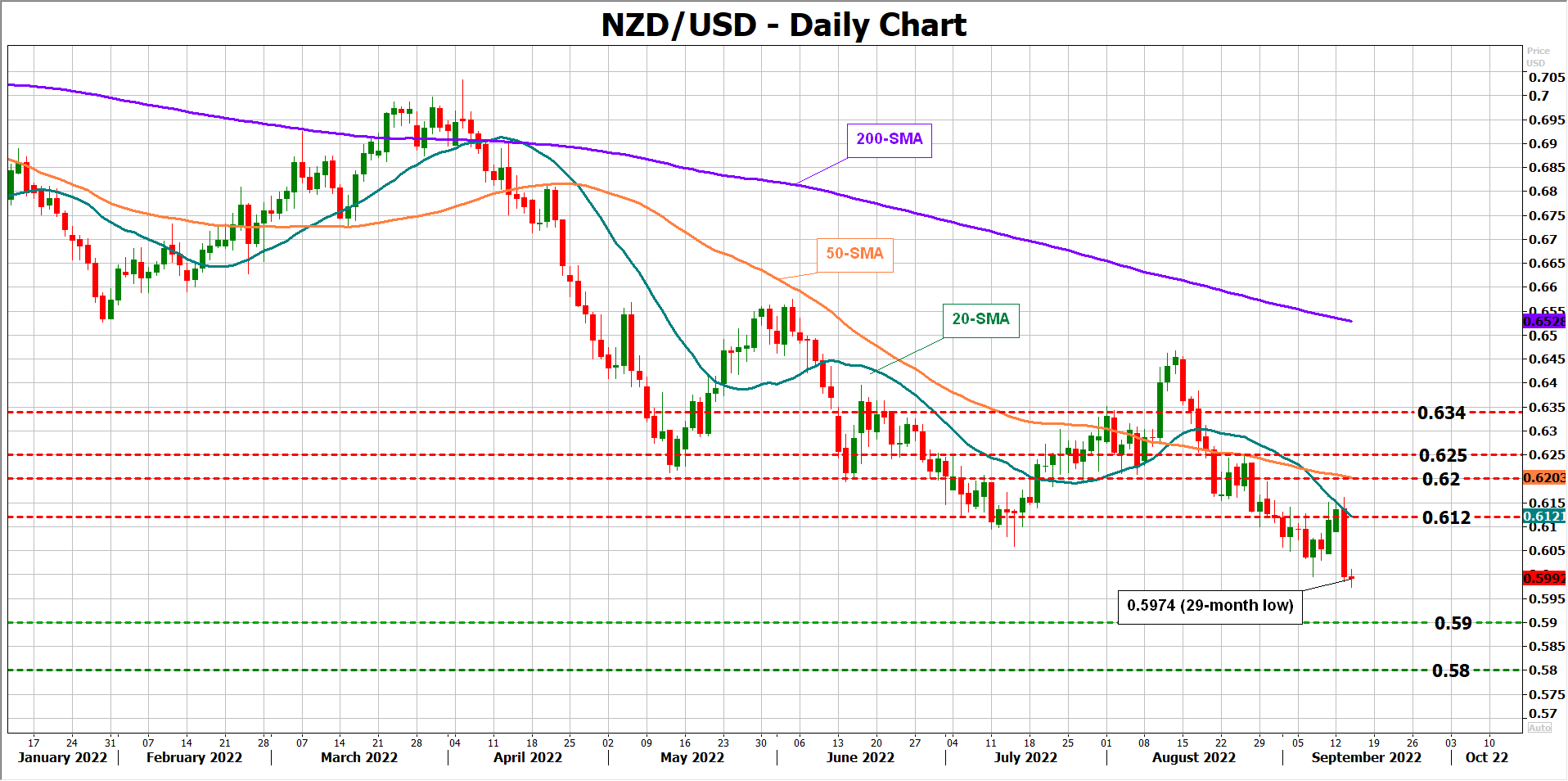
Given the above, the kiwi has little scope to stage a meaningful rally overnight. From a technical perspective, bearish risks have worsened against the US dollar following the plunge to a 28-month low of 0.5975, opening the door for the 0.5900 round level. In the event of a sharper sell-off, the 0.5840 – 0.5800 constraining zone could be the next destination.
On the upside, only a sustainable rebound above the 20-day simple moving average (SMA) at 0.6120 could ease selling interest and help the pair crawl up to the 50-day SMA at 0.6200. Further up, the restrictive area around 0.6250 could add some downside pressure ahead of the 0.6340 region.
Australia Unemployment, and First Central Bank to Blink
Jobs figures are back in focus in Australia following some interesting comments from RBA Governor Lowe a few days back. Of course the RBA doesn't care about the employment situation directly. But the theory is that jobs support consumer demand, which in turn supports prices. With the employment situation expected to turn around, particularly going into Australia's spring season, does that mean it's time to start considering a change in RBA policy?
The Governor insists that it's not, and that policy will be consistent. The issue is that market expectations seem to not align with the RBA's outlook, pricing in more hikes into next year. In his latest speech, Lowe appeared to be trying to temper expectations. One key point is insisting that Australia did not need to follow the Fed's rate higher, citing the employment situation.
What is the employment situation?
Australia has relatively low unemployment, which has contributed to upward pressure in wages. However, wages have not kept pace with rising inflation, which means the RBA doesn't have to worry about a wage-price spiral. With housing prices starting to fall, but exports remaining strong, there is a case that the reserve bank might not feel as much urgency to control the market. Healthy appetite for raw materials from China has continued to support the dollar, which in turn puts downward pressure on prices. Given the amount of imports from Australia, this might have a bigger impact on reducing inflation than direct monetary policy.
Recently there has been a little weakness in employment, but that was seen as a result of lower participation. Increasing labor force participation would be seen as helping the RBA's objective to bring prices down, as it would help increase production and solve some of the supply side issues. For that reason, the RBA might be wary about going above the neutral rate. Lowe did not give a specific range, just simply said that current policy was "nearer".
What to look out for
Australia August unemployment rate is expected to stay steady at 3.4%, despite the participation rate expected to tick up a couple of decimals to 66.6% from 66.4% prior. Australian firms have been complaining for months that they have been having trouble enticing workers back.
The employment change is projected to turn around, and show 35K jobs created compared to -49.9K in July. These figures are seasonally adjusted to account for Australia coming out of the middle of winter. Chief sector that had been impacted over the last few months was construction as home sales and prices started to fall.
Potential market reaction
The issue now is whether the RBA will hike another 50bps or just do 25bps at their next meeting at the start of October. So far, there is much consensus, but the market still seems to be betting on a more hawkish option.
Better jobs numbers would actually give the RBA more room to maneuver, and could be interpreted by the market as meaning a harsher hike is more likely. On the other hand, if the labor market were to not show the expected rebound, it could shake some of the confidence that policy will be as tight as expected, and weaken the Aussie.
Dollar Could Add Another 5% Before Finding G7 Resistance
Yesterday we wondered whether the dollar retreat was a correction or a reversal. But the reaction of the financial markets to the US inflation report has put everything in its place by confirming that we are still in a bull market for the dollar. Very often, though not always, this means a bear market for equities.
The Dollar Index’s corrective pullback from the extremes over the past week allowed players to accumulate liquidity for a new strike, which did not take long to come.
Dollar bulls took advantage of a rather average occasion – a slowdown in inflation to 8.3% instead of the expected 8.1% – to cause the DXY to strengthen by almost two per cent – the strongest one-day move since March 2020. Similarly, the stock market crash recalled the worst moments for the market at the start of the pandemic. That said, the inflation surprise (difference between fact and expectation) was not the most significant during this time.
The money markets have shifted markedly in their expectations for next week’s rate hike, laying down a 100% chance of a 75-point increase and a 34% chance of a 100-point rise at once. The previous day, we talked about less than 90% for 75 points and 0% for 100 points. However, an even bigger shock to expectations in July did not cause commensurate market turbulence.
In our view, yesterday’s move was purely technical. The dollar bulls proved that they hold control of the market, protecting the DXY from any severe test of the 50-day moving average. This was most telling in the EURUSD, which reversed below this line with a decisive move.
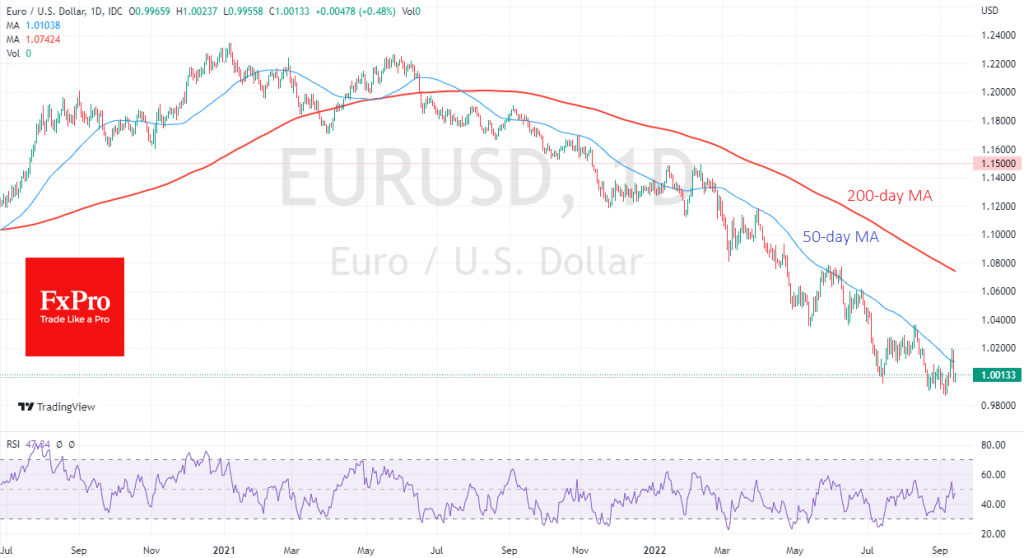
Usually, such strong moves at key levels will break the resistance of the second side for a long time. In other words, we could now see more of a dollar march in the coming days and weeks with the potential for a renewal of the DXY global highs.
A further rise in the dollar could deprive the EURUSD of support near parity, sending it in search of a bottom lower in 0.95-0.96. We have seen quite a few reversals and accelerations in this area throughout the synthetic euro’s existence.
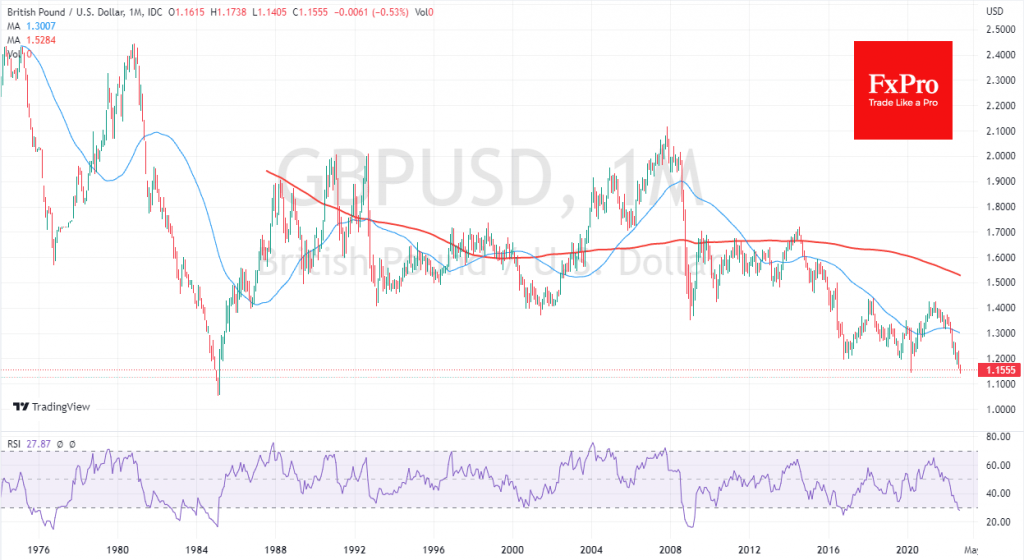
The GBPUSD would then risk a renewal of the lows from 1985, going down to 1.1000. For now, we consider a move below that year’s low (below 1.05) in an unlikely extreme scenario.
For the USDJPY, the road to 150 seems to be opening. However, we are cautiously looking at the potential for further gains. There are now reports that the Bank of Japan is preparing for currency interventions. The currency market values the dollar extremely highly, which could trigger a weakly controlled domino effect in the markets, which is hardly in the interest of the financial and monetary watchdogs.
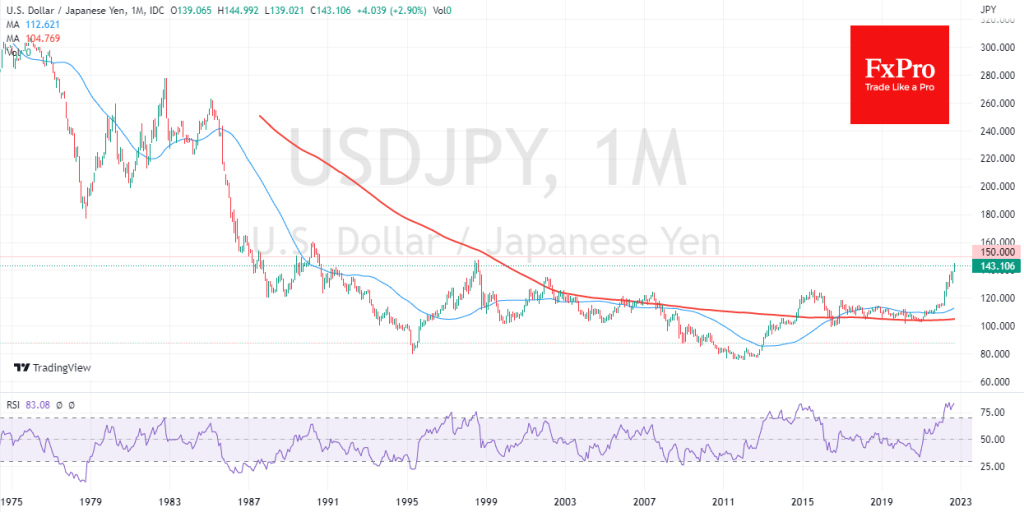
Simply put, the dollar could easily add around 5% to current levels in the coming days and weeks. Still, one must watch the rhetoric of the G7 authorities at the abovementioned levels very closely.
Sunset Market Commentary
Markets
Central bankers of late stressed that the pace of further tightening will be guided by incoming data. In this narrative, yesterday’s higher than expected US inflation challenged markets’ expectations (or was it simply hope?) that there is a case for the Fed to turn less aggressive on its anti-inflation campaign. If inflation stays higher for longer, the peak policy rate also remains subject to debate. Markets after the US CPI release pondered whether that peak Fed policy rate shouldn’t be 4.50% rather than 4.25%. Today’s news flow at least gave no reason to backtrack on yesterday’s repositioning. US yields are gaining an additional 4 (2-y)/2 (30-y) bps. At 3.80%, the 2-y yield set a new cycle top. US 10-y yield (3.45%) is coming ever closer to the 3.50% mid-June peak. The 10-y real yield stays just south of 1.0%. The repricing on European interest rate markets also continued unabatedly. EMU swap yields are gaining another 6.5 bps (2-y) to 2.0 bps (10-y). The 2-y intraday attacked the next key reference (2.49% 2011 top). European money markets gradually consider the idea that the terminal ECB rate for current cycle might be north of 2.5%. EC president Ursula Von der Leyen reconfirmed the EC’s intention to tax revenues of low cost power producers. The EC also tries to hammer out a mechanism to cap gas prices and intends to reduce demand. For now, interest rate markets apparently don’t see how this might help to cool down EMU inflation. UK yields are lagging the moves in the US and EMU. UK August inflation (headline 9.9%, core 6.3%) was as expected. Markets still try to find out the BoE’s reaction function as government measures capping firms’ and consumers’ energy bills will drastically slow inflation, admittedly at the expense of a huge fiscal effort. European equities cede about 1.0% (EuroStoxx 50), but stay away from the August low. US indices open little changed after yesterday free-fall.
Relative calm returned to FX markets after yesterday’s sharp USD rebound. The USD DXY index fails to regain the 110 handle (109.50). In a similar move, EUR/USD tries to recapture parity. Even so, yesterday’s setback suggests that any sustained EUR/USD rebound won’t be easy with US real yields supporting USD attractiveness. USD/JPY retreats from the 145 area as the BOJ checking FX rates was seen as a last warning before starting FX interventions to slow the yen’s free-fall. UK inflation didn’t change the picture for sterling trading. Monday’s rejected test of the key EUR/GBP 0.8721 level inspires some further return action back in previous trading range (currently 0.87665).
News Headlines
Swedish August inflation exceeded estimates. Headline CPI printed at 9.8% Y/Y (1.8% m/m), up from 8.5% and more than the 9.6% expected. Using a fixed interest rate (CPIF), inflation accelerated from 8% to 9%. CPIF excluding energy – the Riksbank’s preferred measure – was the only gauge that didn’t top expectations. Nevertheless it sped up from 6.6% to 6.8%. Intensifying price pressures have already upped the ante for the September Riksbank meeting (Sep 20). Anything less than a 75 bps hike would come as a disappointment. But as the ECB also raised the stakes, the Swedish krone barely profited from the upcoming interest rate support. EUR/SEK is trading near recent highs around 10.67.
Officials close to the matter said the European Commission plans to back recommendations to cut funding to PM Orban’s Hungary on Sunday. It’s the next step in a drawn out legal process over concerns about corruption and the rule of law. EU governments will then make a final decision within three months. It takes a qualified majority of the member states for the EC’s proposal to take effect. Right now, some €40bn in EU financing is blocked. The Hungarian government recently offered to set up an anti-graft agency and to push through changes to public procurement legislation. The EC is said to tell EU leaders to give Orban some time to make good on these pledges. The Hungarian forint greatly underperforms peers following the report. EUR/HUF surges 4 big figures to 403.80.
Belgium successfully launched its second green government bond via a bank syndicate today. The April-2039 dated bond carrying a 2.75% coupon attracted market interest of more than €32bn of which the Kingdom eventually raised €4.5bn. Price was set 6 bps above the conventional 1.9% June 2038 OLO.
Sterling Climbs as UK Inflation Eases
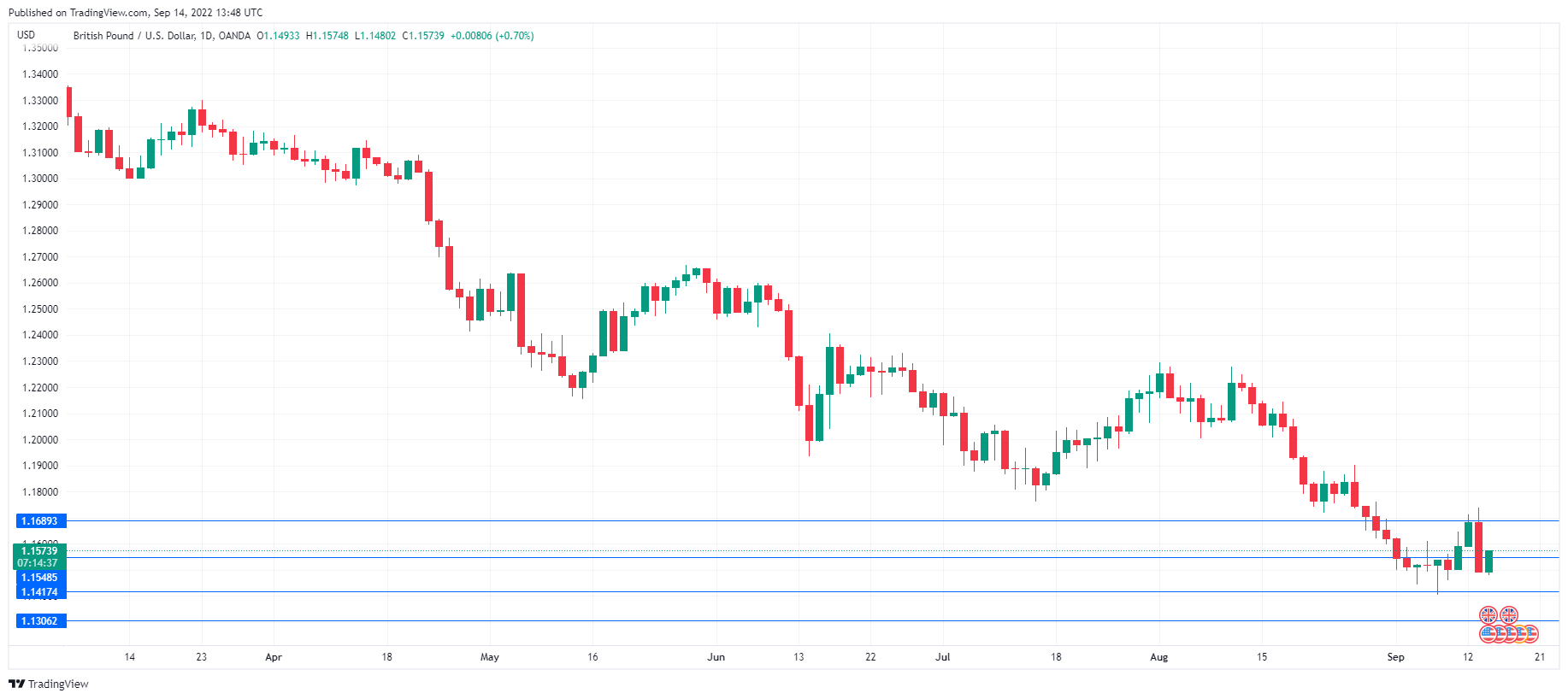
It has been a busy week for the British pound. GBP/USD has climbed 0.66% today and is trading at 1.1566. This follows the pound’s huge decline on Tuesday, as the US dollar pummelled the major currencies after a weaker-than-expected inflation report shocked the financial markets.
The US dollar, which has looked mediocre recently, received a welcome shot in the arm after the July inflation report. The dollar steamrolled most of the major after the inflation data, and GBP/USD declined by 1.62%. Investors were not pleased with the report, as equity markets slumped and the US dollar rose sharply. Headline inflation dropped from 8.5% to 8.3%, but missed the consensus of 8.1%. Core CPI rose to 6.3%, up from 5.9% and above the forecast of 6.1%.
The markets had priced in a 75bp increase in September followed by 50bp in November and 25bp in December. However, with inflation higher than expected, the Fed may need to remain more aggressive than expected. Market pricing for the September meeting is fluctuating – currently, there is a 68% chance of a 75bp move and a 32% likelihood of a massive 100bp increase. Just a few days ago, a “modest” 50bp hike was a strong possibility, but it is apparently off the table after the inflation report.
UK inflation dips below 10%
UK inflation eased slightly in August to 9.9%, down from the 40-year high of 10.1% in July and a notch lower than the 10.0% estimate. The drop in headline reading was due to a decline in fuel prices. Core inflation rose to 6.3%, up from 6.2% prior. Inflation remains very high and the markets are expecting the BoE to come out swinging with a 75bp increase at the September 22nd meeting, just a day after the Federal Reserve meets. The BoE has projected that inflation will not peak before hitting 13%, which means that the new Truss government has its work cut out as it grapples with the severe cost of living crisis in the UK.
GBP/USD Technical
- GBP/USD is testing resistance at 1.1548. Above, there is resistance at 1.1689
- There is support at 1.1417 and 1.1306
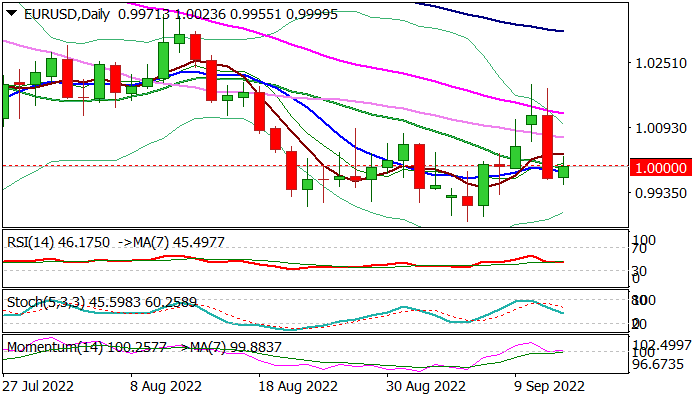
EUR/USD: Recovery Struggles at Parity Level
Recovery attempts after Tuesday’s 1.5% drop, cracked parity barrier (reinforced by 20DMA), but so far lack momentum for stronger recovery.
Headwinds from parity zone, accompanied with bearishly aligned daily studies, warn of recovery stall, which would be additionally signaled by repeated close below this level, as Tuesday’s long bearish daily candle weighs heavily.
On the other side, 14-d momentum is in positive territory and turning north, while near-term action is also underpinned by rising 4-hr cloud, but sustained break above parity is seen as minimum requirement to generate initial recovery signal, which would need confirmation on lift above 1.0031/47 (daily Tenkan-sen/Fibo 38.2% of 1.0197/0.9955 Mon-Wed drop).
Res: 1.0031; 1.0047 1.0076; 1.0105.
Sup: 0.9955; 0.9900; 0.9864; 0.9785.
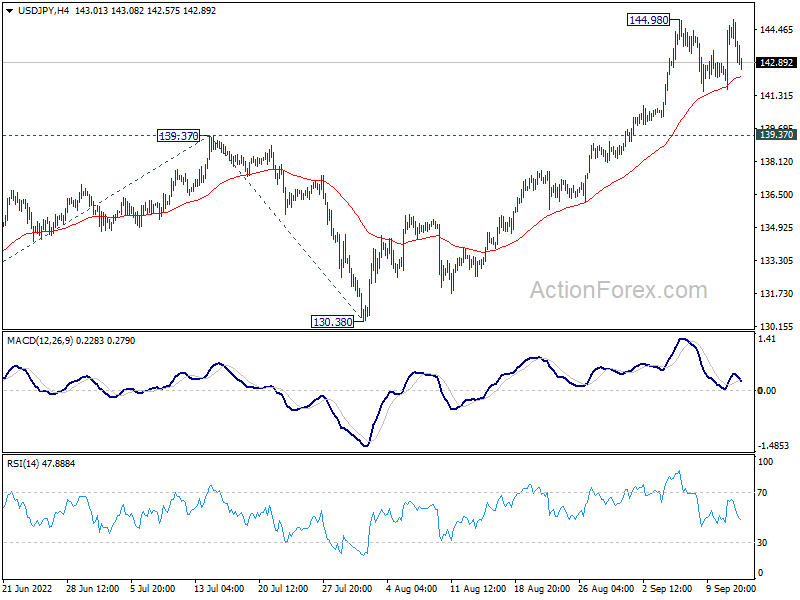
USD/JPY Mid-Day Outlook
Daily Pivots: (S1) 142.59; (P) 143.63; (R1) 145.61; More...
USD/JPY is staying in consolidation from 144.98 and intraday bias remains neutral. Downside should be contained by 139.37 resistance turned support. On the upside, break of 144.98 will resume larger up trend to 147.68 long term resistance. Break there will target 161.8% projection of 126.35 to 139.37 from 130.38 at 151.44 next.
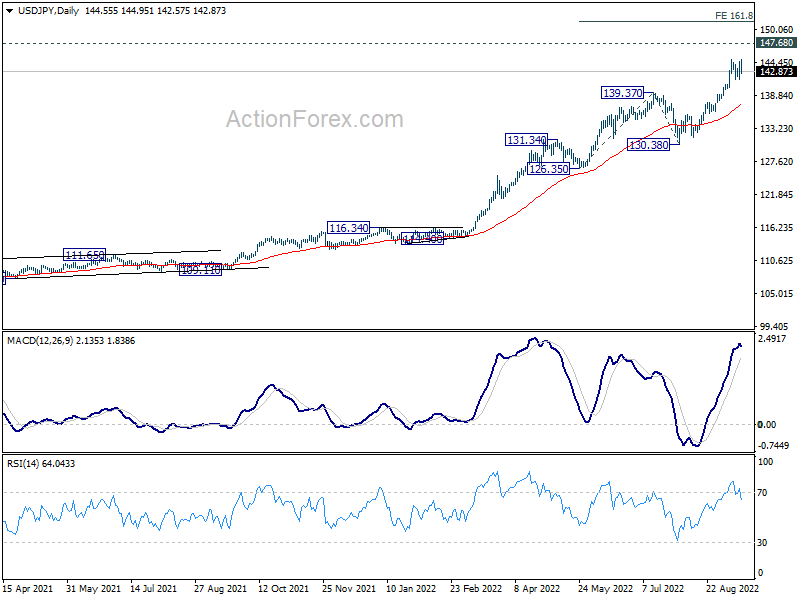
In the bigger picture, up trend from 101.18 is still in progress, as part of the whole up trend from 75.56 (2011 low). Further rise should be seen to 147.68 (1998 high). For now, break of 130.38 support is needed to be the first indication of medium term topping. Otherwise, outlook will stay bullish even in case of deep pull back.
USD/CHF Mid-Day Outlook
Daily Pivots: (S1) 0.9522; (P) 0.9577; (R1) 0.9675; More...
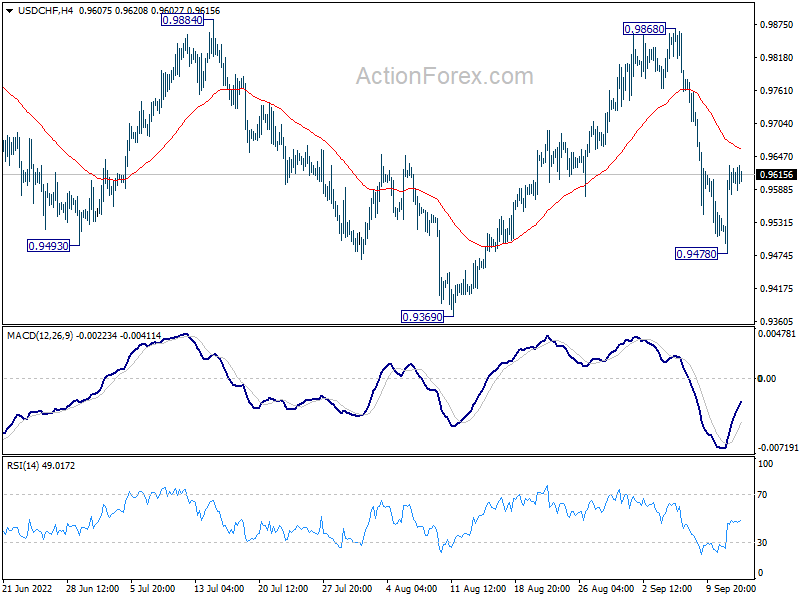
Intraday bias in USD/CHF stays neutral for the moment. The pair is still in corrective pattern from 1.0063. Below 0.9478 will extend the fall from 0.9868 towards 0.9369 support. On the upside, firm break of 4 hour 55 EMA (now at 0.9658) will target 0.9868 resistance first. Further break there will argue that larger up trend is ready to resume through 1.0063.
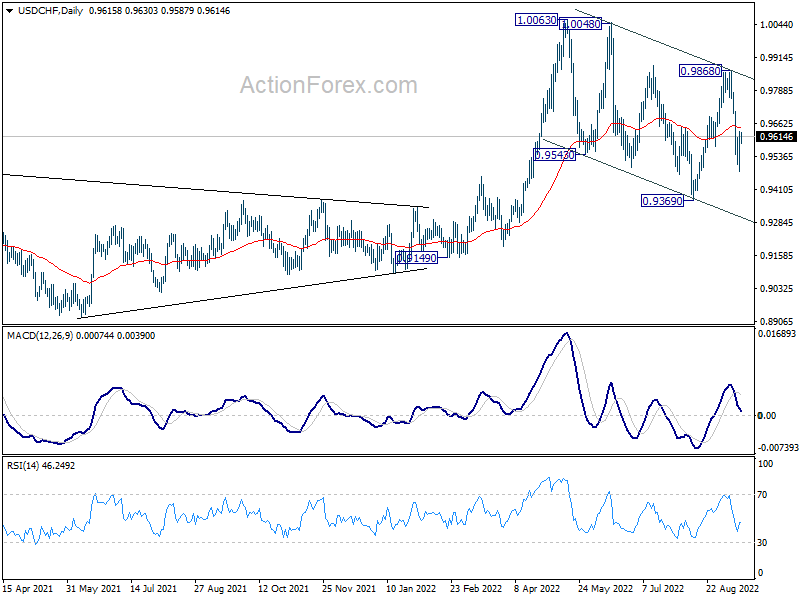
In the bigger picture, current development suggests that up trend from 0.8756 (2021 low) is still in progress. Sustained break of 1.0063 will target 100% projection of 0.9149 to 1.0063 from 0.9369 at 1.0283, and then 1.0342 (2016 high). For now, this will remain the favored case as long as 0.9369 support holds, even in case of deep pull back.
EUR/USD Mid-Day Outlook
Daily Pivots: (S1) 0.9894; (P) 1.0040; (R1) 1.0114; More...
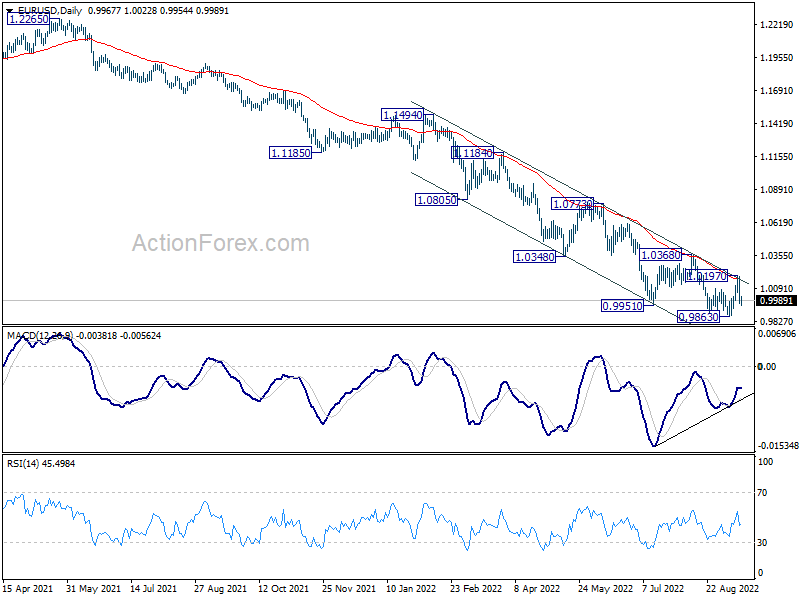
Intraday bias in EUR/USD stays mildly on the downside for retesting 0.9863 low first. . Firm break there will resume larger down trend. On the upside, sustained trading above 55 day EMA (now at 1.0154) raise the chance of larger trend reversal, and target 1.0368 resistance.
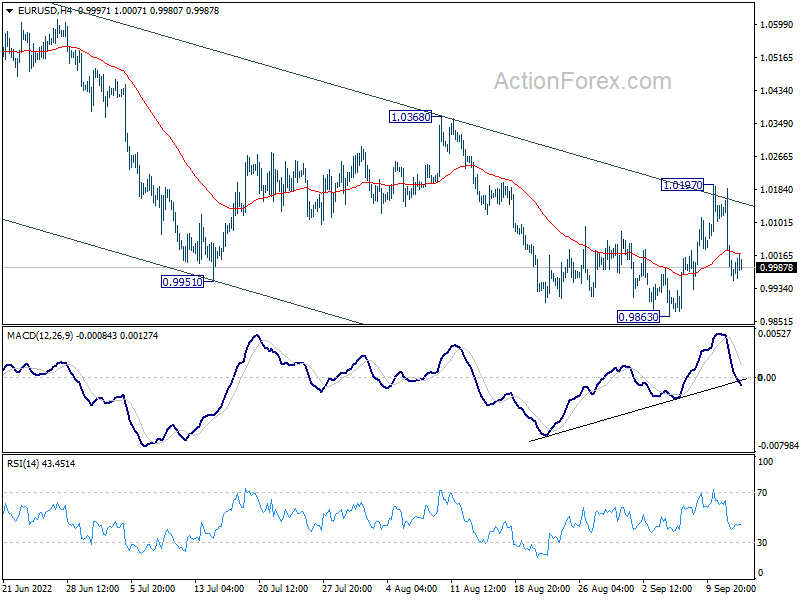
In the bigger picture, down trend from 1.6039 (2008 high) is still in progress. Next target is 100% projection of 1.3993 to 1.0339 from 1.2348 at 0.8694. In any case, outlook will stay bearish as long as 1.0368 resistance holds, in case of strong rebound. However, firm break of 1.0368 will confirm medium term bottom at 0.9863 already.