Sample Category Title
AUD/USD Daily Report
Daily Pivots: (S1) 0.6715; (P) 0.6738; (R1) 0.6770; More...
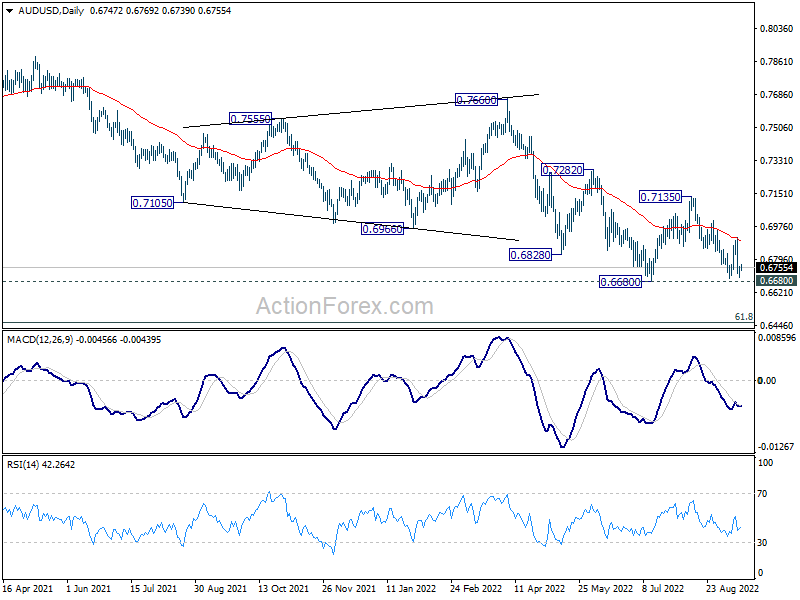
Intraday bias in AUD/USD stays neutral first. Prior rejection by 55 day EMA is a near term bearish sign. Decisive break of 0.6680 will resume larger down trend. Next target will be 0.6461 long term fibonacci level. On the upside, break of 0.6915 resistance will be a near term bullish signal, and bring stronger rally through 0.7008 towards 0.7135 resistance.
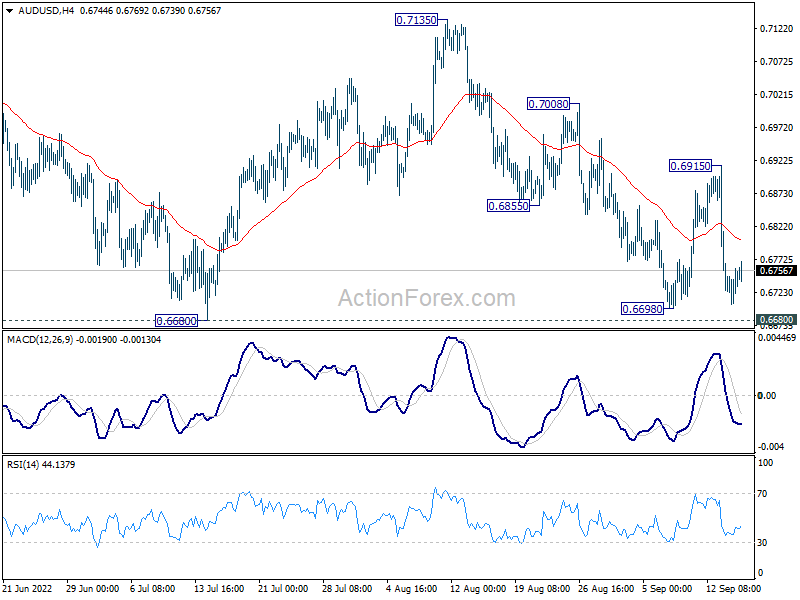
In the bigger picture, price actions from 0.8006 (2021 high) is seen more as a corrective pattern to rise from 0.5506 (2020 low). Or it could also be a bearish impulsive move. In either case, outlook will remain bearish as long as 0.7135 resistance holds. Next target is 61.8% retracement of 0.5506 to 0.8006 at 0.6461.
Dollar Still in Driving Seat as Markets Await Next Moves
The markets are overall steady in Asia today. Yen attempted a rebound yesterday but there was no follow through buying so far. Dollar's rally also lacks sustained push. While commodity currencies are staying as the worst performer for the week, there is sign of some live against Euro. But that's probably more due to Swiss Franc's pressure on the common currency than other reason. Trades will look into reactions to US retail sales data as next guidance.
Technically, near term outlook in Dollar is staying bullish in general, and upside break out is in favor. The levels to watch include 0.9863 support in EUR/USD, 1.1404 support in GBP/USD, 0.6698 support in AUD/USD, 144.98 resistance in USD/JPY, and 1.3207 resistance in USD/CAD. Judging from current sentiment, AUD/USD and USD/CAD has the potential to take the lead.
In Asia, at the time of writing, Nikkei is up 0.18%. Hong Kong HSI is up 0.46%. China Shanghai SSE is down -1.01%. Singapore Strait Times is up 0.44%. Japan 10-year JGB yield is down -0.0014 at 0.256. Overnight DOW rose 30.12%. S&P 500 rose 0.34%. NASDAQ rose 0.74%. 10-year yield dropped -0.010 to 3.412.
ECB Lane: Larger increment of interest rates appropriate
ECB Chief Economist Philip Lane said in a speech that risks to the inflation outlook are "primarily on the upside". Major short term risk is a "further disruption of energy supplies". Over the medium term, inflation may turn out to be higher than expected because of a "persistent worsening of the production capacity", further increases in "energy and food prices", and rise in "inflation expectations above our target" or higher "anticipated wage rises.
"In the context of a long projected period with inflation far above target, the net upside risks to inflation and taking into account that the current setting of the key policy rates is still highly accommodative, it was appropriate to take a major step that frontloads the transition from the prevailing highly-accommodative level of policy rates towards levels that will support a timely return of inflation to our target," he said, about last week's 75bps rate hike".
"In calibrating a multi-step transition path, the appropriate size of an individual increment will be larger, the wider the gap to the terminal rate and the more skewed the risks to the inflation target, he added.
Japan reports record monthly trade deficit, on record increase in imports
Japan exports rose 22.1% yoy to JPY 8062B in August, driven by shipments of auto and chip-related equipment. Imports rose 49.9% yoy to JPY 10879B. That's the largest increase by value on record, since data became available back in 1979. The rise was driven by higher prices for energy including crude oil, coal, and LNG.
Trade deficit came in at JPY -2817B. That's the largest monthly trade deficit on record. That's also the 13th straight month of year-on-year trade shortfalls.
In seasonally adjusted term, exports dropped -0.7% mom to JPY 8379B. Imports rose 1.5% to JPY 10750B. Trade deficit came in at JPY -2371B.
Australia employment rose 33.5k in Aug, unemployment rate ticked up to 3.5%
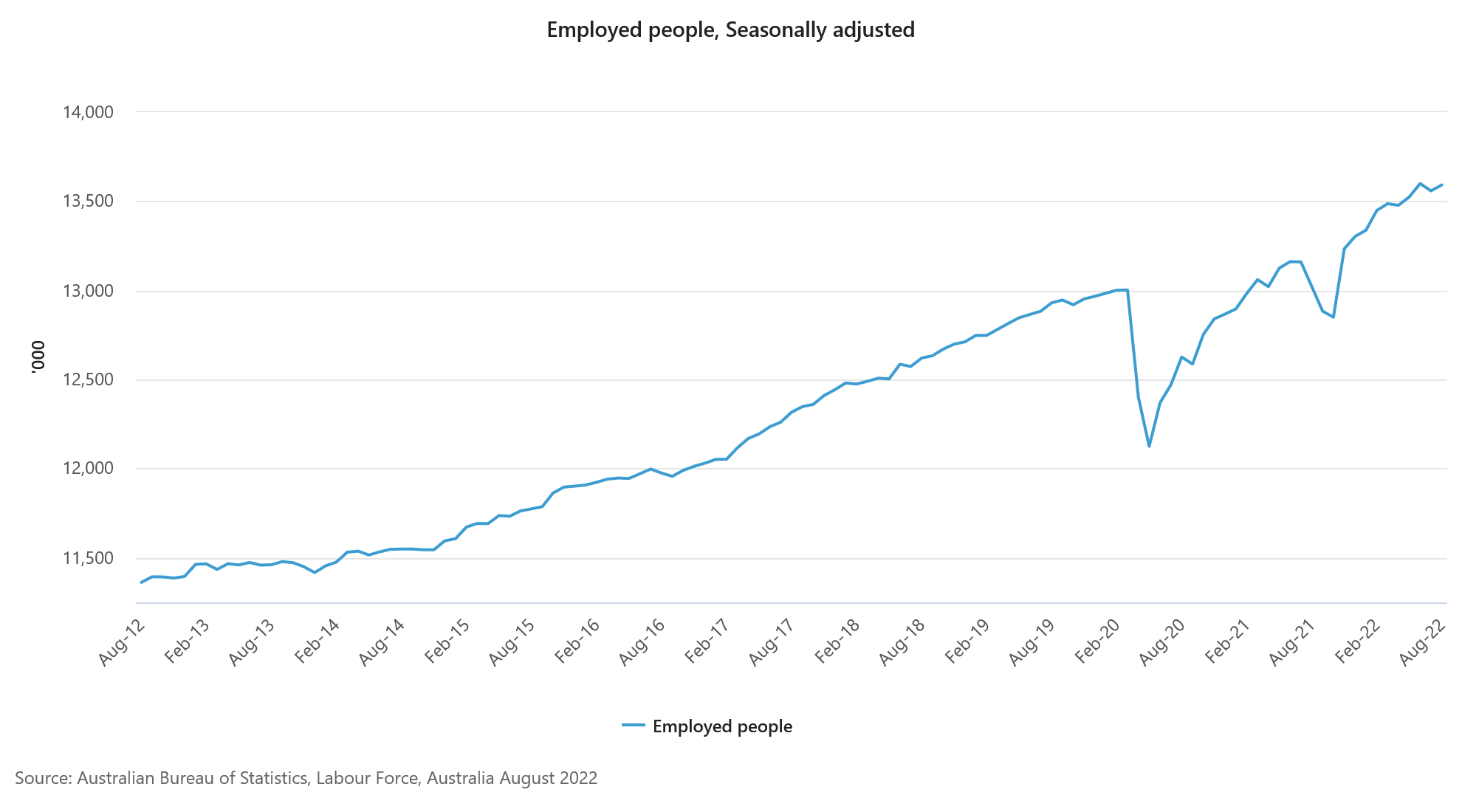
Australia employment rose 33.5k in August, slightly smaller than expectation of 35.5k. Full-time jobs rose 58.8k while part-time jobs decreased -25.3k.
Unemployment rate ticked up from 3.4% to 3.5%, above expectation of 3.4%. Participation rate rose 0.2% from 66.4% to 66.6%. Monthly hours worked rose 0.8% mom.
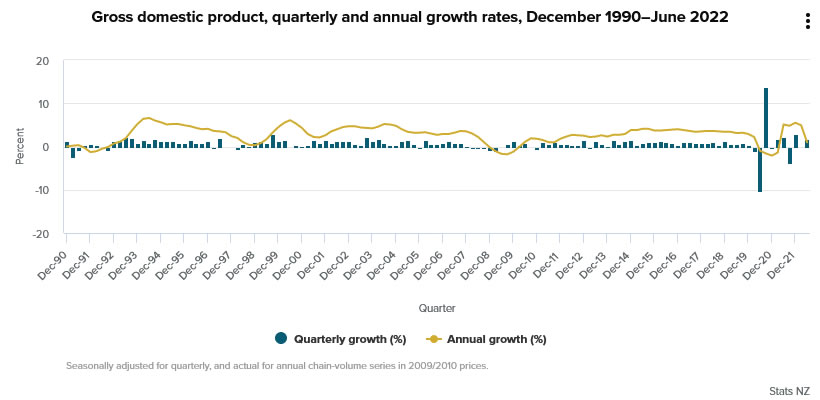
New Zealand GDP grew 1.7% qoq in Q2, driven by services
New Zealand GDP grew 1.7% qoq in Q2, above expectation of 1.0% qoq, following a -0.2% qoq decline in Q1. Service industries rose 2.7% but goods producing industries dropped -3.8%. Primary industries rose 0.2%.
"The reopening of borders, easing of both domestic and international travel restrictions, and fewer domestic restrictions under the Orange traffic light setting supported growth in industries that had been most affected by the COVID-19 response measures," national accounts – industry and production senior manager Ruvani Ratnayake said.
"In the June 2022 quarter, households and international visitors spent more on transport, accommodation, eating out, and sports and recreational activities."
Looking ahead
Eurozone will release trade balance in European session. Main focus is on US retail sales later in the day. Jobless claims, import price index, Empire State manufacturing, Philly Fed survey, industrial production, and business inventories will also be featured.
AUD/USD Daily Report
Daily Pivots: (S1) 0.6715; (P) 0.6738; (R1) 0.6770; More...
Intraday bias in AUD/USD stays neutral first. Prior rejection by 55 day EMA is a near term bearish sign. Decisive break of 0.6680 will resume larger down trend. Next target will be 0.6461 long term fibonacci level. On the upside, break of 0.6915 resistance will be a near term bullish signal, and bring stronger rally through 0.7008 towards 0.7135 resistance.
In the bigger picture, price actions from 0.8006 (2021 high) is seen more as a corrective pattern to rise from 0.5506 (2020 low). Or it could also be a bearish impulsive move. In either case, outlook will remain bearish as long as 0.7135 resistance holds. Next target is 61.8% retracement of 0.5506 to 0.8006 at 0.6461.
Economic Indicators Update
| GMT | Ccy | Events | Actual | Forecast | Previous | Revised |
|---|---|---|---|---|---|---|
| 22:45 | NZD | GDP Q/Q Q2 | 1.70% | 1.00% | -0.20% | |
| 23:50 | JPY | Trade Balance (JPY) Aug | -2.37T | -2.08T | -2.13T | -2.16T |
| 01:00 | AUD | Consumer Inflation Expectations Sep | 5.40% | 5.90% | ||
| 01:30 | AUD | Employment Change Aug | 33.5K | 35.5K | -40.9K | |
| 01:30 | AUD | Unemployment Rate Aug | 3.50% | 3.40% | 3.40% | |
| 04:30 | JPY | Tertiary Industry Index M/M Jul | -0.60% | -0.10% | -0.20% | |
| 09:00 | EUR | Eurozone Trade Balance (EUR) Jul | -32.5B | -30.8B | ||
| 12:30 | USD | Initial Jobless Claims (Sep 9) | 227K | 222K | ||
| 12:30 | USD | Retail Sales M/M Aug | 0.00% | 0.00% | ||
| 12:30 | USD | Retail Sales ex Autos M/M Aug | 0.00% | 0.40% | ||
| 12:30 | USD | Import Price Index M/M Aug | -1.20% | -1.40% | ||
| 12:30 | USD | Empire State Manufacturing Index Sep | -15.25 | -31.3 | ||
| 12:30 | USD | Philadelphia Fed Manufacturing Survey Sep | 2.5 | 6.2 | ||
| 13:15 | USD | Industrial Production M/M Aug | 0.20% | 0.60% | ||
| 14:00 | USD | Business Inventories Jul | 0.80% | 1.40% | ||
| 14:30 | USD | Natural Gas Storage | 71B | 54B |
Japan reports record monthly trade deficit, on record increase in imports
Japan exports rose 22.1% yoy to JPY 8062B in August, driven by shipments of auto and chip-related equipment. Imports rose 49.9% yoy to JPY 10879B. That's the largest increase by value on record, since data became available back in 1979. The rise was driven by higher prices for energy including crude oil, coal, and LNG.
Trade deficit came in at JPY -2817B. That's the largest monthly trade deficit on record. That's also the 13th straight month of year-on-year trade shortfalls.
In seasonally adjusted term, exports dropped -0.7% mom to JPY 8379B. Imports rose 1.5% to JPY 10750B. Trade deficit came in at JPY -2371B.
First Impressions: NZ GDP, June Quarter 2022
New Zealand's GDP rebounded by 1.7% in the June quarter, close to our forecast and the RBNZ’s expectation. Services grew strongly as tourists started to return.
- Quarterly change: +1.7% (last: -0.2%, Westpac f/c: +1.6%, market f/c: +1.0%)
- Annual change: +0.4% (Last +1.0%)
- Annual average change: +1.0% (Last: +5.0%)
New Zealand’s GDP rose by 1.7% in the June quarter, much in line with our 1.6% forecast, as well as the 1.8% rise that the Reserve Bank expected in its August Monetary Policy Statement. In contrast, the result beat the median market forecast for a 1% rise.
The bounce in the June quarter followed an (unrevised) 0.2% dip in the March quarter. Our assessment at the time was that this was due to disruptions to activity from the peak of the Omicron wave, and the absence of the usual uplift in tourist spending at that time of year. Both of those effects were reversed out in the June quarter; indeed, the border reopening led to a strong lift in tourists during what would normally have been the seasonal lull.
That was evident in the spectacular quarterly gains recorded in some sectors: 30% in accommodation and dining out, 20% in transport, 20% in arts and recreation, and 4.7% in administrative services (a group that includes travel agencies).
Even with the strong overall result, it’s important to note that there are parts of the economy that were in decline. Retail sales were down 3.7%, mining shrank by another 8%, non-food manufacturing (excluding petroleum, due to the Marsden Point refinery closure) fell by 1.3%, and construction saw a surprising 2.4% fall.
The overall picture is a normalisation of the economy as both New Zealand and the world have moved beyond Covid restrictions. Generally speaking, the parts of the economy that have been running hot in the last couple of years – when people switched their spending away from services and towards physical goods – now face a return to more sustainable levels of activity. At the same time, travel spending in particular – which was a sizeable net positive for New Zealand before the border closure – is just starting its recovery.
With today’s result very much in line with the RBNZ’s expectation, there are no obvious implications for the interest rate outlook. The heart of the issue is that the economy is running above its non-inflationary capacity. Higher interest rates will work to close that gap over time, but the challenge is in managing that process. Doing too little means that inflation could become stubbornly persistent; too much could mean an unnecessary period of weak activity and high unemployment. We agree with the RBNZ that a 4% peak in the Official Cash Rate would give the best chance of striking that balance.
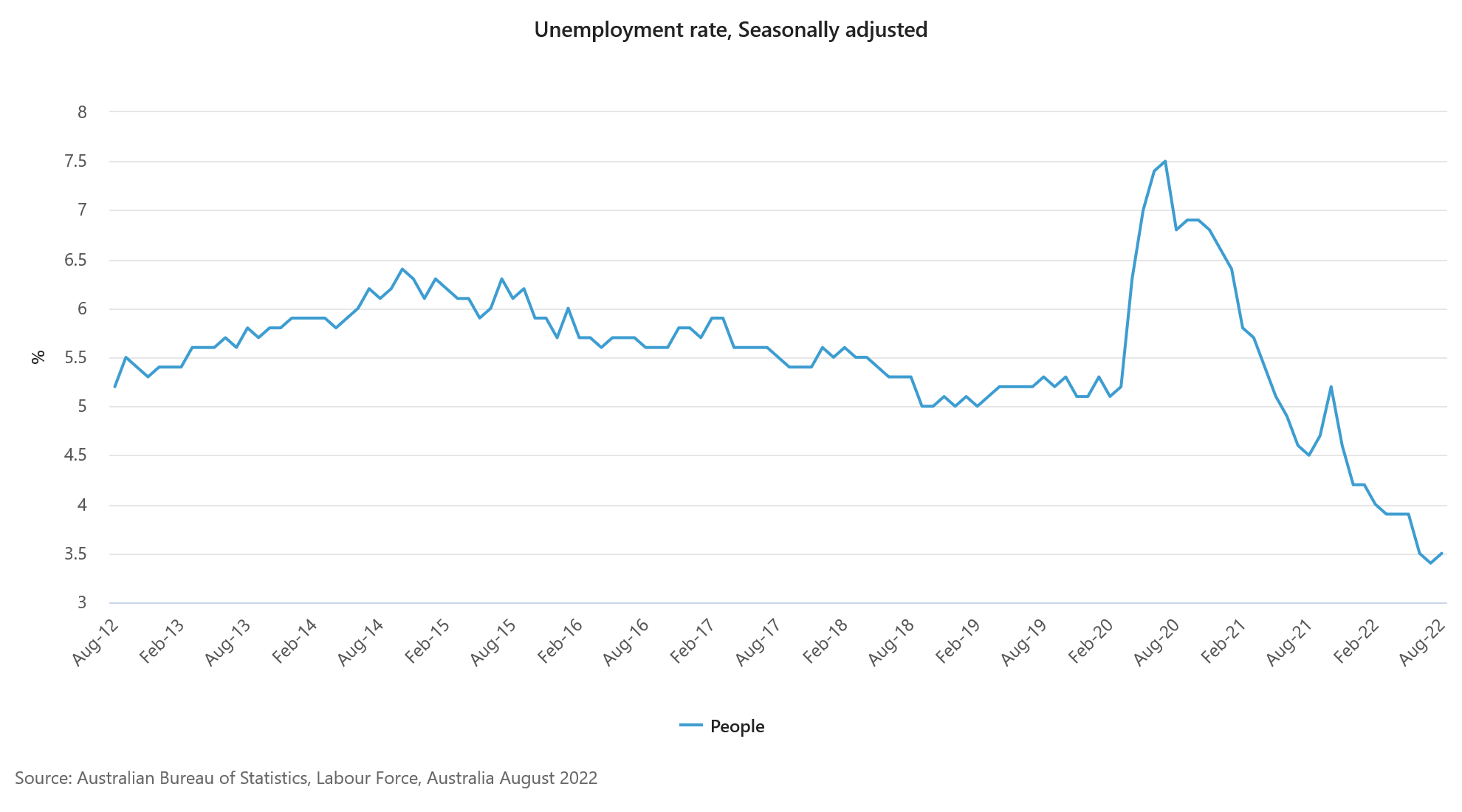
Australia employment rose 33.5k in Aug, unemployment rate ticked up to 3.5%
Australia employment rose 33.5k in August, slightly smaller than expectation of 35.5k. Full-time jobs rose 58.8k while part-time jobs decreased -25.3k.
Unemployment rate ticked up from 3.4% to 3.5%, above expectation of 3.4%. Participation rate rose 0.2% from 66.4% to 66.6%. Monthly hours worked rose 0.8% mom.
New Zealand GDP grew 1.7% qoq in Q2, driven by services
New Zealand GDP grew 1.7% qoq in Q2, above expectation of 1.0% qoq, following a -0.2% qoq decline in Q1. Service industries rose 2.7% but goods producing industries dropped -3.8%. Primary industries rose 0.2%.
"The reopening of borders, easing of both domestic and international travel restrictions, and fewer domestic restrictions under the Orange traffic light setting supported growth in industries that had been most affected by the COVID-19 response measures," national accounts – industry and production senior manager Ruvani Ratnayake said.
"In the June 2022 quarter, households and international visitors spent more on transport, accommodation, eating out, and sports and recreational activities."
ECB Lane: Larger increment of interest rates appropriate
ECB Chief Economist Philip Lane said in a speech that risks to the inflation outlook are "primarily on the upside". Major short term risk is a "further disruption of energy supplies". Over the medium term, inflation may turn out to be higher than expected because of a "persistent worsening of the production capacity", further increases in "energy and food prices", and rise in "inflation expectations above our target" or higher "anticipated wage rises.
"In the context of a long projected period with inflation far above target, the net upside risks to inflation and taking into account that the current setting of the key policy rates is still highly accommodative, it was appropriate to take a major step that frontloads the transition from the prevailing highly-accommodative level of policy rates towards levels that will support a timely return of inflation to our target," he said, about last week's 75bps rate hike".
"In calibrating a multi-step transition path, the appropriate size of an individual increment will be larger, the wider the gap to the terminal rate and the more skewed the risks to the inflation target, he added.
Crude Oil Price Could Gain Bullish Momentum, Gold Consolidates
Key Highlights
- Crude oil price started a steady increase above the $85 resistance.
- It broke a major bearish trend line with resistance at $87.50 on the 4-hours chart.
- Gold price is consolidating losses below the $1,720 resistance zone.
- EUR/USD could revisit the 0.9900 support zone, and GBP/USD is holding the 1.1440 support.
Crude Oil Price Technical Analysis
After declining towards the $81.20 zone, crude oil price found support against the US Dollar. The price started a steady increase and was able to clear the $85 resistance.
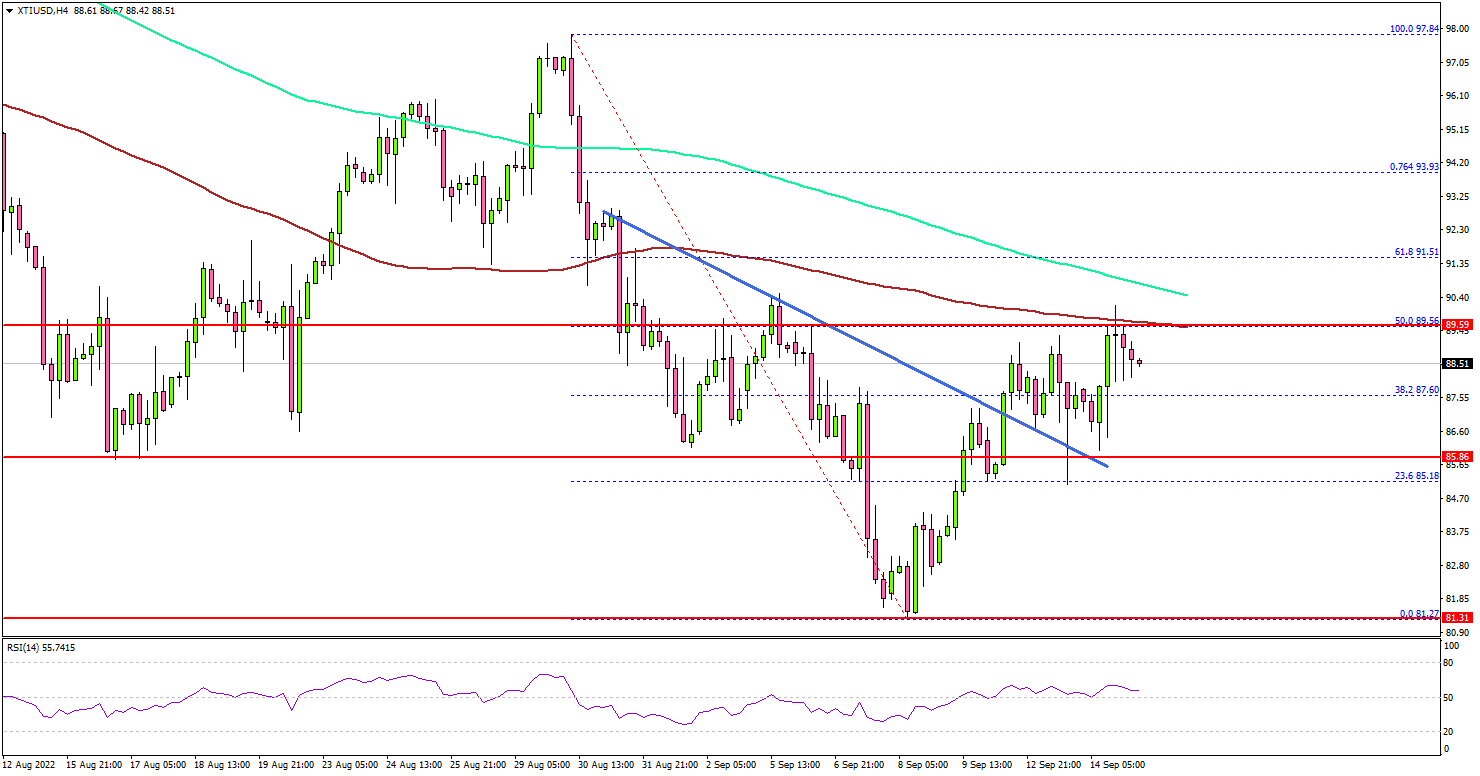
Looking at the 4-hours chart of XTI/USD, there was a break above the $86.50 resistance and a major bearish trend line with resistance at $87.50. It opened the doors for more upsides above the 38.2% Fib retracement level of the downward move from the $97.84 swing high to $81.27 low.
The bulls pushed the price to the $90 zone and the 100 simple moving average (red, 4-hours). The price also tested the 50% Fib retracement level of the downward move from the $97.84 swing high to $81.27 low.
A clear move above the $90.00 level and the 200 simple moving average (green, 4-hours) could push the price further higher.
The next major resistance is near $91.50, above which the price could accelerate higher towards the $94.50 zone.
On the downside, an initial support is near the $87.50 level. The next major support is near $85.80. The main support sits near $85, below which there is a risk of a move towards the $82.50 level. Any more losses might call for a test of the $81.20 zone.
Looking at gold price, the bulls are protecting the $1,690 zone, but the price might continue to face resistance near $1,720.
Economic Releases to Watch Today
- US Retail Sales for August 2022 (MoM) – Forecast 0%, versus 0% previous.
- US Industrial Production for August 2022 (MoM) – Forecast 0.2%, versus 0.6% previous.
Natural Gas Wave Analysis
- Natural gas rising inside impulse wave 3
- Likely to rise to resistance level 9.500
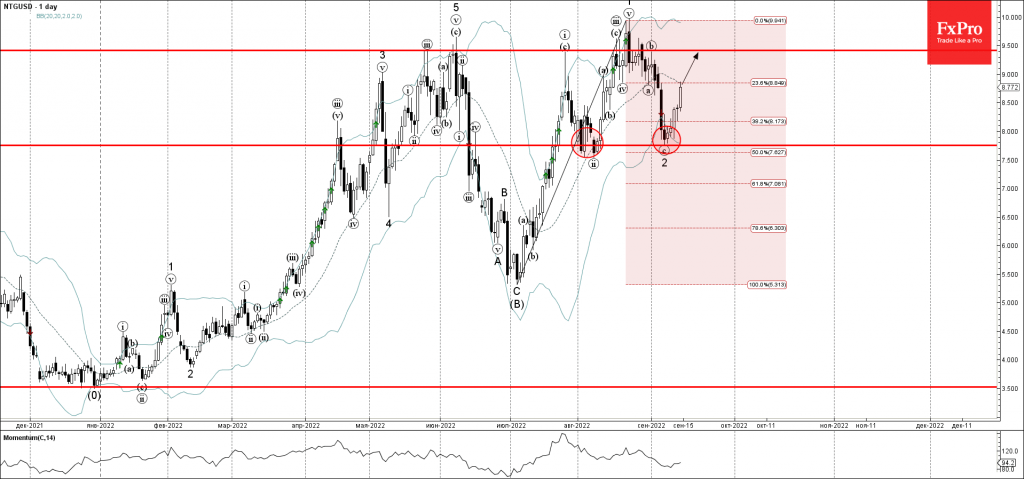
Natural gas recently reversed up from the key support level 7.755 (which has been reversing the price from the start of August), standing near the lower daily Bollinger Band and the 50% Fibonacci correction of the upward impulse from July.
The upward reversal from the support level 7.755 started the active short-term upward, which belongs to wave (C) from July.
Natural gas can be expected to rise further toward the next resistance level 9.500 (top of the earlier short-term correction (b) from last month).