Sample Category Title
Crypto Bears Confirmed Their Strength
Market picture
Bitcoin collapsed 9.6% on Tuesday, ending the day near $20.2K, which remains on Wednesday morning. Ether is losing 6.4% overnight to $1610. The most significant altcoins took a heavy hit, losing between 4.6% (BNB) and 13% (Solana), but remain on the plus side after seven days.
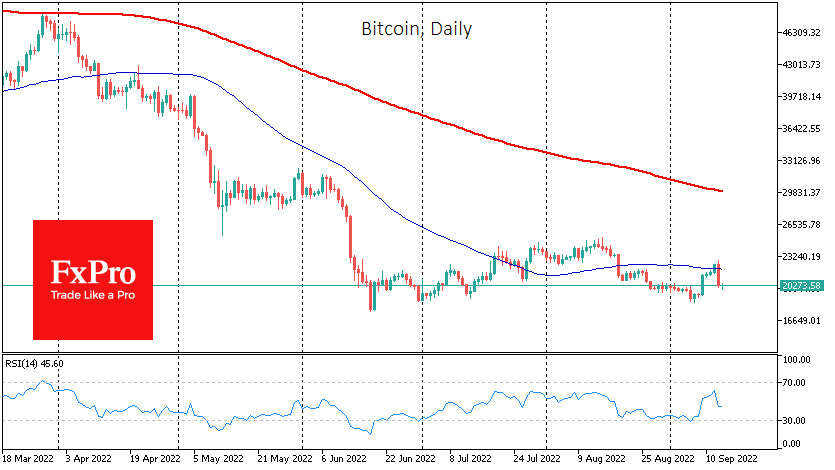
The bears in Bitcoin have asserted that they are in control. From the 50-day moving average level, BTCUSD experienced a substantial decline. This could bring back downward sentiment, as it did in August, for an extended period. However, it is too early to speculate on whether the June lows will be renewed.
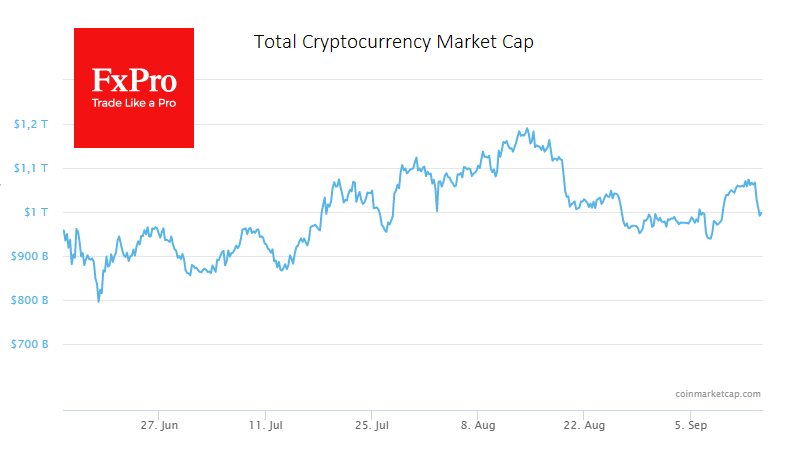
Pressure on all risky assets came after a hot US inflation report, which increased the likelihood of a more robust Fed rate hike next week and triggered the strongest sell-off in more than two years.
News background
Eugene Fama, 2013 Nobel Prize laureate in Economics, believes that bitcoin will have value as a means of payment. However, BTC’s high volatility prevents it from being used for that purpose. We should add that this refers not only to the downside but also to upside moves.
Ethereum has a much higher near-term growth potential than bitcoin, according to ConsenSys. ETH could become a savings vehicle following The Merge event, set to take place on September 15.
Digital asset management platform Abra is launching Abra Bank, the first regulated crypto bank in the US, providing traditional services for cryptocurrencies.
According to media reports, investment giant Fidelity Investments, which serves 34 million clients, plans to provide retail clients access to bitcoin trading on its brokerage platform.
Aussie Stabilizes after Freefall
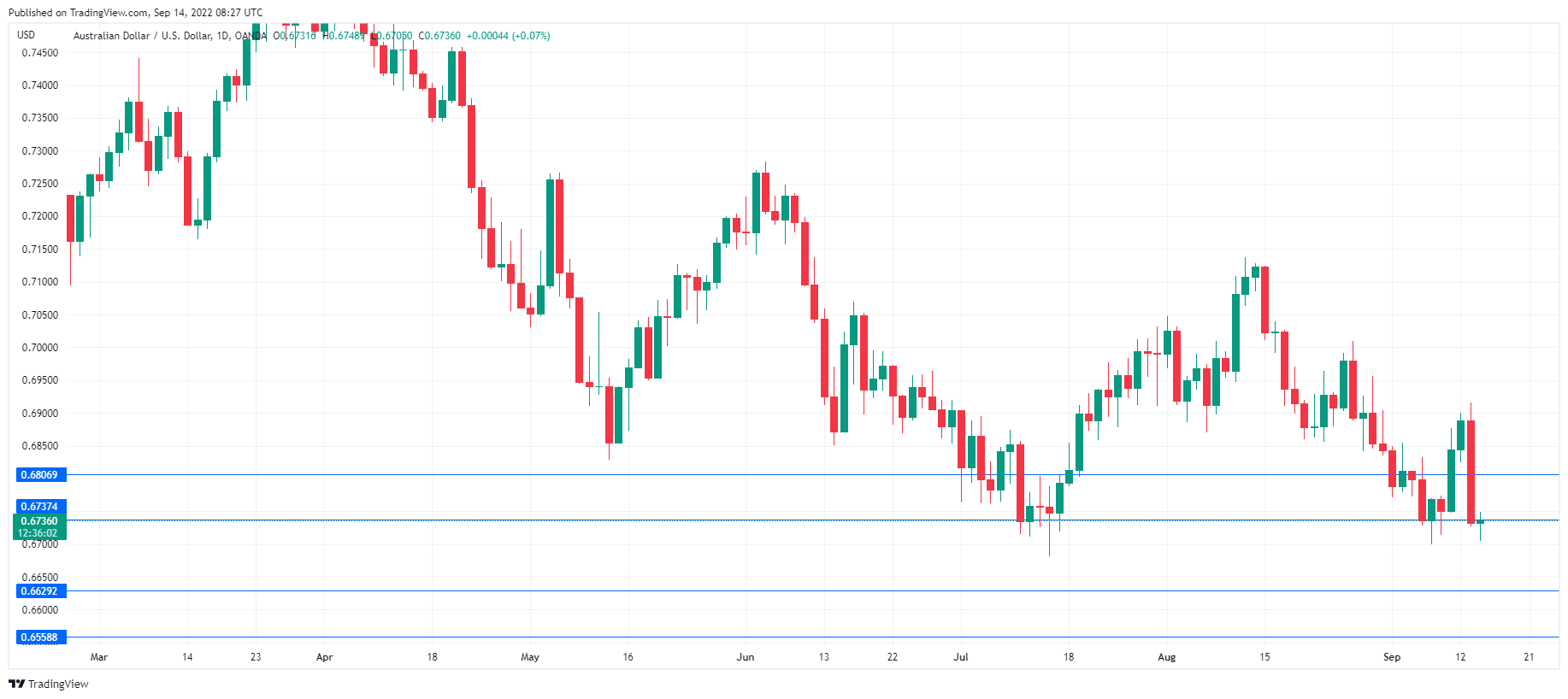
The Australian dollar is licking its wounds today, after a brutal collapse on Tuesday. AUD/USD is trading at 0.6739 in the European session, up 0.12%.
US inflation sends USD soaring
On Tuesday, I noted that the Australian dollar had edged higher, thanks to decent consumer and business confidence data. That changed in a hurry after the US inflation report, and by the end of the day, AUD/USD had plunged an astounding 2.29%. The Aussie wasn’t alone, as the US dollar posted sharp gains against all the major currencies.
In the US, investors were dismayed with the August inflation report, even though headline inflation fell to 8.3%, down from 8.5%, thanks to lower gasoline prices. The reading was well above the consensus of 8.0%, and core CPI rose to 6.3%, up from 5.9% and above the forecast of 6.1%. The markets reacted sharply to the news, as equity markets slumped and the US dollar was off to the races. The market response was a polar opposite to the July inflation report, when market euphoria sent the stock markets flying and the US dollar tumbling.
The latest inflation numbers have removed any expectations of a modest 50bp increase at the Fed’s meeting next week and have raised the possibility of a massive 100bp hike. The markets have priced in a 75bp increase at 60% and a 100bp rise at 40%, compared to 80% for 75bp and 20% for 100bp after the inflation report was released. I expect these odds to continue to fluctuate as we get closer to the September 21st meeting. Larry Summers, a former Treasury Secretary, said on Tuesday that the inflation report indicated that the US has a “serious inflation problem” and a 100bp move would “reinforce credibility”.
Market attention will shift to the Australian employment report on Thursday. The market consensus stands at 35.0 thousand for August, which would be a huge rebound after the -40.9 thousand reading in July. A strong release will make it easier for the RBA to remain aggressive as it continues to battle inflation. The RBA will be keeping a close eye on Consumer Inflation Expectations, which will also be released on Thursday. The index is expected to rise to 6.7% in August, up from 5.9% in July.
AUD/USD Technical
- AUD/USD is testing resistance at 0.6737. Above, there is resistance at 0.6807
- There is support at 0.6629 and 0.6559
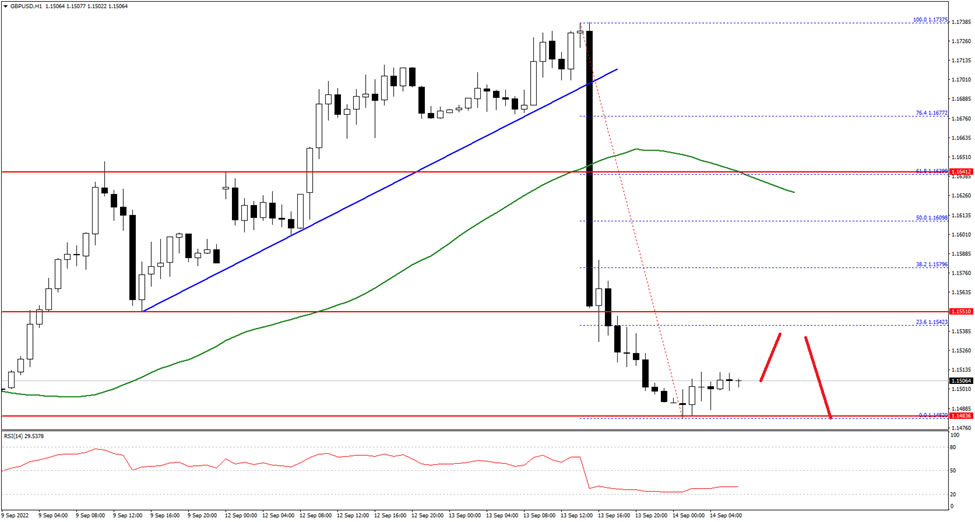
GBP/USD Pair Started a Heavy Decline Below $1.1650
The British Pound started a fresh decline from the 1.1740 resistance zone against the US Dollar. The GBP/USD pair declined heavily below the 1.1700 and 1.1650 levels.
There was a close below the 1.1600 level and the 50 hourly simple moving average. It even spiked below the 1.1520 level and traded as low as 1.1482. The pair is now consolidating losses, with an immediate resistance near the 1.1520 level.
The first major resistance sits near the 1.1550 zone. If there is a clear upside break above the 1.1550 resistance, the pair could rise steadily towards the 1.1600 level in the near term.
On the downside, an initial support is near the 1.1500 level. The main support is forming near 1.1480 on FXOpen. A break below the 1.1480 support could even push the pair below the 1.1450 support.
BoE Preview: Another 50bp Rate Hike in Store
- We expect BoE to hike the Bank Rate by another 50bp on Thursday 22 September, but acknowledge that it is a close call between 50bp and 75bp.
- We expect further 50bp hikes in both November and December followed by 25bp in February. Hence, we lift the end point of our projection to 3.25% (prev. 2.50%)
- We expect fewer hikes than priced in markets as we emphasise the rising recession risk. In our base case, we expect EUR/GBP to rise upon announcement (see p. 2).
BoE call. We expect the Bank of England (BoE) to hike the Bank Rate by another 50bp at its next meeting bringing it to 2.25%. Markets are currently pricing around 65-70bp. We expect 50bp as opposed to 75bp, as we are more negative on the growth outlook. Also BoE has had a tendency to surprise to the dovish side at recent meetings. Additionally, BoE was the first G10 central bank to forecast a recession by Q4 2022 at its last meeting, while using a far more dovish market pricing as policy input than what is currently priced. We see this as a contributing factor to our base case as the growth outlook looks considerably worse now than back then given current market pricing.
We expect the BoE to repeat the message of a meeting-by-meeting approach effectively eliminating forward guidance, similar to both the ECB and the Fed. Note, that there will not be any updated inflation or GDP forecasts published at this meeting (interim meeting).
In light of recent developments we update our BoE call and now expect 50bp hikes in September, November and December followed by a final 25bp hike in February 2023. The endpoint is thus lifted to 3.25% (from 2.50%). We see possibility for further hikes in 2023, if we see underlying inflation pressures to prove persistent.
As outlined at the last meeting, we expect outright government bond selling to commence with a proposed bond sales of GBP 10bn per quarter, totalling a reduction in bond holdings of GBP 80bn over twelve months.
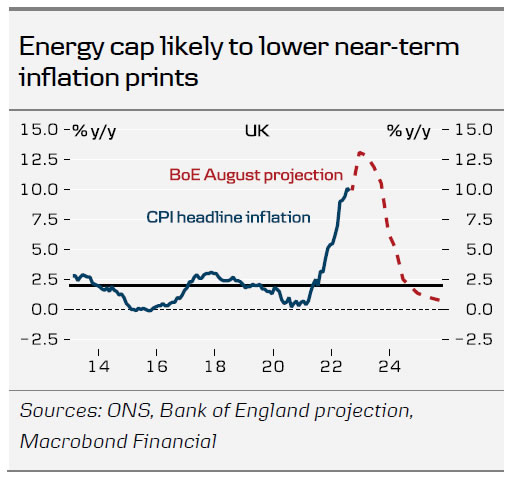
Fiscal policy. The newly elected Prime Minister Liz Truss recently announced an energy support package to households, capping the yearly energy bills at GBP 2,500 from October and two years ahead. This limits the planned increase of 80% in energy costs down to an estimate of 27%. In turn, this could result in inflation prints being lower in the near-term than first projected. In our view, this makes a 75bp hike less likely.
Meanwhile, with the package expected to be deficit funded, we could see upside to inflation down the road with inflation possibly proving to be more persistent. This could highlight the need for further hikes in 2023, yet amid the deficit funding uncertainty we still lean towards 50bp next week.
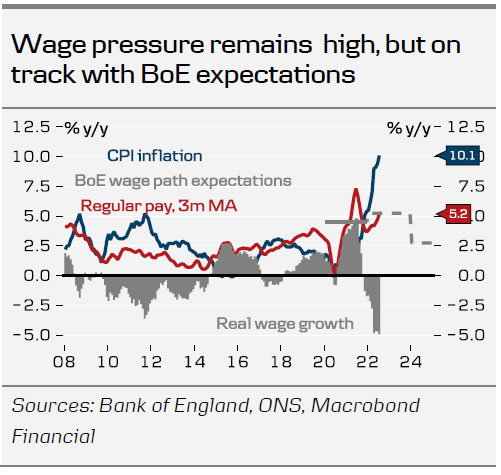
Growth outlook. We continue to expect the UK to head into recession in H1 2023. Although we expect fiscal stimulus to dampen the fall, it will not be enough to fully offset the erosion of real wage growth. Manufacturing PMI dropped to 47.3 in August and retail sales have started to show signs of slowing. The labour market is still very tight with high wage pressure, although the latest labour market data showed some signs that the labour market is losing some of its momentum with higher inactivity and more people stepping out of the work force.
FX. In our base case of a 50bp hike, we expect EUR/GBP to move slightly higher on announcement. As we expect the BoE to highlight the gloomy growth outlook for the UK economy amid rising recession risk, we expect EUR/GBP to continue its move higher during the press conference.
We still widely consider EUR/GBP a range play for the coming months, with GBP currently trading in the weaker part of the range at just below 0.87. Further out, we expect GBP to appreciate vs EUR in a USD-positive environment, which is why we expect the cross to move back towards 0.84 in 12M. We will look for GBP buying opportunities over the coming months as we do not yet like the timing.
Global Inflation Watch – US Inflation Surprise Points to Another 75bp Fed Hike
Overview: Inflation pressures from oil, metals, food and freight rates have come down but labour markets remain tight in US and Europe keeping wage pressures high. Incoming inflation numbers also remain elevated as evident from the upward surprise in US CPI for August (see below). Gas and electricity prices have come off the highs in Europe but remain very high. Looking forward, we expect inflation to stay high in the short term (rise further in the euro area) but decline during 2023 as recession looms.
Inflation expectations: US household 3-year inflation expectations from NY Fed turned lower in August. Euro consumer price expectations are off the peak but still high. Market-based long-term inflation expectations are moving broadly sideways above 2%.
US: CPI inflation surprised to the upside in August, as core inflation remained brisk at +0.6% m/m. Declining gasoline prices will continue to ease energy and transportation related inflation, weighing on headline CPI towards year-end. Most leading indicators point towards moderating inflation expectations, as supply chain challenges ease and commodity prices have declined. In addition, while shelter prices contribute positively to the CPI for now, housing market conditions have continued to cool. That said, the strong economic momentum and persistent labour shortages continue to push wages higher, creating sticky and broad-based upward pressure on consumer prices as well.
Euro: In contrast to the US, an inflation peak remains not yet in sight, with headline inflation reaching an all-time high of 9.1% in August. Food prices remain on a steep uptrend and although energy price inflation moderated slightly, we think it is the 'calm before the storm', with significant increases for gas and electricity prices still looming in coming months. Weaker demand does not yet seem to be an issue for firms' pricing decisions, as both goods and services inflation accelerated further. Inflation expectations ticked up with the latest energy price surge, leaving ECB to highlight the risk of de-anchoring. Despite the tight labour market, a sharp rise in wages is not yet in sight, with negotiated wage edging down to 2.4% in Q2 22 (from 3.0% in Q1).
China: CPI moved down to 2.5% y/y in August from 2.7% in July. PPI inflation fell yet again to 2.3% y/y from 4.2% y/y. It's down from the peak in Oct '21 at 13.5% y/y.
US Inflation Surprise Brings Markets Back Down to Earth
Global markets are trying to pick up the pieces after a torrid Tuesday, following the nasty surprise in the latest US inflation report. The higher-than-expected CPI print nullified premature hopes for a “dovish pivot” by the Fed in the second quarter of next year, wrong-footing risk assets while reasserting king dollar’s dominance.
The S&P 500 erased all of its month-to-date gains in one fell swoop, posting its largest single-day drop since June 2020, though US futures are edging higher on Wednesday. At the time of writing, gold remains rooted near the $1700 floor, oil prices are extending Tuesday’s declines, while EURUSD is still cowering below parity.
Markets have been jolted by the realisation that inflation could stay persistently elevated for an extended period, forcing the Fed to persist with more supersized rate hikes. Fed Funds futures duly raised the forecasted peak in this ongoing rate-hike cycle by 30 basis points to 4.3% by March 2023. There’s even now a 35% chance being allocated for a gargantuan 100-basis point hike by the Fed next week.
As long as the FOMC has more runaway before reaching “peak hawkishness”, risk assets are unlikely to garner significant gains in the interim, while sanctioning king dollar’s iron grip across the FX universe.
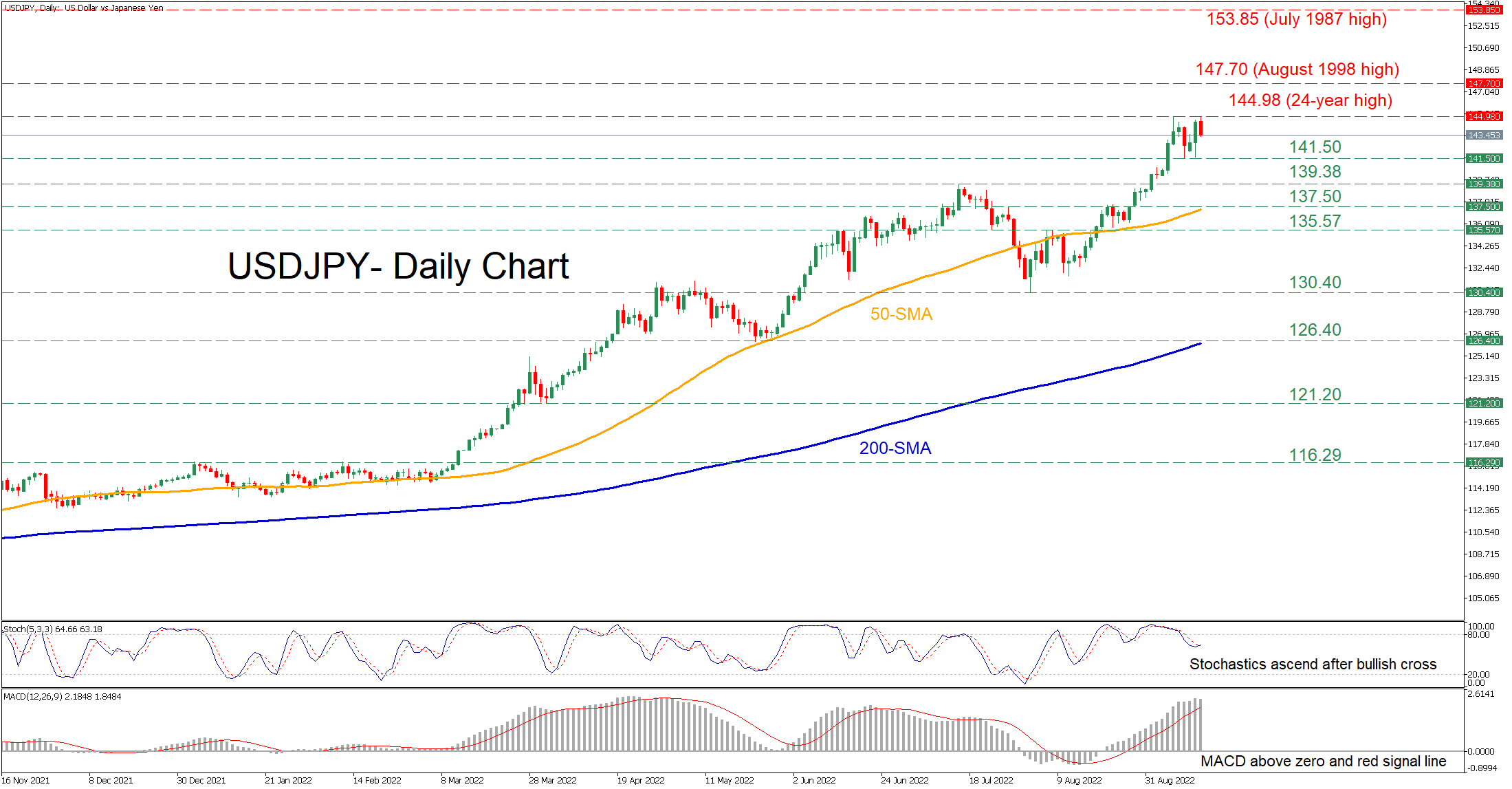
USDJPY Touches 24-Year High as Bullish Forces Persist
USDJPY has been in a prolonged uptrend since early March, crossing forcefully above both its 50- and 200-day simple moving averages (SMAs) and generating consecutive fresh highs. Moreover, despite the recent consolidation, the positive tone appears to be strengthening in the near term as the pair has edged higher again to challenge its recent 24-year high of 144.98.
The momentum indicators currently suggest that bullish forces have gained total control. Specifically, the stochastic oscillator is set to post a bullish crossover, while the MACD histogram is currently above zero and its red signal line.
Should buying interest persist, the pair could move higher to test the 24-year peak of 144.98. Jumping above the latter, the price would form fresh multi-year highs, where the August 1998 resistance of 147.70 might come under examination. Even higher, the July 1987 peak of 153.85 could prove to be a tough barrier for the price to overcome.
On the flipside, a negative correction could initially halt at the recent low of 141.50. Should that floor collapse, the bears could aim for the 139.98 resistance territory before the spotlight turns to the 50-day SMA, currently at 137.50. Failing to stop there, any further declines may encounter strong support at the 135.57.
Overall, USDJPY appears to have the necessary momentum to push higher and generate fresh multi-year highs. Nevertheless, the bulls should not rule out the possibility of some retracement, before the latter is accomplished.
GBP/JPY Daily Outlook
Daily Pivots: (S1) 165.73; (P) 166.41; (R1) 166.82; More...
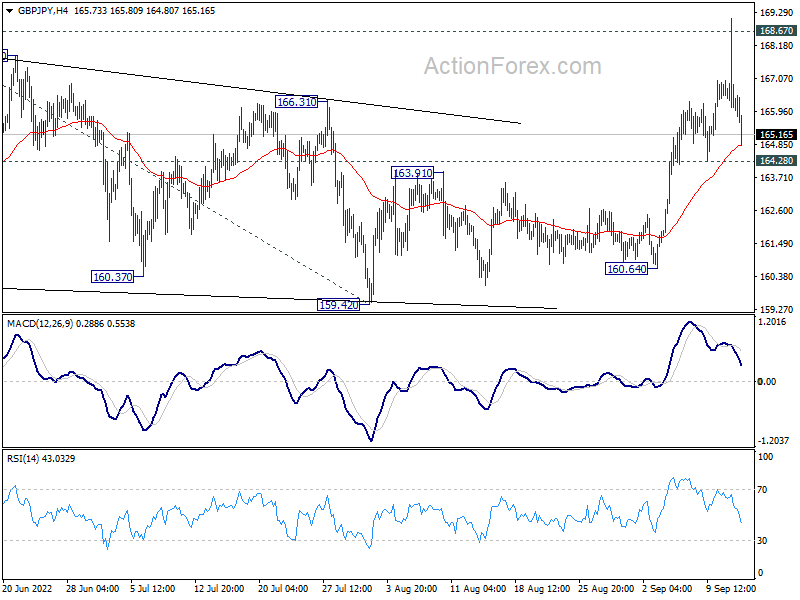
Intraday bias in GBP/JPY is turned neutral with current deep retreat. On the upside, decisive break of 168.67 high will resume larger up trend. Next target is 100% projection of 155.57 to 168.67 from 159.42 at 172.42. On the downside, break of 164.28 minor support will turn bias back to the downside to extend the corrective pattern from 168.67.
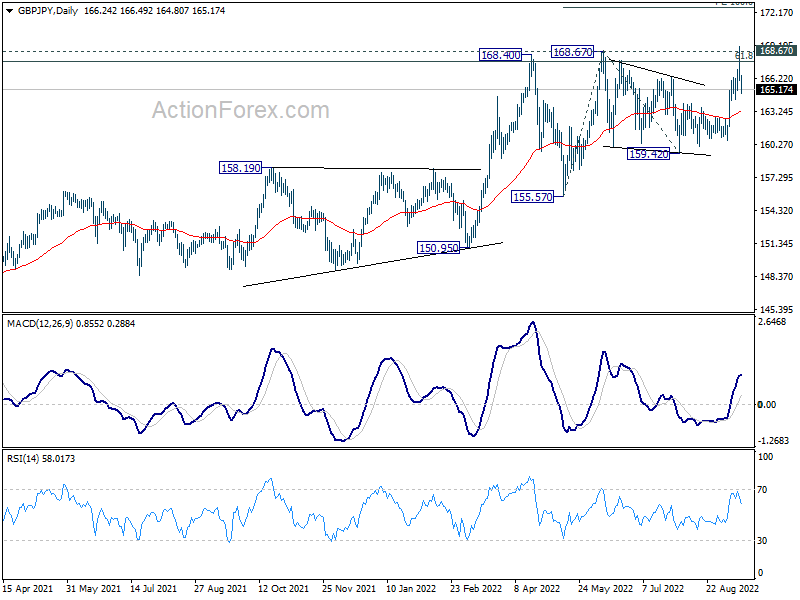
In the bigger picture, up trend from 123.94 (2020 low) is still in progress. Sustained break of 61.8% retracement of 195.86 (2015 high) to 122.75 (2016 low) at 167.93 will be a long term bullish signal, and could pave the way back to 195.86 high. This will remain the favored case as long as 155.57 support holds, even in case of deep pull back.
EUR/JPY Daily Outlook
Daily Pivots: (S1) 143.73; (P) 144.38; (R1) 144.73; More....
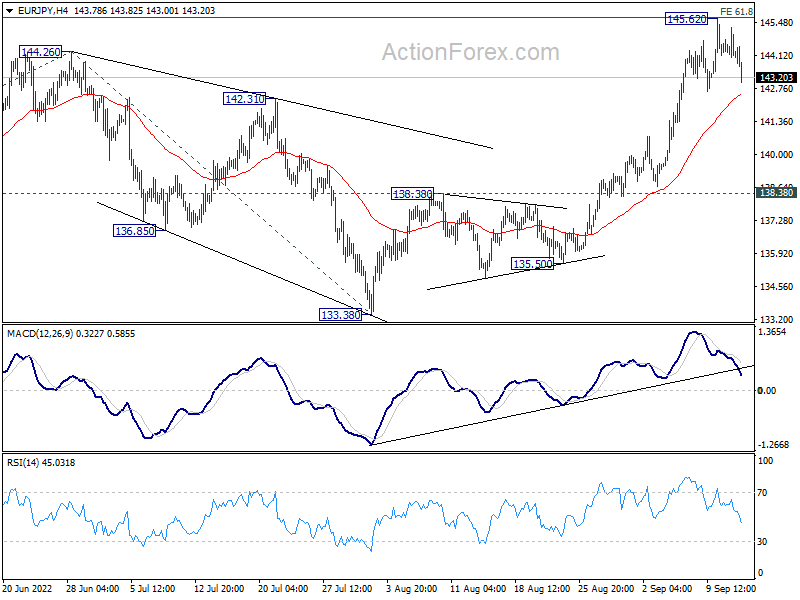
Intraday bias in EUR/JPY is turned neutral with current retreat and some consolidations could be seen. But downside should be contained above 138.38 resistance turned support bring another rally. On the upside, decisive break of 61.8% projection of 124.37 to 144.26 from 133.38 at 145.67 will pave the way to 149.76 long term resistance, and then 100% projection at 153.27.
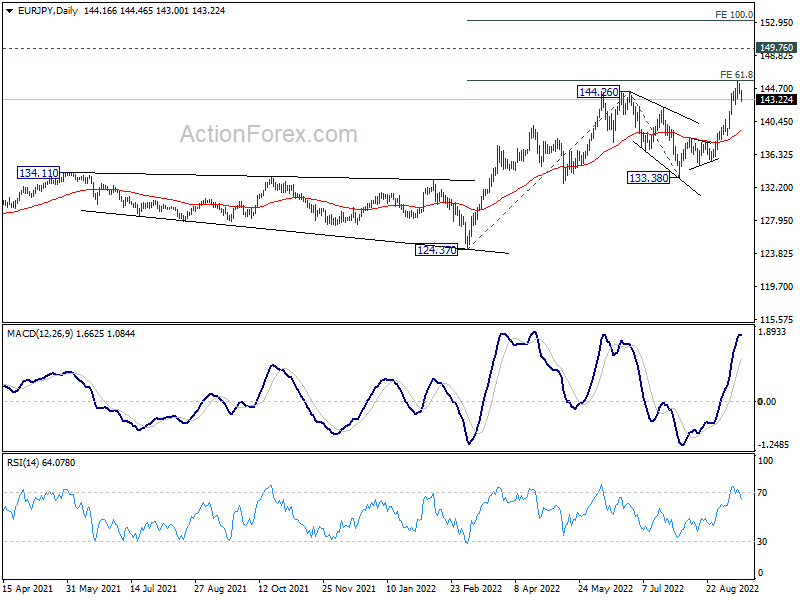
In the bigger picture, up trend from 114.42 (2020 low) is seen as the third leg of the pattern from 109.30 (2016 low). Next target is 149.76 (2015 high). For now, outlook will remain bullish as long as 133.38 support holds, even in case of deep pull back.
EUR/AUD Daily Outlook
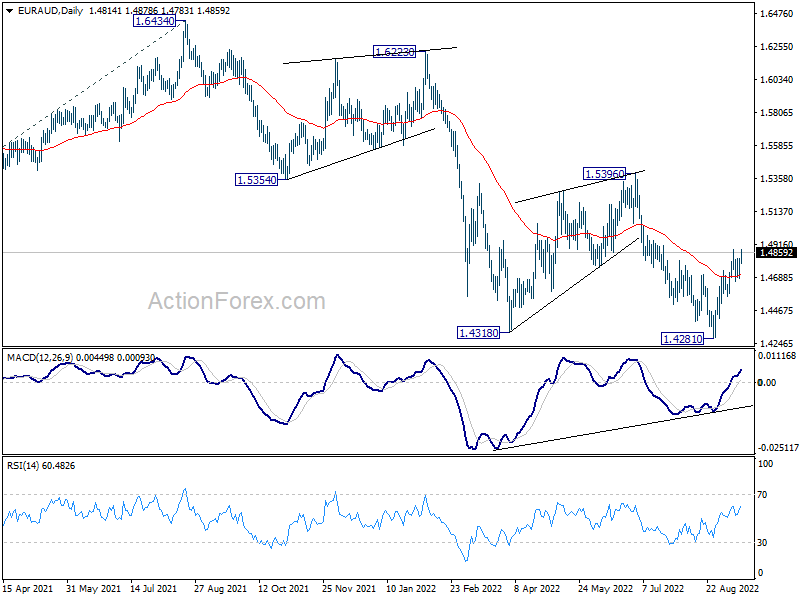
Daily Pivots: (S1) 1.4722; (P) 1.4773; (R1) 1.4859; More...
Intraday bias in EUR/AUD stays neutral as range trading continues. On the upside, above 1.4880 will resume the rebound from 1.4281 short term bottom, and target 1.5396 resistance. On the downside, however, break of 1.4564 minor support will turn bias back to the downside for retesting 1.4281 low.
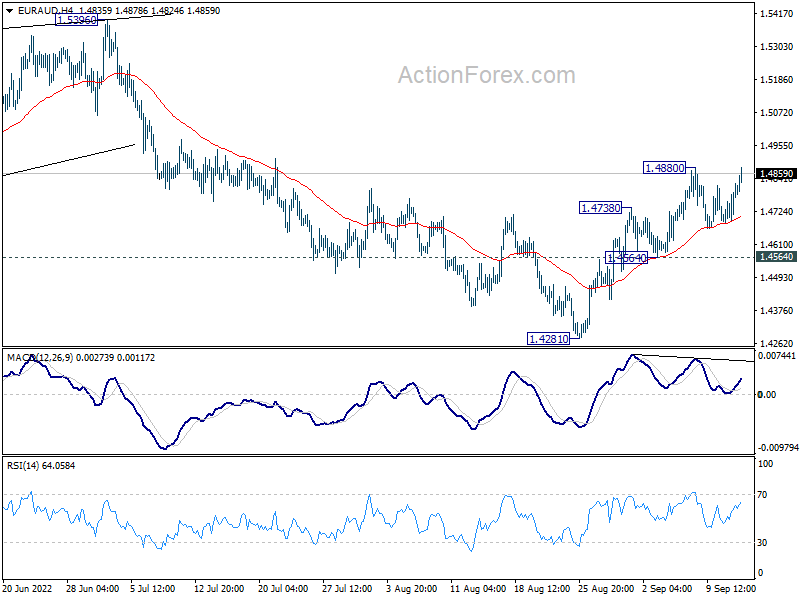
In the bigger picture, down trend from 1.9799 is still in progress. Break of 1.4318 low will target 61.8% projection of 1.9799 to 1.5250 from 1.6434 at 1.3623, which is close to 1.3624 long term support (2017 low). This will remain the favored case now as long as 1.5396 resistance holds.