Sample Category Title
Can US Durable Goods Give US Indices a Push?
US indices fell rather dramatically in the last two sessions. There were a couple of factors contributing, but the Jackson Hole symposium later in the week is seen as a risk catalyst. But in early trading today, better than expected PMI in Europe helped bring back some risk appetite.
With generalized concerns over the health of the US economy, Durable Goods could prove to be an important point for risk sentiment. Investors and CEOs can talk about where they see the economy going, but it's where they put their money that really counts.
What's a stake
Durable goods are seen as a barometer of expectations of the economy, because they represent large investments that firms expect to recover over a period of several years. They are also typically more discretionary since a company doesn't have to open a new factory as much as it has to buy supplies. Increasing durable goods, therefore, is generally seen as a sign that businesses feel they have enough funds in the short term and expect growth in the medium to long term.
This is particularly relevant in periods of higher interest rates, since a lot of durable goods are bought on credit. With rising interest rates, businesses need a higher rate of return to justify taking out loans to buy more equipment. Consumer sentiment can be a little more fickle, as people respond to headlines. Businesses typically take a more measured and studious approach before spending large amounts of money.
What matters in the data
Some distortion can enter durable goods orders on two fronts, but the most relevant right now is defense. Increased defense spending because of heightened geopolitical tensions can inflate the durable goods orders number. Defense spending is discretionary on the government, so the ex-defense figure typically is what the market focuses on.
Though lately there is more interest in the transportation numbers, because automobile production has been curtailed. But industrial transportation has been increasing. Paccar, for example, reported new truck deliveries up 17% over last year. If the economy is going to recover, and supply chain issues resolved, then more trucks are going to be needed, along with more railcars. On the other hand, economic underperformance could weigh on the sale of aircraft.
What to look out for
Headline July Durable Goods Orders are forecast to slow to 0.6% growth compared to 1.9% prior. This comes in conditions when monthly inflation was reported as flat. Durable goods excluding transportation are expected to have grown 0.2% compared to 0.3% in June. Durable goods excluding defense are expected to come in at 0.3% compared to 0.4% prior.
From the projections, we can see that the largest variable is transportation, with investors expecting firms to have cut back on their spending. This is understandable after major retailers such as Walmart, Target and Home Depot reported having large inventories.
Sunset Market Commentary
Markets:
The market focus temporary shifted from Fed Powell’s assessment on monetary policy at Friday’s Jackson Hole symposium to the EMU growth outlook. Activity in the EMU as measured by the PMI’s as expected/feared again contracted in August. The composite index dropped further below the 50-reference, easing from 49.9 to 49.2, the weakest level in 18 months. After unexpected resilience in H1, negative growth in Q3 looks ever more unavoidable. Contraction was mainly due to manufacturing activity (49.7), but the post-pandemic rebound in the services sector was also eroded by the negative impact of higher prices on demand (Services PMI at 50.2). Declining demand is weighing on orders causing a build-up in unsold inventories. ‘Concerns over the economic outlook meant that business confidence remained muted in August. This relatively weak sentiment, plus a sustained downturn in customer demand, meant that firms were increasingly reticent to expand staffing levels and the rate of job creation softened to the slowest in almost a year-and-a-half as a result’, the S&P assessment sounded. .Prices pressures remain elevated even as there are tentative signs that inflationary pressure has reached a peak. The PMI’s still painted a worrisome picture on the EMU economic performance, but optimists maybe will retain that the report at least wasn’t worse than expected/feared. (Interest) rate markets showed no clear directional reaction immediately after the PMI release. In the end, the established uptrend in yields simply continued. The German curve bear steepens with yields gaining between 1.5 bps (2-y) and 6 bps (10/30-y). The US yield curve shows a similar move rising up to 6.0+ bps (10-y). UK Gilts are again clear underperformers with yields jumping up to 16 bps (5-y) despite a mixed/unconvincing UK PMI (composite 50.9, but manufacturing tumbling to 46.0) and a poor CBI orders report (cf infra). Equities stayed under pressure for most of the session (Eurostoxx -0.1%, US indices open little changed), but the sell-off is far less aggressive than was the case yesterday. Gas prices (Dutch future reference contract) at € 266/mwh stay near record levels, but at least for now, one can hope for a lower daily close. Oil gains only marginally (brent $97,6/b) even as the Saudi Arabian Energy Minister warned that OPEC could cut production to bring the market ‘in line with fundamentals’.
An ‘in-line’ EMU PMI evidently wasn’t enough to change fortunes for the single currency. EUR/USD (0.995) keeps the established downtrend, even as some relieve kicked in this afternoon. The USD DXY index (109.00) just failed to touch the June top (109.29). Will Fed Chair Powell finally pull the trigger for a new episode in the USD ascent? The sharp rise in UK yields doesn’t change the trading dynamics for sterling. Cable (1.179) is holding near the YTD/cycle low, but the UK currency gains a few more ticks against the euro (EUR/GBP 0.8445)
News Headlines:
The Hungarian government submitted a comprehensive package of more than 10 legal changes to the EU to address all the Commission’s concerns. The EC is withholding around €6bn form the 2014-2020 EU budget and even more pandemic-related payments given concerns over alleged corruption and violations of the rule of law. Part of the funds are lost for good in absence of agreement by the end of the year. The EU stand-off adds to weakness in the local currency. Last week, it was one of the reasons for rating agency S&P to lower the outlook on the Hungarian BBB rating to negative. The forint trades near all-time record lows at EUR/HUF 412. The rising interest rate environment, the proximity to the Russian war in Ukraine and risk aversion in general weigh as well.
The Confederation of British Industry (CBI) published its monthly survey. It confirmed the grim picture of deteriorating growth and accelerating inflation. The total orders component fell from 8 to -7, the lowest level since August 2021. Finished stocks rose from -7 to 2. The inventory build-up was visible in today’s PMI’s as well. Effective output volumes for the next three months fell from 6 to -2. Average selling prices rose from 48 to 57, ending a two-month decline.
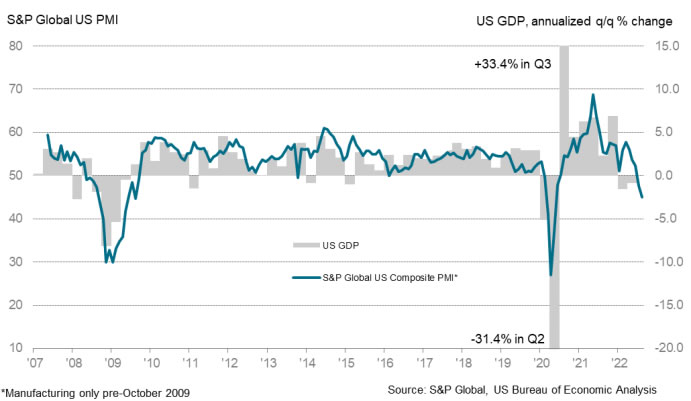
US PMI composite output dropped to 45.0, further disconcerting signs
US PMI Manufacturing dropped from 52.2. to 51.3 in August, a 25-month low. PMI Services dropped from 47.3 to 44.1, a 27-month low. PMI Composite output dropped from 47.7 to 45.0, a 27-month low.
Siân Jones, Senior Economist at S&P Global Market Intelligence said:
"August flash PMI data signalled further disconcerting signs for the health of the US private sector. Demand conditions were dampened again, sparked by the impact of interest rate hikes and strong inflationary pressures on customer spending, which weighed on activity. Gathering clouds spread across the private sector as services new orders returned to contractionary territory, mirroring the subdued demand conditions seen at their manufacturing counterparts. Excluding the period between March and May 2020, the fall in total output was the steepest seen since the series began nearly 13 years ago.
"Lower new order inflows and continued efforts to rein in spending led to the slowest uptick in employment for almost a year. Reports of challenges finding suitable candidates started to be countered by those companies noting that voluntary leavers would not be replaced with any immediacy due to uncertainty regarding demand over the coming months.
"One area of reprieve for firms came in the form of a further softening in inflationary pressures. Input prices and output charges rose at the slowest rates for a year-and-a-half amid reports that some key component costs had fallen. Although pointing to an ongoing movement away from price peaks, increases in costs and charges remained historically robust. At the same time, delivery times lengthened at the slowest pace since October 2020, albeit still sharply, allowing more firms to work through backlogs."
USD/JPY Mid-Day Outlook
Daily Pivots: (S1) 136.89; (P) 137.27; (R1) 137.84; More...
Further rise is expected in USD/JPY despite loss of upside momentum. Rise from 130.38 would target a test on 139.37 high. Strong resistance could be seen from 139.37 high to bring another fall from to extend the corrective pattern from there. On the downside below 134.61 minor support will turn intraday bias back to the downside for 131.72 support.

In the bigger picture, price actions from 139.37 medium term top are seen as a corrective pattern to up trend from 101.18 (2020 low). While deeper decline cannot be ruled out, outlook will stays bullish as long as 55 week EMA (now at 123.21) holds. Long term up trend is expected to resume through 139.37 at a later stage, after the correction finishes.

USD/CHF Mid-Day Outlook
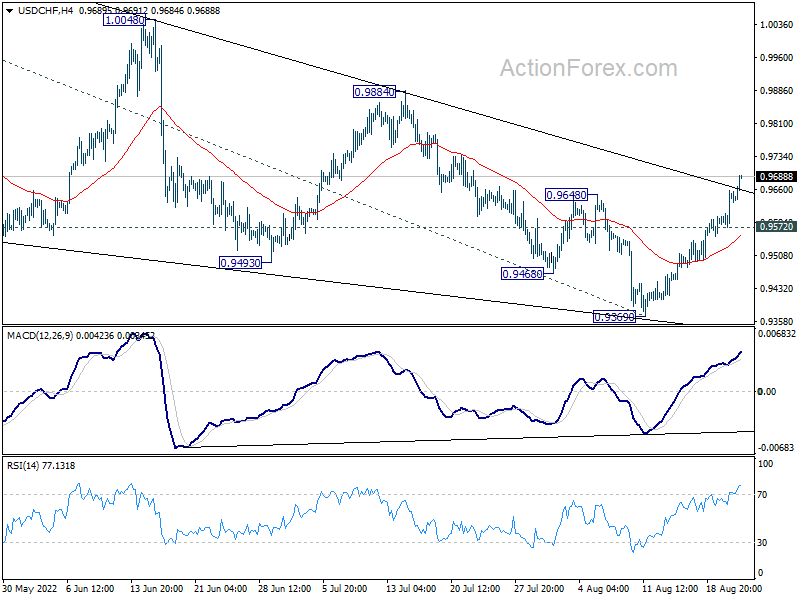
Daily Pivots: (S1) 0.9592; (P) 0.9625; (R1) 0.9677; More...
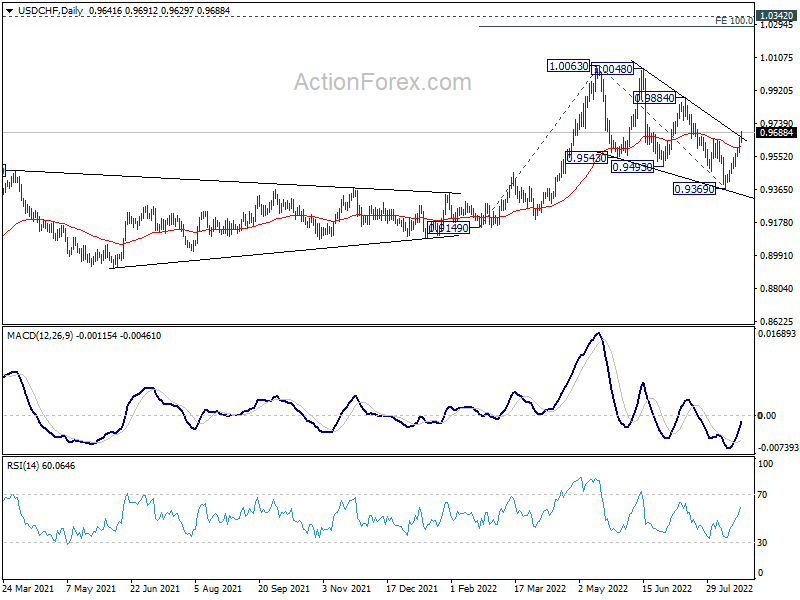
USD/CHF's rally continues today and the break of 0.9648 resistance argues that whole triangle correction from 1.0063 has completed at 0.9369. Further rise should be seen to 0.9884 resistance next. Break there will argue that larger up trend is ready for resumption through 1.0063. On the downside, below 0.9572 minor support will mix up the outlook and turn intraday bias neutral first.
In the bigger picture, current development suggests that up trend from 0.8756 (2021 low) is still in progress. Sustained break of 1.0063 will target 100% projection of 0.9149 to 1.0063 from 0.9369 at 1.0283, and then 1.0342 (2016 high). For now, this will remain the favored case as long as 0.9369 support holds, even in case of deep pull back.
GBP/USD Mid-Day Outlook
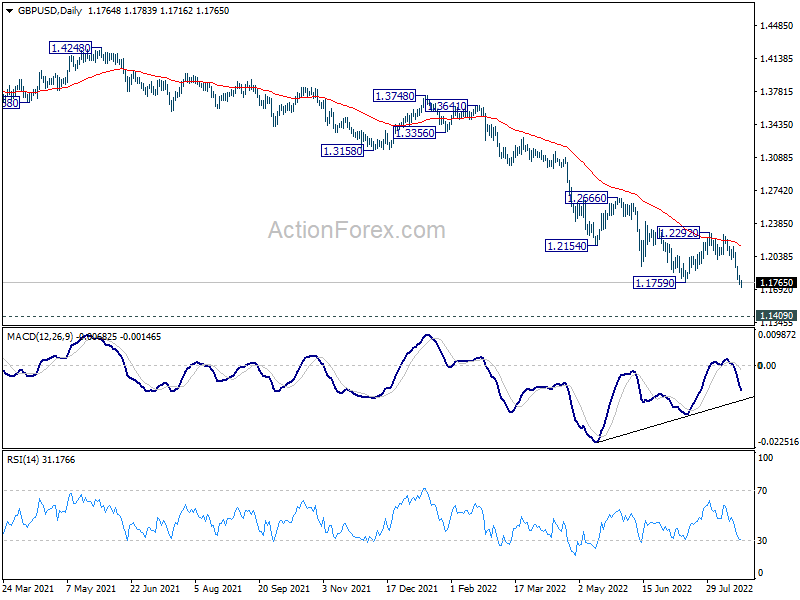
Daily Pivots: (S1) 1.1726; (P) 1.1782; (R1) 1.1822; More...
Intraday bias in GBP/USD remains on the downside at this point. Current down trend should target 1.1409 long term support. On the upside, above 1.1835 minor resistance will turn intraday bias neutral and bring consolidations. But recovery should be limited well below 1.2292 resistance to bring another decline.
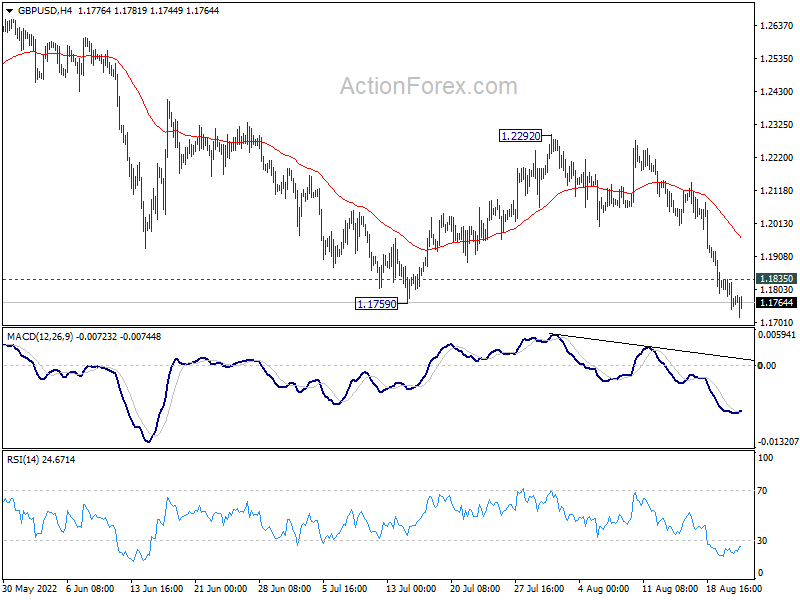
In the bigger picture, fall from 1.4248 (2018 high) could be a leg inside the pattern from 1.1409 (2020 low), or resuming the longer term down trend. Deeper decline is expected as long as 1.2292 resistance holds. Next target is 1.1409 low. However, firm break of 1.2292 will bring stronger rise back to 55 week EMA (now at 1.2859).
EUR/USD Mid-Day Outlook
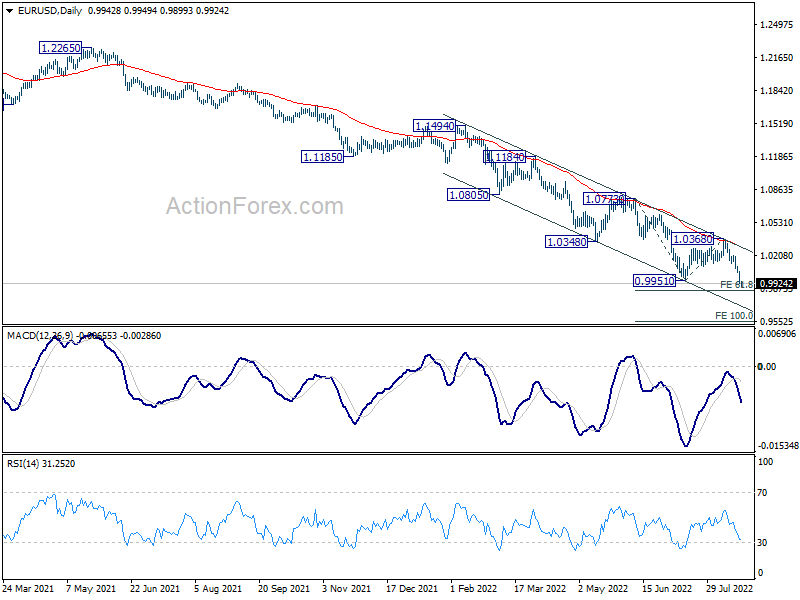
Daily Pivots: (S1) 0.9897; (P) 0.9972; (R1) 1.0018; More...
Intraday bias in EUR/USD remains on the downside for the moment. Next target is 61.8% projection of 1.0773 to 0.9951 from 1.0368 at 0.9860. Firm break there should prompt downside acceleration to 100% projection at 0.9546. On the upside, above 1.0045 minor resistance will turn intraday bias neutral and bring consolidations. But recovery should be limited well below 1.0368 resistance to bring fall resumption.
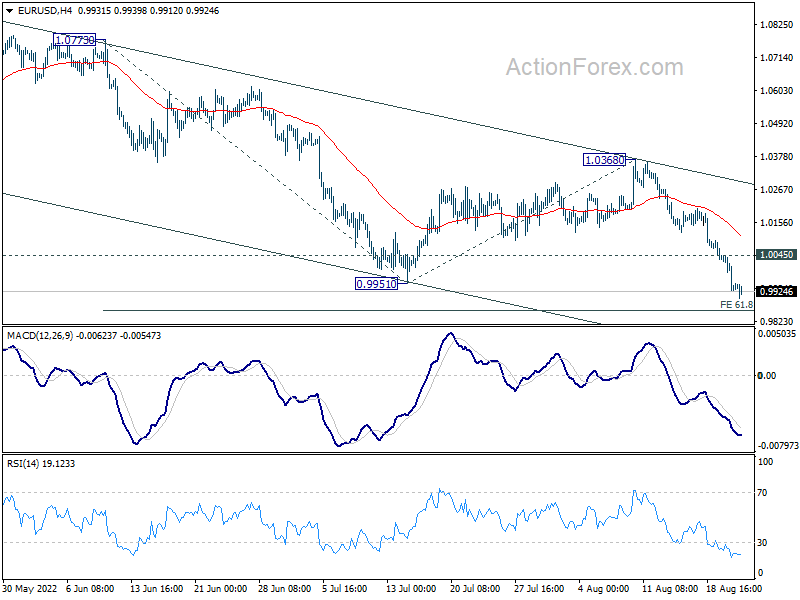
In the bigger picture, down trend from 1.6039 (2008 high) is still in progress. Next target is 100% projection of 1.3993 to 1.0339 from 1.2348 at 0.8694. In any case, outlook will stay bearish as long as 1.0368 resistance holds, in case of strong rebound.
Euro Selloff Continues after Poor PMIs
Euro's selloff continues today after poor PMI data and stays as the worst performer for the week. Swiss Franc is also weak for now, together with Sterling. Dollar remains the strongest one, but struggle to extend gains against commodity currencies. In other markets, major European indexes are soft but downside is limited. US futures also point to flat open. Major treasury yields are extending near term rally. Gold is engaging in weak recovery.
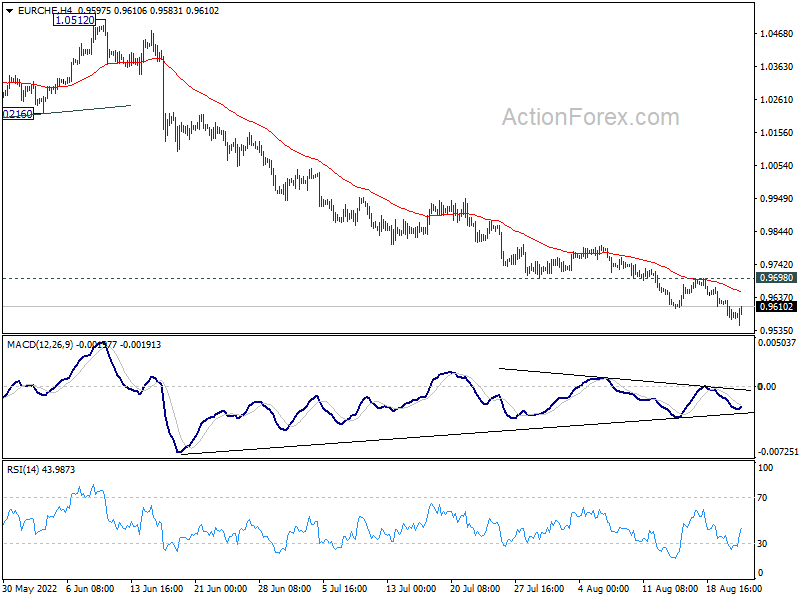
Technically, selling focus appears to be turning from Euro to Swiss Franc. A focus in on EUR/CHF. Further decline is expected as long as 0.9698 resistance holds. However, considering bullish convergence condition in 4 hour MACD, break of 0.9698 resistance will indicate short term bottoming and bring stronger rebound. If happens, that could help Euro stabilize slightly elsewhere.
In Europe, at the time of writing, FTSE is down -0.75%. DAX is down -0.08%. CAC is down -0.32%. Germany 10-year yield is up 0.0349 at 1.341. Earlier in Asia, Nikkei dropped -1.19%. Hong Kong HSI dropped -0.78%. China Shanghai SSE dropped -0.05%. Singapore Strait Times dropped -0.50%. Japan 10-year JGB yield dropped -0.0088 to 0.222.
ECB Panetta: Slowdown or recession would mitigate inflationary pressures
ECB Executive Board Member Fabio Panetta warned in a conference today, "the probability of a recession is increasing. If we will have a significant slowdown or even a recession, this would mitigate inflationary pressures."
"I think that (policy) adjustments are possible but the most recent evolution of the economy should induce us to exercise one of the main features of central bankers which is prudence," he said.
He also added that real rates are "not too far from the estimated neutral level.
Eurozone PMI composite dropped to 49.2 in Aug, economic contraction in Q3
Eurozone PMI manufacturing dropped from 49.8 to 49.7 in August, above expectation of 49.0, a 26-month low. PMI Services dropped from 51.2 to 50.2, below expectation of 50.5, a 17-month low. PMI Composite dropped from 49.9 to 49.2, an 18-month low.
Andrew Harker, Economics Director at S&P Global Market Intelligence said: "The latest PMI data for the eurozone point to an economy in contraction during the third quarter of the year. Cost of living pressures mean that the recovery in the service sector following the lifting of pandemic restrictions has ebbed away, while manufacturing remained mired in contraction in August, seeing another record accumulation of stocks of finished goods as firms were unable to shift products in a falling demand environment. This glut of inventories suggests little prospect of an improvement in manufacturing production any time soon."
Germany PMI Manufacturing recovered from 49.3 to 49.8 in August, above expectation of 48.1.PMI Services dropped from 49.7 to 48.2, below expectation of 49.0, an 18-month low. PMI Composite dropped from 48.1 to 47.6, a 26-month low.
France PMI Manufacturing dropped from 49.5 to 49.0 in August, above expectation of 48.8, a 27-month low. PMI Services dropped from 53.2 to 51.0, below expectation of 53.5, a 16-month low. PMI Composite dropped from 51.7 to 49.8, an 18-month low.
UK PMI manufacturing dived to 46 in Aug, services ticked down to 52.5
UK PMI Manufacturing dropped sharply from 52.1 to 46.0 in August, well below expectation of 51.3. That's also the lowest level in 27 months. PMI Services ticked down from 52.6 to 52.5, above expectation of 52.0, an 18-month low. PMI Composite dropped from 52.1 to 50.9, an 18-month low.
Annabel Fiddes, Economics Associate Director at S&P Global Market Intelligence said:
"The UK private sector moved closer to stagnation in August, as mild growth of activity across the service sector only just offset a deepening downturn at manufacturers. Waning customer demand amid the weaker economic outlook, and shortages of both staff and inputs, were reported to have hit goods producers hard, with firms registering the quickest drops in output and new work since May 2020.
Excluding the initial phase of the pandemic in early-2020, the reduction in manufacturing output was the quickest seen since the start of 2009. Meanwhile, the service sector registered the weakest increase in activity since the recovery began in early 2021."
Japan PMI manufacturing dropped to 51 in Aug, services down to 49.2
Japan PMI Manufacturing dropped from 52.1 to 51.0 in August, below expectation of 51.8. PMI Manufacturing Output dropped from 49.7 to 48.3. That's also the lowest level in 19 months. PMI Services dropped from 50.3 to 49.2, first contraction since March. PMI Composite dropped from 50.2 to 48.9, first contraction since February.
Usamah Bhatti, Economist at S&P Global Market Intelligence, said: "The latest Flash PMI data showed that Japanese private sector activity declined for the first time since February midway through the third quarter. Both manufacturing and services companies recorded a contraction in output in August, with the former falling at the fastest pace for 11 months.
"August data signalled the second-weakest reading in the composite index so far this year, though the rate of deterioration was only mild. Of concern was the amount of new business received by private sector firms, which reduced for the first time in six months and pointed to further weaknesses to come."
Australia PMI composite output dropped to 49.8, a renewed contraction
Australia PMI Manufacturing dropped from 55.7 to 54.5 in August, a 12-month low. PMI Services dropped from 50.9 to 49.6, a 7-month low. PMI Composite Output dropped from 51.1. to 49.8, a 7-month low.
Laura Denman, Economist at S&P Global Market Intelligence said: "A renewed contraction in Australia's private sector economy indicates that recent interest rate hikes made by the RBA, as well as sustained inflationary pressures, have begun to take a toll on overall demand levels.
"Should new order growth remain subdued, this may help reduce demand-pull inflation factors, but survey data continue to highlight the supply issues that remain prevalent globally, which will continue to keep price levels elevated for the foreseeable.
"As such, the RBA will likely continue along its rate-hiking path, which bodes ill for the wider economy given the latest survey data highlight clear signs of underlying weakness."
EUR/USD Mid-Day Outlook
Daily Pivots: (S1) 0.9897; (P) 0.9972; (R1) 1.0018; More...
Intraday bias in EUR/USD remains on the downside for the moment. Next target is 61.8% projection of 1.0773 to 0.9951 from 1.0368 at 0.9860. Firm break there should prompt downside acceleration to 100% projection at 0.9546. On the upside, above 1.0045 minor resistance will turn intraday bias neutral and bring consolidations. But recovery should be limited well below 1.0368 resistance to bring fall resumption.
In the bigger picture, down trend from 1.6039 (2008 high) is still in progress. Next target is 100% projection of 1.3993 to 1.0339 from 1.2348 at 0.8694. In any case, outlook will stay bearish as long as 1.0368 resistance holds, in case of strong rebound.
Economic Indicators Update
| GMT | Ccy | Events | Actual | Forecast | Previous | Revised |
|---|---|---|---|---|---|---|
| 23:00 | AUD | Manufacturing PMI Aug P | 54.5 | 55.7 | ||
| 23:00 | AUD | Services PMI Aug P | 49.6 | 50.9 | ||
| 00:30 | JPY | Manufacturing PMI Aug P | 51 | 51.8 | 52.1 | |
| 07:15 | EUR | France Manufacturing PMI Aug P | 49 | 48.8 | 49.5 | |
| 07:15 | EUR | France Services PMI Aug P | 51 | 53.5 | 53.2 | |
| 07:30 | EUR | Germany Manufacturing PMI Aug P | 49.8 | 48.1 | 49.3 | |
| 07:30 | EUR | Germany Services PMI Aug P | 48.2 | 49 | 49.7 | |
| 08:00 | EUR | Eurozone Manufacturing PMI Aug P | 49.7 | 49 | 49.8 | |
| 08:00 | EUR | Eurozone Services PMI Aug P | 50.2 | 50.5 | 51.2 | |
| 08:30 | GBP | Manufacturing PMI Aug P | 46 | 51.3 | 52.1 | |
| 08:30 | GBP | Services PMI Aug P | 52.5 | 52 | 52.6 | |
| 13:45 | USD | Manufacturing PMI Aug P | 51.5 | 52.2 | ||
| 13:45 | USD | Services PMI Aug P | 50.4 | 47.3 | ||
| 14:00 | USD | New Home Sales M/M Jul | 580K | 590K | ||
| 14:00 | EUR | Eurozone Consumer Confidence Aug P | -28 | -27 |
ECB Panetta: Slowdown or recession would mitigate inflationary pressures
ECB Executive Board Member Fabio Panetta warned in a conference today, "the probability of a recession is increasing. If we will have a significant slowdown or even a recession, this would mitigate inflationary pressures."
"I think that (policy) adjustments are possible but the most recent evolution of the economy should induce us to exercise one of the main features of central bankers which is prudence," he said.
He also added that real rates are "not too far from the estimated neutral level.
NZD Drifting, US New Home Sales Next
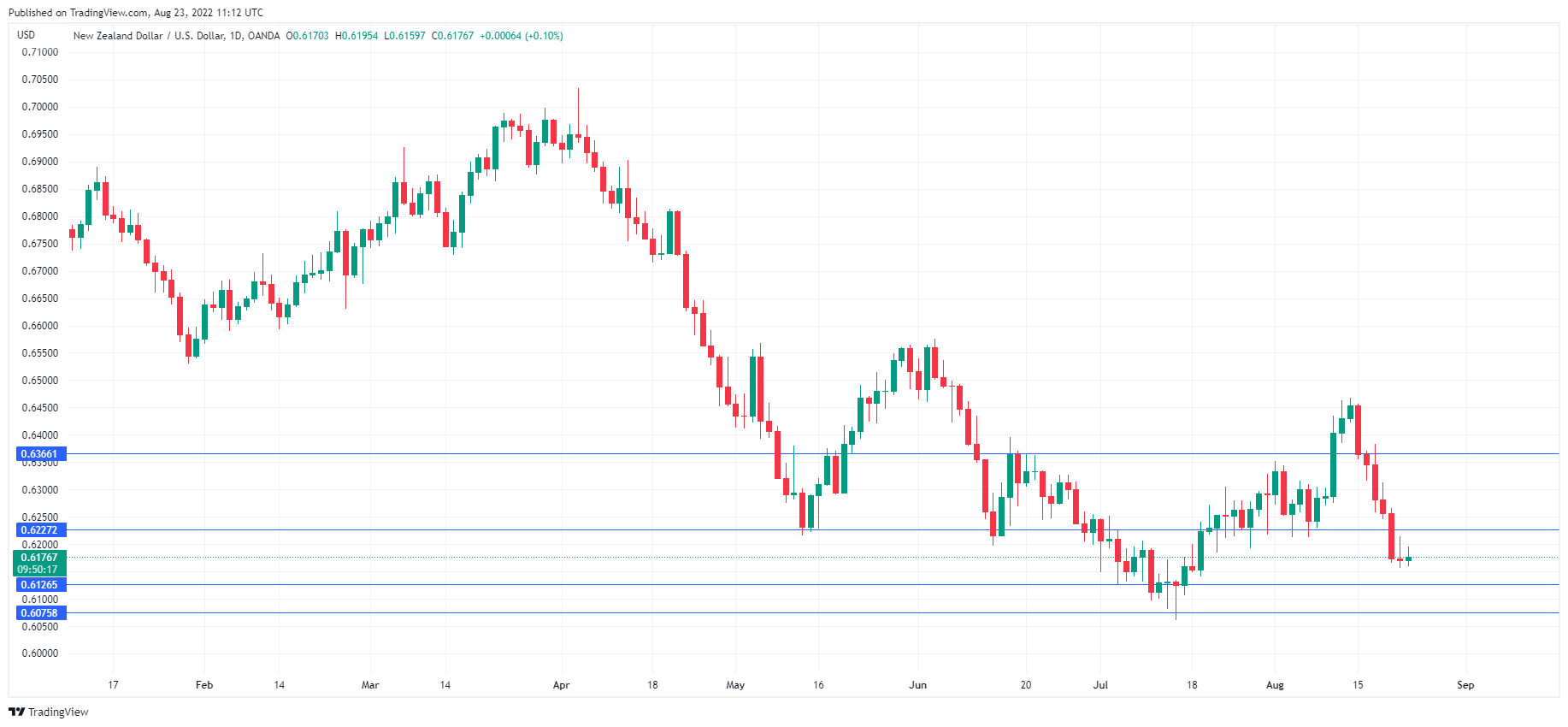
The New Zealand dollar is paddling in calm waters, as NZD/USD trades close to 1-month lows. In the European session, NZD/USD is trading at 0.6176, up 0.10%. The kiwi is still smarting from a disastrous week, in which NZD/USD plunged 4.40%.
RBNZ coy on its plans
The RBNZ is in the midst of an aggressive rate-hike cycle, having raised rates by 50 basis points for a fourth consecutive time. The central bank is expected to add another 50bp hike at the October meeting, which would bring the cash rate to 3.50%. Inflation has hit 7.3%, but the RBNZ is confident that it will peak soon and expects inflation to fall to 3.8% by the end of 2023. The central bank is cautiously positive about the economic outlook, predicting that the economic downturn will not turn into a recession.
Deputy Governor Christian Hawkesby said in an interview this week that the slowdown should lower inflation and bring employment to a more “sustainable level”. Hawkesby said that the RBNZ was deliberately being ambiguous about the peak for rate levels, saying it could be at 4.00% or 4.25% or thereabouts. He added that more rate hikes are coming, while acknowledging that the pace of tightening could slow in the near future.
We’ll get a look at some key US events today and Wednesday that could have an impact on the direction of the US dollar. New Home Sales will be released later today, with a forecast of 575 thousand for July, following 590 thousand in June. Durable goods orders will be published on Wednesday, with the headline reading expected to slow to 0.6% in July, down sharply from 2.0% in June. With the Federal Reserve saying that rate policy will depend to a large extent on the strength of economic data, investors are keeping a close eye on key US events and we could see some movement in the currency markets following these releases.
NZD/USD Technical
- NZD/USD faces resistance at 0.6227 and 0.6366
- There is support at 0.6126 and 0.6075