Sample Category Title
How will Jackson Hole Meeting Affect Markets?
What will happen?
Federal Reserve Chair Jerome Powell will give a speech during the Jackson Hole Symposium on August 26 at 18:00 GMT+3. Analysts expect to hear statements about the future of interest rates and get hints regarding quantitative tightening (QT) in the United States. Therefore, the Federal Reserve Chair has all the chances to set the September market trend.
Moreover, European Central Bank Executive Board member Isabel Schnabel will give her speech on Saturday, but ECB President Christine Lagarde doesn't plan to attend.
Why is it important?
US stocks have rallied since the Fed's last policy meeting in late July as investors saw signs that inflationary pressure decreased and thought that the central bank will begin slowing the pace of tightening.
However, experts are not so optimistic. A year ago, inflation had risen well above the Fed's 2% target, but Powell emphasized that those pressures would probably be transitory.
Now inflation is near the highest level in four decades. Powell has confirmed that the Fed's analysis was incorrect, and policymakers should have begun raising interest rates sooner.
Therefore, despite the latest monthly report on consumer prices causing some optimism that inflation may have peaked, Powell might sound hawkish.
"They are so focused on doing this partly just because they screwed up last year with the whole 'transitory' thing, and they realize that the one thing they can do now is tightening policy, and that will slow inflation," said Kevin Cummins, the chief US economist at NatWest Markets in Stamford, Connecticut.
The Fed raised its benchmark interest rate by 75 basis points at the July policy meeting, following an increase of the same size the month before.
What about Europe?
In Europe, policymakers are also concerned about the size of the next rate hike. Following last month's half-point increase, the ECB can make another 50-basis-point step in September or a more minor, 25-basis-point move due to recession risks.
As the only Executive Board member attending the conference, Isabel Schnabel might provide insights into the ECB's plans to deal with high price pressure and a weakening economy.
The bottom line
Analysts and experts expect to hear some highly hawkish speeches from the central bank's leaders at the end of this week, especially from Jerome Powell. Therefore, the US dollar has strengthened against the other currencies during the previous week. We believe that the markets might overestimate central bankers' intentions.
If Jerome Powell doesn't make any hawkish statements, the US dollar will get under heavy pressure, and it will probably be the end of its rally this year.
Technical analysis
US dollar index, daily chart

US dollar index might come to 110.00 resistance by the end of the week. Currently, the price is trading under the resistance of 108.55. Nothing will stop buyers from reaching the primary target if they break through this support. However, after such a solid growth, a correction is highly expected, and as a famous saying says, “buy the rumors – sell the news.” We expect the US dollar index to reverse at the beginning of the next week towards the resistance range of 104.10 – 105.20, pushing the basket of currencies versus the USD.
EURUSD, H4 chart
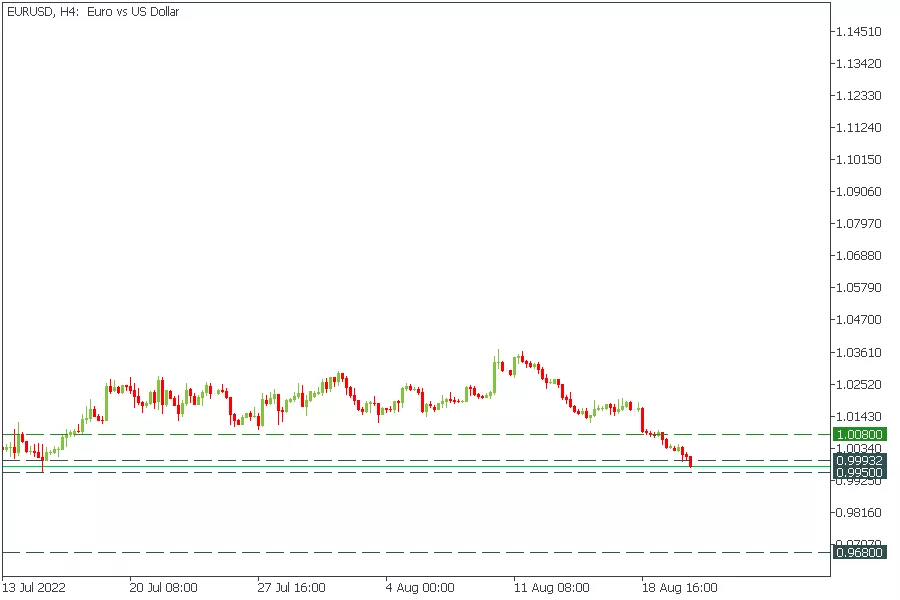
EURUSD is moving right above the 0.9950 – 0.99932 support range. If the pair loses this support, I might plunge towards 0.9680, a support level from 2001. However, if buyers hold this support, it would be a strong signal to buy towards 1.0080.
Is GBPCAD Headed for the 2010 Low?
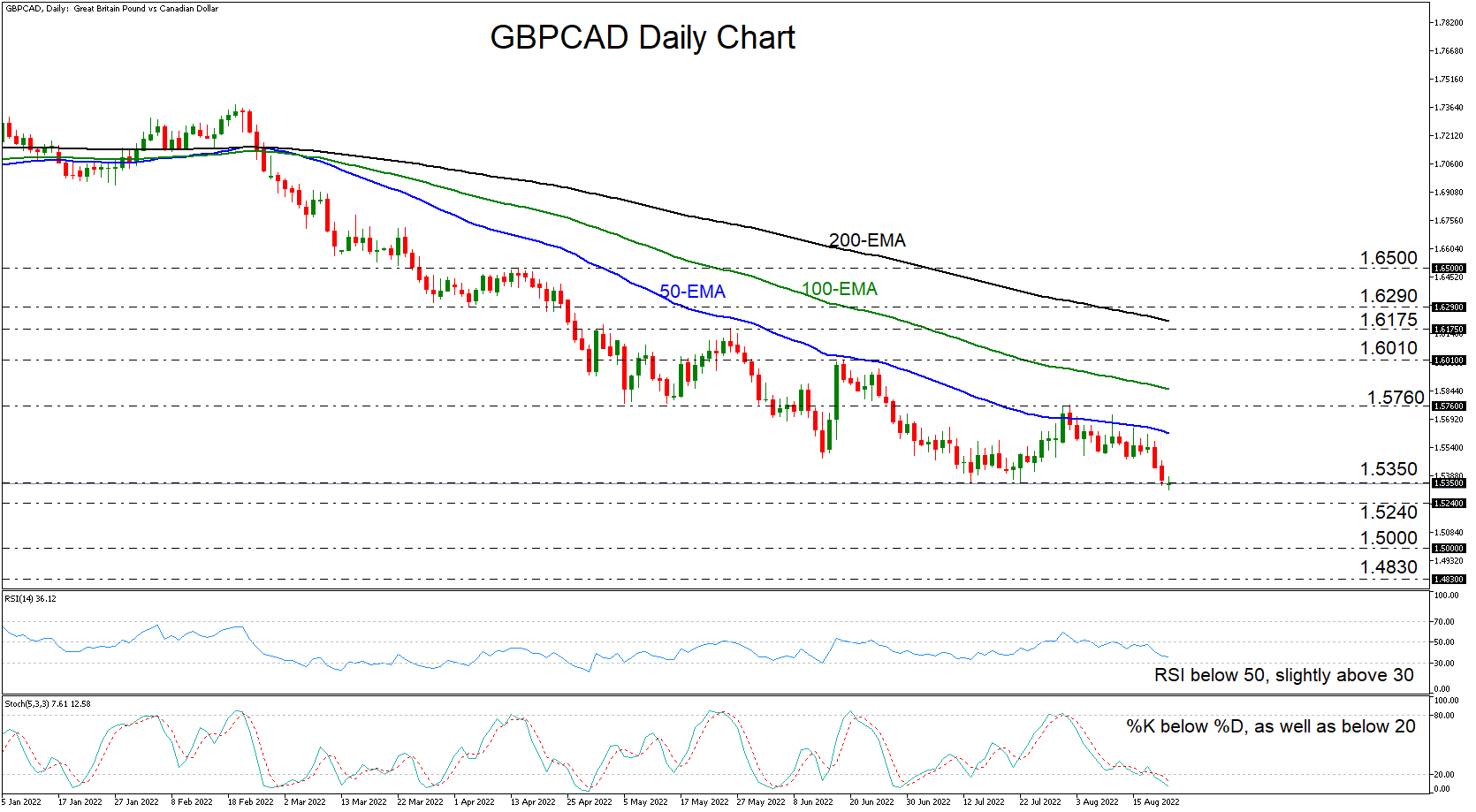
GBPCAD has been drifting south since August 2, when it hit resistance near 1.5760. That said, it has yet to clearly overcome the key support of 1.5350, a move which would not only confirm a forthcoming lower low, but also take the pair into territories last seen back in April 2013. Overall, the trend appears to be to the downside, a narrative supported by the fact that GBPCAD remains below all three of the plotted moving averages.
Our oscillators detect negative momentum, enhancing the case for another lower low very soon. The RSI runs slightly above 30 and points down, while in the stochastic, the %K lies below the %D, as well as below 20.
A clear close below 1.5350 may encourage the bears to flirt with the 1.5240 barrier, which attracted the buyers back in July 2011 and March 2013. If that zone fails to hold this time around, the trend could get extended towards the round figure of 1.5000, or even towards the 1.4830 zone, defined as a support by the lowest point of 2010.
The outlook could brighten upon a break above the 1.5760 barrier, marked by the peak of August 2. This could signal the completion of a double bottom formation on the daily chart, and may encourage advances towards the June 17 peak, at around 1.6010. Should the bulls surpass that obstacle as well, they could then climb towards the peak of May 26, at around 1.6175.
In brief, the broader path of GBPCAD remains to the downside, but before a trend continuation is examined, a clear dip below the key support zone of 1.5350 may be needed.
Euro Slides to 20-Year Low
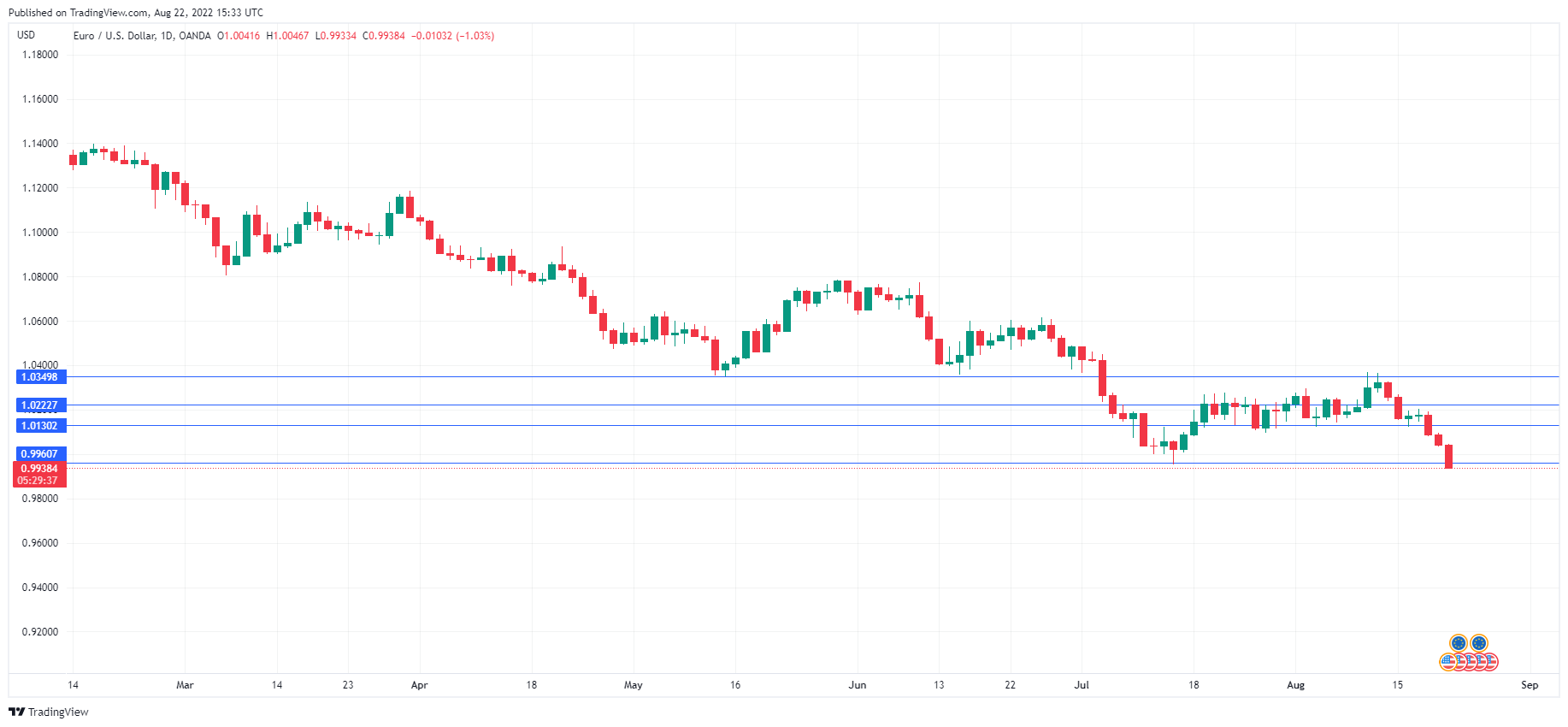
It was a case of the Monday morning blues for the euro. The week started with EUR/USD falling below parity, a psychologically significant line. EUR/USD is currently trading at 0.9951, its lowest level since December 2002.
The US dollar posted gains against all of the major currencies last week and pummelled the euro, which fell by 2.12%. The dollar has found support from market sentiment, as investors are rethinking their views about where the Fed is headed. After the surprise US inflation report for July, which showed a drop in inflation, speculation increased that the Fed would take a dovish pivot after months of aggressive tightening. This boosted the equity markets and sent the US dollar sharply lower. The Fed has insisted that the battle with inflation is far over and that the rate hikes will continue.
We’ll get another chance to hear the Fed’s stance when Jerome Powell addresses the Jackson Hole conference on Friday. The Wyoming resort is often the platform for significant announcements, and Powell’s remarks will be under close scrutiny. Powell may want to sprinkle some dovish comments so as not to sound too pessimistic about the economic outlook, and it’s possible that investors could seize on those comments and ignore the hawkish parts, which would likely boost the equity markets and weigh on the dollar.
The eurozone economy continues to stumble. European energy prices have been soaring, due to a scorching hot summer and concerns that Russia will weaponise energy exports against the bloc. Germany, the largest economy in the eurozone has not been immune to these problems. The services and manufacturing PMIs both indicated contraction in June, and the July numbers are expected to fall further, with estimates of 48.3 for manufacturing and 49.0 for services.
EUR/USD Technical
- EUR/USD is testing support at 0.9959. Below, there is support at 0.9877
- There is resistance at 1.0113 and 1.0223
Crude Oil is Depressed Again
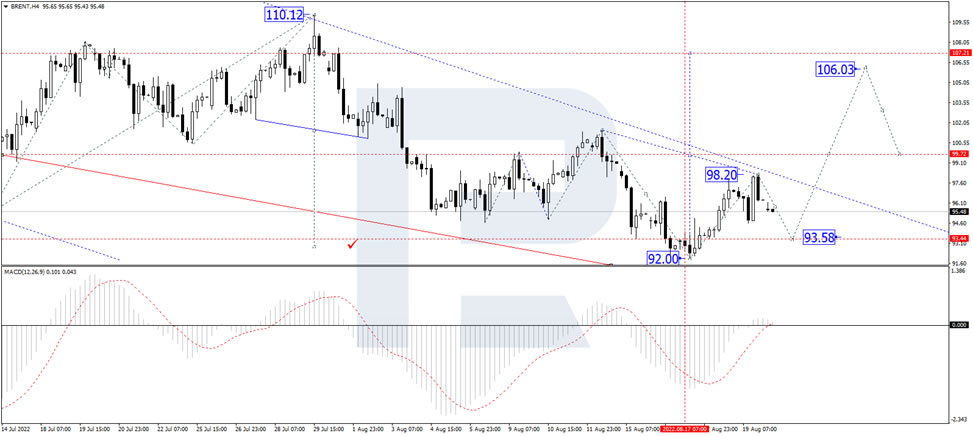
The commodity market remains under bearish control on Monday; Brent is falling to reach $95.45.
Oil is being pressured by the expensive “greenback”, as well as public concerns about a global recession around the world. Today’s economic slump might reduce interest in energies, having a negative impact on prices.
Investors are still waiting for the news on the nuclear deal between the US and Iran. Of course, no rash decisions are expected, but any positive progress would have a positive influence on market sentiment.
According to the CFTC, last week, big-time investors, including hedge funds, decreased their long positions to 290,388 contracts. It’s the lowest number in more than two years. The total long position in futures and options on Brent and WTI dropped to 9-year lows.
On the H4 chart, having completed the first ascending wave at 98.20, Brent is expected to correct down to 93.60 and may later form one more ascending structure with the short-term target at 106.00. After that, the instrument may start another correction towards 99.60 and then resume trading upwards to reach 107.20. From the technical point of view, this scenario is confirmed by the MACD Oscillator: its signal line is moving close to 0 and may yet continue falling. Later, it may grow to break 0 and continue moving to reach new highs.
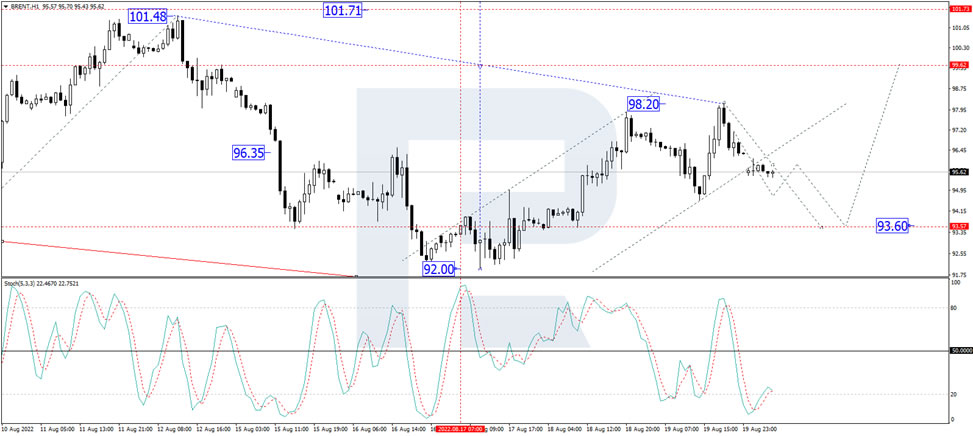
As we can see in the H1 chart, after finishing the ascending structure at 98.20 and breaking the ascending channel at 95.90, Brent is consolidating around the latter level. Possibly, the asset may extend this correction down to 93.60 and then start another growth with the target at 99.60. And it’s just half of the third ascending wave. From the technical point of view, this idea is confirmed by the Stochastic Oscillator: its signal line is moving near the lows below 20. Later, the line may grow to rebound from 50 and resume falling to return to 20. After that, it may reverse and move to reach new highs.
Higher Core Yields in Risk-off Context Keeping Dollar in Pole Position
Markets:
Inflation & recession fears are driving markets at the start of the new week. As was the case last week, the ‘bad news is good news for assets’-paradigm that facilitated a simultaneous rally in both bonds and equities during the mid-June/early-August era, doesn’t work anymore. On the contrary. Recent Fed (and ECB) comments ‘convinced’ bond investors that central banks’ anti-inflation campaign still has some way to go. Tentative signs on (US) inflation potentially topping are premature. At 8.5% Y/Y, returning inflation to the 2% target remains a distant Fata Morgana, especially as the US labour market remains extremely tight. So, there are few reasons for Fed Chair Powell to backtrack on his anti-inflationary rhetoric when addressing the Jackson Hole symposium on Friday. Last week’s rise in yields continues, but this time in a bear flattening rather than a steeping move. US yields are gaining 8 bps (2-y) over 4/2 bps (5-y/10-y) to 1.75 bps (30-y). Prospects for EMU inflation to cool anytime soon are even more uncertain despite elevated recession risks. Today’s new sharp leap in natural gas prices (Dutch reference contract jumping about 15%) suggests persistent upward pressure on corporates’ and consumers’ energy bills, annex risks of second round price increases. After Friday’s steep rise, German yields today add another 6/4 bps. EMU swap yields even gain 11/9 bps for the 2/10 year sector with the 30-y rising ‘only’ 5 bps. Intra-EMU spreads widen but the damage remains modest (10-y Italy vs Germany +3bps). UK interest rate markets to some extent decouple from the flatting trend in the US and EMU with Gilt yields rising between 8 bps (2-y) and 11 bps (30-y). The combination of recessionary fears with higher yields at the same time, proves a toxic cocktail for equities. The EuroStoxx 50 is ceding 2%. US indices open up to 1.7% lower (Nasdaq).
On FX markets, higher core higher yields in a risk-off context are keeping the dollar in pole position. The DXY index (108.40) is ‘gradually’ closing in on the mid-July cycle top (109.29). EUR/USD (1.00) intraday already filled bids below parity. A retest the 0.9952 YTD low is only a matter of time. Most smaller currencies are fighting an uphill battle but the picture isn’t unequivocal. Some commodity related currencies including the kiwi dollar (0.62) and the Aussie dollar (0.69) don’t lose further ground. The Norwegian krone also shows resilience with EUR/NOK (9.78) nearing the 9.76 support area. The Swiss franc (0.9580) still enjoys its (mainly European) safe haven prerogative, trading at the strongest level against the euro since the early 2015 spike. Cable (1.181) is nearing the 1.176 YTD low. At the same time, sterling rebounds against the euro. EUR/GBP (0.8465) for now fails to confirm a potential break out of the downtrend channel since mid-June.
News Headlines:
Belgian consumer confidence slightly improved in August, rising from -13 to -11, matching the June number which was the best (less worse) since February. The improved confidence stems from better expectations about the economic situation in general (-32 from -37) and increased savings intention (11 from 6). As far as their personal situation is concerned, households' expectations regarding their financial situation are slightly more negative (-8 from -7), while they also appear less optimistic about future labour market developments (unemployment gauge up from 12 to 16). Belgian business confidence is due later this week, on Thursday.
The German Bundesbank published its monthly bulletin today. Inflation is about to reach 10% in the autumn as government measures expire. Higher minimum wage and a weaker currency add to price pressure with the inflation outlook remaining extremely uncertain because of commodity markets. Risks are skewed to the upside. Declining economic output in the winter months (and a recession) has become much more likely with the high degree of uncertainty over gas supplies and the sharp price increases likely to weigh heavily on households and companies.
EUR/CHF Mid-Day Outlook
Daily Pivots: (S1) 0.9603; (P) 0.9637; (R1) 0.9660; More....
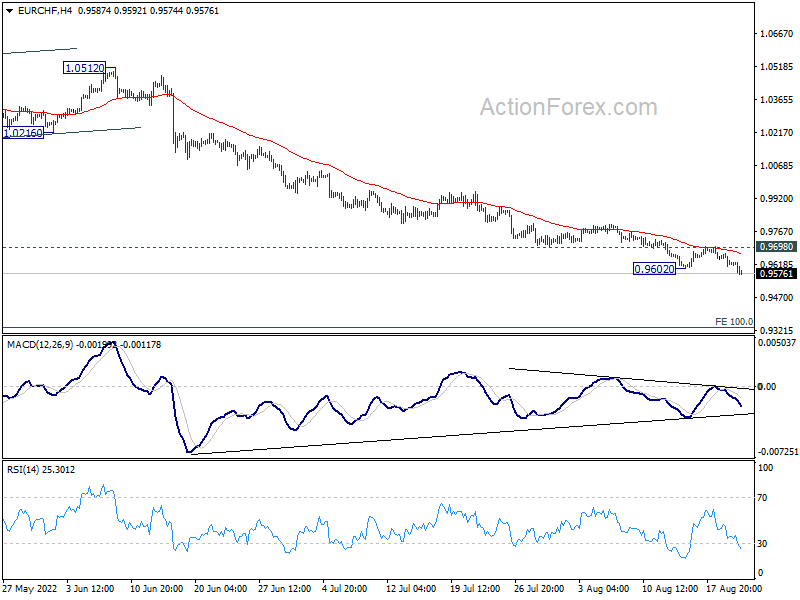
EUR/CHF's down trend resumed by breaking through 0.9602 and intraday bias is back on the downside. Current down trend should now target 100% projection of 1.1149 to 0.9970 from 1.0513 at 0.9334. On the upside, break of 0.9698 resistance will indicate short term bottoming, and turn bias back to the upside for stronger rebound.
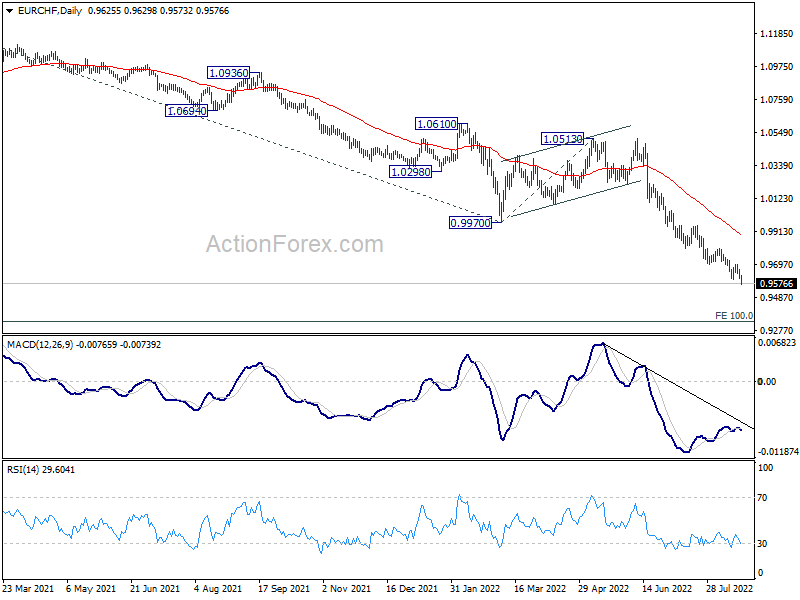
In the bigger picture, long term down trend from 1.2004 (2018 high) is still in progress. Next target is 138.2% projection of 1.2004 to 1.0505 to 1.1149 at 0.9033. On the upside, break of 0.9970 support turned resistance is needed to be the first sign of medium term bottoming. Otherwise, outlook will stay bearish in case of strong rebound.
USD/JPY Mid-Day Outlook
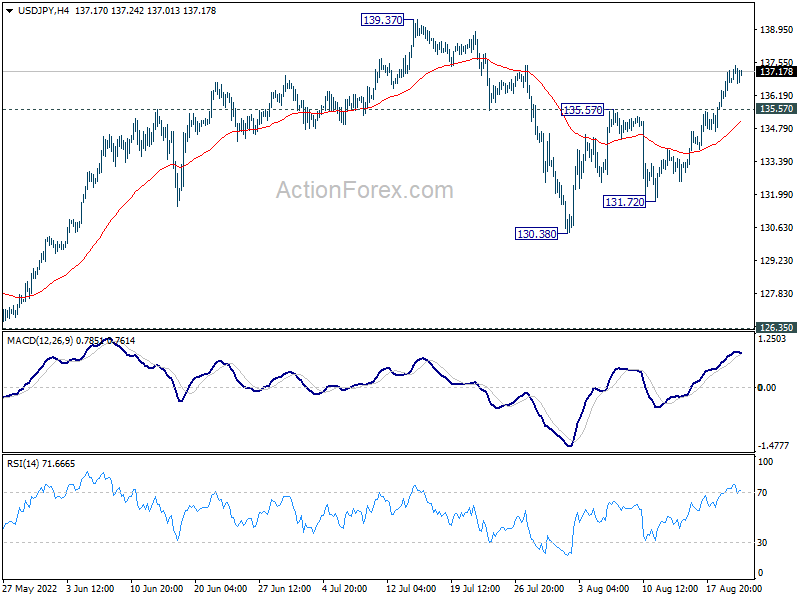
Daily Pivots: (S1) 136.02; (P) 136.62; (R1) 137.53; More...
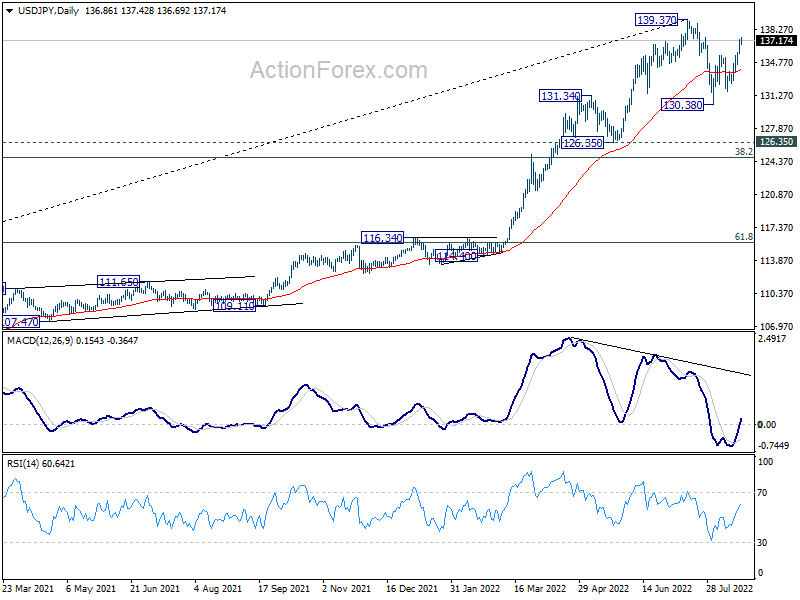
USD/JPY's rally is still in progress and intraday bias remains on the upside for 139.37 high. Strong resistance could be seen from 139.37 high to bring another fall from to extend the corrective pattern from there. On the downside below 134.61 minor support will turn intraday bias neutral first.
In the bigger picture, price actions from 139.37 medium term top are seen as a corrective pattern to up trend from 101.18 (2020 low). While deeper decline cannot be ruled out, outlook will stays bullish as long as 55 week EMA (now at 123.21) holds. Long term up trend is expected to resume through 139.37 at a later stage, after the correction finishes.
USD/CHF Mid-Day Outlook
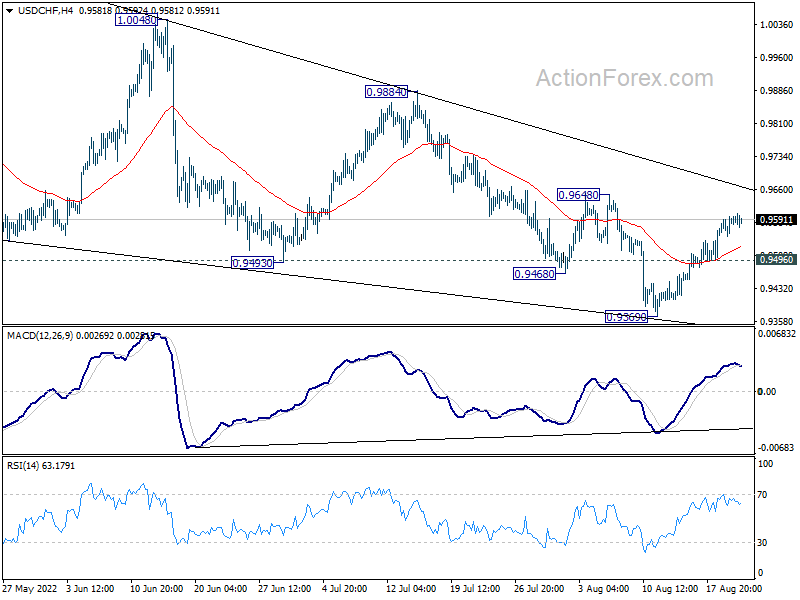
Daily Pivots: (S1) 0.9559; (P) 0.9579; (R1) 0.9604; More...
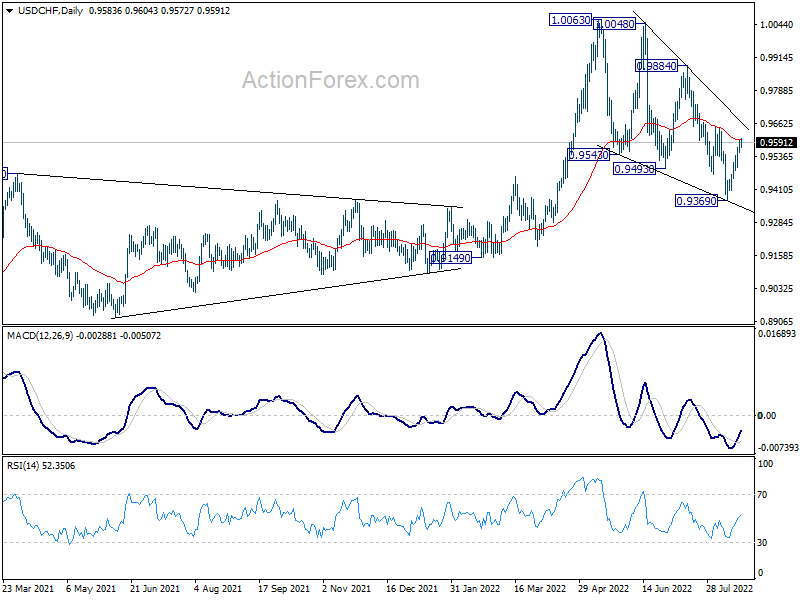
USD/CHF's rise from 0.9369 is still in progress and intraday bias stays mildly on the upside for 0.9648 resistance. Firm break there will bring stronger rally back to 0.9884 resistance next. On the downside, below 0.9496 minor support will revive near term bearishness and bring retest of 0.9369 low.
In the bigger picture, while 0.9471 support (2021 high) was breached, there was no follow through selling. Outlook is mixed for now. On the upside, firm break of 0.9648 resistance will revive the case that price actions from 1.0063 are just a corrective pattern, and the larger up trend is no over yet. However, another fall through 0.9369 will affirm the case that medium term up trend from 0.8756 has completed with three waves up to 1.0063.
GBP/USD Mid-Day Outlook
Daily Pivots: (S1) 1.1765; (P) 1.1858; (R1) 1.1924; More...
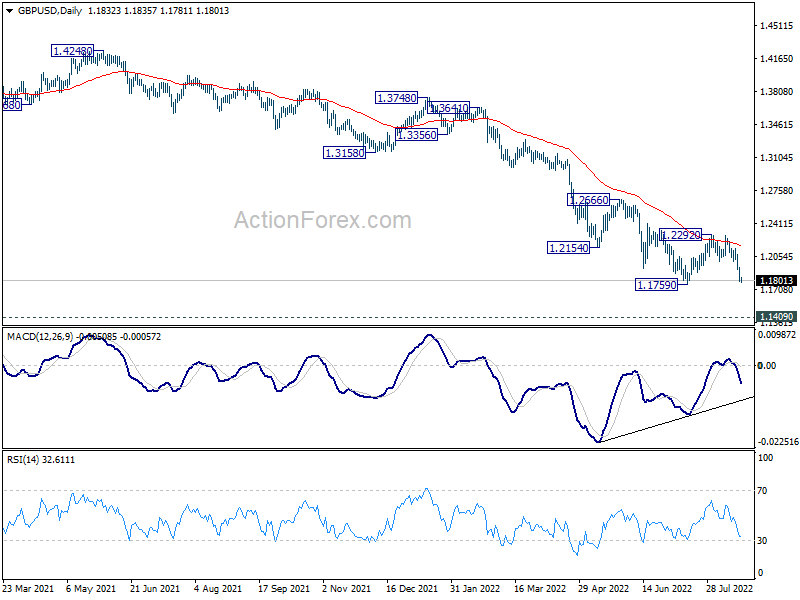
GBP/USD's fall from 1.2292 is still in progress and intraday bias stays on the downside for retesting 1.1759 low. Firm break there will resume larger down trend to 1.1409 long term support. On the upside, above 1.1924 minor resistance will delay the bearish case and turn intraday bias neutral first. But outlook will remain bearish as long as 1.2292 resistance holds.
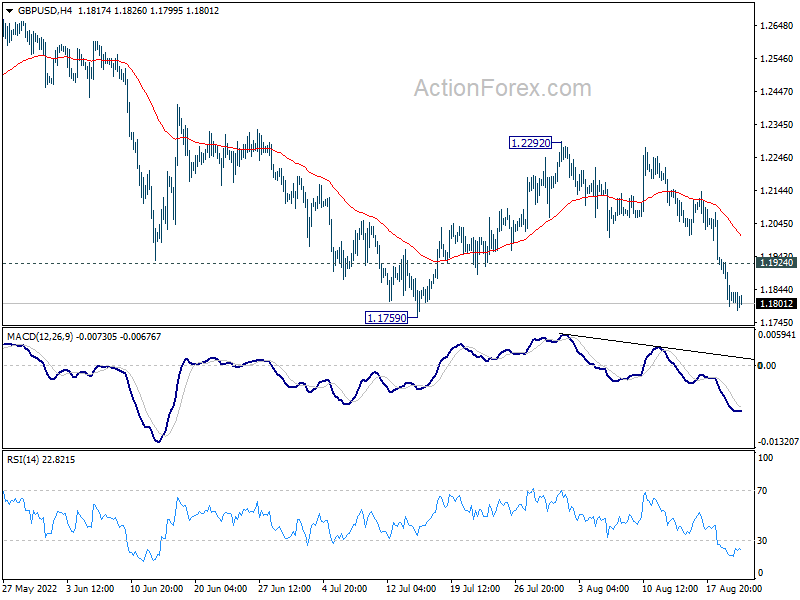
In the bigger picture, fall from 1.4248 (2018 high) could be a leg inside the pattern from 1.1409 (2020 low), or resuming the longer term down trend. Deeper decline is expected as long as 1.2292 resistance holds. Next target is 1.1409 low. However, firm break of 1.2292 will bring stronger rise back to 55 week EMA (now at 1.2859).