Sample Category Title
EUR/AUD Weekly Outlook
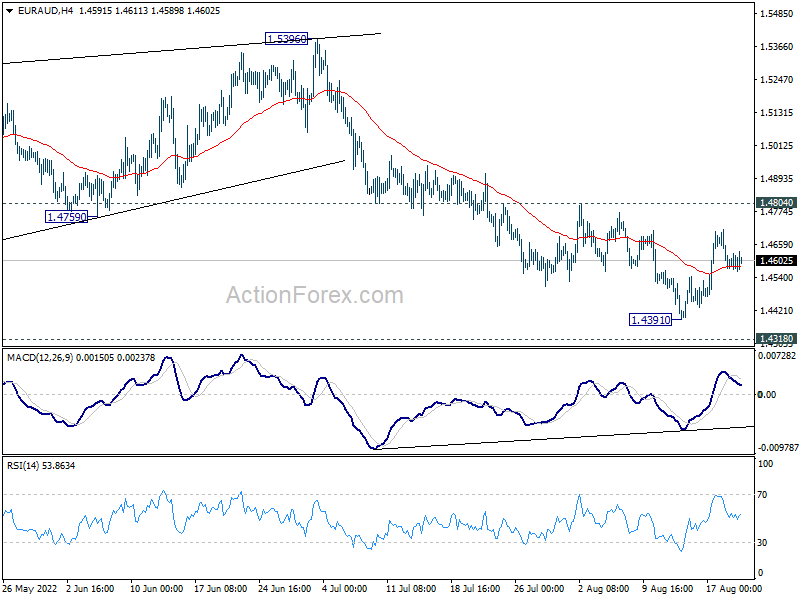
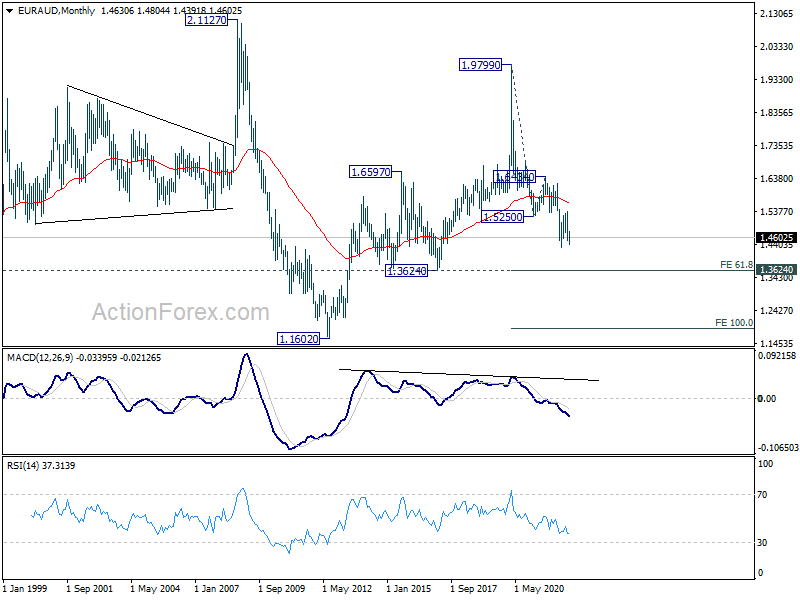
EUR/AUD recovered ahead of 1.4318 low last week, but recovery is limited below 1.4804 resistance. Initial bias remains neutral this week first and further decline is expected. On the downside, firm break of 1.4318 low will resume larger down trend to medium term projection level at 1.3623. However, break of 1.4804 will delay the bearish case and turn bias to the upside for stronger rebound first.
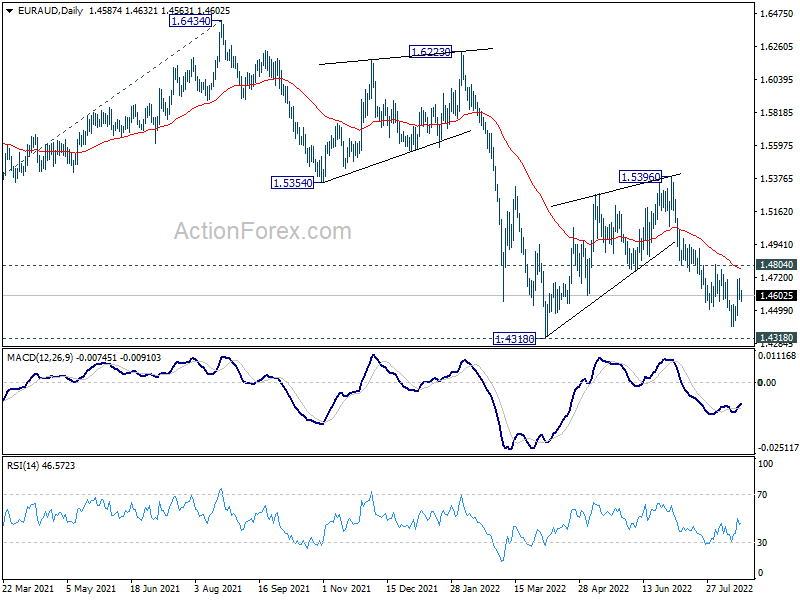
In the bigger picture, down trend from 1.9799 is still in progress. Break of 1.4318 low will target 61.8% projection of 1.9799 to 1.5250 from 1.6434 at 1.3623, which is close to 1.3624 long term support (2017 low). This will remain the favored case now as long as 1.5396 resistance holds.
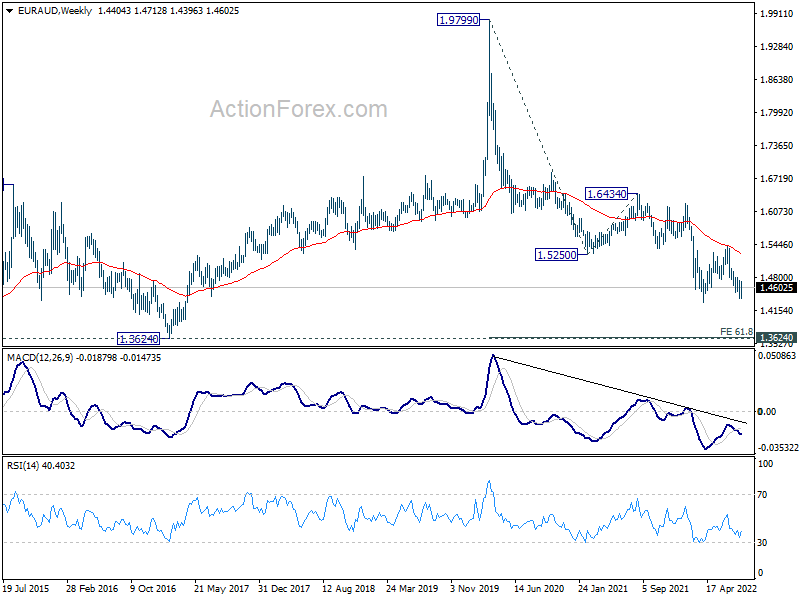
In the longer term picture, fall from 1.9799 (2020 high) is seen as the third leg of the pattern from 2.1127 (2008 high). Deeper fall should be seen to 1.3624 support. Decisive break there would pave the way back to 1.1602 (2012 low). This will remain the favored case as long as 55 month EMA (now at 1.5656) holds.
EUR/CHF Weekly Outlook
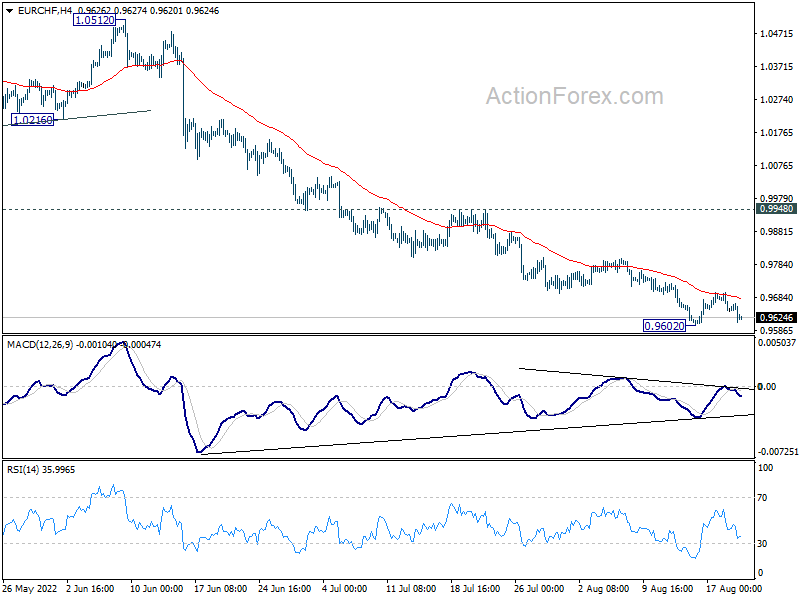
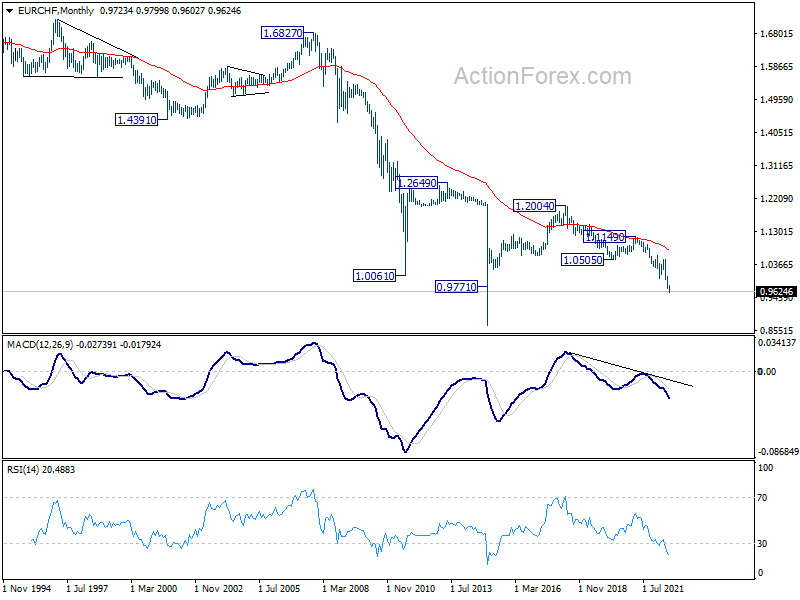
EUR/CHF dropped further to 0.9602 last week but turned sideway since then. Initial bias remains neutral this week first. In case of another recovery, upside should be limited well below 0.9948 resistance to bring another fall. Break of 0.9602 will resume larger down trend to 100% projection of 1.1149 to 0.9970 from 1.0513 at 0.9334.
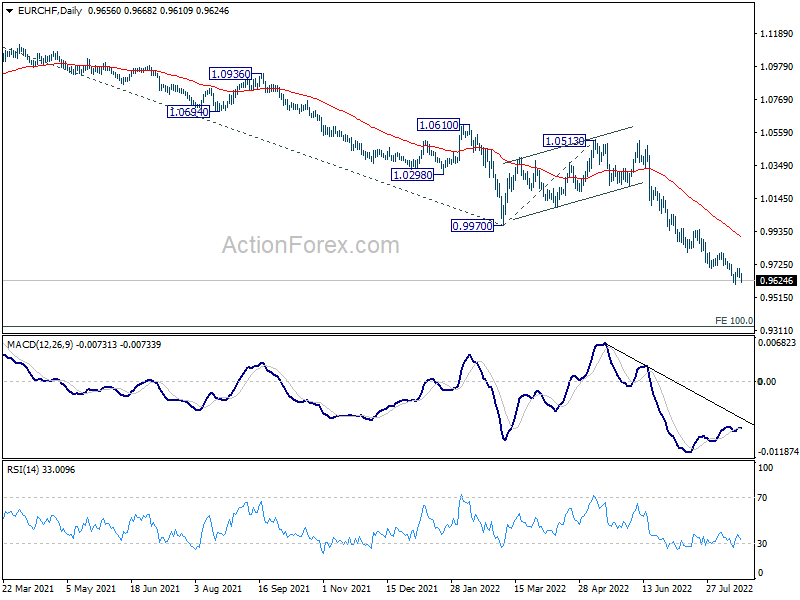
In the bigger picture, long term down trend from 1.2004 (2018 high) is still in progress. Next target is 138.2% projection of 1.2004 to 1.0505 to 1.1149 at 0.9033. On the upside, break of 0.9970 support turned resistance is needed to be the first sign of medium term bottoming. Otherwise, outlook will stay bearish in case of strong rebound.
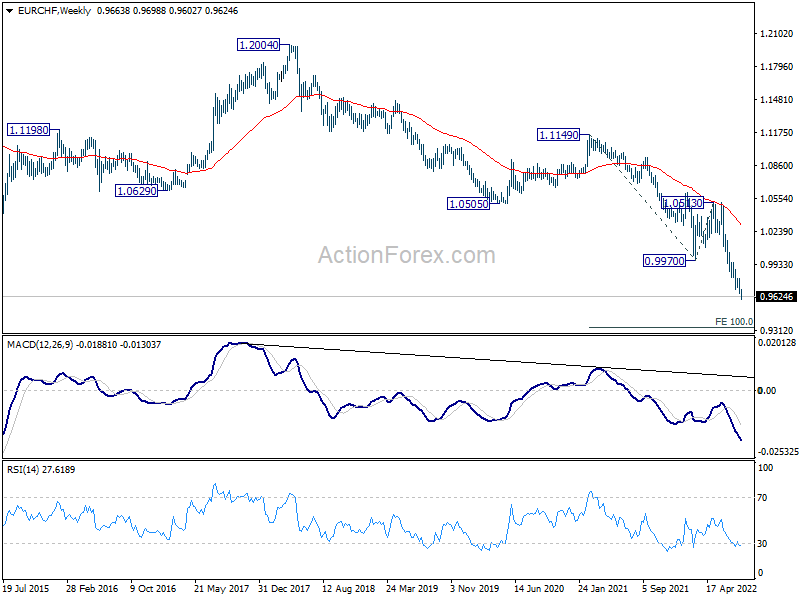
In the long term picture, capped below 55 month EMA, EUR/CHF is seen as extending the multi-decade down trend. There is no prospect of a bullish reversal until firm break of 1.0505 support (2020 low).
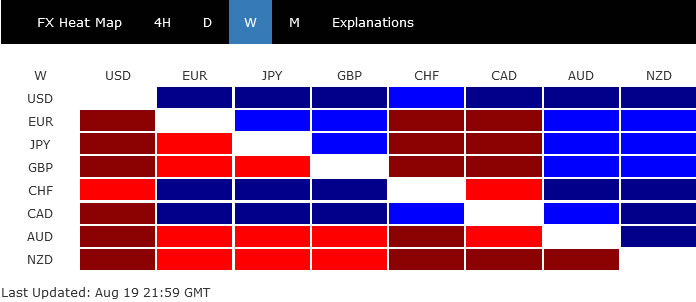
Dollar Rally Rejuvenated as Risk-on Sentiment Lost Steam, Yields Jumped
Dollar ended as the strongest one, closing notably higher against all other major currencies, as risk-on sentiment lost steam while treasury yields surged. The late momentum was rather impressive and argues that the greenback might be ready for breakouts. While Canadian Dollar ended as the second strongest, it's Swiss Franc's resilience, and strength against European majors that's worth more attention.
New Zealand Dollar ended as worst performing one despite RBNZ's hawkish rate hike. Aussie was a close second. But at the same time, Yen, Euro and Sterling were also weak. These three have the potential to overtake and loser spots in the near future.
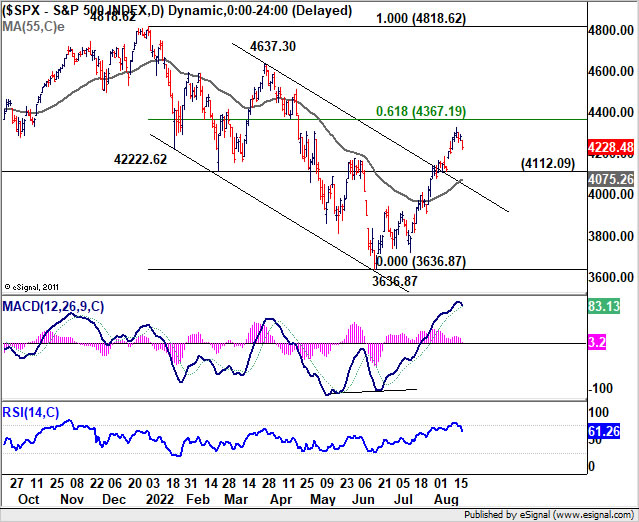
Dollar index rose strongly, yields surged, stocks lost momentum
Investors continued adjust their expectations on Fed's next step, even though there wasn't any clarify from policymakers' comments. But that's rightly so with one more set of job and inflation data to be released before the next FOMC meeting. Much attention will be on the upcoming Jackson Hole symposium, but Fed chair Jerome Powell is unlikely to offer anything concrete.
The expectation adjustments resulted in sharp rally in US benchmark treasury yield while stocks ended mildly lower. Dollar was given a strong boost.
S&P 500's rebound from 3636.87 lost momentum ahead of 61.8% retracement of 4818.62 to 3636.87 at 4367.19. But it's still early to call for near term reversal. Further rise would remain in favor as long as 4112.09 support holds. Sustained trading above 4367.19 will set the stage for retesting 4637.30/4818.62 resistance zone later in the year. However, decisive break of 4112.09 support will argue that the rebound is over.
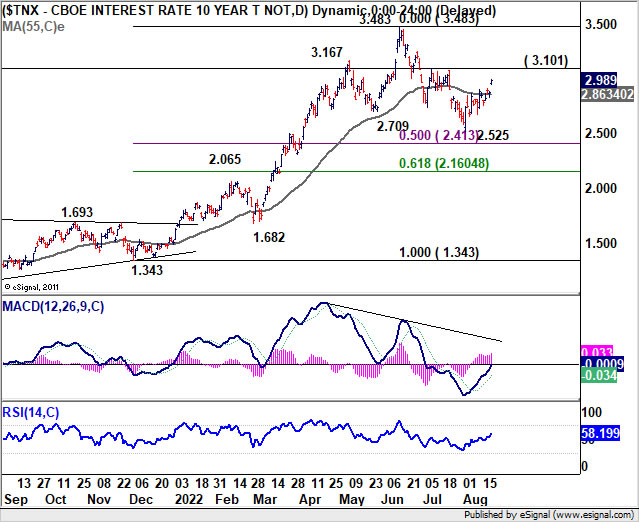
10-year yield closed sharply higher at 2.989 after gapping up on Friday. There is no change in the view that the first leg of the consolidation pattern from 3.483 has completed at 2.525. Rise from there is seen as the second leg and would probably extend through 3.101 resistance. But there is little prospect of breaking through 3.483 high for now.
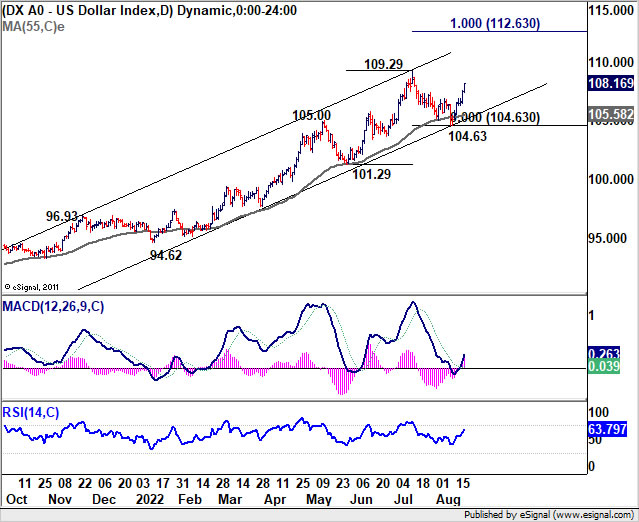
Dollar index staged a strong rally last week to close at 108.16. The upside momentum is very impressive and it's raising the chance of up trend resumption. 109.29 high is now back as a near term focus. Decisive break there will push DXY towards 100% projection of 101.29 to 109.29 from 104.63 at 112.63. Such development would probably require extended rise in 10-year yield towards 3.483, and a near term reversal in stocks and risk sentiment, to happen together.
Bitcoin might have completed corrective recovery
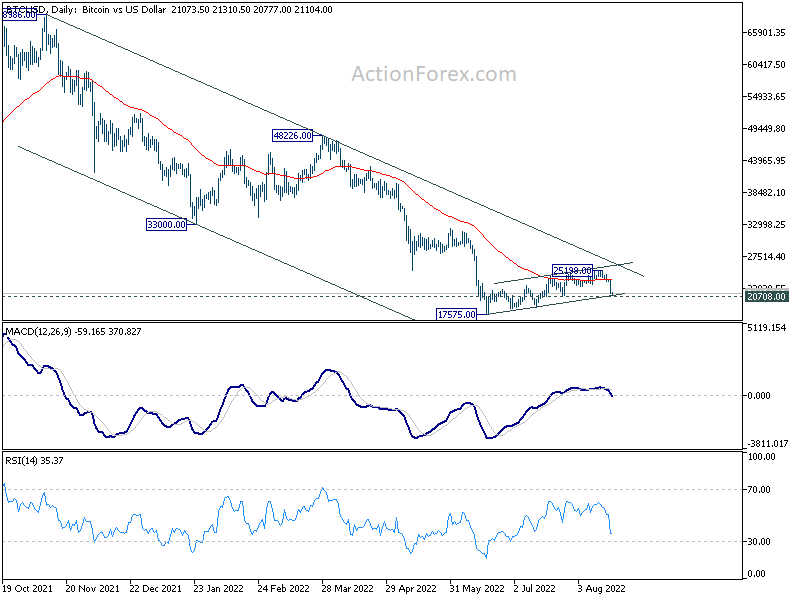
Talking about risk sentiment, the development in Bitcoin might be a hint on what's next. The sharp decline raises the chance that consolidation from 17575 has completed at 25198, ahead of medium term channel resistance. Immediate focus is now on 20708 support. Decisive break there should sent Bitcoin through 17575 lo. That, if happens, could be a leading indicator of troubles in NASDAQ, and the broader stock markets.
GBP/CHF extending down trend, CHF/JPY ready for breakout
In addition to Dollar, the strength in Swiss Franc is also worth a mention. It's clear that SNB is not done with tightening yet and another rate hike, at least 50bps, is expected at the September quarterly meeting. More important, SNB is also clear that it'd like to see appreciation of the Swiss Franc to help curb inflation. These two factors should continue to support the Franc, in particular against European majors.
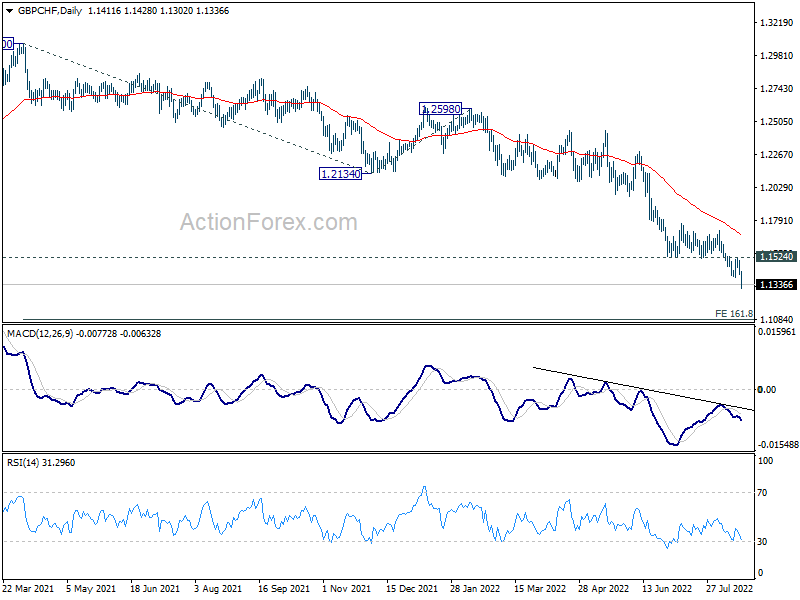
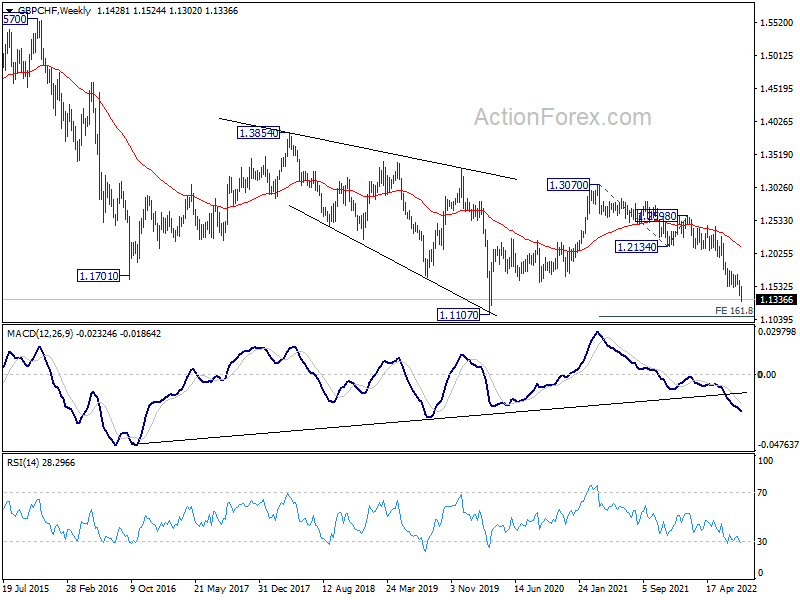
GBP/CHF's down trend continued last week despite brief interim recovery, and hit as low as 1.1302. Near term outlook remains bearish as long as 1.1524 resistance holds. Next target is 161.8% projection of 1.3070 to 1.2134 from 1.2598 at 1.1084, which is close to 1.1107 (2020 low). That could happen rather quickly if speculation of a larger rate hike builds up in the coming weeks.
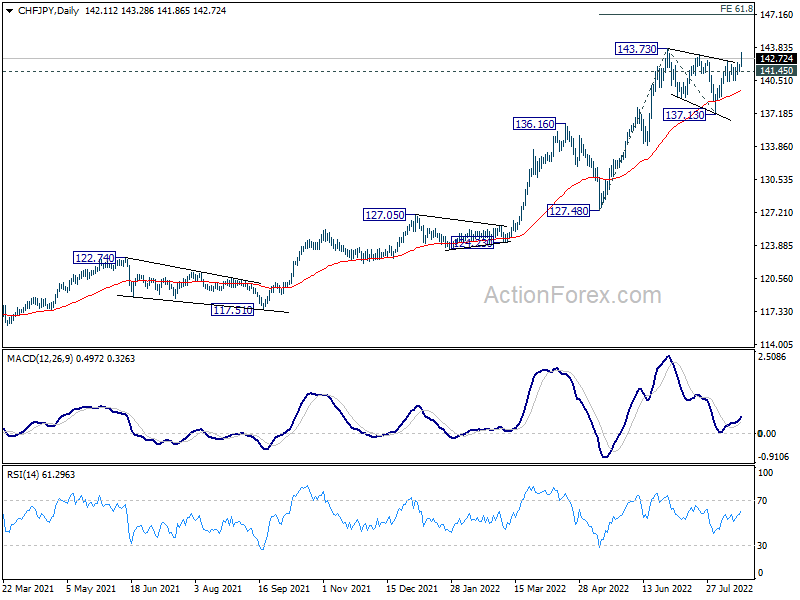
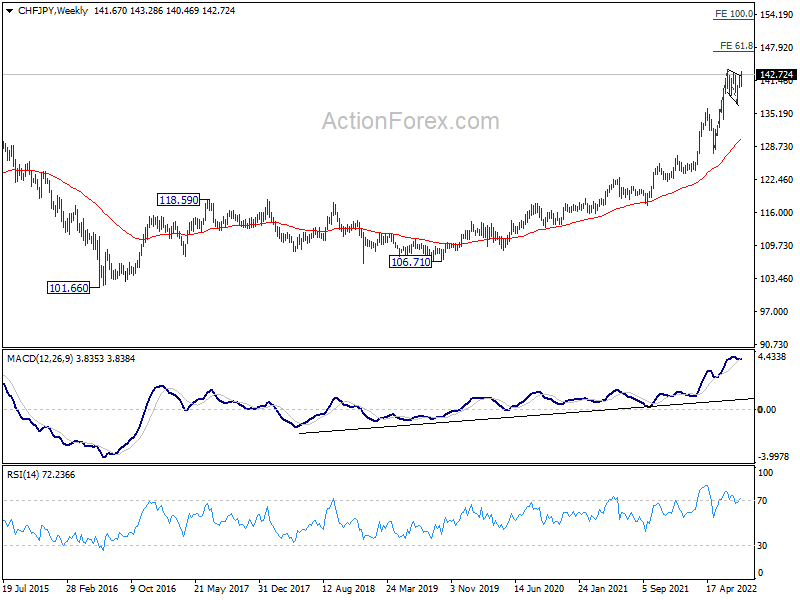
CHF/JPY's up trend is still in acceleration phase, from medium term point of view, with BoJ standing firmly on its dovish stance. Immediate focus is now on 143.73 high. Firm break there will resume larger up trend to 61.8% projection of 127.48 to 143.73 from 137.13 at 147.1, and then 100% projection at 153.38. Nevertheless, break of 141.45 support will delay the bullish case and extend the consolidation from 143.73 with another falling leg first.
EUR/USD Weekly Outlook
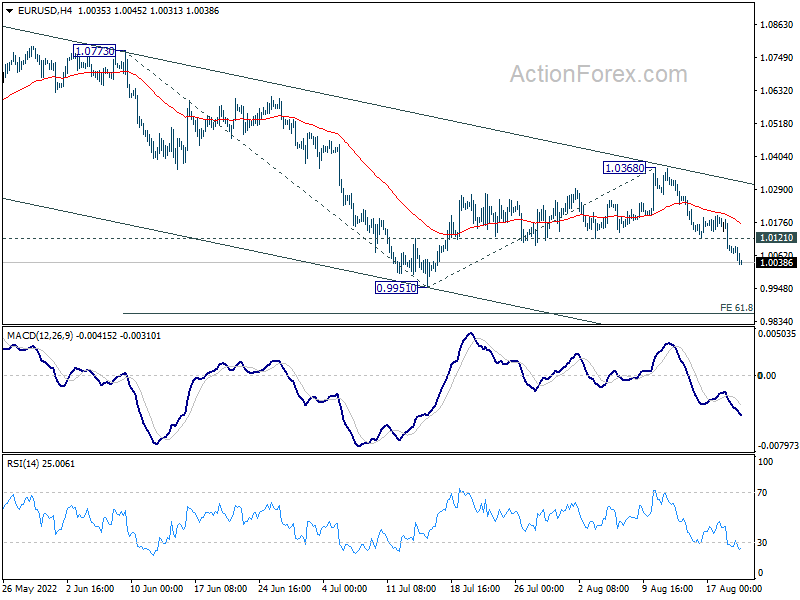
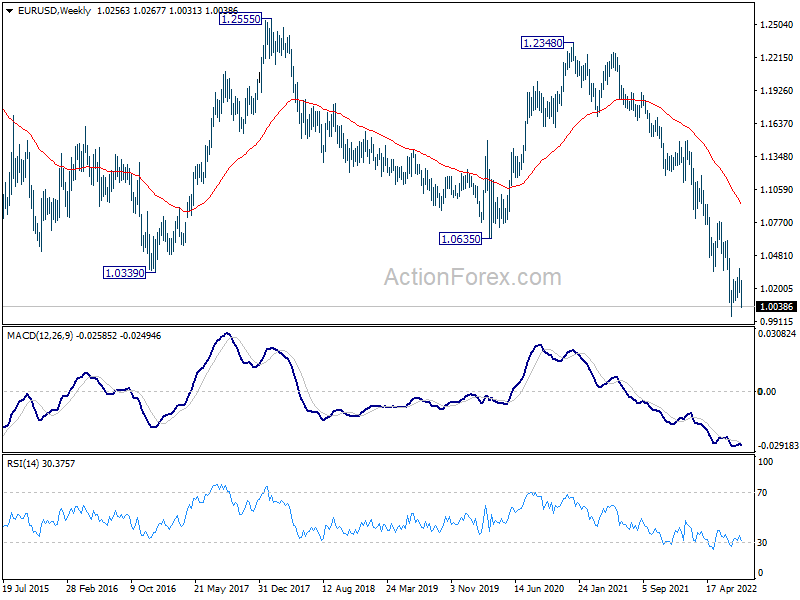
EUR/USD's decline last week suggests that corrective recovery from 0.9951 has completed at 1.0368, after rejection by channel resistance and 55 day EMA. Initial bias stays on the downside this week for retesting 0.9951 low first. Break will resume larger down trend to 61.8% projection of 1.0773 to 0.9951 from 1.0368 at 0.9860, and then 100% projection at 0.9546. On the upside, above 1.0121 minor resistance will turn intraday bias neutral first. But outlook will stay bearish as long as 1.0368 resistance holds.
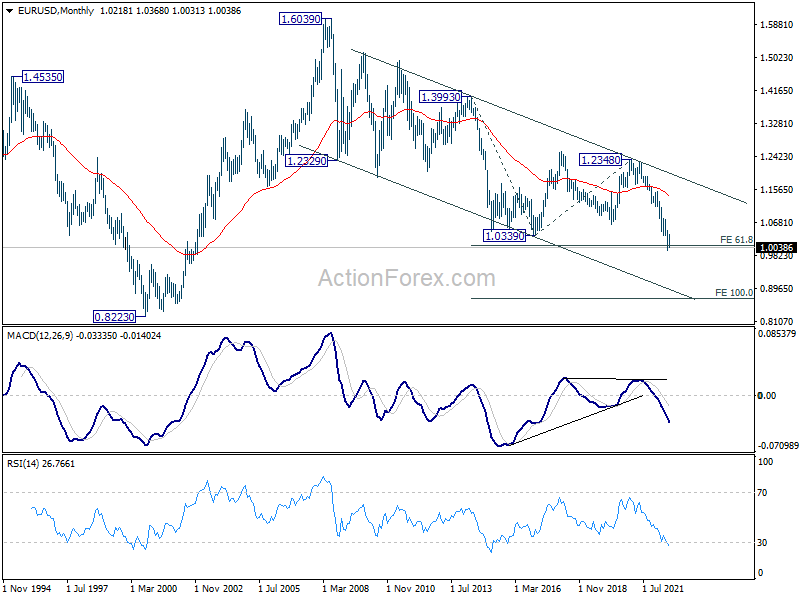
In the bigger picture, down trend from 1.6039 (2008 high) is still in progress. Next target is 100% projection of 1.3993 to 1.0339 from 1.2348 at 0.8694. In any case, outlook will stay bearish as long as 1.0773 resistance holds, in case of strong rebound.
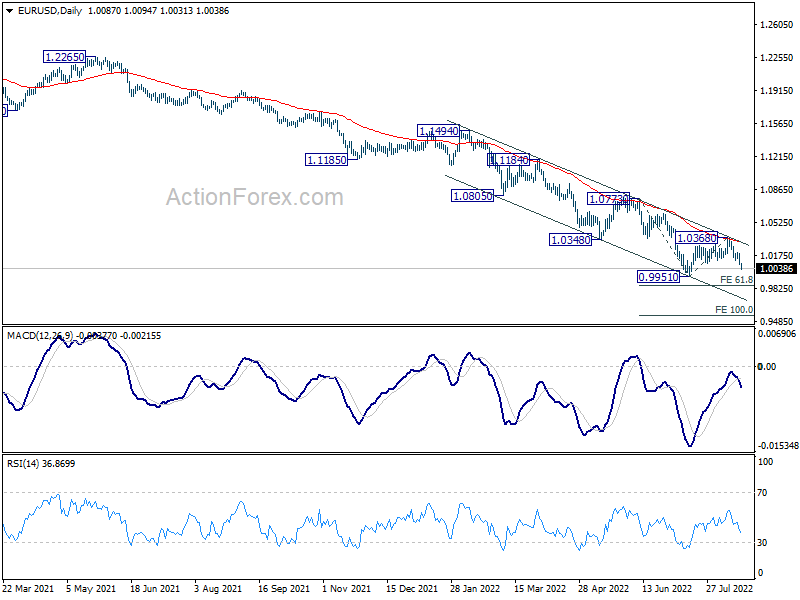
In the long term picture, long term down trend from 1.6039 (2008 high) resuming. Sustained break of 61.8% projection of 1.3993 to 1.0339 from 1.2348 at 1.0090 will pave the way to 100% projection at 0.8694.
Summary 8/22 – 8/26
Monday, Aug 22, 2022
[php_everywhere instance="1"]
Tuesday, Aug 23, 2022
[php_everywhere instance="2"]
Wednesday, Aug 24, 2022
[php_everywhere instance="3"]
Thursday, Aug 25, 2022
[php_everywhere instance="4"]
Friday, Aug 26, 2022
[php_everywhere instance="5"]
The Weekly Bottom Line: How Quickly to Raise Rates? That Is the Question
U.S. Highlights
- Total retail sales were flat in July, marking a deceleration from June’s pace. However, sales in the control group, which exclude several volatile categories and are used in calculating GDP, rose a sturdy 0.8% m/m.
- Housing continued to cool in July. Existing home sales fell 5.9% and the median seasonally adjusted home price retreated for the second month in a row. Homebuilders also continued to ease off the accelerator, with starts down 9.6% in July.
- Minutes from last month’s FOMC meeting revealed that many participants acknowledged the risks that that the Committee could tighten the stance of policy by “more than necessary”.
Canadian Highlights
- Headline inflation cooled a bit to 7.6% y/y in July on lower fuel prices. However, inflation remains uncomfortably high, and is not hitting all households equally.
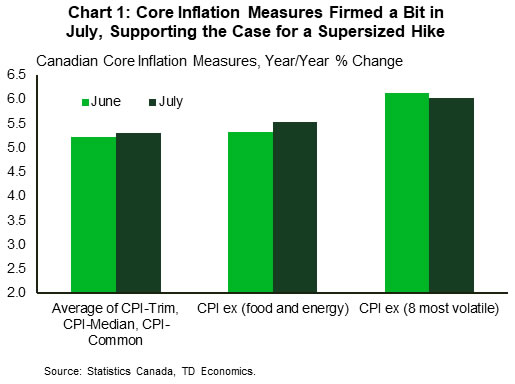
- Core inflation measures ticked higher last month, supporting the case for an aggressive September BoC hike.
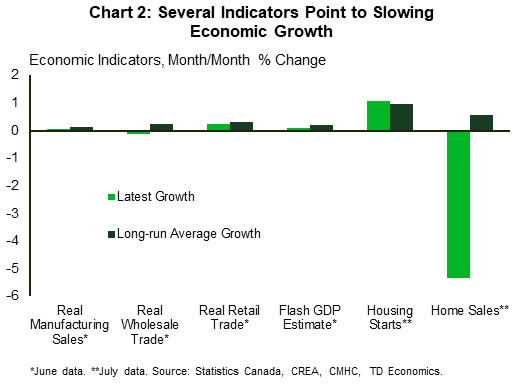
- Growth indicators released this week generally confirmed that economic growth is cooling. The BoC faces an increasingly tough task of engineering a soft-landing.
U.S. - How Quickly to Raise Rates? That Is the Question
The third week of August was a busy data week for the U.S., with updates on housing and the consumer for July. The consumer spent a little more than expected at retailers (omitting auto dealers and gas stations), thanks to a successful Amazon Prime Day event, but housing is continuing to recalibrate to the higher rate environment.
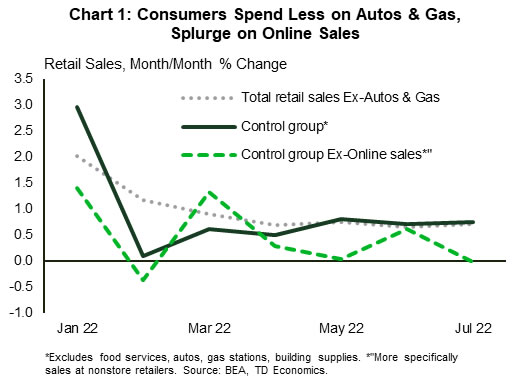
Headline retail sales were flat in July, marking a deceleration from June’s 0.8% month-over-month (m/m) gain. However, the headline measure was dragged down by sales auto & part dealers (-1.6%) and gasoline stations (-1.8%), the latter reflecting lower prices at the pump. Retail sales in all other categories rose a sturdy 0.7% m/m. Similarly, sales in the control group, which strip a couple of more categories from the total and are used in calculating personal consumption expenditures and GDP, were up 0.8% m/m thanks to a boost from sales at non-store retailers (Chart 1). Total CPI inflation was flat in July, so by these measures, real goods consumer spending appears to have had a decent start to the third quarter.
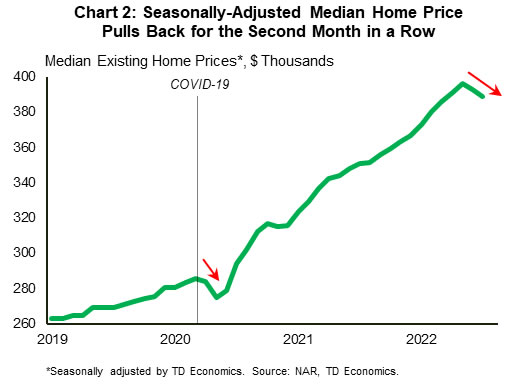
Consumers also spent handsomely at building material and supply dealers last month (+1.5% m/m), a move that went against the grain of the ongoing weakening in housing. Existing home sales fell by almost 6% in July, extending their downward slide from the start of the year to a staggering 26%. Home prices have also been feeling the impact of higher rates, with the median seasonally adjusted home price falling in each of the last two months (Chart 2). The fact that mortgage rates have eased a bit over the past several weeks could provide an opportunity for the housing rout to take a breather. However, the Fed is not done hiking rates, so affordability is likely to remain a meaningful constraint for the foreseeable future. As a result, we expect home sales to continue trending moderately lower through the first half of next year.
Homebuilders have continued to ease off the accelerator amidst this challenging market backdrop, with starts falling 9.6% in July. The weakness in homebuilding over the last several months has been concentrated in the single-family market. A recent sharp decline in homebuilder confidence in this sector suggests that the trend is poised to continue.
The fallout from the downturn in the housing market is only one factor the Fed must consider as it gears up to raise rates again next month. Minutes from last month’s FOMC meeting revealed that many members acknowledged the risks that the Committee could tighten the stance of policy by “more than necessary”. In addition, participants judged that as the policy rate is tightened further “it would become appropriate at some point to slow the pace of policy rate increases” to assess the impacts. Markets interpreted this as a signal that the pace of rate hikes would slow soon, but a few Fed officials (i.e., Bullard, voting member, backs a 75-basis point (bp) hike next) appeared to push back against that notion. For now, markets are pricing in a 50-bp hike at the next meeting. Chair Powell’s Jackson Hole speech next Friday will be closely watched to gauge the Fed’s latest thinking as to where rate hikes are headed.
Canada -Hot to the Core
Canadian financial markets had their eyes fixed squarely on this week's inflation report - the last ahead of the Bank of Canada's rate decision on September 7th. Bond markets reacted by taking short-term yields a bit higher on the week, as core inflation pressures intensified in July. We expect the Bank of Canada to hike their policy rate by 50 basis points (bps) at their September meeting, but the inflation data does tilt the risk to a 75 bp move.
Whether it's 50 or 75 bps, the move likely won't elicit the same sticker-shock as their surprise 100 bp hike in July. However, it would still represent an aggressive increase, and be consistent with messaging from Governor Macklem that it's better to front-load tightening now, rather than having to be more aggressive later. It will also probably not be their last hike. As detailed in our latest quarterly outlook piece they've communicated a need to move rates above their estimate of the neutral range (i.e., above 3%) to maintain credibility.
Looking at the details of July's CPI data, overall inflation cooled a bit to 7.6% year/year (y/y) on a big drop in fuel prices. However, the metric that policymakers tend to put more weight on is core inflation. Nearly all measures of core inflation perked up in July (Chart 1). Even the metrics that didn’t move higher, like CPI-trim, remained uncomfortably high, underscoring the case for an aggressive September salvo.
A 7.6% inflation rate is still much too elevated, and high inflation impacts everybody, albeit not to the same degree. Our research put out this week, notes that it's likely middle-income households that have been hit the hardest by inflation, given their relatively high share of spending on food and transportation.
Ultimately inflation saps purchasing power and weighs on growth in real terms, and this week featured a series of releases offering clarity on how growth is faring. The main message from nearly all these indicators is that growth is slowing (Chart 2), consistent with the soft flash estimate for June's monthly GDP growth. On top of this, TD's high-frequency internal credit and debit card spending data is showing signs of easing as the summer rolls on.
The BoC did forecast slower growth in the third quarter in their July MPR, and some easing in economic activity is required to bring inflation down. Like the Fed, the BoC is trying to engineer a "soft-landing" scenario, where economic growth is below-trend for a time, but still positive, and inflation cools. That's an incredibly tough balance to strike, and with the persistent heat in core inflation, the chances of this outcome unfolding are likely diminishing.
Week Ahead – On to Jackson Hole
The event we’ve all been waiting for
Jackson Hole has been heavily discussed since the Fed’s supposed “dovish pivot” last month when it adopted a more data-dependent stance. While policymakers have pushed back against the idea of a pivot, markets have continued to price in a slower path of tightening.
Chair Jerome Powell could use his platform next week to join the chorus of policymakers highlighting the need for ongoing aggressive tightening, continuing the push back against the market narrative. But will he do that? The CPI data for July may allow for a softer approach, although it could be argued to be counterproductive given how high inflation still is and how much work there remains to do.
As ever with these events, it won’t take much to excite investors. Any hint at all that the central bank could be tempted to take its foot off the break, that inflation has peaked and will fall back towards target could be enough to fuel more optimism in the markets. The question is what happens if there is no pivot? Will investors be as open to a hawkish Powell as they will a dovish one?
US
The main event of the week will be the Jackson Hole Symposium. The annual global central banking conference will feature Fed Chair Powell’s speech which may give some insight into how aggressive the Fed will be with tightening in September. Many traders will remember Powell’s 2021 address which clearly showed him tripling down on his view that inflation was transitory.
Powell will reiterate the message that the economy still has forward momentum and that they are nearing the end of tightening. He may also try to drive the point that after they are done tightening, the Fed will keep rates steady for a while until inflation has clearly returned closer to target.
A wrath of economic data will be released, with the two big ones being the flash PMI readings and the second look at Q2 GDP. Friday will be busy with the Fed’s preferred inflation gauge, and personal income data for July that is expected to remain steady while spending slows.
Election season continues with US primary elections in Florida and New York.
EU
Economic data in focus next week, with surveys among the highlights as flash PMIs, GfK and Ifo are released. Europe is likely heading for recession and the surveys will tell us how fearful businesses in the bloc are ahead of what could be a troubling winter on the energy front. On that, energy will be a key focus as it will throughout the winter.
The ECB meeting accounts will also be in focus as traders fully price in a 50 basis point hike next month. Appearances from policymakers will also be closely followed, as ever.
UK
Flash PMIs are the only releases of note next week while any commentary from BoE policymakers will also be closely monitored. Markets are currently pricing a strong chance of a 50 basis point rate hike next month although there is now an outside chance of 75.
Russia
Just industrial production data next week as traders weigh up how low rates are going to go. They’ve had little impact on the currency so far which remains more than 20% higher since the invasion.
South Africa
The SARB is in the midst of an aggressive tightening cycle and inflation data next week may shed some light on how much more is needed. The CPI number is expected to rise from 7.4% to 7.8%, well above its target range of 3-6%, while the core reading is expected to tick higher to 4.5% from 4.4%. Meanwhile, the unemployment rate is expected to rise from 34.5% to 35.7%.
Turkey
When inflation is running close to 80%, a bad policy move from the CBRT would ordinarily have been not raising interest rates, and aggressively at that. Naturally, that wasn’t enough for it even under these extreme economic conditions, so they instead cut rates by 100 basis points to 13% at their August meeting. In doing so, they caught forecasters everywhere off guard, despite none expecting them to do anything sensible in the first place. It takes something special for the CBRT to underperform even the lowest of expectations.
Switzerland
No data or scheduled appearances next week. We can never discount the possibility of a surprise rate hike given the SNB’s history of policy shocks.
China
On August 15, China’s central bank cut the one-year medium-term lending facility (MLF) and reverse repo rates by 10 basis points to 2.75% and 2.00%, respectively. This should lead to a reduction in the 1 and 5-year loan prime rates early next week.
China’s second-quarter GDP recorded positive growth of 0.4%, but the high cost of its zero-Covid policy and real estate bad debt may continue to limit China’s economic growth.
India
No major data or events next week.
Australia & New Zealand
The Australian and New Zealand dollars fell following the recent release of disappointing Chinese economic data for July. Australia and New Zealand’s largest export market is China, so the weak performance of Chinese economic data may be reflected in the trade data. With inflationary pressures, the RBA may continue its hawkish pace of rate hikes, with the market widely expecting a 50 basis point hike to 2.35% at the September rate meeting, on top of the current rate of 1.85%. The short-term risks are the Fed, the recent fall in commodity prices and the weak Chinese economy. PMIs in focus next week.
On August 17, the RBNZ met market expectations to raise interest rates by 50 basis points to 3.00%, the fourth consecutive rate hike this round. Next up is retail sales on Wednesday.
Japan
The Federal Reserve and the Bank of Japan’s monetary policy divergence continue to support the dollar’s strength against the yen. Events at Jackson Hole could further exacerbate these pressures or perhaps even alleviate them depending on how much the Chairman pushes back against the “dovish pivot” narrative.
BOJ Governor, Haruhiko Kuroda has previously said there is no consideration at all for a rate hike and no plans to extend the upper range of the yield curve control (YCC) of 0.25%.
Singapore
CPI and manufacturing data are in focus next week.
Economic Calendar
Saturday, Aug. 20
Economic Events
- Some UK trains are expected to be cancelled amid strikes by the National Union of Rail, Maritime and Transport Workers
- Italian politicians attend the annual Rimini meeting
Sunday, Aug. 21
Economic Events
- Singapore PM Lee Hsien Loong gives a National Day Rally speech
- German Chancellor Scholz due to speak
- Port workers at Felixstowe in the UK begin an eight-day strike
Monday, Aug. 22
Economic Data/Events
- China loan prime rates
- Taiwan unemployment, export orders
- UK Foreign Secretary Truss and former Chancellor Sunak hold hustings in Birmingham
- German Chancellor Scholz to meet PM Trudeau in Canada
- Austrian Chancellor Nehammer speaks about “The New Europe” at the Alpbach Forum
Tuesday, Aug. 23
Economic Data/Events
- US new home sales, Flash PMIs
- Australia Flash PMIs
- Eurozone Flash PMIs, consumer confidence
- Germany Flash PMIs
- Japan Prelim PMIs, department store sales
- Mexico international reserves
- Singapore CPI
- South Africa unemployment
- Thailand Bloomberg economic survey
- UK Flash PMIs
- Minneapolis Fed President Kashkari speaks at Wharton Minnesota Alumni Club
- ECB’s Panetta speaks at the Annual Congress of the European Economic Association at Bocconi University in Milan
- German Finance Minister Lindner speaks in Switzerland
- US primary elections in Florida and New York
Wednesday, Aug. 24
Economic Data/Events
- US durable goods, MBA mortgage applications, pending home sales
- Japan machine tool orders
- Mexico bi-weekly CPI
- Russia industrial production
- South Africa CPI
- Thailand trade
- EIA crude oil inventory report
- Riksbank Deputy Governor Floden speaks
- French President Emmanuel Macron has his first cabinet meeting after the summer break
- Italian caretaker Prime Minister Mario Draghi attends Rimini meeting
Thursday, Aug. 25
Economic Data/Events
- Kansas City Fed hosts its annual economic policy symposium in Jackson Hole, Wyoming
- US GDP, initial jobless claims
- Germany GDP, IFO business climate
- Japan PPI
- Mexico GDP
- New Zealand retail sales
- ECB publishes an account of its July policy meeting
- Bank of Japan board member Nakamura speaks in Fukuoka, Japan
- Bank of Finland’s Valimaki speaks about the European economy and monetary policy
Friday, Aug. 26
Economic Data/Events
- Fed Chair Powell speaks at Jackson Hole
- US consumer income, wholesale inventories, University of Michigan consumer sentiment
- France consumer confidence
- Italy consumer confidence
- Japan Tokyo CPI
- Mexico trade
- New Zealand consumer confidence
- Singapore industrial production
- Thailand forward contracts, foreign reserves, manufacturing index, capacity utilization
- UK energy regulator Ofgem announces new energy price cap for households
Sovereign Rating Updates
- Austria (S&P)
- Denmark (S&P)
- Belgium (Moody’s)
- Portugal (DBRS)
Weekly Economic & Financial Commentary: The Fed Still Has More Work to Do
Summary
United States: Expansion Not Yet Heading to the Gallows
- An increase in real retail sales by our estimates and a rebound in industrial production in July offered evidence beyond recent jobs data that the U.S. economy is not yet in a recession. That said, with new orders in the manufacturing sector slowing sharply and housing activity continuing to tumble, data this week did little to change our view that a downturn in the coming quarters will be hard to avoid.
- Next week: New Home Sales (Tue), Durable Goods (Wed), Personal Income & Spending (Fri)
International: Diverging Paths for Inflation in Canada and U.K.
- Headline inflation in Canada may be showing signs of cooling down. Overall CPI decelerated to a 7.6% year-over-year pace in July, driven by falling gasoline and energy prices. While inflation in Canada may have peaked in July, price pressures in the U.K. have not yet abated. Headline inflation surprised to the upside, reaching 10.1% year-over-year. We expect U.K. inflation to remain elevated for longer, as another sizable increase in electricity prices is planned for October.
- Next week: U.K. PMIs (Tue), Eurozone PMIs (Tue), South Africa CPI (Wed)
Interest Rate Watch: The Fed Still Has More Work to Do
- We continue to look for the Fed to hike the federal funds rate another 75 bps at its September 20-21 FOMC meeting and to follow that up with a 50 bps hike in early November and a 25 bps hike in December. After that, we believe the Fed will take a break and see how the rate hikes it has implemented so far affect the broader economy.
Topic of the Week: China's Renewed Slowdown Prompts Surprise Rate Cut
- The combination of COVID containment policies and a struggling property sector has led us to revise our annual GDP forecast consistently lower over the course of this year, and as of now, we believe China's economy will grow a little above 3%. We also believe risks are tilted toward even slower growth than we forecast, and July activity data released over the past few weeks reinforces that view.
How Bad is China’s Economic Slowdown? Is it a Recession?
Who will save the global economy if the main engine of global economic growth, China, is slowing down? As growth in major global economies slows a result of high inflation, many hoped that China would come to the world's rescue.
Unfortunately, China is also suffering from its problems. To everyone's shock, the Chinese economy grew only by 0.4% YoY in Q2 of 2022, missing forecasts of 1% and slowing sharply from a 4.8% growth in Q1, recording the softest pace of expansion since a contraction in 2020, when the initial coronavirus outbreak emerged in Wuhan.
Yes, China's economy is still growing but at a much slower pace, making everyone concerned about the main driver of global economic growth. Goldman Sachs cut its forecast for China's GDP growth this year to 3% from 3.3%. That marks the third cut by the Wall Street bank since May.
What’s wrong with the Chinese numbers?
The devil in the details:
1. Industrial production grew by 3.8% in July, following a 3.9% rise in June, and strongly missed the forecast of 4.6%.
2. Retail sales rose by 2.7% year-on-year in July, below market estimates of 5% and after a 3.1% growth last month, pointing to slowing consumer spending.
3. Youth unemployment hit a new record in July, with unemployment among the 16 to 24-year-olds rising to 19.9%.
4. Property sales contracted 29%, deeper than the 18% fall in June.
5. Construction starts declined 45%, unchanged from June.
Is China's economy slowing?
The second-largest economy in the world is struggling with repeated lockdowns under China's strict zero-COVID policy, a worsening property and real estate crisis, the worst heatwave in 60 years with some provinces shutting factories to save power, and declining in demand and output.
China's economy is on a path for its slowest growth in decades. Its factories are selling less to the world, and its consumers are spending less at home.
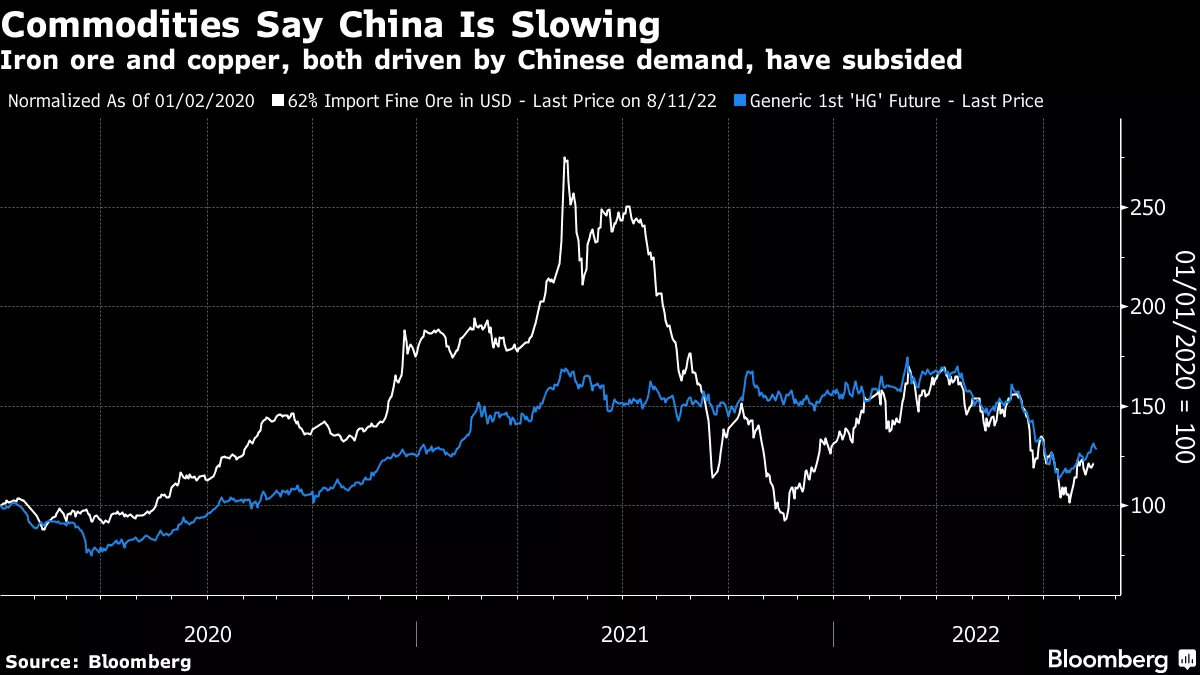
1. Commodity says China is slowing
China's production affects the global economy directly through the prices of commodities, especially industrial metals. The main Chinese iron ore contract has fallen dramatically since its peak last year, while copper dropped sharply this year, a clear sign of weaker demand.
2. Housing prices decline
For decades, buying property was considered a safe investment in China, but now it's related to a lot of trouble. China’s new home prices fell for the 11th straight month in a row for the period ended on July 31, 2022.
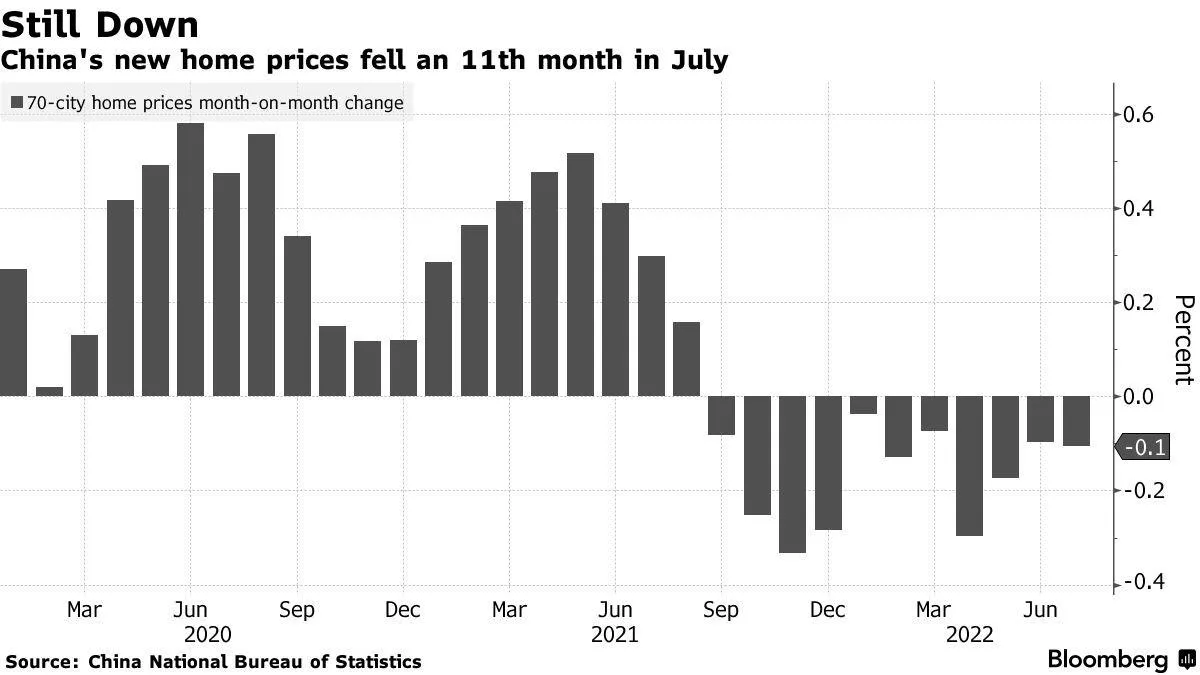
The pace of homebuilding has not been this slow since 2009. The result is an extra supply of metals like Iron ore, metallurgical coal, and copper which are essential materials for construction.
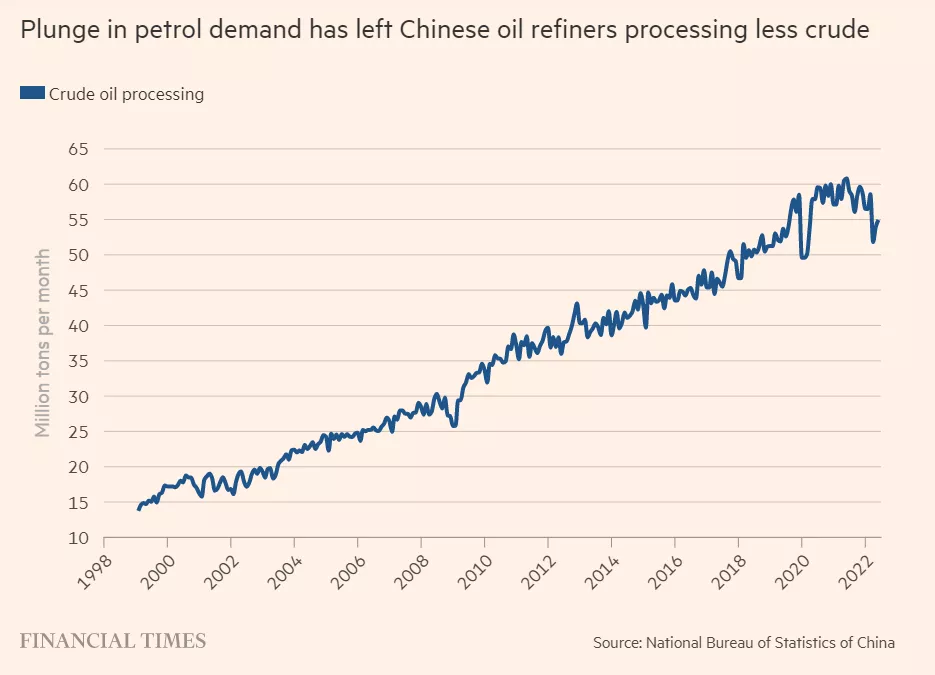
3. Chinese oil refiners processing less crude
Chinese oil refiners have been processing 10% less crude oil since April due to the decline in petrol demand with weaker consumer spending and industrial output. China’s weaker demand for oil has been a counter move to the tight grip on global energy supplies caused by the war in Ukraine.
How did the People's Bank of China and markets react?
After disappointing economic data, the PBOC announced surprise and unexpected interest rate cuts to boost its struggling economy. But the tiny one-tenth of a percentage point last week is unlikely to help economic activity.
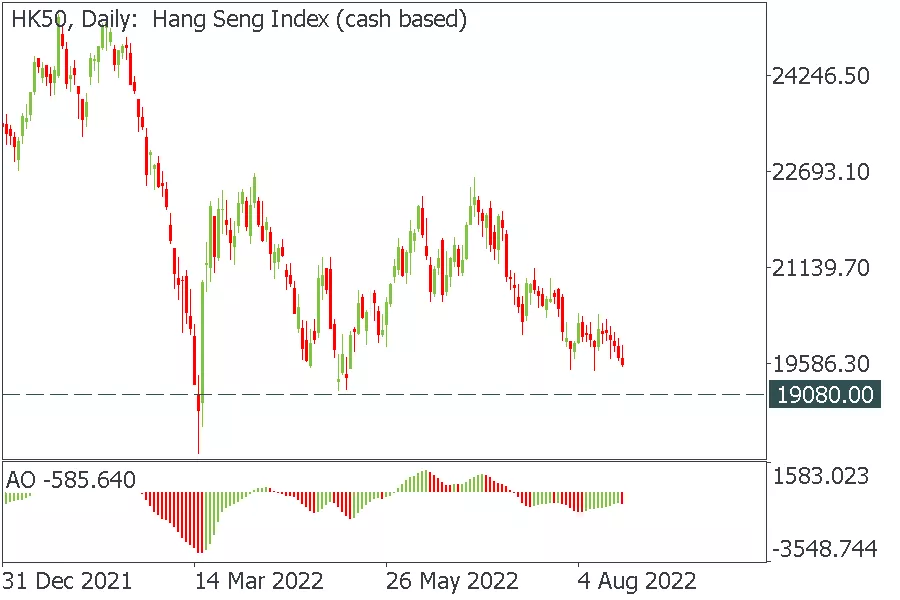
Chinese stocks in Hong Kong rallied for the 40 minutes between the PBOC announcement and the release of more data, then gave up all their gains and dropped more.
HK50 remains under pressure and may revisit May lows around 19080. The pair USDCNY has been up by more than 8% since February.
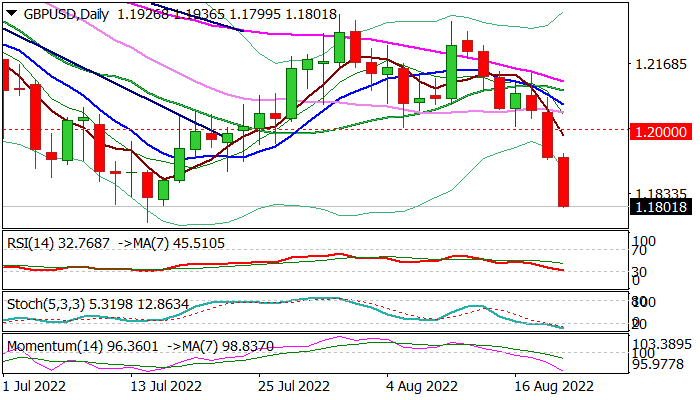
GBP/USD: Bears Accelerate Towards 2022 Low, On Track for the Biggest Weekly Fall in Nearly Two Years
Cable extends sharp fall after eventual break of pivotal 1.20 support, pressured by growing concerns about inflation-growth puzzle which boosts fears that the economy is heading into recession and fresh hawkish comments from Fed policymakers.
Soured sentiment adds to bearish technical studies, completing negative near-term outlook, as the pair is on track for a weekly close below psychological 1.20 level and for the biggest weekly loss since the first week of September 2020.
Bears eye 2022 low at 1.1760 (July 14), violation of which would risk deeper fall and retest of pandemic low at 1.1410 (March 2020).
Oversold daily conditions give initial warning that bears may face headwinds on approach to key 1.1760 support, with limited upticks expected to remain below 1.20 level (psychological /daily cloud base) and offer better levels to re-enter bearish market.
Res: 1.1900; 1.1936; 1.2000; 1.2062
Sup: 1.1760; 1.1700; 1.1634; 1.1556
Forward Guidance: Jobs Report to Confirm a Sizzling Hot Summer Market
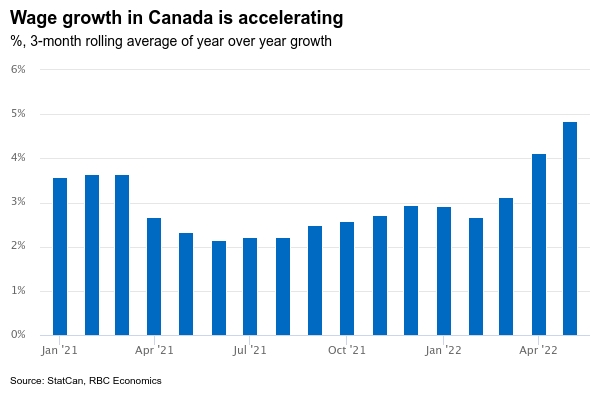
Exceptionally tight labour market conditions showed no sign of loosening in June. And next week’s Survey of Payrolls and Hours (SEPH) is expected to reinforce that message. Employment growth has slowed—as small outright declines in already-reported labour force surveys for June and July showed. But that has more to do with a shortage of workers than a lack of hiring demand. Job vacancies (reported in the SEPH data) were over a million in April and May. That’s double the annual average of 540,000 in 2019. Job postings from indeed.com were still running almost 70% above pre-pandemic levels in June, before ‘slowing’ to more than 60% higher in July. Wage growth, unsurprisingly, has accelerated—particularly in the accommodation and food services sectors which accounted for an outsized 20% of the rise in unfilled jobs from pre-pandemic levels. SEPH’s fixed weight index of average hourly earnings rose to 4.9% in the three months to May, almost twice the average 2.3% pace of growth over the five years before the pandemic.
We expect elevated demand for workers, especially in the close-contact and travel industries, to continue through this summer. Beyond then, consumer spending will slow more significantly across a widening array of goods and services as inflation and higher interest rates cut into household purchasing power. There’s still substantial excess demand in job markets to keep unemployment low in the near-term, but aggressive Bank of Canada rate hikes will soften consumer appetites and, we expect, also start to cool overheated labour markets in the second half of the year.
Week ahead data watch:
Advance wholesale and retail data for July should offer a first glance at domestic production growth in Q3. Declines in manufacturing sales over May and June likely extended into July, given sharply lower prices for petroleum and coal products.
U.S. personal consumption expenditure likely held flat in July, as stronger sales volume offset lower prices at pump stations.