Sample Category Title
The End of the Summer Rally?
Back in late June, we talked about spotting a bear market rally, and how the market tends to rise though summer. Since then, most stock markets around the world have risen, and the Nasdaq even managed to technically get back into a bull market after gaining 20%. Now, the question is whether the gains will keep going (and potentially the dollar could weaken), or is it all about to end?
During the summer, trading volume is typically lower as a lot of the big market makers go on vacation. August is the time when most central banks take a break, as well. This lower volume gives space for smaller traders who tend to be more optimistic, to help push the market higher. More sunshine, improving production, and a host of other factors come into play that usually means markets close higher during the summer.
Now what?
In the United States, Labor Day is the informal transition from summer to autumn for the markets. It's not exact, but by then the big traders are back from their holidays, earnings season is over, and focus switches to how things will play out for the rest of the year. Through the course of the third quarter, major corporations adjust their guidance, and given the economic conditions, that probably means cuts. Generally, optimism takes a step back.
Timing market moves is always difficult; if there was a sure-fire way of knowing when the market would turn around, then there would be no need for traders. So, anything approximating a date for the market to turn around must be approached with extreme caution.
Trying to make an educated guess
All general moves in the market lead to some kind of correction along the way. After nearly two months of the market trending higher, it would be a surprise that at least a correction would be on the way. Which means it's quite useful to keep track of the dynamics that have supported the current move, and then see if they are shifting as a potential precursor to a change in direction.
The end of a summer rally typically coincides with a shift in risk sentiment, which means currency markets are likely to be affected as well. In fact, currency markets might even be a precursor to the shift, as traders move away from higher risk assets and bond yields rise. Most recently in the US, bond yields were trending higher but the FOMC minutes took the wind out of their sails. That might mean there is a bit of a reprieve when risk sentiment turns around, and it could be a little later than normal for when the markets turn around. On the other hand, the downbeat tone from the Fed might accelerate the turnaround.
Lining up opportunities
The main issue for when markets do turn around is trying to figure out if it's a resumption of the downward trend, or a correction. As we mentioned back in June, it's impossible to know for sure until it's already happened.
But a long-term rally in the midst of poor economic data and the Fed promising to keep tightening isn't normal. In fact, that hasn't happened before. Optimism might push the market higher for short periods of time, but it can't fight fundamentals forever. As volumes start ramping up in early September, a keen eye on the data might help figure out whether a shift in market sentiment is temporary, or the start of another leg lower.
EUR/USD Started a Fresh Decline from $1.0180
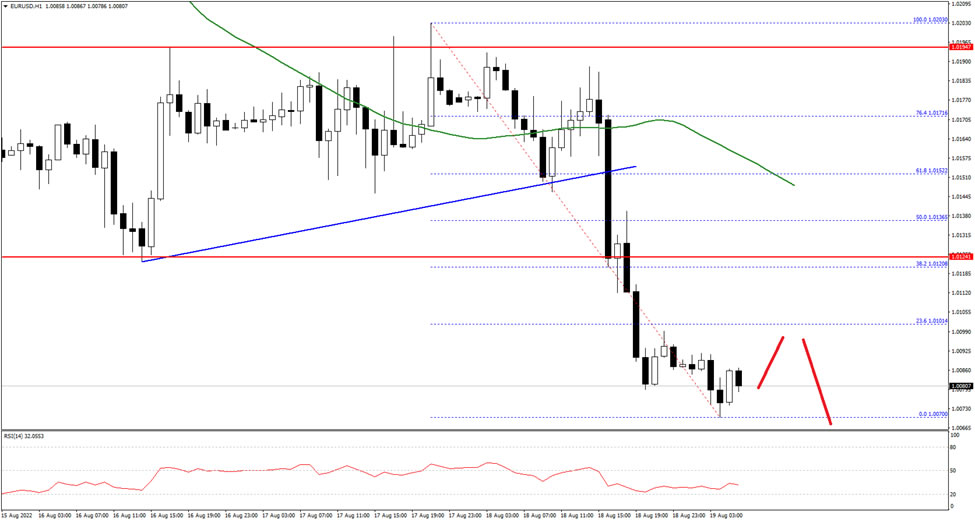
The Euro started a fresh decline from well above the 1.0180 level against the US Dollar. The EUR/USD pair traded below the 1.0150 support zone to move into a bearish zone.
There was a move below a connecting bullish trend line at 1.0152 on the hourly chart. The pair even settled below the 1.0130 level and settled above the 50 hourly simple moving average. A low is formed near 1.0070 and the pair is now consolidating. An immediate resistance on the upside is near 1.0100.
The first major resistance is near the 1.0120 level. A break above the 1.0120 resistance level could start a decent upward move. In the stated case, it could even surpass 1.0150.
If not, the pair might drop below 1.0070 on FXOpen. The next key support is near 1.0050, below the pair could decline towards the 1.0020 level in the near term. Any more losses might send the pair towards the 1.0000 level.
USD/JPY Mid-Day Outlook
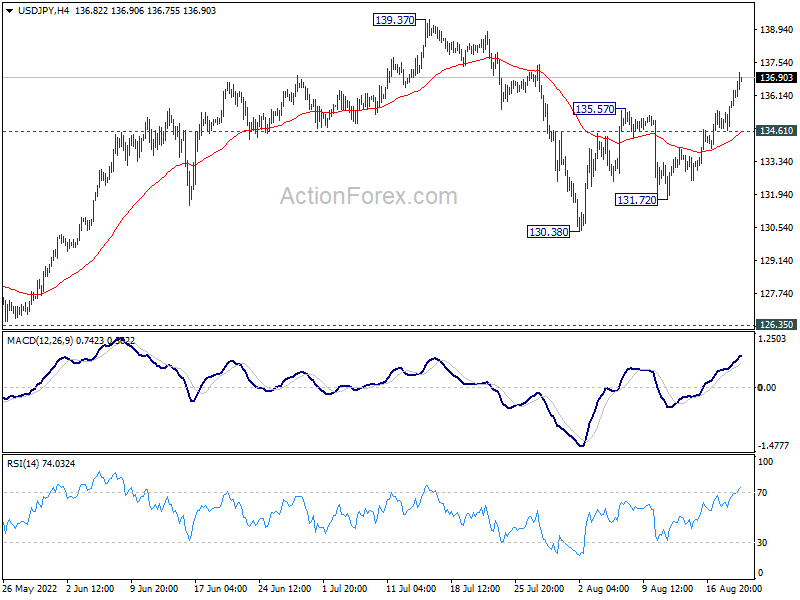
Daily Pivots: (S1) 135.06; (P) 135.48; (R1) 136.31; More...
Intraday bias in USD/JPY stays on the upside at this point. Further rally would be seen to retest 139.37 high. Strong resistance could be seen there to bring another fall to extend the corrective pattern from 139.37. On the downside below 134.61 minor support will turn intraday bias neutral first.
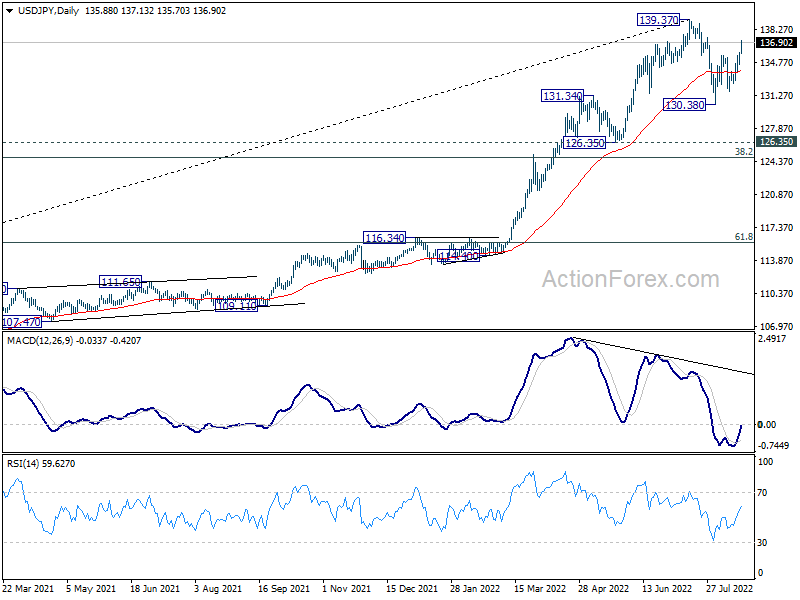
In the bigger picture, fall from 139.37 medium term top is seen as correcting whole up trend from 101.18 (2020 low). While deeper decline cannot be ruled out, outlook will stays bullish as long as 55 week EMA (now at 122.70) holds. Long term up trend is expected to resume through 139.37 at a later stage, after the correction finishes.
USD/CHF Mid-Day Outlook
Daily Pivots: (S1) 0.9521; (P) 0.9546; (R1) 0.9595; More...
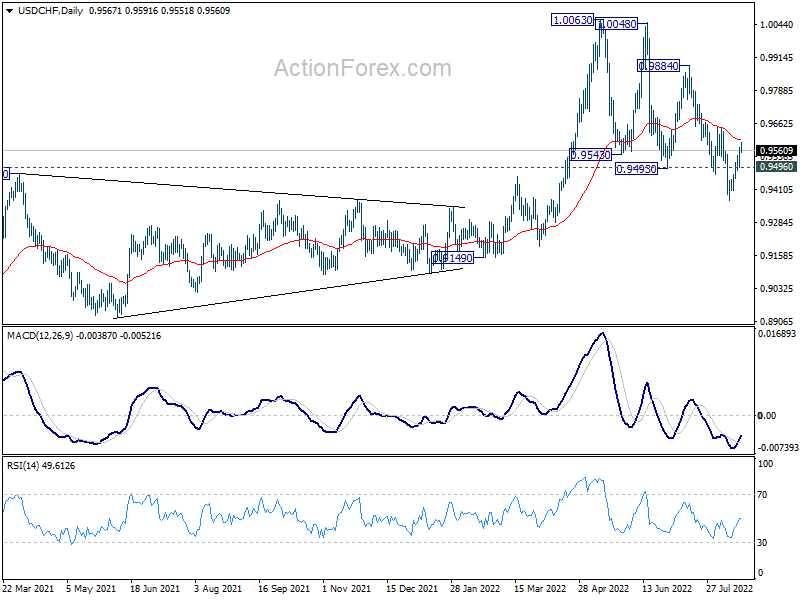
Intraday bias in USD/CHF remains mildly on the upside for 0.9648 resistance first Firm break there will bring stronger rally back to 0.9884 resistance next. On the downside, below 0.9496 minor support will revive near term bearishness and bring retest of 0.9369 low.
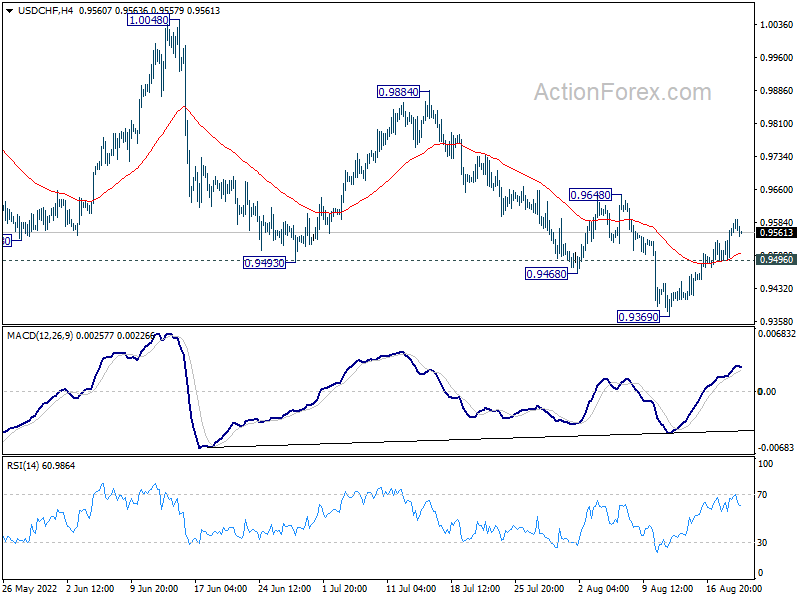
In the bigger picture, break of 0.9471 support turned resistance argues that medium term up trend from 0.8756 has completed with three waves up to 1.0063. Long term sideway pattern might have started another falling leg. Deeper decline would now be in favor as long as 0.9648 resistance holds, to 0.9149 structural support. Sustained break there could pave the way back to 0.8756. However, firm break of 0.648 will revive the case that price actions from 1.0063 are just a corrective pattern, and the larger up trend is no over yet.
EUR/USD Mid-Day Outlook
Daily Pivots: (S1) 1.0047; (P) 1.0120; (R1) 1.0160; More...
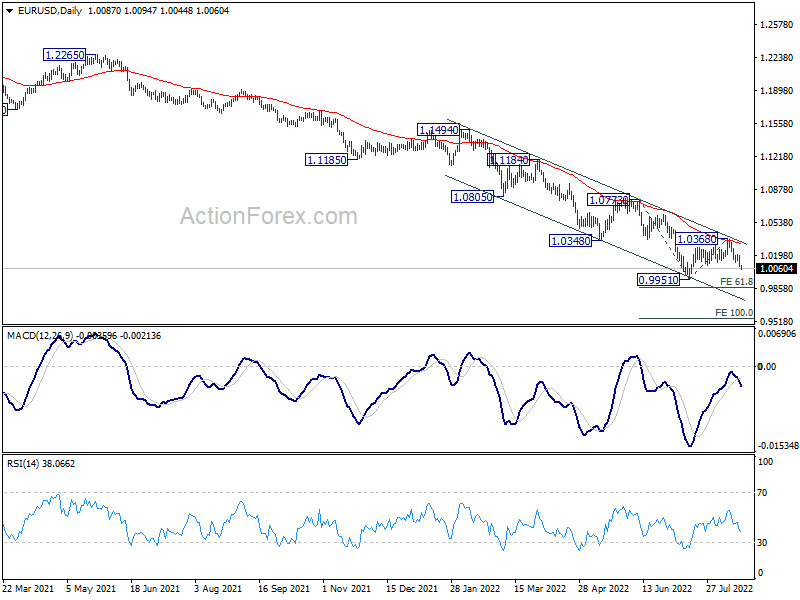
Intraday bias in EUR/USD stays on the downside for retesting 0.9951 low first. Firm break there will resume larger down trend trend. Next near term targets are 61.8% projection of 1.0773 to 0.9951 from 1.0368 at 0.9860, and then 100% projection at 0.9546. On the upside, above 1.0203 minor resistance will turn intraday bias neutral. But risk will stay on the downside as long as 1.0368 resistance holds.
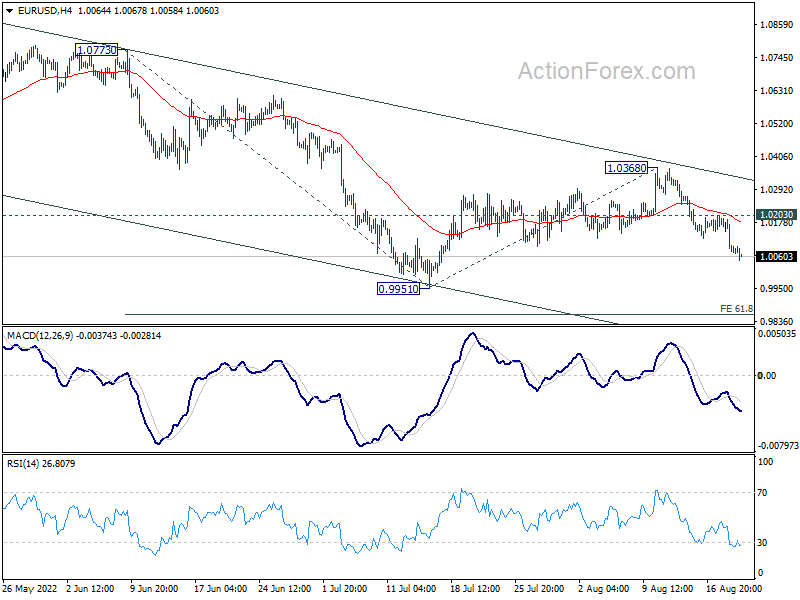
In the bigger picture, down trend from 1.6039 (2008 high) is still in progress. Next target is 100% projection of 1.3993 to 1.0339 from 1.2348 at 0.8694. In any case, outlook will stay bearish as long as 1.0773 resistance holds, in case of strong rebound.
GBP/USD Mid-Day Outlook
Daily Pivots: (S1) 1.1876; (P) 1.1978; (R1) 1.2033; More...
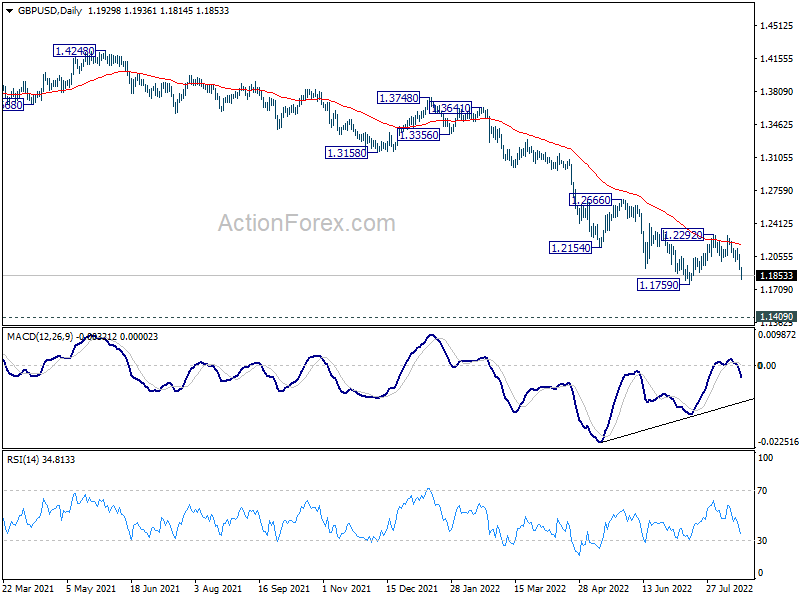
GBP/USD's fall accelerates to as low as 1.1814 so far and intraday bias stays on the downside for retesting 1.1759 support. Firm break there will resume larger down trend Next target is 1.1409 low. On the upside, above 1.2002 support turned resistance will turn intraday bias neutral first. But risk will stay on the downside as long as 1.2292 resistance holds.
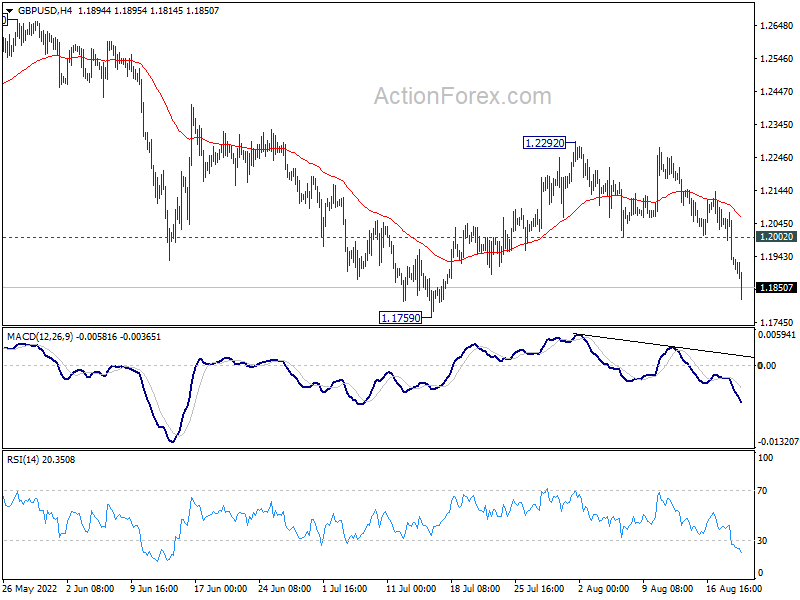
In the bigger picture, fall from 1.4248 (2018 high) could be a leg inside the pattern from 1.1409 (2020 low), or resuming the longer term down trend. Deeper decline is expected as long as 1.2666 resistance holds. Next target is 1.1409 low. However, firm break of 1.2666 will bring stronger rise back to 55 week EMA (now at 1.2897).
Dollar Continues Strong Rally, Swiss Franc Catching Up
Dollar rally continues today and it's set to end the week on a high note. Risk aversion and rising benchmark yield are both helping the greenback. Swiss Franc is also strengthening a lot. Selling focuses are mainly concentrated on Sterling, Euro, and Yen, even though commodity currencies are also soft.
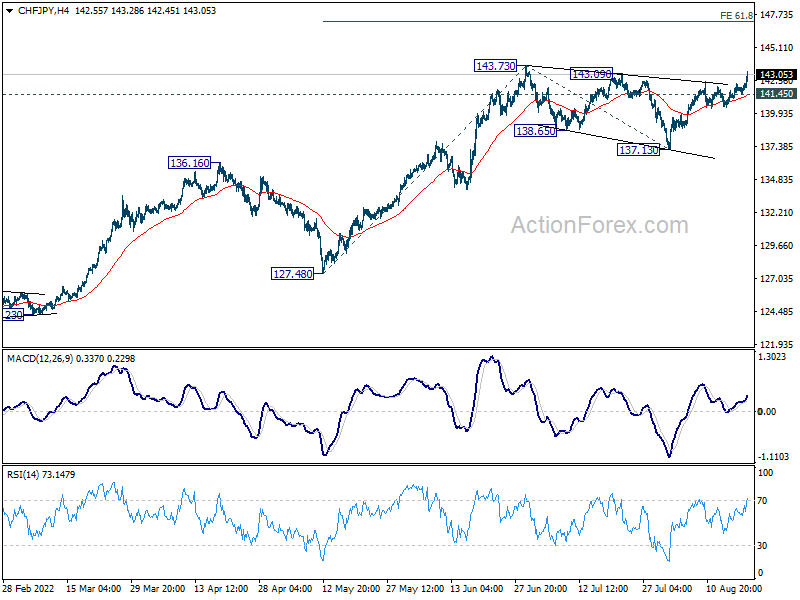
Technically, the rally in CHF/JPY is rather impressive, and it affirms the case that correction from 143.73 has completed with three waves down to 137.13. That is, larger up trend is ready to resume. For now, further rally is expected as long as 141.45 support holds. Firm break of 143.73 (probably next week) will pave the way to 61.8% projection of 127.48 to 143.73 from 137.13 at 147.17.
In Europe, at the time of writing, FTSE is up 0.17%. DAX is down -0.66%. CAC is down -0.55%. Germany 10-year yield is up 0.1122 at 1.214. Earlier in Asia, Nikkei dropped -0.04%. Hong Kong HSI rose 0.05%. China Shanghai SSE dropped -0.59%. Singapore Strait Times dropped -0.82%. Japan 10-year JGB yield rose 0.0011 to 0.201.
Canada retail sales rose 1.1% mom in Jun, core sales up 0.2% mom
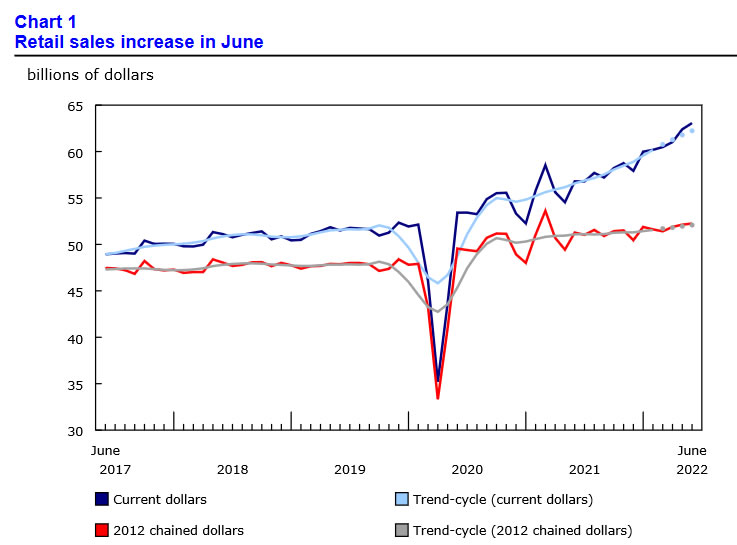
Canada retail sales rose 1.1% mom to CAD 63.1B in June, above expectation of 0.4% mom. That's also the sixth consecutive monthly increase. Sales were up in 8 of 11 subsectors, representing 76.8% of retail trade. Core retail sales, excluding gasoline stations and motor vehicle and parts, rose 0.2% mom.
In the advance estimate, retail sales dropped -2.0% mom in July.
UK retail sales volume rose 0.3% mom in Jul
In volume term, UK retail sales rose 0.3% mom in July, better than expectation of -0.2% mom. Ex-auto sales rose 0.4% mom. Comparing to a year ago, retail sales dropped -3.4% yoy while ex-auto sales dropped -3.0% yoy.
In value term, retail sales rose 1.3% mom, 7.8% yoy. Ex-auto sales rose 1.4% mom, 5.7% yoy.
From Germany, PPI rose 5.3% mom, 37.2% yoy in July, above expectation of 0.5% mom, 31.5% yoy.
UK Gfk consumer confidence drooped to -44, another record low
UK Gfk consumer confidence dropped from -41 to -44 in August, hitting another record low. Personal financial situation over the next 12 months dropped from -26 to -31. General economic situation over the next 12 months dropped from -57 to -60, setting a new record low.
Joe Staton, Client Strategy Director, GfK says: "The Overall Index Score dropped three points in August to -44, the lowest since records began in 1974. All measures fell, reflecting acute concerns as the cost-of-living soars. A sense of exasperation about the UK's economy is the biggest driver of these findings."
Japan CPI core rose to 2.4% yoy, highest since 2014
Japan headline CPI rose from 2.4% yoy to 2.6% yoy in July, above expectation of 2.2% yoy. CPI core (all items ex-fresh food) rose from 2.2% yoy to 2.4% yoy, matched expectations. CPI core-core (all items ex-food, energy) rose from 1.0% yoy to 1.2% yoy, above expectations of 0.6% yoy.
Core inflation has now exceeded BoJ's 2% target for four straight months, and hit the highest level since December 2014. The core-core reading was also the fastest since December 2015, while the headline reading was the strongest since 2008.
Both Prime Minister Fumio Kishida and BoJ Governor Haruhiko Kuroda have called for robust wage gains to ensure that inflation is sustainable. But the markets are expecting some pressure on the BoJ for acting on monetary policy if CPI hits 3%.
New Zealand goods exports rose 16% yoy in Jul, imports rose 26% yoy
New Zealand goods exports rose 16% yoy to NZD 6.7B in July. Goods imports rose 26% yoy to NZD 7.8B. Trade deficit came in at NZD -1.1B, comparing expectation of NZD 105m surplus.
China led the monthly rise in exports, up 13%. Exports to Australia was down -1.1%, USA up 5.8%, EU up 7.5%, Japan up 18%. Imports from China was up 19%, EU up 3.0%, Australia up 16%, USA up 34%, and Japan up 54%.
GBP/USD Mid-Day Outlook
Daily Pivots: (S1) 1.1876; (P) 1.1978; (R1) 1.2033; More...
GBP/USD's fall accelerates to as low as 1.1814 so far and intraday bias stays on the downside for retesting 1.1759 support. Firm break there will resume larger down trend Next target is 1.1409 low. On the upside, above 1.2002 support turned resistance will turn intraday bias neutral first. But risk will stay on the downside as long as 1.2292 resistance holds.
In the bigger picture, fall from 1.4248 (2018 high) could be a leg inside the pattern from 1.1409 (2020 low), or resuming the longer term down trend. Deeper decline is expected as long as 1.2666 resistance holds. Next target is 1.1409 low. However, firm break of 1.2666 will bring stronger rise back to 55 week EMA (now at 1.2897).
Economic Indicators Update
| GMT | Ccy | Events | Actual | Forecast | Previous | Revised |
|---|---|---|---|---|---|---|
| 22:45 | NZD | Trade Balance (NZD) Jul | -1092M | 105M | -701M | -1102M |
| 23:01 | GBP | GfK Consumer Confidence Aug | -44 | -42 | -41 | |
| 23:30 | JPY | National CPI Core Y/Y Jul | 2.40% | 2.40% | 2.20% | |
| 06:00 | EUR | Germany PPI M/M Jul | 5.30% | 0.50% | 0.60% | |
| 06:00 | EUR | Germany PPI Y/Y Jul | 37.20% | 31.50% | 32.70% | |
| 06:00 | GBP | Retail Sales M/M Jul | 0.30% | -0.20% | -0.10% | -0.20% |
| 06:00 | GBP | Retail Sales Y/Y Jul | -3.40% | -3.30% | -5.80% | -6.10% |
| 06:00 | GBP | Retail Sales ex-Fuel M/M Jul | 0.40% | -0.20% | 0.40% | 0.20% |
| 06:00 | GBP | Retail Sales ex-Fuel Y/Y Jul | -3.00% | -2.80% | -5.90% | -6.20% |
| 06:00 | GBP | Public Sector Net Borrowing (GBP) Jul | 4.2B | 25.3B | 22.1B | 20.1B |
| 08:00 | EUR | Eurozone Current Account(EUR) Jun | 4.2B | -3.3B | -4.5B | -6.9B |
| 12:30 | CAD | Retail Sales M/M Jun | 1.10% | 0.40% | 2.20% | 2.30% |
| 12:30 | CAD | Retail Sales ex Autos M/M Jun | 0.80% | 0.90% | 1.90% |
Canada retail sales rose 1.1% mom in Jun, core sales up 0.2% mom
Canada retail sales rose 1.1% mom to CAD 63.1B in June, above expectation of 0.4% mom. That's also the sixth consecutive monthly increase. Sales were up in 8 of 11 subsectors, representing 76.8% of retail trade. Core retail sales, excluding gasoline stations and motor vehicle and parts, rose 0.2% mom.
In the advance estimate, retail sales dropped -2.0% mom in July.
EURAUD Hovers Near a Key Support Zone
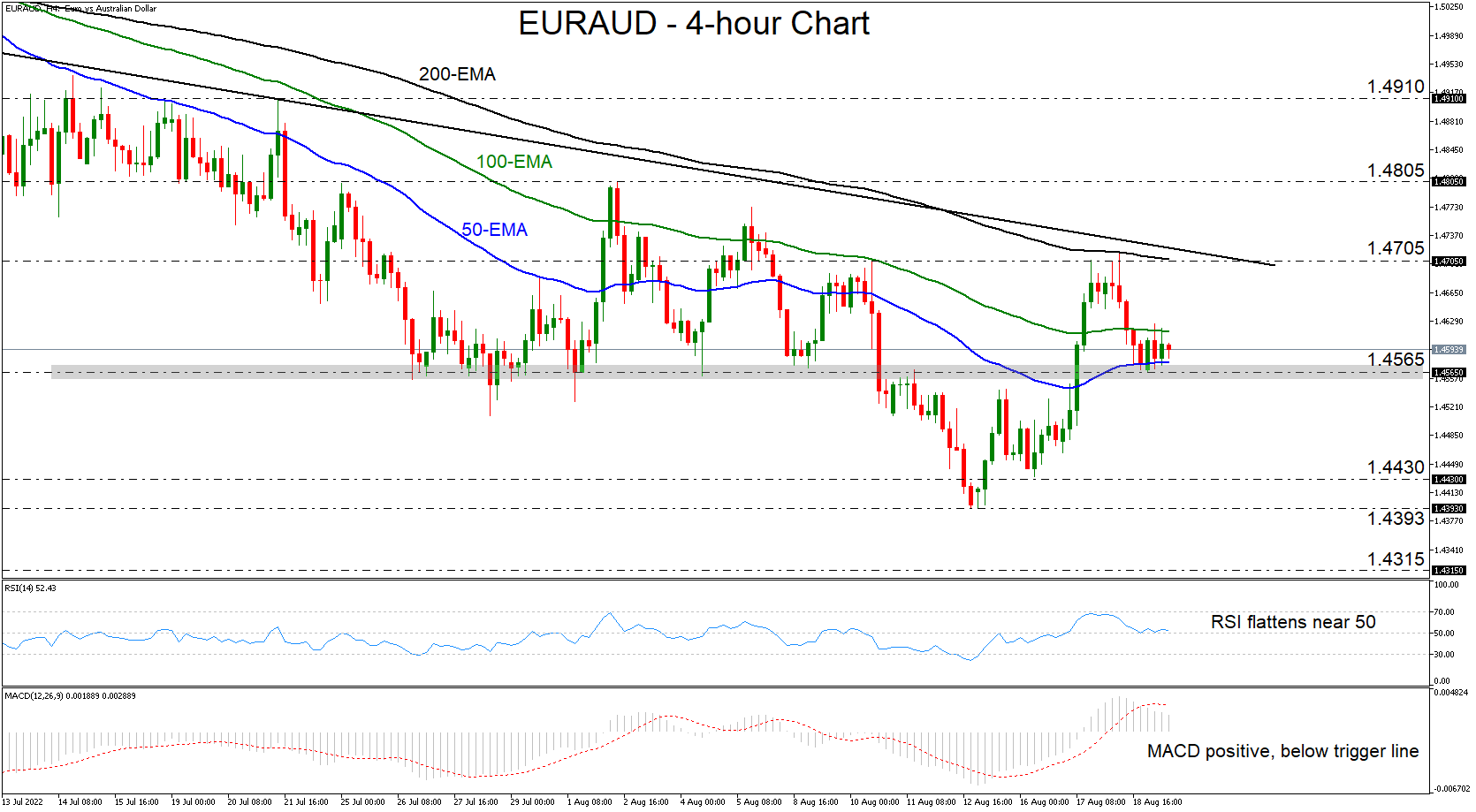
EURAUD came under selling interest yesterday, after hitting resistance at the 200 – period exponential moving average (EMA), fractionally above the 1.4705 barrier, and slightly below the downside line drawn from the July 11 high. Although this keeps the prevailing downtrend intact, in the current session, the pair consolidated near the important support zone of 1.4565.
The cautiously negative outlook is also supported by both our oscillators. The RSI moved lower but stopped and flattened near its equilibrium 50 line, while the MACD, even though it lies below its trigger line and points south, has yet to obtain a negative sign. These technical indications imply that the pair has not started to gather pure negative speed yet.
A break below 1.4565 would confirm a lower low on the 4-hour chart and may initially pave the way towards the 1.4430 barrier, which is the low of August 16, or the 1.4393 hurdle, marked by Monday’s low. If that zone is not able to withstand the pressure either, then the fall may get extended towards the 1.4315 territory, defined as a support by the low of April 5.
The outlook could brighten upon a strong recovery above the aforementioned downtrend line. In this case, EURAUD would already be above the 200-EMA and the 1.4705 barrier and thus, the bulls may get encouraged to climb to the peak of August 2 at 1.4805. Should they breach that resistance as well, they could shoot for the 1.4910 zone, which acted as a temporary ceiling between July 13 and 21.
To recap, EURAUD remains below a downtrend line taken from the high of July 11, but the bears are struggling to overcome the key support of 1.4565. A break below that zone may be the invitation sidelined bears are waiting for.
USD/CAD Eyes 130, Retail Sales Next
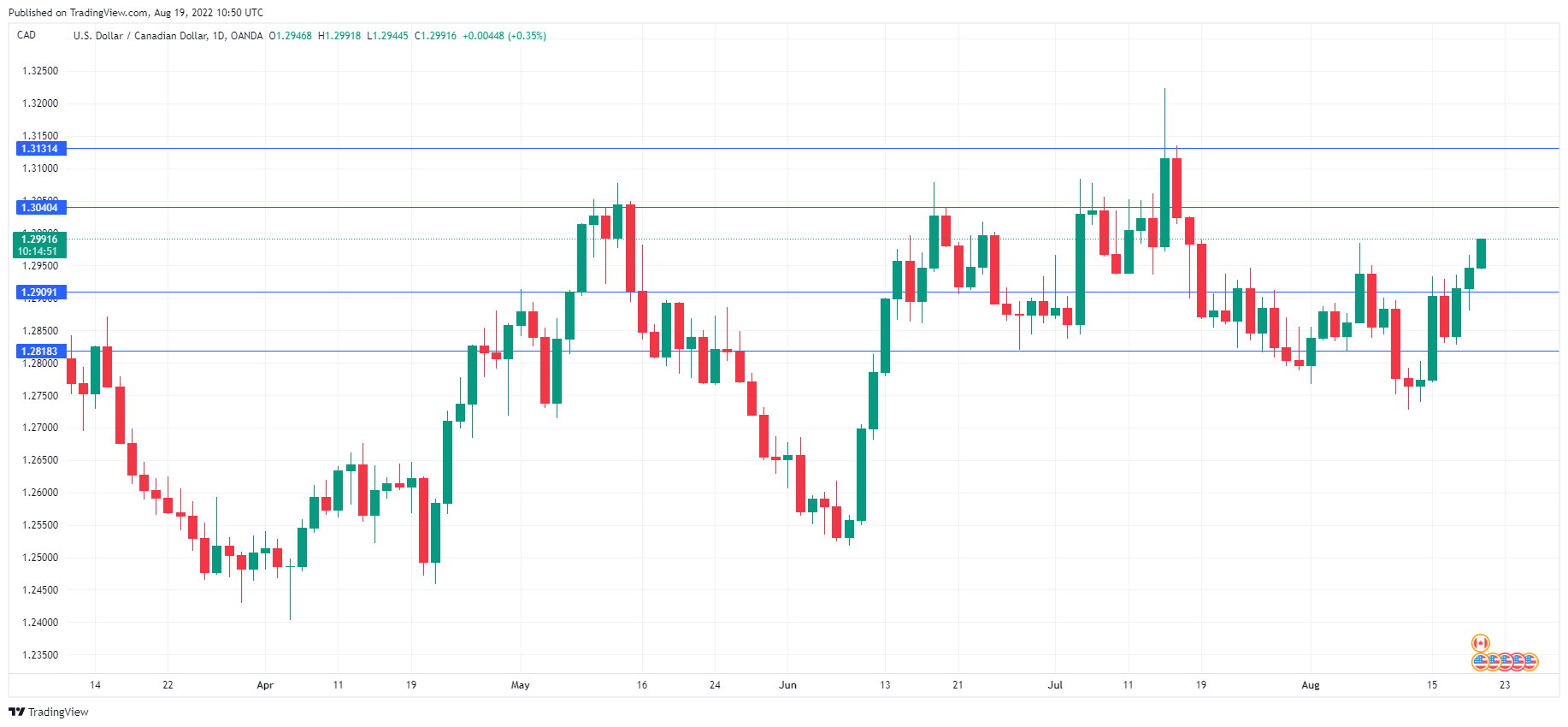
The Canadian dollar is lower for a third straight day. In the European session, USD/CAD is trading at 1.2984, up 0.29% on the day.
Markets brace for soft Canadian retail sales
The US dollar has rebounded this week against the majors, including the Canadian dollar. USD/CAD is on the verge of breaking above the 1.30 line, which has held firm since July 18th. A weak Canadian retail sales report later today could send the Canadian dollar into 130-territory. Retail sales for July is expected to slow to 0.3% MoM, down sharply from the 2.2% gain in June. Core retail sales is projected to drop to 0.9% MoM, down from 1.9%.
Canadian consumers have been hit hard by the cost-of-living crisis, and a natural response has been to cut down on spending. This could prove a major headache for the economy, as domestic demand is a key driver of growth. Canada’s inflation has been heading toward double-digits, but as in the US, inflation dropped in July. Canada’s CPI slowed to 7.6% YoY, down from 8.1% in June, which marked a 40-year high. However, CPI common, a core CPI indicator, rose to 5.5% YoY in July, up from 5.3% in June. This is the Bank of Canada’s preferred gauge and means that the BoC, like the Fed, is not planning any U-turns in policy. We’ll have to wait for additional data to determine if headline inflation has peaked or whether the July release was a one-time blip. Even if inflation is easing, it is expected to fall very slowly, which means that consumers will feel the economic pain for some time to come.
The BoC meets again next month, and the markets are expecting a 50 basis point increase, with a 25% of a 75bp hike. In July, the central bank surprised the markets with a super-size 100bp increase, the first G-7 country to deliver such a large rate hike in the post-Covid era.
USD/CAD Technical
- There is resistance at 1.3040 and 1.3131
- USD/CAD has support at 1.2909 and 1.2818