

Sample Category Title
Weekly Focus – UK Joins the “10% Inflation Club”
Macroeconomic indicators this week pointed to further headwinds for the global economy. In the US, the New York Empire Manufacturing Index slumped to -31.3 (from 11.1) in August, the lowest level since slump after the first Covid-19 lockdown. The sharp drop was driven by weaker current conditions, while the expectations index improved slightly. The current Empire level implies US Manufacturing PMI clearly below 50, in line with what the new orders index predicted already in July.
Also in Europe, there were weak indicators with the German ZEW expectations diving further during August to the lowest level since October 2008. The ZEW signals further declines in PMI ahead and increasing recession risk in the German economy, which is also our base case for the second half of this year, see Research Germany - Zeitenwende, 25 July. Our forward looking macroeconomic model, Macroscope, this week also pointed to further weakening momentum in the global economy across regions over the next six months, see MacroScope: rising recession risks, 18 August.
On the inflation front, UK CPI inflation surprised to the upside creeping above 10% in July. The UK is thereby joining the "club" of countries, mostly in Eastern Europe and emerging markets, with double digit inflation rate. We think this highlights the need for Bank of England (BoE) to continue to frontload rate hikes, although a looming recession may curtail its hiking intentions into next year. The EUR/GBP cross initially moved lower on the back of the print, but later rebounded amid weak global risk sentiment.
Another central bank that is upping its policy rate hikes is Norges Bank, which yesterday as expected carried out a 50bps rate hike. The move comes after the upward inflation surprise in July. The central bank dropped its specific forward guidance for the September meeting, just indicating that the policy rate "will most likely be raised further in September". We expect the Bank to raise its policy rate at that meeting by 25bps against market expectation of a bigger 50bps move.
In financial markets the clear winner was the USD while both equity markets and rates markets traded mostly sideways. We published our new FX Forecast Update this week, FX Forecast Update - USD to shrug off recession fears, 17 August, and see USD strength continuing with EUR/USD falling below parity over the next 12M due to Europe suffering from an energy related negative terms of trade shock and further tightening of global financial conditions.
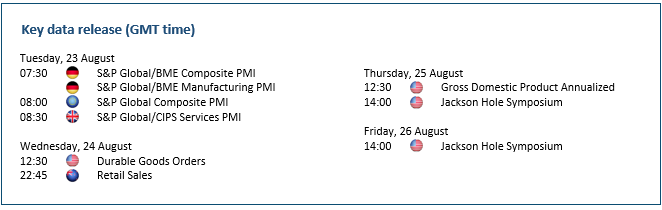
Looking into next week, a key focus will be August flash PMIs out in most western economies on Tuesday. In Europe, further declines - as also signaled by ZEW - will probably be in store, as the energy crisis is taking its toll on demand in manufacturing and services and recession fears are rising. In the US, lower gasoline prices and rebound in real incomes may support service sector demand. Look also out for the US personal expenditure data on Friday. The Jackson Hole Symposium will take place from Thursday until Saturday. Here Federal Reserve officials may outline their view on monetary policy amid a weakening economy.
Research China – The Risk of a Taiwan War and What it Implies – Part 2
In Research China: The risk of a Taiwan war and what it implies - part 1, 11 August, we looked at the risk of a Taiwan war. In this follow-up we consider the implications, both of a possible war and of the rising tensions.
Apart from being a human tragedy with significant loss of lives, we believe a war on Taiwan would trigger a deep global recession through the effects from sanctions, huge disruption to supply chains as well as from a sharp rise in uncertainty due to the risk of a war developing into WWIII.
While we do not expect a war in the short term, the heightened tensions itself and risk of a war on a 5-10 year horizon, will also have implications. Companies will increasingly consider how many eggs they have in the China basket and de-globalisation and decoupling trends will see an extra push. On the geopolitical front we move faster towards what could resemble a new Cold War between the West and China/Russia, albeit a different Cold War than the first, as the world will stay more connected economically and the rest of the world is reluctant to choose sides. This leads to a multipolar and more fragmented world.
Will the UK PMIs Intensify Worries Over a Recession?
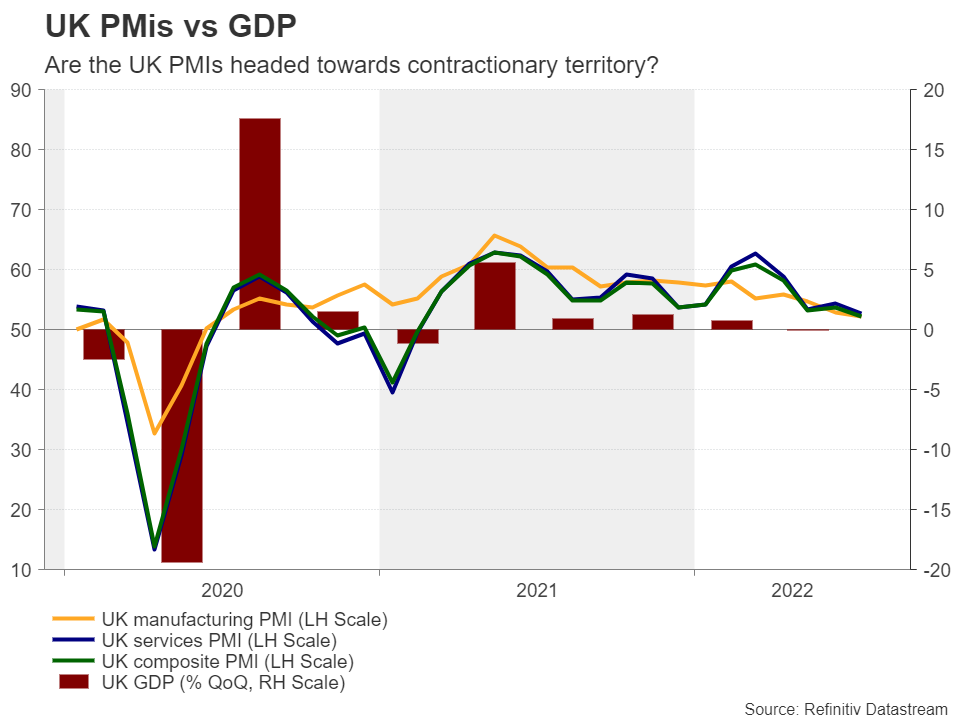
After seeing UK inflation accelerating to double digits earlier this week, pound traders may now turn their gaze to the flash UK Purchasing Managers Indices (PMIs) for August, due to be released out on Tuesday at 08:30 GMT. With the preliminary GDP data revealing contraction in the second quarter of the year, traders may want more clues on how the economy has been faring thereafter.
Are the UK PMIs headed towards contractionary territory?
There are no forecasts available at the time of writing for any of the three indices, but it is worth mentioning their July prints. The manufacturing PMI slid to 52.2 from 52.8, while the services one fell from 54.3 to 52.6. The composite index declined as well, to 52.1 from 53.7. Although all three of them remained above the boom-or-bust zone of 50, they’ve been trending lower since March. Therefore, combined with the BoE’s warnings over a recession, investors may be biting their nails in anticipation of whether the PMIs will get closer to the 50 line, or even fall below it.
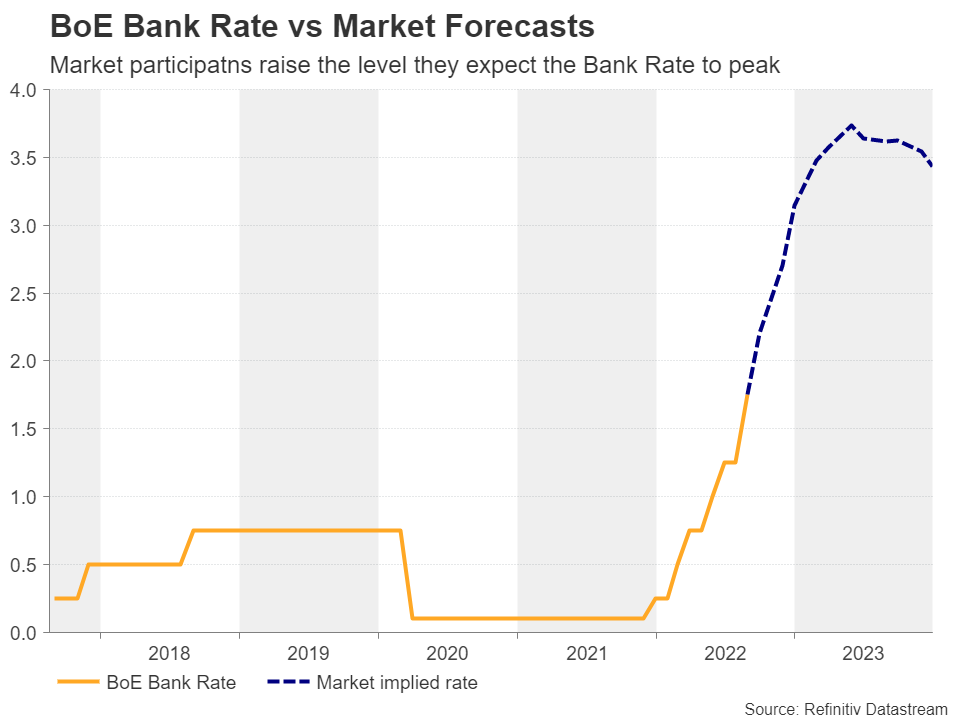
Market raises forecasts on interest rates, but pound keeps falling
At its latest gathering, the BoE raised interest rates by 50bps to 1.75%, retaining the option to act more forcefully if deemed necessary. That said, officials maintained warnings over the UK economy entering recession, saying that this could happen this quarter and last for a whole year. That’s maybe why the pound stayed under pressure even after the UK became the first major economy to experience double digit inflation.
On Wednesday, the July CPI data revealed that the headline rate jumped to 10.1% from 9.4%, while the core rate, which excludes the volatile items of energy and food, rose to 6.2% from 5.8%. This suggests that prices are not rising only due to Russia’s restrictions of gas supplies, and that’s maybe why market participants were quick to raise their bets with regards to future rate hikes by the BoE. They now see the bank rate peaking at 3.75% in May next year, while ahead of the data, they were expecting it to peak at 3.25% in March.
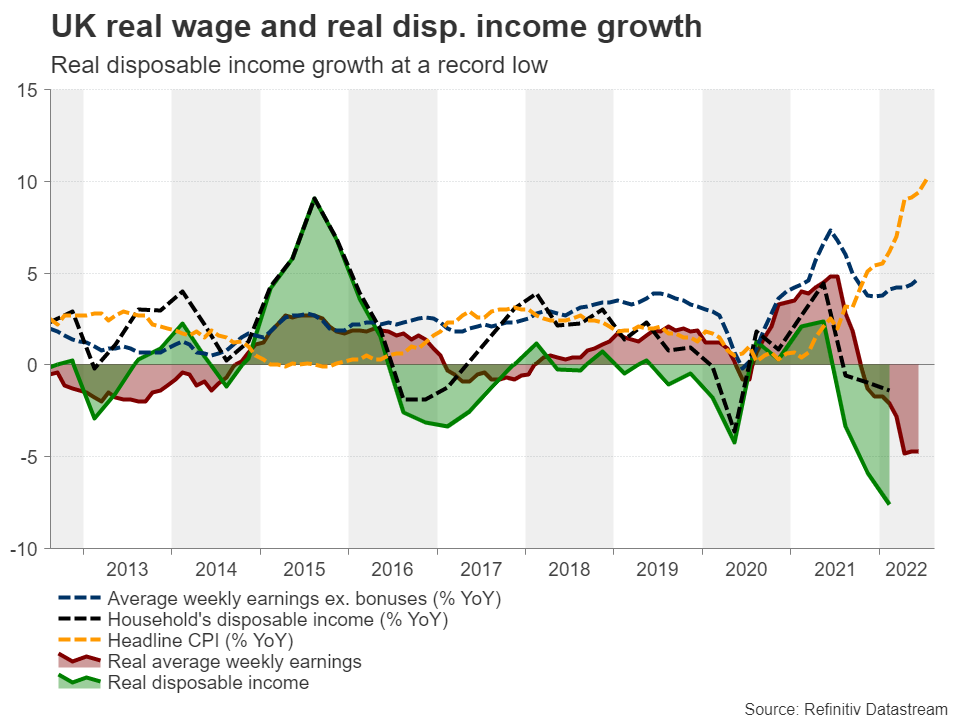
How big is the risk of a UK recession?
Maybe the pound failed to capitalize due to traders staying worried over recession risks rather than trusting the BoE relieving them from the pain of very high consumer prices. Yes, the employment data for June pointed to a labor market remaining tight, but although wages accelerated, real wage growth remained well into the negative territory. What’s more worrisome, during the first quarter of the year, the real disposable income of households slid by the most since we have data for.
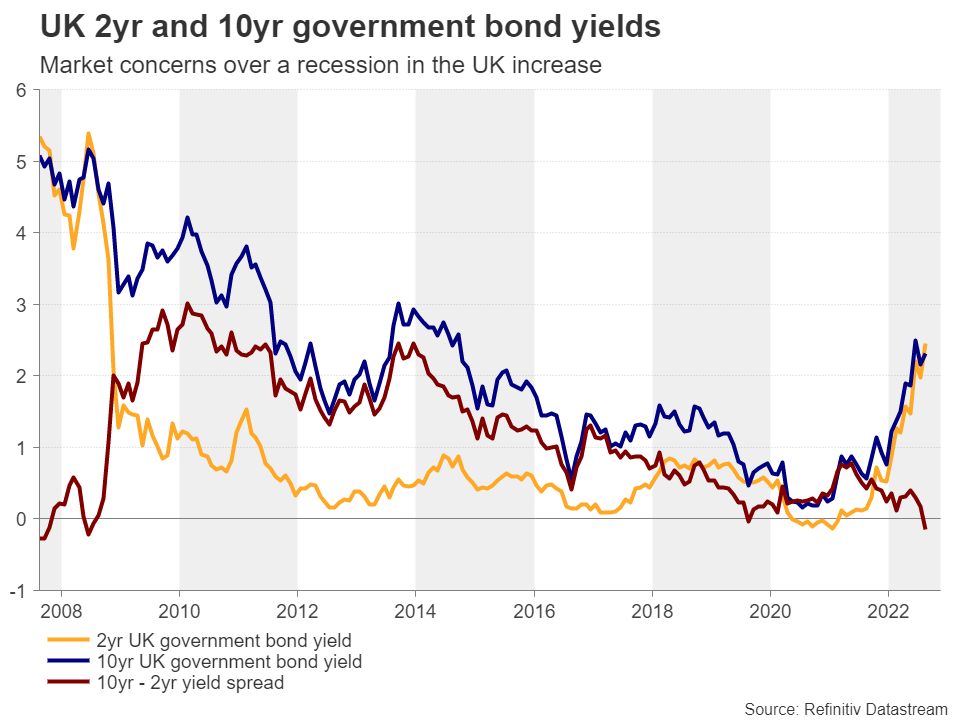
The market’s concern is also visible in the UK government bond market. Although yields have been in a steady uptrend due to the BoE’s actions, the difference between the 10- and 2-year yields turned negative this week for the first time since 2019 and continued well below the level hit then. The last time we saw the 10yr/2yr spread being that low was back in 2008, during the global financial crisis.
Pound breaks below 1.20 dollars. Is more trouble on the cards?
So, with all that in mind, lower PMIs, especially if any of the indices falls below 50, could spell more trouble for the British currency. Pound/dollar already fell below the 1.2000 psychological hurdle yesterday, which may have invited more bears into the game, encouraging them to push even lower in case UK data keeps disappointing. They may aim for the July 14 low of 1.1760, the break of which would confirm a forthcoming lower low on the weekly chart and probably set the stage for larger declines, perhaps towards the low of March 20, 2020, at around 1.1400.
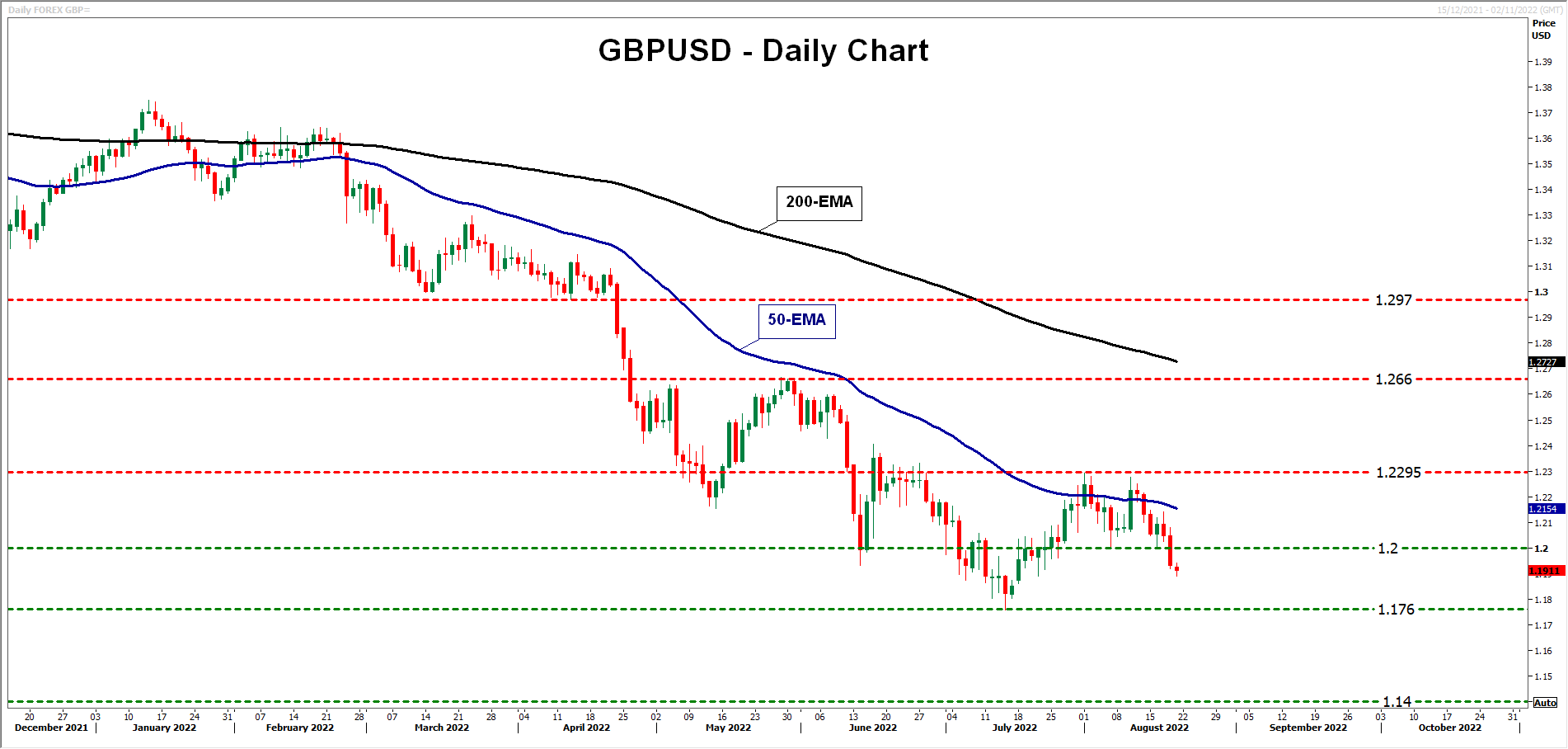
Alternatively, improving PMIs may result in some pound buying, or better say, some short covering. Pound/dollar could rise back above 1.2000, but with the fundamental picture staying gloomy, this may be just a dead cat bounce before a new round of selling. For the outlook of this pair to change, a break above the key resistance zone of 1.2295, accompanied with notable improvement in UK economic data, may be needed.
Eurozone Flash PMIs to Highlight Recession Risks as Energy Crisis Worsens
The Eurozone economy may have notched up impressive growth in the second quarter, but conditions have started to deteriorate rapidly in the third quarter. The flash PMI estimates by S&P Global due on Tuesday will reveal whether business activity improved or slumped in August. Investors will likely be paying particularly close attention to Germany – Europe’s largest economy – as it is the most vulnerable from the energy crunch, which is showing no sign of easing. The euro, meanwhile, is headed for parity versus the US dollar after crashing below its sideways range.
From bad to worse
Things just seem to be getting from bad to worse in Europe this year. If the war in Ukraine wasn’t enough to derail the bumpy recovery from the pandemic, the worst drought in 500 years and the real prospect of energy rationing certainly could. Business confidence is plunging amid headwinds from multiple fronts, with stagnating growth in China being the latest.
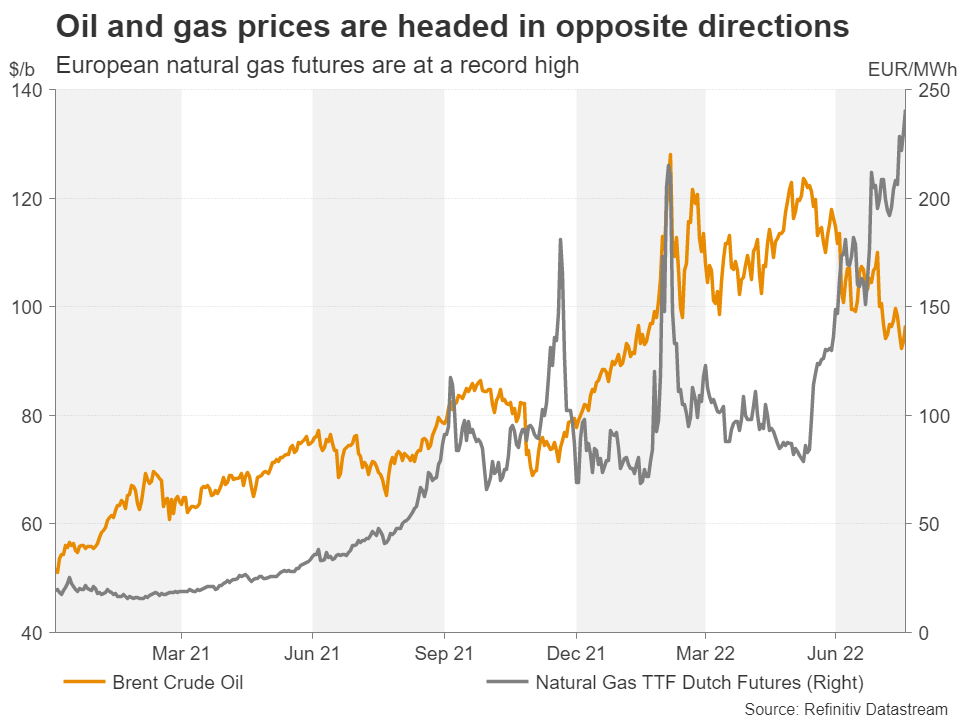
There has been some relief at least from lower oil prices. As more of the price decline in crude oil gets passed on at the pump, and to a lesser extent, in electricity prices, this should provide a substantial boost for both consumers and businesses. However, Europe’s dependency on natural gas, and specifically, on Russian gas, means the energy crisis on the continent could outlast the surge in oil prices.
PMIs are ringing recession alarm bells
The negative risks have already started to materialize as Eurozone manufacturing activity contracted in July for the first time in two years, while the situation was even worse for Germany, with both the manufacturing and services sectors shrinking last month according to the PMI survey.
August’s flash estimates are unlikely to offer much respite in the run of gloomy headlines. The Eurozone’s flash manufacturing PMI is expected to decline from 49.8 to 49.0, while the services print is forecast to drop from 51.2 to 50.5. This would put the composite PMI at 48.8, signalling the start of a broadening decline in economic activity.
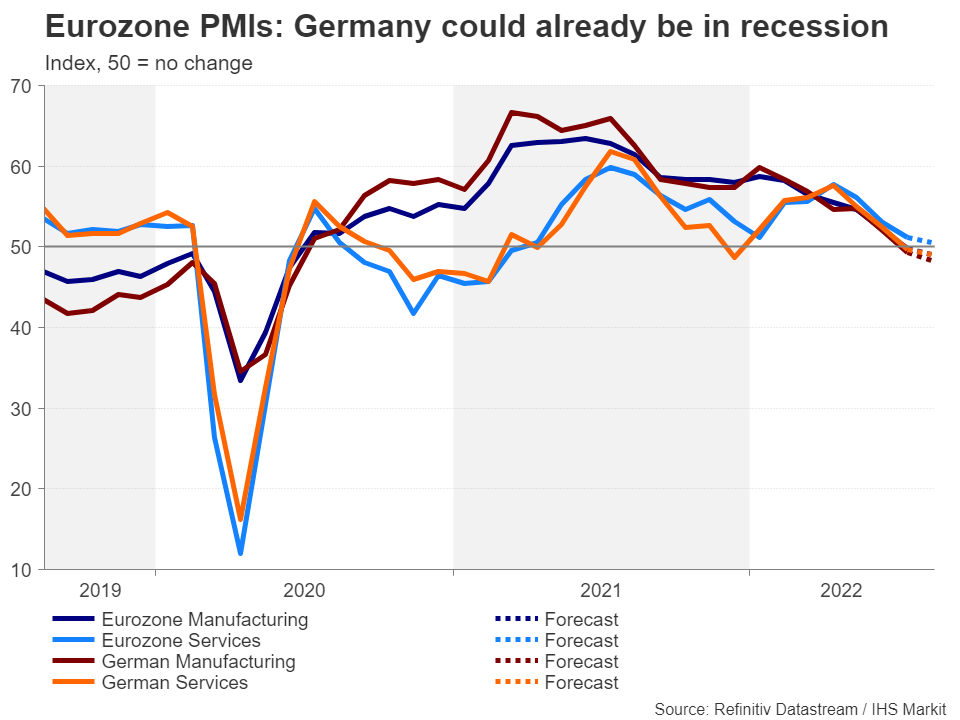
In Germany, the forecasts are notably more dire as the composite PMI is predicted to fall from 48.1 to 47.4, in what could be the beginning of a long and steep contraction.
Within reach of parity
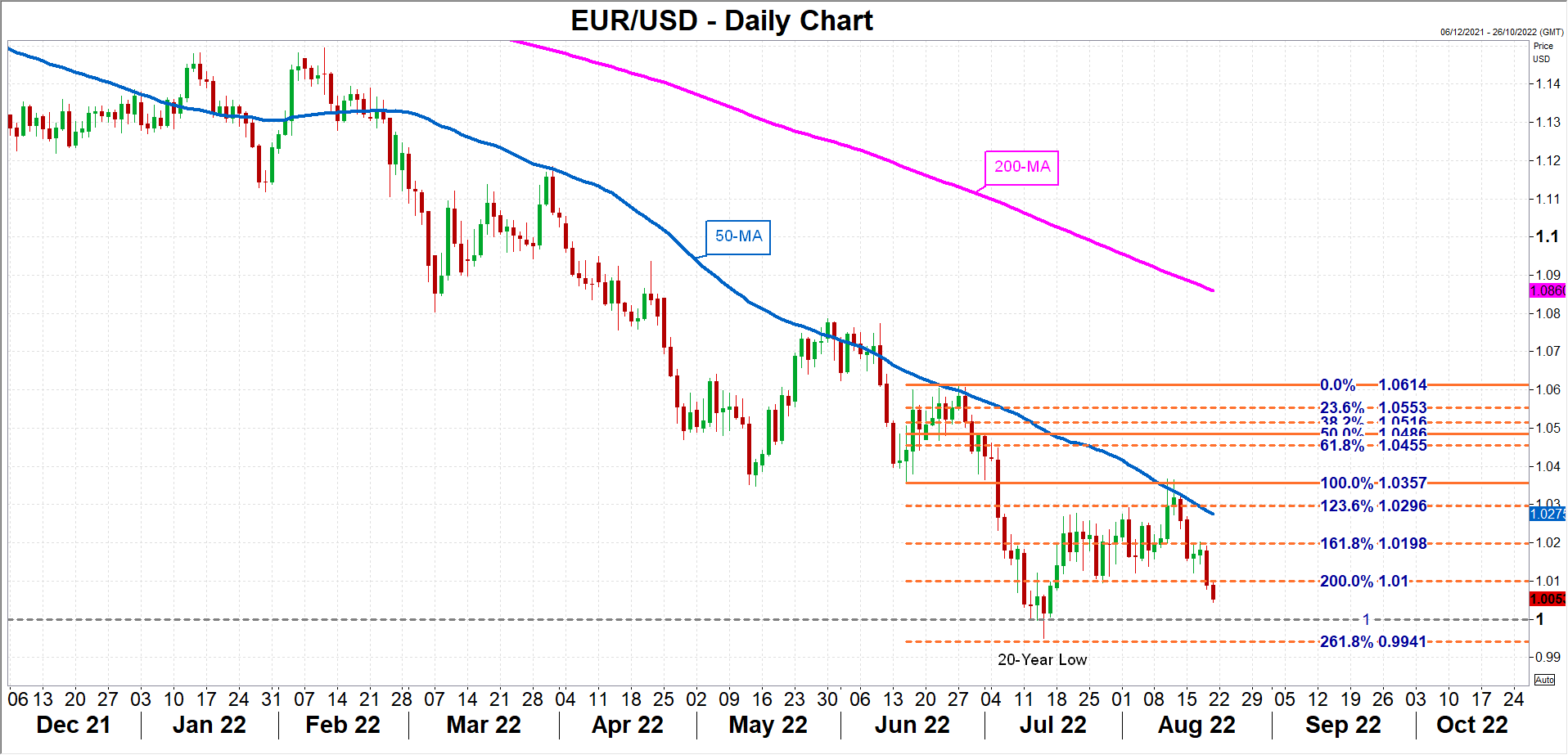
The euro, which had been trapped between the $1.01 and the $1.03 levels for much of July and August, has just dived below this range and is at risk of breaching parity from a poor set of PMI figures. A rerun of July’s 20-year trough of $0.9950 slightly above the 261.8% Fibonacci extension of the June upleg now looks probable.
Alternatively, the euro could rebound towards its 50-day moving average around $1.0275 from any positive surprises in the PMI readings, as long as it can clear the hurdle of the 161.8% Fibonacci just beneath $1.02.
Whether the euro can again bounce off the parity mark will likely depend on the two big variables: what will happen to natural gas prices and supply, and how will the European Central Bank respond to the escalating gas crisis.
Can the ECB halt the euro’s decline?
The ECB’s hawkish tilt in July was pivotal in cementing support in the $1.01 region. Policymakers will probably maintain their pledge to rein in inflation when they meet on September 9. But hawkish soundbites may not be enough this time round.
The chances of tensions between Russia and Europe easing anytime soon are remote. Hence, the coming winter will almost certainly be difficult for countries that rely heavily on natural gas for their electricity needs, regardless of whether Moscow decides to completely cut off supplies, and rationing is looking increasingly unavoidable. A further slowdown in China’s economy would also deepen Europe’s woes, especially for German exporters.
Against such a backdrop, it’s hard to see how a recession can be averted, and more importantly, how the ECB can sound convincingly more hawkish than the Fed and put a floor under the beleaguered euro.
Week Ahead – Will the Fed Fire Back at Jackson Hole?
With the summer coming to a close, Fed officials will head to Jackson Hole for their annual symposium. Financial conditions have loosened lately despite the forceful rate increases, which is counterproductive for the central bank. If they push back, that could spell trouble for risk assets but good news for the dollar.
Fed summer camp
The top brass of the Federal Reserve will head to the central bank’s summer retreat in Jackson Hole, Wyoming on Thursday to discuss monetary policy. This venue has been used in the past to signal major policy shifts, so it is seen as an unofficial policy meeting.
Fed officials are caught in a bind. Despite raising interest rates at the speed of light, their actions didn’t have the desired effects. Yields on government bonds have pulled back and stock markets have rallied with a vengeance since June, ignoring signals from policymakers that they are far from declaring victory on inflation.
As Chairman Powell pointed out, Fed policy is transmitted mainly through ‘financial conditions’, which is essentially a code phrase for bond yields and stocks. The central bank needs tighter financial conditions to slow down the economy and tame inflation, but they have been loosening instead.
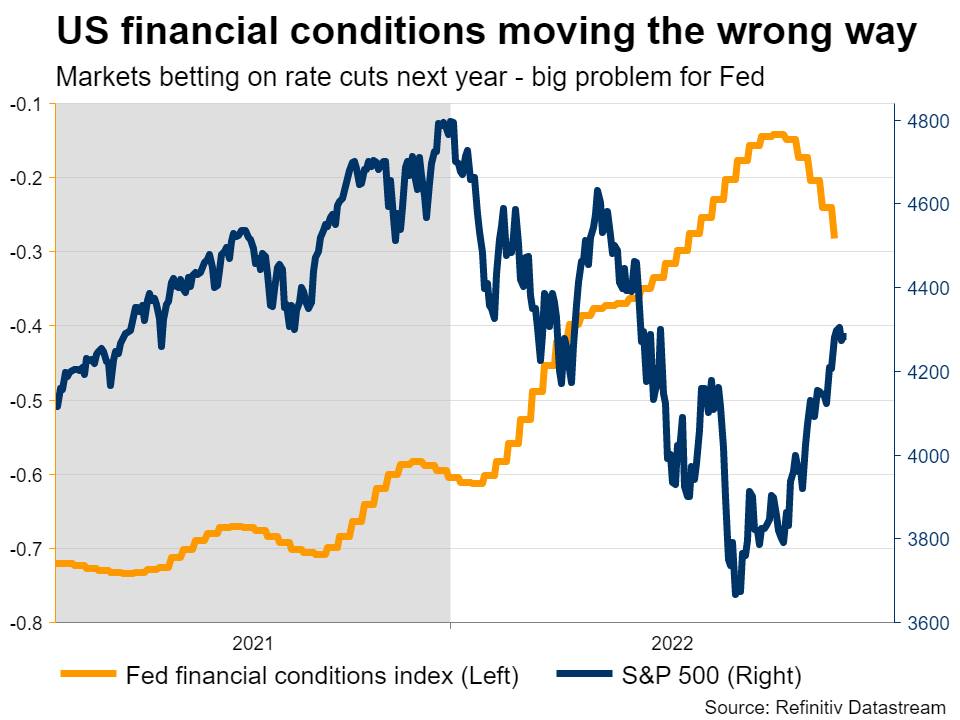
That’s a problem for the Fed. Inflation is still running at 8.5% and looser financial conditions mean it might stay hot for longer. In turn, that would require more monetary tightening to compensate, putting unnecessary pressure on an economy that is already stalling.
As such, the Fed could push back, either by hyping the prospect of another three-quarter-point rate increase in September that markets currently see as a coin toss or through its balance sheet. The process to reduce the balance sheet has already started and will ramp up next month, with $95 billion in securities rolling off per month as they mature.
If Powell and his colleagues want to tighten financial conditions, all they would have to say is they are having conversations on this topic. It would be a hint that the pace can be ramped up further through active sales of bonds or mortgage backed securities, instead of the current passive rolloff.
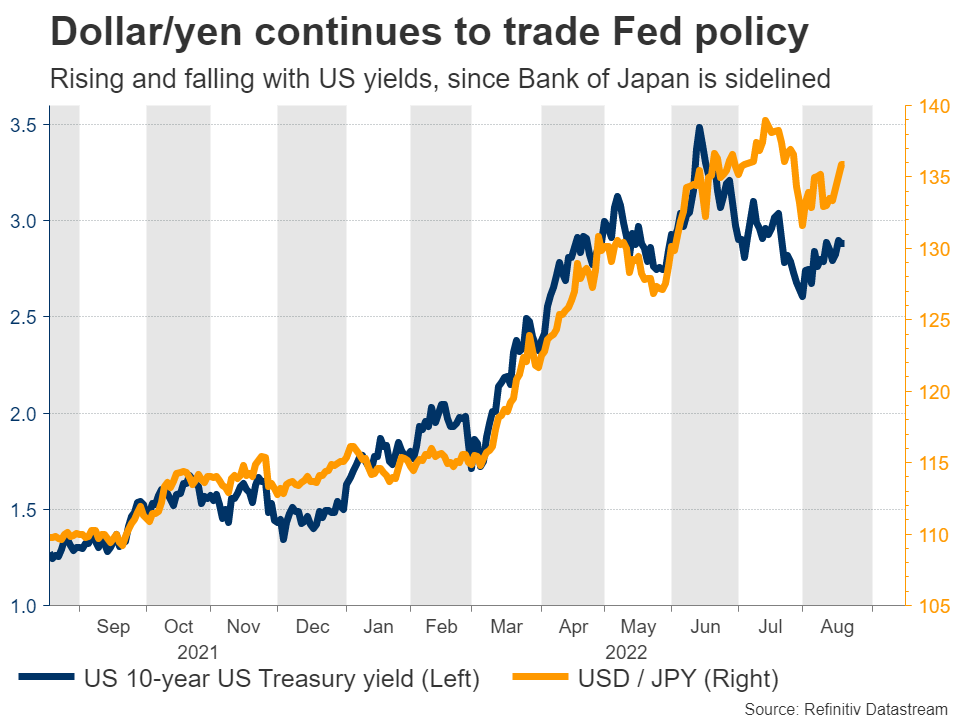
A more forceful tone could dampen the comeback in equity markets and simultaneously add fuel to the US dollar, which continues to steamroll its opponents. The energy crisis has ravaged the euro, the Bank of Japan’s refusal to tighten policy has crippled the yen, and the implosion in China’s property sector has dismantled the commodity currencies.
There’s also a barrage of US data releases, starting with the S&P Global PMIs for August on Tuesday, which will reveal whether growth and inflationary pressures continue to cool off. Other releases include durable goods orders on Wednesday, the second estimate of GDP for Q2 on Thursday, and the core PCE price index on Friday.
European horror show
The past few weeks have been dreadful for the European economy, with the energy shortage pushing natural gas prices on the continent to new records while an intensifying drought in Germany dried up rivers and made it harder to transport supplies.
It’s been a horror show for German industry, whose entire business model used to rely on cheap energy. With gas prices so incredibly high, many companies are uncompetitive and perhaps unprofitable. And if Europe’s powerhouse is struggling, other countries won’t escape unscathed - the supply chain is too interconnected.
Traders will look to the latest PMI business surveys, due out on Tuesday, for an assessment of the damage. Forecasts point to a further cooling of the Eurozone economy in August, with the manufacturing index sinking deeper into contractionary territory and the services print just barely staying in expansion.
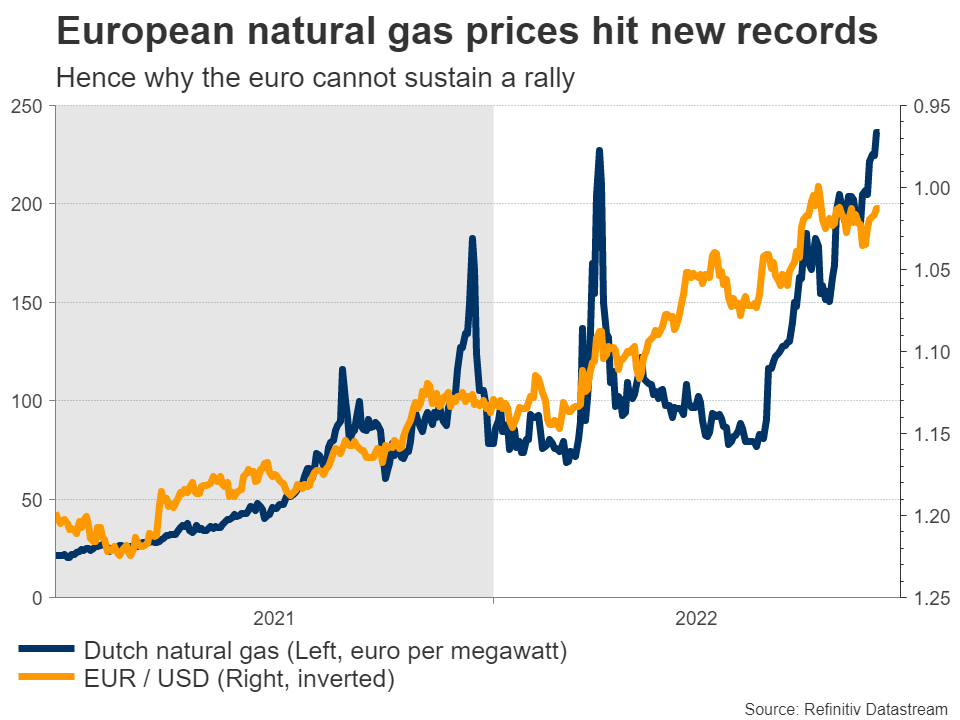
If anything, the risks seem tilted towards disappointment considering that European companies also have high exposure to China, where economic growth is evaporating at an astonishing pace. That could curb bets for a three-quarter-point rate hike by the ECB next month, something investors currently assign a 45% probability to, and spell more trouble for the euro.
The latest relief rally in euro/dollar was rejected by the 50-day moving average and if the Fed indeed strikes a hawkish tone next week while business surveys highlight the Eurozone’s economic problems, there could be another battle around parity.
British PMIs eyed too
The United Kingdom will also get a glimpse at its own PMI surveys for August on Tuesday. It has been a gruesome year for sterling so far, which is underperforming even the war-stricken euro despite the Bank of England raising interest rates at every meeting.
Although the UK doesn’t import much energy from Russia directly, it is not immune to the energy crisis either. The trade trade deficit has blown up as a result and since the UK also runs a large government deficit, sterling has become very sensitive to any shifts in global risk sentiment.
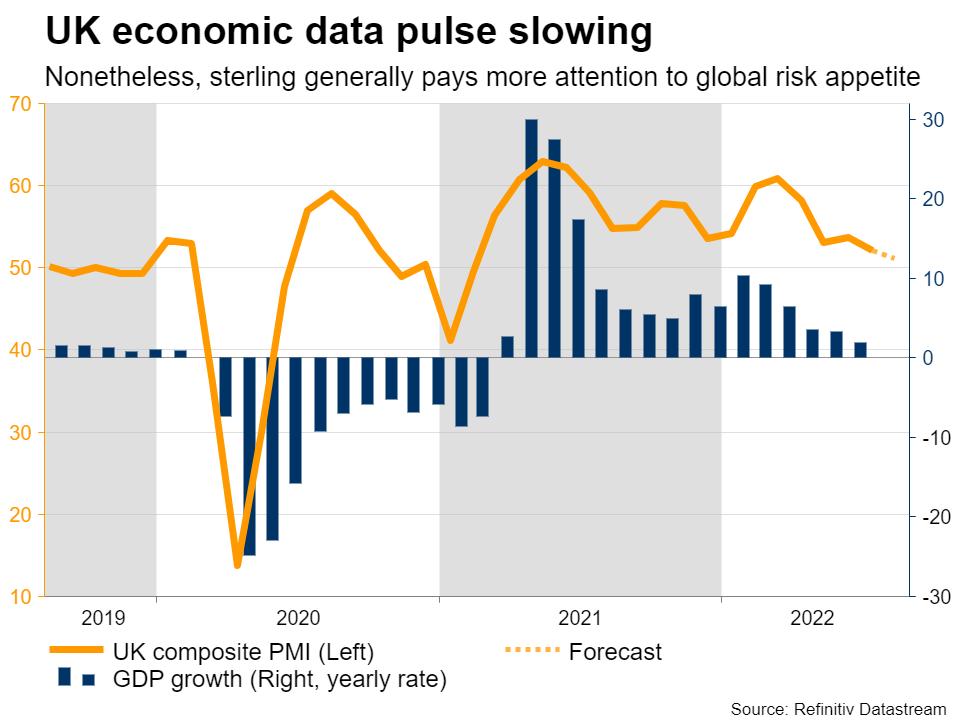
In other words, the main variable for the pound moving forward might be how stock markets perform, since investors already have a good idea of what the BoE will do. In this sense, the risks seem tilted to the downside. Equities have rallied dramatically since June but mainly due to expanding valuations - earnings growth is not impressive and economic data keeps losing momentum.
It might have simply been one epic short squeeze, which seems to be running out of fuel.
Dollar Returns to Growth after a Summer Respite
The US dollar has quite expectedly accelerated its rise. EURUSD is trading less than 50 pips from parity, which it managed to defend in mid-July, having retreated from 20-year lows. GBPUSD has also quickly returned to July lows, losing more than 2.5% since the beginning of the week.
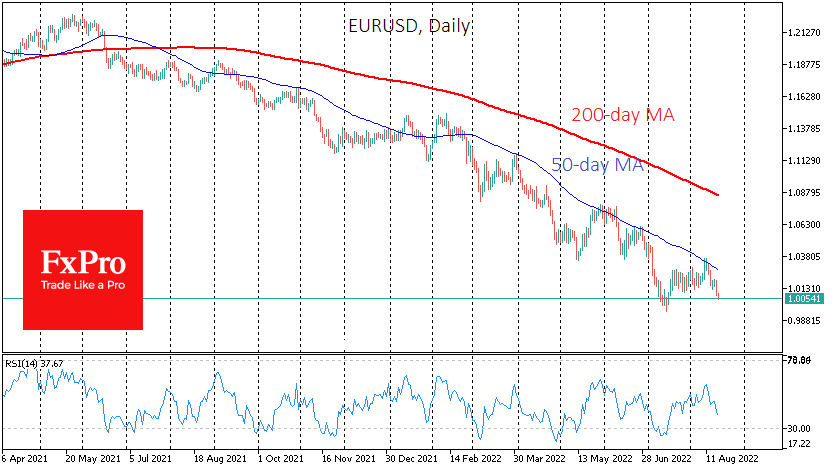
A similar dollar march can be seen in the other most popular currency pairs this week. The dollar bulls didn’t let the retracement pull back after the yearlong rally to new levels. Both macro data and verbal interventions by Fed officials helped this to a large extent.
A report of half-million new jobs in July was combined with a slowdown in inflation in recent days. Such a mix took away some of the fear of an immediate economic deterioration. Still, it also somewhat bolstered faith in the dollar’s purchasing power, which is no longer being eaten up by inflation as much.
That said, FOMC members have not stopped assuring markets that they should and (even more importantly) are willing to do more to curb inflation. It is also worth taking seriously the assurances that the Fed should avoid a surge in inflation expectations, which should be taken as an attitude not to cut rates for quite some time.
During the summer, the dollar bulls had time to refill their guns but did not allow the technical pattern of the dollar growth to be broken.
So EURUSD and GBPUSD got bogged down in the resistance of the 50-day moving average. Separately, EURUSD lost corrective momentum on the approach to 1.0370, where the lows of May and June 2022, December 2016 and January 2017 are concentrated.
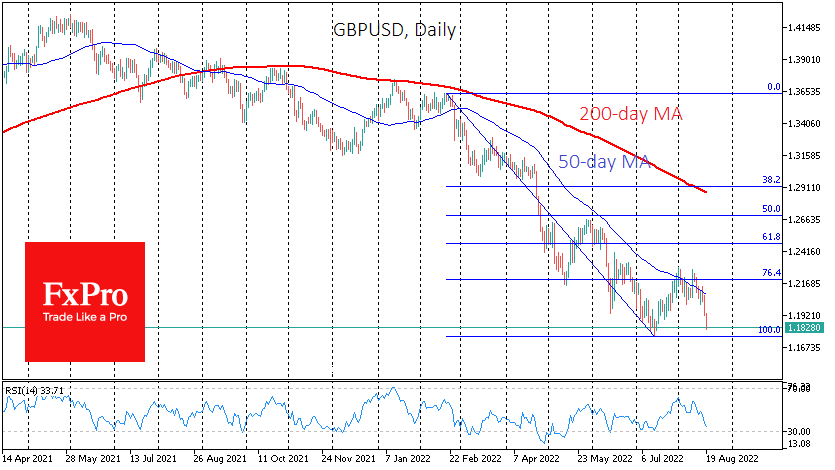
Similarly, in GBPUSD, the former support became resistance, and the recovery has lost momentum at 76.4% of the February-July decline amplitude. A similar Fibonacci retracement works in USDJPY.
The USDCHF and AUDUSD were proving their commitment to their multi-month dollar trends by pulling back from their 200-day averages.
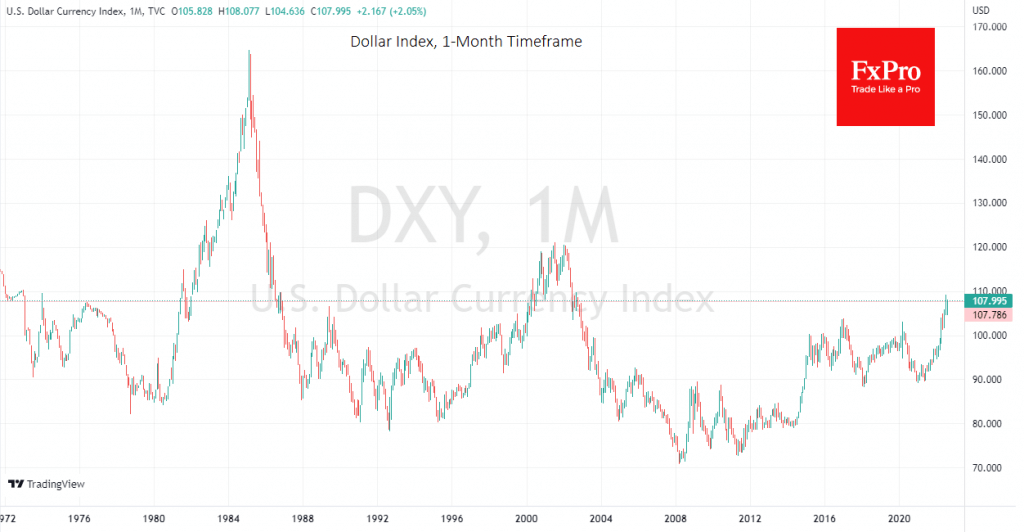
Cautious bulls might wait for the USD index to update the highs near 108.50. But we believe that it is a matter of the next few days. As capitals return from the summer holidays in the last few days, we see a clear upward trend forming for the USD. The rebound in the markets during the summer months now looks not like buying while everyone is afraid but a temporary rebalancing of portfolios and an opportunity for the big players to gain liquidity before a new wave of declines.
If the currency market maintains its momentum, EURUSD will enter September below parity, which could cause even more emotional sell-offs and pull the pair further down. The same is expected from GBPUSD, where a consolidation below 1.18 looks to be in the next few days.
In previous years, a 20% rise in the dollar for 12 months would draw the attention of the US Treasury or the Fed and try to stop the unilateral appreciation of the currency. But a rising dollar is now suppressing commodity prices and imports, bringing the return of inflation closer to normal, doing some of the work instead of the Fed.
Potentially, a path opens up for the dollar in the 2000-2002 highs area, near 120 on the DXY, which is about 10% more from current levels. A wilder scenario with a repeat of the 1980-1985 mega-rally is rejected for the time being because the authorities will try to prevent what they fought against then: the destruction of the US economy and massive defaults by emerging markets due to the excessive strength of the USD.
Dollar is Getting its Momentum Back
Markets:
A new day, a new sell-off on core bond markets. This week showed that the Summer lull is definitely over. Four Fed members dotted the i’s and crossed the t’s yesterday. Current market positioning goes against Fed guidance. Don’t fight the Fed, they said… The US central bank will push forward with its aggressive tightening cycle and doesn’t intend to blink on first economic strains. Rate cuts in 2023 are definitely not on the table.
We’ve witnessed a similar hawkish stance, stressing the need to frontload tightening in order not having to step it up later, in this week’s central bank meetings in New Zealand and Norway. Meanwhile, UK inflation hit double digits and hasn’t reached its peak yet.
Even Japanese core inflation this morning showed an acceleration away from the 2% inflation target (2.4% Y/Y) to the highest level since end 2015. Who’d figured that even BoJ Kuroda would one day face difficulties defending his ultra-easy monetary policy?
In any case, the Fed is talking and the market is listening again. Especially with Fed Chair Powell yesterday being confirmed as key speaker at next week’s Jackson Hole Symposium. “Reassessing constraints on the economy and policy” is this year’s general topic, but Powell will just zoom in on the economic (and probably monetary) outlook.
US yields today rise by 5.7 bps (2-yr) to 7.5 bps (30-yr). The US 10-yr yield is close to touching the 3% mark for the first time since mid-July. European bonds continue their underperformance, having outperformed in the mid-June, end-July recovery. The ECB has quite some catching-up to do with German ECB member Schnabel yesterday suggesting willingness and readiness to do so.
This morning’s German July producer prices also showed a record jump: 5.3% M/M and 37.2% Y/Y (from 32.7% Y/Y), suggesting that price pressure will remain elevated over the next months. German yields rise by 8.3 bps (2-yr) to 11.3 bps (10-yr). The EU 10y swap rate sits back above 2% for the first time since July 21 (inaugural ECB rate hike). Greek and Italian 10-yr yield spreads widen by 6 bps. UK yields add 9.2 bps (2-yr) to 12.8 bps (30-yr).
It’s the first time this week that the longer end of the curve underperforms the front end. Details show both inflation expectations, but especially real yields being responsible for the move.
Stock markets as a consequence suffer a second beating this week. Their Summer rally is over as core bonds turn back in sell-off mode. Main European indices lose around 0.75% with US gauges opening up to 1% softer (Nasdaq).
The dollar is getting its momentum back. EUR/USD yesterday lost 1.01 and changes hands near 1.0050 today. A new attack of parity is in the making. The July YTD low stands at 0.9952.
A hawkish Fed, a more difficult risk climate and potentially weak EMU PMI’s all point in the direction of a lower EUR/USD rate. The trade-weighted dollar reaches 108 with the YTD high at 109.29. Higher core bond yields weigh on the yen as well. USD/JPY is also marching forward to the 139.39 YTD high.
The euro ranks second amongst majors with a technical break in EUR/GBP accelerating the increase in the pair. EUR/GBP breaks out of the corrective downward trend channel in place since mid-June, taking out 0.85.
This morning’s Gfk consumer confidence (weakest since start of the series in 1974) painted an extremely grim picture for UK households. Cable (GBP/USD) is a whisker away from the 1.176 YTD low. News Headlines:Average Polish wage growth exceeded CPI in July. Wages rose by 3.4% M/M and by 15.8% Y/Y, compared to an inflation reading of 15.6% Y/Y. Details showed that especially state-owned mines and power utilities granted heft salary boosts to their employees. The mining industry for example wanted to mitigate the risks of strikes with a monthly wage increase of 26%! The National Bank of Poland slowed its tightening cycle early July (+50 bps to 6.5%), suggesting limited additional scope to extend the normalization cycle. Money markets currently discount a 7.25% cycle peak around the turn of the year.
US Dollar Recovers as Fed Sticks to its Hike Plan
EUR/USD under pressure as recession looms
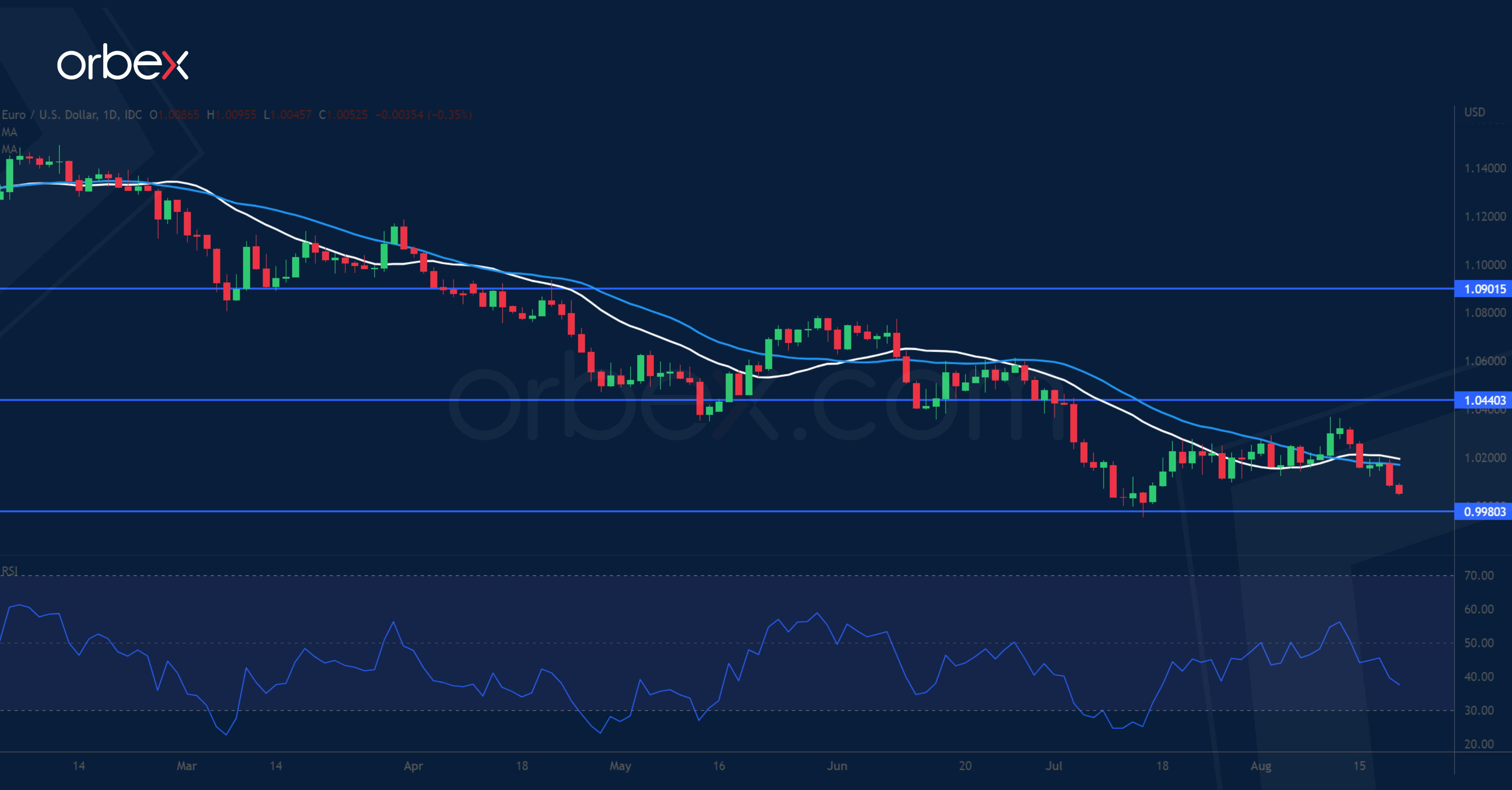
The euro struggles over dimming growth outlooks. The recession risk is not negligible given the energy crisis in Europe, and growth data have pointed to a slowdown. However, a solid labour market in the euro-zone would suggest a mild downturn, alleviating fears of a ‘hard landing’. With inflation over four times the ECB's 2% target, another rate hike in September seems to be a done deal and the market is leaning towards an additional 50 basis points. The single currency may find some respite but will have a hard time against the US dollar which benefits from an uptrend inertia. 0.9980 is the last support and 1.0440 the hurdle ahead.
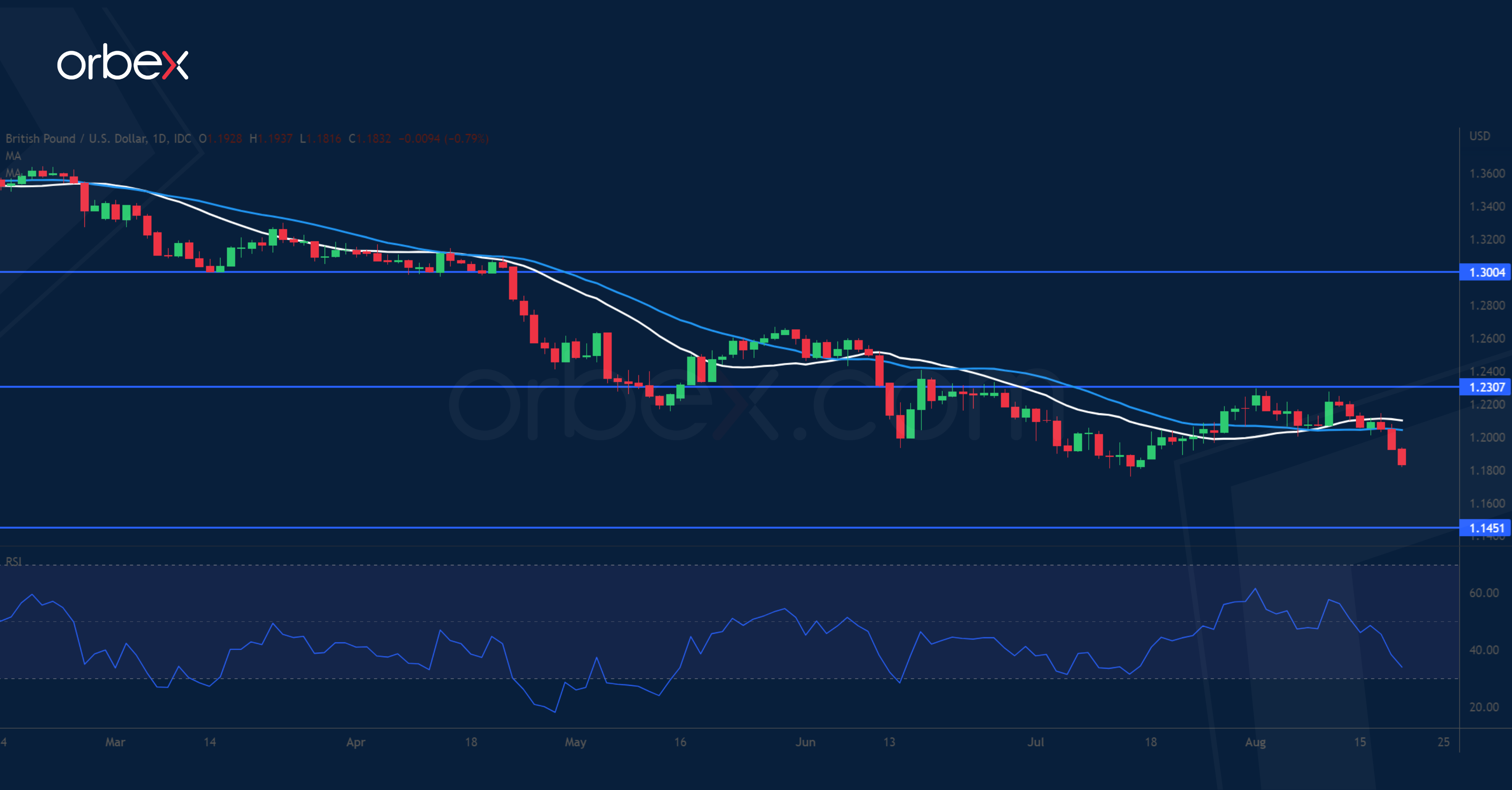
GBP/USD capped by stubborn inflation
The pound struggles over fragile economic fundamentals. The UK’s inflation accelerated to a double digit in July, hitting its highest level since four decades. The BoE is facing the thorny problem of price pressure and recessionary headwinds. There is growing belief that the US inflation may peak soon, leading to a slower tightening pace by the Fed. As the BoE catches up in terms of the rate differential, Sterling could meet some buying interest. The major downside risk is worries that Britain could be more vulnerable to a recession than other countries. 1.2300 is the closest resistance and March 2020’s low at 1.1450 is the target.
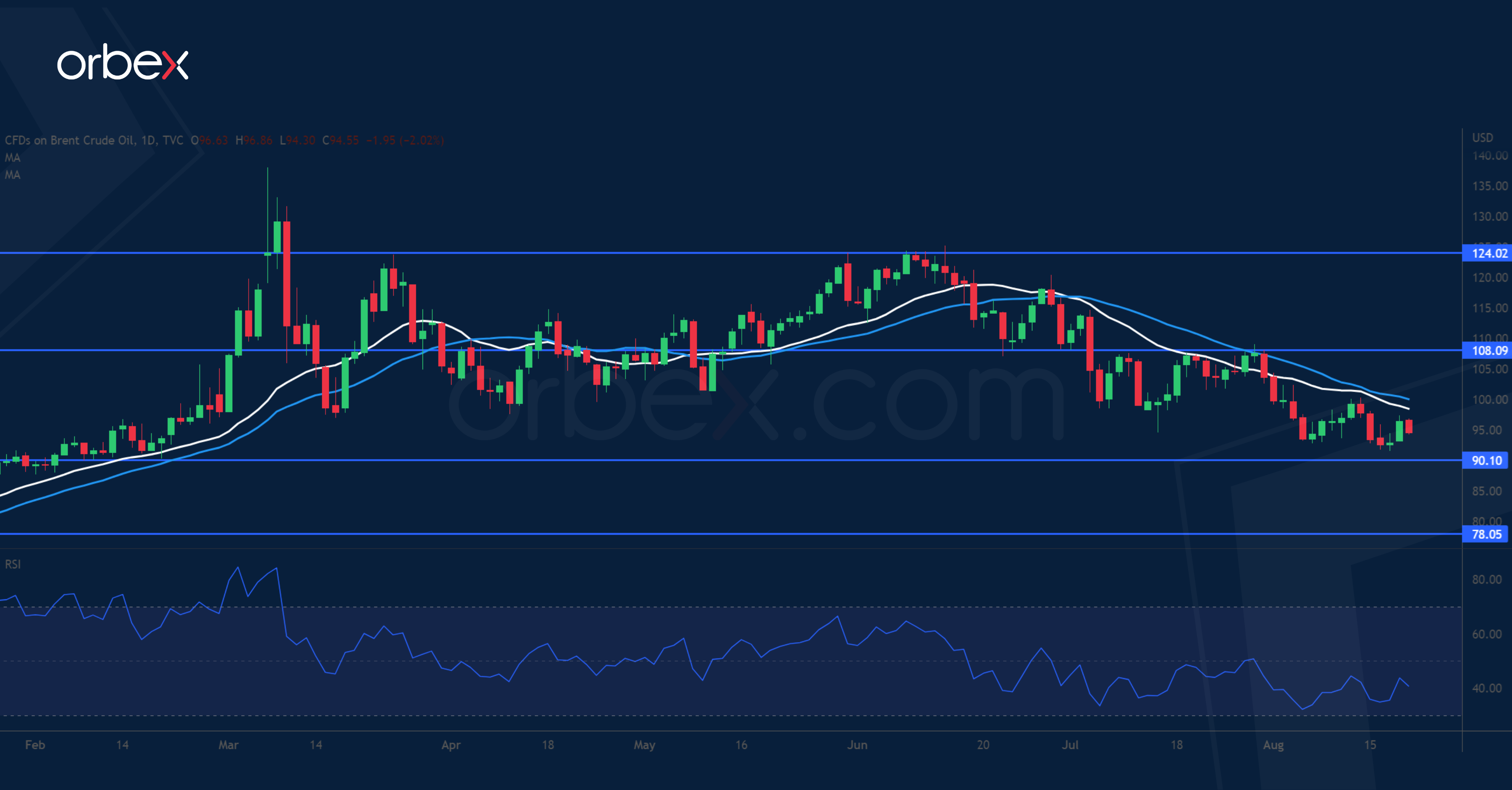
UK oil falls as supply rises
Oil prices retreats as rising output may outweigh global demand. Steady consumption eases concern of slowing economic growth. Rising imports from Europe to replace Russian fuel have triggered a sharp drop in US crude inventories and refineries are set to keep running at near full capacity to meet both domestic and international demand. Planned increase in production from OPEC+ members would further loosen supply constraints. This shift in supply and demand balance is likely to keep the commodity under pressure. Brent spot contracts are exchanging near the psychological level of 90.00 and 108.00 is the first resistance.
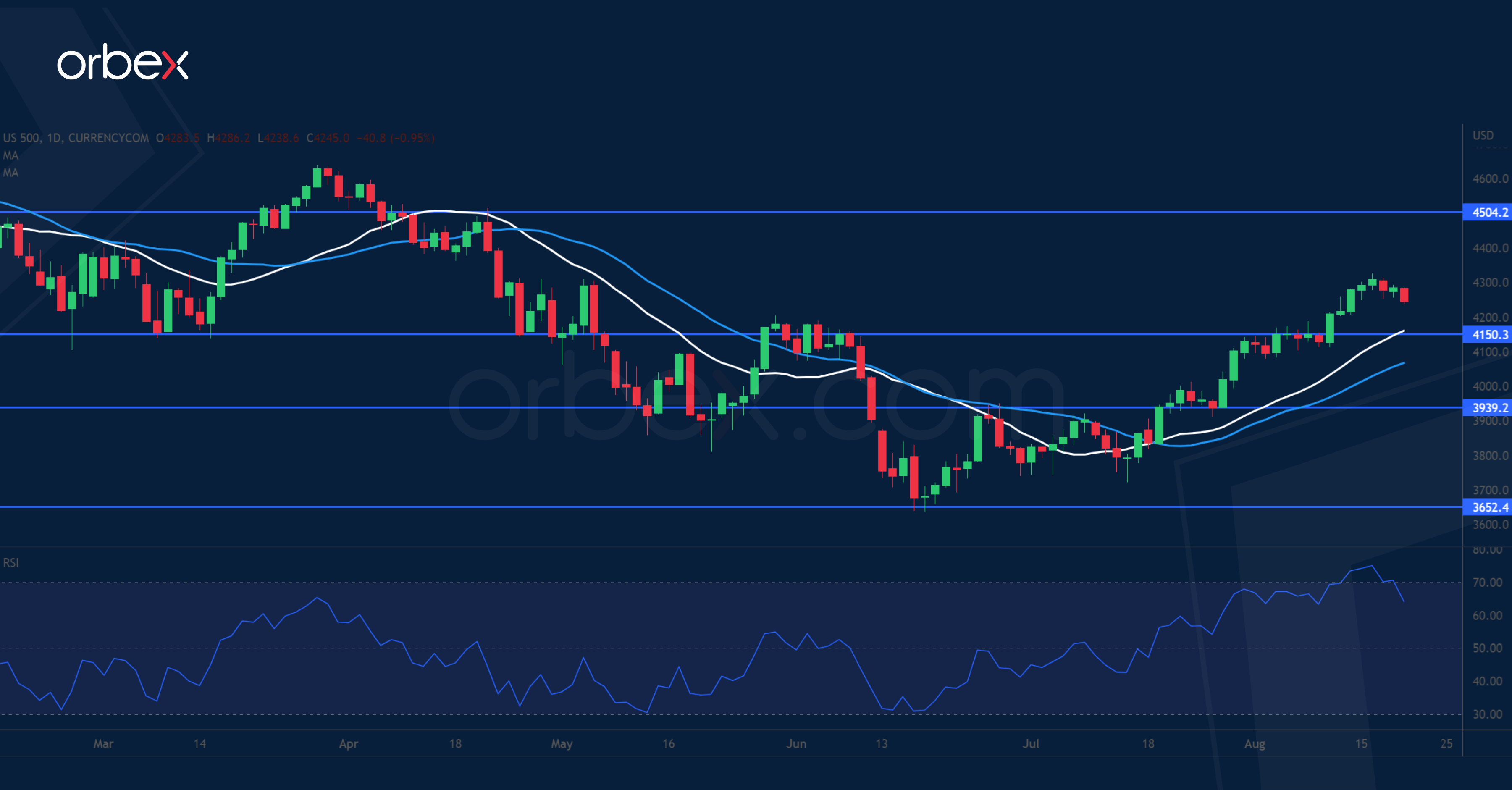
SPX 500 retreats as more tightening to come
The S&P 500 rallies over the prospect of a moderation in tightening. As the Fed pushes rates to the fine line between a ‘soft landing’ and a recession, the pace and the size of rate hikes would eventually go down hill. The question is whether the peak is in sight. Traders are split between a 50 or 75bp hike in the next meeting as the central bank is yet to acknowledge a turning point in price pressures. But as officials are committed to tame inflation for as long as needed, the downside risk is that a lengthy hike journey would lift interest rates to a prohibitive level. The index is heading towards 4500 and 4150 has turned into a support.
Canada: Higher Prices Lift Retail Sales in June
Retail sales rose modestly in June, up 1.1% from a month ago. This is well above Statistics Canada's preliminary estimate for a 0.3% gain. However, growth was considerably softer in inflation-adjusted terms, with the monthly volume of sales up just 0.2%.
Statistics Canada's flash estimate for July points to a 2.0% decline.
The headline in June was boosted by higher sales at gasoline stations and motor vehicle and parts dealers. Receipts at gasoline stations were up 3.9% m/m on the back another leg up in gas prices. Adjusted for the price effect, gasoline satiations' sales actually fell by 1.3% in volume terms – the second consecutive monthly drop. Sales at motor vehicle and parts dealers were up 1.8% on the month.
Core sales, which exclude autos and gasoline, edged up just (+0.2% m/m). This is the smallest increase since the start of the year. Core sales were flat in inflation-adjusted terms.
- Sales rose at general merchandise stores (+1.1%), health & personal care stores (+1.0%), and clothing & accessories stores (+1.8%). Sales were also higher at miscellaneous store retailers (+1.8%), following a steep decline in the month prior.
- However, sale pulled back at electronics and appliance stores (-2.4%) and were flat at the building material and garden equipment dealers. Sales were also lower at food and beverage stores (-1.1%), reversing the increase in the prior month, and sporting goods, hobby and book stores (-0.8%).
- E-commerce sales rose by 4.5% in June– a forth consecutive monthly increase – as consumers looked for better deals online amid rising prices.
Key Implications
The headline growth for retail sales surprised to the upside in June, however, looking under the hood reveals that much of the gain was due to higher prices. Adjusting for inflation, total sales were up just 0.2% on the month while core sales were flat. With inflation running at a multi-decade high, higher prices have been giving a lift to nominal retail sales figures, but inflation-adjusted numbers tell a different story. Sales at gas stations are a prime example. While in dollar terms gasoline sales were up in both June and July, in volume terms sales declined in both of these months, as Canadians cut back on driving to mitigate some of the impact of sky-high prices at the pump.
As we noted in today's report, consumer spending on goods and services appears to have eased in July after strong gains during the initial reopening months. While some of the moderation is to be expected after strong gains during the initial reopening months, higher prices are also weighing on consumers' purchasing power. There is still appetite among consumers for experiences like dining-out, but it is only a matter of time before pent-up demand gets satiated and intensified financial headwinds – red-hot inflation, higher interest rates and an erosion of household wealth – prompt consumers to tighten their purse stings, particularly when it comes to discretionary items.
Fortunately, gasoline prices eased in July, which should give consumers some reprieve. They are going to need those savings given that price growth continued to accelerate for many other key items, such as food. With the inflation genie still out of the bottle, the Bank of Canada is expected to take rates higher again at its next meeting in less than three weeks.
Oil Prices Might Cause Another Inflation Wave
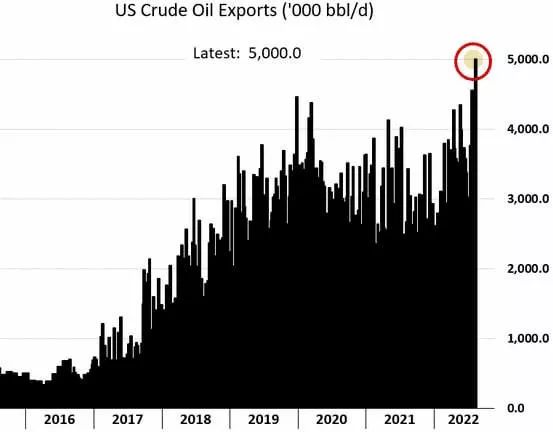
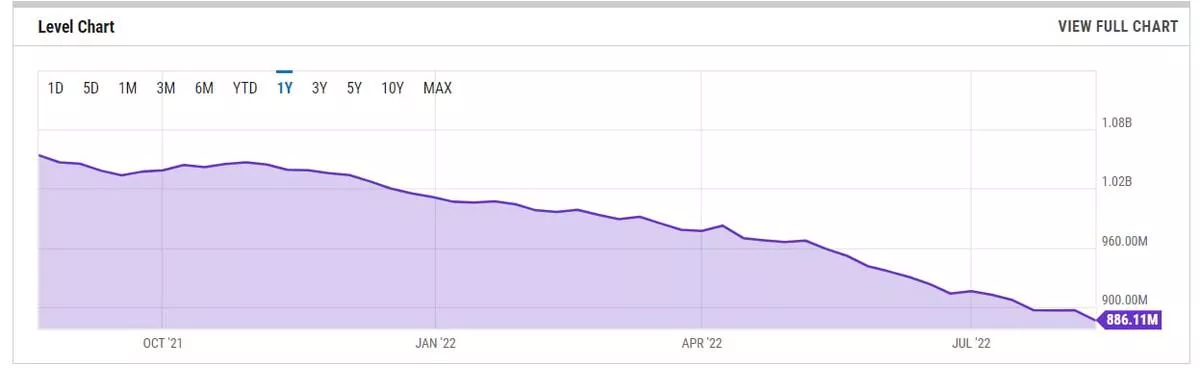
US oil exports reached a record last week at five million barrels a day, according to Energy Information Administration data. Moreover, EIA reported the US oil inventory shortage by 7 million barrels last week, combined with the decline in the US oil production of 12.1 million BPD versus 12.2 million BPD earlier.
The fact that the United States spends more oil from its reserves while the production stays the same explains why the global oil inventories have decreased in the United States since 2019.
In the current conjunction, it’s too early to expect a cooling of oil prices soon. Moreover, more factors make the situation even worse:
1) Sanctions versus Russia due to the conflict in Eastern Europe.
Sanctions include:
- European Union ban on all imports of oil brought in by sea from Russia by the end of 2022.
- The US ban on all Russian oil and gas imports.
- The UK ban on all oil imports by the end of 2022.
Russia has always been one of the biggest oil exporters in the world and the largest one for the European continent. Nowadays, the USA has replaced Russia in the European market, but how long can the USA supply the European continent with its reserves? The question is rhetorical.
2) The United States and Asian countries replace Russian oil in Europe, but it’s too expensive.
Giant supertankers hauling crude oil across the globe have made the most money in more than two years, thanks to swelling shipments from the US and the Middle East. Benchmark earnings for huge crude carriers neared $40 000 a day on Wednesday to hit the highest level since June 2020. Assessments in the industry standard Worldscale system have jumped almost 40% over a week. Transporting oil by sea is not only expensive, but it takes much more time. Moreover, natural disasters such as droughts and storms can affect supply chains.
The industry is underinvested.
Earlier, we have already highlighted the fact that the oil industry is underinvested. New OPEC Secretary-General Haitham Al Ghais confirmed it. "There are other factors beyond OPEC that are really behind the spike we have seen in gas [and] in oil. And again, I think in a nutshell, for me, it is underinvestment — chronic underinvestment," he added.
For example, the main global oil supplier, Saudi Arabia, might raise its production capacity to 13 million barrels per day by 2027 from a capacity of 12 million now, and "after that, the Kingdom will not have any more capacity to increase production."
3) Chinese economy is going through hard times. But how long will it last?
According to the latest data, Chinese industrial production was up 3.8% year-on-year in July, but down from 3.9% in June and well below analysts' forecasts. To answer that, the People's Bank of China increased key interest rates in a surprise move. If the Chinese central bank keeps supporting the economy, the recession might be avoided.China is the first oil exporter in the world. Thus, potential economic stabilization will significantly increase the oil supply, pushing prices higher.
The bottom line
The exclusion of Russian oil for the European countries and the US, supply chain risks, sector underinvestment, the inability to increase production, the decrease in US inventories, and potential Chinese economic recovery - factors that lead to the energy market crisis and keep oil prices on the high level. In turn, high oil prices cause rising inflation in the US and European countries.
However, the US dollar wins in times of rising inflation, while other currencies stay under heavy pressure.
Technical analysis
XBRUSD, daily chart
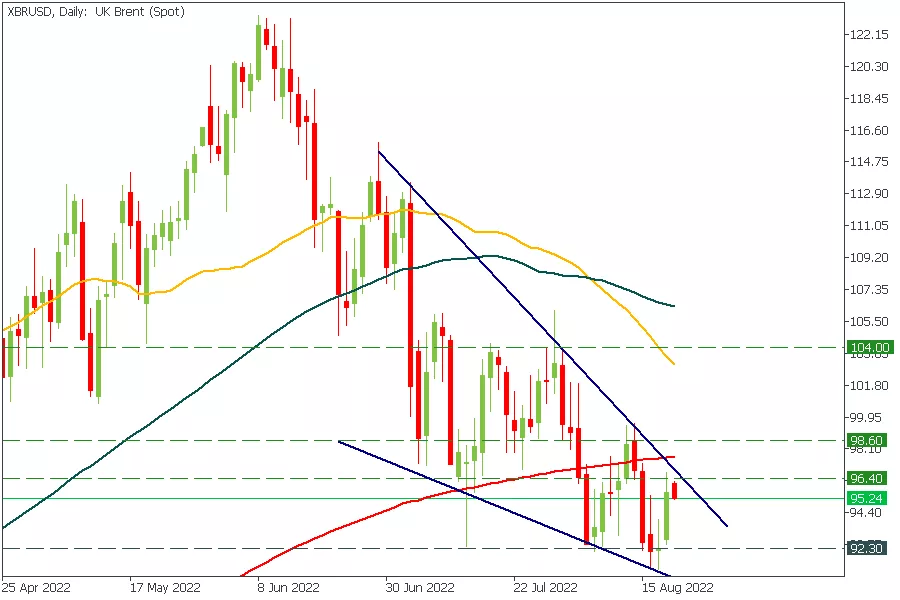
The price is consolidating in the bullish wedge ahead of some key news. After the breakout of the upper wedge’s border, XBRUSD will head towards 98.60. The text target will be 104.00.
XBRUSD, weekly
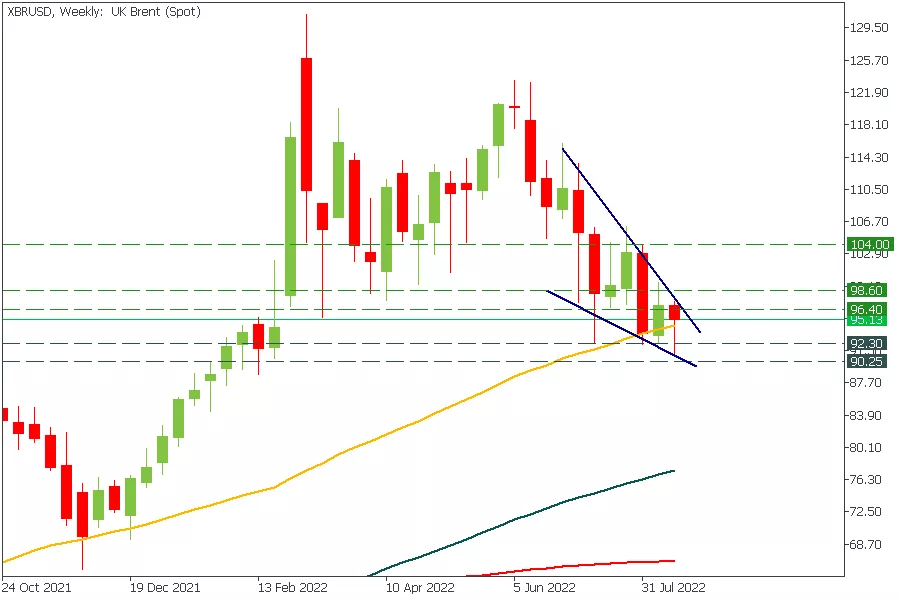
Another important fact is that buyers still manage to hold prices above the 50-week moving average. If this weekly candle closes above this support, it will be a sign of an upcoming bull run during the upcoming week.
US dollar index, weekly
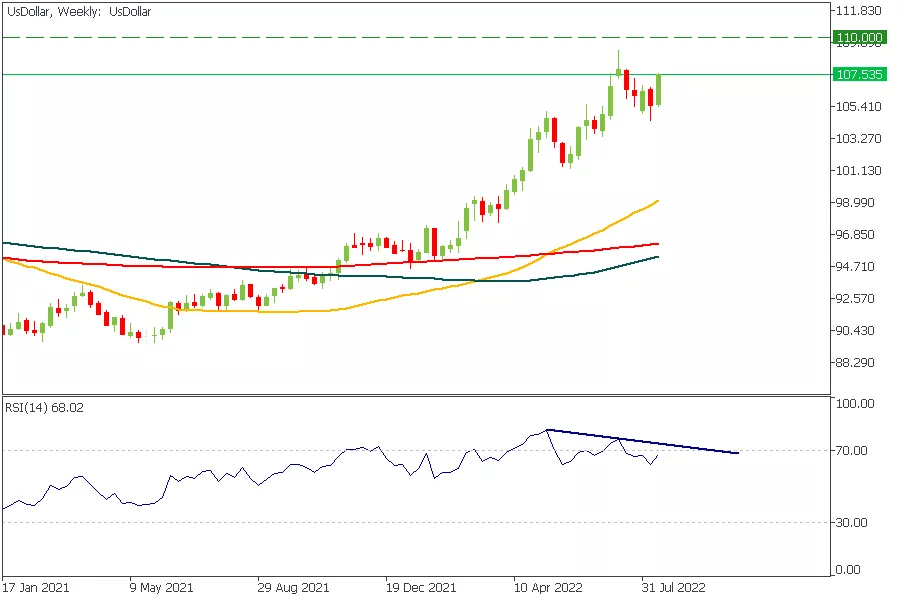
US dollar index is heading towards the 110.00 resistance, the potential point of the global reversal for the USD. Recent pump highlights the probability of rising inflation in the United States, which might be provoked by the upcoming oil prices jump.
If you want to find the highest point for the US dollar index, draw a “divergence” line on the weekly RSI chart. Technically, if the RSI touches this trendline and bounces off from it, the USD will finally reverse.