

Sample Category Title
Canada Sheds Jobs in July for Second Straight Month
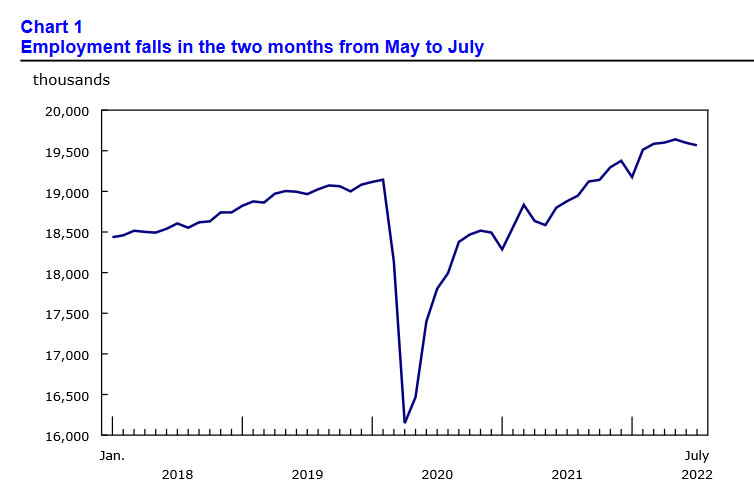
The Canadian labour market shed 30.6k positions in July. Losses were spread among full-time (-13.1k) and part-time (-17.5k) positions.
Public sector employment was responsible for the bulk of the decline as it shed 51k positions. However, private sector employment also dropped (-13.8k). In contrast, self-employment jumped by 34.2k positions.
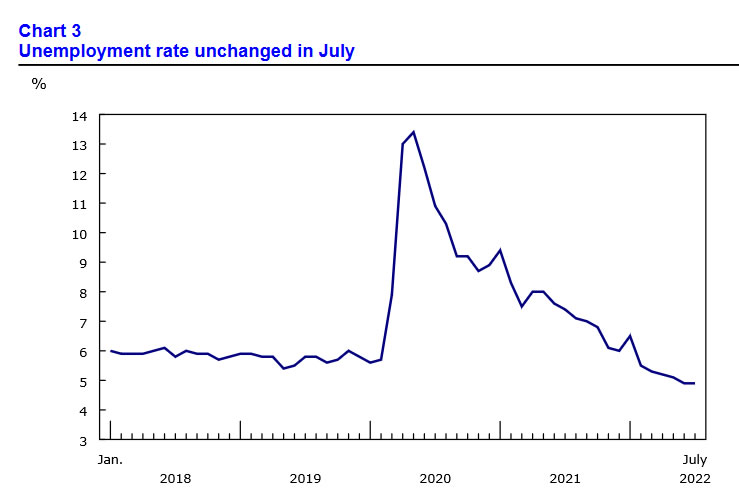
Even with the headline drop in employment, the was unemployment rate was unchanged at 4.9% - matching an historic low – as the labour force fell by 27k and the participation rate declined by 0.2 ppts to 64.7%. Meanwhile, the number of people unemployed long-term declined by 23k, marking the third consecutive drop.
By industry, job losses were concentrated in the services sector, where employment fell by 53k. Losses were spread across several industries, including wholesale and retail trade (-27k), healthcare and social assistance (-22k) and educational services (-18k). In contrast, employment in the goods producing sector was up 23k in June, lifted by manufacturing (+7k) and construction (+8k).
On a geographic basis, the bulk of the national jobs decline took place in Ontario, were employment fell by 27k positions. Elsewhere, the report noted a significant decline in PEI (-2.3k positions) and little change in all other provinces.
Lastly, total hours worked declined 0.5% month-on-month while average hourly earnings were up 5.2% year-on-year, matching June's pace.
Key Implications
That's two in a row in terms of weak headline jobs prints, and employment has now averaged an 11k decline over the past three months. This is consistent with our view that economic growth will soften in the second half of the year. The details skewed to the softer end in July, as full-time employment accounted for a larger share of the overall jobs decline than in June, and hours worked also fell. The latter is particularly notable as it could signal a soft print for monthly GDP, following flat growth in May and a sub-trend gain in June (based on Statcan's preliminary estimate).
Taking some sting away from the report is the fact that full-time employment only modestly retraced May's huge gain in June and July, and is still-up at healthy 4.7% year-on-year. In addition, wage growth continues to be robust (which will provide some offset to household incomes from inflation).
Although the jobs market and underlying economic growth is softening, the Bank of Canada remains determined to rein in sky-high inflation and keep expectations anchored. As such, we expect them to take their policy rate above neutral, with it ending the year at 3.25%.
GBP/USD Slides as Nonfarm Payrolls Surges
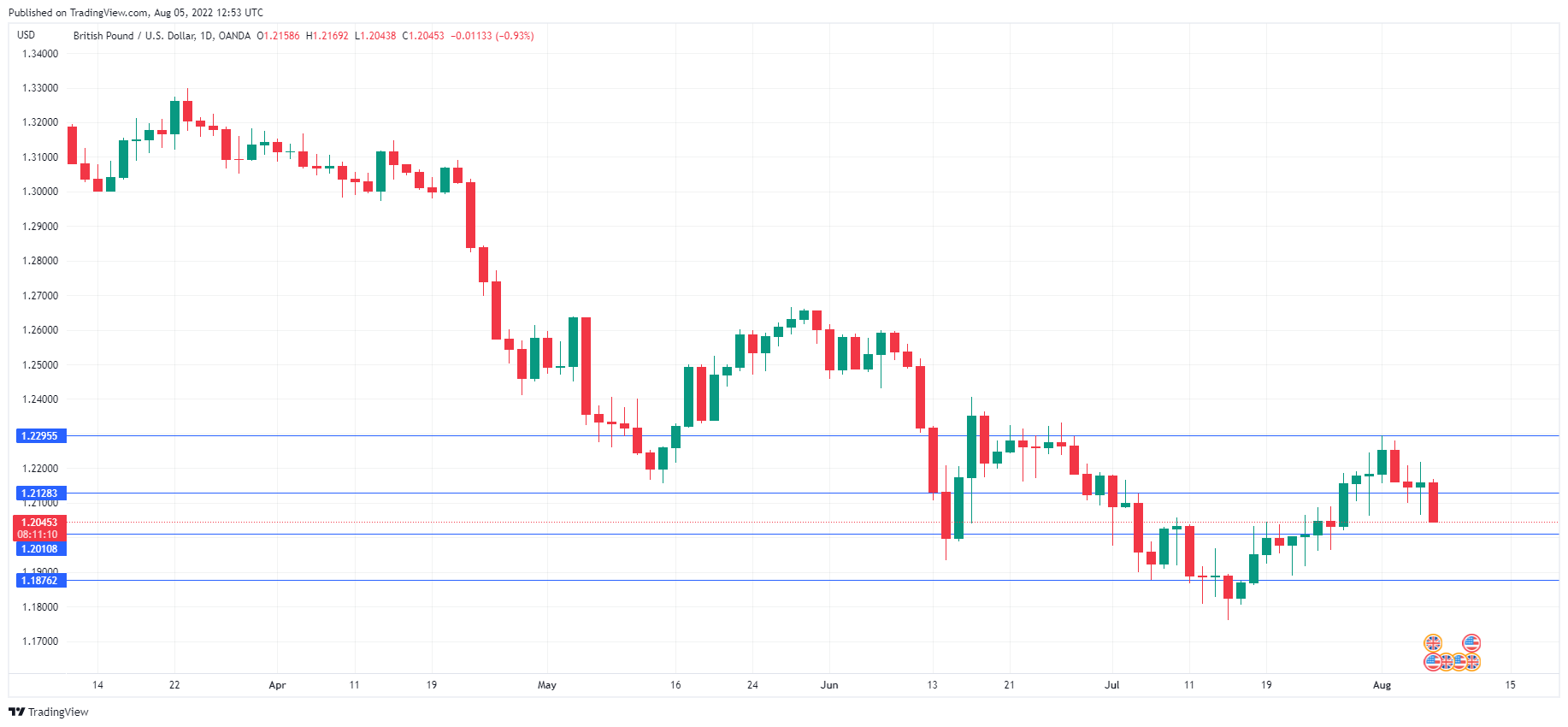
The British pound is falling sharply in the North American session, after a massively strong US nonfarm payment release. GBP/USD is trading at 1.2040, down 0.98% on the day.
US Nonfarm Payrolls smashes higher
It wasn’t so long ago that US nonfarm payrolls was one of the most anticipated events on the economic calendar and often had a significant impact on the movement of the US dollar. That has changed in the new economic landscape of red-hot inflation and central banks raising interest rates practically every month. The markets seem more absorbed with new inflation records and the threat of recession, which may make for more catchy headlines than labor market statistics.
Today, however, NFP demonstrated its ability to be a market-mover. The July gain of 528 thousand crushed the estimate of 250 thousand and follows the June release of 372 thousand. The US dollar has responded with strong gains against the majors, as a strong labour market will enable the Fed to remain hawkish with its rate moves.
BoE delivers with a 50bp hike
The BoE was widely expected to raise rates by 50bp, and the central bank did exactly that. The MPC vote was 8-1 in favour, with one member voting for a 25bp hike. This split shows that Governor Bailey appears to have the MPC members in line, which should bolster Governor Bailey’s credibility. With inflation hitting 9.4% in June and no sign of a peak, the BoE has been accused of raising a white flag with regard to inflation. The 50bp increase, the biggest in 30 years, is an important step in fighting inflation, which has hit 9.4% and shows no signs of peaking. Even with this hike, the Bank Rate is at 1.75%, well behind the Federal Reserve, the central banks of Canada and New Zealand and others.
The BoE’s rate increase was accompanied by a stark warning of a prolonged recession, and the pound responded with losses. The pound managed to recover these losses but it is clear that the currency isn’t getting any support from the BoE’s rate moves, with such a huge gap between inflation levels and current rates.
Investors were also less than impressed as the BoE said that it might ease up on raising rates in the coming months. Governor Bailey has said he would be forceful in combating inflation, but the message that the central bank doesn’t plan to be forceful with its forward guidance is weighing on the pound.
GBP/USD Technical
- GBP/USD is testing resistance at 1.2128. Next, there is resistance at 1.2295
- There is support at 1.2010 and 1.1876
USD/JPY Mid-Day Outlook
Daily Pivots: (S1) 132.31; (P) 133.37; (R1) 133.97; More...
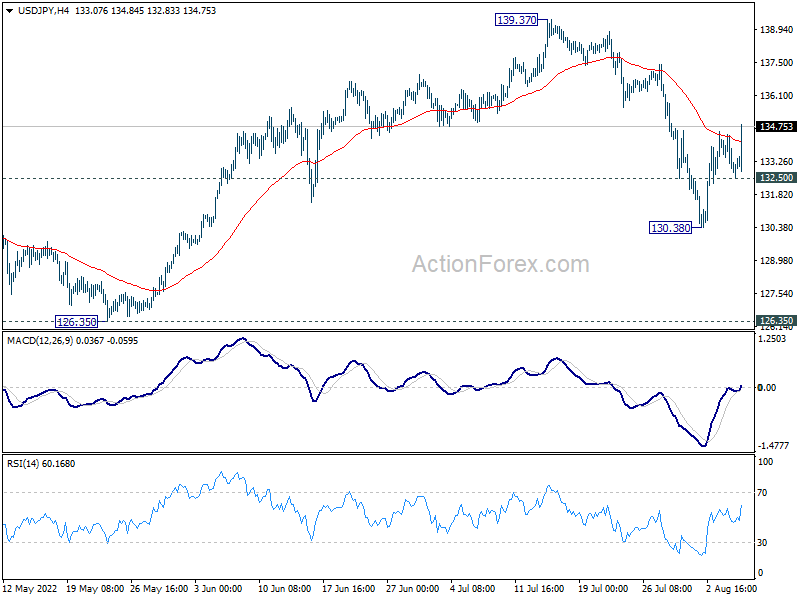
USD/JPY's rebound from 130.38 resumes after brief retreat. Break of 134.58 resistance suggests that correction from 139.37 has completed. Intraday bias is back to the upside for retesting 139.37 high. On the downside, below 132.50 minor support will resume the correction from 139.337 through 130.38 instead.
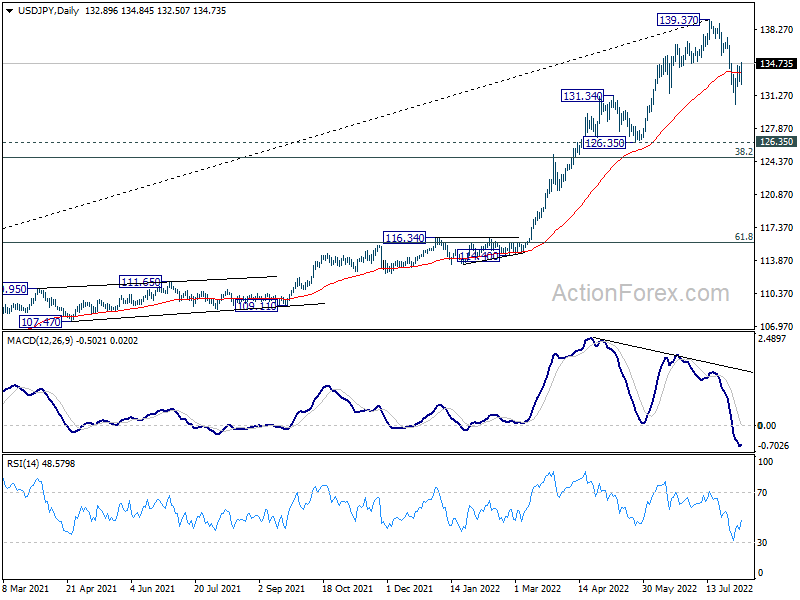
In the bigger picture, a medium term top should be in place at 139.37, on bearish divergence condition in daily MACD. Fall from there could be correcting whole up trend from 101.18 (2020 low). While deeper decline cannot be ruled out, outlook will stays bullish as long as 55 week EMA (now at 121.84) holds. Long term up trend is expected to resume through 139.37 at a later stage, after the correction finishes.
Dollar Soars Broadly after All-Round Strong NFP
Dollar soars broadly, together with benchmark treasury yields, after an all around strong non-farm payroll report. At the same times US futures tumble, apparently on expectations Fed's tightening pace will continue with such healthy job market. The greenback is now the strongest one for the week and the question is, whether it could break through some key near term levels before weekly close.
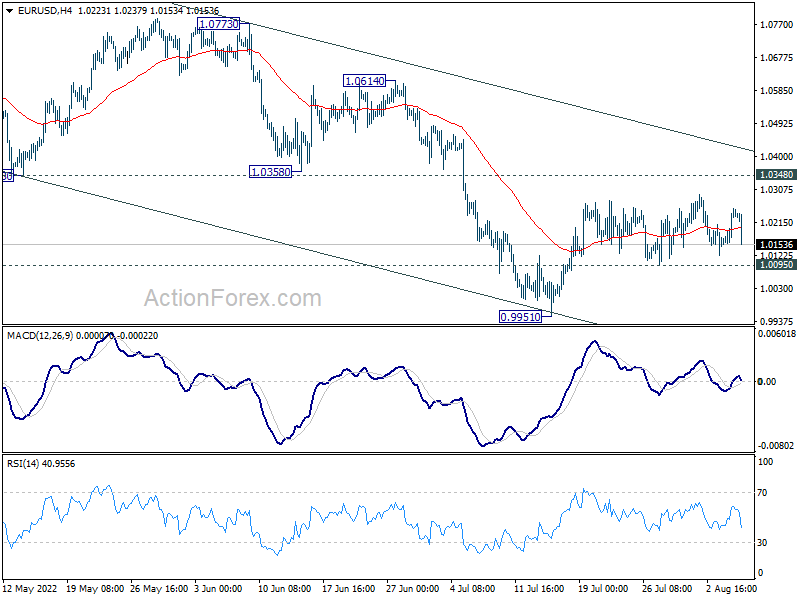
Technically, the most important level to monitor is 1.0095 minor support in EUR/USD. Firm break there will argue that medium term down trend is ready to resume through 0.9951 low. GBP/USD has already made progress on breaking 1.20623 minor support. USD/JPY also breaks 134.58 minor resistance. These two are both Dollar positive developments.
In Europe, at the time of writing, FTSE is down -0.34%. DAX is down -0.34%. CAC is down -0.71%. Germany 10-year yield is up 0.070 at 0.873. Earlier in Asia, Nikkei rose 0.87%. Hong Kong HSI rose 0.14%. China Shanghai SSE rose 1.19%. Singapore Strait Times rose 0.40%. Japan 10-year JGB yield dropped -0.0125 to 0.163.
US NFP grew 528k in Jul, unemployment rate down to 3.5%, strong wage growth
US non-farm payroll employment grew strongly by 528k in July, well above expectation of 250k. That's also much higher than the average gain of 388k over the prior 4 months. Total non-farm employment has also reached its pre-pandemic level.
Unemployment rate dropped from 3.6% to 3.5%, better than expectation of 3.6%. Participation rate dropped -0.1% to 62.1%.
Average hourly earnings rose 0.5% mom in July, above expectation of 0.3% mom.
Canada employment dropped -30.6k in Jul, unemployment rate unchanged at 4.9%
Canada employment dropped -30.6k in July, much worse than expectation of 25.0k growth. Services-producing jobs dropped -53k or -0.3% while goods-producing jobs rose 23k or 0.6%.
Unemployment rate was unchanged at 4.9%, below expectation of 5.0%, but matched the historic low reached in June. Total hours worked were down -0.5%. Average hourly wages was up 5.2% yoy.
BoE Bailey: Businesses concerned about hiring, not raising prices
BoE Governor Andrew Bailey said at the Today Programme that the real risks is import inflation from energy and food becomes "embedded". As firms are not struggling to raise prices, inflation would be comes worse when its embedded.
"The first thing they (businesses) want to talk to me about is that businesses have trouble hiring people, and that is still going on. They're also saying to us actually they're not finding it difficult to raise prices at the moment. That can't go on," he said.
Bailey also said the interest rates are not going to go back to pre-2008 financial crisis levels. Additionally, "we don't think that the rolling back of QE and the sale of assets is going to have a big impact on market interest rates".
BoE Pill: We need flexibility on rates according to circumstances
BoE Chief Economist Huw Pill told Bloomberg Television, the BoE is not "behind the curve" on tightening.
But he added that investors should not assume there will be another 50bps rate hike in September. "Given the uncertainties we face, I think we need flexibility either to go further, or to stay where we are, and the pace at which we go further to be varied according to circumstances," he said.
Australia AiG services rose to 51.7, two-speed sector emerges
Australia AiG Performance of Services rose 2.9 pts to 51.7 in July. Sales jumped 7.4 to 49.3. However, employment dropped -2.9 to 52.4. New orders rose 1.7 to 50.6. Supplier deliveries rose 5.9 to 47.6. Input prices rose 5.3 to 74.3. Selling prices dropped -3.8 to 63.4.
Innes Willox, Chief Executive of Ai Group, said: "We are seeing a 'two-speed' services sector emerge as businesses contend with labour shortages and rising interest rates. Business & property and personal services grew dramatically in July, while retail & hospitality and logistics fell dramatically. Chronic labour shortages and a super-charged winter spike in absenteeism are large and growing challenges for labour-intensive service industries. And rising interest rates are dampening consumer sentiment, casting a shadow over consumer-facing sectors."
USD/JPY Mid-Day Outlook
Daily Pivots: (S1) 132.31; (P) 133.37; (R1) 133.97; More...
USD/JPY's rebound from 130.38 resumes after brief retreat. Break of 134.58 resistance suggests that correction from 139.37 has completed. Intraday bias is back to the upside for retesting 139.37 high. On the downside, below 132.50 minor support will resume the correction from 139.337 through 130.38 instead.
In the bigger picture, a medium term top should be in place at 139.37, on bearish divergence condition in daily MACD. Fall from there could be correcting whole up trend from 101.18 (2020 low). While deeper decline cannot be ruled out, outlook will stays bullish as long as 55 week EMA (now at 121.84) holds. Long term up trend is expected to resume through 139.37 at a later stage, after the correction finishes.
Economic Indicators Update
| GMT | Ccy | Events | Actual | Forecast | Previous | Revised |
|---|---|---|---|---|---|---|
| 22:30 | AUD | AiG Performance of Services Index Jul | 51.7 | 48.8 | ||
| 23:30 | JPY | Labor Cash Earnings Y/Y Jun | 2.20% | 1.90% | 1.00% | |
| 23:30 | JPY | Overall Household Spending Y/Y Jun | 3.50% | 1.50% | -0.50% | |
| 05:00 | JPY | Leading Economic Index JunP | 100.6 | 101.2 | 101.2 | |
| 06:00 | EUR | Germany Industrial Production M/M Jun | 0.40% | -0.20% | 0.20% | |
| 06:45 | EUR | France Trade Balance (EUR) Jun | -13.1B | -12.3B | -13.0B | -12.9B |
| 08:00 | EUR | Italy Industrial Output M/M Jun | -2.10% | -0.30% | -1.10% | |
| 12:30 | USD | Nonfarm Payrolls Jul | 528K | 250K | 372K | 398K |
| 12:30 | USD | Unemployment Rate Jul | 3.50% | 3.60% | 3.60% | |
| 12:30 | USD | Average Hourly Earnings M/M Jul | 0.50% | 0.30% | 0.30% | 0.40% |
| 12:30 | CAD | Net Change in Employment Jul | -30.6K | 25.0K | -43.2K | |
| 12:30 | CAD | Unemployment Rate Jul | 4.90% | 5.00% | 4.90% | |
| 14:00 | CAD | Ivey PMI Jul | 60.3 | 62.2 |
Canada employment dropped -30.6k in Jul, unemployment rate unchanged at 4.9%
Canada employment dropped -30.6k in July, much worse than expectation of 25.0k growth. Services-producing jobs dropped -53k or -0.3% while goods-producing jobs rose 23k or 0.6%.
Unemployment rate was unchanged at 4.9%, below expectation of 5.0%, but matched the historic low reached in June. Total hours worked were down -0.5%. Average hourly wages was up 5.2% yoy.
US NFP grew 528k in Jul, unemployment rate down to 3.5%, strong wage growth
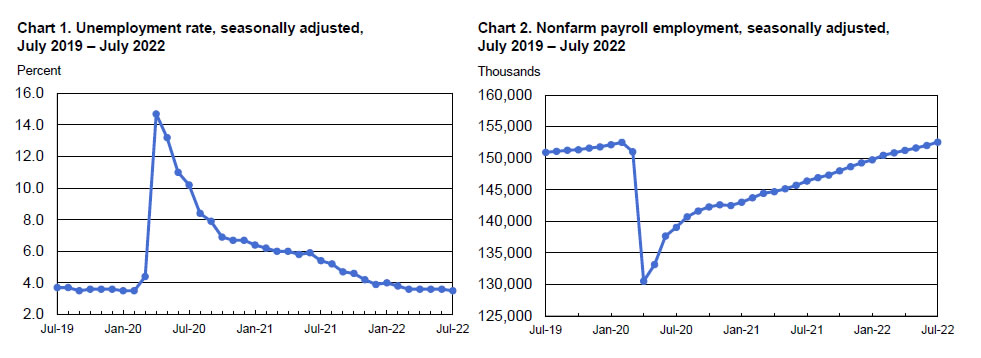
US non-farm payroll employment grew strongly by 528k in July, well above expectation of 250k. That's also much higher than the average gain of 388k over the prior 4 months. Total non-farm employment has also reached its pre-pandemic level.
Unemployment rate dropped from 3.6% to 3.5%, better than expectation of 3.6%. Participation rate dropped -0.1% to 62.1%.
Average hourly earnings rose 0.5% mom in July, above expectation of 0.3% mom.
S&P500: Bear Market Rally or Return to Growth?
The S&P500 is at 4150, having returned to the rebound highs of late May. The direction of the breakout outside the 4100-4200 range will determine its future for the next days or weeks.
In mid-June, the S&P500 halted its correction from the all-time highs. After losing around 25% in just over six months and returning to the lows since December 2020, the stocks have turned up, despite the background rather than thanks to it. In the last month and a half, the financial world has seen two 75-point Fed rate hikes, a shocking downturn in the housing market and a cooling of consumer demand. That said, the index has continued to crawl upwards, even if this recovery cannot be called flat.
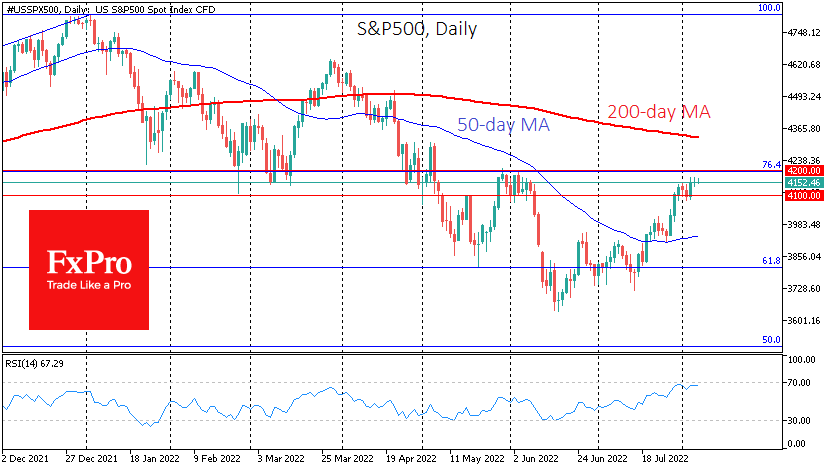
Technically, the S&P500 made a classic Fibonacci correction of the rally from March 2020 to all-time highs in early 2022, getting support on the 61.8% retracement area.
Late last month, a significant signal to break the downtrend was the consolidation above the 50-day moving average, which later turned from resistance into support.
However, locally, it is too early for the bulls to celebrate the return of the bull market. The RSI index on the daily charts is approaching the overbought area, raising the question of a legitimate pullback after a month and a half rally. Separately, the S&P500 index is approaching the circular 4200 level, almost coinciding with the 76.4% retracement of the global rally.
The above disposition shows that gravitational pressure is building up in the equity market, and the downside momentum risks are rising markedly in the near term.
From a longer-term perspective, however, a consolidation above the 4200 levels would mark the start of a new, more solid phase of the equity market recovery. The further upside would no longer be called a “bear market rally”. It would be more of a “return to the upside after a six-month correction”.
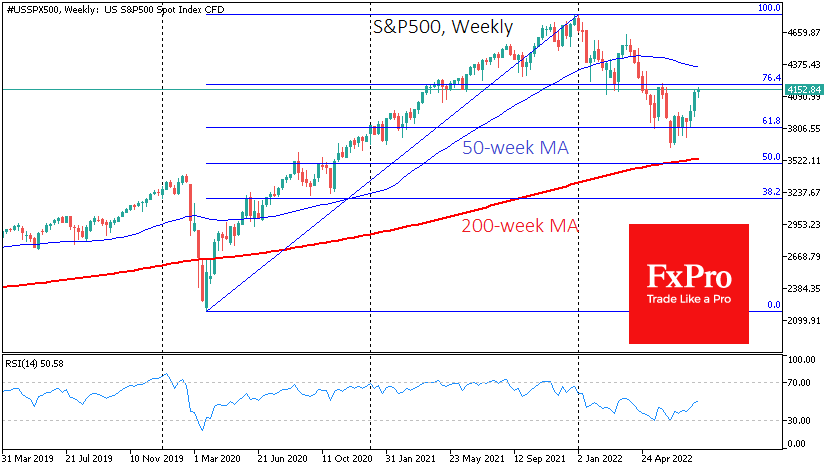
And if the immediate correction takes the S&P500 under 4100 – below the previous local lows – it would indicate that the bearish momentum is taking hold, and we might see a new decline. In that case, investors should be prepared that the markets will not only return to the lows of June but also rewrite them, taking the index towards 3000.
GBPJPY Tests Support Trendline; Bias Bearish
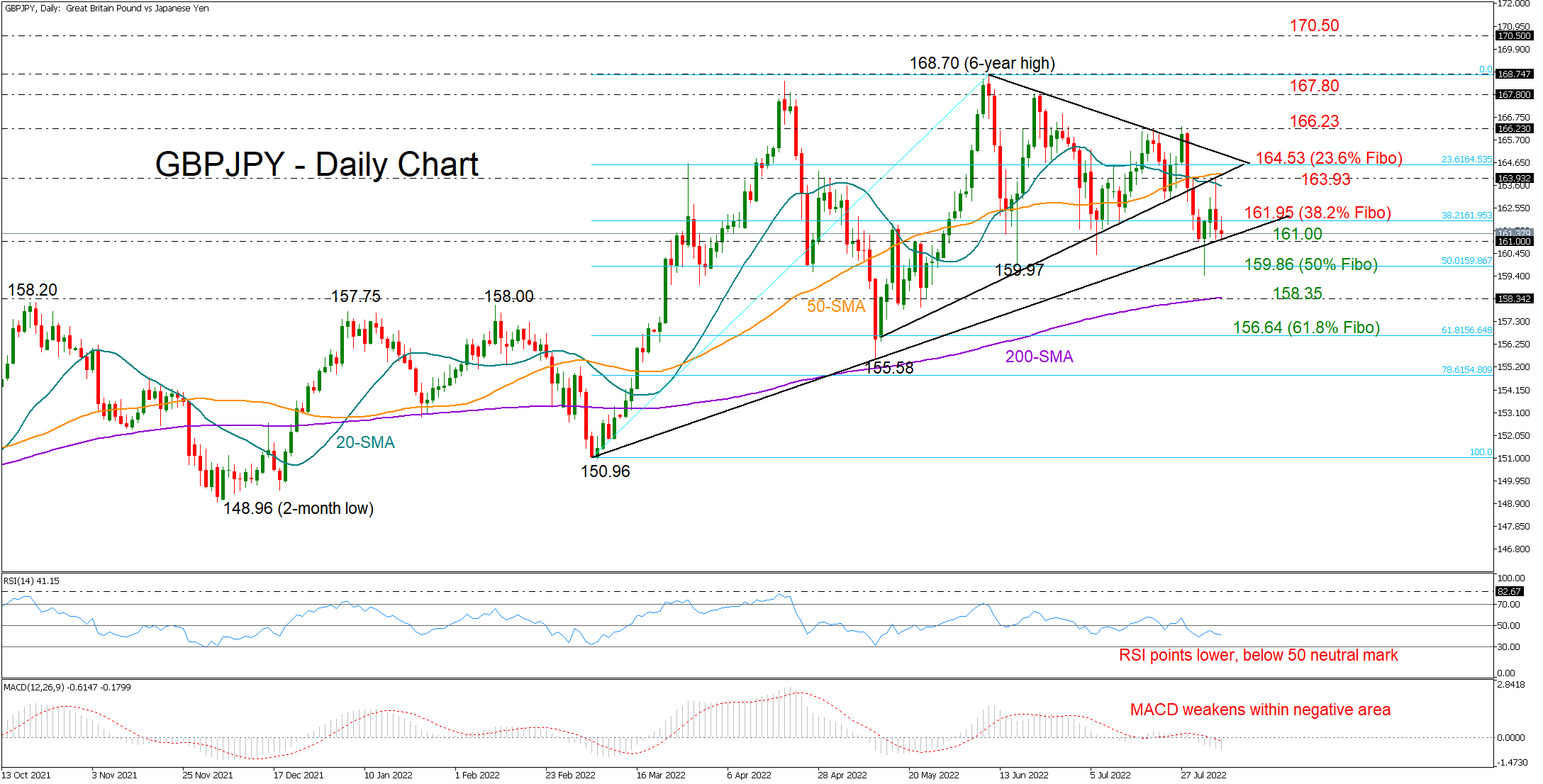
GBPJPY pulled back to test the support trendline at 161.00, which connects the lows from spring, after a failed attempt to pierce its 20- and 50-day simple moving averages (SMAs) around 164.00 on Thursday.
From a technical perspective, sellers seem to have the upper hand as the MACD keeps decelerating within the negative zone and the RSI is reversing southwards, putting in some distance below its 50 neutral mark.
If the bears finally achieve a close below the ascending trendline, the 159.86 area, which coincides with the 50% Fibonacci retracement of the 150.96 – 168.70 upleg, could come to the rescue, rejecting any declines towards the 200-day SMA at 158.35. Should the downfall sharpen below the latter, neutralizing the broad picture, the spotlight will turn to the 61.8% Fibonacci of 156.64.
On the upside, a durable move above the 38.2% Fibonacci of 161.95 may shift attention back to the 20- and 50-day SMAs currently at 163.55 and 164.00 respectively. The 23.6% Fibonacci and the key resistance trendline are also within a breathing distance at 164.53 and could deter any improvement towards the 166.23 border. Nevertheless, if upside pressures persist, traders will next target the 167.80 – 168.70 ceiling.
In brief, GBPJPY continues to face negative risks despite finding a strong footing near an upward-sloping trendline. A close below 161.00 could set the stage for the next bearish round.
BoE Pill: We need flexibility on rates according to cirumstances
BoE Chief Economist Huw Pill told Bloomberg Television, the BoE is not "behind the curve" on tightening.
But he added that investors should not assume there will be another 50bps rate hike in September. "Given the uncertainties we face, I think we need flexibility either to go further, or to stay where we are, and the pace at which we go further to be varied according to circumstances," he said.
Bitcoin Remains in Ascending Corridor
Bitcoin was down 3.5% on Thursday, ending at around $22,500, but almost fully recovered its losses on Friday morning. As a result, changes over the past 24 hours are minimal, with a 0.2% gain to 23,200, with an amplitude of around 4%. Ethereum was trading near $1660 versus $1650 at the same time yesterday.
Other leading altcoins added between 0.4% (XRP) and 2.6% (BNB). Total market capitalisation, according to CoinMarketCap, rose 0.4% overnight to $1.08 trillion. The cryptocurrency Fear & Greed Index rose 1 point to 31.
Bitcoin has been under pressure all Thursday, despite continued positive stock market momentum and a general increase in demand for risk. Such dynamics of the crypto market again show how far it is from the sentiment that pushed the price ahead in the past two years.
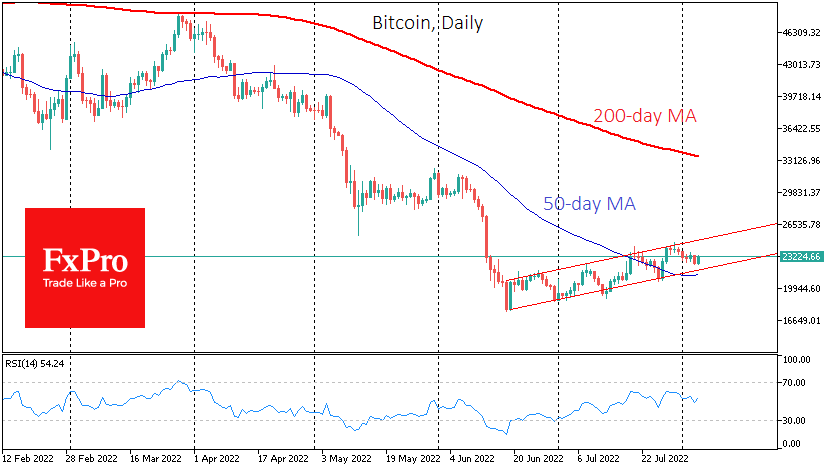
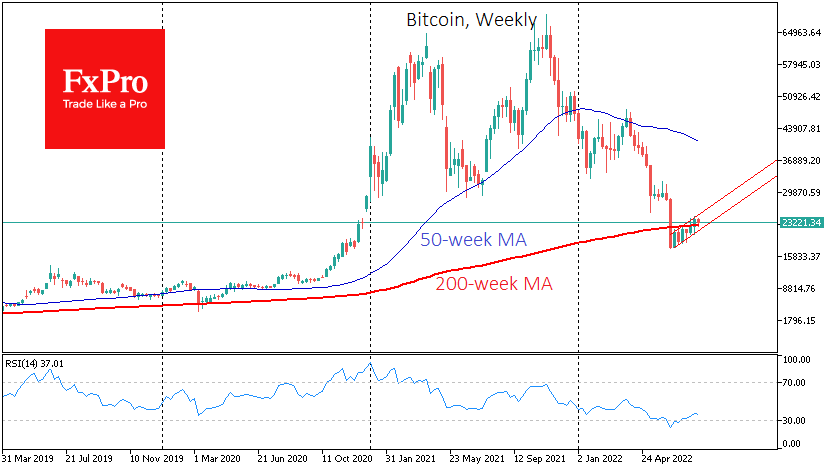
From another perspective, BTCUSD has reversed to the upside this morning just above the lower boundary of its ascending corridor, held for the last seven weeks and stayed above its 200-week moving average.
News background
Ark Invest calculates that BTC has fallen below the 200-WMA only seven times in history. After recovering above that line, the annual return on the asset has averaged around 240%.
Along with the uptrend, the difficulty of mining increased by 1.74% for the first time in two months.
Mastercard noted that it views cryptocurrencies as an asset class rather than a means of payment because of their volatility in price. Stablecoins and DH digital currencies have a better chance of occupying this niche.
FTX CEO Sam Bankman-Fried praised a bill introduced in the US Congress that would give the authority to regulate the crypto market – the Futures Trading Commission (CFTC).
The recent hack of the Project Nomad bridge, in which hackers managed to take out $190 million in assets, was the 13th hack in the industry since the beginning of the year. According to Chainalysis, the total amount of damage was $2bn. Blockchain security agency SlowMist believes that cryptocurrencies are safer than DeFi and firewalls.
According to Peckshield, hackers withdrew $4.8m from ZB, a decentralised crypto exchange that claimed to be the most secure in the world.