Sample Category Title
Sunset Market Commentary
Markets
It was the bad-news-show today. First up: German inflation. The pre-market regional print in North Rein-Westphalia already suggested a nasty surprise and so it happened. The national number eased less than expected, from 7.6% to 7.6% in July. The harmonized figure even unexpectedly accelerated from 8.2% to 8.5%, suggesting upwards risks for the European reading tomorrow. Next: economic confidence (EC) in the euro zone. Confidence evaporated more than expected (from 103.5 to 99) to hit the lowest level since February last year. And finally: US GDP. Growth contracted -0.9% q/q annualized following the -1.6% in Q1, pushing the US in a technical recession. Private consumption decelerated, adding 0.7% to growth while net exports delivered 1.43% points thanks to a significant slowdown in imports but surging exports. Investments particularly weighed on growth (-2.73 ppts) due to depleting inventories while government consumption (-0.33 ppts) accounted for the remainder of the negative GDP reading. All this was surrounded in a post-Fed atmosphere, with markets selectively taking note of Powell’s announcement that the tightening cycle may slow down from the 75 bps hiking pace from September onwards. Especially after the GDP release, markets saw their soft interpretation validated. Core bond yields surge with Bunds, despite the inflation surprise, even outperforming Treasuries. Changes range from -18.5 bps (2y) over 10.9 bps (10y) to 5.4 bps (30y). Peripheral spreads narrow 2 to 3 bps. Greece (+3 bps) underperforms. US yields shed 15-16.3 bps in the 2y/5y segment. Money markets price in a total of 90 bps additional tightening this year and lower the expected terminal rate to just 3.2%. The 10y yield (2.67%, -11 bps) drops below the sideways trading range with the lower bound at 2.72%. Tumbling yields provide some support for equities. European stocks extended a bottoming out to trade 0.6% in the green (EuroStoxx50). US futures did the same but turned red after all shortly after the cash open.
There’s only one real beneficiary in current circumstances on FX markets. The Japanese yen shines, gaining against all G10 peers. USD/JPY drops to the lowest since early July around 134.8. EUR/JPY retraces to 136.93, testing support at the lows earlier in July. EUR/USD is a balance of weakness today which up until the GDP numbers was tilted towards the dollar. The pair hit a low at 1.011 before recovering a tad to 1.015 currently. The Swiss franc is on track for a new closing record high after the SNB reiterated that it can take monetary policy measures at any time if needed. EUR/CHF crumbles to 0.973. News Headlines
According to the flash estimate published by the National Bank of Belgium, Belgian GDP growth in Q2 slowed to 0.2 % Q/Q and 3.3% Y/Y. Growth in Q1 printed at 0.5 % Q/Q and 4.9% Y/Y. According to NBB the slowdown is widespread across the major branches of activity. Value added was down by 0.2 % in industry while in construction and the services sector, growth of activity remained positive, although slowed to 0.3 %. In a separate publication, STATBEL reported that Belgian inflation slowed marginally to 0.83% M/M and 9.62% Y/Y, compared to 0.85% and 9.65% Y/Y in June. Core inflation which doesn’t take into account energy products and unprocessed food, rose further to 5.49% Y/Y from 5.07%. Food price inflation rose sharply further to 9.24% from 8.44% Y/Y. Main price increases in July concerned airplane tickets, hotel rooms, fire insurance, meat, electricity, dairy products, domestic heating oil, the purchases of vehicles and road tax. Motor fuels, city trips, alcoholic beverages and private rents had a decreasing effect on the index.
In its new inflation report, the central bank of Turkey again upwardly revised its forecast for inflation at the end of this year to at 60.4% (from 42%). Headline inflation was 78.62% in June. The CBTR expects inflation to ease to 19.2% end next year and 8.8% at the end of 2024. The CBRT still holds a policy rate of only 14.0%. At EUR/TRY 18.27 and USD/TRY 17.93 the lira again trades within reach of the historic low levels against both major currencies.
US Economic Growth Records Second Consecutive Quarter of Contraction
Real GDP contracted by 0.9% quarter-over-quarter (annualized) in the second quarter of 2022. The reading came in below the consensus forecast, which called for a modest gain of 0.4% q/q.
Consumer spending grew by 1% – a deceleration from the 1.8% recorded in Q1. Spending on services (4.1%) accounted for all the gains, while durable (-2.6%) and non-durable (-5.5%) expenditures both declined. As a result, goods spending fell by 4.4%, and has now recorded declines in two consecutive quarters.
Non-residential business investment (-0.1%) was essentially flat on the quarter, as continued gains in intellectual property products (9.2%) were offset by declines in equipment (-2.7%) and structures (-11.7%) spending. Structures investment has now contracted for five consecutive quarters, and is down over 7% since the Q1-2021.
Residential investment (-14.0%) fell sharply in Q2, as home construction slowed and sales of new and existing homes fell by over 12% on the quarter.
Government spending (-1.9%) declined for the third consecutive quarter, on lower spending at both the federal (-3.2%) and state & local (1.2%) level. In terms of federal spending, gains in defense (2.5%) outlays were more than offset by a sharp decline in non-defense (-10.5%) spending.
Exports surged by 18% in the second quarter, with gains spread across both the exports of goods (15.6%) and services (24.2%). Imports recorded a more modest gain of 3.1% – a marked deceleration from the near 20% growth seen in each of the prior two quarters. This led to some narrowing in the trade deficit, resulting in net trade adding 1.4 percentage points (pp) to Q2 growth.
Inventory investment sharply declined in the second quarter – subtracting 2 pp from headline growth.
The core PCE deflator rose 4.4% on a q/q (annualized) basis – a noticeable deceleration from the 5.2% recorded in Q1.
Key Implications
With the advance estimate of second quarter GDP coming in negative, US economic growth has now recorded two consecutive quarters of contraction – meeting one definition of a "technical" recession. However, most economists would agree that the US economy isn't (yet) in recession. Outside of just economic growth, the National Bureau of Economic Research (NBER) looks at a whole host of other economic indicators including employment, industrial production, and real personal disposable income (less transfers) to name a few. All of these continue to point to an economy still in expansionary territory.
That being said, domestic demand has shown a clear sign of decelerating. Consumer spending continued to soften in the second quarter, while both business and residential investment outright declined. And it doesn't appear that growth prospects will be improving anytime soon. Measures of both consumer and business sentiment have turned decisively lower in recent months, ISM readings have softened, while weaker pending home sales point to further declines in home purchases in the months ahead.
In its interest rate announcement yesterday, the FOMC acknowledged the recent softening in economic data, but reiterated that more interest rate hikes will likely be required to cool inflation. With the policy rate now in the vicinity of neutral – the interest rate where monetary policy is neither accommodative nor restrictive – its entirely feasible that the we see another 100 basis points of tightening by year-end.
EUR/USD Mid-Day Outlook
Daily Pivots: (S1) 1.0124; (P) 1.0173; (R1) 1.0248; More...
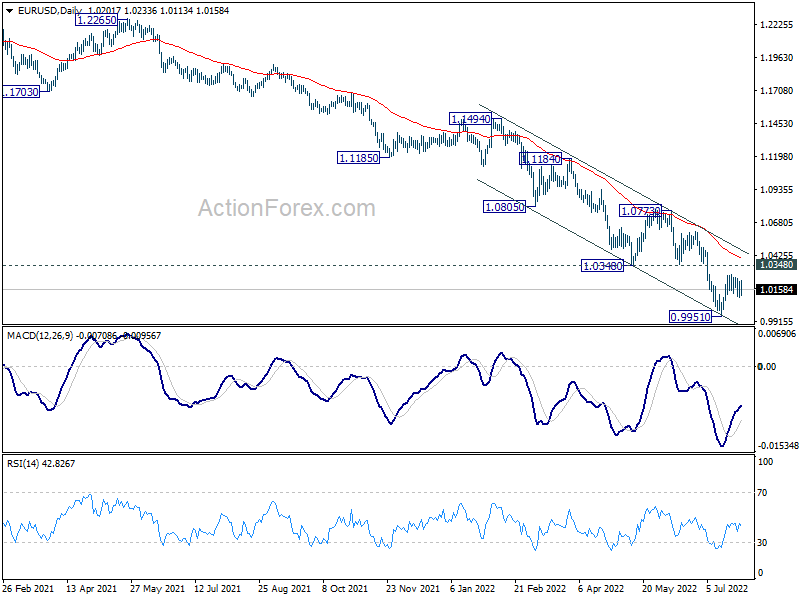
Range trading continues in EUR/USD and intraday bias remains neutral. On the upside, above 1.0277 minor resistance will target 1.0348 resistance first. Break there will target channel resistance at 1.0469. on the downside, break of 1.0095 minor support will bring retest of 0.9951 low instead.
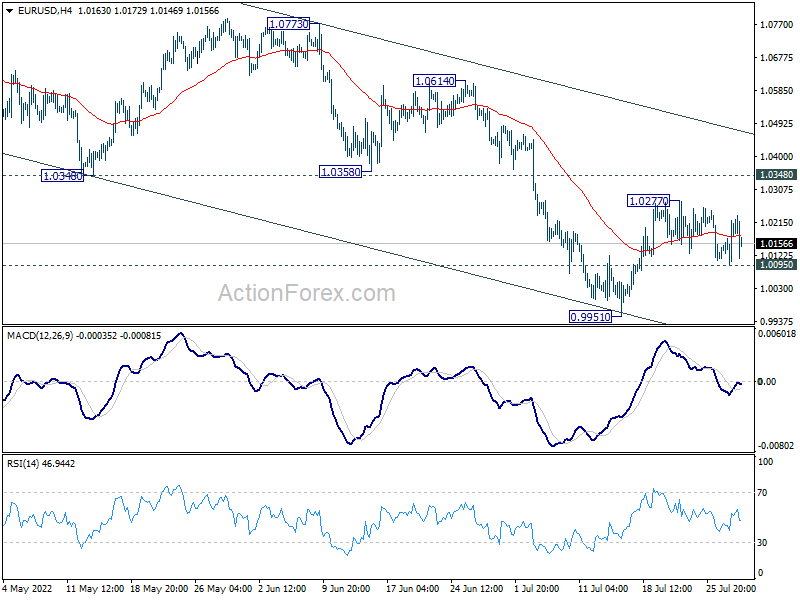
In the bigger picture, down trend from 1.6039 (2008 high) is still in progress. Next target is 100% projection of 1.3993 to 1.0339 from 1.2348 at 0.8694. In any case, outlook will stay bearish as long as 1.0773 resistance holds, in case of strong rebound.
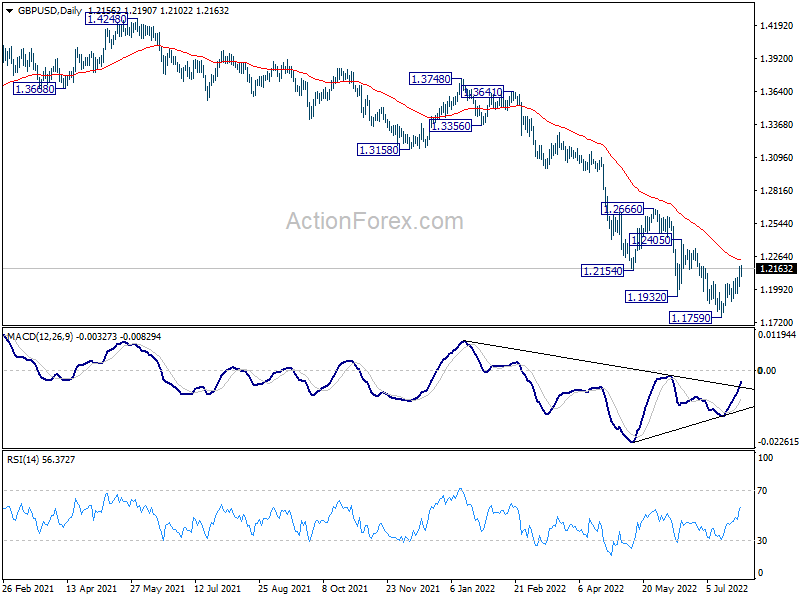
GBP/USD Mid-Day Outlook
Daily Pivots: (S1) 1.2057; (P) 1.2121; (R1) 1.2222; More...
Intraday bias in GBP/USD remains on the upside at this point. Rebound from 1.1759 should target 1.2405 resistance first. Firm break there will target 1.2666 key resistance next. On the downside, break of 1.1962 minor support will turn bias back to the downside for retesting 1.1759 low instead.
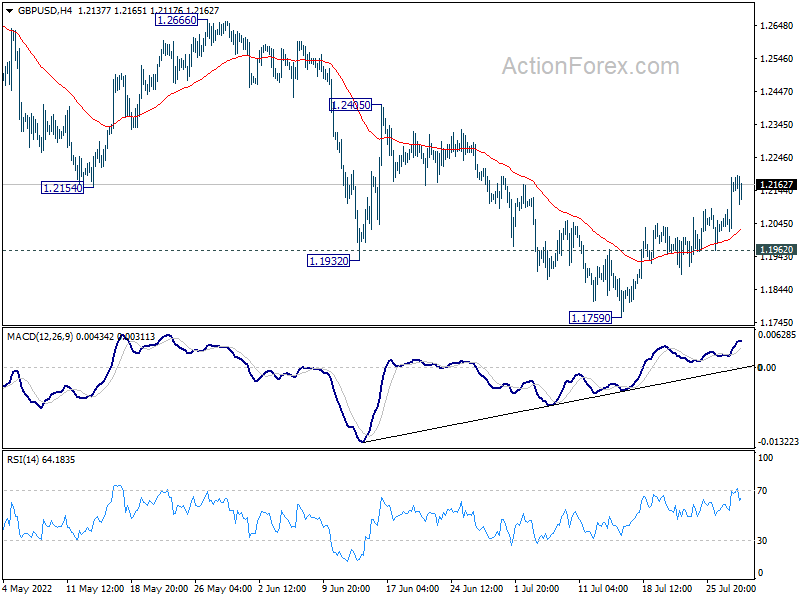
In the bigger picture, fall from 1.4248 (2018 high) could be a leg inside the pattern from 1.1409 (2020 low), or resuming the longer term down trend. Deeper decline is expected as long as 1.2666 resistance holds. Next target is 1.1409 low. However, firm break of 1.2666 will bring stronger rise back to 55 week EMA (now at 1.2986).
USD/CHF Mid-Day Outlook
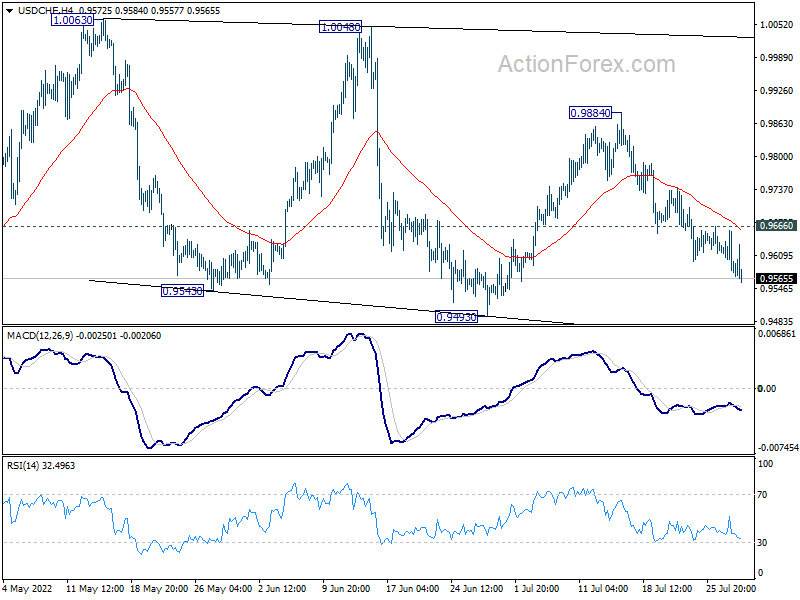
Daily Pivots: (S1) 0.9567; (P) 0.9613; (R1) 0.9642; More...
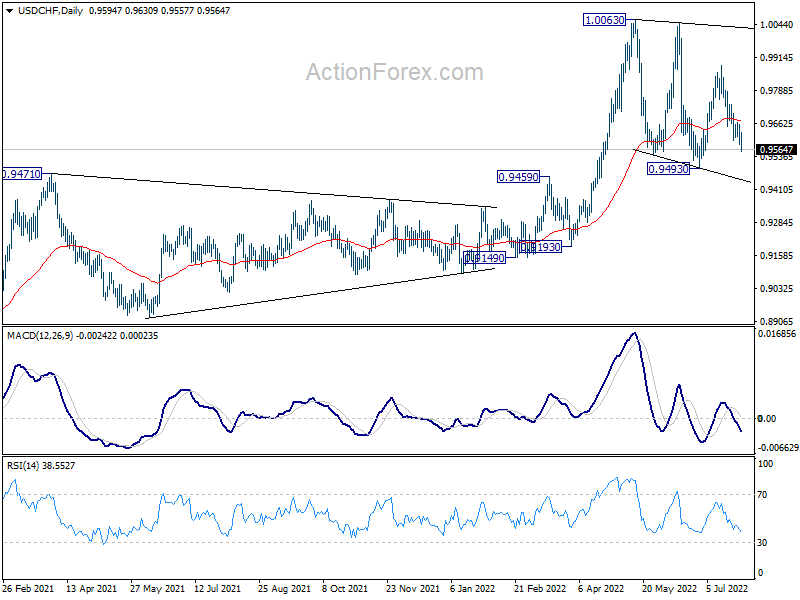
USD/CHF's fall from 0.9884 is still in progress and intraday bias stays on the downside. Such decline is seen as a falling leg of the consolidation from 1.0063. Deeper decline would be seen to 0.9493 support. On the upside, though, above 0.9666 minor resistance will turn bias back to the upside for 0.9884 resistance.
In the bigger picture, medium term up trend from 0.8756 (2021 low) is still in progress. On resumption, next target is 1.0342 (2016 high). Sustained break there will resume long term up trend from 0.7065 (2011 low). This will remain the favored case as long as 0.9471 resistance turned support holds.
USD/JPY Mid-Day Outlook
Daily Pivots: (S1) 136.15; (P) 136.80; (R1) 137.28; More...
USD/JPY's break of 134.73 support now suggests that 139.37 is a medium term top, on bearish divergence condition in daily MACD. Fall from there is seen as a correction to medium term up trend. Intraday bias is on the downside for 55 day EMA (now at 133.84) first. Sustained break there will target 126.35/131.34 support zone. On the upside, break of 137.44 resistance is needed to indicate completion of the decline. Otherwise, risk will stay on the downside in case of recovery.
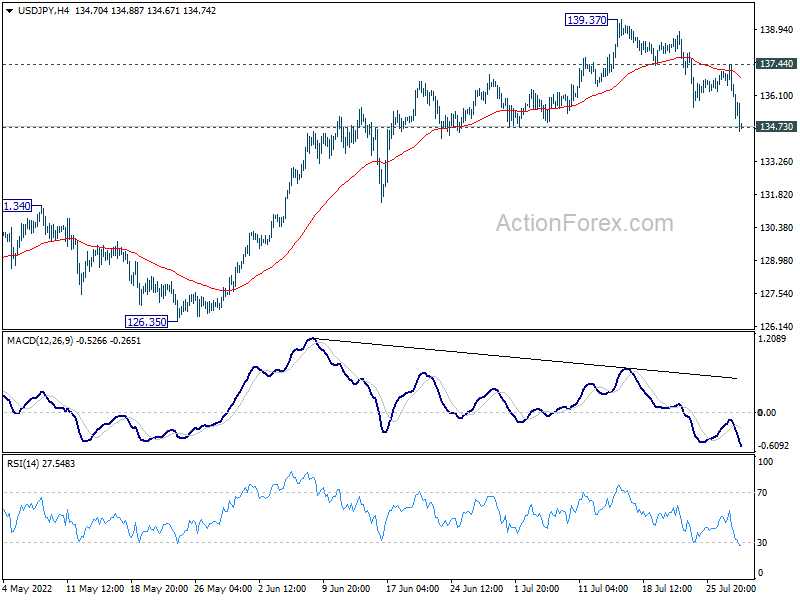
In the bigger picture, current rally is seen as part of the long term up trend from 75.56 (2011 low). Next target is 100% projection of 75.56 (2011 low) to 125.85 (2015 high) from 98.97 at 149.26, which is close to 147.68 (1998 high). This will remain the favored case as long as 126.35 support holds.
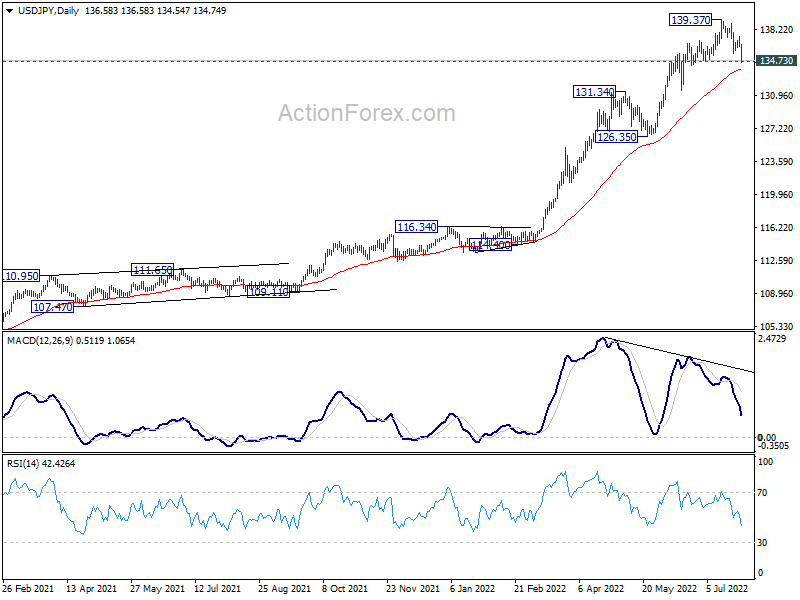
Yen Surges after Shocking US GDP Data
Yen rises strongly today, and buying intensifies in early US session, after surprisingly poor US GDP data. Benchmark treasury yield in both the US and Germany tumble sharply, aiding Yen's advance. Swiss Franc is also strong For now, Euro is the worst performer for today, as selling started earlier in European session already, while Sterling is playing catch-up. Dollar is mixed while commodity currencies look indifferent.
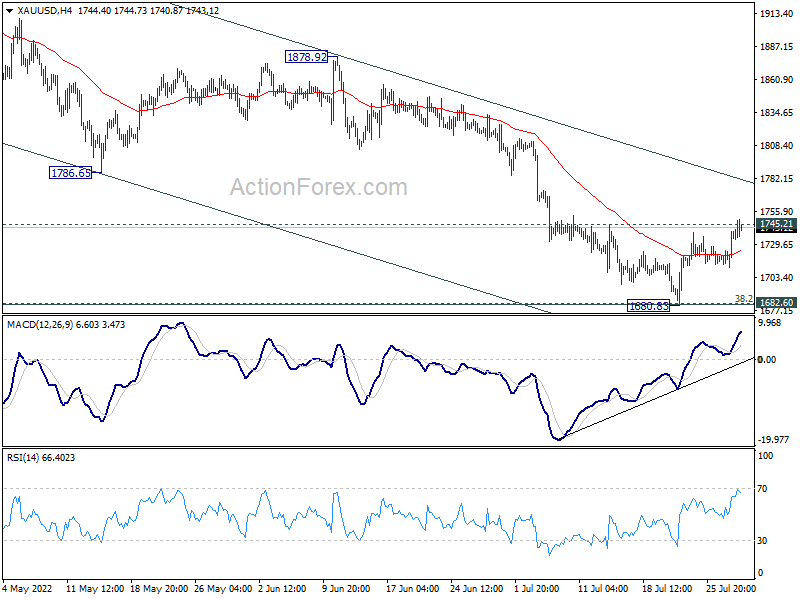
Technically, USD/JPY's break of 134.73 support argues that it's already in correction to medium term up trend. Deeper fall could be seen to 126.35/131.34 support zone. Gold is also pressing 1745.21 minor resistance. Sustained break there will add to the case of bullish trend reversal, after hitting 1682.60 long term cluster support. That, if happens, would be verification of Dollar weakness.
In Europe, at the time of writing, FTSE is down -0.09%. DAX is up 0.18%. CAC is up 0.42%. Germany 10-year yield is down -0.072 at 0.874, below 0.9% handle. Earlier in Asia, Nikkei rose 0.36%. Hong Kong HSI dropped -0.23%. China Shanghai SSE rose 0.21%. Singapore Strait Times rose 0.48%. Japan 10-year JGB yield rose 0.0134 at 0.209.
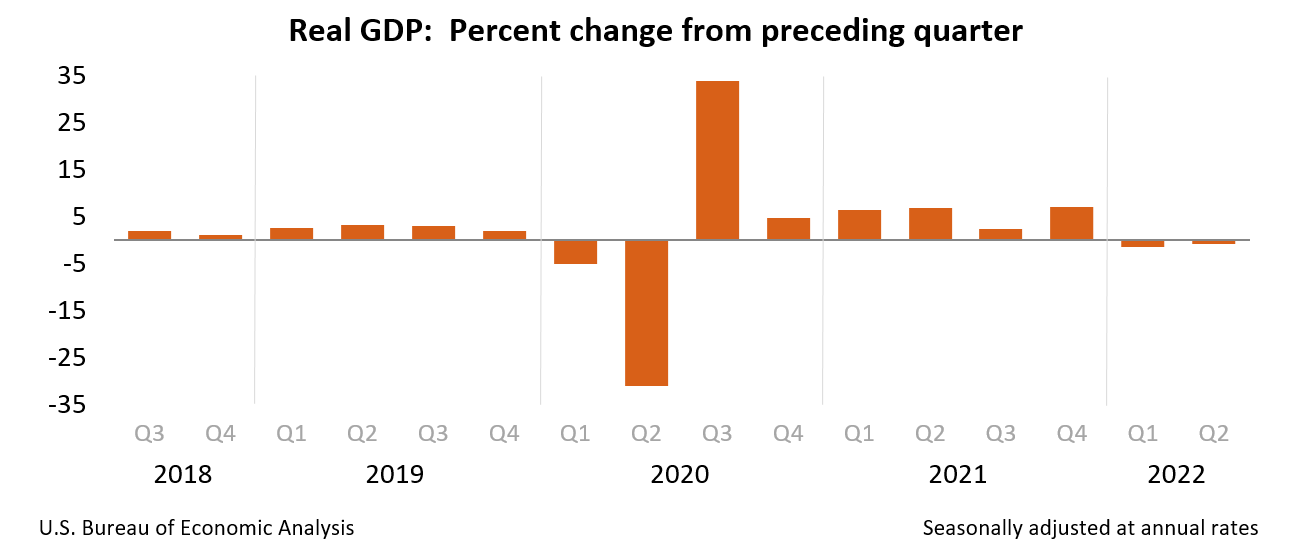
US GDP contract -0.9% in Q2, second quarter of contraction
US GDP contracted an annualized -0.9% in Q2, much worse than expectation of 0.4% rise. That's the second quarter of contraction, after Q1's -1.6% annualized.
BEA said: "The decrease in real GDP reflected decreases in private inventory investment, residential fixed investment, federal government spending, state and local government spending, and nonresidential fixed investment that were partly offset by increases in exports and personal consumption expenditures (PCE). Imports, which are a subtraction in the calculation of GDP, increased"
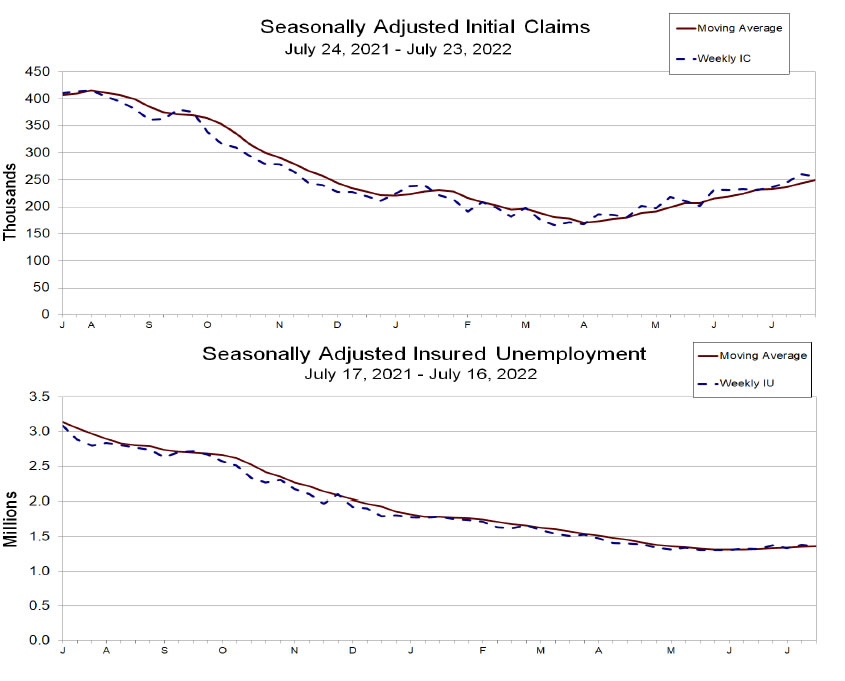
US initial jobless claims dropped to 256k
US initial jobless claims dropped -5k to 256k in the week ending July 23, versus expectation of 248k. Four-week moving average of initial claims rose 6.25k to 249.25k.
Continuing claims dropped -25k to 1359k in the week ending July 16. Four-week moving average of continuing claims rose 8.75k to 1362m.
Eurozone economic sentiment dropped to 99.0 in Jul
Eurozone Economic Sentiment Indicator dropped from 103.5 to 99.0 in July. Industrial confidence dropped from 7.0 to 3.5. Services confidence dropped from 104.1 to 10.7. Consumer confidence dropped from -23.8 to -27.0. Retail trade confidence dropped from -5.2 to -6.8. Construction confidence dropped from 103.5 to 99.0. Employment Expectations Indicator dropped from 110.2 to 107.0.
EU Economic Sentiment Indicator dropped from 101.8 to 97.6. Employment Expectations Indicator dropped from 110.2 to 106.6. In the EU, the drop in the ESI in July was due to significant losses in industry, services, retail trade and consumer confidence, whereas confidence in construction decreased more mildly. The ESI fell markedly in four out of the six largest EU economies, Spain (-5.0), Germany (-4.9), Italy (-3.4) and Poland (-3.2), while it remained broadly stable in France (-0.1) and the Netherlands (+0.2).
BoJ Amamiya: We need to support economic activity with accommodative monetary policy
Deputy Governor Masayoshi Amamiya said, "Japan's economy hasn't recovered yet to pre-pandemic levels... The foundations for an economic recovery remain weak and the outlook for wages is highly uncertain. As such, we need to support economic activity with accommodative monetary policy."
"Achieving our price target means having consumer inflation hit 2% on average over the business cycle, not a temporary rise to that level driven by exogenous factors such as increasing energy import costs," he emphasized.
Japan's CPI core (all-item ex fresh food), has been above BoJ's 2% target for three straight months. But officials are seeing it as temporary, at least until wage pressures build up.
Australia retail sales rose 0.2% mom in Jun, sixth-straight monthly rise
Australia retail sales rose 0.2% mom to AUD 34.2B in June, below expectation of 0.4% mom. Through the year, sales rose 12.0% yoy.
Ben Dorber, head of retail statistics at the ABS, said: "While the 0.2 per cent rise in June 2022 was the sixth-straight rise in retail turnover, it was also the smallest so far this year....
"Given the increases in prices we've seen in the Consumer Price Index, it will also be important to look at changes in the volumes of retail goods, in next week's release of quarterly data."
NZ ANZ business confidence improved to -56.7, business feeling apprehensive
New Zealand ANZ business confidence improved from -62.6 to -56.7 in July. Own activity outlook rose from -9.1 to -8.7. Employment intentions rose from 0.7 to 1.1. Pricing intentions rose from 73.7 to 74.0. Inflation expectations rose from 6.02 to 6.23.
ANZ said that most activity indicators were little changed, but residential construction intentions plummeted again to a fresh record low (-73.7). Inflation pressures remain intense, but may be topping out.
It added: "New Zealand businesses are well aware that the Reserve Bank is on a mission to reduce customer demand for their wares in order to reduce inflation. No wonder they're feeling apprehensive."
USD/JPY Mid-Day Outlook
Daily Pivots: (S1) 136.15; (P) 136.80; (R1) 137.28; More...
USD/JPY's break of 134.73 support now suggests that 139.37 is a medium term top, on bearish divergence condition in daily MACD. Fall from there is seen as a correction to medium term up trend. Intraday bias is on the downside for 55 day EMA (now at 133.84) first. Sustained break there will target 126.35/131.34 support zone. On the upside, break of 137.44 resistance is needed to indicate completion of the decline. Otherwise, risk will stay on the downside in case of recovery.
In the bigger picture, current rally is seen as part of the long term up trend from 75.56 (2011 low). Next target is 100% projection of 75.56 (2011 low) to 125.85 (2015 high) from 98.97 at 149.26, which is close to 147.68 (1998 high). This will remain the favored case as long as 126.35 support holds.
Economic Indicators Update
| GMT | Ccy | Events | Actual | Forecast | Previous | Revised |
|---|---|---|---|---|---|---|
| 01:00 | NZD | ANZ Business Confidence Jul | -56.7 | -62.6 | ||
| 01:30 | AUD | Import Price Index Q/Q Q2 | 4.30% | 1.90% | 5.10% | |
| 01:30 | AUD | Retail Sales M/M Jun | 0.20% | 0.40% | 0.90% | |
| 09:00 | EUR | Eurozone Economic Sentiment Indicator Jul | 99 | 102 | 104 | 103.5 |
| 09:00 | EUR | Eurozone Industrial Confidence Jul | 3.5 | 6.9 | 7.4 | 7 |
| 09:00 | EUR | Eurozone Services Sentiment Jul | 10.7 | 14.5 | 14.8 | 14.1 |
| 09:00 | EUR | Eurozone Consumer Confidence Jul F | -27 | -27 | -27 | |
| 12:00 | EUR | Germany CPI M/M Jul P | 0.90% | 0.60% | 0.10% | |
| 12:00 | EUR | Germany CPI Y/Y Jul P | 7.50% | 7.40% | 7.60% | |
| 12:30 | USD | Initial Jobless Claims (Jul 22) | 256K | 248K | 251K | 261K |
| 12:30 | USD | GDP Annualized Q2 P | -0.90% | 0.40% | -1.60% | |
| 12:30 | USD | GDP Price Index Q2 P | 8.70% | 7.20% | 8.30% | 8.20% |
| 14:30 | USD | Natural Gas Storage | 19B | 32B |
US initial jobless claims dropped to 256k
US initial jobless claims dropped -5k to 256k in the week ending July 23, versus expectation of 248k. Four-week moving average of initial claims rose 6.25k to 249.25k.
Continuing claims dropped -25k to 1359k in the week ending July 16. Four-week moving average of continuing claims rose 8.75k to 1362m.
US GDP contract -0.9% in Q2, second quarter of contraction
US GDP contracted an annualized -0.9% in Q2, much worse than expectation of 0.4% rise. That's the second quarter of contraction, after Q1's -1.6% annualized.
BEA said: "The decrease in real GDP reflected decreases in private inventory investment, residential fixed investment, federal government spending, state and local government spending, and nonresidential fixed investment that were partly offset by increases in exports and personal consumption expenditures (PCE). Imports, which are a subtraction in the calculation of GDP, increased"
Aussie Joins Post-FOMC Rally, US GDP Looms
US dollar sinks after FOMC rate hike
There were no surprises from the Federal Reserve, which delivered a second straight 0.75% hike on Wednesday. The markets had priced in this move, although it was a live meeting, as there was an outside chance of the Fed firing a massive 1.00% salvo in order to curb runaway inflation. The US dollar beat a hasty retreat against the majors, as the markets jumped on Fed Chair Powell’s post-meeting comments. Powell stated that it might be appropriate to reduce the pace of rate hikes moving forward and each rate decision would be made on a meeting-to-meeting basis. In effect, this ditches forward guidance. The equity markets were in a “buy everything” (and sell US dollars) mood after Powell’s remarks, and the Aussie jumped on the bandwagon, climbing 0.76% and hitting a six-week high.
This stance of throwing away forward guidance appears contagious – at the ECB meeting last week, ECB President Lagarde also announced that rate decisions would be made at each meeting. Ahead of that ECB meeting, forward guidance was for a 0.25% increase, but in the end, the ECB went with a 0.50% hike, with investors puzzled as to why the ECB ignored its forward guidance. By keeping mum until the meeting, central banks can avoid being criticized for making a rate move that doesn’t match its forward guidance.
In Australia, retail sales fell sharply in June to 0.2% MoM, down from 0.9% in May (0.5% exp). The RBA has embarked on an aggressive rate-tightening cycle, which has taken a toll on Australian consumers, who are grappling with higher mortgage payments, in addition to soaring inflation. Even with the drop in consumer spending, the RBA is likely to press ahead with a 0.50% rate increase at its meeting on August 2nd.
The markets will now shift attention to US GDP, which will be released later today. The markets are forecasting a small gain of 0.5% for the second quarter. The economy contracted by 1.6% in Q1, and a negative reading today would technically mark a recession, which could shake up the markets, which are always allergic to the “R” word.
AUD/USD Technical
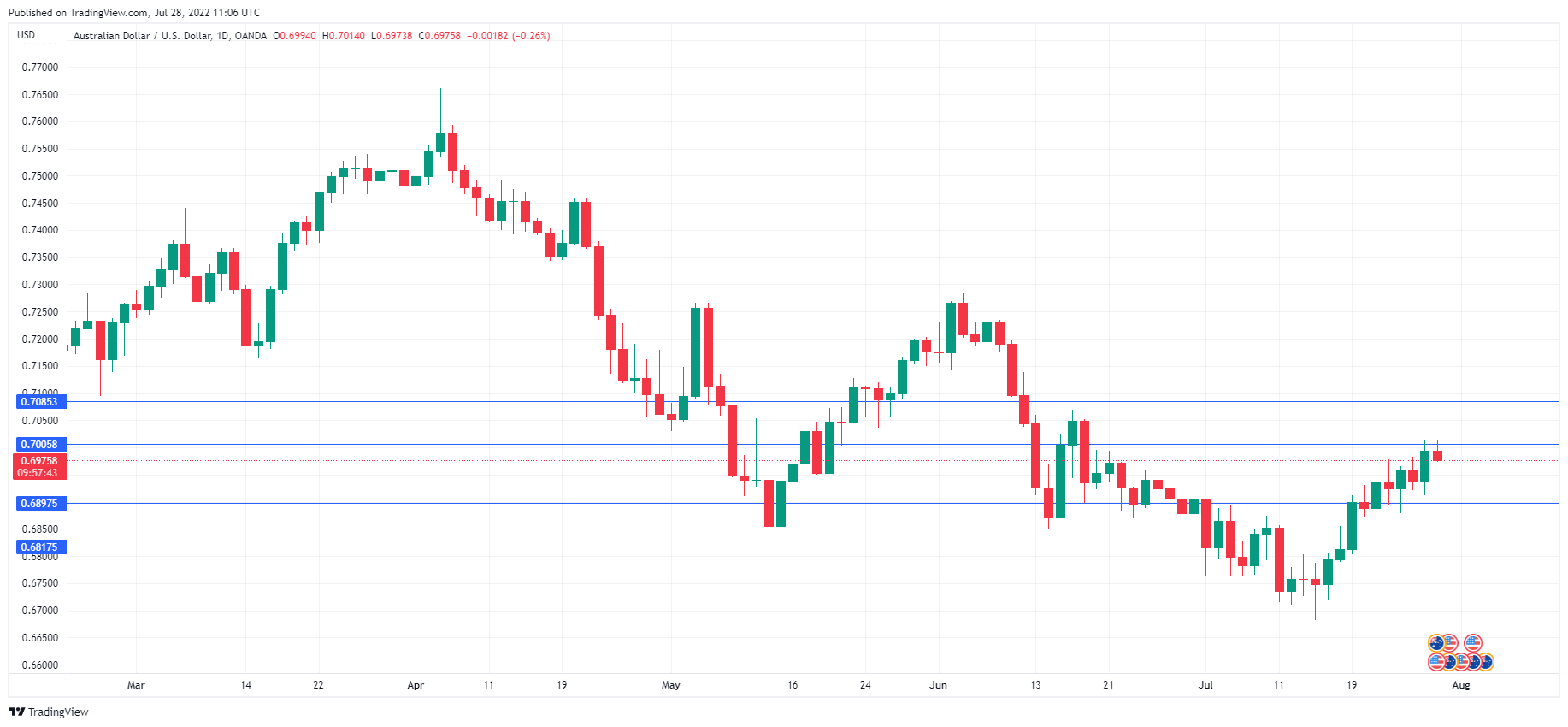
- AUD/USD is testing resistance at 0.7005. Above, there is resistance at 0.7085
- 0.6897 is providing support, followed by 0.6817