

Sample Category Title
A 100bp Gike?
The US inflation report was ugly. Inflation in the US advanced to 9.1% in June, from 8.6% a month earlier, and there was nothing toppish about yesterday’s inflation report, apart from the fact that gasoline prices which soared 60% since last year was the main responsible for the further advance in inflation, and gasoline prices have been trending lower since a couple of weeks now.
Due today, the producer price index is expected to stabilize a touch below the 11% mark.
A CPI figure above the 9% psychological level boosts the idea that the Federal Reserve (Fed) won’t hesitate to continue its aggressive rate increases to abate inflation. Pricing on Fed funds futures now gives more than 80% chance for a 100bp hike at the next FOMC meeting, due by the end of this month. That results in a stronger dollar, higher yields and a further selloff in equities.
More importantly, there is little between now and the Fed decision to reverse the pricing.
Post-CPI
The US dollar index consolidates above the 108 mark, and the bulls have their eyes set at the 110 level.
The 10-year yield remains a touch below the 3% mark, but the 2-year yield continues pushing higher, pushing the 2-10-year portion of the yield curve to a deeper inverted territory.
Gold dived to $1707 per ounce yesterday, not because the market doesn’t buy the inflation rhetoric as claims Cathie Wood, but the rising US yields continue weighing on the precious metal, even when the risk sentiment is off.
And crude oil tipped a toe below the 200-DMA, near $93pb. The tighter monetary policies, the recession talks and prospects of slower demand should keep the bears in charge of the market.
Elsewhere
The Bank of Canada raised its rate by 100bo yesterday, sending the Canadian stocks lower, and the loonie just a little bit higher against the US dollar. But the US dollar remains so strong, that no currency defies its strength.
The data released in Europe was quite mixed. The British GDP grew 3.5%, as both the industrial and manufacturing production surprised to the upside in May. The better-than-expected economic data gave a small boost to Cable at yesterday’s session, but Cable remains under the growing pressure of a stronger US dollar, and will hardly fight back the 1.20 offers.
In the eurozone, the inflation figures were mixed. The German inflation stabilized at 7.6% as expected in June, that was slightly lower than the 7.9% printed a month earlier. The French inflation rose less than expected, advancing from 5.2% to 5.8%, instead of 6.5% expected by analysts. Spanish inflation confirmed a read above 10% in June.
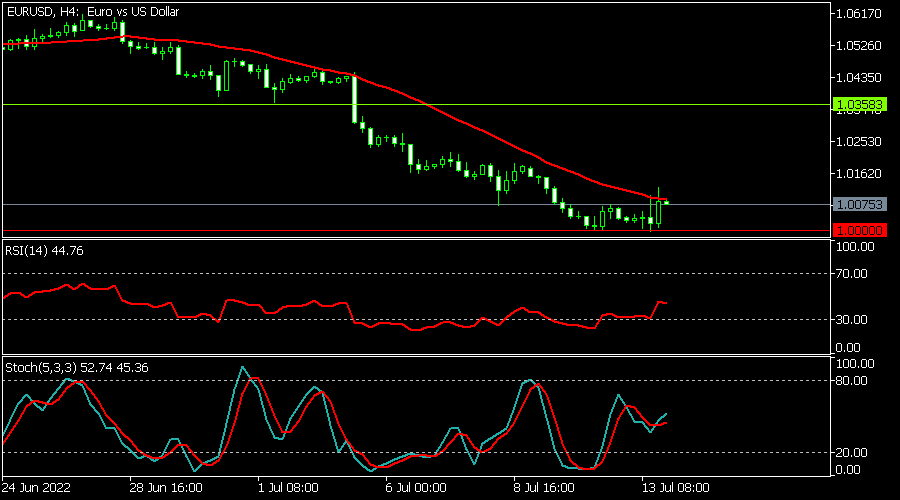
But there was one good news: industrial production in Europe somehow rebounded in May, to 1.8%, versus 0.3% printed a month earlier. I doubt that it would help keeping the EURUSD above parity.
There is a solid support near the 1.00 level, and stops below that level. If the 1.00 support is broken, we could rapidly see the EURUSD slip lower on stops.
Earnings
JP Morgan and Morgan Stanley will go to the earnings confessional today, BlackRock, Citigroup and Wells Fargo are due to release their earnings tomorrow.
The higher interest rates may have increased the banks’ interest margins, but inflation certainly ate a part of that margin. Plus, lower trading volumes and slower loan activity due to the recession fears may have weighed on 2Q earnings.
XAU/USD Attempts to Rebound
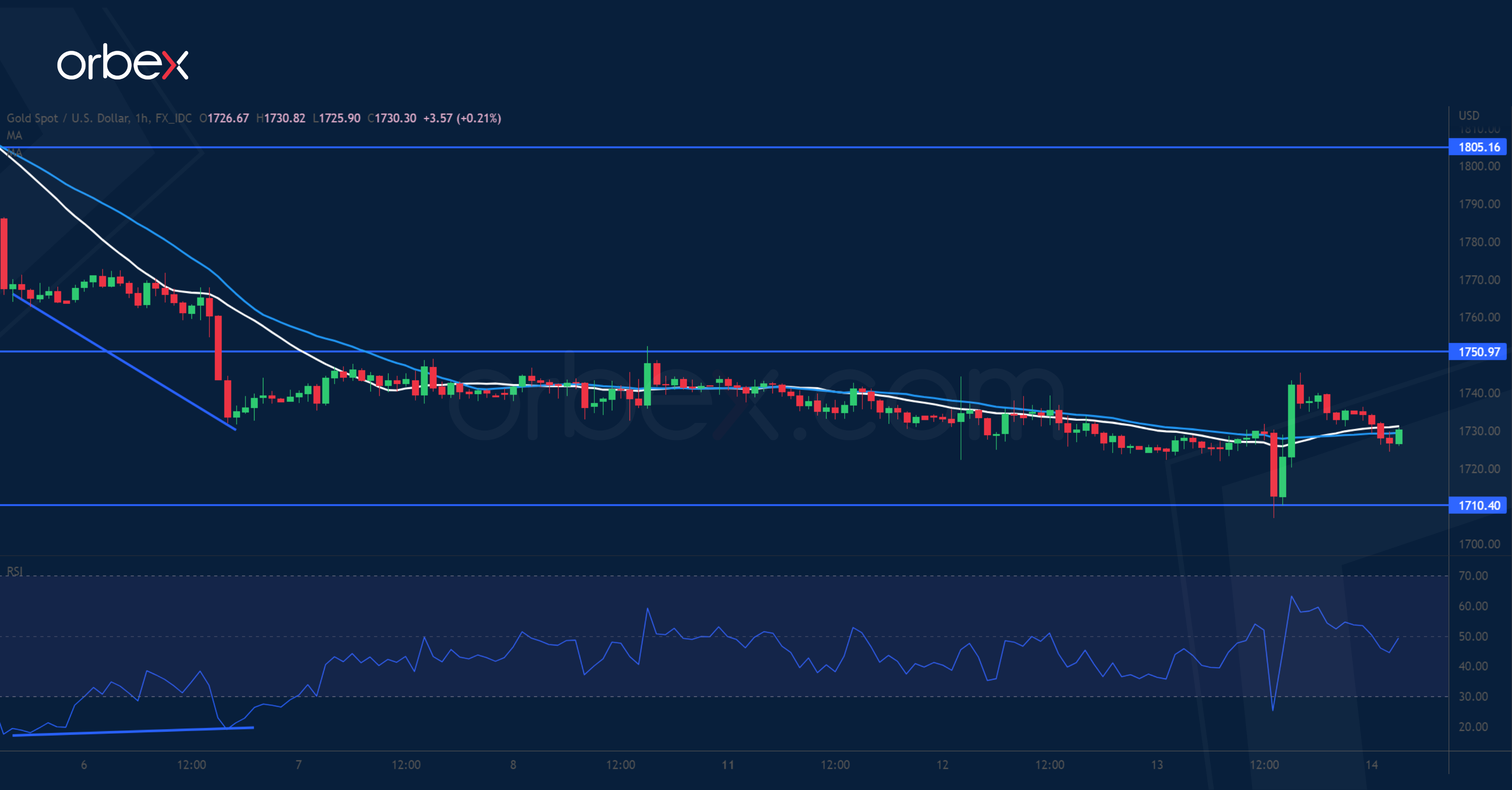
Gold recouped some losses after the US dollar bulls took profit following inflation data in June. The price action has struggled to stay above September 2021’s lows at 1723. A bullish RSI divergence showed a slowdown in the sell-off. A rally above 1750 would act as confirmation and prompt sellers to cover their bets, paving the way for an extended recovery. Then 1805 along the 30-day moving average could be within reach. A drop below 1710 may attract more bears and send the metal to August 2021’s lows near 1682.
USD/CAD Hits Resistance
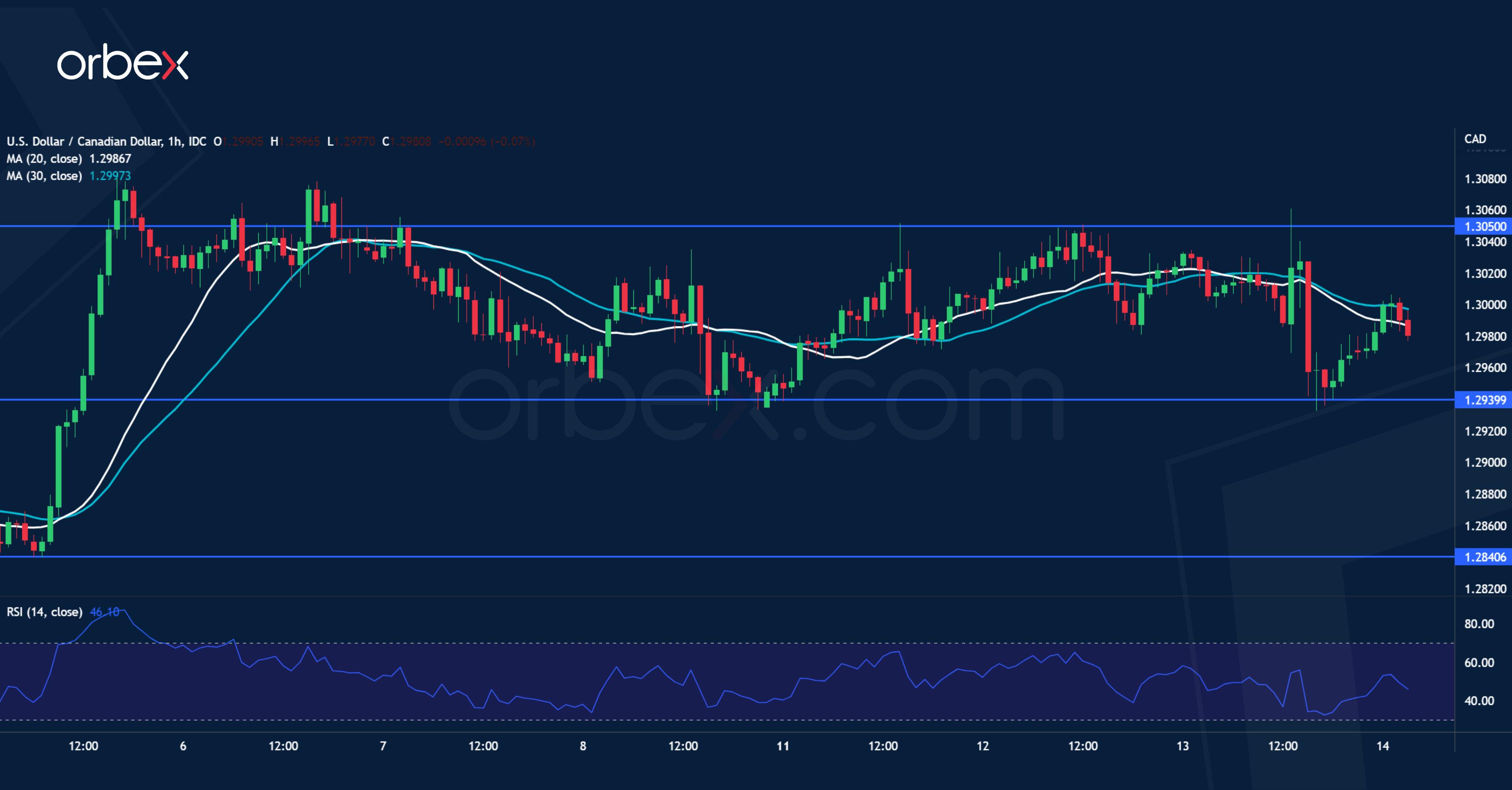
The Canadian dollar soared after the Bank of Canada surprised the market with a 1% hike. The greenback consolidated its gains after it broke above June’s peak at 1.3070. 1.2940 at the base of a previous bullish breakout has offered some support, though its retest is a sign of hesitation. 1.3050 is the last hurdle ahead and a bullish breakout may attract momentum buyers and resume the uptrend. On the downside, a fall below 1.2940 may cast doubt on the bulls’ commitment and deepen the correction to 1.2840.
GBP/USD Sees Limited Bounce
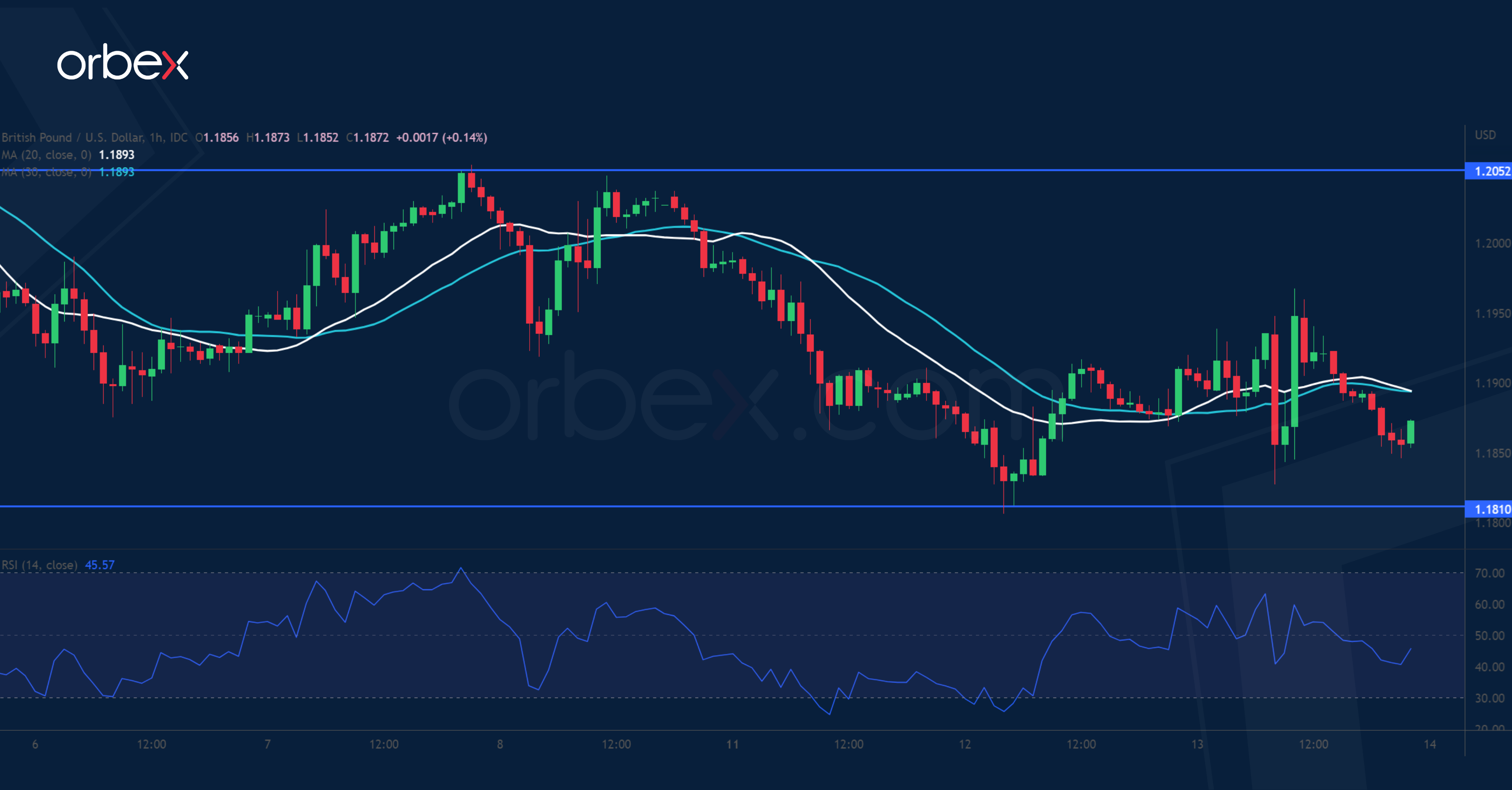
The pound finds support from better-than-expected GDP growth in May. The pair is having a hard time holding onto its rally attempts. Bearish sentiment means that rebounds have rather been opportunities for trend followers to sell into strength. The RSI’s double bottom in the oversold area caught some buyers’ attention. But strong selling could be expected between the psychological level of 1.2000 and 1.2050. 1.1810 is a fresh support and its breach could trigger a new round of liquidation towards 1.1600.
Dow Jones Remains on Edge ahead of Bank Earnings Season
American stocks declined while the U.S. dollar retreated after the strong American consumer inflation data. The numbers showed that the country’s inflation surged to a multi-decade high of 9.1% in June. That increase was bigger than the median estimates of 8.8%. However, core inflation rose at a smaller pace than what analysts were expecting. These numbers imply that the Federal Reserve will likely embrace a more hawkish tone in the coming months. Analysts are now pricing in a 100 basis points hike when the bank meets later this month. Today, the U.S. dollar will react to the latest producer price index (PPI) data.
American equities also retreated as several large American companies started publishing their quarterly results. Delta delivered a bigger profit than expected but warned that inflation will likely lead to thinner margins later this year. This view was shared by PepsiCo, the second-biggest beverage company in the world. Many large companies are expected to publish their results today. This includes companies like Taiwan Semiconductor, JP Morgan, Morgan Stanley, and Cintas. These are important companies because they lead their respective industries and are key barometers of the economy.
The Canadian dollar rose sharply against the US dollar after the latest interest rate decision by the Bank of Canada. The BoC caught most investors by surprise when it decided to hike interest rates by 100 basis points. It pushed the official rate to 2.25% and warned that more hikes will likely happen later this year if inflation remains stubbornly high. The economic calendar is relativle light today. The only important events will be the the U.S. PPI figures and initial jobless claims.
USDCAD
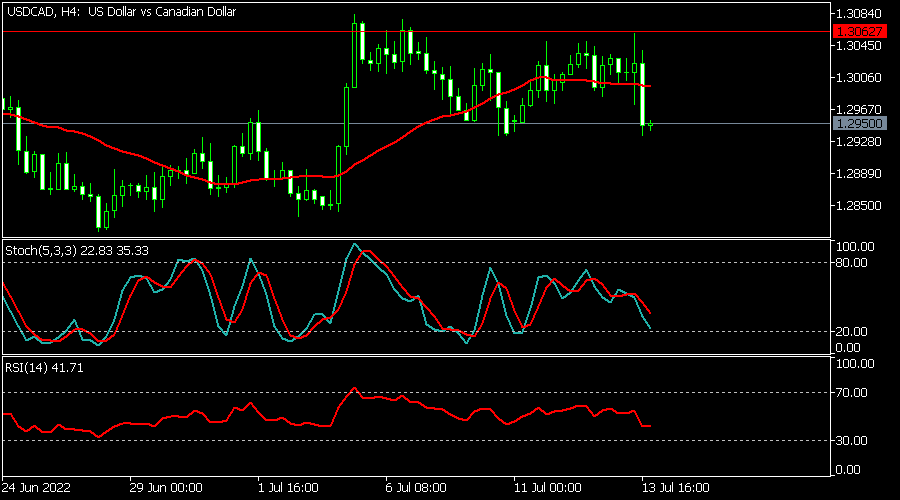
The USDCAD pair declined to an intraday low of 1.2945, the lowest level since July 11. On the four-hour chart, the pair has moved slightly below the 25-day moving average while the Stochastic Oscillator and the Relative Strength Index (RSI) have pointed downwards. The pair has also formed a triple-top pattern. Therefore, the pair will likely have a bearish breakout as sellers target the support at 1.2850.
EURUSD
The EURUSD pair dropped to the parity level after the strong US consumer inflation data. It then bounced back to the current 1.008, which was the highest point since Tuesday. It remains below the 25-day and 50-day moving averages while the Relative Strength Index (RSI) and the Stochastic Oscillator are pointing upwards. Therefore, the pair will likely continue oscillating in this range and then have a bearish breakout.
EURGBP
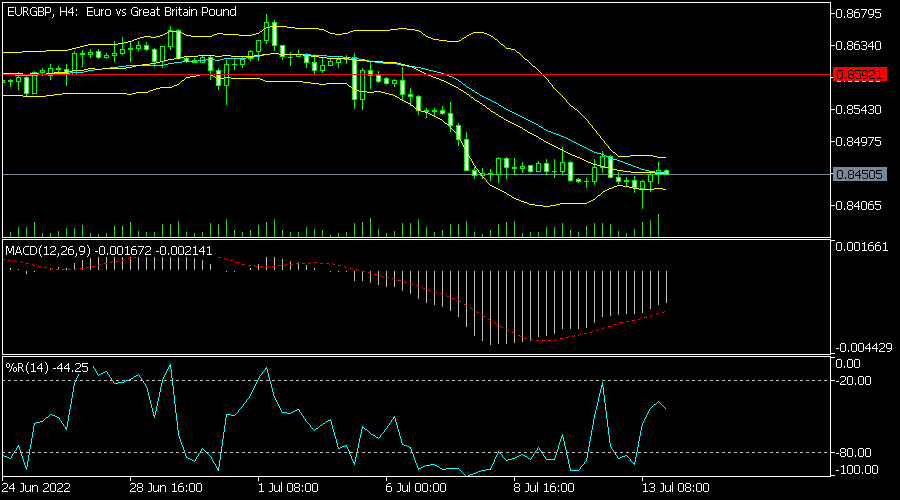
The EURGBP pair moved sideways as investors focused on the political happenings in the UK. It is trading at 0.8453, which is slightly above this week’s low of 0.8400. On the four-hour chart, Bollinger Bands have narrowed while the MACD remains below the neutral point. The Williams % Range has moved above the oversold level. Therefore, the pair will likely have a bearish breakout as sellers target the next support at 0.8400.
USD/JPY Daily Outlook
Daily Pivots: (S1) 136.39; (P) 136.96; (R1) 137.44; More...
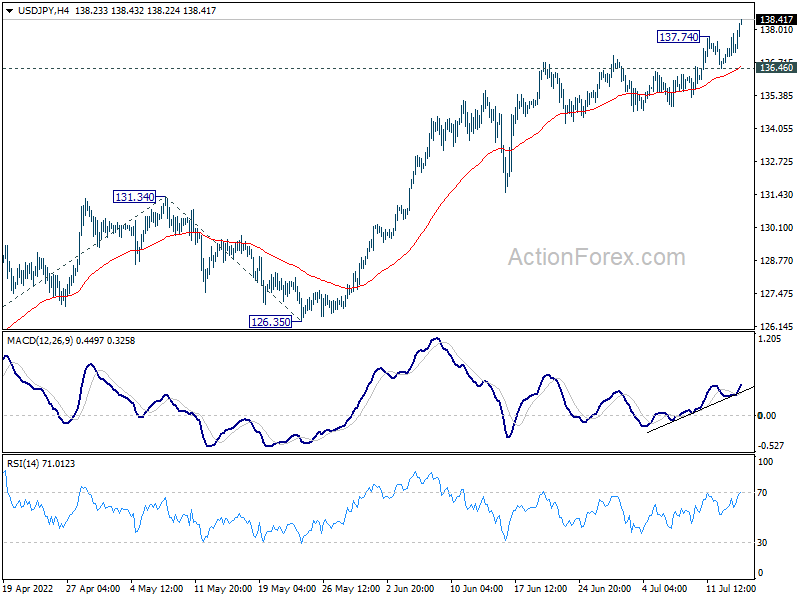
USD/JPY's up trend resumes by breaking 137.74 and intraday bias is back on the upside. There is sign of upside re-acceleration as seen in daily and 4 hour MACD too. Next target is 100% projection of 114.40 to 131.34 from 126.35 at 143.29. On the downside, below 136.46 minor support will turn intraday bias neutral and bring consolidations first, before staging another rally.
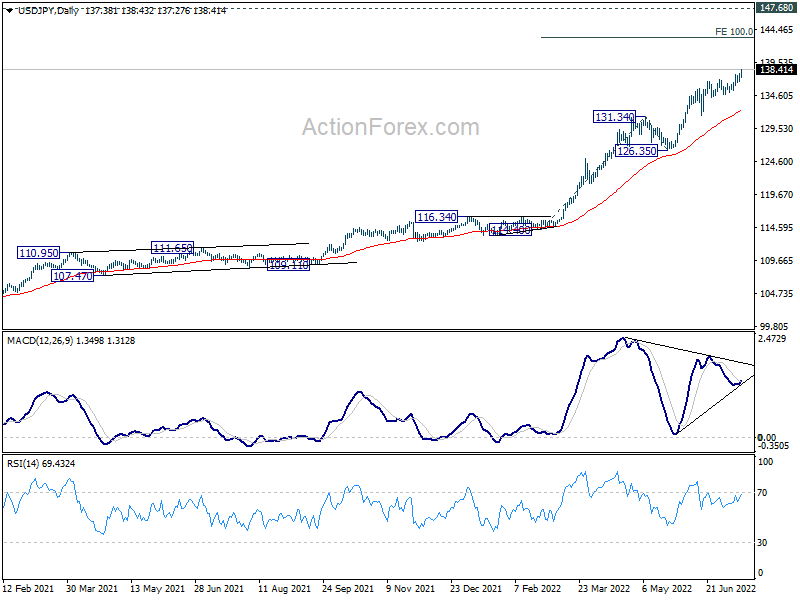
In the bigger picture, current rally is seen as part of the long term up trend from 75.56 (2011 low). Next target is 100% projection of 75.56 (2011 low) to 125.85 (2015 high) from 98.97 at 149.26, which is close to 147.68 (1998 high). This will remain the favored case as long as 126.35 support holds.
Yen Extends Decline Against Dollar and Canadian
Yen's selloff continues in Asian session today, on expectation of further divergence in BoJ's policy with other major central banks. BoC's mega 100bps hike overnight prompted talks that Fed could follow later in the month, given that headline consumer inflation is showing no sign of even plateauing. Dollar remains the strongest one for the week, followed by Canadian and then Swiss Franc. Yen is the worst performing, followed by Euro, and then Sterling.
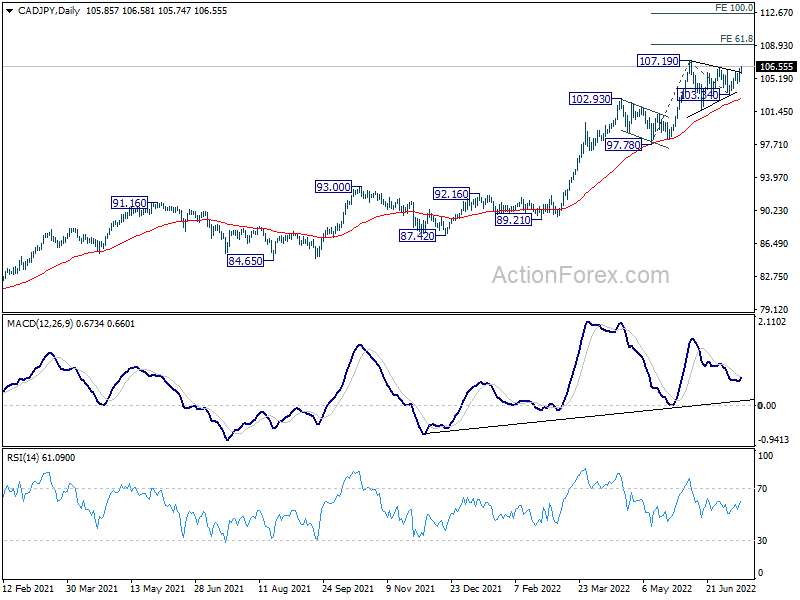
Technically, CAD/JPY looks ready to follow USD/JPY in upside breakout finally. Immediate focus is now on 107.19 resistance. Firm break there will target 61.8% projection of 97.78 to 107.19 from 103.34 at 109.15, and then 100% projection at 112.75. However, for now, other Yen crosses are not showing similar bullish sign yet.
In Asia, at the time of writing, Nikkei is up 0.83%. Hong Kong HSI is down -0.14%. China Shanghai SSE is up 0.26%. Singapore Strait Times is down -0.79%. Japan 10-year JGB yield is down -0.0018 at 0.236. Overnight, DOW dropped -0.67%. S&P 500 dropped -0.45%. NASDAQ dropped -0.15%. 10-year yield dropped -0.054 to 2.904.
Fed Mester: No reason to have a smaller hike than 75bps
Cleveland President Loretta Mester told Bloomberg TV yesterday, the June inflation report was "uniformly bad". "There was no good news in that report at all," she said. "We at the Fed have to be very deliberate and intentional about continuing on this path of raising our interest rate until we get and see convincing evidence that inflation has turned a corner."
"Certainly the inflation report suggests that there's no reason to say that a smaller rate increase than we did last time, right, because nothing moved in that direction," she added.
Asked if a 100bps hike is appropriate this month, Mester said, "We're going to have the meeting and we're going to talk about what the appropriate path of policy is. We don't have to make a decision today."
Fed Bostic: Inflation trajectory not moving in positive way
Commenting on yesterday's US CPI report, which showed headline inflation surged to 9.1%, Atlanta Fed President Raphael Bostic said the "numbers suggest the trajectory is not moving in a positive way". But, "how much I need to adapt is really the next question," as he needed to study the "nuts and bolts" of the report.
"The top-line number is a source of concern," Bostic said, "Everything is in play." Asked if that included by raising rates by a full percentage point, following BoC's surprised move, he replied, "it would mean everything."
Australia unemployment rate dropped to 3.5%, lowest since 1974
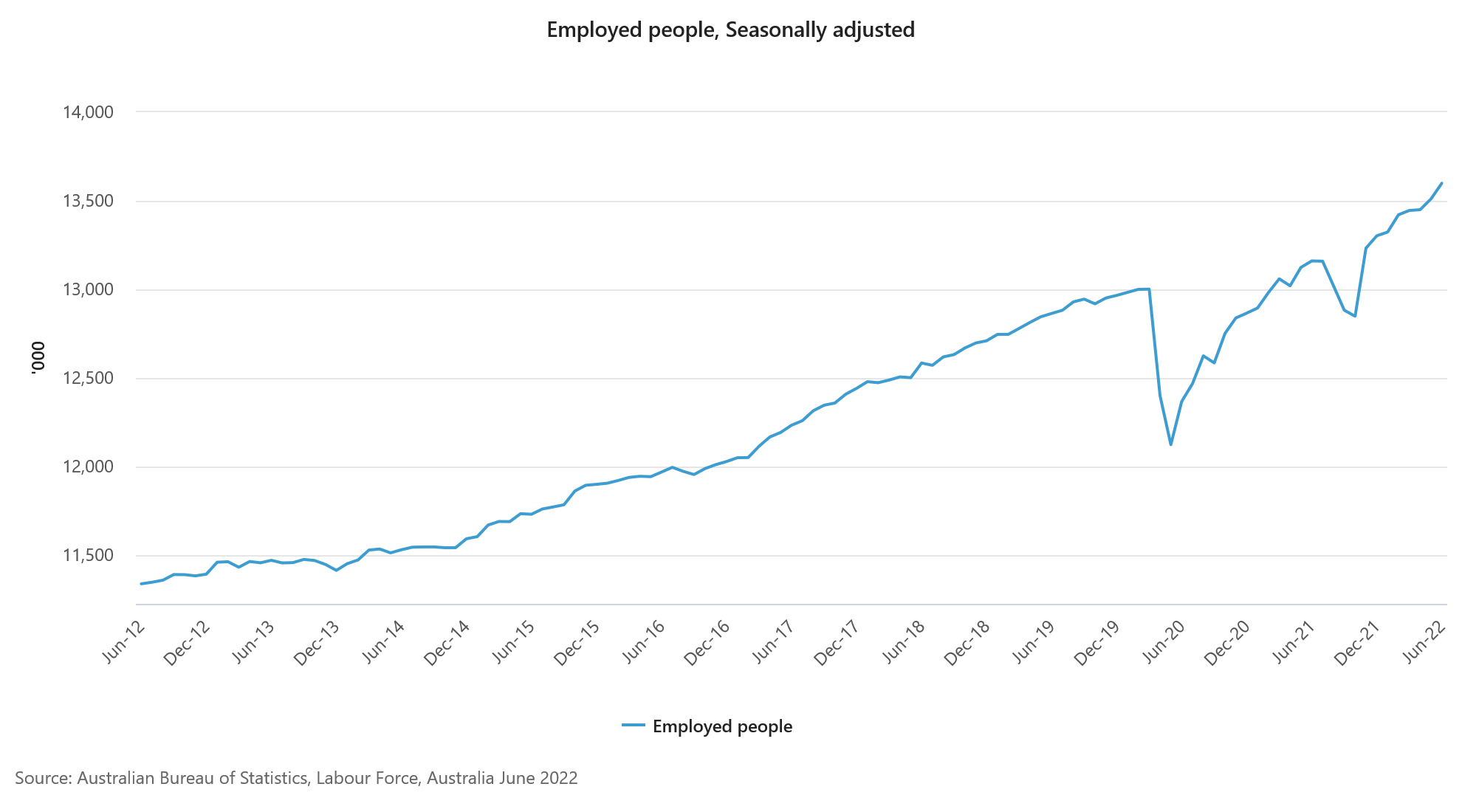
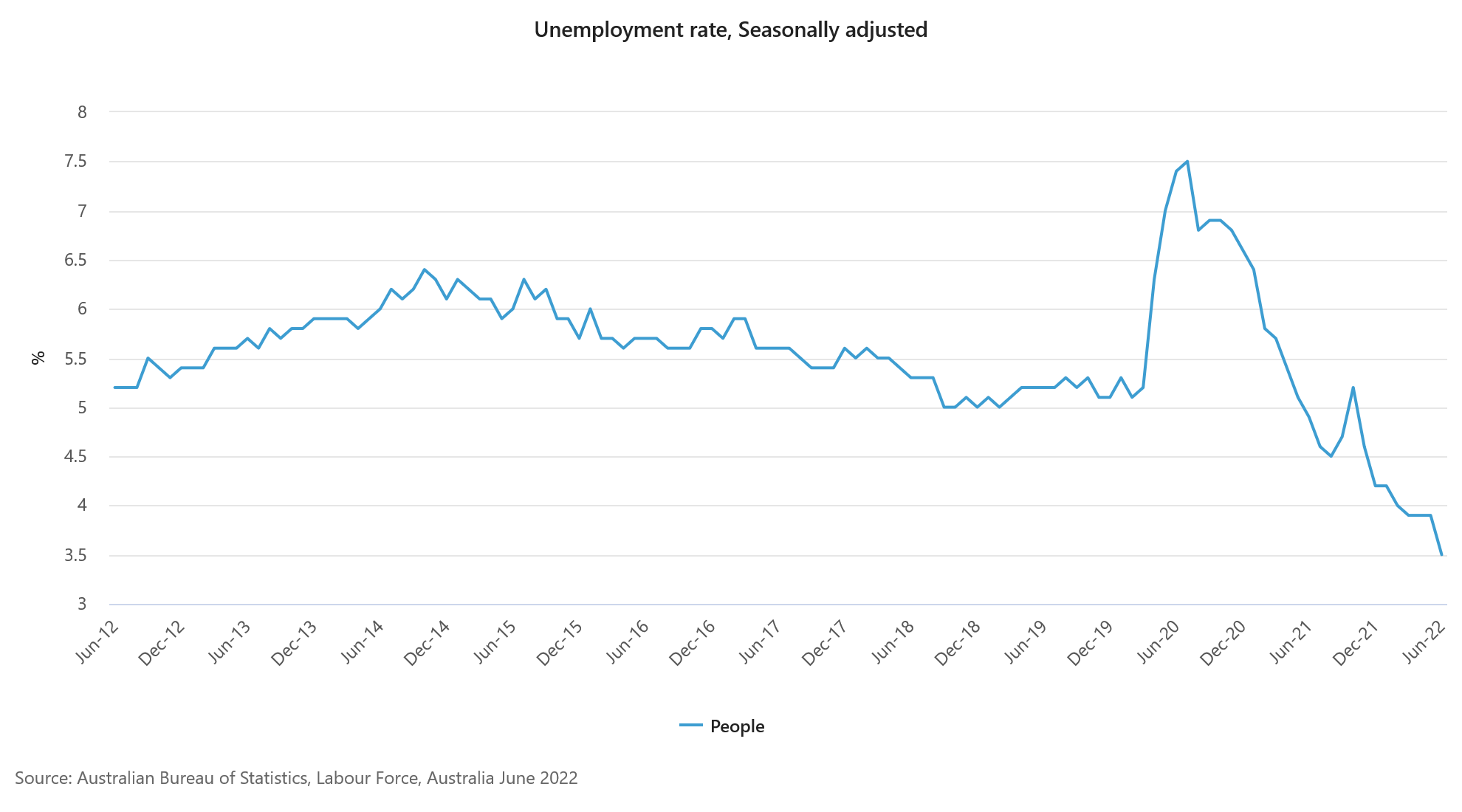
Australia employment grew 88.4k in June, above expectation of 30.0k. Full time jobs grew 52.9k while part-time jobs rose 35.5k. Unemployment rate dropped sharply from 3.9% to 3.5%, below expectation of 3.8%. That's the lowest level since August 1974. Participation rate rose from 66.7% to 66.8%. Monthly hours worked was essentially unchanged at 1856m.
Bjorn Jarvis, head of labour statistics at the ABS, said: "The 3.4 per cent unemployment rate for women was the lowest since February 1974 and the 3.6 per cent rate for men was the lowest since May 1976."
"The large fall in the unemployment rate this month reflects more people than usual entering employment and also lower than usual numbers of employed people becoming unemployed. Together these flows reflect an increasingly tight labour market, with high demand for engaging and retaining workers, as well as ongoing labour shortages."
Looking ahead
Swiss PPI will be released in European session. Later in the day, US will release jobless claims and PPI. Canada will release manufacturing sales.
USD/JPY Daily Outlook
Daily Pivots: (S1) 136.39; (P) 136.96; (R1) 137.44; More...
USD/JPY's up trend resumes by breaking 137.74 and intraday bias is back on the upside. There is sign of upside re-acceleration as seen in daily and 4 hour MACD too. Next target is 100% projection of 114.40 to 131.34 from 126.35 at 143.29. On the downside, below 136.46 minor support will turn intraday bias neutral and bring consolidations first, before staging another rally.
In the bigger picture, current rally is seen as part of the long term up trend from 75.56 (2011 low). Next target is 100% projection of 75.56 (2011 low) to 125.85 (2015 high) from 98.97 at 149.26, which is close to 147.68 (1998 high). This will remain the favored case as long as 126.35 support holds.
Economic Indicators Update
| GMT | Ccy | Events | Actual | Forecast | Previous | Revised |
|---|---|---|---|---|---|---|
| 23:01 | GBP | RICS Housing Price Balance Jun | 65% | 70% | 73% | |
| 01:00 | AUD | Consumer Inflation Expectations Jul | 6.30% | 6.70% | ||
| 01:30 | AUD | Employment Change Jun | 88.4K | 30.0K | 60.6K | |
| 01:30 | AUD | Unemployment Rate Jun | 3.50% | 3.80% | 3.90% | |
| 04:30 | JPY | Industrial Production M/M May F | -7.50% | -7.20% | -7.20% | |
| 06:30 | CHF | Producer and Import Prices M/M Jun | 0.70% | 0.90% | ||
| 06:30 | CHF | Producer and Import Prices Y/Y Jun | 7.30% | 6.90% | ||
| 12:30 | CAD | Manufacturing Sales M/M May | 1.40% | 1.70% | ||
| 12:30 | USD | Initial Jobless Claims (Jul 8) | 240K | 235K | ||
| 12:30 | USD | PPI M/M Jun | 0.80% | 0.80% | ||
| 12:30 | USD | PPI Y/Y Jun | 10.80% | 10.80% | ||
| 12:30 | USD | PPI Core M/M Jun | 0.50% | 0.50% | ||
| 12:30 | USD | PPI Core Y/Y Jun | 8.60% | 8.30% | ||
| 14:30 | USD | Natural Gas Storage | 56B | 60B |
Australia unemployment rate dropped to 3.5%, lowest since 1974
Australia employment grew 88.4k in June, above expectation of 30.0k. Full time jobs grew 52.9k while part-time jobs rose 35.5k. Unemployment rate dropped sharply from 3.9% to 3.5%, below expectation of 3.8%. That's the lowest level since August 1974. Participation rate rose from 66.7% to 66.8%. Monthly hours worked was essentially unchanged at 1856m.
Bjorn Jarvis, head of labour statistics at the ABS, said: "The 3.4 per cent unemployment rate for women was the lowest since February 1974 and the 3.6 per cent rate for men was the lowest since May 1976."
"The large fall in the unemployment rate this month reflects more people than usual entering employment and also lower than usual numbers of employed people becoming unemployed. Together these flows reflect an increasingly tight labour market, with high demand for engaging and retaining workers, as well as ongoing labour shortages."
Fed Mester: No reason to have a smaller hike than 75bps
Cleveland President Loretta Mester told Bloomberg TV yesterday, the June inflation report was "uniformly bad". "There was no good news in that report at all," she said. "We at the Fed have to be very deliberate and intentional about continuing on this path of raising our interest rate until we get and see convincing evidence that inflation has turned a corner."
"Certainly the inflation report suggests that there's no reason to say that a smaller rate increase than we did last time, right, because nothing moved in that direction," she added.
Asked if a 100bps hike is appropriate this month, Mester said, "We're going to have the meeting and we're going to talk about what the appropriate path of policy is. We don't have to make a decision today."
Fed Bostic: Inflation trajectory not moving in positive way
Commenting on yesterday's US CPI report, which showed headline inflation surged to 9.1%, Atlanta Fed President Raphael Bostic said the "numbers suggest the trajectory is not moving in a positive way". But, "how much I need to adapt is really the next question," as he needed to study the "nuts and bolts" of the report.
"The top-line number is a source of concern," Bostic said, "Everything is in play." Asked if that included by raising rates by a full percentage point, following BoC's surprised move, he replied, "it would mean everything."