

Sample Category Title
EUR/USD Mid-Day Outlook
Daily Pivots: (S1) 1.0366; (P) 1.0443 (R1) 1.0486; More...
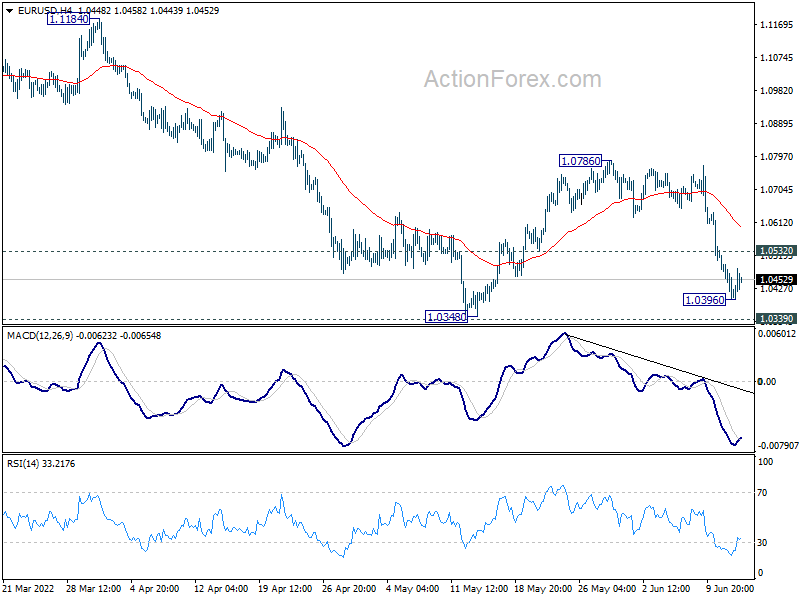
A temporary low is formed at 1.0396 in EUR/USD and intraday bias is turned neutral first. Risk stays on the downside as long as 1.0786 resistance holds. Below 1.0396 will target 1.0039 long term support. Decisive break there will resume larger down trend. Next target is long term projection level at 1.0090.
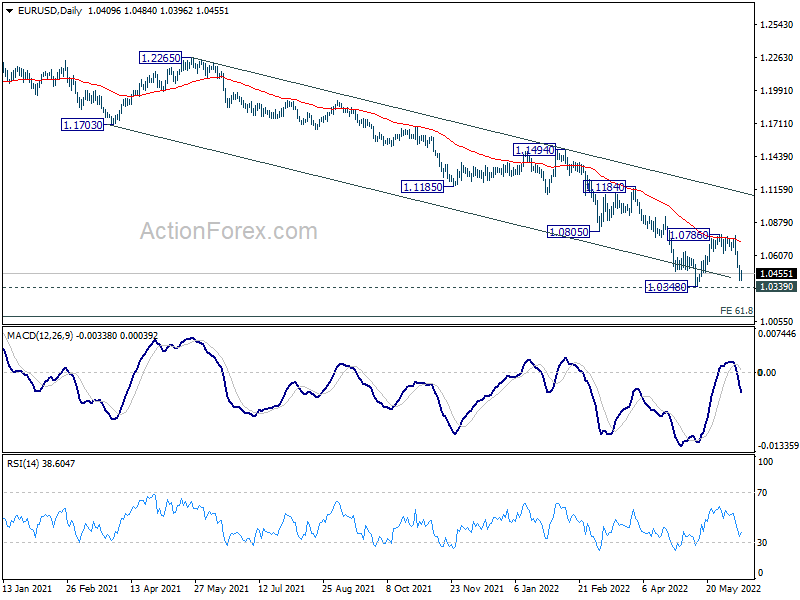
In the bigger picture, focus stays on 1.0339 long term support (2017 low). Decisive break there will resume whole down trend from 1.6039 (2008 high). Next target is 61.8% projection of 1.3993 to 1.0339 from 1.2348 at 1.0090. However, firm break of 1.0805 support turned resistance will delay this bearish case, and bring stronger rebound first.
USD/CHF Mid-Day Outlook
Daily Pivots: (S1) 0.9898; (P) 0.9946; (R1) 1.0019; More...
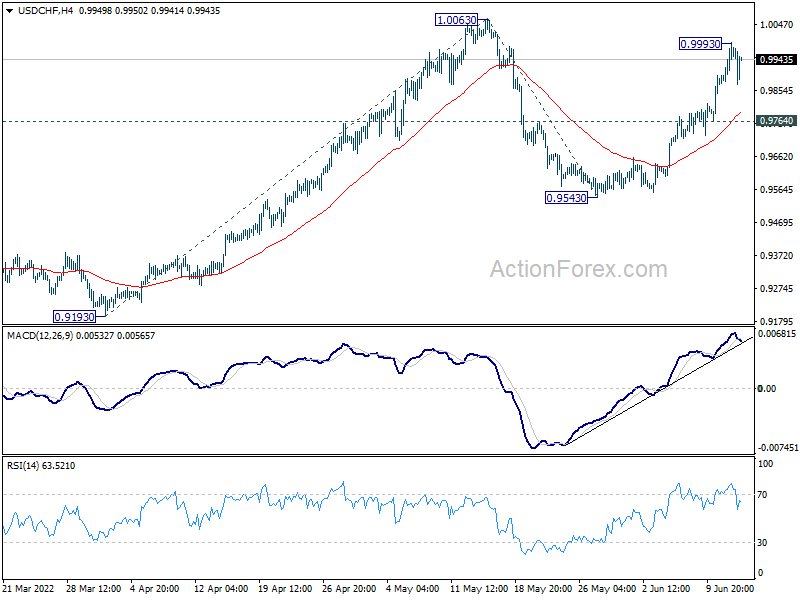
Intraday bias in USD/CHF remains neutral for consolidation below 0.9993 temporary top. On the upside, above 0.9993 will target 1.0063 resistance. Firm break there will resume larger up trend. Next target is 100% projection of 0.9193 to 1.0063 from 0.9543 at 1.0413. On the downside, below 0.9764 minor support will extend the corrective pattern from 1.0063 with another falling leg, and turn intraday bias to the downside.
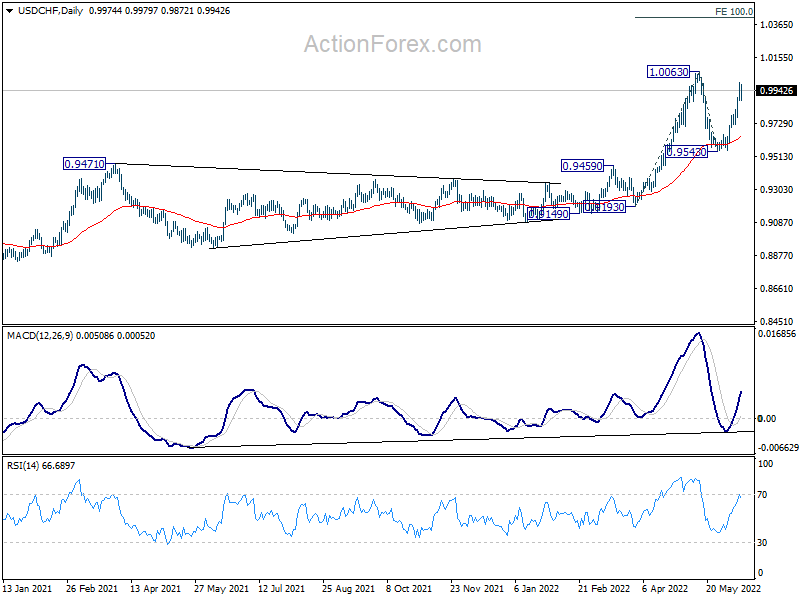
In the bigger picture, down trend from 1.0342 (2016 high) should have completed with three waves down to 0.8756 (2021 low) already. Rise from 0.8756 is likely a medium term up trend of its own. Next target is 1.0237/0342 resistance zone. This will remain the favored case as long as 0.9471 resistance turned support holds. However, sustained break of 0.9471 will extend long term range trading with another falling leg.
USD/JPY Mid-Day Outlook
Daily Pivots: (S1) 133.61; (P) 134.41; (R1) 135.21; More...
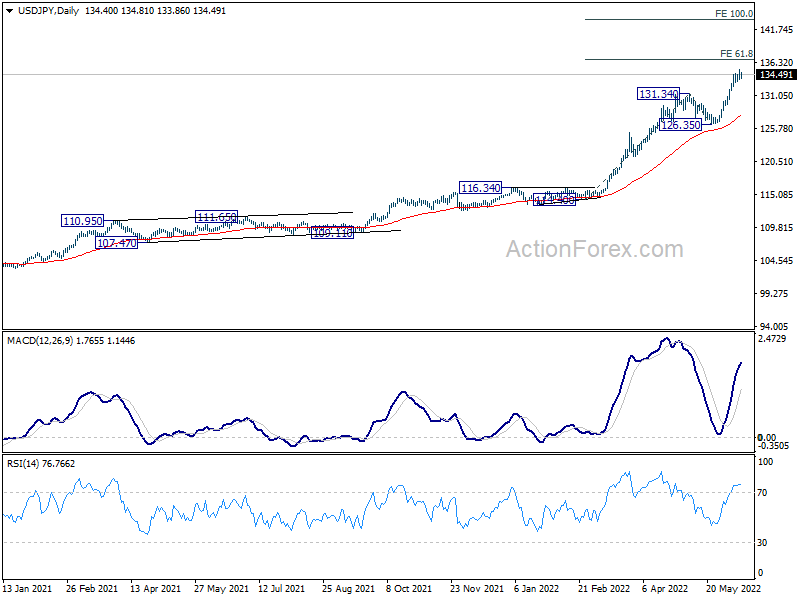
USD/JPY is staying in consolidation from 135.18 and intraday bias remains neutral. Downside of retreat should be contained by 131.34 resistance turned support to bring another rally. On the upside, break of 135.18 will resume larger up trend to 61.8% projection of 114.40 to 131.34 from 126.35 at 136.81. Firm break there will target 100% projection at 143.29.
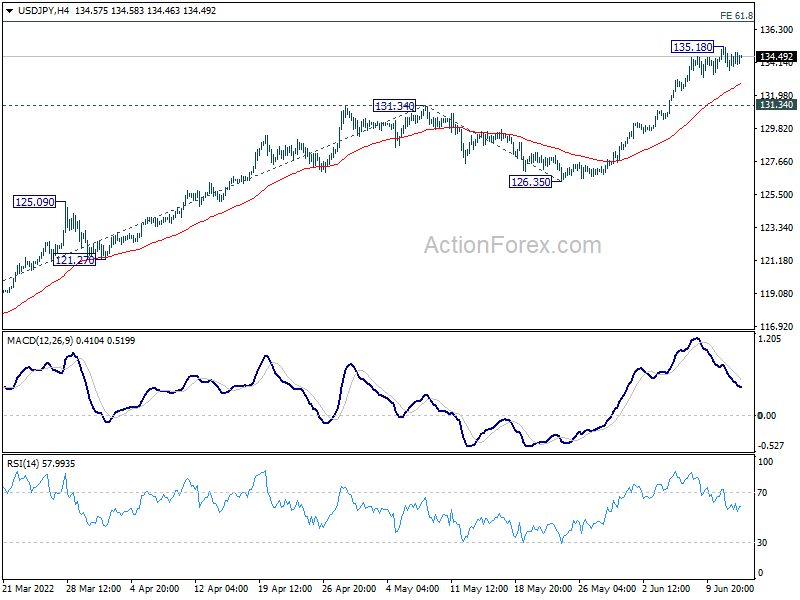
In the bigger picture, current rally is seen as part of the long term up trend from 75.56 (2011 low). Next target is 100% projection of 75.56 (2011 low) to 125.85 (2015 high) from 98.97 at 149.26, which is close to 147.68 (1998 high). This will remain the favored case as long as 126.35 support holds.
GBP/USD Mid-Day Outlook
Daily Pivots: (S1) 1.2051; (P) 1.2188; (R1) 1.2269; More...
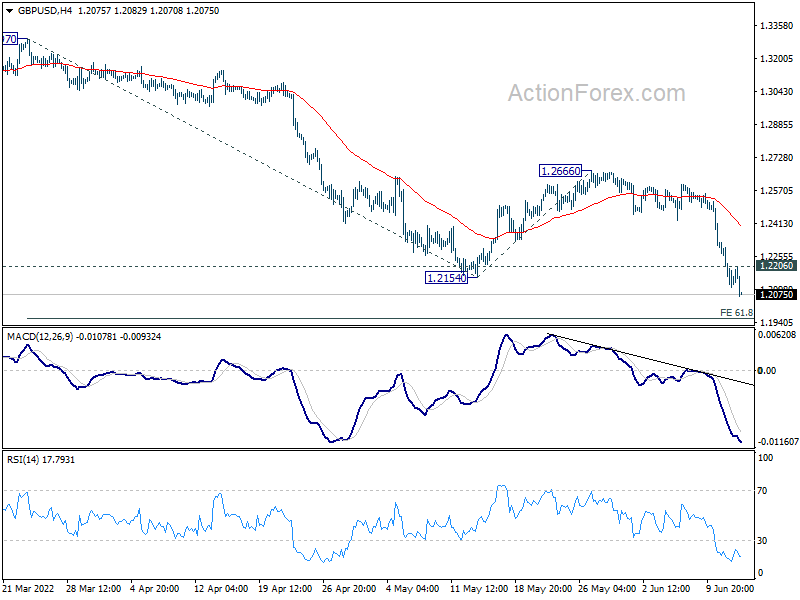
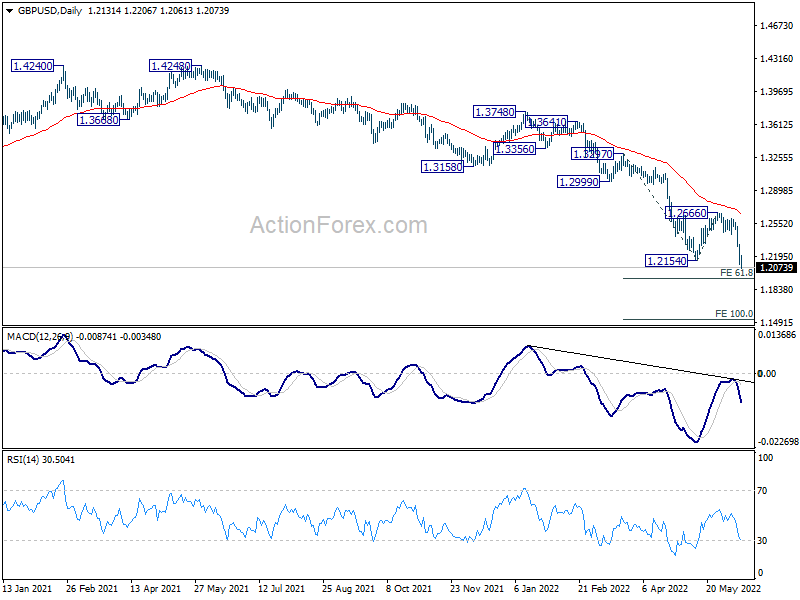
GBP/USD's down trend is still in progress. Intraday bias remains on the downside for 61.8% projection of 1.3297 to 1.2154 from 1.2666 at 1.1960. Break there will target 100% projection at 1.1523 next. On the upside, above 1.2206 minor resistance will turn intraday bias neutral and bring consolidations first, before staging another decline.
In the bigger picture, fall from 1.4248 (2018 high) could be a leg inside the pattern from 1.1409 (2020 low), or resuming the longer term down trend. Deeper decline is expected as long as 1.2666 resistance holds. On resumption, next target is 1.1409 low.
EUR/GBP Mid-Day Outlook
Daily Pivots: (S1) 0.8542; (P) 0.8568; (R1) 0.8604; More...
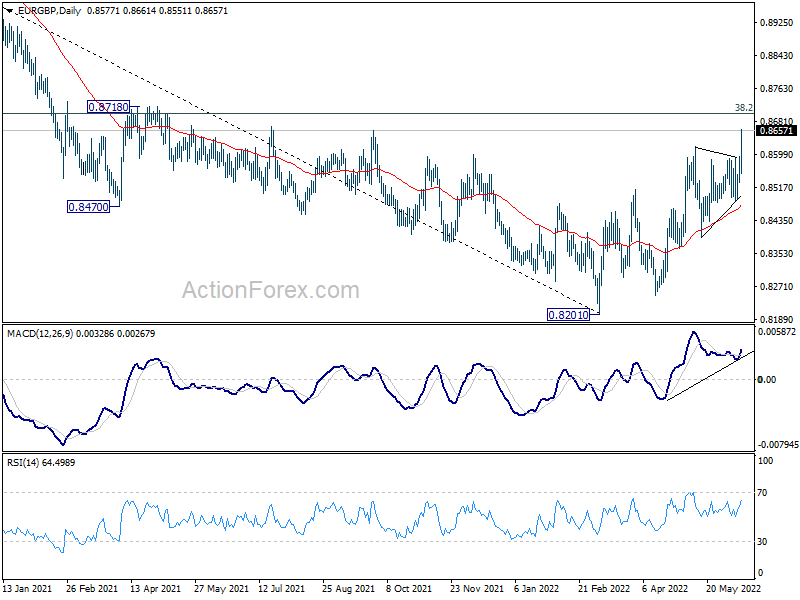
EUR/GBP's strong break of 0.8617 resistance confirms resumption of rise from 0.8201. Intraday bias is now on the upside for 0.8697 medium term fibonacci level. Sustained break there will carry larger bullish implication and target next fibonacci level at 0.9003. On the downside, below 0.8593 minor support will turn intraday bias neutral first. But outlook will stay bullish as long as 0.8484 support holds.
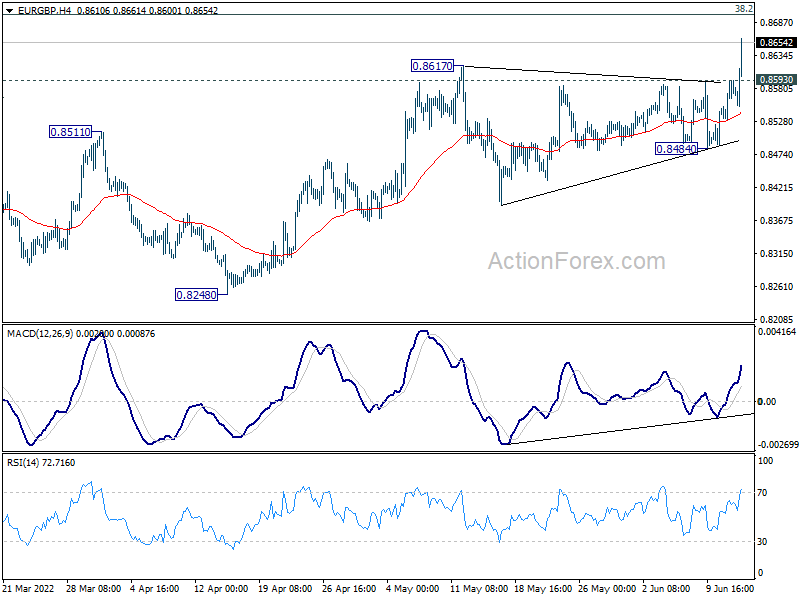
In the bigger picture, rise from 0.8201 medium term bottom could could either be a correction to the down trend from 0.9499 (2020 high), or a medium term up trend itself. Sustained break of 38.2% retracement of 0.9499 to 0.8201 at 0.8697 will affirm the latter case, and pave the way to 61.8% retracement at 0.9003.
Sterling Selloff Resumes, Dollar Power Continues
Sterling's selloff resumes today, after job data added to expectation that BoE would lag far behind Fed in tightening. Weak market sentiment sends commodity currencies lower. Thanks to buying against the Pound, Euro is so far the strongest one for today, leading Dollar, Yen and Swiss Franc. But still, Euro is far behind the greenback for the week. Overall, investor might start to turn cautious during the later part of today, as four central bank decisions lies ahead, starting with tomorrow's FOMC.
Technically, the selloff in the Pound is finally making some progress with EUR/GBP breaking through 0.8617 resistance firmly. A break through 1.1969 support in GBP/CHF would seal the bearish case for Sterling. Such development could push GBP/USD even deeper through 1.2 handle with downside acceleration.
In Europe, at the time of writing, FTSE is down -0.29%. DAX is down -0.18%. CAC is down -0.67%. Germany 10-year yield is up 0.025 at 1.662. Earlier in Asia, Nikkei dropped -1.32%. Hong Kong HSI closed flat. China Shanghai SSE rose 1.02%. Singapore Strait Times dropped -0.97%. Japan 10-year JGB yield rose 0.0013 to 0.256.
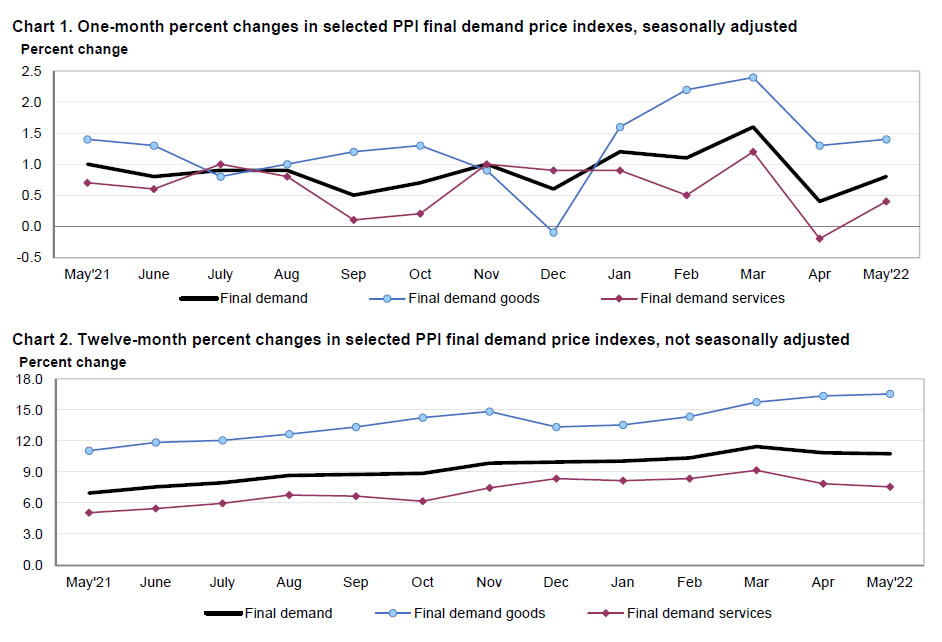
US PPI rose 0.8% mom, 10.8% yoy in May
US PPI for final demand rose 0.8% mom in May, matched expectations. For the 12-month period, PPI rose 10.8% yoy, down from April's 10.9% yoy, below expectation of 10.9% yoy. PPI less food, energy and trade services rose 0.5% mom, 6.8% yoy.
From Canada, manufacturing sales rose 1.7% mom in April, below expectation of 2.1% mom.
Germany ZEW rose to -28 in Jun, less pessimistic but still deep in negative
Germany ZEW Economic Sentiment rose from -34.3 to -28.0 in June, slightly below expectation of -27.5. Current Situation Index rose from -36.5 to -27.6, above expectation of -31.0.
Eurozone ZEW Economic Sentiment rose from -29.5 to -28.0, below expectation of -24.3. Current Situation Index rose 8.6 pts to -26.4.
"Financial market experts are less pessimistic about the economy. However, the economy is still exposed to numerous risks, such as the effects of the sanctions against Russia, the unclear pandemic situation in China and the gradual change of course in monetary policy. So although expectations have improved, they are still deep in negative territory," comments ZEW President Professor Achim Wambach on current expectations.
Also from Germany, CPI was finalized at 0.9% mom, 7.9% yoy in May.
UK payrolled employees rose 90k in May, unemployment rate unchanged at 3.8% in Apr
UK payrolled employees rose 90k, or 0.3% mom in May. Claimant count dropped -19.7k, versus expectations of -42.5k. Median monthly pay rose 5.4% yoy to GBP 2076.
In the three months to April, unemployment rate was unchanged at 3.8%. Economic inactivity rate dropped -0.1% to 21.3%. Average earnings including bonus rose 6.8% over the year, below expectation of 7.6%. Average earnings excluding bonus rose 4.2% over the year, above expectation of 4.0%.
RBA Lowe: Interest rate will get to 2.5% at some point
In an interview, RBA Governor Philip Lowe said, "Australians need to prepare for higher interest rates". He expects inflation to get to 7% by the end of the year, and "we need to be able to chart a course back to 2 to 3 per cent inflation".
Lowe said, "it's reasonable that the cash rate gets to 2½ per cent at some point... How fast we get to 2½ per cent, and indeed whether we get to 2½ per cent, is going to be determined by events."
He expects inflation to peak at around 7% in the December quarter this year. Inflation will "clearly be coming down" into the second half of next year.
Australia NAB business confidence dropped to 6 in May, conditions dropped to 16
Australia NAB business confidence dropped from 10 to 6 in May. Business conditions dropped from 19 to 16. Looking at some details, trading conditions dropped from 27 to 24. Profitability conditions dropped from 21 to 17. Employment conditions rose from 11 to 12.
"Lower confidence in May likely reflects a range of risks on the horizon," said NAB Group Chief Economist Alan Oster. "Businesses are facing a new environment of higher inflation, rising interest rates, and risks to global growth. However, confidence is still at a fairly robust level all things considered."
EUR/GBP Mid-Day Outlook
Daily Pivots: (S1) 0.8542; (P) 0.8568; (R1) 0.8604; More...
EUR/GBP's strong break of 0.8617 resistance confirms resumption of rise from 0.8201. Intraday bias is now on the upside for 0.8697 medium term fibonacci level. Sustained break there will carry larger bullish implication and target next fibonacci level at 0.9003. On the downside, below 0.8593 minor support will turn intraday bias neutral first. But outlook will stay bullish as long as 0.8484 support holds.
In the bigger picture, rise from 0.8201 medium term bottom could could either be a correction to the down trend from 0.9499 (2020 high), or a medium term up trend itself. Sustained break of 38.2% retracement of 0.9499 to 0.8201 at 0.8697 will affirm the latter case, and pave the way to 61.8% retracement at 0.9003.
Economic Indicators Update
| GMT | Ccy | Events | Actual | Forecast | Previous | Revised |
|---|---|---|---|---|---|---|
| 01:30 | AUD | NAB Business Confidence May | 6 | 10 | ||
| 01:30 | AUD | NAB Business Conditions May | 16 | 20 | ||
| 04:30 | JPY | Industrial Production M/M Apr F | -1.50% | -1.30% | -1.30% | |
| 06:00 | GBP | Claimant Count Change May | -19.7K | -42.5K | -56.9K | -65.5K |
| 06:00 | GBP | ILO Unemployment Rate (3M) Apr | 3.80% | 3.60% | 3.70% | |
| 06:00 | GBP | Average Earnings Including Bonus 3M/Y Apr | 6.80% | 7.60% | 7.00% | |
| 06:00 | GBP | Average Earnings Excluding Bonus 3M/Y Apr | 4.20% | 4.00% | 4.20% | |
| 06:00 | EUR | Germany CPI M/M May F | 0.90% | 0.90% | 0.90% | |
| 06:00 | EUR | Germany CPI Y/Y May F | 7.90% | 7.90% | 7.90% | |
| 09:00 | EUR | Germany ZEW Economic Sentiment Jun | -28 | -27.5 | -34.3 | |
| 09:00 | EUR | Germany ZEW Current Situation Jun | -27.6 | -31 | -36.5 | |
| 09:00 | EUR | Eurozone ZEW Economic Sentiment Jun | -28 | -24.3 | -29.5 | |
| 10:00 | USD | NFIB Business Optimism Index May | 93.1 | 93.1 | 93.2 | |
| 12:30 | USD | PPI M/M May | 0.80% | 0.80% | 0.50% | 0.40% |
| 12:30 | USD | PPI Y/Y May | 10.80% | 10.90% | 11.00% | 10.90% |
| 12:30 | USD | PPI Core M/M May | 0.50% | 0.60% | 0.40% | 0.20% |
| 12:30 | USD | PPI Core Y/Y May | 8.30% | 8.60% | 8.80% | |
| 12:30 | CAD | Manufacturing Sales M/M Apr | 1.70% | 2.10% | 2.50% | 3.50% |
US PPI rose 0.8% mom, 10.8% yoy in May
US PPI for final demand rose 0.8% mom in May, matched expectations. For the 12-month period, PPI rose 10.8% yoy, down from April's 10.9% yoy, below expectation of 10.9% yoy. PPI less food, energy and trade services rose 0.5% mom, 6.8% yoy.
Heads Up: Brace for a Hawkish FOMC Meeting
Summary
- Prior to Friday, June 10, we shared the universal consensus that the FOMC would hike rates by 50 bps its June 15 policy meeting. But the higher-than-expected inflation print for May now has us looking for a 75 bps rate hike.
- This expectation was reinforced by press reports on June 13 that seem designed to re-calibrate market expectations regarding the potential magnitude of the rate hike.
- We also look for a meaningful upward shift in the so-called "dot plot," which would indicate that Fed policymakers believe even more monetary tightening is appropriate in coming quarters.
- We look for the median dot to shift up to 3.375% at the end of this year and to 4.125% at the end of next year.
- We also expect the FOMC will raise its inflation forecast for 2022 while also paring down its GDP growth forecast for this year.
Source: Federal Reserve Board and Wells Fargo Economics
We Now Look for a 75 bps Rate Hike
In the preview report we wrote on June 6 that outlined our views about the June 15 FOMC meeting, we made the case for why a 50 bps rate hike was all but assured. But, that report was written before the May CPI data were released on June 10,which showed that inflation was once again higher than expected. Specifically, the overall CPI rose 1.0% in May, which boosted the year-over-year rate of inflation to 8.6% (Figure 1). Furthermore, the data were disheartening because they showed broad-base price pressures in the economy. In short, the Federal Reserve appears to be further "behind the curve" in its efforts to reduce the rate of inflation.
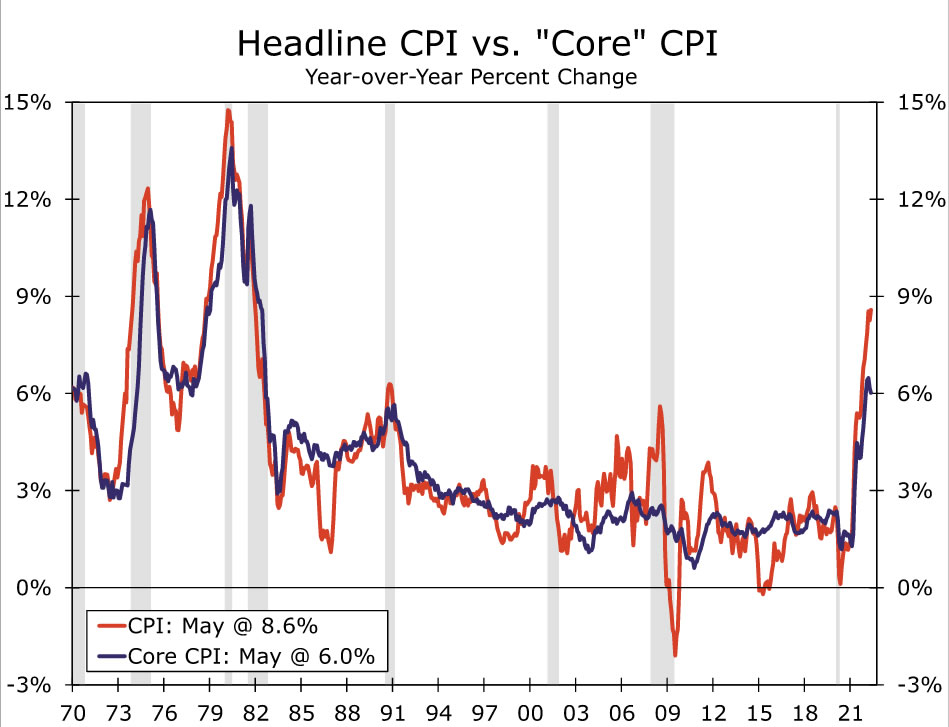
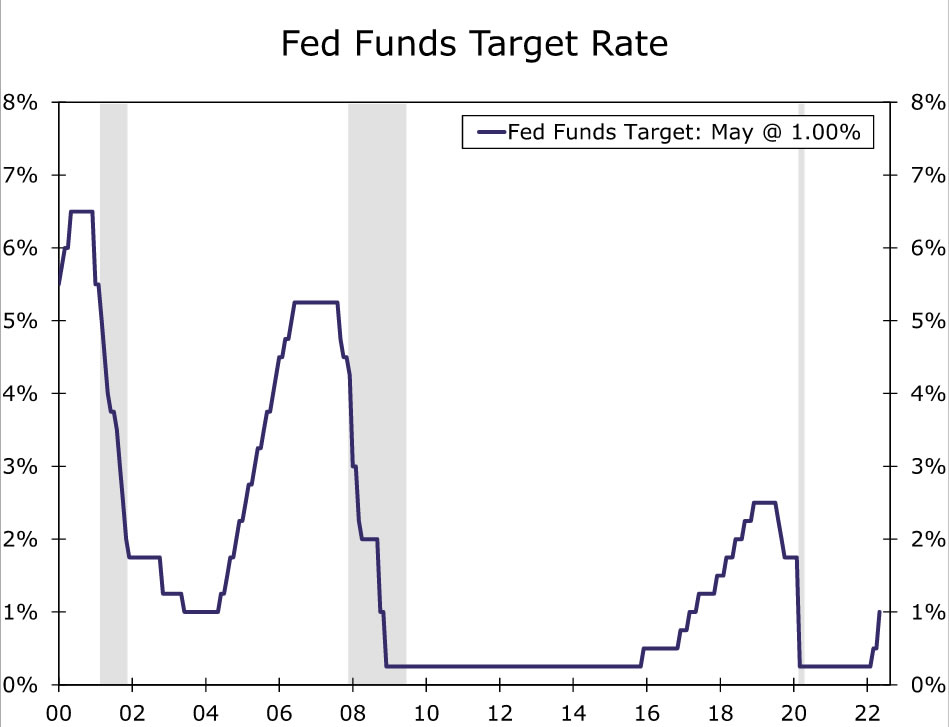
Consequently, we now believe it is likely that the Committee will opt to hike rates by 75 bps, which would take the target range for the fed funds rate to 1.50% to 1.75%. This expectation was reinforced by press reports on Monday, June 13 that policymakers would consider "surprising" markets with a 75 bps rate hike. Because we are now in the 10-day "blackout" period that usually precedes FOMC meetings, Fed officials are not scheduled to give any speeches. However, these press reports, which likely were confirmed by off-the-record comments by Fed officials, serve the useful purpose of re-calibrating market expectations in a rapidly changing environment.
That said, the Committee could still opt for 50 bps, although we think 75 bps is much more likely. In the event that the FOMC hikes by only 50 bps, we believe it would signal more aggressive tightening ahead via Chair Powell's post-meeting press conference and/or a significant shift higher in the so-called "dot plot."
Summary of Economic Projections: Higher Dots and Inflation, Less Growth
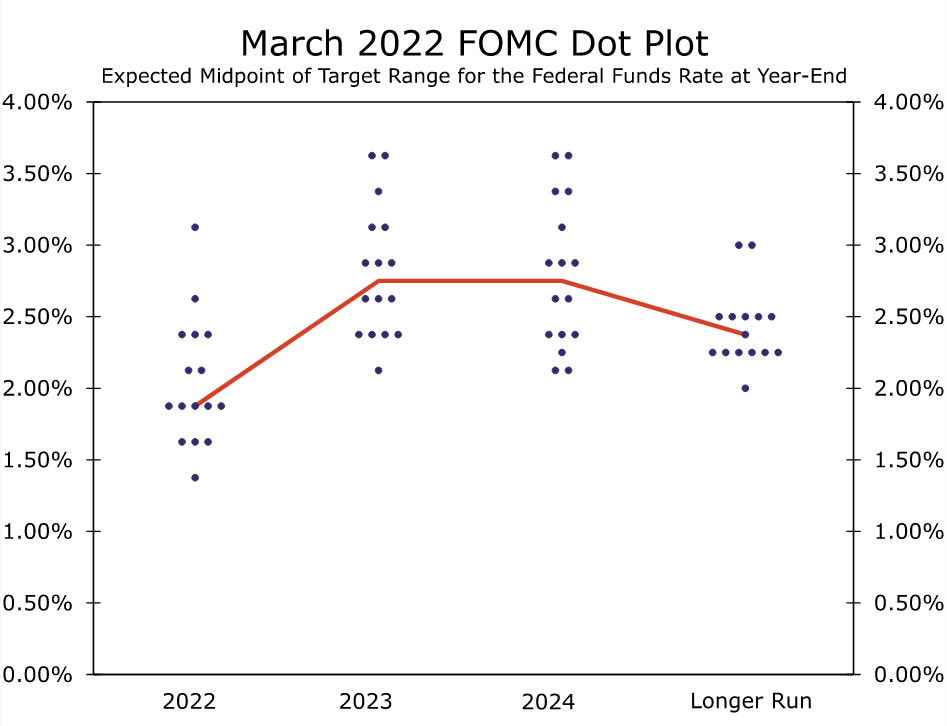
The dot plot (Figure 2) to be released on Wednesday likely will signal even more monetary policy tightening than we previously envisioned. In our previous FOMC preview report, we looked for the median dots for year-end 2022 and 2023 to rise to 2.875% and 3.375%, respectively. In light of last week's economic data, we now believe these projections are too low. We look for the year-end 2022 dot to be 3.375%, which would imply 175 bps of additional tightening at the four remaining FOMC meetings of the year (or 200 bps if the FOMC only hikes by 50 bps at the June 15 meeting). For 2023, we look for a year-end dot of 4.125%, which if realized would imply a target range of 4.00% to 4-25%. For 2024, we think the dot plot will signal that rates are steadily declining back toward the "neutral" rate of 2.50% or so. Accordingly, we look for the median dot for 2024 to be 3.125%.
On the inflation front, the Fed's projections will almost certainly move higher, particularly for headline inflation. Our June 8 forecast looked for the PCE deflator to increase 5.8% year-over-year in Q4 of this year, and the risks to that forecast lie to the upside after the CPI release on June 10. The median projection in the March Summary of Economic Projections (SEP) was 4.3%, and we would not be surprised if the June SEP has a median projection north of 5%. We doubt headline inflation projections for 2023 and 2024 will increase all that much as we suspect the FOMC will implicitly assume that food and energy prices decelerate and perhaps even decline somewhat in 2023 and beyond. The median projection for core PCE inflation may also tick up a tenth or two for 2022 and 2023.
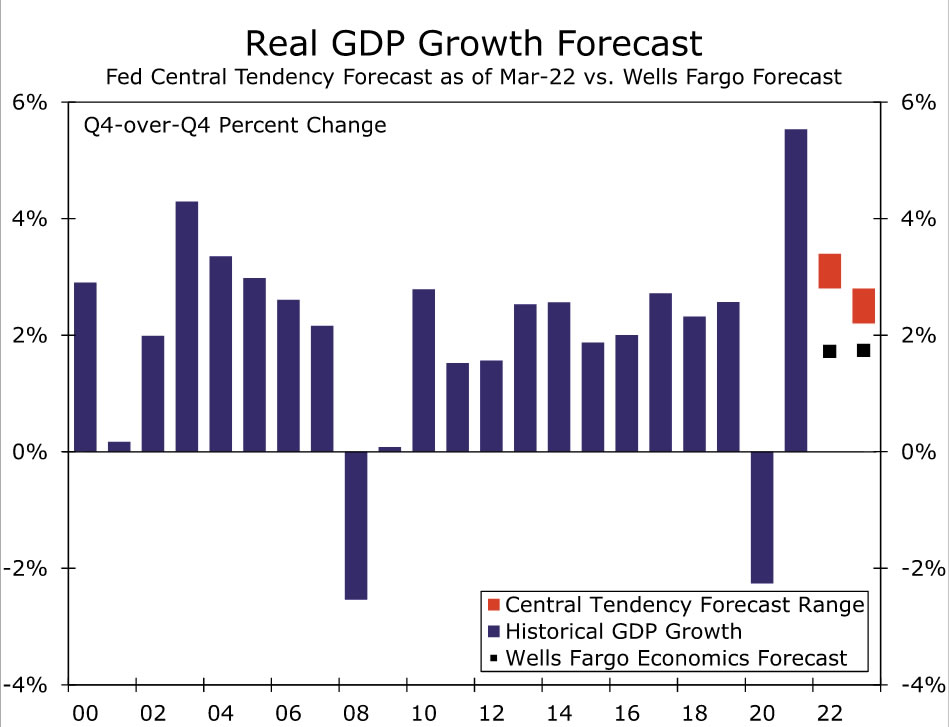
Although the FOMC's projections for the federal funds rate and inflation are likely headed up, the same cannot be said for the Committee's growth forecasts. The March SEP looked for 2.8% real GDP growth year-over-year in Q4-2022, whereas our most recent forecast looks for 1.7% (Figure 3). We doubt the FOMC will revise its forecast down that much, but a median projection of between 2.0% and 2.25% seems plausible to us. The FOMC's trend-like projections for economic growth in 2023 and 2024 may fall modestly, but we doubt that they will fall substantially.
Similarly, the Fed's March projections for the unemployment rate were flat in 2022 and 2023 at 3.5%, with just a modest uptick to 3.6% in 2024. A small increase in the median unemployment rate projection strikes us as plausible for 2023 and 2024. The "longer-run" projection for the unemployment rate was 4.0% in March, so the Fed could signal slightly higher unemployment while still tacitly signaling that it believes a soft landing is in the cards.
Yen Steady ahead of FOMC Meeting
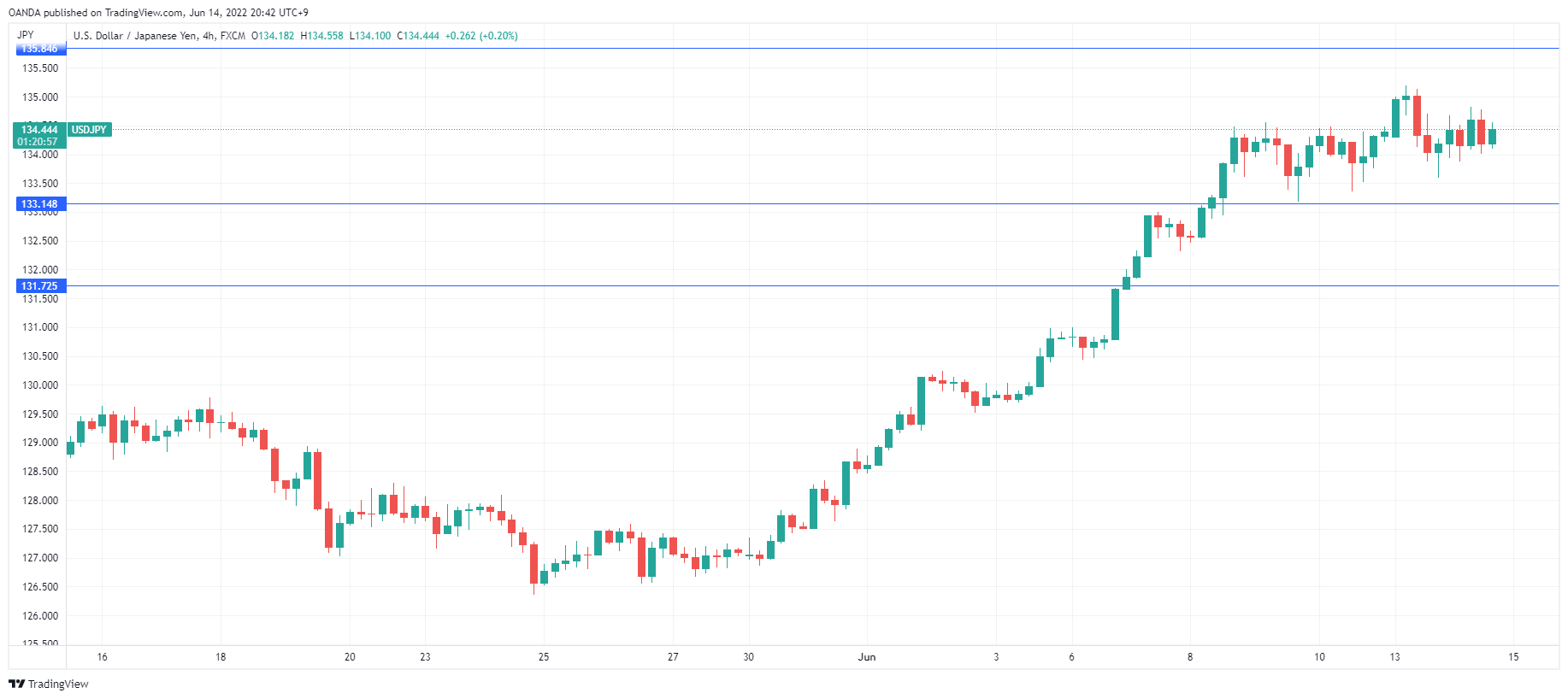
The Japanese yen continues to drift this week. In the European session, USD/JPY is trading at 134.30, down 0.09% on the day.
All eyes on the Federal Reserve
The Federal Reserve holds its policy meeting later today. The central bank is widely expected to raise rates by 0.50% for a second straight meeting, but there are voices calling for a massive 0.75% hike, notably, the chief economist at Goldman Sachs. It would be truly shocking if the Fed delivered a 0.75% increase, given the turbulent economic environment. The financial markets are very concerned (some are calling it “panicked”) about a recession in the US. The recent US inflation report shows inflation continues to accelerate, raising doubts that an aggressive Fed can guide the economy to a soft landing and the inversion of US Treasury yields is adding to these concerns.
The US dollar enjoyed a spectacular day on Monday against most major currencies, and the dollar index surged above resistance at 105. US 10-year yields rose as high as 3.38% earlier in the day, and the upward movement continues to support the US dollar.
The Bank of Japan’s policy meeting tends to be a dull affair, but with the yen sliding lower, there is talk that the Bank could intervene aggressively on the yield curve at Friday’s meeting. The BoJ has been quick to intervene to cap JGB yields at 0.25%, and with yields breaking above this line, the BoJ may decide to respond with a change in monetary policy. The yen has lost 15% of its value this year and USD/JPY pushed above the 135 line on Monday. The BoJ and Ministry of Finance have been jawboning over the exchange rate, to little avail.
USD/JPY Technical
- USD/JPY is testing resistance at 133.68. Above, there is resistance at 1.3638
- There is support at 132.26 and 131.24
Markets Jumped the Gun, Expecting Hawkish Fed Tomorrow
The S&P500 index fell 3.9% intraday on Monday, closing the index in the bear market territory. The Nasdaq collapsed more than 4.6%, losing a third of its all-time high in November last year.
The dollar index closed above 105 on Monday, renewing 20-year highs.
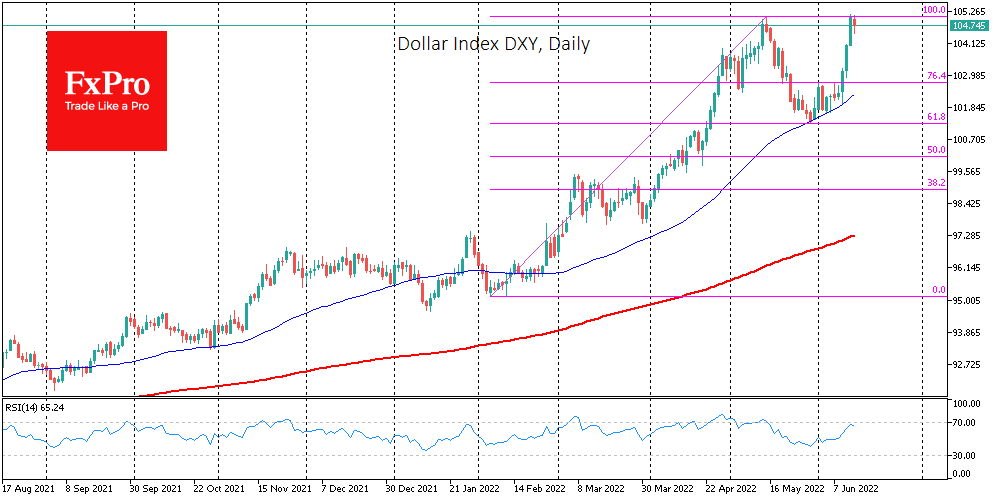
On Tuesday morning, markets are technically bouncing back after yesterday’s strong move, with index futures adding more than 1% at the start of the European trading session and the DXY retreating to 104.60.
Whether we see a double-top formation in the Dollar Index or a temporary stop before a breakout upwards, we are unlikely to know before we see the market reaction to the Fed’s Funds rate decisions and comments tomorrow evening.
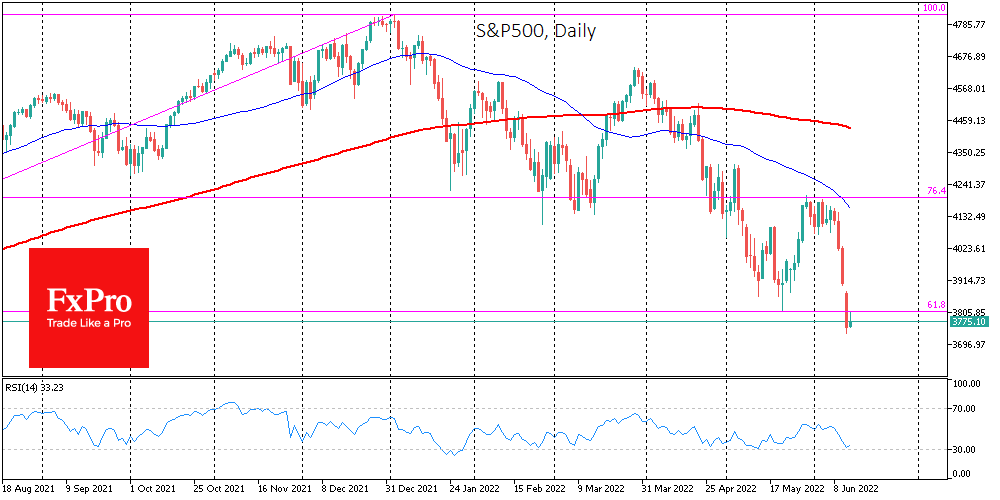
The strong market movement from late last week was driven by consumer inflation, which in May hit a record since 1981, rising to 8.6% y/y. This data has triggered a wave of reassessment of the market outlook. Rate futures right now are laying down a 91% chance of a 75-point hike as early as tomorrow against a 35% chance the day before.
These are rather stressed estimates of the situation. But such a move would be too extreme for the Fed, which had previously warned that it was prepared to make several moves with a 50-point hike. In our view, the most hawkish of the realistic scenarios involves a 50-point rate hike and a hint of a 75 step up at the end of July if required.
Suppose the Fed’s tone is in line with our expectations. In that case, the dollar could retreat from its extreme valuations and a more sustained rebound in equities as the most frightening outlook for the economy recedes into the background.
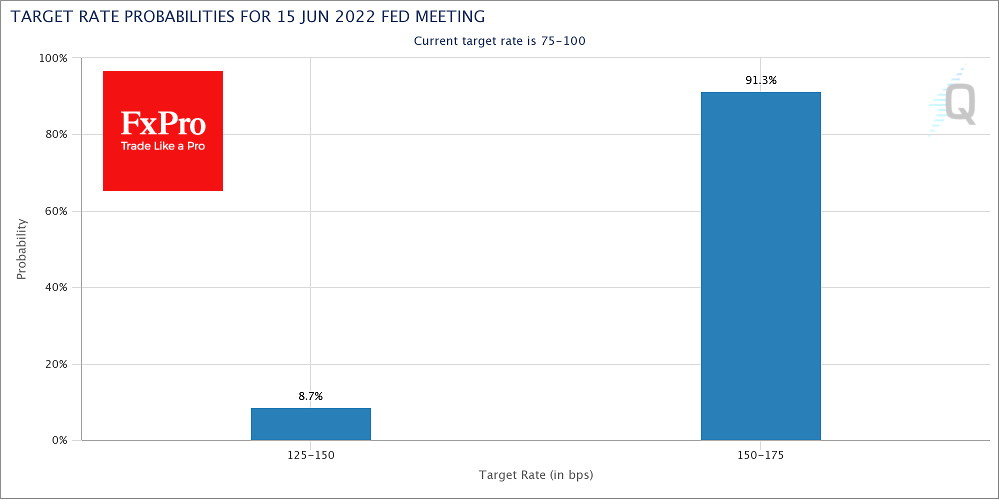
However, although it will raise the rate by 50 points, the chances are high that the Fed will indicate a willingness to be more aggressive by warning of a readiness to raise the rate by 75 points in the next few meetings. Predictions about when the Fed intends to end policy tightening are equally crucial for the markets.
The markets expect the rate to peak at 4.00% in March next year from 0.75%.
Market expectations on how the Fed will act in the short and medium-term have formed an emotional bias towards excessive tightness.
However, with high and still rising inflation expectations, it may not be in the interest of the Fed to soften these expectations too much in the coming days and weeks. The latter means that the Fed could warn that it is prepared to act more firmly afterwards by keeping demand for the dollar and pressure on assets until the peak in inflation has occurred.