

Sample Category Title
WTI oil breaks 110 on upside acceleration, heading to 147?
Oil price surged to highest level since 2014 on concern of supply disruptions related to Russia invasion of Ukraine. The International Energy Agency's 31 member countries have just agreed to release 60 million barrels of oil from their strategic reserves . But that's apparently not enough to calm the markets.
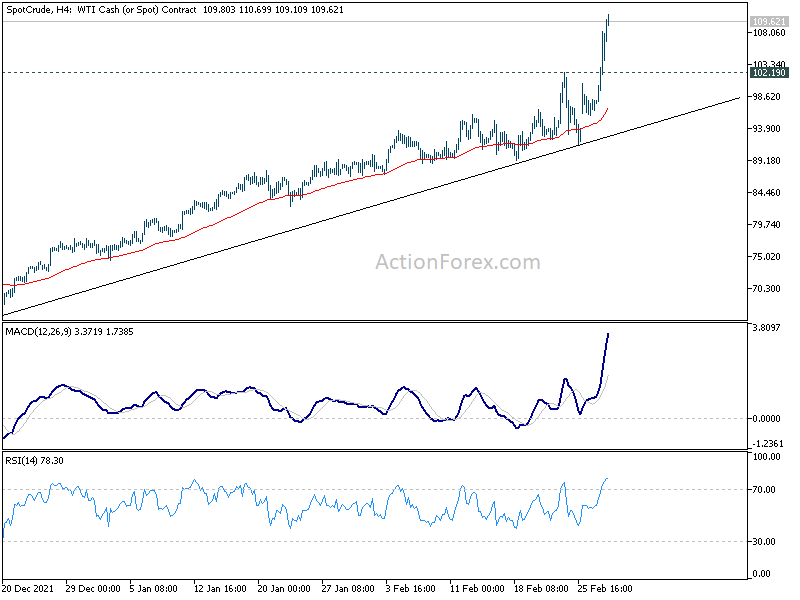
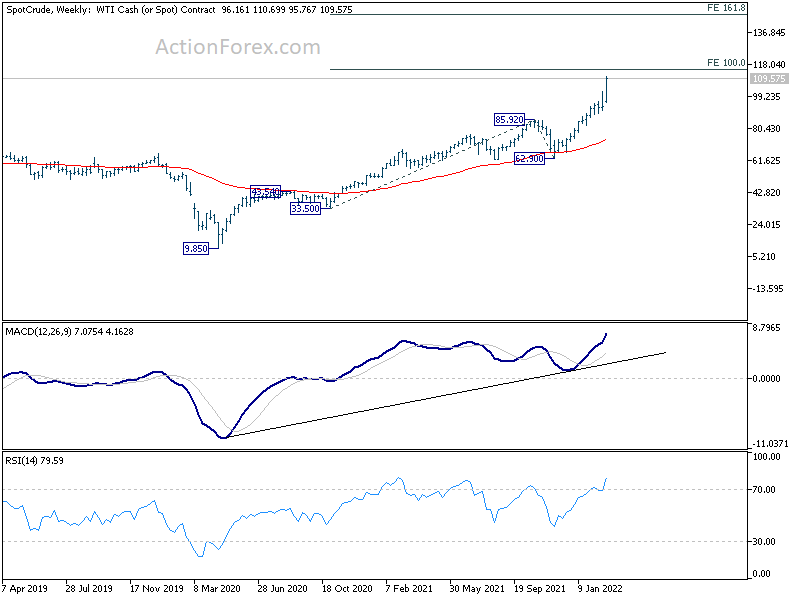
WTI crude oil accelerated sharply to as high as 110.69 so far. Technically, further rise is expected as long as 102.19 resistance turned support holds. Next target is 100% projection of 33.50 to 85.92 from 62.90 at 115.32.
It's still early to say. But is should be noted that fear driven moves in commodity markets could be extremely powerful. Just remember oil price was negative less than two years ago. So, decisive break of 115.32 could easily prompt more acceleration to 161.8% projection at 147.71, in rather quick manner.
Australia GDP grew 3.4% qoq in Q4, no material impact from Omicron
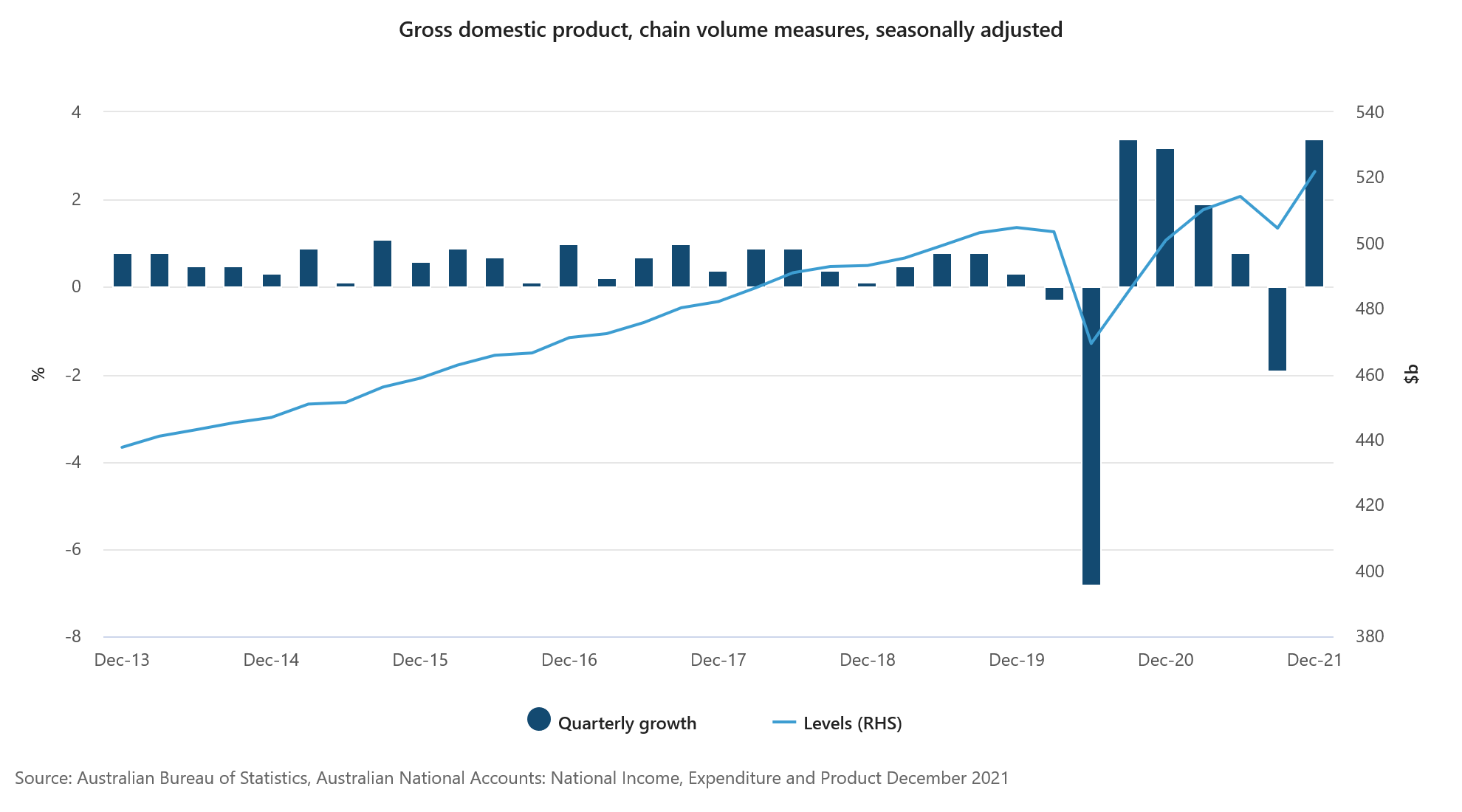
Australia GDP grew 3.4% qoq in Q4, above expectation of 2.9% qoq. Real net national disposable income rose 1.7%. Terms of trade fell -5.1%. GDP in the December quarter 2021 was 3.4% above December 2019 pre-pandemic levels. The emergence of the Omicron variant over the second half of December 2021 did not have a material impact on activity this quarter.
SNB Zurbruegg: Important to keep rate differential to avoid excessive Franc appreciation
SNB Vice Chairman Fritz Zurbruegg said in a l'agefi interview, "Switzerland has always had lower rates than others since the financial crisis. It is very important for us to keep this differential to avoid an excessive appreciation of the Swiss franc."
"As soon as the situation requires it, we'll raise our interest rate," he said. But, "we'll keep this ability to intervene in foreign exchange markets if needed to ensure price stability."
"Experience has shown that having some leeway within the range we associate with price stability has worked well in the past in Switzerland," he added. "We are a small, open economy with capital flows linked to our safe-haven status. We cannot always achieve a precise target and inflation can fluctuate in the short term because we aim for the medium term."
Fed Mester: Russia invasion adding upside risk to inflation, downside risk to growth
Cleveland Fed President Loretta Mester said yesterday that Russia's invasion of Ukraine could push inflation up higher. "The unfolding event has implications for the economic outlook, adding upside risk to inflation even as it puts downside risks to the growth forecast," she said.
"The challenge facing Fed policymakers is how to recalibrate monetary policy, reducing the accommodation from the emergency levels needed earlier in the pandemic in order now to get inflation under control and at the same time sustain the expansion and maintain healthy labor markets," Mester added.
BoE Mann: Embedded inflation becomes a domestic problem
BoE MPC member Catherine Mann said yesterday, "we already have very rapid increase in oil prices... In the U.K., that it becomes embedded by virtue of the institution mechanism of the price cap" on domestic energy bills.
"That embeddedness becomes a domestic inflationary problem that we have to deal with on the monetary policy stage," she said.
"You only get inflation if businesses raise their prices. That's where it comes from. It doesn't come from wage settlements. It comes from businesses' capacity to raise their prices in a systematic way and sustain demand," she said.
BoE Saunders prefers to move rates quite quickly towards neutral
BoE MPC member Michael Saunders said yesterday, "the economy is in significant excess demand, and inflation expectations are not as well anchored as I would like."
"My preference is to move quite quickly towards a more neutral stance in order to prevent the recent trend of higher inflation expectations and rising pay growth from becoming more firmly embedded," he said.
However, he emphasized that his vote for 50bps hike in February "does not necessarily imply that I would vote for a 50 basis-point hike in the event that further tightening is required."
"All else equal, the case for policy to move in a larger step probably is greater when Bank Rate is clearly further away from the approximate level that, if maintained, would return inflation to target and keep it there," he added.
Technical Outlook and Review
DXY:
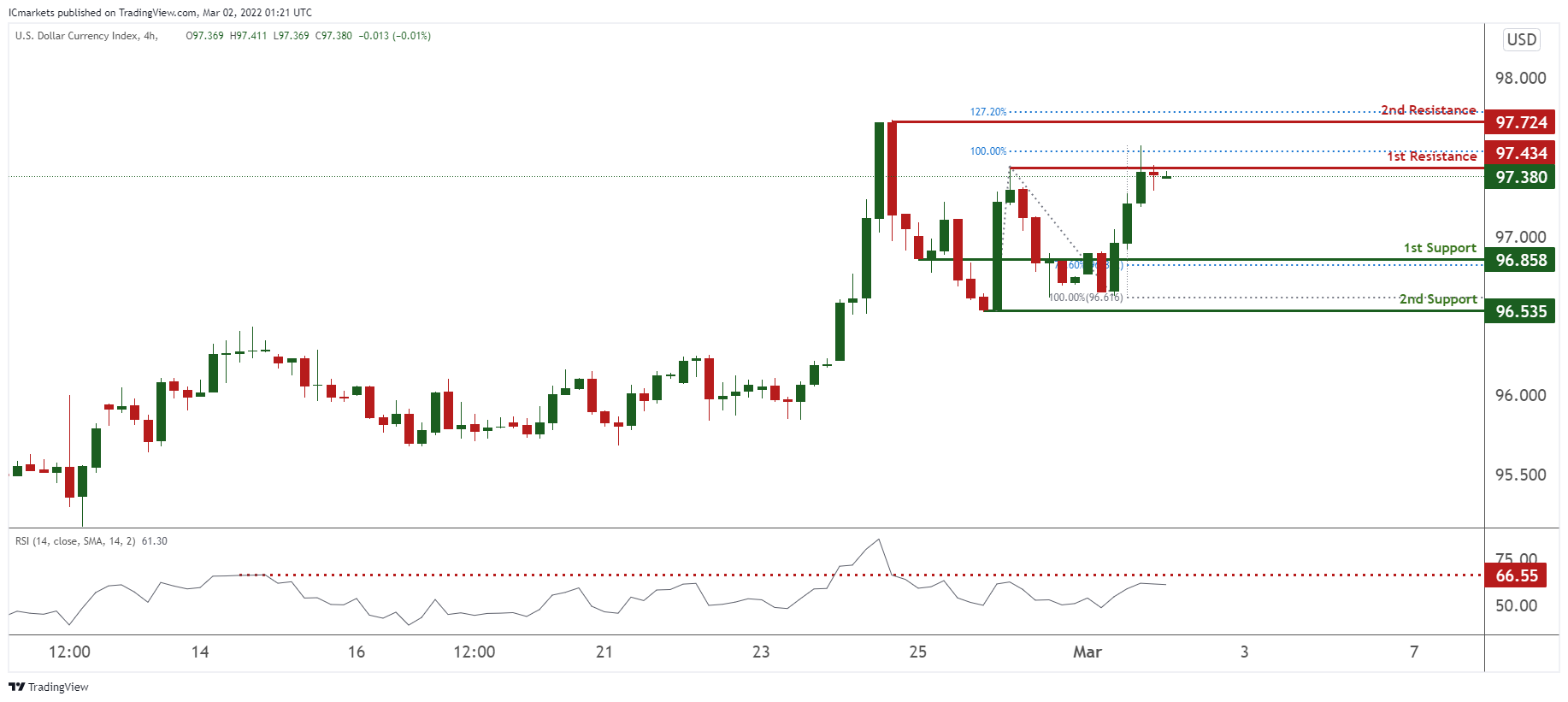
On the H4 timeframe, prices are at pivot and in line with a recent swing high. We see the potential for a dip from our 1st resistance at 97.434 in line with 100% Fibonacci extension towards our 1st support at 96.858 in line with 78.6% Fibonacci retracement. RSI is at a level where dips occurred previously and further supporting our bearish bias.
Areas of consideration:
- H4 time frame, 1st resistance at 97.434
- H4 time frame, 1st support at 96.858
XAU/USD (GOLD):
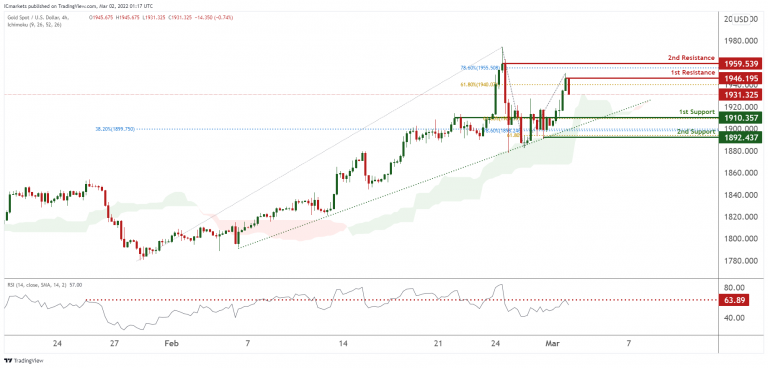
On the H4 chart, prices areon bullish momentum and abiding to our ascending trendline support. We see potential for a slight pullback from our 1st resistance at 1946.195 in line with 61.8% Fibonacci extension towards our 1st support at 1910.357 in line with 61.8% Fibonacci retracement. Our bullish bias is further supported by RSI being at levels where dips occurred previous and ichimoku clouds forecasting bearish momentum.
Areas of consideration:
- 4h 1st support at 1910.357
- 4h 1st resistance at 1946.195
GBP/USD
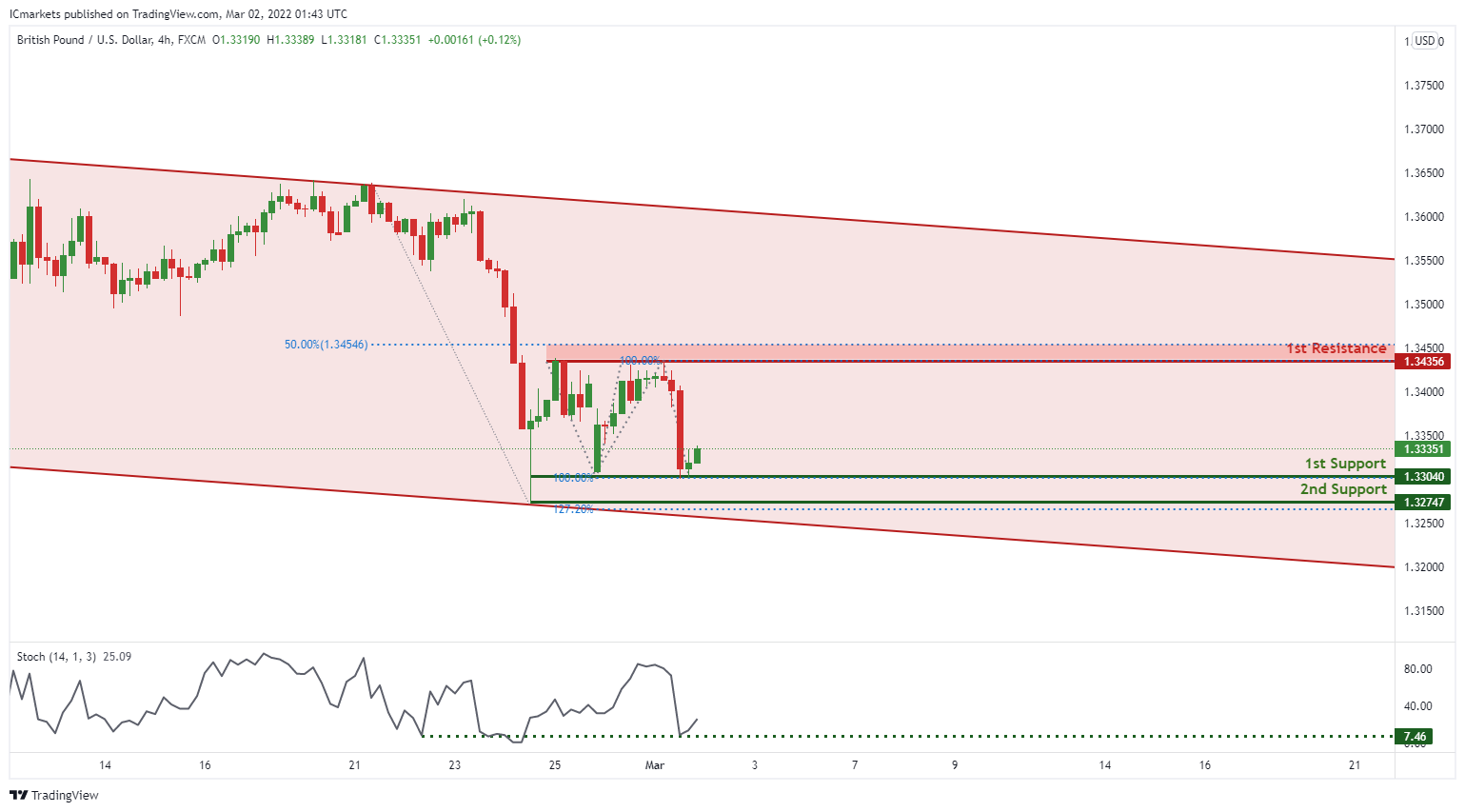
On the H4 chart , price is trading in a descending channel and near 1st support level of 1.33040 in line with 100% Fibonacci projection. Price can potentially go to the 1st resistance level of 1.34356 in line with 50% Fibonacci retracement and 100% Fibonacci projection. Our bearish bias is supported by stochastic indicator as it is nears support level
Areas of consideration
- H4 1st resistance at 1.34356
- H4 1st support at 1.33040
USD/CHF:
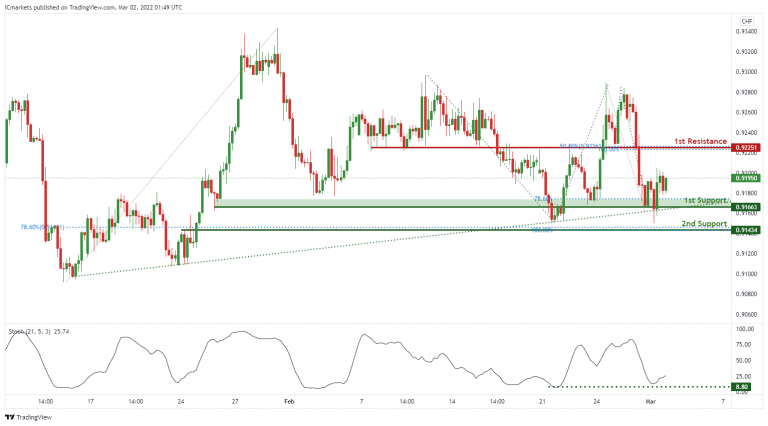
On the H4, price is abiding by an ascending trendline and near 1st support level of 0.91663 in line with 78.% Fibonacci projection. Price can potentially bounce to the 1st resistance level of 0.92251 in line with 50% Fibonacci retracement and 100% Fibonacci projection. Our bullish bias is supported by the stochastic indicator as it is at support level.
Areas of consideration
- 1st support level at 0.91663
- 1st resistance level at 0.92251
EUR/USD :
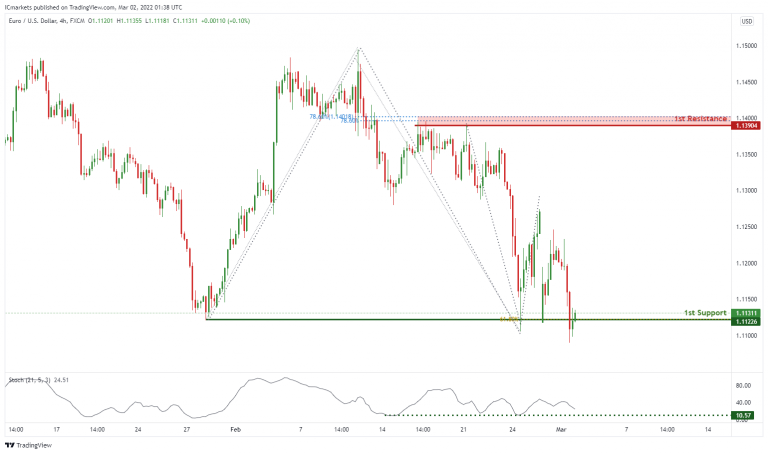
On the H4 chart price is near 1st support level of 1.11226 in line with 61.8% Fibonacci projection. Price can potentially go to the 1st resistance level of 1.13904 in line with 78.6% Fibonacci retracement and 78.6% Fibonacci projection. Our bullish bias is supported by the stochastic indicator as it is near support level.
Areas of consideration :
- H4 1st support at 1.11226
- H4 1st resistance at 1.13904
USD/JPY
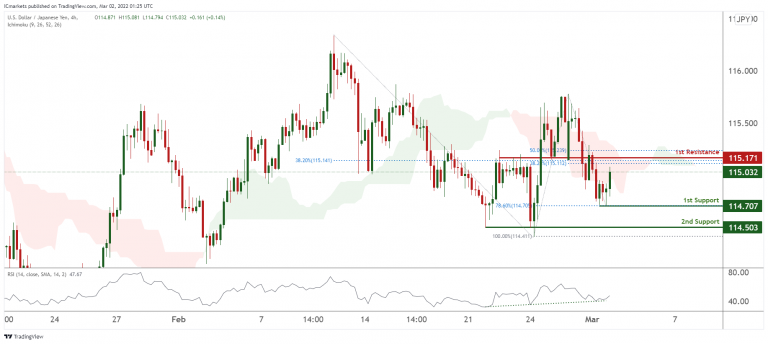
On the H4 timeframe, prices have recently bounced off a strong graphical overlap and also 1st support. We see the potential for further bullish continuation from our 1st support at 115.707 in line with 78.6% Fibonacci retracement towards our 1st resistance at 115.171 which is an area of Fibonacci confluences. Our bullish bias is further supported by ichimoku forecasting green clouds and RSI showing bullish momentum.
Areas of consideration:
- H4 time frame, 1st resistance at 115.171
- H4 time frame, 1st support at 115.707
AUD/USD:
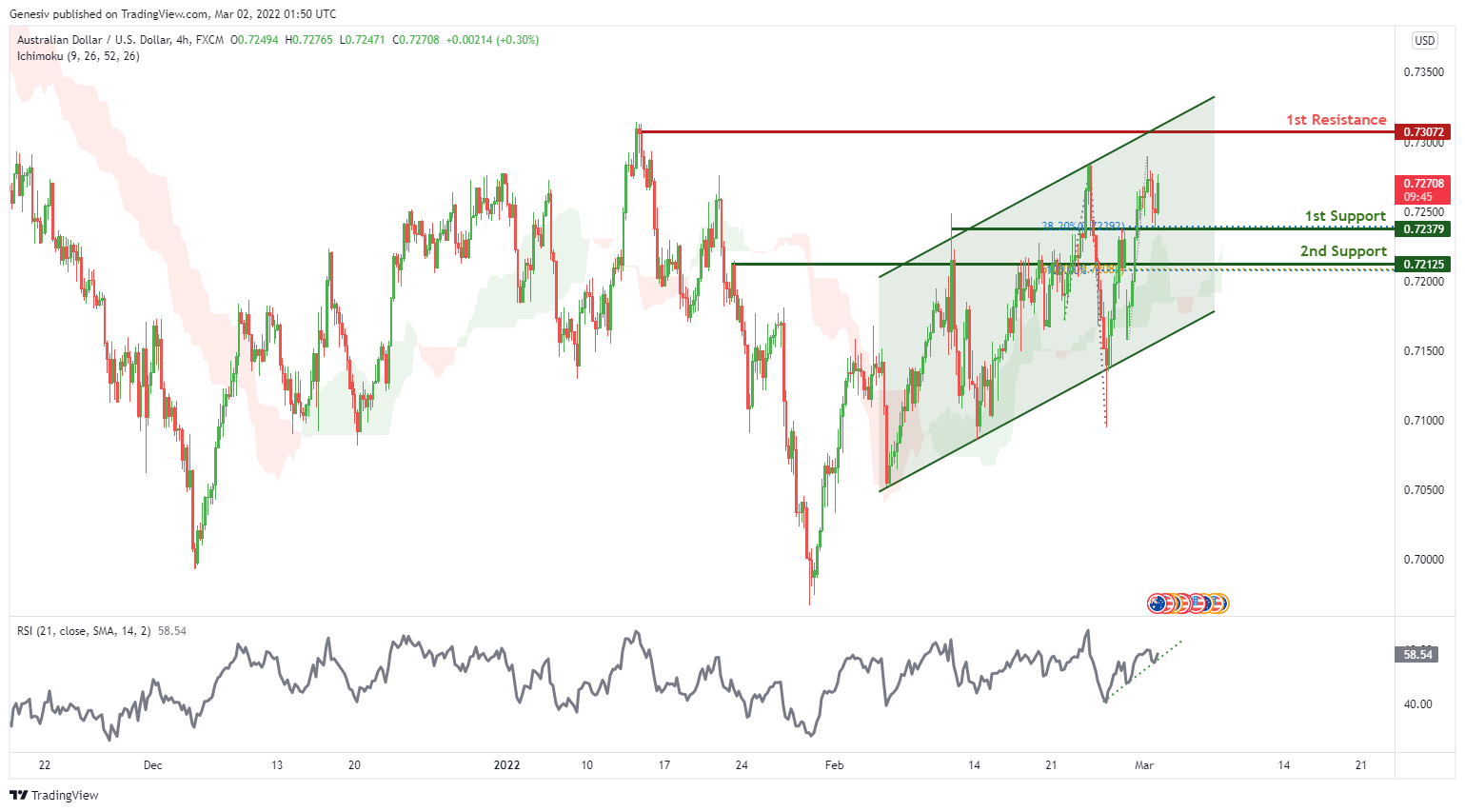
On the H4 chart, prices are moving along the ascending channel. We see potential for a bullish continuation from our 1st support at 0.72379 in line with 38.2% Fibonacci retracement and towards our 1st resistance at 0.73072 which is also the graphical swing high level . Alternatively, price can potentially dip to the 2nd support level at 0.72125 in line with 61.8% Fibonacci retracement and 100% Fibonacci projection. Our bullish bias is further supported by RSI as it is abiding by an ascending trendline thus showing bullish momentum . Moreover our bias is further supported by the ichimoku cloud indicator as price is trading above the clouds.
Areas of consideration :
- H4 1st support at 0.72379
- H4 1st resistance at 0.73072
NZD/USD:
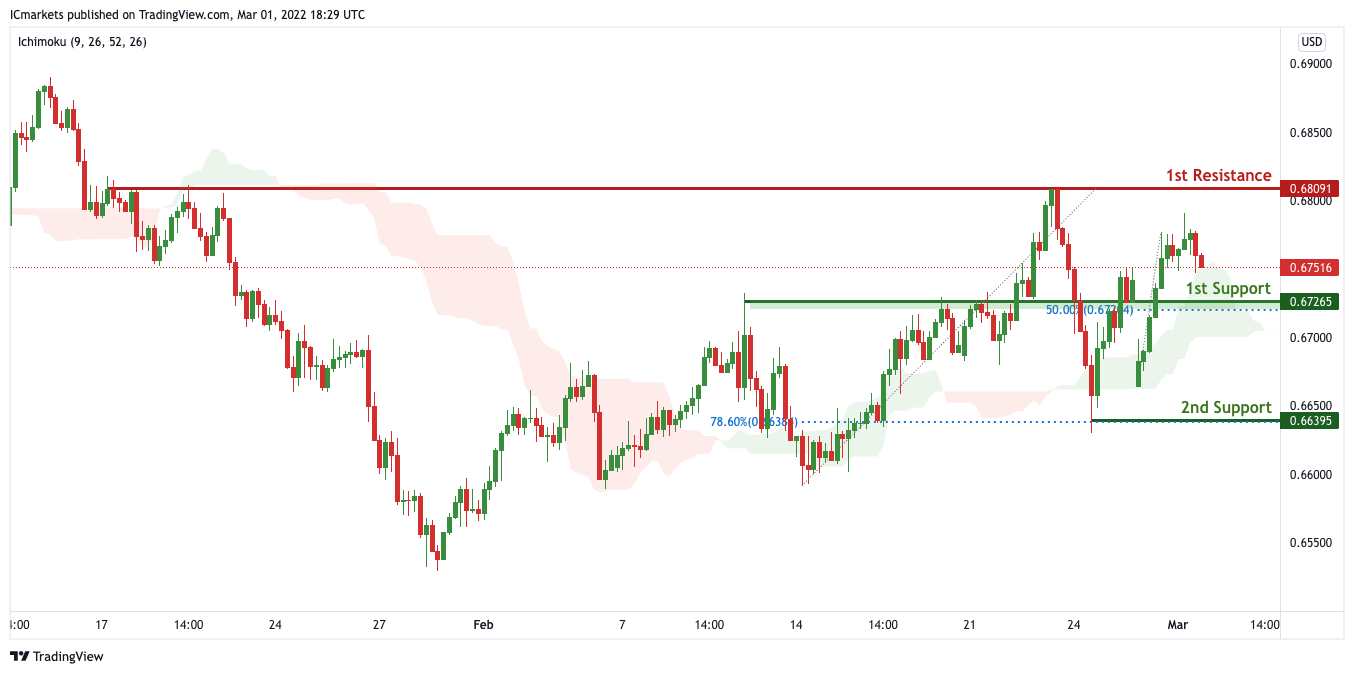
On the H4 chart, price is near 1st support level of 0.67265 in line with horizontal overlap support. Price can potentially rise to the 1st resistance level of 0.68091 in line with the horizontal swing high resistance. Alternatively, price may break 1st support and head for 2nd support at 0.66395. Our bullsh bias is supported by how price is expected to bounce off the support of the ichimoku cloud.
Areas of consideration:
- H4 time frame, 1st resistance at 0.68091
- H4 time frame, 1st support at 0.67265
USD/CAD:
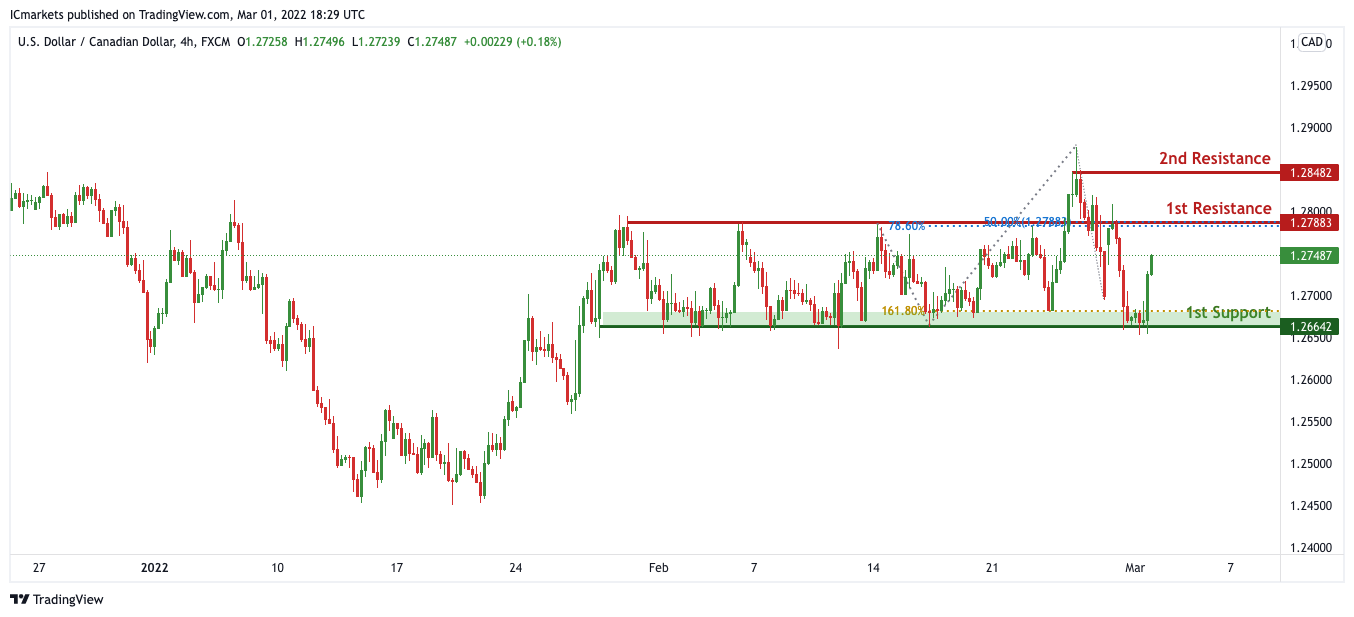
On the H4, price is ranging in between our 1st support and 1st resistance. With no clear indication of where price is heading at this current juncture, We have a bias that price will continue to range within our support and resistance of 1.26642 and 1.27883 respectively.
Areas of consideration:
- H4 time frame, 1st support at 1.26642
- H4 time frame, 1st resistance at 1.27883
OIL:
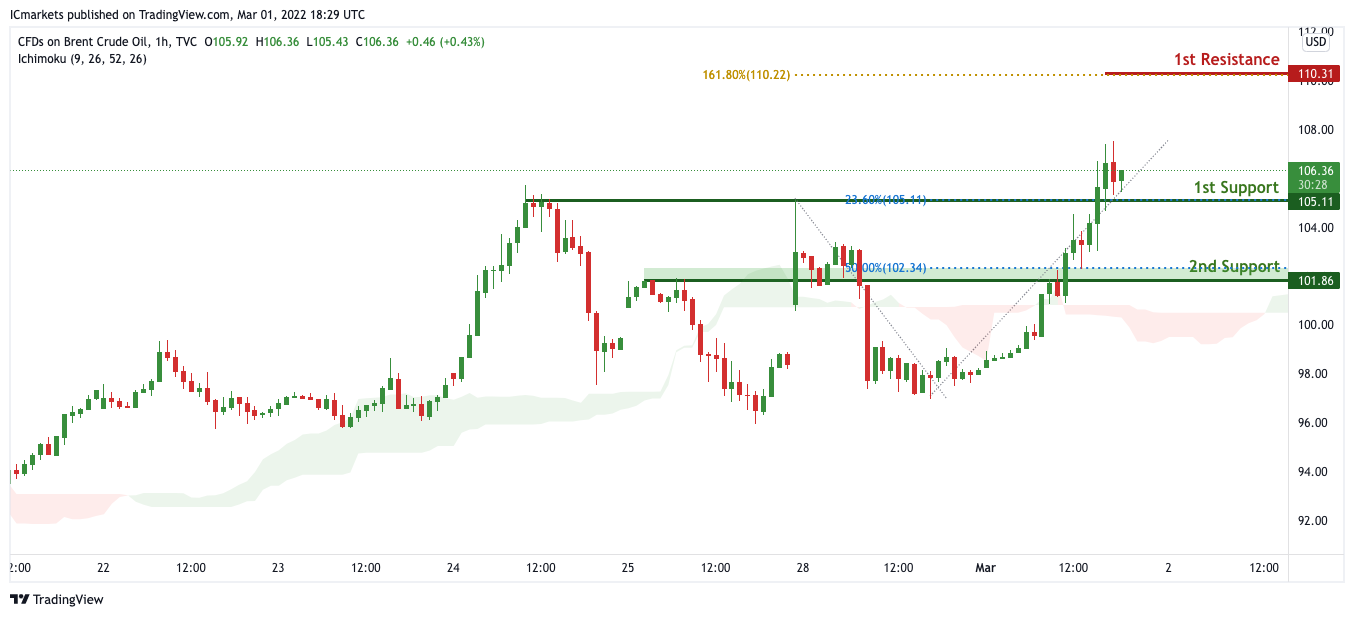
On the H4 chart, price is near 1st support level of 105.11 in line with horizontal overlap support and 23.6% Fibonacci retracement. Price can potentially rise to the 1st resistance level of 110.31 in line with the 161.8% Fibonacci extension level. Alternatively, price may break 1st support and head for 2nd support at 101.86. Our bullsh bias is supported by how price is expected to bounce off the support of the ichimoku cloud.
Areas of consideration:
- H4 time frame, 1st resistance of 110.31
- H4 time frame, 1st support of 105.11
Dow Jones Industrial Average:
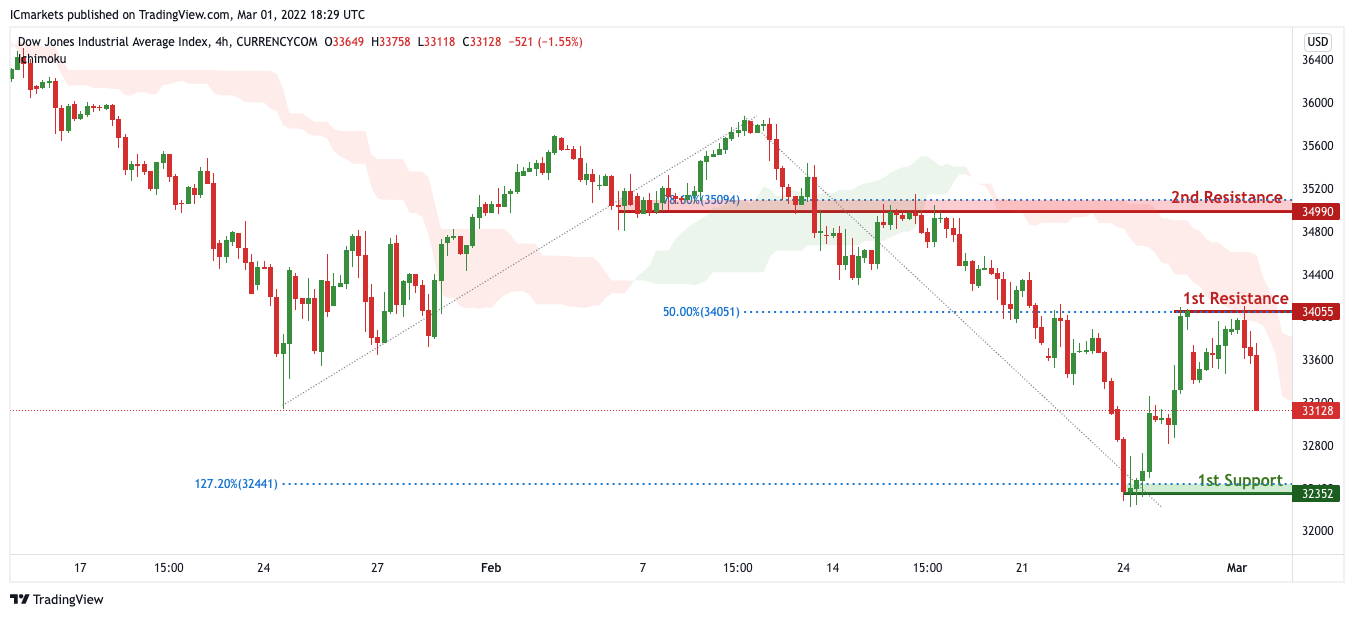
On the H4 timeframe, We see the possibility of bearish continuation from our 1st resistance at 34055 in line with horizontal overlap resistance towards our 1st support at 32352 in line with the horizontal swing low support. Alternatively, price may break 1st resistance and head for 2nd resistance at 34990 in line with the 78.6% Fibonacci retracement level. Our bearish bias is further supported by how price is moving below the ichimoku cloud
Areas of consideration :
- H4 1st support at 32352
- H4 1st resistance at 34055
Crude Oil Price Clears $100, Why Bulls Are Not Done Yet
Key Highlights
- Russia-Ukraine tension pushed oil price above $100.
- It broke a major bearish trend line at $90.00 on the monthly chart.
- EUR/USD is struggling to stay above the 1.1120 support.
- The US ADP Employment could increase 388K in Feb 2022.
Crude Oil Price Technical Analysis
In the past few months, crude oil price saw a major increase above $75.00 against the US Dollar. The price surpassed the $80.00 level to move into a positive zone.
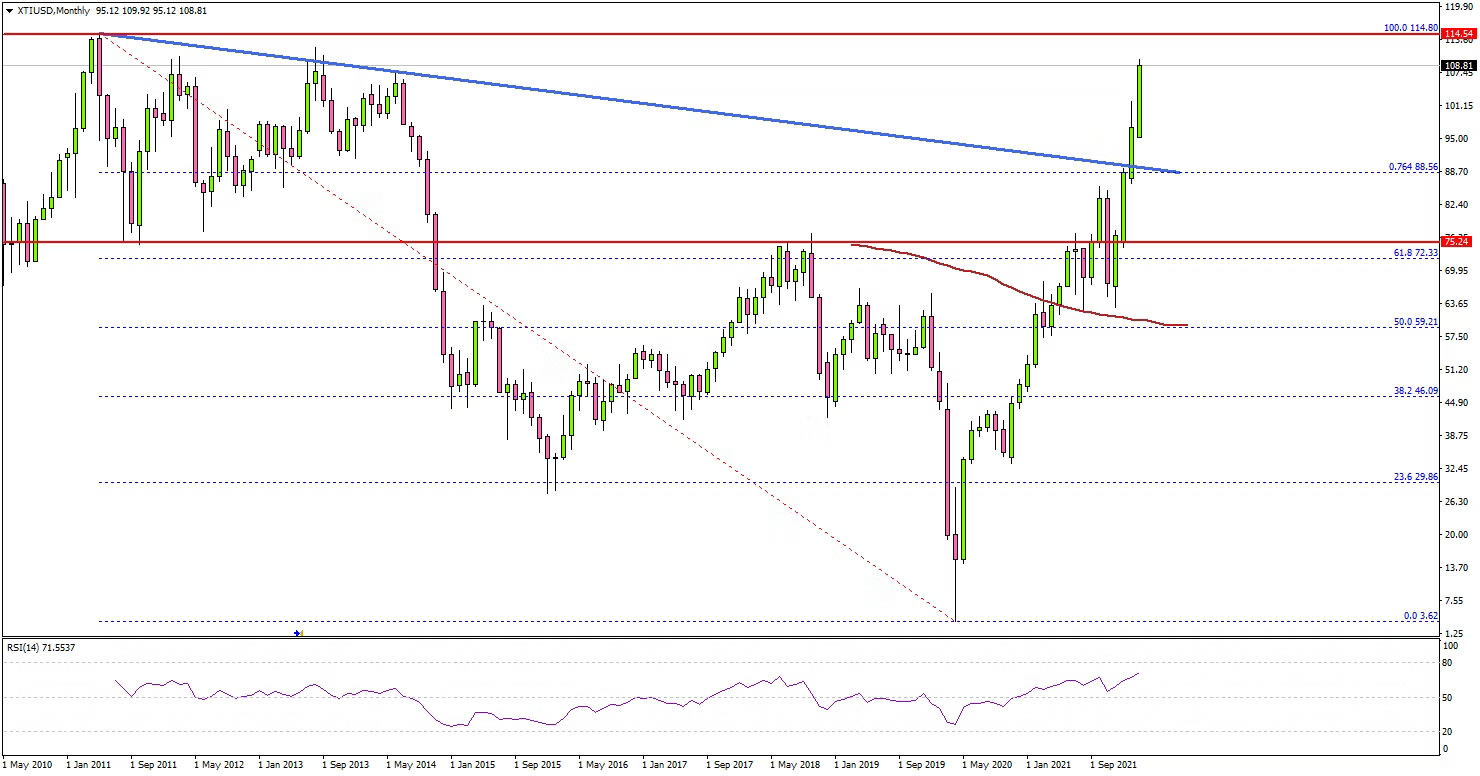
Looking at the monthly chart of XTI/USD, the price settled above the $90.00 level and the 100-month simple moving average (red). There was also a break above a major bearish trend line with resistance at $90.00.
The price gained pace above the 76.4% Fib retracement level of the downward move from the $114.80 swing high (formed in May 2011) to $3.62 swing low.
It even cleared the $100 barrier. It seems like the bulls are now aiming the 2011 high swing high near $114.80. Any more gains might call for a test of the $120.00 level in the near term.
On the downside, $98.00 level is a short-term support. The main trend support seems to be forming near the $75.00 level on the monthly chart, where the bulls might continue to take a stand.
Looking at EUR/USD, the pair extended decline in the past few days and the bulls are now struggling to protect the 1.1120 support.
Economic Releases to Watch Today
- Germany’s Unemployment Change for Feb 2022 - Forecast -23K, versus -48K previous.
- Germany’s Unemployment Rate for Feb 2022 – Forecast 5.1%, versus 5.1% previous.
- US ADP Employment Change for Feb 2022 - Forecast 388K, versus -301K previous.
- BoC Interest Rate Decision – Forecast 0.5%, versus 0.25% previous.
Bank of Canada to start rate hike cycle
Despite the geopolitical mess across the Ukrainian borders and growing fears about its global economic impact, the Bank of Canada (BoC) is expected to hike its benchmark interest rate on Wednesday at 15:00 GMT. Local developments could well justify the much-awaited rate increase, though a hawkish communication is more likely to trigger a new bullish wave in the Canadian dollar than an aggressive boost in rates.
A March rate hike looks to be a done deal
The BoC defied rate hike expectations in January, keeping its borrowing costs stable at a record low of 0.25% in the face of the omicron uncertainty. Its communication, however, was quite directional, with the governor Tiff Macklem expressing the view that a rate increase is inevitable in the coming months in an economy which operates at full capacity. Having removed its rate guidance as well, there is little doubt the central bank could hold back this time.
While the world learns to live with the pandemic, the Russian-Ukrainian political tensions opened out of the blue a new, more depressing chapter in global history. The nonstop exchange of sanctions and countermeasures between Russia and Ukraine’s West allies following Moscow’s invasion in Ukraine last week is getting more intense day by day, raising alarms about the already heightened inflation and boosting fears for another bitter global economic shock as Russia is a key source of grains, energy, and metals.
An aggressive rate hike may not happen
Hence, global economic uncertainties will come once again to debate the central bank’s tightening plans this week given Canada’s dependence on international trade. Policymakers, however, may not push back this time. Actually, domestic factors could overshadow external risks as inflation sits at a three-decade high of 5.1% y/y as of January, more than twice the central bank’s 2.0% midpoint target, and could sail further up as the geopolitical noise across the Ukrainian borders could add to the supply chain issues. Home prices followed higher too in the same month, and rising energy prices could even be beneficial for Canadian oil exporters as long as the energy sector is not drastically involved in the Ukrainian crisis.
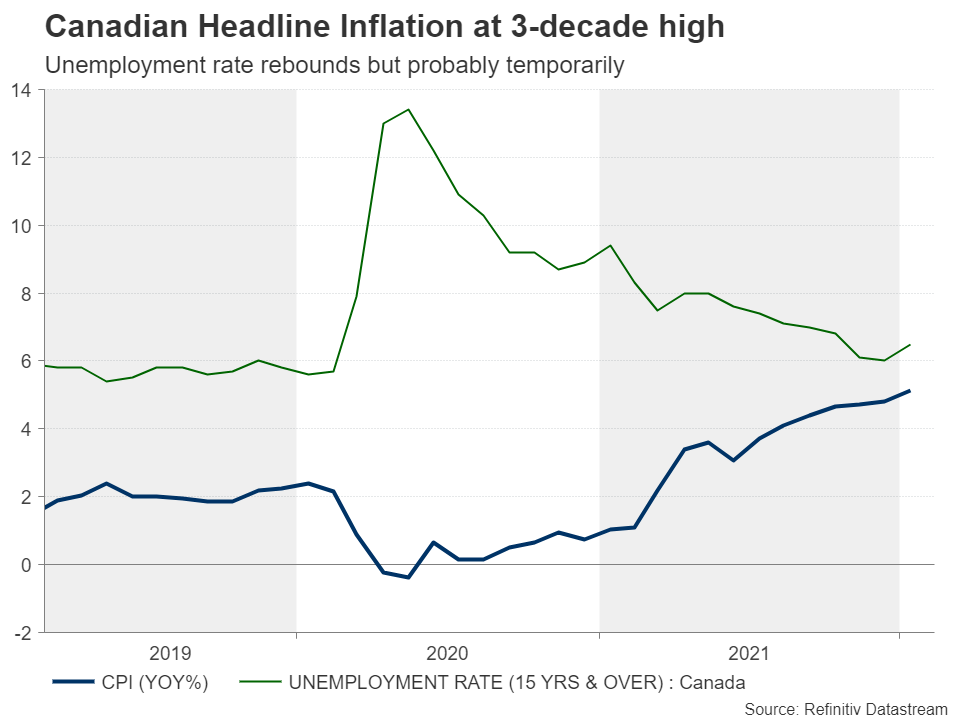 Of course, the rebound in the unemployment rate, which edged up to 6.5% in January - the highest since November –, and the loss of 200k job positions have upset investors, though that hiccup in the labor market is probably an outcome of the latest omicron restrictions, which have already been scaled down.
The above is justifying investors’ forecast for a 25 bps rate hike, which futures markets fully price in. There is a minority of investors who are betting for a more aggressive 50bps rate increase, though given the uncertain geopolitical developments, the BoC will probably decide to play it safe for now and start its rate hike cycle with a normal rate increase to 0.50% from 0.25%.
Loonie outlook
Turning to FX markets, the loonie has survived the Ukrainian crisis with softer injuries relative to European currencies, and higher oil prices continued to defend it against the US dollar's strength.
Investors are certain about the rate announcement, therefore the policy decision itself may not boost the loonie unless the central bank reiterates it will forcefully adjust “monetary policy if needed to address whatever situation arises” as BoC debuty governor Tim Lane stated two weeks ago. If such comments endorse the six rate hike scenario priced in markets for this year, the loonie could drift higher.
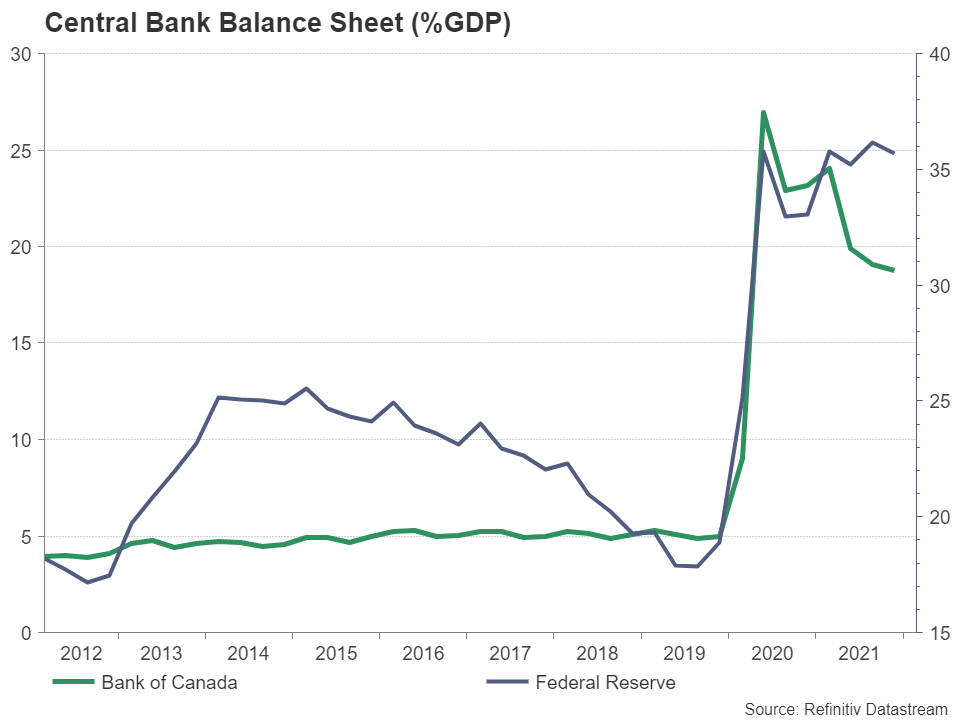
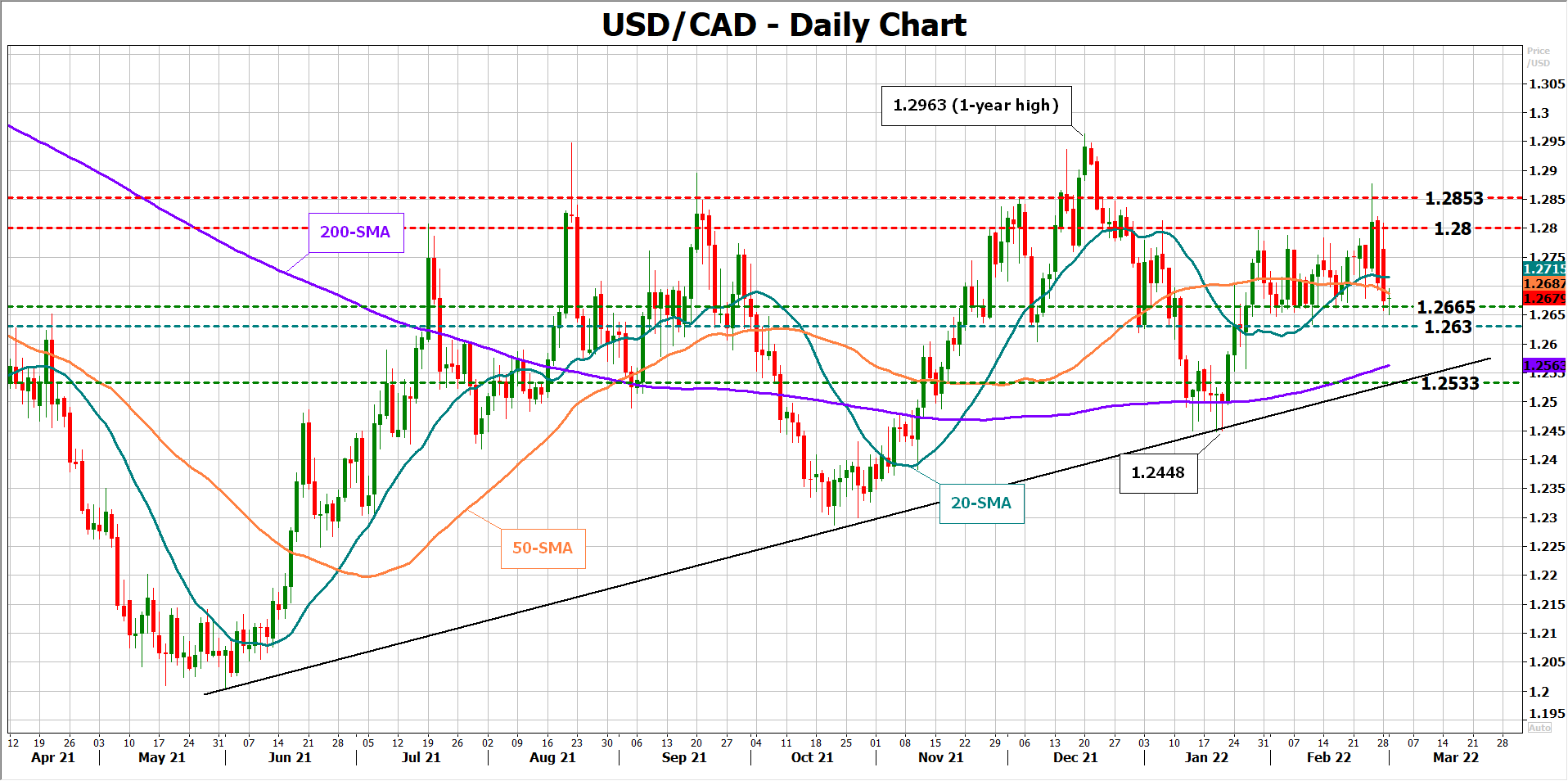
Notably, policymakers also revealed during January’s gathering that they are considering to start selling government bonds (quantitative tightening) once the first rate hike is delivered . Therefore, any positive guidance on that could further power the loonie given that the BoC has never attempted to shrink its balance sheet before. If that turns out to be the case, it would be interesting to see whether the key support region of 1.2665 – 1.2630 in dollar/loonie can collapse, clearing the way towards the 200-day simple moving average (SMA) at 1.2560 and the ascending trendline at 1.2550.
 Alternatively, if the BoC rate hike is accompanied by a more conservative communication style, which questions the aggressive rate hike pricing and postpones quantitative tightening ahead of the Fed meeting, the pair may head for another test near the tough resistance of 1.2800. A steeper increase above 1.2853 could then open the door for the one-year high of 1.2963.
First Impressions: Australian Q4 GDP
Output +3.4%, meeting expectations. Conditions rebound strongly from delta lockdowns, led by the consumer, +6.3%, as people adapt to the challenges of the pandemic.
The Australian economy expanded by 3.4% in Q4, on the reopening from delta lockdowns (which were centred in NSW, Victoria and the ACT). This follows a 1.9% contraction in Q3.
The outcome met expectations, Westpac forecast +3.3% and market median +3.5%.
The result represents a relatively rapid rebound from delta disruptions, evidence that households and businesses are continuing to adapt to the challenges of the pandemic.
Annual growth edged up from 4.0% to 4.2% and the level of activity in Q4 2021 is 3.4% above that at the end of 2019, prior to the pandemic.
GDP, three measures: the GDP headline is an average of three measures: expenditure, income and production. GDP (E) printed at 3.6% qtr, GDP (I) 3.4% and GDP (P) was 3.3%.
Hours worked: The National Accounts estimate that hours worked increased by 4.3% in Q4, following a 4.8% decline in Q3.
These movements are more pronounced than reported in the Labour Force survey. Hours worked in the Labour Force Survey printed -3.2% for Q3 and +2.4% for Q4. For NSW, hours worked (in the LFS) was -9.0% for Q3 and +7.8%. for Q4. However, for Victoria, with various lockdowns and a later delta lockdown and reopening, hours worked contracted in Q4, down by -1.2% after a +0.2%.
State demand: NSW rebounded strongly on the reopening, with state demand up by 6.7% in Q4, reversing a sharp decline in Q3. For Victoria, state demand grew by 3.7% in Q4. Nationally, domestic demand increased by 2.9% - with subdued results in the other states (Qld flat, WA +0.1%, SA 0.3% and Tasmania -1.5%).
Key surprises: Spending by households came in above our expectations, driving the upside surprise on the GDP expenditure estimate. The consumer surprised to the upside across the board in Q4, all major spending categories outstripping expectations and incomes also posting a better than expected result.
The consumer: Total consumer spending increased by 6.3% in Q4, more than reversing a 4.8% fall in Q3. We had anticipated a rise of 5.0%.
This snap back in spending differs from the 2020 experience, when the rebound in consumer spending in Q3 (7.6%) only partially reversed the plunge in Q2 associated with the initial lockdown (-12.1%). As noted above, this is further evidence of adaptation to the challenges presented by the pandemic.
Within the spending detail, there are very large swings associated with the lockdown and reopening. For Q4: recreation & culture, +17.1%; hospitality, +41.6%; operation of vehicles +13.9%; and clothing & footwear, +41.6%.
Household saving ratio: Understandably, with the reopening, the household saving ratio moderated, to be at 13.6% in Q4, after spiking to 19.8% in Q3 (boosted by government payments and by reduced consumer spending). That is up from 11.8% in Q2 2021. Recall that the saving ratio spiked to 23.7% in Q2 2020, associated with the initial nationwide lockdown.
The saving ratio remains elevated (with an “equilibrium rate” in the order of 5%).
Over the two years of the pandemic, a sizeable household savings buffer has been accumulated. This can be drawn upon to help fund future spending – thereby supporting what is likely to be a strong economic recovery in 2022 (associated with high vaccination rates).
Expenditure detail:
Consumer spending and an inventory rebuild were the growth drivers in Q4.
Elsewhere spending was on the softer side.
Home building activity declined by -2.2%, including a -4.4% fall in renovations work. Recall that the Construction Work Survey indicated that work in the sector was led lower in the period by Victoria.
Business investment edged lower, -0.3%. This included a decline in equipment spending, -1.5%. Recall that the Capex survey indicated that while equipment spending did rebound in NSW and Victoria, falls were recorded elsewhere.
Public demand paused, edging -0.4% lower. That follows rapid growth of late, notably a 3.5% rise in Q3, boosted by the response to the delta outbreak. Annual growth is still brisk, at 5.6%, down from 7.3%.
Net exports a small negative, -0.2ppts, led by a decline in export volumes, -1.5%.
Total inventories added to growth, 0.9ppts, led by private non-farm business inventories, +1.0ppt, with an inventory rebuild as the economy reopened. Other inventories were a small negative, -0.1ppt (farm -0.3ppts and public authorities +0.2ppts).