Sample Category Title
Equities Remain Pressured as Traders Weigh Fed and Geopolitical Risks
- Stock market rout deepens amid Fed and Ukraine worries, but US futures point to rebound
- Dollar and gold edge up, euro see-saws on mixed PMIs
- Fed meeting and major earnings to likely dictate market sentiment
Markets still jittery but selloff eases
Wall Street just had its most bruising week since the onset of the pandemic in March 2020 and it could get even rockier for stocks in the coming days. The Federal Reserve is poised to give a formal nod to liftoff on Wednesday and the earnings season is about to heat up with a host of major names set to report this week. Meanwhile, tensions between the West and Russia over Ukraine show no sign of easing, adding to the market angst as a conflict could potentially deepen the global energy crisis.
The S&P 500 (-1.9%) closed below its 200-day moving average on Friday for the first time since June 2020, while the Nasdaq Composite (-2.7%) plunged to levels last seen in June 2021. The selloff for the Dow Jones (-1.3%) remained much more contained as the index continued to benefit from the value-to-growth rotation.
Is the Fed getting ready for 50-bps hikes?
This week’s events could determine whether this rotation becomes a longer-term shift. Although the Fed is not expected to announce any policy changes this week, investors are nervous about the pace of policy normalization for the rest of the year. With some traders beginning to price in a half-point rate hike, there is a growing fear that the Fed will move too aggressively to rein in soaring inflation.
Nevertheless, Treasury yields slipped again on Monday. The long end of the curve has seen the steepest pullback. That could partly be a sign that investors are worried Fed policy will become too tight and are therefore less optimistic about the long-term growth prospects of the US economy. But it could also be down to rising safe-haven demand for government bonds amid the increased frictions on the Ukrainian border.
Gold climbs as Russia and Ukraine edge towards conflict
After several rounds of diplomacy, there’s been no progress in diffusing the heightened hostilities between Russia and Ukraine. With both the US and UK withdrawing some embassy staff from Ukraine, there is a real threat of an imminent Russian invasion.
Gold headed higher on Monday on the back of the geopolitical tensions, with fresh Houthi missile attacks on Saudi Arabia and the United Arab Emirates further boosting the flight to safety.
The precious metal was last up 0.4% to trade around $1,840/oz. The Japanese yen was also in demand, appreciating against all of its major peers, while the US dollar was slightly firmer.
Euro finds support in not-so-bad PMIs
The euro was choppy at the start of the week as the flash PMIs for January painted a mixed picture of the Eurozone economy. French PMIs disappointed badly but Germany’s figures beat the top estimates. On the whole, however, it appears that the Eurozone economy continues to expand despite some Omicron restrictions. A bigger concern for Europe is if the energy crisis were to escalate should there be a war in Ukraine.
The single currency was off its lows in mid-morning European trade to stand around $1.1325. The pound fared a little worse as the UK’s PMIs declined in January. Traders will be keeping an eye on the happenings in Downing Street this week as the inquiry into the ‘partygate’ scandal is due to be published at some point in the next few days.
But the worst performer so far today is the Australian dollar, slipping 0.5%, followed by the New Zealand dollar, which came under pressure from fresh Covid curbs being announced yesterday by Prime Minister Jacinda Ardern.
Is a rebound in store for Wall Street?
In equity markets, a mixed session in Asia failed to shore up shares in Europe, which slumped not long after the open. The troubling headlines about Ukraine could be dampening the mood in Europe as US futures indicate an easing in the selloff.
Netflix shares crashed more than 20% on Friday but the Q4 earnings could yet turn Wall Street’s fortunes around as several big tech and other major US companies will announce their latest results this week, starting with IBM after today’s market close.
EURUSD Edges Sideways after Advances Curbed by 100-MA
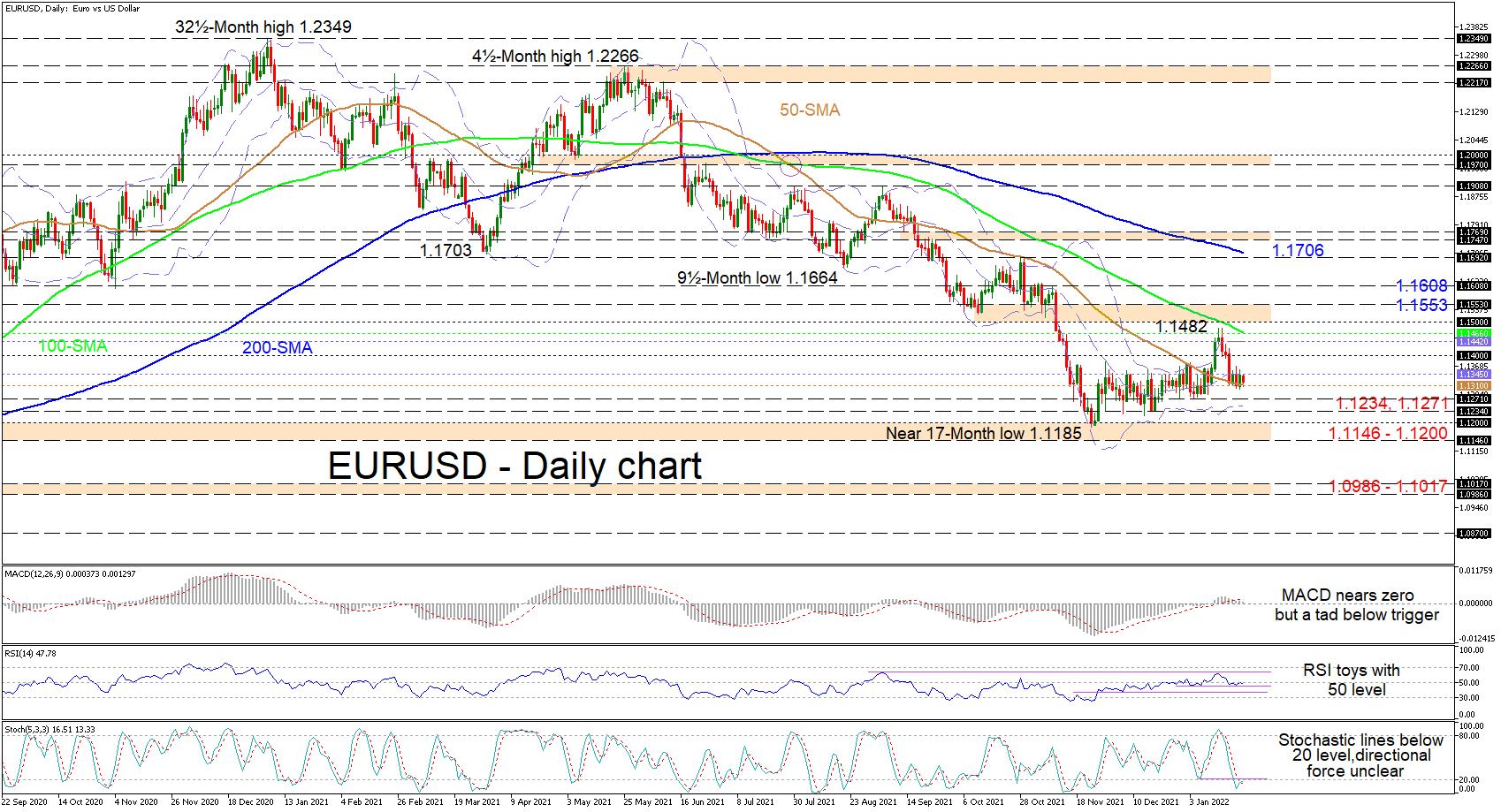
EURUSD continues to exhibit a lack of directional impetus, drifting between the 50-day simple moving average (SMA) at 1.1310 and the mid-Bollinger band at 1.1345. The falling SMAs are defending the broader downtrend that started from the 1.2266 peak.
Currently, the Bollinger bands are suggesting feeble volatility in the pair confined to the lower and upper Bollinger bands of 1.1247 and 1.1442 respectively. Furthermore, the short-term oscillators are indicating that guiding forces are absent, confirming that directional momentum has diminished. The MACD and RSI are flirting with their neutral thresholds at zero and 50 respectively, while the stochastic %K line, which is in oversold territory, is not signalling a definitive directional charge.
If sellers drive the price beneath the 50-day SMA at 1.1310, a reinforced zone of support between the nearby 1.1271 and 1.1234 lows could impede a price drop. However, dipping lower, the price may then encounter the 1.1146-1.1200 support foundation, extending back to the end of March 2020. Should this base, which includes the 17-month trough of 1.1185, fail to mute negative tendencies from snowballing, the price could dive for the 1.0986-1.1017 support border, which has held from the April-May 2020 period.
In the positive scenario, buyers would need to step above the mid-Bollinger band at 1.1345 and over the 1.1400 handle to tackle the key resistance zone between the upper Bollinger band at 1.1442 and the 100-day SMA at 1.1466. Should profound upside pressures unfold beyond the 1.1482 high and conquer the 1.1500-1.1553 critical resistance obstacle, the 1.1608 barrier could come into play.
Summarizing, EURUSD maintains a neutral-to-bearish tone below the 100-day SMA and the 1.1500-1.1553 resistance border. That said, for the sideways trajectory in the pair to dissolve, the price would need to start with a break either below the 1.1234-1.1271 area or above the 1.1400 hurdle.
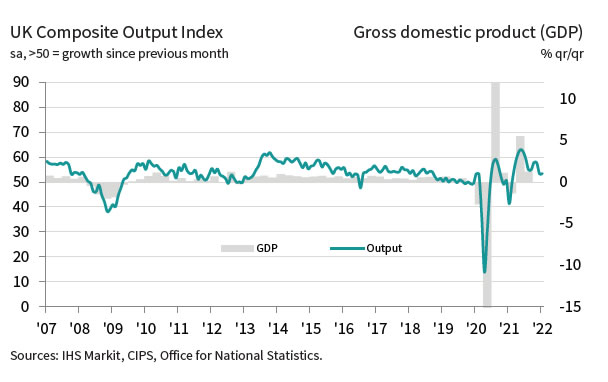
UK PMIs: Consumer facing businesses hit hard, but others encouragingly robust
UK PMI manufacturing dropped form 57.9 to 56.9 in January, below expectation of 57.9. PMI Services ticked down from 53.6 to 53.3, well below expectation of 55.0. PMI Composite dropped from 53.6 to 53.4. All three indexes were at their 11-month low.
Chris Williamson, Chief Business Economist at IHS Markit, said: "A resilient rate of economic growth in the UK during January masks wide variations across different sectors. Consumer-facing businesses have been hit hard by Omicron and manufactures have reported a further worrying weakening of order book growth, but other business sectors have remained encouragingly robust."
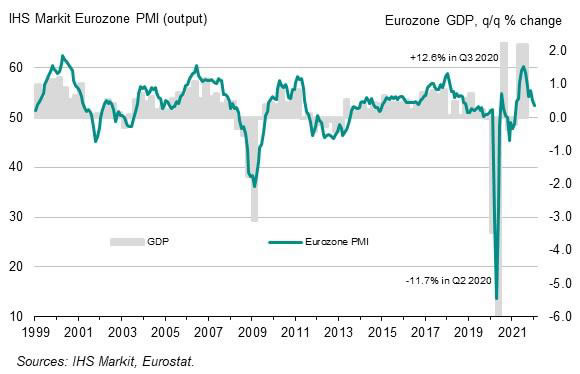
Eurozone PMI composite dropped to 11-mth low at 52.4
Eurozone PMI Manufacturing rose from 58.0 to 59.0 in January, above expectation of 57.5, a 5-month high. PMI Services dropped from 53.1 to 51.2, below expectation of 52.2, 1 9-month low. PMI Composite dropped from 53.3 to 52.4, a 11-month low.
Chris Williamson, Chief Business Economist at IHS Markit said: "The Omicron wave has led to yet another steep drop in spending on many consumer-facing services at the start of the year, with tourism, travel and recreation especially hard hit. However, so far the overall impact on the wider economy appears relatively muted, and most encouraging is the further easing of manufacturing supply chain delays despite the renewed virus wave. Not only has the alleviating supply crunch helped factories boost production, but cost pressures in manufacturing have also moderated.
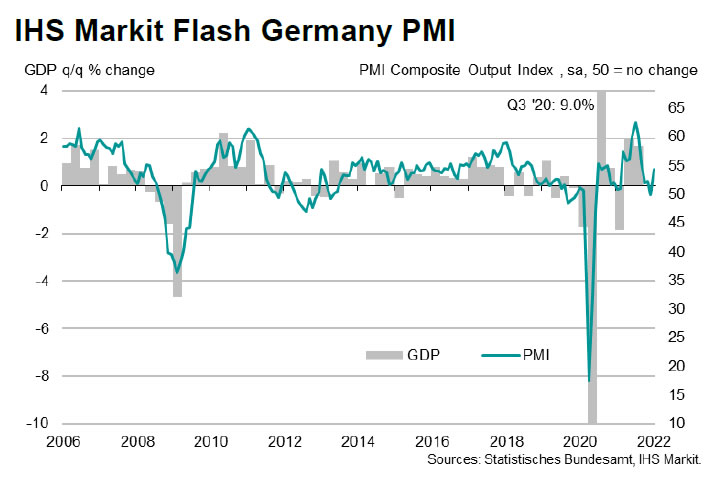
Germany PMI composite jumped to 54.3, surprisingly resilient performance
Germany PMI Manufacturing rose from 57.4 to 60.5 in January, above expectation of 57.0, a 5-month high. PMI Services also rose from 48.7 to 52.2, above expectation of 48.0. PMI Composite rose form 49.9 to 54.3, a 4-month high.
Phil Smith, Economics Associate Director, at IHS Markit said: "January's flash PMI numbers came in comfortably above consensus to show a surprisingly resilient performance from the German economy at the start of the year... Manufacturing is expected to stage a recovery in 2022 as supply bottlenecks ease... January's services numbers, showing activity recovering slightly after the decline at the end of last year, were another positive surprise... Still, rising costs remain a concern for businesses, with the survey data showing that input prices are continuing to rise sharply and on multiple fronts."
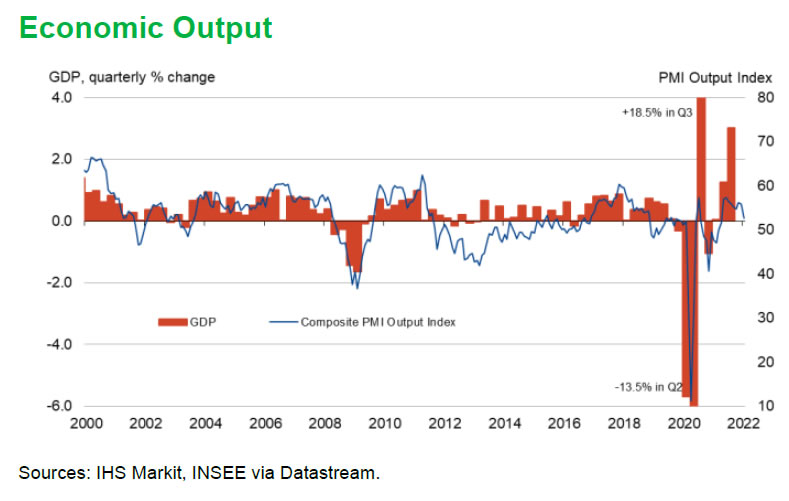
France PMI composite dropped to 52.7, a 9-month low
France PMI Manufacturing ticked down from 55.6 to 55.5 in January, matched expectations. PMI Services dropped notably from 57.0 to 53.1, below expectation of 55.3, a 9-month low. PMI Composite dropped from 55.8 to 52.7, a 9-month low too.
Joe Hayes, Senior Economist at IHS Markit said: "Given the surging number of daily COVID-19 cases we've seen in France, it's no surprise to see softer PMI numbers in January.... Supply chain issues continue to impact the economy, particularly manufacturers, but we do appear to have seen the worst as delivery times lengthened to a far weaker extent than seen during much of 2021. That being said, the inflationary side effects remain in play and are being exacerbated by rising staff costs and energy prices."
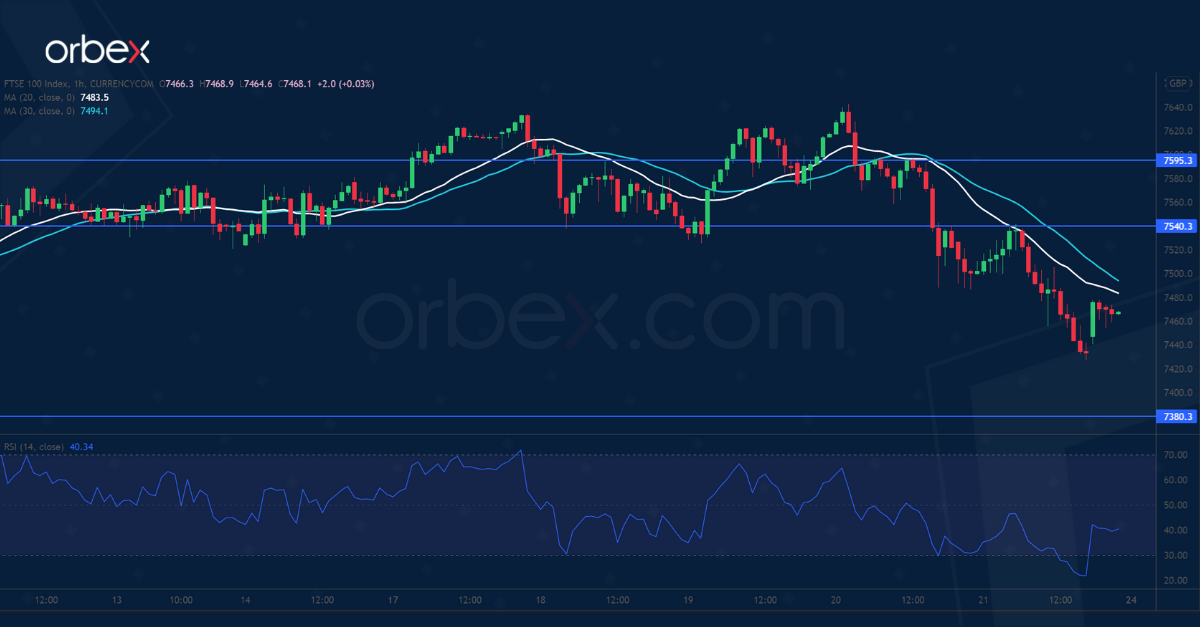
UK 100 Tumbles Through Supports
The FTSE 100 stalls as appetite subside across risk assets. An overbought RSI on the daily chart suggests over-extension after a month-long rally.
A pullback is necessary for the bulls to catch their breath. A drop below 7530 and then 7470 further weighs on short-term sentiment as profit-taking intensifies.
The index is about to test 7380, a fresh demand zone from the November-December double top on the daily timeframe. The bulls need to reclaim 7540 before a rebound could gain traction.
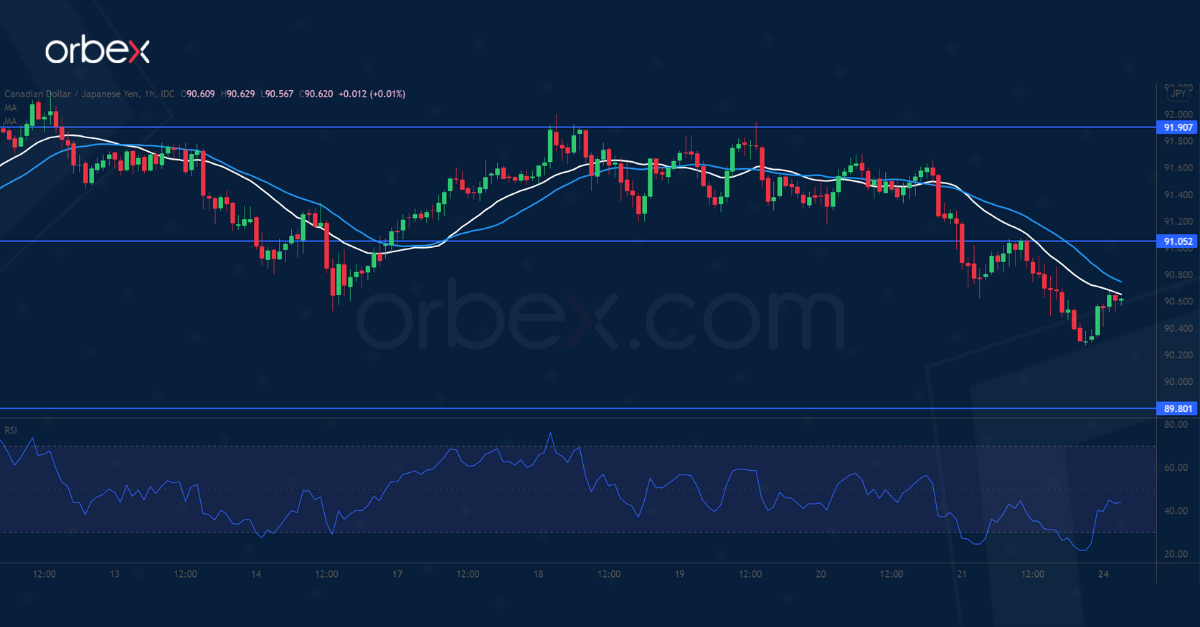
CAD/JPY Breaks Key Support
The Canadian dollar slipped after disappointing retail sales in November. A bearish RSI divergence at the recent high (91.15) indicates a loss of momentum in the rally.
The first drop below 90.60 prompted some buyers to bail out. Then the rebound met stiff selling pressure at 91.90. And this is a sign of exhaustion after a four-week-long uptrend.
The loonie now has fallen through the major support at 90.60, with 89.80 as the target. As the RSI goes oversold, traders may look to sell the next bounce near 91.05.
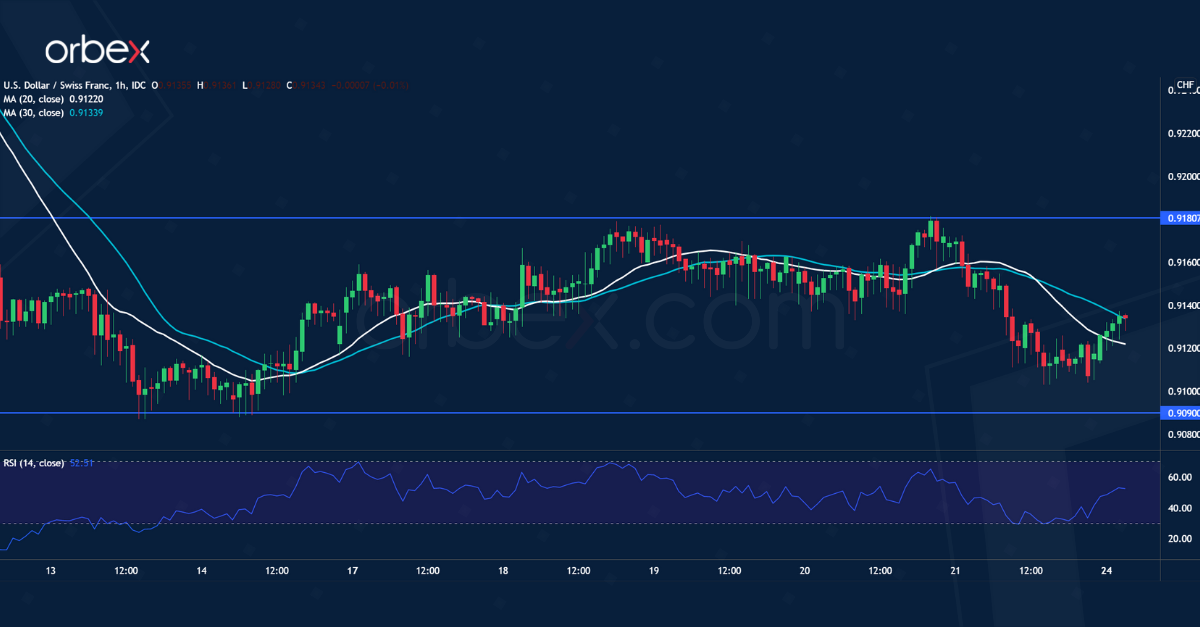
USD/CHF Tests Daily Support
The Swiss franc rallied as traders poured into safe-haven currencies.
The pair previously bounced off the critical floor (0.9090) on the daily chart. An oversold RSI in this demand zone brought in some buying interest.
However, sentiment remains downbeat with the greenback struggling to clear offers around 0.9180. A fall below said support would trigger a new round of sell-off towards 0.9020 as late buyers rush to the exit. On the upside, a bullish breakout would open the door to the recent peak at 0.9275.
US 500 Index Meets Resistance at 200-SMA; Bearish Outlook
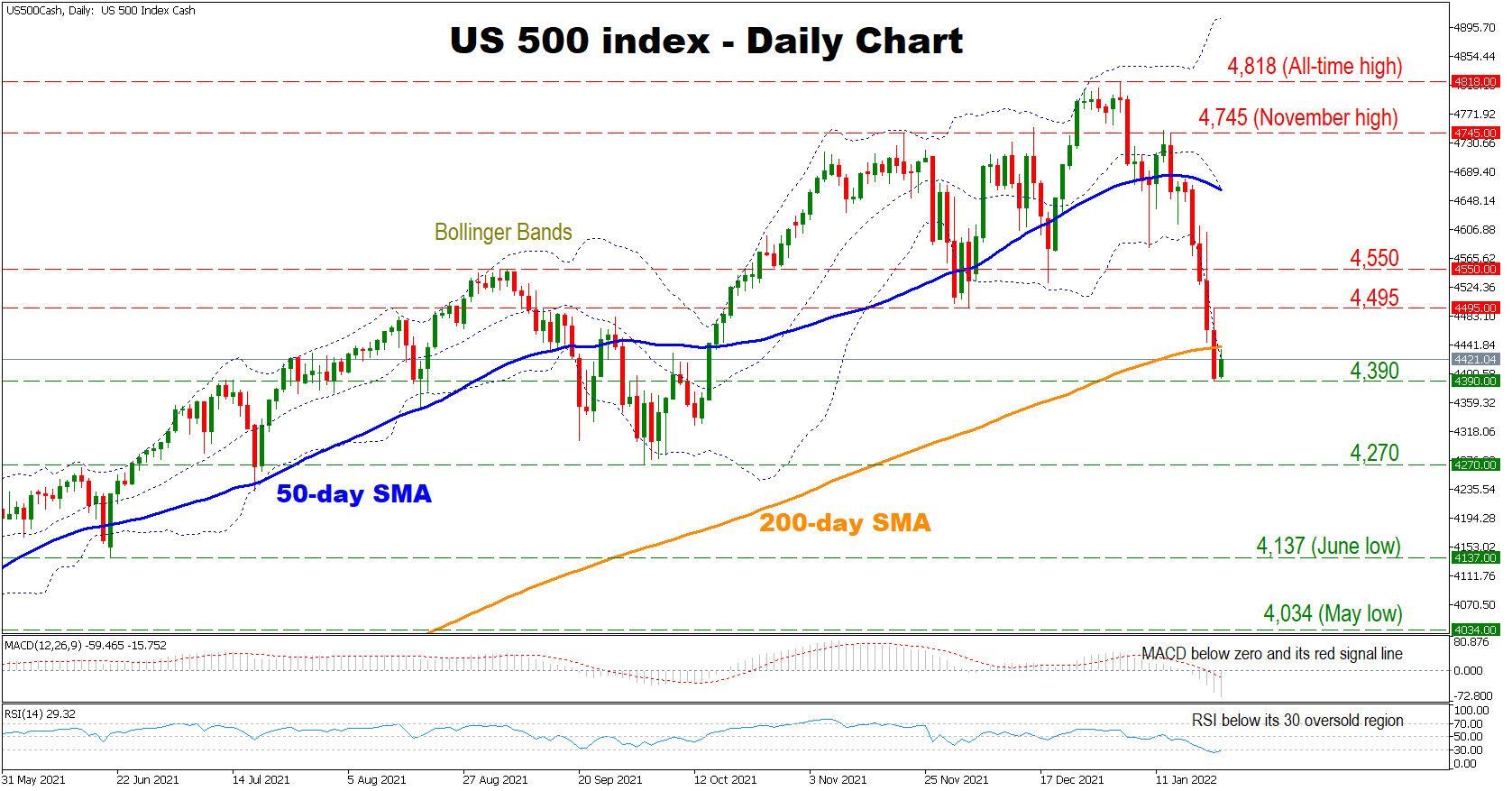
The US 500 cash index has witnessed a pullback from its all-time high, reaching a 3-month low amid increasing negative forces. The index has also crossed below its 50- and 200-day simple moving average (SMA), which points towards an overall bearish outlook. However, the price is currently trading below its lower Bollinger Band, indicating that an immediate upside movement should not be ruled out.
Short-term momentum indicators are reflecting a mixed picture for the index. The MACD is found below zero and its red signal line, suggesting that the negative forces might be gaining further traction. However, the RSI has entered its 30 oversold region indicating that an immediate upside movement is not out of the equation.
Should the bears maintain control, initial support might be found at the 4,390 level before sellers target the 4,270 hurdle. A break below the latter could intensify selling pressures, sending the price to test its June low at 4,137. Breaching below this point, could open the door towards the May low at 4,034.
On the flip side, if the price crosses above its 200-day SMA currently at 4,440, buyers might then shift their attention towards the 4,495 hurdle. Moving above from this point could send the price to test the 4,550 barrier before targeting the 50-day SMA currently at 4,670. A cross above the latter could turn the fortunes around for the pair, sending the index to test its November high at 4,745.
In brief, despite the fact that the latest downside move seems overextended, the short-term outlook for the pair is bearish. For sentiment to change, sellers would need to break above the 50-day SMA.