Sample Category Title
USD/JPY Mid-Day Outlook
Daily Pivots: (S1) 113.49; (P) 113.82; (R1) 114.04; More...
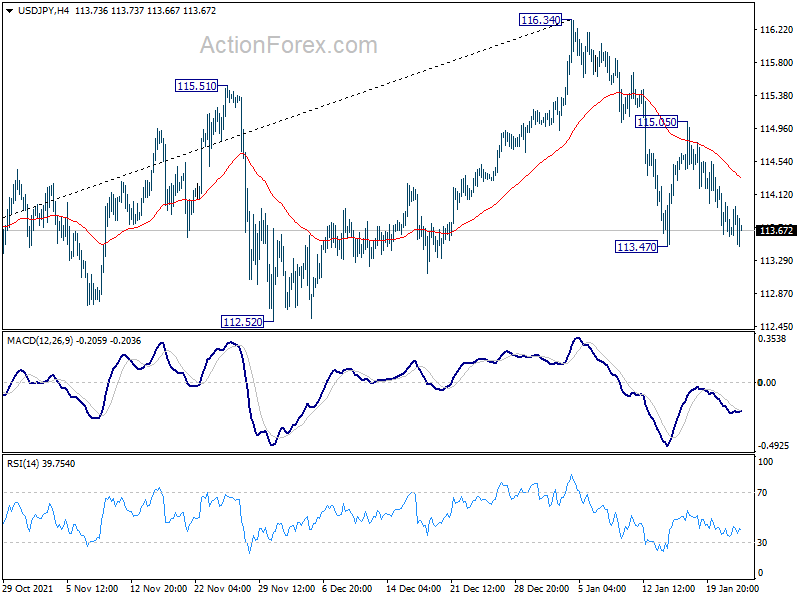
Intraday bias in USD/JPY remains on the downside and outlook is unchanged. Considering bearish divergence condition in in daily MACD, it's probably already in correction to whole up trend from 102.58. Break of 113.47 will target 112.52 support first, and then 38.2% retracement of 102.58 to 116.34 at 111.08. For now, risk will stay on the downside as long as 115.05 resistance holds, in case of recovery.
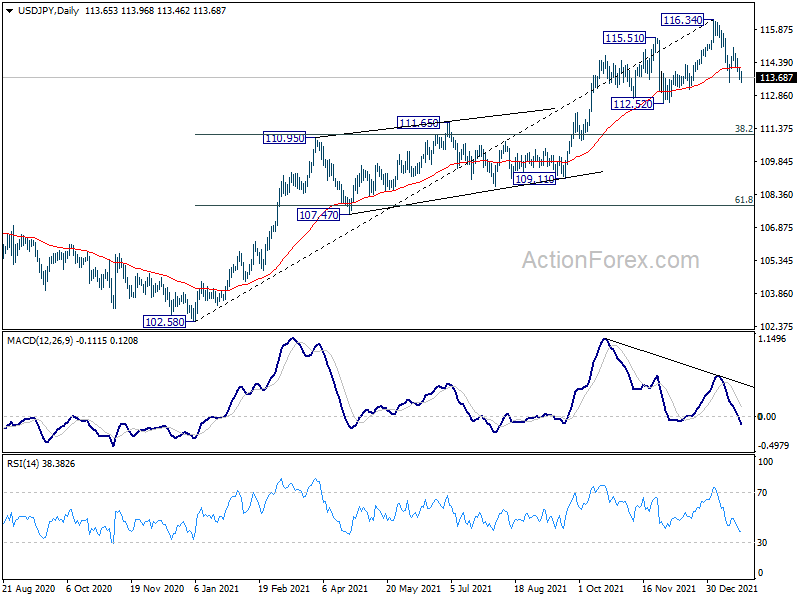
In the bigger picture, no change in the view that rise from 102.58 is the third leg of the up trend from 101.18 (2020 low). Such rally should target a test on 118.65 (2016 high). Sustained break there will pave the way to 120.85 (2015 high) and raise the chance of long term up trend resumption. This will remain the favored case as long as 55 week EMA (now at 110.91) holds.
USD/CAD Mid-Day Outlook
Daily Pivots: (S1) 1.2527; (P) 1.2558; (R1) 1.2616; More...
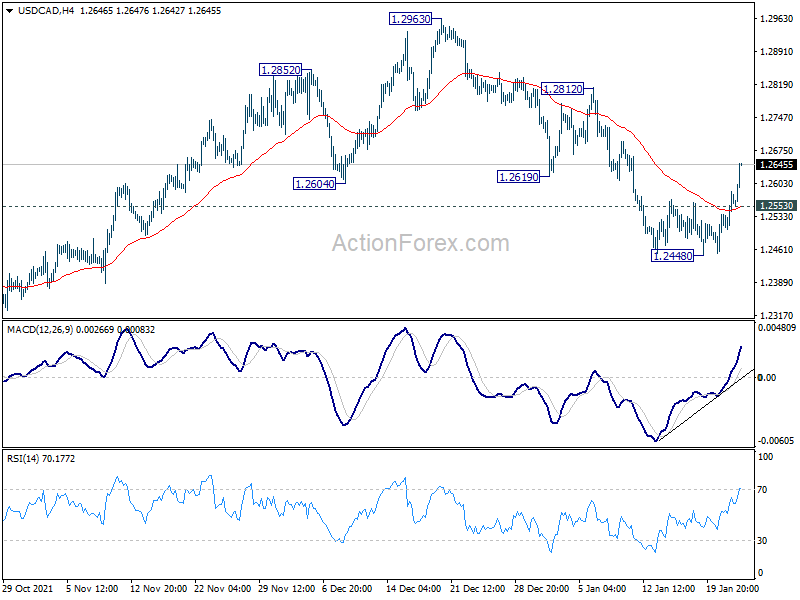
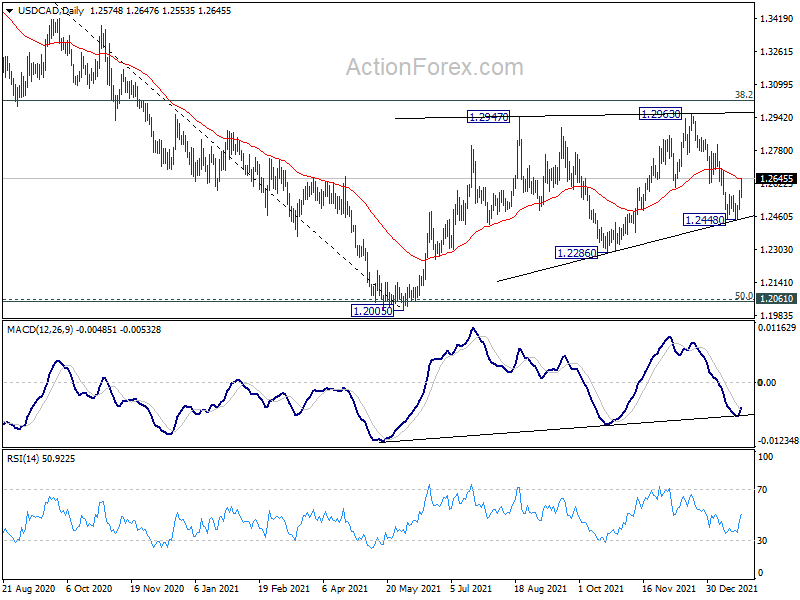
USD/CAD's rebound from 1.2448 extends higher today. Break of 1.2619 support argues that pull back from 1.2963 has completed with three waves down to 1.2448. Intraday bias stays on the upside for 1.2812 resistance first, and then 1.2963. On the downside, below 1.2553 minor support will mix up the near term outlook and turn intraday bias neutral.
In the bigger picture, focus stays on 38.2% retracement of 1.4667 (2020 high) to 1.2005 (2021 low) at 1.3022. Sustained break there should confirm that the down trend from 1.4667 has completed after defending 1.2061 long term cluster support. Further rise would then be seen towards 61.8% retracement at 1.3650. However, rejection by 1.3022 will maintain medium term bearishness. Break of 1.2005 will resume the down trend form 1.4667 and that carries larger bearish implications too.
US Stocks Remain Pressured Amid Rising Geopolitical Risks
Geopolitical tensions drive safe-haven demand
Fears of an imminent Russian-Ukrainian conflict rattled the markets on Monday after both the US and the UK have reportedly started to withdraw families from their embassies in Kiev. The increasing geopolitical tensions are driving the current risk-off sentiment, sending investors to seek refuge into the safety of gold and US Treasury bonds, with the yield of the 10-year benchmark moving lower on Monday.
Omicron weighs on Eurozone and UK growth
Eurozone’s services flash PMI reading for January slumped to a nine-month low amid ongoing covid-19 restrictions. On the bright side, the slight easing of supply chain disruptions has helped to bolster manufacturing activity in the currency union. Similarly, the consumer facing business activity in the UK has witnessed a significant slowdown due to the surging Omicron cases, with manufacturers also reporting further weakening in order book growth.
In the FX arena, the US dollar inched higher against a basket of currencies as investors braced for the upcoming FOMC meeting. Meanwhile, the euro and the British pound have witnessed significant losses against the greenback on Monday. However, the worst performer so far has been the Australian dollar, which slipped versus all of its major peers after the large flash PMI miss for January, attributed to ongoing pandemic-related restrictions distorting business activity.
US stocks to extend their decline
In Friday's trading session, the rout in US equities deepened as investors weighed corporate earnings results and geopolitical tensions in Eastern Europe. The S&P 500 and Nasdaq Composite fell by 1.9% and 2.7% respectively, logging their worst weekly drawdowns since March 2020. Defensive stocks such as utilities emerged as the undisputed winners over the past week as investors remain jittery about elevated valuations and the prospects of tighter monetary policy. Looking ahead, with pandemic darlings such as Netflix calling for slower future growth, the rotation towards value-oriented names is expected to persist.
Futures for the major US indices are pointing to further ‘pain’ on Monday. While the ongoing downturn of US stocks appears to be overextended, considering the recent drop of the 10-year benchmark yield from its recent highs, the current tensions in the Russian-Ukrainian border are buoying risk-off sentiment in the markets. Likewise, in Europe, the Stoxx 600 index is in negative territory, while Hong Kong’s Hang Seng index closed 1.24% lower after the region reported its highest covid-19 cases in the past 18 months, diminishing the chances for further economic reopening.
Meanwhile, oil inched lower at the time of writing despite the supply disruption fears amid the rising tensions in the Middle East between the UAE and Yemen’s Houthis which could make an already tight market even tighter at a period where OPEC is still struggling to raise output.
AUD/USD Mid-Day Report
Daily Pivots: (S1) 0.7155; (P) 0.7193; (R1) 0.7213; More...
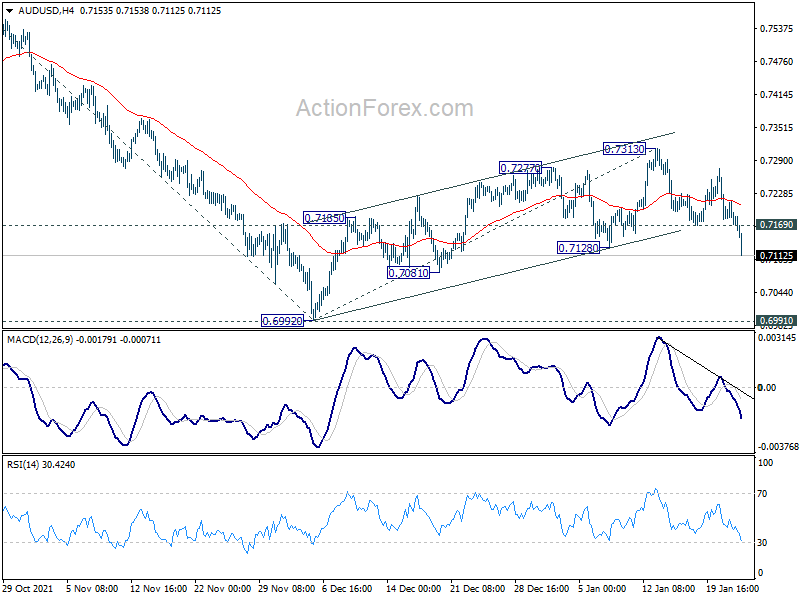
AUD/USD's break of 0.7128 support dampens our original bullish view and indicates that corrective rebound from 0.6992 has completed at 0.7313. Intraday bias is back on the downside for retesting 0.6991/2 support zone. Further break there will resume larger down trend from 0.8006, and carries larger bearish implication. Next target will be 100% projection of 0.7555 to 0.6992 from 0.7313 at 0.6750. For now, risk will stay on the downside as long as 0.7313 resistance holds, in case of recovery.
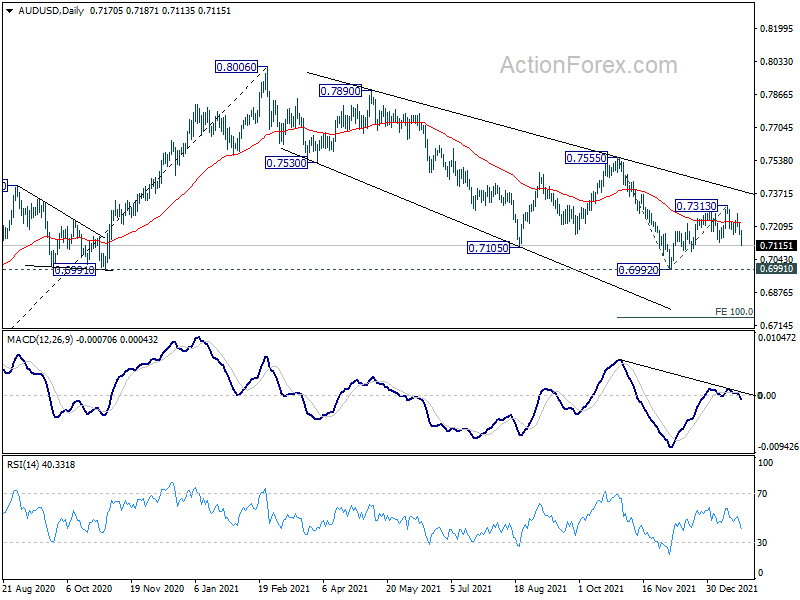
In the bigger picture, strong rebound from 0.6991 key structural support will retain medium term bullishness. That is, whole up trend from 0.5506 is still in progress. Firm break of 0.7555 resistance will target 0.8006 high and above. However, sustained break of 0.6991 will argue that the whole up trend from 0.5506 might be finished at 0.8006, after rejection by 0.8135 long term resistance. Deeper decline would then be seen back to 61.8% retracement of 0.5506 to 0.8006 at 0.6461.
Swiss Franc, Dollar and Yen on Risk Aversion as Ukraine Tensions Escalate
Swiss Franc, Dollar and Yen rise strongly today on risk-off sentiment as geopolitical tensions around Ukraine escalate. Aussie is currently the worst performing one, followed by Sterling and then Kiwi. Euro and Canadian are mixed. In the back ground, markets are also preparing for some hawkish comments from Fed later in the week to set the stage for the start of rate hike cycle in March. In other markets, cryptocurrencies are extending recent free fall. Silver weakens notably but Gold is steady. Oil is extending range trading.
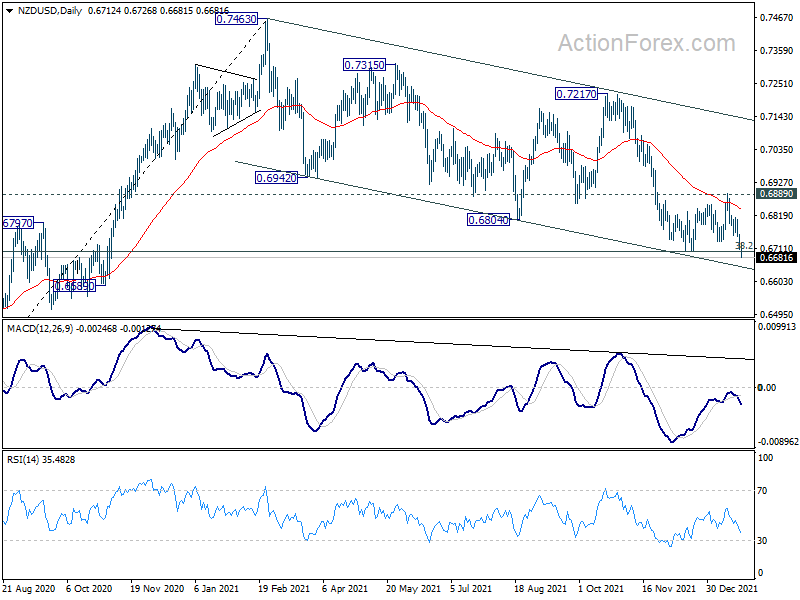
Technically, AUD/USD's break of 0.7128 support suggests that recent choppy rebound from 0.6992 has completed at 0.7313. USD/CAD 's break of 1.2619 also indicate that fall from 1.2963 has completed at 1.2588. Even worse, NZD/USD has already resumed the choppy fall from 0.7463. It looks like sentiment will only get worse before getting better.
In Europe, at the time of writing, FTSE is down -1.37%. DAX is down -2.16%. CAC is down -2.16%. Germany 10-year yield is down -0.025 at -0.089. Earlier in Asia, Nikkei rose 0.24%. Hong Kong HSI dropped -1.24%. China Shanghai SSE rose 0.04%. Singapore Strait Times dropped -0.35%. Japan 10-year JGB yield rose 0.0027 to 0.139.
UK PMIs: Consumer facing businesses hit hard, but others encouragingly robust
UK PMI manufacturing dropped form 57.9 to 56.9 in January, below expectation of 57.9. PMI Services ticked down from 53.6 to 53.3, well below expectation of 55.0. PMI Composite dropped from 53.6 to 53.4. All three indexes were at their 11-month low.
Chris Williamson, Chief Business Economist at IHS Markit, said: "A resilient rate of economic growth in the UK during January masks wide variations across different sectors. Consumer-facing businesses have been hit hard by Omicron and manufactures have reported a further worrying weakening of order book growth, but other business sectors have remained encouragingly robust."
Eurozone PMI composite dropped to 11-mth low at 52.4
Eurozone PMI Manufacturing rose from 58.0 to 59.0 in January, above expectation of 57.5, a 5-month high. PMI Services dropped from 53.1 to 51.2, below expectation of 52.2, 1 9-month low. PMI Composite dropped from 53.3 to 52.4, a 11-month low.
Chris Williamson, Chief Business Economist at IHS Markit said: "The Omicron wave has led to yet another steep drop in spending on many consumer-facing services at the start of the year, with tourism, travel and recreation especially hard hit. However, so far the overall impact on the wider economy appears relatively muted, and most encouraging is the further easing of manufacturing supply chain delays despite the renewed virus wave. Not only has the alleviating supply crunch helped factories boost production, but cost pressures in manufacturing have also moderated.
Germany PMI composite jumped to 54.3, surprisingly resilient performance
Germany PMI Manufacturing rose from 57.4 to 60.5 in January, above expectation of 57.0, a 5-month high. PMI Services also rose from 48.7 to 52.2, above expectation of 48.0. PMI Composite rose form 49.9 to 54.3, a 4-month high.
Phil Smith, Economics Associate Director, at IHS Markit said: "January's flash PMI numbers came in comfortably above consensus to show a surprisingly resilient performance from the German economy at the start of the year... Manufacturing is expected to stage a recovery in 2022 as supply bottlenecks ease... January's services numbers, showing activity recovering slightly after the decline at the end of last year, were another positive surprise... Still, rising costs remain a concern for businesses, with the survey data showing that input prices are continuing to rise sharply and on multiple fronts."
Bundesbank: Germany inflation to remain extraordinarily high at 2022 beginning
Bundesbank said in the monthly report that real GDP grew by 2.7% in 2021, not enough to compensate the -4.50% contraction in 2020. It added, "setbacks caused by the pandemic and bottlenecks on the supply side dampened the recovery in the past year."
Overall, prices was at an above-average rate of 3.2% in 2021. The factors driving up inflation are "also having an effect into the new year." Bundesbank added, "the rate at the beginning of 2022 is likely to remain extraordinarily high....In addition, due to the significant rise in market quotations for natural gas, the corresponding end customer tariffs will be raised significantly."
France PMI composite dropped to 52.7, a 9-month low
France PMI Manufacturing ticked down from 55.6 to 55.5 in January, matched expectations. PMI Services dropped notably from 57.0 to 53.1, below expectation of 55.3, a 9-month low. PMI Composite dropped from 55.8 to 52.7, a 9-month low too.
Joe Hayes, Senior Economist at IHS Markit said: "Given the surging number of daily COVID-19 cases we've seen in France, it's no surprise to see softer PMI numbers in January.... Supply chain issues continue to impact the economy, particularly manufacturers, but we do appear to have seen the worst as delivery times lengthened to a far weaker extent than seen during much of 2021. That being said, the inflationary side effects remain in play and are being exacerbated by rising staff costs and energy prices."
Japan PMI manufacturing ticked up to 54.6, services tumbled to 46.6
Japan PMI Manufacturing ticked up from 54.3 to 54.6 in January, below expectation of 55.0. PMI Services dropped sharply from 52.1 to 46.6. PMI Composite also dropped from 52.5 to 48.8.
Usamah Bhatti, Economist at IHS Markit, said: "Flash PMI data indicated that activity at Japanese private sector businesses dipped into contraction territory for the first time in four months at the start of 2022. The pace of decline was modest, and led by the sharpest fall in services activity since August, while manufacturers commented on a slight quickening in output growth."
Australia PMI composite dropped to 45.3, slipped from strong recovery to contraction
Australia PMI Manufacturing dropped from 57.7 to 55.3 in January. PMI Services tumbled sharply from 55.1 to 45.0. PMI Composite also dropped from 54.9 to 45.3, first contraction follow three months of growth. All are at their 5-month low.
Jingyi Pan, Economics Associate Director at IHS Markit, said: "The Australian economy had slipped from a state of strong recovery in end-2021 to being affected by the surge in COVID-19 infections at the start of 2022... Supply issues meanwhile remained prevalent... This had led to input price inflation worsening Employment levels were unchanged."
AUD/USD Mid-Day Report
Daily Pivots: (S1) 0.7155; (P) 0.7193; (R1) 0.7213; More...
AUD/USD's break of 0.7128 support dampens our original bullish view and indicates that corrective rebound from 0.6992 has completed at 0.7313. Intraday bias is back on the downside for retesting 0.6991/2 support zone. Further break there will resume larger down trend from 0.8006, and carries larger bearish implication. Next target will be 100% projection of 0.7555 to 0.6992 from 0.7313 at 0.6750. For now, risk will stay on the downside as long as 0.7313 resistance holds, in case of recovery.
In the bigger picture, strong rebound from 0.6991 key structural support will retain medium term bullishness. That is, whole up trend from 0.5506 is still in progress. Firm break of 0.7555 resistance will target 0.8006 high and above. However, sustained break of 0.6991 will argue that the whole up trend from 0.5506 might be finished at 0.8006, after rejection by 0.8135 long term resistance. Deeper decline would then be seen back to 61.8% retracement of 0.5506 to 0.8006 at 0.6461.
Economic Indicators Update
| GMT | Ccy | Events | Actual | Forecast | Previous | Revised |
|---|---|---|---|---|---|---|
| 22:00 | AUD | Manufacturing PMI Jan P | 55.3 | 57.7 | ||
| 22:00 | AUD | Services PMI Jan P | 45 | 55.1 | ||
| 00:30 | JPY | Manufacturing PMI Jan P | 54.6 | 55 | 54.3 | |
| 08:15 | EUR | France Manufacturing PMI Jan P | 55.5 | 55.5 | 55.6 | |
| 08:15 | EUR | France Services PMI Jan P | 53.1 | 55.3 | 57 | |
| 08:30 | EUR | Germany Manufacturing PMI Jan P | 60.5 | 57 | 57.4 | |
| 08:30 | EUR | Germany Services PMI Jan P | 52.2 | 48 | 48.7 | |
| 09:00 | EUR | Eurozone Manufacturing PMI Jan P | 59 | 57.5 | 58 | |
| 09:00 | EUR | Eurozone Services PMI Jan P | 51.2 | 52.2 | 53.1 | |
| 09:30 | GBP | Manufacturing PMI Jan P | 56.9 | 57.9 | 57.9 | |
| 09:30 | GBP | Services PMI Jan P | 53.3 | 55 | 53.6 | |
| 14:45 | USD | Manufacturing PMI Jan P | 56.8 | 57.7 | ||
| 14:45 | USD | Services PMI Jan P | 55 | 57.6 |
Japanese Yen at 5-Week High
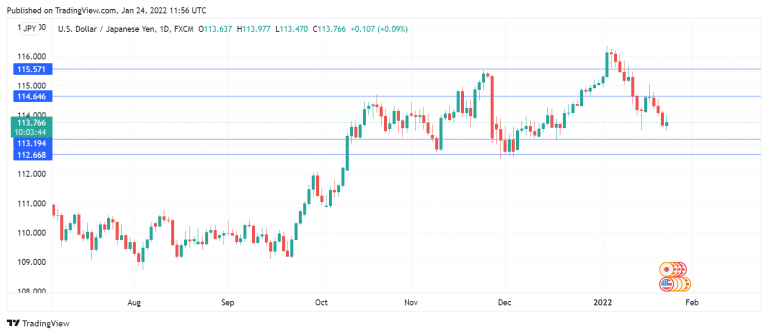
After gaining ground over three straight sessions, the Japanese yen has paused on Monday, as it trades around 113.80.
Markets eye BoJ inflation gauge
Inflation indicators continue to garner attention in Japan, which is showing inflationary pressures after years of deflation. December core CPI climbed 0.5% y/y, just shy of the 0.6% forecast. Inflation is being driven by higher fuel costs and a weak yen, but a 53% reduction in mobile phone fees in December curbed the CPI gain. If the mobile phone fees are taken out of the equation, core CPI rose close to 2%, which is the BoJ’s inflation target. On Tuesday, Japan releases BoJ Core CPI, the bank’s preferred inflation indicator.
The central bank is following closely the rise in inflation, with the BoJ minutes from the December meeting indicating that members discussed the increase in CPI due to the rise in producer prices. The uptrend is inflation is a new development in Japan, but the bank is unlikely to shift away from its ultra-accommodative policy or raise rates anytime soon. BoJ Governor Haruhiko Kuroda has said that a rise in inflation that does not include higher wage growth is not sustainable, which sounds very much like the ‘transient inflation’ phrase that Fed Chair Jerome Powell was using until recently.
It’s a busy economic calendar in the US, highlighted by the FOMC meeting on Wednesday. With inflation running at its highest level in almost 40 years, the Fed is under pressure to raise rates and the markets have priced in a 70% likelihood a rate hike in March. The Fed will likely signal that a rate hike is imminent, and the markets have priced in four rate hikes this year. Goldman Sachs sent out a note on Saturday saying that its baseline forecast stands at four hikes, but the surge in inflation could push the Fed to respond with even more rate hikes this year.
There has also been some speculation that the Fed might depart from incremental hikes of 0.25% and announce a 0.50% rise in rates. This would provide a ‘double punch’ of curbing inflation and sending the markets a strong message in order to restore credibility, which has taken a hit from some market participants that feel that the Fed has been too slow in its response to surging inflation.
USD/JPY Technical
- There is resistance at 115.54, followed by 116.88
- There is support at 113.18 and 112.16
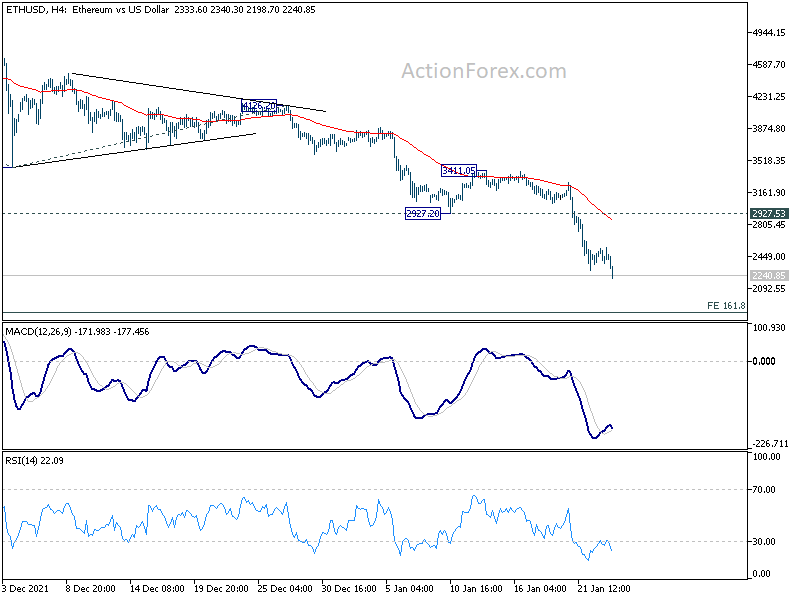
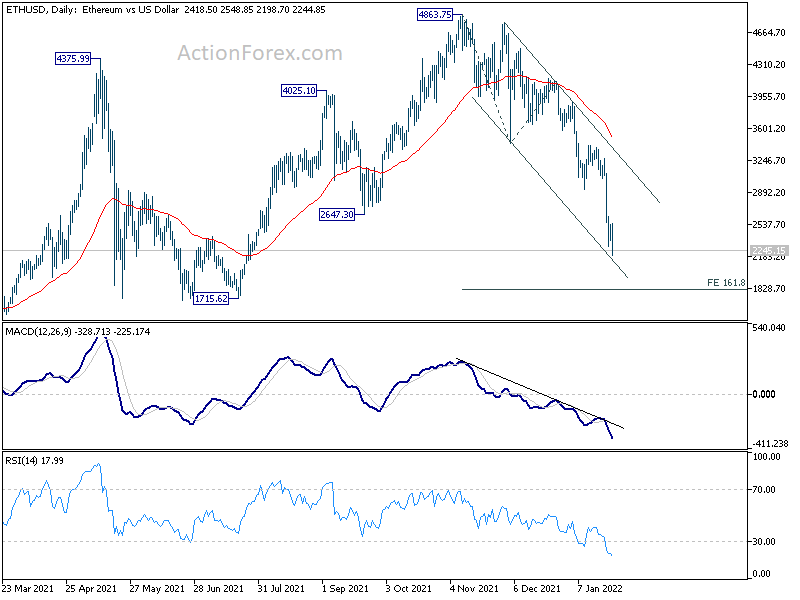
Ethereum heading to 2k, Bitcoin to 30k
The massacre of cryptocurrencies continues today as Ethereum resumes recent steep fall and hit as low as 2198.70 so far. The fall from 4863.75 is still in progress to 161.8% projection 4863.75 to 3439.00 from 4126.20 at 1820.95, which is below 2000 and above 1715.62 low. Considering deeply oversold condition in daily RSI, some support should be seen below 2000 to bring an overdue rebound. But in any case, break of 2927.20 support turned resistance is needed to indicate bottoming. Otherwise, risk will still stay on the downside.
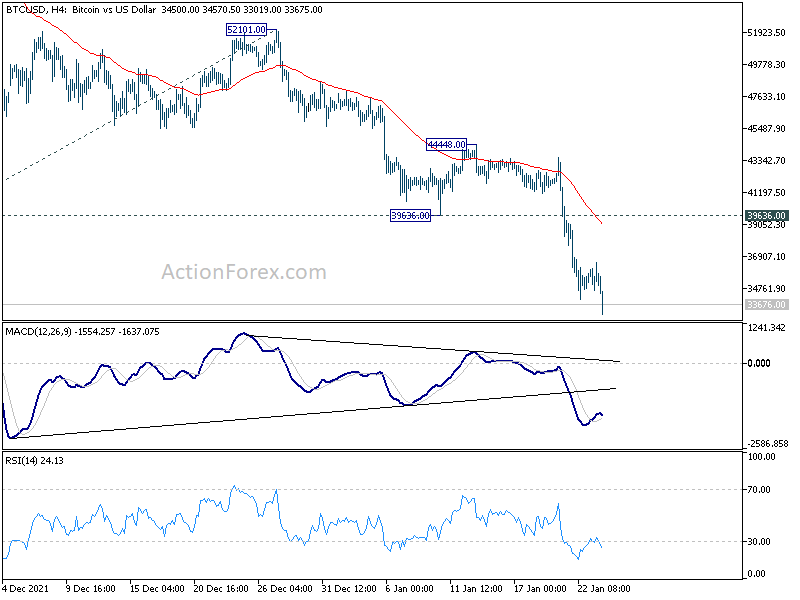
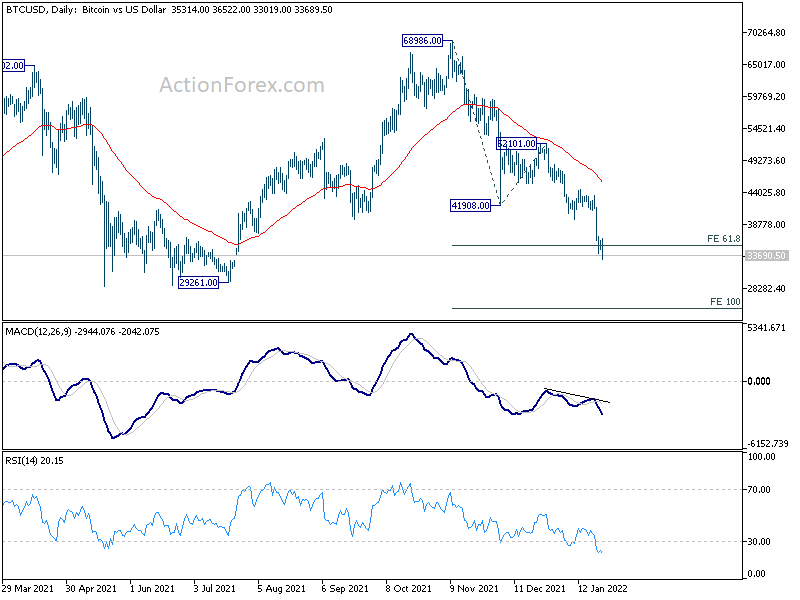
Bitcoin also drops to as low as 33019 so far. Daily RSI is deeply oversold while BTC is close to 29261 support. There should be signs of bottoming ahead. But still, break of 39636 support turned resistance is needed to indicate bottoming, or risk will stay heavily on the downside. The more bearish scenario is not favored yet, but bitcoin could extend the down trend from 68986 to 100% projection at 25023 if it couldn't defend 30k handle.
Sterling on verge of breakdown: EUR/GBP, GBP/USD, GBP/CHF
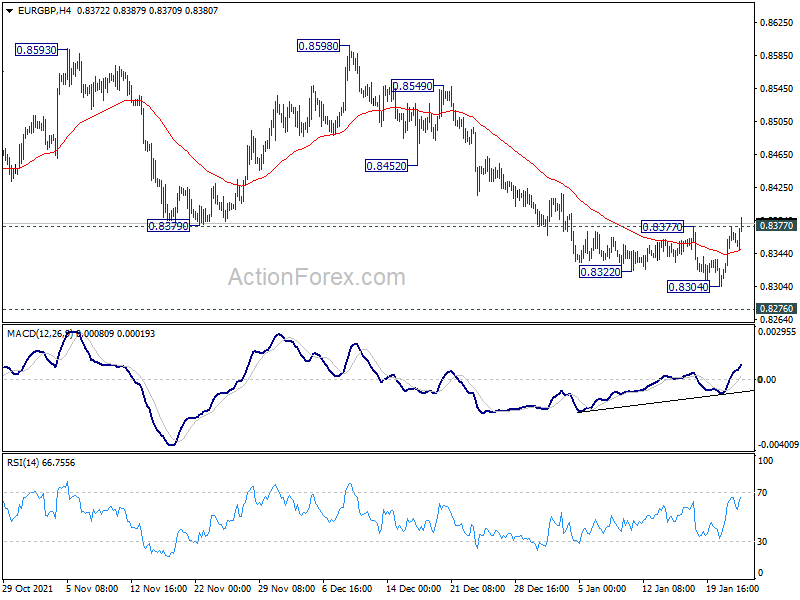
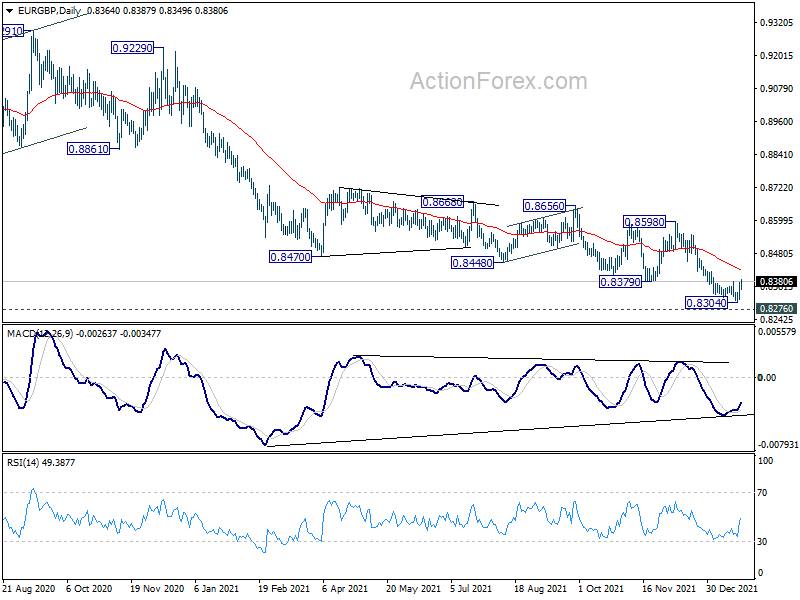
Sterling is on the verge of breaking down as risk-off sentiment intensifies into European session. EUR/GBP's break of 0.8377 resistance now suggests that a short term bottom is formed at 0.8304 on bullish convergence condition in 4 hour MACD, just ahead of a key long term support level 0.8276 (2019 low). It's way too early say that EUR/GBP is staging a bullish trend reversal. But at least, there is room for more rise back to 55 day EMA (now at 0.8423).
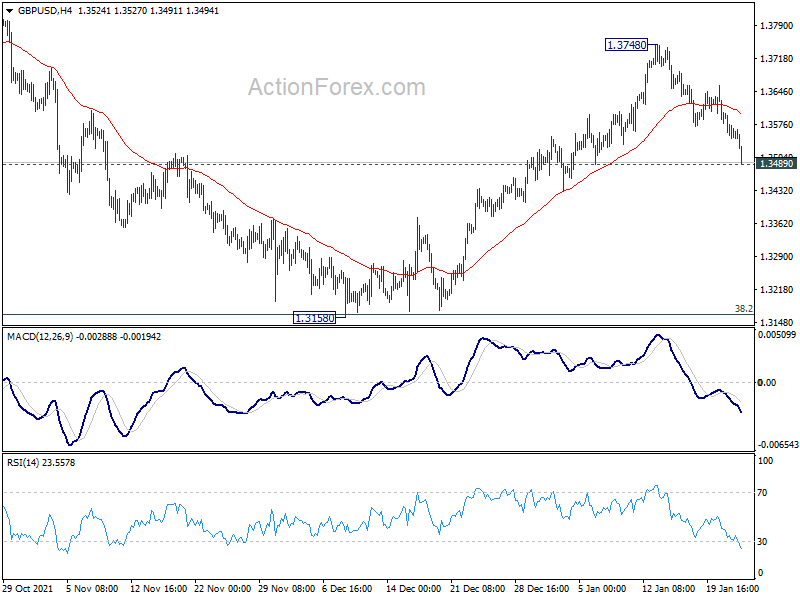
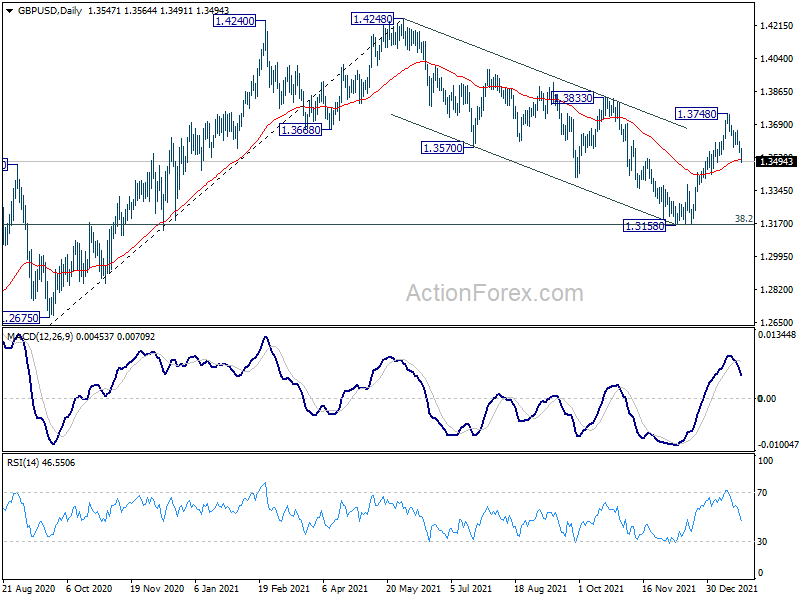
GBP/USD's fall from 1.3748 accelerates down today. Break of 1.3489 support, and sustained trading below 55 day EMA (now at 1.3504) will indicate that rebound from 1.358 has completed at 1.3748. That would also argue that whole decline from 1.4248 is not complete. Or at least, GBP/USD could extend lower to have a retest on 1.3158 low.
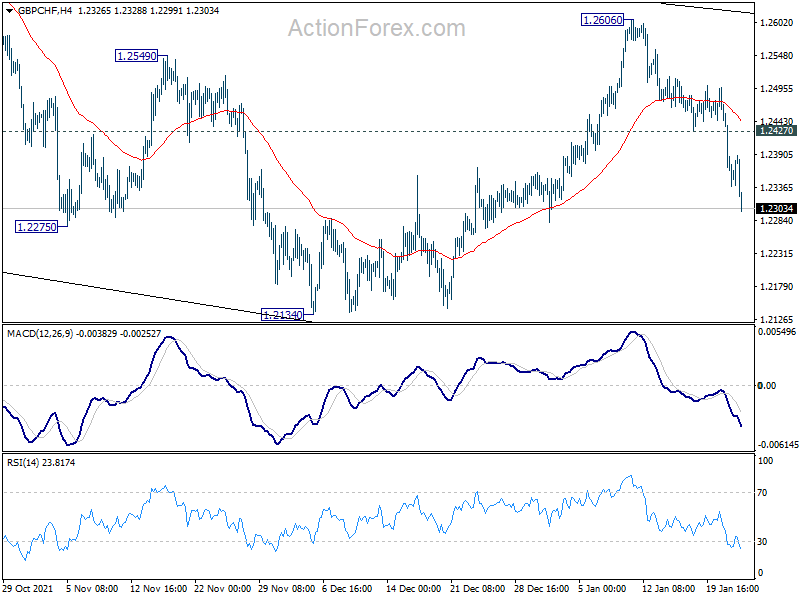
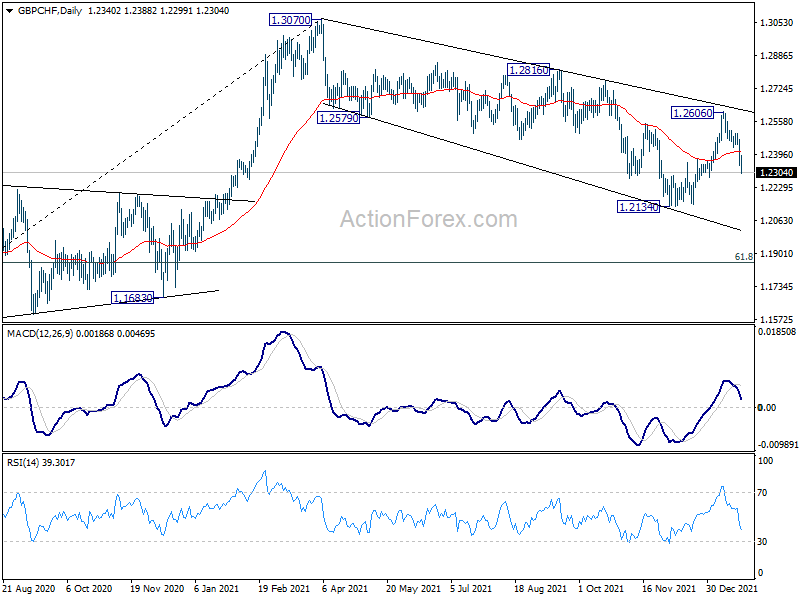
GBP/CHF is also accelerating downwards. Fall from 1.2606 is seen as a falling leg in the whole pattern from 1.3070. Deeper decline is expected as long as 1.2427 support turned resistance holds. GBP/CHF should be heading to 1.2134 support and beyond.
Bundesbank: Germany inflation to remain extraordinarily high at 2022 beginning
Bundesbank said in the monthly report that Germany's real GDP grew by 2.7% in 2021, not enough to compensate the -4.50% contraction in 2020. It added, "setbacks caused by the pandemic and bottlenecks on the supply side dampened the recovery in the past year."
Overall, prices was at an above-average rate of 3.2% in 2021. The factors driving up inflation are "also having an effect into the new year." Bundesbank added, "the rate at the beginning of 2022 is likely to remain extraordinarily high....In addition, due to the significant rise in market quotations for natural gas, the corresponding end customer tariffs will be raised significantly."
Aussie Falls to 2-Week Low
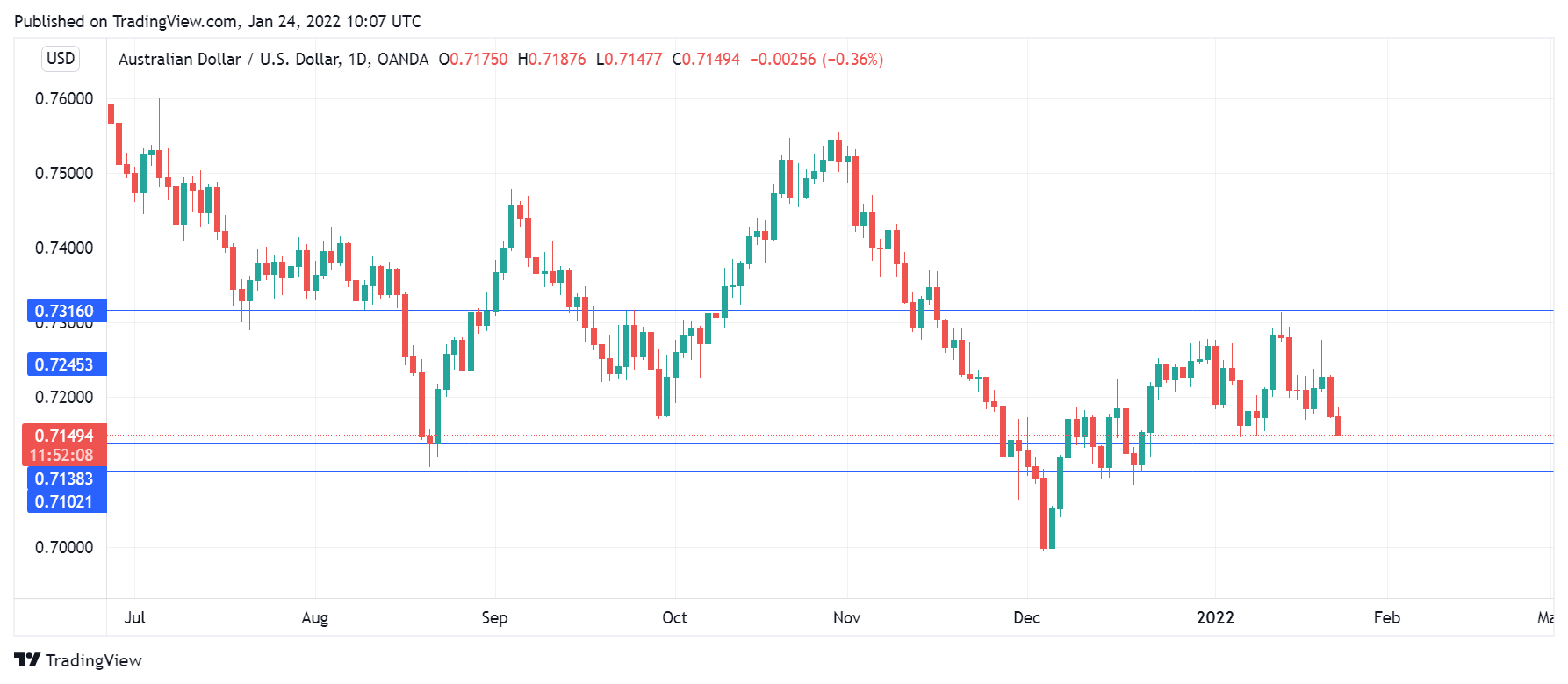
The Australian dollar is in negative territory to start the week. AUD/USD is down about one percent since Thursday as the pair remains under pressure ahead of the Australian CPI release on Tuesday. In the European session, AUD/USD is trading at 0.7147, down 0.38% on the day.
CPI could have RBA implications
It should be an interesting start to the trading week as Australia releases key inflation data in the Tuesday Asian session. Employment data for December was better than expected, as the economy created 64.8 thousand jobs, above the consensus of 4.3.3 thousand. The unemployment rate fell sharply to 4.2%, down from 4.6%. The consensus for CPI for Q4 stands at 1.0%, after a gain of 0.8% in Q3. If this forecast is accurate, inflation would rise to 3.1% YoY, which would be just above the RBA’s target band of 2%-3%.
What are the implications for the RBA? The central bank did not expect unemployment to improve as quickly as it has, and a CPI gain of 1.0% or higher will put further pressure on bank policy makers to consider a rate hike. The markets have priced in a rise in the cash rate later in the year, but RBA Governor Philip Lowe has repeatedly stated that he won’t raise rates until unemployment has fallen to 4% and wage growth rises to 3%. Unemployment is close to that requirement, but wage growth is only at 2.2% and is unlikely to hit 3% until 2023.
It is entirely possible that the RBA is willing to let inflation continue to rise but will hold off on a rate hike until wage growth is at or close to 3%. I would therefore urge caution if Tuesday’s CPI reading is strong – the Australian dollar is likely to rebound, but I would be careful not to get up in any rate hike fever. At the same time, a robust CPI reading could result in the RBA ending its bond-buying scheme at the February meeting.
AUD/USD Technical
- AUD/USD is putting pressure on support at 0.7138. Close by, there is support at 0.7101, protecting the round number of 0.7100
- There is resistance at 0.7245 and 0.7315